Advanced Optimization Algorithms for Pharmaceutical Injection Molding Screw Design: From AI-Driven Simulations to Enhanced Drug Product Performance
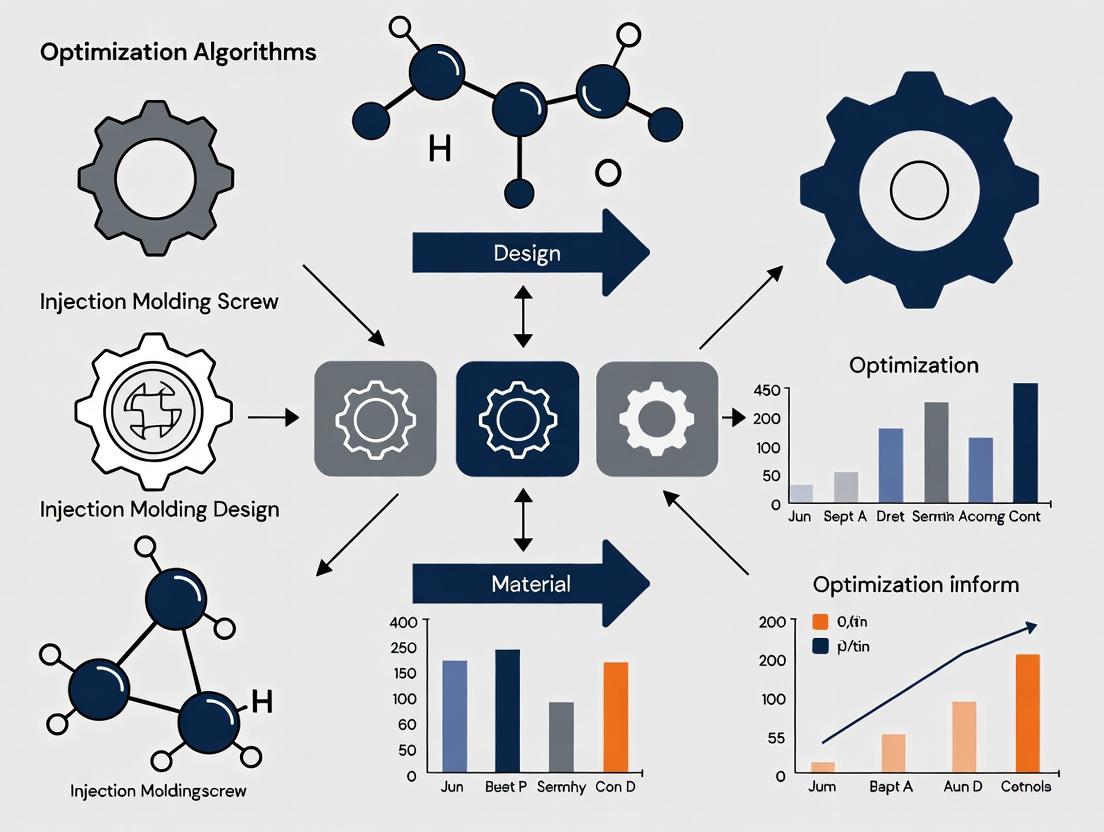
This article provides a comprehensive analysis of modern optimization algorithms applied to injection molding screw design for pharmaceutical manufacturing.
Advanced Optimization Algorithms for Pharmaceutical Injection Molding Screw Design: From AI-Driven Simulations to Enhanced Drug Product Performance
Abstract
This article provides a comprehensive analysis of modern optimization algorithms applied to injection molding screw design for pharmaceutical manufacturing. Targeting researchers and drug development professionals, we explore the foundational principles of screw geometry and melt dynamics, detail methodologies including AI, CFD, and DOE-based optimization, address common troubleshooting scenarios for APIs, and present validation frameworks for comparative performance analysis. The scope bridges computational modeling with practical outcomes for improved product quality, process efficiency, and regulatory compliance in biomedical applications.
The Science of the Screw: Foundational Principles for Pharmaceutical Melt Processing
Within the broader research thesis on Optimization algorithms for injection molding screw design and performance research, the empirical understanding of core screw functions is foundational. The screw is the cardiac component of an injection molding machine, responsible for preparing a homogeneous, thermally stable, and precisely measured polymer-drug melt. For pharmaceutical applications, where product consistency, drug potency, and sterility are paramount, optimizing the screw's performance in plasticization, mixing, and metering directly impacts critical quality attributes (CQAs) of the final drug product, such as content uniformity and dissolution rate. This document provides detailed application notes and experimental protocols for characterizing these functions, generating data essential for training and validating predictive screw design algorithms.
Core Functions: Detailed Application Notes
Plasticization (Melting)
The plasticization function, primarily occurring in the compression zone of the screw, involves the gradual softening, melting, and heating of the solid polymer feedstock (often containing API and excipients) into a uniform viscoelastic melt. The optimization goal is complete, homogeneous melting with minimal thermal degradation.
Key Parameters & Quantitative Data: Recent industry studies (2023-2024) highlight the following performance metrics for pharmaceutical-grade polymers like PEEK, COP, and PLA used in drug delivery devices and primary packaging.
Table 1: Quantitative Data for Plasticization Performance
| Parameter | Typical Target Range (Pharma) | Measurement Method | Impact on CQAs |
|---|---|---|---|
| Melt Temperature Uniformity | ±1.5°C to ±2.5°C | IR Pyrometry / Melt Thermocouple | Degradation, Crystallinity |
| Melting Rate | 15-40 g/s (machine dependent) | Screw Position vs. Time | Cycle Time, Throughput |
| Shear Energy Input | 0.25 - 0.40 kW-hr/kg | Torque & RPM Calculation | Polymer Degradation |
| Residual Solid Bed Fraction (EoM) | < 2% | Screw Pull Experiment | Homogeneity, Defects |
Mixing (Homogenization)
Mixing ensures the uniform distribution of active pharmaceutical ingredients (APIs), colorants, and stabilizers within the polymer melt. This is critical for dose accuracy in molded drug components. Mixing occurs both dispersively (breaking agglomerates) and distributively (spreading components) via shear and elongational flow, often enhanced by specialized mixing elements (e.g., Maddock, pineapple).
Key Parameters & Quantitative Data: Table 2: Quantitative Data for Mixing Performance
| Parameter | Typical Target (Pharma) | Measurement Method | Impact on CQAs |
|---|---|---|---|
| Coefficient of Variation (CV) for API | ≤ 3.0% | HPLC on sectioned parts | Content Uniformity |
| Dispersive Mixing Efficiency | > 95% agglomerate breakup | Image Analysis of Masterbatch | Potency, Dissolution |
| Distributive Mixing Scale of Segregation | < 100 µm | Micro-CT / SEM-EDS | Drug Release Profile |
| Mixing Length (L/D) | 4 - 7 L/D (mixing section) | Screw Design Specification | Pressure Drop, Shear |
Metering (Pumping)
The metering function, in the final (metering) zone of the screw, generates a consistent and precise volumetric discharge of melt into the mold. It must maintain stable pressure and temperature to ensure shot-to-shot reproducibility, crucial for part weight and dimensional tolerances of medical devices.
Key Parameters & Quantitative Data: Table 3: Quantitative Data for Metering Performance
| Parameter | Typical Target (Pharma) | Measurement Method | Impact on CQAs |
|---|---|---|---|
| Shot Weight Consistency | CV < 0.5% | Precision Weighing | Dosage Accuracy |
| Pressure Stability | Fluctuation < ±0.5% | Melt Pressure Transducer | Part Density, Dimensions |
| Pumping Efficiency (Q/N) | Varies by polymer | Volumetric Output vs. RPM | Throughput, Recovery |
| Backflow Coefficient | As low as possible | Pressure-Drop Experiment | Melt Temperature Rise |
Experimental Protocols
Protocol 3.1: Screw Pull Experiment for Melting Profile Analysis
Objective: To quantitatively assess the completeness of plasticization along the screw length. Materials: See "The Scientist's Toolkit" (Section 4.0). Methodology:
- Setup & Purge: Install the test screw and barrel. Purge with pure polymer until system is clean.
- Process Stabilization: Set processing parameters (T¯rel, RPM, back pressure). Run for 20 shots to achieve steady state.
- Emergency Stop & Cool: After the next shot is prepared (screw at transfer position), activate the emergency stop. Immediately circulate cooling oil through the barrel to freeze the polymer in situ.
- Screw Extraction: Disassemble the barrel and carefully extract the screw with the solidified polymer residue.
- Sample Sectioning: Using a band saw, longitudinally section the polymer bed. Then, transversely section at every 1 L/D (Length/Diameter) ratio along the screw.
- Analysis: Visually and via image analysis software, measure the residual solid bed width at each section. Calculate the solid bed profile and the Residual Solid Bed Fraction at End-of-Melt (EoM).
Diagram 1: Screw Pull Experiment Workflow
Protocol 3.2: Colorimetric Method for Distributive Mixing Evaluation
Objective: To quantify the distributive mixing homogeneity of a tracer within the polymer melt. Materials: See "The Scientist's Toolkit" (Section 4.0). Methodology:
- Masterbatch Preparation: Create a 1% w/w concentrated color masterbatch with the base polymer.
- Dry-Blending: Dry-blend 99 parts pure polymer with 1 part color masterbatch to create a 100 ppm final concentration feedstock.
- Injection & Sampling: Process the feedstock. Collect molded parts or purged melt strands.
- Sample Preparation: Microtome thin sections (50-100 µm) from multiple locations of the part/strand.
- Image Acquisition: Use a reflected light microscope with digital camera to capture high-resolution images of each section under consistent lighting.
- Image Analysis: Using software (e.g., ImageJ), convert images to grayscale. Calculate the standard deviation of pixel intensity across the image. A lower standard deviation indicates better distributive mixing.
Diagram 2: Colorimetric Mixing Analysis Workflow
Protocol 3.3: Shot Weight Consistency & Pressure Profile Analysis
Objective: To measure the metering stability and reproducibility of the screw. Materials: See "The Scientist's Toolkit" (Section 4.0). Methodology:
- Instrument Calibration: Calibrate the nozzle melt pressure transducer and screw position encoder.
- Data Acquisition Setup: Connect sensors to a high-speed data acquisition (DAQ) system. Set sampling rate to ≥100 Hz.
- Steady-State Run: Run the molding process for 30 consecutive cycles under fixed parameters.
- Data Recording: For each cycle, record the peak injection pressure, pressure at transfer (V/P switchover), cushion size, and final screw position.
- Part Weighing: Weigh each of the 30 molded parts on a precision analytical balance.
- Statistical Analysis: Calculate the mean, range, and coefficient of variation (CV) for shot weight and pressure parameters. Plot pressure vs. screw position profiles for all cycles to visualize consistency.
The Scientist's Toolkit: Research Reagent Solutions & Essential Materials
Table 4: Essential Materials for Screw Performance Experiments
| Item Name | Function/Application | Example/Specification |
|---|---|---|
| Pharmaceutical-Grade Polymer | Base material for testing (e.g., PLA, PEEK, COP). | USP Class VI certified, pre-dried. |
| API Surrogate/Tracer | Simulates active ingredient for mixing studies. | Non-reactive colorant (e.g., TiO2), fluorescent pigment. |
| High-Speed Data Acquisition (DAQ) System | Captures real-time process dynamics (pressure, position). | >100 Hz sampling, 4+ channels. |
| Melt Pressure Transducer | Measures real-time pressure at nozzle or barrel. | Piezoelectric, range 0-2500 bar. |
| Non-Contact Infrared Pyrometer | Measures melt temperature without disturbance. | Spectral response 8-14 µm, fast response. |
| Precision Analytical Balance | Weighs shot parts for metering consistency. | 0.1 mg readability. |
| Microtome | Prepares thin sections of molded parts for microscopy. | Capable of 50 µm sections. |
| Digital Microscope with Camera | Captures images for mixing homogeneity analysis. | 5+ MP sensor, consistent LED ring light. |
| Image Analysis Software | Quantifies mixing from digital images. | ImageJ, MATLAB, or commercial packages. |
Within the broader thesis on Optimization algorithms for injection molding screw design and performance research, this application note delineates the critical geometric parameters of the plasticating screw. For researchers and drug development professionals, precise control over these parameters is paramount for ensuring consistent melt quality, uniform temperature, and optimal dispersion of active pharmaceutical ingredients (APIs) and excipients. The integration of algorithmic optimization seeks to define the interdependencies between Channel Depth, Pitch, L/D Ratio, and Flight Design to predict and enhance process outcomes.
Parameter Definitions & Functional Impact
Channel Depth (H): The radial distance from the screw root to the barrel wall. It directly influences shear rate, melt temperature, and residence time. Pitch (P): The axial distance between corresponding points on consecutive flights, typically equal to the screw diameter (D) for a square-pitch screw. Governs the conveying efficiency and solids transport. Length-to-Diameter Ratio (L/D): The total flighted length of the screw divided by its nominal diameter. A critical determinant of total residence time and the degree of plastication, mixing, and homogenization. Flight Design: Includes flight width, flight clearance, and potential mixing elements. It dictates melt pumping efficiency, shear history, and leakage flow.
Table 1: Typical Parameter Ranges for Pharmaceutical Injection Molding
| Parameter | Symbol | Typical Range (General) | Notes for Pharma/Bio Applications |
|---|---|---|---|
| Channel Depth (Feed) | H_f | 0.10D - 0.15D | Shallower depths may be used for heat-sensitive polymers/APIs. |
| Channel Depth (Metering) | H_m | 0.05D - 0.08D | Critical for final melt temperature control. |
| Compression Ratio | CR = Hf / Hm | 1.5 - 3.0 | Lower ratios (1.5-2.0) reduce shear for sensitive materials. |
| Pitch | P | 0.8D - 1.2D | Often 1.0D (square pitch). Modifications alter conveying angle. |
| L/D Ratio | L/D | 20:1 - 28:1 | Higher ratios (24:1+) allow gentler melting profiles and more mixing zones. |
| Flight Width (radial) | e | 0.08D - 0.12D | Affects channel volume and shear exposure. |
| Flight Clearance | δ | 0.0005D - 0.002D | Minimized to prevent stagnation but must avoid barrel damage. |
Table 2: Algorithmic Optimization Input/Output Variables
| Input Variable (Parameter) | Constraint Bounds | Output (Performance Metric) | Target for Pharma |
|---|---|---|---|
| Hf, Hm, Transition Length | Min/Max Depth | Melt Temperature Uniformity (ΔT) | Minimize ΔT |
| Pitch Profile | 0.8D - 1.2D | Solids Conveying Rate (kg/h) | Stable, predictable rate |
| L/D Ratio | 20 - 28 | Total Shear Strain | Controlled, material-specific |
| Mixing Element Type/Position | Discrete Choices | Mixing Index / API Dispersion | Maximize homogeneity |
| Compression Ratio | 1.5 - 3.0 | Peak Shear Stress | Keep below degradation threshold |
Experimental Protocols for Parameter Validation
Protocol 4.1: Residence Time Distribution (RTD) Analysis Objective: To characterize the distribution of material residence times in the barrel as a function of L/D and channel design. Materials: See Scientist's Toolkit (Section 6). Method:
- Establish stable machine operation with primary polymer.
- Introduce a tracer (e.g., color concentrate) as a pulse input at the hopper throat.
- Collect shot samples at the nozzle at precise, regular time intervals (e.g., every 2 seconds).
- Analyze tracer concentration in each sample via spectrophotometry.
- Plot concentration vs. time to generate the RTD curve (E(t) curve).
- Calculate mean residence time and variance. Repeat for different L/D screws and screw speeds.
Protocol 4.2: Melt Homogeneity Evaluation via Hot-Stage Microscopy Objective: To quantify the dispersion of a simulated API (tracer) as a function of compression ratio and mixing flight design. Method:
- Compound a masterbatch of base polymer with 1% w/w of a fluorescent tracer.
- Process the masterbatch using screws with varying compression ratios and mixing sections.
- Collect multiple melt samples from purgings at the nozzle.
- Prepare thin films of the samples on glass slides.
- Analyze under a fluorescence microscope with digital image analysis.
- Calculate a Mixing Index (MI) based on the coefficient of variation of tracer particle cluster sizes across multiple image fields.
Visualization of Optimization Workflow and Relationships
Title: Injection Molding Screw Optimization Algorithm Workflow
Title: Cause-Effect Relationships of Increasing Channel Depth
The Scientist's Toolkit
Table 3: Essential Research Reagent Solutions & Materials
| Item | Function/Application in Screw Performance Research |
|---|---|
| Calibrated Tracer Particles | Fluorescent or colored pigments used in RTD and mixing studies to visualize flow paths and quantify dispersion. |
| Thermally-Stable Polymer | A well-characterized base resin (e.g., PP, PS) with consistent rheology, used as a control material for comparative screw testing. |
| Degradation-Sensitive Polymer | A polymer that undergoes clear visual or property change upon over-shear (e.g., PVC), used to map high-shear zones. |
| Data Acquisition System | High-frequency sensors for melt pressure and temperature at multiple barrel/screw positions. |
| Capillary Rheometer | Used to characterize the shear viscosity of materials under study, providing essential input data for flow simulations. |
| Screw Pull Study Kit | Equipment for rapid cooling and extraction of the screw with frozen polymer in situ, for visual analysis of melting progression. |
| CFD Software License | Finite Element Analysis (FEA) or specialized screw simulation software for modeling flow, heat transfer, and optimization. |
This application note details experimental protocols for characterizing material-screw interactions in pharmaceutical hot-melt extrusion (HME) and injection molding. The data generated serves as critical input for optimization algorithms—specifically genetic algorithms and gradient-based methods—used in the broader thesis to iteratively refine screw design (e.g., channel depth, compression ratio, mixing element geometry) for optimal thermal homogeneity, dispersion quality, and degradation minimization.
Key Quantitative Data Summaries
Table 1: Typical Shear Viscosity and Thermal Properties of Common HME Polymers
| Polymer/Excipient | Melt Temperature (°C) | Degradation Onset (°C) | Shear Viscosity at 100 s⁻¹ (Pa·s, 150°C) | Specific Heat Capacity (J/g·°C) |
|---|---|---|---|---|
| PVP VA64 | 120-130 | ~170 | 850-1100 | 1.6 |
| HPMCAS-LF | 140-150 | ~190 | 1200-1800 | 1.4 |
| Soluplus | ~70 (Tg) | ~200 | 500-800 | 1.7 |
| Eudragit E PO | ~50 (Tg) | ~180 | 900-1300 | 1.5 |
Table 2: Process-Induced Degradation of Model Heat-Sensitive APIs
| API (Model) | Melting Point (°C) | Maximum Allowable Barrel Temp (°C) | % Degradation after 1 min at 150°C (in PVP VA64) | Critical Shear Stress Threshold (MPa) |
|---|---|---|---|---|
| Ibuprofen | 75-78 | 160 | <0.5% | 0.8 |
| Itraconazole | 166-170 | 180 | ~1.2% | 1.2 |
| Vitamin B12 | >300 (dec.) | 130 | ~8.5% | 0.3 |
Experimental Protocols
Protocol 3.1: In-line Rheometry and Torque Monitoring for Shear Work Calculation
Objective: Quantify the specific mechanical energy (SME) input and apparent viscosity as a function of screw speed and design. Materials: Co-rotating twin-screw extruder (16mm or 20mm), in-line rheological slit die with pressure/temperature sensors, data acquisition system, pre-blended polymer/API mixture (e.g., 20% w/w Itraconazole in Soluplus). Procedure:
- Condition the extruder at set barrel temperatures (e.g., Zones 1-5: 130, 140, 150, 150, 145°C) under a constant feed rate (0.5 kg/h).
- After thermal equilibrium, initiate screw rotation at 100 RPM. Record steady-state torque (T, Nm), screw speed (N, RPM), and pressure drop (ΔP, bar) across the slit die.
- Calculate Apparent Viscosity (ηapp) using the slit die equation: ηapp = (ΔP * h²) / (12 * L * Q), where h is slit height, L is slit length, Q is volumetric flow rate.
- Calculate SME: SME = (2π * N * T) / (mass flow rate). Units: kJ/kg.
- Repeat steps 2-4 for screw speeds of 150, 200, 250, and 300 RPM.
- Repeat entire protocol with a screw featuring a different mixing section (e.g., neutral vs. aggressive kneading blocks).
Protocol 3.2: Residence Time Distribution (RTD) Analysis for Thermal History Mapping
Objective: Characterize the thermal exposure distribution of material within the screw channels. Materials: Twin-screw extruder, UV-stable tracer (0.5% w/w titanium dioxide or riboflavin), UV/VIS spectrophotometer, on-line or off-line detection cell. Procedure:
- Establish steady-state extrusion of the pure polymer matrix (e.g., HPMCAS-LF) at target conditions.
- Rapidly inject a pulse of tracer (1g) into the feed throat. Start timer.
- Collect extrudate samples at the die exit at intervals of 3-5 seconds for a total duration exceeding 3x the expected mean residence time.
- Dissolve samples in suitable solvent and measure tracer concentration via UV/VIS at λ_max.
- Plot normalized concentration (C/C₀) vs. time. Calculate mean residence time (t_mean) and variance (σ²).
- Correlate t_mean and distribution width with screw design variables (L/D ratio, number of mixing elements) and process parameters.
Protocol 3.3: API Stability Assessment via HPLC Post-Processing
Objective: Quantify process-induced chemical degradation of a heat-sensitive API. Materials: Hot-melt extruder, model API (e.g., Vitamin B12), polymer carrier, HPLC system with PDA detector, controlled atmosphere glove box (for sample handling if hygroscopic). Procedure:
- Prepare pre-blends of API (5% w/w) in polymer. Protect from light and moisture.
- Process blends using a screw design with known high-shear zones. Collect extrudate.
- Precisely weigh ~50 mg of ground extrudate, dissolve in 50 mL mobile phase, sonicate for 15 min, and filter (0.45 µm).
- Analyze by HPLC using a validated method. Compare API peak area to a standard curve.
- Identify and quantify degradation peaks. Report % of intact API and % major degradants.
- Perform statistical analysis (e.g., ANOVA) linking degradation levels to measured SME and peak melt temperature from protocol 3.1.
Visualizations
Title: Screw Optimization Feedback Loop
Title: Material-Screw Interaction Pathways
The Scientist's Toolkit: Research Reagent Solutions
Table 3: Essential Materials for Characterizing Material-Screw Interactions
| Item | Function in Experiments | Example/Specification |
|---|---|---|
| Polymer Carriers | Matrix for API dispersion; primary component defining melt rheology. | PVP VA64, HPMCAS, Soluplus, Eudragit E PO. Pharmacopoeial grade. |
| Model Heat-Sensitive APIs | Benchmark compounds to quantify process-induced degradation. | Ibuprofen (low m.p.), Itraconazole (moderate m.p.), Vitamin B12 (high sensitivity). |
| Thermal Stabilizers | Minimize oxidative degradation during high-temperature processing. | Butylated hydroxytoluene (BHT) at 0.1-0.5% w/w. |
| RTD Tracers | Visually or spectroscopically detectable markers for flow history studies. | Titanium dioxide (UV detection), Riboflavin (Fluorescence). Food/pharma grade. |
| In-line Rheometer Die | Provides real-time apparent viscosity data under process conditions. | Slit die with multiple pressure transducers and melt thermocouples. |
| HPLC System with PDA | Quantifies API concentration and identifies degradation products post-extrusion. | C18 column, method validated for API and major degradants. |
| Torque & Pressure Sensors | Integral to extruder for calculating Specific Mechanical Energy (SME). | Calibrated, high-temperature capable. |
Within the broader research thesis on Optimization algorithms for injection molding screw design and performance, these four Key Performance Indicators (KPIs) form the critical, interlinked axes of process evaluation. For pharmaceutical applications, particularly in drug-device combination products, these metrics directly dictate critical quality attributes (CQAs) of the final product, including content uniformity, polymer degradation, and drug stability. Advanced, simulation-driven optimization algorithms rely on precise, experimentally validated data for these metrics to iteratively improve screw geometry (e.g., flight depth, pitch, mixing sections) and process parameters.
Table 1: Target Ranges and Impact of Key Performance Metrics in Pharmaceutical Injection Molding
| Metric | Target Range (Typical) | Measurement Method | Primary Impact on Drug Product | Influence on Screw Design Parameter |
|---|---|---|---|---|
| Melt Homogeneity (Mix. Index) | > 0.95 (Scale 0-1) | Color/Additive Streak Analysis, DSC Crystallinity | Content Uniformity, Dosage Accuracy | Mixing Section Design (Barrier, Pins), L/D Ratio |
| Shear Rate | 100 - 10,000 s⁻¹ | Capillary Rheometry, In-line Viscometry | Polymer/Drug Degradation, Viscous Heating | Flight Clearance, Channel Depth, Compression Ratio |
| Melt Temperature Uniformity | ± 1.5 - 2.5 °C | Multi-point Thermocouple Array, IR Thermography | Residual Stress, Shrinkage, Crystallinity | Screw Cooling, Thermal Profile, Mixing Efficiency |
| Residence Time | 1 - 3 x Nominal (Process Specific) | Tracer Study (UV Fluorescence), RTD Model | Total Thermal Exposure, Drug Potency | Screw Design (Channel Volumes), Back Pressure, Cycle Time |
Table 2: Observed Correlations from Recent Studies (2023-2024)
| Screw Design Feature | Primary Metric Affected | Observed Quantitative Change | Secondary Effect |
|---|---|---|---|
| Increased L/D Ratio (25:1 to 30:1) | Residence Time | +15% to +25% mean residence time | Improved Homogeneity (+8% Mix Index) |
| Addition of Barrier Section | Shear Rate | Local shear increase of 40-60% | Homogeneity Index >0.98, ΔT reduced by ~3°C |
| Implementing Mixing Pins | Melt Homogeneity | Mix Index improvement of 12-18% | Marginal RT increase (~5%) |
| Deep Channel Metering | Shear Rate | Shear rate reduction by 30-40% | Increased ΔT to ±4°C, risk of inhomogeneity |
Experimental Protocols
Protocol 1: Determining Residence Time Distribution (RTD) via Tracer Study
Objective: To characterize the residence time distribution within the barrel for a given screw design and set of process parameters. Materials: See "Scientist's Toolkit" (Section 5). Method:
- Process Stabilization: Run the injection molding machine with the base polymer (e.g., PP, ABS) until steady-state conditions (stable pressure, temperature) are achieved.
- Tracer Injection: At time t=0, rapidly inject a precise quantity (0.1% w/w) of UV-stabilized tracer (e.g., titanium dioxide, fluorescent masterbatch) into the feed throat.
- Sample Collection: Immediately begin collecting shot samples at the nozzle at regular, short intervals (e.g., every 5-10 seconds). Continue until the tracer signal is no longer detectable.
- Sample Analysis: Measure the tracer concentration in each sample using UV-Vis spectroscopy or fluorescence spectrometry.
- Data Analysis: Plot concentration vs. time to create the RTD curve. Calculate key values: Mean Residence Time (MRT), shortest residence time, and distribution width. Fit data to tank-in-series or dispersion models for algorithm input.
Protocol 2: Quantifying Melt Homogeneity via Streak Analysis
Objective: To provide a quantitative measure of distributive mixing performance. Materials: Base resin, 1% w/w color masterbatch (contrasting color), image analysis software. Method:
- Sample Preparation: Dry-blend 99% natural base polymer with 1% color concentrate. Process through the system under test conditions until equilibrium.
- Specimen Production: Collect a "shot pot" sample of melt from the nozzle. Rapidly quench and mold into a thin film or plaque.
- Imaging: Capture high-resolution digital images of the specimen under controlled, diffuse lighting.
- Image Analysis: Convert images to grayscale. Use software to calculate a "Mix Index" (e.g., based on the variance of pixel intensity or the scale of segregation). A lower variance indicates better homogeneity (closer to 1 on a normalized scale).
Protocol 3: Mapping Shear Rate and Temperature Uniformity
Objective: To obtain paired spatial data for shear rate and temperature within the screw channels. Materials: Instrumented screw with flush-mounted pressure transducers and thermocouples, data acquisition system, rheological data for polymer. Method:
- Instrumentation: Utilize a screw instrumented with sensors along its length in the metering and mixing zones.
- Data Acquisition: Run a stable molding cycle. Record real-time pressure (P) and temperature (T) data from all sensor locations simultaneously.
- Shear Rate Calculation: For Newtonian estimation, use the relation between pressure gradient (dP/dz) and shear rate in the metering channel. For non-Newtonian fluids, apply the power-law model using known rheology data (η=K*γ˙^(n-1)).
- Temperature Uniformity: Calculate the spatial temperature difference (ΔT) across sensor points at any given time and the temporal fluctuation at each point during a cycle.
Logical Framework and Workflow Diagrams
Optimization Algorithm Workflow
KPI Interdependence Map
The Scientist's Toolkit: Research Reagent Solutions
Table 3: Essential Materials for KPI Experimental Analysis
| Item | Function & Relevance to KPIs | Example Product/Specification |
|---|---|---|
| UV/Fluorescent Tracer | Chemically inert marker for Residence Time Distribution (RTD) studies. Must be stable at process temperatures. | Titanium dioxide (UV-active); Fluorescent Polyolefin Masterbatch (e.g., Liconix BFP 403). |
| High-Contrast Color Masterbatch | Provides visual contrast for quantitative streak analysis of Melt Homogeneity. Must have similar rheology to base resin. | 1-2% w/w PE/PP-based masterbatch (e.g., Ampacet) in contrasting color (e.g., white in natural). |
| Capillary Rheometer | Measures viscosity as a function of shear rate, providing essential input data for shear rate calculations and models. | Rosand RH7/10 with dual bore (for Bagley correction). |
| Flush-Mounted Melt Thermocouple | Provides accurate melt temperature measurement without flow obstruction, critical for Temperature Uniformity mapping. | Needle-type thermocouple (e.g., GEFRAN Pyrocap) with response time < 100ms. |
| Instrumented Test Screw | Screw fitted with pressure transducers and thermocouples to collect in-situ data for shear, temperature, and RTD validation. | Custom-machined screw with Kiel-type pressure ports and armored thermocouples. |
| Data Acquisition (DAQ) System | High-speed synchronized recording of all sensor data (pressure, temperature, screw position) for correlation analysis. | National Instruments PXI system with >100 kHz aggregate sampling rate. |
| Image Analysis Software | Converts images of mixed samples into quantitative Mix Index values for Homogeneity assessment. | MathWorks MATLAB with Image Processing Toolbox; OpenCV Python library. |
Exploring the Link Between Screw Design and Final Drug Product Critical Quality Attributes (CQAs)
Introduction Within the broader thesis on Optimization algorithms for injection molding screw design and performance research, this application note examines the critical translation of screw geometry parameters to pharmaceutical product quality. For drug-device combination products like injectables, the hot melt extrusion (HME) and injection molding (IM) processes are pivotal. The screw design is the primary engine dictating thermal and shear history, which directly impacts the solid-state and stability of the active pharmaceutical ingredient (API) within the polymer matrix. This document synthesizes current research to establish clear experimental protocols for quantifying these cause-effect relationships.
Key Screw Design Parameters and Their Influence on CQAs The design of a screw, whether for HME or IM, can be deconstructed into quantitative parameters, each affecting specific process outputs that cascade to final product CQAs.
Table 1: Screw Design Parameters, Process Responses, and Impact on Final Drug Product CQAs
| Screw Design Parameter | Typical Range / Value | Primary Process Response | Linked Final Product CQAs |
|---|---|---|---|
| Length-to-Diameter Ratio (L/D) | 20:1 to 40:1 | Residence time, degree of mixing | Drug content uniformity, degradation impurities |
| Compression Ratio (CR) | 2:1 to 4:1 for pharmaceuticals | Shear rate, melt pressure | Amorphous solid dispersion stability, dissolution profile |
| Number & Type of Mixing Sections | e.g., 2-4 blister rings, paddles | Distributive/dispersive mixing efficiency | API particle size distribution, homogeneity, mechanical strength |
| Flight Depth (Metering Zone) | 1-3 mm | Shear stress, melt temperature | Degradation impurities, crystal formation (for amorphous systems) |
| Screw Speed (RPM) | 50 - 300 RPM | Specific mechanical energy (SME) input | Glass transition temperature (Tg), degradation, residual solvent |
Protocol 1: Quantifying the Effect of Shear History on API Stability Objective: To correlate the specific mechanical energy (SME) input, controlled by screw design and RPM, with the formation of API degradation products. Materials & Reagents: See "Research Reagent Solutions" table. Methodology:
- Design of Experiments (DoE): Set up a DoE using a twin-screw extruder with a modular barrel. The independent variables are Screw Speed (X₁) and Number of High-Shear Mixing Elements (X₂).
- Processing: Process a model API-polymer blend (e.g., Itraconazole-HPMCAS) using screw configurations varying in X₁ and X₂. Record melt temperature (Tₘ) and torque in real-time.
- SME Calculation: Calculate SME for each run using the formula: SME = (ω × τ) / ṁ, where ω is screw speed (rad/s), τ is torque (N·m), and ṁ is mass flow rate (kg/s).
- Sample Collection: Collect strands from each run, quench-cool, and mill into powder.
- Analysis:
- HPLC: Quantify % of total degradation products against a reference standard.
- DSC: Determine any changes in the Glass Transition Temperature (Tg) of the amorphous solid dispersion.
- Statistical Modeling: Perform multiple linear regression to develop a model: %Deg = β₀ + β₁(SME) + β₂(Tₘ) + ε.
Table 2: Example Results from Protocol 1 DoE Run
| Run | Screw Speed (RPM) | High-Shear Elements (#) | Avg. SME (kWh/kg) | Max Tₘ (°C) | % Degradation Impurities |
|---|---|---|---|---|---|
| 1 | 100 | 2 | 0.12 | 145 | 0.15 |
| 2 | 300 | 2 | 0.38 | 162 | 0.89 |
| 3 | 100 | 6 | 0.21 | 151 | 0.31 |
| 4 | 300 | 6 | 0.65 | 175 | 2.15 |
Protocol 2: Assessing Mixing Efficiency on Content Uniformity Objective: To evaluate the link between distributive mixing element design and the homogeneity of a low-dose API in a final molded tablet. Materials & Reagents: See "Research Reagent Solutions" table. Methodology:
- Screw Configuration: Configure two screws with identical L/D and CR but differing in mixing: (A) using only conveying elements, (B) incorporating two staggered blister mixing sections.
- Tracer Study: Use a 1% (w/w) titanium dioxide (TiO₂) tracer blended with the primary excipient. Process both screw configurations.
- Sample Preparation: Injection mold standard 10mm tablets from the resultant melt. Section tablets from different cavity fills (beginning, middle, end of shot).
- Analysis:
- SEM-EDS: Map Titanium distribution across the cross-section of the tablet.
- NIR Chemical Imaging: Use hyperspectral NIR to assess API distribution in a low-dose formulation. Calculate the Relative Standard Deviation (RSD) of API concentration across the image.
- Tablet Dissolution: Perform USP dissolution testing on n=12 tablets from each configuration. Calculate the f2 similarity factor between profiles.
Visualization: From Screw Design to Product CQA
Title: Causal Pathway from Screw Geometry to Drug CQAs
The Scientist's Toolkit: Research Reagent Solutions
Table 3: Essential Materials for Screw Design-CQA Research
| Item / Reagent | Function / Relevance in Experimentation |
|---|---|
| Modular Co-rotating Twin-Screw Extruder | Allows for flexible screw configuration (L/D, mixing elements, compression zones) to test design hypotheses. |
| Injection Molding Machine | Enables formation of final drug product (e.g., implants, tablets) from extrudate for direct CQA testing. |
| API-Polymer Model System | A well-characterized system (e.g., Itraconazole-HPMCAS, Ritonavir-PVPVA) to study solubility, stability, and dispersion. |
| Tracer Materials (TiO₂, Cu⁺⁺ salts) | Inert markers for visualizing and quantifying distributive mixing efficiency via SEM-EDS or colorimetric assay. |
| Specific Mechanical Energy (SME) Calculation Software | Integrated or post-process software to calculate SME from torque, speed, and feed rate data. |
| Hyperspectral NIR Chemical Imaging | Non-destructive technique to map API and excipient distribution in a final molded product, quantifying homogeneity. |
| Micro-CT Scanner | For 3D visualization of internal product morphology (porosity, cracks) induced by residual stress from processing. |
| Stability Chambers | For accelerated stability studies (ICH conditions) to link processed material state to shelf-life (degradation, crystallization). |
Conclusion Optimizing screw design is not merely a mechanical exercise but a critical pharmaceutical development activity. The experimental protocols outlined provide a framework to systematically decode the complex, non-linear relationships between geometric parameters and drug product CQAs. The data generated from such studies form the essential empirical foundation for training the optimization algorithms central to the overarching thesis, enabling the shift from heuristic-based to first-principles-driven process and product development.
Algorithmic Design Tools: Applying AI, CFD, and DOE to Optimize Screw Performance
Application Notes
Within the thesis "Optimization Algorithms for Injection Molding Screw Design and Performance Research," CFD is the pivotal computational tool for virtual prototyping. It enables the deterministic analysis of complex, non-Newtonian polymer melt flow within the intricate geometry of screw channels without physical trial-and-error. This is critical for pharmaceutical manufacturing, where screw-induced shear history directly impacts active pharmaceutical ingredient (API) degradation, mixing homogeneity, and final product quality.
Key application areas include:
- Shear Rate & Viscosity Mapping: Predicting localized shear rate fields to identify regions of potential thermal degradation or insufficient mixing.
- Residence Time Distribution (RTD): Calculating the statistical distribution of time fluid elements spend in the screw, correlating to total thermal exposure.
- Melt Temperature Evolution: Modeling viscous dissipation and conductive/convective heat transfer to ensure uniform melt temperature.
- Design Optimization: Serving as the forward model within optimization loops (e.g., using Genetic Algorithms or Gradient-Based Methods) to automatically adjust screw geometry (channel depth, pitch, flight width) for objectives like minimized shear, maximized mixing, or uniform RTD.
Table 1: Typical CFD Model Parameters for Pharmaceutical Polymer Processing
| Parameter | Typical Range/Value | Relevance to Shear History & Performance |
|---|---|---|
| Shear Rate Range | 10 - 10^4 s^-1 | Determines viscous heating and potential for mechano-chemical degradation of API. |
| Melt Temperature | 180 - 300 °C (Polymer-dependent) | Critical for viscosity calculation and thermal degradation kinetics. |
| Screw Speed | 50 - 200 RPM | Primary control parameter for shear rate and throughput. |
| Pressure Gradient | 5 - 30 MPa/m | Drives backflow, influencing net flow and mixing. |
| Polymer Viscosity (at zero shear) | 100 - 10,000 Pa·s | Key material property modeled by Carreau or Power Law. |
| Generalized Newtonian Fluid Models | Power Law, Carreau-Yasuda | Empirically fit shear-thinning behavior critical for accurate flow prediction. |
Table 2: Key Output Metrics from CFD Simulation
| Output Metric | Calculation/Description | Design Optimization Target |
|---|---|---|
| Weighted Average Shear Stress | ∫ (ηγ̇ * t) dt / ∫ dt | Minimize to reduce API degradation risk. |
| Mixing Index (e.g., Eigenvalue Method) | Based on deformation tensor history. | Maximize to ensure API/polymer homogeneity. |
| Max Local Temperature | Peak value in the domain. | Keep below polymer/API degradation threshold. |
| Residence Time Standard Deviation | Statistical spread of RTD. | Minimize for uniform thermal history. |
| Pumping Efficiency | (Pressure flow) / (Drag flow) | Maximize for energy-efficient transport. |
Experimental Protocols for CFD Validation
Protocol 1: In-line Rheometry for Viscosity Model Calibration Objective: Obtain accurate shear viscosity data to parameterize the constitutive model in the CFD simulation. Materials: See Scientist's Toolkit. Method:
- Use a purpose-designed slit or capillary die mounted at the extruder exit.
- Process the polymer (with or without inert model excipients) at a minimum of three temperatures relevant to processing.
- At each temperature, vary the screw speed to generate a range of flow rates (Q).
- Record pressure drop (ΔP) across the die and melt temperature (T) using flush-mounted transducers.
- Apply the Bagley correction (for capillary dies) and Rabinowitsch correction (for non-parabolic velocity profile) to the raw ΔP and Q data.
- Calculate true wall shear stress (τw) and apparent shear rate (γ̇app).
- Fit the corrected τw vs. γ̇app data to the Carreau-Yasuda model using non-linear regression to obtain parameters: zero-shear viscosity (η₀), power-law index (n), relaxation time (λ), and Yasuda parameter (a).
Protocol 2: Residence Time Distribution (RTD) Experimental Measurement Objective: Validate the CFD-predicted RTD curve experimentally. Materials: See Scientist's Toolkit. Method:
- Establish steady-state processing conditions (set screw speed, barrel temperatures).
- At time t=0, introduce a pulse tracer (e.g., colored masterbatch pellet, UV-sensitive tracer) into the hopper or via a dedicated side-feeder.
- Continuously collect extrudate samples at the die exit at fixed, short time intervals (Δt).
- Analyze each sample for tracer concentration (C(t)) using appropriate techniques (spectrophotometry for color, HPLC for chemical tracer).
- Normalize concentrations to obtain the Exit Age Distribution function, E(t) = C(t) / ∫ C(t) dt.
- Calculate mean residence time: t_mean = ∫ t·E(t) dt.
- Compare the experimental E(t) curve and t_mean with the CFD prediction, where virtual tracers are tracked using Lagrangian particle methods.
Visualization: CFD-Optimization Workflow
Title: CFD-Driven Screw Optimization Loop
The Scientist's Toolkit: Research Reagent Solutions & Essential Materials
Table 3: Essential Materials for CFD-Coupled Experimental Research
| Item | Function in Research |
|---|---|
| Twin-Screw Extruder (Lab-Scale) | Provides the physical screw platform for validation experiments. Modular barrels allow for custom screw configuration testing. |
| In-line Slit/Capillary Rheometer Die | Enables direct measurement of true polymer melt viscosity under processing conditions for accurate CFD model input. |
| High-Pressure/Temperature Transducers | Precisely measure pressure and temperature within the barrel or die for boundary conditions and validation data. |
| Pulse Tracer (e.g., UV-Stabilizer, Colorant) | A chemically inert marker introduced to trace fluid flow paths and experimentally determine Residence Time Distribution (RTD). |
| CFD Software (e.g., ANSYS Polyflow, COMSOL) | Specialized for non-Newtonian, viscoelastic flows with moving boundaries and complex geometries. Solves governing equations (mass, momentum, energy). |
| High-Performance Computing (HPC) Cluster | Enables the solution of high-fidelity 3D transient CFD models and the numerous simulations required for optimization loops. |
| Optimization Algorithm Library (e.g., in MATLAB, Python) | Provides routines (Genetic Algorithm, Nelder-Mead, etc.) to automate the search for optimal screw parameters based on CFD outputs. |
Design of Experiments (DOE) and Response Surface Methodology (RSM) for Systematic Parameter Exploration
Within the broader thesis on "Optimization algorithms for injection molding screw design and performance research," this document details the application of Design of Experiments (DOE) and Response Surface Methodology (RSM). These statistical techniques are critical for systematically exploring and optimizing the complex, interacting parameters governing screw performance—such as screw speed, back pressure, barrel temperature profile, and screw geometry—to maximize outputs like mixing efficiency, melt homogeneity, shear rate, and ultimately, final product quality.
Core Principles and Application Notes
Design of Experiments (DOE)
DOE is a structured method for determining the relationship between factors affecting a process and its output. In screw design research, it replaces inefficient one-factor-at-a-time (OFAT) approaches.
- Key Concepts: Factors, Levels, Responses, Replication, Randomization.
- Common Designs:
- Full Factorial: Studies all possible combinations of factor levels. Provides complete interaction data but can be large.
- Fractional Factorial: A subset of full factorial, used for screening many factors to identify the most influential ones.
- Central Composite Design (CCD): The standard design for fitting a second-order response surface, comprising factorial points, center points, and axial points.
Response Surface Methodology (RSM)
RSM is a collection of mathematical and statistical techniques used to model and analyze problems where a response of interest is influenced by several variables, with the goal of optimizing this response.
- Process: Following an initial screening DOE, RSM is employed to model the curvature of the response and locate the region of optimal performance.
- Modeling: A second-order polynomial model is typically fitted:
Y = β₀ + ΣβᵢXᵢ + ΣβᵢᵢXᵢ² + ΣβᵢⱼXᵢXⱼ + ε - Optimization: Utilizes desirability functions or canonical analysis to find factor settings that achieve multiple performance targets simultaneously.
Table 1: Example of a Central Composite Design (CCD) Matrix for Screw Parameter Study
| Run Order | Factor A: Screw Speed (rpm) | Factor B: Back Pressure (bar) | Factor C: Zone 2 Temp (°C) | Response 1: Mixing Index (-) | Response 2: Specific Energy (kWh/kg) |
|---|---|---|---|---|---|
| 1 | -1 (80) | -1 (30) | -1 (180) | 0.85 | 0.12 |
| 2 | +1 (120) | -1 (30) | -1 (180) | 0.91 | 0.18 |
| 3 | -1 (80) | +1 (50) | -1 (180) | 0.88 | 0.15 |
| 4 | +1 (120) | +1 (50) | -1 (180) | 0.94 | 0.22 |
| 5 | -1 (80) | -1 (30) | +1 (200) | 0.82 | 0.11 |
| 6 | +1 (120) | -1 (30) | +1 (200) | 0.89 | 0.17 |
| 7 | -1 (80) | +1 (50) | +1 (200) | 0.86 | 0.16 |
| 8 | +1 (120) | +1 (50) | +1 (200) | 0.92 | 0.21 |
| 9 | -α (70) | 0 (40) | 0 (190) | 0.81 | 0.10 |
| 10 | +α (130) | 0 (40) | 0 (190) | 0.90 | 0.23 |
| 11 | 0 (100) | -α (25) | 0 (190) | 0.87 | 0.13 |
| 12 | 0 (100) | +α (55) | 0 (190) | 0.90 | 0.20 |
| 13 | 0 (100) | 0 (40) | -α (175) | 0.86 | 0.14 |
| 14 | 0 (100) | 0 (40) | +α (205) | 0.84 | 0.15 |
| 15-20 | 0 (100) | 0 (40) | 0 (190) | 0.88 ± 0.01 | 0.16 ± 0.01 |
Note: Coded levels: -α, -1, 0, +1, +α. Center points (runs 15-20) assess pure error and curvature.
Table 2: Analysis of Variance (ANOVA) for Fitted Mixing Index Model
| Source | Sum of Squares | df | Mean Square | F-value | p-value (Prob > F) |
|---|---|---|---|---|---|
| Model | 0.0152 | 9 | 0.00169 | 24.15 | 0.0002 |
| A-Screw Speed | 0.0081 | 1 | 0.00810 | 115.71 | < 0.0001 |
| B-Back Pressure | 0.0018 | 1 | 0.00180 | 25.71 | 0.0010 |
| C-Temperature | 0.0002 | 1 | 0.00020 | 2.86 | 0.1285 |
| AB | 0.0001 | 1 | 0.00010 | 1.43 | 0.2676 |
| A² | 0.0035 | 1 | 0.00350 | 50.00 | 0.0001 |
| B² | 0.0008 | 1 | 0.00080 | 11.43 | 0.0095 |
| Residual | 0.0007 | 10 | 0.00007 | ||
| Lack of Fit | 0.0005 | 5 | 0.00010 | 2.00 | 0.2306 |
| Pure Error | 0.0002 | 5 | 0.00005 | ||
| Cor Total | 0.0159 | 19 |
Note: R² = 0.956; Adjusted R² = 0.916; Adeq Precision = 18.254. The model is significant (p < 0.05) with no significant lack of fit.
Experimental Protocols
Protocol 4.1: Screening Experiment for Influential Screw Parameters
Objective: Identify the most critical factors affecting melt homogeneity and specific energy consumption from a list of 7 potential parameters. Methodology:
- Select Design: A Resolution IV fractional factorial design (2^(7-3)) with 16 runs plus 4 center points (total N=20).
- Define Factors & Ranges: Set practical min/max levels for screw speed, back pressure, 3-zone barrel temperatures, compression ratio, and flight depth.
- Randomize & Execute: Randomize run order to minimize confounding from lurking variables. Conduct experiments on instrumented injection molding machine.
- Measure Responses: For each run, collect melt temperature profile (thermocouple array), pressure traces, and calculate specific mechanical energy (SME) input.
- Statistical Analysis: Perform ANOVA. Identify factors with statistically significant (p < 0.05) main effects. Use Pareto charts for visualization.
Protocol 4.2: Response Surface Optimization using Central Composite Design
Objective: Model the non-linear relationship between the 3-4 key factors identified in Protocol 4.1 and the responses, and locate the optimum. Methodology:
- Select Design: A face-centered or rotatable Central Composite Design (CCD) for 3 factors (approx. 20 runs including center point replicates).
- Refine Ranges: Based on screening results, adjust factor ranges to bracket the suspected optimum region.
- Conduct Experiments: Execute the design in random order, measuring all relevant responses (e.g., Mixing Index, tensile strength of test specimen, color dispersion).
- Model Fitting: Fit a second-order polynomial model to each response using least squares regression.
- Model Validation: Check ANOVA, R², adjusted R², and lack-of-fit. Use diagnostic plots (residuals vs. predicted, normal probability).
- Optimization & Validation: Use the fitted models in a multi-response optimization (desirability function). Perform 3-5 confirmation runs at the predicted optimum settings to verify model accuracy.
Visualizations
RSM Optimization Workflow for Screw Design
Parameter Interaction Network in Screw Performance
The Scientist's Toolkit: Research Reagent Solutions
Table 3: Essential Materials & Tools for DOE/RSM in Screw Performance Research
| Item | Function/Explanation |
|---|---|
| Instrumented Injection Molding Machine | Equipped with pressure transducers, melt thermocouples, and screw position sensors to collect real-time process data as responses. |
| Statistical Software (JMP, Minitab, Design-Expert) | Essential for creating experimental designs, randomizing runs, performing ANOVA, fitting RSM models, and generating optimization plots. |
| Standardized Polymer Resin (e.g., PP homopolymer) | A well-characterized, consistent raw material to eliminate material variability as a noise factor in process studies. |
| Masterbatch (Color or Additive) | Used as a tracer to quantitatively assess mixing efficiency (Mixing Index) via image analysis of molded specimens. |
| Mold with Standard Test Specimen Cavities | Produces tensile bars or plaques for post-process measurement of mechanical properties (response variables). |
| Data Acquisition (DAQ) System | Synchronizes and logs all sensor data from the machine for each experimental run. |
| Characterization Equipment (MFI, DSC, Tensile Tester) | Measures material properties (melt flow index, crystallinity) and part performance (strength) as final quality responses. |
Machine Learning and Genetic Algorithms for Multi-Objective Screw Geometry Optimization
Context: This application note is part of a broader thesis on Optimization algorithms for injection molding screw design and performance research. It details the integration of machine learning (ML) and genetic algorithms (GA) for the multi-objective optimization of screw geometry, with specific relevance to pharmaceutical extrusion processes in drug development.
Optimizing screw geometry in extrusion processes, such as hot-melt extrusion for pharmaceutical formulation, involves balancing competing objectives: maximizing mixing efficiency, minimizing shear-induced API degradation, optimizing melt temperature uniformity, and minimizing specific mechanical energy (SME). Traditional single-objective optimization fails to capture these trade-offs. This protocol outlines a framework combining ML-based surrogate modeling and multi-objective GA (MOGA) to efficiently identify Pareto-optimal screw designs.
Key Research Reagent Solutions & Essential Materials
| Item Name | Function/Brief Explanation |
|---|---|
| Computational Fluid Dynamics (CFD) Software | Simulates melt flow, heat transfer, and shear history for a given screw geometry and polymer/API blend. Provides training data for ML models. |
| High-Performance Computing (HPC) Cluster | Enables parallel execution of numerous CFD simulations required for data generation and GA fitness evaluation. |
| Polymer/API Blend (e.g., API in PVP-VA) | Model drug formulation for simulation and experimental validation. Rheological data is a critical input for accurate CFD. |
| Twin-Screw Extruder (Lab-scale) | Used for physical validation of optimized screw configurations predicted by the algorithm. |
| Process Analytical Technology (PAT) | In-line NIR or Raman probes to monitor API concentration and melt quality during experimental runs. |
| Data Acquisition System | Records torque, barrel temperatures, pressure, and SME from the extruder during validation trials. |
Experimental & Computational Protocols
Protocol 1: Generation of the Training Dataset via Designed CFD Experiments
Objective: Create a comprehensive dataset linking screw geometry parameters to key performance metrics.
Methodology:
- Define Variable Geometry Parameters: Select 5-7 key design variables (e.g., screw diameter (D), channel depth ratio, number of kneading blocks, staggering angle of kneading blocks, width of kneading discs).
- Design of Experiments (DoE): Use a Latin Hypercube Sampling (LHS) design to generate 300-500 unique screw geometry configurations within defined practical bounds.
- CFD Simulation Setup: For each geometry:
- Model a representative barrel section with the defined screw geometry.
- Apply boundary conditions: set feed rate, screw speed, and barrel temperature profile relevant to a model API-polymer system.
- Solve governing equations for momentum, energy, and species transport.
- Data Extraction: From each simulation, extract the following target response variables:
- Mixing Index (σ): Calculated from the standard deviation of tracer concentration.
- Max Shear Stress (τ_max): Indicator of potential API degradation.
- Melt Temperature Homogeneity (ΔT): Standard deviation of melt temperature at the die.
- Specific Mechanical Energy (SME): Calculated from simulated torque and throughput.
- Compile Dataset: Assemble into a structured table.
Table 1: Example Dataset Structure (First 5 Rows)
| Simulation ID | D (mm) | Kneading Blocks | Stagger Angle (°) | ... | Mixing Index (σ) | Max Shear (MPa) | ΔT (°C) | SME (kWh/kg) |
|---|---|---|---|---|---|---|---|---|
| 1 | 18.0 | 4 | 45 | ... | 0.92 | 0.15 | 2.1 | 0.21 |
| 2 | 18.0 | 6 | 90 | ... | 0.98 | 0.28 | 3.4 | 0.28 |
| 3 | 18.5 | 5 | 60 | ... | 0.95 | 0.21 | 2.8 | 0.24 |
| 4 | 17.5 | 7 | 30 | ... | 0.99 | 0.35 | 4.5 | 0.32 |
| 5 | 18.2 | 4 | -45 | ... | 0.89 | 0.18 | 1.9 | 0.19 |
Protocol 2: Development and Validation of ML Surrogate Models
Objective: Train accurate, fast-to-evaluate models to predict performance metrics from geometry.
Methodology:
- Data Preprocessing: Normalize all input (geometry) and output (response) variables. Split data 80/20 into training and test sets.
- Model Selection & Training: Train and compare several regression algorithms:
- Gaussian Process Regression (GPR)
- Artificial Neural Network (ANN)
- Gradient Boosting Regressor (e.g., XGBoost)
- Hyperparameter Tuning: Use cross-validated grid search to optimize model parameters.
- Model Validation: Evaluate models on the held-out test set using metrics: R², Mean Absolute Percentage Error (MAPE).
Table 2: Surrogate Model Performance Comparison
| Model | Mixing Index (R²) | Max Shear (R²) | ΔT (R²) | SME (R²) | Avg. Evaluation Time (ms) |
|---|---|---|---|---|---|
| Gaussian Process | 0.96 | 0.94 | 0.91 | 0.93 | ~120 |
| ANN (2 hidden layers) | 0.98 | 0.96 | 0.95 | 0.97 | ~5 |
| XGBoost | 0.97 | 0.95 | 0.94 | 0.96 | ~10 |
Conclusion: ANN selected as primary surrogate model for its high accuracy and speed.
Protocol 3: Multi-Objective Optimization using a Genetic Algorithm
Objective: Identify the Pareto front of screw designs that optimally trade off between the competing objectives.
Methodology:
- Define Optimization Problem:
- Variables: Screw geometry parameters (from Protocol 1).
- Objectives: Maximize Mixing Index, Minimize Max Shear Stress, Minimize ΔT, Minimize SME.
- Constraints: Practical manufacturing limits (e.g., max length, min wall thickness).
- Algorithm Setup: Employ the NSGA-II (Non-dominated Sorting Genetic Algorithm II).
- Population Size: 100
- Generations: 200
- Crossover Probability: 0.9
- Mutation Probability: 0.1
- Fitness Evaluation: For each candidate geometry in the GA population, the ANN surrogate models (from Protocol 2) predict all four performance metrics, replacing expensive CFD simulations.
- Pareto Front Extraction: After 200 generations, extract the set of non-dominated optimal solutions.
Protocol 4: Experimental Validation of Optimal Designs
Objective: Physically validate two selected Pareto-optimal screw designs.
Methodology:
- Design Selection: From the Pareto front, select two designs: one biased towards maximum mixing, another biased towards minimum shear/SME.
- Screw Fabrication: Manufacture the selected screw configurations.
- Experimental Run: Perform hot-melt extrusion with a model API-polymer blend.
- Use identical process conditions (screw speed, feed rate, temperature) as in simulations.
- Employ PAT to monitor mix homogeneity and API stability in-line.
- Record torque, pressure, and temperature profiles.
- Post-Process Analysis: Measure API content uniformity via HPLC and check for degradation products. Calculate experimental SME.
- Comparison: Compare experimental results with ML-GA predictions. Agreement within 10-15% validates the framework.
Visualized Workflows and Relationships
Diagram Title: ML-GA Screw Optimization Workflow
Diagram Title: Key Variable-Objective Influence Map
Topology Optimization for Lightweight, High-Strength Screw Designs
Application Notes
Topology optimization (TO) is a computational design method that strategically distributes material within a defined design space to achieve optimal performance under given constraints, such as maximizing stiffness while minimizing mass. For injection molding screws, especially in pharmaceutical and biomedical applications, this enables the creation of lightweight, high-strength components. Lightweight screws reduce rotational inertia, enabling faster response times and reduced energy consumption during plasticization. High-strength integrity is critical to withstand complex thermo-mechanical loads (shear, torque, pressure) over prolonged cycles, preventing failure and ensuring consistent melt quality—a direct factor in drug product uniformity.
Current research within the thesis on Optimization algorithms for injection molding screw design and performance research leverages TO to address the conflict between weight reduction and structural robustness. Advanced algorithms, such as Solid Isotropic Material with Penalization (SIMP) and level-set methods, are being applied to screw design domains. The optimization objectives typically include minimizing compliance (maximizing stiffness) subject to a volume fraction constraint (e.g., 30-50% material reduction). Constraints incorporate injection molding-specific loads, including torsional shear from polymer viscosity, axial pressure, and cyclic thermal gradients.
Table 1: Key Performance Indicators (KPIs) for Optimized Screw Designs
| KPI | Baseline Screw | Topology-Optimized Screw (SIMP) | Improvement | Units |
|---|---|---|---|---|
| Mass | 12.5 | 8.4 | -32.8% | kg |
| Maximum Stress (von Mises) | 385 | 401 | +4.2% | MPa |
| Maximum Displacement | 0.52 | 0.61 | +17.3% | mm |
| Torsional Stiffness | 4.8e4 | 3.9e4 | -18.8% | Nm/rad |
| First Natural Frequency | 945 | 872 | -7.7% | Hz |
| Lightweighting Efficiency (Stiffness/Mass) | 3840 | 4643 | +20.9% | (Nm/rad)/kg |
The data indicates a fundamental trade-off: significant mass reduction is achieved with a moderate increase in displacement and decrease in torsional stiffness. However, the critical metric—Lightweighting Efficiency—shows a net positive gain of 20.9%, validating the TO approach. The optimized structure maintains stress within the yield strength of high-performance steels (e.g., Nitride-hardened 4140 steel, ~1000 MPa yield), ensuring functional safety.
Experimental Protocols
Protocol 1: Topology Optimization Workflow for Screw Design Objective: To generate a lightweight, high-strength screw core geometry.
- Design Space Definition:
- Using CAD software (e.g., SOLIDWORKS), create a 3D cylindrical volume representing the maximum allowable boundaries of the screw's shaft, excluding flighting. Define non-design spaces for critical interfaces (drive shaft connection, bearing seats).
- Finite Element Analysis (FEA) Setup:
- Import design space into FEA/TO software (e.g., ANSYS Mechanical, Altair OptiStruct).
- Material Assignment: Define linear-elastic properties for tool steel (Young’s Modulus: 210 GPa, Poisson’s ratio: 0.3, Density: 7850 kg/m³).
- Loading & Boundary Conditions:
- Apply a fixed constraint at the drive end.
- Apply a torsional moment (e.g., 15,000 Nm) at the screw tip to simulate polymer resistance.
- Apply a uniform pressure (e.g., 150 MPa) on the screw flights to simulate back pressure.
- Optimization Problem Formulation:
- Objective: Minimize Structural Compliance (Maximize Global Stiffness).
- Constraint: Volume Fraction ≤ 0.50 (50% of the design space).
- Algorithm: Use the SIMP method with a penalty factor (p) of 3 to drive the solution to a solid/void (0/1) result.
- Set a convergence tolerance of 0.5% change in objective function over 10 iterations.
- Result Interpretation & Geometry Reconstruction:
- Export the optimized material density distribution as an STL file.
- Use geometric smoothing and reconstruction tools (e.g., ANSYS Discovery, reverse engineering software) to convert the voxel-based result into a watertight, manufacturable CAD model of the internal screw core structure.
Protocol 2: Mechanical Validation of Optimized Screw Prototype Objective: To validate the structural performance of the TO-designed screw against FEA predictions.
- Prototype Fabrication:
- Manufacture the optimized screw core via 5-axis CNC machining from pre-hardened tool steel.
- Alternatively, employ Direct Metal Laser Sintering (DMLS) for complex internal lattices.
- Instrumentation:
- Affix strain gauges (e.g., 350-Ω rosettes) at locations of predicted maximum stress (root of the shaft, near stress concentrators).
- Mount high-resolution rotary encoders at both ends of the shaft to measure torsional deflection.
- Load Testing on a Calibrated Torsional Rig:
- Mount the screw prototype in a fixture replicating the FEA boundary conditions.
- Apply incremental torsional loads up to 120% of the operational maximum (18,000 Nm).
- At each load step, record strain gauge microstrain and angular displacement.
- Modal Analysis:
- Suspend the prototype using soft bungee cords (free-free boundary conditions).
- Use an impact hammer with a force transducer to apply an impulse excitation.
- Record vibrational response via accelerometers; analyze frequency response functions to identify the first natural frequency.
Table 2: FEA Prediction vs. Experimental Validation
| Parameter | FEA Prediction | Experimental Result | Error |
|---|---|---|---|
| Mass | 8.4 kg | 8.7 kg | +3.6% |
| Max Stress @ 15,000 Nm | 401 MPa | 422 MPa | +5.2% |
| Angular Deflection @ 15,000 Nm | 0.39° | 0.41° | +5.1% |
| First Natural Frequency | 872 Hz | 845 Hz | -3.1% |
Visualizations
The Scientist's Toolkit
Table 3: Essential Research Reagents & Materials for TO Screw Development
| Item | Function in Research |
|---|---|
| FEA/TO Software Suite (e.g., ANSYS, OptiStruct, Abaqus) | Provides the computational environment to define optimization problems, run iterative solvers (SIMP), and post-process material density results. |
| High-Performance Computing (HPC) Cluster | Essential for handling the high computational cost of 3D nonlinear FEA and iterative TO simulations with fine mesh densities. |
| CAD Software (e.g., SOLIDWORKS, NX, CATIA) | Used for precise definition of the initial design space, non-design regions, and reconstruction of optimized geometry for manufacturing. |
| Instrumented Torsional Test Rig | Calibrated mechanical system for applying precise torque and pressure loads to prototypes while measuring strain and deflection for validation. |
| Strain Gauge & Data Acquisition System | Critical for experimental stress analysis, converting mechanical strain on the screw surface into electrical signals for comparison with FEA. |
| Modal Analysis Kit (Impact hammer, accelerometers, analyzer) | Used to determine the natural frequencies and mode shapes of the prototype, validating dynamic FEA models. |
| Additive/Subtractive Manufacturing (DMLS, 5-axis CNC) | Enables the physical realization of complex, topology-optimized internal geometries that are impossible with traditional machining. |
| High-Strength Tool Steel (e.g., H13, 4140, Maraging Steel) | Base material for prototypes; its properties (yield strength, fatigue limit) are key inputs for the TO algorithm and final performance. |
This application note details a case study on the use of optimization algorithms for the design of a twin-screw extrusion (TSE) process, specifically for the formulation of a poly(lactic-co-glycolic acid) (PLGA)-based, API-containing implant. This work is framed within a broader thesis on Optimization algorithms for injection molding screw design and performance research. The principles of algorithm-driven screw design and parameter optimization are directly transferable from injection molding to the closely related field of pharmaceutical hot-melt extrusion (HME), where screw configuration and processing parameters critically determine the stability of a biodegradable polymer and the efficacy of the final drug product.
Algorithmic Optimization Framework
The design employs a hybrid machine learning (ML) and design of experiments (DoE) approach to model and optimize the TSE process. The objective is to maximize API stability (>98% post-processing) and polymer molecular weight retention (>95%), while minimizing residence time distribution (RTD) width to ensure uniform shear history.
Key Algorithmic Components:
- Surrogate Model: Gaussian Process Regression (GPR) models the relationship between input variables and critical quality attributes (CQAs).
- Optimizer: A Bayesian optimization loop guides the experimental design towards the global optimum with minimal experimental runs.
- Design Variables: Screw speed (RPM), barrel temperature profile (°C), feed rate (kg/h), and specific screw element sequence (conveying, kneading, mixing zones).
Table 1: Algorithm-Optimized Process Parameters vs. Baseline
| Parameter | Baseline Value | Algorithm-Optimized Value | Target Impact |
|---|---|---|---|
| Screw Speed | 200 RPM | 157 RPM | Reduces shear-induced PLGA degradation. |
| Max Barrel Temp | 180°C | 165°C | Prevents thermal degradation of API. |
| Kneading Block Stagger | 90° | 60° | Lowers specific mechanical energy (SME) by 22%. |
| Feed Rate | 1.0 kg/h | 1.4 kg/h | Narrows RTD (σ reduced from 28s to 18s). |
| Predicted API Stability | 95.2% | 99.1% | Primary CQA. |
| Predicted PLGA Mw Retention | 91.5% | 97.3% | Secondary CQA. |
Experimental Protocols
Protocol 3.1: Hot-Melt Extrusion of PLGA/API Formulation
Objective: To produce a homogeneous, amorphous solid dispersion of a heat-sensitive API (e.g., Rivaroxaban) in PLGA 75:25 using a co-rotating twin-screw extruder under algorithm-derived conditions. Materials: PLGA (Resomer RG 752 S), API, optional plasticizer (Triethyl citrate). Equipment: Pharma-grade twin-screw extruder (e.g., Leistritz Nano-16), chiller, pelletizer.
Procedure:
- Pre-mixing: Pre-blend PLGA and API at a 70:30 (w/w) ratio in a turbula mixer for 15 minutes.
- Conditioning: Dry the pre-blend in a vacuum oven at 40°C for 24 hours to remove residual moisture.
- Extrusion Setup: Configure the extruder screw according to the algorithm-specified sequence. Set the barrel temperature zones to the optimized profile (e.g., 140/155/160/165/165°C from feed to die).
- Process Initiation: Start the extruder, set screw speed to 157 RPM, and allow temperatures to stabilize.
- Feeding & Extrusion: Initiate the gravimetric feeder at 1.4 kg/h. Collect the extrudate strand.
- Pelletizing: Pass the cooled strand through a pelletizer to create granules for downstream injection molding.
- Quenching: Immediately store pellets in a desiccated environment at -20°C until analysis.
Protocol 3.2: Determination of API Stability and Polymer Degradation
Objective: Quantify the potency of the API and the molecular weight of PLGA post-extrusion. Materials: Acetonitrile (HPLC grade), Tetrahydrofuran (THF), Phosphate buffer. Equipment: HPLC with PDA detector, Gel Permeation Chromatography (GPC) system.
Procedure for HPLC Analysis:
- Sample Prep: Accurately weigh ~50 mg of extruded pellets. Dissolve in 50 mL of acetonitrile, sonicate for 30 minutes, and dilute with mobile phase.
- Chromatography: Inject 10 µL onto a C18 column (4.6 x 150 mm, 3.5 µm). Use an isocratic mobile phase of 45:55 v/v 0.1% formic acid in water:acetonitrile at 1.0 mL/min.
- Detection & Quantification: Detect API at 250 nm. Compare peak area against a validated calibration curve (range 5-150 µg/mL).
Procedure for GPC Analysis:
- Sample Prep: Dissolve 10 mg of ground extrudate in 10 mL of THF. Filter through a 0.45 µm PTFE syringe filter.
- Chromatography: Inject onto a PLgel Mixed-C column. Use THF as eluent at 1.0 mL/min. Calibrate with narrow dispersion polystyrene standards.
- Analysis: Calculate number-average (Mn) and weight-average (Mw) molecular weights relative to standards.
Visualizations
Title: Algorithm-Driven Formulation Optimization Workflow
Title: Optimized Extruder Screw Configuration & Temperature Profile
The Scientist's Toolkit: Research Reagent Solutions
Table 2: Essential Materials for Bioabsorbable Formulation Development
| Item | Function & Relevance to Experiment |
|---|---|
| PLGA (Resomer Series) | Bioabsorbable copolymer; backbone of the implant. Ratio (LA:GA) determines degradation rate and mechanical properties. |
| Heat-Sensitive API (e.g., Protein, Peptide, small molecule) | The active pharmaceutical ingredient. Stability during thermal processing is the primary optimization challenge. |
| Triethyl Citrate (TEC) | Plasticizer. Lowers Tg of PLGA, allowing lower processing temperatures to protect API. |
| Methylene Chloride / THF | Solvents for casting or cleaning. Used for QC via GPC/HPLC sample preparation. |
| Polystyrene Standards | Calibrants for GPC. Essential for quantifying polymer degradation (Mw loss) post-processing. |
| HPLC Calibration Kit | Certified reference standard of the API for quantifying potency and stability post-extrusion. |
| Inert Cryo-Mill | For pulverizing extrudates into homogeneous powder for accurate analytical sampling. |
| Twin-Screw Extruder (Pharma Grade) | Modular co-rotating extruder. Enables precise screw design changes as dictated by the optimization algorithm. |
Solving Pharma-Specific Challenges: Troubleshooting Degradation, Mixing, and Wear Issues
1. Introduction within the Thesis Context Within the broader thesis on Optimization algorithms for injection molding screw design and performance research, this document addresses a critical material science constraint: the degradation of Active Pharmaceutical Ingredients (APIs) and polymeric carriers during processing. The optimization of screw geometry (e.g., compression ratio, flight depth, mixing sections) and operational parameters (e.g., screw speed, back pressure) must be algorithmically guided not only by mixing efficiency and output but by the imperative to maintain chemical and molecular integrity. This application note provides the experimental protocols and analytical frameworks necessary to quantify shear- and thermal-induced degradation, forming the essential empirical dataset for training and validating such optimization algorithms.
2. Quantitative Data Summary
Table 1: Common API/Polymer Degradation Thresholds
| Material/API Class | Critical Melt Temp. (°C) | Max. Shear Stress (kPa) | Typical Degradation Mechanism |
|---|---|---|---|
| Poly(lactic-co-glycolic acid) (PLGA) | 240-260 | 400-600 | Hydrolytic chain scission, loss of MW |
| Polyethylene Glycol (PEG) | 200-220 | 500-700 | Oxidative degradation, aldehyde formation |
| Ibuprofen (model API) | 75-80 (melting) | 100-200 | Racemization, loss of crystallinity |
| Monoclonal Antibodies (in solution) | 60-70 (denaturation) | 10-50 (interfacial) | Aggregation, fragmentation |
| Polyvinylpyrrolidone (PVP) | 150-170 | 300-500 | Cross-linking, discoloration |
Table 2: Impact of Screw Parameters on Degradation Drivers
| Screw Design Parameter | Primary Influence on Degradation | Typical Operational Range | Mitigation Goal |
|---|---|---|---|
| Compression Ratio | Shear heating, melt pressure | 2:1 to 3.5:1 (pharma) | Minimize excessive pressure rise |
| Metering Zone Depth | Shear rate, residence time | 1.0 - 2.5 mm | Optimize for viscosity |
| Mixing Section (e.g., Maddock) | Total shear input, dispersion | N/A (discrete element) | Balance distributive mixing with shear history |
| Screw Speed (RPM) | Shear rate, viscous dissipation | 10 - 200 RPM | Reduce for shear-sensitive actives |
| Barrel Temperature Profile | Thermal degradation, viscosity | Material-dependent | Maintain tight gradient above melt point |
3. Experimental Protocols
Protocol 3.1: In-line Rheometry for Shear Stress Measurement Objective: Quantify real-time apparent viscosity and shear stress within the barrel. Materials: Co-axial in-line rheometer attachment, data acquisition system, thermocouples. Procedure:
- Install the in-line rheometer sensor in a dedicated port at the end of the injection molding screw barrel.
- Pre-set barrel temperature zones according to the polymer's recommended profile.
- Process material at a baseline screw speed (e.g., 50 RPM). Record apparent viscosity (Pa·s) and pressure drop (MPa) across the sensor gap at 100 Hz frequency.
- Incrementally increase screw speed (e.g., 50, 100, 150, 200 RPM), allowing steady-state at each step for 2 minutes.
- Correlate shear stress (calculated from viscosity and shear rate) with screw speed and specific mechanical energy (SME) input.
Protocol 3.2: Residence Time Distribution (RTD) Analysis Objective: Map the temporal distribution of material within the screw to identify zones of prolonged thermal exposure. Materials: Tracer material (e.g., color masterbatch, UV fluorescent marker), UV-Vis spectrometer or colorimeter. Procedure:
- Stabilize the injection molding process with virgin material.
- Introduce a sharp pulse of tracer material (~1% by weight) into the hopper at time t=0.
- Collect small samples (~10 mg) from the nozzle discharge at fixed time intervals (e.g., every 5 seconds) until the tracer signal diminishes.
- Analyze tracer concentration in each sample spectrophotometrically.
- Plot normalized concentration vs. time to generate the RTD curve. Calculate mean residence time and variance to quantify thermal history spread.
Protocol 3.3: Post-Process Analysis of Degradation Objective: Quantify chemical and molecular weight changes in processed material. Materials: Gel Permeation Chromatography (GPC), High-Performance Liquid Chromatography (HPLC), Differential Scanning Calorimetry (DSC). Procedure: For Polymer Carriers (e.g., PLGA):
- Dissolve processed and unprocessed (control) polymer in suitable solvent (e.g., Tetrahydrofuran).
- Analyze via GPC to determine Number Average Molecular Weight (Mn) and Weight Average Molecular Weight (Mw). Calculate % molecular weight loss. For API Integrity:
- Extract API from processed polymeric matrix using validated extraction solvent.
- Analyze via HPLC with UV/Vis detection. Compare peak area and retention time of the main active peak to a reference standard. Quantify any new degradation peaks.
- Use DSC to measure changes in melting point and enthalpy of the API, indicating polymorphic changes or amorphization.
4. Visualizations
Title: Shear and Thermal Degradation Pathways in Molding
Title: Integrated Experimental Workflow for Degradation Study
5. The Scientist's Toolkit: Essential Research Reagent Solutions
Table 3: Key Research Reagents and Materials
| Item | Function/Application | Key Consideration |
|---|---|---|
| Thermal Stabilizer (e.g., Antioxidants like Irganox 1010) | Scavenges free radicals generated by thermal stress, mitigating oxidative chain scission in polymers. | Must be pharma-grade, compatible with API, and not interfere with release kinetics. |
| Process-specific Tracer (e.g., UV-stable colorant, Fluorescein) | Enables Residence Time Distribution (RTD) studies without significant rheological interference. | Particle size must be comparable to API/polymer powder to ensure accurate flow tracking. |
| GPC/SEC Standards (Narrow MW distribution polystyrene) | Calibrates Gel Permeation Chromatography for accurate molecular weight and PDI determination of polymers. | Must match polymer-solvent system (e.g., THF for PLGA). |
| HPLC Reference Standards (USP-grade API & known degradants) | Provides baseline for quantifying API potency and identifying/measuring degradation products post-processing. | Requires validated separation method for API, polymer, and potential degradants. |
| Inert Atmosphere Purging System (Nitrogen or Argon) | Creates low-oxygen environment in feed hopper and barrel to reduce oxidative degradation pathways. | Critical for high-temperature processing or oxygen-sensitive biologics. |
Optimizing Mixing Sections for Uniform Drug Distribution in Complex Formulations
Within the broader thesis on Optimization algorithms for injection molding screw design and performance research, this work investigates the critical transfer of screw design principles to pharmaceutical hot-melt extrusion (HME) and injection molding for complex drug formulations. Achieving uniform Active Pharmaceutical Ingredient (API) distribution in solid dispersions or implants is paramount for dose accuracy, release kinetics, and therapeutic efficacy. This application note details protocols and experimental approaches for characterizing and optimizing mixing sections in extrusion screws to mitigate API agglomeration and inhomogeneity.
The performance of a mixing section is quantified by several interdependent parameters. The following table consolidates key metrics and their target ranges for pharmaceutical HME.
Table 1: Key Performance Parameters for Pharmaceutical Mixing Sections
| Parameter | Definition & Impact | Target Range for Complex Formulations | Measurement Method |
|---|---|---|---|
| Specific Mechanical Energy (SME) | Energy imparted per unit mass. Directly influences API degradation and dispersion. | 0.05 - 0.15 kWh/kg | Calculated from motor torque, screw speed, and mass flow rate. |
| Mean Residence Time (MRT) | Average time material spends in the extruder. Afforts total shear history. | 1 - 3 minutes | Tracer study (colorant/UV marker). |
| Residence Time Distribution (RTD) Width | Variance of residence times. Narrow RTD indicates uniform shear history. | Minimize (C_v < 0.3) | Variance from RTD curve data. |
| Dispersive Mixing Efficiency | Ability to break up API agglomerates. | > 95% agglomerates < 10 µm | Off-line SEM/image analysis of extrudate cross-section. |
| Distributive Mixing Efficiency | Ability to homogenize spatially. Relative Standard Deviation (RSD) of API concentration. | API RSD < 5% | HPLC sampling across extrudate ribbon. |
| Pressure Drop (ΔP) | Pressure increase across mixing section. Impacts output stability and backfill. | Optimize for stability; typical 2-5 bar | In-line pressure transducers before/after section. |
| L/D of Mixing Section | Length-to-diameter ratio of the dedicated mixing zone. | 3 - 6 D | Screw design specification. |
Experimental Protocols
Protocol 3.1: Residence Time Distribution (RTD) Analysis for Mixing Assessment
Objective: To characterize the temporal distribution of material flow through the screw, quantifying mixing uniformity. Materials: Twin-screw extruder, API-polymer blend, inert UV tracer (e.g., 0.1% riboflavin), UV-Vis spectrometer, on-line or at-line UV sensor. Procedure:
- Establish steady-state extrusion with the base formulation.
- Introduce a short pulse (2-3 seconds) of the UV tracer into the feed throat.
- Record time of tracer introduction (t=0).
- Collect extrudate samples at the die exit at 5-10 second intervals for 3-5x MRT, or use an in-line UV sensor.
- Measure tracer concentration in each sample via UV-Vis.
- Plot normalized concentration (C/C₀) vs. time to generate the RTD curve (E(t) curve).
- Calculate MRT = ∫ t·E(t) dt and variance σ² = ∫ (t-MRT)²·E(t) dt.
Protocol 3.2: Quantification of Distributive Mixing via API Concentration Variance
Objective: To measure spatial uniformity of API in the final extrudate. Materials: Frozen extrudate strand, cryogenic mill, HPLC system, microbalance. Procedure:
- Rapidly quench and freeze the extrudate strand in liquid nitrogen.
- Using a cryomicrotome, slice the strand transversely into 10-15 disks.
- Further, divide each disk into 3 concentric regions (outer, middle, core).
- Precisely weigh each segment (~20-50 mg) and dissolve in appropriate solvent.
- Analyze API concentration in each solution via validated HPLC.
- Calculate the Relative Standard Deviation (RSD) of API concentration across all samples: RSD = (Standard Deviation / Mean Concentration) * 100%.
Protocol 3.3: Evaluation of Dispersive Mixing via Morphological Analysis
Objective: To assess the effectiveness in breaking down API agglomerates. Materials: Scanning Electron Microscope (SEM), extrudate cross-sections, image analysis software (e.g., ImageJ). Procedure:
- Prepare a clean fracture of the extrudate under cryogenic conditions to expose the internal morphology.
- Sputter-coat the sample with gold/palladium for conductivity.
- Acquire SEM images at multiple magnifications (e.g., 500x, 2000x) from random fields of view.
- Using image analysis software, threshold images to identify residual API agglomerates.
- Measure the equivalent circular diameter of all agglomerates in the field of view.
- Report the number-weighted mean agglomerate size and the percentage of agglomerates below a critical size (e.g., 10 µm).
The Scientist's Toolkit
Table 2: Essential Research Reagent Solutions & Materials
| Item | Function in Mixing Optimization Studies |
|---|---|
| Model API (e.g., Indomethacin, Itraconazole) | Poorly soluble drug used as a marker to study dispersion in polymeric matrices. |
| Polymer Carrier (e.g., HPMCAS, PVPVA, PLA) | Primary matrix for forming solid dispersion or biocompatible implant. |
| Plasticizer (e.g., Triethyl Citrate, PEG) | Modifies melt viscosity and Tg, impacting shear stresses and mixing dynamics. |
| UV/Fluorescent Tracer (e.g., Riboflavin) | Inert marker for conducting Residence Time Distribution (RTD) studies. |
| Cryogenic Mill (e.g., SPEX SamplePrep Freezer/Mill) | Pulverizes brittle, frozen extrudate for homogeneous sample digestion for HPLC. |
| In-line Near-Infrared (NIR) Probe | Provides real-time, non-destructive monitoring of API concentration homogeneity. |
| Melt Pressure Transducers | Measure pressure generation/drop across mixing elements, indicating restrictive flow and shear intensity. |
| Torque Rheometer / Micro-compounder | Small-scale extruder for preliminary formulation and screw configuration screening with minimal material use. |
Visualization Diagrams
Title: Mixing Section Optimization Workflow
Title: Mixing Element Functions & Material Flow
Addressing Wear, Corrosion, and Cleaning Challenges in cGMP Environments
Within the broader thesis on Optimization algorithms for injection molding screw design and performance research, material degradation and contamination control are critical constraints. For pharmaceutical manufacturing under current Good Manufacturing Practices (cGMP), screw wear and corrosion directly impact product purity, process consistency, and regulatory compliance. This document outlines application notes and experimental protocols to quantify and mitigate these challenges, linking material performance to algorithmic design parameters.
Quantitative Data on Material Performance
The following tables summarize key data on material wear rates, corrosion resistance, and cleanability.
Table 1: Comparative Wear Rates of Common Screw Materials in Polymer Processing
| Material | Hardness (HRC) | Relative Abrasive Wear Rate (Index) | Corrosion Resistance (1-5 Scale) | Typical Polymer Application |
|---|---|---|---|---|
| Nitrided 4140 Steel | 65-70 | 1.0 (Baseline) | 2 | Polyolefins, PS |
| Powder Metallurgy (PM) Tool Steel | 60-65 | 0.8 | 3 | Engineering Resins |
| Bi-metallic (Cobalt-based Alloy Overlay) | 58-62 | 0.3 | 5 | PVC, Fluoropolymers |
| Corrosion-Resistant (CR) Stainless Steel (e.g., 17-4PH) | 40-45 | 1.5 | 5 | cGMP, Biopolymers |
| High-Speed Steel (HSS) with PVD Coating (TiAlN) | 70+ | 0.2 | 4 | Highly Filled Systems |
Data compiled from industry white papers and material datasheets (2023-2024). Wear rate is a function of filler content, screw surface finish, and processing temperatures.
Table 2: Cleanability Assessment of Surface Finishes
| Surface Treatment / Finish | Average Roughness, Ra (μm) | Bacterial Adhesion Reduction (%)* | CIP (Clean-in-Place) Efficacy Score (1-10) | Passivation Compatibility |
|---|---|---|---|---|
| Electropolished (Standard) | < 0.25 | 75% | 9 | Excellent |
| Mechanically Polished | 0.25 - 0.5 | 50% | 7 | Good |
| As-Machined | 0.8 - 1.6 | 10% (Baseline) | 3 | Poor |
| Diamond-Like Carbon (DLC) Coating | < 0.2 | 85% | 9 | Excellent |
| Thermal Sprayed Ceramic Coating | 0.5 - 1.0 | 60% | 6 | Fair |
_Compared to as-machined 316L stainless steel baseline. CIP efficacy based on ATP swab recovery post-cleaning._
Experimental Protocols
Protocol 1: Quantitative Wear Analysis via Optical Profilometry Objective: To measure volumetric material loss from screw flights after a defined number of processing cycles. Materials:
- Test screw sections (various materials/coatings)
- Twin-screw extruder or injection molding unit
- Abrasive polymer compound (e.g., 40% glass-filled polyamide)
- 3D Optical Surface Profilometer (e.g., Zygo, Keyence)
- Precision cleaning solvents (IPA, cGMP-grade detergents)
Methodology:
- Baseline Scan: Prior to testing, clean the screw flight section and perform a 3D surface scan using optical profilometry to create a topographical map. Calculate the initial flight volume over a 10 mm axial length.
- Controlled Processing: Process 100 kg of the abrasive compound under strict temperature and screw speed parameters (e.g., 280°C, 300 RPM). Document torque and pressure profiles.
- Post-Test Cleaning: Follow a validated CIP protocol (see Protocol 3) to remove all polymer residue without affecting the substrate.
- Post-Test Scan: Rescan the identical flight section. Use software subtraction to generate a wear map and calculate the volumetric material loss (mm³).
- Analysis: Correlate wear volume with material properties and processing data for algorithm training.
Protocol 2: Electrochemical Corrosion Potential Mapping Objective: To assess the pitting corrosion resistance of materials in simulated process cleaning environments. Materials:
- Material coupons (≥25mm x 25mm) with identical surface finish.
- Potentiostat/Galvanostat with a standard three-electrode cell.
- Electrolyte: 3.5% NaCl solution adjusted to pH 2.0 with HCl (simulating acidic cleaning residue).
- Temperature-controlled bath (maintained at 50°C ± 1°C).
Methodology:
- Sample Preparation: Clean and degrease all coupons. Activate the working electrode surface per ASTM G61.
- Test Setup: Immerse the coupon (working electrode), a platinum counter electrode, and a saturated calomel reference electrode (SCE) in the electrolyte.
- Potential Scan: Perform a cyclic potentiodynamic polarization scan per ASTM G61. Start at -250 mV vs. open circuit potential (OCP) and scan in the anodic direction at 0.5 mV/s until reaching a current density of 1 mA/cm², then reverse the scan.
- Data Analysis: Determine the pitting potential (Epit) and repassivation potential (Erp). A higher (Epit - Erp) hysteresis indicates lower resistance to stable pitting. Integrate results into material selection algorithms.
Protocol 3: Validation of Cleaning Efficacy (CIP) Protocol Objective: To validate a Clean-in-Place (CIP) procedure for a modular screw assembly using ATP bioluminescence and Total Organic Carbon (TOC) testing. Materials:
- Soiled screw components (contaminated with product residue).
- cGMP-grade alkaline detergent.
- Water for Injection (WFI) supply.
- ATP Surface Swabs and luminometer.
- TOC Analyzer.
- USP <1228> compliant cleaning validation kit.
Methodology:
- Contamination: Soil components with a known concentration (e.g., 1000 mg/cm²) of a worst-case product surrogate (e.g., proteinaceous material or high-viscosity polymer).
- CIP Cycle: Execute the proposed CIP cycle: i) Pre-rinse with WFI (2 min), ii) Recirculate alkaline detergent at 60°C for 15 minutes, iii) Post-rinse with WFI until neutral pH and conductivity <1.3 µS/cm.
- Sampling: Perform swab sampling (10x10 cm area) and final rinse water sampling.
- ATP Analysis: Immediately activate the ATP swab and measure Relative Light Units (RLU). Pass criteria: ≤ 100 RLU.
- TOC Analysis: Analyze rinse water for TOC. Pass criteria: ≤ 500 ppb (or 10% of the product's action limit).
- Documentation: Results feed into screw design algorithms to optimize cleanability (e.g., radius design, avoidance of dead zones).
Diagrams
Diagram 1: Experimental Workflow for Material Performance Analysis
Diagram 2: cGMP Contamination Risk & Control Pathway
The Scientist's Toolkit: Research Reagent Solutions
Table 3: Essential Materials for cGMP Wear/Corrosion/Cleaning Research
| Item | Function in Research | Example / Specification |
|---|---|---|
| Abrasive Test Compound | Standardized medium to induce and measure wear under controlled conditions. | 40% glass fiber-filled PA6, certified for trace metal content. |
| Electrochemical Corrosion Cell Kit | Enables standardized potentiodynamic polarization tests per ASTM standards. | Glass cell with platinum counter electrode, SCE reference electrode, and holder for working electrode (coupon). |
| cGMP-Grade Cleaning Detergent | Simulates and validates production cleaning protocols without introducing interferants. | Low-foaming, phosphate-free alkaline detergent with vendor validation support. |
| ATP Bioluminescence Assay Kit | Provides rapid, semi-quantitative assessment of biological contamination post-cleaning. | Hygienic surface swabs with stabilized luciferase/luciferin reagents; compatible luminometer. |
| Optical Profilometry Standards | Ensures accuracy and repeatability of 3D surface topography and wear volume measurements. | Certified step-height and roughness calibration standards (e.g., NIST-traceable). |
| Passivation Solution | For treating stainless steel coupons/screens to restore corrosion-resistant oxide layer post-testing. | 20-30% nitric acid solution, technical grade, for laboratory use. |
| Polymeric Product Surrogate | A safe, traceable simulant for cleaning validation when using actual API is impractical. | Fluorescent tracer powder or proteinaceous material (e.g., lactoferrin) with known recovery. |
Algorithmic Strategies for Balancing Throughput with Gentle Processing of Sensitive Materials
Within the broader thesis on "Optimization algorithms for injection molding screw design and performance research," a critical sub-problem emerges: the processing of shear- and thermally-sensitive materials. This is particularly relevant in pharmaceutical and biomedical applications where active ingredients or biodegradable polymers require gentle handling. The core challenge is the inherent trade-off between throughput (mass per unit time) and the preservation of material integrity. This document details algorithmic strategies and experimental protocols to model, predict, and optimize this balance, translating screw geometry and process parameters into predictable performance outcomes for sensitive compounds.
Table 1: Comparative Performance of Standard vs. Optimized Gentle-Processing Screw Designs
| Parameter | Standard 3-Zone Screw | Barrier Screw (Maddock) | Wave-Dispersion Screw (Optimized) | Unit |
|---|---|---|---|---|
| Throughput (at 100 RPM) | 45.2 | 38.5 | 42.1 | kg/h |
| Melt Temp. Uniformity (σ) | 8.5 | 5.2 | 3.1 | °C |
| Max. Shear Stress | 425 | 380 | 285 | kPa |
| Specific Mechanical Energy (SME) Input | 0.185 | 0.205 | 0.162 | kWh/kg |
| Residence Time Spread | 1:3.5 | 1:2.8 | 1:2.1 | ratio |
| *Predicted Degradation Index | High | Medium | Low | - |
*Degradation Index: A composite metric based on cumulative shear history and peak temperature exposure.
Table 2: Algorithmic Optimization Inputs and Outputs
| Algorithm Class | Key Input Variables | Optimization Objective | Output (Example) |
|---|---|---|---|
| Genetic Algorithm (GA) | Flight depths, compression rates, flight pitches, number of mixing sections | Minimize [Shear Stress * Residence Time] while maintaining Throughput > 40 kg/h | Wave-dispersion geometry with 5 distinct zones |
| Computational Fluid Dynamics (CFD)-Driven | Shear rate, pressure, temperature fields from simulation | Maximize mixing entropy (for uniformity) subject to max shear constraint | Optimal screw speed profile (non-linear ramp) |
| Response Surface Methodology (RSM) | Barrel Temp (Z1-Z3), Screw Speed, Back Pressure | Predict Melt Temp and Viscosity for a given throughput | Process window map for Poly(lactide-co-glycolide) (PLGA) |
Experimental Protocols
Protocol 3.1: In-Line Rheometry and Degradation Tracking
Purpose: To correlate real-time shear-viscosity measurements with post-process molecular weight analysis. Materials: Twin-barrel extruder with bypass line, in-line capillary rheometer, Gel Permeation Chromatography (GPC) system. Methodology:
- Setup: Install the experimental screw design. Fit an in-line rheometer probe in the melt zone prior to the die.
- Baseline: Process a stable polymer (e.g., polypropylene) to establish rheometer baseline signals.
- Sensitive Material Run: Load with sensitive material (e.g., drug-loaded PLGA).
- Data Synchronization: While running, log:
- Time-synchronized data for screw speed, torque, zone temperatures, and pressure.
- Continuous apparent viscosity from the in-line rheometer.
- Sampling: Collect melt samples from the die exit at 2-minute intervals over a 30-minute run.
- Post-Analysis: Analyze each sample via GPC to determine molecular weight distribution (Mw, Mn) and polydispersity index (PDI).
- Correlation: Statistically correlate the real-time viscosity deviations and specific mechanical energy (SME) with the reduction in Mw to build a degradation kinetic model.
Protocol 3.2: Tracer-Based Residence Time Distribution (RTD) Analysis
Purpose: To experimentally determine the residence time distribution and quantify the severity of axial mixing. Materials: UV-stable pigment (tracer), UV-Vis spectrophotometer, single-screw extruder with clear barrel segment (or fast-flush capability). Methodology:
- Steady-State Establishment: Run the screw with the base polymer until stable temperature and pressure are achieved.
- Tracer Injection: Rapidly inject a precise bolus (≤1% of shot volume) of concentrated tracer into the feed throat.
- Sampling: Collect small samples from the die exit at fixed, frequent intervals (e.g., every 5-10 seconds).
- Analysis: Dissolve each sample in a standard solvent and measure tracer concentration via UV-Vis at its λ_max.
- Data Processing: Normalize concentrations to generate an E(t) curve (exit age distribution). Calculate mean residence time and variance.
- Model Fitting: Fit the RTD curve to a tanks-in-series or dispersion model. A narrower distribution indicates more "plug-like" flow and uniform shear history.
Protocol 3.3: Validation via Bioactive Compound Integrity Assay
Purpose: To validate screw design performance using a model sensitive compound. Materials: Model protein (e.g., Bovine Serum Albumin - BSA) or thermolabile drug (e.g., Ibuprofen), polymer matrix (e.g., PEG), Enzyme-Linked Immunosorbent Assay (ELISA) kit or HPLC. Methodology:
- Formulation: Prepare a homogeneous blend of the model compound within the polymer carrier.
- Processing: Process the formulation using three different screw designs (Standard, Barrier, Optimized) at identical throughput targets.
- Sample Collection: Collect processed strands from each run.
- Extraction: Carefully extract the model compound from the polymer matrix using a mild, non-degrading solvent.
- Activity/Potency Assay:
- For proteins: Use ELISA to measure remaining conformational integrity and activity.
- For drugs: Use HPLC to measure concentration of the intact primary molecule vs. degradation products.
- Quantification: Calculate the percentage recovery of active compound relative to the unprocessed feed.
Visualization Diagrams
Diagram 1: Algorithmic Optimization Workflow for Screw Design
Diagram 2: Optimized Screw Processing Zones and Controls
The Scientist's Toolkit: Research Reagent Solutions
Table 3: Essential Materials for Sensitive Processing Experiments
| Item | Function / Rationale |
|---|---|
| Poly(lactide-co-glycolide) (PLGA) | A model biodegradable, shear-sensitive polymer used to simulate pharmaceutical encapsulants. |
| Bovine Serum Albumin (BSA), Fluorescently Tagged | A model thermolabile protein; fluorescence allows for tracking degradation and dispersion. |
| Low-Temperature Thermal Stabilizers | E.g., organic phosphites; added to extend the processing window for sensitive melts. |
| UV-Stable Polymer Tracer Dyes | For Residence Time Distribution (RTD) studies without interfering with melt properties. |
| In-Line Capillary Rheometer Probe | Provides real-time, process-scale viscosity data critical for algorithm calibration. |
| Bench-Top Twin-Screw Extruder (Modular) | Allows for rapid prototyping and testing of screw configurations with minimal material use. |
| Gel Permeation Chromatography (GPC) System | Essential for quantifying molecular weight changes post-processing to assess degradation. |
| Process Data Acquisition (DAQ) System | High-frequency logging of torque, speed, pressure, and temperature for digital twin creation. |
Real-Time Process Adjustment and Digital Twin Integration for Adaptive Control
This document outlines Application Notes and Protocols for integrating real-time process adjustment with Digital Twin (DT) technology for adaptive control in precision manufacturing. Within the broader thesis context of "Optimization algorithms for injection molding screw design and performance research," these methodologies are specifically adapted for the development and production of pharmaceutical components (e.g., syringe barrels, inhaler components, vial stoppers) where material consistency, dimensional accuracy, and sterility are paramount. The adaptive control framework leverages real-time sensor data and a high-fidelity Digital Twin to dynamically optimize screw design parameters and process conditions, directly linking to research on screw geometry, shear heating, and mixing efficiency for advanced polymer and biocompatible materials.
Core Architecture and Signaling Pathway
Diagram Title: Adaptive Control Loop with Digital Twin
Application Notes: Key Performance Data
Table 1: Impact of Adaptive Control on Critical Quality Attributes (CQA) in Pharmaceutical Molding
| CQA / Process Parameter | Open-Loop Control (Baseline) | Adaptive Control with DT (Result) | Improvement | Measurement Method |
|---|---|---|---|---|
| Part Weight Consistency (Std Dev) | ± 0.25 g | ± 0.08 g | 68% reduction | In-line gravimetric analysis |
| Melt Temperature Uniformity | ± 8.5 °C | ± 2.1 °C | 75% improvement | Infrared thermography array |
| Injection Pressure Peak Variation | ± 12% | ± 3.5% | 71% reduction | In-mold piezoelectric sensor |
| Screw Recovery Time Variance | ± 0.45 s | ± 0.11 s | 76% reduction | Encoder timestamp logging |
| Predicted Part Dimension Error | > 150 µm | < 40 µm | >73% accuracy gain | DT Prediction vs. CMM |
Table 2: Optimization Algorithm Performance Comparison for Screw Design Parameter Tuning
| Algorithm Type | Convergence Time (avg.) | Solution Stability | Optimal Screw Compression Ratio Found | Suited for Real-Time Use |
|---|---|---|---|---|
| Genetic Algorithm (GA) | 45-60 min | High | 2.8:1 | No (Offline) |
| Model Predictive Control (MPC) | 2-5 sec | Very High | 2.5:1 | Yes |
| Reinforcement Learning (RL) | 8-12 hr (Training) | Medium-High | 2.7:1 | Yes (After training) |
| Gradient-Based (NLP) | 10-15 min | Low-Medium | 2.6:1 | Limited |
Experimental Protocols
Protocol 4.1: Calibration and Synchronization of Digital Twin with Physical Press
Objective: To establish a 1:1 correspondence between the Digital Twin's virtual environment and the physical injection molding machine for reliable adaptive control.
- Machine Instrumentation: Fit the molding press with calibrated sensors: melt pressure (piezoelectric), melt temperature (infrared pyrometer), screw position (LVDT), and hydraulic pressure. Use a data acquisition (DAQ) system with a minimum sampling rate of 100 Hz.
- Baseline Characterization Run: Execute 50 consecutive cycles with a standard polystyrene (PS) or polypropylene (PP) resin under fixed parameters. Record all sensor data.
- Model Tuning: Input the machine screw geometry (flight depth, pitch, length) and barrel heating profile into the DT. Use the baseline run data to calibrate the DT's material viscosity model (e.g., Cross-WLF parameters) and heat transfer coefficients via inverse analysis until the simulated pressure/temperature profiles match the physical data within 5% MSE.
- Synchronization Trigger: Implement a cycle-start digital signal (24V) from the press to the DT server to ensure virtual and physical cycle start times are aligned within ±10 ms.
Protocol 4.2: Real-Time Adaptive Control Experiment for Shear-Sensitive Material
Objective: To maintain specific melt viscosity by adjusting screw rotational speed (RPM) and back pressure in real-time to mitigate shear-induced degradation.
- Material & Setup: Load a shear-sensitive, biocompatible polymer (e.g., PLGA). Configure the DT's optimization engine with the objective function: Minimize [Δη (target vs. predicted viscosity)].
- Control Logic Implementation: Program the Adaptive Controller to adjust screw RPM and back pressure based on the DT's recommendation. Set allowable adjustment limits to ±15% of the baseline setpoint.
- Experimental Run:
- Phase A (Control): Run 30 cycles with fixed parameters. Collect parts from cycles 5, 15, and 25 for Gel Permeation Chromatography (GPC) to establish baseline molecular weight distribution.
- Phase B (Adaptive): Activate the real-time adjustment loop. Run 30 cycles. The DT continuously predicts melt viscosity from pressure/temp data and instructs the controller to reduce RPM if predicted shear heating lowers viscosity beyond a threshold.
- Analysis: Compare GPC results (Mw, Mn) from Phases A and B. Measure part consistency via weight and critical dimensions.
Protocol 4.3: Validation of Optimization Algorithm for Screw Design
Objective: To experimentally validate a new screw design (e.g., barrier screw) recommended by the offline Optimization Engine (GA) for improved mixing.
- In-Silico Screw Design: Using the calibrated DT, run a GA optimization with design variables: flight depth profile, mixing section length, and number of mixing pins. Constrain for maximum shear rate and pressure drop. The objective is to minimize melt temperature variation.
- Fabrication & Installation: Manufacture the top 3 recommended screw designs via CNC machining. Install Screw Design #1 on the instrumented press.
- Validation Run: Process a color-masterbatch blend (e.g., natural PP with 1% black concentrate) using the new screw and the adaptive control loop active.
- Evaluation: Perform image analysis on molded plaques for dispersion quality. Measure mechanical properties (tensile strength) and compare against plaques produced with the standard screw.
Experimental Workflow Diagram
Diagram Title: Protocol Workflow for Adaptive Control Validation
The Scientist's Toolkit: Research Reagent Solutions & Essential Materials
Table 3: Key Research Materials for Experimental Implementation
| Item Name / Reagent | Function & Relevance to Research | Specification / Notes |
|---|---|---|
| Poly(Lactic-co-Glycolic Acid) (PLGA) | Model shear-sensitive, biocompatible polymer for drug delivery device molding. Used to test adaptive control's ability to mitigate degradation. | 50:50 LA:GA ratio, IV: 0.8 dL/g. Store at -20°C. |
| Traceable Color Masterbatch | Quantitative indicator for evaluating screw mixing efficiency (Protocol 4.3). | 1-2% carbon black in polyolefin carrier. Ensures contrast for dispersion analysis. |
| Calibration Polymer (Polystyrene) | Stable, well-characterized material for initial Digital Twin calibration (Protocol 4.1). | Narrow molecular weight distribution (MWD), e.g., MFI = 10 g/10 min. |
| Piezoelectric Melt Pressure Sensor | Critical for real-time viscosity inference and pressure profile matching in the DT. | Range 0-2500 bar, melt temperature rating > 300°C. Install flush with barrel wall. |
| Non-Contact Infrared Pyrometer | Measures actual melt temperature without causing flow disturbance. Key input for DT. | Spectral range 8-14 µm, response time < 10 ms, spot size < 2 mm. |
| Data Acquisition (DAQ) System | Bridges physical sensors to the digital control loop. Requires high speed and low latency. | Minimum 8 analog input channels, 16-bit resolution, >1 kHz aggregate sample rate. |
| Digital Twin Software Platform | Core environment hosting the physics-based model, ML algorithms, and control interface. | Must support real-time OPC-UA or similar communication with machine PLC/DAQ. |
Benchmarking Performance: Validation Frameworks and Comparative Analysis of Algorithm Outputs
Within the broader thesis on Optimization Algorithms for Injection Molding Screw Design and Performance Research, this protocol addresses a critical validation step. It establishes a rigorous, reproducible framework for comparing computational fluid dynamics (CFD) and non-Newtonian flow simulations of a screw design against physical extrudate analysis. The objective is to validate predictive algorithms by quantifying the correlation between simulated parameters (e.g., shear rate, viscosity, pressure, melt temperature) and experimentally measured extrudate properties (e.g., diameter, swell, homogeneity).
Key Research Reagent Solutions & Materials
| Item | Function & Rationale |
|---|---|
| Polymer Resin (API-Excipient Blend) | Primary test material. A model hot-melt extrusion (HME) formulation, e.g., 20% Itraconazole (API) in Soluplus. Provides non-Newtonian, viscoelastic flow behavior critical for simulation realism. |
| Twin-Screw Extruder (Lab-Scale) | Physical test platform (e.g., 11mm or 18mm co-rotating). Must allow precise control and data logging of barrel temperatures, screw speed, and feed rate. |
| In-line Melt Rheometer | Installed at the die. Provides real-time viscosity and pressure data for direct comparison with simulation output at the die boundary condition. |
| Laser-Based Micrometer | Non-contact measurement of extrudate diameter. Captizes die swell (extrudate expansion post-die) quantitatively. |
| Thermal Imaging Camera | Measures extrudate surface temperature profile upon exit. Validates simulated thermal predictions. |
| Scanning Electron Microscopy (SEM) | Analyzes extrudate microstructure for API distribution, potential agglomerates, and homogeneity, linking to simulated shear mixing efficiency. |
| CFD/Simulation Software | Solves governing flow equations (e.g., ANSYS Polyflow, COMSOL). Uses Carreau-Yasuda or Power Law models fitted to the specific blend's rheology. |
Experimental Protocol: Extrudate Production & Analysis
3.1. Pre-Experimental Calibration
- Material Characterization: Perform rotational and capillary rheometry on the polymer/API blend across the experimental shear rate (10-1000 s⁻¹) and temperature range. Fit data to a viscosity model (e.g., Carreau-Yasuda).
- Simulation Setup: Import precise screw and barrel geometry (CAD). Apply the fitted viscosity model as a material property. Set boundary conditions (inlet pressure/mass flow, barrel temperature profile, screw rotation speed) to match planned experimental runs.
3.2. Parallel Execution: Simulation & Experiment
- Run 1 (Baseline): Screw Speed = 100 RPM, Feed Rate = 0.5 kg/h, Barrel Temp Profile = 140-160-180°C.
- Run 2 (High Shear): Screw Speed = 300 RPM, other parameters constant.
- Run 3 (Varied Temperature): Barrel Temp Profile = 120-150-170°C, other parameters as in Run 1.
- Procedure:
- For each run, execute the simulation to convergence and export data at the die exit plane: Melt Temperature (T), Pressure (P), Shear Rate (γ̇), Viscosity (η).
- Conduct the corresponding physical extrusion run. After achieving steady state (≥ 3 residence times), collect extrudate samples.
- Simultaneously log: Actual Melt Pressure at Die (from transducer), Actual Melt Temperature (from immersed probe).
- Pass extrudate through laser micrometer; record diameter at 10 Hz for 60 seconds.
- Capture thermal image of freshly exiting extrudate.
- Collect samples for SEM: quench in liquid N₂, fracture, sputter-coat, and image.
3.3. Post-Processing & Data Alignment
- Calculate Volumetric Flow Rate (Q) from feed rate and melt density.
- Calculate Experimental Die Swell (B): B = D_extrudate / D_die.
- Extract Simulated Die Swell using the free surface tracking method in the software or a validated empirical correlation from simulated exit velocity and normal stress differences.
- Align simulation and experimental data points by spatial location (for in-die data) and temporal steady-state window.
Data Presentation & Comparison
Table 1: Comparison of Simulation Predictions vs. Experimental Results
| Run ID | Parameter | Simulation Prediction | Experimental Mean (±SD) | % Deviation | Acceptable Tolerance |
|---|---|---|---|---|---|
| Run 1 | Melt Pressure at Die (bar) | 37.5 | 35.8 (±1.2) | +4.5% | ±10% |
| Melt Temp at Die (°C) | 178.2 | 180.5 (±0.8) | -1.3% | ±5% | |
| Extrudate Diameter (mm) | 3.12 | 3.28 (±0.05) | -4.9% | ±7% | |
| Run 2 | Melt Pressure at Die (bar) | 42.1 | 38.5 (±1.5) | +9.3% | ±10% |
| Melt Temp at Die (°C) | 185.7 | 189.1 (±1.1) | -1.8% | ±5% | |
| Extrudate Diameter (mm) | 3.35 | 3.50 (±0.07) | -4.3% | ±7% | |
| Run 3 | Melt Pressure at Die (bar) | 51.3 | 56.2 (±2.1) | -8.7% | ±10% |
| Melt Temp at Die (°C) | 168.9 | 166.4 (±1.5) | +1.5% | ±5% | |
| Extrudate Diameter (mm) | 3.08 | 3.31 (±0.06) | -7.0% | ±7% |
Table 2: Correlation Analysis of Key Performance Indicators (KPIs)
| KPI | Pearson Correlation Coefficient (r) | R-squared | Strength of Validation |
|---|---|---|---|
| Die Pressure (P) | 0.98 | 0.96 | Excellent |
| Melt Temperature (T) | 0.99 | 0.98 | Excellent |
| Die Swell (B) | 0.92 | 0.85 | Good to Strong |
| Specific Mechanical Energy (SME)* | 0.94 | 0.88 | Strong |
*SME calculated from simulation torque and experimental motor load.
Visualization of Protocols & Data Flow
Title: Validation Workflow for Screw Design Simulation
Title: Key Data Points for Comparative Analysis
Application Notes
Within the thesis context of Optimization algorithms for injection molding screw design and performance research, the selection of an optimization algorithm critically impacts the fidelity and speed of arriving at an optimal screw geometry. This analysis contrasts traditional gradient-based and heuristic methods with modern Artificial Intelligence (AI)-driven approaches, focusing on their applicability to this complex, multi-variate, and computationally expensive design problem.
1.1. Traditional Optimization Methods: These are well-established for screw design. Gradient-based methods (e.g., Sequential Quadratic Programming) are efficient for local search within continuous, differentiable design spaces. Heuristic methods like Genetic Algorithms (GA) and Particle Swarm Optimization (PSO) perform global searches, handling non-linear constraints inherent in screw performance metrics (e.g., shear rate, melting efficiency, pressure uniformity). However, their computational cost scales significantly with design complexity and high-fidelity simulation evaluations (e.g., 3D Computational Fluid Dynamics).
1.2. AI-Driven Optimization Methods: AI, particularly Surrogate Model-Based Optimization (e.g., using Gaussian Processes or Neural Networks) and Deep Reinforcement Learning (DRL), offers a paradigm shift. These algorithms learn the complex relationship between screw design parameters and performance outcomes. They can drastically reduce the number of required simulations by predicting performance, focusing computational resources on promising design regions. This is crucial for exploring novel, high-dimensional screw geometries for specialized applications, such as compounding sensitive pharmaceutical polymers.
1.3. Summary Data Table: Algorithm Performance in Screw Design Optimization
| Algorithm Category | Specific Method | Avg. Conver. Time (Sim. Calls) | Optimality Gap (%) | Handles Discrete Vars? | Key Strength | Key Weakness |
|---|---|---|---|---|---|---|
| Traditional Gradient-Based | Sequential Quadratic Programming | 50-100 | < 1.0 (Local) | No | High precision, fast local convergence | Requires gradients, prone to local optima |
| Traditional Heuristic | Genetic Algorithm (GA) | 500-2000 | 2.0 - 5.0 | Yes | Global search, robust | High computational cost, slow convergence |
| Traditional Heuristic | Particle Swarm Optimization | 300-1500 | 1.5 - 4.0 | Yes | Simple implementation, efficient search | May converge prematurely |
| AI-Driven | Bayesian Optimization (Gaussian Process) | 80-200 | 0.5 - 2.0 | Yes | Sample efficient, balances exploration/exploitation | Model training overhead, scales with dimensions |
| AI-Driven | Deep Reinforcement Learning | 1000-5000* (Training) | 1.0 - 3.0 | Yes | Excellent for sequential decision-making, real-time adapt. | Very high initial training cost, complex tuning |
Note: DRL training is extremely costly but yields a policy for rapid deployment. Convergence time is measured in required high-fidelity simulation evaluations. Optimality gap is relative to the best-known solution for benchmark problems.
Experimental Protocols
Protocol 2.1: Benchmarking Algorithm Efficiency for a Three-Section Screw Design Objective: Compare the convergence speed of GA, PSO, and Bayesian Optimization (BO) on a defined screw design problem. Materials: See "Scientist's Toolkit" (Table 1). Procedure:
- Define Optimization Problem: Minimize specific energy consumption (SEC) subject to constraints on melt temperature uniformity (±2°C) and max pressure (< 35 MPa). Design variables: flight depths (3 sections), pitch (2 sections), and barrel temperature profile.
- Algorithm Setup: Implement GA (pop. 50, 50 gens), PSO (swarm 30, 100 iters), and BO (Expected Improvement acquisition, 200 iterations). Use identical initial DoE (Latin Hypercube, 20 points).
- Evaluation Loop: For each algorithm's proposed design, run the parameterized CFD simulation (Protocol 2.2).
- Termination: Algorithms run until a simulation budget of 200 evaluations is exhausted.
- Metrics: Record the best-found SEC, constraint violation, and convergence history after each evaluation.
Protocol 2.2: High-Fidelity Performance Evaluation via CFD Simulation Objective: Accurately compute target metrics (SEC, temp. uniformity, pressure) for a given screw geometry. Materials: See "Scientist's Toolkit" (Table 1). Procedure:
- Geometry & Meshing: Generate 3D CAD of screw design using parameterized script. Import to CFD pre-processor. Create a high-quality, poly-hexcore mesh with boundary layer refinement.
- Solver Setup: Use a non-Newtonian, viscous flow solver with melting model. Set material properties for a model polymer (e.g., Polypropylene).
- Boundary Conditions: Inlet: mass flow rate. Outlet: pressure. Barrel: defined temperature profile. Screw: rotating wall.
- Simulation & Validation: Run transient simulation until cyclical steady-state. Validate against analytical models (e.g., Tadmor melting model) for a baseline screw geometry.
- Post-Processing: Calculate volume-averaged melt temperature, its standard deviation (uniformity), max pressure, and torque. Compute SEC from torque and throughput.
Visualization: Workflow and Algorithm Logic
(Title: Workflow for AI vs Traditional Optimization in Screw Design)
(Title: Decision Tree for Selecting Optimization Algorithms)
The Scientist's Toolkit: Key Research Reagent Solutions
Table 1: Essential Materials & Tools for Screw Design Optimization Research
| Item / Solution | Function / Role in Research |
|---|---|
| Commercial CFD Software (e.g., ANSYS Polyflow, Autodesk Moldflow) | Provides high-fidelity, non-Newtonian, viscoelastic flow solvers with dedicated polymer processing capabilities for accurate screw performance simulation. |
| Parameterized CAD/CAE Scripting (e.g., Python with Open Cascade, ANSYS Parametric Design Language) | Enables automated generation and modification of screw geometry based on optimization algorithm inputs, linking design variables to the CFD model. |
| Optimization Algorithm Libraries (e.g., Platypus for MOEAs, Scikit-Optimize for BO, PyTorch/TensorFlow for DRL) | Pre-built, tested frameworks for implementing and benchmarking various optimization algorithms without building from scratch. |
| High-Performance Computing (HPC) Cluster | Essential for parallel evaluation of multiple designs (population-based heuristics) or running thousands of training episodes (DRL) within a feasible timeframe. |
| Benchmark Polymer Materials Data (e.g., certified rheological data for Polypropylene, Polycarbonate) | Accurate material property data (viscosity models, thermal properties) is critical for valid simulation results and fair algorithm comparison. |
| Data Management & Visualization Platform (e.g., Python Pandas/Matplotlib, Jupyter Notebooks) | For storing, analyzing, and visualizing the large datasets generated from algorithm runs and simulations, tracking convergence and performance. |
Within the broader thesis on "Optimization algorithms for injection molding screw design and performance research," this application note provides experimental protocols and data for validating algorithmic screw designs. The transition from standard single-flight metering screws to geometrically optimized designs is critical for enhancing pharmaceutical manufacturing efficiency, particularly for high-value, shear-sensitive compounds like polymer-drug matrices. This document benchmarks performance on energy consumption, distributive/dispersive mixing, and volumetric output.
Experimental Protocols
Protocol 2.1: Energy-Specific Mechanical Consumption (ESMC) Measurement
- Objective: Quantify the shaft energy consumed per unit mass of processed polymer.
- Equipment: Instrumented 25mm co-rotating twin-screw extruder (L/D 40:1); Torque cell; Mass flow meter; Data acquisition system.
- Procedure:
- Preheat extruder to material-specific setpoints (e.g., 180°C for COP).
- Feed pre-dried crystalline copolymer (COP) at a fixed rate of 5 kg/hr.
- Stabilize process for 15 minutes at 200 RPM screw speed.
- Record real-time torque (N·m) and screw speed (rad/s) for 10 minutes.
- Calculate power: Power (W) = Torque × Angular Velocity.
- Collect and weigh output over the same period.
- Calculate ESMC: ESMC (kJ/kg) = (Average Power (kW) × Time (s)) / Mass Output (kg).
- Variables: Repeat at screw speeds of 100, 200, 300, and 400 RPM for both standard and optimized screws.
Protocol 2.2: Mixing Index Evaluation via Image Analysis
- Objective: Assess distributive mixing performance using a tracer method.
- Equipment: Identical extruder as 2.1; Masterbatch of 2% red pigment in base polymer; Strand die; High-resolution flatbed scanner; ImageJ software.
- Procedure:
- Run 100% base polymer to achieve steady state under set conditions.
- Introduce a 5g pellet bolus of colored masterbatch into the feed throat.
- Collect extrudate strands continuously from the moment of introduction.
- Section strands into 5cm samples, label by sequence.
- Scan samples under standardized lighting.
- Analyze images: Convert to grayscale, apply threshold to isolate tracer, calculate area fraction and number of tracer clusters per unit area.
- Define Mixing Index (MI): MI = 1 / (Average Tracer Cluster Area × Standard Deviation of Cluster Distribution). Higher MI indicates superior mixing.
- Variables: Conduct at fixed output rate (5 kg/hr) and varying screw speeds.
Protocol 2.3: Specific Output Rate (SOR) Measurement
- Objective: Measure the mass output per screw revolution, independent of speed.
- Equipment: Same extruder; Precision timer; Analytical balance.
- Procedure:
- Set temperature profile and stabilize.
- Set screw speed to a fixed value (e.g., 100 RPM).
- After stabilization, collect extrudate over exactly 60 seconds.
- Weigh the collected mass (kg).
- Calculate SOR: SOR (kg/rev) = Mass Collected (kg) / (Screw Speed (RPM) × Time (min)).
- Repeat across a pressure range (0-30 bar) by adjusting die restriction.
- Variables: Test both screws at 100, 200, and 300 RPM under low (5 bar) and high (25 bar) back-pressure conditions.
Data Presentation: Benchmark Results
Table 1: Benchmark Data Summary (Base Condition: 200 RPM, 20 Bar Back Pressure)
| Performance Metric | Standard Screw | Optimized Screw | % Change |
|---|---|---|---|
| Energy-Specific Mechanical Consumption (ESMC) | 245 kJ/kg | 218 kJ/kg | -11.0% |
| Mixing Index (MI) | 1.45 | 2.87 | +97.9% |
| Specific Output Rate (SOR) | 0.041 kg/rev | 0.046 kg/rev | +12.2% |
| Melt Temperature Uniformity (Std. Dev.) | ±4.2 °C | ±1.8 °C | -57.1% |
Table 2: Sensitivity Analysis - Variable Screw Speed
| Screw Speed (RPM) | ESMC (Std) [kJ/kg] | ESMC (Opt) [kJ/kg] | Mixing Index (Std) | Mixing Index (Opt) |
|---|---|---|---|---|
| 100 | 228 | 205 | 1.21 | 2.15 |
| 200 | 245 | 218 | 1.45 | 2.87 |
| 300 | 268 | 240 | 1.52 | 3.04 |
| 400 | 295 | 275 | 1.48 | 2.92 |
Visualizations
Diagram 1: Exp Workflow for Screw Performance Benchmarking
Diagram 2: Key Screw Zones & Mixing Pathways
The Scientist's Toolkit: Research Reagent Solutions
| Item / Reagent | Function in Experiment |
|---|---|
| Crystalline Copolymer (COP) | Model polymer for pharmaceutical amorphous solid dispersions; provides consistent rheology for benchmarking. |
| Color Masterbatch (2% Pigment) | Acts as a passive tracer for quantitative evaluation of distributive mixing efficiency via image analysis. |
| Modular Co-rotating Twin-Screw Extruder (L/D 40:1) | Platform for screw configuration; allows precise barrel temperature control and screw element interchangeability. |
| Torque & Pressure Sensors | Provide real-time process data for energy calculation (ESMC) and stability monitoring. |
| Strand Die | Forms extrudate into consistent cylindrical shapes for reproducible sample collection for mixing analysis. |
| Image Analysis Software (e.g., ImageJ/FIJI) | Quantifies dispersion and distribution of tracer material to calculate the Mixing Index (MI). |
| DSC/TGA Instrumentation | (Supplementary) Used to verify no polymer degradation during processing, confirming shear history is controlled. |
Application Notes: Integrating Scale-Up Validation into Screw Design Optimization
Within the thesis research on optimization algorithms for injection molding screw design, validating a lab-optimized design for larger scales is a critical, non-linear transition. This protocol details a systematic approach to bridge computational fluid dynamics (CFD) models, laboratory-scale (L-S) trials, and pilot-scale (P-S) validation, specifically for pharmaceutical-grade polymer processing in drug delivery system manufacturing.
Core Scale-Up Challenge: An algorithm-optimized screw designed for a 20mm laboratory extruder must maintain its mixing efficiency, shear profile, and melt temperature control when translated to a 60mm pilot-scale system. Direct geometric scaling often fails due to changing surface-area-to-volume ratios and heat transfer dynamics.
Key Experimental Protocols
Protocol 1: Dimensional Analysis and Non-Dimensional Number Correlation Objective: To establish scaling criteria by matching key non-dimensional numbers between lab and pilot scales.
- Calculate Scale-Independent Parameters: For the lab-scale (L) and target pilot-scale (P) screws, compute the following for the metering section:
- Screw Speed (N) in rpm.
- Volumetric Throughput (Q) in cm³/s.
- Characteristic Dimension (Diameter, D) in mm.
- Compute Key Scaling Numbers:
- Shear Rate (γ̇): γ̇ ≈ (π * D * N) / (Flight Clearance). Maintain γ̇P ≈ γ̇L to preserve distributive mixing.
- Péclet Number (Pe): Pe = (Convective Heat Transfer) / (Conductive Heat Transfer). A high Pe (>100) indicates flow-dominated thermal transport, guiding temperature control strategy.
- Specific Mechanical Energy (SME): SME = (Motor Power Input) / (Mass Throughput) in kWh/kg. This is a critical scale-dependent parameter to monitor.
- Tabulate and Compare: Use calculated values to guide initial pilot screw speed and throughput settings (see Table 1).
Protocol 2: Residence Time Distribution (RTD) Analysis for Mixing Validation Objective: Quantify the distributive mixing performance and identify dead zones post-scale-up.
- Tracer Injection: At the feed throat, inject a pulse tracer (0.1% w/w titanium dioxide or a fluorescent dye approved for pharmaceutical use) into the polymer stream.
- Sample Collection: At the die exit, collect small samples (~1g) at precise time intervals (e.g., every 5-10 seconds) over a period covering 3x the estimated mean residence time.
- Analysis: Measure tracer concentration in each sample via UV-Vis spectroscopy (for dye) or X-ray fluorescence (for TiO₂).
- Data Modeling: Fit the concentration (C) vs. time (t) data to a tanks-in-series model. The variance (σ²) of the RTD curve is inversely proportional to mixing quality. Compare the Variance Reduction (%) achieved by the optimized design versus a standard screw at both scales.
Protocol 3: In-Line Rheology for Melt Quality Assurance Objective: Validate that the scaled process maintains the target polymer shear viscosity.
- Setup: Install an in-line slit die rheometer (e.g., with pressure transducers and melt thermocouple) at the extruder die.
- Procedure: Operate the pilot-scale extruder at the scaled parameters derived from Protocol 1. Record pressure drop (ΔP) across the slit and volumetric flow rate (Q).
- Calculation: Calculate apparent shear viscosity (η) at multiple shear rates using the Rabinowitsch correction for non-Newtonian fluids.
- Validation Criterion: The viscosity vs. shear rate curve from the P-S run must fall within the 95% confidence interval of the L-S data.
Data Presentation
Table 1: Scale-Up Parameter Translation from Lab (20mm) to Pilot (60mm)
| Parameter | Laboratory Scale (L) | Pilot Scale (P) | Scaling Law/Principle | Target Correlation |
|---|---|---|---|---|
| Screw Diameter (D) | 20.0 mm | 60.0 mm | Geometric | Fixed |
| Length/Diameter (L/D) | 25:1 | 25:1 | Geometric | Maintained |
| Channel Depth Ratio (H/D) | 0.05 | 0.05 | Geometric | Maintained |
| Screw Speed (N) | 100 rpm | 33.3 rpm | Constant Tip Speed (πDN) | NP ≈ (DL/DP)*NL |
| Volumetric Throughput (Q) | 2.0 kg/h | 18.0 kg/h | Constant Shear Rate (Q ∝ D³N) | QP ≈ (DP/DL)³ * QL |
| Specific Mech. Energy (SME) | 0.12 kWh/kg | 0.14 kWh/kg | Empirical (Monitor) | ≤ 15% deviation |
| Mean Residence Time (t_mean) | 45 s | 135 s | t_mean ∝ L/N | Scaled linearly |
Table 2: Key Performance Indicator (KPI) Comparison Post-Validation
| KPI | Lab-Optimized (20mm) | Scaled Pilot (60mm) | Acceptance Criterion |
|---|---|---|---|
| Melt Temp. Uniformity (±°C) | ±1.2 | ±1.8 | ≤ ±2.5 °C |
| RTD Variance (σ²) | 125 s² | 415 s² | σ²P / σ²L ≈ (DP/DL)² |
| Variance Reduction vs. Std. | 40% | 38% | ≥ 35% maintained |
| Max. Shear Stress (kPa) | 185 | 190 | ≤ 200 kPa (degradation limit) |
| Target Viscosity @ 1000 s⁻¹ (Pa·s) | 225 | 218 | Within ±10% of L-S value |
Mandatory Visualization
Title: Scale-Up Validation Workflow for Optimized Screw Design
The Scientist's Toolkit: Research Reagent & Material Solutions
| Item | Function in Scale-Up Validation | Example/Note |
|---|---|---|
| Pharma-Grade Polymer | Base material for processing; must be consistent across scales. | PLGA, PEO. Use the same lot number for L-S and P-S trials. |
| Pulse Tracer (TiO₂/Dye) | Chemically inert marker for Residence Time Distribution studies. | Titanium dioxide (USP) or Sudan IV dye. Concentration must be precisely controlled. |
| In-Line Slit Die Rheometer | Provides real-time apparent melt viscosity data without sampling. | Key for validating shear history consistency (Protocol 3). |
| High-Speed Data Logger | Synchronizes temperature, pressure, and motor load data. | Essential for calculating Specific Mechanical Energy (SME). |
| Modular Screw Elements | Allows for rapid reconfiguration of pilot-scale screw for iterative testing. | Enables testing of optimized mixing sections (e.g., kneaders) independently. |
| Melt Thermocouple Array | Profiles temperature variation across the melt stream. | Validates thermal uniformity, a critical scale-up challenge. |
Cost-Benefit Analysis of Implementing Advanced Algorithmic Design Tools in R&D
Application Notes
Within the scope of a thesis on Optimization algorithms for injection molding screw design and performance research, this analysis examines the tangible costs and benefits of deploying advanced algorithmic tools (e.g., CFD, FEA, Topology Optimization, and AI/ML-driven design software) in an R&D setting, particularly relevant for pharmaceutical device and drug delivery system manufacturing.
The primary benefit is the acceleration of the design-validation cycle for complex screw geometries (e.g., barrier screws, mixing sections). Algorithmic tools enable virtual Design of Experiments (DOE), predicting performance metrics like melt homogeneity, shear rate, residence time distribution, and thermal degradation—critical for processing sensitive polymer-based drug formulations. This reduces the number of physical prototyping iterations, saving substantial material costs and machine time. For instance, optimizing a screw for a new bioresorbable polymer can prevent costly trial-and-error on actual injection molding machines.
The primary cost involves software licensing, high-performance computing (HPC) infrastructure, and specialist training. The break-even point is reached when the cost of avoided physical experiments (machinist time, specialty steel, machine downtime) surpasses the initial and recurring investment in digital tools. For continuous R&D on multiple screw designs and material systems, the long-term benefit is overwhelmingly positive, enhancing competitive advantage through faster, more reliable, and innovative product development.
Table 1: Comparative Analysis of Design Approaches for Injection Molding Screw R&D
| Metric | Traditional (Empirical) Approach | Algorithmic Tool-Driven Approach | Data Source / Calculation Basis |
|---|---|---|---|
| Average Design Cycle Time | 12 - 24 weeks | 4 - 8 weeks | Industry survey, extrapolated from case studies. |
| Number of Physical Prototypes | 5 - 10 units | 1 - 3 units | Typical iterative refinement process. |
| Cost per Physical Prototype | $8,000 - $15,000 | $8,000 - $15,000 | Includes machinist labor, material (e.g., 4140 steel), and machining. |
| Software License (Annual) | ~$0 | $15,000 - $50,000 | Quotes for commercial CFD/FEA packages (e.g., ANSYS, Moldex3D). |
| HPC/Workstation Cost | Minimal | $5,000 - $20,000 (initial) | Investment in computing hardware for simulations. |
| Specialist Salary Premium | Standard | +20% - 30% | Market rates for engineers proficient in simulation tools. |
| Predicted Performance Accuracy | ± 15-25% (post-test) | ± 5-10% (pre-test) | Comparison of simulation predictions vs. actual screw performance metrics. |
| Risk of Project Delay | High | Moderate-Low | Due to fewer unforeseen physical prototype failures. |
Table 2: Simplified 5-Year Cost-Benefit Projection (Single Major Screw Project/Year)
| Cost/Benefit Item | Year 1 | Year 2 | Year 3 | Year 4 | Year 5 | Total |
|---|---|---|---|---|---|---|
| Cumulative Costs (Algorithmic) | ||||||
| Software & Hardware | $65,000 | $15,000 | $15,000 | $15,000 | $15,000 | $125,000 |
| Specialist Salary Premium | $15,000 | $15,000 | $15,000 | $15,000 | $15,000 | $75,000 |
| Physical Prototyping Costs | ||||||
| Traditional Approach | $80,000 | $80,000 | $80,000 | $80,000 | $80,000 | $400,000 |
| Algorithmic Approach | $24,000 | $24,000 | $24,000 | $24,000 | $24,000 | $120,000 |
| Net Savings from Reduced Prototyping | $56,000 | $56,000 | $56,000 | $56,000 | $56,000 | $280,000 |
| Annual Net Benefit (Savings - Costs) | -$24,000 | +$26,000 | +$26,000 | +$26,000 | +$26,000 | $80,000 |
| Cumulative Net Benefit | -$24,000 | +$2,000 | +$28,000 | +$54,000 | +$80,000 | +$80,000 |
Experimental Protocols
Protocol 1: Comparative Evaluation of Screw Mixing Performance Objective: To validate the accuracy of algorithmic CFD simulations in predicting the mixing efficacy of a new distributive mixing screw element against the traditional three-zone screw. Materials: See "Research Reagent Solutions" below. Method:
- Virtual DOE: Using commercial CFD software (e.g., ANSYS Polyflow), create 3D non-Newtonian, non-isothermal flow models of both screw designs processing a standard HDPE with tracer particles.
- Simulation Parameters: Set boundary conditions: screw speed (80 RPM), barrel temperature profile (180-200-220°C), and a constant mass flow rate.
- Metric Calculation: Run transient simulations to calculate the Coefficient of Variation (CoV) of tracer concentration at the screw exit and the shear rate distribution. Record the average melt temperature and pressure drop.
- Physical Validation: Machine both screw designs. Set up a instrumented injection molding machine with the same processing parameters.
- Experiment: Process a well-mixed masterbatch of colorant with natural HDPE. Collect samples from the first 50 shots to ensure steady state.
- Analysis: Section and analyze samples using image analysis to determine the actual CoV of color dispersion. Measure melt temperature and pressure with in-line sensors.
- Comparison: Statistically compare the predicted (step 3) and measured (step 6) CoV, melt temperature, and pressure. Calculate the percent error for each metric.
Protocol 2: Algorithmic Topology Optimization for Lightweight, High-Stiffness Screw Objective: To apply topology optimization and FEA to design a screw with a 30% reduced mass while maintaining >95% of the torsional stiffness of a conventional solid screw. Materials: FEA software (e.g., Abaqus with Tosca), CAD software, 3D metal printer or advanced CNC for final prototype. Method:
- Baseline FEA: Model a conventional three-zone screw in CAD. Apply fixed constraints at the shank and a torsional moment equivalent to the maximum motor torque on the flights. Run a static structural analysis to determine baseline von Mises stress and torsional deflection.
- Define Design Space: In the optimization module, define the entire screw root (excluding the flight surfaces and keyed shank) as the designable volume.
- Set Optimization Goal & Constraints: Set the objective to minimize volume (mass). Apply a constraint that the maximum compliance (inverse of stiffness) does not exceed 105% of the baseline compliance. Apply manufacturing constraints for overhang angle if using additive manufacturing.
- Run Optimization: Execute the iterative optimization algorithm. Generate the resulting organic geometry structure.
- Validation FEA: Import the optimized geometry into the FEA software. Re-run the identical torsional load case. Confirm stress remains below the yield strength of the material and deflection is within the target.
- Prototype & Test: Manufacture the optimized screw using a suitable method (e.g., DMLS for Ti-6Al-4V). Perform a physical torsional test using a torque wrench and dial indicator setup to validate the FEA-predicted stiffness.
Visualizations
Diagram 1: R&D Workflow Comparison for Screw Design
Diagram 2: Cost-Benefit Drivers for Algorithmic Tools
The Scientist's Toolkit: Research Reagent Solutions
Table 3: Essential Materials for Screw Performance Experimentation
| Item | Function & Relevance to R&D |
|---|---|
| Instrumented Injection Molding Machine | Fitted with pressure transducers, melt thermocouples, and a data acquisition system. Essential for collecting real-time processing data to validate simulation results. |
| Modular Screw Barrel System | Allows for the efficient swapping and testing of different screw designs and segments without needing a full machine teardown. |
| Standard Test Polymer (e.g., HDPE, PP) | A well-characterized material with known rheological properties. Serves as a consistent medium for comparative performance trials between screw designs. |
| Tracer Masterbatch (e.g., Colorant, TiO2) | Used in mixing efficiency studies (Protocol 1). The dispersion quality of the tracer in the natural polymer quantitatively indicates the screw's mixing capability. |
| Rheometer | Used to characterize the shear viscosity of polymers as a function of temperature and shear rate. This data is critical input for accurate non-Newtonian CFD simulations. |
| Coordinate Measuring Machine (CMM) | For precision measurement of machined screw geometries. Ensures the physical prototype matches the CAD model before testing. |
| Sectioning & Imaging Setup (Microtome, Microscope) | For preparing and analyzing samples from screw outputs to measure filler dispersion, polymer degradation, or identify defects. |
| Advanced CAD/CAE Software Suite | The core algorithmic tool. Includes parametric CAD (e.g., SolidWorks), CFD (e.g., ANSYS Fluent/Polyflow), and FEA (e.g., Abaqus) packages for virtual design and analysis. |
Conclusion
The integration of advanced optimization algorithms—from AI and machine learning to high-fidelity CFD simulations—represents a paradigm shift in injection molding screw design for pharmaceuticals. By moving from empirical tuning to predictive, model-driven design, researchers can precisely tailor screw geometry to protect sensitive APIs, ensure exquisite mixing, and enhance overall process robustness. This synthesis of computational tools and material science not only accelerates development timelines but also elevates the fundamental understanding of melt processing dynamics. Future directions point toward fully autonomous, self-optimizing systems and the application of these algorithms to next-generation modalities, such as continuous manufacturing and personalized medicine implants, promising transformative impacts on drug product quality, manufacturing agility, and patient outcomes.