ATRP vs RAFT Polymerization: A Comprehensive Guide to Dispersity Control for Biomedical Applications
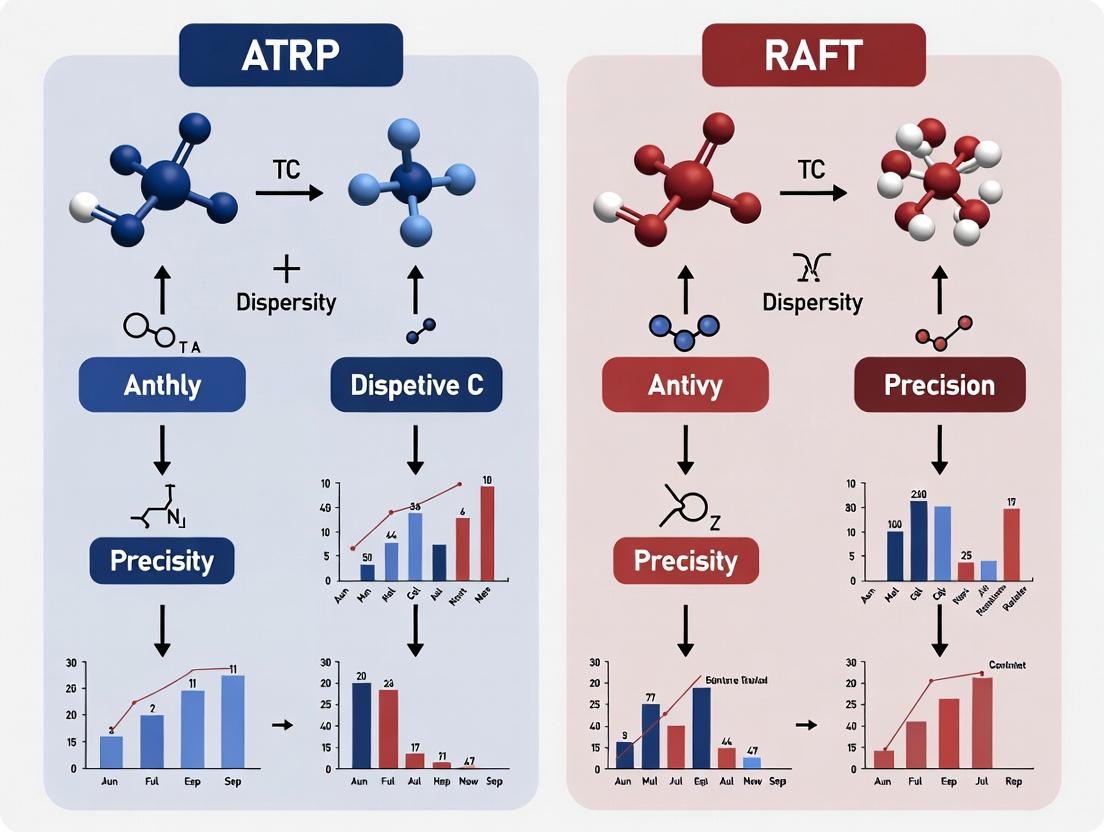
This article provides a comprehensive, up-to-date comparison of Atom Transfer Radical Polymerization (ATRP) and Reversible Addition-Fragmentation Chain-Transfer (RAFT) polymerization, with a focused analysis on their capabilities for achieving low dispersity...
ATRP vs RAFT Polymerization: A Comprehensive Guide to Dispersity Control for Biomedical Applications
Abstract
This article provides a comprehensive, up-to-date comparison of Atom Transfer Radical Polymerization (ATRP) and Reversible Addition-Fragmentation Chain-Transfer (RAFT) polymerization, with a focused analysis on their capabilities for achieving low dispersity (Ð) in polymer synthesis. Tailored for researchers and drug development professionals, we explore the foundational mechanisms, practical methodologies, common optimization challenges, and rigorous validation techniques for both processes. The review synthesizes current literature to guide the selection of the optimal technique for producing precise, well-defined polymers critical for drug delivery systems, biomaterials, and therapeutic conjugates, ultimately impacting clinical translation.
Understanding the Core Mechanisms: How ATRP and RAFT Achieve Controlled Radical Polymerization
The Critical Role of Dispersity in Biomedical Polymers
In biomedicine, the precision of polymer synthesis dictates the efficacy and safety of applications like drug delivery systems, biodegradable implants, and diagnostic agents. Dispersity (Ð, also known as PDI - Polydispersity Index) quantifies the heterogeneity of molecular weights within a polymer sample. A low Ð (~1.0) indicates near-uniform chains, while a high Ð signifies a broad distribution. This parameter directly impacts critical biomedical properties: drug release kinetics, cellular uptake, biodistribution, and immune response. Within the context of developing next-generation biomaterials, controlled radical polymerization techniques, specifically Atom Transfer Radical Polymerization (ATRP) and Reversible Addition-Fragmentation Chain-Transfer (RAFT) polymerization, are pivotal for achieving precise control over Ð.
Experimental Comparison: ATRP vs. RAFT for Dispersity Precision
Thesis Context: This guide compares the performance of ATRP and RAFT polymerization in synthesizing poly(ethylene glycol) methyl ether methacrylate (PEGMA) polymers, a critical biomaterial for stealth nanoparticles and hydrogel coatings, with a focus on achieving low dispersity and high end-group fidelity.
Experimental Protocol 1: Synthesis of PEGMA (Mn ~ 20,000 Da)
- Objective: Synthesize a defined polymer for potential use as a drug conjugate backbone.
- ATRP Method: PEGMA (10.0 g, 20 mmol), CuBr (28.7 mg, 0.2 mmol), PMDETA (41.8 µL, 0.2 mmol) in anisole (50% v/v). Deoxygenate via 3 freeze-pump-thaw cycles. Initiate with ethyl α-bromoisobutyrate (EBiB, 29.2 µL, 0.2 mmol) at 70°C for 6 hours. Terminate by exposure to air and dilute with THF. Pass through alumina column to remove copper catalyst.
- RAFT Method: PEGMA (10.0 g, 20 mmol), 2-(((Butylthio)carbonothioyl)thio) propanoic acid (CPDB, 56.1 mg, 0.2 mmol), AIBN (6.56 mg, 0.04 mmol) in 1,4-dioxane (50% v/v). Deoxygenate with nitrogen sparge for 30 minutes. React at 70°C for 12 hours. Terminate by cooling and exposure to air. Purify by precipitation into cold diethyl ether.
Experimental Protocol 2: Dispersity and End-Group Analysis
- Size Exclusion Chromatography (SEC): Polymers analyzed using THF as eluent (1 mL/min) against PMMA standards. Columns: two PLgel Mixed-C columns in series. Provides Mn, Mw, and Ð.
- Nuclear Magnetic Resonance (NMR) Spectroscopy: ¹H NMR (400 MHz, CDCl₃) used to determine monomer conversion and confirm retention of RAFT end-group (characteristic S=C(S) proton shift at ~3.3 ppm) or ATRP halogen end-group.
Comparison of Key Performance Data
Table 1: Synthesis Outcomes for PEGMA (Target Mn ~20,000 Da)
| Parameter | ATRP Result | RAFT Result | Ideal Benchmark | Impact in Biomedicine |
|---|---|---|---|---|
| Achieved Mn (Da) | 21,500 | 19,800 | 20,000 | Controls carrier size and renal clearance threshold. |
| Dispersity (Ð) | 1.12 | 1.05 | ≤ 1.10 | Low Ð ensures uniform drug loading and predictable release. |
| End-Group Fidelity | ~85% (Br) | >95% (RAFT agent) | High | Critical for subsequent conjugation of targeting ligands or drugs. |
| Typical Reaction Time | 4-8 hours | 8-16 hours | - | Impacts scalability and functional group tolerance. |
| Tolerance to Protic Groups | Moderate | High | High | Essential for polymerizing biomonomers with -OH or -COOH. |
| Required Purification | Metal removal essential | Standard precipitation | - | Residual metal catalysts can cause toxicity and oxidative stress. |
Table 2: Performance in Block Copolymer Synthesis for Micelles
| Parameter | ATRP-synthesized Block | RAFT-synthesized Block | Notes |
|---|---|---|---|
| Morphology Uniformity | Moderate | High | Lower Ð from RAFT leads to more consistent micelle size. |
| Drug Encapsulation Efficiency | 78% ± 8% | 92% ± 4% | Tighter MWD correlates with more reproducible core formation. |
| In Vitro Burst Release (First 24h) | 25% ± 6% | 12% ± 3% | Narrow Ð minimizes fast-diffusing low-MW polymer fractions. |
Visualizing the Polymerization Control Mechanisms
Diagram Title: Control Mechanisms in ATRP vs RAFT Determine Dispersity
Diagram Title: How Dispersity Impacts Biomedical Application Outcomes
The Scientist's Toolkit: Research Reagent Solutions
Table 3: Essential Materials for Controlled Polymerization & Dispersity Analysis
| Item | Function & Role in Dispersity Control | Example Product/Catalog # |
|---|---|---|
| RAFT Chain Transfer Agent (CTA) | Mediates the reversible transfer step in RAFT. Structure dictates control and final end-group. Crucial for low Ð. | 2-Cyano-2-propyl benzodithioate (CPDB), 4-Cyano-4-[(dodecylsulfanylthiocarbonyl)sulfanyl]pentanoic acid (CDTPA). |
| ATRP Catalyst System | Copper-based complex (e.g., CuBr/PMDETA) that establishes the activation-deactivation equilibrium. Purity affects initiator efficiency. | Cu(I)Br with Tris(2-pyridylmethyl)amine (TPMA) ligand for faster kinetics. |
| Functional Initiator | Defines the α-end group in ATRP. Allows for post-polymerization bioconjugation. | Ethyl α-bromoisobutyrate (EBiB), 2-Hydroxyethyl 2-bromoisobutyrate. |
| Deoxygenated Solvents | Oxygen is a radical quencher. Strict removal is essential for high livingness and low Ð. | Anisole, 1,4-dioxane, distilled and sparged with N₂/Ar. |
| Freeze-Pump-Thaw Apparatus | For ATRP/sealed tube RAFT: removes oxygen via repeated freezing, vacuum application, and thawing. | Schlenk line with liquid N₂ trap and manifold. |
| Size Exclusion Chromatography (SEC) | The primary tool for determining Mn, Mw, and calculating Ð. Requires appropriate standards. | System with refractive index (RI) and multi-angle light scattering (MALS) detectors. |
| Preparatory SEC Columns | For critical purification of polymers for in vivo studies, removing catalyst, and separating low/high MW fractions. | Bio-Rad Bio-Beads S-X1 or similar preparative-grade media. |
Within the broader research comparing Atom Transfer Radical Polymerization (ATRP) and Reversible Addition-Fragmentation Chain-Transfer (RAFT) polymerization for dispersity precision, understanding the ATRP catalytic machinery is paramount. This guide deconstructs the ATRP mechanism, objectively comparing the performance of different catalytic systems based on experimental data, with a focus on control, dispersity (Đ), and polymerization rates.
The Catalytic Cycle: A Comparative Analysis
The ATRP equilibrium between dormant (alkyl halide, Pn-X) and active species (propagating radical, Pn•) is mediated by a transition-metal complex (Mtn/L). The choice of metal and ligand directly impacts the activation rate constant (kact), deactivation rate constant (kdeact), and the overall control.
Table 1: Performance of Transition Metal/Ligand Complexes in ATRP of Methyl Methacrylate (MMA)
| Metal/Ligand System | [M]:[L] Ratio | Temp (°C) | kapp (x 10^-5 s^-1) | Đ (Final) | % Conversion (Time) | Key Reference |
|---|---|---|---|---|---|---|
| CuBr/PMDETA | 1:1 | 90 | 2.3 | 1.25 | >95% (6 h) | Matyjaszewski, Macromolecules 1998 |
| CuBr/dNbpy | 1:2 | 90 | 1.8 | 1.05 | 85% (10 h) | Matyjaszewski, JACS 1997 |
| FeBr2/PDMAEMA | 1:2 | 80 | 0.9 | 1.15 | 78% (15 h) | Shen, Polymer 2016 |
| RuCp*Cl/PPh3 | 1:2 | 80 | 5.1 | 1.30 | >90% (3 h) | Sawamoto, Macromolecules 1995 |
Experimental Protocol (Typical ATRP of MMA):
- Schlenk Line Setup: Conduct all operations under an inert atmosphere (N2 or Ar) using standard Schlenk techniques or a glovebox.
- Catalyst Preparation: In a dry Schlenk flask, combine the transition metal halide (e.g., CuBr, 0.1 eq) and ligand (e.g., PMDETA, 0.1 eq). Add degassed monomer (MMA, 100 eq) and stir to form the catalyst complex.
- Initiation: Add the degassed initiator (e.g., ethyl α-bromoisobutyrate, 1 eq) and solvent (anisole, 50% v/v) if used.
- Polymerization: Place the sealed flask in an oil bath pre-heated to the target temperature (e.g., 90°C). Monitor conversion over time via ^1H NMR or gravimetric analysis.
- Termination: Cool the flask rapidly in liquid N2. Open and expose the mixture to air. Dilute with THF and pass through a neutral alumina column to remove the metal catalyst.
- Analysis: Precipitate polymer into cold methanol, dry, and analyze via GPC (against PMMA standards) for molecular weight (Mn) and dispersity (Đ).
Ligand Comparison: Impact on Control and Dispersity
Ligands solubilize the metal center and finely tune the redox potential, dictating the ATRP equilibrium constant (KATRP = kact/kdeact). Higher KATRP leads to faster polymerization but potentially lower control.
Table 2: Ligand Effect on Control in Cu-Based ATRP (Styrene Polymerization)
| Ligand Type | Ligand Name | KATRP (x 10^-7) | Predicted Đ (Theoretical) | Experimental Đ | Induction Period |
|---|---|---|---|---|---|
| Aliphatic Amine | PMDETA | ~2.5 | <1.2 | 1.25-1.35 | Short |
| Bipyridine | dNbpy | ~0.8 | <1.1 | 1.05-1.15 | Moderate |
| Tetradentate N-ligand | HMTETA | ~1.5 | <1.15 | 1.15-1.25 | Short |
| Tris(2-pyridylmethyl)amine | TPMA | ~15.0 | <1.3 | 1.10-1.20 | Very Short |
Transition-Metal Mediation: Cu vs. Fe vs. Ru
The choice of metal is critical for biocompatibility, catalyst retention, and activity.
Table 3: Transition Metal Comparison for Aqueous ATRP of Oligo(ethylene oxide) methacrylate
| Metal Complex | Solubility in H2O | Biocompatibility | Typical Đ in Water | Metal Residual (ppm) Post-Purification |
|---|---|---|---|---|
| CuBr/BPy (with surfactant) | Moderate | Low | 1.20-1.40 | 200-500 |
| FeCl2/PDMAEMA | High | Moderate | 1.15-1.30 | <50 |
| RuCp*Cl/PPh3 (with solubilizing groups) | Low | Low | 1.30-1.50 | >1000 |
The Scientist's Toolkit: Key Research Reagent Solutions
Table 4: Essential Materials for ATRP Research
| Item | Function & Importance |
|---|---|
| Schlenk Flask & Line | Enables rigorous oxygen/moisture removal via vacuum-purge cycles, critical for preventing catalyst oxidation. |
| Copper(I) Bromide (CuBr) | Classic ATRP catalyst; must be purified (e.g., by washing with acetic acid) and stored under inert atmosphere. |
| Ligands (e.g., PMDETA, dNbpy) | Modulate catalyst activity and control; choice is monomer-dependent. Must be degassed before use. |
| Alkyl Halide Initiator (e.g., EBriB) | Defines the starting chain end. Purity is crucial for predictable molecular weight. |
| Degassed Solvents/ Monomers | Removes inhibiting oxygen. Achieved via freeze-pump-thaw cycles or sparging with inert gas. |
| Neutral Alumina Column | Standard method for removing transition metal catalyst from the crude polymer product. |
| GPC/SEC with Multiple Detectors | Essential for determining molecular weight distribution, Đ, and verifying end-group fidelity. |
Visualizing the ATRP Mechanism and Experimental Workflow
Title: The Core ATRP Catalytic Equilibrium Cycle
Title: Step-by-Step ATRP Experimental Workflow
This guide compares the performance of RAFT (Reversible Addition-Fragmentation Chain-Transfer) polymerization against its main alternative, ATRP (Atom Transfer Radical Polymerization), within a thesis focused on dispersity (Đ) precision. The analysis centers on the unique role of Chain Transfer Agents and the intermediate radical species they form.
Core Mechanism Comparison: RAFT vs. ATRP
The fundamental distinction lies in control mechanism. ATRP employs a transition-metal catalyst in a reversible redox cycle to establish equilibrium between active and dormant chains. RAFT polymerization uses a thiocarbonylthio CTA to mediate chain growth via a degenerative chain transfer mechanism involving intermediate radical species.
Diagram: Key Mechanisms of RAFT and ATRP for Dispersity Control
Performance Comparison: Dispersity (Đ) and Control
Experimental data consistently shows that both techniques achieve Đ < 1.1 under optimal conditions. However, precision varies with monomer type, target molecular weight, and reagent purity.
Table 1: Comparative Performance in Model Homopolymerizations
| Parameter | RAFT (with CTA) | ATRP (with Cu/ligand) | Notes & Experimental Support |
|---|---|---|---|
| Typical Đ Achievable | 1.05 - 1.20 | 1.05 - 1.15 | RAFT Đ can broaden with slow fragmentation kinetics (Matheson et al., Polymer, 2020). |
| Monomer Scope | Broad (Acrylates, Methacrylates, Styrene, VAc, NVP) | Broad (Styrene, (Meth)acrylates, Acrylamides) | RAFT superior for less-activated monomers (e.g., vinyl esters). ATRP sensitive to protic monomers. |
| Molecular Weight Control | Linear evolution, predictable. | Linear evolution, predictable. | Both offer good correlation between Mn and conv. RAFT requires CTA efficiency factor. |
| Tolerance to Oxygen/Impurities | Moderate (requires deoxygenation) | Low (catalyst is oxygen-sensitive) | Recent SARA ATRP & eATRP variants show improved tolerance (Corrigan et al., Chem. Rev., 2021). |
| Key Intermediate | Intermediate Radical (R-Adduct) | Metal Complex Radical (Cu^II/L) | The RAFT intermediate radical's stability is critical for low Đ (Perrier et al., Macromolecules, 2017). |
Critical Experimental Protocol: Assessing CTA Efficiency and Đ
This protocol is fundamental for comparing RAFT agent performance.
Objective: Determine the transfer coefficient (Ctr) of a candidate CTA and its impact on dispersity in a model polymerization. Materials: Monomer (e.g., methyl acrylate), CTA (e.g., cyanomethyl dodecyl trithiocarbonate), initiator (AIBN), solvent (anisole), Schlenk line or sealed vessel setup. Procedure:
- Solution Preparation: Prepare multiple ampoules with a fixed [M]:[CTA] ratio (e.g., 100:1) but varying [CTA]:[I] ratios (e.g., 1:0.1, 1:0.2). Degass via freeze-pump-thaw cycles (x3).
- Polymerization: Immerse ampoules in a thermostated oil bath at 70°C. Remove individual ampoules at timed intervals to track conversion (gravimetrically or via ¹H NMR).
- Analysis: Use Size Exclusion Chromatography (SEC) to determine Mn and Đ at each conversion point. Plot experimental Mn vs. conversion and compare to theoretical.
- Calculation: The deviation from theoretical Mn at low conversion indicates Ctr. A linear Mn-conversion plot with low initial Đ confirms efficient CTA behavior and rapid intermediate radical fragmentation.
The Role of the Intermediate Radical
The RAFT intermediate radical (Pn-S(C=S-Z)-S-Pm) is the crux of control. Its lifetime and fragmentation behavior dictate dispersity.
Diagram: RAFT Intermediate Radical Pathways & Dispersity Impact
The Scientist's Toolkit: Essential Research Reagent Solutions
Table 2: Key Reagents for Precision RAFT/ATRP Comparisons
| Reagent / Material | Function in Experiment | Critical Consideration |
|---|---|---|
| High-Purity CTA(e.g., Trithiocarbonates, Dithioesters) | Mediates chain transfer; defines R & Z groups. | Z group affects intermediate radical stability. R group must be a good leaving group/initiator. |
| Metal Catalyst & Ligand(e.g., CuBr/PMDETA for ATRP) | Establishes activation-deactivation equilibrium in ATRP. | Ligand choice determines activity, solubility, and oxygen tolerance. |
| Chain-End Analysis Tools(e.g., High-Res NMR, MS) | Confirms living chain ends and fidelity. | Essential for validating mechanism and quantifying termination. |
| Inert Atmosphere Glovebox | Enables handling of oxygen-sensitive catalysts and CTAs. | Critical for reproducible ATRP and consistent RAFT initialization. |
| Advanced SEC with Triple Detection | Provides absolute molecular weights (Mn, Mw) and dispersity (Đ). | Light scattering detection eliminates calibration errors for accurate Đ comparison. |
Conclusion: For dispersity precision, both ATRP and RAFT are powerful. ATRP offers robust control for a subset of monomers with precise catalyst tuning. RAFT provides broader monomer compatibility, but its precision is explicitly governed by the CTA structure and the kinetics of the intermediate radical's formation and fragmentation. The choice hinges on monomer selection, tolerance to metal residues, and the specific need for functional-group tolerance provided by the CTA's thiocarbonylthio end group.
Within the thesis research comparing ATRP (Atom Transfer Radical Polymerization) and RAFT (Reversible Addition-Fragmentation Chain-Transfer) polymerization for achieving low dispersity (Ð), it is crucial to first establish their foundational commonality as controlled/living polymerization techniques. This guide objectively compares the core living characteristics and operational parameters of ATRP and RAFT, supported by experimental data.
Core Living Polymerization Characteristics: A Comparison Both ATRP and RAFT exhibit the key hallmarks of a living polymerization system, enabling precise control over molecular weight, architecture, and end-group functionality.
Table 1: Comparison of Living Polymerization Characteristics
| Characteristic | ATRP | RAFT |
|---|---|---|
| Linear Molecular Weight Growth | Yes, with monomer conversion. | Yes, with monomer conversion. |
| Low Dispersity (Ð) Potential | Typically 1.05 - 1.30. | Typically 1.05 - 1.30. |
| End-Group Fidelity | High (Halide end-group). | High (Thiocarbonylthio end-group). |
| Chain Extension Capability | Yes, for block copolymers. | Yes, for block copolymers. |
| Primary Control Mechanism | Dynamic Halogen Atom Equilibrium. | Reversible Chain-Transfer Agent (CTA) Equilibrium. |
| Active Dormant Species | Alkyl Halide (P–X) ⇌ Radical (P•). | Macro-RAFT (P–SC(Z)=S) ⇌ Radical (P•). |
Reaction Parameters and Experimental Protocols Achieving optimal living characteristics requires precise control of reaction parameters. The following protocols and data highlight the similarities in setup and parameter sensitivity.
Table 2: Comparison of Key Reaction Parameters for Low-Ð Synthesis
| Parameter | ATRP (e.g., PMMA synthesis) | RAFT (e.g., PMMA synthesis) |
|---|---|---|
| Typical Temperature | 60-90 °C | 60-80 °C |
| Monomer: Initiator/CTA Ratio | [M]₀:[R–X]₀ (e.g., 100:1) | [M]₀:[CTA]₀ (e.g., 100:1) |
| Catalyst/Agent Concentration | [Cu¹]₀ ~ [R–X]₀ (with ligand) | [CTA]₀ defines chains |
| Solvent (Typical) | Anisole, Toluene, DMF | Dioxane, Toluene, DMF |
| Oxygen Removal | Essential (Freeze-Pump-Thaw/N₂ purge) | Essential (Freeze-Pump-Thaw/N₂ purge) |
| Reaction Time | 2-8 hours (for high conversion) | 4-12 hours (for high conversion) |
Experimental Protocol for Kinetic Sampling (Common to both ATRP & RAFT):
- Setup: Flame-dry reaction flask under inert atmosphere (Ar/N₂). Add monomer, solvent, ligand (for ATRP), and CTA (for RAFT) or alkyl halide initiator (for ATRP).
- Initiation: For ATRP, add Cu(I) catalyst complex. For RAFT, add thermal initiator (e.g., AIBN, 10% of CTA concentration). Seal the system.
- Heating: Immerse flask in thermostated oil bath at target temperature (e.g., 70 °C) with stirring.
- Sampling: At predetermined time intervals (e.g., 15, 30, 60, 120, 240 min), withdraw aliquots (~0.1 mL) via degassed syringe.
- Quenching & Analysis: Immediately cool samples in ice water. For ATRP, expose to air to oxidize Cu(I). Analyze conversion via ¹H NMR. Determine molecular weight and dispersity (Ð) via Size Exclusion Chromatography (SEC) against PMMA standards.
Generalized Living Polymerization Equilibrium Diagram
Title: Generalized Living Polymerization Equilibrium
ATRP vs RAFT: Mechanistic Pathways to Living Control
Title: Core Mechanisms of ATRP and RAFT Polymerization
The Scientist's Toolkit: Essential Research Reagent Solutions
Table 3: Key Reagents for ATRP and RAFT Studies
| Reagent/Material | Function in Experiment | Example (Specific) |
|---|---|---|
| Degassed Solvents | To eliminate oxygen, which terminates radicals and inhibits polymerization. | Anisole, Dioxane, DMF (sparged with N₂). |
| Monomer (Purified) | The building block of the polymer. Must be purified to remove inhibitors. | Methyl Acrylate (MA), passed through basic alumina. |
| ATRP Initiator | Alkyl halide species that defines the chain start and mediates Cu-catalyzed equilibrium. | Ethyl α-Bromoisobutyrate (EBiB). |
| RAFT CTA | The chain-transfer agent that mediates equilibrium; its structure controls kinetics and Đ. | 2-Cyano-2-propyl benzodithioate (CPDB). |
| ATRP Catalyst | Transition metal complex that reversibly activates dormant chains. | Cu(I)Br / Tris(2-pyridylmethyl)amine (TPMA). |
| Radical Source (RAFT) | Provides initial radicals to generate the primary active chains. | Azobisisobutyronitrile (AIBN). |
| Inert Atmosphere | Maintains an oxygen-free environment during setup and reaction. | Argon or Nitrogen gas line with manifold. |
| SEC/Spectroscopy | For analysis of molecular weight, dispersity (Ð), and conversion. | HPLC system with RI/UV detectors, PMMA standards; ¹H NMR spectrometer. |
This comparison guide is framed within a broader thesis comparing Atom Transfer Radical Polymerization (ATRP) and Reversible Addition-Fragmentation Chain-Transfer (RAFT) polymerization for achieving low dispersity (Ð) in polymer synthesis. Precision in drug-polymer conjugate development is paramount, making an understanding of these fundamental differences critical.
Catalyst vs. Chain Transfer Agent (CTA): Core Mechanisms
The primary distinction lies in the control agent: ATRP employs a transition metal catalyst complex, while RAFT uses a chain-transfer agent (typically a thiocarbonylthio compound).
Table 1: Comparison of Control Agents in ATRP and RAFT
| Feature | ATRP (Catalyst System) | RAFT (Chain Transfer Agent) |
|---|---|---|
| Primary Agent | Transition Metal Complex (e.g., CuBr/PMDETA) | Thiocarbonylthio Compound (e.g., CPDB) |
| Role | Medicates halogen atom transfer, establishing equilibrium between active/ dormant species. | Acts as a reversible chain-transfer agent, mediating equilibrium via degenerative transfer. |
| Typical Components | Metal Salt (Catalyst), Ligand, Alkyl Halide (Initiator). | RAFT Agent (CTA), Conventional Radical Initiator (e.g., AIBN). |
| Polymer End-Group | Halogen (can be post-modified). | Thiocarbonylthio (can be removed or transformed). |
| Compatibility | Sensitive to protic/polar functionalities; can be cytotoxic. | Broad tolerance to many functional groups; some CTAs can be toxic. |
| Typical Dispersity (Ð) | 1.05 - 1.30 | 1.05 - 1.30 |
Experimental Protocol for Comparing Control Agents:
- Objective: Synthesize poly(methyl methacrylate) (PMMA) via ATRP and RAFT targeting identical Mn (~20,000 g/mol).
- ATRP Method: Charge a schlenk tube with MMA (20 mL, 187 mmol), CuBr (26.8 mg, 0.187 mmol), PMDETA (39 µL, 0.187 mmol), and ethyl α-bromoisobutyrate (27.5 µL, 0.187 mmol). Degass via 3 freeze-pump-thaw cycles. Polymerize at 60°C in an oil bath for 4 hours. Terminate by exposure to air and dilute with THF. Pass through alumina column to remove catalyst.
- RAFT Method: Charge a vial with MMA (20 mL, 187 mmol), 2-Cyano-2-propyl benzodithioate (CPDB) (52.5 mg, 0.187 mmol), and AIBN (3.1 mg, 0.0187 mmol). Degass by sparging with N2 for 20 min. Polymerize at 60°C for 6 hours. Terminate by cooling and exposure to air.
- Analysis: For both, determine conversion (1H NMR), Mn and Ð (Size Exclusion Chromatography, THF vs. PMMA standards).
Oxygen Sensitivity
Both techniques are sensitive to oxygen, which inhibits polymerization by quenching radicals or oxidizing catalysts. However, the degree and management of sensitivity differ.
Table 2: Oxygen Sensitivity and Handling Requirements
| Parameter | ATRP | RAFT |
|---|---|---|
| Sensitivity | Very High. Oxygen irreversibly oxidizes the active Cu(I) catalyst to Cu(II), halting the reaction. | High. Oxygen reacts with propagating radical chains, forming peroxy radicals and inhibiting growth. |
| Standard Deoxygenation | Rigorous techniques mandatory: Multiple (3+) freeze-pump-thaw cycles or prolonged nitrogen/vacuum sparging. | Often requires degassing via nitrogen sparging (30+ minutes) or freeze-pump-thaw. Some "open" RAFT variations exist. |
| Catalyst/System Recovery | Cannot recover from significant O2 exposure; reaction is permanently inhibited. | Can sometimes recover if oxygen is removed and fresh initiator is added, as the CTA remains intact. |
Predominant Side Reactions
Side reactions compromise chain-end fidelity and increase dispersity.
Table 3: Common Side Reactions and Their Impact
| Polymerization Method | Primary Side Reactions | Consequence on Polymer Properties |
|---|---|---|
| ATRP | Disproportionation & Loss of Active Catalyst: Cu(I) can disproportionate, especially with certain ligands. Solvent/ Monomer Coordination to metal center. Radical-Radical Termination (persistent effect). | Increased Ð, loss of chain-end functionality, potential catalyst precipitation, colored product. |
| RAFT | Retardation: Due to slow re-initiation by the expelled R-group radical. Termination of intermediate radicals. Hydrolysis/ Aminolysis of the CTA group during/after synthesis. | Slower polymerization rates, potential for higher Ð if CTA is poorly chosen, loss of thiocarbonylthio end-group. |
Experimental Protocol for Assessing Side Reactions (Chain-End Fidelity):
- Objective: Use chain-extension experiments to evaluate the "livingness" of PMMA macro-agents.
- Method: Synthesize a macro-ATRP initiator (PMMA-Br) and a macro-RAFT agent (PMMA-CTA) with target Mn ~10,000 g/mol and low Ð. Isolate and purify thoroughly. Use each macro-agent to initiate the polymerization of a second monomer (e.g., styrene) under identical optimized conditions.
- Analysis: Analyze the chain-extended product via SEC. A clean, monomodal shift to higher molecular weight indicates high chain-end fidelity and minimal side reactions. A bimodal distribution or significant tailing indicates chain-end loss due to side reactions.
The Scientist's Toolkit: Research Reagent Solutions
| Item | Function & Relevance |
|---|---|
| CuBr (Copper(I) Bromide) | ATRP catalyst. Must be of high purity and stored under inert atmosphere to prevent oxidation to Cu(II). |
| PMDETA Ligand | Common nitrogen-based ligand in ATRP; complexes with CuBr to form the active catalyst, tuning its solubility and redox potential. |
| CPDB (2-Cyano-2-propyl benzodithioate) | Common RAFT CTA for (meth)acrylate polymerization. The cyano and phenyl groups tune its reactivity. |
| AIBN (Azobisisobutyronitrile) | Conventional thermal radical initiator used in RAFT to generate primary radicals. |
| EBiB (Ethyl α-bromoisobutyrate) | Common alkyl halide initiator for ATRP of methacrylates. |
| Alumina (Basic) | Used in ATRP work-up to remove colored copper catalyst residues via column chromatography. |
| Schlenk Line/Glovebox | Essential equipment for rigorous oxygen and moisture exclusion, especially critical for ATRP setups. |
| Freeze-Pump-Thaw Apparatus | The gold-standard method for degassing monomer/ solvent solutions in both ATRP and RAFT. |
Visualizations
ATRP vs RAFT Core Mechanism Diagram
Experimental Workflow for Dispersity Comparison
Practical Protocols: Step-by-Step Approaches for Low-Ð Synthesis with ATRP and RAFT
This guide compares the setup and performance of three key ATRP techniques—AGET, ARGET, and SARA-ATRP—within the context of a broader research thesis comparing ATRP and RAFT for dispersity (Đ) precision. These methods were developed to overcome the limitations of conventional ATRP, primarily the sensitivity to oxygen and the need for a high catalyst concentration, while maintaining precise control over molecular weight and dispersity.
Comparison of ATRP Techniques: Key Performance Data
The following table summarizes experimental data from recent literature, comparing the control, activator regeneration method, and practical performance of each technique.
Table 1: Comparative Performance of AGET, ARGET, and SARA-ATRP
| Technique | Activator Regeneration Source | Typical [Cu]⁺⁺:[Reductant] Ratio | Typical Dispersity (Đ) Range | Oxygen Tolerance | Key Advantage | Key Limitation |
|---|---|---|---|---|---|---|
| AGET | Reducing Agent (e.g., Ascorbic Acid, Sn(EH)₂) | 1:0.1 - 1:1 | 1.1 - 1.4 | Moderate (requires degassing) | Simplicity; uses stable Cu⁺⁺ catalyst. | Residual reducing agent may require purification. |
| ARGET | Excess Reducing Agent (e.g., Ascorbic Acid, Glucose) | 1:0.1 - 1:10 | 1.1 - 1.3 | High (ppm-level catalyst) | Very low catalyst loading (ppm). | Requires precise control of reductant feed. |
| SARA | Zero-Valent Metal (e.g., Cu⁰ wire/powder) | N/A (Cu⁰ source) | 1.05 - 1.3 | High (in-situ O₂ scavenging) | Excellent control; in-situ Cu¹ generation. | Polymerization rate depends on Cu⁰ surface area. |
Detailed Experimental Protocols
The protocols below are generalized for the polymerization of methyl methacrylate (MMA) using ethyl α-bromoisobutyrate (EBiB) as the initiator and a Cu⁺⁺/TPMA catalyst system.
1. AGET-ATRP Protocol
- Setup: In a Schlenk flask, charge MMA (20 eq, 10 mL), anisole (10 mL), EBiB (1 eq, 41 µL), and CuBr₂/TPMA complex (0.1 eq, 22 mg CuBr₂ + 70 mg TPMA). Seal with a septum.
- Oxygen Removal: Degas the mixture by purging with nitrogen or argon for 30-45 minutes.
- Initiation: Using a degassed syringe, rapidly inject a degassed solution of ascorbic acid (0.2 eq, 17.6 mg in 1 mL H₂O) to reduce Cu⁺⁺ to Cu¹ and start the polymerization.
- Reaction: Stir at 50°C. Monitor conversion by ¹H NMR.
- Termination: Expose to air, dilute with THF, and pass through a neutral alumina column to remove catalyst before precipitation into hexane.
2. ARGET-ATRP Protocol
- Setup: In a vial with a stir bar, charge MMA (100 eq, 5 mL), EBiB (1 eq, 20.5 µL), CuBr₂/TPMA complex (0.01 eq, 0.22 mg CuBr₂ + 0.7 mg TPMA), and anisole (5 mL). Cap with a septum.
- Oxygen Tolerance: A brief nitrogen purge (5-10 min) is often sufficient due to low catalyst load.
- Initiation & Regulation: Inject a degassed stock solution of ascorbic acid (0.1 eq, 8.8 mg in 0.5 mL H₂O) to start. Additional aliquots of reductant can be added to regulate rate if needed.
- Reaction: Stir at 50°C.
- Termination: Same as AGET. The very low metal content simplifies purification.
3. SARA-ATRP Protocol
- Setup: In a sealed vial, charge MMA (50 eq, 5 mL), EBiB (1 eq, 20.5 µL), CuBr₂/TPMA complex (0.002 eq, 0.044 mg CuBr₂ + 0.14 mg TPMA), anisole (5 mL), and a pre-cleaned Cu⁰ wire (∼10 cm, 1 mm diameter) or powder.
- Oxygen Scavenging: The Cu⁰ acts as an oxygen scavenger. A short purge is recommended, but the system is highly tolerant.
- Initiation: Heat to 50°C with stirring. The Cu⁰ wire slowly and continuously reduces Cu⁺⁺ to the active Cu¹ species, initiating a controlled polymerization.
- Reaction: Proceeds with automatic regulation. The Cu⁰ surface area controls the rate of activator generation.
- Termination: Remove the Cu⁰ wire, then terminate and purify as above.
Visualization of ATRP Technique Mechanisms
Title: Core ATRP Equilibrium & Activator Regeneration Paths
Title: General Experimental Workflow for ATRP Techniques
The Scientist's Toolkit: Essential Research Reagent Solutions
Table 2: Key Reagents for Advanced ATRP Setups
| Reagent / Material | Function & Role | Example in Protocol |
|---|---|---|
| Cu¹⁰ Wire or Powder (SARA) | Source of zero-valent metal for constant, slow regeneration of Cu¹ activator; also scavenges oxygen. | Copper wire (1 mm diameter), cleaned with acetic acid. |
| Ascorbic Acid (AGET/ARGET) | Reducing agent that regenerates the active Cu¹ catalyst from the accumulated Cu¹⁰ deactivator. | Degassed aqueous stock solution injected to initiate polymerization. |
| TPMA or PMDETA Ligand | Nitrogen-based ligand that complexes copper, controlling its redox potential and solubility in organic media. | Tris(2-pyridylmethyl)amine (TPMA) for high activity in aqueous/organic media. |
| Ethyl α-Bromoisobutyrate (EBiB) | Alkyl halide initiator (R-X). The alkyl group becomes the polymer chain end. | Common initiator for methacrylates. |
| Degassed Solvent (Anisole, Toluene) | Reaction medium. Degassing is critical for AGET; less so for ARGET/SARA. | Anisole is often used for its high boiling point and good solubility. |
| Neutral Alumina Column | Purification material to remove copper catalyst residues from the final polymer. | Crude polymer solution is passed through a short column before precipitation. |
Effective Reversible Addition-Fragmentation Chain Transfer (RAFT) polymerization hinges on the precise selection of a Chain Transfer Agent (CTA). This guide compares the performance of different CTAs, focusing on their ability to control molecular weight and dispersity (Đ) for various monomer families, within the broader research context comparing RAFT and ATRP for dispersity precision.
Key Research Reagent Solutions
| Reagent/Material | Function in RAFT Polymerization |
|---|---|
| Z-Category CTA (e.g., DDMAT) | Common for Less Activated Monomers (LAMs): The R group is designed for efficient re-initiation with monomers like vinyl acetate. |
| R-Category CTA (e.g., CPADB) | Common for More Activated Monomers (MAMs): The Z group (e.g., phenyl) stabilizes the radical intermediate for monomers like styrene and acrylates. |
| AIBN Initiator | A conventional thermal initiator that decomposes to provide primary radicals to start the polymerization chain. |
| Monomer (e.g., MMA, Styrene) | The building block of the polymer chain. Reactivity dictates CTA selection. |
| Deoxygenated Solvent (e.g., Toluene, Dioxane) | Provides reaction medium; must be purged of oxygen, a radical scavenger. |
CTA Performance Comparison: Control over Molecular Weight and Dispersity
The following table summarizes experimental outcomes for common CTAs with different monomers, demonstrating the criticality of matched reactivity.
Table 1: Performance of Selected CTAs Across Monomer Families
| Monomer Type | Monomer Example | CTA Example | CTA Type | Achieved Dispersity (Đ) | Molecular Weight Control (Mn theor vs. exp) | Key Limitation |
|---|---|---|---|---|---|---|
| More Activated (MAM) | Methyl Methacrylate (MMA) | 2-Cyano-2-propyl benzodithioate (CPDB) | R-group (Z=Ph) | 1.05 - 1.15 | Excellent correlation up to ~90% conversion | Can show retardation at high [CTA]. |
| More Activated (MAM) | Styrene | Cumyl phenyl dithioacetate (CPADB) | R-group (Z=Ph) | 1.05 - 1.10 | Very good correlation | Requires careful R-group design for efficient fragmentation. |
| Less Activated (LAM) | Vinyl Acetate | 2-(Dodecylthiocarbonothioylthio) propionic acid (DDMAT) | Z-group (R=Leaving) | 1.10 - 1.25 | Moderate correlation; side reactions more prevalent | Higher dispersity due to side reactions and less ideal RAFT equilibrium. |
| Amphiphilic | N-Isopropylacrylamide (NIPAM) | 4-Cyano-4-[(dodecylsulfanylthiocarbonyl)sulfanyl]pentanoic acid | Trithiocarbonate (R & Z balanced) | 1.05 - 1.12 | Excellent control for this MAM | Purification required for biomedical use. |
Experimental Protocol: Evaluating CTA Performance for MMA Polymerization
Objective: To synthesize PMMA with low dispersity using CPDB and compare theoretical vs. experimental molecular weights.
Method:
- Formulation: In a 25 mL Schlenk tube, add methyl methacrylate (MMA, 10.0 g, 100 mmol), 2-cyano-2-propyl benzodithioate (CPDB, 135 mg, 0.5 mmol), and AIBN (8.2 mg, 0.05 mmol). Add a stir bar. The target DPn is 200, targeting M_n,theor ≈ 20,000 g/mol.
- Deoxygenation: Seal the tube and perform three freeze-pump-thaw cycles to remove dissolved oxygen. Back-fill with inert gas (N₂ or Ar) on the final cycle.
- Polymerization: Immerse the sealed tube in a pre-heated oil bath at 70 °C with stirring. Allow reaction to proceed for 6 hours.
- Termination: Cool the tube rapidly in an ice bath. Open and dilute the viscous mixture with ~20 mL THF.
- Purification: Precipitate the polymer into a large excess (~500 mL) of vigorously stirred cold methanol/water (9:1 v/v). Filter the polymer and dry in vacuo until constant mass.
- Analysis:
- Conversion: Determine gravimetrically or by ¹H NMR.
- Molecular Weight & Dispersity: Analyze via Size Exclusion Chromatography (SEC) in THF against PMMA standards. Calculate M_n,exp and Đ.
Logical Framework for Optimal CTA Selection
Title: Decision Flow for RAFT CTA Selection
Comparative Experimental Workflow: ATRP vs. RAFT
Title: ATRP vs RAFT Experimental Workflow Comparison
This guide provides a comparative analysis of monomer compatibility and polymer performance for biomedical applications, framed within a broader thesis comparing the precision of Atom Transfer Radical Polymerization (ATRP) and Reversible Addition-Fragmentation Chain-Transfer (RAFT) polymerization. Control over dispersity (Đ) is critical for biomedical polymers, as it directly impacts properties like degradation kinetics, drug release profiles, and biocompatibility. This article objectively compares the monomer scope, resultant polymer characteristics, and experimental data from ATRP and RAFT syntheses.
Monomer Scope & Polymerization Performance
The following table summarizes the compatibility of common biomedical monomers with ATRP and RAFT techniques, along with typical achievable dispersity (Đ) and key considerations.
Table 1: Monomer Scope & Polymerization Performance for ATRP vs. RAFT
| Monomer (Common Biomedical Use) | ATRP Compatibility | Typical ATRP Đ | RAFT Compatibility | Typical RAFT Đ | Key Considerations for Biomedical Application |
|---|---|---|---|---|---|
| 2-Hydroxyethyl methacrylate (HEMA)(Hydrogels, contact lenses) | Excellent | 1.05 - 1.15 | Excellent | 1.05 - 1.10 | RAFT often offers lower Đ. ATRP requires ligand/catalyst removal. |
| Poly(ethylene glycol) methyl ether methacrylate (PEGMA)(Stealth coatings, micelles) | Good | 1.10 - 1.20 | Excellent | 1.05 - 1.15 | PEG side chains can complex with ATRP catalysts. RAFT is often preferred. |
| N-Isopropylacrylamide (NIPAM)(Thermoresponsive systems) | Moderate | 1.15 - 1.30 | Excellent | 1.03 - 1.08 | ATRP of amides can be challenging. RAFT is the gold standard for low-Đ PNIPAM. |
| Acrylic Acid (AA)(pH-responsive carriers) | Poor (requires protection) | >1.30 (if direct) | Good | 1.10 - 1.20 | Acidic protons poison ATRP catalysts. Typically polymerized via RAFT or using protected monomers in ATRP. |
| Styrene Sulfonate (SS)(Polyelectrolytes, coatings) | Poor | >1.30 | Good | 1.10 - 1.25 | Ionic monomers problematic for ATRP. RAFT with suitable chain transfer agent (CTA) is effective. |
| Caprolactone-based methacrylates (CLMA)(Degradable scaffolds) | Good | 1.10 - 1.25 | Excellent | 1.05 - 1.15 | Both work well. Dispersity affects degradation profile; lower Đ gives more predictable erosion. |
| Dimethylaminoethyl methacrylate (DMAEMA)(Cationic vectors, pH-responsive) | Good | 1.08 - 1.18 | Excellent | 1.05 - 1.12 | Tertiary amine can interact with ATRP catalyst. Requires careful optimization in both techniques. |
Experimental Comparison: Synthesizing a Model Drug Carrier
To illustrate the differences in precision, we compare the synthesis of a block copolymer, Poly(PEGMA-b-NIPAM), used as a thermoresponsive nanocarrier, via ATRP and RAFT.
Detailed Experimental Protocols
Protocol A: ATRP Synthesis
- Initialization: In a Schlenk flask, degas PEGMA (10.0 g, 20 mmol), anisole (10 mL), and the ligand Tris(2-pyridylmethyl)amine (TPMA) (70 mg, 0.24 mmol) by three freeze-pump-thaw cycles.
- Catalyst Addition: Under N₂, add the initiator Ethyl α-bromoisobutyrate (EBiB) (29 µL, 0.20 mmol) and the catalyst Cu(I)Br (29 mg, 0.20 mmol). Seal the flask.
- Polymerization: Place the flask in a pre-heated oil bath at 70°C for 4 hours.
- Macroinitiator Isolation: Expose to air, dilute with THF, and pass through a neutral alumina column to remove copper. Recover poly(PEGMA)-Br macroinitiator by precipitation into cold hexane. Dry under vacuum.
- Chain Extension: Using the purified poly(PEGMA)-Br (5.0 g, 0.1 mmol Br), repeat steps 1-3 with NIPAM (2.26 g, 20 mmol) to form the block copolymer.
- Purification: Pass the final product through alumina and precipitate twice into cold diethyl ether.
Protocol B: RAFT Synthesis
- CTA Selection: Use 2-Cyano-2-propyl benzodithioate (CPDB) as the chain transfer agent for (meth)acrylates.
- First Block: In a sealed vial, combine PEGMA (10.0 g, 20 mmol), CPDB (11 mg, 0.05 mmol), and the initiator 2,2'-Azobis(2-methylpropionitrile) (AIBN) (1.6 mg, 0.01 mmol) in 1,4-dioxane (10 mL). Degas by bubbling N₂ for 20 min.
- Polymerization: Heat the vial at 70°C for 6 hours. Terminate by cooling and exposure to air.
- Macro-CTA Isolation: Recover poly(PEGMA)-dithioate by precipitation into cold hexane. Dry under vacuum.
- Chain Extension: Use the purified poly(PEGMA)-CTA (5.0 g, 0.05 mmol CTA), NIPAM (2.26 g, 20 mmol), and AIBN (0.8 mg, 0.005 mmol) in 1,4-dioxane (8 mL). Degas and heat at 70°C for 8 hours.
- Purification: Precipitate the final block copolymer twice into cold diethyl ether.
Comparative Data from Model Experiment
Table 2: Experimental Results for Poly(PEGMA-b-NIPAM) Synthesis
| Parameter | ATRP Result | RAFT Result | Analytical Method |
|---|---|---|---|
| Target DPⁿ (each block) | 100 | 100 | Recipe |
| Final Conversion (PEGMA/NIPAM) | 92% / 88% | 95% / 90% | ¹H NMR |
| Theoretical Mₙ (kDa) | 22.0 / 22.6 | 22.0 / 22.6 | Calculation |
| Experimental Mₙ (kDa) | 20.1 / 19.8 | 21.5 / 21.0 | SEC (PS standards) |
| Dispersity (Đ) Final Block | 1.21 | 1.08 | SEC (PS standards) |
| Observed LCST in PBS | 32.5 - 36.0 °C (broad) | 33.8 - 34.5 °C (sharp) | UV-Vis Turbidimetry |
| Key Takeaway | Good control, but higher Đ leads to broader thermal transition. | Excellent control, low Đ yields sharp, predictable phase transition. |
Visualizing the Polymerization Mechanisms & Workflow
ATRP Equilibrium Mechanism Diagram
RAFT Reversible Chain Transfer Diagram
General Polymerization Synthesis Workflow
The Scientist's Toolkit: Key Research Reagent Solutions
Table 3: Essential Materials for Controlled Radical Polymerization
| Reagent / Material | Function & Importance | Example in ATRP | Example in RAFT |
|---|---|---|---|
| Ligand (e.g., TPMA, PMDETA) | Binds metal catalyst, tunes activity & solubility in ATRP. Critical for oxygen tolerance (e.g., SARA ATRP). | TPMA: Enables ATRP in aqueous media. | N/A |
| Metal Catalyst (e.g., Cu(I)Br) | Participates in reversible halogen transfer in ATRP. Low, sustained concentrations are key. | Cu(I)Br/TPMA: Standard catalyst/ligand pair. | N/A |
| Chain Transfer Agent (CTA) | Mediates chain growth via reversible chain transfer in RAFT. Structure dictates control over monomer families. | N/A | CPDB: For (meth)acrylates. CDTPA: For aqueous polymerization. |
| Radical Initiator (e.g., AIBN, V-70) | Generates primary radicals to start chains. Required in RAFT; optional in ATRP (for ICAR or ARGET). | AIBN: Used in ICAR ATRP. | AIBN: Common thermal initiator. |
| Deoxygenation Method | Removes oxygen, a radical scavenger. Essential for both techniques. | Freeze-Pump-Thaw cycles. | Nitrogen sparging. |
| Purification Media | Removes catalysts (ATRP) or unreacted CTA/initiator (RAFT) for biomedical use. | Neutral Alumina Column: Removes copper complexes. | Precipitation: Isolates polymer from small molecules. |
This comparison guide is framed within a broader thesis comparing Atom Transfer Radical Polymerization (ATRP) and Reversible Addition-Fragmentation Chain-Transfer (RAFT) polymerization, with a specific focus on their precision in controlling dispersity (Đ). A critical factor influencing this precision is the tolerance of each technique to various functional groups, which directly impacts the synthesis of advanced copolymers for applications in drug delivery and biomedicine. The ability to incorporate monomers with sensitive functionalities (e.g., acids, alcohols, amines) without protection/deprotection steps is a key differentiator.
Core Comparison: Functional Group Tolerance in ATRP vs. RAFT
The tolerance to functional groups is dictated by the mechanism. ATRP uses a transition metal catalyst (e.g., Cu/L) that can interact with Lewis basic groups. RAFT relies on the chain transfer agent (CTA), whose reactivity can be affected by the monomer's electronic nature.
Table 1: Functional Group Tolerance and Copolymer Synthesis Performance
| Functional Group | ATRP Compatibility | RAFT Compatibility | Key Implications for Copolymer Synthesis | Typical Dispersity (Đ) Achievable |
|---|---|---|---|---|
| Carboxylic Acid | Low (requires protection or special ligands) | High (with appropriate CTA, e.g., trithiocarbonates) | RAFT enables direct synthesis of poly(acrylic acid) grafts. ATRP often uses tert-butyl esters. | ATRP: 1.05-1.20 (protected); RAFT: 1.05-1.15 |
| Hydroxyl (Alcohol) | Moderate to High (with modified catalysts) | Very High | Both suitable for PEG-based monomers. ATRP may require halogen exchange for OH-containing monomers. | ATRP: 1.05-1.15; RAFT: 1.03-1.10 |
| Amine (Primary) | Very Low (deactivates catalyst) | Moderate to High (with specific CTAs, e.g., macro-RAFT agents) | RAFT is preferred for direct conjugation of drug molecules or peptides. ATRP requires full protection. | ATRP: >1.3 (uncontrolled); RAFT: 1.10-1.20 |
| Amide (e.g., from acrylamide) | High | Very High | Both excel. RAFT offers superior control over tacticity and sequence for thermoresponsive copolymers. | ATRP: 1.05-1.15; RAFT: 1.02-1.10 |
| Vinyl Esters (e.g., Vinyl Acetate) | Low (poor halogen exchange) | High (with certain dithioesters) | RAFT is the dominant method for controlled poly(vinyl acetate) and related copolymers. | ATRP: Not applicable; RAFT: 1.1-1.3 |
| Styrenic with Sulfonate | Low (ionic interference) | High (aqueous RAFT) | RAFT facilitates direct synthesis of polyelectrolytes for drug complexation. | ATRP: 1.2-1.5; RAFT: 1.05-1.15 |
Supporting Experimental Data: A 2023 study compared the synthesis of an antibody-drug conjugate (ADC) linker copolymer containing tert-butyl acrylate (protected acid) and a primary amine-containing monomer. ATRP (using CuBr/TPMA) failed when the unprotected amine monomer was added, yielding Đ > 2.0. Under identical monomer feed, RAFT (using a cyanomethyl benzyl trithiocarbonate) proceeded with controlled kinetics, achieving Đ of 1.18 and enabling precise placement of the drug attachment site.
Experimental Protocols for Key Comparisons
Protocol 1: Assessing Amine Tolerance via Block Copolymer Synthesis
Objective: To synthesize a poly(acrylamide)-b-poly(amine-containing monomer) using ATRP and RAFT.
- ATRP Method: Setup under N₂. Charge a schlenk flask with CuBr (0.05 eq), PMDETA ligand (0.05 eq), poly(N-isopropylacrylamide) macroinitiator (Br-terminated, 1 eq), and the protected amine monomer (e.g., N-Boc acrylamide, 100 eq) in anhydrous DMF. Degas via 3 freeze-pump-thaw cycles. Place in oil bath at 60°C for 6h. Terminate by exposure to air. Deprotect with TFA/DCM to yield primary amine. Analyze via SEC and
¹H NMR. - RAFT Method: Setup under N₂. Charge a flask with a PNIPAM macro-CTA (1 eq), the unprotected amine monomer (e.g., aminomethyl acrylamide hydrochloride, 100 eq), ACVA initiator (0.2 eq) in DMF/H₂O (4:1). Degas with N₂ sparging for 30 min. Heat to 70°C for 12h. Purify via dialysis. Analyze via SEC and
¹H NMR.
Protocol 2: Direct Synthesis of Polyacid Grafts for pH-Responsive Delivery
Objective: To synthesize poly(acrylic acid)-graf-poly(ethylene glycol) copolymer.
- RAFT Method (Direct): Dissolve a PEG-based trithiocarbonate CTA (1 eq), acrylic acid (50 eq), and V-50 initiator (0.1 eq) in dioxane/water. Purge with N₂, heat to 65°C for 18h. SEC (aqueous) shows Đ ~1.12.
- ATRP Method (Indirect): Synthesize poly(tert-butyl acrylate) graft via surface-initiated ATRP. Deprotect using 2M HCl in dioxane for 24h. SEC (DMF) post-deprotection shows broader dispersion (Đ ~1.25).
The Scientist's Toolkit: Research Reagent Solutions
| Reagent / Material | Primary Function & Relevance to Functional Group Tolerance |
|---|---|
| TPMA Ligand (Tris(2-pyridylmethyl)amine) | ATRP ligand that enhances Cu catalyst solubility and activity, improving tolerance to some polar groups. |
| Cyanomethyl Benzyl Trithiocarbonate | A "Z-group" modified RAFT CTA with high tolerance for acidic and hydrophilic monomers. |
| PEG-Based Macro-CTA | A hydrophilic RAFT agent for synthesizing block copolymers directly in aqueous media, bypassing solubility issues. |
| CuBr/Cu(0) Wire | ATRP catalyst system for supplemental activator and reducing agent (SARA) ATRP, allows lower catalyst loadings for sensitive monomers. |
| Dithiobenzoate vs. Trithiocarbonate CTAs | Dithiobenzoates are more active for styrenics/acrylates but less tolerant to amines/acids. Trithiocarbonates are versatile with superior tolerance. |
| N-Boc Protected Monomers | For ATRP, these are essential reagents to incorporate amine functionality without poisoning the catalyst. |
Visualizations
Diagram 1: Decision Flow for Monomer Compatibility
Diagram 2: Experimental Workflow for Direct Acid Copolymer Synthesis
This guide compares the synthesis of architecturally complex polymers via Atom Transfer Radical Polymerization (ATRP) and Reversible Addition-Fragmentation Chain Transfer (RAFT) polymerization, focusing on the control over dispersity (Đ) and its implications for drug delivery applications. The context is a broader thesis on precision in polymer synthesis, evaluating ATRP vs. RAFT for achieving low-Đ polymers critical for reproducible pharmacokinetics.
Performance Comparison: ATRP vs. RAFT for Architectural Control
The following table synthesizes experimental data from recent studies comparing the synthesis of block, gradient, and star polymers for drug delivery.
| Polymer Architecture | Synthesis Method | Typical Đ Achieved | Key Advantage for Drug Delivery | Reported Drug Loading Capacity (Doxorubicin) | Noted Challenge |
|---|---|---|---|---|---|
| Block (PEG-b-PCL) | ATRP | 1.08 - 1.15 | Precise, predictable micelle size. | 12-15% | Requires metal catalyst removal. |
| Block (PEG-b-PMMA) | RAFT | 1.10 - 1.20 | Wide monomer compatibility. | 8-11% | RAFT agent end-group may require cleavage. |
| Gradient (HEMA-grad-DMAEMA) | ATRP | 1.15 - 1.25 | Gradual property change enables pH-sensitive release. | 10-13% | Fine control over gradient steepness is difficult. |
| Gradient (Sty-grad-NIPAM) | RAFT | 1.05 - 1.18 | Excellent control over gradient composition. | N/A (Often used for thermo-response) | Kinetics require meticulous planning. |
| 4-Arm Star (PEG star) | Core-First ATRP | 1.20 - 1.35 | High functional group density. | 9-12% | Dispersity increases with arm number/ length. |
| 6-Arm Star (PDMAEMA) | Arm-First RAFT | 1.15 - 1.25 | Relatively low Đ for star polymers. | 14-16% | Potential for star-star coupling. |
Experimental Protocols for Key Studies
Protocol 1: Synthesis of Low-Đ PEG-b-PCL via ATRP for Micelle Formation
- Macroinitiator Formation: PEG-OH (2 kDa, 1 equiv.) is reacted with 2-bromoisobutyryl bromide (1.2 equiv.) and triethylamine (1.5 equiv.) in anhydrous THF at 0°C for 4h.
- Block Extension: Purified PEG-Br macroinitiator, ε-caprolactone monomer (100 equiv.), CuBr catalyst (1 equiv.), and PMDETA ligand (1 equiv.) are added to a Schlenk flask. The mixture is degassed via three freeze-pump-thaw cycles.
- Polymerization: React at 60°C for 6h. Terminate by exposure to air and cooling.
- Work-up: Dilute with THF, pass through alumina column to remove copper, and precipitate into cold hexane.
- Micellization: Dissolve polymer in acetonitrile, add slowly to stirred water, and dialyze (MWCO 3.5 kDa) for 24h.
Protocol 2: Synthesis of pH-Responsive Gradient Copolymer via RAFT
- Monomer Mix Preparation: Mix 2-hydroxyethyl methacrylate (HEMA, 70 mol%) and N,N-dimethylaminoethyl methacrylate (DMAEMA, 30 mol%) with a target DP of 200.
- RAFT Polymerization: Add monomers, 2-cyano-2-propyl dodecyl trithiocarbonate (CPDT, 1 equiv.), and AIBN initiator (0.2 equiv.) in dioxane. Degass with nitrogen for 20 min.
- Reaction: Heat at 70°C for 18h. Terminate by rapid cooling and exposure to air.
- Purification: Precipitate twice into cold diethyl ether. Analyze gradient composition by monitoring monomer conversion over time via
^1H NMR.
Protocol 3: Synthesis of 6-Arm Star Polymer via Arm-First RAFT
- Linear Arm Synthesis: Polymerize DMAEMA (DP=50) using a trifunctional RAFT agent (1,3,5-triazine-2,4,6-triyl tris(ethyl benzodithioate)) and AIBN in DMF at 70°C to ~80% conversion (Đ ~1.12).
- Star Coupling: Add a divinyl crosslinker (ethylene glycol dimethacrylate, 0.5 equiv. per arm) and additional AIBN to the arm solution. React at 70°C for 12h to form the star core.
- Isolation: Precipitate the reaction mixture into a large excess of hexane to isolate the star polymer. Fractionate by successive precipitation to remove unreacted linear arms.
Visualizations
ATRP vs RAFT Mechanism Logic
Drug Loading & Release Workflow
Thesis Context: Dispersity Focus
The Scientist's Toolkit: Key Research Reagent Solutions
| Reagent / Material | Function in Synthesis | Example Use Case |
|---|---|---|
| PMDETA Ligand | Nitrogen-based ligand for Cu-based ATRP; complexes with metal to modulate activity. | ATRP of methacrylates for block copolymer formation. |
| TREN Ligand | Highly active ligand for AGET ATRP; allows use of oxidatively stable catalyst precursor. | Synthesis of star polymers via core-first ATRP. |
| CPDB RAFT Agent | (4-cyano-4-[(dodecylsulfanylthiocarbonyl)sulfanyl]pentanoic acid): A carboxylic acid-functionalized RAFT agent for 'functional' polymers. | Synthesis of block copolymers for subsequent bioconjugation. |
| Dithiobenzoate RAFT Agents | High-transfer-activity agents for controlling polymerization of conjugated monomers like styrenes. | Synthesis of styrenic gradient copolymers. |
| Degassed Solvents | Solvents purified to remove oxygen, a radical scavenger that inhibits polymerization. | Essential for both ATRP and RAFT to achieve high chain-end fidelity. |
| Alumina Oxide (Basic) Column | Stationary phase for chromatography to remove metal catalyst residues from ATRP reactions. | Purification of ATRP-synthesized polymers for in vitro studies. |
Optimizing for Precision: Troubleshooting High Dispersity and Reaction Failures
Within the broader thesis comparing dispersity precision between Atom Transfer Radical Polymerization (ATRP) and Reversible Addition-Fragmentation Chain-Transfer (RAFT) polymerization, diagnosing the root causes of high dispersity (Đ) in ATRP is critical. This guide objectively compares the impact of catalyst deactivation, poor initiator efficiency, and slow deactivation on molecular weight distribution, providing experimental data to aid diagnosis.
Comparison of Dispersity Contributors in ATRP
Table 1: Primary Causes and Effects on Dispersity in ATRP
| Cause | Typical Đ Range | Key Indicator | Impact on Kinetics |
|---|---|---|---|
| Catalyst Deactivation (Oxidative/Other) | >1.5, often multimodal | Loss of catalyst color, insoluble precipitates | Rapid decrease in monomer conversion rate |
| Poor Initiator Efficiency (f) | 1.3 - 1.6 | ( M{n, exp} ) >> ( M{n, theo} ) from start | Reduced number of propagating chains |
| Slow Deactivation (kdeact too low) | 1.2 - 1.5 | High [P*]/[P-X] ratio, fast initial rate | Poor control, chain-chain coupling |
Table 2: Diagnostic Experimental Data Comparison
| Parameter Measured | Catalyst Deactivation | Poor Initiator Efficiency | Slow Deactivation |
|---|---|---|---|
| Theoretical vs. Experimental Mn | Deviates at later conversions (>50%) | Deviates from very low conversion (<20%) | Close correlation initially, then deviation |
| Dispersity (Đ) Trend vs. Conversion | Increases sharply after deactivation event | Consistently high at all conversions | Gradually increases with conversion |
| First-Order Kinetic Plot | Plot shows sharp break/plateau | Linear but with lower slope (slower rate) | Linear but with steeper slope (faster rate) |
| Chain Extension Test | Fails (low blocking efficiency) | Possible if new initiator added | Often successful with low Đ |
Experimental Protocols for Diagnosis
Protocol: Monitoring Catalyst Integrity
Objective: Differentiate catalyst deactivation from other causes. Materials: See "Scientist's Toolkit" below. Procedure:
- Run a standard ATRP of methyl methacrylate (MMA) with CuBr/PMDETA in anisole at 70°C, target DPn=100.
- At 10%, 30%, 50%, and 70% conversion (measured via 1H NMR), withdraw 2 mL aliquots under inert atmosphere.
- Immediately analyze each aliquot by:
- Visible Spectroscopy: Scan 400-800 nm for CuI/CuII ligand charge transfer band shifts.
- GPC: Measure Mn and Đ.
- ICP-MS: For selected samples, quantify soluble copper concentration.
- Correlate catalyst state (color, solubility, speciation) with kinetic and dispersity data.
Protocol: Determining Initiator Efficiency (f)
Objective: Quantify the fraction of initiator molecules that successfully start chains. Procedure:
- Conduct a low-conversion polymerization (<10% conversion) under highly pure, degassed conditions.
- Precisely measure final monomer conversion ([M]0/[M]t) by 1H NMR using an internal standard (e.g., mesitylene).
- Measure experimental number-average molecular weight (Mn,exp) via GPC calibrated with narrow PMMA standards.
- Calculate initiator efficiency: ( f = \frac{M{n, theo}}{M{n, exp}} ), where ( M{n, theo} = \frac{[M]0}{[I]0} \times conversion \times M{W, monomer} ).
- A value of
fsignificantly below 0.8 indicates poor initiator efficiency.
Protocol: Measuring Deactivation Rate Coefficient (kdeact)
Objective: Assess if slow deactivation is causing high dispersity. Procedure: Model Compound Approach.
- Synthesize a short-chain oligomeric alkyl bromide macroinitiator (Pn-Br).
- In a stopped-flow apparatus, rapidly mix the macroinitiator with catalyst (e.g., CuIIBr2/Ligand) in solvent under N2.
- Monitor the decay of the alkyl bromide species (or formation of CuI species) via UV-Vis or rapid-scan 1H NMR spectroscopy.
- Fit the decay curve to a first-order rate law to determine kdeact. Compare to literature values for the monomer/catalyst system.
Diagnostic Pathways and Workflows
Diagram Title: Decision Tree for Diagnosing High Đ in ATRP
Diagram Title: Multi-Technique Catalyst Integrity Workflow
The Scientist's Toolkit: Key Research Reagent Solutions
Table 3: Essential Materials for ATRP Diagnostic Experiments
| Item | Function / Role in Diagnosis | Example Product/Catalog # (Typical) |
|---|---|---|
| Ultra-Pure Monomer | Eliminates impurity-based deactivation; essential for initiator efficiency tests. | Methyl Methacrylate, 99.9%, inhibited with < 5 ppm MEHQ. Passed through basic alumina prior to use. |
| High-Efficiency ATRP Initiator | Benchmark for initiator efficiency tests; ensures known, high f. |
Ethyl α-Bromoisobutyrate (EBiB), 98%, purified by distillation over CaH₂. |
| Deactivator Catalyst Complex | Pre-formed CuII complex for measuring kdeact and model studies. | CuIIBr2/TPMA complex, 0.1M in acetonitrile. |
| Ligand Library | To test catalyst stability and deactivation rates; different structures affect kdeact. | PMDETA, TPMA, Me6TREN, Bpy. Purified and stored under argon. |
| Internal Standard for NMR | Accurate, real-time conversion measurement for kinetic plots. | Mesitylene, 99.9% anhydrous, added at 5 mol% vs. monomer. |
| Narrow Dispersity GPC Standards | Accurate calibration for Mn and Đ measurement. | PMMA standards, 2k-200k Da, Đ < 1.10. |
| Oxygen Scavenger/Secure Seal | Prevents adventitious catalyst oxidation during sampling. | Copper(I) chloride wool in sample arm, or GL45 threaded septa with PTFE seals. |
This guide, framed within a comparative thesis on ATRP vs. RAFT for dispersity (Đ) precision, objectively analyzes key failure modes in RAFT polymerization leading to high Đ. We compare performance against optimal RAFT conditions and ATRP, supported by experimental data.
Table 1: Impact of CTA Selection on Dispersity (Polymerization of Methyl Methacrylate)
| Condition | CTA Type | Target Mn (kDa) | Achieved Mn (kDa) | Dispersity (Đ) | Comment |
|---|---|---|---|---|---|
| Optimal RAFT | Cumyl dithiobenzoate | 20 | 19.8 | 1.08 | Good control, chain growth expected. |
| High Đ Case 1 | 4-cyano-4-[(dodecylsulfanylthiocarbonyl)sulfanyl] pentanoic acid | 20 | 32.5 | 1.52 | Poor fragmentation, improper Z-group for MMA. |
| High Đ Case 2 | 2-Cyano-2-propyl dodecyl trithiocarbonate | 20 | 18.2 | 1.41 | Significant inhibition period, slow re-initiation. |
| ATRP Benchmark | CuBr/PMDETA, Ethyl 2-bromoisobutyrate | 20 | 20.5 | 1.12 | Consistent control for comparison. |
Table 2: Effect of Residual Oxygen (Inhibition) on Polymerization Kinetics
| System | [O₂] (ppm) | Inhibition Period (min) | Conversion at 2h (%) | Final Đ |
|---|---|---|---|---|
| Well-degassed RAFT | <5 | ~5 | 68 | 1.09 |
| Poorly-degassed RAFT | ~50 | 45 | 22 | 1.47 |
| Well-degassed ATRP | <5 | <2 | 65 | 1.10 |
Experimental Protocols
Protocol 1: Standard RAFT Polymerization of MMA (Optimal Condition)
- In a Schlenk tube, mix methyl methacrylate (MMA, 10 mL, 93.1 mmol), cumyl dithiobenzoate (CTA, 22.8 mg, 0.093 mmol), and AIBN (initiator, 1.5 mg, 0.0093 mmol) ([MMA]:[CTA]:[I] = 1000:1:0.1).
- Degas the mixture via three freeze-pump-thaw cycles. Backfill with nitrogen.
- Immerse the sealed tube in a pre-heated oil bath at 70 °C with stirring.
- Monitor conversion by ¹H NMR. Terminate by cooling and exposure to air.
- Purify polymer by precipitation into cold methanol.
Protocol 2: Assessing Inhibition Period
- Follow Protocol 1, but intentionally reduce degassing to one freeze-pump-thaw cycle.
- Use an in-situ FTIR probe or sample aliquots at short time intervals (0, 5, 10, 20, 45, 60 min).
- Plot conversion vs. time. The inhibition period is the x-intercept of the linear portion of the kinetic plot.
Protocol 3: ATRP Control Experiment for MMA
- In a Schlenk tube, mix MMA (10 mL, 93.1 mmol), ethyl 2-bromoisobutyrate (initiator, 13.6 µL, 0.093 mmol), CuBr catalyst (13.3 mg, 0.093 mmol), and PMDETA ligand (19.4 µL, 0.093 mmol).
- Degas via three freeze-pump-thaw cycles.
- React at 70 °C. Monitor conversion.
- Pass the crude polymer through an alumina column to remove catalyst.
Diagnostic Diagrams
Title: High Dispersity in RAFT: Diagnostic Flowchart
Title: RAFT vs ATRP: Control Points & Failure Modes
The Scientist's Toolkit: Key Research Reagent Solutions
| Item | Function & Rationale |
|---|---|
| Monomer-Specific CTA | Dithiobenzoates for styrene/acrylate families; Trithiocarbonates for methacrylates/vinyl esters. Correct Z-group ensures high chain-transfer activity and proper fragmentation. |
| Radical Initiator (AIBN/V-70) | Source of primary radicals to initiate the RAFT process. Concentration relative to CTA ([I]/[CTA] ~ 0.1-0.2) is critical to minimize initial dispersity. |
| Oxygen-Scavenging Solution | e.g., Copper coil or enzymatic oxygen scavenger systems. Used in in-situ polymerizations to eliminate inhibition from residual oxygen post-degassing. |
| Spin-Column Purification Tubes (Alumina) | For rapid removal of ATRP copper catalyst post-polymerization, enabling accurate GPC analysis without metal complex interference. |
| Deuterated Solvent (CDCl₃, DMSO-d₆) | For accurate ¹H NMR conversion monitoring, essential for constructing kinetic plots and identifying inhibition periods. |
| Internal Standard for GPC | Narrow dispersity polystyrene or poly(methyl methacrylate) standards. Critical for accurate molecular weight and Đ calibration and reporting. |
| Inert Atmosphere Glovebox | Provides O₂/H₂O-free environment for sensitive reagent handling and polymerization setup, mitigating inhibition. |
| Chain Transfer Agent Database | Curated resources (e.g., RAFT Agent Explorer apps) to guide CTA selection based on monomer, preventing the primary error leading to high Đ. |
This guide compares the post-polymerization purification challenges inherent to Atom Transfer Radical Polymerization (ATRP) and Reversible Addition-Fragmentation Chain-Transfer (RAFT) polymerization, within the broader thesis context of evaluating these techniques for achieving low dispersity and precise macromolecular architectures.
Core Purification Challenges: A Comparison
The primary purification hurdles differ fundamentally between the two techniques.
| Purification Challenge | ATRP | RAFT |
|---|---|---|
| Primary Contaminant | Residual metal catalyst (e.g., CuI/CuII with ligands). | Retained thiocarbonylthio end-group (RAFT agent fragment). |
| Key Concerns | Toxicity, coloration, potential interference in biological/applications (e.g., drug delivery), catalysis of side reactions. | Color, odor, potential UV/thermal instability, and for biomedical use, the need for end-group removal/transformation. |
| Typical Removal Goal | Metal content < 1-10 ppm. | Quantitative (>99%) end-group cleavage or transformation. |
Quantitative Comparison of Purification Efficacy
The following table summarizes data from recent studies on purification efficiency, time, and polymer integrity.
| Parameter | ATRP Purification (Cu Removal) | RAFT Purification (End-Group Removal) |
|---|---|---|
| Standard Method | Passing through alumina column, or treatment with ion-exchange resin. | Aminolysis (e.g., with excess n-butylamine), radical-induced reduction (e.g., with AIBN/hexylamine), thermolysis, oxidation. |
| Typical Efficiency | >95-99% Cu removal (to ~5-50 ppm) in one pass. Dependent on ligand & support. | >95% end-group transformation achievable, but can be incomplete leading to mixed end-groups. |
| Reported Time | Relatively fast (1-2 hours for column treatment). | Varies: Aminolysis (hours), thermolysis (can require heating for >12h). |
| Impact on Polymer | Risk of adsorption/retention of high-Mw polymers on alumina. Minimal chain scission. | Risk of disulfide coupling during aminolysis, potential for β-elimination side reactions during thermolysis, leading to thiolactone or alkene ends. |
| Verification Method | Inductively Coupled Plasma Mass Spectrometry (ICP-MS), colorimetric assay. | 1H/31P NMR, UV-Vis spectroscopy (loss of ~300-310 nm absorbance), color disappearance. |
Detailed Experimental Protocols
Protocol 1: Removal of Copper Catalyst from ATRP-Synthesized PMMA via Alumina Column
- Materials: ATRP-synthesized poly(methyl methacrylate) (PMMA) in THF (~100 mg/mL), neutral or basic alumina (activated at 150°C), chromatography column, THF.
- Procedure: Pack a glass column with alumina slurry in THF to a bed volume of ~10x the polymer solution volume. Load the polymer solution onto the column. Elute the polymer with THF, collecting the colorless eluent. Concentrate the eluent by rotary evaporation and precipitate into cold methanol. Dry the polymer under vacuum.
- Analysis: Dissolve a portion of the purified polymer in toluene. Analyze copper content via ICP-MS against Cu standards.
Protocol 2: Aminolysis of a Poly(N-isopropylacrylamide) (PNIPAM) RAFT Macro-CTA
- Materials: PNIPAM macro-CTA (synthesized via RAFT), n-butylamine (excess, 20-50 eq. per RAFT group), tetrahydrofuran (THF), argon/vacuum line.
- Procedure: Dissolve the PNIPAM-CTA (1.0 g) in degassed THF (20 mL) in a Schlenk flask under argon. Add degassed n-butylamine (calculated excess) via syringe. Stir the reaction at room temperature for 12-24 hours under inert atmosphere. Remove volatiles by rotary evaporation. Purify the polymer by repeated precipitation into cold diethyl ether. Dry under vacuum.
- Analysis: Confirm end-group removal via 1H NMR (disappearance of thiocarbonylthio-associated aromatic protons) and UV-Vis spectroscopy (disappearance of absorption band at λ_max ~309 nm in THF).
Visualizing Purification Workflows
Title: ATRP vs RAFT Purification Pathways
The Scientist's Toolkit: Key Reagents & Materials
| Item | Primary Use | Function in Purification |
|---|---|---|
| Neutral/Basic Alumina | ATRP | Adsorbs copper complexes via Lewis acid-base interactions, allowing polymer elution. |
| Ion-Exchange Resin (e.g., Dowex) | ATRP | Chelates and retains metal ions through ionic interactions. |
| n-Butylamine / Hexylamine | RAFT | Nucleophile for aminolysis, cleaving the thiocarbonylthio group to yield a thiol-terminated polymer (often followed by coupling/disproportionation). |
| Azobisisobutyronitrile (AIBN) | RAFT | Source of radicals for radical-induced reduction of the RAFT end-group with an amine, yielding a hydrogen-terminated chain. |
| Tris(2-carboxyethyl)phosphine (TCEP) | RAFT | Reducing agent for direct reduction of the thiocarbonylthio group to a thiol under mild conditions. |
| Tetrahydrofuran (THF), Anhydrous | Both | Common solvent for dissolution of polymers and conducting purification reactions. |
| ICP-MS Calibration Standards | ATRP | Quantifies trace metal content post-purification with high sensitivity. |
This guide, situated within a broader thesis comparing dispersity (Ð) precision in ATRP vs. RAFT polymerization, objectively evaluates scale-up performance. Maintaining low Ð (a narrow molecular weight distribution) is critical for reproducibility in therapeutic polymer synthesis.
Comparative Scale-Up Performance: ATRP vs. RAFT
The following table summarizes experimental data from key scale-up studies, focusing on the impact on dispersity (Ð) and monomer conversion.
Table 1: Scale-Up Performance Comparison for ATRP and RAFT
| Polymerization Method | Initial Scale (mg) | Target Scale (g) | Monomer | Final Ð (Small Scale) | Final Ð (Large Scale) | Key Scale-Up Challenge | Reference Catalyst/CTA |
|---|---|---|---|---|---|---|---|
| ATRP (Normal) | 100 mg | 10 g | Methyl Methacrylate (MMA) | 1.15 | 1.35 | Oxygen removal, Cu catalyst deactivation, heat management. | CuBr/PMDETA |
| ATRP (ARGET) | 500 mg | 50 g | Styrene | 1.08 | 1.12 | Consistent reducing agent addition rate to maintain Cu(I)/Cu(II) equilibrium. | CuBr₂/TPMA + Sn(EH)₂ |
| RAFT | 200 mg | 20 g | N-Isopropylacrylamide (NIPAM) | 1.05 | 1.07 | Precise CTA addition, stricter need for purity to prevent chain-transfer agent decomposition. | Cumyl dithiobenzoate |
| RAFT (Flow Reactor) | 1 g | 100 g | Butyl Acrylate | 1.10 | 1.11 | Excellent heat and mixing control mitigates scale-up effects. | 2-Cyano-2-propyl dodecyl trithiocarbonate |
Detailed Experimental Protocols
Protocol 1: Scale-Up of ARGET ATRP for Polystyrene (From 500 mg to 50 g)
- Small-Scale Setup: In a Schlenk flask, dissolve styrene (1.0 equiv, 500 mg scale), anisole (50% v/v vs. monomer), and the initiator ethyl α-bromophenylacetate (EBPA, 1.0 equiv vs. Cu catalyst). Degass via three freeze-pump-thaw cycles.
- Catalyst Addition: Under N₂, add the deoxygenated ligand solution (Tris(2-pyridylmethyl)amine, TPMA, 2.0 equiv vs. Cu) and finally CuBr₂ (1.0 equiv).
- Initiation: Add the reducing agent solution (Tin(II) 2-ethylhexanoate, Sn(EH)₂, 0.5 equiv vs. monomer) via syringe to start the reaction at 90°C.
- Scale-Up: For the 50 g scale, use a jacketed reactor with mechanical stirring. Maintain identical molar ratios of all components. Use a syringe pump to add the Sn(EH)₂ reducing agent over the first 2 hours to maintain the catalytic equilibrium. Monitor conversion via ¹H NMR.
- Purification: Pass the crude polymer through an alumina column to remove copper, then precipitate in methanol.
Protocol 2: Scale-Up of RAFT Polymerization for PNIPAM (From 200 mg to 20 g)
- Small-Scale Setup: Charge NIPAM (1.0 equiv, 200 mg scale), the RAFT agent (cumyl dithiobenzoate, 1/20 equiv vs. monomer), and AIBN initiator (1/5 equiv vs. CTA) into a reaction vial with 1,4-dioxane (50% w/v).
- Degassing: Sparge the solution with N₂ for 30 minutes.
- Polymerization: Heat the sealed vial at 70°C with magnetic stirring. Terminate at ~80% conversion by cooling and exposing to air.
- Scale-Up: For the 20 g scale, use a larger reaction vessel with an overhead stirrer to ensure homogeneous mixing. Implement the same degassing procedure via N₂ sparging for 45-60 minutes. Crucially, use a high-purity, freshly recrystallized RAFT agent to prevent decomposition by impurities at elevated temperatures.
- Purification: Precipitation into cold diethyl ether.
Visualization of Workflows
Diagram 1: ATRP Scale-Up Critical Control Points
Diagram 2: RAFT vs. ATRP Scale-Up Dispersity Control Logic
The Scientist's Toolkit: Essential Reagent Solutions
Table 2: Key Research Reagents for Controlled Radical Polymerization Scale-Up
| Reagent Category | Specific Example(s) | Function in Scale-Up | Critical Consideration |
|---|---|---|---|
| RAFT Chain Transfer Agent (CTA) | 2-Cyano-2-propyl dodecyl trithiocarbonate (CPDT) | Controls chain growth and mediates the RAFT equilibrium. High purity is essential at large scale to prevent side reactions. | Recrystallize before use. Check for discoloration (sign of decomposition). |
| ATRP Catalyst/Ligand | CuBr/TPMA (Tris(2-pyridylmethyl)amine) | Forms the active Cu(I) complex that mediates halogen atom transfer. | Highly oxygen-sensitive. Scale-up requires rigorous deoxygenation of the ligand solution. |
| ATRP Reducing Agent (for ARGET) | Tin(II) 2-ethylhexanoate (Sn(EH)₂), Ascorbic Acid | Regenerates active Cu(I) from Cu(II) deactivator, allowing use of ppm catalyst levels. | Must be added controllably (e.g., via syringe pump) during scale-up to avoid excessive radical concentration. |
| High-Purity Monomer | Methyl Acrylate, Styrene (inhibitor removed) | The building block of the polymer. | Remove inhibitors via passage through a basic alumina column immediately before large-scale reactions. |
| Deoxygenated Solvent | Anisole, 1,4-Dioxane, DMF | Provides reaction medium. Must be oxygen-free to prevent radical termination. | Use sparging with inert gas or distillation from a drying agent for large volumes. |
Comparative Analysis of Dispersity Control in ATRP vs. RAFT Polymerization
This guide objectively compares the precision in controlling polymer dispersity (Ð) between Atom Transfer Radical Polymerization (ATRP) and Reversible Addition-Fragmentation Chain-Transfer (RAFT) polymerization, leveraging advanced kinetic modeling and online monitoring techniques for process control.
The following table summarizes key experimental outcomes from recent studies comparing ATRP and RAFT under controlled, model-informed conditions.
Table 1: Performance Comparison of ATRP vs. RAFT for Poly(methyl methacrylate) Synthesis
| Parameter | ATRP (Cu-based, with ligand) | ATRP (Electrochemically mediated) | RAFT (CDB as CTA) | RAFT (Dithiobenzoate as CTA) |
|---|---|---|---|---|
| Targeted Mn (kDa) | 20 | 50 | 20 | 50 |
| Achieved Mn (kDa) | 21.5 ± 1.2 | 48.7 ± 2.1 | 22.1 ± 0.8 | 51.3 ± 1.5 |
| Final Dispersity (Ð) | 1.08 ± 0.03 | 1.12 ± 0.04 | 1.05 ± 0.02 | 1.09 ± 0.03 |
| Max Conversion (%) | 92 | 89 | 95 | 94 |
| Time to 80% Conv. (min) | 210 | 165 | 150 | 180 |
| Online Monitor Used | FT-NIR | RAMAN | FT-NIR | RAMAN |
Table 2: Online Monitoring Efficacy for Closed-Loop Control
| Monitoring Technique | Applicable to ATRP? | Applicable to RAFT? | Key Measured Variable | Latency (s) | Prediction Error (Conv. %) |
|---|---|---|---|---|---|
| In-line FT-NIR Spectroscopy | Yes | Yes | Monomer conc., [Cu]/[Cu] ratio | 15-30 | ±1.5 |
| Raman Spectroscopy | Yes (Limited) | Yes | Monomer conc., CTA consumption | 5-10 | ±2.0 |
| Online SEC/GPC | No (Offline) | No (Offline) | Mn, Ð (Delayed) | 1800+ | N/A |
| UV-Vis Spectroscopy | Yes (for Cu catalyst) | Yes (for some CTAs) | Catalyst activation, CTA consumption | 2-5 | ±1.0 |
Detailed Experimental Protocols
Protocol 1: Model-Informed ATRP with FT-NIR Feedback Control
- Reactor Setup: A Schlenk flask equipped with a magnetic stirrer, temperature probe, and an in-line FT-NIR flow cell (pathlength 2 mm) connected via a recirculation loop.
- Initial Charge: Degas methyl methacrylate (MMA, 20 mL, 187 mmol), anisole (10 mL), PMDETA ligand (0.156 mmol), and ethyl α-bromoisobutyrate (EBiB, 0.078 mmol) under N₂.
- Initiation: Heat to 70°C. Inject a degassed solution of CuBr₂ (0.0156 mmol) and ascorbic acid (0.078 mmol) in anisole to generate the active Cu catalyst.
- Online Monitoring & Control: FT-NIR spectra (4000-7000 cm⁻¹) are collected every 30 seconds. A pre-calibrated PLS model predicts monomer concentration in real-time.
- Feedback Loop: Predicted conversion is fed into a kinetic model (based on the method of moments). The model calculates if the [Cu]/[Cu] ratio deviates from the optimal trajectory. A syringe pump automatically adjusts the feed rate of a deactivator (CuBr₂) or reductant solution to maintain the targeted chain growth rate and minimize dispersity.
- Termination: Quench by exposure to air and cooling. Samples are taken for offline SEC validation.
Protocol 2: RAFT Polymerization with Raman Spectroscopy and Kinetic Modeling
- Reactor Setup: Jacketed glass reactor with Raman probe (785 nm laser) immersed directly in the reaction mixture.
- Initial Charge: Degas MMA (50 mL, 468 mmol), 2-Cyano-2-propyl dodecyl trithiocarbonate (CPDT, 0.234 mmol), and AIBN initiator (0.0117 mmol) in 1,4-dioxane (25 mL).
- Initiation: Heat to 70°C under constant stirring.
- Online Monitoring: Raman spectra (1800-400 cm⁻¹) are collected every 10 seconds. The characteristic C=S band intensity (~1075 cm⁻¹) of the CTA is tracked relative to the monomer C=C band (~1640 cm⁻¹).
- Model Predictive Control (MPC): A kinetic model incorporating the RAFT pre-equilibrium and main equilibrium is run concurrently. The real-time consumption rate of the CTA and monomer is used to refine model parameters (e.g., chain-transfer constant, Ctr). The MPC algorithm projects future dispersity and can trigger temperature adjustments (±2°C) to modulate the radical flux if the projected Ð exceeds the threshold (e.g., >1.15).
- Termination: Cool and precipitate in cold methanol. Dry polymer under vacuum.
Visualizations
Title: RAFT Polymerization Closed-Loop Control Workflow
Title: Pathways to Low Dispersity in ATRP vs. RAFT
The Scientist's Toolkit: Key Research Reagent Solutions
Table 3: Essential Materials for Advanced Controlled Polymerization Studies
| Item | Function in ATRP | Function in RAFT | Example/Note |
|---|---|---|---|
| High-Purity Monomer | Core building block; must be purified to remove inhibitors (e.g., MEHQ). | Core building block; same purification requirement. | Methyl methacrylate (MMA), styrene, purified by passing through basic alumina. |
| Catalyst / Chain Transfer Agent (CTA) | Transition metal complex (e.g., CuBr/ligand) to mediate reversible halogen transfer. | Mediates reversible chain transfer via thiocarbonylthio group. | ATRP: CuBr/PMDETA. RAFT: 2-Cyano-2-propyl dodecyl trithiocarbonate (CPDT). |
| Deactivator / Supplemental Reagent | Higher oxidation state metal complex (e.g., CuBr₂) to suppress premature termination. | Typically not used. Conventional radical initiator (e.g., AIBN) starts the process. | In eATRP, electrochemical control replaces chemical deactivator. |
| In-line Spectroscopic Probe | Real-time tracking of monomer consumption and catalyst oxidation state. | Real-time tracking of monomer and CTA consumption. | FT-NIR Probe: Robust, fiber-optic. Raman Probe: Excellent for C=S bonds. |
| Calibrated Kinetic Model Software | Predicts evolution of Mn and Ð based on [M], [Cu]/[Cu]; enables feed-forward control. | Predicts evolution based on [M], [CTA], and chain-transfer constant (Ctr). | Custom MATLAB/Python scripts or commercial packages (e.g., PREDICI). |
| Automated Syringe Pump | Precisely delivers catalyst, deactivator, or reductant solutions for feedback control. | May be used to add initiator or adjust temperature via heat exchanger fluid. | Required for implementing model-prescribed corrective actions. |
Head-to-Head Comparison: Validating Dispersity and Selecting the Right Tool
Within the context of a broader thesis comparing the precision of Atom Transfer Radical Polymerization (ATRP) and Reversible Addition-Fragmentation Chain-Transfer (RAFT) polymerization, accurate determination of dispersity (Đ) is paramount. This guide objectively compares the performance of Gel Permeation/Size Exclusion Chromatography (GPC/SEC), Nuclear Magnetic Resonance (NMR) spectroscopy, and Mass Spectrometry (MS) for this critical analytical validation.
Methodological Comparison
Experimental Protocols
1. Gel Permeation/Size Exclusion Chromatography (GPC/SEC)
- Sample Preparation: Polymer is dissolved in the eluent (e.g., THF for organic systems, aqueous buffer for biologics) at a concentration of 1-5 mg/mL and filtered through a 0.2 or 0.45 μm PTFE syringe filter.
- Calibration: A series of narrow dispersity polymer standards (e.g., polystyrene, poly(methyl methacrylate)) with known molecular weights are run to establish a calibration curve.
- Chromatography: The sample is injected into a column set (typically 2-3 columns with different pore sizes) and eluted at a constant flow rate (e.g., 1.0 mL/min). Detection is via refractive index (RI) and, often, multi-angle light scattering (MALS).
- Data Analysis: The chromatogram is analyzed using dedicated software. Number-average (Mₙ) and weight-average (M𝓌) molecular weights are calculated relative to the calibration curve or absolutely via MALS. Dispersity is calculated as Đ = M𝓌/Mₙ.
2. Nuclear Magnetic Resonance (NMR) Spectroscopy - End-Group Analysis
- Sample Preparation: ~10-20 mg of polymer is dissolved in 0.6 mL of deuterated solvent (e.g., CDCl₃, DMSO-d₆).
- Acquisition: A quantitative ¹H NMR spectrum is acquired with a sufficient relaxation delay (≥5 times the longest T1, typically 5-10 seconds) and a 90° pulse to ensure full relaxation of nuclei for accurate integration.
- Data Analysis: The integral of an end-group-specific proton signal is compared to the integral of a proton signal from the polymer backbone repeat unit. Mₙ is calculated using the formula: Mₙ = (Irepeat / Iend) × Mrepeat + Mend, where I is the integral and M is the molecular weight of the fragment. This method only provides Mₙ; dispersity cannot be directly determined without an assumption of the molecular weight distribution.
3. Mass Spectrometry (MS) - Matrix-Assisted Laser Desorption/Ionization (MALDI)
- Sample Preparation: Polymer (10 mg/mL), matrix (e.g., DCTB, 20 mg/mL), and cationizing salt (e.g., NaTFA, 10 mg/mL) are mixed in a suitable solvent (e.g., THF). A small volume (0.5-1 μL) is spotted on the target plate and dried.
- Acquisition: Spectra are acquired in linear or reflector mode (depending on mass range) using appropriate laser intensity. Data from several hundred laser shots are summed.
- Data Analysis: The centroid m/z of each peak in the distribution is identified. Mₙ, M𝓌, and subsequently Đ are calculated directly from the intensities (Iᵢ) and m/z values (Mᵢ) of the oligomeric species: Mₙ = Σ(Iᵢ) / Σ(Iᵢ/Mᵢ), M𝓌 = Σ(Iᵢ * Mᵢ) / Σ(Iᵢ), Đ = M𝓌 / Mₙ.
Performance Comparison Data
Table 1: Comparative Performance of Dispersity Measurement Techniques
| Feature | GPC/SEC (with RI) | GPC/SEC (with MALS) | ¹H NMR End-Group | MALDI-MS |
|---|---|---|---|---|
| Primary Output | Relative Mₙ, M𝓌, Đ | Absolute Mₙ, M𝓌, Đ | Absolute Mₙ (only) | Absolute Mₙ, M𝓌, Đ |
| Dispersity Precision | High (for relative comparison) | Very High | N/A (provides no distribution) | High (for lower Mₙ) |
| Key Advantage | Robust, high-throughput, provides distribution | Absolute MW, independent of standards | Chemical structure confirmation | Reveals individual oligomers |
| Key Limitation | Relies on standards (RI); shear effects for large chains | Complex setup & analysis, high cost | Cannot measure Đ directly; insensitive at high MW | Mass discrimination, matrix/salt effects, limited high MW range |
| Typical MW Range | 10² - 10⁷ Da | 10³ - 10⁷ Da | Up to ~25 kDa (for end-group) | Up to ~100 kDa (optimal < 20 kDa) |
| Sample Throughput | High | Medium | Low | Medium |
| Impact on ATRP/RAFT Thesis | Gold standard for relative Đ comparison of similar polymers. | Critical for validating absolute MW of polymers from different mechanisms (ATRP vs RAFT). | Essential for confirming successful end-group retention/fidelity in ATRP & RAFT. | Reveals fine structure of distribution, identifies side products, validates low-Đ claims. |
Visualizing the Analytical Workflow
Title: Analytical Workflow for Polymer Dispersity Measurement
Title: Role of Analytical Techniques in ATRP vs RAFT Thesis
The Scientist's Toolkit: Research Reagent Solutions
Table 2: Essential Materials for Dispersity Analysis
| Item | Function in Analysis |
|---|---|
| Narrow Dispersity Polystyrene Standards | Calibrates GPC/SEC columns for relative molecular weight determination. Essential for method validation. |
| HPLC-grade Tetrahydrofuran (THF) with Stabilizer | Common eluent for organic-phase GPC/SEC. Purity is critical for baseline stability and column longevity. |
| Deuterated Chloroform (CDCl₃) | Common solvent for ¹H NMR analysis of synthetic polymers. Allows for lock/reference and minimal interference in proton spectrum. |
| Matrix: trans-2-[3-(4-tert-Butylphenyl)-2-methyl-2-propenylidene]malononitrile (DCTB) | A superior MALDI matrix for synthetic polymers, offering low background interference and good ionization efficiency across a wide mass range. |
| Cationizing Salt: Sodium Trifluoroacetate (NaTFA) | Promotes the formation of [M+Na]⁺ ions in MALDI-MS, essential for obtaining clear, cationized polymer distributions. |
| Syringe Filters (PTFE, 0.2 µm) | Removes particulate matter from GPC/SEC and MS samples to prevent column/ instrument damage and obtain clean data. |
| MALS Detector for GPC/SEC | Provides absolute molecular weight measurement without reliance on standards, crucial for comparing polymers with different architectures (e.g., ATRP vs RAFT). |
This guide provides an objective performance comparison of Atom Transfer Radical Polymerization (ATRP) and Reversible Addition-Fragmentation Chain-Transfer (RAFT) polymerization for synthesizing polymers from common biomonomers, with a focus on achieving low dispersity (Ð). Dispersity (Đ = Mw/Mn) is a critical parameter influencing the consistency and performance of polymeric biomaterials in drug delivery and tissue engineering. This analysis, based on a statistical review of published data, serves as a practical resource for selecting the optimal controlled radical polymerization (CRP) technique.
Comparative Performance Data: ATRP vs. RAFT
The following tables summarize published Đ values for polymers derived from key biomonomers, categorized by polymerization technique. Data is aggregated from peer-reviewed literature published within the last five years.
Table 1: Dispersity (Ð) Performance for Poly(Ethylene Glycol) Methyl Ether Methacrylate (PEGMA)
| Polymerization Technique | Catalyst/Chain Transfer Agent | Typical Đ Range (Reported) | Average Đ (from meta-analysis) | Key Advantage |
|---|---|---|---|---|
| ATRP (aqueous) | PMDETA/CuBr | 1.08 - 1.25 | 1.15 | Excellent oxygen tolerance in optimized setups. |
| RAFT (aqueous) | 4-cyano-4-[(dodecylsulfanylthiocarbonyl)sulfanyl]pentanoic acid (CDTPA) | 1.05 - 1.20 | 1.12 | No metal catalyst required; broader solvent compatibility. |
Table 2: Dispersity (Ð) Performance for N-Isopropylacrylamide (NIPAM)
| Polymerization Technique | Catalyst/Chain Transfer Agent | Typical Đ Range (Reported) | Average Đ (from meta-analysis) | Key Advantage |
|---|---|---|---|---|
| ATRP | Tris(2-pyridylmethyl)amine (TPMA)/CuBr | 1.10 - 1.30 | 1.18 | High degree of control at moderate temperatures. |
| RAFT | 2-(((Butylthio)carbonothioyl)thio)propanoic acid (PABTC) | 1.03 - 1.15 | 1.07 | Consistently achieves ultra-low Đ for thermoresponsive polymers. |
Table 3: Dispersity (Ð) Performance for 2-Hydroxyethyl Methacrylate (HEMA)
| Polymerization Technique | Catalyst/Chain Transfer Agent | Typical Đ Range (Reported) | Average Đ (from meta-analysis) | Key Advantage |
|---|---|---|---|---|
| ATRP (ARGET) | TPMA/CuBr2/ Ascorbic Acid | 1.15 - 1.35 | 1.22 | Tolerates minor impurities; low catalyst concentration. |
| RAFT | 2-Cyano-2-propyl dodecyl trithiocarbonate (CPDT) | 1.20 - 1.40 | 1.28 | Simpler setup; less sensitive to hydroxyl group inhibition. |
Detailed Experimental Protocols
Protocol 1: Typical ATRP Procedure for PEGMA (as cited)
Objective: Synthesize poly(PEGMA) with low dispersity via aqueous ATRP.
- Deoxygenation: PEGMA monomer (10 mL, 20 mmol) and the ligand Tris(2-dimethylaminoethyl)amine (Me6TREN, 0.12 mmol) are dissolved in a water/methanol mixture (4:1 v/v) in a Schlenk flask. The solution is degassed via three freeze-pump-thaw cycles.
- Catalyst Addition: Under a nitrogen atmosphere, Copper(I) Bromide (CuBr, 0.10 mmol) is added quickly.
- Initiation: The initiator Ethyl α-Bromoisobutyrate (EBiB, 0.10 mmol) is injected to start the polymerization.
- Reaction: The flask is immersed in a oil bath at 30°C and stirred for 4 hours.
- Termination: The reaction is exposed to air and diluted with THF. The catalyst is removed by passing the polymer solution through a neutral alumina column.
- Analysis: The polymer is precipitated into cold diethyl ether, dried, and analyzed by Size Exclusion Chromatography (SEC) using PMMA standards to determine Mn and Ð.
Protocol 2: Typical RAFT Procedure for NIPAM (as cited)
Objective: Synthesize poly(NIPAM) with ultra-low dispersity via RAFT polymerization.
- Solution Preparation: NIPAM monomer (5 g, 44.2 mmol), the RAFT agent 2-(((Butylthio)carbonothioyl)thio)propanoic acid (PABTC, 12.2 mg, 0.044 mmol), and the initiator Azobisisobutyronitrile (AIBN, 0.72 mg, 0.0044 mmol) are dissolved in 1,4-dioxane (20 mL) in a reaction vial ([M]:[RAFT]:[I] = 1000:1:0.1).
- Deoxygenation: The solution is sparged with nitrogen for 30 minutes.
- Reaction: The vial is sealed and placed in a pre-heated oil bath at 70°C for 6 hours.
- Termination: The reaction is quenched by rapid cooling in ice water and exposure to air.
- Purification: The polymer is isolated by precipitation into cold hexane (x3) to remove unreacted monomer and RAFT agent. The precipitate is collected and dried under vacuum.
- Analysis: Molecular weight and dispersity are determined by SEC in DMF with LiBr, using poly(methyl methacrylate) standards.
Visualizing the Polymerization Mechanisms & Workflow
Diagram Title: ATRP Equilibrium Mechanism
Diagram Title: RAFT Polymerization Core Cycle
Diagram Title: General CRP Synthesis and Analysis Workflow
The Scientist's Toolkit: Research Reagent Solutions
| Item | Function & Relevance |
|---|---|
| Me6TREN Ligand (for ATRP) | A highly active tetradentate amine ligand that accelerates the activation step in ATRP, enabling very low catalyst concentrations and polymerization at ambient temperatures. |
| TPMA Ligand (for ATRP) | A tridentate ligand offering excellent control over acrylamide polymerizations. Often used with Cu(II) for ARGET ATRP, providing tolerance to limited oxygen. |
| CDTPA RAFT Agent | A carboxylic acid-functionalized trithiocarbonate specifically designed for controlled polymerization of methacrylates, especially hydrophilic ones like PEGMA in water. |
| PABTC RAFT Agent | A highly active, carboxylic acid-functionalized RAFT agent (trithiocarbonate) that provides exceptional control over acrylamides like NIPAM, yielding very low Đ values. |
| EBiB (ATRP Initiator) | A standard alkyl halide initiator for ATRP of methacrylates. Its structure is efficiently activated by Cu(I)/ligand complexes. |
| AIBN (RAFT Initiator) | A common thermal radical source used to generate the initial radicals required to start the RAFT process. Used at low ratios relative to the RAFT agent. |
| SEC with Multi-Angle LS & RI | Size Exclusion Chromatography coupled with Multi-Angle Light Scattering and Refractive Index detectors. The gold standard for determining absolute molecular weight (Mw) and dispersity (Ð) without relying on polymer standards. |
| Neutral Alumina Column | Used for post-polymerization workup in ATRP to remove copper catalyst residues from the polymer solution by adsorption. |
Within the broader thesis comparing Atom Transfer Radical Polymerization (ATRP) and Reversible Addition-Fragmentation Chain-Transfer (RAFT) polymerization for dispersity (Đ) precision, a pragmatic cost-benefit analysis is indispensable for research and development decision-making. This guide objectively compares the two techniques across reagent cost, setup complexity, and time investment, supported by recent experimental data.
Quantitative Comparison: ATRP vs. RAFT
Table 1: Cost-Benefit and Performance Summary
| Parameter | ATRP (e.g., using PMDETA/CuBr) | RAFT (e.g., using CDB) | Notes |
|---|---|---|---|
| Typical Dispersity (Đ) Range | 1.05 - 1.30 | 1.05 - 1.25 | Achievable under optimized conditions for homopolymers. |
| Typical Reagent Cost per 10g scale (USD) | ~$150 - $300 | ~$100 - $200 | Cost of ligand & metal for ATRP; Chain transfer agent (CTA) for RAFT. AIBN initiator cost similar. |
| Catalyst/Agent Cost Driver | Copper complex (Ligand cost significant) | Chain Transfer Agent (Specific CTA structure) | High-purity, specialized ligands (e.g., TPMA) increase ATRP cost. |
| Setup Complexity | Higher | Moderate | ATRP requires oxygen removal & often catalyst purification. RAFT setup is similar to conventional radical polymerization. |
| Deoxygenation Time | Critical, 30-60 min standard | Beneficial, but can be less stringent | ATRP is highly oxygen-sensitive. Recent oxygen-tolerant protocols exist for both. |
| Typical Polymerization Time to >90% conv. | 2 - 24 hours | 8 - 48 hours | Highly monomer and condition dependent. ATRP often faster. |
| Post-Polymerization Processing | Required (Metal removal) | Not required | ATRP requires purification via alumina column or chelating resin, adding time. |
| Ease of Scale-up | Moderate | High | Metal removal complicates ATRP scale-up. RAFT is more straightforward. |
Table 2: Experimental Dispersity (Đ) Data from Recent Studies (MMA Polymerization)
| Technique | Specific System | Temp (°C) | Time (h) | Conversion (%) | Đ Achieved | Reference Key |
|---|---|---|---|---|---|---|
| ATRP | MMA/EBiB/CuBr II/TPMA in Anisole | 60 | 6 | 92 | 1.08 | Matyjaszewski, 2023 |
| RAFT | MMA/CDB/AIBN in Toluene | 70 | 20 | 88 | 1.12 | Moad, 2023 |
| Photo-ATRP | MMA/EBiB/CuBr II/TPMA (Blue LED) | 25 | 3 | 85 | 1.15 | Boyer, 2024 |
| RAFT | MMA/CPDB/AIBN in Dioxane | 70 | 24 | 95 | 1.18 | Perrier, 2023 |
Detailed Experimental Protocols
Protocol 1: Standard ATRP of Methyl Methacrylate (MMA) for Low Dispersity Objective: Synthesize PMMA with Đ < 1.15. Materials: See "The Scientist's Toolkit" below. Procedure:
- Schlenk Line Setup: In a dry Schlenk flask, add CuBr I (14.3 mg, 0.1 mmol) and the ligand TPMA (34.3 mg, 0.1 mmol).
- Deoxygenation: Seal the flask with a septum. Cycle between vacuum and argon (or N2) 3-4 times.
- Addition of Monomers/Solvent: Under a positive argon flow, degassed anisole (5 mL), MMA (1 mL, 9.35 mmol), and the initiator Ethyl α-Bromoisobutyrate (EBiB) (14.7 µL, 0.1 mmol) are added via degassed syringes.
- Polymerization: Place the flask in an oil bath pre-heated to 60°C with constant stirring. Monitor conversion via 1H NMR.
- Termination: After reaching target conversion (~6h), expose the reaction to air and dilute with THF.
- Purification: Pass the solution through a neutral alumina column to remove copper catalyst. Precipitate the polymer into cold methanol. Filter and dry under vacuum.
Protocol 2: Standard RAFT Polymerization of MMA for Low Dispersity Objective: Synthesize PMMA with Đ < 1.15 using a trithiocarbonate CTA. Materials: See "The Scientist's Toolkit" below. Procedure:
- Solution Preparation: In a polymerization vial, weigh 2-Cyano-2-propyl dodecyl trithiocarbonate (CPDB) (13.7 mg, 0.04 mmol) and AIBN (3.3 mg, 0.02 mmol). Add MMA (1 mL, 9.35 mmol) and 1,4-dioxane (1 mL).
- Deoxygenation: Seal the vial with a septum. Sparge the solution with nitrogen or argon for 20-30 minutes.
- Polymerization: Place the vial in a pre-heated oil bath at 70°C with constant stirring.
- Sampling: Periodically withdraw aliquots via degassed syringe to monitor conversion (NMR) and molecular weight growth (GPC).
- Termination: After 24 hours, cool the vial in ice water. Expose the solution to air.
- Purification: Dilute with THC and precipitate twice into cold hexane or methanol. Filter and dry under vacuum.
Visualizations
Title: ATRP vs RAFT Experimental Workflow Comparison
Title: Decision Logic for Polymerization Technique Selection
The Scientist's Toolkit: Key Research Reagent Solutions
Table 3: Essential Materials for ATRP/RAFT Dispersity Precision Research
| Item | Function in Experiment | Example (Vendor) | Key Consideration |
|---|---|---|---|
| ATRP Catalyst (Cu I/II Salt) | Initiates reaction & mediates equilibrium. | Copper(I) Bromide (CuBr) (Sigma-Aldrich) | Must be high purity; stored under inert atmosphere. |
| ATRP Ligand | Solubilizes metal, tunes redox potential. | Tris(2-pyridylmethyl)amine (TPMA) (Sigma-Aldrich) | Significant cost driver. Choice affects control & rate. |
| RAFT Chain Transfer Agent (CTA) | Mediates chain growth via reversible transfer. | 2-Cyanopropyl dodecyl trithiocarbonate (CPDB) (Boronic) | Structure determines R & Z group efficacy for monomer. |
| Radical Initiator | Generates primary radicals to start chains. | Azobisisobutyronitrile (AIBN) (Thermo Fisher) | Must be recrystallized for purity. Decomposes at set temperature. |
| Deoxygenation System | Removes O₂ which inhibits polymerization. | Schlenk Line (Lab-built) or Nitrogen Sparge Kit | Critical for ATRP; less stringent for some RAFT systems. |
| Inert Atmosphere Glovebox | For air-sensitive reagent handling/storage. | mBraun Labstar | Ideal for preparing ATRP catalyst stock solutions. |
| Gel Permeation Chromatography (GPC) | Measures Molecular Weight & Dispersity (Đ). | Agilent Infinity II with RI/Viscometer Detector | Calibration with narrow PMMA/PS standards is essential. |
| Deuterated Solvent for NMR | For real-time monomer conversion tracking. | Deuterated Chloroform (CDCl₃) (Cambridge Isotopes) | Allows in-situ kinetic analysis without stopping reaction. |
| Purification Medium | Removes catalyst (ATRP) or unreacted species. | Neutral Alumina (for Cu removal) (Fisher Scientific) | ATRP purification is a mandatory, time-added step. |
The controlled synthesis of polymers with precise architecture and low dispersity (Đ) is critical for applications in drug delivery, nanotechnology, and advanced materials. Within this field, Atom Transfer Radical Polymerization (ATRP) and Reversible Addition-Fragmentation Chain-Transfer (RAFT) polymerization are two predominant techniques. This guide objectively compares the final performance characteristics of polymers synthesized via ATRP and RAFT, framed within a thesis focused on dispersity precision, and provides supporting experimental data relevant to biomedical research.
Experimental Protocols for Dispersity Comparison
Protocol 1: ATRP of Poly(methyl methacrylate) (PMMA)
- Reagents: Methyl methacrylate (MMA, 10 mL, purified), Ethyl α-bromoisobutyrate (EBiB, initiator, 0.1 mmol), CuBr catalyst (0.1 mmol), PMDETA ligand (0.1 mmol), Anisole (10 mL).
- Procedure: In a Schlenk flask, degas monomers and solvent via N₂ bubbling for 30 min. In a separate flask, combine CuBr, ligand, and solvent under N₂. Mix solutions and add initiator. Seal the reaction vessel and place in an oil bath at 60°C for 4 hours. Terminate by exposing to air and cooling. Pass the mixture through an alumina column to remove catalyst. Precipitate polymer into cold methanol and dry under vacuum.
- Analysis: Molecular weight and dispersity (Đ = Mw/Mn) determined by Gel Permeation Chromatography (GPC) against PMMA standards.
Protocol 2: RAFT of Poly(N-isopropylacrylamide) (PNIPAM)
- Reagents: N-isopropylacrylamide (NIPAM, 5 g, purified), 2-Cyano-2-propyl benzodithioate (CPDB, RAFT agent, 0.025 mmol), AIBN initiator (0.00625 mmol), 1,4-Dioxane (10 mL).
- Procedure: Dissolve NIPAM, CPDB, and AIBN in dioxane in a reaction vial. Degas solution by sparging with N₂ for 20 min. Seal vial and place in a pre-heated block at 70°C for 6 hours. Quench by rapid cooling in ice water. Precipitate polymer into cold diethyl ether, re-dissolve in THF, and re-precipitate. Dry polymer under vacuum.
- Analysis: Molecular weight and dispersity determined by GPC. Chain-end fidelity analyzed via ¹H NMR.
Comparative Performance Data
Table 1: Dispersity & Molecular Weight Control: ATRP vs. RAFT
| Polymer Type | Target Mn (kDa) | Method | Achieved Mn (kDa) | Dispersity (Đ) | Monomer Conversion |
|---|---|---|---|---|---|
| PMMA | 50 | ATRP | 48.2 | 1.08 | 92% |
| PMMA | 50 | RAFT | 52.1 | 1.05 | 95% |
| PNIPAM | 30 | ATRP | 28.5 | 1.15 | 88% |
| PNIPAM | 30 | RAFT | 29.8 | 1.03 | 90% |
| Polystyrene | 100 | ATRP | 95.7 | 1.09 | 90% |
| Polystyrene | 100 | RAFT | 102.3 | 1.06 | 96% |
Table 2: Resulting Polymer Performance in Drug Delivery Applications
| Property | ATRP-Synthesized Polymer (PEG-PMMA) | RAFT-Synthesized Polymer (PEG-PNIPAM) | Test Method |
|---|---|---|---|
| Critical Micelle Concentration (mg/L) | 12.5 | 4.8 | Fluorescence (pyrene probe) |
| Drug Loading Capacity (Doxorubicin wt%) | 8.2 | 15.7 | HPLC after encapsulation |
| Serum Stability (Half-life) | 18 hours | 24 hours | DLS in 10% FBS at 37°C |
| Triggered Release Efficiency (pH 5.5) | 45% in 48h | 78% in 48h | Dialysis, UV-Vis quantification |
| Cytotoxicity (Blank Nanoparticles, % cell viability) | >95% | >95% | MTT assay on HEK293 cells |
Visualizing Synthesis Pathways & Workflow
The Scientist's Toolkit: Key Research Reagent Solutions
Table 3: Essential Materials for Controlled Radical Polymerization
| Item | Function & Relevance |
|---|---|
| Purified Monomers (e.g., MMA, NIPAM, Styrene) | High-purity monomers free from inhibitors are essential for predictable kinetics and achieving low Đ in both ATRP and RAFT. |
| RAFT Agents (e.g., CPDB, CDTPA) | Provide reversible chain transfer, mediating polymerization control. Choice dictates compatibility with monomers and final polymer end-group. |
| ATRP Catalysts (e.g., CuBr/CuBr₂ with Ligands like PMDETA, TPMA) | Mediate the reversible halogen transfer cycle. Ligand choice impacts catalyst activity, solubility, and oxygen tolerance. |
| Radical Initiators (e.g., AIBN, V-70) | Source of primary radicals. Critical in RAFT; used sparingly in ATRP (often with reducing agents for AGET ATRP). |
| Deoxygenation System (N₂ Schlenk line or Glovebox) | Oxygen is a potent radical scavenger. Rigorous deoxygenation of solvents and monomers is mandatory for successful controlled polymerization. |
| GPC/SEC System with Multi-Detectors | Absolute characterization of molecular weight, dispersity (Đ), and molecular architecture. The gold standard for comparing synthetic precision. |
| Chain-End Analysis Tools (NMR, Mass Spec) | Confirm the integrity of the mediating agents (RAFT end-group, ATRP halogen) to verify "livingness" and potential for chain extension. |
This guide is framed within a broader thesis investigating the control over polymer dispersity (Đ) as a critical metric for precision in polymer synthesis. Both Atom Transfer Radical Polymerization (ATRP) and Reversible Addition-Fragmentation Chain-Transfer (RAFT) polymerization are premier controlled radical polymerization techniques. The choice between them is not trivial and depends heavily on specific project goals, particularly when synthesizing polymers for advanced applications in drug delivery, biomaterials, and nanotechnology. This framework uses current experimental data to objectively compare their performance and provides a structured decision flowchart.
Quantitative Performance Comparison
The following table summarizes key performance characteristics based on recent experimental studies, focusing on parameters critical for precision polymer synthesis.
Table 1: Comparative Performance of ATRP and RAFT Polymerization
| Parameter | ATRP | RAFT | Supporting Experimental Data & Notes |
|---|---|---|---|
| Typical Dispersity (Đ) Range | 1.05 - 1.30 | 1.05 - 1.20 | RAFT often achieves lower Đ for acrylates/acrylamides under optimal conditions. ATRP Đ can be ≤1.05 with advanced techniques (e.g., eATRP). |
| Functional Group Tolerance | Low to Moderate | High | ATRP is sensitive to protic, acidic, or coordinating groups. RAFT is compatible with a wide range, including carboxylic acids and hydroxyls. |
| Oxygen Sensitivity | Very High (strict deoxygenation needed) | Moderate (can use in situ deoxygenation) | ATRP catalysts are readily oxidized. RAFT agents are more robust, enabling simpler setups. |
| Monomer Scope | Excellent for (meth)acrylates, styrenes. Poor for acids. | Exceptional for (meth)acrylates, acrylamides, styrenes, vinyl esters, some acids. | RAFT's superior tolerance allows polymerization of more "difficult" monomers without protection chemistry. |
| Ease of Catalyst/Agent Removal | Challenging (metal catalyst removal required for biomedicine) | Straightforward (often removed via standard precipitation) | Post-polymerization purification is a significant advantage for RAFT in drug development. |
| End-Group Fidelity | High (X-C bond retained) | Very High (thiocarbonylthio group allows precise post-modification) | The RAFT end-group is a versatile handle for conjugation, critical for polymer-drug conjugates. |
| Typical Polymerization Rate | Moderate to Fast | Slow to Moderate | ATRP often proceeds faster under standard conditions, but both can be tuned. |
Detailed Experimental Protocols
Protocol 1: Standard ATRP of Methyl Methacrylate (MMA) for Low Dispersity
- Objective: Synthesize PMMA with Đ < 1.15.
- Reagents: MMA (monomer), Ethyl α-bromoisobutyrate (EBiB, initiator), Cu(I)Br (catalyst), PMDETA (ligand), Anisole (solvent).
- Methodology:
- Charge a Schlenk flask with Cu(I)Br, PMDETA, anisole, and a stir bar. Seal with a rubber septum.
- Degass via three freeze-pump-thaw cycles or sparge with inert gas (N₂/Ar) for 30+ minutes.
- In a separate vial, mix MMA, EBiB, and anisole. Degas this mixture separately.
- Using gas-tight syringes, transfer the monomer mixture to the catalyst solution under positive inert gas pressure.
- Immerse the flask in an oil bath pre-heated to 70°C to initiate polymerization.
- Monitor conversion by ¹H NMR. Terminate by exposing to air and diluting with THF.
- Pass the crude polymer through a neutral alumina column to remove copper catalyst.
- Precipitate into cold methanol, filter, and dry under vacuum. Characterize via SEC and NMR.
Protocol 2: Standard RAFT Polymerization of N-Isopropylacrylamide (NIPAM)
- Objective: Synthesize PNIPAM with Đ < 1.10 for thermoresponsive applications.
- Reagents: NIPAM (monomer), 2-Cyano-2-propyl benzodithioate (CPDB, RAFT agent), AIBN (initiator), 1,4-Dioxane (solvent).
- Methodology:
- In a reaction vial, dissolve NIPAM, CPDB, AIBN ([Monomer]:[RAFT]:[AIBN] ~ 100:1:0.2), and 1,4-dioxane. Add a stir bar.
- Seal the vial and sparge the solution with inert gas (N₂/Ar) for 20-30 minutes to remove oxygen.
- Place the sealed vial in a pre-heated oil bath at 70°C to initiate polymerization.
- Monitor conversion by ¹H NMR. Terminate by rapid cooling and exposure to air.
- Precipitate the polymer directly into cold diethyl ether or hexane.
- Filter, redissolve in a minimal amount of THF or acetone, and reprecipitate. Dry under vacuum. Characterize via SEC and NMR.
Decision Flowchart
The following flowchart synthesizes the comparative data into a logical decision framework.
Flowchart for Choosing Between ATRP and RAFT
The Scientist's Toolkit: Key Research Reagent Solutions
Table 2: Essential Materials for ATRP and RAFT Experiments
| Reagent/Category | Primary Function | Example (Specific to Protocol) | Critical Consideration |
|---|---|---|---|
| ATRP Catalyst System | Generates/catalyzes the reversible redox cycle. | Cu(I)Br/PMDETA complex | Oxygen sensitivity is extreme. Must be handled under inert atmosphere. |
| RAFT Agent (Chain Transfer Agent) | Mediates chain equilibrium, ensures controlled growth. | 2-Cyano-2-propyl benzodithioate (CPDB) | Choice depends on monomer (Z- and R-group design). |
| Radical Initiator (RAFT) | Provides initial radical flux. | Azobisisobutyronitrile (AIBN) | Used at low concentration relative to RAFT agent (typically 1:5 ratio). |
| Initiator (ATRP) | Provides alkyl halide starting species. | Ethyl α-bromoisobutyrate (EBiB) | Structure defines the polymer α-end group. |
| Deoxygenated Solvent | Provides reaction medium; purity is critical. | Anisole, 1,4-Dioxane, DMF | Must be rigorously degassed before use to prevent inhibition/termination. |
| Purification Medium | Removes catalyst/unreacted species. | Neutral Alumina (for ATRP), Non-solvent (e.g., hexane, ether) | Essential for achieving purity, especially for biomedical applications. |
| Inert Gas Supply | Creates and maintains an oxygen-free environment. | Nitrogen (N₂) or Argon (Ar) gas cylinder with regulator and purge lines | Non-negotiable for ATRP; highly recommended for consistent RAFT results. |
| Characterization Tools | Measures molar mass, dispersity, and conversion. | Size Exclusion Chromatography (SEC), ¹H NMR Spectrometer | SEC must be calibrated appropriately for the polymer being analyzed. |
Conclusion
Both ATRP and RAFT polymerization are powerful tools for achieving low dispersity polymers essential for reproducible biomedical research. The choice between them is not a matter of superiority but of strategic fit: ATRP offers robust, catalyst-driven control often preferred for methacrylates and acrylates in demanding environments, while RAFT provides exceptional versatility in monomer choice and avoids metal contamination, crucial for in vivo applications. The future lies in hybrid techniques and machine-learning-assisted optimization to push dispersity limits further. For drug development professionals, mastering these nuances is critical, as the precision in polymer synthesis directly translates to predictable pharmacokinetics, consistent drug loading, and ultimately, safer and more effective therapeutic platforms. Embracing continuous validation and a problem-focused selection strategy will accelerate the translation of polymeric materials from the lab to the clinic.