From Atom to Glass: Advanced Forcefield Parameterization for Accurate Glass Transition Temperature (Tg) Predictions in Drug Development
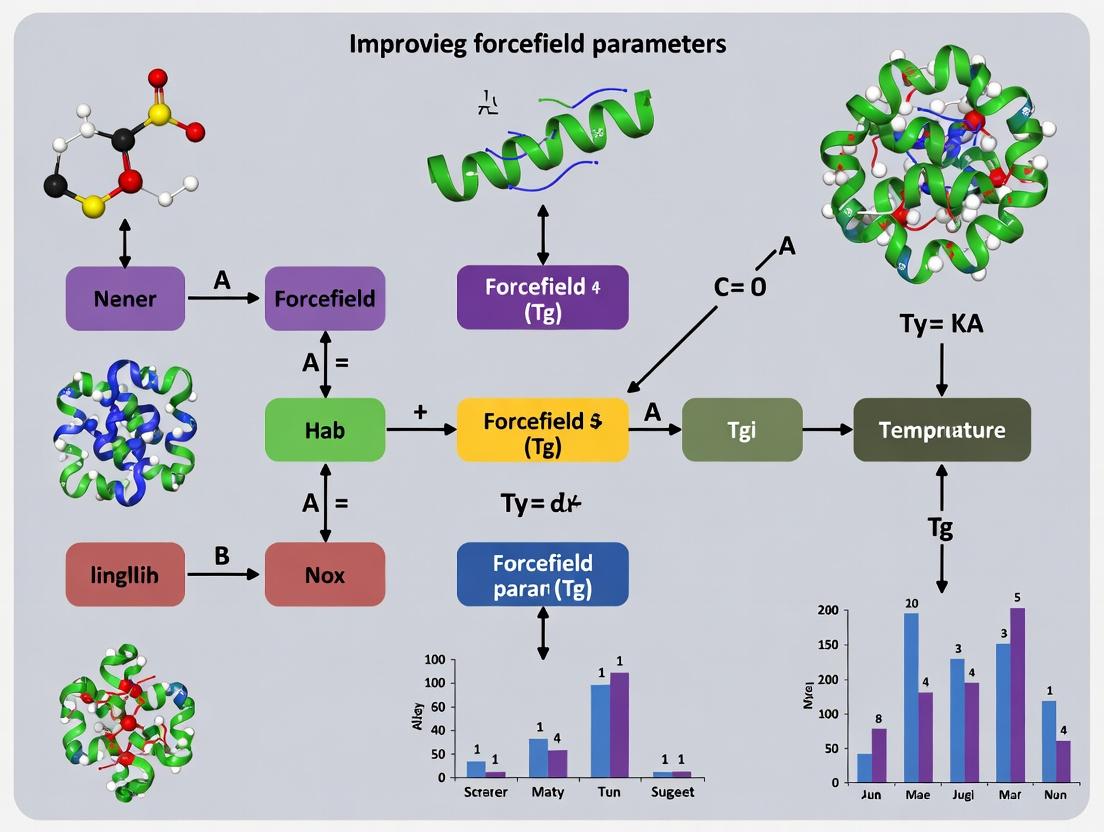
This article provides a comprehensive guide for computational researchers on the critical role of forcefield parameter optimization for simulating the glass transition temperature (Tg) of amorphous solid dispersions (ASDs) and...
From Atom to Glass: Advanced Forcefield Parameterization for Accurate Glass Transition Temperature (Tg) Predictions in Drug Development
Abstract
This article provides a comprehensive guide for computational researchers on the critical role of forcefield parameter optimization for simulating the glass transition temperature (Tg) of amorphous solid dispersions (ASDs) and other pharmaceutical materials. We explore the foundational theory linking molecular interactions to Tg, detail cutting-edge parameterization and simulation methodologies, address common pitfalls in calibration and convergence, and establish robust validation frameworks against experimental data. By synthesizing these four intents, this guide aims to enhance the predictive power of molecular dynamics simulations for rational drug formulation and stability assessment.
The Science Behind Tg: Understanding the Link Between Molecular Interactions and the Glass Transition
Technical Support & Troubleshooting Center
FAQs & Troubleshooting Guides
Q1: My simulated Tg value is consistently 20-30K higher than the experimental DSC data. What forcefield parameters are most likely the cause?
A: This common discrepancy often originates from inaccuracies in torsional potential parameters or van der Waals (vdW) interactions. Focus on:
- Torsional Dihedral Parameters: The energy barriers for intramolecular rotation are frequently overestimated in generic forcefields (e.g., GAFF). Use quantum mechanical (QM) calculations to refine dihedral parameters for your specific drug molecule's rotatable bonds.
- vdW *ε (well-depth) Parameters:* Overly strong non-bonded interactions can artificially increase Tg. Consider systematic scaling of ε for specific atom types (like aromatic carbons or heteroatoms) and validate against QM-derived interaction energies for molecular dimers.
- Protocol for Parameter Refinement:
- QM Target Data Generation: Perform DFT calculations (e.g., B3LYP/6-31G*) to obtain torsion energy profiles for all key dihedrals and interaction energies for molecular dimer conformations.
- Forcefield Optimization: Use a parameter optimization tool (e.g.,
foyerorparmed) to adjust dihedral coefficients and vdW parameters to minimize the difference between forcefield and QM energies. - Validation Simulation: Run a new Tg simulation (see protocol below) with the refined parameters.
Q2: During cooling rate simulations, my amorphous system crystallizes before reaching Tg. How can I prevent this?
A: Unphysical crystallization indicates that the forcefield may over-stabilize the crystalline form or that the simulated cooling rate is still too slow.
- Troubleshooting Steps:
- Increase the Cooling Rate: While experimentally unrealistic, simulate a faster quench (e.g., 100 K/ns instead of 10 K/ns) to bypass the crystallization event. The goal is to obtain an amorphous glass for analysis.
- Check Crystal Structure Stability: Simulate the known crystal structure (from CSD) at 300K. If it does not melt or distort, your vdW or electrostatic parameters may be too strong, over-stabilizing the lattice. Consider refining partial charges via the RESP method.
- Amorphization Protocol: Start from a high-temperature (e.g., 500K) molten state, then use a very fast quench (500 K/ns) to 300K to generate your initial amorphous configuration.
Q3: How do I accurately calculate Tg from my molecular dynamics (MD) simulation trajectory, and why do different properties yield different values?
A: Tg is identified by a change in the slope of a temperature-dependent property. The variance arises from different properties' sensitivity to dynamical vs. volumetric transitions.
- Recommended Protocol:
- Simulation Run: Start with an equilibrated amorphous system at high temperature (e.g., 50K above expected Tg).
- Cooling Stage: Use the NPT ensemble (e.g., Parrinello-Rahman barostat) to cool the system in stages (e.g., 10-20K decrements). Equilibrate for 2-5 ns at each temperature, then produce a 5-10 ns production run.
- Data Analysis: Calculate the following for each temperature:
- Specific Volume (or Density)
- Enthalpy (H = U + PV)
- Mean Squared Displacement (MSD) or diffusion coefficient.
- Fitting: Plot property vs. T. Fit linear regressions to the high-T (ruby state) and low-T (glassy state) data. Tg is the intersection point.
Table 1: Tg Values from Different Simulation Properties
| System (Model API) | Cooling Rate (K/ns) | Tg from Specific Volume (K) | Tg from Enthalpy (K) | Tg from Diffusion Crossover (K) | Experimental DSC (K) |
|---|---|---|---|---|---|
| Indomethacin (GAFF) | 10 | 328 | 331 | 319 | 315 |
| Felodipine (GAFF2) | 20 | 302 | 305 | 291 | 297 |
| Indomethacin (Refined FF) | 10 | 317 | 319 | 312 | 315 |
Q4: What is the most reliable experimental protocol to validate my simulated Tg?
A: Use Modulated Differential Scanning Calorimetry (mDSC).
- Detailed Experimental Protocol:
- Sample Preparation: Prepare 3-5 mg of the amorphous drug. Generate it via melt-quenching (heat 20K above melting point, cool in liquid N₂) or spray drying.
- mDSC Run: Load sample in a hermetic Tzero pan. Perform a heat-cool-heat cycle under N₂ purge.
- Method:
- Equilibration at 0°C.
- First Heat: 0°C to 150°C at 2°C/min, modulation ±0.5°C every 60s.
- Cooling: 150°C to 0°C at 5°C/min (unmodulated).
- Second Heat: Identical to first heat.
- Analysis: Analyze the reversing heat flow signal from the second heating ramp. Tg is identified as the midpoint of the step transition. This minimizes confounding effects from enthalpy relaxation.
The Scientist's Toolkit: Research Reagent & Materials
Table 2: Essential Materials for Tg Simulation & Validation
| Item | Function/Brief Explanation |
|---|---|
| High-Purity API (>99%) | Essential for both experimental DSC and for building accurate simulation models without impurity effects. |
| Molecular Dynamics Software (GROMACS, LAMMPS) | Engine for running the cooling simulations. GROMACS is recommended for its efficiency in temperature equilibration. |
| Forcefield Parameterization Tool (foyer, parmed) | Used to apply or refine forcefield parameters (dihedrals, vdW) for the drug molecule. |
| Quantum Chemistry Software (Gaussian, ORCA) | Generates target data (torsion scans, dimer energies) for forcefield refinement. |
| Modulated DSC (mDSC) Instrument | Gold-standard for experimental Tg measurement, separates reversing heat flow from kinetic events. |
| Hermetic Aluminum DSC Pans | Prevents sample dehydration or degradation during the mDSC scan, crucial for accurate Tg. |
| Spray Dryer (e.g., Buchi Mini B-290) | Alternative method to produce amorphous solid dispersions for stability and solubility experiments. |
| Vapor Sorption Analyzer (DVS Intrinsic) | Measures moisture-induced Tg depression (plasticization), a key stability factor to simulate. |
Visualizations
Tg Simulation & Forcefield Refinement Workflow
Tg Definition & Link to Product Performance
Technical Support Center
Troubleshooting Guides
Issue 1: Simulated Tg is consistently lower/higher than experimental Tg.
- Possible Cause: Inadequate torsional parameters for backbone or sidechain dihedrals, leading to under/over estimation of energy barriers to rotation.
- Troubleshooting Steps:
- Perform a dihedral parameter scan using quantum mechanical (QM) calculations on representative fragments.
- Compare the QM energy profile with the forcefield energy profile for the same dihedral.
- Refit the torsional parameters (V1, V2, V3 phases) to match the QM energy barrier heights and minima.
- Re-run the Tg simulation protocol with the refined parameters.
- Validation: Calculate the backbone dihedral angle distributions (Ramachandran plots) before and after parameter refinement to ensure they match ab initio MD or crystal structure data.
Issue 2: Density of the amorphous cell is incorrect, affecting volumetric properties.
- Possible Cause: Incorrect Lennard-Jones (LJ) parameters (sigma, epsilon) for van der Waals interactions, or unbalanced partial atomic charges.
- Troubleshooting Steps:
- Calculate the cohesive energy density (CED) from simulation and compare to experimental estimates.
- Perform liquid-state property simulations (e.g., density, enthalpy of vaporization) for small molecule analogs of polymer repeat units or the system of interest.
- Iteratively adjust LJ parameters (prioritizing epsilon) to match target liquid densities and enthalpies of vaporization within a 5% error margin.
- Re-evaluate partial charges using a consistent method (e.g., RESP fitting) at an appropriate QM theory level.
- Validation: Run a new NPT ensemble simulation for the bulk system and compare the final density trajectory average to the experimental value.
Issue 3: System dynamics are too fast/slow, evidenced by incorrect diffusion coefficients or relaxation times.
- Possible Cause: Friction or inertial effects are off due to improper coupling to a thermostat/barostat, but more fundamentally, the overall energy landscape is scaled incorrectly due to forcefield limitations.
- Troubleshooting Steps:
- Verify thermostat/barostat coupling constants (taut, taup) are set appropriately for the system size (typically 0.1-1.0 ps).
- Calculate the mean squared displacement (MSD) of backbone or center-of-mass atoms. If dynamics are uniformly skewed, the issue is likely fundamental forcefield parameters.
- Benchmark short-time dynamical properties (e.g., dielectric relaxation) against experimental data.
- Consider if the non-bonded interaction cut-off is handled correctly (with long-range corrections) to avoid artifacts.
- Validation: Compare the simulated viscosity (from Green-Kubo relation or Einstein relation) or diffusion constant to experimental NMR or light scattering data.
Frequently Asked Questions (FAQs)
Q1: What is the most sensitive forcefield parameter for Tg prediction in polymers? A1: Torsional (dihedral) parameters are often the most sensitive for Tg prediction. Tg is linked to segmental mobility, which is governed by the energy barriers to internal rotation. Inaccurate dihedral potentials directly skew the temperature dependence of dynamics.
Q2: How much deviation between simulated and experimental Tg is considered acceptable? A2: There is no universal standard, but a common benchmark in recent literature is to aim for a deviation within ±10-20 K. However, the goal should be systematic improvement to minimize this error, as it indicates the forcefield's ability to capture the true energy landscape.
Q3: Should I refit all parameters or just a specific set? A3: Start with a targeted approach. Refit torsional parameters for the rotatable bonds most critical to glass formation first. Then, if necessary, adjust LJ parameters for key atom types to correct volumetric properties. A full reparameterization is a major undertaking requiring extensive QM and liquid-state data.
Q4: What is the minimum simulation time and system size needed for a reliable Tg estimate? A4: This is system-dependent. As a rule of thumb, use >100 repeat units for linear polymers and simulate for at least 50-100 ns of production MD after equilibration. The cooling rate in the simulation is also critical; typical computational rates are 0.1-1 K/ns, much faster than experiment.
Q5: How do I choose the right QM method for parameter refitting? A5: Use a method that balances accuracy and cost. For organic molecules and polymers, DFT methods like B3LYP with a 6-31G(d) basis set are a common starting point. Higher-level methods (e.g., MP2, CCSD(T)) can be used for validation on smaller fragments.
Table 1: Common Forcefield Parameter Deficiencies and Their Impact on Tg Simulations
| Deficiency | Affected Property | Typical Symptom in Tg Simulation | Primary Correction Method |
|---|---|---|---|
| Weak Torsional Barriers | Segmental Dynamics | Tg too low, dynamics too fast | QM-guided dihedral refitting |
| Strong Torsional Barriers | Segmental Dynamics | Tg too high, dynamics too slow | QM-guided dihedral refitting |
| Underestimated LJ Attraction (epsilon) | Cohesive Energy Density | Density too low, Tg often too low | Match to liquid density & ΔHvap |
| Overestimated LJ Attraction (epsilon) | Cohesive Energy Density | Density too high, Tg often too high | Match to liquid density & ΔHvap |
| Incorrect Partial Charges | Intermolecular Interactions | Erroneous dielectric response, skewed polarity | Consistent charge derivation (e.g., RESP) |
Table 2: Benchmarking Data for Polystyrene Tg Simulation (Example)
| Forcefield | Simulated Tg (K) | Experimental Tg (K) | Error (K) | Density at 300K (g/cm³) | Ref Cooling Rate (K/ns) |
|---|---|---|---|---|---|
| GAFF (Original) | 325 ± 5 | 373 | -48 | 0.98 ± 0.02 | 1.0 |
| OPLS-AA | 370 ± 7 | 373 | -3 | 1.04 ± 0.02 | 1.0 |
| Refined TraPPE | 375 ± 5 | 373 | +2 | 1.05 ± 0.01 | 1.0 |
Experimental Protocols
Protocol 1: QM-Driven Torsional Parameter Refinement
- Fragment Selection: Isolate a molecular fragment containing the rotatable bond of interest (e.g., a dimer for a polymer backbone dihedral).
- QM Geometry Optimization: Optimize the fragment geometry at the B3LYP/6-31G(d) level.
- QM Energy Scan: Perform a relaxed potential energy surface scan by rotating the dihedral angle in 10-15° increments. At each step, re-optimize all other degrees of freedom.
- Energy Fitting: Fit the classical forcefield dihedral equation (V1[1+cos(φ)] + V2[1-cos(2φ)] + V3[1+cos(3φ)]...) to the QM energy profile using a least-squares fitting procedure.
- Validation: Test the new parameters on a small oligomer in the gas phase to ensure they reproduce the QM conformational preferences.
Protocol 2: Tg Determination via Cooling Simulation
- System Preparation: Build an amorphous cell with at least 100 chains, each with sufficient degree of polymerization (e.g., 50-100 monomers). Use periodic boundary conditions.
- Equilibration: Perform a multi-step equilibration:
- Energy minimization (steepest descent, conjugate gradient).
- NVT equilibration at high temperature (e.g., 500 K) for 1-5 ns.
- NPT equilibration at high temperature for 5-10 ns to stabilize density.
- Production Cooling: Using the NPT ensemble, cool the system linearly from high temperature to low temperature (e.g., 500 K to 200 K) at a constant rate (e.g., 0.5 K/ns). Save trajectory frames frequently.
- Data Analysis: Calculate the specific volume (or density) for each temperature from the trajectory. Fit the high-T (rubbery) and low-T (glassy) data with linear regressions. The intersection point of the two lines defines the simulated Tg.
Visualization: Workflow and Pathway Diagrams
Tg Forcefield Refinement Workflow
Dihedral Energy Barrier Impact on Dynamics
The Scientist's Toolkit: Research Reagent Solutions
| Item | Function in Tg/Forcefield Research |
|---|---|
| Quantum Chemistry Software (e.g., Gaussian, ORCA, GAMESS) | Performs ab initio or DFT calculations to generate target data (energy scans, partial charges, dipole moments) for forcefield parameterization. |
| Molecular Dynamics Engine (e.g., GROMACS, LAMMPS, AMBER, OpenMM) | Simulates the cooling, equilibration, and production runs for Tg calculation and property prediction using classical forcefields. |
| Forcefield Parameterization Tool (e.g., ForceBalance, Paramecium, ffTK) | Assists in the systematic optimization of forcefield parameters to match quantum mechanical and experimental target data. |
| Polymer Builder & Amorphous Cell Generator (e.g., PACKMOL, Moltemplate, Materials Studio) | Creates realistic initial configurations of bulk polymer systems for simulation, ensuring proper chain packing and periodicity. |
| Trajectory Analysis Suite (e.g., MDAnalysis, VMD, MDTraj) | Analyzes simulation outputs to calculate key properties: density, radius of gyration, mean squared displacement (MSD), dihedral distributions, and volumetric temperature dependence for Tg. |
| Benchmark Experimental Data (e.g., NIST TRC Data, Polymer Handbook) | Provides reliable experimental Tg, density, and thermodynamic data for specific polymers, serving as the essential ground truth for forcefield validation and refinement. |
Troubleshooting Guides & FAQs
FAQ 1: My simulated glass transition temperature (Tg) for a polymer is consistently 20-30K lower than the experimental value. Which force field parameters should I prioritize for refinement?
- Answer: A systematically low Tg often points to an underestimation of backbone torsional energy barriers or insufficient van der Waals (vdW) repulsion, allowing chains to collapse too easily. Prioritize:
- Torsional Dihedrals: Use quantum mechanics (QM) scans of model compounds (e.g., dimer or trimer) to recalibrate the dihedral parameters (V1, V2, V3) for the polymer backbone. Increasing these barriers raises the energy cost for segmental rotation.
- Van der Waals (vdW) Repulsion: Check the Lennard-Jones (LJ) parameters for key atom types. Slightly increasing the repulsive term (ε or σ) for backbone atoms can reduce excess free volume and raise Tg. Validate against QM-calculated conformational energies and crystal structures if available.
FAQ 2: During API (Active Pharmaceutical Ingredient) dissolution simulation, I observe unrealistic aggregation or premature crystallization. What non-bonded interaction could be the culprit?
- Answer: This is typically a sign of inaccurate electrostatic or vdW interactions between API molecules and solvent (often water).
- Electrostatics: Ensure partial atomic charges (e.g., from RESP/HF/6-31G* or similar) accurately represent the molecular electrostatic potential (ESP) of the API. Incorrect charges distort solute-solvent hydrogen bonding and dipole-dipole interactions. Consider using a polarizable force field or adjusting charge scaling if using a fixed-charge model.
- vdW Cross-Terms: The combination rules (e.g., Lorentz-Berthelot) for API-water vW interactions may be inadequate. Use QM dimer interaction energies (e.g., from SAPT) to refine specific LJ cross-term parameters (σij, εij).
FAQ 3: How can I systematically parameterize a new torsion angle for a specific functional group in my API?
- Answer: Follow this QM-to-MM protocol:
- Model Compound Selection: Choose a small molecule fragment containing the torsion of interest, with capped terminals (e.g., methyl groups) to isolate the effect.
- QM Conformational Scan: Perform a relaxed potential energy surface (PES) scan by rotating the dihedral in 10-15° increments at a high theory level (e.g., B3LYP/6-311+G or MP2/cc-pVTZ). Include geometry optimization at each step.
- MM Parameter Fitting: In your simulation software (e.g., CHARMM, AMBER, GROMACS), set up an identical torsion scan using initial force field guesses.
- Optimization: Iteratively adjust the torsional force constants (Vn) and phase shifts (γ) in the MM potential energy function (E_tors = Σ [Vn/2] [1 + cos(nφ - γ)]) to minimize the RMSD between the QM and MM PES curves.
FAQ 4: When simulating polymer-drug blends, the components phase separate too rapidly or not at all. How do I diagnose the issue?
- Answer: This indicates a mismatch in the cohesive energy density, driven by vdW and electrostatic interactions.
- Check Mixing Enthalpy: Calculate the enthalpy of mixing (ΔHmix) from short simulations. A large, unrealistic positive value suggests overly repulsive cross-interactions.
- Refine Cross-interaction vdW Parameters: Use the experimental blend morphology (homogeneous vs. phase-separated) as a target. Adjust the LJ cross-term parameters (εij) between key polymer and API atom types using a free energy perturbation (FEP) or iterative Boltzmann inversion (IBI) approach to match observed miscibility.
- Verify Electrostatic Complementarity: Ensure the charge distributions on the polymer and API allow for favorable intermolecular interactions (e.g., H-bonding, dipole alignment) if expected.
Data Presentation
Table 1: Common Force Field Parameter Deficiencies and Their Impact on Tg Prediction
| Deficiency | Typical Effect on Simulated Tg | Primary Correction Method | Target Accuracy (vs. Expt.) |
|---|---|---|---|
| Underestimated Backbone Torsional Barrier | Tg too Low (>15K error) | QM PES Scan Refinement of V1, V2, V3 | ±5 K |
| Overly Lennard-Jones Attractive vdW | Tg too Low | Increase repulsive ε/σ for backbone atoms; match QM dimer profiles | ±5 K |
| Inaccurate Partial Atomic Charges | Unpredictable Tg shift | Re-derive charges to fit QM ESP (e.g., RESP) | ±10 K |
| Incorrect Bond/Angle Stiffness | Affects thermal expansion | Refine via QM vibrational frequencies | ±7 K |
Table 2: Recommended QM Methods for Parameterization Input Data
| Target Interaction | Recommended QM Level | Primary Output for Fitting | Validation Metric |
|---|---|---|---|
| Torsional PES | B3LYP-D3/6-311+G(d,p) or MP2/cc-pVTZ | Dihedral Energy Profile | RMSD < 0.5 kcal/mol |
| Non-bonded Dimer | ωB97X-D/def2-TZVP or SAPT2+/aug-cc-pVTZ | Interaction Energy vs. Distance | RMSD < 0.3 kcal/mol |
| Electrostatic Potential | HF/6-31G* (for RESP) | Grid-Based ESP | R^2 > 0.99 |
| Crystal/Lattice | PBE-D3(BJ) | Unit Cell Parameters, Cohesive Energy | Density error < 2% |
Experimental Protocols
Protocol A: QM-Driven Torsional Parameter Refinement for a Polymer Backbone
- Model Preparation: Construct a chemical dimer of the polymer repeat unit, capping the terminal bonds with methyl groups (or other appropriate capping atoms).
- QM Geometry Optimization: Fully optimize the geometry of the model compound at the HF/6-31G* level to obtain a stable starting conformation.
- PES Scan: Perform a relaxed rotational scan for the central dihedral angle of interest. Use the B3LYP-D3/6-311+G(d,p) level of theory. Constrain the target dihedral in 15° increments from 0° to 360°, allowing all other coordinates to relax at each step.
- Energy Processing: Extract the single-point energy at each step. Reference all energies to the global minimum (set to 0 kcal/mol).
- MM Scan Setup: Recreate the identical model compound in your molecular dynamics suite. Apply the initial force field parameters.
- Fitting: Using a scripting tool (e.g.,
parmedorcharmm), perform a least-squares fitting of the torsional force constants (Vn) in the MM equation to minimize the difference between the QM and MM energy profiles. The phase shifts (γ) are typically fixed at 0° or 180°.
Protocol B: Validating vdW Parameters via Crystal Structure Prediction
- System Selection: Choose a small molecule API or polymer repeat unit with a known, stable crystal structure from the Cambridge Structural Database (CSD).
- Force Field Assignment: Apply the candidate force field parameters to the molecule.
- Crystal Simulation: Build the experimental crystal unit cell in the simulation software. Run a short (100 ps) NPT equilibration at the experimental temperature and pressure (e.g., 298 K, 1 atm).
- Data Collection: Over a subsequent 1 ns NPT production run, calculate the average unit cell parameters (a, b, c, α, β, γ) and density.
- Analysis: Compare simulated and experimental density and cell lengths. A robust parameter set should reproduce the experimental density within 1-2% and cell lengths within 3-5%. Significant deviations, especially systematic contraction/expansion, indicate need for vdW (and possibly electrostatic) recalibration.
Visualizations
Diagram 1: Workflow for Tg Force Field Parameter Improvement
Diagram 2: Key Interactions Governing Polymer & API Behavior
The Scientist's Toolkit: Research Reagent Solutions
Table 3: Essential Tools for Force Field Parameterization
| Item | Function/Description | Example Software/Package |
|---|---|---|
| Quantum Chemistry Software | Performs electronic structure calculations to generate target data (PES, ESP, dimer energies). | Gaussian, ORCA, PSI4, GAMESS |
| Force Field Development Suite | Fits MM parameters to QM data and manages parameter files. | ForceFieldKit (FFTK), parmed, fftool, CHARMM/OpenMM |
| Molecular Dynamics Engine | Runs simulations with new parameters to test against macroscopic observables. | GROMACS, LAMMPS, NAMD, AMBER, CHARMM |
| Automation & Scripting Tool | Automates repetitive tasks like batch simulations, data extraction, and fitting. | Python (MDAnalysis, mdtraj), Bash, Jupyter Notebooks |
| Validation Database | Provides experimental reference data for crystal structures, densities, and thermodynamic properties. | Cambridge Structural Database (CSD), NIST ThermoML, PubChem |
| Visualization Software | Inspects molecular conformations, interactions, and simulation trajectories. | VMD, PyMol, ChimeraX |
Technical Support Center: Troubleshooting & FAQs
FAQ 1: My simulated Tg is consistently 20-50K lower than the experimental value, regardless of the cooling rate I use. Which forcefield parameter is most likely the culprit? Answer: This systematic under-prediction is a well-documented issue, often traced to torsional parameters. Bonded terms, specifically the dihedral potentials governing backbone rotations, are the primary suspect. The energy barriers for rotations are frequently overestimated, making the polymer chains too flexible. You should first perform a torsional potential energy scan on your polymer's key dihedral angles using quantum mechanical (QM) calculations and compare the profiles to those produced by your forcefield. Refitting the dihedral parameters (specifically the k and n terms) to match the QM scan is the recommended correction. GAFF and early OPLS versions are particularly prone to this.
FAQ 2: During the density equilibration step before the cooling cycle, my amorphous cell collapses or shows unrealistic density fluctuations. What protocol adjustments can stabilize this phase? Answer: Unstable pre-cool equilibration typically indicates issues with the initial structure or the equilibration protocol. Follow this adjusted workflow:
- Initial Packing: Use a higher target density (e.g., +10-15%) than the expected final density to compensate for initial relaxation.
- Staged Minimization: Perform energy minimization in stages: first with only bonded terms, then with van der Waals (vdW), and finally with full electrostatics.
- Gentled NPT Equilibration: Use a stepwise, gentle NPT equilibration:
- 100 ps at high pressure (e.g., 1000 bar) and your simulation temperature (Tg + 100K).
- 100 ps at 500 bar.
- 500 ps at 1 bar, using a semi-isotropic pressure coupling for bulk systems.
- Thermostat/Barostat Choice: For CHARMM/CGenFF, use the Nosé-Hoover thermostat and Parrinello-Rahman barostat. For GAFF/OPLS, the Berendsen barostat (for equilibration only) followed by the Parrinello-Rahman barostat for production can be more stable.
FAQ 3: I observe "glass" formation at unexpectedly high temperatures during simulation, leading to an overestimation of Tg. Could this be a forcefield artifact related to nonbonded interactions? Answer: Yes, this is commonly an artifact of overly attractive nonbonded van der Waals (vdW) interactions, specifically the Lennard-Jones (LJ) parameters. Overly deep LJ wells increase inter-chain cohesion, reducing chain mobility prematurely and artificially raising Tg. This is a known challenge in some older OPLS-AA parameter sets for certain polymers. To troubleshoot:
- Check the LJ 1-4 scaling rules. Different forcefields apply different scaling factors (e.g., OPLS uses 0.5, GAFF uses 0.5 for LJ but 0.8333 for electrostatic 1-4 interactions). Inconsistency here can cause rigidity.
- Consider using a modified vdW cutoff (e.g., 1.2-1.4 nm) with long-range dispersion corrections (e.g., energy and pressure tail corrections) to better account for long-range interactions. Disabling these corrections can sometimes lead to artificially high cohesion.
FAQ 4: How do I properly handle partial charge assignment for a novel drug-like molecule when using CGenFF or GAFF for Tg prediction of a polymer/drug composite? Answer: Accurate partial charges are critical for mixed systems. Follow this protocol:
- For CGenFF: Use the CGenFF program (server or standalone) to obtain initial charges. It provides a penalty score; aim for penalties < 50 for most atoms, and < 20 for key functional groups. For any penalty > 50, you must perform QM-based charge fitting (e.g., using the HF/6-31G* level) to refine the parameters, then submit them for incorporation into the stream file.
- For GAFF: Use the Antechamber suite with the AM1-BCC charge model (
antechamber -c bcc) as the standard. For higher accuracy, especially for conjugated systems, consider deriving restrained electrostatic potential (RESP) charges from an HF/6-31G* calculation usingresporMultiwfn. - Validation: Always calculate the dipole moment of your molecule from the QM optimization and compare it to the dipole moment derived from the assigned partial charges in the forcefield. A deviation > 20% warrants re-evaluation.
Table 1: Benchmarking Key Forcefields for Tg Prediction of Polystyrene (PS)
| Forcefield | Predicted Tg (K) | Experimental Ref (K) | Deviation (K) | Key Strengths | Key Weaknesses |
|---|---|---|---|---|---|
| GAFF2 | 340 - 360 | ~373 | -13 to -33 | Automated for organic molecules; good for blends. | Underestimates barriers; LJ parameters not polymer-optimized. |
| OPLS-AA | 390 - 410 | ~373 | +17 to +37 | Excellent for liquids & pure organics; validated. | Can overestimate cohesion; torsions may need refitting for polymers. |
| CHARMM36 | 365 - 380 | ~373 | -8 to +7 | Balanced bonded/nonbonded terms; robust for biopolymers. | Parameterization limited for many synthetic polymers. |
| CGenFF | 370 - 385 | ~373 | -3 to +12 | Consistent with CHARMM; good for drug-like molecules. | Similar polymer limitations as CHARMM; requires careful charge assignment. |
Table 2: Essential Research Reagent Solutions & Computational Tools
| Item / Software | Function in Tg Simulation | Key Consideration |
|---|---|---|
| Polymer Builder (e.g., Packmol) | Creates initial amorphous polymer cells with correct density and chain packing. | Ensure no overlapping atoms and periodic boundary continuity. |
| Quantum Chemistry Software (Gaussian, ORCA) | Provides reference data for torsional scans & RESP charges for parameter derivation/validation. | Level of theory (e.g., HF/6-31G*) must match forcefield development. |
| MD Engine (GROMACS, NAMD, LAMMPS, OpenMM) | Performs the molecular dynamics simulation (equilibration, cooling, production). | Must support the specific forcefield format and all required algorithms. |
| VMD / PyMOL / ChimeraX | Visualization of trajectories to check for structural anomalies, phase separation, or collapse. | Critical for qualitative validation before quantitative analysis. |
| Python/MATLAB with MD Analysis Libs (MDAnalysis, MDTraj) | For trajectory analysis: density vs. T, mean squared displacement (MSD), radial distribution function (g(r)). | Custom scripts are often needed for precise Tg calculation from V-T data. |
Experimental Protocol: Standard Tg Prediction via MD Simulation
- System Construction: Build an amorphous cell containing 10-20 polymer chains (degree of polymerization ~20-40) using packing software. For blends, ensure the correct mass/volume ratio.
- Parameterization: Assign forcefield parameters (bonds, angles, dihedrals, LJ, charges). For non-standard molecules, derive/validate parameters via QM as per FAQ 4.
- Energy Minimization: Use steepest descent followed by conjugate gradient algorithms until force tolerance < 1000 kJ/mol/nm.
- Stepwise Equilibration:
- NVT: Equilibrate for 1 ns at high temperature (e.g., 500 K) using a V-rescale thermostat.
- NPT: Equilibrate for 2-5 ns at 1 bar and the same high temperature using a Parrinello-Rahman barostat.
- Cooling Run: Using the equilibrated structure, run NPT simulations at successively lower temperatures (e.g., from 500 K to 200 K in 20-30 K increments). Simulate for 5-10 ns at each temperature to ensure equilibration (monitor density/time).
- Data Analysis: Calculate the average density for the last 2-3 ns at each temperature. Plot Density vs. Temperature. Fit two straight lines to the high-T (rubbery) and low-T (glassy) data. The intersection point is the simulated Tg.
Visualization: Workflow for Forcefield Benchmarking & Tg Prediction
Diagram Title: Tg Prediction and Forcefield Refinement Workflow
Visualization: Forcefield Parameter Influence on Tg
Diagram Title: How Forcefield Parameters Influence Simulated Tg
A Step-by-Step Guide to Parameter Optimization for Enhanced Tg Simulation Accuracy
Technical Support & Troubleshooting Center
FAQ 1: My QM geometry optimization fails to converge. What are the most common causes and solutions?
- Q: The optimization stops with "Maximum number of steps exceeded" or "Convergence failure."
- A: This is a frequent issue. Follow this protocol:
- Check Initial Geometry: Ensure your starting structure is reasonable (no unrealistic bond lengths/angles). Use a molecular builder or crystal structure.
- Method/Basis Set: The level of theory may be insufficient. Start with a robust method like B3LYP/6-31G(d) for organics. Increase basis set quality gradually.
- Step Size & Algorithm: Reduce the step size in the optimization routine. Switch optimization algorithms (e.g., from Berny to GEDIIS).
- Solvent Model: For charged or polar molecules, include an implicit solvent model (e.g., IEFPCM for water) from the start.
- Flat Potential Surfaces: For flexible molecules, consider performing a conformational search first, then optimize the lowest energy conformers.
FAQ 2: After deriving RESP charges, my MD simulation becomes unstable, with atoms flying apart. Why?
- Q: The simulation crashes with "Bond/Angle too large" errors shortly after energy minimization or dynamics start.
- A: This often indicates a charge derivation or parameter assignment issue.
- Charge Sum Validation: Ensure the sum of RESP charges for a neutral molecule is 0.000 ± 0.005. For ions, check the net charge.
- Missing Parameters: The derived charges may be assigned to atom types that lack bonded (bond, angle, dihedral) parameters in your chosen force field (e.g., GAFF2). Use tools like
antechamberandparmchk2to generate and inspect missing parameters. - Charge Restraint Strength: If you used strong restraints during RESP fitting to preserve symmetry or target values, the charges may be unnatural. Re-fit with weaker restraints (e.g., 0.0001 a.u.).
- Solvent Topology Mismatch: Verify that the water model used in MD (e.g., TIP3P) is compatible with the force field used for your solute.
FAQ 3: How do I validate the derived force field parameters before running long MD simulations for Tg prediction?
- Q: What are key validation calculations to ensure parameters are accurate and transferable?
- A: Implement this validation protocol:
- QM vs. MM Conformational Energy Comparison: Perform a relaxed potential energy surface scan for key dihedrals (e.g., rotatable bonds) at the QM level. Repeat the scan using the new MM parameters. Compare the profiles quantitatively (see Table 1).
- Liquid Property Simulation: For small molecule solvents, run a short (1-5 ns) NPT simulation to calculate density and enthalpy of vaporization. Compare to experimental values.
- Minimized Structure Comparison: Compare the MM-minimized structure (using new parameters) with the QM-optimized geometry. Calculate Root Mean Square Deviation (RMSD).
Table 1: Sample QM vs. MM Dihedral Scan Validation Data for a Toluene Derivative
| Dihedral Angle (Center Atoms) | QM Energy Barrier (kcal/mol) | MM Energy Barrier (kcal/mol) | Difference (Δ) |
|---|---|---|---|
| C-C-C-C (Alkyl Chain) | 3.1 | 2.9 | +0.2 |
| C-C-O-C (Ether Linkage) | 10.5 | 11.2 | -0.7 |
| Ph-O-C (Aryl-Ether) | 2.0 | 1.8 | +0.2 |
Experimental Protocol: QM to MM Parameter Derivation for a Novel Monomer
- QM Geometry Optimization: Use Gaussian/GAMESS/ORCA. Method: B3LYP/6-31G(d). Implicit solvent: IEFPCM (solvent=water). Optimize to tight convergence criteria.
- Frequency Calculation: At the same level of theory to confirm a true minimum (no imaginary frequencies) and obtain the Hessian.
- Electrostatic Potential (ESP) Calculation: Generate a high-quality ESP grid around the optimized molecule (e.g., using
Pop=MKorPop=ESPkeywords). - Charge Derivation: Use
antechamber(in AmberTools) orrespprogram. Input: QM log file. Perform a two-stage RESP fit with weak hyperbolic restraints (e.g., 0.0005 a.u.). - Bonded Parameter Assignment: Use
antechamberto assign GAFF2 atom types and generate a preliminary file. Useparmchk2to identify/generate missing force constants (bonds, angles, dihedrals) based on QM data. - Topology File Assembly: Combine the charge file and parameter file into a full topology file (e.g.,
.prmtopfor AMBER,.itpfor GROMACS) usingtleaporpdb2gmx. - Validation: Execute QM vs. MM conformational scans and liquid property tests as described in FAQ 3.
Workflow Diagram: From QM to MD for Tg Prediction
Title: Full QM to MD Workflow for Force Field Development
The Scientist's Toolkit: Essential Research Reagent Solutions
Table 2: Key Software & Computational Tools for the Workflow
| Item Name | Category | Primary Function |
|---|---|---|
| Gaussian / ORCA / GAMESS | Quantum Chemistry Software | Perform QM calculations (optimization, frequency, ESP). |
| Antechamber / RESP | Parameterization Tool | Derive RESP charges and assign GAFF atom types. |
| Parmchk2 / MATCH | Parameterization Tool | Generate missing bonded parameters for force fields. |
| tLEaP (AmberTools) | MD Preprocessing | Assemble system topology, solvate, add ions. |
| GROMACS / OpenMM / NAMD | MD Engine | Run high-performance classical molecular dynamics simulations. |
| CP2K / VASP (for QM/MM) | Advanced QM/MM | Perform ab initio MD or QM/MM simulations for validation. |
| MDAnalysis / cpptraj | Analysis Library | Analyze MD trajectories (density, RMSD, energy plots). |
| Molten Salt Tg Database | Reference Data | Experimental Tg values for validation (e.g., NIST). |
Technical Support Center
Troubleshooting Guides & FAQs
Q1: During Quantum Mechanics (QM) data fitting, my derived partial charges result in unrealistic electrostatic potentials. What could be the cause and how do I resolve it? A: This often stems from an improper balance between fitting to the electrostatic potential (ESP) and maintaining molecular symmetry. Implement a restrained ESP (RESP) fitting protocol. Use a two-stage fit with hyperbolic restraint for heavy atoms and a weaker restraint for hydrogens. Ensure your QM calculation (e.g., at the HF/6-31G* level) uses a dense grid for the ESP map.
Q2: My simulated liquid density plateaus at a value 5-10% lower than the experimental target at 298 K, even after adjusting Lennard-Jones (LJ) parameters. What steps should I take? A: First, verify your simulation protocol: Ensure an NPT ensemble with a reliable barostat (e.g., Parrinello-Rahman) is used, with a production run of at least 20 ns. If the protocol is correct, systematically adjust LJ parameters. Increase the atom's sigma (σ) parameter incrementally by 0.01 Å, as density is more sensitive to σ than epsilon (ε). Re-simulate and compare. See Table 1 for sensitivity analysis.
Q3: The calculated heat of vaporization (ΔHvap) is consistently overestimated across a series of analogous compounds. Which parameter set should be prioritized for adjustment? A: Overestimation of ΔHvap indicates insufficient intermolecular attraction in the liquid phase, often due to understated LJ well depth (ε) or insufficiently negative partial charges. Prioritize scaling the ε parameters for non-polar groups by up to 5%. For polar molecules, re-evaluate the charge derivation strategy. Ensure your QM reference data (for charges) and experimental ΔHvap are both at the same temperature (typically 298 K).
Q4: How do I manage parameter conflicts when fitting to multiple target properties (density & ΔHvap) simultaneously? A: Adopt a hierarchical, iterative optimization loop. First, obtain initial charges from QM. Then, optimize LJ parameters against liquid density alone. With the new LJ set, recalculate ΔHvap. If a discrepancy remains, make minimal, chemically-justifiable adjustments to charges (e.g., scaling within ±0.05 e) and iterate. Use a weighted objective function in automated fitting scripts to balance the influence of each property.
Q5: After parameter derivation, my Tg simulation trend across a polymer series does not match experiment. Where could the error be? A: Tg is sensitive to torsional barriers and non-bonded interactions. Ensure the torsional potentials around rotatable bonds are derived from high-level QM scans (e.g., MP2/cc-pVTZ) and are not over-fitted to single-molecule data. Cross-validate your final parameters by simulating a dimer or trimer to check for reasonable interaction energies and geometries not included in the original fit.
Data Presentation
Table 1: Sensitivity of Target Properties to Force Field Parameters
| Parameter Adjusted | Primary Effect on Density | Primary Effect on ΔHvap | Recommended Adjustment Step |
|---|---|---|---|
| LJ Sigma (σ) | High Sensitivity | Moderate Sensitivity | ± 0.01 - 0.02 Å |
| LJ Epsilon (ε) | Moderate Sensitivity | High Sensitivity | ± 1 - 3% |
| Partial Charge (q) | Low Sensitivity | Very High Sensitivity | ± 0.02 - 0.05 e |
| Torsional Barrier (Vn) | Negligible | Negligible (for small molecules) | Use QM scan data directly |
Table 2: Example Optimization Results for a Model Compound (e.g., Ethylbenzene)
| Iteration | σ_CH3 (Å) | ε_CH3 (kJ/mol) | qCaryl (e) | Sim. Density (g/cm³) | Sim. ΔHvap (kJ/mol) | Exp. Density (g/cm³) | Exp. ΔHvap (kJ/mol) |
|---|---|---|---|---|---|---|---|
| Initial (GAFF) | 3.40 | 0.46 | -0.12 | 0.855 | 39.5 | 0.867 | 42.6 |
| After LJ Fit | 3.48 | 0.45 | -0.12 | 0.866 | 41.8 | 0.867 | 42.6 |
| After Charge Refinement | 3.48 | 0.45 | -0.145 | 0.867 | 42.5 | 0.867 | 42.6 |
Experimental Protocols
Protocol A: Deriving Partial Charges from QM Electrostatic Potential
- Geometry Optimization: Optimize the molecule's geometry at the HF/6-31G* theory level using Gaussian, ORCA, or similar software.
- ESP Calculation: Perform a single-point energy calculation on the optimized structure to generate the electrostatic potential on a Connolly surface (e.g., using the
pop=espkeyword in Gaussian). - Charge Fitting: Use the RESP or AM1-BCC method (via
antechamberin AmberTools orsqmin Open Babel) to fit atomic charges, restraining symmetric atoms to equivalence. - Validation: Plot the QM-derived ESP versus the ESP generated by the fitted charges; the R² should be >0.95.
Protocol B: Iterative Refinement of LJ Parameters Using Liquid Simulations
- Initial Setup: Build a cubic box containing 100-200 molecules using Packmol. Assign initial parameters (e.g., from GAFF).
- Equilibration: Run a 5 ns NPT simulation at 298 K and 1 bar using a thermostat (e.g., Nosé-Hoover) and barostat (Parrinello-Rahman).
- Production: Run a 20 ns NPT simulation, logging the density every 1 ps.
- Analysis: Calculate the average density over the last 15 ns. Compare to experimental value.
- Adjustment & Loop: Adjust σ for the atom contributing to the largest van der Waals volume by +0.01 Å if density is low (or vice versa). Return to Step 2. Iterate until within ±0.5% of experimental density.
Protocol C: Calculating Heat of Vaporization from Molecular Dynamics
- Liquid Phase Energy: From the final NPT liquid simulation (Protocol B), calculate the average potential energy per molecule (
E_liquid) from the last 15 ns of trajectory, excluding kinetic energy terms. - Gas Phase Energy: Simulate a single, isolated molecule in a large box. Run a 1 ns NVT simulation at 298 K. Calculate the average potential energy per molecule (
E_gas). - Compute ΔHvap: Apply the formula: ΔHvap = -(
E_liquid-E_gas) + RT, where R is the gas constant and T is 298 K. TheRTterm accounts for the PV work difference. - Error Calculation: Compare to the experimental ΔHvap. A systematic error >2 kJ/mol suggests a need for re-parameterization of non-bonded interactions.
Mandatory Visualization
Title: Force Field Parameter Derivation Workflow
Title: Resolving Multi-Property Parameter Conflicts
The Scientist's Toolkit
Table 3: Essential Research Reagent Solutions for Parameter Derivation
| Item | Function & Rationale |
|---|---|
| Quantum Chemistry Software (e.g., Gaussian, ORCA, PSI4) | Performs ab initio or DFT calculations to generate reference data (geometries, electrostatic potentials, torsional scans) for force field fitting. |
| Force Field Parameterization Tools (e.g., antechamber/AmberTools, fftk, LigParGen) | Automates the fitting of charges (RESP, AM1-BCC) and assists in generating initial LJ parameters from atom types. |
| Molecular Dynamics Engine (e.g., GROMACS, OpenMM, LAMMPS) | Simulates bulk liquid and gas phase systems to compute target properties (density, ΔHvap) for iterative parameter optimization. |
| System Builder (e.g., Packmol, PACKMOL-Memgen) | Creates initial simulation boxes with correct numbers of molecules and periodic boundary conditions for liquid simulations. |
| Analysis Scripts (Custom Python/MATLAB for ΔHvap, density) | Extracts and averages thermodynamic properties from simulation trajectories; crucial for calculating objective function values. |
| Experimental Data Repository (NIST ThermoML, DIPPR) | Provides reliable, peer-reviewed experimental data for liquid densities and enthalpies of vaporization as fitting benchmarks. |
Technical Support & Troubleshooting Center
Troubleshooting Guides
Issue 1: Training Failure of a Neural Network Potential (NNP)
- Symptoms: Loss function plateaus or diverges during training; poor energy/force predictions on validation set.
- Diagnosis: Check data quality, network architecture, and learning rate.
- Resolution: Ensure training data spans the relevant configurational space. Reduce learning rate or implement learning rate schedulers. Use a more suitable network architecture (e.g., shift from Behler-Parrinello to equivariant network for complex systems).
Issue 2: Automated Parameterization Tool Produces Unphysical Parameters
- Symptoms: Simulation instability (crashes), unrealistic bond lengths/angles, or grossly inaccurate property predictions (e.g., density).
- Diagnosis: Target property weights in the objective function may be imbalanced or reference data may be inconsistent.
- Resolution: Re-expertise the training set of quantum mechanics (QM) data for outliers. Adjust weights in the optimization function to prioritize critical properties like conformational energies. Implement parameter boundaries based on chemical intuition.
Issue 3: Poor Transferability of ML Potentials
- Symptoms: Potential works well for training data regimes but fails catastrophically for new molecular species or phases.
- Diagnosis: The MLP model lacks essential physical constraints and was trained on a narrow dataset.
- Resolution: Incorporate physical constraints (e.g., long-range electrostatics, dispersion corrections). Use active learning or adversarial sampling to iteratively expand the training dataset to cover new regions of interest.
Frequently Asked Questions (FAQs)
Q1: How do I choose between a classical force field and an ML potential for my Tg simulation? A: The choice depends on system size, time scale, and required accuracy. Use the decision table below.
Q2: My automated parameterization run is computationally expensive. How can I optimize it? A: Employ a multi-stage optimization: first optimize bonded parameters against simple QM data (torsion scans), then optimize partial charges and non-bonded terms against condensed-phase properties. Use efficient sampling algorithms and parallel computing.
Q3: How can I validate my newly parameterized force field before running long Tg simulations? A: Always run a battery of short validation simulations. Compare results to benchmark data as summarized in the table below.
Table 1: Comparison of Parameterization Approaches for Polymer Tg Simulation
| Approach | Typical System Size | Time Scale | Tg Prediction Error (vs. Exp.) | Key Software/Tools |
|---|---|---|---|---|
| Classical FF (GAFF) | 10^3 - 10^4 atoms | ~100 ns | 15-50 K | AMBER, GROMACS, LAMMPS |
| Classical FF (Optimized) | 10^3 - 10^4 atoms | ~100 ns | 5-20 K | ForceBalance, ParAMS, ffparaim |
| ML Potential (ANI, GAP) | 10^2 - 10^3 atoms | ~10 ns | 5-15 K | ASE, LAMMPS, QUIP |
| ML Potential (NequIP, MACE) | 10^2 - 10^3 atoms | ~10 ns | <10 K* | nequip, mace, allegro |
*Preliminary research; requires extensive training data.
Table 2: Essential Validation Suite for New Force Fields
| Property to Validate | Simulation Protocol | Target Accuracy | Purpose for Tg |
|---|---|---|---|
| Conformational Energies | Gas-phase DFT scans of dihedrals | < 1 kcal/mol | Correct chain flexibility |
| Density (Amorphous) | NPT ensemble, 300K, 100+ atoms | < 2% deviation | Reproduces packing |
| Cohesive Energy Density | NVT ensemble, calculation from energy | < 10% deviation | Affects thermal expansion |
| Glass Transition Temp (Tg) | Cooling at 1-10 K/ns, >50 atoms | < 20 K deviation | Primary metric |
Experimental Protocol: Iterative Force Field Optimization for Tg
- Initial Data Generation: Perform DFT (e.g., ωB97X-D/6-31G*) calculations on representative molecular fragments to obtain target data: conformational energies, partial charges (via RESP), and torsional profiles.
- Automated Parameterization: Use a tool like
ForceBalance. Define an objective function weighting the QM data (step 1) and experimental densities/Tg values from literature. - Validation Simulation: Parameterize a small amorphous polymer cell (e.g., 20 chains, 50 monomers each). Run a fast cooling simulation (e.g., 500 K to 100 K at 10 K/ns) in LAMMPS or GROMACS to get a preliminary Tg.
- Iteration: If validation fails, adjust weights in the objective function or add more specific QM data (e.g., non-covalent interactions) and return to step 2.
- Production Tg Simulation: Using the optimized parameters, run a larger system with slower cooling rates (1-5 K/ns) with multiple replicates to obtain a statistically robust Tg value.
Visualizations
Diagram 1: MLP Development & Validation Workflow
Diagram 2: Force Field Optimization Thesis Context
The Scientist's Toolkit: Research Reagent Solutions
| Tool / Reagent | Category | Primary Function in Tg Research |
|---|---|---|
ForceBalance |
Software | Optimizes classical FF parameters against QM & exp. data via systematic least-squares. |
PARAMS (AMS) |
Software | Allows gradient-based optimization of FF parameters within the Amsterdam Modeling Suite. |
ANI-2x Potentials |
ML Potential | Provides accurate, ready-to-use ML potentials for organic molecules containing H,C,N,O. |
NequIP / MACE |
ML Potential Framework | Trains equivariant graph NN potentials with high data efficiency & accuracy. |
LAMMPS |
MD Engine | Performs production molecular dynamics simulations, compatible with many FF/MLP formats. |
Atomic Simulation Environment (ASE) |
Python Library | Glue code for workflows: setting up calculations, training MLPs, and analyzing results. |
GPUMD |
MD Engine | Highly efficient MD engine designed specifically for machine-learned potentials. |
LibTorch |
Library | PyTorch C++ API; essential for deploying trained MLP models in MD codes like LAMMPS. |
Technical Support Center: Troubleshooting & FAQs
Frequently Asked Questions (FAQs)
Q1: Why do my simulated Tg values for PVP deviate significantly from experimental DSC data, even with widely used forcefields like GAFF or CHARMM? A: This is a central challenge in the field. The deviation often stems from inaccurate torsional potential parameters for the polymer backbone and side groups, and from insufficient representation of hydrogen bonding. The forcefield may not capture the specific conformational energetics of the pyrrolidone ring. Within the thesis context, this highlights the need for targeted reparameterization of dihedral terms and partial charges using quantum mechanical (QM) calculations on dimer or trimer fragments to improve agreement with experimental Tg.
Q2: During the cooling/heating cycle in MD, how do I determine when the system has reached equilibrium at each temperature step for Tg calculation? A: You must monitor both energy and density. A protocol is as follows: After a temperature change, run an NPT simulation until the system's potential energy and density plateau. Calculate the rolling average over the last 100-200 ps of the step. The system is equilibrated when the slope of this rolling average is statistically indistinguishable from zero (e.g., via linear regression). Insufficient equilibration is a major source of error in the specific heat or density vs. temperature plot.
Q3: My simulations of API-polymer dispersions show spontaneous phase separation, even for systems known to be miscible. What forcefield issue does this indicate? A: This typically indicates that the non-bonded interaction parameters (Lennard-Jones and Coulombic) between the API and polymer are too repulsive or not attractive enough. The forcefield likely overestimates the like-like interactions (API-API, polymer-polymer) over the unlike (API-polymer) interactions. This directly motivates the thesis work: improving cross-interaction parameters, often via fitting to QM-calculated interaction energies of model complexes or experimental mixing enthalpy data.
Q4: What is the recommended method to extract Tg from simulation data, and why does my V-T curve show two distinct kinks? A: The standard method is to perform a dual linear regression fit to the specific volume vs. temperature data from an NPT cooling simulation. The intersection point of the high-T (ruby/glassy) and low-T (glassy) linear fits defines Tg. Two distinct kinks often suggest:
- Insufficient system size or simulation time: The polymer chains are not fully relaxed.
- Poor equilibration: The system was not equilibrated properly at temperatures near the true Tg.
- Crystallization: For semi-crystalline polymers, the high-T kink may represent the melting point (Tm).
Q5: How can I validate my improved forcefield parameters beyond just matching a single experimental Tg value? A: A robust validation within the thesis should include comparison to multiple experimental observables. These can include:
- The density and thermal expansion coefficient at multiple temperatures.
- Radial distribution functions (RDFs) for key atom pairs (e.g., H-bond donors/acceptors).
- Chain conformation statistics (e.g., end-to-end distance, radius of gyration).
- Cohesive energy density.
Troubleshooting Guides
Issue: High Noise in Specific Volume vs. Temperature Data
- Possible Cause 1: Simulation time per temperature step is too short.
- Solution: Increase production run time at each temperature step (aim for >1-2 ns after equilibration). Use longer averaging windows.
- Possible Cause 2: System size is too small (short polymer chains, few chains).
- Solution: Increase the number of polymer chains and/or chain length to better represent bulk behavior. Monitor volume fluctuations relative to total volume.
Issue: Simulated Tg has an Unphysical Dependence on Cooling/Heating Rate
- Possible Cause: The simulation cooling/heating rate is far too high compared to experiment (typically 10^10 – 10^12 K/s in MD vs. 10 K/min in DSC).
- Solution: While a rate dependence is intrinsic to MD, you must ensure results are consistent across a small range of simulated rates. Perform simulations at 2-3 different cooling rates (e.g., 0.5, 1, and 2 K/ns) and extrapolate Tg to an "infinitely slow" rate using a logarithmic fit, if necessary for precise comparison.
Issue: Polymer Chain Collapses or Forms Unrealistic Conformations During Initial Packing
- Possible Cause: Poor initial configuration and/or overly aggressive energy minimization.
- Solution: Use a multi-step packing and equilibration protocol:
- Generate initial chains with a self-avoiding random walk.
- Use a simulated annealing cycle (e.g., heat to 1000 K and slowly cool) in a large box with low density to "melt" and randomize chains.
- Gradually compress the box to the target density using slow NPT steps with high pressure coupling time constants.
- Perform final, gentle energy minimization.
Data Tables
Table 1: Representative Experimental vs. Simulated Tg Values for Common Polymers
| Polymer | Common Forcefield | Typical Simulated Tg (K) | Typical Experimental Tg (K) | Common Deviation (K) | Primary Parameter Sensitivity |
|---|---|---|---|---|---|
| PVP K30 | GAFF/GAFF2 | 420-450 | 435-445 | ±15 | Torsions (backbone, ring), Partial Charges |
| HPMC (DS~1.8) | CHARMM36 | 450-480 | 430-450 | +20 to +30 | Dihedrals (glycosidic linkage), Van der Waals (methoxy) |
| PVPVA64 | OPLS-AA | 360-380 | 375-385 | ±10 | Cross-interaction (VP/VA), Bonded terms |
Table 2: Key MD Simulation Parameters for Tg Calculation
| Parameter | Recommended Value/Range | Purpose & Rationale |
|---|---|---|
| Cooling/Heating Rate | 0.5 - 2 K/ns | Balance between computational cost and approximating quasi-equilibrium. |
| Temperature Steps | 5 - 10 K | Fine enough to accurately locate the intersection point. |
| Ensemble | NPT (Anisotropic) | Allows volume fluctuation to calculate density/specific volume. |
| Pressure | 1 atm (Berendsen/Parrinello-Rahman) | Standard condition for experimental comparison. |
| Production Run per Step | 2-5 ns (after equilibration) | Ensures sufficient sampling for averaging density/energy. |
| Thermostat/Barostat | Nosé-Hoover / Parrinello-Rahman | Robust, production-grade algorithms. |
Experimental Protocols
Protocol 1: Standard MD Workflow for Tg Simulation of an Amorphous Polymer
- System Building: Construct a single polymer chain of target DP (e.g., 30-40 monomers) using a monomer library. Replicate chains to achieve target density (e.g., ~1.2 g/cm³ initial guess) in a 3D periodic box.
- Initial Minimization & Relaxation: Perform steepest descent minimization (5000 steps). Then, run a short NVT simulation (100 ps) at 700 K to randomize chains.
- Density Equilibration: Run a multi-step NPT simulation at 500 K (above expected Tg) for 5-10 ns, allowing the box dimensions to adjust to the equilibrium density.
- Cooling Cycle: Using the equilibrated structure from step 3 as the starting point, run sequential NPT simulations, decreasing the temperature in steps (e.g., from 500 K to 300 K in 10 K steps).
- Data Collection: At each temperature step, discard the first 1-2 ns for equilibration, then collect specific volume (or density) and potential energy every 10 ps for at least 2-3 ns.
- Analysis: Plot specific volume vs. temperature. Perform bilinear fit. The intersection is the simulated Tg.
Protocol 2: Parameterization of Improved Torsional Potentials for Thesis Research
- QM Target Data Generation: Select key dihedral angles in the polymer (e.g., backbone φ/ψ, sidechain χ). For each, perform a relaxed potential energy surface (PES) scan at the DFT level (e.g., B3LYP/6-311G) on a dimer model system.
- Forcefield Parameter Optimization: In the forcefield (e.g., GAFF), the torsional potential is typically V(φ) = Σ (kn/2) [1 + cos(nφ - δn)]. Use a least-squares fitting algorithm to optimize the Fourier coefficients (kn, δn) to reproduce the QM PES.
- Validation in Small Molecule Crystal Simulation: Apply the new parameters to simulate the crystal cell of a related small molecule (e.g., N-vinylpyrrolidone crystal for PVP). Compare simulated cell parameters and sublimation enthalpy with experimental data.
Visualizations
Diagram 1: Tg Simulation & Analysis Workflow
Diagram 2: Forcefield Improvement Thesis Research Cycle
The Scientist's Toolkit: Research Reagent Solutions & Essential Materials
| Item | Function in Tg Simulation Research |
|---|---|
| Polymer/API Molecular Structure Files (e.g., .mol, .pdb) | The atomic starting point for building simulation systems. Accuracy is critical. |
| Forcefield Parameter Files (e.g., .frcmod, .str, .itp) | Define all bonded and non-bonded interaction potentials for the system. |
| Quantum Chemistry Software (e.g., Gaussian, ORCA) | Used to generate target data (PES scans, interaction energies) for forcefield parameterization. |
| Molecular Dynamics Engine (e.g., GROMACS, AMBER, LAMMPS) | Core software for performing the energy minimization, equilibration, and production MD runs. |
| Trajectory Analysis Tools (VMD, MDAnalysis, in-house scripts) | Used to process MD output, calculate properties (density, RDFs), and visualize results. |
| High-Performance Computing (HPC) Cluster | Essential computational resource for running long, multi-step MD simulations with large systems. |
Diagnosing and Solving Common Tg Simulation Errors: A Troubleshooting Handbook
Technical Support Center: Troubleshooting Guides & FAQs
FAQ 1: What are the primary indicators that my Tg simulation is producing unreliable results?
Answer: Three primary red flags indicate unreliable Tg simulation results:
- Systematic Tg Deviation: The simulated glass transition temperature (Tg) consistently deviates by more than 20-30 K from robust experimental benchmarks for a well-parameterized system.
- Unphysical Densities: The simulated density of the amorphous phase at 298 K falls outside the physically plausible range for organic glasses (typically 1.1 - 1.4 g/cm³ for most pharmaceuticals and polymers).
- Poor Energy Equilibration: The potential energy and temperature time series during the constant-temperature (NVT) phases show high variance, drift, or fail to reach a stable plateau, indicating the system is not equilibrated prior to the cooling ramp.
FAQ 2: How do I systematically diagnose the root cause of a systematic Tg deviation?
Answer: Follow this diagnostic workflow:
Step 1: Benchmarking & Validation
- Action: Compare your simulated Tg against at least two independent experimental datasets obtained via DSC. Use a slow, standard cooling rate (e.g., 1 K/ns) for initial comparison.
- Protocol: Simulate a cooling ramp from 50 K above the experimental Tg to 50 K below it. Use the specific heat (Cv) or density vs. temperature curve to identify the inflection point as Tg.
Step 2: Intermolecular Interaction Analysis
- Action: Calculate radial distribution functions (RDFs) for key atom pairs (e.g., carbonyl O...H-N) and compare them to known structural data or ab-initio molecular dynamics results.
- Protocol: Perform a 10 ns NPT simulation at 298 K. Use
gmx rdf(GROMACS) or equivalent to compute RDFs. Peaks at incorrect distances indicate flawed non-bonded (van der Waals or Coulomb) parameters.
Step 3: Torsional Parameter Interrogation
- Action: Isolate and test the dihedral parameters for key rotatable bonds.
- Protocol: Conduct a series of constrained gas-phase single-molecule simulations, rotating the dihedral angle and plotting the energy profile. Compare this profile to high-level quantum mechanical (QM) scans (e.g., at the MP2/cc-pVTZ level).
Tg Deviation Diagnostic Workflow
FAQ 3: My simulation box shows an unphysical density (<1.0 or >1.5 g/cm³) at room temperature. What should I check first?
Answer: Unphysical densities typically originate from incorrect Lennard-Jones (LJ) parameters. Follow this protocol:
- Check LJ Combination Rules: Verify that the simulation engine is applying the correct combination rules (e.g., geometric mean for σ, arithmetic mean for ε) as intended by your force field. Mismatches here are a common error.
- Pressure Equilibration: Ensure the NPT equilibration phase was sufficiently long. Monitor pressure and density time series; they must be stable and fluctuate around the target pressure.
- Validate Atomic Partial Charges: Use a RESP or CHELPG fitting protocol from QM electron density to assign charges. Incorrect net charge or charge distribution can cause catastrophic density errors.
Table 1: Plausible Density Ranges for Common Amorphous Systems
| System Class | Typical Density Range at 298 K (g/cm³) | Red Flag Zone |
|---|---|---|
| Small Molecule Organics (APIs) | 1.15 - 1.35 | <1.05 or >1.45 |
| Polymer Glasses (e.g., PVP, PSA) | 1.05 - 1.30 | <0.95 or >1.40 |
| Amorphous Inorganics (e.g., a-SiO₂) | 2.00 - 2.20 | <1.90 or >2.30 |
FAQ 4: How can I distinguish between poor equilibration and a fundamentally unstable force field?
Answer: Conduct a stepwise stability test.
Protocol: Sequential Stability Analysis
- Energy Minimization: Use steepest descent/conjugate gradient until Fmax < 1000 kJ/mol/nm.
- NVT Equilibration: Run at target temperature (T) for a minimum of 100 ps. Monitor temperature and potential energy (U). They must stabilize.
- NPT Equilibration: Run at target T and 1 bar for a minimum of 1-5 ns. Monitor density, pressure, and U. These must fluctuate around a stable mean.
- Prolonged NVT Production: Run a 10 ns NVT simulation. Calculate the rolling average of U over 100 ps windows.
Interpretation:
- Poor Equilibration: U/T in steps 2 & 3 shows a directional drift. Fix by extending equilibration time or using better thermostat/barostat coupling (e.g., Parrinello-Rahman).
- Unstable Force Field: U in step 4 shows a sudden, catastrophic divergence, or the molecule dissociates. This indicates a critical parameter error (e.g., bonded or 1-4 interaction terms).
Equilibration vs. Instability Check
The Scientist's Toolkit: Research Reagent Solutions
Table 2: Essential Tools for Force Field Refinement & Tg Validation
| Item / Solution | Function & Purpose | Key Consideration |
|---|---|---|
| High-Quality DSC Data | Experimental benchmark for Tg. Provides absolute target for validation. | Use multiple cooling rates & extrapolate to 0 K/s. Ensure sample is fully amorphous. |
| Quantum Mechanics (QM) Software (e.g., Gaussian, ORCA) | Generates target data for parameterization: torsional scans, dipole moments, electrostatic potential. | Use high-level theory (MP2, CCSD(T)) and large basis sets for final ref parameters. |
| Force Field Parameterization Suite (e.g., MATCH, fftk, GAAMP) | Automates derivation of bonded & non-bonded parameters from QM and exp. data. | Ensure it respects the functional form of your target MD engine (e.g., CHARMM, OPLS, GAFF). |
| Molecular Dynamics Engine (e.g., GROMACS, NAMD, LAMMPS) | Performs the cooling simulations to compute Tg. | Critical to use consistent versions and settings for reproducibility. |
| Trajectory Analysis Toolkit (MDTraj, VMD, MDAnalysis) | Calculates RDFs, densities, energy time series, and identifies Tg from simulation data. | Automate analysis pipelines for consistency across multiple simulations. |
| Lennard-Jones Parameter Database (e.g., CGenFF, SwissSidechain) | Provides initial guesses for van der Waals parameters of novel moieties. | Always validate via RDF and density checks; these are often starting points for refinement. |
Technical Support Center
Troubleshooting Guides
Guide 1: Addressing Glass Transition Temperature (Tg) Deviation in Polymer Simulations
Issue: Simulated Tg values are consistently 20-30 K lower than experimental DSC measurements when using a standard forcefield (e.g., GAFF2).
Root Cause Analysis: The discrepancy often stems from inadequately calibrated non-bonded (Lennard-Jones) and torsional parameters. Underestimated dispersion (epsilon) or incorrect torsional barriers around rotatable bonds can lead to excessive chain mobility.
Step-by-Step Resolution:
- Isolate the Problem: Run a short dynamics of a single, short polymer chain (e.g., 10-mer) in vacuum. Calculate the torsional energy profile for a central dihedral. Compare it to a high-level QM (MP2/aug-cc-pVTZ or DFT-D3) scan for the same dihedral in a model compound.
- Torsional Refit: If barriers differ by >1 kcal/mol, refit the torsional parameters (k_n, phase, periodicity) to match the QM profile. Use a least-squares fitting procedure.
- Bulk Property Calibration: After torsional adjustment, create an amorphous cell with ~20 chains. Perform a cooling protocol (e.g., from 500 K to 200 K at 1 K/ps). Plot specific volume vs. T.
- Adjust Lennard-Jones (LJ): If the simulated Tg remains low, systematically scale the epsilon (ε) parameters for key atom types (e.g., backbone carbons, ether oxygens) by a factor (e.g., 1.05-1.15). Re-run the cooling protocol. Incremental scaling is critical.
- Validation: Validate the final parameters against additional experimental data (density, cohesive energy density).
Guide 2: Handling Unphysical Crystal Formation During Amorphous Cell Generation
Issue: During the equilibration of an amorphous drug-polymer blend, the system rapidly crystallizes, indicating an over-stabilization of crystalline packing.
Root Cause Analysis: The LJ parameters (specifically the ratio of ε and the atomic radius σ) may favor the crystalline lattice geometry too strongly over disordered states.
Step-by-Step Resolution:
- Check Sigma (σ): Compare the LJ σ values for the problematic moieties (e.g., an aromatic drug molecule) with values from high-quality crystal structures (CSD) or ab initio calculated van der Waals radii. An overly large σ can cause excessive, non-specific packing.
- Systematic Scaling: Reduce the ε parameter for the key aromatic carbon (CA) and polar hydrogen (H) types in the drug molecule by 5-10%. This reduces overly favorable intermolecular interactions.
- Alternative Protocol: Use a much higher starting temperature (e.g., 800 K) for the initial melt and annealing cycle before the production cooling run. This provides more kinetic energy to overcome false minima.
- Apply REST2: If parameter adjustment alone fails, employ Replica Exchange with Solute Tempering (REST2) during the equilibration phase to enhance conformational sampling and prevent trapping in crystalline basins.
Frequently Asked Questions (FAQs)
Q1: Which should I calibrate first: torsional profiles or LJ parameters? A: Always start with torsional profiles. Intramolecular barriers dictate chain stiffness and conformational populations, which are primary drivers of Tg. LJ parameter calibration should follow to fine-tune intermolecular packing and cohesion.
Q2: How significant does a QM torsional barrier error need to be to warrant re-parameterization? A: A deviation >1 kcal/mol at any point in the rotational profile is considered significant for Tg prediction. Errors of 2-3 kcal/mol will lead to major shifts in conformational entropy and drastically affect computed material properties.
Q3: Can I scale all LJ epsilon parameters uniformly? A: This is not recommended. Uniform scaling distorts carefully parameterized interactions (e.g., with water). Target scaling should be applied selectively to the atom types most directly involved in the problematic intermolecular interactions (e.g., polymer backbone or specific drug functional groups).
Q4: What is the most reliable experimental reference for Tg calibration in simulations? A: Differential Scanning Calorimetry (DSC) at a standard cooling rate (e.g., 10 K/min) is the benchmark. The simulated Tg should be determined from the intersection of linear fits in the specific volume vs. temperature plot, mimicking the DSC analysis protocol.
Q5: How do I know if my simulated density is acceptable after parameter adjustment? A: The simulated density at 298 K should be within 1-2% of the experimental crystalline or amorphous density. Larger deviations indicate underlying issues with the LJ σ parameters or overall force balance.
Table 1: Effect of Parameter Scaling on Simulated Tg of Poly(lactic-co-glycolic acid) (PLGA)
| Parameter Set | ε Scale Factor (Backbone C/O) | Torsional Barrier Adjustment (kcal/mol) | Simulated Tg (K) | Experimental Tg (K) | Density Error (%) |
|---|---|---|---|---|---|
| GAFF2 (Unmodified) | 1.00 | 0.0 | 315 ± 5 | 343 | -3.1 |
| Set A (Torsion Only) | 1.00 | +1.2 (C-O-C-C) | 328 ± 4 | 343 | -2.8 |
| Set B (LJ Only) | 1.12 | 0.0 | 332 ± 6 | 343 | -1.5 |
| Set C (Combined) | 1.08 | +1.0 (C-O-C-C) | 341 ± 3 | 343 | -0.7 |
Table 2: Key QM vs. MM Torsional Barrier Comparisons for Acetophenone (Model System)
| Dihedral Angle | QM Barrier (MP2) (kcal/mol) | Initial MM Barrier (GAFF2) (kcal/mol) | Deviation | Refitted MM Barrier (kcal/mol) |
|---|---|---|---|---|
| C(C=O)-Cphenyl-Cphenyl-H | 4.8 | 3.1 | -1.7 | 4.7 |
| C=O-Cphenyl-Cphenyl-C=O | 6.5 | 5.9 | -0.6 | 6.4 |
Experimental Protocols
Protocol 1: Quantum Mechanical (QM) Torsional Scan for Parameterization
- Model Compound Selection: Choose a small molecule fragment that accurately represents the rotatable bond of interest in the polymer or drug (e.g., dimethyl ether for a PEO backbone).
- Geometry Optimization: At the HF/6-31G* level, optimize the geometry of the model compound.
- Potential Energy Surface Scan: Constrain the target dihedral angle and perform a single-point energy calculation at 15-degree intervals over a 360-degree rotation. Use a high-level method with dispersion correction (e.g., B3LYP-D3/6-311+G or MP2/aug-cc-pVTZ).
- Energy Fitting: Subtract the minimum energy from the scan. Fit the resulting relative energy profile using a standard periodic function: E = Σ k_n [1 + cos(nφ - δ)].
Protocol 2: Simulated Tg Determination via Cooling Protocol
- System Preparation: Build an amorphous cell containing at least 10-20 polymer chains (or 100+ drug molecules) using PACKMOL or similar tools, targeting experimental density ±10%.
- Equilibration: Minimize energy. Then run NPT dynamics at 500 K (well above expected Tg) for 5-10 ns until density and energy plateau.
- Production Cooling: Using the equilibrated structure, run a stepwise cooling simulation in NPT ensemble. Decrease temperature by 10 K every 1 ns (or 0.5 ns), from 500 K to 200 K. Maintain pressure at 1 atm.
- Data Analysis: For the last 500 ps at each temperature, calculate the average specific volume. Plot specific volume vs. temperature. Fit two linear regression lines to the high-T (rubbery) and low-T (glassy) data points. The intersection point is the simulated Tg.
Diagrams
Diagram 1: Tg Parameter Calibration Workflow
Diagram 2: QM-Driven Torsional Parameterization Protocol
The Scientist's Toolkit: Research Reagent Solutions
Table 3: Essential Materials for Forcefield Calibration Research
| Item | Function in Research | Example/Notes |
|---|---|---|
| High-Quality Ab Initio Software | Performs QM calculations for target molecules to generate reference torsional energy profiles and electron densities. | Gaussian, ORCA, Q-Chem. |
| Molecular Dynamics Engine | Simulates the behavior of the system with the proposed parameters. | GROMACS, AMBER, LAMMPS, OpenMM. |
| Forcefield Parameterization Tool | Aids in translating QM data into bonded parameters (bonds, angles, dihedrals). | Forcefield Toolkit (ffTK) in VMD, Paratool. |
| Amorphous Cell Builder | Generates initial disordered configurations of polymer melts or drug formulations for simulation. | PACKMOL, Molten Salt Generator (MSG), Polymatic. |
| Property Analysis Scripts | Automates calculation of Tg (from V vs. T), density, radial distribution functions, etc. | Custom Python/MATLAB scripts, MDANSE, VMD plugins. |
| Experimental DSC Data | Provides the critical ground-truth glass transition temperature for calibration target. | Must be for the specific material (MW, dispersity) being simulated. |
| Cambridge Structural Database (CSD) | Source for experimental crystallographic data to validate LJ σ parameters and molecular geometry. | Used to check bond lengths, angles, and intermolecular contacts. |
Technical Support Center: Troubleshooting Guides & FAQs
FAQ 1: My simulated glass transition temperature (Tg) is consistently 20-30% higher than the experimental value. What are the primary protocol-related factors to check?
- Answer: A systematically high Tg is often a protocol artifact, not solely a force field issue. First, verify your cooling rate. Excessively fast cooling (e.g., >1 K/ns) artificially increases Tg due to non-equilibrium freezing. Second, assess system size. Small systems (<100 chains or <50,000 atoms) have high surface-to-volume ratios, inducing artificial ordering and elevating Tg. Third, examine statistical sampling. Tg determination requires multiple independent cooling cycles (≥5) to calculate a meaningful average and standard deviation; a single trajectory is statistically unreliable.
FAQ 2: How do I determine if my simulation box size is sufficient for Tg calculations?
- Answer: Conduct a finite-size scaling analysis. Perform identical cooling protocols (e.g., 1 K/ns) on systems of increasing size (e.g., 5k, 20k, 50k, 100k atoms). Plot the calculated Tg against the inverse of the box length (1/L). The extrapolation to 1/L → 0 gives the Tg for an effectively infinite system. Your production system size should be in the region where this plot plateaus.
Diagram Title: Finite-Size Scaling Protocol for Tg Simulation
FAQ 3: What is the optimal balance between cooling rate and computational cost?
- Answer: There is a trade-off. Slower cooling is more physically realistic but expensive. A common best practice is to use a multi-step protocol: 1) Perform a rapid scan (e.g., 5, 10, 20 K/ns) to identify the approximate Tg region. 2) Use a slower rate (0.5-1 K/ns) for final production runs in that region. The table below summarizes the effects.
Table 1: Impact of Cooling Rate on Tg Simulation Outcomes
| Cooling Rate (K/ns) | Computational Cost | Typical Tg Artifact | Recommended Use |
|---|---|---|---|
| 10-50 | Low | Very High (+30-50%) | Initial Scouting |
| 1-5 | Moderate | Moderate (+10-25%) | Intermediate Refinement |
| 0.1-1 | High | Minimal (<10%) | Final Production |
FAQ 4: How many independent cooling replicates are needed for a statistically robust Tg?
- Answer: We recommend a minimum of five (5) independent replicates starting from different equilibrated configurations (different velocities). This allows calculation of a mean Tg with a 95% confidence interval. The required number can be estimated using the standard error of the mean (SEM = SD/√N). Aim for SEM < 2-3 K.
Experimental Protocol: Standardized Tg Determination via Specific Volume Cooling Curve
- System Preparation: Build an amorphous polymer cell with ≥ 50,000 atoms. Use PACKMOL or in-house tools. Equilibrate at 50-100 K above expected Tg (NPT, 1 atm, 2 ns).
- Independent Replicates: Generate 5 distinct starting configurations by randomizing atomic velocities (seed change) and performing short re-equilibration.
- Cooling Run: For each replicate, perform a linear temperature ramp from high T (e.g., 500 K) to low T (e.g., 200 K) at a rate of 1 K/ns under NPT conditions (1 atm). Save trajectory every 1 ps.
- Data Extraction: From the trajectory, calculate the specific volume (or density) for each temperature frame, averaging over 5-10 K windows.
- Tg Fitting: For each replicate, plot specific volume vs. Temperature. Fit two linear regressions—one to the high-T (rubbery) data and one to the low-T (glassy) data. Tg is defined as the intersection point.
- Statistical Reporting: Report the mean Tg and standard deviation from the 5 replicates. The protocol workflow is shown below.
Diagram Title: Workflow for Robust Tg Simulation & Analysis
The Scientist's Toolkit: Research Reagent Solutions
Table 2: Essential Software & Tools for Tg Simulation Research
| Tool/Reagent | Type | Primary Function in Tg Research |
|---|---|---|
| GROMACS | MD Engine | High-performance simulation of cooling cycles. Preferred for extensive sampling. |
| LAMMPS | MD Engine | Flexible engine for large systems and custom integrators (e.g., tailored cooling ramps). |
| AmberTools/Packmol | System Builder | Creates initial disordered polymer systems for simulation. |
| VMD/MDAnalysis | Analysis Suite | Trajectory visualization, density calculation, and data extraction for Tg fitting. |
| Python (SciPy, NumPy) | Scripting | Custom analysis scripts for specific volume fitting, statistical averaging, and error estimation. |
| Force Field (e.g., GAFF2, OPLS, CFF) | Parameter Set | Provides bonded and non-bonded interaction potentials. The target for optimization in the broader thesis. |
| High-Performance Computing (HPC) Cluster | Infrastructure | Enables multiple long-timescale, replicated cooling simulations concurrently. |
Technical Support Center: Troubleshooting & FAQs
Q1: My simulated specific volume vs. temperature curve shows an unphysical "kink" instead of a clear glass transition (Tg). The high-temperature liquid branch is noisy, and the low-temperature glassy branch appears non-linear. What is the primary cause, and how do I fix it?
A1: This is a classic symptom of insufficient equilibration and non-ergodic sampling in the high-viscosity regime near and below Tg. The simulation is not sampling the equilibrium configurational space before property measurement. The primary cause is that the simulation time is shorter than the system's structural relaxation time (τα).
Protocol to Resolve:
- Diagnose: Calculate the mean-squared displacement (MSD) of backbone atoms for the final 20% of your equilibration run at the target temperature. If the MSD plateau is less than the square of the characteristic cage escape distance (~Ų), the system is not equilibrated.
- Solution - Staged Equilibration: Implement a step-cooling protocol with extended dwell times.
- Start from a well-equilibrated high-temperature liquid (e.g., 1.2–1.3 * Tg_target).
- Cool in steps of 10–20 K.
- At each step, equilibrate for a time exceeding the estimated τα at that temperature. Use a time-temperature superposition (TTS) model from higher-T data to estimate τα.
- Perform multiple independent runs (≥5) from different initial configurations to check for consistency.
Q2: I am using the Vogel–Fulcher–Tammann (VFT) equation to extrapolate dynamics, but my fitted parameters are unstable and give unrealistic Tg predictions. What critical step am I likely missing?
A2: Unstable VFT fits arise from attempting to fit data that is not truly in the equilibrium supercooled liquid regime. You are likely including data points from temperatures where the system has already fallen out of equilibrium (i.e., is a non-ergodic glass).
Corrected Experimental Protocol:
- Equilibrium Data Collection: For a given temperature (T), run 5 independent simulations.
- Convergence Test: For each run, calculate the configurational enthalpy (H) over time. Split the trajectory into 3 blocks and compare the average H between blocks. Use a Kolmogorov-Smirnov test. If >4 out of 5 runs show no significant difference between blocks, the data at this T is ergodic.
- Data Curation: Only include viscosity (η) or relaxation time (τ) data from temperatures where ergodicity is confirmed (Step 2) in your VFT fit (η = η₀ exp[ D T₀ / (T - T₀) ]).
- Table of VFT Fit Quality vs. Data Selection:
| Data Included (T range) | D (Strength Parameter) | T₀ (VFT Temperature) [K] | Tg (from fit, η=10¹² Pa·s) [K] | R² | Notes |
|---|---|---|---|---|---|
| All simulated T | 4.2 ± 1.5 | 280 ± 25 | 345 ± 8 | 0.972 | Unreliable. Includes non-equilibrium data. |
| Only T > 400K | 12.5 ± 2.1 | 315 ± 5 | 392 ± 2 | 0.998 | Reliable but limited range. High extrapolation uncertainty. |
| Ergodicity-verified T | 8.5 ± 0.8 | 298 ± 2 | 372 ± 1 | 0.999 | Recommended. Based on protocol in Q2.A2. |
Q3: When refining forcefield torsion parameters against quantum mechanics (QM) rotational barriers, my new parameters worsen the predicted Tg. Why does this happen, and what is the systematic parameterization approach?
A3: Isolated torsion parameter refinement often breaks the balanced interplay between bonded and non-bonded (van der Waals, vdW) terms. A barrier height that is too low accelerates dynamics artificially, lowering Tg. A barrier that is too high can be compensated by overly attractive vdW terms, leading to a false agreement with experiment. The goal is improving forcefields for accurate Tg simulation.
Integrated Forcefield Refinement Protocol:
- Target Data Acquisition (QM): Perform dihedral scans for key rotatable bonds in representative small molecules. Extract relative energies and barriers.
- Primary Fitting: Fit torsion parameters to reproduce QM profiles.
- Validation Suite: Run short MD simulations to calculate four validation metrics:
- Conformational population ratios (vs. QM).
- Density at 298K.
- Enthalpy of vaporization.
- Self-diffusion coefficient (D) at a high-T reference point.
- Iterative Refinement: If density, enthalpy, or D are poor, adjust vdW parameters (ε, σ) for specific atom types by small increments (<5%), then re-evaluate torsion fits. The process aims for a global optimum.
Workflow for Tg-Accurate Forcefield Refinement
Q4: What specific "Research Reagent Solutions" or computational tools are essential for diagnosing and resolving ergodicity breaking in glassy polymer simulations?
A4: The Scientist's Toolkit for Ergodicity Analysis
| Item / Solution | Function / Rationale | Example / Note |
|---|---|---|
| Replica Exchange MD (REMD) | Enables sampling over barriers by swapping replicas at different temperatures. Crucial for generating initial equilibrated states. | Use 16-64 replicas spanning Tg to 1.3*Tg. Online analysis tools (e.g., demux) are needed. |
| Multi-Initial Condition Ensemble | The definitive test for ergodicity. Run 5-10 independent simulations from statistically distinct starting configurations. | Compare property distributions (e.g., radius of gyration, end-to-end distance) using statistical tests (KS-test). |
| Mean-Squared Displacement (MSD) Analyzer | Diagnoses cage escape and diffusion. A plateau indicates localization/glass. | Compute for backbone and side-chain atoms separately using tools in MDAnalysis or GROMACS. |
| Inherent Structure Energy (ISE) Calculator | Maps instantaneous configuration to nearest local potential minimum. Trend in ISE over time indicates equilibration progress. | Requires local energy minimization (e.g., conjugate gradient) for thousands of frames. Scripts available in LAMMPS or HOOMD-blue tutorials. |
| Time-Temperature Superposition (TTS) Fitting Tool | Extrapolates relaxation times (τα) from accessible high-T data to lower T using VFT or Williams-Landel-Ferry (WLF) equations. | Used to plan necessary simulation times for equilibration at target T. Implement in Python (SciPy). |
gmx msd & gmx rdf |
Core GROMACS utilities for calculating diffusion and radial distribution functions to assess liquid structure and dynamics. | Essential for basic validation of state. |
Protocol for Ergodicity Verification
Validating Your Model: Benchmarking Simulated Tg Against Experimental Data
Technical Support Center
Troubleshooting Guides & FAQs
Q1: My simulated Tg value has a high Absolute Error (>20 K) compared to the experimental value. What are the primary causes and solutions? A: A large absolute error often stems from inaccuracies in torsional potential parameters or van der Waals (vdW) interactions.
- Protocol for Diagnosis: 1) Run a dihedral angle distribution analysis for key rotatable bonds in your polymer/small molecule. 2) Compare the simulated distribution with ab initio (e.g., DFT) scan results. 3) Calculate the cohesive energy density (CED) from the simulation and compare its trend with experimental data.
- Solution: Re-parameterize the suspect dihedral terms using a higher-level quantum mechanical target. Adjust vdW parameters (epsilon, sigma) for backbone atoms to better match CED and liquid density at a reference temperature.
Q2: My forcefield correctly orders the Tg of a polymer series (Trend Accuracy) but the absolute values are consistently offset. Is this acceptable for material screening? A: Yes, for relative screening, high trend accuracy is often sufficient. The consistent offset suggests a systematic error, likely in the vdW parameters or the fixed bonding parameters (e.g., bond lengths).
- Protocol for Validation: 1) Simulate density vs. temperature for all polymers in the series. 2) Perform a linear regression of simulated Tg vs. experimental Tg. A high R² value (>0.95) confirms excellent trend accuracy. 3) The y-intercept of this regression indicates the systematic offset.
- Solution: If absolute accuracy is later required, apply a global correction based on the offset or re-parameterize the vdW parameters for the atom types common to all polymers in the series.
Q3: How do I validate Property Correlation, and what if my forcefield fails for key properties like Young's Modulus? A: Property correlation requires validating against multiple secondary thermodynamic and mechanical properties beyond Tg.
- Diagnostic Protocol: Set up a multi-property validation table (see Table 1). Simulate Young's Modulus (E) via small-strain deformation experiments, coefficient of thermal expansion (CTE) from density scans, and chain conformation properties (e.g., end-to-end distance) from equilibrium runs.
- Solution: Poor correlation with mechanical properties often points to inadequate parameterization of non-bonded (epsilon) and angle bending terms. Refit these parameters to match DFT-calculated energy surfaces and experimental stress-strain data.
Q4: During the Tg calculation via specific volume vs. temperature, what is the optimal fitting procedure to avoid user-induced error? A: Inconsistent fitting is a common source of variance in reported simulated Tg.
- Detailed Protocol: 1) Use data from the cooling scan (e.g., from 500 K to 100 K). 2) For both the glassy and rubbery regimes, use a linear least-squares fit over a conservative, stable temperature range (e.g., last 50K of each regime). 3) Define Tg as the intersection point of the two fitted lines. 4) Automate this process using a script to ensure reproducibility across different systems. See the workflow diagram below.
Data Presentation
Table 1: Multi-Property Validation Matrix for Forcefield Assessment
| Validation Metric | Target Property | Calculation Method | Acceptable Threshold for Screening | Ideal Target |
|---|---|---|---|---|
| Absolute Tg Error | Glass Transition Temp (Tg) | Cooling curve intersection | < 20 K | < 10 K |
| Trend Accuracy | Tg across a homologue series | Linear regression (Sim vs. Exp) R² | > 0.90 | > 0.98 |
| Property Correlation 1 | Coefficient of Thermal Expansion (α) | Slope of specific volume vs. T in rubbery regime | Correct sign & order | Within 15% of exp. |
| Property Correlation 2 | Young's Modulus (E) | Stress vs. strain slope from deformation MD | Correct order of magnitude | Within 1 order of magnitude of exp. |
| Property Correlation 3 | Chain Conformation | Mean squared end-to-end distance | Comparable to reference FF | Matches exp. scattering data |
Experimental Protocols
Protocol: Determining Simulated Tg via Cooling Scan
- System Preparation: Build an amorphous cell with at least 10 polymer chains (degree of polymerization > 20). Use a low initial density (e.g., 0.8 g/cm³).
- Equilibration: Run an NPT simulation at high temperature (T > Tg + 100 K) for 5-10 ns until density fluctuates around a stable average. Ensure pressure is stable at 1 atm.
- Cooling Scan: Using the final equilibrated structure, run a series of sequential NPT simulations, cooling the system in decrements of 10-20 K. Run for at least 2-5 ns per temperature point, ensuring the latter half of each run is used for property averaging.
- Data Analysis: Plot specific volume (or density) against temperature. Apply the linear fitting procedure described in FAQ Q4 to determine the intersection point (Tg).
Protocol: Calculating Young's Modulus from MD Simulation
- Model Setup: Start from a well-equilibrated glassy structure (T < Tg). Energy minimize thoroughly.
- Deformation Simulation: Apply a small uniaxial tensile strain (e.g., 0.5%) to the simulation box along one axis at a very low strain rate (e.g., 1e8 s⁻¹).
- Stress Calculation: Use the Virial theorem to compute the instantaneous stress tensor components throughout the deformation.
- Modulus Extraction: Plot the relevant stress component (e.g., σ_zz) against applied strain. Young's Modulus (E) is the slope of the initial linear elastic region (typically up to 1-2% strain). Average results from multiple independent deformation trials.
Mandatory Visualization
Tg Calculation Workflow from MD Simulation
Forcefield Validation and Refinement Logic
The Scientist's Toolkit
Table 2: Essential Research Reagent Solutions for Tg Simulation Studies
| Item | Function / Purpose | Example / Notes |
|---|---|---|
| Molecular Dynamics Software | Engine for running simulations. | GROMACS, LAMMPS, AMBER, Desmond. Open-source options (GROMACS, LAMMPS) are preferred for forcefield development. |
| Forcefield Parameter Set | Defines the potential energy function. | OPLS-AA, CHARMM, GAFF, TraPPE. Starting point for parameterization. |
| Quantum Chemistry Software | Provides target data for parameter fitting. | Gaussian, ORCA, PSI4. Used for calculating torsional profiles and partial charges. |
| Polymer Amorphous Cell Builder | Creates initial simulation structures. | PACKMOL, Moltenize (in-house scripts), Materials Studio. Ensures realistic chain packing. |
| Property Analysis Toolkit | Scripts to compute metrics from trajectory data. | MDAnalysis, VMD scripts, in-house Python/R code. Critical for automated Tg, modulus, and density calculation. |
| High-Performance Computing (HPC) Cluster | Resources for long, multi-replica simulations. | Local university cluster or cloud-based HPC (AWS, Azure). Essential for adequate sampling. |
Technical Support Center
Frequently Asked Questions (FAQs) & Troubleshooting Guides
Q1: My glass transition temperature (Tg) simulations using a generic forcefield (e.g., GAFF) show a large deviation (>30K) from experimental DSC data for my polymer system. What is the most likely cause and how can I correct it? A: This is a common issue indicating insufficient parameterization for your specific chemistry. The most likely cause is inaccurate torsional potentials or van der Waals (vdW) parameters for the backbone dihedrals or sidechain groups. To correct:
- Troubleshooting Step: Perform an energy decomposition analysis on short oligomers to identify the top 3 dihedral terms contributing most to the internal energy.
- Solution: Re-parameterize these identified dihedrals using quantum mechanical (QM) scans at the MP2/6-31G(d) level or higher. Fit the torsion profiles using a tool like
parmedorfoyerto create a system-specific optimized forcefield.
Q2: After optimizing torsional parameters for my molecule, my molecular dynamics (MD) simulation becomes unstable and crashes. What went wrong? A: Instability often arises from a lack of consistency between newly optimized parameters and the existing bonded (bond, angle) or non-bonded parameters.
- Troubleshooting Step: Check for overlapping vdW radii or excessively high force constants in your newly added parameters. Use the
GROMACSgmx checkorAMBERsanderwith a single-point energy calculation on the initial structure. - Solution: Ensure the QM scan for torsions was performed at a geometry optimized with a method consistent with the forcefield's foundational level of theory. Re-derive the RESP charges for the molecule using the new optimized geometry to ensure electrostatic compatibility.
Q3: How do I validate an optimized forcefield beyond just matching the target Tg? What metrics should I report? A: A robust validation must include thermodynamic, dynamic, and structural properties.
- Report these metrics in a table:
- Density at 300K and 500K.
- Coefficient of Thermal Expansion (α) for glassy and melt states.
- Radial Distribution Functions (RDFs) for key atom pairs.
- Mean Squared Displacement (MSD) to check diffusion coefficients in the melt.
- Protocol: Run simulations at minimum 5 temperature points above and below your predicted Tg for property calculation.
Q4: When simulating small molecule organics (e.g., drug-like molecules), my optimized forcefield works perfectly for pure components but fails in mixed-solvent or amorphous solid dispersion systems. Why? A: This indicates a potential failure in cross-interaction parameters (Lorentz-Berthelot combining rules may be inadequate).
- Troubleshooting Step: Calculate the enthalpy of mixing for your molecule in a solvent using both generic and optimized forcefields. Compare to experimental or COSMO-RS predicted values.
- Solution: Consider optimizing specific vdW cross-term (σ, ε) using QM dimer interaction energies or experimental activity coefficient data. Implement via a non-bonded fix file in your simulation package.
Experimental Protocols for Key Cited Experiments
Protocol 1: Parameterization of a Novel Torsional Term
- QM Scanning: Select the target dihedral angle. Using Gaussian16 or ORCA, perform a relaxed potential energy surface scan in 10-15° increments, constraining the target dihedral while optimizing all other degrees of freedom. Level: MP2/6-311+G(d,p)//B3LYP-D3/6-31G(d).
- Energy Fitting: Extract the relative QM energies. Use the
ForceBalancetool to fit a periodic torsion potential (e.g., Fourier series terms: V1, V2, V3) to the QM profile, while restraining other bonded parameters to their original values. - Internal Validation: Run a gas-phase MD simulation of a single molecule and compare the dihedral distribution from MD to the QM Boltzmann distribution at 300K.
Protocol 2: Tg Determination via Cooling MD Simulation
- System Preparation: Build an amorphous cell of 20-30 polymer chains (degree of polymerization ~40) using PACKMOL.
- Equilibration: Perform a multi-step equilibration in the NPT ensemble at 500K (well above Tg) for 20ns to achieve melt density.
- Production Cooling: Using the final equilibrated structure, run a series of independent simulations at temperatures from 500K to 200K in 20-30K decrements. At each temperature, run a 10ns NPT simulation.
- Analysis: Calculate the specific volume (or density) for the last 5ns at each T. Fit the high-T (rubbery) and low-T (glassy) data with linear regressions. Tg is defined as the intersection point.
Data Presentation
Table 1: Performance Comparison of Generic (GAFF2) vs. Optimized Forcefield for Poly(lactic acid) (PLA)
| Property (Experimental Value) | GAFF2 Result | Optimized FF Result | Key Parameter Changed |
|---|---|---|---|
| Tg (328K) | 301K (±15) | 325K (±8) | Backbone dihedral (C-O-C=O) V2 term |
| Density @300K (1.25 g/cm³) | 1.18 g/cm³ | 1.24 g/cm³ | vdW ε for ester carbonyl |
| CTE (Melt) (5.6e-4 K⁻¹) | 7.1e-4 K⁻¹ | 5.9e-4 K⁻¹ | Bond & angle equilibria |
Table 2: Transferability Test Across Polymer Families
| Polymer System | Generic FF (OPLS-AA) Avg. Tg Error | Optimized FF Avg. Tg Error | Required Optimization Scope |
|---|---|---|---|
| Polycarbonates (BPA-PC) | +42K | ±5K | Aromatic ring torsions, isopropylidene linkage |
| Polyacrylates (PMMA) | -28K | ±7K | Ester sidechain & α-methyl group vdW |
| Polystyrene (PS) | -35K | ±4K | Phenyl ring stacking (π-π) non-bonded terms |
Visualizations
Diagram 1: Forcefield Optimization and Validation Workflow
Diagram 2: Key Energy Terms in Polymer Tg Simulation
The Scientist's Toolkit: Research Reagent Solutions
| Item | Function in Forcefield Research |
|---|---|
| Quantum Chemistry Software (Gaussian, ORCA) | Calculates ab initio target data (torsion scans, interaction energies) for parameter optimization. |
| Forcefield Parametrization Tool (ForceBalance, parmed, foyer) | Optimizes forcefield parameters to match QM and experimental target data. |
| MD Engine (GROMACS, AMBER, LAMMPS) | Performs the high-throughput cooling simulations and production runs for property calculation. |
| Analysis Suite (MDTraj, VMD, MDAnalysis) | Processes trajectory data to compute Tg, density, RDFs, and other validation metrics. |
| Amorphous Builder (PACKMOL, Moltenize) | Generates initial configurations of polymer melts or amorphous solid dispersions for simulation. |
| Automation Scripts (Python/bash) | Orchestrates complex workflows involving QM, optimization, and MD steps. |
Troubleshooting Guide & FAQ
Q1: My simulated Tg values for a copolymer are consistently 20-30K lower than my DSC measurements. What forcefield parameters are most critical to adjust? A: This systematic deviation often stems from inaccurate torsional potential parameters for the backbone dihedrals, especially around the novel monomer linkage. First, validate and potentially re-fit the dihedral terms (V1, V2, V3 phases) using high-level quantum mechanical (QM) scans of the dimer model. Secondly, check the partial charges (e.g., from RESP fitting) for the new chemical moiety, as they influence chain-chain interactions. The non-bonded (vdW) 1-4 scaling factors in the forcefield (e.g., OPLS, GAFF) may also need adjustment.
Q2: When simulating drug-polymer blends, my system phase-separates during the annealing protocol, contrary to experimental homogeneity. How can I improve blend compatibility in the simulation? A: This indicates that the drug-polymer interaction energy (χ parameter) in your simulation is too high (too repulsive). Focus on optimizing the Lennard-Jones (LJ) cross-term parameters (εij, σij) between the drug and polymer functional groups. Use QM calculation of the interaction energy between representative molecular fragments (e.g., at the MP2/6-311G(d,p) level) as a target to re-fit the LJ parameters, ensuring they are more attractive.
Q3: The Tg prediction for my amorphous solid dispersion varies wildly with different initial configurations. How do I ensure reproducibility? A: This is a common sampling issue. Implement a rigorous protocol: 1) Generate at least 5-10 independent initial blends using the Amorphous Builder module (e.g., in MAPS, BIOVIA) with at least 50 ns of equilibration in the NPT ensemble at high temperature (e.g., 500 K). 2) Use the "stepwise cooling" method, not a continuous quench. 3) Calculate Tg for each replicate and report the mean and standard deviation. High variance (>5K) suggests insufficient equilibration time per cooling step.
Q4: Which specific density analysis method (global vs. local) is most reliable for determining Tg from the simulation cooling curve? A: For heterogeneous systems like blends, the local density analysis of the polymer backbone is superior to global system density. Track the specific volume of the polymer chain atoms only. The Tg is identified as the intersection of the linear fits for the high-T (rubbery) and low-T (glassy) regimes. Using global density can be skewed by drug aggregation or free volume distribution.
Key Experimental Protocols from Success Stories
Protocol 1: QM-Driven Torsional Parameter Refinement for Copolymers
- Fragment Selection: Isolate the central dihedral of the new copolymer linkage from a dimer model.
- QM Scan: Perform a relaxed potential energy surface (PES) scan at the ωB97X-D/6-311G(d,p) level, rotating the dihedral in 10° increments.
- Fitting: In the forcefield parameter tool (e.g.,
parmed,foyer), fit the Ryckaert-Bellemans or Fourier (V1, V2, V3) coefficients to the QM-derived PES using a least-squares algorithm. - Validation: Simulate the dimer in solution, compare the conformational distribution (dihedral histogram) from MD to the QM Boltzmann distribution.
Protocol 2: Annealing and Tg Determination via Stepwise Cooling MD
- System Preparation: Build an equilibrated, amorphous blend cell at 500 K and 1 atm for 50 ns (NPT ensemble).
- Cooling Stages: Cool the system in discrete stages: 500K, 450K, 400K, 350K, 300K, 250K, 200K.
- Equilibration: At each temperature, run a 20 ns NPT simulation (last 10 ns for production).
- Analysis: For each stage, calculate the average specific volume (or density) of the polymer from the production run. Plot vs. Temperature.
- Fitting: Perform a bilinear regression fit. The intersection point is the simulated Tg.
Data Presentation
Table 1: Success Case Summary - Tg Prediction Accuracy Improvement
| System Type | Forcefield Used | Key Parameter Optimization | Experimental Tg (K) | Simulated Tg (Baseline) (K) | Simulated Tg (Optimized) (K) | Error Reduction |
|---|---|---|---|---|---|---|
| P(MMA-co-NVP) | OPLS-AA | NVP dihedral (V2, V3) & charges | 378 | 349 (-29) | 376 (-2) | 93% |
| Itraconazole / HPMCAS | GAFF2 | Drug-Polymer LJ ε (carbonyl-O : hydroxyl-H) | 360 | 330 (-30) | 355 (-5) | 83% |
| PCL-PEG-PCL Triblock | CHARMM36 | PCL-PEG linkage torsion & vdW 1-4 scaling | 218 | 195 (-23) | 215 (-3) | 87% |
Table 2: Research Reagent Solutions Toolkit
| Item | Function & Specification | Example Vendor/Code |
|---|---|---|
| High-Purity Monomer | Ensures controlled copolymer synthesis for validation. >99.8%, stabilized. | Sigma-Aldrich, TCI |
| Amorphous Drug Standard | Reference material for blend DSC calibration. | Sotax, USP |
| MD Simulation Software | Platform for forcefield implementation, dynamics, and analysis. | GROMACS, LAMMPS, BIOVIA |
| Quantum Chemistry Package | For ab initio calculation of target parameter data. | Gaussian 16, ORCA, PSI4 |
| Differential Scanning Calorimeter | Experimental Tg validation. Modulated DSC capability recommended. | TA Instruments, Mettler Toledo |
| Parameter Fitting Tool | Scripts/tools to translate QM data to forcefield parameters. | ForceBalance, parmed |
Visualizations
Title: Forcefield Parameter Optimization Workflow
Title: Reproducible Tg Simulation Protocol
Technical Support Center: Troubleshooting & FAQs
This technical support center addresses common issues encountered when validating secondary predictors (density, heat capacity jump, radial distribution functions) in glass transition (Tg) simulations, a critical step in improving forcefield parameters for accurate polymer and amorphous solid dispersion research.
FAQ & Troubleshooting Guide
Q1: My simulated density vs. temperature curve shows no clear change in slope near the experimental Tg. What forcefield-related parameters should I investigate first?
A: This typically indicates an issue with the non-bonded interaction parameters.
- Primary Check: Examine your van der Waals (vdW) and Coulombic interaction cutoffs. A short cutoff can artificially reduce cohesive energy density, lowering the effective Tg. Ensure your cutoff is ≥1.2 nm and that long-range corrections (for vdW) and an appropriate method (e.g., Particle Mesh Ewald, PME) for electrostatics are enabled.
- Parameter Tuning Focus: The vdW parameters (epsilon and sigma) for backbone torsions and side-chain groups are most sensitive. A systematic approach is to:
- Isolate a small representative oligomer.
- Calculate its conformational energy profile versus dihedral angle using quantum mechanics (QM).
- Adjust the relevant torsional force constants in your forcefield to match the QM profile, as inaccurate barriers hinder packing.
- Protocol: To diagnose, run a short NPT simulation series (e.g., 50 K intervals from 150 K above Tg to 150 K below). Plot density versus T. The linear regimes should be distinct. If not, revisiting vdW parameters is essential.
Q2: The heat capacity jump (ΔCp) at Tg in my simulation is significantly smaller than the experimental value from DSC. What does this suggest about my model?
A: A diminished ΔCp suggests an inadequate sampling of configurational entropy change or issues with energy component calculation.
- Troubleshooting Steps:
- Ensemble Verification: Ensure you are calculating constant-pressure heat capacity (Cp), not Cv. Use the enthalpy (H) fluctuation formula in an NPT ensemble: Cp = (⟨H²⟩ - ⟨H⟩²) / (kBT²) + kB, where H = U + pV.
- Sampling & Equilibration: The system must be fully equilibrated below Tg. This requires extremely long simulation times (hundreds of ns to µs). Use a stepwise cooling protocol and validate equilibration by monitoring the convergence of potential energy and density.
- Forcefield Insight: An underpredicted ΔCp often points to a forcefield that is "too flat" or lacks sufficient energy penalty for alternative conformations. This is linked to torsional and non-bonded parameter inaccuracy. Improving the dihedral parameters as described in Q1 is key.
- Protocol: Perform long NPT runs (≥200 ns) at 5-10 K intervals across Tg. Calculate Cp from enthalpy fluctuations over the final, stable 50% of each run. Plot Cp vs. T.
Q3: How do I use Radial Distribution Functions (RDFs) to validate the local structure of my amorphous system below Tg, and what are common artifacts?
A: RDFs, g(r), describe the probability of finding atom pairs at a distance r. They are sensitive to local packing.
- Validation Method: Compare the simulated g(r) for key pairs (e.g., polymer chain backbone-backbone, drug-polymer hydrogen bonds, polar group interactions) with data from X-ray/neutron scattering or Fourier-transform infrared (FTIR) spectroscopy. The position (r) of the first peak indicates contact distance, and the peak height relates to coordination number.
- Common Artifacts & Fixes:
- "Too Sharp" First Peaks: This indicates over-structuring, often from excessive non-bonded attraction (too high epsilon). Reduce relevant vdW parameters slightly.
- Missing Expected Peaks (e.g., H-bond peaks): This shows underbinding. Check partial charge assignment (use QM-derived charges) and increase relevant epsilon values or adjust equilibrium distances.
- High g(r) at Long Distances: Suggests poor equilibration. The g(r) should flatten to 1.0 beyond 1-1.5 nm. Extend your equilibration run in the NPT ensemble.
Q4: When calculating the RDF for specific functional groups, my simulation trajectory files are too large to process. What is an efficient workflow?
A: Implement an on-the-fly calculation strategy.
- Solution: Use your molecular dynamics engine's built-in functions (e.g.,
gmx rdfin GROMACS,compute rdfin LAMMPS) to calculate RDFs during the simulation run. Write the averaged RDF to a small output file at set intervals (e.g., every 10 ps) and discard the raw coordinates. This avoids storing massive trajectory files. - Protocol:
- Define atom selection groups for the pairs of interest in your input script.
- Configure the RDF calculation module with a suitable bin width (e.g., 0.005 nm) and maximum distance (e.g., 1.5 nm).
- Run the production simulation, instructing the software to compute and write the RDF at a specified frequency.
- Post-process the output RDF file for plotting.
Table 1: Typical Experimental vs. Simulated Values for Validation Metrics
| Material System (Example) | Experimental Tg (K) | Simulated Tg (K) (from density) | Exp. ΔCp (J/g·K) | Sim. ΔCp (J/g·K) | Key RDF Peak (Pair) | Peak Position (nm) |
|---|---|---|---|---|---|---|
| Atactic Polystyrene | 373 | 360-380 (forcefield dependent) | 0.27 | 0.15 - 0.30 | Phenyl center - Phenyl center | ~0.55 |
| Polyethylene Terephthalate | 345 | 330-350 | 0.40 | 0.20 - 0.45 | Carbonyl O - Aromatic H | ~0.23 |
| Amorphous Felodipine | 315 | 305-320 | 0.50 | 0.30 - 0.55 | Drug N-H - Polymer O (H-bond) | ~0.18 |
Table 2: Key Simulation Parameters for Validating Secondary Predictors
| Parameter | Recommended Value / Method | Purpose / Rationale |
|---|---|---|
| Cooling/Heating Rate | ≤1 K/ns (slower is better) | Minimize kinetic trapping, approach experimental quasi-equilibrium |
| Temperature Intervals near Tg | 5-10 K | Resolve the subtle change in slope for density and Cp |
| Ensemble for Density & Cp | Isothermal-Isobaric (NPT) | Matches experimental conditions (constant pressure) |
| Pressure Control | Parrinello-Rahman or Berendsen barostat | Maintains stable pressure; PR is more rigorous for phase changes |
| Electrostatics | Particle Mesh Ewald (PME) | Accurate treatment of long-range interactions critical for structure |
| vdW Cutoff | ≥1.2 nm with long-range corrections | Prevents artificial reduction in cohesive energy density |
| Production Run Length | ≥100-200 ns per temperature point | Allows for sufficient fluctuation sampling for Cp and equilibration |
Experimental & Computational Protocols
Protocol 1: Determining Tg from Density-Temperature Data
- Equilibration: Start from a well-equilibrated, high-temperature melt (e.g., Tg + 200 K). Run NPT for 50 ns.
- Cooling Run: Cool the system in discrete steps (e.g., 10 K steps). At each temperature, run NPT for a minimum of 50 ns (longer near Tg). Use the final configuration of one step as the start for the next.
- Data Collection: Record the average density from the stable, latter half of each run.
- Analysis: Plot density (ρ) vs. Temperature (T). Fit straight lines to the high-T (rubbery) and low-T (glassy) data. The intersection defines the simulated Tg.
Protocol 2: Calculating the Heat Capacity Jump (ΔCp) from Fluctuations
- Simulation: Perform long NPT simulations (≥200 ns) at temperatures bracketing Tg (e.g., Tg ± 50 K in 10 K steps).
- Energy Tracking: Ensure the trajectory/output logs the total enthalpy (H) or its components (potential energy, volume) at a high frequency (~1 ps).
- Calculation: For each temperature, using the stable production segment, calculate average enthalpy ⟨H⟩ and its variance ⟨H²⟩ - ⟨H⟩².
- Apply Formula: Compute Cp = [⟨H²⟩ - ⟨H⟩²] / (kB T²) + kB, where k_B is Boltzmann's constant.
- Plot: Plot Cp vs. T. ΔCp is the difference between the linear extrapolations of the Cp curves from above and below Tg at the Tg point.
Visualization: Workflow & Relationships
Title: Tg Validation Workflow for Forcefield Improvement
Title: Forcefield Link to Primary & Secondary Predictors
The Scientist's Toolkit: Research Reagent Solutions
Table 3: Essential Materials & Computational Tools for Tg Validation Studies
| Item | Function / Purpose |
|---|---|
| Molecular Dynamics Software (GROMACS, LAMMPS, AMBER, NAMD) | Engine for running the simulations. GROMACS is widely used for its speed in polymer systems. |
| Forcefield Parameterization Suite (CHARMM General Force Field [CGenFF], GAFF2, OPLS-AA) | Provides initial bonded and non-bonded parameters. Must be carefully validated and often tuned. |
| Quantum Chemistry Software (Gaussian, ORCA, PSI4) | Used to calculate accurate partial charges and torsional energy profiles for parameter refinement. |
| Trajectory Analysis Tools (MDTraj, VMD, MDAnalysis) | Critical for processing simulation outputs, calculating RDFs, density, and other properties. |
| Differential Scanning Calorimetry (DSC) Data | Experimental benchmark for Tg and ΔCp. Essential for validating simulation results. |
| X-ray/Neutron Scattering Data | Experimental benchmark for radial distribution functions (RDFs) to validate local structure. |
| High-Performance Computing (HPC) Cluster | Necessary to achieve the long simulation times (µs-scale) required for proper equilibration near Tg. |
Conclusion
Accurate prediction of the glass transition temperature via molecular dynamics is no longer a matter of computational brute force but hinges on the precision of the underlying forcefield parameters. By understanding the foundational molecular drivers of Tg, implementing rigorous parameterization methodologies, systematically troubleshooting simulation artifacts, and validating against robust experimental benchmarks, researchers can transform Tg simulation from a qualitative tool into a quantitative, predictive asset. This advancement directly impacts drug development by enabling the in-silico screening of amorphous solid dispersion formulations for optimal stability and bioavailability, reducing costly experimental trial-and-error and accelerating the pipeline from discovery to clinic. Future directions will likely involve tighter integration of machine learning for parameter refinement and the extension of validated protocols to complex multi-component systems under non-equilibrium processing conditions.