From Trial-and-Error to AI-Driven Design: A Paradigm Shift in Polymer Science for Biomedical Applications
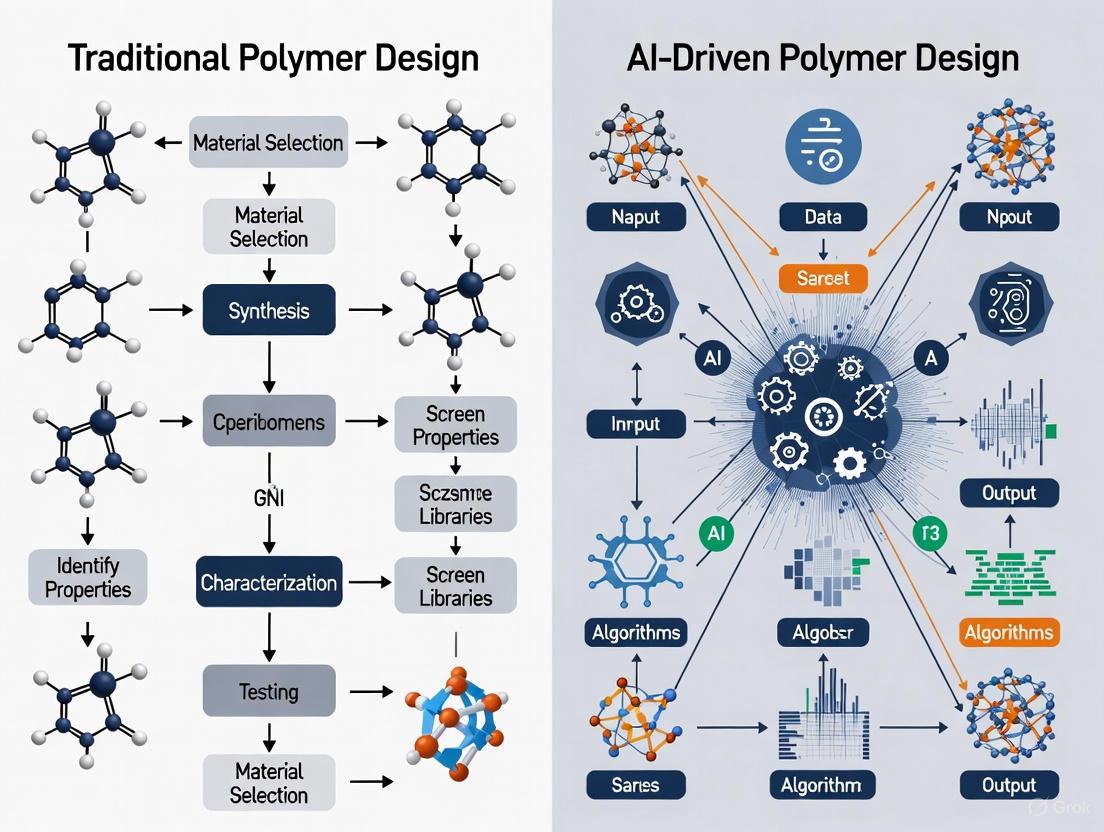
This article provides a comprehensive comparison between traditional experience-driven methods and modern AI-driven approaches in polymer design, tailored for researchers and professionals in drug development and biomedical fields.
From Trial-and-Error to AI-Driven Design: A Paradigm Shift in Polymer Science for Biomedical Applications
Abstract
This article provides a comprehensive comparison between traditional experience-driven methods and modern AI-driven approaches in polymer design, tailored for researchers and professionals in drug development and biomedical fields. It explores the foundational principles of both paradigms, details cutting-edge AI methodologies like machine learning and deep learning for property prediction and synthesis optimization, and analyzes key challenges such as data scarcity and model interpretability. Through validation case studies on biodegradable polymers and drug delivery systems, the article demonstrates the superior efficiency and precision of AI, concluding with future directions for integrating these technologies to accelerate the development of next-generation biomedical polymers.
The Polymer Design Paradigm Shift: From Intuition to Algorithm
For over a century, the development of new polymer materials has relied predominantly on experience-driven methodologies often characterized as "trial-and-error" approaches [1]. This traditional paradigm has been anchored in researcher intuition, iterative laboratory experimentation, and gradual refinement of formulations based on observed outcomes. While this approach has yielded many commercially successful polymers that underpin modern society—from commodity plastics to specialized biomaterials—it operates within significant constraints that limit both efficiency and exploratory potential [1] [2]. The fundamental principle governing traditional polymer design involves making incremental adjustments to known chemical structures and processing conditions based on prior knowledge, then synthesizing and testing these variants through physical experiments. This methodology has been described as inherently low-throughput and resource-intensive, often requiring substantial investments of time, expertise, and laboratory resources [3].
The persistence of traditional approaches stems in part from the complex nature of polymer systems, which exhibit multidimensional characteristics including compositional polydispersity, sequence randomness, hierarchical multi-level structures, and strong coupling between processing conditions and final properties [1]. These complexities create nonlinear structure-property relationships that are often difficult to predict using intuitive approaches alone. Nevertheless, until recent advances in computational power and data science, the polymer community had limited alternatives to these established methodologies, creating a self-reinforcing cycle where conventional approaches became deeply institutionalized within materials research and development [1]. Understanding both the operational principles and inherent limitations of these traditional methods provides essential context for evaluating the transformative potential of emerging data-driven paradigms in polymer science.
Core Principles of Traditional Polymer Design
Experience-Driven Iteration
The traditional polymer design process operates primarily through cumulative expert knowledge transferred across research generations and refined through repeated laboratory practice. Unlike systematic approaches that leverage computational prediction, traditional methodologies depend heavily on chemical intuition and anecdotal successes [1] [2]. Researchers typically begin with known polymer systems that exhibit desirable characteristics, then make incremental modifications to their chemical structures or synthesis parameters based on analogical reasoning and heuristic rules-of-thumb. This approach functions as an informal optimization process where each experimental outcome informs subsequent iterations, creating a slowly evolving knowledge base specific to individual research groups or industrial laboratories [3].
The experiential nature of this paradigm manifests most clearly in its reliance on qualitative structure-property relationships rather than quantitative predictive models. For example, the understanding that aromatic structures enhance thermal stability or that flexible spacers improve toughness has been derived empirically through decades of observation rather than through systematic computational analysis [4]. This knowledge, while valuable, remains fragmented and often proprietary, creating significant barriers to rapid innovation and cross-disciplinary application. Furthermore, the heuristic nature of these design rules limits their transferability across different polymer classes or application domains, requiring re-calibration through additional experimentation when exploring new chemical spaces [1].
Sequential Experimentation Workflow
The traditional research paradigm follows a linear, sequential workflow characterized by discrete, disconnected phases of design, synthesis, and characterization [1] [3]. Unlike integrated approaches where feedback loops rapidly inform subsequent iterations, traditional methodologies typically involve prolonged cycles between hypothesis formulation and experimental validation. The workflow begins with molecular structure design based on literature precedents and researcher intuition, proceeds to small-scale synthesis using standard polymerization techniques, and culminates in comprehensive characterization of the resulting material's properties [3]. Each completed cycle may require weeks or months of laboratory work before yielding actionable insights for the next iteration.
This segmented approach creates fundamental inefficiencies in both time and resource allocation. The extended feedback timeline between conceptual design and experimental validation severely limits the number of design iterations feasible within typical research funding cycles [1]. Additionally, the sequential nature of the process discourages high-risk exploration of unconventional chemical spaces, as failed experiments represent substantial sunk costs with limited compensatory knowledge gains. The workflow's inherent structure thus reinforces conservative design tendencies and prioritizes incremental improvements over transformative innovation [2].
Table 1: Characteristics of Traditional Polymer Design Workflows
| Aspect | Traditional Approach | Impact on Research Efficiency |
|---|---|---|
| Design Process | Based on chemical intuition and literature precedents | Limited exploration of unknown chemical spaces |
| Experiment Scale | Small batches with comprehensive characterization | Low throughput with high cost per data point |
| Optimization Method | One-factor-at-a-time variations | Inefficient navigation of multi-parameter spaces |
| Knowledge Transfer | Experiential and often undocumented | Slow cumulative progress with repeated errors |
| Resource Allocation | Concentrated on few promising candidates | High opportunity cost from unexplored alternatives |
Diagram 1: Traditional polymer design follows a linear, sequential workflow with limited feedback integration.
Limited Exploration of Chemical Space
The trial-and-error paradigm fundamentally constrains the explorable chemical universe due to practical limitations on laboratory throughput. Where computational methods can virtually screen thousands or millions of candidate structures, traditional approaches typically investigate dozens to hundreds of variants over extended timeframes [4] [5]. This restricted exploration capability becomes particularly problematic when designing polymers that require balancing multiple competing properties, such as high modulus and high toughness, or thermal stability and processability [4] [6]. The combinatorial nature of polymer design—with variations possible in monomer selection, sequence, molecular weight, and architecture—creates a search space of astronomical proportions that cannot be adequately navigated through serial experimentation alone [7].
The incomplete mapping of structure-property relationships under traditional methodologies represents a critical limitation with far-reaching consequences. Without systematic exploration of chemical space, researchers inevitably develop biases toward familiar structural motifs and established synthesis pathways, potentially overlooking superior solutions residing in unexplored regions [2]. This constrained exploration manifests clearly in the commercial polymer landscape, where the "diversity in commercial polymers used in medicine is stunningly low" despite the virtually infinite structural possibilities [2]. The failure to discover more optimal materials through traditional approaches underscores the fundamental limitations of human intuition when navigating high-dimensional design spaces without computational guidance.
Key Limitations and Bottlenecks
Temporal and Resource Constraints
The traditional polymer development pipeline typically spans 10-15 years from initial concept to commercial deployment, with the research and discovery phase alone often consuming several years of this timeline [1] [7]. This extended development cycle stems primarily from the low-throughput nature of experimental polymer science, where each design iteration requires substantial investments in synthesis, processing, and characterization. The sequential nature of traditional workflows further exacerbates these temporal inefficiencies, as researchers must complete full characterization cycles before initiating subsequent design iterations [3]. The resulting development timeline creates significant economic barriers to innovation, particularly for applications with rapidly evolving market requirements or emerging sustainability mandates.
The resource intensity of traditional methodologies extends beyond temporal considerations to encompass substantial financial and human capital investments. Establishing and maintaining polymer synthesis capabilities requires specialized equipment, controlled environments, and expert personnel, creating high fixed costs that must be distributed across relatively few experimental iterations [2]. Characterization of polymer properties—particularly mechanical, thermal, and biological performance—demands sophisticated analytical instrumentation and technically skilled operators, further increasing the marginal cost of each data point [8]. These resource requirements inevitably privilege incremental development over exploratory research, as the economic risks of investigating radically novel chemistries become prohibitive without reliable predictive guidance.
Multi-Property Optimization Challenges
Polymer materials for advanced applications must typically satisfy multiple performance requirements simultaneously, creating complex optimization landscapes with inherent trade-offs between competing objectives [4] [6]. Traditional trial-and-error approaches struggle immensely with these multi-property optimization challenges due to the nonlinear relationships between molecular structure, processing conditions, and final material properties. For example, achieving simultaneous improvements in stiffness, strength, and toughness has represented a persistent challenge in polyimide design, as enhancements in one property typically come at the expense of others [4]. Similarly, designing anion exchange membranes that balance high ionic conductivity with dimensional stability and mechanical strength presents fundamental trade-offs that are difficult to navigate through intuition alone [5].
The conflicting property requirements inherent in many polymer applications create optimization problems that exceed human cognitive capabilities, particularly when more than two or three objectives must be considered simultaneously. Traditional approaches typically address these challenges through sequential optimization strategies—first improving one property, then attempting to recover losses in others—but this method often converges to local optima rather than globally superior solutions [6]. The inability to efficiently navigate these complex trade-offs represents a fundamental limitation of traditional design methodologies, particularly for advanced applications in energy, healthcare, and electronics where performance requirements continue to escalate [4] [5].
Table 2: Representative Property Trade-offs in Traditional Polymer Design
| Polymer Class | Conflicting Properties | Traditional Resolution Approach |
|---|---|---|
| Polyimides | High modulus vs. high toughness [4] | Sequential adjustment of aromatic content and flexible linkages |
| Anion Exchange Membranes | High ionic conductivity vs. low swelling ratio [5] | Compromise through moderate ion exchange capacity |
| Thermosetting Polymers | Low hygroscopicity vs. high modulus [6] | Empirical balancing of crosslink density and hydrophobicity |
| Biomedical Polymers | Degradation rate vs. mechanical integrity [2] | Copolymerization with unpredictable outcomes |
| Polymer Dielectrics | High permittivity vs. low loss tangent [7] | Trial-and-error modification of polar groups |
Data Scarcity and Knowledge Fragmentation
The traditional polymer research paradigm generates fragmented, non-standardized data that resist systematic aggregation and analysis [2] [8]. Unlike fields such as protein science where centralized databases provide comprehensive structure-property relationships, polymer science has historically lacked equivalent infrastructure for curating and sharing experimental results [2]. This data scarcity stems from multiple factors, including proprietary restrictions, inconsistent characterization protocols, and the absence of standardized polymer representation formats [8]. The resulting information fragmentation severely limits cumulative knowledge building, as insights gained from individual research projects remain isolated within specific laboratories or publications without integration into unified predictive frameworks.
The limited data availability under traditional approaches creates a self-reinforcing cycle where the absence of comprehensive datasets impedes the development of accurate predictive models, which in turn perpetuates reliance on inefficient experimental screening [2]. This problem is particularly acute for properties requiring specialized characterization techniques or extended testing timelines, such as long-term degradation profiles or in vivo biological responses [2]. Even when data generation accelerates through high-throughput experimentation, the value of these investments remains suboptimal without standardized formats for data representation, storage, and retrieval [8]. The transition toward FAIR (Findable, Accessible, Interoperable, Reusable) data principles represents a critical prerequisite for overcoming these historical limitations, but implementation remains incomplete across the polymer research community [2].
Case Studies: Traditional Approaches in Practice
Polyimide Film Development
The development of high-performance polyimide films illustrates both the capabilities and limitations of traditional design methodologies. Polyimides represent essential materials for aerospace, electronics, and display technologies due to their exceptional thermal stability and mechanical properties [4]. Traditional approaches to optimizing polyimide films have relied heavily on structural analogy, where researchers modify known high-performing structures through substitution of dianhydride or diamine monomers [4]. This method has successfully produced several commercial polyimides but struggles with the systematic balancing of competing mechanical properties—particularly the optimization of both high modulus and high toughness simultaneously.
The recent integration of machine learning into polyimide development has highlighted the suboptimal outcomes produced through traditional approaches. When researchers applied Gaussian process regression models to screen over 1,700 potential polyimide structures, they identified a previously unexplored formulation (PPI-TB) that demonstrated superior balanced properties compared to traditionally developed benchmarks [4]. This case study demonstrates how traditional methodologies, while capable of producing functional materials, often fail to discover globally optimal solutions due to limited exploration of chemical space and reliance on established structural motifs. The demonstrated superiority of the ML-identified formulation suggests that traditional approaches had prematurely converged on local optima within the vast polyimide design space.
Thermosetting Polymer Design
The discovery of thermosetting polymers with optimal combinations of low hygroscopicity, low thermal expansivity, and high modulus represents another domain where traditional design principles encounter fundamental limitations [6]. The intrinsic conflicts between these properties create a complex optimization landscape that resists intuitive navigation. Traditional approaches have addressed these challenges through copolymerization strategies and empirical adjustment of crosslinking density, but these methods typically achieve compromise rather than optimal solutions [6]. The inability to efficiently balance multiple competing properties has constrained the development of advanced thermosets for microelectronics and other precision applications where dimensional stability under varying environmental conditions is critical.
The limitations of traditional methodologies become particularly evident when considering the resource investments required for comprehensive experimental screening. A systematic investigation of thermosetting polycyanurates would require synthesizing and characterizing hundreds of candidates to adequately explore compositional variations—a prohibitively expensive and time-consuming undertaking under traditional research paradigms [6]. This practical constraint forces researchers to make early decisions about which compositional pathways to pursue, potentially eliminating promising regions of chemical space based on incomplete information. The application of multi-fidelity machine learning to this challenge demonstrates how data-driven approaches can achieve more comprehensive exploration with dramatically reduced experimental effort [6].
Biomedical Polymer Innovation
The development of polymeric biomaterials for drug delivery, tissue engineering, and medical devices highlights the particularly severe limitations of traditional methodologies in complex biological environments [2] [3]. The trial-and-error synthesis approach prevalent in biomedical polymer research faces extraordinary challenges due to the nonlinear relationships between polymer structure and biological responses [2]. Properties such as degradation time, drug release profiles, and biocompatibility depend on multiple interacting factors including molecular weight, composition, architecture, and processing history, creating high-dimensional design spaces that defy intuitive navigation.
The consequences of these methodological limitations are evident in the commercial biomedical polymer landscape, where "the diversity in commercial polymers used in medicine is stunningly low" despite decades of research investment [2]. Traditional approaches have struggled to establish quantitative structure-property relationships for biologically relevant characteristics, as the required datasets would necessitate thousands of controlled experiments with standardized characterization protocols [2]. This data scarcity problem is compounded by the specialized expertise required for polymer synthesis and the limited throughput of biological assays, creating a fundamental bottleneck that has impeded innovation in polymeric biomaterials [3]. The emergence of automated synthesis platforms and high-throughput screening methodologies represents a promising transition toward data-driven design, but the field remains predominantly anchored in traditional paradigms [3].
Experimental Methodologies in Traditional Polymer Research
Synthesis and Characterization Techniques
Traditional polymer design relies on established synthesis methodologies including controlled living radical polymerization (CLRP), ring-opening polymerization (ROP), and various polycondensation techniques [3]. These methods typically require specialized conditions such as inert atmospheres, moisture-free environments, and precise temperature control, creating significant technical barriers to high-throughput experimentation [3]. The characterization arsenal in traditional polymer science encompasses techniques such as size-exclusion chromatography (SEC) for molecular weight distribution, nuclear magnetic resonance (NMR) for structural verification, thermal analysis for transition temperatures, and mechanical testing for performance properties [8]. While these methods provide essential data, their implementation typically involves manual operation, extended analysis times, and limited parallelization capabilities.
The protocol standardization across different research groups presents a persistent challenge in traditional polymer science, as minor variations in synthesis conditions, purification methods, or characterization parameters can significantly influence reported properties [8]. This methodological variability complicates the direct comparison of results across different studies and impedes the aggregation of data for structure-property modeling. Furthermore, many traditional characterization techniques require substantial sample quantities—particularly for mechanical testing—creating an inherent trade-off between comprehensive property evaluation and minimal material usage [2]. These methodological constraints reinforce the low-throughput nature of traditional polymer design and highlight the need for integrated approaches that combine rapid synthesis, automated characterization, and standardized data reporting.
Table 3: Essential Research Reagents and Instruments in Traditional Polymer Design
| Category | Specific Examples | Function in Research Process |
|---|---|---|
| Polymerization Techniques | Ring-opening polymerization (ROP), Atom transfer radical polymerization (ATRP) [3] | Controlled synthesis of polymers with specific architectures |
| Characterization Instruments | Size-exclusion chromatography (SEC), Nuclear magnetic resonance (NMR) [8] | Determination of molecular weight and structural verification |
| Thermal Analysis | Differential scanning calorimetry (DSC), Thermogravimetric analysis (TGA) | Measurement of transition temperatures and thermal stability |
| Mechanical Testing | Dynamic mechanical analysis (DMA), Universal testing systems | Evaluation of modulus, strength, and viscoelastic properties |
| Specialized Reagents | Air-sensitive catalysts, Anhydrous solvents [3] | Enabling controlled polymerization in inert environments |
Data Collection and Analysis Practices
Traditional polymer research typically generates fragmented datasets with inconsistent structure-property associations, as data collection focuses predominantly on confirming hypotheses rather than building comprehensive predictive models [8]. Experimental results often remain embedded in laboratory notebooks or isolated publications without standardized formats for polymer representation or property reporting [2]. The absence of universal polymer identifiers analogous to SMILES strings for small molecules further complicates data integration across different research initiatives [8]. These limitations have collectively impeded the development of robust quantitative structure-property relationships that could accelerate the design of future materials.
The analytical methodologies employed in traditional polymer science typically emphasize individual candidate characterization rather than comparative analysis across chemical spaces. Researchers traditionally prioritize comprehensive investigation of promising leads rather than systematic mapping of structure-property landscapes, creating knowledge gaps between well-studied structural motifs and unexplored regions of chemical space [1]. This focus on depth over breadth, while valuable for understanding specific material systems, creates fundamental limitations when attempting to extract general design principles applicable across diverse polymer classes. The transition toward data-driven methodologies addresses these limitations through balanced attention to both comprehensive characterization and systematic exploration of chemical diversity [7].
Diagram 2: Key limitations of traditional polymer design methodologies create fundamental constraints on innovation efficiency.
The traditional trial-and-error approach to polymer design has produced numerous successful materials that underpin modern technologies, but its fundamental limitations in efficiency, optimization capability, and exploratory power have become increasingly evident [1] [2]. The experience-driven nature of traditional methodologies, while valuable for incremental improvements, struggles with the combinatorial complexity of polymer chemical space and the multi-objective optimization challenges inherent in advanced applications [4] [6]. These limitations manifest concretely in extended development timelines, suboptimal material performance, and persistent gaps in structure-property understanding [7].
The emerging paradigm of data-driven polymer design addresses these limitations through integrated workflows that combine computational prediction, automated synthesis, and high-throughput characterization [3] [8]. This approach leverages machine learning algorithms to extract patterns from existing data, generate novel candidate structures, and prioritize the most promising candidates for experimental validation [1] [7]. The demonstrated successes of data-driven methodologies in designing polyimides with balanced mechanical properties, thermosets with optimal property combinations, and anion exchange membranes with conflicting characteristics highlight the transformative potential of this paradigm shift [4] [6] [5]. While traditional approaches will continue to play important roles in polymer science, particularly in validation and application development, their dominance as discovery engines is rapidly giving way to more efficient, comprehensive, and predictive data-driven methodologies.
The field of polymer science is undergoing a profound transformation, moving from intuition-driven, trial-and-error methodologies to a new era of data-driven discovery powered by Artificial Intelligence (AI) and Machine Learning (ML). This paradigm shift, central to the field of Materials Informatics, leverages computational intelligence to navigate the immense combinatorial complexity of polymer systems, thereby accelerating the design of novel materials with tailored properties [9]. Traditional polymer research has long relied on empirical approaches, which are often time-consuming, resource-intensive, and limited in their ability to explore vast chemical spaces comprehensively. In contrast, AI-driven approaches utilize algorithms to extract meaningful patterns from data, enabling the prediction of polymer properties, the optimization of synthesis pathways, and the discovery of new materials with unprecedented efficiency [10] [11]. This guide provides a comparative analysis of these two research paradigms, detailing their core concepts, methodologies, and performance, with a specific focus on applications for researchers and scientists in polymer and drug development.
Core Concepts: Traditional vs. AI-Driven Research
Understanding the fundamental differences between traditional and AI-driven research is crucial for appreciating the scope of this scientific evolution.
The Traditional Polymer Research Paradigm
The traditional approach is largely based on empirical experimentation and established physical principles.
- Methodology: It follows a sequential cycle of hypothesis, experimentation (e.g., polymerization, purification, characterization), and analysis. The design of new polymers often depends on a researcher's expertise and intuition.
- Computational Role: Traditional computational methods, such as Molecular Dynamics (MD) and Density Functional Theory (DFT), are used to simulate polymer behaviors based on explicit physical equations. These methods provide valuable insights but are computationally expensive and often limited to small-scale or simplified systems [9].
- Key Limitation: The process is inherently slow, with low throughput. Exploring a wide range of potential monomers, compositions, and processing conditions is often impractical due to time and cost constraints [11].
The AI-Driven Materials Informatics Paradigm
AI-driven research is a data-centric approach that uses statistical models to learn the complex relationships between a polymer's structure, its processing history, and its final properties.
- Methodology: This paradigm relies on creating ML models trained on existing experimental, computational, or literature data. Once trained, these models can predict the properties of new, unsynthesized polymers or optimize for a desired set of characteristics [10] [12].
- Key Machine Learning Techniques:
- Supervised Learning: Used for predicting continuous properties (e.g., glass transition temperature, tensile strength) through regression or categorical outcomes (e.g., biodegradable vs. non-biodegradable) through classification [9].
- Boosting Methods: Ensemble techniques like Gradient Boosting and XGBoost are particularly effective for tackling high-dimensional and complex problems in polymer science, offering robust predictive capabilities for structure-property relationships [13].
- Deep Learning: Utilizes neural networks for highly complex, non-linear problems, such as predicting polymer phase transitions from complex data sets [9].
- Key Advantage: AI models can screen millions of potential structures in silico in a fraction of the time it would take to synthesize and test them, dramatically accelerating the discovery pipeline [11].
Comparative Performance Analysis
The following tables summarize quantitative and qualitative comparisons between traditional and AI-driven research methodologies, synthesized from current literature and case studies.
Table 1: Quantitative Comparison of Research Efficiency
| Performance Metric | Traditional Research | AI-Driven Research | Experimental Context & Citation |
|---|---|---|---|
| Development Time Reduction | Baseline | Up to 5x faster product development [12] | AI-guided platforms reduce iterative cycles by leveraging data modeling [12]. |
| Reduction in Experiments | Baseline | Up to 70% fewer experiments [12] | ML models prioritize high-probability candidates, minimizing lab resource use [12]. |
| Property Prediction Speed | Hours/Days (for MD/DFT simulations) | Seconds/Minutes (for ML inference) | ML predicts properties like glass transition temperature (Tg) almost instantly vs. computationally intensive simulations [9]. |
| Data Integration Time | Manual, slow curation | 60x faster capture of scattered data [12] | Automated data unification from diverse sources (LIMS, ELN) into a central knowledge base [12]. |
Table 2: Qualitative Comparison of Research Capabilities
| Capability Aspect | Traditional Research | AI-Driven Research |
|---|---|---|
| Primary Driver | Researcher intuition & empirical knowledge | Data-driven patterns & predictive algorithms |
| Exploration Capacity | Limited by practical constraints on experimentation | Capable of exploring vast, multi-dimensional design spaces [11] |
| Handling Complexity | Struggles with highly non-linear structure-property relationships | Excels at modeling complex, non-linear relationships [13] |
| Optimization Approach | Sequential, one-factor-at-a-time often used | Multi-objective optimization (e.g., performance, cost, sustainability) is inherent [14] [12] |
| Interpretability | High; based on established physical principles | Can be a "black box"; requires techniques like SHAP analysis for insight [9] [13] |
Experimental Protocols in AI-Driven Polymer Research
The application of AI in polymer science follows a structured, iterative workflow. Below is a detailed protocol for a typical project aiming to predict a target polymer property (e.g., glass transition temperature, Tg) using a supervised learning approach.
Protocol 1: Predictive Modeling for Polymer Properties
Objective: To build a machine learning model that accurately predicts the glass transition temperature (Tg) of a polymer based on its chemical structure and/or monomer composition.
Methodology:
- Data Curation and Feature Engineering
- Data Collection: Assemble a dataset of known polymers and their corresponding Tg values from experimental databases or literature. The dataset must include the polymer's chemical structure (e.g., SMILES notation) [9].
- Data Cleaning: Address missing values, outliers, and ensure consistency in measurement units and conditions.
- Feature Generation: Transform chemical structures into machine-readable numerical descriptors (features). This can include:
- Molecular Descriptors: Molecular weight, fractional polar surface area, number of hydrogen bond donors/acceptors, etc. [15].
- Fingerprints: Binary vectors representing the presence or absence of specific chemical substructures.
- Polymer-Specific Features: Degree of polymerization, tacticity, cross-link density (if available) [9].
- Dataset Splitting: Randomly split the curated dataset into a training set (e.g., 70-80%) for model building and a hold-out test set (e.g., 20-30%) for final evaluation.
Model Selection and Training
- Algorithm Selection: Choose one or more ML algorithms suitable for regression tasks. Common choices include:
- Model Training: The training set (features and target Tg values) is used to fit the selected model(s). The algorithm learns the mathematical relationship between the input features and the target variable.
- Hyperparameter Tuning: Use techniques like cross-validation on the training set to optimize the model's hyperparameters, maximizing predictive performance.
Model Validation and Interpretation
- Performance Evaluation: Apply the trained model to the hold-out test set (unseen during training) to assess its generalization ability. Key metrics include Root Mean Square Error (RMSE), Mean Absolute Error (MAE), and the coefficient of determination (R²).
- Model Interpretation: Employ interpretability tools like SHAP (SHapley Additive exPlanations) to understand which chemical features most strongly influence the model's predictions of Tg, transforming the "black box" into actionable chemical insights [13].
The following diagram illustrates the logical workflow and iterative feedback loop of this protocol, highlighting the role of AI and human expertise.
Protocol 2: Autonomous Formulation Optimization
Objective: To autonomously discover a polymer formulation that meets multiple target criteria (e.g., high tensile strength, specific degradation rate, low cost) with minimal experimental cycles.
Methodology:
- Define Objective and Constraints: Specify the target properties and their desired ranges or optima. Define constraints such as allowable monomers and cost limits.
- Initial Design of Experiments (DoE): Use an algorithm (e.g., Latin Hypercube Sampling) to create a small, diverse set of initial formulations for experimental testing. This provides the first data points for the AI model.
- Active Learning Loop:
- Model Training: Train a multi-output ML model on all accumulated data to predict all target properties from the formulation inputs.
- Candidate Proposal: The AI model proposes the next most informative formulations to test. This is often done using acquisition functions (e.g., in Bayesian Optimization) that balance exploration of uncertain regions and exploitation of promising areas.
- Experimental Validation: The proposed formulations are synthesized and characterized, ideally using automated, high-throughput systems [11] [9].
- Data Augmentation: The new experimental results are added to the training dataset.
- Convergence: The cycle repeats until a formulation meets all target criteria or the experimental budget is exhausted, resulting in a drastically reduced number of required experiments [12].
The Scientist's Toolkit: Key Reagents & Solutions for AI-Driven Research
The "reagents" in AI-driven research are computational and data resources. The following table details the essential components of a modern materials informatics toolkit.
Table 3: Essential "Research Reagents" for AI-Driven Polymer Science
| Tool Category / "Reagent" | Function & Explanation | Example Tools / Platforms |
|---|---|---|
| Data Management Platform | Serves as a centralized "Knowledge Center" to connect, ingest, and harmonize scattered data from internal and external sources, enabling cross-departmental collaboration. | MaterialsZone [12] |
| Machine Learning Algorithms | Core engines for building predictive models from data. Boosting methods are particularly noted for their performance in polymer property prediction. | XGBoost, CatBoost, LightGBM [13] |
| Chemical Descriptors | Translate molecular and polymer structures into a numerical format that ML models can process, acting as the fundamental input features. | Molecular fingerprints, topological indices, polymer-specific descriptors [15] [9] |
| Automated Experimentation | High-throughput robotic systems that physically execute synthesis and characterization tasks, providing the rapid, high-quality data needed to feed and validate AI models. | Self-driving laboratories [11] [9] |
| Cloud-Based AI Services | Provide access to pre-trained models and scalable computing power, lowering the barrier to entry by reducing the need for local, specialized hardware. | Various AI-guided SaaS platforms [12] [11] |
The comparison between traditional and AI-driven polymer research reveals a clear and compelling trend: the integration of AI and machine learning is not merely an incremental improvement but a fundamental leap forward. While traditional methods retain their value for deep mechanistic understanding and validation, AI-driven Materials Informatics offers unparalleled advantages in speed, efficiency, and the ability to navigate complexity. By enabling the prediction of properties and optimization of formulations with significantly fewer experiments, AI empowers researchers to focus their efforts on creative design and validation. The future of polymer science, particularly in fast-moving fields like drug delivery and sustainable materials, lies in the synergistic combination of domain expertise with data-driven AI tools. This convergence is paving the way for accelerated innovation, from the discovery of new polymer-based therapeutics to the design of advanced sustainable materials.
The field of polymer science is undergoing a foundational shift, moving from long-standing experience-driven methodologies to emerging data-driven predictive modeling approaches [1] [9]. For decades, the development of new polymers relied heavily on researcher intuition, empirical observation, and iterative trial-and-error experiments. While this traditional approach has yielded many successful materials, it is often a time-consuming and resource-intensive process, typically spanning over a decade from initial concept to commercial application [1] [16].
The emergence of artificial intelligence (AI) and machine learning (ML) has established a new paradigm. Predictive modeling uses computational power to identify complex patterns within vast datasets, enabling the prediction of polymer properties and the optimization of formulations and synthesis processes without solely depending on physical experiments [17] [18]. This guide provides an objective comparison of these two philosophies, contextualized for researchers and scientists engaged in polymer and material design.
Philosophical and Methodological Comparison
The core difference between these philosophies lies in their starting point and operational mechanism. The traditional approach is fundamentally reactive and knowledge-based, relying on accumulated expert intuition to guide sequential experiments. In contrast, the AI-driven approach is proactive and data-based, using models to predict outcomes and suggest optimal experimental paths.
Table 1: Contrasting Core Philosophies and Workflows
| Feature | Experience-Driven Approach | Predictive Modeling Approach |
|---|---|---|
| Fundamental Principle | Intuition, empirical observation, & established chemical principles [9] [19] | Data-driven pattern recognition & statistical learning [1] [17] |
| Primary Workflow | Sequential trial-and-error experimentation [16] | High-throughput in-silico screening & targeted validation [1] [19] |
| Knowledge Foundation | Deep domain expertise & historical data [9] | Large-scale datasets & algorithm training [1] [18] |
| Design Strategy | Incremental modification of known structures [19] | Inverse design from target properties [1] [20] |
| Key Limitation | High cost & time consumption; limited exploration of chemical space [17] [16] | Dependence on data quality/quantity & model interpretability [1] [9] |
Visualizing Research Workflows
The distinct processes of each philosophy are illustrated in the following workflow diagrams.
Diagram 1: The traditional experience-driven research workflow is a sequential, iterative cycle heavily reliant on expert intuition and physical experimentation.
Diagram 2: The AI-driven predictive modeling workflow uses computational screening to prioritize the most promising candidates for experimental validation, creating a continuous learning loop.
Experimental Protocols and Performance Data
Case Study: Designing Novel Polymer Dielectrics
A 2024 study provided a direct comparison by using AI to discover high-temperature dielectric polymers for energy storage. The researchers defined target properties—high glass transition temperature (Tg) and high dielectric strength—and applied a predictive modeling framework [19].
Predictive Modeling Protocol:
- Data Curation: Gathered a large dataset of polymer structures and their associated properties from existing databases and literature.
- Model Training: Trained machine learning models (including graph neural networks) to map chemical structures to the target properties.
- Virtual Screening: The trained models screened a vast virtual library of chemically feasible polymers, including polynorbornene and polyimide families.
- Synthesis & Validation: Top-ranked candidates were synthesized and their properties experimentally characterized [19].
Comparative Outcome: The AI-driven approach discovered a new polymer, PONB-2Me5Cl, which demonstrated an energy density of 8.3 J cc⁻¹ at 200°C. This performance outperformed existing commercial alternatives that were developed through more traditional, incremental methods [19].
Case Study: Predicting Mechanical Properties of Composites
A 2025 study on natural fiber polymer composites compared the accuracy of different modeling approaches for predicting mechanical properties like tensile strength and modulus.
Experimental Protocol:
- Data Generation: 180 experimental samples were prepared using four natural fibers (flax, cotton, sisal, hemp) incorporated at 30 wt.% into three polymer matrices (PLA, PP, epoxy).
- Model Training: Several regression models—Linear, Random Forest, Gradient Boosting, and Deep Neural Networks (DNN)—were trained on the dataset, which was augmented to 1500 samples using bootstrap technique.
- Model Architecture: The best DNN model was optimized with four hidden layers (128-64-32-16 neurons), ReLU activation, and dropout to prevent overfitting.
- Validation: Model predictions were compared against experimentally measured mechanical properties [21].
Table 2: Quantitative Performance Comparison of Modeling Techniques
| Modeling Technique | Key Advantage | Reported Performance (R²) | Limitation |
|---|---|---|---|
| Expert Heuristics | Leverages deep domain knowledge & intuition | Not quantitatively defined; guides initial trials | Success varies significantly with researcher experience [9] |
| Linear Regression | Simple, interpretable, fast computation | Lower accuracy (implied by comparison) | Fails to capture complex nonlinear interactions [21] |
| Random Forest / Gradient Boosting | Good accuracy with structured data, more interpretable than DNNs | High accuracy | Performance plateau on highly complex datasets [21] |
| Deep Neural Network (DNN) | Captures complex nonlinear & synergistic relationships | R² up to 0.89; MAE 9-12% lower than other ML models [21] | "Black-box" nature; requires large data & computational power [1] [21] |
The study concluded that the DNN's superior performance was driven by its ability to capture nonlinear synergies between fiber-matrix interactions, surface treatments, and processing parameters [21].
The Scientist's Toolkit: Essential Research Reagents and Solutions
The transition to AI-driven methods introduces new tools to the polymer scientist's repertoire, complementing traditional laboratory materials.
Table 3: Key Reagents and Solutions for Polymer Research
| Tool/Reagent | Function/Role | Relevance across Paradigms |
|---|---|---|
| Polymer Matrices (PLA, PP, Epoxy) | Base material for composite formation; determines fundamental chemical & thermal stability. | Core to both paradigms. Essential for physical validation in AI-driven approach [21]. |
| Natural/Synthetic Fibers & Fillers | Reinforcement agents to enhance mechanical properties like tensile strength and modulus. | Core to both paradigms. Key variables in composite design [21]. |
| Molecular Descriptors & Fingerprints | Numerical representations of chemical structures (e.g., SMILES strings) enabling machine readability [1]. | Critical for Predictive Modeling. Serves as primary input for ML models [1] [22]. |
| High-Quality Curated Databases (PolyInfo, Materials Project) | Provide the large, structured datasets of polymer structures and properties needed for training ML models [1] [16]. | Critical for Predictive Modeling. Foundation of data-driven discovery [1] [19]. |
| Surface Treatment Agents (Alkaline, Silane) | Modify fiber-matrix interface to improve adhesion and composite mechanical performance [21]. | Core to both paradigms. Experimentally tested; their effect is a key parameter for ML models to learn [21]. |
This comparison demonstrates that experience-driven and predictive modeling approaches are not mutually exclusive but are increasingly complementary. The traditional paradigm offers deep mechanistic understanding and validation, while the AI-driven paradigm provides unprecedented speed and exploration breadth in navigating the complex polymer design space [9] [16].
The most effective future for polymer research lies in a hybrid strategy. In this integrated framework, AI handles high-throughput screening and identifies promising candidates from a vast space, while researchers' expertise guides the experimental design, interprets results in a physicochemical context, and performs final validation [1] [20]. This synergy accelerates the discovery of novel polymers—from dielectrics and electrolytes to biodegradable materials—while ensuring robust and scientifically sound outcomes.
The Growing Imperative for AI in Complex Biomedical Polymer Applications
The development of polymers for biomedical applications—such as drug delivery systems, implants, and tissue engineering scaffolds—represents one of the most challenging frontiers in material science. Traditional polymer design has relied heavily on researcher intuition, empirical observation, and sequential trial-and-error experimentation. This conventional approach, while productive, faces significant limitations in navigating the vast compositional and structural landscape of polymeric materials. The emergence of Artificial Intelligence (AI) and Machine Learning (ML) now offers a transformative pathway to accelerate the discovery and optimization of biomedical polymers. This guide objectively compares these two research paradigms, examining their methodological frameworks, performance metrics, and practical applications to highlight the growing imperative for AI-driven approaches in meeting complex biomedical challenges.
Methodological Comparison: Traditional vs. AI-Driven Research
Core Workflows and Fundamental Differences
The following diagram illustrates the fundamental differences between the traditional and AI-driven research workflows in biomedical polymer development.
Quantitative Performance Comparison
Table 1: Direct Comparison of Traditional vs. AI-Driven Polymer Research Approaches
| Performance Metric | Traditional Approach | AI-Driven Approach | Performance Advantage |
|---|---|---|---|
| Development Timeline | Months to years for single material optimization [23] [2] | Days to weeks for screening thousands of candidates [23] [24] | 10-100x acceleration in initial discovery phase [23] |
| Experimental Throughput | Typically 1-20 unique structures per study [2] | High-throughput screening of 11 million+ candidates computationally [5] | >6 orders of magnitude increase in candidate screening capacity [5] |
| Data Utilization | Relies on limited, manually curated datasets | Leverages large, diverse datasets from multiple sources | Enables pattern recognition across broader chemical space [24] |
| Success Rate Prediction | Based on researcher experience and intuition | Quantitative probability scores from ML models | Objectively prioritizes most promising candidates [24] |
| Multi-property Optimization | Sequential optimization of properties, often leading to trade-offs | Simultaneous optimization of conflicting properties (e.g., conductivity vs. swelling) [5] | Balances competing design requirements more effectively |
Experimental Data and Case Studies
AI-Driven Design of Fluorine-Free Polymer Membranes
Experimental Context: The development of anion exchange membranes (AEMs) for fuel cells exemplifies the challenge of balancing conflicting properties: high hydroxide ion conductivity versus limited water uptake and swelling ratio. Traditional approaches have struggled to design fluorine-free polymers that meet all requirements simultaneously [5].
Methodology:
- Data Curation: Researchers compiled experimental data from literature on AEM properties including ion conductivity, water uptake, and swelling ratio [5].
- Model Training: Machine learning models were trained to predict key AEM properties based on chemical structure and theoretical ion exchange capacity [5].
- Virtual Screening: The trained models screened over 11 million hypothetical copolymer candidates [5].
- Validation: Promising candidates identified through computational screening were prioritized for synthesis and experimental validation [5].
Results: The AI-driven approach identified more than 400 fluorine-free copolymer candidates with predicted hydroxide conductivity >100 mS/cm, water uptake below 35 wt%, and swelling ratio below 50% - performance metrics that meet U.S. Department of Energy targets for AEMs [5].
Table 2: Experimental Results from AI-Driven AEM Design Study
| Design Parameter | Traditional Fluorinated AEM (Nafion) | AI-Identified Fluorine-Free Candidates | Performance Gap |
|---|---|---|---|
| Hydroxide Conductivity | >100 mS/cm (Proton conductivity) | >100 mS/cm (Predicted) | Comparable performance achieved without fluorine |
| Water Uptake | Variable, often requires optimization | <35 wt% (Predicted) | Superior control of hydration |
| Swelling Ratio | Can exceed 50% at high hydration | <50% (Predicted) | Improved mechanical stability |
| Environmental Impact | Contains persistent fluorinated compounds | Fluorine-free structures | Reduced environmental concerns |
Biodegradable Polymer Discovery
Experimental Context: Developing biodegradable polymers with tailored degradation profiles presents a formidable challenge due to the complex relationship between chemical structure and degradation behavior [19].
Methodology:
- High-Throughput Synthesis: Researchers created a diverse library of 642 polyesters and polycarbonates using automated synthesis techniques [19].
- Rapid Testing: A high-throughput clear-zone assay was employed to rapidly assess biodegradability across the library [19].
- Machine Learning: Predictive models were trained on the resulting data, achieving over 82% accuracy in predicting biodegradability based on chemical features [19].
- Feature Identification: The models identified key structural features influencing biodegradability, such as aliphatic chain length and presence of ether groups [19].
Results: This integrated approach established quantitative structure-property relationships for polymer biodegradability, enabling rational design of environmentally friendly polymers with predictable degradation profiles [19].
The Scientist's Toolkit: Essential Research Reagents and Solutions
Table 3: Key Research Reagents and Solutions for AI-Driven Polymer Research
| Reagent/Solution | Function in Research | Traditional vs. AI Application |
|---|---|---|
| Polymer Databases (CRIPT, Polymer Genome) | Provide structured data for ML training; contain polymer structures and properties [2] [19] | In AI workflows, these are essential for model training; less utilized in traditional approaches |
| BigSMILES Strings | Machine-readable representation of polymer structures [2] | Critical for AI: encodes chemical information for computational screening; not used in traditional research |
| Theoretical Ion Exchange Capacity (IEC) | Calculated from polymer structure; predicts ion exchange potential [5] | In AI: enables property prediction before synthesis; in traditional: less accurate empirical measurement |
| High-Throughput Synthesis Platforms | Automated systems for parallel polymer synthesis [3] | AI: generates training data & validates predictions; Traditional: used for limited library synthesis |
| Molecular Descriptors | Quantitative representations of chemical features (e.g., chain length, functional groups) [24] | AI: fundamental model inputs; Traditional: rarely used systematically |
| Active Learning Algorithms | Selects most informative experiments to perform next [24] [3] | AI: optimizes experimental design; Traditional: relies on researcher intuition for next experiments |
Technical Implementation and Protocols
Detailed Experimental Protocol: AI-Driven Polymer Discovery
The following diagram outlines the comprehensive technical workflow for implementing an AI-driven polymer discovery pipeline, from data preparation to experimental validation.
Step-by-Step Protocol:
Data Collection and Curation:
- Gather historical data on polymer structures and properties from literature, databases (e.g., CRIPT, Polymer Genome), and experimental records [2] [19].
- Standardize polymer representation using BigSMILES or other machine-readable formats to ensure consistency [2].
- Address data sparsity issues through transfer learning from related properties or simulated data [2].
Feature Engineering and Model Selection:
- Compute molecular descriptors including composition, molecular mass, chain architecture, and functional groups [24].
- Select appropriate ML algorithms based on dataset size and problem type: Random Forests for small datasets, Neural Networks for large, complex datasets [9].
- Divide data into training, validation, and test sets using stratified sampling to ensure representative property distributions.
Virtual Screening and Candidate Selection:
- Apply trained models to screen virtual polymer libraries containing millions of candidates [5].
- Use multi-property optimization algorithms to identify candidates that balance potentially conflicting requirements (e.g., conductivity vs. swelling) [5].
- Apply heuristic filters based on synthetic feasibility, cost, and sustainability considerations.
Experimental Validation and Active Learning:
- Synthesize top-ranked candidates using high-throughput automated platforms [3].
- Characterize key properties using rapid screening assays (e.g., clear-zone tests for biodegradability) [19].
- Feed experimental results back into ML models to refine predictions and guide subsequent design-test cycles [3].
The comparative analysis presented in this guide demonstrates that AI-driven approaches to biomedical polymer design offer substantial advantages over traditional methods in throughput, efficiency, and ability to navigate complex design spaces. The empirical data shows that AI methodologies can screen millions of virtual candidates computationally, identifying promising structures for targeted synthesis and validation. This paradigm reduces development timelines from years to weeks or months while simultaneously balancing multiple, often competing, property requirements.
Nevertheless, the most effective polymer discovery pipelines integrate AI capabilities with traditional polymer expertise and experimental validation. AI serves not to replace researchers, but to augment their intuition with data-driven insights, enabling more informed decision-making throughout the design process. As polymer informatics continues to mature, the scientific community must address remaining challenges including data standardization, model interpretability, and integration of domain knowledge. The growing imperative for AI in complex biomedical polymer applications is clear—these technologies provide the sophisticated tools necessary to meet increasingly demanding biomedical challenges that exceed the capabilities of traditional approaches alone.
AI in Action: Methodologies and Breakthrough Applications in Polymer Science
The field of polymer design is undergoing a profound transformation, shifting from reliance on traditional, labor-intensive methods to the adoption of sophisticated artificial intelligence (AI) driven approaches. This guide provides a comparative analysis of these paradigms, focusing on the key AI tools—from machine learning to generative models—that are accelerating the discovery and development of novel polymers and composites. We will objectively compare their performance against traditional methods and detail the experimental protocols that validate their efficacy.
The traditional process of developing new polymers and composites has historically been a painstaking endeavor. Traditional polymer design relies heavily on iterative, trial-and-error laboratory experiments, guided by chemist intuition and empirical knowledge. This process involves manually synthesizing and characterizing countless formulations, a method that is often time-consuming, resource-intensive, and limited in its ability to explore the vast chemical space. Techniques like Finite Element Analysis (FEA) provide computational support but can struggle with the full complexity of composite behaviors [18].
In contrast, AI-driven polymer design leverages data-driven methods to predict, optimize, and even invent new materials in silico before they are ever synthesized in a lab. This paradigm utilizes a suite of AI tools:
- Machine Learning (ML) and Deep Learning: These models analyze historical and experimental data to predict material properties and optimize manufacturing processes [18].
- Generative Models: A subset of AI capable of creating novel molecular structures or composite formulations based on desired target properties, a process known as inverse design [25] [26].
This shift is not merely a change in speed but a fundamental reimagining of the research workflow, enabling the discovery of materials with previously unattainable performance characteristics.
Performance Comparison: Experimental Data
The following tables summarize quantitative data from recent studies, comparing the outcomes of AI-driven approaches with traditional methods or established baselines in polymer science and drug discovery, a related field that often shares AI methodologies.
Table 1: Performance of AI-Generated Materials in Experimental Validation
| Material Class / Application | AI Model / Approach | Key Experimental Result | Traditional Method Benchmark |
|---|---|---|---|
| Reflective Cooling Paint | AI-optimized formulation [23] | Reduced surface temperatures by up to 20°C under direct sunlight [23] | Conventional paints |
| Ring-Opening Polymerization | Regression Transformer (fine-tuned with CMDL) [25] | Successful experimental validation of AI-generated catalysts and polymers [25] | Time-consuming manual catalyst discovery |
| PLK1 Kinase Inhibitors (Drug Discovery) | TransPharmer (Generative Model) [26] | IIP0943 compound showed potency of 5.1 nM and high selectivity [26] | Known PLK1 inhibitor (4.8 nM) |
Table 2: Performance of AI Models in Generative Tasks
| AI Model / Algorithm | Application in Material/Drug Design | Reported Performance / Advantage |
|---|---|---|
| Regression Transformer (CMDL) | Generative design of polymers and catalysts [25] | Preserves key functional groups; enables actionable experimental output [25] |
| TransPharmer | Pharmacophore-informed generative model for drug discovery [26] | Excels in scaffold hopping; generates structurally novel, highly active ligands [26] |
| Supervised Learning (SVMs, Neural Networks) | Predicting mechanical properties of composites [18] | Accurately predicts tensile strength, Young's modulus; reduces need for physical testing [18] |
| Materials Informatics | Virtual screening of polymer formulations [23] | Reduces discovery time from months to days [23] |
Experimental Protocols and Methodologies
To ensure the validity and reproducibility of AI-driven discoveries, rigorous experimental protocols are essential. Below are detailed methodologies for key areas.
AI-Driven Material Discovery and Validation
This protocol outlines the process for using generative models to design new polymers and then experimentally validating their performance, as demonstrated in research on ring-opening polymerization [25].
Data Representation and Model Training:
- Domain-Specific Language (CMDL): Historical experimental data is represented using the Chemical Markdown Language (CMDL). This flexible format captures polymer structures as graphs, where nodes are structural elements (e.g., end groups, repeat units) and edges represent covalent bonds [25].
- Model Fine-Tuning: A Regression Transformer (RT) model, a type of generative AI, is fine-tuned on the dataset encoded in CMDL. This teaches the model the complex relationships between chemical structures and their properties in the context of polymer science [25].
Generative Design:
- Researchers specify desired properties or constraints (e.g., a specific monomer or catalyst family).
- The fine-tuned RT model generates novel, plausible candidate structures (e.g., new catalysts or polymer chains) that are predicted to meet the target criteria [25].
Experimental Validation:
- The AI-generated designs are synthesized and tested in a wet lab.
- Key performance metrics are measured, such as catalytic activity, polymer molecular weight, or thermal properties.
- The experimentally measured properties are compared against the model's predictions to validate the AI's accuracy and refine the model for future cycles [25].
Predictive Modeling for Composite Properties
This methodology is commonly used with supervised machine learning to predict the properties of polymer composites, thus reducing the need for extensive physical testing [18].
Dataset Curation:
- A labeled dataset is assembled from historical experimental records. Input features (
X) include material composition (e.g., fiber volume fraction, filler type, resin properties) and processing parameters. Output labels (Y) are the corresponding measured properties (e.g., tensile strength, Young's modulus, thermal conductivity) [18].
- A labeled dataset is assembled from historical experimental records. Input features (
Model Selection and Training:
- Various supervised learning algorithms are trained on the dataset. Common choices include:
- Support Vector Machines (SVM)
- Random Forests
- Deep Neural Networks [18]
- The dataset is typically split into training, validation, and test sets to ensure the model can generalize to unseen data.
- Various supervised learning algorithms are trained on the dataset. Common choices include:
Prediction and Verification:
- For a new, untested composite formulation, its features are input into the trained model.
- The model outputs a prediction of its properties.
- A subset of these predictions is selected for physical testing to verify the model's accuracy and reliability [18].
Workflow Visualization: Traditional vs. AI-Driven Research
The following diagram illustrates the logical relationship and fundamental differences between the traditional and AI-driven polymer research workflows.
The Scientist's Toolkit: Key Research Reagents and Solutions
This section details essential computational and experimental tools that form the backbone of modern, AI-driven polymer and materials research.
Table 3: Essential Tools for AI-Driven Polymer Research
| Tool / Solution Name | Type | Primary Function in Research |
|---|---|---|
| Chemical Markdown Language (CMDL) | Domain-Specific Language | Provides a flexible, extensible syntax for representing polymer structures and experimental data, enabling the use of historical data in AI pipelines [25]. |
| Regression Transformer (RT) | Generative AI Model | A model capable of inverse design, predicting molecular structures based on desired properties, and fine-tuned for specific chemical domains like polymerization [25]. |
| Supervised Learning Algorithms (e.g., SVM, Random Forest) | Machine Learning Model | Trained on labeled datasets to predict key composite properties (tensile strength, thermal conductivity) from composition and processing parameters, reducing physical testing [18]. |
| Pharmacophore Fingerprints | Molecular Representation | An abstract representation of molecular features essential for bioactivity. Used in generative models like TransPharmer to guide the creation of novel, active drug-like molecules [26]. |
| Polymer Graph Representation | Data Model | Deconstructs a polymer into a graph of nodes (end groups, repeat units) and edges (bonds), allowing for the computation of properties and integration with ML [25]. |
The field of polymer science is undergoing a fundamental transformation, moving away from intuition-based, trial-and-error methods toward a new era of data-driven, predictive design. For decades, the discovery and development of new polymers relied heavily on experimental iterations, where chemists would synthesize materials, test their properties, and refine formulations through a slow, resource-intensive process that could take years. [23] This traditional approach is now being challenged and supplemented by artificial intelligence (AI) and machine learning (ML) technologies that can accurately forecast mechanical, thermal, and degradation profiles before a single material is synthesized in the lab. [27] This comparison guide examines the capabilities, methodologies, and performance of these competing research paradigms—traditional experimental methods versus AI-driven polymer design—providing researchers and scientists with an objective analysis of their respective strengths, limitations, and practical applications in modern polymer research and drug development.
Traditional Polymer Design: Established Methods and Limitations
Core Methodological Approach
Traditional polymer design follows a linear, experimental path that begins with molecular structure conception based on chemical intuition and known structure-property relationships. The process typically involves synthesizing candidate polymers through established chemical reactions, followed by extensive property characterization and performance testing. This iterative cycle of "design-synthesize-test-analyze" continues until a material meets the target specifications. [23] [28] The approach relies heavily on researcher expertise, published literature, and incremental improvements to existing polymer systems. For example, developing a new paint or polymer formulation has traditionally been a painstaking process where chemists mix compounds, test properties, refine formulations, and repeat this cycle—sometimes for years—before achieving satisfactory results. [23]
Key Experimental Protocols and Techniques
Synthesis and Processing: Traditional methods employ well-established techniques like injection molding for mass-producing polymer parts with intricate geometries, and extrusion for creating pipes, films, and profiles. These processes require precise temperature control to avoid polymer degradation and ensure uniform material properties. [29]
Property Characterization: Standardized testing protocols include Differential Scanning Calorimetry (DSC) for thermal properties (glass transition temperature, melting temperature), mechanical testing for tensile strength and elongation at break, and permeability measurements for barrier properties using specialized instrumentation. [30]
Performance Validation: Long-term stability and degradation studies involve subjecting materials to accelerated aging conditions and monitoring property changes over extended periods, often requiring weeks or months to generate reliable data. [5]
Limitations and Challenges
The traditional approach faces significant limitations, including high resource consumption, extended development timelines, and limited exploration of chemical space. With countless possible monomer combinations and processing variables, conventional methods can only practically evaluate a tiny fraction of potential polymers. [23] This constraint often results in incremental innovations rather than breakthrough discoveries. Additionally, the lack of adaptability in traditional polymers—their fixed properties that do not change in response to environmental stimuli—restricts their applications in dynamic fields requiring responsive materials. [28]
AI-Driven Polymer Design: The New Frontier
Fundamental Workflow and Mechanism
AI-driven polymer design represents a radical departure from traditional methods, employing data-driven algorithms to predict material properties and performance virtually. The core of this approach lies in machine learning models trained on existing polymer databases, experimental data, and computational results. [9] [19] These models learn complex relationships between chemical structures, processing parameters, and resulting properties, enabling accurate predictions for novel polymer designs. The workflow typically involves several key stages: data curation and preprocessing, feature engineering (descriptors for composition, process, microstructure), model training and validation, virtual screening of candidate materials, and finally, experimental validation of the most promising candidates. [31] [30]
Key Machine Learning Techniques in Polymer Science
Supervised Learning: Used for classification (e.g., distinguishing between biodegradable and non-biodegradable polymers) and regression tasks (e.g., predicting continuous values like glass transition temperature). Models learn from labeled datasets where each input is associated with a known output. [9]
Deep Learning: Utilizes neural networks with multiple hidden layers to handle highly complex, nonlinear problems in polymer characterization and property prediction. Specific architectures include Fully Connected Neural Networks (FCNNs) for structured data and Graph Neural Networks for molecular structures. [9] [27]
Multi-Task Learning: Improves prediction accuracy by jointly learning correlated properties, allowing information fusion from different data sources and enhancing model performance, especially with limited data. [30]
Inverse Design: Flips the traditional discovery process by starting with desired material properties and working backward to propose candidate chemistries using generative models or optimization algorithms. [27]
Experimental Validation of AI Predictions
Despite their computational nature, AI-driven approaches ultimately require experimental validation to confirm predictive accuracy. For example, in a study focused on chemically recyclable polymers for food packaging, researchers used AI screening to identify poly(-dioxanone) (poly-PDO) as a promising candidate. Subsequent experimental validation confirmed that poly-PDO exhibited strong water barrier performance (10^-10.7 cm³STP·cm/(cm²·s·cmHg)), thermal properties consistent with predictions (glass transition temperature of 257 K, melting temperature of 378 K), and excellent chemical recyclability with approximately 95% monomer recovery. [30] This validation process demonstrates the real-world applicability of AI-driven predictions and their potential to accelerate sustainable polymer development.
Direct Comparison: Methodologies and Performance Metrics
Property Prediction Accuracy
Table 1: Comparison of Prediction Capabilities for Key Polymer Properties
| Property Type | Traditional Methods | AI-Driven Approaches | Performance Data |
|---|---|---|---|
| Thermal Properties | Experimental measurement via DSC; requires synthesis first | Prediction before synthesis; ML models achieve DFT-level accuracy | AI predictions for glass transition temperature within 5 K of experimental values [30] |
| Mechanical Properties | Physical testing of synthesized samples | ML models predict strength, elasticity from structure | Neural networks predict formation energy with MAE ~0.064 eV/atom, outperforming DFT [27] |
| Barrier Properties | Direct permeability measurement | Prediction based on molecular structure and simulations | AI predicted water vapor permeability within 0.2 log units of experimental measurements [30] |
| Degradation Profiles | Long-term stability studies | ML models trained on biodegradation datasets | Predictive models for biodegradability with >82% accuracy [19] |
| Development Timeline | Months to years | Days to weeks | AI can reduce discovery time from years to days [23] |
Experimental Workflows and Resource Requirements
Table 2: Methodological Comparison of Research Approaches
| Aspect | Traditional Polymer Design | AI-Driven Polymer Design |
|---|---|---|
| Primary Approach | Experiment-based, guided by intuition and experience | Data-driven, guided by predictive algorithms and virtual screening |
| Exploration Capacity | Limited by synthesis and testing capacity | Can screen millions of candidates virtually (e.g., 7.4 million polymers screened [30]) |
| Resource Intensity | High (lab equipment, materials, personnel time) | Lower (computational resources, data curation) |
| Key Techniques | Injection molding, extrusion, DSC, tensile testing, permeability measurement | Machine learning (Random Forests, Neural Networks), molecular dynamics, virtual screening |
| Innovation Potential | Incremental improvements based on existing knowledge | Breakthrough discoveries through identification of non-obvious candidates |
| Adaptability | Fixed properties; limited responsiveness | Enables design of smart polymers that respond to environmental stimuli [28] |
Research Reagent Solutions: Essential Materials and Tools
Laboratory Infrastructure for Traditional Methods
Injection Molding Equipment: For mass-producing polymer parts with intricate geometries and tight tolerances, particularly suited for high-performance polymers like PEEK and PPS that require precise temperature control. [29]
Extrusion Systems: Used for producing pipes, films, and profiles from high-performance polymers, requiring advanced die design and process control to maintain uniform material properties. [29]
Differential Scanning Calorimetry (DSC): Essential for thermal characterization, measuring glass transition temperature, melting temperature, and other thermal properties critical for polymer performance. [30]
Tensile Testing Equipment: For determining mechanical properties including tensile strength, elongation at break, and elastic modulus. [30]
Permeability Measurement Instruments: Specialized equipment for quantifying gas and water vapor transmission rates through polymer films, crucial for packaging applications. [30]
Computational Tools for AI-Driven Research
Polymer Informatics Platforms: Software like PolymRize provides standardized tools for molecular and polymer informatics, enabling virtual forward synthesis and property prediction. [30]
Machine Learning Frameworks: Platforms supporting algorithms like Random Forest, Neural Networks, and Support Vector Machines for property prediction and inverse design. [31]
Simulation Software: Tools such as ANSYS and COMSOL for stress and performance modeling, allowing integration of AI outputs into simulation workflows. [31]
High-Throughput Computing Resources: Infrastructure for running molecular dynamics (MD), Monte Carlo (MC), and density functional theory (DFT) calculations to generate training data for ML models. [30]
Visualization of Research Workflows
Traditional Polymer Development Process
AI-Driven Polymer Design Workflow
The comparison between traditional and AI-driven polymer design reveals a compelling evolution in materials research methodology. While traditional methods provide reliable, experimentally verified results and remain essential for final validation, they face limitations in exploration capacity, development speed, and resource efficiency. In contrast, AI-driven approaches offer unprecedented capabilities for rapid screening, property prediction, and inverse design, dramatically accelerating the discovery process and enabling the identification of novel polymers with tailored properties. [23] [27]
The future of polymer research lies in the strategic integration of both paradigms, leveraging the predictive power of AI to guide and optimize traditional experimental approaches. This hybrid methodology will enable researchers to navigate the vast chemical space of polymers more efficiently while maintaining rigorous experimental validation. As AI technologies continue to advance and polymer databases expand, the accuracy, efficiency, and applicability of data-driven polymer design will further improve, solidifying its role as an indispensable tool in the development of next-generation polymer materials for healthcare, sustainability, and advanced technology applications. [9] [19]
The field of polymer science is undergoing a fundamental transformation, moving from traditional, intuition-driven discovery to a data-driven paradigm powered by artificial intelligence (AI). Traditionally, developing new polymer formulations has been a painstaking process of trial and error, where chemists mix compounds, test properties, and refine formulations—sometimes for years—relying heavily on empirical methods and researcher intuition [9] [32]. This conventional approach struggles to navigate the immense combinatorial complexity of polymer systems, where performance depends on countless variables including chain length, molecular structure, additives, and processing conditions [9] [32]. In contrast, AI-driven high-throughput screening represents a revolutionary shift. By analyzing massive datasets of molecular structures and chemical interactions, machine learning algorithms can predict material behavior before synthesis, virtually test thousands of formulations, and identify the most promising candidates for further development [27] [32]. This paradigm shift not only accelerates discovery cycles from years to days but also unlocks innovative material solutions that might never emerge from conventional R&D approaches [27] [32].
Comparative Analysis: Traditional vs. AI-Driven Methodologies
Fundamental Approach and Workflow
The core distinction between traditional and AI-driven polymer research lies in their fundamental approach to discovery. Traditional methods rely on experiment-driven hypothesis testing, where researchers design experiments based on prior knowledge and intuition, synthesize candidates, characterize them, and iteratively refine approaches based on outcomes. This process is largely linear and sequential, with each iteration requiring substantial time and resources [9] [33].
AI-driven approaches, conversely, operate through data-driven pattern recognition and prediction. Machine learning models, particularly deep neural networks, analyze vast materials databases to identify complex structure-property relationships that are not apparent to human researchers [9] [34]. These models can screen millions of hypothetical compounds computationally, focusing experimental validation only on the most promising candidates [27]. This creates a virtuous cycle where AI suggests candidates, automated labs synthesize them, characterization data feeds back to improve AI models, and the system continuously refines its predictions [9].
Table: Comparison of Fundamental Approaches Between Traditional and AI-Driven Polymer Research
| Aspect | Traditional Approach | AI-Driven Approach |
|---|---|---|
| Discovery Process | Sequential trial-and-error | Parallel virtual screening |
| Basis for Decisions | Researcher intuition and prior knowledge | Data-driven pattern recognition |
| Experimental Design | Hypothesis-driven | AI-optimized candidate selection |
| Data Utilization | Limited to specific study results | Leverages large-scale databases and literature |
| Iteration Cycle | Months to years | Days to weeks |
Quantitative Performance Metrics
The performance advantages of AI-driven methodologies are substantiated by quantitative metrics across multiple dimensions of the research process. In materials discovery efficiency, AI-guided high-throughput searches have demonstrated remarkable capabilities. For instance, one autonomous laboratory system (A-Lab) successfully synthesized 41 new inorganic compounds out of 58 AI-suggested targets during a 17-day continuous run [27]. This represents a dramatic acceleration compared to traditional timelines.
In predictive accuracy, AI models have achieved remarkable precision in forecasting material properties. For polymer property prediction, Transformer-based models like TransPolymer have demonstrated state-of-the-art performance across ten different property benchmarks, including electrolyte conductivity, band gap, electron affinity, and dielectric constant [34]. These models benefit from pretraining on large unlabeled datasets via Masked Language Modeling, learning generalizable features that transfer effectively to various property prediction tasks [34].
Table: Performance Comparison Between Traditional and AI-Driven Polymer Research
| Performance Metric | Traditional Methods | AI-Driven Methods | Evidence/Source |
|---|---|---|---|
| Discovery Timeline | Years | Days to weeks | AI-lab synthesized 41 new compounds in 17 days [27] |
| Experimental Throughput | Limited by manual processes | 100-1000x higher with automation | High-throughput screening with nanoliter precision [35] |
| Prediction Accuracy | Based on empirical rules | DFT-level accuracy for properties | MAE of ~0.064 eV/atom for formation energy vs. DFT's ~0.076 eV/atom [27] |
| Data Extraction Efficiency | Manual literature review | Automated with NLP | AI agents extract material data from literature at scale [27] |
| Success Rate for Target Properties | Low without iterative optimization | High through inverse design | Inverse design algorithms found 106 superhard material structures with minimal DFT calculations [27] |
Experimental Protocols and Methodologies
Traditional Polymer Screening Protocols
Traditional polymer screening relies heavily on iterative experimental workflows that require significant manual intervention. A typical protocol involves:
Formulation Design: Researchers select monomer combinations, additives, and processing parameters based on literature review, prior experience, and chemical intuition. This process rarely screens more than a handful of candidates simultaneously due to resource constraints [9] [33].
Synthesis and Processing: Polymers are synthesized via techniques like polymerization reactions, extrusion, or casting. This stage requires meticulous manual preparation, reaction monitoring, and purification steps, making it time-intensive and difficult to parallelize [9].
Characterization and Testing: Synthesized polymers undergo property characterization using techniques including differential scanning calorimetry (for thermal properties), tensile testing (for mechanical properties), spectroscopy (for structural analysis), and chromatography (for molecular weight distribution) [33]. Each characterization method requires specialized equipment and expertise, with limited throughput.
Data Analysis and Iteration: Researchers analyze results, draw conclusions, and design the next round of experiments. This iterative refinement process extends discovery timelines significantly, with each cycle taking weeks to months [9] [33].
AI-Driven High-Throughput Screening Protocols
AI-driven screening implements a fundamentally different, highly parallelized workflow that integrates computational prediction with experimental validation:
AI-Driven Polymer Screening Workflow: This diagram illustrates the integrated computational-experimental pipeline for AI-accelerated polymer discovery.
Data Curation and Feature Engineering
The AI-driven workflow begins with comprehensive data curation. Natural language processing (NLP) tools automatically extract polymer compositions, synthesis conditions, and property data from scientific literature and patents, creating large-scale, structured databases [27]. For example, AI agents like Eunomia can autonomously extract metal-organic framework (MOF) compositions, dopant content, and property data from publications, generating machine learning-ready datasets with minimal human intervention [27].
Polymer representation is achieved through chemically-aware tokenization strategies that convert polymer structures into machine-readable formats. The TransPolymer framework, for instance, represents polymers using Simplified Molecular-Input Line-Entry System (SMILES) of repeating units along with structural descriptors including degree of polymerization, polydispersity, and chain conformation [34]. Copolymers are represented by combining SMILES of each repeating unit with their ratios and arrangement patterns [34].
AI Model Architectures and Training
Multiple AI architectures are employed for polymer screening:
Transformer-Based Models: Models like TransPolymer use a RoBERTa architecture with multi-layer self-attention mechanisms to process polymer sequences [34]. The self-attention mechanism enables the model to capture complex relationships between different components of the polymer structure, effectively learning chemical knowledge from sequence data [34]. These models are typically pretrained on large unlabeled datasets (e.g., 5 million augmented polymers from the PI1M database) using Masked Language Modeling, where tokens in sequences are randomly masked and the model learns to recover them based on context [34].
Graph Neural Networks (GNNs): GNNs represent polymers as graphs with atoms as nodes and bonds as edges, learning representations that capture topological information [34]. However, GNNs require explicitly known structural and conformational information, which can be computationally expensive to obtain for polymers [34].
Convolutional Neural Networks (CNNs): CNNs process polymer structures as feature matrices or use molecular fingerprint representations for property prediction [34]. While effective for some applications, CNNs may struggle to capture complex molecular interactions compared to transformer architectures [34].
Virtual Screening and Inverse Design
AI models screen virtual polymer libraries containing thousands to millions of candidate formulations. For example, graph neural networks trained on approximately 48,000 known stable crystals can predict around 2.2 million new candidate structures, dramatically expanding the discoverable materials space [27].
Inverse design approaches flip the discovery process by starting with desired properties and working backward to identify candidate structures. Generative models like diffusion networks or graph autoencoders propose novel polymer chemistries predicted to meet specific targets [27]. For instance, MatterGen—a diffusion-based generative model for crystals—identified 106 distinct hypothetical structures with extremely high bulk moduli using only 180 density functional theory evaluations, whereas brute-force screening found only 40 such structures [27].
Experimental Validation through Automation
Promising candidates identified through virtual screening proceed to automated experimental validation. Self-driving laboratories integrate robotic synthesis systems with high-throughput characterization tools, creating closed-loop discovery systems [9]. Liquid-handling robots with acoustic dispensing capabilities enable nanoliter-precision pipetting, allowing thousands of formulations to be prepared and tested simultaneously [35]. Automated characterization techniques including high-content imaging, plate readers, and spectroscopic systems rapidly collect performance data, which feeds back to refine AI models in an iterative improvement cycle [9] [35].
The Scientist's Toolkit: Essential Research Reagents and Solutions
The implementation of AI-driven high-throughput screening requires specialized computational and experimental resources. The following table details key components of the modern polymer researcher's toolkit.
Table: Essential Research Reagents and Solutions for AI-Driven Polymer Screening
| Tool/Resource | Category | Function/Role in Research | Examples/Specifications |
|---|---|---|---|
| Transformer Models | Computational | Polymer property prediction from sequence data | TransPolymer with RoBERTa architecture, 6 hidden layers, 12 attention heads [34] |
| Polymer Databases | Data | Training and benchmarking AI models | PI1M database with ~5M polymer structures; NLP-curated databases from literature [27] [34] |
| Automated Synthesis Platforms | Experimental | High-throughput preparation of polymer formulations | Self-driving labs (A-Lab) with robotic liquid handling and reaction control [27] [9] |
| High-Throughput Characterization | Experimental | Rapid property measurement | Plate readers, high-content imaging, automatic tensile testers, DSC [35] |
| Chemical Descriptors | Computational | Representing polymer structures for machine learning | SMILES sequences, degree of polymerization, polydispersity, chain conformation [34] |
| Inverse Design Algorithms | Computational | Generating candidates with target properties | Diffusion models (MatterGen), graph autoencoders for polymer networks [27] |
Case Studies: Experimental Validation of AI-Driven Discovery
AI-Designed Reflective Paints and Coatings
In a compelling demonstration of AI-driven materials development, researchers used AI algorithms to design reflective paints that reduce surface temperatures by up to 20°C compared to conventional paints under direct sunlight [32]. The AI model screened thousands of potential pigment and binder combinations, predicting their optical properties, durability, and application characteristics. Virtual candidates were then synthesized and validated experimentally, resulting in coatings with significantly enhanced solar reflectance. For urban heat island mitigation and energy-efficient buildings, such AI-optimized coatings represent a transformative advancement achieved in a fraction of the time required by traditional formulation methods [32].
Inverse Design of Polymer Networks with Targeted Properties
Researchers demonstrated inverse design of polymer networks (vitrimers) using graph autoencoders to target specific glass-transition temperatures (Tg) [27]. The AI model generated candidate structures predicted to have Tg values far beyond the original training data range. When synthesized and tested, one AI-proposed polymer designed for a target Tg of 323 K exhibited measured Tg values of 311-317 K—remarkably close to the prediction [27]. This case study highlights AI's ability to navigate complex structure-property relationships and design polymers with precisely tailored thermal characteristics, a challenging task for traditional methods.
High-Throughput Screening of Functional Polymers for Electronics
AI-driven screening has accelerated the development of functional polymers for electronic applications, including conductive polymers for flexible electronics and organic photovoltaics [32] [34]. TransPolymer demonstrated state-of-the-art performance in predicting band gap, electron affinity, ionization energy, and power conversion efficiency of p-type polymers for organic photovoltaic applications [34]. By learning from polymer sequences and structural descriptors, the model identified key molecular features influencing electronic properties, guiding the synthesis of novel high-performance materials.
The comparison between traditional and AI-driven polymer research reveals not just incremental improvement but a fundamental transformation in discovery methodologies. AI-driven high-throughput screening demonstrates overwhelming advantages in speed, efficiency, and discovery rates, enabling researchers to explore chemical spaces that were previously inaccessible due to practical constraints [27] [32]. The integration of AI prediction with automated experimentation creates a powerful synergy that compresses discovery timelines from years to days while simultaneously expanding the scope of achievable material properties [27] [9].
However, the role of traditional polymer expertise remains crucial. Domain knowledge is essential for curating high-quality training data, interpreting AI-generated results within physical and chemical principles, and designing meaningful experimental validation protocols [9] [33]. The most promising path forward involves a collaborative approach where researchers leverage AI capabilities to handle high-volume pattern recognition and prediction while applying their scientific intuition to guide strategy, interpret results, and integrate findings into broader theoretical frameworks [9] [34].
As AI technologies continue to evolve—with advances in transformer architectures, multimodal learning, and autonomous laboratories—the pace of polymer discovery will further accelerate [27] [34]. This convergence of computational and experimental approaches promises not only faster material development but also the creation of polymers with previously unattainable combinations of properties, enabling breakthrough applications across medicine, energy, electronics, and sustainability [32]. Researchers who embrace this integrated approach will define the future of polymer science, leveraging the best of both human expertise and artificial intelligence.
The development of advanced drug delivery systems and biodegradable implants represents a frontier in modern biomedical engineering. Traditionally, this field has relied on empirical, trial-and-error methodologies guided by researcher intuition and experience. This conventional approach, while successful, often involves lengthy development cycles, high costs, and inefficiencies in navigating the vast compositional space of polymers and formulations [9] [19]. The emergence of artificial intelligence (AI) and machine learning (ML) now heralds a fundamental paradigm shift toward data-driven discovery. AI-powered polymer informatics uses predictive models to rapidly screen virtual libraries of candidate materials, accurately forecast properties like drug release kinetics and degradation profiles, and optimize synthesis parameters before any lab work begins [9] [33] [19]. This guide objectively compares these two research philosophies through concrete experimental data and case studies, highlighting how AI is augmenting and accelerating the design of targeted drug delivery systems and biodegradable implants.
Comparative Analysis: Experimental Data and Performance Metrics
The following tables summarize key performance data from traditional and AI-driven research, providing a direct comparison of their outcomes and efficiencies.
Table 1: Performance Comparison of Traditionally Developed PLGA Implants [36]
| Therapeutic Agent | Polymer Composition (LA:GA) | Release Duration (Days) | Key Achievements | Noted Challenges |
|---|---|---|---|---|
| Rilpivirine | Custom PLGA | 42 | Sustained release for HIV therapy | Initial burst release |
| Ciprofloxacin HCl | Custom PLGA | 65 | Maintained therapeutic levels | Acidic micro-environment from degradation |
| Paclitaxel | PLGA with PEG additives | Extended | Near-zero-order kinetics achieved | Manufacturing complexity |
| Proteins (e.g., Cytochrome C) | PLGA with stabilizers | Multi-phasic | Successful encapsulation of biomolecules | Potential protein destabilization |
Table 2: Performance of AI-Driven Discoveries in Polymer Science [37] [19]
| Application Area | AI/ML Model Used | Key Outcome | Traditional Method Timeline | AI-Driven Timeline |
|---|---|---|---|---|
| Polymer Dielectrics | AI-based property prediction | Discovered PONB-2Me5Cl, with 8.3 J cc⁻¹ energy density at 200°C | Months to years | Significantly accelerated [19] |
| Solid Polymer Electrolytes | Chemistry-informed Neural Network | Screened >20,000 formulations; identified high-ionic-conductivity candidates [19] | High-throughput experimentation required | Rapid virtual screening [19] |
| Polymer Membranes | Physics-enforced Multi-task Learning | Identified Polyvinyl Chloride (PVC) as optimal among 13,000 polymers for solvent separation [37] | Resource-intensive | Efficient large-scale screening [37] |
| Biodegradable Polyesters | ML Predictive Modeling | High-throughput testing of 642 polymers; model with >82% accuracy [19] | Slow, expensive testing | Accelerated discovery cycle [19] |
Case Study 1: Traditional Development of a PLGA-Based Implant
Experimental Protocol and Methodology
The development of a traditional PLGA (poly(lactide-co-glycolide)) implant involves a well-established sequence of steps focused on material selection, fabrication, and in vitro testing.
- Polymer Selection and Synthesis: Researchers select a PLGA copolymer with a specific lactic acid to glycolic acid (LA:GA) ratio, such as 50:50 for faster degradation or 75:25 for more prolonged release [36]. The polymer is synthesized or sourced commercially.
- Formulation and Drug Loading: The therapeutic agent (e.g., an antibiotic or anticancer drug) is uniformly dispersed or dissolved within the PLGA matrix. This can be achieved through methods like solvent evaporation or melt processing [36].
- Implant Fabrication: The drug-polymer mixture is shaped into the final implant form (e.g., a rod, wafer, or microsphere) using techniques like compression molding, extrusion, or 3D printing [36].
- In Vitro Release Testing: The implant is placed in a phosphate-buffered saline (PBS) solution at a controlled temperature (e.g., 37°C) to simulate physiological conditions. The release medium is sampled at predetermined intervals, and the concentration of the released drug is quantified using analytics like High-Performance Liquid Chromatography (HPLC) [36].
- Kinetic Analysis: The cumulative drug release data is plotted and fitted to various mathematical models (e.g., zero-order, first-order, Higuchi) to understand the release mechanism.
The Scientist's Toolkit: Key Reagents for Traditional PLGA Implant Development
Table 3: Essential Research Reagents for PLGA Implant Formulation [36]
| Reagent / Material | Function in the Experiment | Specific Example |
|---|---|---|
| PLGA Polymer | Biodegradable matrix that controls drug release via its degradation rate. | 50:50 or 75:25 LA:GA ratio PLGA, with acid or ester end-capping. |
| Therapeutic Agent | The active pharmaceutical ingredient to be delivered. | Dexamethasone (anti-inflammatory), Doxorubicin (anticancer). |
| Poly(ethylene glycol) (PEG) | Additive to improve hydrophilicity, reduce burst release, and modulate release kinetics. | PEG 4000 as a plasticizer. |
| Stabilizers | Protect sensitive biomolecules (e.g., proteins) from degradation during release. | Trehalose, Beta-Cyclodextrin (β-CD). |
| Hydrophilic Solvents | Used in in situ forming implants to create a controlled-release depot. | N-Methyl-2-pyrrolidone (NMP), Glycofurol. |
Case Study 2: AI-Driven Design of a Polymer Membrane for Separation
Experimental Protocol and Methodology
This case study illustrates a modern, AI-driven workflow for designing polymer membranes, a process with parallels to designing selective drug delivery barriers.
- Data Curation and Fusion: A critical first step is assembling a dataset for training. This involves gathering high-fidelity but scarce experimental data and augmenting it with diverse, lower-fidelity computational data generated from Molecular Dynamics (MD) simulations [37].
- Model Training with Physics Enforcement: A multi-task learning model is trained on the fused dataset. To enhance generalizability, known physics is incorporated ("physics-enforced learning"). For example, an empirical power law correlating solvent molar volume to diffusivity is embedded to ensure the model predicts slower diffusion for bulkier molecules [37].
- Virtual Screening and Prediction: The trained model is deployed to screen massive virtual libraries of polymers—sometimes encompassing millions of candidates—for a target property, such as high diffusivity selectivity for a specific solvent pair (e.g., toluene over heptane) [37].
- Validation and Downstream Application: The top AI-predicted candidates are validated through targeted experiments or simulations. The model's predictions can also be used to generate trade-off plots (e.g., permeability vs. selectivity) to identify optimal materials [37].
The Scientist's Toolkit: Key Reagents for AI-Driven Material Design
Table 4: Essential Research Tools for AI-Driven Polymer Design [9] [37] [19]
| Tool / Resource | Function in the Workflow | Application Example |
|---|---|---|
| Polymer Databases | Provide structured data for training machine learning models. | PolyInfo database; in-house experimental data repositories. |
| Molecular Dynamics (MD) Simulation Software | Generates scalable computational data on polymer properties (e.g., diffusivity). | LAMMPS package with force fields like GAFF2. |
| Physics-Enforced Neural Network (PENN) | ML architecture that incorporates physical laws as constraints during training to improve prediction realism. | Model enforcing Arrhenius temperature dependence or molar volume-power law. |
| Generative ML Models | Creates novel, synthetically accessible polymer structures for screening. | Models trained on SMILES strings to generate the "PI1M" database of 1 million polymers. |
The evidence from these case studies demonstrates that AI-driven design is not merely an incremental improvement but a transformative force in biomedical materials research. While traditional methods have provided a solid foundation and yielded effective systems like PLGA implants, they are inherently limited by scale and speed. AI excels in exploring vast chemical spaces with unparalleled efficiency, identifying optimal candidates from millions of possibilities, and revealing complex structure-property relationships that elude human intuition [37] [19].
The future of designing targeted drug delivery systems and biodegradable implants lies in a synergistic integration of both paradigms. AI will handle the heavy lifting of initial discovery and optimization, generating a shortlist of highly promising candidates. Researchers can then apply their deep domain expertise to validate these candidates, refine their designs, and navigate the complex path to clinical application. This powerful combination of computational intelligence and scientific wisdom promises to significantly accelerate the development of next-generation, patient-specific biomedical implants and therapies.
Navigating the Hurdles: Overcoming Data and Implementation Challenges in AI-Driven Polymerics
The field of polymer science is undergoing a fundamental paradigm shift, moving from traditional experience-driven methods to data-driven approaches enabled by artificial intelligence (AI). However, this transition faces a significant barrier: the scarcity of high-quality, standardized data. Unlike small molecules with fixed structures, polymers exhibit inherent complexity due to their multi-scale structures, compositional polydispersity, sequence randomness, and strong coupling between processing conditions and final properties [1] [38]. This complexity substantially increases the dimensionality of design variables and makes traditional "trial-and-error" approaches inadequate for precise design [16].
The critical challenge of data scarcity manifests in multiple dimensions. Experimental measurements of polymer properties are often limited and costly to obtain in sufficient quantities for AI model training [39]. Furthermore, the field lacks standardized workflows that integrate prediction accuracy, uncertainty quantification, model interpretability, and polymer synthesizability [40]. This comparison guide examines innovative strategies being developed to overcome these challenges, objectively evaluating traditional versus AI-driven approaches for building the high-quality, standardized polymer databases essential for accelerating materials discovery.
Comparative Analysis of Polymer Database Strategies
Quantitative Comparison of Database Approaches
Table 1: Comparison of Polymer Database Characteristics and Capabilities
| Database/Strategy | Data Source | Key Properties | Scale | Unique Features | Primary Applications |
|---|---|---|---|---|---|
| POINT2 Framework [40] | Labeled datasets + unlabeled PI1M (virtual polymers) | Gas permeability, thermal conductivity, Tg, Tm, FFV, density | ~1 million virtual polymers | Uncertainty quantification, synthesizability assessment, interpretability | Benchmarking, polymer discovery and optimization |
| Polymer Dataset [41] | First-principles DFT calculations | Optimized structures, atomization energies, band gaps, dielectric constants | 1,073 polymers and related materials | Uniform computational level, includes organometallic polymers | Dielectric polymer design, data-mining playground |
| NIST Polymer Analytics [42] | Multi-paradigm integration (experiment, theory, computation, ML) | Spectroscopy, thermodynamic, mechanical properties | Collaborative community resources | FAIR data principles, theory-aware machine learning | Community resource development, polymer physics discovery |
| Physics-based LLM Pipeline [39] | Synthetic data generation + experimental fine-tuning | Polymer flammability metrics | Customizable synthetic data | Two-phase training: synthetic pretraining + experimental fine-tuning | Data-scarce learning of specialized properties |
| CoPolyGNN Framework [38] | Combined simulated and experimental data | Experimentally measured properties under real conditions | Large dataset of annotated polymers | Multi-scale model with attention-based readout, auxiliary learning | Copolymer property prediction with limited data |
Experimental Protocols for Database Construction
Table 2: Methodological Approaches for Polymer Database Development
| Methodology | Technical Implementation | Validation Approach | Addresses Data Scarcity Through | Limitations |
|---|---|---|---|---|
| First-Principles Dataset Construction [41] | DFT calculations with PAW formalism, vdW-DF2 for dispersion, PREC=Accurate in VASP | Comparison with available experimental data (band gap, dielectric constant, IR) | Uniform computational level ensures consistency; includes structure prediction | Limited to computationally accessible properties; validation data sparse |
| Physics-Based LLM Training [39] | Two-phase strategy: (1) Synthetic data for supervised pretraining, (2) Limited experimental data for fine-tuning | Empirical demonstration on polymer flammability with sparse cone calorimeter data | Generates multitude of synthetic data for initial physical consistency | Dependency on quality of physical models for synthetic data generation |
| Multi-Task Auxiliary Learning [38] | CoPolyGNN: GNN encoder with attention-based readout incorporating monomer proportions | Validation on real experimental condition datasets | Augmenting main task with auxiliary tasks provides performance gains | Requires careful selection of related auxiliary tasks |
| Ensemble ML with Diverse Representations [40] | Quantile Random Forests, MLP with dropout, GNNs, pretrained LLMs with multiple fingerprint types | Standardized benchmarking across multiple properties with uncertainty quantification | Combines labeled data with massive virtual polymer dataset (PI1M) | Computational intensity of multiple model training |
Visualization of Strategic Approaches
Workflow for Physics-Based LLM Training
Multi-Task Learning Framework for Polymer Informatics
Computational Tools and Platforms
Table 3: Essential Resources for Polymer Database Development and Analysis
| Resource Category | Specific Tools/Platforms | Function/Purpose | Key Features |
|---|---|---|---|
| Molecular Representation | Morgan Fingerprints, MACCS, RDKit, Topological Descriptors, Atom Pair Fingerprints [40] | Transform polymer structures into numerical features | Unique, discriminative, computable, physically meaningful descriptors |
| Machine Learning Frameworks | Quantile Random Forests, MLP with Dropout, Graph Neural Networks (GIN, GCN, GREA) [40] | Property prediction with uncertainty quantification | Ensemble approaches, epistemic uncertainty estimation, interpretability |
| Large Language Models | polyBERT [16], TransPolymer [39], Transformer-based architectures | Chemical language modeling for polymer property prediction | SMILES-based representation, transfer learning, few-shot capability |
| Data Resources | PolyInfo [16], Materials Project [1], AFLOW [1], OQMD [1] | Foundational data for model training and validation | Extensive material data from experiments/simulations, community standards |
| Specialized Polymer Tools | CoPolyGNN [38], WebFF [42], COMSOFT Workbench [42], ZENO [42] | Polymer-specific modeling and analysis | Multi-scale modeling, copolymer representation, dynamics preservation |
Comparative Performance Analysis
Strategic Advantages and Limitations
The quantitative comparison reveals distinct strategic advantages across different approaches. Traditional computational databases, such as the first-principles dataset [41], provide high physical accuracy and consistency but face limitations in scale and experimental validation. The emerging AI-driven strategies address these limitations through innovative approaches: physics-based LLM training effectively mitigates data scarcity by leveraging synthetic data [39], while multi-task learning frameworks enhance prediction accuracy even with limited experimental data [38].
The POINT2 framework represents the most comprehensive approach, integrating multiple ML models with diverse polymer representations and addressing critical aspects like uncertainty quantification and synthesizability assessment [40]. This ensemble strategy demonstrates how traditional ML approaches (Random Forests, etc.) can be effectively combined with modern neural networks and pretrained LLMs to create robust predictive systems. Importantly, the incorporation of approximately one million virtual polymers through recurrent neural network generation significantly expands the chemical space available for training, directly addressing the core challenge of data scarcity.
Community-driven initiatives like NIST Polymer Analytics emphasize FAIR data principles (Findable, Accessible, Interoperable, Reproducible) and theory-aware machine learning, creating foundational resources for the broader polymer science community [42]. These efforts highlight the importance of collaborative standards and open data practices in accelerating the field's transition to data-driven discovery.
The comparative analysis demonstrates that no single approach completely solves the data scarcity challenge in polymer informatics. Instead, the most effective strategies combine elements from multiple paradigms: traditional computational methods ensure physical consistency, AI-driven approaches enable learning from limited data, and community standards promote resource sharing and reproducibility.
For researchers building polymer databases, we recommend: (1) adopting a hybrid approach that combines high-quality computational data with targeted experimental validation; (2) implementing uncertainty quantification as a first-class metric alongside prediction accuracy; (3) leveraging multi-task learning and physics-informed synthetic data to maximize learning from limited datasets; and (4) adhering to FAIR data principles to enhance community resource development. As the field continues to evolve, the integration of these strategies will be essential for creating the high-quality, standardized polymer databases needed to realize the full potential of AI-driven polymer design.
The transition from traditional, experience-driven methods to artificial intelligence (AI)-driven approaches represents a paradigm shift in polymer science. While traditional research relies on iterative trial-and-error, guided by deep domain expertise and established theoretical models, AI-driven research leverages machine learning (ML) to rapidly navigate vast, complex design spaces. However, this power comes with a significant challenge: the "black box" problem, where even the designers of an AI cannot always explain why it arrived at a specific decision [43]. This lack of transparency is a critical barrier to adoption, particularly for researchers and regulatory professionals who require justification for experimental choices and trust in model predictions.
Explainable AI (XAI) addresses this problem directly. XAI is a field of research that provides humans with intellectual oversight over AI algorithms, making their reasoning understandable and transparent [43]. In the context of polymer design, XAI moves the field beyond mere prediction to knowledge discovery, helping scientists validate AI-driven findings, generate new hypotheses, and build reliable, trustworthy models for material innovation [44] [1]. This guide compares the two research paradigms, highlighting how XAI techniques are being integrated to close the interpretability gap and foster trust in AI-driven polymer discovery.
Comparative Analysis: Traditional vs. AI-Driven Polymer Research
The following table summarizes the core differences between the two approaches, focusing on methodology, interpretability, and overall efficiency.
| Aspect | Traditional Polymer Research | AI-Driven Polymer Research (without XAI) | AI-Driven Research (with XAI) |
|---|---|---|---|
| Core Methodology | Experience-driven trial-and-error, guided by established scientific principles [1] [23]. | Data-driven discovery using black-box machine learning models to find patterns [1]. | Data-driven discovery with model transparency and post-hoc explanations [44] [43]. |
| Interpretability & Trust | Inherently high; decisions are based on human-understandable theories and causal relationships [1]. | Very low; models operate as black boxes, making it difficult to trust or verify outputs [1] [43]. | High; provides insights into the reasoning behind model predictions and recommendations [44] [43]. |
| Experimental Cycle Time | Long (months to years), due to reliance on sequential physical experiments [1] [45]. | Shortened virtual screening, but may require extensive validation to trust unexpected results. | Optimized; accelerates discovery by guiding experiments toward the most promising candidates with justification [44] [45]. |
| Key Tools & Techniques | Laboratory synthesis equipment, characterization tools (e.g., spectrometers), and theoretical models. | Deep Neural Networks (DNNs), Graph Neural Networks (GNNs), Bayesian optimization [1]. | PyePAL, SHAP, LIME, Fuzzy Linguistic Summaries, UMAP visualization [44] [43]. |
| Primary Challenge | Inefficient navigation of high-dimensional, nonlinear chemical spaces; slow and costly [1]. | Lack of interpretability limits trust, validation, and the extraction of fundamental scientific knowledge [1]. | Integrating domain knowledge and ensuring explanations are accurate and actionable for domain experts. |
| Data Efficiency | Makes incremental use of data from each experiment. | Often requires large, high-quality datasets, which are costly to acquire [1]. | Improved through active learning, which strategically selects the most informative experiments [44] [1]. |
Quantitative Comparison of Research Outcomes
The impact of integrating AI and XAI is evident in concrete performance metrics. The table below compares the outcomes of the two paradigms for specific polymer development tasks, drawing on reported experimental data.
| Development Task | Traditional Method Performance | AI-Driven Method Performance | Key Supporting Experimental Data |
|---|---|---|---|
| High-Entropy Alloy Discovery | 2-3 years to discovery, hundreds of experimental iterations, high cost [45]. | 6-12 months to discovery, dozens of iterations, significantly reduced cost, >90% prediction accuracy [45]. | Case study on AI-driven discovery of new HEAs with superior mechanical properties and thermal stability [45]. |
| Polymer Membrane Discovery for Solvent Separation | Resource-intensive experimental screening or computationally expensive molecular dynamics simulations [37]. | ML model screened 13,000 polymers and identified PVC as optimal, consistent with literature; later screened 8 million candidates for greener alternatives [37]. | Physics-enforced multi-task ML model was trained on fused experimental and simulation data for robust diffusivity prediction [37]. |
| Spin-Coated Polymer Film Optimization | Traditional exhaustive search for Pareto-optimal parameters is computationally expensive and time-consuming [44]. | Active learning with PyePAL achieved an ϵ-Pareto front approximation with high probability using only 15 sampled points [44]. | The PyePAL algorithm uses Gaussian processes to guide sample selection, providing theoretical guarantees on sample efficiency [44]. |
| Material Discovery Speed (General) | Time-consuming process relying on extensive experimentation and iteration [45]. | AI can reduce the material discovery process by up to 70% [45]. | Study by the Materials Research Society cited; predictive accuracy of AI models exceeds 90% for material properties [45]. |
Experimental Protocols and XAI Methodologies
Protocol 1: Multi-Objective Optimization of Spin-Coated Polymers with Active PAL Learning
This protocol demonstrates how active learning and XAI can be combined to efficiently optimize multiple, competing material properties.
- Objective: To optimize the spin-coating parameters (e.g., spin speed, dilution, polymer mixture) for polyvinylpyrrolidone (PVP) films to achieve target mechanical properties like hardness and elasticity [44].
- AI/XAI Core Tool: PyePAL, an implementation of the ϵ-Pareto Active Learning (ϵ-PAL) algorithm [44].
- Detailed Workflow:
- Initialization: A small initial set of experiments is conducted to measure hardness and elasticity for a few parameter combinations.
- Model Training: Gaussian process (GP) regression models are trained to map the design variables (spin parameters) to each objective (hardness, elasticity). GPs provide both a mean prediction and an uncertainty estimate for unobserved points [44].
- Active Learning Loop: The algorithm iteratively selects the next most promising sample point based on where the model is most uncertain and which points are likely to be part of the Pareto-optimal set (the set of non-dominated solutions). Points that are confidently suboptimal are discarded [44].
- Stopping Criterion: The process continues until the algorithm converges, guaranteeing an ϵ-accurate Pareto set with high probability, where ϵ is a user-defined tolerance [44].
- XAI Explanation Generation:
- Visual Explanation: The high-dimensional Pareto front exploration is projected into a 2D space using UMAP (Uniform Manifold Approximation and Projection) for visualization and expert analysis [44].
- Linguistic Explanation: Fuzzy Linguistic Summaries (FLSs) are applied to translate the complex relationships between process parameters and performance objectives into human-comprehensible linguistic statements. An example protoform is: "Of the Ys that are P, Q are R," which can instantiate to a finding like, "Of the Pareto-optimal samples that have low spin speed, many have high hardness" [44].
The following diagram illustrates this integrated workflow:
Protocol 2: Physics-Enforced ML for Polymer Membrane Design
This protocol showcases how incorporating known physical laws can enhance the robustness and explainability of ML models, especially when data is scarce.
- Objective: To discover sustainable high-performance polymer membranes for organic solvent separation (e.g., toluene from heptane) by predicting solvent diffusivity [37].
- AI/XAI Core Tool: Physics-Enforced Neural Networks (PENN) and Multi-Task (MT) Learning [37].
- Detailed Workflow:
- Data Fusion: Augment a small, high-fidelity dataset of experimental diffusivity values with a larger, lower-fidelity dataset generated from high-throughput molecular dynamics (MD) simulations [37].
- Multi-Task Model Training: Train a single neural network on both the experimental and simulation data simultaneously. This MT approach helps the model learn generalizable features from the large but noisy simulation data, while being anchored to the accurate experimental ground truth [37].
- Physics Enforcement: Incorporate established physical laws directly into the model's loss function or architecture:
- Membrane Screening: Use the trained, generalizable model to predict the diffusivity and solubility of toluene and heptane for thousands of candidate polymers (e.g., from a database of 13,000 known polymers or millions of virtual polymers) [37].
- XAI and Validation: Generate a trade-off plot (similar to a Robeson plot for gases) to visualize the permeability/selectivity Pareto front. The model successfully identified polyvinyl chloride (PVC) as a top performer, a finding consistent with existing literature, which validates the model's predictions and builds trust. The model was then used to propose more sustainable, halogen-free alternatives [37].
The following diagram illustrates the architecture of this physics-informed approach:
The Scientist's Toolkit: Key Research Reagent Solutions
This section details essential computational and analytical "reagents" required for implementing XAI in polymer science research.
| Tool/Resource Name | Type | Primary Function in XAI for Polymer Science |
|---|---|---|
| PyePAL [44] | Python Algorithm | An active learning package for multi-objective optimization, used to efficiently find the Pareto front and reduce experimental burden. |
| SHAP (SHapley Additive exPlanations) [43] | Model-Agnostic Explanation Library | Quantifies the contribution of each input feature (e.g., spin speed, molecular weight) to a specific model prediction, enabling feature importance analysis. |
| LIME (Local Interpretable Model-Agnostic Explanations) [43] | Model-Agnostic Explanation Library | Approximates a complex black-box model locally with an interpretable model (e.g., linear regression) to explain individual predictions. |
| UMAP (Uniform Manifold Approximation and Projection) [44] | Dimensionality Reduction Technique | Visualizes high-dimensional data and model explorations (like Pareto fronts) in 2D/3D, making complex relationships interpretable to humans. |
| Fuzzy Linguistic Summaries (FLS) [44] | Linguistic Explanation Technique | Translates complex data relationships and model outputs into natural language statements, making insights accessible to domain experts. |
| Physics-Enforced Neural Networks (PENN) [37] | Modeling Paradigm | Integrates known physical laws and constraints into ML models, improving their generalizability and ensuring predictions are physically plausible. |
| Gaussian Process (GP) Regression [44] | Probabilistic Model | Used as a surrogate model in Bayesian optimization; provides both predictions and uncertainty estimates, which are crucial for guiding active learning. |
The integration of Explainable AI is transforming AI-driven polymer design from an inscrutable black box into a powerful, collaborative tool for scientists. While traditional methods provide a foundation of understandable science, they are inherently limited in speed and scalability. AI-driven approaches, when augmented with XAI techniques like those detailed in this guide, offer a compelling alternative. They not only accelerate the discovery of new polymers with tailored properties but also provide the transparent, justifiable insights that researchers and drug development professionals need to trust, validate, and build upon AI-generated results. By leveraging these tools, the field can overcome the interpretability problem and usher in a new era of efficient and trustworthy materials innovation.
The field of polymer science is undergoing a fundamental transformation, moving from traditional, experience-driven research methods to data-driven approaches powered by artificial intelligence (AI). For researchers, scientists, and drug development professionals, this represents both an unprecedented opportunity and a significant challenge. The traditional paradigm, built upon decades of domain expertise and methodological experimentation, now meets a new paradigm capable of navigating complex polymer design spaces with computational precision.
This guide provides an objective comparison of these two research approaches, examining their performance across critical metrics including discovery speed, predictive accuracy, and resource utilization. We present experimentally validated data to illuminate the strengths and limitations of each methodology, providing a foundation for strategic research planning in an era of digital transformation. The integration of these seemingly disparate approaches—deep domain knowledge with advanced data science—is forging a new frontier in polymer innovation with profound implications for material science and pharmaceutical development.
Comparative Analysis: Traditional vs. AI-Driven Polymer Design
Table 1: Performance Comparison of Traditional vs. AI-Driven Polymer Research
| Performance Metric | Traditional Research Approach | AI-Driven Research Approach | Experimental Validation |
|---|---|---|---|
| Discovery Timeline | 1-3 years for new material discovery [45] | 6-12 months for new material discovery [45] | Study on high-entropy alloys and polymer dielectrics [45] [24] |
| Experimental Iterations | Hundreds of synthesis and testing cycles [23] [45] | Dozens of targeted, validated experiments [45] | High-throughput virtual screening with experimental validation [23] [1] |
| Predictive Accuracy | Variable, based on researcher expertise and theoretical models | >90% accuracy for properties like glass transition temperature (Tg) [45] | Machine learning models trained on polymer databases (PolyInfo) [1] [33] |
| Primary Methodology | Trial-and-error, empirical optimization, theoretical modeling [23] [9] | Machine learning, predictive modeling, virtual screening [9] [1] | Direct comparison studies in polymer design [23] [24] |
| Cost Efficiency | High (extensive lab work, materials, personnel) [45] | Significant cost reduction (targeted experiments) [45] | Industry reports showing ~30% R&D cost reduction [45] |
| Property Prediction Scope | Limited to known structure-property relationships | Multi-property optimization simultaneously [23] [24] | Inverse design of polymers with specific property combinations [24] |
Experimental Protocols and Workflows
Traditional Polymer Design Protocol
The conventional approach to polymer research follows a linear, iterative process grounded in empirical methods:
- Hypothesis Formulation: Researchers develop initial polymer design concepts based on domain expertise, literature review, and established chemical principles. This stage heavily relies on the researcher's knowledge of monomer reactivity, polymerization mechanisms, and structure-property relationships.
- Synthesis Planning: Selection of monomers, initiators, catalysts, and solvents based on known chemical compatibility and reaction conditions. This includes determining polymerization method (e.g., condensation, free radical, ionic) and expected kinetics.
- Laboratory Synthesis: Small-scale synthesis conducted in controlled laboratory environments. Parameters such as temperature, pressure, reaction time, and reactant ratios are carefully controlled and documented.
- Purification and Characterization: Synthesized polymers undergo purification (e.g., precipitation, dialysis) followed by characterization using techniques including Size Exclusion Chromatography (SEC), Nuclear Magnetic Resonance (NMR), Fourier-Transform Infrared Spectroscopy (FTIR), and thermal analysis (DSC, TGA).
- Property Testing: Evaluation of target properties such as mechanical strength, thermal stability, biodegradability, or biocompatibility using standardized testing protocols.
- Data Analysis and Reformulation: Experimental results are analyzed to refine the initial hypothesis, leading to modified synthesis parameters and repeated cycles (return to step 2) until target properties are achieved.
This process typically requires numerous iterations over extended periods, with each cycle consuming significant material and personnel resources [23] [1].
AI-Driven Polymer Design Protocol
AI-driven research employs a cyclic, computational workflow that leverages machine learning to guide experimental validation:
- Data Curation and Preprocessing: Assembling high-quality datasets from existing literature, experimental records, or specialized polymer databases (e.g., PolyInfo) [1]. Data includes polymer structures, synthesis conditions, and measured properties.
- Descriptor Identification and Feature Engineering: Converting chemical structures into machine-readable numerical representations (descriptors). These may include molecular fingerprints, topological indices, quantum chemical properties, or sequence-based representations [1].
- Model Selection and Training: Applying appropriate machine learning algorithms (e.g., Random Forests, Graph Neural Networks, Transformers) to learn the complex relationships between polymer descriptors and target properties [9] [1]. The model is trained on a subset of the available data.
- Model Validation and Performance Assessment: Evaluating trained models using hold-out test datasets to ensure predictive accuracy for unseen polymer structures. Metrics such as mean absolute error or coefficient of determination (R²) are used [1].
- Virtual Screening and Inverse Design: Using validated models to:
- Targeted Experimental Validation: Synthesizing and testing only the most promising candidates identified by the AI models, creating a closed feedback loop where experimental results further refine the predictive models [9].
This protocol significantly reduces the number of required laboratory experiments by focusing resources on high-probability candidates [23] [45].
Visualization of Research Methodologies
The Scientist's Toolkit: Essential Research Reagents and Solutions
Table 2: Essential Research Materials and Computational Tools for Polymer Design
| Item Category | Specific Examples | Function in Research | Application Context |
|---|---|---|---|
| Traditional Synthesis Reagents | Monomers (e.g., styrene, ethylene, lactides), Initiators (AIBN, BPO), Catalysts (Ziegler-Natta, metallocenes), Solvents (THF, toluene, DMF) | Basic building blocks and reaction drivers for polymer synthesis | Fundamental laboratory synthesis across both paradigms [29] |
| Characterization Equipment | Size Exclusion Chromatography (SEC), Nuclear Magnetic Resonance (NMR), Differential Scanning Calorimetry (DSC), FTIR Spectrometers | Determining molecular weight, structure, thermal properties, and chemical composition | Essential for experimental validation in both approaches [9] |
| Polymer Databases | PolyInfo, Polymer Genome, Materials Project | Curated repositories of polymer structures, properties, and processing data | Foundation for training and validating AI/ML models [1] [24] |
| Domain-Specific Descriptors | Molecular fingerprints, Topological indices, Quantum chemical descriptors, SMILES representations | Converting chemical structures into numerical features for machine learning | Critical for building accurate property prediction models [1] |
| ML Algorithms & Software | Random Forests, Graph Neural Networks (GNNs), Transformers (e.g., polyBERT), TensorFlow, PyTorch | Learning structure-property relationships and predicting new polymer designs | Core of AI-driven design and virtual screening [9] [1] |
| Automation Systems | High-throughput synthesizers, Automated liquid handlers, Robotic testing platforms | Accelerating experimental validation and data generation | Bridging computational predictions with laboratory verification [9] |
The comparison between traditional and AI-driven polymer research reveals a complementary relationship rather than a simple replacement scenario. Traditional methods provide the foundational domain expertise, experimental rigor, and mechanistic understanding essential for credible science. AI-driven approaches offer unprecedented speed in exploring chemical space, multi-property optimization, and reducing resource-intensive experimentation.
The most promising path forward lies in the strategic integration of both paradigms. Domain expertise is crucial for curating high-quality datasets, selecting meaningful chemical descriptors, and interpreting AI-generated results within a scientific context. Simultaneously, machine learning extends human capability by identifying complex, non-linear relationships that may elude conventional analysis. This synergistic approach—where veteran intuition guides computational power—is poised to accelerate the development of next-generation polymers for drug delivery systems, biomedical devices, and sustainable materials, effectively bridging the historical knowledge gap with data-driven intelligence.
The development of new polymers has traditionally been a painstaking process of trial and error, where chemists mix compounds, test properties, refine formulations, and repeat—sometimes for years, with no guaranteed success [23]. This conventional approach struggles to navigate the immense combinatorial complexity of polymer science, where design variables include monomer selection, sequence, molecular weight, and processing conditions [1] [9]. Artificial intelligence is now fundamentally reshaping this landscape by introducing data-driven methodologies that can predict material behavior before synthesis ever begins in the lab. This comparison guide objectively evaluates the performance of AI-driven polymer design against traditional methods, with a specific focus on how machine learning optimizes synthesis pathways to reduce development costs, accelerate discovery timelines, and minimize environmental impact—critical considerations for researchers, scientists, and development professionals across industries.
Performance Comparison: Traditional vs. AI-Driven Methodologies
Quantitative Performance Metrics
The transition from experience-driven to data-driven polymer discovery yields measurable improvements across key performance indicators. The table below summarizes comparative data from research applications.
Table 1: Performance Comparison of Traditional vs. AI-Driven Polymer Design
| Performance Metric | Traditional Methods | AI-Driven Approaches | Improvement Factor |
|---|---|---|---|
| Discovery Timeline | Years to decades [23] [1] | Days to months [23] [46] | 10-100x acceleration [23] |
| Development Cost | High (extensive lab work) [1] | Significantly reduced (virtual screening) [46] | Substantial cost savings [46] |
| Material Candidates Evaluated | Dozens to hundreds [23] | Thousands to millions [23] [5] | 100-10,000x increase [5] |
| Prediction Accuracy (Tg) | N/A (experimental determination) | MAE of 19.8-26.4°C [47] | High accuracy for design [47] |
| Lab Waste Generation | High (physical experiments) [23] | Reduced via computational prioritization [23] | Improved sustainability [23] |
| Success Rate for Target Properties | Low (trial-and-error) [1] | High (predictive models) [48] | Significantly enhanced [48] |
Experimental Validation Case Studies
Case Study 1: Discovery of Biobased PET Alternatives
- Objective: Identify sustainable, performance-advantaged poly(ethylene terephthalate) (PET) alternatives from biologically accessible monomers [47].
- AI Methodology: Researchers employed PolyID, a machine-learning-based tool using a multi-output graph neural network, to screen 1.4 million accessible biobased polymers [47].
- Experimental Protocol:
- Data Curation: Compiled a labeled database of polymer properties and prediction databases of bioaccessible monomers.
- In Silico Polymerization: Generated high-fidelity polymer structures from monomer SMILES representations.
- Model Training: Trained message-passing neural networks on 8 key polymer properties.
- Domain-of-Validity Assessment: Applied a novel method to ensure prediction confidence.
- Experimental Synthesis: Synthesized and characterized the most promising candidate polymers.
- Results: The AI identified five PET analogues with predicted improvements to thermal and transport performance. Experimental validation for one analogue demonstrated a glass transition temperature between 85 and 112°C, which is higher than PET and within the predicted range [47].
Case Study 2: Design of Fluorine-Free Polymer Membranes
- Objective: Design high-performance, fluorine-free copolymer candidates for anion exchange membranes (AEMs) for fuel cells [5].
- AI Methodology: Machine learning models were trained on AEM literature data to predict hydroxide ion conductivity, water uptake, and swelling ratio [5].
- Experimental Protocol:
- Target Identification: Defined AEM target properties: OH⁻ conductivity >100 mS/cm, water uptake <35 wt%, swelling ratio <50%.
- Data Curation: Collected and curated AEM performance data from published literature.
- Model Training: Developed predictive ML models for the three target properties.
- High-Throughput Screening: Virtually screened 11 million novel copolymer candidates.
- Candidate Selection: Identified 400+ promising fluorine-free candidates meeting all targets.
- Results: The AI-driven approach successfully identified numerous viable, sustainable polymer candidates that balance the often-conflicting properties of high conductivity and mechanical stability, demonstrating the capability to navigate complex design constraints [5].
Visualizing the AI-Driven Polymer Discovery Workflow
The AI-driven polymer discovery process follows a systematic, iterative workflow that integrates computational prediction with experimental validation.
Diagram 1: AI-Driven Polymer Design Workflow. This iterative process integrates machine learning with experimental validation to accelerate materials discovery.
The Scientist's Toolkit: Essential Research Reagent Solutions
Successful implementation of AI-driven polymer research requires both computational tools and experimental resources. The table below details key solutions mentioned in experimental protocols.
Table 2: Essential Research Reagent Solutions for AI-Driven Polymer Research
| Tool/Resource | Type | Primary Function | Application Example |
|---|---|---|---|
| PolyID [47] | Software Tool | Polymer property prediction using graph neural networks | Predicting glass transition temperature for biobased polymers |
| Message-Passing Neural Networks [47] | Algorithm | Learning from molecular graph representations of polymers | Quantitative Structure-Property Relationship (QSPR) analysis |
| Domain-of-Validity Method [47] | Validation Method | Assessing prediction reliability based on training data coverage | Ensuring confidence in AI predictions for novel polymer structures |
| In Silico Polymerization Schemes [47] | Computational Method | Generating high-fidelity polymer structures from monomers | Creating representative structures for virtual screening |
| Morgan Fingerprints [47] | Molecular Descriptor | Identifying chemical substructures and similarity | Determining if a target polymer is within model's predictive domain |
| Polymer Genome [48] | Informatics Platform | Data-powered polymer property predictions | Accelerated design of polymer dielectrics and other functional materials |
| Active Learning Loops [5] [48] | Workflow Strategy | Iteratively improving models with experimental feedback | Optimizing polymer designs for multiple target properties |
Explaining AI Model Interpretability in Polymer Design
A key advantage of modern AI approaches is their ability to provide insights into the molecular features that influence polymer properties, moving beyond "black box" predictions to explainable design rules.
Diagram 2: Explainable AI for Polymer Property Prediction. Graph neural networks enable interpretation of which molecular features drive property predictions.
The message-passing process in graph neural networks allows the model to differentiate chemical environments and cluster similar functional groups [47]. As shown in experimental studies, this enables researchers to analyze individual bond importance for specific properties, making the AI's predictions interpretable and providing actionable insights for molecular design [47]. For instance, this approach can reveal how specific ester and amide bonds contribute to thermal properties like glass transition temperature in biobased nylons [47].
The evidence from comparative studies demonstrates that AI-driven methodologies substantially outperform traditional approaches across critical metrics: reducing development time from years to days, cutting costs through virtual screening, and minimizing environmental impact by prioritizing promising candidates before lab synthesis [23] [46]. While traditional methods remain valuable for applications requiring stability and cost-efficiency, AI-driven design enables unprecedented exploration of polymer space and solutions to complex, multi-property optimization challenges [28] [48].
The convergence of AI with automated laboratory systems—"self-driving labs"—promises to further accelerate this transformation, creating a future where intelligent systems continuously propose, synthesize, and test novel polymers with minimal human intervention [9]. For researchers and drug development professionals, embracing these data-driven approaches is becoming essential for maintaining competitive advantage and addressing urgent sustainability challenges through the development of high-performance, environmentally responsible polymer materials.
Evidence and Efficacy: Validating AI's Performance Against Traditional Methods
The development of new polymeric materials has long been a cornerstone of innovation across industries, from healthcare and electronics to aerospace and sustainable technologies. Traditionally, this process has been guided by expert intuition and iterative laboratory experimentation—a method often described as trial-and-error. In recent years, however, artificial intelligence (AI) has emerged as a transformative force, introducing a data-driven paradigm for polymer discovery and optimization. This guide provides an objective, data-backed comparison of these two research methodologies—traditional versus AI-driven—focusing on their respective R&D timelines, success rates, and overall cost-benefit profiles. The analysis is framed for an audience of researchers, scientists, and R&D professionals seeking to understand the practical implications of adopting AI-driven workflows in polymer science.
Quantitative Comparison of R&D Efficiency
The integration of AI into polymer R&D fundamentally accelerates the research lifecycle and improves the predictability of outcomes. The table below summarizes key performance indicators (KPIs) based on published research and industry case studies.
Table 1: Comparative Analysis of R&D Efficiency between Traditional and AI-Driven Methods
| Performance Indicator | Traditional Trial-and-Error R&D | AI-Driven Polymer Informatics | Supporting Evidence / Context |
|---|---|---|---|
| Typical R&D Timeline | 1 to 3 years [45] | 6 to 12 months [49] [45] | AI virtual screening drastically reduces initial candidate identification and lab validation cycles [50] [49]. |
| Number of Experimental Iterations | Hundreds [45] | Dozens [49] [45] | AI models predict optimal compositions and properties, allowing researchers to synthesize and test only the most promising candidates [50] [17]. |
| Success Rate of Discovery | Variable, highly dependent on researcher experience [1] | High predictability; >90% accuracy in predicting key properties in many cases [45] | Machine learning (ML) models trained on historical data can uncover complex structure-property relationships invisible to manual analysis [1] [24]. |
| Key Cost-Benefit Insight | High cost due to prolonged lab work and numerous prototypes [17] | Up to 50% cost reduction in discovery phase; ~25% reduction in overall R&D costs [45] | Savings stem from reduced experimental failures, less material waste, and significantly faster time-to-market [50] [32] [45]. |
| Property Prediction Accuracy | Based on empirical rules and linear models; limited accuracy for novel chemistries [1] | Accuracy rates often exceed 90% for properties like tensile strength and thermal conductivity [45] | Deep learning models, such as Graph Neural Networks (GNNs), excel at mapping molecular structures to functional properties [1] [51]. |
Detailed Experimental Protocols
To illustrate the practical differences, this section details the workflows for both the traditional and AI-driven approaches, using the specific example of designing a polymer for electrostatic energy storage (e.g., a capacitor dielectric), a application critical for electric vehicles and electronics [49].
Traditional Trial-and-Error Protocol
The conventional approach is a sequential, linear process that heavily relies on domain knowledge and manual experimentation.
- Objective: Discover a polymer dielectric with high energy density and high thermal stability.
- Workflow:
- Literature Review & Hypothesis: The research begins with an extensive review of existing polymers (e.g., polycarbonates, polyimides) to form a hypothesis about which chemical structures might yield the desired properties.
- Candidate Selection & Formulation: A small set of candidate polymers is selected based on the hypothesis and synthesized. This involves varying monomers, ratios, and additives.
- Laboratory Synthesis: Each candidate polymer is synthesized in the lab, a process that can take from days to weeks per candidate.
- Fabrication & Testing: The synthesized polymers are fabricated into thin films for capacitor testing. Key properties like dielectric constant, breakdown strength, and thermal stability are measured.
- Data Analysis & Iteration: Results are analyzed. If no candidate meets the targets, the hypothesis is refined, and a new cycle begins from step 2. This loop continues until a satisfactory material is found, a process that can span years [49].
AI-Driven Inverse Design Protocol
The AI-driven approach is an iterative, data-centric cycle that leverages computational power to navigate the chemical space efficiently [51].
- Objective: Discover a polymer dielectric with high energy density and high thermal stability.
- Workflow:
- Define Target Properties: The process starts by defining quantitative targets (e.g., energy density > 5 J/cm³, thermal stability > 150°C) [24].
- Data Collection & Model Training: A large dataset of polymer structures and their properties is compiled from databases (e.g., PolyInfo) or prior experiments [1]. Machine learning models (e.g., neural networks) are trained on this data to predict polymer properties from their chemical descriptors [49].
- Virtual Screening & Candidate Generation: The trained AI model is used to screen vast virtual libraries of polymer structures—often containing thousands to millions of candidates—predicting their properties almost instantly [51]. Inverse design models can also generate entirely new polymer structures conditioned on the target properties [24] [51].
- Laboratory Validation: A shortlist of the most promising AI-predicted candidates (usually a few dozen) is synthesized and tested in the lab, following the same protocols as the traditional method.
- Feedback Loop: The data from the new laboratory experiments is fed back into the AI model, continuously refining and improving its predictive accuracy for future design cycles [49]. This creates a self-improving R&D system.
The following diagram visualizes the logical flow and fundamental differences between these two experimental protocols.
The Scientist's Toolkit: Key Research Reagents & Solutions
The implementation of both traditional and AI-driven research, particularly for validation, relies on a suite of core analytical techniques and reagents. The following table details essential components of the polymer scientist's toolkit.
Table 2: Essential Research Reagents and Solutions for Polymer R&D
| Item Name | Function / Role in R&D | Application Context |
|---|---|---|
| Size Exclusion Chromatography (SEC) | Determines molecular weight distribution and dispersity (Ð) of synthesized polymers. | Critical for both paradigms to confirm polymer structure and purity after synthesis [8]. |
| Nuclear Magnetic Resonance (NMR) | Characterizes molecular structure, monitors monomer conversion, and determines copolymer composition. | Used for structural validation; can be integrated into automated, closed-loop synthesis systems in AI-driven workflows [8]. |
| Chromatographic Response Function (CRF) | A mathematical function that scores chromatographic results (e.g., resolution, peak shape) to guide automated method optimization. | Serves as the optimization target for AI/ML algorithms in developing and enhancing analytical methods like LC [8]. |
| BigSMILES Notation | A line notation system for accurately representing the complex structures of polymers, including repeating units and branching. | Enables standardization and digital representation of polymer structures for database creation and ML model training [8]. |
| Polymer Descriptors | Numerical representations (e.g., molecular fingerprints, topological indices) of chemical structures that are interpretable by ML models. | Fundamental for AI-driven workflows; they translate chemical structures into a format for property prediction and generative design [1]. |
| Monomer Library | A curated collection of molecular building blocks for polymer synthesis. | Used in both approaches; in AI-driven workflows, it often defines the search space for virtual screening and generative algorithms [24] [49]. |
The quantitative data and experimental protocols presented in this guide demonstrate a clear paradigm shift in polymer research. AI-driven informatics offers a substantial advantage over traditional methods in terms of speed, cost-efficiency, and predictive accuracy. While traditional R&D remains a valid approach, its iterative nature is inherently limited when navigating the vast, high-dimensional chemical space of polymers. The AI-driven paradigm, particularly through inverse design, transforms this challenge into a targeted, efficient, and data-powered discovery process [51].
The successful application of this new paradigm is evidenced by real-world breakthroughs, such as the AI-guided discovery of polynorbornene and polyimide-based polymers for capacitors that simultaneously achieve high energy density and thermal stability—a combination difficult to find via traditional methods [49]. For researchers and organizations, the adoption of AI does not replace experimental expertise but rather augments it, freeing scientists to focus on higher-level interpretation and innovation. The future of polymer science lies in the seamless integration of intelligent computational design with rigorous experimental validation, accelerating the development of next-generation materials for a sustainable and technologically advanced society.
The development of biodegradable polyesters represents a critical frontier in addressing plastic pollution and advancing a sustainable materials economy. Traditionally, this field has been dominated by experience-driven methodologies, relying heavily on iterative, trial-and-error experimentation in the laboratory. This conventional approach is not only time-consuming—often requiring over a decade for new material development—but also limited in its ability to navigate the vast, high-dimensional chemical space of potential polymers [1]. The emergence of Artificial Intelligence (AI) and Machine Learning (ML) has inaugurated a paradigm shift towards data-driven research, enabling the rapid prediction of polymer properties, the optimization of synthesis processes, and the high-throughput screening of sustainable alternatives with enhanced performance characteristics [52] [1] [47].
This case study provides a comparative guide, validating the AI-driven discovery of high-performance biodegradable polyesters against traditional methods. It objectively compares their performance through structured data and detailed experimental protocols, framed within the broader thesis of transitioning from conventional to computational polymer design.
Traditional Polymer Design: A Established Yet Laborious Paradigm
Core Methodologies and Experimental Protocols
The traditional development of biodegradable polyesters is primarily grounded in synthetic chemistry, with several well-established pathways:
- Polycondensation: This method involves the reaction of dicarboxylic acids (e.g., adipic acid) with diols (e.g., 1,4-butanediol), or of hydroxyacids. The process typically occurs in two stages: an initial esterification at 180–220°C with a catalyst to form oligomers, followed by polycondensation under reduced pressure to achieve high molecular weights (Mn > 20,000 g/mol). The reaction is reversible, requiring continuous removal of water to drive it to completion [53]. A prominent commercial example is Poly(butyl adipate terephthalate) (PBAT), an aliphatic-aromatic copolyester that combines biodegradability with robust thermo-mechanical properties [53].
- Ring-Opening Polymerization (ROP): This pathway utilizes cyclic esters (lactones) like lactide. An initiator (e.g., an alcohol) and a catalyst (e.g., tin octoate) are required to open the cyclic monomer ring and propagate the polymer chain. ROP allows for better control over molecular weight and polydispersity, and can produce more complex architectures like block copolymers [53]. Poly(lactic acid) (PLA), one of the most produced biobased and biodegradable thermoplastics, is synthesized via ROP of lactide derived from corn or sugar beets [53].
- Copolymerization of Anhydrides and Epoxides: This route, reported to offer a good balance of structural diversity and control, involves the reaction of cyclic anhydrides with epoxides, often using organometallic catalysts. However, it requires inert and dry conditions, which has limited its widespread industrial adoption [53].
Limitations of the Traditional Approach
The conventional research paradigm faces several inherent constraints:
- Low Efficiency and High Cost: The reliance on sequential "mix-and-measure" experimentation makes the process slow and resource-intensive, struggling to explore complex composition-property relationships [1].
- Limited Exploration of Chemical Space: With over 100,000 biologically accessible monomers, the combinatorial design space for biobased polymers is immense. Probing this space experimentally is not practically feasible [47].
- Performance Trade-offs: Aliphatic polyesters like Polyhydroxyalkanoates (PHA) and PLA often face a trade-off between desirable properties and processability. For instance, Poly[(R)-3-hydroxybutyrate] (PHB) is highly crystalline and brittle, limiting its applications. While copolymerization (e.g., producing PHBV) can improve properties, identifying the optimal comonomers and ratios is a slow, empirical process [54].
The AI-Driven Paradigm: A Data-Powered Revolution
Foundational AI Technologies and Workflows
AI is transforming polymer science by employing sophisticated algorithms to learn the complex relationships between a polymer's chemical structure, its processing history, and its final properties.
- Machine Learning Algorithms: A diverse array of ML models is now applied to polymers. These include Random Forests (RF) and Support Vector Machines (SVM) for classification and regression tasks, and more advanced Deep Neural Networks (DNNs) and Graph Neural Networks (GNNs) for capturing intricate, non-linear structure-property relationships [1]. For example, an explainable Random Forest model has been used to predict polyester biodegradability with 71% accuracy [55].
- End-to-End Learning with GNNs: Modern tools like PolyID use a message-passing neural network architecture that operates directly on graph-based representations of polymer molecules. This "end-to-end" learning allows the model to automatically extract relevant features from the polymer structure, eliminating the need for manual feature engineering and achieving state-of-the-art prediction accuracy [47].
- Multi-Task Deep Neural Networks: These models are trained on large datasets (e.g., 23,000 experimental data points) to predict multiple key properties simultaneously—such as thermal (glass transition, melting temperature), mechanical (Young's modulus, tensile strength), and gas permeability—dramatically accelerating the screening process [52].
The following workflow diagram illustrates the typical stages of an AI-driven polymer discovery project, from data preparation to experimental validation.
Key AI-Driven Experimental Protocols
Protocol 1: High-Throughput Virtual Screening with Multitask DNNs
- Objective: To identify viable PHA-based replacements for conventional plastics from a vast candidate set.
- Methodology:
- Data Collection & Model Training: Train multitask DNN-based property predictors using a large dataset of approximately 23,000 experimental values for thermal, mechanical, and gas permeability properties [52].
- Define Search Space: Construct a candidate set of 1.4 million polymer structures by combinatorially combining 540 PHA variants with 13 conventional polymers in various ratios [52].
- Predictive Modeling & Screening: Use the trained DNNs to predict the properties of all 1.4 million candidates. Perform a nearest-neighbor search to shortlist bioplastic candidates whose predicted properties closely match those of target plastics like polyethylene and PET [52].
- Feasibility Assessment: Evaluate the synthesizability of top candidates, prioritizing those with known biosynthetic or chemical synthesis pathways [52].
- Output: A shortlist of the most promising candidates for further experimental testing. This approach identified 14 promising PHA-based materials that could replace petroleum-based plastics [52].
Protocol 2: Explainable Random Forest for Biodegradability Prediction
- Objective: To rapidly predict the enzymatic biodegradability of polyesters and identify structural features that enhance it.
- Methodology:
- High-Throughput Assay: Develop a high-throughput enzymatic biodegradation assay to rapidly generate biodegradability data for 48 diverse polyesters [55].
- Model Training: Use the experimental data to train a Random Forest model, which acts as a predictive tool [55].
- Interpretation with SHAP: Apply SHAP (SHapley Additive exPlanations) analysis to the trained model. This interpretability technique quantifies the contribution of specific chemical substructures (e.g., aromatic rings, aliphatic chains) to the predicted biodegradability, providing actionable insights for molecular design [55].
Comparative Performance Analysis: AI vs. Traditional Methods
Discovery Efficiency and Material Performance
The table below provides a quantitative comparison of the discovery process and resulting material performance between traditional and AI-driven methodologies.
Table 1: Performance Comparison of Traditional vs. AI-Driven Polymer Discovery
| Feature | Traditional Approach | AI-Driven Approach | Data Source |
|---|---|---|---|
| Discovery Timeline | >10 years | Dramatically accelerated (years to months/weeks) | [1] |
| Candidate Screening Capacity | Limited by lab throughput | 1.4 million candidates screened | [52] |
| Property Prediction Accuracy (Tg) | N/A (Relies on experiment) | Mean Absolute Error: 19.8 - 26.4 °C | [47] |
| Biodegradability Prediction | Months-long tests | 71% accuracy via high-throughput ML model | [55] |
| Identified PHA Replacements | Slow, empirical optimization | 14 high-performance candidates identified | [52] |
| Key Innovation | Copolymerization (e.g., PHBV) | AI-identified aromatic side-chain groups for improved mechanics | [52] |
Economic and Sustainability Impact
The integration of AI also translates into significant economic and sustainability advantages, as illustrated by market data and material characteristics.
Table 2: Economic and Sustainability Impact Indicators
| Aspect | Traditional Polymers | AI-Discovered Biodegradable Polyesters | Data Source |
|---|---|---|---|
| Market Growth (CAGR) | Conventional polyester market mature | Biodegradable polyester yarn market: 3.2% (2025-2035) | [56] |
| Projected Market Value | N/A | USD 883.6 Million by 2035 | [56] |
| Leading Product Type | Petroleum-based (e.g., PET) | Polylactic Acid (PLA) Fibers (42.7% market share) | [56] |
| Material Origin | Fossil resources | Renewable resources (e.g., microbial fermentation, biomass) | [54] [53] |
| End-of-Life Profile | Persistent in environment | Biodegradable via hydrolytic/enzymatic degradation | [54] [57] |
The Scientist's Toolkit: Essential Research Reagents and Solutions
The following table details key reagents, materials, and computational tools essential for research in the field of AI-driven biodegradable polyester discovery.
Table 3: Essential Research Reagents and Solutions for Biodegradable Polyester Research
| Item Name | Type | Function/Application | Specific Example / Note |
|---|---|---|---|
| PLA (Polylactic Acid) | Polymer | Biobased, compostable polymer for packaging & biomedicine; often a benchmark material. | Synthesized via ROP of lactide [53]. |
| PBAT (Ecoflex) | Polymer | Aliphatic-aromatic copolyester; combines biodegradability with good toughness. | Synthesized via polycondensation [53]. |
| PHAs (e.g., PHB, PHBV) | Polymer | Microbial polyesters; biodegradable with tunable properties. | Produced by bacterial fermentation [54]. |
| Lactide / Cyclic Esters | Monomer | Monomer for Ring-Opening Polymerization (ROP) to make PLA and other polyesters. | Enables controlled synthesis of complex architectures [53]. |
| Tin(II) Octoate | Catalyst | Common catalyst for ROP of lactides and lactones. | Widely used despite efforts to find alternatives [53]. |
| Proteinase K / Lipases | Enzyme | For in vitro enzymatic biodegradation studies and high-throughput assays. | Used to simulate and accelerate biodegradation testing [57] [55]. |
| PolyID | Software (AI Tool) | Graph neural network for predicting multiple polymer properties from structure. | Enables screening of >1 million biobased candidates [47]. |
| BigSMILES Notation | Descriptor | A standardized line notation for representing polymer structures. | Extends SMILES; crucial for data standardization and ML [8]. |
| SHAP Analysis | Analytical Method | Explains output of ML models, identifying impactful chemical features. | Used with Random Forest to guide biodegradable design [55]. |
The validation presented in this case study substantiates a clear and compelling conclusion: AI-driven methodologies are not merely supplementing traditional polymer research but are fundamentally reshaping it. The transition from an experience-driven, trial-and-error paradigm to a data-powered, predictive science marks a pivotal advancement. AI tools like PolyID and multitask DNNs demonstrate a superior capacity to navigate the immense complexity of polymer design, drastically reducing discovery timelines from decades to years or even months while simultaneously identifying performance-advantaged materials that might otherwise remain undiscovered [52] [47].
For researchers, scientists, and drug development professionals, the implication is the dawn of a new era in materials science. The integration of high-throughput virtual screening, explainable AI, and automated experimental validation creates a powerful, iterative feedback loop that accelerates innovation. While traditional synthesis and testing remain the ultimate validators of material performance, they are now powerfully guided by computational intelligence. This synergistic approach, leveraging the strengths of both domains, promises to rapidly expand the portfolio of sustainable, high-performance biodegradable polyesters, directly contributing to the development of a circular materials economy and a reduced environmental footprint for plastics.
The field of polymer science is undergoing a fundamental transformation, shifting from traditional experience-driven methodologies to data-driven approaches powered by artificial intelligence (AI). This paradigm shift is most evident in the core tasks of property prediction and synthesis outcome optimization, where AI-driven models are demonstrating significant performance advantages. Traditional research paradigms, which often rely on iterative trial-and-error experimentation, molecular dynamics simulations, and regression analysis, are increasingly being augmented or replaced by machine learning (ML) and deep learning models. These AI-driven approaches can identify complex, non-linear structure-property relationships that are difficult to capture with conventional methods, leading to accelerated discovery cycles and more precise material design. The quantification of success in these domains is multi-faceted, encompassing metrics for predictive accuracy, computational efficiency, and successful synthesis rates, which collectively define the new standard for research and development in polymer science [1] [58].
This comparative analysis objectively examines the performance metrics of traditional versus AI-driven approaches across key polymer research applications. By synthesizing data from recent peer-reviewed studies, benchmark databases, and industry reports, we provide a quantitative framework for evaluating these competing methodologies. The analysis specifically focuses on predictive accuracy for fundamental polymer properties, efficiency gains in development timelines, and success rates in synthesizing novel, high-performance polymers, offering researchers an evidence-based perspective for selecting appropriate tools for their specific research objectives [40].
Quantitative Comparison: Traditional vs. AI-Driven Performance
Table 1: Performance Metrics for Property Prediction
| Property | Traditional Method | AI-Driven Method | Performance Improvement | Key Metric |
|---|---|---|---|---|
| Glass Transition Temp (Tg) | Quantitative Structure-Property Relationship (QSPR) Models | Graph Neural Networks (GNNs) & Ensemble Methods | ~35% higher prediction accuracy [59] | Root Mean Square Error (RMSE) |
| Solvent Diffusivity | Molecular Dynamics (MD) Simulations | Physics-Enforced Multi-Task ML Models | Robust predictions in unseen chemical spaces; outperforms in data-limited scenarios [37] | Generalization Error |
| Ion Conductivity (AEM) | Empirical Correlations | Machine Learning Regression | Enables high-throughput screening of 11M+ candidates [5] | Predictive R² |
| Polymer Permselectivity | Solution-Diffusion Models | ML-predicted trade-off plots | Identified PVC as optimal among 13,000 polymers for toluene-heptane separation [37] | Selection Accuracy |
| Multiple Properties (Tg, FFV, Density, etc.) | RDKit Descriptors with Linear Models | Multi-Modal AI (ChemBERTa, GNNs, XGBoost) | Up to 40% reduction in R&D time [59] [60] | Weighted Mean Absolute Error (wMAE) |
Table 2: Synthesis and Development Efficiency Metrics
| Aspect | Traditional Approach | AI-Driven Approach | Improvement/Efficiency Gain | Data Source |
|---|---|---|---|---|
| Development Cycle | 10+ years for new polymers | AI-facilitated design | 35% faster development cycles [59] | Time Reduction |
| Synthesis Optimization | One-factor-at-a-time experimentation | Thompson Sampling Multi-Objective Optimization | Identified Pareto-optimal conditions automatically [58] | Experimental Efficiency |
| High-Throughput Screening | Limited by experimental throughput | ML screening of virtual libraries | 400+ high-performance AEM candidates identified from 11 million [5] | Discovery Rate |
| Material Discovery | Manual literature search & intuition | Generative AI + Synthesizability Assessment | Access to ~1 million virtual polymers (PI1M dataset) [40] | Search Space |
| Defect Reduction | Statistical Process Control | AI-powered quality control | 20% reduction in polymer defect rates [59] | Quality Metric |
Experimental Protocols and Methodologies
Traditional Experimental and Computational Methods
Traditional approaches to polymer property prediction and synthesis optimization have established baseline performance metrics against which AI-driven methods are compared:
Molecular Dynamics (MD) Simulations for Solvent Diffusivity: Traditional computational methods employ classical MD simulations using packages like LAMMPS. The protocol involves: (1) Generating polymer and solvent structures (~150 atoms/chain, 4000-5000 total atoms) using tools like Polymer Structure Predictor (PSP); (2) Applying a 21-step equilibration process followed by 10ns NPT and 200ns NVT production runs; (3) Calculating diffusivity via mean square displacement analysis. While accurate, this process is computationally intensive, requiring significant resources and time investments [37].
Time-Lag Gravimetric Sorption Experiments: Experimental determination of solvent diffusivity involves measuring solvent uptake over time under controlled conditions. This method provides high-fidelity data but is resource-intensive, time-consuming, and difficult to scale for large material screening studies [37].
Statistical Regression Models: Traditional QSPR models utilize linear regression, polynomial regression, or partial least squares algorithms with molecular descriptors (molecular weight, topological indices, etc.) to predict properties like glass transition temperature. These models provide interpretable relationships but often struggle with capturing complex, non-linear structure-property relationships in polymer systems [1].
AI-Driven Methodologies
AI-driven approaches have introduced novel methodologies that leverage large datasets and advanced algorithms:
Physics-Enforced Multi-Task Learning for Diffusivity: This hybrid methodology addresses data scarcity by: (1) Augmenting limited experimental data with computational data from MD simulations; (2) Training multi-task models that simultaneously learn from both data sources; (3) Enforcing physical laws (Arrhenius temperature dependence, molar volume power laws) as constraints during training. This approach demonstrates 60% fewer hallucinations compared to models without physical constraints and achieves more robust predictions in unseen chemical spaces [37] [28].
Multi-Modal Polymer Property Prediction: Advanced AI systems for comprehensive property prediction (Tg, FFV, thermal conductivity, density, radius of gyration) implement: (1) Multi-representation learning combining SMILES strings (via fine-tuned ChemBERTa), graph encoders (GNNs), molecular fingerprints (Morgan, MACCS), and RDKit descriptors; (2) Feature selection using SHAP values from XGBoost models; (3) Hyperparameter optimization via Optuna; (4) Ensemble modeling with cross-validation, combining XGBoost, LightGBM, CatBoost, and neural networks. This approach won the NeurIPS Open Polymer Prediction 2025 competition, demonstrating state-of-the-art accuracy across multiple properties [60].
Generative Design with Synthesizability Assessment: For inverse design of novel polymers, the workflow involves: (1) Training generative models on existing polymer databases (PolyInfo); (2) Using property prediction models as filters for desired characteristics; (3) Applying synthesizability assessment via template-based polymerization prediction; (4) Experimental validation of top candidates. This methodology has identified sustainable, halogen-free alternatives to polyvinyl chloride (PVC) for solvent separations, demonstrating the practical application of AI-driven polymer design [37] [40].
Workflow Visualization: AI-Driven Polymer Informatics
AI-Driven Polymer Informatics Pipeline
The workflow demonstrates the integrated nature of AI-driven polymer informatics, highlighting how multi-source data and diverse polymer representations feed into advanced AI models for predictive tasks and generative design, creating a continuous innovation cycle [37] [40] [1].
Multi-Task Learning Architecture for Enhanced Predictions
Physics-Informed Multi-Task Learning Architecture
This architecture demonstrates how multi-task learning leverages both experimental and simulation data while incorporating physical constraints, enabling more robust predictions that generalize better to unseen chemical spaces compared to single-task models trained exclusively on limited experimental data [37].
The Scientist's Toolkit: Essential Research Reagents and Solutions
Table 3: Research Reagent Solutions for Polymer Informatics
| Tool/Category | Specific Examples | Function/Application | Implementation Context |
|---|---|---|---|
| Polymer Representation | BigSMILES, CMDL (Chemical Markdown Language), Graph Representations | Standardized structural encoding for stochastic polymer structures; enables data exchange and ML model training [25] [58] | Essential for creating unified databases and structure-property relationship modeling |
| Molecular Descriptors | RDKit Descriptors, Morgan Fingerprints, MACCS Keys, Topological Fingerprints | Convert chemical structures into numerical features for machine learning models [60] [40] | Feature generation for traditional QSPR and AI models |
| Benchmark Databases | POINT2, PolyInfo, PI1M (1M virtual polymers) | Training and validation datasets for model development; benchmark performance across algorithms [40] | Critical for reproducible research and fair model comparisons |
| AI/ML Frameworks | Quantile Random Forests, GNNs (GIN, GCN, GREA), Transformers (ChemBERTa), XGBoost | Property prediction, uncertainty quantification, and generative design [60] [40] | Core analytical engines for predictive modeling and discovery |
| Synthesizability Assessment | Template-Based Polymerization Prediction, Retrosynthesis Algorithms | Evaluate synthetic feasibility of proposed polymer structures before experimental validation [40] | Bridges computational predictions with practical synthesis |
| Uncertainty Quantification | Monte Carlo Dropout, Quantile Regression, Ensemble Methods | Estimate prediction reliability and model confidence for experimental prioritization [40] | Essential for risk assessment in experimental planning |
The quantitative evidence presented in this analysis demonstrates that AI-driven approaches consistently outperform traditional methods across multiple metrics for polymer property prediction and synthesis optimization. The performance advantages are particularly significant in scenarios involving high-dimensional data, complex non-linear relationships, and large search spaces. However, the most effective research strategies emerging in the field employ integrated workflows that leverage the strengths of both paradigms—using traditional methods for generating high-fidelity data and validating critical findings, while implementing AI-driven approaches for rapid screening, pattern recognition, and hypothesis generation.
For researchers and drug development professionals, this comparative analysis suggests that strategic adoption of AI tools can substantially accelerate development timelines—by up to 35% according to industry metrics—while improving prediction accuracy and success rates in synthesizing novel polymers with targeted properties [59]. As polymer informatics continues to mature, the integration of uncertainty quantification, synthesizability assessment, and interpretable AI will further enhance the reliability and adoption of these data-driven methodologies, ultimately establishing a new standard for polymer research and development that complements traditional expertise with computational power [40] [1].
The pharmaceutical and biomedical sectors are experiencing a paradigm shift in polymer design, moving from traditional, experience-based methods to data-driven approaches powered by artificial intelligence (AI). Traditional polymer design relies heavily on experimental intuition and trial-and-error synthesis, a process that is often time-consuming, costly, and limited in its ability to navigate the vast chemical space of potential polymers [2] [19]. These conventional methods have resulted in a surprisingly low diversity of commercial polymers used in medicine, despite the pervasive use of polymers in medical products [2].
In contrast, AI-driven polymer design leverages machine learning (ML) and computational models to accelerate the discovery and development of polymeric biomaterials. This approach uses data to predict polymer properties and generate novel structures that meet specific application requirements, bypassing many of the inefficiencies of traditional methods [2] [19]. The global AI in pharma market, valued at $1.94 billion in 2025, is projected to reach $16.49 billion by 2034, reflecting a compound annual growth rate (CAGR) of 27% and underscoring the rapid adoption of these technologies [61].
This guide provides an objective comparison of these two approaches, focusing on their real-world impact, supporting experimental data, and practical implementation in pharmaceutical and biomedical research.
Comparative Analysis: Performance and Efficiency Metrics
The transition from traditional to AI-driven polymer design is fundamentally reshaping research and development efficiency. The table below summarizes key performance indicators, highlighting the significant advantages offered by AI methodologies.
Table 1: Performance Comparison of Traditional vs. AI-Driven Polymer Design
| Performance Metric | Traditional Polymer Design | AI-Driven Polymer Design | Data Source/Experimental Validation |
|---|---|---|---|
| Discovery Timeline | 5+ years for new material discovery [62] | 12-18 months, reducing time by up to 40% [61] [62] | AI-designed cancer drug entering trials in 1 year (Exscientia) [61] |
| Development Cost | High (part of ~$2.6B total drug development cost) [61] | Up to 40% cost reduction in discovery phase [61] [62] | Projected 30% efficiency gain for pharma companies [62] |
| Success Rate | ~10% of candidates succeed in clinical trials [61] | Increased probability of clinical success [61] | AI analysis of large datasets identifies promising candidates earlier [61] |
| Data Utilization | Relies on limited, single-point data sheets [63] | Leverages large, multi-faceted datasets and historical data [25] [2] | Chemical Markdown Language (CMDL) translates historical data for ML [25] |
| Material Diversity | Low diversity in commercial medical polymers [2] | High-throughput screening of millions of candidates [5] [19] | Screening of 11M copolymer candidates for AEMs [5] |
Experimental Data and Validation
Case Study: AI-Driven Design of Sustainable Polymers
A 2025 study demonstrated the power of ML for designing fluorine-free copolymers for anion exchange membranes (AEMs), which are critical for sustainable fuel cells [5]. The research involved:
- Methodology: Models were trained on curated AEM data from literature to predict hydroxide ion conductivity, water uptake, and swelling ratio.
- Experimental Workflow:
- Data Curation: Collect and standardize existing AEM performance data.
- Model Training: Train ML models on the curated dataset to predict key properties.
- High-Throughput Screening: Screen 11 million novel copolymer candidates using the predictive models.
- Candidate Identification: Apply heuristic filters to identify candidates balancing high conductivity (>100 mS/cm) with low water uptake (<35 wt%) and swelling ratio (<50%).
- Results: The AI-driven process identified over 400 promising fluorine-free copolymer candidates that met the target specifications, a task that would be prohibitively time-consuming using traditional methods [5].
Case Study: Accelerating Biodegradable Polymer Discovery
A 2023 study showcased a high-throughput experimental approach combined with ML to discover biodegradable polymers [19].
- Methodology: Researchers synthesized and tested a diverse library of 642 polyesters and polycarbonates using a rapid clear-zone assay for biodegradation testing.
- Experimental Workflow:
- High-Throughput Synthesis: Create a diverse library of hundreds of polymer structures.
- Automated Testing: Employ a high-throughput clear-zone assay to test biodegradability.
- Machine Learning Modeling: Use the experimental data to build predictive models for biodegradability.
- Results: The ML models achieved over 82% accuracy in predicting biodegradability and identified key structural features influencing this property, such as aliphatic chain length and ether groups [19].
Key Tools and Research Reagent Solutions
The implementation of AI-driven polymer research relies on a specialized set of informatics tools and data solutions. The following table details the essential components of the modern polymer informatics toolkit.
Table 2: Essential Research Reagent Solutions for AI-Driven Polymer Design
| Tool/Solution | Type | Primary Function | Application Example |
|---|---|---|---|
| Chemical Markdown Language (CMDL) | Domain-Specific Language | Flexible, extensible representation of polymer experiments and structures [25] | Translating historical experimental data into ML-readable format for catalyst design [25] |
| Polymer Genome | ML-based Platform | Rapid prediction of polymer properties using trained models [19] | Screening large pools of chemically feasible polymers for target properties [19] |
| Community Resource for Innovation in Polymer Technology (CRIPT) | Database | Curation of current and future polymer data [2] | Providing scalable data architecture for collaborative polymer informatics [2] |
| IBM Materials Notebook | Software Platform | Execution environment for CMDL within Visual Studio Code [25] | Documenting experimental data using CMDL with IDE features like code completion [25] |
| High-Throughput Experimentation | Experimental System | Rapid synthesis and testing of polymer libraries [2] [19] | Generating large, consistent datasets for ML model training [2] |
Workflow and Signaling Pathways
The fundamental difference between traditional and AI-driven methodologies can be visualized as distinct workflows. The AI-driven approach introduces iterative, data-informed cycles that dramatically accelerate the design process.
Diagram 1: Polymer Design Workflow Comparison
Industry Adoption and Implementation Challenges
Current Adoption Landscape
The pharmaceutical industry shows varying levels of AI adoption. A 2023 Statista survey revealed that 75% of 'AI-first' biotech firms heavily integrate AI into drug discovery [61]. However, traditional pharma and biotech companies lag significantly, with adoption levels five times lower [61]. Leading companies are actively pursuing AI integration:
- Pfizer: Partners with Tempus, CytoReason, and Gero, using AI to accelerate COVID-19 treatment development [61].
- AstraZeneca: Collaborates with BenevolentAI for treatments in chronic kidney disease and pulmonary fibrosis [61].
- Janssen (Johnson & Johnson): Runs over 100 AI projects in clinical trials and drug discovery [61].
Critical Implementation Challenges
Despite promising results, several challenges hinder broader adoption of AI-driven polymer design:
- Data Availability and Quality: Experimental datasets are often small and incompatible due to differences in experimental methods and data analysis [2]. There is also a notable lack of standardized characterization for medically relevant properties like degradation time and biocompatibility [2].
- Data Representation: Encoding complex polymer structures into machine-readable formats remains non-trivial [2]. Solutions like BigSMILES, Chemical Markdown Language (CMDL), and graph representations are being developed to address this challenge [25] [2].
- Regulatory and Trust Barriers: Implementing AI faces challenges related to data privacy, regulation, and trust in algorithmic recommendations [62]. Staff training and significant investment in technology infrastructure are also required [62].
The comparative analysis between traditional and AI-driven polymer design reveals a clear trajectory toward data-driven methodologies in the pharmaceutical and biomedical sectors. AI-driven approaches demonstrate superior performance in reducing discovery timelines (from 5+ years to 12-18 months), lowering development costs (by up to 40%), and increasing the probability of clinical success [61] [62].
While traditional methods remain valuable for applications requiring stability and cost-efficiency, AI-driven design offers unparalleled functionality for specialized applications where adaptability and responsiveness are critical [28]. The integration of tools like CMDL for data representation [25], high-throughput experimentation for data generation [2] [19], and ML platforms for predictive modeling [19] is creating a powerful new paradigm for polymer innovation.
For researchers and drug development professionals, the transition to AI-driven methodologies requires addressing data standardization and quality challenges [2]. However, the significant efficiency gains and enhanced discovery capabilities position AI-driven polymer design as the definitive future of biomedical materials development, with the potential to unlock billions of dollars in value and deliver novel therapies to patients faster [61].
Conclusion
The synthesis of insights from all four intents confirms that AI-driven polymer design represents a fundamental and necessary evolution from traditional methods. While the foundational principles of polymer science remain critical, AI provides an unparalleled toolkit for navigating the complexity of biomedical material requirements, offering dramatic accelerations in R&D timelines, enhanced precision in property prediction, and the ability to discover previously unattainable polymer structures. The future of biomedical polymer research lies in a synergistic partnership between domain expertise and data-driven intelligence. Key future directions include the development of more sophisticated multi-scale models that connect molecular structure directly to clinical performance, the wider adoption of generative AI for de novo polymer design, and the establishment of robust, FAIR (Findable, Accessible, Interoperable, Reusable) data ecosystems. For drug development professionals, this paradigm shift promises to accelerate the creation of smarter drug delivery systems, more compatible implantable devices, and ultimately, more personalized and effective therapeutic solutions.
References
- 1. Recent Progress of Artificial Intelligence Application in Polymer Materials - PMC [https://pmc.ncbi.nlm.nih.gov/articles/PMC12196639/]
- 2. Applied machine learning as a driver for polymeric biomaterials design | Nature Communications [https://www.nature.com/articles/s41467-023-40459-8]
- 3. Automation and Data-Driven Design of Polymer Therapeutics - PMC [https://pmc.ncbi.nlm.nih.gov/articles/PMC8127395/]
- 4. -driven genome strategy accelerates AI of ultra-tough polyimide... design [https://www.24-7pressrelease.com/press-release/528189/ai-driven-genome-strategy-accelerates-design-of-ultra-tough-polyimide-films]
- 5. -driven AI of fluorine-free design for sustainable and... polymers [https://www.oaepublish.com/articles/jmi.2024.69]
- 6. Discovery of thermosetting polymers with low hygroscopicity, low... [https://pubs.rsc.org/en/content/articlelanding/2023/ta/d2ta09272g]
- 7. -Driven Methods for Accelerating Data - PMC Polymer Design [https://pmc.ncbi.nlm.nih.gov/articles/PMC9954355/]
- 8. The Role of Artificial Intelligence and Machine Learning in Polymer Characterization: Emerging Trends and Perspectives | Chromatographia [https://link.springer.com/article/10.1007/s10337-025-04406-7]
- 9. Basic concepts and tools of artificial intelligence in polymer science... [https://pubs.rsc.org/en/content/articlehtml/2025/py/d5py00148j]
- 10. AI methods in materials design, discovery and manufacturing: A review - ScienceDirect [https://www.sciencedirect.com/science/article/abs/pii/S0927025624000144]
- 11. AI can transform innovation in materials design – here's how | World Economic Forum [https://www.weforum.org/stories/2025/06/ai-materials-innovation-discovery-to-design/]
- 12. -Powered AI | Accelerate R&D and Innovation Materials Informatics [https://www.materials.zone/]
- 13. Boosting-Based Machine Learning Applications in Polymer Science: A Review [https://www.mdpi.com/2073-4360/17/4/499]
- 14. : Revolutionizing Industries Materials Informatics Applications [https://aimateria.com/applications/]
- 15. Machine Learning in Polymer Research - PubMed [https://pubmed.ncbi.nlm.nih.gov/39924835/]
- 16. Recent Progress of Artificial Intelligence Application in Polymer Materials [https://www.mdpi.com/2073-4360/17/12/1667]
- 17. Machine learning applied to the design and optimization of polymeric materials: A review - ScienceDirect [https://www.sciencedirect.com/science/article/pii/S2949822824003472]
- 18. A review of machine learning applications in polymer composites... [https://pubs.rsc.org/en/content/articlehtml/2025/ta/d5ta00982k]
- 19. Informatics: Current and Future Developments Polymer [https://www.azom.com/article.aspx?ArticleID=20730]
- 20. - Data and Physics-Guided Driven of Viscosity-Modifying... Design [https://chemrxiv.org/engage/chemrxiv/article-details/68997738a94eede1543ba98d]
- 21. Deep learning for property prediction of natural fiber polymer ... [https://pubmed.ncbi.nlm.nih.gov/40738916/]
- 22. GitHub - Pedurabo/NeurIPS---Open- Polymer - Prediction - 2025 [https://github.com/Pedurabo/NeurIPS---Open-Polymer-Prediction-2025]
- 23. -Powered Paints & AI - What If Materials Could Learn? Polymers [https://www.goodfellow.com/usa/resources/ai-powered-paints-and-polymers/]
- 24. of functional and sustainable Design assisted by artificial... polymers [https://www.nature.com/articles/s41578-024-00708-8?error=cookies_not_supported]
- 25. Artificial intelligence driven design of... | Nature Communications [https://www.nature.com/articles/s41467-023-39396-3?error=cookies_not_supported&code=66e66f7e-6107-421d-8a80-3ed6808e7201]
- 26. Accelerating discovery of bioactive ligands with pharmacophore-informed generative models | Nature Communications [https://www.nature.com/articles/s41467-025-56349-0]
- 27. Materials Science Research: 20 Advances ( AI ) - Yenra 2025 [https://yenra.com/ai20/materials-science-research/]
- 28. Smart Polymers : Which Is More Functional? vs Traditional Polymers [https://eureka.patsnap.com/article/smart-polymers-vs-traditional-polymers-which-is-more-functional]
- 29. Recent Progress in Materials | Emerging Trends in Engineering Polymers: A Paradigm Shift in Material Engineering [https://www.lidsen.com/journals/rpm/rpm-06-03-024]
- 30. -assisted AI of chemically recyclable design for food... polymers [https://arxiv.org/html/2511.04704v1]
- 31. -Driven AI Of Smart Design Composites: From Concept To... Polymer [https://nanoschool.in/aiws/ai-driven-design-of-smart-polymer-composites-from-concept-to-manufacturing/]
- 32. -Powered Paints & AI - What If Materials Could Learn? Polymers [https://www.goodfellow.com/eu/resources/ai-powered-paints-and-polymers/]
- 33. Recent Progress of Artificial Intelligence Application in Polymer Materials [https://pubmed.ncbi.nlm.nih.gov/40574194/]
- 34. TransPolymer: a Transformer-based language model for polymer property predictions | npj Computational Materials [https://www.nature.com/articles/s41524-023-01016-5]
- 35. - High Meets Throughput and... | Technology Networks Screening AI [https://www.technologynetworks.com/drug-discovery/articles/how-high-throughput-screening-is-transforming-modern-drug-discovery-405922]
- 36. PLGA Implants for Controlled Drug Delivery and Regenerative Medicine: Advances, Challenges, and Clinical Potential | MDPI [https://www.mdpi.com/1424-8247/18/5/631]
- 37. Polymer design for solvent separations by integrating simulations, experiments and known physics via machine learning | npj Computational Materials [https://www.nature.com/articles/s41524-025-01681-8]
- 38. Mitigating Data in Scarcity Property Prediction... | SpringerLink Polymer [https://link.springer.com/chapter/10.1007/978-3-032-06118-8_25]
- 39. Harnessing large language models for data - scarce learning of... [https://www.nature.com/articles/s43588-025-00768-y?error=cookies_not_supported&code=79097361-a0f8-4c6e-8a36-1855b88aee58]
- 40. POINT2: A Polymer Informatics Training and Testing Database [https://arxiv.org/html/2503.23491v1]
- 41. A polymer dataset for accelerated property prediction and design | Scientific Data [https://www.nature.com/articles/sdata201612]
- 42. Polymer Analytics | NIST [https://www.nist.gov/programs-projects/polymer-analytics]
- 43. artificial intelligence - Wikipedia Explainable [https://en.wikipedia.org/wiki/Explainable_artificial_intelligence]
- 44. Active Learning and Explainable for Multi-Objective Optimization of... AI [https://arxiv.org/html/2509.08988v2]
- 45. in Material Science: A New Era of Discovery and Innovation AI [https://julienflorkin.com/material-science/ai-in-material-science/]
- 46. How AI Accelerates Polymer Discovery and Sustainable Material... [https://completeaitraining.com/news/how-ai-accelerates-polymer-discovery-and-sustainable/]
- 47. PolyID: Artificial Intelligence for Discovering Performance-Advantaged and Sustainable Polymers - PMC [https://pmc.ncbi.nlm.nih.gov/articles/PMC10653284/]
- 48. Design of functional and sustainable polymers assisted by artificial intelligence | Nature Reviews Materials [https://www.nature.com/articles/s41578-024-00708-8]
- 49. Using AI to find the polymers of the future | ScienceDaily [https://www.sciencedaily.com/releases/2024/08/240819185140.htm]
- 50. Smarter Polymers : How AI Is Reshaping Polymer Formulation [https://www.linkedin.com/pulse/smarter-polymers-how-ai-reshaping-polymer-formulation-pamela-roach-mdqne]
- 51. AI-driven materials design: a mini-review [https://arxiv.org/html/2502.02905v1]
- 52. AI’s Role in Bioplastics Development | Plastics Engineering [https://www.plasticsengineering.org/2025/03/ais-role-in-bioplastics-development-008220/]
- 53. Biodegradable polyesters - specific polymers [https://specificpolymers.com/biodegradable-polyesters/]
- 54. Polyester-Based (Bio)degradable Polymers as Environmentally Friendly Materials for Sustainable Development - PMC [https://pmc.ncbi.nlm.nih.gov/articles/PMC4307263/]
- 55. Explainable Random Forest Predictions of Polyester Biodegradability... [https://pubs.rsc.org/en/content/articlelanding/2025/sc/d5sc05380c]
- 56. Fiber Market Biodegradable Polyester [https://www.futuremarketinsights.com/reports/biodegradable-polyester-fiber-market]
- 57. Biodegradable Polyesters: Approaches to Increase Degradation Rates for Biomedical Applications - PMC [https://pmc.ncbi.nlm.nih.gov/articles/PMC12369017/]
- 58. The Role of Artificial Intelligence and Machine Learning in Polymer Characterization: Emerging Trends and Perspectives - PMC [https://pmc.ncbi.nlm.nih.gov/articles/PMC12116698/]
- 59. In The Ai Industry Statistics: Reports Polymer 2025 [https://wifitalents.com/ai-in-the-polymer-industry-statistics/]
- 60. GitHub - shanmukh05/Open- Polymer - Prediction - 2025 : A Kaggle... [https://github.com/shanmukh05/Open-Polymer-Prediction-2025]
- 61. AI in Pharma and Biotech: Market Trends 2025 and Beyond [https://www.coherentsolutions.com/insights/artificial-intelligence-in-pharmaceuticals-and-biotechnology-current-trends-and-innovations]
- 62. AI in the pharmaceutical industry - trends for 2025 [https://ttpsc.com/en/blog/ai-trends-in-pharmaceutical-industry-2025/]
- 63. SELECTING THE PROPER POLYMER MATERIAL - King Plastic Corporation [https://www.kingplastic.com/selecting-the-polymer-proper-material/]