Glass Transition Temperature (Tg): A Comprehensive Guide for Pharmaceutical Scientists
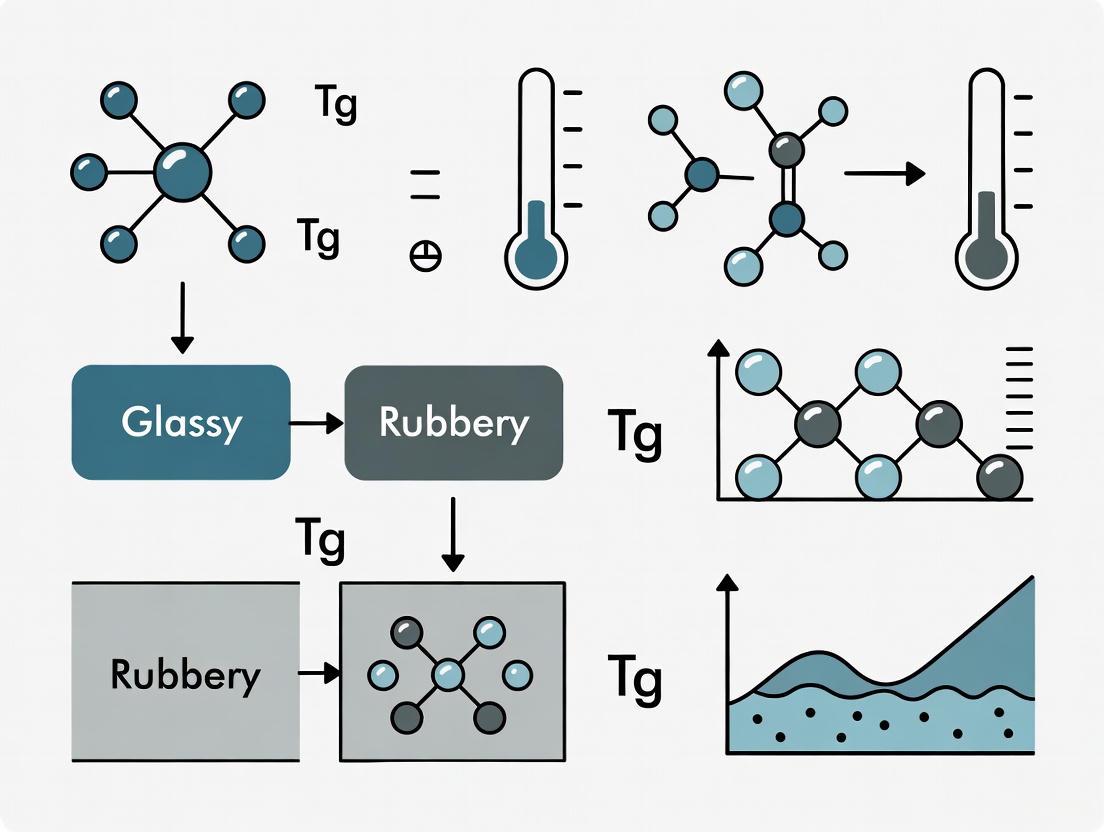
This article provides a comprehensive exploration of glass transition temperature (Tg) and its critical role in pharmaceutical development.
Glass Transition Temperature (Tg): A Comprehensive Guide for Pharmaceutical Scientists
Abstract
This article provides a comprehensive exploration of glass transition temperature (Tg) and its critical role in pharmaceutical development. Tailored for researchers and drug development professionals, it covers the fundamental principles of Tg in amorphous solid dispersions, details practical methodologies for its measurement, and addresses common challenges in stabilization. It further explores advanced predictive computational models and compares Tg behaviors across various Active Pharmaceutical Ingredients (APIs) and excipients. The synthesis of this information aims to equip scientists with the knowledge to enhance the kinetic stability and solubility of amorphous drug formulations.
Understanding Tg: From Molecular Fundamentals to Pharmaceutical Significance
The glass–liquid transition, or glass transition, is the gradual and reversible transition in amorphous materials (or in amorphous regions within semicrystalline materials) from a hard and relatively brittle "glassy" state into a viscous or rubbery state as the temperature is increased [1]. An amorphous solid that exhibits a glass transition is called a glass. The reverse transition, achieved by supercooling a viscous liquid into the glass state, is called vitrification [1].
Unlike first-order phase transitions such as melting or crystallization, the glass transition is not a transition between thermodynamic equilibrium states [1] [2]. It is primarily a dynamic phenomenon where time and temperature are interchangeable quantities to some extent, as expressed in the time–temperature superposition principle [1]. The question of whether some phase transition underlies the glass transition remains a matter of ongoing research [1].
This in-depth technical guide explores the glass transition as a complex phenomenon extending beyond a single temperature point, framing it within current research on glass transition temperature explanation and its critical applications in material science and pharmaceutical development.
Fundamental Principles and Characteristics
Molecular Origins of the Glass Transition
At the molecular level, the glass transition temperature corresponds to the temperature at which the largest openings between the vibrating elements in the liquid matrix become smaller than the smallest cross-sections of the elements or parts of them when the temperature is decreasing [1]. As a result of the fluctuating input of thermal energy into the liquid matrix, temporary cavities ("free volume") are created between the elements, the number and size of which depend on the temperature [1].
The glass transition occurs when molecular motions become frozen in on the timescale of observation. For polymers, conformational changes of segments, typically consisting of 10–20 main-chain atoms, become infinitely slow below the glass transition temperature [1]. In a partially crystalline polymer, the glass transition occurs only in the amorphous parts of the material [1].
Key Distinctions from Melting
The glass-transition temperature (Tg) of a material is always lower than the melting temperature (Tm) of the crystalline state of the material, if one exists, because the glass is a higher energy state than the corresponding crystal [1]. The transition comprises a smooth increase in the viscosity of a material by as much as 17 orders of magnitude within a temperature range of 500 K without any pronounced change in material structure [1]. This contrasts sharply with the freezing or crystallization transition, which is a first-order phase transition involving discontinuities in thermodynamic and dynamic properties such as volume, energy, and viscosity [1].
Table 1: Comparison of Glass Transition and Melting Processes
| Characteristic | Glass Transition | Melting Transition |
|---|---|---|
| Thermodynamic Classification | Second-order transition features, but not considered true thermodynamic transition | First-order phase transition (Ehrenfest classification) |
| Structural Changes | No long-range order change; gradual change in molecular mobility | Fundamental change from ordered crystalline to disordered liquid state |
| Viscosity Change | Smooth change over ~17 orders of magnitude | Abrupt change at specific temperature |
| Enthalpy/Volume | Continuous change with a step in thermal expansion coefficient and heat capacity | Discontinuous change at transition temperature |
| History Dependence | Strongly dependent on thermal history and cooling/heating rates | Largely independent of thermal history |
Experimental Determination of Tg
Measurement Techniques and Protocols
Multiple experimental techniques exist for measuring the glass transition temperature, each probing different aspects of the transition and often yielding different numeric results. At best, values of Tg for a given substance agree within a few kelvins [1].
Differential Scanning Calorimetry (DSC)
Principle: Measures heat flow differences between sample and reference as a function of temperature, detecting changes in heat capacity at Tg [3].
Standard Protocol:
- Sample preparation: 5-20 mg of material in hermetically sealed pans
- Cooling: Typically at 10 K/min to below Tg
- Heating: At same rate (typically 10 K/min) through transition region
- Tg determination: Midpoint of the step change in heat flow curve [1]
Data Interpretation: The glass transition is identified as a step change in the heat flow curve, with Tg typically taken as the midpoint temperature of this transition [1]. DSC detects the calorimetric Tg associated with changes in enthalpy and heat capacity.
Dynamic Mechanical Analysis (DMA)
Principle: Applies oscillatory stress to sample and measures mechanical response, detecting changes in viscoelastic properties at Tg [3].
Standard Protocol:
- Sample geometry: Dependent on measurement mode (tension, compression, bending)
- Frequency: Typically 1 Hz (influences measured Tg value)
- Heating rate: 3-5 K/min through transition region
- Tg determination: Peak in tan δ curve or onset of storage modulus drop
Data Interpretation: DMA detects the mechanical Tg associated with changes in molecular mobility affecting mechanical properties. The mechanical Tg often differs from calorimetric Tg due to different underlying phenomena being measured [3].
Dilatometry (Thermal Expansion)
Principle: Measures dimensional changes as a function of temperature, detecting changes in thermal expansion coefficient at Tg.
Standard Protocol:
- Heating rates: 3-5 K/min (5.4–9.0 °F/min) are common [1]
- Tg determination: Temperature at intersection of regression lines for glassy and rubbery states [1]
Discrepancies Between Measurement Techniques
Different operational definitions of Tg yield different numeric results due to the intrinsic nature of the glass transition as a kinetic phenomenon. The mechanical glass transition temperature from DMA often differs from the calorimetric Tg from DSC because they probe different aspects of the transition [3]. For biopolymer systems, the network glass transition temperature derived from mechanical measurements reflects structural relaxation supporting network formation, while calorimetric Tg reflects heat capacity considerations [3].
Factors Influencing Glass Transition Temperature
Molecular and Structural Factors
Multiple molecular factors significantly influence the glass transition temperature of polymeric materials:
Chain Length: Each chain end has associated free volume. Polymers with shorter chains have more chain ends per unit volume, resulting in more free volume and lower Tg [2]. The relationship follows: Tg = [1/Tg,∞ + K/Mw]⁻¹, where Tg,∞ is Tg at infinite molecular weight and Mw is weight average molecular weight [4].
Chain Flexibility: Polymers with flexible backbones have lower Tg due to lower activation energy for conformational changes [2].
Side Groups: Larger side groups hinder bond rotation, increasing Tg. Polar groups (Cl, CN, OH) have the strongest effect [2].
Cross-linking: Cross-linking reduces chain mobility, increasing Tg. It also affects macroscopic viscosity by preventing chains from sliding past each other [2].
Plasticizers: Small molecules (typically esters) increase chain mobility by spacing out chains, reducing Tg [2].
Material-Specific Tg Values
Table 2: Glass Transition Temperatures of Common Polymers and Materials
| Material | Tg (°C) | Tg (°F) | Application State |
|---|---|---|---|
| Tire Rubber | -70 | -94 | Used above Tg (rubbery state) [1] |
| Polypropylene (atactic) | -20 | -4 | Semi-crystalline, used above Tg [1] [5] |
| Poly(vinyl acetate) (PVAc) | 30 | 86 | Amorphous polymer [1] |
| Poly(vinyl chloride) (PVC) | 80 | 176 | Amorphous, used below Tg [1] |
| Polycarbonate (PC) | 145 | 293 | Amorphous, used below Tg (glassy state) [5] |
| Polyetherimide (PEI) | 210 | 410 | Amorphous, high-performance thermoplastic [5] |
| 49% DMSO (aqueous) | -131 | -204 | Cryopreservation solution [6] |
| 63% Sucrose (aqueous) | -82 | -116 | Food/biopolymer system [6] |
Advanced Theoretical Frameworks
Kinetic vs. Thermodynamic Approaches
The formation of glasses can be understood from both kinetic and thermodynamic perspectives:
Kinetic Approach
From a kinetic perspective, glass formation occurs when a liquid is cooled too rapidly for crystals to form. The cooling rate must be fast enough to avoid the crystal region in time-temperature-transformation (TTT) diagrams [2]. This approach explains why Tg depends on cooling rate - slower cooling allows more time for structural relaxation, resulting in a higher density glass and lower Tg [1] [2].
Thermodynamic Approach
The thermodynamic approach considers the temperature dependence of thermodynamic properties like enthalpy and entropy. If a supercooled liquid could be followed without crystallizing, its entropy would eventually become less than that of the corresponding crystal at the Kauzmann temperature (TK) [2]. This paradox is avoided because the liquid undergoes the glass transition before reaching TK [2].
Free Volume Theory
The free volume theory posits that molecular transport occurs when voids between molecules exceed a critical size. The glass transition occurs when the free volume decreases to a critical value where molecular rearrangements become impossible on experimental timescales [1] [2].
Tg in Applied Research and Industrial Applications
Cryopreservation and Vitrification
In cryopreservation by vitrification, Tg plays a critical role in preventing thermal stress cracking. Recent research demonstrates that solutions with higher glass transition temperatures experience lower thermal stress and reduced cracking when thermally cycled to and from liquid nitrogen temperatures [6]. This relationship stems from the inverse relationship between Tg and thermal expansion coefficient - higher Tg solutions have lower thermal expansion coefficients, reducing thermally induced stresses [6].
Table 3: Research Reagent Solutions for Glass Transition Studies
| Reagent/Solution | Composition | Application/Function | Typical Tg Range |
|---|---|---|---|
| DMSO Solution | 49 wt% DMSO in water | Common cryoprotectant for vitrification | -131°C [6] |
| Glycerol Solution | 79 wt% Glycerol in water | Cryoprotectant with intermediate Tg | -102°C [6] |
| Xylitol Solution | 65 wt% Xylitol in water | Sugar alcohol for elevated Tg systems | -87°C [6] |
| Sucrose Solution | 63 wt% Sucrose in water | High Tg cryoprotectant | -82°C [6] |
| κ-Carrageenan/Glucose Syrup | Biopolymer/co-solute matrix | Model for structural relaxation studies | Variable (method-dependent) [3] |
| Gelatin/Polydextrose | Crosslinked protein matrix | Model for network Tg studies | Variable (method-dependent) [3] |
Pharmaceutical and Food Science Applications
In pharmaceutical formulation and food science, Tg determines storage stability, crystallization tendency, and molecular mobility. Below Tg, molecular mobility is severely restricted, potentially preserving unstable compounds [3]. Research has shown that the oxidation rates of omega fatty acids in condensed biopolymer matrices are controlled by their mechanical glass transition temperature, with oxidation kinetics following a sigmoidal model that correlates with structural relaxation processes [3].
The glass transition is a complex phenomenon that extends far beyond a single temperature point. Its definition encompasses kinetic, thermodynamic, and mechanical perspectives, each providing unique insights into material behavior. The dependence of measured Tg on experimental methodology, thermal history, and material composition underscores the need for researchers to carefully consider context when applying glass transition concepts.
Ongoing research continues to reveal new dimensions of the glass transition, particularly in complex biological and pharmaceutical systems where the relationship between molecular mobility, structural relaxation, and stability remains a vibrant area of investigation. The recognition that mechanical and calorimetric glass transitions provide complementary rather than identical information has opened new avenues for controlling material properties in applications ranging from organ cryopreservation to stabilized nutraceutical delivery systems.
As research progresses, the fundamental understanding of the glass transition continues to evolve, driving innovations in material design and processing across diverse scientific and industrial domains.
The glass transition temperature (Tg) is a fundamental physicochemical parameter that marks the critical temperature at which an amorphous polymer undergoes a transformation from a hard, glassy state to a soft, rubbery state. This transition is not a phase change but a kinetic phenomenon, characterized by the onset of cooperative segmental motion of polymer chains as thermal energy overcomes the energy barriers for molecular rotation and translation [7] [8]. Below Tg, the chains are frozen in a disordered, solid state, with only limited local vibrations. Above Tg, sufficient energy is available for chains to exhibit large-scale conformational changes, leading to viscoelastic behavior. Understanding and characterizing this "molecular dance" is crucial for researchers and drug development professionals, as it governs key material properties including mechanical modulus, diffusion rates, structural stability, and ultimately, the performance and shelf-life of polymeric materials and their composites [9] [10].
This whitepaper situates itself within the broader context of glass transition research, which seeks to move from phenomenological description to quantitative prediction and control. Recent advances, particularly in machine learning (ML) and high-throughput molecular simulation, are revolutionizing this field. These data-driven approaches are uncovering intricate quantitative structure-property relationships (QSPRs), enabling the rational design of polymers with precisely tailored Tg values for specific applications, from high-temperature composites to controlled-release drug delivery systems [7] [8] [10].
Molecular Mechanisms of Chain Mobility
At the heart of the glass transition lies the concept of chain mobility. The transition from a glass to a rubber is fundamentally a dramatic increase in the freedom of motion of the polymer backbone and side chains.
The Role of Molecular Structure
A polymer's chemical structure directly dictates the energy landscape for chain motion. A key structural descriptor identified through machine learning is the number of rotatable bonds. A higher number of such bonds within the polymer backbone or side chains increases conformational flexibility, leading to a lower Tg, as less thermal energy is required to initiate segmental motion [7]. Conversely, rigid structures, particularly aromatic rings and fused cyclic systems, dramatically reduce chain mobility and elevate Tg. Polyimides (PIs), for instance, owe their high Tg and excellent thermal stability to the presence of rigid, aromatic imide rings and the formation of intramolecular and intermolecular charge-transfer complexes [7] [8].
The influence of side-chain dynamics on bulk properties has been vividly demonstrated in stimuli-responsive polymers. Research on polymethacrylates with pendant triethanolamine borate (TEAB) units reveals that the reversible conversion between a rigid, cage-shaped TEAB and a flexible, open-chain triethanolamine (TEA) can induce a massive Tg shift of up to 166 °C. This work highlights that modulating the conformational flexibility of individual side chains is a potent strategy for controlling macroscopic polymer chain mobility and thermal properties [11].
Aggregation Structure and Dynamics
In complex polymer systems such as semiconducting polymers, the relationship between chain motion and performance is multifaceted. Studies on intrinsically stretchable semiconducting polymers have revealed a distinct decoupling of responsibilities within the aggregation structure: side-chain dynamics predominantly govern the material's stretchability and glass transition behavior, while effectively aggregated backbones are primarily responsible for maintaining efficient charge transport pathways. This insight underscores that the "molecular dance" is not uniform across all parts of a complex polymer architecture [12].
Research Methodologies: From Simulation to Machine Learning
The prediction and measurement of Tg leverage a multi-faceted toolkit, ranging from atomistic simulations that model physical behavior to data-driven models that uncover statistical patterns.
Molecular Dynamics (MD) Simulations
MD simulations provide an atomic-level view of polymer behavior across temperatures. The canonical method involves simulating a density-temperature curve during a cooling process; Tg is identified as the point where this curve shows a distinct change in slope [13]. A significant advancement is the ensemble-based MD approach, which runs multiple replicas (an ensemble) of the simulation concurrently at different temperatures, rather than sequentially. This methodology drastically reduces the computational wall-clock time from days to a few hours while maintaining accuracy and providing a robust estimate of uncertainty. Studies recommend ensembles of at least ten replicas to achieve 95% confidence intervals for Tg of less than 20 K [13].
For complex or poorly characterized systems, Machine-Learning Molecular Dynamics (MLMD) has emerged as a powerful tool. In MLMD, a machine-learned potential (MLP) is trained on a high-quality dataset from quantum mechanical calculations (e.g., Density Functional Theory). This MLP can then be used to run accurate MD simulations at a fraction of the computational cost of direct quantum simulation. This approach has proven highly effective for modeling the structure and glass transition of complex inorganic glasses, such as calcium aluminosilicate systems, where traditional classical MD struggles [14].
Machine Learning (ML) for Tg Prediction
ML-based QSPR modeling bypasses direct simulation by establishing a statistical link between a polymer's chemical structure (represented by molecular descriptors) and its Tg. The standard workflow, as applied to a dataset of over 900 homopolymers [10] and 1261 polyimides [7] [8], involves:
- Data Curation: Assembling a large, high-quality dataset of polymer structures and their experimental Tg values.
- Descriptor Generation: Converting chemical structures into a numerical representation (e.g., using SMILES strings and RDKit) to calculate molecular descriptors that encode topological, electronic, and geometric features.
- Model Training & Validation: Training multiple ML algorithms (e.g., Support Vector Machines, Categorical Boosting, Random Forest) on a subset of the data and rigorously validating their predictive performance on a held-out test set.
The interpretability of these models is enhanced using techniques like SHapley Additive exPlanations (SHAP), which quantifies the contribution of each molecular descriptor to the predicted Tg, thereby providing insights for molecular design [7] [8].
Table 1: Key Molecular Descriptors and Their Impact on Glass Transition Temperature
| Descriptor | Description | Impact on Tg | Molecular Interpretation |
|---|---|---|---|
| NumRotatableBonds [7] | Number of rotatable bonds in the repeating unit. | Negative | More rotatable bonds increase chain flexibility, lowering the Tg. |
| Electronic Effect Indices [10] | Descriptors encoding the electronic environment of atoms. | Positive | Electron-withdrawing groups can increase intermolecular forces or chain rigidity, raising Tg. |
| Topological Descriptors [10] | Describe the molecular branching and connectivity. | Variable | Complex branching can restrict chain mobility (increasing Tg) or inhibit packing (decreasing Tg). |
| Aromatic Ring Count [8] | Number of aromatic rings in the repeating unit. | Positive | Aromatic rings impart significant rigidity to the polymer backbone, elevating Tg. |
Quantitative Data Synthesis
The performance of modern Tg prediction methodologies can be compared across several studies, revealing a trend where larger, more diverse datasets lead to more robust and accurate models.
Table 2: Performance Comparison of Tg Prediction Methodologies from Recent Studies
| Methodology | Polymer System | Dataset Size | Key Performance Metrics | Reference |
|---|---|---|---|---|
| Categorical Boosting (ML) | Polyimides (PIs) | 1261 | R² (test) = 0.895, MAE = 18.58 °C, RMSE = 23.06 °C | [7] [8] |
| Support Vector Machine (ML) | Homopolymers | 902 | R² (training) = 0.813, R² (test) = 0.770, RMSE = 0.062 (log units) | [10] |
| Ensemble MD Simulation | Cross-linked Epoxy Resins | 6 (systems) | Agreement with experiment; 95% CI < 20 K with N>=10 replicas | [13] |
| All-Atom MD Validation | Polyimides (PIs) | 8 (structures) | Lowest prediction deviation from ML: ~6.75% | [7] [8] |
| Graph CNN (ML) | Polymers (Various) | 600 | R² = 0.88, MAE = 22.5 K | [10] |
Experimental Protocols
Protocol 1: Machine Learning Workflow for Tg Prediction
This protocol outlines the steps for developing a predictive ML model for Tg, as detailed in recent large-scale studies [7] [8] [10].
- Dataset Construction: Collect and curate a dataset of polymer structures and their corresponding experimentally measured Tg values from literature and public databases. Prefer data measured via consistent methods (e.g., Differential Scanning Calorimetry - DSC) to minimize error.
- Structure Standardization and Featurization:
- Represent each polymer's repeating unit using a Simplified Molecular Input Line Entry System (SMILES) string.
- Use a cheminformatics toolkit (e.g., RDKit) to compute a wide array (e.g., 200+) of molecular descriptors from the SMILES strings. These can include topological, constitutional, and electronic descriptors.
- Feature Selection: Apply feature selection methods (e.g., genetic algorithms, correlation analysis) to eliminate redundant or non-informative descriptors and reduce the feature set to a critical subset (e.g., 15-20 descriptors) that maximizes predictive power.
- Model Training and Validation:
- Split the dataset into a training set (typically 70-80%) and a test set (20-30%).
- Train multiple ML algorithms (e.g., Categorical Boosting, Support Vector Machine, Random Forest, Artificial Neural Networks) on the training set using the selected descriptors as input and Tg as the output.
- Tune the hyperparameters of each algorithm via cross-validation on the training set.
- Evaluate the final performance of each model on the untouched test set using metrics like R², MAE, and RMSE.
- Model Interpretation: Apply model interpretation techniques like SHAP analysis to the best-performing model to identify which molecular descriptors have the greatest influence on Tg and the direction of their effect.
Protocol 2: Ensemble Molecular Dynamics for Tg Determination
This protocol describes the ensemble-based MD approach for calculating Tg with quantified uncertainty [13].
- System Preparation: Build an atomistic model of the cross-linked polymer network or amorphous polymer cell using a tool like PACKMOL. Assign force field parameters (e.g., PCFF, CVFF, GAFF).
- Equilibration: Perform energy minimization and equilibration in the NPT (isothermal-isobaric) ensemble at a high temperature (e.g., 500 K) well above the expected Tg to ensure a relaxed, melt-like state.
- Ensemble Generation: Generate N independent replicas (N ≥ 10 is recommended) of the fully equilibrated system.
- Concurrent Cooling Simulation:
- For each replica, assign a different target temperature from a range that spans the glassy and rubbery states (e.g., from 500 K to 300 K).
- Run NPT simulations for all replicas concurrently (in parallel) for a defined burn-in period (e.g., 4 ns) followed by a production run (e.g., 2 ns).
- For each replica, record the average density during the production run.
- Data Analysis:
- For each temperature, calculate the average density and standard deviation across the N replicas.
- Plot the average density versus temperature.
- Fit two separate straight lines through the data points in the rubbery (high-temperature) and glassy (low-temperature) regions.
- The glass transition temperature (Tg) is defined as the intersection point of these two linear fits.
- The 95% confidence interval for Tg can be determined based on the standard deviations and the number of replicas.
Visualizing the Workflows
The following diagrams illustrate the logical relationships and workflows of the key methodologies discussed.
Machine Learning Prediction Workflow
Ensemble Molecular Dynamics Workflow
The Scientist's Toolkit: Research Reagent Solutions
Table 3: Essential Materials and Tools for Glass Transition Research
| Item / Reagent | Function / Application | Reference |
|---|---|---|
| Differential Scanning Calorimetry (DSC) | The primary experimental technique for measuring Tg by detecting changes in heat capacity. | [7] [11] |
| RDKit Software Package | An open-source cheminformatics toolkit used to compute molecular descriptors from SMILES strings for ML model input. | [7] [8] [10] |
| Triethanolamine Borate (TEAB) Monomers | Functional monomers used to synthesize polymers with chemically switchable side chains, enabling large, reversible modulation of Tg. | [11] |
| Categorical Boosting (CatBoost) Algorithm | A high-performance, open-source ML algorithm particularly effective for building accurate QSPR models with structured data. | [7] [8] |
| LAMMPS (MD Simulator) | A widely used, open-source molecular dynamics simulator capable of performing the ensemble-based simulations for Tg calculation. | [13] |
| SHAP (SHapley Additive exPlanations) | A game-theoretic approach to explain the output of any ML model, crucial for interpreting which structural features affect Tg. | [7] [8] |
Why Tg is a Cornerstone for Amorphous Pharmaceutical Stability
The glass transition temperature (Tg) is a fundamental property that dictates the physical stability, performance, and shelf-life of amorphous pharmaceutical dosage forms. For poorly water-soluble drugs, amorphous solid dispersions (ASDs) have emerged as a transformative strategy to enhance bioavailability, with their kinetic stability rooted in the principles of the glassy state. This whitepaper elucidates the pivotal role of Tg through the lens of thermodynamic, kinetic, and environmental factors. We detail advanced experimental protocols for characterizing Tg and its implications, supported by quantitative data and predictive modeling. Framed within ongoing research on glass transition temperature, this guide provides drug development professionals with a foundational understanding and practical toolkit for leveraging Tg to engineer robust, stable amorphous formulations.
The persistent challenge of poor water solubility has driven the pharmaceutical industry to increasingly adopt amorphous formulations. Unlike their crystalline counterparts, amorphous materials lack long-range molecular order, which confers a higher energy state and a significant solubility advantage [15] [16]. This metastable state, however, is inherently susceptible to recrystallization over time or under stress, compromising solubility, dissolution rate, and ultimately, product efficacy and safety [17] [16].
Amorphous solid dispersions (ASDs), where the active pharmaceutical ingredient (API) is molecularly dispersed within a polymer matrix, have become a cornerstone technology to stabilize the amorphous form. From 2012 to 2023, the U.S. FDA approved 48 ASD-based formulations, signaling a paradigm shift in the pharmaceutical domain [15]. The stability of these systems is not accidental but is engineered through a deep understanding of material science, at the heart of which lies the glass transition temperature (Tg).
The Tg is the critical temperature at which an amorphous material transitions from a brittle, glassy state to a rubbery, supercooled liquid. This transition is accompanied by significant changes in thermodynamic properties such as enthalpy, volume, and entropy, and a dramatic increase in molecular mobility [15] [17]. This whitepaper positions Tg as the cornerstone of amorphous pharmaceutical stability, exploring its theoretical basis, its role in stabilization mechanisms, and the advanced experimental and computational methods used to harness its power in modern drug development.
Theoretical Foundations of Glass Transition Temperature
Defining the Glassy and Rubbery States
Below the Tg, an amorphous material exists in a glassy state. Molecular motions are largely restricted to vibrational and short-range movements, resulting in high viscosity (typically >10^12 Pa·s) and low molecular mobility. In this state, the material is kinetically trapped, and the driving force for crystallization is suppressed, leading to superior physical stability [15] [17].
Upon heating above the Tg, the material transitions to a rubbery state. This is characterized by a rapid increase in molecular mobility, as cooperative motions of entire molecular chains become possible. The system's viscosity drops precipitously, and the configurational entropy increases, making nucleation and crystal growth thermodynamically and kinetically favorable [17]. The relationship between molecular mobility and physical stability is thus intrinsically tied to the Tg, making it a key predictor of shelf life.
The Thermodynamic and Kinetic Basis of Tg
The instability of the amorphous form originates from its higher Gibbs free energy compared to the crystalline state. The difference in free energy provides the thermodynamic driving force for crystallization. The Tg acts as a kinetic barrier to this process; below Tg, the immense viscosity leads to arrested molecular motion, effectively preventing the molecular reorganization required for crystallization over pharmaceutically relevant timescales [16].
The reduced glass transition temperature (Trg = Tg/Tm, where Tm is the melting point in Kelvin) is a useful parameter for determining the glass-forming ability (GFA) of a system. Systems with a higher Trg are generally more stable and less prone to crystallization. Poor glass formers, characterized by low viscosity and high molecular mobility even at room temperature, are prone to crystallization and require higher polymer-to-drug ratios for stabilization, which can limit drug loading [15].
Tg as the Primary Predictor of Physical Stability
Molecular Mobility and Crystallization Tendency
The propensity for an amorphous drug to crystallize is directly linked to its molecular mobility, which is a strong function of the temperature relative to its Tg. A comprehensive study involving 52 drug compounds demonstrated this relationship unequivocally [17].
Table 1: Physical Stability of Amorphous Drugs in Relation to Tg and Glass-Forming Ability (GFA)
| GFA Class | Definition | Stability at T < Tg | Stability at T > Tg | Key Observation |
|---|---|---|---|---|
| Class II | Crystallizes upon reheating the amorphous material | All compounds remained stable (0/18 crystallized) | Majority crystallized (14/18 crystallized) | High risk of crystallization if stored above Tg |
| Class III | Remains amorphous upon reheating | All compounds remained stable (0/34 crystallized) | Nearly all remained stable (33/34 remained amorphous) | High inherent stability, even above Tg |
This data confirms that storage below Tg is a sufficient condition for the stability of both Class II and Class III compounds. However, storage above Tg is perilous for most Class II compounds, as the increased molecular mobility readily facilitates crystallization. The inherent crystallization tendency, encapsulated by the GFA classification, is therefore a critical determinant of a formulation's stability profile [17].
The Role of Polymers and the Gordon-Taylor Equation
In ASDs, polymers are not inert carriers but active stabilizers. They primarily function by increasing the overall Tg of the dispersion, thereby reducing molecular mobility at storage conditions. A polymer with a high Tg acts as an anti-plasticizer, raising the system's Tg and enhancing its kinetic stability [15].
The Tg of a binary mixture, such as an ASD, can be predicted using the Gordon-Taylor equation, which helps in pre-formulation screening:
Tg,mix = (w1Tg1 + Kw2Tg2) / (w1 + Kw2)
Where w1 and w2 are the weight fractions of components 1 and 2, Tg1 and Tg2 are their respective glass transition temperatures, and K is a fitting constant often related to the strength of molecular interactions [18].
Furthermore, specific drug-polymer interactions, such as hydrogen bonding, van der Waals forces, and ionic interactions, can provide an additional stabilizing effect beyond mere mobility reduction. These interactions improve miscibility and can further inhibit nucleation and crystal growth [15] [18]. The following diagram illustrates the core relationship between Tg, molecular mobility, and stability.
Diagram 1: The relationship between storage temperature, Tg, molecular mobility, and crystallization risk in Amorphous Solid Dispersions (ASDs).
Quantitative Stability Data and Tg
The stability of an ASD is not a simple binary outcome but a complex function of drug loading, storage conditions, and the properties of the polymer. Thermodynamic modeling, such as the Flory-Huggins theory and PC-SAFT, allows for the construction of phase diagrams to identify stable and metastable zones.
For instance, a case study on Ibuprofen (IBU) with various polymers demonstrated how Tg and solubility predictions guide formulation. While all polymers were predicted to be miscible with IBU, phase diagrams revealed that HPMCAS-based ASDs could only maintain stability at very low drug loadings (<5% w/w) at room temperature. In contrast, polymers like KOL17PF and KOLVA64 allowed for higher, pharmaceutically relevant drug loadings (>10% w/w) to reside in a metastable zone, making them superior candidates [18].
Table 2: Impact of Polymer Selection on Ibuprofen ASD Stability (Theoretical Predictions)
| Polymer | Predicted Miscibility | Stable Drug Loading at 25°C | Metastable Drug Loading at 25°C | Suitability for IBU ASD |
|---|---|---|---|---|
| KOL17PF | Miscible | N/A | >10% w/w | High |
| KOLVA64 | Miscible | N/A | >10% w/w | High |
| Eudragit EPO | Miscible (Borderline) | N/A | >10% w/w | Moderate |
| HPMCAS | Miscible (Borderline) | <5% w/w | 5-10% w/w | Low |
These models highlight that a high Tg polymer alone is insufficient; strong drug-polymer interactions and high miscibility are equally critical to achieving a stable, high-drug-load ASD.
Essential Research Reagents and Materials
The development and characterization of stable ASDs rely on a specific toolkit of materials and analytical techniques.
Table 3: The Scientist's Toolkit for ASD Research and Development
| Category | Item | Function & Rationale |
|---|---|---|
| Model Polymers | HPMCAS, PVP-VA64 (KOLVA64), Eudragit EPO, HPMC | Industry-standard carriers that elevate Tg and inhibit crystallization via anti-plasticization and molecular interactions. |
| Characterization Instruments | Differential Scanning Calorimeter (DSC) | The primary tool for experimental determination of Tg and melting point depression. |
| Powder X-ray Diffractometer (PXRD) | Confirms the amorphous state of the ASD and monitors for recrystallization during stability studies. | |
| Fourier-Transform Infrared Spectrometer (FTIR) | Probes drug-polymer interactions (e.g., hydrogen bonding) that contribute to stability. | |
| Computational Tools | PC-SAFT / Flory-Huggins Models | Thermodynamic models for predicting API-polymer solubility, miscibility, and phase diagrams. |
| Molecular Modeling & Machine Learning | In silico tools for predicting Tg, interaction parameters, and stability, reducing experimental burden. |
Experimental Protocols for Tg Characterization
Determining Tg via Differential Scanning Calorimetry (DSC)
Principle: DSC measures the heat flow into or out of a sample as a function of temperature. The glass transition appears as a step change in the heat capacity (Cp) of the material.
Protocol:
- Sample Preparation: Place 3-5 mg of the finely powdered ASD or pure API into a standard aluminum DSC pan. Crimp the pan hermetically to maintain a dry environment, especially for hygroscopic materials.
- Instrument Calibration: Calibrate the DSC cell for temperature and enthalpy using high-purity standards such as indium and zinc.
- Method Setup:
- Equilibration: Hold at 20°C below the expected Tg for 5 min.
- Heating Scan: Heat the sample at a controlled rate (typically 10°C/min) to a temperature well above the expected Tg but below the melting point to avoid thermal degradation.
- Atmosphere: Use a dry nitrogen purge gas (50 mL/min) throughout the experiment.
- Data Analysis: Analyze the resulting thermogram. The Tg is conventionally reported as the midpoint of the step transition in the heat flow curve [15] [18].
Investigating Miscibility via Melting Point Depression (MPD)
Principle: Based on Flory-Huggins theory, the melting point (Tm) of a crystalline API will depress when mixed with a miscible polymer. The extent of depression quantifies the strength of API-polymer interactions and allows for the calculation of the interaction parameter (χ).
Protocol:
- Preparation of Physical Mixtures: Create intimate physical mixtures of the crystalline API with the polymer at varying low drug loadings (e.g., 5%, 10%, 20% w/w).
- DSC Analysis: Run DSC on each physical mixture using the same parameters as for Tg analysis, but ensure the scan range includes the API's melting endotherm.
- Measurement: Record the end-set melting temperature of the API in each mixture. This provides a more consistent value for MPD analysis than the onset or peak temperature [18].
- Modeling:
- Construct a plot of API melting temperature versus polymer volume fraction.
- Fit the data using the Flory-Huggins equation or more advanced models like PC-SAFT to determine the interaction parameter (χ).
- A negative or low positive χ value indicates favorable mixing and miscibility [18].
The workflow for this integrated characterization is summarized below.
Diagram 2: An integrated experimental workflow for characterizing ASD stability using DSC and thermodynamic modeling.
Advanced Formulation Strategies and Future Directions
Leveraging Tg in Formulation Design
Understanding Tg enables sophisticated formulation strategies. For instance, co-milling a drug with excipients like croscarmellose sodium can induce amorphization. Research shows this is particularly effective for good glass formers (Class III) with a high intrinsic Tg, which form more stable amorphous phases under mechanical stress compared to low-Tg drugs [19]. Furthermore, ternary amorphous solid dispersions (TASDs) incorporating a second drug or surfactant can achieve high drug loading and exceptional stability. A TASD of curcumin and resveratrol with Eudragit EPO demonstrated a single, elevated Tg and remained physically stable for 12 months at room temperature, highlighting how multi-component interactions can optimize the glassy matrix [20].
The Future: Predictive Modeling and Digital Design
The field is rapidly moving from empirical testing to a predictive, digital-design approach. Machine learning (ML) and artificial intelligence (AI) are being leveraged to predict Tg, drug-polymer miscibility, and physical stability from molecular structures, drastically reducing development timelines [16]. Support vector machine (SVM) algorithms have successfully classified the physical stability of amorphous drugs above Tg based on molecular features, identifying that aromaticity and π-π interactions can reduce inherent stability [17]. The integration of these computational tools with high-throughput experimentation is paving the way for Quality by Digital Design (QbDD), ensuring the development of robust and stable amorphous pharmaceuticals [16] [18].
The glass transition temperature (Tg) is undeniably a cornerstone of amorphous pharmaceutical stability. It serves as a critical indicator of molecular mobility, a predictor of crystallization risk, and a primary target for formulation design. Through the strategic selection of high-Tg polymers and the engineering of specific drug-polymer interactions, formulators can kinetically stabilize the amorphous state, unlocking the bioavailability benefits of poorly soluble drugs. As advanced characterization techniques and predictive computational models continue to evolve, the fundamental understanding of Tg will remain central to the rational design and successful commercialization of amorphous drug products.
The glass transition temperature (Tg) is a fundamental property of amorphous polymers, marking the temperature at which a material transitions from a hard, glassy state to a soft, rubbery state. This transition profoundly influences a polymer's mechanical properties, stability, and application potential [21]. In pharmaceutical development, the Tg of polymer excipients and active amorphous solid dispersions is critical for predicting product stability, dissolution behavior, and shelf life. Plasticization, the process of adding a low-molecular-weight substance to a polymer to increase its chain mobility and flexibility, is a primary mechanism for Tg reduction. When the plasticizer is water or ambient moisture, this effect becomes a critical consideration for the handling, performance, and long-term stability of pharmaceutical formulations [21] [22].
The free volume theory provides the dominant explanation for this phenomenon. Above the Tg, polymers possess increased free volume, allowing chain segments to move. Plasticizers, including water, increase this free volume and facilitate polymer chain mobility, thereby lowering the temperature at which the glass-to-rubber transition occurs [23]. This effect is particularly consequential for hydrophilic polymers used in drug delivery systems, as they can absorb significant amounts of moisture from the environment, leading to unpredictable Tg depression and potential failure. This whitepaper explores the mechanisms, quantitative impacts, and experimental analysis of water-induced Tg depression, providing a framework for controlling this effect in pharmaceutical research.
Theoretical Foundations of Plasticization
Mechanisms of Water as a Plasticizer
Water acts as an effective external plasticizer for hydrophilic polymers. Its small molecular size and polar nature allow it to penetrate the polymer matrix and interact with polymer chains through several mechanisms. A key mechanism is the disruption of polymer-polymer hydrogen bonding. Many pharmaceutical polymers, such as polysaccharides and proteins, possess functional groups (e.g., -OH, -COOH) that form intermolecular hydrogen bonds, creating a rigid network. Water molecules, with their strong hydrogen-bonding capacity, can insert themselves between polymer chains, breaking these polymer-polymer interactions and replacing them with polymer-water hydrogen bonds [22]. This disruption reduces the overall cohesive energy density of the polymer system, allowing chains to move more freely at lower temperatures.
Furthermore, water molecules increase the free volume within the polymer matrix. According to the free volume theory, the small solvent molecules create space between polymer chains, providing room for chain segments to wiggle and slide past one another. This increase in molecular mobility directly translates to a lower Tg [23]. The effectiveness of water as a plasticizer is therefore a function of its compatibility with the polymer (governed by polarity and hydrophilicity) and its concentration within the matrix. The following diagram illustrates the atomistic mechanism of this process.
Internal vs. External Plasticization
It is crucial to distinguish between internal and external plasticization, as their implications for product stability differ significantly. Internal plasticization involves chemically modifying the polymer backbone or side chains to increase flexibility, for example, by copolymerizing a rigid monomer with a flexible comonomer. This method permanently incorporates the flexible units into the polymer structure, making the Tg reduction stable and non-migratory [21].
In contrast, external plasticization relies on the physical addition of a small molecule, such as water, to the polymer matrix. While highly effective, this approach is inherently less stable. The plasticizer can leach out or migrate over time due to changes in environmental conditions, such as temperature and relative humidity. This volatility can lead to an unstable Tg and, consequently, unpredictable material properties during the shelf life of a pharmaceutical product [21]. For water-sensitive formulations, this necessitates rigorous controlled storage and packaging.
Quantitative Analysis of Tg Reduction by Water
Tg Depression by Various Plasticizers
The extent of Tg depression is highly dependent on the specific polymer-plasticizer system. The following table summarizes the effect of different plasticizers, including water and polyols, on the Tg of various polymer matrices, as reported in the literature.
Table 1: Tg Depression by Water and Other Plasticizers in Different Polymer Systems
| Polymer System | Plasticizer | Plasticizer Concentration | Resulting Tg (°C) | Tg Depression (ΔTg) | Reference/Model |
|---|---|---|---|---|---|
| Hydroxypropylmethylcellulose Acetate Succinate (HPMCAS) | Water | Varying Concentration | Measured Reduction | Quantified Agreement | Molecular Dynamics (MD) Simulation [21] |
| β-Cyclodextrin | Water | Varying Concentration | Predicted by Empirical Equations | Quantified Rate | Molecular Dynamics (MD) Simulation [21] |
| Curdlan (CL) Films | Glycerol (GLY) | 10% of dry matter | Not Specified | Significant (Most effective plasticizer) | DSC & Tensile Testing [22] |
| Curdlan (CL) Films | Polyethylene Glycol (PEG) | 10% of dry matter | Not Specified | Significant (Increased water sensitivity) | DSC & Tensile Testing [22] |
| Polyvinyl Chloride (PVC) | Di(2-ethylhexyl) phthalate (DEHP) | 30-40 wt% | Drastic Reduction | Baseline for comparison | MD Simulation [23] |
| Polyvinyl Chloride (PVC) | Diheptyl Succinate (DHS) | Modeled | Comparable to DEHP | Promising non-toxic alternative | MD Simulation [23] |
| Polyvinyl Chloride (PVC) | Dibutyl Sebacate (DBS) | Modeled | Comparable to DEHP | Promising non-toxic alternative | MD Simulation [23] |
The Relationship Between Plasticizer Properties and Effectiveness
The efficiency of a plasticizer is not uniform; it depends on its molecular properties. Key factors include:
- Molecular Weight: Lower molecular weight plasticizers like glycerol (92 g/mol) and ethylene glycol (62 g/mol) are often more effective at reducing Tg on a per-mass basis than higher molecular weight counterparts like sorbitol (182 g/mol) due to their greater mobility and ability to separate polymer chains [22].
- Polarity and Hydrogen Bonding: The number of hydrophilic groups (e.g., -OH) per molecule determines a plasticizer's compatibility with hydrophilic polymers. Glycerol, with three hydroxyl groups, showed superior compatibility and plasticizing effect in curdlan films compared to other polyols [22].
- Molecular Structure: Branching and the balance between polar (cohesive) and non-polar (spacer) groups influence how a plasticizer interacts with the polymer chain. Longer aliphatic chains in molecules like diheptyl succinate (DHS) act as spacers, introducing more free volume and enhancing plasticization [23].
Experimental Protocols for Characterizing Tg
Differential Scanning Calorimetry (DSC) Protocol
Differential Scanning Calorimetry (DSC) is the gold standard for the direct experimental determination of Tg. The following protocol, adapted from standardized methods, ensures accurate and reproducible results [24].
Objective: To determine the glass transition temperature (Tg) of a polymer sample using DSC.
Materials and Equipment:
- DSC instrument (e.g., Mettler Toledo DSC-1)
- Analytical balance (precision to 0.01 mg)
- Aluminum crucibles with lids (e.g., 40 µL volume)
- Sample press
- Nitrogen gas supply (for inert atmosphere)
Procedure:
- Sample Preparation: Pre-dry the polymer sample if necessary to establish a baseline moisture content. Precisely weigh 4-8 mg of the sample using an analytical balance.
- Loading: Place the weighed sample into an aluminum crucible and hermetically seal it using a press. Prepare an identical empty crucible as the reference.
- First Heating Cycle (Heat History Erasure):
- Place the sample and reference crucibles in the DSC furnace.
- Purge the system with nitrogen gas (e.g., 50 mL/min flow rate).
- Quench the sample by rapidly cooling it to -90°C (or a suitable temperature below the expected Tg).
- Hold at -90°C for 5 minutes for thermal equilibration.
- Heat the sample from -90°C to 100°C at a constant rate of 2°C/min.
- This first cycle erases the thermal history of the polymer.
- Second Heating Cycle (Tg Measurement):
- After the first cycle, cool the sample back to -90°C at a controlled rate.
- Reheat the sample from -90°C to 100°C at the same constant rate of 2°C/min. This second heating curve is used for the Tg analysis.
- Data Analysis:
- Use the instrument's software to plot the heat flow (W/g) against temperature.
- Identify the Tg as the midpoint of the step transition in the heat flow curve using the tangent method. The software typically places one tangent on the flat baseline before the transition and another on the flat baseline after the transition, with the Tg taken as the midpoint of the bend between these tangents.
The experimental workflow for this protocol is summarized below.
Complementary Thermal Analysis Techniques
While DSC is primary for Tg, other techniques provide complementary information:
- Thermogravimetric Analysis (TGA): Measures mass change as a function of temperature. It is crucial for determining the volatile content, including water, in a polymer sample. This information is essential for correlating the exact moisture content with the observed Tg [25].
- Dynamic Mechanical Analysis (DMA): Applies a oscillatory stress to the sample and measures the strain response. DMA is highly sensitive to the glass transition, which appears as a sharp drop in the storage modulus (E') and a peak in the loss modulus (E'' or tan δ). It is particularly useful for characterizing thin films [22].
- Thermogravimetry-Mass Spectrometry (TG-MS): Couples TGA with a mass spectrometer to identify and quantify the evolved gases, including water vapor, during thermal decomposition. This is invaluable for understanding decomposition pathways and confirming the loss of moisture at specific temperatures [26].
Table 2: Comparison of Key Thermal Analysis Techniques
| Technique | Acronym | Measurement Principle | Primary Application in Tg Analysis | Quantitative Output |
|---|---|---|---|---|
| Differential Scanning Calorimetry | DSC | Heat flow difference between sample and reference | Direct measurement of Tg and other thermal transitions | Yes (Heat in Joules) |
| Thermogravimetric Analysis | TGA | Mass change of the sample under heating | Determines sample's water/volatile content pre-Tg analysis | Yes (Mass in mg/%) |
| Dynamic Mechanical Analysis | DMA | Mechanical response (modulus & damping) to oscillatory force | Highly sensitive detection of Tg, especially in films | Yes (Modulus in Pa) |
| Differential Thermal Analysis | DTA | Temperature difference between sample and reference | Identifies thermal events (e.g., Tg) | No (Qualitative) |
The Scientist's Toolkit: Essential Research Reagents and Materials
Table 3: Key Reagents and Materials for Plasticization and Tg Studies
| Reagent/Material | Function/Description | Example Application in Research |
|---|---|---|
| Polyol Plasticizers (Glycerol, Sorbitol, Xylitol, PEG) | Low molecular weight, hydrophilic molecules used to study external plasticization effects. Their multiple hydroxyl groups facilitate hydrogen bonding with polymers. | Systematically comparing plasticizer efficiency in biopolymer films like curdlan [22]. |
| Bio-based Plasticizer Candidates (Diheptyl Succinate - DHS, Dibutyl Sebacate - DBS) | Potential non-toxic alternatives to phthalates. Their structure (ester groups, aliphatic chains) is designed for compatibility and reduced leaching. | In silico (MD simulation) and experimental evaluation of performance in PVC and other polymers [23]. |
| Hydrophilic Polymer Matrices (Curdlan, HPMCAS, β-Cyclodextrin) | Model polymers that are susceptible to water plasticization. Used as the base material for studying moisture-polymer interactions. | Investigating water uptake, Tg depression, and changes in mechanical properties [21] [22]. |
| Aluminum Crucibles | Standard containers for holding solid samples in DSC and TGA. Their high thermal conductivity ensures rapid heat transfer. | Encapsulating polymer samples for Tg measurement via DSC [24]. |
| Inert Carrier Gas (Nitrogen, Helium) | Creates an inert atmosphere during thermal analysis to prevent oxidative degradation of the sample. | Purging the DSC/TGA furnace during Tg and decomposition analysis [26] [24]. |
Implications and Strategic Control in Pharmaceutical Development
The plasticizing effect of water has profound implications for pharmaceutical development. For amorphous solid dispersions, which are often used to enhance the bioavailability of poorly soluble drugs, a depression of Tg below the storage temperature can lead to devitrification (crystallization of the drug). This crystallization can drastically reduce dissolution rate and bioavailability. Similarly, the physical stability of lyophilized (freeze-dried) products, which rely on a high Tg to remain stable in the glassy state, can be compromised by moisture uptake during storage.
To mitigate these risks, strategic approaches are essential:
- Formulation Optimization: Selecting polymer excipients with inherently high Tg or low hygroscopicity.
- Robust Packaging: Using moisture-barrier primary packaging (e.g, cold-form blister packs, glass vials with appropriate closures) to control the storage microenvironment.
- Process Control: Implementing rigorous drying steps and controlling humidity during manufacturing.
- Predictive Modeling: Utilizing molecular dynamics (MD) simulations to predict the Tg of polymer-water systems before extensive experimental work, accelerating the development cycle [21] [23].
Water is a potent and ubiquitous plasticizer that can dramatically lower the glass transition temperature of hydrophilic polymers. This effect, driven by the disruption of polymer-polymer interactions and an increase in free volume, poses a significant challenge to the stability of pharmaceutical formulations. A comprehensive understanding of the quantitative relationships, coupled with robust experimental characterization using DSC, TGA, and other thermal techniques, is paramount. By integrating this knowledge with strategic formulation and packaging design, scientists can effectively control the plasticizing effect of moisture, ensuring the development of stable and efficacious drug products.
In the field of lyophilization, also known as freeze-drying, the glass transition temperature of the maximally freeze-concentrated solution (Tg') stands as a fundamental physicochemical parameter that dictates process design and product stability. Lyophilization is an essential manufacturing process for improving the long-term stability of labile drugs, particularly therapeutic proteins, with approximately 50% of marketed biopharmaceuticals utilizing this approach [27]. The process consists of three critical steps: freezing, primary drying, and secondary drying [27] [28]. Within this framework, Tg' represents the temperature at which the amorphous concentrated solute phase, formed during ice crystallization, undergoes a transition from a rigid glass to a viscous rubbery state [29]. This transition profoundly influences the lyophilization cycle design and ultimately determines the stability, efficacy, and quality of the final lyophilized product.
Understanding Tg' is particularly crucial for pharmaceutical scientists developing lyophilized biopharmaceuticals because it establishes the critical temperature limit during primary drying. Exceeding this temperature risks structural collapse of the product, potentially compromising key quality attributes including stability, reconstitution time, and residual moisture content [29]. This technical guide explores the theoretical foundations of Tg', details experimental methodologies for its determination, provides quantitative data for common pharmaceutical excipients, and establishes its practical significance within the broader context of glass transition temperature research for lyophilized product development.
Theoretical Foundations of Tg'
The Freezing Process and Cryoconcentration
The lyophilization process begins with the freezing step, during which a liquid formulation is cooled until ice nucleation occurs, followed by ice crystal growth. This process results in the physical separation of pure ice crystals from a matrix of concentrated solutes [27]. As freezing progresses, the solution becomes increasingly concentrated in a process known as cryoconcentration until it reaches a state referred to as the "maximally freeze-concentrated solution." In this state, the concentrated solute phase no longer allows further ice formation due to its extremely high viscosity [27] [29]. The temperature at which this maximally freeze-concentrated solute phase undergoes a glass transition is defined as Tg', while the corresponding solute concentration is designated as Cg' [29].
The Significance of the Glassy State
Below Tg', the maximally freeze-concentrated solute exists in an amorphous glassy state characterized by extremely high viscosity (approximately 10^13 poise), which effectively immobilizes molecules within a rigid matrix [30]. This molecular immobilization drastically reduces diffusion-limited degradation pathways, thereby preserving the stability of biopharmaceuticals during storage. The glassy state inhibits chemical degradation reactions and physical changes, making it essential for maintaining the stability of labile therapeutic proteins during storage [27]. The transition from this glassy state to a rubbery state above Tg' represents a critical boundary for process design, as the increased molecular mobility in the rubbery state can lead to collapse during drying and increased degradation rates during storage [29].
Distinction Between Tg' and Collapse Temperature (Tc)
It is crucial to distinguish Tg' from the collapse temperature (Tc), though these parameters are closely related. Tg' is a well-defined thermodynamic transition point of the maximally freeze-concentrated solute phase, while Tc represents the practical temperature at which macroscopic structural collapse occurs in the product during primary drying [29]. For most amorphous formulations with low solute concentrations (<50 mg/mL), Tc typically lies within 1-2°C of Tg'. However, for high-concentration protein formulations (≥50 mg/mL), a significant difference of 5°C or more between Tc and Tg' is often observed [29]. This distinction becomes critically important for process optimization, as primary drying can sometimes be conducted above Tg' but below Tc without adversely affecting product quality, potentially reducing primary drying time by approximately 13% per 1°C increase in product temperature [29].
Experimental Determination of Tg'
Differential Scanning Calorimetry (DSC)
Differential Scanning Calorimetry serves as the primary technique for experimental determination of Tg'. The methodology involves several carefully controlled steps to ensure accurate and reproducible results [31].
Sample Preparation
- Prepare the candidate formulation solution in the desired buffer system.
- Dialyze protein solutions if necessary to remove low molecular weight contaminants using membranes with appropriate molecular weight cut-offs (typically 12-14 kDa) [31].
- Load 3-5 mg of the solution into a hermetically sealed DSC pan, using an empty pan as reference.
Thermal Cycling Protocol
- Equilibration: Equilibrate the sample at 20°C for 2 minutes [31].
- Freezing Phase: Cool the sample to -50°C at a controlled rate of 1°C/min to simulate freezing conditions in lyophilization [31].
- Isothermal Hold: Maintain the sample at -50°C for 30 seconds to ensure complete thermal equilibrium [31].
- Heating Phase: Heat the sample to 30°C at a rate of 10°C/min while monitoring heat flow [31].
Data Analysis
- Analyze the resulting thermogram using appropriate software (e.g., Universal Analysis software for TA Instruments) [31].
- Identify Tg' as the onset temperature of the change in heat capacity during the heating phase, which appears as a step change in the baseline signal [29].
- For complex systems exhibiting multiple thermal events, the lower transition typically corresponds to Tg" (attributed to glass transition in a less concentrated frozen solution), while the higher transition represents Tg' [32].
The following diagram illustrates the experimental workflow for Tg' determination using DSC:
Freeze-Dry Microscopy (FDM)
Freeze-Dry Microscopy complements DSC by providing direct visualization of structural collapse and determining the collapse temperature (Tc), which is closely related to Tg' [29].
Methodology
- Place a small sample volume (typically a few microliters) on a temperature-controlled stage.
- Freeze the sample and apply vacuum to simulate primary drying conditions.
- Gradually increase temperature while monitoring the sample structure via microscopy.
- Record the temperature at which the frozen matrix loses its microscopic structure and collapses as Tc.
Recent advancements including optical coherence tomography freeze-dry microscopy enable Tc determination directly in vials, which may provide more relevant data than traditional FDM for cycle development [29].
Quantitative Tg' Data for Pharmaceutical Systems
The Tg' value varies significantly depending on the composition of the formulation. Disaccharides generally exhibit higher Tg' values compared to monomeric sugars, and the presence of crystalline components or proteins further influences this critical parameter.
Tg' Values of Common Lyophilization Excipients
Table 1: Glass Transition Temperatures (Tg') of Common Pharmaceutical Excipients in Maximally Freeze-Concentrated Solutions
| Excipient | Tg' (°C) | Concentration | Notes |
|---|---|---|---|
| Sucrose | -82 [6] | 63 wt% | Common lyoprotectant |
| Sucrose | -32 [32] | Not specified | Varies with measurement method |
| DMSO | -131 [6] | 49 wt% | Common cryoprotectant |
| Glycerol | -102 [6] | 79 wt% | Plasticizer, lowers Tg' |
| Xylitol | -87 [6] | 65 wt% | Sugar alcohol |
| Mannitol | Crystalline | N/A | Forms crystalline phase, no Tg' |
Tg' in Protein Formulations
Table 2: Tg' and Tc Values in Model Protein Formulations [29]
| Protein | Formulation Type | Protein Concentration (mg/mL) | Tg' (°C) | Tc (°C) |
|---|---|---|---|---|
| mAb A | Amorphous-only | 25 | -27.5 | -25.5 |
| mAb A | Amorphous-only | 50 | -23.5 | -18.5 |
| Pro B | Amorphous-crystalline | 2.5 | -33.5 | -31.5 |
| Pro B | Amorphous-crystalline | 25 | -31.5 | -26.5 |
The data demonstrates that Tg' increases with protein concentration in amorphous systems and that partially crystalline systems (containing components like mannitol or glycine) exhibit different Tg' profiles compared to purely amorphous systems [29].
Practical Applications in Lyophilization Cycle Development
Role in Primary Drying Design
The Tg' parameter directly informs the development of the primary drying phase, which is typically the longest segment of the lyophilization cycle [28] [29]. During primary drying, the product temperature must be maintained below Tg' (or Tc for high-concentration formulations) to prevent structural collapse of the product cake [29]. Modern approaches to cycle optimization focus on operating as close as possible to this temperature limit without exceeding it, thereby maximizing sublimation rates while maintaining product quality.
Controlled Ice Nucleation
The random nature of ice nucleation presents a significant challenge to process consistency, as it creates variability in ice crystal size and morphology, subsequently affecting drying rates and product homogeneity [27] [28]. Controlled ice nucleation techniques address this challenge by actively initiating ice formation at a defined temperature, promoting the formation of larger ice crystals and resulting in a more consistent pore structure with lower resistance to vapor flow during primary drying [28]. This approach enhances inter-vial consistency and can reduce primary drying times, demonstrating the interconnection between freezing behavior and the Tg'-defined design space.
Single-Step Drying and Tg'
Recent advancements in lyophilization technology have explored single-step drying approaches, where primary and secondary drying are combined into one continuous step [29]. This methodology can potentially reduce overall cycle times from several days to a single day, offering significant manufacturing efficiencies. The successful implementation of single-step drying relies on precise control of product temperature relative to Tg' and Tc, particularly for high-concentration protein formulations where the difference between these parameters is more pronounced [29].
The Scientist's Toolkit: Essential Research Reagents and Materials
Table 3: Key Reagents and Materials for Tg' Research and Lyophilization Development
| Item | Function/Application | Examples |
|---|---|---|
| DSC Instrument | Thermal analysis to determine Tg' | TA Instruments Q2000 [31] |
| Freeze-Dry Microscope | Direct visualization of collapse events | Optical coherence tomography systems [29] |
| Lyoprotectants | Stabilize proteins during drying and storage | Sucrose, Trehalose [31] |
| Cryoprotectants | Protect against freezing-induced stresses | DMSO, Glycerol [6] |
| Crystalline Bulking Agents | Provide structural support and eutectic crystallization | Mannitol, Glycine [29] |
| Buffer Systems | Maintain pH during freezing and drying | Potassium Phosphate, Histidine [31] |
| Bench-top Lyophilizer | Small-scale process development | Virtis Bench Top Lyophilizer [31] |
Thermal Transitions in Frozen Systems
The thermal behavior of frozen aqueous systems is complex, often involving multiple transitions that researchers must carefully interpret. As shown in the diagram below, frozen systems can exhibit two distinct thermal events: Tg" (the glass transition of a less concentrated freeze-concentrated solution) and Tg' (the glass transition of the maximally freeze-concentrated solution) [32]. Some interpretations also include the ice melting/dissolution onset in this complex thermal profile.
Tg' remains an indispensable parameter in the development and optimization of lyophilization cycles for biopharmaceutical products. Its critical role in defining the maximum allowable product temperature during primary drying establishes the fundamental boundary conditions for process design. As the biopharmaceutical landscape continues to evolve with increasingly complex therapeutic modalities, the precise determination and application of Tg' will maintain its vital importance in ensuring the production of stable, efficacious, and high-quality lyophilized products. Furthermore, ongoing research into the relationships between Tg', Tc, and collapse phenomena continues to enable more efficient lyophilization processes, such as single-step drying and aggressive primary drying approaches, that reduce manufacturing costs while maintaining product quality.
Measuring Tg in Practice: Techniques and Formulation Strategies
Differential Scanning Calorimetry (DSC) stands as the predominant thermoanalytical technique for detecting and characterizing the glass transition temperature (Tg) in polymeric, pharmaceutical, and advanced material systems. This whitepaper provides an in-depth technical examination of DSC methodologies for Tg detection, detailing underlying principles, standardized experimental protocols, and critical interpretation guidelines. Within the broader context of glass transition research, DSC offers unparalleled capability for quantifying the reversible heat capacity change that demarcates the glassy-to-rubbery transition, providing essential data for material selection, formulation stability, and performance prediction in drug development and material science applications.
Differential Scanning Calorimetry (DSC) is a thermoanalytical technique that measures the difference in heat flow between a sample and an inert reference as they undergo a controlled temperature program [33]. The fundamental principle underpinning DSC is the monitoring of heat flow required to maintain the sample and reference at identical temperatures throughout the heating or cooling process [34]. When a thermal event occurs in the sample—such as the glass transition—the instrument quantifies the differential energy input needed to maintain thermal equilibrium, providing direct calorimetric measurement of transition energies [35].
The glass transition temperature (Tg) represents a critical physicochemical parameter where amorphous materials transition from a rigid glassy state to a more flexible, rubbery state [36]. This second-order transition manifests in DSC as a characteristic step change in the baseline heat flow due to an alteration in the sample's heat capacity (Cp) [34] [36]. Unlike first-order transitions such as melting or crystallization that produce distinct peaks, the glass transition represents a change in the material's molecular mobility without a formal phase change [34]. For researchers and drug development professionals, accurate Tg determination provides crucial insights into material stability, processing conditions, and end-use performance, particularly for polymeric excipients, protein formulations, and solid dispersions [37] [38].
DSC Technology and Measurement Principles
Fundamental DSC Operating Principles
DSC instruments operate primarily under two distinct measurement principles, both capable of Tg detection but employing different technical approaches:
Heat-Flux DSC: This system employs a single furnace that simultaneously heats both the sample and reference crucibles, which are positioned on a thermoelectric disk [33] [39]. The temperature difference (ΔT) between the sample and reference is measured and converted to heat flow using the thermal equivalent of Ohm's law (q = ΔT/R), where R represents the thermal resistance of the measuring system [37] [39]. Heat-flux DSC designs offer benefits including simple design, good baseline stability, and robustness across various atmospheric conditions [39].
Power-Compensated DSC: This configuration utilizes separate, individually controlled furnaces for the sample and reference [33] [34]. The system actively maintains both furnaces at identical temperatures by supplying differential power to the two heaters, and directly measures this power difference as the heat flow signal [34] [37]. This design allows for rapid heating and cooling rates and can provide enhanced sensitivity for certain applications.
Table 1: Comparison of DSC Measurement Principles
| Feature | Heat-Flux DSC | Power-Compensated DSC |
|---|---|---|
| Basic Principle | Measures temperature difference between sample and reference | Measures power difference to maintain equal temperatures |
| Furnace Configuration | Single shared furnace | Separate furnaces for sample and reference |
| Key Advantage | Simpler design, good baseline stability | Faster response time, high sensitivity |
| Typical Applications | Routine quality control, polymer analysis | High-resolution studies, pharmaceutical applications |
Advanced DSC Techniques
Several specialized DSC methodologies have been developed to enhance Tg detection and interpretation:
Temperature-Modulated DSC (TMDSC): This technique superimposes a sinusoidal temperature oscillation onto the conventional linear heating ramp, enabling the separation of reversible and non-reversing thermal events [34]. For glass transition analysis, this allows distinguishing the reversible heat capacity change (associated with Tg) from overlapping non-reversing events such as relaxation endotherms or evaporation effects [34].
High-Pressure DSC: Systems capable of operating under elevated pressures (up to 150 bar) facilitate the study of pressure-dependent Tg behavior, particularly relevant for polymers and materials processing under non-ambient conditions [39].
Fast-Scan DSC: Employing micromachined sensors, this technique achieves ultrahigh scanning rates (up to 10⁶ K/s) with exceptional heat capacity resolution (<1 nJ/K), enabling the study of rapid phase transitions and thermally labile compounds [34].
Tg Detection by DSC: Mechanisms and Signature
The Molecular Basis of Glass Transition
The glass transition represents a kinetic phenomenon where polymer chains or molecular segments gain sufficient mobility to undergo coordinated molecular motion as temperature increases [40]. Below Tg, molecular motions are restricted to vibrations and short-range rotations, with backbone segments frozen in place. As temperature approaches Tg, the free volume increases sufficiently to permit segmental rearrangement, leading to the characteristic softening observed as the material transitions from a glassy to rubbery state [40]. This increased molecular mobility requires additional energy input, manifesting as an increase in the heat capacity (Cp) of the material [34] [36].
Characteristic DSC Signature of Tg
In a DSC thermogram, the glass transition appears as a step change in the baseline heat flow direction rather than a distinct peak [36]. The transition is characterized by three key temperature points:
- Onset Temperature (Tg-onset): The initial deviation from the baseline, indicating the beginning of the glass transition process.
- Midpoint Temperature (Tg-mid): The temperature at which half of the heat capacity change has occurred, typically reported as the standard Tg value.
- Endpoint Temperature (Tg-end): The point where the baseline stabilizes again, completing the transition.
For conjugated polymers and semicrystalline materials, the Tg signature in conventional DSC can be suppressed due to rigid backbones and limited amorphous regions, sometimes necessitating complementary techniques like dynamic mechanical analysis for unambiguous identification [40].
The following diagram illustrates the characteristic DSC curve for Tg detection and its interpretation:
Experimental Protocols for Tg Detection
Sample Preparation Methodologies
Proper sample preparation is critical for obtaining accurate and reproducible Tg measurements:
Sample Mass and Pan Selection: Optimal sample masses typically range from 5-20 mg, depending on the expected transition strength [34]. Hermetically sealed aluminum crucibles are standard for most applications, providing good thermal contact while preventing solvent loss. For high-pressure measurements or volatile samples, high-pressure stainless steel crucibles are recommended [34] [39].
Sample Form Considerations:
- Powders: Finely ground powders ensure uniform heat transfer and representative sampling. Particle size should be consistent across comparative studies.
- Solid Films: Uniform thickness films provide excellent thermal contact with the crucible base.
- Liquids/Solutions: Hermetic sealing is essential to prevent evaporation artifacts during heating [34].
Buffer Matching and Dialysis: For protein formulations or biological samples, dialysis against the buffer/reference solution ensures identical solvent conditions in sample and reference cells, maximizing detection sensitivity for the protein-specific thermal transitions [38].
Degassing: Sample degassing is essential to eliminate air bubbles that can cause artifacts in the heat flow signal, particularly for liquid samples or solutions [38].
Instrument Calibration and Performance Verification
Rigorous calibration ensures measurement accuracy and reproducibility:
Temperature Calibration: Performed using high-purity reference materials with precisely known melting points, such as indium (Tm = 156.6°C), zinc (Tm = 419.5°C), or tin (Tm = 231.9°C) [36]. Calibration should be performed at the same heating rate used for experimental measurements.
Heat Flow Calibration: Utilizes the known enthalpy of fusion of standard materials (e.g., indium ΔHfus = 28.45 J/g) to calibrate the heat flow signal [41] [36].
Baseline Stability Verification: Regular buffer-buffer scans confirm no measurable difference in heat input between sample and reference cells, indicating proper instrument cleaning and performance [38].
Table 2: Standard Reference Materials for DSC Calibration
| Reference Material | Melting Point (°C) | Enthalpy of Fusion (J/g) | Primary Application |
|---|---|---|---|
| Indium | 156.6 | 28.45 | Temperature and enthalpy calibration |
| Tin | 231.9 | 60.46 | Temperature calibration |
| Zinc | 419.5 | 107.5 | High-temperature calibration |
| Lead | 327.5 | 23.0 | Temperature calibration |
Optimal Experimental Parameters
Selection of appropriate run conditions significantly impacts Tg detection:
Scan Rate: Typical heating rates range from 5-20°C/min [40]. Higher scan rates can enhance transition signals but may shift Tg to higher temperatures due to thermal lag [34]. Lower rates improve temperature resolution but may yield weaker signals.
Temperature Range: The selected temperature window should fully capture the pre-transition baseline, the complete glass transition event, and the post-transition baseline to enable accurate baseline construction and Cp calculation [38].
Purge Gas: Inert gases such as nitrogen (50 mL/min flow rate) are standard for most applications. For high-temperature studies (>600°C), argon is preferred due to its lower thermal conductivity, while helium offers advantages for low-temperature experiments [34].
Sample Concentration: For protein stability studies, concentration-dependent effects should be evaluated by performing DSC at multiple protein concentrations, typically in the range of 0.5-2.0 mg/mL [38].
The following workflow diagram outlines the complete experimental process for Tg determination:
Data Interpretation and Analysis
Quantitative Tg Determination
Accurate Tg determination requires systematic analysis of the DSC thermogram:
Baseline Construction: Establish linear baselines before and after the transition step. For curved baselines, tangent lines are drawn at the inflection points.
Step Height Measurement: Calculate the vertical distance (ΔCp) between the pre- and post-transition baselines at the midpoint of the transition.
Tg Assignment:
- Onset Temperature: Intersection point of the pre-transition baseline tangent with the tangent drawn at the steepest point of the transition.
- Midpoint Temperature: Temperature at which the heat flow reaches half the value between the extrapolated pre- and post-transition baselines.
- Endpoint Temperature: Intersection point of the post-transition baseline tangent with the tangent drawn at the steepest point of the transition.
The midpoint temperature is most commonly reported as Tg in scientific literature, though consistent reporting of all three values provides more comprehensive characterization [36].
Factors Influencing Tg Measurements
Multiple experimental and material factors impact Tg values and must be controlled for reproducible results:
Heating Rate Effects: Faster heating rates typically increase measured Tg values due to kinetic limitations in molecular rearrangement [34]. Standardized heating rates (e.g., 10°C/min) enable interlaboratory comparisons.
Thermal History Effects: Previous processing, annealing, or quenching procedures significantly impact Tg. Elimination of thermal history through controlled heating above Tg followed by standardized cooling is recommended for comparative studies.
Molecular Weight Dependence: Tg typically increases with molecular weight, plateauing at higher molecular weights (~15°C difference between 10-100 kg/mol for conjugated polymers) [40].
Plasticization Effects: The presence of water or solvents dramatically reduces Tg. For hygroscopic materials, strict moisture control is essential during sample preparation and measurement.
The Scientist's Toolkit: Essential Research Reagents and Materials
Table 3: Essential Research Materials for DSC Tg Analysis
| Item | Function/Application | Technical Specifications |
|---|---|---|
| Hermetic Crucibles | Sample containment with precise thermal contact | Aluminum standard (Tmax ~600°C); Gold-plated for corrosive samples; High-pressure steel for volatile samples [34] [39] |
| Calibration Standards | Temperature and enthalpy calibration | Indium (99.999% purity), Tin, Zinc; Certified Reference Materials traceable to national standards [41] [36] |
| Purge Gases | Atmospheric control during measurement | Nitrogen (standard); Argon (>600°C); Helium (low temperature); Oxygen (oxidative studies) [34] |
| Sample Preparation Tools | Precise sample handling | Microbalance (±0.001 mg); Hermetic press; Micro-syringes for liquid samples |
| Reference Materials | Method validation and comparison | Certified polymer standards with established Tg values (e.g., polystyrene, polycarbonate) |
Applications in Pharmaceutical and Materials Research
Pharmaceutical Development
DSC Tg analysis provides critical data throughout drug development:
Amorphous Solid Dispersions: Tg determination predicts physical stability and crystallization tendency, guiding stabilizer selection and storage condition establishment [37] [36].
Protein Therapeutics: Protein thermal unfolding transitions monitored by DSC provide stability fingerprints for comparability studies and biosimilar development [38]. The melting temperature (Tm) and enthalpy of denaturation (ΔH) serve as key indicators of structural integrity and formulation robustness [37] [38].
Lyophilized Formulations: Tg' (glass transition of maximally freeze-concentrated solution) determination guides freeze-drying cycle development, ensuring cake stability and elegant product morphology [36].
Polymer Science and Advanced Materials
Tg analysis enables advanced material design and performance optimization:
Structure-Property Relationships: Systematic Tg studies reveal how chemical structure (backbone rigidity, side chain length, branching) impacts material performance [40]. For conjugated polymers, Tg directly influences mechanical properties and operational stability in electronic devices [40].
Polymer Blends and Composites: Tg measurements determine miscibility and phase behavior in multicomponent systems, guiding material selection for specific applications.
Curing and Crosslinking: Tg elevation during thermoset curing monitors reaction progress and degree of crosslinking, enabling process optimization [36].
Complementary Techniques for Tg Detection
While DSC remains the industry standard, several complementary techniques provide additional insights:
Dynamic Mechanical Analysis (DMA): Measures mechanical loss modulus peaks, often providing greater sensitivity for Tg detection in semicrystalline polymers or fiber composites [42].
Thermomechanical Analysis (TMA): Detects dimensional changes at Tg through coefficient of thermal expansion measurements [42].
Dielectric Analysis (DEA): Monitors dielectric constant changes at Tg, particularly useful for polar polymers and curing studies.
The following diagram illustrates how multiple thermal analysis techniques correlate in detecting the glass transition:
Differential Scanning Calorimetry maintains its position as the industry standard for Tg detection through its direct measurement of the fundamental heat capacity change associated with the glass transition. The technique provides quantitative, reproducible data essential for material characterization, formulation development, and stability assessment across pharmaceutical, polymer, and advanced material sectors. Ongoing methodological refinements—including advanced modulation techniques, improved sensitivity, and enhanced automation—continue to expand DSC applications while maintaining the rigorous standards required for research and quality control. For scientists and drug development professionals, mastery of DSC principles and methodologies remains indispensable for advancing glass transition research and its practical applications in product development.
Within the broader research on glass transition temperature explanation, understanding the fundamental thermal and mechanical properties of materials is paramount. While the glass transition temperature (Tg) represents a critical transition where amorphous materials shift from a glassy, rigid state to a rubbery, flexible one, no single technique provides a complete picture. This whitepaper details the complementary roles of Dynamic Mechanical Analysis (DMA) and Thermomechanical Analysis (TMA) in characterizing this and other mechanical transitions. DMA measures the viscoelastic response of materials to an oscillating force, providing unparalleled sensitivity to molecular motions [43]. In contrast, TMA precisely monitors dimensional changes in a material subjected to a constant stress or load as temperature varies, offering direct insight into expansion, softening, and flow [44]. For researchers and drug development professionals, these techniques are indispensable tools for material selection, quality control, and predicting product performance and stability, especially for polymers and amorphous pharmaceutical powders [45].
Theoretical Foundations of DMA and TMA
Principles of Dynamic Mechanical Analysis (DMA)
DMA operates by applying a sinusoidal stress to a sample and measuring the resulting strain [43]. The response of viscoelastic materials is characterized by a phase lag (δ) between the applied stress and the measured strain. This phase difference allows for the calculation of two key dynamic moduli:
- Storage Modulus (E' or G'): This represents the elastic, solid-like component of the material's response. It quantifies the energy stored and recovered per cycle [43] [45].
- Loss Modulus (E" or G"): This represents the viscous, liquid-like component. It quantifies the energy dissipated as heat per cycle due to internal friction [43] [45].
The ratio of the loss modulus to the storage modulus is known as the loss tangent, or tan delta (tan δ). Peaks in the tan δ curve are highly sensitive indicators of molecular relaxations, most notably the glass transition [46] [44]. The complex modulus (E* = E' + iE") describes the overall viscoelastic behavior [45].
Principles of Thermomechanical Analysis (TMA)
TMA provides a direct measurement of a sample's dimensional changes—such as expansion, contraction, and penetration—under a minimal static load during a controlled temperature program [44]. Key measurements and modes include:
- Coefficient of Thermal Expansion (CTE): Measured using dilatometry, this mode applies a very low force to track thermal expansion, revealing changes in slope at transitions like the glass transition [44].
- Penetration Probe: This mode uses a higher force, causing the probe to sink into the sample as it softens at transitions, providing data on softening temperatures [44].
- Dynamic Load TMA (DLTMA): This variant alternates between a low and high force, allowing for the simultaneous measurement of dimensional changes and sample stiffness (Young's modulus) [44].
Experimental Protocols and Methodologies
DMA Experimental Protocol
A standard DMA temperature sweep to characterize the glass transition involves several critical steps [46] [45]:
- Sample Preparation:
- For solid polymers, samples are typically machined into rectangular beams or cylindrical rods with precise, uniform dimensions to ensure consistent stress application.
- For powders, especially in pharmaceutical applications, specialized powder holders are used. A novel disposable aluminum powder holder can be employed in a single cantilever configuration, eliminating the need for compaction that could alter the sample's amorphous structure [45].
- Instrument Setup:
- Select an appropriate clamping geometry (e.g., single/dual cantilever, tension, shear) based on the sample's material properties and form.
- Calibrate the instrument according to manufacturer specifications, including force, displacement, and temperature.
- Experimental Parameters:
- Frequency: Set a constant oscillation frequency (e.g., 1 Hz). The choice of frequency affects the measured Tg; higher frequencies shift the transition to higher temperatures.
- Strain/Stress Amplitude: Choose a level within the material's linear viscoelastic region.
- Temperature Program: Run a temperature sweep (e.g., from -150°C to 270°C) at a controlled heating rate (e.g., 2°C/minute to 5°C/minute) [44].
- Data Analysis:
- Identify the glass transition temperature (Tg) using multiple metrics from the resulting data [46]:
- Onset of Storage Modulus Drop: The temperature at which the storage modulus (E') begins to decrease sharply indicates the beginning of the transition.
- Peak of Loss Modulus (E"): The temperature at which E" reaches a maximum.
- Peak of Tan Delta (tan δ): The temperature at which the tan δ curve peaks. This is the most sensitive indicator and typically yields the highest Tg value among the three methods [46].
- Identify the glass transition temperature (Tg) using multiple metrics from the resulting data [46]:
TMA Experimental Protocol
A standard TMA penetration test to assess softening points follows this workflow [44]:
- Sample Preparation:
- Place a sample of known thickness (e.g., 0.5 mm) on a silica disk.
- For CTE measurements, the sample should be sandwiched between disks and may be preheated to remove thermal history.
- Instrument Setup:
- Select a suitable probe (e.g., a flat-ended or ball-point probe for penetration, a broad probe for dilatometry).
- Ensure the probe rests directly on the sample surface.
- Experimental Parameters:
- Force: Apply a defined static force. This is typically low (e.g., 0.005 N) for dilatometry and higher (e.g., 0.1 N to 0.5 N) for penetration tests [44].
- Temperature Program: Heat the sample across a desired range (e.g., 30°C to 300°C) at a constant rate (e.g., 20°C/minute).
- Data Analysis:
- Analyze the dimensional change versus temperature curve.
- The glass transition is identified by a clear change in the slope of the expansion curve.
- Softening points and melting are marked by a rapid decrease in sample height as the probe penetrates the material.
The following workflow diagram illustrates the core experimental pathways for both DMA and TMA.
Data Presentation and Comparative Analysis
Comprehensive Comparison of Thermal Analysis Techniques
The table below summarizes the capabilities of DMA and TMA alongside other common thermal analysis techniques, using Polyethylene Terephthalate (PET) as a model material [44].
Table 1: Effects Measured by Different Analytical Methods on PET [44]
| Effect | DSC | TGA/DSC | TMA | DMA |
|---|---|---|---|---|
| β Relaxation | x | |||
| Glass Transition | x | x (DSC signal) | x | x |
| Cold Crystallization | x | x (DSC signal) | x | x |
| Recrystallization | (x) | x | ||
| Melting | x | x | x | x |
| Decomposition | (x) | x | (x) |
Table 2: Comparison of PET Transition Temperatures Determined by Different Techniques [44]
| Effect | DSC (20 K/min) | TGA/DSC (20 K/min) | TMA (20 K/min) | DMA (1 Hz, 2 K/min, tan delta) |
|---|---|---|---|---|
| β Relaxation | - | - | - | -77 °C |
| Glass Transition | 80 °C | 81 °C | 77 °C | 81 °C |
| Cold Crystallization | 150 °C | 154 °C | 152 °C | 118 °C |
| Recrystallization | - | - | - | 183 °C |
| Melting | 248 °C | 251 °C | 242 °C | 254 °C |
| Decomposition | - | 433 °C | - | - |
The Scientist's Toolkit: Essential Research Reagents and Materials
For researchers deploying DMA and TMA, particularly in pharmaceutical and polymer science, specific materials and instrument configurations are essential.
Table 3: Key Research Reagent Solutions for DMA/TMA Analysis
| Item Name | Function/Application |
|---|---|
| Disposable Powder Holder | Allows DMA characterization of loose, incompressible powders (e.g., APIs, excipients) without altering structure via compaction [45]. |
| Hydroxypropyl Methyl Cellulose (HPMC) | A common pharmaceutical polymer used as a model system to study glass transition and viscoelastic properties [45]. |
| Polyethylene-Oxide (PEO) | A high molecular weight polymer used in pharmaceutical and material science research for testing thermal and mechanical transitions [45]. |
| Felodipine | An Active Pharmaceutical Ingredient (API) used in crystalline and amorphous states to study recrystallization and Tg behavior [45]. |
| Dual/Single Cantilever Clamps | Standard DMA fixtures for analyzing the flexural properties of solid polymer bars or films. |
| Penetration Probe | A TMA probe used to determine the softening point and melting temperature of materials [44]. |
| Dilatometry Probe | A TMA probe used for precise measurement of the Coefficient of Thermal Expansion (CTE) of a material [44]. |
Advanced Applications in Pharmaceutical Research
The sensitivity of DMA makes it particularly valuable in pharmaceutical development, where the physical state of an Active Pharmaceutical Ingredient (API) and excipients directly impacts stability, dissolution, and bioavailability. A key application is the characterization of amorphous powders. Since the amorphous state often has enhanced solubility but is metastable, understanding its Tg is critical for predicting storage conditions and shelf-life [45]. Traditional DSC can struggle to detect the Tg of powders or complex biomaterials like starches, whereas DMA can identify these transitions through pronounced changes in the apparent storage modulus and tan delta, even in challenging samples [45] [44]. The use of specialized powder holders enables these measurements without the risk of inducing crystallization through high-pressure compaction, providing a more accurate representation of the powder's native state [45].
Dynamic Mechanical Analysis and Thermomechanical Analysis provide distinct yet profoundly complementary data on the mechanical transitions of materials. DMA stands out for its exceptional sensitivity to molecular motions, capable of detecting subtle transitions like β-relaxations that are invisible to other techniques [44]. TMA offers direct, quantitative insight into the dimensional stability and thermomechanical behavior of materials under load. When used together, they form a powerful toolkit for explaining the glass transition and other critical phenomena. For researchers, particularly in drug development, integrating these techniques provides a robust framework for material characterization, failure analysis, and predicting long-term performance, thereby forming a cornerstone of modern material science and pharmaceutical development.
The glass transition temperature (Tg) is a fundamental property of amorphous materials, representing the temperature at which a supercooled liquid transitions to a solid glass or vice versa [47]. In pharmaceutical development, the Tg of a formulation is not merely a characteristic but a critical design parameter that dictates physical stability, dissolution behavior, and shelf life. Below the Tg, molecular mobility is drastically reduced, effectively trapping drug molecules in an amorphous matrix and preventing crystallization [48]. As the majority of new chemical entities exhibit poor aqueous solubility, amorphous solid dispersions (ASDs) and polymeric nanoparticles have become essential strategies for enhancing bioavailability, making the understanding and manipulation of Tg paramount for successful formulation [49] [50].
This technical guide examines the deliberate use of excipients and carrier materials to elevate the Tg of pharmaceutical formulations. By strategically designing systems with higher Tg values, formulation scientists can create dosage forms that remain in the thermodynamically stable glassy state throughout storage, ensuring consistent drug performance, preventing recrystallization, and maintaining supersaturation upon administration [51] [52].
Fundamental Concepts: Tg and Its Pharmaceutical Significance
The Molecular Basis of the Glass Transition
At the molecular level, the glass transition involves a change in the mobility of polymer chains or amorphous phases. As a material cools below its Tg, the viscosity increases dramatically (typically to ~10¹² Pa·s), and molecular motions become so slow that the system falls out of thermodynamic equilibrium, forming a glass [47] [48]. This transition is not a first-order phase change like melting, but a kinetic phenomenon that depends on the timescale of observation. In pharmaceutical systems, this translates to a matrix where drug molecules have insufficient mobility to nucleate and grow crystals, thereby stabilizing the amorphous form [49].
The Kauzmann paradox highlights the thermodynamic driving force behind glass formation. As a supercooled liquid is cooled, its entropy would theoretically become lower than that of the corresponding crystal if the liquid persisted below a certain temperature (the Kauzmann temperature). Nature avoids this paradox through the glass transition, where the system departs from equilibrium and forms a glass with higher entropy than the crystal [47].
Tg as a Predictor of Formulation Stability
The relationship between Tg and storage temperature directly impacts product stability. A general rule of thumb states that storage should occur at least 50°C below the Tg to ensure sufficient molecular immobilization [51]. When the storage temperature (Ts) approaches the Tg (Ts ≈ Tg), segmental polymer chain mobility increases, potentially leading to:
- Drug recrystallization from the amorphous matrix
- Physical aging and volume relaxation of the polymer [48]
- Changes in dissolution profile and drug release kinetics
- Reduced shelf life and potential loss of efficacy
For example, in lyophilized protein formulations, maintaining storage temperature well below Tg is essential for preventing aggregation and other degradation pathways [51].
Strategic Approaches to Elevate Tg Through Excipient Selection
Molecular-Level Design Principles
The Tg of a polymer-based formulation can be elevated through strategic molecular design by incorporating specific structural features that restrict chain mobility:
- Introduction of rigid rings and bulky side groups that increase chain stiffness
- Enhanced hydrogen bonding capacity between polymer chains
- Higher molecular weight polymers that reduce chain ends, which are sites of increased free volume and mobility [52]
- Cross-linking that creates a network structure restricting segmental motion
Research on carbohydrate excipients for lyophilized protein formulations demonstrates how computational molecular design can identify structures with optimal Tg values. Quantitative structure-property relationships (QSPRs) developed for carbohydrates correlate molecular topology with Tg, enabling rational excipient design [51].
High-Throughput Excipient Discovery
Modern excipient development employs high-throughput approaches to systematically explore chemical space. The synthon approach designs copolymer excipients where one monomer serves as a precipitation inhibitor through specific interactions with the drug molecule, while the comonomer provides hydrophilicity [52]. For phenytoin, a drug with low aqueous solubility (~0.03 mg/mL), poly(N-isopropylacrylamide-co-N,N-dimethylacrylamide) with 70 mol% NIPAm demonstrated superior Tg elevation and drug solubilization, maintaining supersaturation at 1000 μg/mL where conventional excipients failed [52].
The Antiplasticization Effect
While plasticizers lower Tg, certain excipients can act as antiplasticizers when incorporated at specific concentrations, increasing Tg and reducing free volume. Antiplasticizers typically work by:
- Filling free volume in the polymer matrix
- Increasing cohesive energy density through strong intermolecular interactions
- Restricting local chain motions through specific molecular interactions
The balance between plasticization and antiplasticization depends on the chemical structure of the additive, its concentration, and its interaction with the polymer matrix.
Figure 1: Antiplasticizers elevate Tg by filling free volume and restricting polymer chain mobility.
Quantitative Analysis of Excipient Impact on Tg
Tg Elevation by Excipient Class
Table 1: Impact of Excipient Classes on Formulation Tg
| Excipient Class | Representative Examples | Mechanism of Tg Elevation | Magnitude of Tg Increase | Application Context |
|---|---|---|---|---|
| Synthetic Polymers | Poly(NIPAm-co-DMA) [52], PLGA [48] [50] [53] | Molecular dispersion, hydrogen bonding, chain rigidity | 20-50°C above drug alone | Amorphous solid dispersions, nanoparticles |
| Natural Polymers | Chitosan [49], Sodium Alginate [49], Pullulan [49] | Extensive hydrogen bonding network, chain stiffness | 15-40°C above drug alone | Biocompatible ASDs, sustainable formulations |
| Carbohydrates | Sucrose, Trehalose [51] | Hydrogen bonding, molecular packing density | 10-30°C above drug alone | Lyophilized protein formulations |
| Cellulose Derivatives | HPMC [54], HPMCAS [52] | Polymer chain entanglement, hydrogen bonding | 15-35°C above drug alone | Hot melt extrusion, spray drying |
Impact of Polymer Composition on Drug Release
Table 2: Correlation Between Tg, Polymer Composition, and Drug Release from PLGA Systems
| Polymer Composition | Tg (°C) | Drug Loading | Burst Release | Overall Release Profile | Key Influencing Factors |
|---|---|---|---|---|---|
| PLGA (RG502H) [50] | 42.5 (dry) | Flurbiprofen: 3.1% | Moderate (40-60%) | Biphasic with sustained phase | Hydrophilicity of drug, polymer molecular weight |
| DL-PLA (R203H) [50] | 51.5 (dry) | Flurbiprofen: 3.0% | Lower (20-40%) | Slower, more controlled | Crystallinity of polymer, degradation rate |
| L-PLA (L206S) [50] | 63.8 (dry) | Flurbiprofen: 2.7% | Lowest (10-30%) | Most prolonged release | Higher Tg, reduced chain mobility |
| PLGA + 5% PVA [50] | 35.5 (wet) | mTHPP: 1.7% | Higher (50-70%) | Rapid initial release | Water plasticization, emulsifier type |
Experimental Protocols for Tg Manipulation and Characterization
Formulation Design Workflow for Tg Elevation
Figure 2: Systematic workflow for developing high-Tg formulations through iterative design and testing.
High-Throughput Screening Protocol
Objective: Rapid identification of polymer excipients that elevate Tg and maintain drug supersaturation [52].
Materials:
- Polymer libraries with systematic variation in chemical composition
- Drug candidate (e.g., phenytoin, nilutamide)
- 96-well plates and automated liquid handling system
- Phosphate buffered saline (PBS), methanol
- UV-Vis plate reader for concentration measurement
Methodology:
- Polymer Synthesis: Prepare well-defined copolymers via controlled polymerization (e.g., RAFT) targeting specific molecular weights (20-60 kg/mol) and chemical compositions [52].
- Solution Preparation: Dissolve polymers in PBS buffer in 96-well plates using automated liquid handling.
- Drug Supersaturation: Introduce drug in methanol (2% v/v final concentration) to polymer solutions.
- Incubation: Maintain plates at 37°C with continuous monitoring.
- Analysis: Measure drug concentration in supernatant via UV-Vis at predetermined time points (e.g., 5, 15, 30, 60, 120, 180 min).
- Data Processing: Calculate area-under-the-dissolution-curve (AUC) and identify excipients that maintain supersaturation at target concentration (e.g., 1000 μg/mL).
Key Parameters:
- Sink Index (SI) = (Crystalline drug solubility × Volume) / Dose [52]
- Target non-sink conditions (SI < 1) to better predict performance
- Triplicate measurements for statistical significance
- Comparison against reference polymers (e.g., HPMCAS)
Hot Melt Extrusion for High-Tg Amorphous Solid Dispersions
Objective: Prepare stable ASDs with elevated Tg using thermal processing [54].
Materials:
- API (e.g., Ritonavir)
- Polymer carrier (e.g., AFFINISOL HPMC HME 15 LV, PLGA)
- Optional: Plasticizers, bulking agents, disintegrants
- Twin-screw extruder with temperature control zones
- Milling equipment and characterization instruments
Methodology:
- Physical Mixture Preparation: Blend API and polymer carrier in appropriate ratio (e.g., 1:2 drug:polymer for Ritonavir:HPMC) [54].
- Sieving: Pass blend through 30-mesh sieve for uniform particle size.
- Extrusion: Feed mixture through twin-screw extruder with controlled temperature profile (e.g., 120°C for Ritonavir/HPMC), screw speed, and feed rate.
- Pelletization: Cut extrudates into 1-2 mm pellets using rotary cutter.
- Milling: Reduce pellet size to target particle distribution (< 250 μm) using ultra-centrifugal mill.
- Characterization: Assess Tg by DSC, drug content, dissolution performance, and physical stability.
Critical Process Parameters:
- Extrusion temperature (must be above polymer Tg but below drug degradation temperature)
- Screw configuration and speed
- Residence time in extruder
- Cooling rate after extrusion
Nanoparticle Preparation with Controlled Tg
Objective: Prepare drug-loaded polymeric nanoparticles with tailored Tg for modulated release kinetics [50].
Materials:
- Biodegradable polymer (PLGA, PLA)
- Drug candidate (flurbiprofen, mTHPP)
- Emulsifier (PVA, human serum albumin)
- Organic solvent (dichloromethane, ethyl acetate)
- High-pressure homogenizer or probe sonicator
Methodology:
- Organic Phase Preparation: Dissolve polymer and drug in water-immiscible organic solvent.
- Aqueous Phase Preparation: Dissolve emulsifier in purified water.
- Emulsification: Add organic phase to aqueous phase with high-shear mixing (homogenization or sonication) to form primary emulsion.
- Solvent Evaporation: Remove organic solvent under reduced pressure with continuous stirring.
- Purification: Centrifuge or dialyze nanoparticles to remove free drug and emulsifier.
- Lyophilization: Add cryoprotectant (e.g., mannitol) and freeze-dry for long-term storage.
- Characterization: Determine particle size (DLS), Tg (DSC), drug loading (HPLC), and in vitro release profile.
Key Considerations:
- Emulsifier type and concentration significantly impact final Tg [50]
- Drug hydrophilicity/hydrophobicity affects incorporation efficiency and Tg
- Residual solvent and water act as plasticizers, lowering measured Tg
Case Studies in Tg Elevation for Enhanced Drug Performance
Case Study 1: Phenytoin Solid Dispersion with Custom Excipients
Challenge: Phenytoin, an essential antiepileptic drug, suffers from extremely low aqueous solubility (~0.03 mg/mL) and rapid crystallization kinetics, limiting its oral bioavailability [52].
Solution: Implementation of a synthon-based excipient design approach using poly(NIPAm-co-DMA) at 70 mol% NIPAm composition.
Results:
- Tg Elevation: The custom copolymer significantly increased formulation Tg compared to crystalline phenytoin alone.
- Supersaturation Maintenance: Maintained phenytoin at 1000 μg/mL over 180 minutes, far exceeding the performance of commercial excipients like HPMCAS.
- Enhanced Bioavailability: In vivo rat studies demonstrated a 23-fold improvement in oral bioavailability compared to crystalline phenytoin and a 3-fold improvement over HPMCAS-based formulations.
Mechanistic Insight: NMR studies revealed that phenytoin specifically associated with the NIPAm units through complementary hydrogen bonding, with drug molecules exhibiting lowered diffusivity in solution, explaining the potent crystallization inhibition [52].
Case Study 2: Natural Polymer-Based ASD for Curcumin
Challenge: Improve the solubility and stability of curcumin, a natural compound with poor aqueous solubility (60.62 μg/mL) and limited bioavailability [49].
Solution: Development of a natural polymer-based ASD using chitosan oligosaccharide as the carrier.
Results:
- Enhanced Solubility: Increased curcumin solubility to over 97 μg/mL.
- Supersaturation Maintenance: Maintained supersaturation for 24 hours.
- Improved Physical Stability: Prevented recrystallization during storage under accelerated conditions.
Advantages: The natural polymer system provided superior biocompatibility and potential for sustainable formulation development compared to synthetic alternatives [49].
Case Study 3: PLGA Nanoparticles with Modulated Tg for Controlled Release
Challenge: Control the burst release and modulate the release kinetics of hydrophobic drugs from PLGA nanoparticles [50] [53].
Solution: Systematic investigation of polymer composition and its relationship to Tg and drug release behavior.
Key Findings:
- Polymer Composition Impact: L-PLA with higher Tg (63.8°C) provided more prolonged release compared to PLGA with lower Tg (42.5°C) [50].
- Plasticization Effect: Water and incorporated drugs acted as plasticizers, significantly reducing Tg in aqueous dispersion and affecting release kinetics.
- Molecular Size Influence: Small, hydrophilic drug molecules (e.g., flurbiprofen) showed more pronounced plasticizing effects compared to larger, hydrophobic drugs (e.g., mTHPP).
Formulation Implications: Selection of higher Tg polymers or incorporation of Tg-elevating excipients enables better control of initial burst release and subsequent sustained release profiles [50] [53].
The Scientist's Toolkit: Essential Research Reagents and Materials
Table 3: Key Research Reagents for Tg Elevation Studies
| Reagent/Material | Function/Application | Key Characteristics | Representative Examples |
|---|---|---|---|
| Synthetic Polymer Carriers | Primary matrix for amorphous solid dispersions | Tunable Tg, specific drug-polymer interactions | PLGA [48] [50] [53], Poly(NIPAm-co-DMA) [52], PVP [49] |
| Natural Polymer Carriers | Biocompatible alternative for ASD systems | Biodegradable, renewable source, bioactive | Chitosan [49], Sodium Alginate [49], Pullulan [49] |
| Cellulose Derivatives | Traditional ASD polymers with well-characterized properties | Solubility enhancement, stability | HPMC [54], HPMCAS [52] |
| Carbohydrate Excipients | Stabilizers for lyophilized formulations | Hydrogen bonding capacity, high Tg | Sucrose, Trehalose [51] |
| High Tg Monomers | Building blocks for custom polymer synthesis | Rigid structures, strong intermolecular interactions | NIPAm [52], Bulky methacrylates |
| Characterization Tools | Tg measurement and physical characterization | Sensitivity, resolution, compatibility | DSC, DMA, DLS [50] |
The strategic elevation of Tg through excipient design represents a powerful approach in advanced formulation development. As demonstrated, careful selection and design of carrier materials can significantly increase formulation Tg, leading to improved physical stability, controlled release profiles, and enhanced bioavailability of poorly soluble drugs. The field is advancing toward more sophisticated approaches, including computational molecular design for targeted excipient development [51] [52], high-throughput screening methodologies for rapid identification of optimal compositions [52], and increased utilization of natural polymers for sustainable and biocompatible formulations [49].
Future developments will likely focus on intelligent excipient systems that respond to physiological stimuli while maintaining high Tg during storage, multifunctional polymers that combine Tg elevation with specific targeting capabilities, and increasingly predictive in silico models that can accurately forecast Tg and stability outcomes based on molecular structure. As these technologies mature, the formulator's ability to precisely control Tg through excipient selection will remain fundamental to transforming challenging drug candidates into viable medicines.
This case study investigates the strategic use of nucleobases as co-formers in co-amorphous systems to enhance the stability of active pharmaceutical ingredients (APIs). Focusing on the critical role of glass transition temperature (Tg), we demonstrate through molecular dynamics simulations and experimental data how adenine and cytosine effectively stabilize model APIs including carbamazepine, ibuprofen, indomethacin, and naproxen. The analysis reveals that strong intermolecular interactions, particularly hydrogen bonding between API and nucleobase molecules, significantly elevate Tg and reduce molecular mobility, thereby extending the physical stability of amorphous dispersions. This approach offers a promising alternative to polymer-based stabilization, addressing fundamental challenges in formulating poorly soluble drugs while maintaining high drug loading capacity.
The pharmaceutical industry faces a significant formulation challenge with nearly 40% of marketed drugs and 90% of drug candidates exhibiting poor water solubility, leading to inadequate bioavailability and suboptimal therapeutic outcomes [55] [56]. While converting crystalline APIs to amorphous forms enhances apparent solubility, these metastable systems face inherent physical instability and recrystallization tendencies during storage and dissolution [57].
Within this context, co-amorphous dispersions have emerged as a promising strategy, where APIs are combined with low molecular weight co-formers to create homogeneous single-phase amorphous systems [56]. Unlike polymer-based amorphous solid dispersions that often require high excipient ratios, co-amorphous systems achieve stabilization with minimal additives, preserving high drug loading [58]. The glass transition temperature (Tg) serves as a crucial indicator of kinetic stability in these systems, with higher Tg values correlating with reduced molecular mobility and suppressed crystallization risk [59] [60].
This case study examines nucleobases—specifically adenine and cytosine—as novel co-formers in co-amorphous systems. Their molecular structure, rich in hydrogen bonding sites, facilitates strong intermolecular interactions with APIs, making them particularly effective at elevating Tg and enhancing physical stability [59]. We present a comprehensive analysis of this stabilization mechanism within the broader framework of Tg optimization research.
Theoretical Framework: Co-amorphous Systems and Tg
Fundamentals of Co-amorphous Systems
Co-amorphous systems represent a distinct category of amorphous solid dispersions where an API is molecularly dispersed with one or more low molecular weight co-formers. These systems create a homogeneous single-phase amorphous material characterized by several advantages over traditional polymer-based dispersions [56]:
- Higher drug loading capacity due to smaller mass contribution from co-formers
- Reduced hygroscopicity compared to many polymeric carriers
- Enhanced dissolution properties through maintenance of supersaturation
- Improved physical stability via strong specific intermolecular interactions
The stabilization mechanism in co-amorphous systems fundamentally differs from polymer-based approaches. While polymers primarily provide physical separation and mobility restriction, low molecular weight co-formers like nucleobases establish directional intermolecular interactions including hydrogen bonding, π-π interactions, and ionic forces that directly inhibit crystallization pathways [59] [56].
Glass Transition Temperature as a Stability Indicator
The glass transition temperature represents a second-order phase transition between rubbery and glassy states, serving as a critical parameter predicting amorphous system stability. Above Tg, significantly increased molecular mobility accelerates crystallization processes, while below Tg, molecular motions are substantially restricted, extending the amorphous material's lifetime [59].
For co-amorphous systems, Tg functions as a composite property influenced by several factors:
- Individual component properties (Tg of pure API and co-former)
- Strength and density of intermolecular interactions
- System composition and molecular weight distribution
- Plasticizing effects of residual solvents or moisture
Molecular dynamics simulations provide atomistic insights into Tg behavior, revealing relationships between molecular structure, dynamics, and cohesion in amorphous materials [59]. These computational approaches enable systematic screening of beneficial API-co-former pairs by predicting Tg elevation and identifying interaction patterns that enhance stability.
Figure 1: Stabilization Mechanism Pathway in Co-amorphous Systems. This diagram illustrates the sequential process from initial components to final pharmaceutical benefits, highlighting the central role of intermolecular interactions in enhancing stability.
Nucleobases as Co-formers: Structural Advantages
Molecular Features of Nucleobases
Nucleobases, the fundamental building blocks of nucleic acids, possess distinctive molecular features that make them exceptionally suitable as co-formers in co-amorphous systems. Their structural characteristics include:
- Multiple hydrogen bond donors and acceptors enabling robust intermolecular interactions
- Aromatic ring systems facilitating π-π stacking with complementary API structures
- Planar molecular geometry promoting dense molecular packing
- Natural origin and biocompatibility reducing regulatory concerns
- Low molecular weight maintaining high drug loading capacity
Adenine and cytosine, the primary nucleobases investigated in this context, exhibit specific interaction profiles. Adenine provides multiple hydrogen bonding sites across its purine ring system, while cytosine offers both donor and acceptor capabilities through its amino and carbonyl groups [59]. These features enable the formation of extensive hydrogen bond networks with API molecules, effectively suppressing crystallization drivers.
Interaction Mechanisms with APIs
The stabilization efficacy of nucleobases stems from their ability to form specific directional interactions with API molecules:
- Hydrogen bonding between nucleobase functional groups and complementary sites on APIs
- π-π stacking interactions between aromatic systems when present in both components
- Ionic interactions for ionizable APIs under appropriate pH conditions
- Dipole-dipole interactions contributing to overall cohesion energy
Molecular dynamics simulations of nucleobase-API systems reveal that the strength and spatial distribution of these interactions directly correlate with Tg elevation [59]. Systems with more extensive hydrogen bonding networks demonstrate higher Tg values and consequently enhanced kinetic stability.
Experimental Data and Analysis
Tg Enhancement with Nucleobase Co-formers
Molecular dynamics studies provide quantitative evidence of Tg enhancement when nucleobases are employed as co-formers. The simulated Tg values for pure APIs and their mixtures with adenine and cytosine reveal substantial stabilization effects.
Table 1: Glass Transition Temperature (Tg) Data for Pure APIs and Nucleobase Mixtures [59]
| API | Pure API Tg (K) | Co-former | Mixture Tg (K) | Tg Increase (K) |
|---|---|---|---|---|
| Carbamazepine | 345 | Adenine | 369 | 24 |
| Carbamazepine | 345 | Cytosine | 376 | 31 |
| Ibuprofen | 300 | Adenine | 317 | 17 |
| Ibuprofen | 300 | Cytosine | 325 | 25 |
| Indomethacin | 318 | Adenine | 342 | 24 |
| Indomethacin | 318 | Cytosine | 351 | 33 |
| Naproxen | 303 | Adenine | 326 | 23 |
| Naproxen | 303 | Cytosine | 334 | 31 |
The data demonstrates that cytosine consistently provides greater Tg elevation compared to adenine across all API systems studied, with increases ranging from 25-33K. This enhanced performance likely stems from cytosine's superior hydrogen bonding capacity, particularly its ability to function as both donor and acceptor in multiple configurations [59].
Composition-Property Relationships
The molar ratio between API and nucleobase significantly influences the resulting Tg and stability of co-amorphous systems. Experimental investigations typically examine ratios including 1:3, 1:1, and 3:1 (API:nucleobase) [59].
Table 2: Effect of Composition on Co-amorphous System Properties [59] [56]
| System | Molar Ratio (API:Nucleobase) | Tg (K) | Stability (months) | Molecular Interactions |
|---|---|---|---|---|
| Carbamazepine:Adenine | 1:1 | 369 | >6 | Strong H-bonding |
| Carbamazepine:Cytosine | 1:1 | 376 | >6 | Extensive H-bond network |
| Ibuprofen:Adenine | 1:1 | 317 | >6 | Moderate H-bonding |
| Indomethacin:Cytosine | 1:1 | 351 | >6 | Strong ionic and H-bond interactions |
| Naproxen:Adenine | 3:1 | 312 | >4 | Weaker interactions |
The optimal stabilization typically occurs at 1:1 molar ratios, where maximum intermolecular interactions can form between API and nucleobase molecules. Deviation from this stoichiometry often reduces Tg elevation and compromises long-term stability due to incomplete interaction networks [59].
Methodological Approaches
Molecular Dynamics Simulation Protocols
Molecular dynamics (MD) simulations provide atomistic insights into the structure and dynamics of co-amorphous systems. The standard protocol for investigating API-nucleobase systems encompasses several critical stages [59]:
Force-Field Parameterization and System Setup
- Utilize all-atom OPLS force field with parameters derived from quantum chemical calculations
- Employ CHELPG procedure for atomic charge derivation at MP2/aug-cc-pVTZ theory level
- Create simulation boxes containing 600-700 molecules (approximately 15,000 atoms) using Packmol code
- Implement particle-particle particle-mesh (PPPM) long-range electrostatics with dispersion tail corrections
Equilibration and Production Dynamics
- Conduct initial NPT ensemble equilibration at 450 K for 1 ns
- Perform sequential equilibration at temperature range 200-500 K (10 K intervals) for 1 ns each
- Run production simulations for 5 ns at each temperature with 1 fs time step
- Apply Nosé-Hoover thermostat/barostat and velocity Verlet integration scheme
- Employ SHAKE algorithm for hydrogen-containing bond constraints
Tg Determination Methods
- Calculate mean-squared displacement (MSD) from trajectory data
- Monitor volumetric changes V(T) across temperature range
- Identify Tg as break point in MSD and V(T) versus temperature plots
- Analyze hydrogen bonding and cohesive energy via trajectory analysis
This comprehensive approach enables correlation of molecular-level interactions with macroscopic Tg behavior, providing insights for co-former selection and optimization.
Experimental Preparation and Characterization
Complementing computational studies, experimental validation follows standardized preparation and characterization protocols for co-amorphous systems [57]:
Preparation Techniques
- Solvent evaporation: Dissolve API and nucleobase in volatile solvent, remove via rotary evaporation
- Ball milling: Mechanochemical activation through high-energy grinding of physical mixtures
- Spray drying: Atomize solution into hot air chamber for rapid solvent removal
- Freeze-drying: Sublimate solvent from frozen solutions for thermolabile compounds
- Quench cooling: Rapid cooling of molten mixtures to avoid crystallization
Characterization Methods
- XRPD: Confirm amorphous nature and monitor recrystallization
- DSC: Direct Tg measurement and thermal behavior analysis
- FTIR: Identify specific intermolecular interactions
- Solid-state NMR: Probe molecular environment and mobility
- Dissolution testing: Evaluate performance enhancement in relevant media
Figure 2: Co-amorphous System Research Workflow. This diagram outlines the integrated computational and experimental approach for developing and optimizing co-amorphous formulations, highlighting the iterative nature of the process.
The Scientist's Toolkit: Essential Research Reagents and Materials
Successful investigation of API-nucleobase co-amorphous systems requires specific reagents, computational tools, and characterization instruments. This toolkit enables comprehensive analysis from molecular-level interactions to macroscopic performance.
Table 3: Essential Research Tools for API-Nucleobase Co-amorphous Studies
| Category | Specific Items | Function/Purpose | Examples/Specifications |
|---|---|---|---|
| API Models | Carbamazepine, Ibuprofen, Indomethacin, Naproxen | Model compounds with varied structures and interaction potentials | Commercial sources, high purity (>98%) [59] |
| Nucleobase Co-formers | Adenine, Cytosine | Primary co-formers with complementary interaction sites | Tautomer control, pharmaceutical grade [59] |
| Computational Tools | LAMMPS, Gaussian 16, Packmol | Molecular dynamics simulations, quantum calculations, system building | OPLS force field, MP2/aug-cc-pVTZ theory level [59] |
| Preparation Equipment | Ball mill, Rotary evaporator, Spray dryer, Freeze-dryer | Co-amorphous system preparation through various routes | Control of energy input, temperature, and solvent removal [57] |
| Characterization Instruments | XRPD, DSC, FTIR, ssNMR | Solid-state analysis of amorphous nature, Tg, and interactions | Quantitative analysis, stability monitoring [55] [57] |
| Performance Evaluation | Dissolution apparatus, HPLC, Stability chambers | Assessment of dissolution enhancement and physical stability | USP methods, ICH stability guidelines [55] |
This comprehensive toolkit enables researchers to systematically investigate, optimize, and validate API-nucleobase co-amorphous systems, bridging computational predictions with experimental performance.
This case study demonstrates that nucleobases, particularly adenine and cytosine, serve as highly effective co-formers in co-amorphous systems, significantly enhancing API stability through substantial Tg elevation. The stabilization mechanism primarily relies on strong, directional intermolecular interactions, especially hydrogen bonding, that restrict molecular mobility and suppress crystallization pathways. Molecular dynamics simulations have proven invaluable in predicting Tg trends and understanding molecular-level interactions, guiding efficient co-former selection.
The integration of computational and experimental approaches provides a robust framework for developing optimized co-amorphous formulations. The consistent Tg increases of 20-35°C observed across multiple API systems underscore the general applicability of nucleobases as stabilizers for amorphous pharmaceuticals. Future research directions should explore expanded nucleobase libraries, investigate ternary co-amorphous systems, and establish quantitative structure-property relationships to further advance this promising stabilization strategy.
The Role of Tg in Spray Drying and Lyophilization Process Design
The glass transition temperature (Tg) is a fundamental physicochemical property that governs the stability, morphology, and performance of biopharmaceutical products during and after drying processes. In both spray drying and lyophilization (freeze-drying), understanding and controlling Tg is critical for developing robust manufacturing processes that preserve the integrity of active pharmaceutical ingredients (APIs), particularly proteins, peptides, and other complex biologics. This technical guide explores the role of Tg within the context of modern pharmaceutical development, providing researchers and scientists with practical methodologies and theoretical frameworks for leveraging this critical parameter in process design. The principles outlined herein support a broader thesis on glass transition temperature explanation research, emphasizing its practical application in overcoming formulation and stability challenges for sensitive biopharmaceutical products.
Theoretical Foundations of Glass Transition Temperature
Fundamental Concepts
The glass transition temperature represents the critical temperature at which an amorphous material transitions from a brittle, glassy state to a rubbery, viscous state as temperature increases. This transition profoundly impacts molecular mobility, chemical stability, and physical properties of pharmaceutical formulations. In the glassy state, molecular mobility is severely restricted, providing enhanced stability to biopharmaceuticals. Above Tg, the dramatic increase in molecular mobility can accelerate degradation processes, including protein aggregation, chemical reactions, and physical collapse.
In lyophilization, two critical Tg values are particularly important: Tg', the glass transition temperature of the maximally freeze-concentrated solute, and Tg, the glass transition of the final dried product. Tg' dictates the maximum allowable product temperature during primary drying to prevent melt-back or collapse, typically ranging from -40°C to -10°C for common pharmaceutical formulations [61]. For spray-dried dispersions (SDDs), the glass transition of the final powder determines storage stability and handling requirements, with higher Tg values generally preferred for room temperature storage.
Tg in Amorphous vs. Crystalline Systems
The behavior and significance of Tg varies considerably between amorphous and partially crystalline systems:
Fully amorphous systems: These formulations remain entirely in the amorphous state throughout processing and storage. The Tg' and collapse temperature (Tc) are typically within 1-2°C of each other for low-concentration protein formulations (<50 mg/mL), requiring precise temperature control during primary drying [29].
Partially crystalline systems: When crystalline bulking agents (e.g., mannitol, glycine) are incorporated, the amorphous phase containing the protein and stabilizers exists within a crystalline matrix. This architecture allows primary drying to be performed at higher temperatures (above Tg') without structural collapse, as the crystalline framework provides mechanical support [62] [29]. However, the shelf life of lyophilized proteins may still be compromised if the amorphous phase transitions to the viscous state during storage [62].
Table 1: Critical Temperature Parameters in Drying Process Design
| Parameter | Definition | Significance in Process Design | Typical Range |
|---|---|---|---|
| Tg' | Glass transition of maximally freeze-concentrated solute | Maximum allowable product temperature during primary drying in lyophilization | -40°C to -10°C |
| Tc | Collapse temperature | Temperature at which structural collapse occurs during drying | Often 1-5°C above Tg' |
| Tg | Glass transition of dried product | Determines storage stability and conditions | Varies by formulation (e.g., 50-100°C) |
| Teu | Eutectic temperature | Critical temperature for crystalline systems | Formulation-dependent |
Tg in Lyophilization Process Design
Role in Formulation and Cycle Development
In lyophilization, Tg' serves as the primary determinant for establishing appropriate primary drying conditions. The fundamental rule dictates that the product temperature must remain below Tg' (for amorphous systems) or Tc (if higher than Tg') throughout primary drying to maintain cake structure and ensure pharmaceutically elegant products [62] [29]. Violating this constraint risks collapse, which potentially impacts critical quality attributes including reconstitution time, residual moisture, and long-term stability [29].
For high-concentration protein formulations (≥50 mg/mL), a significant difference between Tc and Tg' is often observed, enabling primary drying at temperatures substantially above Tg' while remaining below Tc [29]. This strategic approach can dramatically improve process efficiency, as every 1°C increase in product temperature during primary drying reduces primary drying time by approximately 13% [29].
Experimental Protocol: Determining Critical Formulation Temperatures
Objective: To characterize the critical temperatures (Tg', Tc, Teu) of a lyophilization formulation for establishing appropriate process parameters.
Materials:
- Differential Scanning Calorimetry (DSC) instrument
- Freeze-Dry Microscopy (FDM) system
- Formulation solution
- Reference standards
Methodology:
Sample Preparation:
- Prepare formulation solution at target concentration
- For DSC, load 5-20 mg solution into hermetic pan
- For FDM, place small droplet (~2 µL) between cover slides
DSC Analysis:
- Cool sample to -60°C at 5°C/min
- Hold for 5 minutes
- Heat to 25°C at 2-5°C/min
- Analyze thermogram for Tg' (onset/midpoint of transition step change) and Teu (endothermic peak)
Freeze-Dry Microscopy:
- Cool stage to -50°C at 5°C/min
- Apply vacuum to initiate sublimation
- Gradually increase temperature (0.5-2°C/min) while monitoring structure
- Record temperature at which viscous flow and collapse occur (Tc)
Data Interpretation:
- Compare Tg' (DSC) with Tc (FDM)
- Note that Tc from FDM may be several degrees higher than laboratory-measured Tg'
- Establish maximum product temperature limit as 2-3°C below Tc for process safety margin
Figure 1: Experimental Workflow for Determining Critical Formulation Temperatures
Advanced Considerations: Controlled Ice Nucleation
The freezing protocol significantly influences the resulting ice crystal structure, pore size distribution, and subsequent drying characteristics. Controlled ice nucleation techniques can elevate ice nucleation temperatures, producing larger ice crystals with lower specific surface area [28]. This creates a cake architecture with reduced resistance to vapor flow during primary drying, potentially shortening process times. However, products frozen with controlled nucleation may require extended secondary drying due to their reduced specific surface area [28].
Tg in Spray Drying Process Design
Role in Particle Engineering and Stability
In spray drying, Tg primarily governs the physical stability of the amorphous powder both during production and throughout storage. The spray drying process rapidly converts solution droplets into solid particles through solvent evaporation, typically resulting in amorphous powders. The Tg of these powders must be sufficiently high relative to storage temperatures to prevent sticking, agglomeration, and crystallization.
The outlet temperature in spray drying must be controlled to ensure the resulting particles remain below their Tg during collection and storage. Plasticization by residual solvents or moisture significantly impacts Tg, with even small amounts of water dramatically reducing Tg for hygroscopic materials [63]. This relationship is quantified by the Fox equation, which predicts how plasticizers lower the blend Tg.
Experimental Protocol: Spray Drying Process Optimization
Objective: To establish spray drying parameters that produce stable, amorphous particles with target critical quality attributes.
Materials:
- Spray dryer with atomization nozzle
- Formulation solution
- Drying gas (typically nitrogen)
- Characterization equipment (DSC, laser diffraction, SEM)
Methodology:
Formulation Preparation:
- Prepare drug-polymer solution in appropriate solvent
- Determine solids content based on target particle size
Parameter Screening:
- Set inlet temperature based on solvent boiling point
- Adjust liquid feed rate to achieve target outlet temperature
- Variate atomization parameters (nozzle pressure, type) to control droplet size
- Collect powder from cyclone or collector
Product Characterization:
- Determine residual solvent content (GC, TGA)
- Measure particle size distribution (laser diffraction)
- Assess morphology (SEM)
- Determine Tg (DSC)
Stability Assessment:
- Store powders at various temperature/RH conditions
- Monitor physical stability (appearance, crystallinity)
- Perform dissolution testing
Table 2: Spray Drying Process Parameters and Their Impact on Product Attributes
| Process Parameter | Impact on Product Attributes | Relationship to Tg |
|---|---|---|
| Inlet Temperature | Influences drying rate, residual solvent | Higher temperature reduces residual solvent, increasing Tg |
| Outlet Temperature | Affects particle formation, density | Must be controlled relative to Tg to prevent stickiness |
| Atomization Pressure | Determines droplet size, particle size | Indirect effect via surface area and drying kinetics |
| Solids Content | Impacts particle size, morphology | Higher solids content may increase Tg through composition |
| Drying Gas Flow Rate | Affects residence time, drying efficiency | Indirect effect through residual solvent content |
Comparative Analysis of Drying Technologies
Lyophilization vs. Spray Drying: Tg Considerations
While both processes rely on Tg principles, the specific applications and implications differ significantly:
Process Time: Spray drying typically offers substantially shorter process times (hours vs. days for lyophilization) [64], though this advantage may be reduced if secondary drying is required for low residual moisture.
Thermal Stresses: During spray drying, droplet temperatures approximate the wet-bulb temperature of the drying gas (typically ~40°C), minimizing thermal denaturation risks despite high inlet temperatures (often >100°C) [64]. Protein denaturation temperatures increase sharply with decreasing water content, protecting APIs during the brief drying period.
Particle Engineering: Spray drying enables precise control over particle size, density, and morphology—attributes critical for inhaled products where aerosol performance determines efficacy [65] [64]. The ability to produce composite-corrugated particles with optimized surface characteristics makes spray drying particularly valuable for dry powder inhaler formulations.
Figure 2: Comparative Process Schematics: Lyophilization vs. Spray Drying
Emerging Hybrid Technology: Spray Freeze-Drying
Spray freeze-drying (SFD) combines elements of both technologies, potentially offering advantages for specific applications. In SFD, solution is first atomized into a cryogenic medium to form frozen droplets, which are subsequently dried via sublimation [66] [67]. This approach can preserve the structure of sensitive biologics like mRNA-loaded lipid nanoparticles while offering process times substantially shorter than conventional vial lyophilization [67].
For transglutaminase, ultrasonic spray freeze-drying (USFD) preserved enzyme activity and even enhanced it in some cases, with optimal results obtained at specific nozzle frequencies (120 kHz) and drying temperatures [66]. This demonstrates the potential for SFD to maintain biological activity while creating powders with favorable characteristics.
The Scientist's Toolkit: Essential Research Reagents and Materials
Table 3: Key Reagent Solutions for Tg Research and Drying Process Development
| Reagent Category | Specific Examples | Function in Formulation | Tg Considerations |
|---|---|---|---|
| Stabilizers | Sucrose, Trehalose | Protect proteins during drying and storage | Higher Tg values (~100°C for trehalose) enhance stability |
| Bulking Agents | Mannitol, Glycine | Provide cake structure in lyophilization | Crystalline forms (β-mannitol) avoid Tg concerns |
| Polymers | HP-β-CD, PVP, HPMC | Enhance stability, control release | Tg values vary widely (e.g., ~220°C for HP-β-CD) |
| Surfactants | Polysorbates | Prevent surface-induced aggregation | Can lower Tg; concentration optimization critical |
| Buffers | Phosphate, Histidine | Control pH environment | Crystallization may occur; impact on Tg' |
| Solvents | Water, Ethanol, Methylene Chloride | Processing medium | Residual solvent plasticizes final product |
The glass transition temperature serves as a cornerstone parameter in the design and optimization of both lyophilization and spray drying processes for biopharmaceuticals. While its specific implications differ between these technologies, Tg-informed process design consistently leads to improved product quality, enhanced stability, and more efficient manufacturing. As emerging modalities including mRNA therapies, complex proteins, and novel vaccine platforms continue to expand the biopharmaceutical landscape, the principles of Tg management remain fundamentally important. Future advancements in analytical techniques, modeling approaches, and process control will further enhance our ability to leverage Tg as a key design parameter, ultimately enabling more robust and effective dried pharmaceutical products.
Solving Stability Challenges: A Practical Guide to Tg Optimization
Amorphous materials have gained significant interest in pharmaceutical development due to their enhanced dissolution properties and potential to improve bioavailability of poorly soluble drugs. However, these materials are inherently metastable and prone to physical instability, manifesting as caking, crystallization, and other morphological changes that can compromise product performance, safety, and shelf life. The glass transition temperature (Tg) serves as a fundamental parameter governing the physical stability of amorphous systems, representing the critical temperature at which a glassy material transitions to a rubbery or supercooled liquid state with significantly increased molecular mobility.
This technical guide examines common failure modes of amorphous pharmaceutical systems through the lens of Tg-based research, providing experimental methodologies, stability prediction models, and practical formulation strategies. Within the broader context of glass transition temperature explanation research, understanding these failure mechanisms is essential for developing robust amorphous drug products that maintain their physicochemical properties throughout their intended shelf life.
Theoretical Foundations: Molecular Mobility and Instability Mechanisms
The Nature of Amorphous Systems
Unlike crystalline materials with long-range molecular order, amorphous solids possess a disordered molecular arrangement resembling that of a liquid but with the mechanical properties of a solid. This disordered state provides thermodynamic advantages for drug solubility but creates inherent instability as the system tends toward crystallization to achieve a lower energy state. The driving force for crystallization is the Gibbs free energy difference between amorphous and crystalline forms, while the kinetic barrier is governed by molecular mobility, which is temperature-dependent and changes dramatically at the Tg.
Glass Transition Temperature as a Stability Indicator
The glass transition temperature (Tg) represents a critical threshold in the physical stability of amorphous materials. Below Tg, molecules are frozen in a glassy state with limited molecular mobility, resulting in higher kinetic stability. Above Tg, the dramatic increase in molecular mobility as the material transitions to a supercooled liquid state significantly accelerates crystallization processes. Research on 52 drug compounds has demonstrated that storage temperature relative to Tg is a primary determinant of physical stability, with most compounds maintaining amorphous structure when stored at 20°C below Tg, while crystallizing when stored at 20°C above Tg [17].
Experimental Evidence: Tg-Stability Relationships
Comprehensive Drug Stability Study
A landmark study investigating the physical stability of 52 drug compounds after storage above and below their Tg values revealed critical patterns in amorphous system behavior. The research classified compounds based on their glass-forming ability (GFA) and crystallization tendency:
- Class II compounds (18 compounds): Crystallized upon heating the amorphous material
- Class III compounds (34 compounds): Remained amorphous upon heating [17]
The experimental results demonstrated that all drugs maintained their classification when stored at 20°C below Tg. However, when stored at 20°C above Tg, 14 of the 18 Class II compounds crystallized, while all except one of the Class III compounds remained amorphous. This finding highlights the critical importance of both storage conditions relative to Tg and inherent material properties in determining physical stability [17].
Table 1: Stability Behavior of Amorphous Drugs After Storage Above and Below Tg
| Compound Class | Total Compounds | Stable Below Tg | Stable Above Tg | Crystallized Above Tg |
|---|---|---|---|---|
| Class II | 18 | 18 (100%) | 4 (22%) | 14 (78%) |
| Class III | 34 | 34 (100%) | 33 (97%) | 1 (3%) |
Molecular Features Influencing Stability
Computational modeling using support vector machine (SVM) algorithms applied to the experimental data identified specific molecular features that impact physical stability. The research revealed that molecular features related to aromaticity and π-π interactions reduce the inherent physical stability of amorphous drugs [17]. These structural characteristics facilitate molecular arrangements that promote crystallization nucleation and growth, particularly when molecular mobility is high above Tg.
Experimental Protocols for Stability Assessment
Differential Scanning Calorimetry (DSC) Methodology
Differential scanning calorimetry serves as a primary tool for evaluating Tg and physical stability of amorphous materials. The standard experimental protocol includes:
- Sample Preparation: High-purity drugs (98.0-99.9%) are melted and rapidly cooled to form amorphous material
- Thermal Analysis: Samples undergo controlled heating-cooling-heating cycles to determine Tg, crystallization events, and melting points
- In Situ Storage Simulation: Amorphous materials are stored for 12 hours at temperatures 20°C above and below Tg within the DSC apparatus
- Data Collection: Thermal events including glass transition, crystallization exotherms, and melting endotherms are recorded and analyzed [17]
This methodology enables direct observation of physical stability under controlled temperature conditions and classification of compounds according to their glass-forming ability and crystallization tendency.
Computational Prediction Models
Computational approaches provide valuable tools for predicting physical stability of amorphous systems:
- Support Vector Machine (SVM) Algorithm: Develop classification models based on molecular structure-property relationships
- Molecular Descriptor Analysis: Identify structural features correlated with physical stability
- Stability Prediction: Generate predictive models for crystallization tendency above Tg [17]
These computational methods complement experimental approaches by enabling rapid screening of candidate compounds and formulation strategies based on molecular structure.
Research Reagent Solutions and Materials
Table 2: Essential Materials for Amorphous Stability Research
| Material/Equipment | Function | Key Specifications |
|---|---|---|
| Differential Scanning Calorimeter | Thermal analysis of amorphous materials | Temperature range: 183-773 K; heating rate: 0.5-20°C/min |
| High-Purity Drug Compounds | Formation of amorphous systems | Purity: 98.0-99.9%; diverse Tg range: 225-425 K |
| Support Vector Machine Algorithm | Computational stability prediction | Classification based on molecular descriptors |
| Controlled Atmosphere Chambers | Stability storage studies | Temperature control ±0.1°C; humidity control (0-90% RH) |
Stability Diagrams and Workflows
Diagram 1: Experimental workflow for amorphous drug stability assessment relative to Tg
Mitigation Strategies for Physical Instabilities
Formulation Approaches to Enhance Stability
Multiple formulation strategies can mitigate caking, crystallization, and physical instability in amorphous systems:
- Polymeric Stabilization: Incorporating high-Tg polymers to increase overall system Tg and reduce molecular mobility
- Antiplasticization: Adding small molecules that reduce free volume and molecular mobility without decreasing Tg
- Mesoporous Confinement: Utilizing porous carriers to physically restrict molecular motion and crystal growth
- Solid Dispersion Technologies: Creating molecular-level mixtures that inhibit nucleation through drug-polymer interactions
The selection of appropriate stabilization strategies depends on the specific physical and chemical properties of the drug substance, desired product characteristics, and manufacturing considerations.
Storage Condition Optimization
Based on the established relationship between Tg and physical stability, storage conditions should be maintained sufficiently below the system Tg to ensure adequate shelf life. The general recommendation is to store amorphous systems at least 20°C below Tg to minimize molecular mobility and crystallization risk. For systems with marginal stability (Class II compounds), more conservative storage conditions (Tg-30°C to Tg-50°C) may be necessary to ensure physical stability throughout the product shelf life.
The physical stability of amorphous pharmaceutical systems is governed by complex interactions between thermodynamic driving forces and kinetic barriers, with glass transition temperature serving as a critical parameter. Understanding the relationship between Tg and common failure modes such as caking and crystallization enables rational formulation design and appropriate storage condition selection. Experimental evidence demonstrates that storage temperature relative to Tg significantly impacts crystallization tendency, with molecular features such as aromaticity and π-π interactions further influencing inherent stability. Through comprehensive thermal analysis, computational modeling, and appropriate stabilization strategies, robust amorphous drug products can be developed to leverage their solubility advantages while mitigating physical instability risks.
The glass transition temperature (Tg) is a critical physical parameter that dictates the performance of amorphous solid dispersions and polymeric systems in pharmaceutical development. It represents the temperature at which a material transitions from a rigid glassy state to a flexible rubbery state, profoundly impacting stability, dissolution behavior, and shelf life. Within the context of a broader thesis on glass transition temperature explanation research, this technical guide comprehensively examines two fundamental strategies for Tg enhancement: chemical modification of active pharmaceutical ingredients (APIs) and co-formulation with excipients. As drug delivery systems grow increasingly complex, mastering these strategies becomes essential for research scientists and drug development professionals seeking to optimize solid dosage forms, mitigate crystallization risks, and ensure consistent product performance.
Chemical Modification Strategies
Chemical modification of drug molecules through covalent conjugation represents a powerful approach to fundamentally alter their thermal properties and physicochemical characteristics. These strategies directly modify the molecular structure of APIs, leading to intrinsic changes in their Tg.
Lipid-Drug Conjugates (LDCs)
Lipid-drug conjugates are prodrug systems where drug molecules are covalently linked to lipid moieties, significantly increasing molecular weight and lipophilicity while altering thermal behavior [68] [69]. The conjugation strategies can be systematically categorized based on the lipid component used.
Table 1: Lipid-Drug Conjugation Strategies and Their Impacts on Material Properties
| Conjugation Type | Key Lipids Used | Common Linkages | Impact on Tg & Properties | Example Drugs |
|---|---|---|---|---|
| Fatty Acid Conjugation | Docosahexaenoic acid (DHA), Squalenoic acid (SQ), Stearic acid (SA), Palmitic acid (PA) [68] | Ester, Amide [68] | Increased lipophilicity, enhanced membrane permeability, formation of self-assembled nanostructures [69] | Gemcitabine, Paclitaxel, Doxorubicin [68] |
| Steroid Conjugation | Cholesterol, Ursodeoxycholic acid (UDCA), Lithocholic acid [68] | Carbonyl, Ester [68] | Enhanced endocytosis, targeting to LDL receptor-overexpressing cells, improved metabolic stability [68] [69] | 5-Fluorouracil, Zidovudine, Tamoxifen [68] |
| Glyceride Conjugation | Triglyceride-mimetic structures [68] | Ester with self-immolative spacers [69] | Lymphatic targeting via triglyceride deacylation-reacylation pathway, improved oral bioavailability [68] | Mycophenolic acid, Testosterone, Docetaxel [68] [69] |
| Phospholipid Conjugation | Phosphatidylcholine derivatives [68] | Phosphate ester, sn-2 position attachment [68] | Enhanced incorporation into lipid-based delivery systems, enzyme-sensitive drug release [68] | Gemcitabine, Chlorambucil [68] |
The conjugation process typically involves reacting carboxylic acid groups of lipids with hydroxyl or amine groups on drug molecules to form stable ester or amide linkages [68]. In some cases, strategic incorporation of self-immolative spacers or branched linkers can optimize enzymatic lability and control drug release kinetics [69]. For instance, glyceride-mimetic prodrugs of docetaxel incorporating reduction-sensitive disulfide bonds have been developed to promote oral absorption via lymphatic transport while enabling activated drug release in tumor tissue [69].
Molecular Design Considerations
The selection of chemical bonds in conjugate design critically influences both Tg enhancement and drug release profiles. Ester bonds are among the most commonly employed linkages, formed through reaction between hydroxyl groups of parent drugs and carboxylic acid groups of lipids [68]. These bonds are susceptible to enzymatic hydrolysis by esterases, providing a controlled release mechanism. The chemical structure of adjacent groups and spacers significantly affects cleavage rates, enabling tunable release kinetics [68].
The incorporation of lipid conjugates substantially increases the molecular weight and introduces flexible alkyl chains, which generally elevates Tg by restricting molecular mobility. Furthermore, these modifications enhance the ability of drug molecules to integrate into polymeric matrices during co-formulation, creating more homogeneous dispersions with improved stability.
Figure 1: Lipid-Drug Conjugate Synthesis and Benefits Pathway
Co-formulation Strategies
Co-formulation involves the strategic combination of APIs with various excipients to create composite systems with enhanced Tg. This approach physically blends components without covalent modification, leveraging intermolecular interactions to achieve desired thermal properties.
Polymeric Carriers and Plasticization Effects
The selection of polymeric carriers significantly influences the Tg of pharmaceutical formulations. Polycaprolactone (PCL), with its inherent low Tg of approximately -60°C, can be structurally enhanced to modify its thermal properties [70]. Similarly, polyimide (PI) systems demonstrate Tg values that are highly dependent on their chemical structure, with certain configurations achieving Tg exceeding 400°C [8].
Polymer blending represents a powerful co-formulation approach to modulate Tg. The incorporation of κ-carrageenan with fish gelatin through electrostatic interactions and hydrogen bonding has been shown to significantly enhance gel strength and thermal stability [71]. Similarly, transglutaminase (TGase) enzymatically cross-links gelatin chains through ε-(γ-Glu)-Lys isopeptide bonds, creating dense network structures with improved mechanical properties [71].
Table 2: Co-formulation Excipients and Their Functional Impacts
| Excipient Category | Specific Examples | Key Functions | Impact on Tg & System Properties |
|---|---|---|---|
| Polymeric Carriers | PCL, PLA, PLGA, Polyimide [70] [8] | Matrix formation, structural support | Tunable mechanical strength, modified degradation rates, enhanced thermal stability [70] [8] |
| Cross-linking Agents | Transglutaminase (TGase) [71] | Enzymatic formation of covalent bonds between polymer chains | Increased gel strength, enhanced thermal stability, formation of dense network structures [71] |
| Polysaccharide Additives | κ-Carrageenan [71] | Non-covalent interactions (H-bonding, electrostatic) with polymers | Enhanced gel strength, improved thermal stability, modified rheological properties [71] |
| Supercritical Fluids | scCO₂ [70] | Physical foaming agent, plasticizer | Induces porous structures, temporarily reduces Tg during processing, creates low-density scaffolds [70] |
Advanced Processing Techniques
Innovative processing methods can further enhance Tg through structural modifications. Hydrothermal treatment of PCL scaffolds before supercritical CO₂ foaming significantly increases porosity (from 16.5% to 57.9%) while maintaining compressive moduli suitable for tissue engineering (2-12 MPa) [70]. This combination of physical treatment and foaming creates interconnected porous networks without compromising mechanical integrity.
Supercritical CO₂ foaming represents another advanced technique that leverages the plasticizing effect of compressed CO₂ to manipulate polymer morphology. When polymers are saturated with CO₂ at high pressure, the dissolved gas increases chain mobility and reduces Tg, enabling the formation of porous structures upon rapid depressurization [70]. The resulting foams exhibit tailored pore architectures that influence both thermal and mechanical properties.
Experimental Protocols and Methodologies
Synthesis of Lipid-Drug Conjugates
Protocol: Stearic Acid-Gemcitabine Conjugate Synthesis [68]
Reaction Setup: Dissolve gemcitabine (1.0 mmol) and stearic acid (1.2 mmol) in anhydrous dimethylformamide (10 mL) under nitrogen atmosphere.
Catalyst Addition: Add 1-ethyl-3-(3-dimethylaminopropyl)carbodiimide (EDC, 1.5 mmol) and 4-dimethylaminopyridine (DMAP, 0.1 mmol) as coupling agents.
Reaction Conditions: Stir the reaction mixture at room temperature for 24 hours under inert atmosphere.
Purification: Precipitate the crude product in ice-cold diethyl ether, collect via filtration, and purify using silica gel chromatography (dichloromethane/methanol gradient).
Characterization: Confirm structure via ¹H-NMR and mass spectrometry; determine purity by HPLC; analyze thermal properties by DSC.
Protocol: Enzymatic Cross-linking with Transglutaminase [71]
Solution Preparation: Prepare fish gelatin solution (5% w/v) in deionized water at 45°C with continuous stirring.
Enzyme Addition: Add microbial transglutaminase (50 U/g gelatin) to the solution and maintain at 45°C for 2 hours.
Reaction Termination: Heat the mixture to 85°C for 10 minutes to denature the enzyme.
Gel Formation: Cool the solution to room temperature and allow to set at 4°C for 12 hours.
Analysis: Characterize gel strength via texture analysis and confirm cross-linking density through rheological measurements.
Tg Measurement Techniques
Accurate determination of Tg is essential for formulation development. Multiple complementary techniques are employed:
Differential Scanning Calorimetry (DSC): The most widely used method, where Tg is identified as a step change in heat flow in the thermogram. Typical parameters: heating rate of 10°C/min, nitrogen purge gas, sample mass of 5-10 mg [8].
Molecular Dynamics (MD) Simulations: All-atom MD simulations can predict Tg by tracking volume-temperature changes or dihedral energy transitions during cooling cycles [8] [72]. Simulations typically involve gradual cooling from above to below Tg with analysis of property transitions.
Machine Learning Prediction: Recent advances enable Tg prediction from molecular structure using algorithms like Categorical Boosting (CATB) and SHapley Additive exPlanations (SHAP) analysis, achieving coefficients of determination (R²) up to 0.895 compared to experimental values [8].
Figure 2: Glass Transition Temperature Determination Methodology
The Scientist's Toolkit: Research Reagent Solutions
Table 3: Essential Research Reagents for Tg Enhancement Studies
| Reagent/Material | Function/Application | Key Characteristics | Representative Examples |
|---|---|---|---|
| Fatty Acids | Lipid-drug conjugate synthesis | Long hydrocarbon chains, carboxylic acid group for conjugation, enhance membrane permeability [68] [69] | Docosahexaenoic acid (DHA), Squalenoic acid (SQ), Stearic acid (SA) [68] |
| Cross-linking Enzymes | Polymer network strengthening | Catalyze covalent bond formation between polymer chains, improve mechanical properties [71] | Transglutaminase (TGase) [71] |
| Structural Polymers | Matrix formation for solid dispersions | Biocompatibility, tunable thermal and mechanical properties, controlled degradation [70] [8] | Polycaprolactone (PCL), Polyimide (PI) [70] [8] |
| Polysaccharide Additives | Gel modification and reinforcement | Form non-covalent interactions with polymers, enhance thermal and mechanical stability [71] | κ-Carrageenan [71] |
| Supercritical Fluids | Porous structure fabrication | Plasticizing agent during processing, creates cellular structures in polymers [70] | Supercritical CO₂ [70] |
| Coupling Agents | Conjugate synthesis | Facilitate formation of amide/ester bonds between drugs and lipids [68] | EDC, DMAP [68] |
The strategic enhancement of glass transition temperature through chemical modification and co-formulation represents a critical capability in advanced pharmaceutical development. Lipid-drug conjugates provide a versatile platform for fundamentally altering API properties, enabling simultaneous improvement of Tg, stability, and targeted delivery. Complementary co-formulation approaches leverage polymeric carriers and processing techniques to create optimized delivery systems with tailored thermal behavior. The integration of computational methods, including machine learning prediction and molecular dynamics simulations, with experimental validation offers a powerful framework for accelerating the design of next-generation formulations with precisely controlled Tg. As drug delivery systems continue to evolve in complexity, these Tg enhancement strategies will play an increasingly vital role in ensuring product stability, efficacy, and commercial viability.
The glass transition temperature (Tg) is a critical physical parameter in polymer science and materials engineering, marking the temperature at which an amorphous material transitions from a brittle, glassy state to a flexible, rubbery state. This transition profoundly impacts material properties, including thermal expansion, viscosity, and mechanical strength. For researchers and drug development professionals, predicting the Tg of mixtures—whether polymer blends, pharmaceutical formulations, or cryoprotective solutions—is essential for designing materials with tailored stability and processing characteristics. Within this context, the Gordon-Taylor equation and the Fox equation emerge as foundational models for predicting the Tg of multi-component systems based on the properties of their constituents. This whitepaper provides an in-depth technical examination of these equations, detailing their theoretical underpinnings, experimental validation, and practical application in contemporary research, thereby offering a robust framework for Tg prediction within a broader thesis on glass transition phenomena.
Theoretical Foundations
The Fox Equation for Polymer Blends and Plasticized Systems
The Fox equation offers a straightforward model for predicting the glass transition temperature of a binary mixture. It is particularly applicable to polymer blends and systems containing a plasticizer. The equation is expressed as:
1/Tg = w1/Tg1 + w2/Tg2 [73] [74]
In this formulation, Tg represents the predicted glass transition temperature of the mixture, while Tg1 and Tg2 are the glass transition temperatures of the two pure components. The terms w1 and w2 denote their respective weight fractions [74]. The Fox equation is derived from the free volume concept of polymers, which posits that the free volume—the space not occupied by polymer chains—is additive when components are mixed. The model assumes ideal mixing and a high degree of compatibility between the components, meaning their Hansen Solubility Parameters (HSP) distance should be low. If components are incompatible and phase-separate, the Fox equation becomes invalid, and multiple Tg values, corresponding to the separate phases, may be observed [73].
The Gordon-Taylor Equation for Copolymers and Mixtures
The Gordon-Taylor equation provides a more generalized approach for estimating the Tg of mixtures, including copolymers and binary solid systems. Its standard form is:
Tg = (w1 * Tg1 + K * w2 * Tg2) / (w1 + K * w2) [75]
Here, Tg, Tg1, Tg2, w1, and w2 hold the same meanings as in the Fox equation. The key difference is the introduction of K, an empirical curvature constant that accounts for the strength of interactions between the two components and the non-ideality of the mixture [75]. The value of K is typically fitted from experimental data. In some theoretical interpretations, K is related to the ratio of the changes in thermal expansion coefficients (Δα) of the two components [74]. The Gordon-Taylor equation is also rooted in free volume theory, and it reduces to a form similar to the Fox equation when K is equal to Tg1/Tg2 [74] [75].
Table 1: Key Characteristics of the Fox and Gordon-Taylor Equations
| Feature | Fox Equation | Gordon-Taylor Equation |
|---|---|---|
| Standard Form | 1/Tg = w1/Tg1 + w2/Tg2 |
Tg = (w1 * Tg1 + K * w2 * Tg2) / (w1 + K * w2) |
| Primary Application | Polymer blends, plasticized systems | Copolymers, binary and ternary mixtures |
| Theoretical Basis | Free volume additivity | Free volume additivity |
| Key Parameter | Weight fractions (w1, w2) |
Weight fractions (w1, w2) and empirical constant K |
| Assumptions | Ideal mixing, component compatibility | Adjustable for non-ideality via K |
| Key Limitation | Fails for incompatible/phase-separated components | Requires experimental data to fit K for accurate predictions |
Experimental Protocols and Validation
Validating the predictive power of the Fox and Gordon-Taylor equations requires precise experimental measurement of Tg. The following protocols are standard in the field.
Sample Preparation for Anhydrous Sugar Mixtures
The preparation of fully amorphous and anhydrous samples is critical for obtaining accurate Tg values, as water acts as a potent plasticizer. A robust methodology for sugar mixtures involves:
- Solution Preparation: Weigh sugars according to desired molar ratios and dissolve completely in purified water (e.g., MilliQ water) [75].
- Freeze-Drying: Transfer the solution to sample trays, shock-freeze with liquid nitrogen, and lyophilize for approximately 48 hours under high vacuum (e.g., 10 Pa) to remove the bulk of the water [75].
- Post-Drying: Subject the lyophilized samples to further drying at elevated temperature (e.g., 1 Pa and 25°C) for ~72 hours, followed by storage in vacuum desiccators over a strong desiccant like P2O5 for at least two weeks to ensure complete anhydrous conditions [75].
Glass Transition Measurement via Differential Scanning Calorimetry (DSC)
DSC is the most common technique for measuring Tg. The standard protocol is:
- Instrument Calibration: Calibrate the DSC cell using indium or other standard references.
- Sample Loading: Place a small, precisely weighed sample (e.g., 5-10 mg) into a sealed hermetic pan to prevent moisture uptake during measurement.
- Thermal Cycling: Subject the sample to a defined heating rate (typically 10-20°C per minute) across a temperature range that spans the expected glass transition. Each sample should be run in triplicate to ensure reproducibility [76].
- Data Analysis: Identify the Tg as the midpoint of the step change in heat capacity observed in the thermogram, or use the extrapolation method (the intersection of the baseline and the transition slope) for consistency [76].
Workflow for Model Application and Validation
The following diagram illustrates the logical workflow for applying and validating the Fox and Gordon-Taylor equations in an experimental setting.
Quantitative Data and Model Performance
Experimental Tg Data for Model Inputs
Accurate prediction requires reliable Tg values for pure components. The table below summarizes data relevant to cryopreservation and food/pharmaceutical science.
Table 2: Experimentally Determined Glass Transition Temperatures of Common Aqueous Solutions and Sugars
| Material | Composition | Glass Transition Temperature (Tg) °C | Measurement Technique | Citation Context |
|---|---|---|---|---|
| DMSO Solution | 49 wt% DMSO | -131 | Optical Analysis | [6] |
| Glycerol Solution | 79 wt% Glycerol | -102 | Optical Analysis | [6] |
| Xylitol Solution | 65 wt% Xylitol | -87 | Optical Analysis | [6] |
| Sucrose Solution | 63 wt% Sucrose | -82 | Optical Analysis | [6] |
| Glucose | Anhydrous | 31 | DSC | [75] |
| Maltose | Anhydrous | 43 | DSC | [75] |
| Maltotriose | Anhydrous | 75 | DSC | [75] |
| Maltotetraose | Anhydrous | 98 | DSC | [75] |
| Maltopentaose | Anhydrous | 108 | DSC | [75] |
| Maltohexaose | Anhydrous | 116 | DSC | [75] |
| Maltoheptaose | Anhydrous | 121 | DSC | [75] |
Model Performance and Limitations in Real Systems
While the Fox and Gordon-Taylor equations are widely used, their predictive accuracy has boundaries. Systematic studies on anhydrous sugar mixtures reveal specific limitations:
- Systematic Underestimation by Fox: The Fox equation often systematically underestimates the experimentally measured Tg of binary sugar mixtures, particularly as the molecular size difference between components increases [75].
- Sigmoidal Deviation in Gordon-Taylor: The Gordon-Taylor equation can exhibit a sigmoidal deviation pattern for polymer mixtures. It may underestimate Tg at low concentrations of a small molecule, meet experimental values near equimolarity, and overestimate Tg at high concentrations of the small molecule. This deviation becomes more pronounced with increasing Tg differences between components [75].
- Role of Molecular Architecture: Predictions are more accurate for mixtures where components are similar in size and shape (e.g., monosaccharide-monosaccharide). Accuracy decreases for mixtures with significantly different molecular sizes (e.g., monosaccharide-trisaccharide), indicating that molecular architecture and non-ideal mixing behavior significantly influence Tg [75].
Table 3: Comparison of Model Performance in Selected Binary Mixtures
| Mixture System | Key Observation | Applicable Model & Performance | Reference |
|---|---|---|---|
| Glucose-Maltotriose | Sigmoidal deviation from predicted Tg | Gordon-Taylor: Shows systematic error, underestimating at low glucose and overestimating at high glucose content. | [75] |
| Polymer Blends | Dependent on component compatibility | Fox: Only accurate if components are miscible (low HSP distance). Fails for phase-separated systems. | [73] |
| Binary Sugar-Water | Plasticizing effect of water | Gordon-Taylor: Often sufficient for a limited concentration range when the total solid mass is treated as one component. | [75] |
Advanced Applications and Contemporary Research
The Critical Role of Tg in Cryopreservation
Recent research highlights Tg as a dominant factor in mitigating thermal stress cracking during the vitrification of aqueous solutions in cryopreservation. Studies show that solutions with a higher Tg develop lower thermal stress during cooling and warming cycles. This is anchored to an inverse relationship between Tg and the thermal expansion coefficient (α)—solutions with higher Tg have lower α, leading to reduced thermal stress accumulation. Experiments with DMSO, Glycerol, Xylitol, and Sucrose solutions demonstrated that higher-Tg solutions like sucrose (Tg = -82°C) exhibited significantly less cracking compared to lower-Tg solutions like DMSO (Tg = -131°C) under identical thermal cycling conditions [6]. This finding suggests that manipulating solution Tg is a viable strategy for reducing cracking risks in organ and tissue cryopreservation.
The Emergence of Machine Learning and High-Throughput Screening
The integration of machine learning (ML) with traditional models is a frontier in Tg prediction. ML approaches, particularly Quantitative Structure-Property Relationship (QSPR) models, are being trained on large datasets of polymers to predict Tg based on molecular descriptors.
- Data-Driven Models: Studies have assembled datasets of over 1,200 polyimides to build QSPR models using algorithms like Categorical Boosting (CatBoost), achieving high prediction accuracy (R² > 0.89) [7].
- Interpretability: Techniques like SHapley Additive exPlanations (SHAP) analysis identify which molecular descriptors (e.g., the number of rotatable bonds, which negatively impacts Tg) are most influential [7].
- Hybrid Workflows: ML is used for high-throughput screening of millions of potential structures to identify candidates with a desired Tg. The most promising candidates are then validated with molecular dynamics (MD) simulations, creating an efficient materials discovery pipeline that tremendously reduces time and resource consumption compared to purely simulation-based approaches [7].
The Scientist's Toolkit: Essential Research Reagents and Materials
Table 4: Key Reagents and Materials for Tg Prediction Research
| Item | Function/Application | Example in Context |
|---|---|---|
| Monodispersed Polymers | Provide well-defined molecular weight standards for fundamental Tg studies and model validation. | Anionically prepared polystyrene samples [76]. |
| Homologous Sugar Series | Enable systematic study of molecular size and chain length effects on Tg in mixtures. | Glucose, maltose, maltotriose, etc. [75]. |
| Cryoprotectant Agents (CPAs) | Used to form vitrified aqueous solutions for studying Tg's role in thermal stress and cracking. | DMSO, Glycerol, Xylitol, Sucrose [6]. |
| Differential Scanning Calorimeter (DSC) | The primary instrument for experimental measurement of the glass transition temperature. | Used to measure Tg of pure components and mixtures [76] [75]. |
| Freeze Dryer (Lyophilizer) | Enables preparation of fully amorphous, anhydrous solid mixtures for accurate Tg measurement. | Used to prepare amorphous sugar mixtures after shock-freezing [75]. |
| Strong Desiccant (e.g., P2O5) | Maintains anhydrous conditions during sample storage, preventing plasticization by ambient moisture. | Used in vacuum desiccators for storing samples post-drying [75]. |
The Gordon-Taylor and Fox equations remain cornerstones of material science, providing accessible and often sufficiently accurate methods for predicting the glass transition temperature of mixtures. Their utility spans the design of plasticized polymers, stable pharmaceutical amorphous solid dispersions, and advanced cryopreservation solutions. However, their limitations, particularly in non-ideal systems with significant molecular size disparities or weak component compatibility, are well-documented. The future of Tg prediction lies in a multi-faceted approach that integrates these classical models with deeper experimental investigation of mixing behavior and the burgeoning power of data-driven machine learning methods. This synergistic framework will accelerate the rational design of advanced materials with precisely tailored thermal and mechanical properties for demanding applications in drug development, electronics, and biotechnology.
In industrial processes such as spray drying and lyophilization, the optimization of drying temperature and feed flow rate is critical for determining final product quality, stability, and process efficiency. These parameters exert a profound influence on the glass transition temperature (Tg), a key property governing the physical state and performance of amorphous materials. This whitepaper examines the interrelationship between process parameters and Tg, detailing experimental methodologies for their characterization and optimization. By integrating findings from pharmaceutical and polymer science, this guide provides a framework for researchers to design robust drying protocols that prevent failure modes such as product collapse, wall deposition, and incomplete drying, thereby ensuring the production of high-quality solid dispersions and biopharmaceuticals.
The glass transition temperature (Tg) is a fundamental thermodynamic property of amorphous materials, marking the temperature at which a polymer or solid dispersion transitions from a brittle, glassy state to a rubbery, viscous state [30]. This transition dramatically alters material properties, including molecular mobility, mechanical strength, and chemical stability [5]. In the context of drying processes, the relationship between the process temperature and the material's Tg dictates critical quality attributes.
Operating a process at a temperature above a material's Tg can lead to:
- Product Collapse: The loss of porous structure in lyophilized products [77].
- Wall Deposition: Unwanted adhesion of powder to dryer walls, drastically reducing yield [78].
- Instability: Increased molecular mobility can lead to phase separation or chemical degradation in pharmaceutical formulations [79].
Therefore, the overarching goal of parameter optimization is to maintain the product temperature below its Tg during critical process phases or to carefully manage viscosity and mobility when operating above Tg. Drying temperature and feed flow rate are two of the most impactful parameters controlling the product's thermal and mass transfer history, making their understanding essential for researchers and drug development professionals.
Theoretical Foundation: Linking Process Parameters to Glass Transition
The Nature of the Glass Transition
The glass transition is not a first-order phase transition like melting but a dynamic change in the mobility of polymer chains. As a material is cooled from a melt, its viscosity increases dramatically until chain segment motion becomes effectively frozen, forming a glass [30]. This transition is observed as a change in slope in thermodynamic property curves, such as specific volume versus temperature [30]. For conjugated polymers and many amorphous pharmaceuticals, Tg demarks embrittlement and dictates morphological stability [79].
How Drying Temperature and Feed Flow Rate Influence Product State
During drying, heat is transferred to the product to facilitate solvent evaporation. The rate of this heat transfer, controlled by the drying temperature, and the rate of mass introduction, controlled by the feed flow rate, determine the product's temperature and hydration state.
- Drying Temperature: Directly influences the product temperature. If the product temperature exceeds Tg, the viscosity drops, and the material becomes rubbery and sticky, leading to wall deposition and collapse [78].
- Feed Flow Rate: Affects the drying kinetics and the resultant plasticizing effect of the solvent. A higher flow rate introduces more solvent into the system, which can depress the Tg. Water and many solvents act as plasticizers, lowering the Tg and increasing the risk of entering a sticky, rubbery state if not adequately removed [78] [77].
The interplay between these parameters determines the T - Tg value (process temperature minus glass transition temperature), which is a critical indicator for predicting stickiness and collapse.
Experimental Methodologies for Parameter Optimization
Determining the Glass Transition Temperature
Accurate measurement of Tg is a prerequisite for process optimization. Several techniques are commonly employed, each with specific applications.
Table 1: Techniques for Glass Transition Temperature Measurement
| Technique | Principle | Application Example | Considerations |
|---|---|---|---|
| Differential Scanning Calorimetry (DSC) [30] | Measures heat flow difference between sample and reference as temperature changes. The Tg is identified as a step change in heat flow. | Quality control of polymer batches; formulation screening. | The Tg value can depend on the heating or cooling rate of the experiment. |
| Dynamic Mechanical Analysis (DMA) [30] [79] | Applies an oscillatory stress and measures the resultant strain. Tg is identified as a peak in the loss modulus (G″) or tan δ. | Unambiguous identification of Tg in semicrystalline conjugated polymers [79]. | Sensitive to mechanical relaxations; can detect multiple transitions (e.g., backbone vs. side chain Tg). |
| Thermomechanical Analysis (TMA) [30] | Measures dimensional changes (e.g., expansion or penetration) of a sample under a negligible load as a function of temperature. | Useful for film samples and composite materials. | Provides information on the coefficient of thermal expansion, which changes at Tg. |
A Representative Experimental Workflow
The following diagram outlines a generalized experimental workflow for optimizing drying temperature and feed flow rate, incorporating Tg analysis.
Key Research Reagents and Materials
The following table details essential materials and their functions in drying process research, as evidenced in the literature.
Table 2: Essential Research Materials for Drying Process Development
| Material/Reagent | Function in Research | Example from Literature |
|---|---|---|
| Polymer Carriers (e.g., HPMCAS) | Form the amorphous matrix, dictating the base Tg and providing stability and dissolution control. | Used as a polymer carrier for a spray-dried dispersion of a crystalline drug substance [78]. |
| Crystalline Drug Substance | The active pharmaceutical ingredient (API) to be stabilized in an amorphous solid dispersion. | A model compound spray-dried with HPMCAS to improve bioavailability [78]. |
| Solvents (e.g., Acetone) | Dissolve the drug and polymer to create a homogeneous feed solution for spray drying. | Used as the spray solvent for a drug-polymer solution in a closed-cycle spray dryer [78]. |
| Lyo-/Drying Protectants | Bulking agents or stabilizers used to raise Tg and prevent collapse during freeze-drying. | While not explicitly listed, excipients like sucrose or mannitol are common in lyophilization to modulate Tg [77]. |
Case Studies in Process Optimization
Case Study 1: Mitigating Wall Deposition in Spray Drying
A study investigating the spray drying of a drug-polymer dispersion (HPMCAS in acetone) observed an atypical yield problem: the first batch yielded 98%, while the second consecutive batch yielded only 59% [78]. Significant powder deposition was found on the chamber walls.
Root Cause Investigation: The wall-deposited powder from the first batch was exposed to temperatures during the startup of the second batch that were close to its glass transition temperature (Tg). This exposure caused the powder to become sticky, leading to increased wall accumulation and yield loss in subsequent batches [78].
Optimized Parameters and Solution:
- Corrected Startup/Shutdown Parameters: Modified the operating procedures to avoid exposing residual powder to temperatures near its Tg.
- Controlled Gas Flow: Eliminated factors contributing to gas flow variability. By addressing these factors, the yield reduction issue was successfully mitigated [78].
Case Study 2: Lyophilization Primary Drying Optimization
In lyophilization (freeze-drying), the primary drying phase is the most resource-intensive. Its optimization focuses on selecting the shelf temperature and chamber pressure to minimize cycle time while avoiding collapse.
Critical Relationship: The product temperature at the sublimation interface must remain below the collapse temperature (Tg') to preserve the porous cake structure [77]. The shelf temperature (heating) and chamber pressure (influencing heat transfer) must be balanced to maximize sublimation rate without exceeding this critical temperature.
Mechanistic Modeling Approach: A Kv-Rp model can be used to build a design space. This model employs a heat transfer coefficient (Kv) and a resistance of the dried product layer to mass transfer (Rp) to predict product temperature and sublimation rate for different combinations of shelf temperature and chamber pressure [77]. This allows for the identification of a "sweet spot" where process time is minimized while the product temperature remains safely below Tg'.
Data Integration and Analysis
The following table summarizes quantitative data from the cited research, illustrating the effects of process and formulation changes.
Table 3: Summary of Quantitative Data from Experimental Studies
| Study Description | Process/Formulation Change | Key Quantitative Result | Impact on Tg or Performance |
|---|---|---|---|
| Spray drying yield issue [78] | Improper startup procedure exposing residue to high T | Wet yield dropped from 98% (1st batch) to 59% (2nd batch) | Residual powder Tg was depressed, causing stickiness and wall deposition. |
| Conjugated polymer design [79] | Increasing alkyl side chain length and mass fraction (w) | Tg suppression from ~200°C to <0°C with increasing w | Demonstrated internal plasticization; Tg can be tuned by molecular design. |
| Push-pull polymer [79] | Addition of hexyl side chains to thiophene units | Backbone Tg decreased by ~50°C | Side chain mobility plasticizes the rigid backbone, lowering Tg. |
| Poly(3-alkylthiophene) [79] | Increasing side chain length | Backbone Tg decreases; side chain Tg increases | Decouples backbone and side chain dynamics, yielding two distinct Tgs. |
The optimization of drying temperature and feed flow rate is inextricably linked to the fundamental material science of the glass transition. A deep understanding of Tg and its dependence on formulation and process conditions is not merely academic but a practical necessity for efficient and robust process development in the pharmaceutical industry. By employing a systematic approach that integrates precise Tg measurement, well-designed experiments, and mechanistic modeling, researchers can define a design space that ensures product quality while maximizing yield and efficiency. The case studies presented demonstrate that failures to account for the T - Tg relationship directly lead to significant process challenges, whereas its careful application enables the successful development of advanced drug products.
Managing Moisture Content and Storage Conditions to Maintain Tg
Glass transition temperature (Tg) is a critical parameter governing the physical stability of amorphous materials across pharmaceutical, food, and polymer sciences. This technical guide examines the fundamental relationship between moisture content, storage conditions, and Tg stability, contextualized within ongoing research to predict and control the glass transition phenomenon. For researchers and drug development professionals, maintaining Tg is essential for ensuring the long-term stability of amorphous drugs, dried biological specimens, and polymer-based systems. Evidence synthesized from current literature demonstrates that moisture acts as a potent plasticizer, significantly depressing Tg, while strategic storage below Tg can effectively inhibit crystallization. This whitepaper provides validated experimental protocols for Tg determination and stabilization, supported by quantitative data and practical methodologies for industrial and research applications.
The glass transition temperature (Tg) represents a critical physical boundary where amorphous materials transition from a rigid, glassy state to a soft, rubbery state. This transition profoundly impacts material properties, including mechanical strength, viscosity, and molecular mobility. In pharmaceutical sciences, the amorphous state of active pharmaceutical ingredients (APIs) is often exploited to enhance the solubility and bioavailability of poorly soluble compounds [17]. However, this state is inherently metastable, with a strong tendency to crystallize over time, potentially compromising drug product performance, stability, and efficacy [17] [80].
The primary challenge in utilizing amorphous materials lies in maintaining physical stability throughout a product's shelf life. Research has established that molecular mobility, which increases dramatically above Tg, is a key driver of crystallization and other destabilizing processes [17]. Consequently, the relationship between storage temperature (Ts) and Tg—specifically, maintaining a condition where Ts < Tg—becomes a fundamental principle for stabilizing amorphous systems. This guide explores the mechanisms through which moisture content influences Tg and provides evidence-based strategies for managing storage conditions to preserve the glassy state, with direct implications for pharmaceutical development and manufacturing.
Fundamental Concepts: Tg, Plasticization, and Stability
Defining the Glass Transition
The glass transition is a second-order transition observed in amorphous polymers and solids, characterized by a change in the thermal expansion coefficient and heat capacity without the latent heat associated with first-order melting transitions [81]. At the molecular level, below Tg, polymer chains and molecules are frozen in a disordered, glassy state where molecular motions are restricted to short-range vibrations. Above Tg, segments of the polymer chains gain sufficient thermal energy to undergo coordinated long-range motion, resulting in a transition to a rubbery or leathery state with significantly increased free volume and molecular mobility [5] [81].
- Below Tg: Materials are hard, brittle, and exhibit glass-like properties. Molecular mobility is low, leading to kinetic trapping of the amorphous state and superior physical stability [17] [81].
- Above Tg: Materials soften, becoming flexible and rubbery. The dramatic increase in molecular mobility facilitates crystallization, chemical degradation, and other diffusion-controlled processes [17] [81].
Water as a Plasticizer
Water is a potent plasticizer for many hydrophilic amorphous materials, including polymers, foods, and pharmaceuticals. Plasticizers work by inserting themselves between polymer chains, increasing the free volume, and reducing the energy required for chain segment movement [81] [82]. This phenomenon is quantitatively demonstrated in various systems:
- In low-methoxyl pectin, Tg decreases consistently with increasing moisture content [82].
- In carbon/epoxy composites, the drop in glass transition temperature ranged from 4.38% to 6.95% for every 1% increase in moisture content [83].
The plasticizing effect of water follows a predictable pattern, where increasing water activity (aw) leads to a depression of Tg. For instance, in dried Bacillus cereus cells, Tg decreased by approximately 5°C to 20°C as aw increased from 0.43 to 0.87 [84] [85]. This relationship underscores the critical need to control environmental moisture during the processing and storage of Tg-sensitive materials.
Quantitative Data: Moisture Content and Tg Relationships
The following tables consolidate experimental data from various studies, illustrating the quantitative impact of moisture and storage conditions on Tg and material stability.
Table 1: Impact of Moisture Content on Glass Transition Temperature in Different Material Systems
| Material System | Moisture Content / Water Activity (aₘ) | Glass Transition Temperature (Tg) | Source |
|---|---|---|---|
| Low-Methoxyl Pectin | Increasing moisture content | Decreased Tg | [82] |
| Carbon/Epoxy Composite | Per 1% increase in moisture content | Tg decrease of 4.38% to 6.95% | [83] |
| Air-Dried B. cereus | aₘ 0.43 | Higher Tg | [84] [85] |
| Air-Dried B. cereus | aₘ 0.87 | Tg decreased by ~5°C to 20°C | [84] [85] |
Table 2: Physical Stability of Amorphous Drugs in Relation to Tg [17]
| Storage Condition Relative to Tg | Number of Compounds Tested | Crystallization Outcome | Key Finding |
|---|---|---|---|
| 20°C below Tg | 52 (18 Class II, 34 Class III) | 0% crystallized (All compounds maintained amorphous state) | Storage below Tg prevents crystallization. |
| 20°C above Tg | 18 (Class II compounds) | 14 of 18 crystallized (77.8%) | High crystallization tendency above Tg. |
| 20°C above Tg | 34 (Class III compounds) | 1 of 34 crystallized (97% remained amorphous) | Class III compounds have high inherent glass stability. |
Table 2 demonstrates that storing amorphous materials at temperatures sufficiently below their Tg is a highly effective strategy for ensuring physical stability, regardless of the compound's inherent crystallization tendency.
Experimental Protocols for Tg Determination and Stabilization
Key Research Reagent Solutions
Table 3: Essential Materials and Reagents for Tg and Sorption Studies
| Reagent/Material | Function/Application | Experimental Context |
|---|---|---|
| Saturated Salt Solutions (e.g., LiCl, CH₃COOK, MgCl₂, KCl) | To maintain constant relative humidity (water activity) in desiccators for sorption isotherm studies. | Used to condition samples at specific aₘ levels [82]. |
| Model Organism/API (e.g., Bacillus cereus ATCC 10987, Amorphous Drugs) | The biological or chemical entity whose stability and Tg are being investigated. | Selected for study due to relevance in low-moisture food outbreaks or poor solubility [84] [17]. |
| UV-Curable Polymer (e.g., Norland Optical Adhesive 63) | A shape-memory polymer used to study the tunability of Tg based on curing conditions. | Used to demonstrate programmable Tg by varying ambient temperature during UV curing [86]. |
Methodologies for Key Experiments
Protocol 1: Determining Moisture Sorption Isotherms and Tg Depression
This protocol is adapted from studies on pectin and composite materials [83] [82].
- Sample Preparation: Prepare representative samples of the material (e.g., powder, film, or fabricated composite).
- Equilibration: Place triplicate samples in controlled environments at a constant temperature. Use desiccators with saturated salt solutions to maintain a range of known, constant relative humidity (RH) levels (e.g., from 11% to 94% RH).
- Gravimetric Measurement: Weigh samples repeatedly until equilibrium moisture content (EMC) is achieved, defined as a weight change of less than 0.001 g between successive measurements.
- Thermal Analysis: Determine the glass transition temperature (Tg) of the equilibrated samples using Differential Scanning Calorimetry (DSC). The midpoint of the transition in the DSC thermogram is typically reported as the Tg.
- Data Modeling: Plot EMC against water activity (aₘ) to generate the sorption isotherm. Model the data using equations like Oswin or GAB. Correlate Tg values with their corresponding moisture content to quantify the plasticizing effect of water.
Protocol 2: Assessing Physical Stability of Amorphous Drugs
This protocol is derived from a comprehensive study of 52 drug compounds [17].
- Amorphous Material Production: Generate the amorphous form of the drug using appropriate methods such as melt-quenching or spray-drying.
- Thermal Characterization: Use DSC to measure the Tg of the freshly prepared amorphous material.
- In-Situ Storage Study: Using the DSC, subject the amorphous sample to an isothermal hold for a defined period (e.g., 12 hours) at a target storage temperature (Ts). Critical temperatures include:
- Ts = Tg - 20°C
- Ts = Tg + 20°C
- Stability Assessment: After the isothermal hold, re-scan the sample to check for crystallization events (exotherms) or the melting of formed crystals (endotherms). The presence or absence of these thermal events indicates the physical stability of the amorphous drug under the tested storage condition.
Experimental Workflow and Decision Framework
The following diagram illustrates the logical workflow for conducting a stability study based on Tg, integrating the protocols above.
The precise management of moisture content and storage temperature relative to Tg is a cornerstone of ensuring the stability of amorphous materials. Robust experimental data confirms that water acts as a powerful plasticizer, depressing Tg and potentially pushing a material into an unstable, rubbery state during storage. The critical finding that storing materials 20°C below their Tg effectively prevents crystallization provides a clear, actionable guideline for formulators and storage professionals [17]. Furthermore, the concept of the temperature differential (Tg - Ts) emerges as a potent predictive indicator for the stability of complex biological systems, offering a unified parameter to guide storage protocol development [84] [85].
Within the broader context of Tg explanation research, these findings highlight a critical convergence of physics, materials science, and biology. The universal application of glass transition principles—from stabilizing dried bacterial cultures to maintaining the amorphous state of cutting-edge pharmaceuticals—underscores its fundamental importance. Future research will continue to refine predictive models for Tg and physical stability, enabling more rational design of stable formulations and storage protocols across the pharmaceutical and food industries.
Beyond Experimentation: Predictive Modeling and Comparative Tg Analysis
The glass transition temperature (Tg) is a critical thermophysical property that defines the temperature at which an amorphous polymer transitions from a hard, glassy state to a soft, rubbery state. This transition profoundly impacts mechanical properties such as modulus, viscosity, specific heat, and diffusion rates, thereby determining the utilization limits and manufacturing processes for countless polymeric materials, including those used in drug delivery systems and medical devices [10]. Experimental determination of Tg using techniques like differential scanning calorimetry (DSC) or dynamic mechanical analysis, while accurate, can be time-consuming, costly, and susceptible to inaccuracies due to random experimental factors [87].
Within the broader context of glass transition temperature explanation research, in silico predictive modeling has emerged as a powerful alternative. Among these approaches, Quantitative Structure-Property Relationship (QSPR) models that correlate molecular structures with Tg have shown significant promise. Data-driven machine learning (ML) techniques enable the high-throughput screening of polymer properties, potentially accelerating the design of novel materials with tailored transition temperatures [10]. This technical guide focuses on one particularly effective ML method: the application of molecular descriptors as input features for Support Vector Regression (SVR) to build robust, predictive models for polymer Tg.
Molecular Descriptors and Feature Engineering
Molecular Representation for Polymers
The foundational step in building a QSPR model is the numerical representation of the polymer's chemical structure. For homopolymers, the repeating unit structure is typically used for descriptor calculation [10]. The most common representations include:
- Simplified Molecular Input Line Entry System (SMILES): A linear string notation that can be converted into numerical data using methods like One-Hot Encoding (OHE) or Natural Language Processing (NLP) techniques [87].
- Molecular Descriptors: Numerical quantities that capture specific aspects of the molecular structure, ranging from simple atom counts to complex electronic or topological indices. These are typically categorized as:
- 0D Descriptors: Constitutional descriptors (e.g., atom counts, molecular weight).
- 1D Descriptors: Fragments and functional groups.
- 2D Descriptors: Topological descriptors derived from the molecular graph.
- 3D Descriptors: Geometrical descriptors derived from the three-dimensional molecular structure [10].
Key Descriptors for Tg Prediction
Research on large datasets of homopolymers has identified several classes of molecular descriptors that are critically important for predicting Tg. A study analyzing over 900 homopolymers found that a subset of 15 molecular descriptors could accurately predict Tg values, with electronic effect indices being particularly significant contributors [10]. Furthermore, recent studies utilizing a structural feature approach have identified four key structural descriptors with high predictive power:
Table 1: Key Structural Descriptors for Tg Prediction
| Descriptor | Description | Influence on Tg |
|---|---|---|
| Flexibility | Reflects the ease of chain segment rotation (e.g., number of rotatable bonds) | Higher flexibility generally leads to a lower Tg [88] |
| Side Chain Occupancy Length | Characterizes the size and bulk of side chain groups | Longer/bulkier side chains can restrict mobility and increase Tg [88] |
| Polarity | Indicates the overall polar nature of the repeating unit | Higher polarity often increases intermolecular forces, raising Tg [88] |
| Hydrogen Bonding Capacity | Quantifies the potential for forming strong intermolecular hydrogen bonds | Increased hydrogen bonding leads to significantly higher Tg [88] |
Feature importance analysis has revealed that among these, flexibility exerts the strongest influence on Tg, followed by side-chain occupancy length, hydrogen bonding, and polarity [88].
Support Vector Regression (SVR) Methodology
Algorithm Fundamentals
Support Vector Regression (SVR) is a powerful machine learning algorithm adapted from Support Vector Machines (SVM) for regression tasks. Its core objective is to find a function ( f(x) ) that deviates from the actual observed training targets ( yn ) by a value no greater than ( \epsilon ) for each training point ( xn ), while remaining as flat as possible [87]. In essence, SVR aims to fit the error within a certain tolerance, rather than minimizing the error between the predicted and actual values directly.
The algorithm utilizes kernel functions to map the original input data (molecular descriptors) into a higher-dimensional feature space, allowing it to capture complex, non-linear relationships between the molecular structure and the Tg. Common kernel choices include the Radial Basis Function (RBF), polynomial, and linear kernels. Key hyperparameters that control the model's behavior are:
- C (Regularization Parameter): Controls the trade-off between achieving a low error on the training data and minimizing the model complexity to prevent overfitting.
- Gamma: Defines the influence of a single training example; a low gamma implies a far-reaching influence, while a high gamma means the influence is limited to nearby points.
- Epsilon (( \epsilon )): Defines the margin of tolerance where no penalty is given to errors.
SVR Workflow for Tg Prediction
The following diagram illustrates the end-to-end workflow for developing an SVR model to predict the glass transition temperature of polymers.
Experimental Protocol and Model Implementation
Data Collection and Curation
The first critical step involves assembling a high-quality dataset. A robust dataset for Tg prediction should include:
- Polymer Structures: Typically represented by canonical SMILES strings of the repeating units.
- Experimental Tg Values: Sourced from public databases like PolyInfo (MatNavi NIMS) or compiled from scientific literature [10] [87].
- Data Curation: The collected data must be cleaned to remove duplicates, handle missing values, and potentially exclude outliers. A study achieving high performance used a dataset of over 900 curated homopolymers [10].
The dataset must then be split into a training set (typically 70-80%) used to build the model and a test set (20-30%) used for an unbiased evaluation of its predictive performance. It is crucial that this split is performed in a way that ensures the chemical space of the test set is well-represented in the training set, which can be assessed via cluster analysis [10].
Feature Selection and Model Training
After calculating a wide range of molecular descriptors, feature selection is often necessary to reduce dimensionality and mitigate overfitting. Methods include:
- Elimination of constant and near-constant descriptors.
- Correlation analysis to remove highly intercorrelated descriptors.
- Genetic algorithms or other feature importance metrics to select the most relevant subset of descriptors [10].
The SVR model is then trained on the scaled training data using the selected descriptors. Hyperparameter optimization (for C, gamma, and epsilon) is essential and is typically performed via grid search or random search combined with cross-validation on the training set.
Table 2: Key Computational Tools for SVR-based Tg Prediction
| Tool / Resource | Type | Function in the Workflow |
|---|---|---|
| RDKit | Open-source Cheminformatics Library | Calculates 2D/3D molecular descriptors and fingerprints from SMILES strings [89] |
| Dragon | Commercial Molecular Descriptor Software | Generates a vast array (>5000) of molecular descriptors for QSPR modeling [10] |
| Python (scikit-learn) | Programming Language / ML Library | Provides environment for data processing, SVR implementation, and hyperparameter tuning [87] |
| PolyInfo Database | Public Polymer Database | Primary source for experimental Tg data and polymer structures for model training [87] |
| Web Application (e.g., Flask) | Deployment Framework | Allows deployment of a trained model as an online tool for easy Tg prediction by other researchers [10] |
Performance Benchmarking and Validation
Model Performance Metrics
The predictive performance of SVR and other ML models for Tg is typically evaluated using the following statistical metrics:
- Coefficient of Determination (R²): Measures the proportion of variance in the Tg values that is predictable from the descriptors.
- Root Mean Square Error (RMSE): The standard deviation of the prediction errors, indicating how concentrated the data is around the line of best fit.
- Mean Absolute Error (MAE): The average absolute difference between predicted and experimental Tg values.
Comparative Performance of Machine Learning Models
Multiple studies have benchmarked SVR against other machine learning algorithms. The results demonstrate that SVR is a highly competitive and often top-performing method for this task.
Table 3: Comparative Performance of Machine Learning Models for Tg Prediction
| Study | Dataset Size | Best Performing Model(s) | Reported Performance (Test Set) | SVR Performance |
|---|---|---|---|---|
| Large Homopolymer Set [10] | ~900 | Support Vector Machine (SVM) | R²: 0.770, RMSE: 0.062 (log(Tg)) | SVM/SVR showed the best performance with the lowest estimation error. |
| SMILES-Based Study [87] | ~1,400 | Artificial Neural Network (ANN) | R²: 0.790 | SVR was a strong contender, though XGBoost was favored for its stability and speed. |
| Structural Feature Approach [88] | Not Specified | Extra Trees (ET), Gaussian Process (GPR) | R²: 0.97, MAE: ~7-7.5 K | Not the top performer in this specific feature context, but other studies confirm its general efficacy. |
The strong performance of SVR in these studies, particularly its top ranking in the large-scale homopolymer analysis, underscores its suitability for Tg prediction tasks. Its robustness to outliers and effectiveness in high-dimensional spaces makes it well-suited for handling the complex relationship between molecular structure and Tg [10] [87].
The application of molecular descriptors with Support Vector Regression provides a robust, accurate, and efficient computational framework for predicting the glass transition temperature of polymers. This QSPR approach successfully captures the underlying structure-property relationships, with key molecular features like flexibility, polarity, and electronic indices being primary determinants of Tg.
The validation of these models on large, diverse datasets and their favorable benchmarking against other machine learning algorithms confirms their practical utility. The development of web applications based on these models makes this predictive power accessible to experimental researchers, facilitating the high-throughput virtual screening of polymer candidates [10]. This accelerates the design of new materials with precisely tailored glass transition profiles for specific applications in drug development, material science, and beyond.
Future advancements are likely to focus on integrating multiscale features—from quantum chemical calculations to macroscopic conditions—to further enhance predictive accuracy and generalizability [90]. As datasets continue to grow and algorithms are refined, in silico Tg prediction will become an even more indispensable tool in the polymer scientist's arsenal.
The glass transition temperature (Tg) is a critical physicochemical parameter that dictates the morphological stability and performance of amorphous materials, particularly in the pharmaceutical and organic electronics industries [91]. Unlike the sharp phase transition of a melting point, the glass transition is a second-order transition where an amorphous material changes from a brittle, glassy state to a rubbery or viscous state upon heating. Molecular Dynamics (MD) simulations have emerged as a powerful computational tool to predict and investigate Tg trends from first principles, providing atomic-level insights that are often challenging to obtain experimentally [92]. This technical guide explores the application of MD simulations for Tg prediction, detailing methodologies, force field considerations, and analysis techniques relevant to pharmaceutical and materials research.
Fundamental Principles of Tg Investigation via MD
Theoretical Basis for Tg in Simulations
In MD simulations, the glass transition is not a single event but a dynamic process captured by monitoring the evolution of specific physical properties as a function of temperature. The underlying principle involves simulating a system across a temperature range and identifying the point where a change in the slope of a property-versus-temperature plot occurs. The most common approach involves monitoring the specific volume or density of the system, though other properties like potential energy or diffusion coefficients can also be employed [91] [93]. The system is initially equilibrated in a liquid or rubbery state at high temperature and then gradually cooled. As the system passes through Tg, the atoms' ability to explore configuration space dramatically slows, and the material falls out of equilibrium, forming a glass. This manifests in the simulation as a distinct change in the thermal expansion coefficient [91].
Molecular Dynamics Fundamentals
Classical Molecular Dynamics operates by numerically solving Newton's equations of motion for a system of interacting atoms or particles [92]. The interactions are defined by a force field, a mathematical expression consisting of:
- Bonded terms: Govern bond lengths, angles, and dihedral rotations.
- Non-bonded terms: Describe van der Waals and electrostatic interactions.
For reliable Tg prediction, the simulation must accurately capture the balance of these interactions. The computational cost of MD is significant, and the achievable timescales (nanoseconds to microseconds) are many orders of magnitude faster than experimental cooling rates. This necessitates the use of high simulation cooling rates, which is a primary source of discrepancy between simulated and experimental Tg values [91] [92].
Computational Methodologies for Tg Prediction
Core Simulation Workflow
A standardized workflow is essential for robust and reproducible Tg prediction. The following protocol, visualized in Figure 1, outlines the key steps:
Figure 1. MD Simulation Workflow for Tg Prediction
System Construction and Force Field Parameterization: An amorphous morphology containing hundreds to thousands of molecules is constructed, typically using a simulated annealing procedure to achieve a realistic configuration [91] [93]. The choice and parameterization of the force field are the most critical steps for accuracy. As demonstrated in a study of organic semiconductors, using the DDEC6 method for non-bonded parameterization significantly improved the mean absolute error (MAE) against experimental Tg to ~20 °C, compared to an MAE of 59.1 °C with other common methods [91].
Energy Minimization and Equilibration: The initial structure is energy-minimized to remove high-energy contacts. This is followed by equilibration in the isothermal-isobaric (NPT) ensemble at a starting temperature above the expected Tg to relax the density and establish liquid-like dynamics [93].
Simulated Annealing and Cooling: The equilibrated system is subjected to a cooling ramp. A linear temperature decrease is standard, though step-wise cooling with equilibration periods at set temperatures is also used [93]. The cooling rate in simulations is typically very high (e.g., 100 K/ns) due to computational constraints, which can affect the absolute Tg value; however, comparative trends remain valuable [91].
Data Extraction and Tg Determination: The density (or specific volume) of the system is recorded throughout the cooling trajectory. Tg is identified by performing a bilinear fit to the density-temperature data, where Tg is defined as the intersection point of the linear regressions for the glassy and rubbery states [91] [93].
Advanced Fitting Protocol: The R²-T Plot
A significant challenge in the bilinear fit method is the subjective selection of temperature ranges for the linear regressions. An advanced, less biased protocol uses the R²-T plot to determine the optimal fitting ranges [91]. In this method, the coefficient of determination (R²) is calculated for linear fits using a sliding window across the temperature data. The optimal regions for the glassy and rubbery states correspond to the "hill tops" (maxima in R²) on either side of the transition valley. This method reduces human bias and improves reproducibility, as illustrated in Figure 2.
Figure 2. R²-Based Fitting Protocol for Unbiased Tg Determination
Quantitative Performance and Data
Accuracy of MD Predictions
The performance of an MD protocol for Tg prediction is typically evaluated by its Mean Absolute Error (MAE) and correlation coefficient (R²) against experimental data. The following table summarizes key performance metrics from a recent systematic study on organic semiconductors [91]:
Table 1: Performance Comparison of Tg Prediction Protocols
| Prediction Protocol | Mean Absolute Error (MAE) | Correlation (R²) | Key Features |
|---|---|---|---|
| MK-based Forcefield | 59.1 °C | 0.61 | Standard Merz-Kollman partial charges, OPLS VdW parameters |
| DDEC6 Forcefield | 20.5 °C | 0.87 | Electron density-based non-bonded parameterization |
| Patrone's Protocol | 64.7 °C | 0.75 | Hyperbolic fit of entire density-temperature data range |
Representative Tg Values from Simulation
The following table provides a sample of simulated Tg values for different classes of materials, demonstrating the application of MD across various systems:
Table 2: Simulated Tg Values for Different Material Classes
| Material Class | Example Compound | Simulated Tg (K) | Experimental Tg (K) | Reference/Context |
|---|---|---|---|---|
| Epoxy Polymer | DETDA-crosslinked epoxy | ~450 (est. from plot) | ~450-470 (est. from plot) | ReaxFF tutorial, SCM [93] |
| OLED Host | BCP | 324 - 421 (range) | ~400 (exp.) | NPJ Comput. Mater. 7, 179 (2021) [91] |
| PCM Composite | Paraffin/Cu Nanoparticle | Varies with Cu % | N/A | J. Mol. Liq. (2022) [94] |
Successful execution of MD simulations for Tg analysis requires a suite of software and computational resources. The table below details the key components of the research toolkit.
Table 3: Essential Research Toolkit for Tg MD Simulations
| Tool Category | Example | Function and Application |
|---|---|---|
| MD Simulation Engines | LAMMPS [95], GROMACS [96], Desmond [96] | High-performance software to perform the numerical integration of equations of motion for large systems. |
| Force Fields | DDEC6 [91], OPLS-AA [96], CHARMM [96], AMBER [96] | Parameter sets defining bonded and non-bonded interactions between atoms. Choice is critical for accuracy. |
| Pre-/Post-Processing Tools | VMD [96], Ascalaph Designer [96], AMSinput [93] | Software for building initial molecular structures, setting up simulations, and visualizing/analyzing trajectories. |
| Analysis Scripts | Custom Python Scripts [91] [93] | For automating analysis of output files (e.g., density vs. temperature) and applying fitting protocols. |
| Computational Resources | High-Performance Computing (HPC) Cluster with CPUs/GPUs | MD simulations are computationally intensive and require parallel processing for practical timescales. |
Molecular Dynamics simulations provide a powerful, atomistically detailed framework for predicting and understanding glass transition temperature trends. The accuracy of the predictions is highly dependent on the chosen force field and the analysis protocol. Advanced parameterization methods like DDEC6 and robust, unbiased fitting procedures like the R²-T plot have demonstrated a significant increase in predictive power, achieving MAEs near 20 °C. While computational cost and high cooling rates remain challenges, MD serves as an invaluable tool for the virtual screening of material stability and the rational design of pharmaceuticals and organic semiconductors with tailored thermal properties.
Comparative Analysis of Tg Values for Common APIs and Excipients
The glass transition temperature (Tg) is a critical physical parameter that profoundly influences the processing, stability, and performance of amorphous solid dispersions (ASDs) in pharmaceutical formulations. This whitepaper provides a comprehensive technical analysis of Tg values for common active pharmaceutical ingredients (APIs) and excipients, exploring the fundamental principles governing Tg behavior and its implications for drug development. Within the broader context of glass transition temperature explanation research, we examine advanced measurement methodologies, data interpretation frameworks, and emerging computational approaches for Tg prediction. For researchers and drug development professionals, this guide synthesizes current understanding of how Tg impacts amorphous stabilization, with specific protocols for characterization and analysis to inform formulation strategies for poorly soluble APIs.
The glass transition temperature represents the critical temperature at which an amorphous material transitions from a rigid, glassy state to a rubbery, viscous state upon heating. This transition significantly impacts molecular mobility, physical stability, and chemical reactivity of pharmaceutical materials. In modern drug development, where an increasing percentage of new chemical entities exhibit poor aqueous solubility, the intentional creation and stabilization of amorphous APIs has become a prevalent strategy to enhance bioavailability. The success of these amorphous solid dispersions hinges on maintaining the amorphous API in a metastable state below its Tg throughout the product's shelf life.
The Tg of a material is not a fixed point but rather a temperature range influenced by multiple factors including molecular weight, chemical structure, intermolecular interactions, and thermal history. For polymeric excipients commonly used in ASDs, a relatively high Tg (typically 70°C or higher) is desirable as it increases the overall Tg of the dispersion and decreases molecular mobility, thereby enhancing stability [97]. Excipients with high Tg values are particularly effective at stabilizing amorphous APIs because they reduce the risk of recrystallization during storage. Furthermore, the Tg value directly impacts processing conditions for techniques like hot-melt extrusion, where the processing temperature must be carefully selected relative to the Tg of the formulation components.
Understanding the comparative Tg values of APIs and excipients enables formulators to select optimal polymer carriers, predict physical stability, design appropriate manufacturing processes, and establish proper storage conditions. This analysis provides the foundational knowledge required to navigate the complexities of amorphous drug product development.
Theoretical Framework: Molecular Determinants of Tg
The glass transition temperature is fundamentally governed by molecular structure and intermolecular interactions. Heavily influenced by polymer chain flexibility, molecular weight, and functional group chemistry, Tg reflects the temperature at which segmental chain motions become possible. Rigid aromatic structures and polar functional groups that facilitate strong intermolecular interactions, such as hydrogen bonding and π-π stacking, generally elevate Tg values by restricting molecular motion. Conversely, flexible alkyl chains, rotatable bonds, and non-polar groups typically lower Tg values by increasing molecular mobility [7].
Recent machine learning studies on polyimides have quantitatively demonstrated that molecular descriptors such as NumRotatableBonds have a significantly negative impact on Tg, confirming that structural flexibility directly reduces glass transition temperatures [7]. The same principles apply to pharmaceutical polymers, where the balance between rigid and flexible structural elements determines the resulting Tg. For instance, cross-linked polymers typically exhibit higher Tg values than their linear analogs due to restricted chain mobility, while plasticizers lower Tg by increasing free volume and facilitating chain movement.
The Tg of amorphous solid dispersions follows approximately the Gordon-Taylor equation, which describes the composition-dependent Tg of mixtures. In ASD systems, favorable API-polymer interactions can lead to a positive deviation from ideal mixing behavior, resulting in a higher-than-predicted Tg and enhanced stability. These interactions include hydrogen bonding, ionic interactions, and van der Waals forces that collectively reduce molecular mobility and raise the glass transition temperature of the formulation.
Methodologies for Tg Measurement
Principal Measurement Techniques
Several analytical techniques are commonly employed to characterize the glass transition temperature of pharmaceutical materials, each with distinct principles and applications:
Differential Scanning Calorimetry (DSC): Measures heat flow differences between sample and reference as a function of temperature. The Tg is typically identified as a step change in heat capacity in the baseline. DSC is widely used due to its simplicity and minimal sample requirements, though it may lack sensitivity for weak transitions [98]. Recent methodological advances include zero heating rate analysis protocols to determine the "true" Tg at thermal equilibrium [99].
Dynamic Mechanical Analysis (DMA): Applies oscillatory stress to measure viscoelastic properties (storage modulus E', loss modulus E", and tan δ) as functions of temperature. The glass transition can be identified from the onset of decrease in E', peak in E", or peak in tan δ [98]. DMA is exceptionally sensitive to molecular mobility changes and can detect transitions that are difficult to observe by DSC.
Rheology: Similar to DMA but typically performed in shear mode, measuring G' and G".- Thermomechanical Analysis (TMA): Measures dimensional changes as a function of temperature, with Tg identified from changes in thermal expansion coefficient.
The measured Tg value depends on the experimental technique used, with DMA and rheology typically providing higher sensitivity to the glass transition compared to DSC. Furthermore, the determined Tg varies depending on the specific parameter analyzed (onset of E'/G', peak of E"/G", or peak of tan δ), as illustrated in Table 1.
Experimental Protocol: DMA Measurement of Tg
The following detailed protocol outlines the standard methodology for determining Tg via dynamic mechanical analysis, based on established procedures [98]:
Sample Preparation: Prepare specimens of appropriate geometry (tension, compression, or torsion) with uniform dimensions. For polymeric films, rectangular strips approximately 12.5 mm × 3.3 mm × 60 mm are suitable for torsion testing.
Instrument Calibration: Perform temperature and force calibration according to manufacturer specifications. Ensure the furnace/environmental system is properly purged with inert gas if necessary.
Experimental Parameters:
- Deformation mode: Torsion for thin films, tension for free-standing films, compression for powders or solids
- Strain amplitude: Within the linear viscoelastic region (typically 0.01-0.1%)
- Frequency: 1 Hz (standard), though frequency dependence should be characterized
- Temperature range: From at least 50°C below to 50°C above the expected Tg
- Heating rate: 2°C/min (validate against temperature sweep to minimize thermal lag)
Data Collection: Monitor storage modulus (E'), loss modulus (E"), and tan δ as functions of temperature. Ensure sufficient data point density through the transition region (≥5 points/°C).
Data Analysis:
- Onset Tg: Determine from the intersection of tangents drawn to the glassy plateau and the transition region of the E' curve
- Loss modulus peak Tg: Identify the temperature at the maximum of the E" peak
- Tan δ peak Tg: Identify the temperature at the maximum of the tan δ peak
Validation: Confirm minimal thermal lag by comparing ramp data with temperature sweep measurements at selected temperatures. For anisotropic materials, consider testing in multiple orientations.
Figure 1: DMA Tg measurement workflow illustrating the sequential steps from sample preparation to data analysis and validation.
Comparative Tg Data for Pharmaceutical Excipients
Polymeric Carriers for Amorphous Solid Dispersions
Polymeric excipients serve as the primary matrix for stabilizing amorphous APIs in solid dispersions. Their Tg values directly impact processing conditions and storage stability. Table 1 summarizes Tg values for common pharmaceutical polymers used in ASD formulations:
Table 1: Glass Transition Temperatures of Common Pharmaceutical Polymers
| Polymer/Excipient | Chemical Class | Tg Range (°C) | Key Characteristics | Common Applications |
|---|---|---|---|---|
| PVP (Polyvinylpyrrolidone) | Vinyl polymer | 150-180 | High Tg, water-soluble, good compatibility with APIs | Spray-dried dispersions, immediate release |
| PVP-VA (Copovidone) | Vinyl copolymer | 105-115 | Lower Tg than PVP, enhanced hydrophilicity | Hot-melt extrusion, spray drying |
| HPMC (Hypromellose) | Cellulose ether | 160-180 | High Tg, pH-independent release | Matrix systems, controlled release |
| HPMCAS | Cellulose ester | 110-135 | Enteric polymer, pH-dependent solubility | Spray-dried dispersions, intestinal targeting |
| HPC (Hydroxypropyl cellulose) | Cellulose ether | 100-130 | Lower Tg, thermoplastic properties | Hot-melt extrusion, film coating |
| Soluplus (PVA-PEG graft copolymer) | Graft copolymer | ~70 | Low Tg, amphiphilic properties | Hot-melt extrusion, solubility enhancement |
Data compiled from pharmaceutical literature and manufacturer specifications [97].
The selection of polymer carriers depends on multiple factors including the API's thermal stability, miscibility with the polymer, and intended processing method. Polymers with high Tg values (>150°C) such as PVP and HPMC provide superior stabilization against crystallization but may require higher processing temperatures or the addition of plasticizers. Conversely, polymers with moderate Tg values (100-130°C) like HPMCAS and PVP-VA offer a balance between stability and processability, while low-Tg polymers like Soluplus enable processing at milder temperatures but provide less stabilization against molecular mobility.
Inorganic and Other Functional Excipients
Inorganic excipients represent approximately 50.6% of the pharmaceutical excipients market by product type and play critical functional roles in drug formulation beyond amorphous stabilization [100]. While most inorganic excipients are crystalline and do not exhibit a glass transition, they can influence the Tg of amorphous systems when used as fillers or adsorbents:
Mesoporous silica has emerged as an important excipient for stabilizing poor glass-forming APIs through steric confinement in nanosized pores, which substantially reduces API mobility [97]. The extensive surface area and pore structure can immobilize amorphous API molecules, effectively increasing the system's Tg.
Calcium phosphate, magnesium stearate, and titanium dioxide are widely used inorganic excipients that primarily serve as fillers, lubricants, and opacifiers, respectively. When blended with amorphous systems, these materials typically act as diluents rather than directly participating in the glass transition.
The growing emphasis on multifunctional excipients has driven development of co-processed materials that combine multiple functionalities. For instance, a study demonstrated how magnesium oxide (MgO) incorporated into orally disintegrating tablets significantly improved tablet hardness and stability during storage without affecting disintegration time [100].
Tg Values for Amorphous APIs
The glass transition temperatures of amorphous APIs vary considerably based on molecular structure, molecular weight, and intermolecular interactions. While comprehensive Tg data for specific APIs is often proprietary, general trends can be established:
- Small molecule APIs typically exhibit Tg values ranging from 0°C to 150°C, with most falling between 50°C and 100°C [97].
- APIs with high melting points and rigid molecular structures generally have higher Tg values due to restricted molecular motion in the amorphous state.
- The Tg/Tm ratio for most organic compounds follows the approximate relationship Tg/Tm ≈ 0.7-0.8 (when temperatures are expressed in Kelvin), known as the Boyer-Beaman rule.
The Tg of an amorphous API is a critical determinant of its viability for ASD formulation. APIs with inherently high Tg values (>80°C) are generally more amenable to amorphous stabilization, as they provide a wider window between storage temperature and Tg. Conversely, low-Tg APIs present greater formulation challenges due to increased molecular mobility at room temperature, requiring careful selection of high-Tg polymeric stabilizers.
The classification of APIs as "brick dust" or "grease ball" molecules based on their melting point and lipophilicity provides guidance on formulation approaches. "Brick dust" APIs with high melting points typically have higher Tg values and may be limited by crystal lattice energy, while "grease ball" APIs with high lipophilicity often have lower Tg values and face solvation-limited solubility [97].
Advanced Characterization and Prediction Methods
Machine Learning Approaches for Tg Prediction
Recent advances in machine learning (ML) have enabled accurate prediction of Tg values from molecular structure, potentially reducing the need for extensive experimental characterization. A 2025 study on polyimides demonstrated that ML models trained on large datasets can achieve remarkable prediction accuracy, with the Categorical Boosting (CATB) algorithm achieving a coefficient of determination (R²) of 0.895 for Tg prediction [7].
The methodology for ML-based Tg prediction typically involves:
- Dataset Curation: Assembling comprehensive datasets of chemical structures and corresponding Tg values (e.g., 1261 PI structures in the referenced study)
- Descriptor Calculation: Converting chemical structures to numerical descriptors using tools like RDKit
- Feature Selection: Identifying the most relevant molecular descriptors influencing Tg
- Model Training: Applying multiple regression algorithms to establish quantitative structure-property relationships (QSPRs)
- Model Interpretation: Using techniques like SHapley Additive exPlanations (SHAP) to identify critical structural features
These data-driven approaches have identified that molecular descriptors such as NumRotatableBonds have a significantly negative impact on Tg, confirming the fundamental relationship between molecular flexibility and glass transition temperature [7]. Similar methodologies are increasingly being applied to pharmaceutical materials to accelerate the design of stable amorphous formulations.
Molecular Dynamics Simulations
Molecular dynamics (MD) simulations provide a complementary computational approach for predicting Tg, particularly for novel chemical entities lacking experimental data. All-atom MD simulations can calculate Tg by monitoring changes in specific volume, enthalpy, or molecular mobility as a function of temperature. A comparative study demonstrated that ML predictions showed deviations as low as 6.75% from MD simulations, while tremendously reducing computational time and resource consumption [7].
The integration of ML prediction with MD validation represents a powerful framework for Tg determination, combining the speed of machine learning with the physicochemical basis of molecular simulation. This approach is particularly valuable for screening potential API candidates early in development and guiding synthetic efforts toward structures with desirable Tg characteristics.
The Scientist's Toolkit: Essential Materials and Reagents
Table 2: Key Research Reagent Solutions for Tg Characterization
| Reagent/Equipment | Function/Application | Technical Specifications |
|---|---|---|
| Dynamic Mechanical Analyzer (DMA) | Measures viscoelastic properties during temperature ramps to detect glass transitions | Standard frequency: 1 Hz; Temperature range: -150°C to 600°C; Deformation modes: tension, compression, torsion |
| Differential Scanning Calorimeter (DSC) | Detects heat capacity changes associated with glass transitions | Standard heating rate: 10°C/min; Modulated DSC capability; Temperature range: -180°C to 725°C |
| Theological Analyzer | Determines Tg via shear deformation measurements | Parallel plate or torsional geometry; Oscillation temperature sweep capability |
| Polymer Carriers (PVP, HPMC, HPMCAS) | Matrix materials for amorphous solid dispersions | High purity pharmaceutical grade; Tg values: 70-180°C; Various molecular weight grades |
| Mesoporous Silica | Alternative stabilizer for poor glass-forming APIs | High surface area (≥500 m²/g); Controlled pore size (2-50 nm); Pharmaceutical grade purity |
| Plasticizers (PEG, Poloxamers) | Modify processing and Tg characteristics of polymer-API systems | Pharmaceutical grade; Low volatility; Compatible with polymer carriers |
This toolkit represents the essential materials and equipment required for comprehensive Tg characterization of pharmaceutical materials, from standard polymers to advanced analytical instrumentation [98] [97].
The comparative analysis of Tg values for APIs and excipients provides fundamental insights critical to the development of stable amorphous drug products. As the pharmaceutical industry continues to confront challenges posed by poorly soluble compounds, understanding and leveraging glass transition behavior becomes increasingly essential. The Tg parameter serves as a key indicator for predicting physical stability, guiding processing selection, and ensuring product performance throughout the shelf life.
Emerging trends in Tg research include the development of co-amorphous systems utilizing low-molecular-weight coformers such as amino acids, which offer potential advantages in processability and quality control compared to polymeric ASDs [97]. Additionally, the integration of machine learning and molecular dynamics simulations presents opportunities to accelerate the design of optimized amorphous systems by predicting Tg values from molecular structure alone [7].
For researchers and drug development professionals, a thorough understanding of comparative Tg values and their implications enables more rational formulation design and efficient development of robust amorphous drug products. As characterization methodologies continue to advance and computational approaches mature, the fundamental principles outlined in this analysis will remain essential for navigating the complexities of amorphous pharmaceutical systems.
The glass transition temperature (Tg) and the melting temperature (Tm) are two fundamental thermal properties that dictate the behavior and application of amorphous and semi-crystalline materials, from polymers to pharmaceuticals. While Tg describes the transition from a brittle glassy state to a viscous rubbery state, Tm marks the solid-to-liquid transition for crystalline regions. Understanding the relationship between these two properties is crucial for material design and selection. This technical guide explores the established empirical correlations, particularly the common approximation that Tm (in Kelvin) is often about 1.5 times Tg (K) for many organic molecules. We delve into the structural and experimental factors that define and influence these transitions, present curated data for common materials, detail standard measurement protocols, and critically examine the limitations of generalized predictive models. The framework presented herein is essential for researchers and scientists engaged in the development of novel materials, including solid dispersions in the pharmaceutical industry.
In the study of material states, the glass transition temperature (Tg) and the melting temperature (Tm) represent two critical boundaries. The glass transition temperature (Tg) is a second-order transition where an amorphous material changes from a hard, glassy state to a soft, rubbery state upon heating. This is not a true phase transition but a kinetic event characterized by a significant change in molecular mobility and a step change in heat capacity (Cp) [101]. In contrast, the melting temperature (Tm) is a first-order transition involving the absorption of latent heat, where a well-ordered crystalline structure transforms into a disordered liquid or amorphous state [101]. This transition is marked by a discontinuous change in properties like enthalpy (H) and volume (V) [101].
A core objective in glass transition temperature explanation research is to establish reliable relationships between a material's chemical structure and its macroscopic properties. Tg and Tm are cornerstone properties in this endeavor. For researchers, predicting one value from the other provides a valuable initial screening tool. The most cited empirical rule, initially observed for organic polymers and small molecules, posits that Tm (K) ≈ 1.5 × Tg (K) [102]. While useful, this relationship is not universal, and its breakdown offers profound insights into the molecular specifics of a system, such as the rigidity of the polymer chain or the strength of intermolecular interactions [103] [102]. This guide will dissect this correlation and its boundaries, providing a scientific basis for its application in fields ranging from polymer engineering to drug development.
Theoretical Foundations and Empirical Relationships
The thermodynamic landscape of a material, as illustrated in the free energy versus temperature diagram, provides the foundational context for understanding Tg and Tm. Upon cooling a liquid below its Tm, if crystallization is kinetically avoided, a supercooled liquid is formed. This state maintains the equilibrium properties of the liquid until, upon further cooling, the dramatic increase in viscosity (reaching ~10^12 Pa·s) leads to the formation of a non-equilibrium glassy state at the Tg [102]. The temperatures Tg, Tm, and the crossover temperature (Tx, where viscosity begins to sharply increase, approximately 1.2 Tg) are thus intrinsically linked through the material's relaxation dynamics [102].
The Tm/Tg Ratio and Its Significance
The empirical observation that Tm (K) is often approximately 1.5 times Tg (K) for many organic materials serves as a common rule of thumb [102]. This ratio provides a preliminary estimate for one property when the other is known. However, this relationship is not a law of nature. Deviations from this ratio are informative:
- Ratios significantly lower than 1.5 can suggest high chain flexibility or weak intermolecular forces in the amorphous regions.
- Ratios significantly higher than 1.5 often indicate a very rigid polymer backbone or exceptionally strong intermolecular interactions in the crystalline phase that stabilize the solid structure, requiring more energy (higher temperature) to melt [103] [104].
The following diagram illustrates the fundamental thermodynamic and kinetic relationships between these transitions.
Predicting Tg in Mixtures
For amorphous mixtures, such as API-polymer solid dispersions, predicting the glass transition is vital. The Gordon-Taylor equation is widely used for miscible binary systems and is a key tool in pharmaceutical development [102].
Tg,mix = (w1Tg1 + w2Tg2) / (w1 + K w2)
Where w1 and w2 are the weight fractions of the two components, Tg1 and Tg2 are their respective glass transitions in Kelvin, and K is a constant often related to the ratio of the components' density or change in heat capacity [102]. When the densities are similar, this simplifies to the Fox equation:
1/Tg,mix = w1/Tg1 + w2/Tg2
The behavior of a mixture's Tg relative to the Gordon-Taylor prediction reveals the nature of intermolecular interactions. A negative deviation (a lower Tg,mix than predicted) suggests weaker-than-ideal mixing, often due to strong self-association of a component (e.g., sucrose). A positive deviation (a higher Tg,mix) indicates strong favorable interactions between the different components, such as hydrogen bonding between an API and a polymer [102].
Data Presentation: Tg and Tm of Common Materials
The relationship between Tg and Tm is best understood through experimental data. The following table compiles the glass transition and melting temperatures for several common polymers, illustrating the variation in the Tm/Tg ratio. Temperatures are in degrees Celsius for practical reference, though ratios must be calculated in Kelvin (K = °C + 273.15).
Table 1: Thermal Transition Temperatures of Common Polymers [103]
| Polymer | Tg (°C) | Tm (°C) | Approx. Tm/Tg (K) | Notes |
|---|---|---|---|---|
| Low-density Polyethylene (LDPE) | -100 | 110 | 1.26 | Highly flexible chain, low Tg. |
| Polypropylene (PP) | -25 | 170 | 1.44 | |
| Nylon 6,6 | 49 | 250 | 1.38 | Strong intermolecular H-bonding. |
| Polyethylene Terephthalate (PET) | 70 | 240 | 1.32 | |
| Acrylonitrile Butadiene Styrene (ABS) | 100 | 125 | 1.08 | |
| Polycarbonate (PC) | 149 | 149 | 1.00 | Tm and Tg coincide in this dataset. |
| Polyphenylene Oxide (PPO) | 200 | 300 | 1.21 | High rigidity raises both Tg and Tm. |
- Key Observation: The Tm/Tg ratio for these polymers varies significantly, from approximately 1.0 to 1.44, demonstrating the limitation of a single universal factor. Materials like ABS and PC deviate substantially from the 1.5 rule, underscoring the need for compound-specific analysis.
Experimental Protocols for Measurement
Accurate determination of Tg and Tm is paramount. Differential Scanning Calorimetry (DSC) is the most prevalent technique due to its wide temperature range, small sample requirement, and ability to provide both qualitative and quantitative data [103] [101].
Differential Scanning Calorimetry (DSC) Workflow
The following diagram outlines the key steps in a standard DSC experiment to characterize Tg and Tm.
Detailed Methodology
- Sample Preparation: A small, representative sample (typically 5-10 mg) is accurately weighed and placed in a hermetic aluminum pan, which is then crimped shut. This ensures a controlled environment and good thermal contact [101].
- Instrument Setup: The sample pan and an empty reference pan are loaded into the DSC. The method parameters are set, including a heating rate (commonly 10°C/min) and a temperature range that encompasses the expected transitions [103]. For higher fidelity, slower rates like 2°C/min may be used.
- First Heating Scan: The instrument heats the sample and reference at the controlled rate. The heat flow (energy input) required to maintain both at the same temperature is recorded, generating a thermogram.
- Tg Identification: The glass transition appears as a step-change or inflection in the baseline, corresponding to a change in heat capacity. It is often reported as the midpoint of this step [103] [102].
- Tm Identification: The melting transition is an endothermic peak. The melting temperature is typically taken as the onset or the peak of this transition [103].
- Data Analysis: The thermogram is analyzed using the instrument's software to identify Tg (midpoint) and Tm (peak or onset). For semi-crystalline polymers, the enthalpy of fusion (ΔHf) can be calculated by integrating the area under the Tm peak. This value can be compared to the ΔHf of a 100% crystalline standard to estimate the percent crystallinity of the sample [103].
Advanced and Complementary Techniques
- Modulated DSC (MDSC): This technique employs a sinusoidal heating rate, which deconvolutes the total heat flow into its reversible (heat capacity-related, e.g., Tg, Tm) and non-reversible (kinetic, e.g., crystallization, evaporation) components. This is particularly useful for separating overlapping transitions, such as a Tg immediately followed by a cold crystallization exotherm [101].
- Thermogravimetric Analysis (TGA): Often used simultaneously with DSC (TGA-DSC), this technique measures mass loss. It is crucial for distinguishing a true melting event from a decomposition event that might also appear as an endotherm [101].
- Dynamic Mechanical Analysis (DMA): While DSC detects changes in heat flow, DMA measures the mechanical response (modulus and damping) of a material to an oscillatory stress. It is often more sensitive than DSC for detecting Tg, especially in highly cross-linked or filled materials [102].
The Scientist's Toolkit: Essential Research Reagents and Materials
Successful thermal analysis relies on specific instruments and consumables. The following table details key items used in the featured DSC experiments.
Table 2: Key Research Reagents and Materials for Thermal Analysis
| Item | Function / Description |
|---|---|
| Differential Scanning Calorimeter (DSC) | The core instrument that measures heat flow differences between a sample and reference as a function of temperature, enabling detection of Tg, Tm, and other transitions [103] [101]. |
| Hermetic Aluminum pans and Lids | Consumable pans that encapsulate the sample, preventing volatile loss during heating and ensuring a sealed, controlled environment for accurate results [101]. |
| Liquid Nitrogen Cooling System | An accessory for the DSC that enables rapid cooling and sub-ambient temperature control, essential for analyzing materials with low Tg values (e.g., below 0°C) [101]. |
| Standard Reference Materials | High-purity materials (e.g., indium, zinc) with well-defined melting points and enthalpies. Used for temperature and enthalpy calibration of the DSC instrument. |
| Modulated DSC (MDSC) Software | Advanced analytical software that enables the design and interpretation of modulated temperature experiments, crucial for deconvoluting complex thermal events [101]. |
Limits and Complexities of Empirical Correlations
While the Tm ≈ 1.5 Tg rule and mixing rules like Gordon-Taylor are valuable, their application has strict boundaries.
- Material-Specific Nature: The Tm/Tg ratio is not a universal constant. It is highly dependent on molecular architecture. Flexible polymers like polyethylene exhibit low ratios (~1.26), while rigid-chain polymers can have ratios closer to or even below 1.0, as seen with ABS and PC in Table 1 [103]. The chemical structure of polypyromellitimides directly influences both Tg and Tm, and these relationships were specific to that homologous series [104].
- Experimental Conditions: The measured value of Tg is kinetically controlled and depends on the thermal history of the sample and the experimental heating or cooling rate. A common rule of thumb is that a one-order-of-magnitude change in cooling rate can shift Tg by 3–5 K [102]. Therefore, the conditions of measurement must be reported and controlled for any meaningful comparison or prediction.
- Effect of Water and Plasticizers: The absorption of water, a potent plasticizer, can dramatically depress the Tg of amorphous materials. This is a critical consideration in pharmaceutical and food science. A "dry" Tg and a "wet" Tg for the same material can be vastly different, and predictive models must account for this [102].
- Crystallinity and Morphology: The thermal properties of a polymer are profoundly affected by its crystallinity. Higher crystallinity levels generally lead to higher observed Tg values because the crystalline regions restrict the mobility of the amorphous chains [103]. Furthermore, complex morphologies like trans-crystalline regions near a substrate can create a heterogeneous thermal profile within a single sample [103].
The correlation between the glass transition temperature (Tg) and the melting point (Tm) provides a foundational heuristic in material science. The approximation Tm (K) ≈ 1.5 × Tg (K) and predictive models like the Gordon-Taylor equation for mixtures are indispensable for initial material screening and formulation design, particularly in pharmaceutical development. However, this guide has underscored that these relationships are empirical, not laws. Their validity is constrained by molecular structure, experimental conditions, and sample history. Accurate characterization using rigorous protocols, primarily Differential Scanning Calorimetry (DSC) and its advanced variants, remains the only reliable method for determining these critical parameters. A deep understanding of both the utility and the limits of the Tg-Tm correlation is essential for researchers aiming to rationally design and develop new polymers, amorphous solid dispersions, and other advanced materials with tailored properties.
The glass transition temperature (Tg) represents a critical parameter in polymer science and materials engineering, denoting the temperature at which an amorphous material transitions from a hard, glassy state to a soft, rubbery state. This transition significantly impacts mechanical properties, including brittleness, viscosity, and thermal expansion. Unlike first-order phase transitions such as melting, the glass transition is a kinetic phenomenon whose measured temperature depends on the experimental timescale and measurement technique [105]. This fundamental characteristic explains why different analytical methods, particularly Differential Scanning Calorimetry (DSC) and Dynamic Mechanical Analysis (DMA), often yield different Tg values for the identical material.
Understanding the comparative strengths, limitations, and underlying principles of DSC and DMA is essential for researchers and development professionals. This guide provides an in-depth technical comparison of these two prominent techniques, offering detailed experimental protocols and data interpretation guidelines to inform method selection within broader glass transition research.
Fundamental Principles: What Each Technique Measures
Differential Scanning Calorimetry (DSC)
DSC is a thermoanalytical technique that measures the heat flow difference between a sample and an inert reference as a function of temperature or time. The primary principle involves maintaining both sample and reference at the same temperature while quantifying the energy required to achieve this balance. When the sample undergoes a thermal event, such as the heat capacity change at the glass transition, the instrument measures the difference in heat flow [106] [107].
DSC detects the glass transition as a step change in the heat flow baseline, corresponding to a change in the sample's heat capacity (Cp) as molecular mobility increases. The reported Tg is typically calculated as the midpoint of this transition step [108] [109]. While highly effective for characterizing melting, crystallization, and curing reactions, DSC's sensitivity to the Tg is limited because it measures a heat capacity change rather than a substantial energy absorption or release.
Dynamic Mechanical Analysis (DMA)
DMA employs a mechanical approach by applying a sinusoidal stress or strain to the sample and measuring the resultant response. This method directly probes the viscoelastic properties of a material, characterizing both the energy storage (elastic component) and energy dissipation (viscous component) as temperature or frequency varies [106] [109].
The DMA output provides several key parameters:
- Storage Modulus (E'): Represents the elastic, energy-storing component of the material's response.
- Loss Modulus (E''): Represents the viscous, energy-dissipating component.
- Tan Delta (tan δ): The ratio of the loss modulus to the storage modulus (E''/E').
The glass transition is associated with a substantial drop in the storage modulus and distinct peaks in both the loss modulus and tan delta curves, as molecular motions become unfrozen, maximizing mechanical energy dissipation [110] [109]. DMA is exceptionally sensitive to the glass transition, with reported sensitivity 10 to 100 times greater than that of DSC [106] [109].
Table 1: Fundamental Comparison of DSC and DMA Techniques
| Feature | Differential Scanning Calorimetry (DSC) | Dynamic Mechanical Analysis (DMA) |
|---|---|---|
| Measured Property | Heat Flow (Heat Capacity Change) | Viscoelastic Moduli (E', E'', tan δ) |
| Primary Tg Indicator | Step change in heat flow | Peak in E'' or tan δ; Sharp drop in E' |
| Physical Basis | Energetic (Thermodynamic) | Mechanical (Molecular Mobility) |
| Typical Sample Size | Small (1-20 mg) [108] | Larger (Varies with clamping mode) |
| Sensitivity to Tg | Moderate | Very High (10-100x DSC) [106] [109] |
Experimental Protocols for Tg Determination
DSC Experimental Methodology
Sample Preparation:
- Mass: Typically 5-20 mg of material is sealed in a standard aluminum crucible [108].
- Form: The sample can be a piece of film, a powder, or a solid chip. For polymers, it is often recommended to conduct two heating cycles. The first heating erases the thermal history from processing, and the second provides information on the material's "equilibrium" properties [106].
- Reference: An empty, hermetic aluminum crucible of identical type is used as a reference.
Temperature Program:
- Equilibration at a starting temperature below the expected Tg (e.g., 30°C).
- Heating scan at a constant rate (commonly 10°C/min) to a temperature above the Tg and any other thermal transitions.
- Cooling scan back to the starting temperature.
- A second heating scan (repeat of step 2) is performed to analyze the material with erased thermal history.
Data Analysis: The glass transition is identified from the second heating scan. A step-like change in the heat flow signal will be visible. The Tg value is determined by drawing tangents to the heat flow curve before, during, and after the transition. The midpoint of the step (half-height) is the conventionally reported Tg value [108] [109].
DMA Experimental Methodology
Sample Preparation and Clamping:
- Geometry: The sample must be prepared to a specific geometry (e.g., rectangular bar, film, fiber) compatible with the instrument's clamping system.
- Clamping Mode: Selection depends on the sample's stiffness and form. Common modes include:
- Single/dual cantilever for rigid solids.
- Tension for films and fibers.
- Compression for soft or irregularly shaped samples [109].
- The sample must be securely clamped to ensure accurate transmission of the oscillatory stress.
Experimental Parameters:
- Temperature Range: From below to above the anticipated Tg.
- Heating Rate: Typically 2-5°C/min, slower than in DSC to ensure thermal equilibrium [110].
- Frequency: A single frequency (e.g., 1 Hz) is standard for temperature sweeps, though multi-frequency analysis is possible [110].
- Strain/Stress Amplitude: Set within the linear viscoelastic region of the material to ensure a non-destructive measurement.
Data Analysis: Tg can be reported from the DMA data using three common conventions, which yield different values [110] [108] [109]:
- Onset of Storage Modulus (E') Drop: The temperature at which the E' curve begins to deviate sharply from the glassy plateau.
- Peak of Loss Modulus (E''): The temperature at which E'' reaches its maximum. This is often considered the true mechanical Tg.
- Peak of Tan Delta (tan δ): The temperature of the tan δ peak. This typically occurs at a higher temperature than the E'' peak and represents a more viscous response.
Figure 1: Comparative Experimental Workflows for DSC and DMA.
Comparative Data Analysis and Interpretation
Quantitative Tg Differences Between Techniques
The Tg values obtained from DSC and DMA are inherently different due to their distinct physical principles. A comparative study on an epoxy-amine system clearly illustrates this disparity, as shown in Table 2.
Table 2: Measured Tg Values for an Epoxy-Amine System via Different Techniques [108]
| Technique | Tg Convention | Reported Tg (°C) |
|---|---|---|
| DSC | Midpoint | 106 |
| TMA | Intersection of Tangents | 106 |
| DMA | Onset of E' drop | 106 |
| DMA | Peak of E'' | 113 |
| DMA | Peak of Tan δ | 126 |
The data demonstrates that while the DSC midpoint, TMA, and DMA E' onset can yield similar values, the DMA E'' peak and tan δ peak report progressively higher temperatures. The tan δ peak, in particular, can be 10-20°C higher than the DSC midpoint Tg [108] [109]. This is consistent with the understanding that tan δ is sensitive to more large-scale molecular motions that occur after the primary transition.
The Critical Role of Frequency
A fundamental distinction lies in the frequency dependence of the measured Tg. Standard DSC operates at an effectively very low frequency (near 0 Hz), whereas DMA measurements are performed at a user-defined mechanical frequency (often 1 Hz or higher). Since the glass transition is a kinetic process, a higher observation frequency results in a higher measured Tg [111] [105].
Research comparing the dynamic Tg (Tgd) from Temperature Modulated DSC (TMDSC) and DMA under identical frequency and temperature conditions found that when both techniques measure the phase angle peak, the resulting Tgd values are practically identical [111]. This indicates that both techniques are sensitive to the same underlying relaxation process when experimental conditions are matched. A frequency change of one decade in DMA can shift the Tg by approximately 5-7°C [111].
Table 3: Impact of Measurement Conditions and Material Properties on Tg Results
| Factor | Impact on DSC | Impact on DMA |
|---|---|---|
| Heating Rate | Higher rate increases Tg. | Higher rate increases Tg. |
| Measurement Frequency | Minimal direct effect (low effective frequency). | Strong effect. Higher frequency increases Tg significantly [111]. |
| Thermal History | Significant effect; erased by first heat. | Significant effect. |
| Sample Geometry | Minimal effect with good contact. | Critical effect. Must match clamping mode. |
| Polymer Cross-linking | Can be difficult to detect broad Tg. | Highly sensitive; excellent for epoxies and thermosets [109]. |
Research Reagent Solutions and Essential Materials
Table 4: Essential Materials and Reagents for Tg Measurement Experiments
| Item | Function/Description | Technical Application |
|---|---|---|
| Hermetic Aluminum Crucibles | Seals sample to prevent volatile loss during heating. | Standard for DSC analysis of polymers and organics. |
| Inert Reference Pan | Empty pan identical to sample pan. | Provides baseline for heat flow measurement in DSC. |
| Calibration Standards | High-purity metals (e.g., Indium, Tin) with known melting points and enthalpies. | Temperature and enthalpy calibration of DSC [107] [105]. |
| Quartz & Standard Tools | For sample cutting and clamping. | Preparation of samples to precise geometries for DMA. |
| Liquid Nitrogen Cooling System | Provides controlled low-temperature environment. | Enables sub-ambient temperature scans for both DSC and DMA. |
| Calibrated Weights & Micrometers | For mass and dimension measurement. | Essential for accurate sample preparation and modulus calculation in DMA. |
The choice between DSC and DMA for Tg determination is not a matter of identifying a single "correct" method, but rather of selecting the most appropriate tool for the specific research question.
- Use DSC when: The application requires thermodynamic data (enthalpy of transition, heat capacity), the sample quantity is very limited, or a rapid, standard quality control measurement is sufficient. It is also the preferred method for measuring melting points and crystallization behavior [107].
- Use DMA when: The research focus is on mechanical property changes through the transition, the material has a very broad or weak Tg (e.g., highly cross-linked epoxies), or when extreme sensitivity is required. DMA is indispensable for mapping material behavior as a function of frequency [106] [109].
For a comprehensive understanding of a material's glass transition, the two techniques are highly complementary. Reporting Tg values must always include the technique used (DSC or DMA), the specific convention for Tg assignment (e.g., DSC midpoint, DMA E'' peak), and key experimental conditions such as heating rate and, for DMA, the frequency. This rigorous approach ensures data is reproducible, comparable, and meaningful within the broader context of glass transition research.
Conclusion
Glass transition temperature is not merely a material property but a fundamental design parameter critical to the success of amorphous drug formulations. A deep understanding of Tg, from its molecular origins to its practical implications in process design and storage, is essential for ensuring the physical stability and enhanced solubility of modern pharmaceuticals. The integration of robust experimental measurement with emerging computational predictive models represents the future of rational formulation design. As drug molecules become more complex and insoluble, mastering Tg optimization will be paramount for developing stable, effective, and commercially viable biopharmaceutical products, paving the way for more advanced drug delivery systems and personalized medicines.
References
- 1. Glass transition [https://en.wikipedia.org/wiki/Glass_transition]
- 2. The Glass Transition in Polymers (all content) [https://www.doitpoms.ac.uk/tlplib/glass-transition/printall.php]
- 3. The effect of mechanical glass transition temperature on ... [https://www.sciencedirect.com/science/article/abs/pii/S0308814624032631]
- 4. Glass Transition Temperature - an overview [https://www.sciencedirect.com/topics/earth-and-planetary-sciences/glass-transition-temperature]
- 5. Glass Transition Temperature (Tg) of Polymers [https://www.protolabs.com/resources/design-tips/glass-transition-temperature-of-polymers/]
- 6. Higher glass transition temperatures reduce thermal stress ... [https://www.nature.com/articles/s41598-025-13295-7]
- 7. Prediction and Interpretability Study of the Glass Transition ... [https://pmc.ncbi.nlm.nih.gov/articles/PMC12349611/]
- 8. Prediction and Interpretability Study of the Glass Transition ... [https://www.mdpi.com/2073-4360/17/15/2083]
- 9. The Mechanical Glass Transition Temperature Affords a ... [https://www.mdpi.com/2304-8158/14/12/2098]
- 10. Machine learning analysis of a large set of homopolymers ... [https://www.nature.com/articles/s42004-024-01305-0]
- 11. Reversible modulation of polymer chain mobility by ... [https://www.nature.com/articles/s41428-024-00986-7]
- 12. Aggregation structure and glass transition of intrinsically ... [https://www.sciencedirect.com/science/article/pii/S2590238523002606]
- 13. Rapid, Accurate and Reproducible Prediction of the Glass ... [https://pubmed.ncbi.nlm.nih.gov/39876601/]
- 14. Machine-Learning Molecular Dynamics Study on the ... [https://chemrxiv.org/engage/chemrxiv/article-details/68207192927d1c2e66104b9a]
- 15. Advances in formulation strategies and stability ... [https://www.sciencedirect.com/science/article/abs/pii/S1773224725003259]
- 16. Recent Techniques to Improve Amorphous Dispersion ... [https://pmc.ncbi.nlm.nih.gov/articles/PMC12567211/]
- 17. Physical stability of drugs after storage above and below ... [https://pmc.ncbi.nlm.nih.gov/articles/PMC4622963/]
- 18. Advancing amorphous solid dispersions through empirical ... [https://www.pharmaexcipients.com/news/advancing-amorphous-sd/]
- 19. Co-milling of glass forming ability class III drugs [https://pubmed.ncbi.nlm.nih.gov/40139572/]
- 20. Design, Development, and Characterization of High Drug ... [https://pubmed.ncbi.nlm.nih.gov/40328992/]
- 21. Effect of external and internal plasticization on the glass ... [https://www.sciencedirect.com/science/article/abs/pii/S0032386119306196]
- 22. Effects of Different Plasticizers on the Structure, Physical ... [https://pmc.ncbi.nlm.nih.gov/articles/PMC11641202/]
- 23. Thermomechanical Properties of Nontoxic Plasticizers for ... [https://pmc.ncbi.nlm.nih.gov/articles/PMC10214373/]
- 24. 2.3.4. Determination of Glass Transition Temperature ... [https://bio-protocol.org/exchange/minidetail?id=9842843&type=30]
- 25. DTA, TGA, and DSC Analysis - Differences You Need to ... [https://www.worldoftest.com/articles/dta-tga-and-dsc-analysis-differences]
- 26. Quantitative Analysis by Thermogravimetry-Mass Spectrum ... [https://pmc.ncbi.nlm.nih.gov/articles/PMC6235619/]
- 27. The freezing step in lyophilization: Physico-chemical ... [https://www.sciencedirect.com/science/article/abs/pii/S0939641111001111]
- 28. Practical Advice on Scientific Design of Freeze-Drying Process [https://pmc.ncbi.nlm.nih.gov/articles/PMC10661802/]
- 29. Lyophilization Process Design and Development: A Single- ... [https://www.sciencedirect.com/science/article/abs/pii/S0022354918307251]
- 30. Glass Transition Temperature - an overview [https://www.sciencedirect.com/topics/physics-and-astronomy/glass-transition-temperature]
- 31. Development of lyophilization cycle and effect of excipients ... [https://pmc.ncbi.nlm.nih.gov/articles/PMC3465145/]
- 32. Freeze-thaw of pharmaceutical solutions: counter-intuitive ... [https://www.sciencedirect.com/science/article/abs/pii/S0022354925002576]
- 33. Principle of Differential Scanning Calorimetry (DSC) [https://www.hitachi-hightech.com/global/en/knowledge/analytical-systems/thermal-analysis/basics/dsc.html]
- 34. Differential scanning calorimetry [https://en.wikipedia.org/wiki/Differential_scanning_calorimetry]
- 35. 4: Differential Scanning Calorimetry (DSC) [https://chem.libretexts.org/Courses/Sophia_College_for_Women/Thermal_Methods_of_Analysis_(Shetty)/04%3A_Differential_Scanning_Calorimetry_(DSC)]
- 36. Differential Scanning Calorimetry DSC Analysis [https://torontech.com/differential-scanning-calorimetry-dsc-analysis/]
- 37. Differential Scanning Calorimetry Techniques: Applications in ... [https://pmc.ncbi.nlm.nih.gov/articles/PMC2977967/]
- 38. Practical Guidance for the Confident Application of ... [https://www.technologynetworks.com/analysis/articles/practical-guidance-for-the-confident-application-of-differential-scanning-calorimetry-294814]
- 39. Differential Scanning Calorimeter (DSC/DTA) [https://analyzing-testing.netzsch.com/en-US/products/differential-scanning-calorimeter-dsc-differential-thermal-analyzer-dta]
- 40. Glass transition temperature from the chemical structure of ... [https://www.nature.com/articles/s41467-020-14656-8]
- 41. Standards Development For Differential Scanning ... [https://pmc.ncbi.nlm.nih.gov/articles/PMC6658433/]
- 42. analysis of glass transition temperature of pcb & substrate ... [https://mavmatrix.uta.edu/mechaerospace_theses/768/]
- 43. Dynamic mechanical analysis [https://en.wikipedia.org/wiki/Dynamic_mechanical_analysis]
- 44. TGA, TMA, and DMA Analysis of Thermoplastics [https://www.azom.com/article.aspx?ArticleID=16219]
- 45. Assessment of Thermal Transitions by Dynamic ... [https://pmc.ncbi.nlm.nih.gov/articles/PMC3986708/]
- 46. Determining Glass Transition Temperature Using DMA [https://madisongroup.com/determining-glass-transition-temperature-using-dma/]
- 47. Unlocking the Mystery of Glass Transition Temperatures [https://www.pharmaexcipients.com/news/glass-transition-temperatures/]
- 48. Potential Roles of the Glass Transition Temperature ... [https://pmc.ncbi.nlm.nih.gov/articles/PMC9431771/]
- 49. Biocompatible Natural Polymer-Based Amorphous Solid ... [https://www.mdpi.com/2073-4360/17/15/2059]
- 50. Influence of the glass transition temperature on drug release [https://www.sciencedirect.com/science/article/pii/S037851731631167X]
- 51. Use of glass transitions in carbohydrate excipient design ... [https://pmc.ncbi.nlm.nih.gov/articles/PMC3876287/]
- 52. High-Throughput Excipient Discovery Enables Oral Delivery of ... [https://pmc.ncbi.nlm.nih.gov/articles/PMC5084074/]
- 53. Glass Transition Temperature of PLGA Particles and the ... [https://researchwith.njit.edu/en/publications/glass-transition-temperature-of-plga-particles-and-the-influence-]
- 54. Impact of Excipients & Manufacturing Process on Solubility- ... [https://drug-dev.com/formulation-development-impact-of-excipients-manufacturing-process-on-solubility-enhanced-ritonavir-tablet-size-weight-reduction/]
- 55. Nucleotides as new co-formers in co-amorphous systems [https://www.pharmaexcipients.com/news/nucleotides-co-formers/]
- 56. Co-Amorphous Solid Dispersions for Solubility and ... [https://pmc.ncbi.nlm.nih.gov/articles/PMC6161132/]
- 57. Recent Advances in Coamorphous Systems of Natural Active ... [https://pmc.ncbi.nlm.nih.gov/articles/PMC12368684/]
- 58. Cutting-Edge Approaches in the Co-Amorphization Process [https://www.mdpi.com/1999-4923/17/7/850]
- 59. Structure and Glass Transition Temperature of Amorphous ... [https://www.mdpi.com/1999-4923/13/8/1253]
- 60. Structure and Glass Transition Temperature of Amorphous ... [https://pubmed.ncbi.nlm.nih.gov/34452214/]
- 61. Applying Quality by Design to Lyophilization [https://www.biopharminternational.com/view/applying-quality-design-lyophilization]
- 62. Effect of product temperature during primary drying on the long-term... [https://pubmed.ncbi.nlm.nih.gov/18161627/]
- 63. SPRAY-DRIED DISPERSIONS - Developing Process ... [https://drug-dev.com/spray-dried-dispersions-developing-process-control-strategies-for-the-manufacture-of-spray-dried-dispersions/]
- 64. Spray drying as alternative to Lyophilization in ... [https://www.lyophilizationworld.com/post/spray-drying-as-alternative-to-lyophilization-in-the-pharmaceutical-industry]
- 65. Influence of Composition and Spray-Drying Process ... [https://pmc.ncbi.nlm.nih.gov/articles/PMC7022846/]
- 66. Evaluation of Process Conditions for Ultrasonic Spray ... [https://pmc.ncbi.nlm.nih.gov/articles/PMC7365335/]
- 67. WO2023248128A1 - Use of a spray freeze- drying ... - Google Patents [https://patents.google.com/patent/WO2023248128A1/en]
- 68. Lipid–Drug Conjugate for Enhancing Drug Delivery - PMC [https://pmc.ncbi.nlm.nih.gov/articles/PMC5477224/]
- 69. Engineering of small-molecule lipidic prodrugs as novel ... [https://jnanobiotechnology.biomedcentral.com/articles/10.1186/s12951-022-01257-4]
- 70. Hydrothermal Treatment to Enhance Supercritical CO 2 ... [https://www.mdpi.com/2073-4360/17/22/3076]
- 71. The impacts of different modification techniques on the gel ... [https://www.sciencedirect.com/science/article/abs/pii/S0268005X24008105]
- 72. Exploring glass transition in polyethylene via molecular ... [https://www.sciencedirect.com/science/article/pii/S0142941825000728]
- 73. Polymer Fox Equation | Practical Solubility Science [https://www.stevenabbott.co.uk/practical-solubility/polymer-fox-equation.php]
- 74. Flory–Fox equation [https://en.wikipedia.org/wiki/Flory%E2%80%93Fox_equation]
- 75. Systematic Investigation on the Glass Transition ... [https://www.mdpi.com/2304-8158/11/12/1679]
- 76. The Glass Transition Temperature of Monodispersed ... [https://pmc.ncbi.nlm.nih.gov/articles/PMC6742816/]
- 77. Optimization and transfer of robust primary drying protocols for ... [https://aapsopen.springeropen.com/articles/10.1186/s41120-025-00115-5]
- 78. Driving Spray Drying towards Better Yield [https://pmc.ncbi.nlm.nih.gov/articles/PMC10459734/]
- 79. Glass transition temperature from the chemical structure of ... [https://pmc.ncbi.nlm.nih.gov/articles/PMC7021822/]
- 80. Early drug development predictions of glass-forming ability ... [https://www.sciencedirect.com/science/article/pii/S0928098713001243]
- 81. Glass Transition Temperature (Tg) of Plastics [https://www.specialchem.com/plastics/guide/glass-transition-temperature]
- 82. Moisture adsorption isotherms and glass transition ... [https://pmc.ncbi.nlm.nih.gov/articles/PMC3602573/]
- 83. Moisture and Glass Transition Temperature Kinetics of ... [https://www.mdpi.com/2504-477X/7/11/447]
- 84. The role of glass transition temperature (Tg) and storage ... [https://pubmed.ncbi.nlm.nih.gov/40132243/]
- 85. The role of glass transition temperature (T g ) and storage ... [https://www.sciencedirect.com/science/article/abs/pii/S0168160525001072]
- 86. Restoration Temperature Control through Glass Transition ... [https://pmc.ncbi.nlm.nih.gov/articles/PMC11234400/]
- 87. Prediction of Glass Transition Temperature of Polymers Using Simple Machine Learning [https://www.mdpi.com/2073-4360/16/17/2464]
- 88. Machine Learning-assisted Prediction of Polymer Glass ... [https://link.springer.com/article/10.1007/s10118-025-3361-3]
- 89. A systematic study of key elements underlying molecular property prediction | Nature Communications [https://www.nature.com/articles/s41467-023-41948-6]
- 90. Forecast of Glass Transition Zone of Thermoset Polymers ... [https://pubmed.ncbi.nlm.nih.gov/39995156/]
- 91. Glass transition temperature prediction of disordered ... [https://www.nature.com/articles/s41524-021-00647-w]
- 92. Best Practices for Foundations in Molecular Simulations ... [https://pmc.ncbi.nlm.nih.gov/articles/PMC6884151/]
- 93. Glass transition temperature — Tutorials 2025.1 documentation [https://www.scm.com/doc/Tutorials/MolecularDynamicsAndMonteCarlo/PolymersGlassTransitionTemp.html]
- 94. Molecular dynamics simulation of thermal behavior ... [https://www.sciencedirect.com/science/article/abs/pii/S0735193325004841]
- 95. LAMMPS Molecular Dynamics Simulator [https://www.lammps.org/]
- 96. Comparison of software for molecular mechanics modeling [https://en.wikipedia.org/wiki/Comparison_of_software_for_molecular_mechanics_modeling]
- 97. Stabilization of Amorphous APIs [https://www.pharmtech.com/view/stabilization-of-amorphous-apis]
- 98. Measurement of Glass Transition Temperatures by ... [https://www.tainstruments.com/applications-notes/measurement-of-glass-transition-temperatures-by-dynamic-mechanical-analysis-and-rheology/]
- 99. Journal of Optics and Photonics Research - BonViewPress [https://ojs.bonviewpress.com/index.php/JOPR/article/view/4831]
- 100. Pharmaceutical Excipients Market Size & Forecast, 2025- ... [https://www.coherentmarketinsights.com/market-insight/pharmaceutical-excipients-market-124]
- 101. Application of Differential Scanning Calorimetry (DSC) and ... [https://pmc.ncbi.nlm.nih.gov/articles/PMC7023573/]
- 102. Commentary: Considerations in the Measurement of Glass ... [https://pmc.ncbi.nlm.nih.gov/articles/PMC6917632/]
- 103. Glass Transition Temperature (Tg) - an overview [https://www.sciencedirect.com/topics/engineering/glass-transition-temperature-tg]
- 104. Relationships between glass transition and melting ... [https://link.springer.com/article/10.1007/BF01909475]
- 105. The glass transition temperature Tg of polymers ... [https://www.sciencedirect.com/science/article/abs/pii/S0142941800000234]
- 106. An introduction to thermal analysis of polymeric materials [https://www.r-techmaterials.com/news-and-blog/an-introduction-to-thermal-analysis-of-polymeric-materials/]
- 107. Thermal Analysis Applications - Instrument Specialists Inc. [https://instrument-specialists.com/thermal-analysis-applications/]
- 108. Practical Tips for Curing Thermosets Part Nine [https://polymerinnovationblog.com/practical-tips-curing-thermosets-part-nine-comparing-glass-transition-temperatures-measured-using-various-methods/]
- 109. A Closer Look: Techniques for Obtaining Glass Transition ... [https://www.intertek.com/blog/2013/04-15-glass-transition-temperature/]
- 110. Comparison of mathematical models to predict glass ... [https://pmc.ncbi.nlm.nih.gov/articles/PMC6261222/]
- 111. Comparative study of the dynamic glass transition ... [https://www.sciencedirect.com/science/article/abs/pii/S0142941810001492]