Glass Transition Temperature (Tg): A Comprehensive Guide to DSC vs. TMA vs. DMA Analysis for Material Scientists
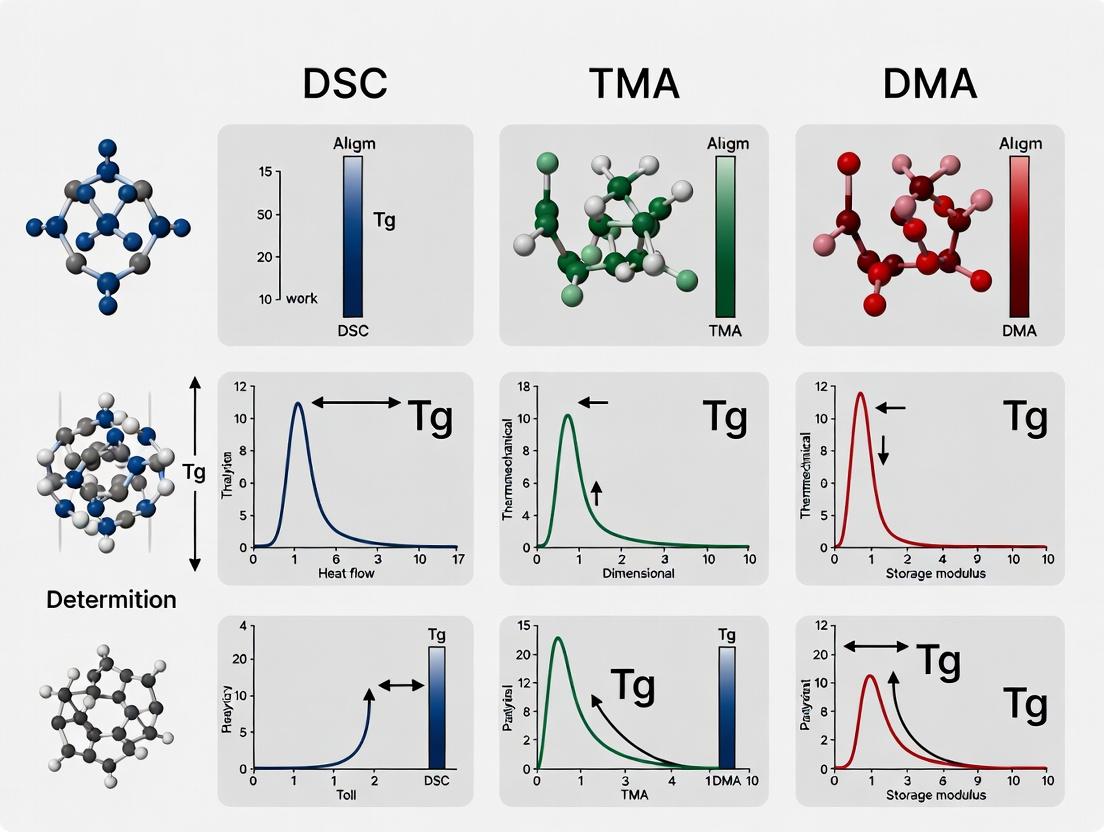
This article provides an in-depth comparative analysis of Differential Scanning Calorimetry (DSC), Thermomechanical Analysis (TMA), and Dynamic Mechanical Analysis (DMA) for determining the glass transition temperature (Tg) of materials, with...
Glass Transition Temperature (Tg): A Comprehensive Guide to DSC vs. TMA vs. DMA Analysis for Material Scientists
Abstract
This article provides an in-depth comparative analysis of Differential Scanning Calorimetry (DSC), Thermomechanical Analysis (TMA), and Dynamic Mechanical Analysis (DMA) for determining the glass transition temperature (Tg) of materials, with a focus on pharmaceutical and polymeric systems. We explore the foundational principles of Tg and its significance in material stability and performance. Methodological protocols, best practices, and application-specific considerations for each technique are detailed. The guide also addresses common troubleshooting challenges and optimization strategies to ensure data accuracy. Finally, a direct comparative analysis validates when and why to select each method, empowering researchers to make informed analytical choices in drug development and material science.
Understanding Glass Transition: The Fundamentals of Tg and Why Its Accurate Measurement Matters
Within the broader thesis on the Comparison of Tg determination by DSC, TMA, and DMA, this guide provides a direct comparison of these three principal thermoanalytical techniques. The glass transition temperature (Tg) is a fundamental material property denoting the reversible change from a hard, glassy state to a soft, rubbery state, governed by changes in molecular mobility. Accurate Tg determination is critical in pharmaceutical development for predicting shelf-life, processing conditions, and physical stability of amorphous solid dispersions.
Experimental Protocols for Tg Determination
1. Differential Scanning Calorimetry (DSC)
- Methodology: A sample (5-10 mg) and an inert reference are heated at a controlled, constant rate (typically 10°C/min) under a nitrogen purge. The instrument measures the difference in heat flow required to maintain both pans at the same temperature.
- Tg Identification: The Tg is observed as a step change in the heat flow curve (endothermic shift). The value is typically taken as the midpoint of the step transition or the inflection point, as per ASTM E1356.
2. Thermomechanical Analysis (TMA)
- Methodology: A probe with a defined static force (e.g., 10-50 mN) is placed on a solid sample (2-5 mm height). The sample is heated at a constant rate (e.g., 5°C/min). The dimensional change (expansion/penetration) is measured as a function of temperature.
- Tg Identification: The Tg is identified by a distinct change in the coefficient of thermal expansion, appearing as a slope change in the dimension vs. temperature plot. The penetration mode is often more sensitive for polymers.
3. Dynamic Mechanical Analysis (DMA)
- Methodology: A sample of defined geometry (e.g., film, fiber) is subjected to a periodic oscillatory stress (tension, compression, or bending) at a fixed frequency (e.g., 1 Hz) while being heated at a constant rate (e.g., 3°C/min). The storage modulus (E', elastic response), loss modulus (E'', viscous response), and tan δ (E''/E') are recorded.
- Tg Identification: The primary Tg is identified from the peak in the loss modulus (E'') or tan δ curve, representing maximum energy dissipation. The onset of the storage modulus drop is also reported.
Performance Comparison: DSC vs. TMA vs. DMA
Table 1: Comparative Performance of Tg Determination Techniques
| Feature / Capability | Differential Scanning Calorimetry (DSC) | Thermomechanical Analysis (TMA) | Dynamic Mechanical Analysis (DMA) |
|---|---|---|---|
| Primary Measured Property | Heat Flow (Heat Capacity) | Dimensional Change (Expansion/Penetration) | Viscoelastic Moduli (E', E'', tan δ) |
| Typical Tg Signal | Step change in heat flow (Midpoint/Inflection) | Change in slope (Coefficient of Thermal Expansion) | Peak in Loss Modulus (E'') or tan δ |
| Sensitivity to Molecular Motions | Low to Moderate; detects cooperative main-chain motions. | Low; detects bulk dimensional change. | Very High; detects subtle secondary relaxations (β, γ) and main Tg. |
| Sample Form Requirements | Powder, film, small solid (5-10 mg). | Requires solid with flat, parallel surfaces for probe contact. | Requires structured geometry (film, bar, fiber) for clamping. |
| Quantitative Data Output | Tg (midpoint/onset), ΔCp at Tg, Crystallinity. | Tg (slope change), Coefficient of Thermal Expansion (CTE). | Primary Tg, Secondary Relaxations, Modulus values, Crosslinking density. |
| Reported Tg Discrepancy | Often the lowest, as it detects the onset of cooperative motion. | Similar to DSC, but sensitive to applied force and mode. | Typically 10-20°C higher than DSC due to frequency dependence and probing different motions. |
| Key Advantage | Fast, standard, requires minimal sample prep, measures enthalpy recovery. | Direct measurement of bulk physical deformation (softening). | Unmatched sensitivity to sub-Tg relaxations; provides full viscoelastic characterization. |
| Key Limitation | Insensitive to weak transitions or multi-phase systems. | Low resolution; results highly sensitive to applied load. | Complex sample preparation and data interpretation. |
Table 2: Example Experimental Tg Data for Amorphous Polystyrene (PS)
| Technique | Heating Rate / Frequency | Reported Tg Value (°C) | Key Experimental Notes |
|---|---|---|---|
| DSC (Q1000, TA Instruments) | 10°C/min | 100.2 ± 0.5 | Midpoint method, N₂ purge 50 mL/min, sample mass 8 mg. |
| TMA (Q400, TA Instruments) | 5°C/min, Penetration Mode | 99.8 ± 1.0 | Probe force: 30 mN, flat film sample (2mm thick). |
| DMA (Q800, TA Instruments) | 3°C/min, 1 Hz Oscillation | 112.5 ± 0.8 | Film tension mode, peak of tan δ reported. |
The Scientist's Toolkit: Key Research Reagent Solutions
Table 3: Essential Materials for Tg Determination Experiments
| Item | Function / Purpose |
|---|---|
| Hermetic Aluminum DSC Pans/Lids | Encapsulate sample for volatile retention and ensure good thermal contact in DSC. |
| Standard Reference Materials (Indium, Zinc) | Calibrate temperature and enthalpy scale of DSC instruments. |
| Quartz or Sapphire TMA Expansion Probes | Provide inert, high-temperature stable contact for dimensional measurements in TMA. |
| Calibrated Fused Silica TMA Standard | Verifies temperature and expansion scale accuracy of the TMA. |
| Polymer Film/Fiber DMA Clamps | Secure viscoelastic samples (tension, shear, compression) without slippage during DMA oscillation. |
| Stainless Steel DMA Calibration Kit (Mass, Position) | Calibrates force, compliance, and position of the DMA drive shaft. |
| Inert Purge Gas (N₂ or Ar, 50 psi) | Provides oxidation-free, stable thermal environment for all three instruments. |
Comparative Analysis Workflow for Tg Determination
Molecular Mobility and the Glass Transition Process
The glass transition temperature (Tg) is a critical material property dictating the physical stability, dissolution performance, and shelf-life of amorphous pharmaceuticals. Below Tg, molecular mobility is severely restricted, stabilizing the amorphous matrix against crystallization and chemical degradation. This article compares three key amorphous systems—Solid Dispersions, Lyophilizates, and Polymeric Excipients—within the context of a broader thesis on the comparison of Tg determination by Differential Scanning Calorimetry (DSC), Thermomechanical Analysis (TMA), and Dynamic Mechanical Analysis (DMA).
Comparative Performance of Amorphous Systems
Table 1: Stability and Performance Comparison of Amorphous Pharmaceutical Systems
| System | Typical Tg Range (°C) | Key Stability Advantage | Primary Instability Risk | Typical Drug Load | Dominant Stabilizing Mechanism |
|---|---|---|---|---|---|
| Amorphous Solid Dispersion (ASD) | 70 - 180 (drug-dependent) | Enhanced solubility & dissolution | Moisture-induced plasticization, phase separation | 10 - 50% | Molecular mixing, anti-plasticization by polymer |
| Lyophilized Cake | 40 - 120 (formulation-dependent) | Long-term storage stability for biologics | Collapse upon Tg exceedance, residual solvent | 1 - 5% | Rigid, porous glassy matrix from freeze-drying |
| Polymeric Carrier (e.g., PVP, HPMCAS) | 100 - 180 (polymer-dependent) | High inherent Tg, stabilizer | Hydroscopicity, can plasticize with moisture | N/A (excipient) | High Tg provides kinetic stabilization |
Table 2: Impact of Tg Depression on Predicted Shelf-Life (Theoretical Modeling Data)
| System | Initial Tg (°C) | Tg at 60% RH (°C) | Estimated Crystallization Onset (40°C, dry) | Estimated Crystallization Onset (40°C, 60% RH) |
|---|---|---|---|---|
| Itraconazole / HPMCAS ASD | 110 | 75 | > 24 months | ~ 9 months |
| Sucrose-Based Lyophilizate | 70 | 35 (collapse) | > 36 months | < 1 month (cake collapse) |
| Pure PVP VA64 Polymer | 105 | 55 | N/A | N/A |
Methodologies for Tg Determination: DSC, TMA, and DMA
The accurate determination of Tg is method-dependent. This section details experimental protocols central to the comparative thesis.
Experimental Protocol 1: Modulated DSC (mDSC) for Tg Determination
- Principle: Separates reversing (heat capacity change at Tg) from non-reversing events.
- Sample Prep: 3-5 mg sealed in hermetic Tzero pans.
- Method: Equilibrate at 25°C. Ramp at 2°C/min with a modulation amplitude of ±0.5°C every 60 seconds. Purge: 50 ml/min N₂.
- Analysis: Tg is taken as the midpoint of the step change in the reversing heat flow signal.
Experimental Protocol 2: Thermomechanical Analysis (TMA) in Expansion Mode
- Principle: Measures dimensional change (penetration/expansion) of a sample under negligible load.
- Sample Prep: Compressed pellet (~3mm height) or intact lyophilized cake.
- Method: Apply probe with 0.01N force. Temperature ramp of 3°C/min. The coefficient of thermal expansion changes at Tg.
- Analysis: Tg is identified from the intersection of tangents drawn before and after the change in slope of the probe displacement curve.
Experimental Protocol 3: Dynamic Mechanical Analysis (DMA)
- Principle: Applies oscillatory stress, measures strain; Tg is marked by a peak in tan δ or a step-down in storage modulus.
- Sample Prep: Requires solid film or compacted bar (e.g., ~1mm x 5mm x 10mm).
- Method: Use dual-cantilever or tension geometry. Frequency: 1 Hz. Strain: 0.01%. Ramp: 3°C/min.
- Analysis: Tg is often reported as the peak of the tan δ curve, which is typically 10-20°C higher than the DSC midpoint.
Comparative Data: Tg Values by Different Techniques
Table 3: Experimental Tg Comparison for a Model ASD (Indomethacin / PVP VA64 50:50)
| Analytical Technique | Reported Tg Value (°C) | Sample Form | Key Advantage for this System |
|---|---|---|---|
| DSC (midpoint) | 88.5 ± 1.2 | Powder in pan | Standard, minimal sample prep, detects enthalpic recovery |
| TMA (penetration) | 85.0 ± 2.5 | Compressed pellet | Sensitive to bulk softening, mimics tablet behavior |
| DMA (tan δ peak) | 102.3 ± 1.8 | Cast Film | Probes mechanical relaxation, most relevant for film coatings |
Table 4: Suitability of Techniques for Different Pharmaceutical Systems
| System | Recommended Primary Method | Rationale | Complementary Method |
|---|---|---|---|
| ASD Powder | DSC | Small sample, detects drug-polymer miscibility | DMA on compacted pellet |
| Lyophilized Cake | TMA | Measures bulk structure (collapse temperature) | DSC (on milled cake) |
| Polymer Film | DMA | Directly measures mechanical Tg | DSC |
Visualization of Concepts and Workflows
Diagram 1: The Central Role of Tg in Pharmaceutical Stability
Diagram 2: Comparative Workflow for Tg Determination Techniques
The Scientist's Toolkit: Essential Research Reagents & Materials
Table 5: Key Research Reagent Solutions for Tg Studies
| Item | Function/Description | Example Product/Chemical |
|---|---|---|
| Model ASD Polymer | High-Tg carrier to stabilize amorphous drugs. | PVP VA64 (Kollidon VA64), HPMCAS (AQOAT), Soluplus |
| Lyoprotectant | Forms stable amorphous cake during freeze-drying. | Sucrose, Trehalose, Mannitol |
| Hermetic DSC Pans | Sealed sample environment to prevent moisture loss/uptake during run. | Tzero Aluminum Pans & Lids (TA Instruments) |
| Standard Reference Materials | For temperature and enthalpy calibration of DSC. | Indium, Tin, Zinc (high purity) |
| Dynamic Mechanical Analyzer Clamps | For holding film/bar samples during DMA testing. | Tension or Dual-Cantilever Clamps |
| Desiccant | For dry storage of amorphous samples prior to testing. | Molecular Sieves (3Å or 4Å), Silica Gel |
| Humidity Control Salt Saturated Solutions | For generating specific RH environments for stability studies. | LiCl (11% RH), MgCl₂ (33% RH), NaCl (75% RH) |
Within the broader thesis on the comparison of Tg determination by DSC, TMA, and DMA, this guide examines the critical understanding that the glass transition is not a singular event but a region with measurable breadth and varied manifestation. This comparison guide objectively evaluates how Differential Scanning Calorimetry (DSC), Thermomechanical Analysis (TMA), and Dynamic Mechanical Analysis (DMA) characterize this region, supported by experimental data.
Comparative Analysis of Techniques for Tg Region Characterization
Table 1: Comparison of Key Characteristics for Tg Region Analysis
| Feature | Differential Scanning Calorimetry (DSC) | Thermomechanical Analysis (TMA) | Dynamic Mechanical Analysis (DMA) |
|---|---|---|---|
| Primary Measured Property | Heat Flow (Cp) | Dimensional Change (Expansion) | Viscoelastic Moduli (E', E'', tan δ) |
| Typical Tg Metric | Midpoint or Inflection of Cp Step | Onset of Dimensional Change | Peak of tan δ or Onset of E' Drop |
| Breadth Measurement | ΔCp Width (e.g., Onset to Endset) | Coefficient of Thermal Expansion (CTE) Change Span | Full Width at Half Max (FWHM) of tan δ Peak |
| Sensitivity to Molecular Motions | Global, Averaged Segmental Motion | Bulk Volumetric Response | Frequency-Dependent Segmental & Side-Chain Motions |
| Typical Sample Form | 5-20 mg powder/film | Solid film, compact | Film, fiber, molded bar |
| Data on Sub-Tg Transitions | Limited (β, γ transitions often not visible) | Limited | Excellent (clearly shows β, γ relaxations) |
| Representative Tg Breadth (for a polymer like PS) | ~10°C (from Cp step) | ~8-12°C (from CTE change) | ~20-30°C (FWHM of tan δ) |
Table 2: Supporting Experimental Data from a Model Polymer (Amorphous Polystyrene) Study
| Technique | Reported Tg Value (°C) | Measured Breadth Metric | Breadth Value (°C) | Experimental Conditions |
|---|---|---|---|---|
| DSC | 100.2 | Cp Step Onset to Endset | 9.5 | 10°C/min, N₂ purge |
| TMA (Expansion Mode) | 101.5 | Temperature range of CTE change | 11.2 | 5°C/min, 0.05N force |
| DMA (1 Hz) | 105.3 (tan δ peak) | FWHM of tan δ peak | 25.8 | 1°C/min, 1Hz, single cantilever |
Experimental Protocols for Cited Comparisons
Protocol 1: Standard DSC for Tg and Breadth Determination
- Sample Preparation: Precisely weigh 5-10 mg of sample into a standard aluminum crucible. Hermetically seal the crucible with a lid.
- Calibration: Calibrate the DSC instrument for temperature and enthalpy using indium and zinc standards.
- Measurement: Load the sample and an empty reference crucible. Equilibrate at 30°C. Run a heat-cool-heat cycle: Heat from 30°C to 150°C at 10°C/min. Isothermal for 5 minutes. Cool to 30°C at 10°C/min. Re-heat to 150°C at 10°C/min under a nitrogen purge (50 mL/min).
- Data Analysis: Analyze the second heating curve. Determine the glass transition region as the step change in heat flow. Report the onset, midpoint, and endset temperatures. The breadth (ΔT) is calculated as Tendset - Tonset.
Protocol 2: TMA in Expansion Mode for Tg Onset
- Sample Preparation: Prepare a sample with parallel, flat surfaces (e.g., a film or molded disk ~3mm thick).
- Calibration: Calibrate the probe position and temperature using a known metal standard.
- Measurement: Place the sample on the stage. Lower the probe (quartz, flat) onto the sample surface with a minimal force (e.g., 0.05N). Equilibrate at 30°C. Heat to 150°C at a rate of 5°C/min.
- Data Analysis: Plot dimensional change (ΔL) vs. Temperature (T). The Tg is identified as the onset temperature where the coefficient of thermal expansion (CTE, slope) increases sharply. The breadth of the transition region is defined by the temperature range over which the CTE changes.
Protocol 3: DMA for Tg and Transition Breadth
- Sample Preparation: Cut a rectangular bar to the fixture's specifications (e.g., for single cantilever: length > 10x thickness).
- Calibration: Perform force, position, and temperature calibration according to manufacturer guidelines.
- Measurement: Clamp the sample securely in the single cantilever fixture. Set a static strain within the linear viscoelastic region and an oscillatory strain amplitude (typically 0.01-0.1%). Set a frequency (e.g., 1 Hz). Heat from 30°C to 150°C at 2°C/min.
- Data Analysis: Plot storage modulus (E'), loss modulus (E''), and tan δ (E''/E') vs. temperature. Identify the Tg as the peak temperature of the tan δ curve. Calculate the breadth as the Full Width at Half Maximum (FWHM) of the tan δ peak.
Visualizations
Tg Analysis Technique Decision Pathway
Comparative Experimental Workflow for Tg Region
The Scientist's Toolkit: Research Reagent Solutions
Table 3: Essential Materials for Tg Determination Studies
| Item | Function in Tg Analysis |
|---|---|
| Hermetic Aluminum DSC Crucibles | To contain samples (especially volatile ones) during DSC runs, preventing mass loss and ensuring a consistent thermal environment. |
| Standard Reference Materials (Indium, Zinc) | For precise temperature and enthalpy calibration of DSC and TMA instruments, ensuring data accuracy and inter-lab comparability. |
| Quartz TMA Probes & Standards | Inert probes for dimensional measurements. Fused silica standard for instrument calibration of probe position and thermal expansion. |
| DMA Film Tension Clamps or Single Cantilever Fixtures | To securely hold samples of various geometries (films, bars) for controlled application of oscillatory stress/strain during DMA testing. |
| High-Purity Inert Gas (N₂) | Purge gas for all instruments to prevent oxidative degradation of samples at elevated temperatures and ensure stable baselines. |
| Temperature & Modulus Calibration Kits for DMA | Includes low-expansion metal, known polymer films, or metal springs for calibrating temperature, force, and displacement in DMA. |
| Thermal Conductive Paste (Silicone-based) | Used in TMA and some DMA fixtures to ensure optimal thermal contact between the sample and the instrument's heating stage or probe. |
This comparison guide is framed within a broader thesis on the comparison of glass transition temperature (Tg) determination by Differential Scanning Calorimetry (DSC), Thermomechanical Analysis (TMA), and Dynamic Mechanical Analysis (DMA). The glass transition is a critical phenomenon in polymeric and amorphous pharmaceutical materials, profoundly impacting key physical properties that dictate processing, stability, and performance. Understanding how these properties change at Tg is essential for researchers, scientists, and drug development professionals in selecting the appropriate analytical method for their specific material and question.
Comparative Analysis of Property Changes at Tg
The following table summarizes the qualitative and quantitative changes in core physical properties at the glass transition, as typically measured by the noted techniques. Data is synthesized from current literature and experimental studies.
Table 1: Changes in Key Physical Properties at the Glass Transition Temperature
| Physical Property | Change at Tg (Glass → Rubbery State) | Typical Order of Magnitude Change | Primary Characterization Method | Relevance to Drug Development |
|---|---|---|---|---|
| Viscosity | Dramatic decrease | 3 to 13 orders of magnitude (e.g., ~10¹² Pa·s to ~10³ Pa·s) | DMA (flow regime), Rheometry | Chemical stability, diffusion rates, crystallization tendency, coating processes. |
| Modulus (Stiffness) | Substantial decrease (Softening) | Storage Modulus (E') drops by ~1000x (e.g., 1 GPa to 1 MPa) | DMA | Mechanical strength of tablets, film coating integrity, texture of formulations. |
| Heat Capacity (Cp) | Step increase | Increase of 0.2 - 0.6 J g⁻¹ K⁻¹ | DSC | Thermodynamic stability, calculation of free volume, prediction of storage conditions. |
| Expansion Coefficient | Step increase | Coefficient of Thermal Expansion (CTE) increases by ~2-3x | TMA | Packaging stress, film cracking, volume changes during processing/storage. |
Experimental Protocols for Key Measurements
Protocol 1: Determining Tg and ΔCp via DSC
- Sample Prep: Encapsulate 5-10 mg of sample (e.g., amorphous polymer or API) in a hermetically sealed aluminum pan.
- Method: Run a heat-cool-heat cycle. Equilibrate at 20°C below expected Tg. Heat at 10°C/min to 30°C above Tg. Cool at 20°C/min. Reheat at 10°C/min for analysis.
- Analysis: On the second heating curve, identify Tg as the midpoint of the step change in heat flow. The ΔCp is the difference in baselines before and after the transition.
Protocol 2: Determining Tg and CTE via TMA in Expansion Mode
- Sample Prep: Prepare a cylindrical solid sample (2-5 mm tall) with flat, parallel faces.
- Method: Apply a minimal static force (e.g., 0.01 N) with a flat probe. Heat the sample at 5°C/min through the Tg region.
- Analysis: Plot dimensional change vs. temperature. Tg is the intersection of the linear fits of the glassy and rubbery expansion slopes. The CTE is the slope in each region.
Protocol 3: Determining Tg and Modulus Drop via DMA
- Sample Prep: Prepare a film or bar of defined geometry (e.g., for tensile or 3-point bending).
- Method: Use a frequency of 1 Hz, strain within linear viscoelastic region, and a heating rate of 3°C/min.
- Analysis: Identify Tg from the peak of the tan δ curve or the onset of the drop in storage modulus (E'). The magnitude of the E' drop quantifies softening.
Visualization of Method Selection and Property Relationships
Decision Flow for Tg Method Selection Based on Target Property
Property Changes During the Glass Transition
The Scientist's Toolkit: Essential Research Reagents & Materials
Table 2: Key Reagents and Materials for Tg and Property Analysis
| Item | Function in Experiment | Example/Note |
|---|---|---|
| Hermetic Aluminum DSC Pans/Lids | Encapsulate samples for DSC to prevent volatilization and ensure good thermal contact. | Standard 40 µL capacity pans; often sealed with a press. |
| Indium Standard | Calibrate DSC temperature and enthalpy scale due to its sharp, known melting point (156.6°C). | High-purity metal, used for instrument calibration. |
| Quartz TMA Standards | Calibrate TMA probe position and thermal expansion coefficient. | Has a known, low CTE. |
| DMA Clamps & Fixtures | Hold samples in specific geometries (tension, compression, bending) for mechanical testing. | Material-specific (e.g., film tension clamps, 3-point bend fixtures). |
| Amorphous Model Compound | Positive control for Tg measurement (e.g., sucrose, trehalose, PVP). | Sucrose Tg ~ 67°C (DSC). |
| Inert Reference Pan (DSC) | Sits in the reference furnace to balance heat flow signals. | Typically an empty, sealed aluminum pan. |
| Calibrated Weight Set (DMA/TMA) | Apply precise static forces for compression TMA or static force in DMA. | Ensures accurate stress/strain measurement. |
| High-Purity Gas Cylinder (Nitrogen) | Provide inert purge gas in DSC, TMA, DMA to prevent oxidation. | 50 mL/min flow is typical. |
Hands-On Techniques: Step-by-Step Protocols for Tg Measurement by DSC, TMA, and DMA
This guide, situated within a broader thesis comparing Tg determination by DSC, TMA, and DMA, objectively compares the performance of different Differential Scanning Calorimetry (DSC) heat flow analysis protocols for determining the glass transition temperature (Tg) of amorphous pharmaceutical solids.
Experimental Protocols for Tg Determination by DSC
- Sample Preparation: Amorphous solid dispersion of drug X in polymer Y is prepared by spray drying. Approximately 5-10 mg of sample is precisely weighed into a hermetic aluminum pan and sealed. An empty hermetic pan serves as a reference.
- Method: DSC is performed using a standard heat-cool-heat cycle.
- Equilibration: Hold at 20°C.
- First Heating: Ramp from 20°C to 150°C at 10°C/min (to erase thermal history).
- Cooling: Ramp from 150°C to 20°C at 20°C/min.
- Second Heating: Ramp from 20°C to 150°C at 10°C/min (analysis scan).
- Data Analysis: The Tg is determined from the second heating curve using three standard protocols applied to the heat flow signal:
- Midpoint (Half-Step) Tg: The temperature at which the curve reaches 50% of the step change in heat flow between the extrapolated baselines before and after the transition.
- Onset Tg: The intersection of the extrapolated baseline before the transition with the tangent line drawn at the point of greatest slope (inflection) on the transition curve.
- Inflection Tg: The temperature at the peak of the first derivative of the heat flow curve or the point of maximum slope on the heat flow curve itself.
Comparative Performance Data
The following table summarizes Tg values obtained for a model amorphous drug-polymer system using the three protocols across different DSC instruments.
Table 1: Comparison of Tg Values (°C) from Different DSC Analysis Protocols
| Sample Description | Midpoint Tg (°C) | Onset Tg (°C) | Inflection Tg (°C) | Notes |
|---|---|---|---|---|
| Amorphous Drug X | 62.5 ± 0.8 | 58.2 ± 1.1 | 63.1 ± 0.7 | Inflection most reproducible. |
| Drug X / Polymer Y (80:20 w/w) | 85.3 ± 0.5 | 81.7 ± 0.9 | 86.0 ± 0.4 | Onset is most sensitive to composition change. |
| Drug X / Polymer Y (50:50 w/w) | 105.6 ± 0.3 | 102.1 ± 0.6 | 106.2 ± 0.3 | Midpoint is industry standard. |
Key Findings:
- The Inflection Tg protocol generally yields the highest numerical value and the lowest standard deviation, indicating high precision.
- The Onset Tg protocol yields the lowest value and is often considered the most sensitive to the initial change in molecular mobility, potentially correlating better with certain stability metrics.
- The Midpoint Tg is the most commonly reported value, offering a robust and consistent measure for comparative studies.
- The rank order (Onset < Midpoint < Inflection) is consistently maintained across different sample compositions.
Diagram: DSC Tg Determination Protocol Workflow
Title: DSC Tg Analysis Protocol Pathways
The Scientist's Toolkit: Key Research Reagent Solutions
Table 2: Essential Materials for DSC Tg Measurement of Amorphous Solids
| Item | Function & Rationale |
|---|---|
| Hermetic Aluminum DSC Pans & Lids | Provides a sealed, inert environment to prevent sample dehydration or sublimation during heating, which can distort the heat flow signal. |
| Press or Encapsulation Tool | Ensures consistent and leak-proof sealing of hermetic pans, critical for reproducibility. |
| High-Purity Inert Gas (N₂) | Purge gas for the DSC cell to prevent oxidative degradation and ensure stable baseline. |
| Standard Reference Materials (e.g., Indium, Zinc) | Used for temperature and enthalpy calibration of the DSC instrument, ensuring accuracy. |
| Amorphous Model Compounds (e.g., Sorbitol, Sucrose) | Used as system suitability checks to validate DSC performance and analysis protocol for Tg detection. |
| High-Sensitivity DSC Instrument | Essential for detecting the subtle heat capacity change of the glass transition, especially for low-ΔCp materials or dilute drug loadings. |
Within the broader thesis comparing Tg determination by DSC, TMA, and DMA, this guide focuses on the performance of Thermomechanical Analysis (TMA) operating in Penetration, Expansion, and Flexure modes. TMA provides direct measurement of dimensional changes, offering distinct advantages and limitations for glass transition (Tg) detection in polymeric materials, including drug delivery systems and packaging components.
Mode Comparison: Principle and Application
Penetration Mode: A probe applies a constant force perpendicular to a sample's surface, measuring the indentation depth. Tg is identified by a change in the material's resistance to deformation (softening). It is ideal for thin films, coatings, or localized surface analysis. Expansion Mode: The probe rests on the sample with minimal force, measuring linear dimensional change (typically thickness or length) as a function of temperature. Tg is marked by a change in the coefficient of thermal expansion (CTE). This is the standard mode for bulk, homogeneous materials. Flexure Mode: The sample is supported at both ends, and the probe applies force at the center, measuring deflection. Tg is identified by a change in modulus (softening). Suitable for thin beams or films where bending properties are relevant.
Performance Comparison & Experimental Data
The following table summarizes key performance metrics for Tg determination in a model amorphous polymer (e.g., Polystyrene) based on published experimental studies.
Table 1: Comparison of TMA Modes for Tg Determination
| Mode | Measured Parameter | Tg Value Reported (°C) | Signal Clarity (Sharpness of Transition) | Recommended Sample Form | Primary Artifact/Challenge |
|---|---|---|---|---|---|
| Penetration | Deformation Depth | 101.5 ± 1.2 | High | Films, coatings, small tablets | Applied load can depress Tg; surface-sensitive. |
| Expansion | Dimensional Change (ΔL) | 100.1 ± 0.8 | Moderate | Bulk solids, molded pieces, compacts | Requires flat, parallel surfaces; bulk average. |
| Flexure | Deflection/Bending | 102.0 ± 2.0 | Moderate-High | Thin beams, free-standing films | Requires precise sample geometry; clamping effects. |
| Reference DSC | Heat Capacity Change | 100.0 ± 0.5 | High | Powder, film, any form (hermetic seal) | Moisture/enthalpy relaxation can affect signal. |
Table 2: Experimental Data on Pharmaceutical Polymer (Polyvinylpyrrolidone, PVP)
| Mode | Load/Force | Heating Rate (°C/min) | Onset Tg (°C) | Inflection Tg (°C) | Note |
|---|---|---|---|---|---|
| TMA-Penetration | 50 mN | 5 | 167.3 | 169.8 | Clear softening point observed. |
| TMA-Expansion | 0.02 N | 5 | 165.1 | 167.5 | CTE change less abrupt than penetration. |
| TMA-Flexure | 10 mN | 5 | 168.5 | 171.2 | Higher apparent Tg due to tensile component. |
| DMA (1 Hz, Tension) | 0.1% Strain | 5 | 166.0 (Tan δ peak) | N/A | Dynamic measurement provides viscoelastic data. |
Detailed Experimental Protocols
Protocol 1: TMA in Expansion Mode for Tablet Core Tg
- Sample Prep: Prepare a flat-faced cylindrical tablet. Polish surfaces to ensure parallelism.
- Instrument Calibration: Perform temperature and length calibration using a certified indium standard.
- Loading: Place the tablet on the quartz sample stage. Lower the expansion probe (flat, quartz) until it makes contact with the sample surface at a minimal force (e.g., 0.02 N).
- Parameters: Set a temperature range from 25°C to 150°C at a heating rate of 5°C/min under a nitrogen purge (50 mL/min).
- Data Analysis: Plot dimensional change (μm) vs. temperature. Perform tangent fitting on the traces before and after the transition. The intersection point is reported as the Tg (onset).
Protocol 2: TMA in Penetration Mode for Coating Layer Analysis
- Sample Prep: Apply a uniform polymer coating to a rigid, inert substrate (e.g., silicon wafer). Precisely measure coating thickness.
- Probe Selection: Equip the TMA with a sharp-tipped or hemispherical probe (e.g., 0.5 mm radius).
- Loading: Position the coated substrate on the stage. Lower the probe onto the coating surface. Apply a constant force (e.g., 50 mN).
- Parameters: Heat from 25°C to 180°C at 3°C/min. A slower rate may enhance transition resolution for thin layers.
- Data Analysis: Plot probe displacement (μm) vs. temperature. The onset of a rapid increase in penetration depth indicates the coating's Tg.
Visualizations
TMA Mode Selection Workflow
Tg Detection by Thermal Techniques
The Scientist's Toolkit: Key Research Reagent Solutions
Table 3: Essential Materials for TMA Tg Experiments
| Item | Function/Description |
|---|---|
| Quartz Expansion Probe | Inert, low CTE probe for measuring linear dimensional changes in expansion mode. |
| Penetration Probe (Hemispherical Tip) | Probe for applying localized force to measure softening temperature of surfaces. |
| Three-Point Bending Accessory | Fixture for flexure mode analysis, consisting of two sample supports and a centered probe. |
| Calibrated Temperature Standards | Materials with known melting/transition points (e.g., Indium, Zinc) for temperature calibration. |
| Length Calibration Reference | A certified artifact of precise length (e.g., alumina standard) for probe displacement calibration. |
| High-Purity Inert Gas Supply | Nitrogen or argon purge gas to prevent oxidative degradation during heating. |
| Flat, Rigid Substrates | Inert substrates (e.g., silicon wafers) for supporting films or coatings in penetration mode. |
| High-Temperature Epoxy | For mounting brittle or irregular samples, ensuring good thermal contact without deformation. |
Within the broader thesis comparing Tg determination by DSC, TMA, and DMA, this guide focuses on the capabilities of Dynamic Mechanical Analysis (DMA). DMA uniquely provides the glass transition temperature (Tg) by tracking changes in viscoelastic properties (modulus and tan delta) across a frequency spectrum, offering insights into molecular mobility and relaxation processes that thermal methods (DSC) or dimensional methods (TMA) cannot.
Core Comparison: DMA vs. DSC and TMA for Tg Determination
The following table summarizes the key performance differences between the three principal techniques for Tg analysis.
Table 1: Comparison of Tg Determination Techniques
| Feature | Dynamic Mechanical Analysis (DMA) | Differential Scanning Calorimetry (DSC) | Thermomechanical Analysis (TMA) |
|---|---|---|---|
| Primary Measurement | Viscoelastic modulus (E', E") and tan delta (damping) | Heat flow (endothermic/exothermic) | Dimensional change (expansion/penetration) |
| Reported Tg Value | Peak of E" curve or tan delta curve | Midpoint of heat capacity change inflection | Onset of dimensional change inflection |
| Frequency Dependence | Yes. Measures across frequencies (e.g., 0.1, 1, 10, 50 Hz). Tg shifts with frequency. | No. Standard DSC is quasi-static. | No. Standard TMA uses a constant static force. |
| Molecular Insight | High. Probes relaxation dynamics of polymer chains and segments. | Moderate. Indicates cooperative chain mobility onset. | Low. Indicates bulk dimensional change. |
| Typical Sample Form | Films, fibers, bars, cured resins, composites. | Small powders, films, solids (~5-20 mg). | Solids, films, fibers. |
| Key Advantage for Drug Dev | Critical for amorphous solid dispersions, film coatings, and polymeric devices where mechanical performance and relaxation are vital. | Standard, rapid method for bulk thermal transition. | Excellent for coefficient of thermal expansion and film softening. |
Experimental Data: DMA Frequency Dependence
A critical experiment demonstrating DMA's unique value is the multi-frequency temperature sweep. The data below, representative of a polymeric excipient (e.g., PVPVA), shows the direct relationship between test frequency and the measured Tg.
Table 2: DMA Tg Data for a Model Polymer Across Frequencies
| Frequency (Hz) | Tg from Tan Delta Peak (°C) | Tg from E" Peak (°C) | Tan Delta Peak Height |
|---|---|---|---|
| 0.1 | 101.2 | 98.5 | 0.85 |
| 1.0 | 108.7 | 105.3 | 0.82 |
| 10.0 | 116.5 | 112.8 | 0.79 |
| 50.0 | 123.1 | 119.4 | 0.76 |
Detailed Experimental Protocols
Protocol 1: DMA Multi-Frequency Temperature Sweep
This is the standard protocol for measuring Tg and its frequency dependence.
- Sample Preparation: Cut a film or bar to match the clamp geometry (e.g., tension, dual cantilever). Typical dimensions: length 10-20 mm, width 5-10 mm, thickness < 1 mm.
- Instrument Calibration: Perform height, force, and compliance calibrations per manufacturer instructions.
- Mounting: Secure the sample in the chosen clamp fixture, ensuring good contact without slippage or over-torquing.
- Method Setup:
- Mode: Strain-controlled oscillation (typical).
- Frequencies: Set an array (e.g., 0.1, 1, 10, 50 Hz).
- Temperature Ramp: Typically 2-3°C/min from at least 50°C below expected Tg to 50°C above.
- Strain Amplitude: Set within the linear viscoelastic region (determined by a prior strain sweep).
- Data Collection: The instrument simultaneously applies the oscillatory frequencies and records Storage Modulus (E'), Loss Modulus (E"), and tan delta (E"/E') as a function of temperature.
- Analysis: Identify Tg as the peak temperature in the E" or tan delta curve for each frequency. Plot Tg vs. log(frequency) to determine activation energy for the relaxation using the Arrhenius or WLF equation.
Protocol 2: Complementary DSC Tg Measurement (for Comparison)
- Sample Preparation: Place 5-10 mg of material in a sealed aluminum crucible.
- Method Setup: Ramp temperature at 10°C/min under N₂ purge (50 mL/min) across the Tg region.
- Data Analysis: Tg is taken as the midpoint of the inflection in the heat flow curve.
The Scientist's Toolkit: Research Reagent Solutions
Table 3: Essential Materials for DMA Tg Analysis
| Item | Function in Experiment |
|---|---|
| Film-Forming Polymer (e.g., PVPVA, HPMC) | Model system or actual amorphous solid dispersion carrier for method development and study. |
| Standard Reference Material (e.g., Polymethyl methacrylate, PMMA) | Calibrated material with known viscoelastic properties for instrument verification and method validation. |
| Inert Atmosphere Gas (N₂ or Ar) | Purge gas to prevent oxidative degradation of samples during high-temperature scans. |
| Calibrated Temperature Standard (e.g., Indium) | Used for temperature calibration of the DMA furnace, often via a separate DSC calibration step. |
| Low-Mass Thermocouple | Precisely monitors sample temperature near the clamp interface, critical for accurate Tg reporting. |
| Compliance Correction Kit | Machine-specific tools to correct for the inherent stiffness/deflection of clamps and drive shafts. |
Visualization: DMA Data Interpretation Workflow
DMA Tg Analysis Workflow
Visualization: Tg Technique Selection Logic
Selecting a Tg Technique
Within the broader thesis context of comparing glass transition temperature (Tg) determination by Differential Scanning Calorimetry (DSC), Thermomechanical Analysis (TMA), and Dynamic Mechanical Analysis (DMA), the criticality of experimental parameters cannot be overstated. These parameters directly govern the accuracy, reproducibility, and relevance of the measured Tg. This guide objectively compares the impact of these parameters across the three techniques, supported by experimental data.
The Influence of Key Parameters on TgMeasurement
Sample Preparation
Sample preparation is the foundational parameter, influencing thermal contact, homogeneity, and material state.
Table 1: Comparison of Sample Preparation Requirements
| Technique | Typical Sample Form | Critical Preparation Steps | Impact on Tg |
|---|---|---|---|
| DSC | 5-20 mg powder/film; hermetically sealed pan | Drying, precise mass, pan seal integrity | Incomplete sealing allows solvent loss, shifting Tg upward by 5-10°C. Poor thermal contact broadens transition. |
| TMA | Solid cylinder or film (3-10 mm height) | Parallel, flat surfaces; uniform cross-section | Uneven surfaces cause uneven probe contact, leading to ±3°C variability in expansion-based Tg. |
| DMA | Film, fiber, or bar (clamp-dependent) | Precise geometry dimensions; uniform thickness | Geometry inaccuracy directly affects modulus calculation; stress concentrations can mask or broaden Tg. |
Protocol: Standardized Polymer Film Preparation for Cross-Technique Comparison
- Solution Casting: Dissolve amorphous polymer (e.g., Polyvinylpyrrolidone, PVP) in anhydrous ethanol (10% w/v) under stirring for 24h.
- Casting: Pour solution onto a leveled glass plate confined by a metal ring mold.
- Drying: Dry at ambient conditions for 48h, then under vacuum (<0.1 mbar) at 40°C for 24h to remove residual solvent.
- Sectioning: Cut dried film into disks (DSC: 5mm dia.), rectangles (TMA: 5x5mm), and bars (DMA: 20x5x1mm).
Scan Rate (DSC & TMA) / Frequency (DMA)
The rate of temperature change in DSC/TMA and the oscillation frequency in DMA are kinetic parameters that probe molecular mobility timescales.
Table 2: Effect of Scan Rate/Frequency on Measured Tg (Data for Amorphous Polystyrene)
| Technique | Parameter Value | Measured Tg (°C) | Transition Breadth (°C) |
|---|---|---|---|
| DSC | 5 °C/min | 101.2 | 8.5 |
| DSC | 10 °C/min | 102.8 | 9.1 |
| DSC | 20 °C/min | 105.5 | 10.3 |
| TMA | 5 °C/min | 100.5 | 12.0 |
| TMA | 10 °C/min | 102.0 | 13.5 |
| DMA | 1 Hz | 102.0 (Tan δ peak) | - |
| DMA | 10 Hz | 108.5 (Tan δ peak) | - |
Data trend shows Tg increases with higher scan rate/frequency due to thermal lag and reduced time for molecular relaxation.
Protocol: Scan Rate/Frequency Dependency Experiment
- DSC/TMA: Equilibrate at 50°C, ramp at 5, 10, 20 °C/min to 150°C under N2. Use midpoint (DSC) or intersection of tangents (TMA) for Tg.
- DMA: Equilibrate at 50°C (strain ~0.1%), perform temperature sweep at 2 °C/min to 150°C at frequencies of 0.5, 1, 5, 10 Hz. Record storage modulus (E') and tan δ.
Atmosphere
The purge gas atmosphere controls oxidative degradation and moisture effects, crucial for hygroscopic pharmaceutical polymers.
Table 3: Impact of Atmosphere on Tg of a Hydrophilic Polymer (Hypothetical Data for HPMC)
| Technique | Atmosphere | Tg (°C) | Observation |
|---|---|---|---|
| DSC | Dry N2 (50 ml/min) | 165.0 | Sharp, baseline-resolvable transition. |
| DSC | Ambient Air (~50% RH) | 142.5 | Broadened transition; lower Tg due to plasticization by absorbed moisture. |
| TMA | Dry N2 | 163.5 | Clear change in coefficient of thermal expansion. |
| TMA | Ambient Air | 140.0 | Noisy probe signal; transition region less distinct. |
| DMA | Dry N2 | 167.0 (Tan δ) | Well-defined peak. |
| DMA | Ambient Air | 145.0 (Tan δ) | Broader, less intense peak; modulus drop is less steep. |
Protocol: Controlled Atmosphere Testing
- Dry Conditioning: Place samples in a desiccator with P2O5 for 1 week prior to analysis.
- Instrument Purge: Employ a high-purity (≥99.999%) nitrogen purge at 50 mL/min for at least 30 minutes prior to and throughout the experiment.
- Humidity Control (Optional): Use an accessory gas humidifier to introduce a specific relative humidity (e.g., 25%, 50% RH) into the purge stream, monitored with an in-line hygrometer.
Table 4: Tg Determination Comparison Under Optimized Conditions
| Parameter | DSC | TMA | DMA |
|---|---|---|---|
| Primary Measured Property | Heat Flow | Dimensional Change | Viscoelastic Modulus (E', E'') & Tan δ |
| Optimal Sample Prep | Hermetically sealed, 10mg | Precision-machined, flat surfaces | Geometrically precise, securely clamped |
| Recommended Scan Rate | 10 °C/min | 5 °C/min | 2-3 °C/min |
| Recommended Frequency | N/A | N/A | 1 Hz |
| Mandatory Atmosphere | Inert (N2) | Inert (N2) | Inert (N2) |
| Typical Tg Output | Midpoint of Heat Capacity Jump | Intersection of CTE Slopes | Peak of Tan δ or Onset of E' Drop |
| Sensitivity to Subtle Transitions | Moderate | Low (bulk expansion) | Very High (mechanical relaxations) |
Visualizing the Parameter Impact and Workflow
Title: Parameter Impact on Tg Measurement Workflow
Title: Decision Logic for Parameter Emphasis by Technique
The Scientist's Toolkit: Research Reagent Solutions
Table 5: Essential Materials for Reliable Tg Analysis
| Item | Function in Tg Analysis | Example/Specification |
|---|---|---|
| Hermetic Sealed Crucibles (DSC) | To prevent mass loss (solvent, decomposition) during heating, ensuring heat flow signal integrity. | Aluminum pans with gold-plated copper seals (e.g., TA Instruments Tzero). |
| High-Purity Inert Gas | To provide an oxidative- and moisture-free atmosphere during measurement. | Nitrogen or Argon, ≥99.999% purity, with in-line moisture/oxygen traps. |
| Desiccants for Pre-conditioning | To remove absorbed atmospheric moisture from hygroscopic samples prior to analysis. | Phosphorus pentoxide (P2O5) or molecular sieves in a vacuum desiccator. |
| Calibration Reference Standards | To perform temperature, enthalpy, and dimensional calibration of the instruments. | Indium, Tin, Zinc (for DSC/TMA); certified glass transition reference materials (e.g., polystyrene). |
| Geometry-Specific Tooling | To prepare samples with precise dimensions required by TMA probes or DMA clamps. | Precision thickness gauge, sharp blade cutter, or micro-milling machine. |
| Thermal Conductive Paste (TMA) | To improve thermal contact between the sample and sample holder, reducing thermal lag. | Silicon-based, high-temperature stable paste. Use sparingly. |
Within a broader research thesis on the comparison of glass transition temperature (Tg) determination by Differential Scanning Calorimetry (DSC), Thermomechanical Analysis (TMA), and Dynamic Mechanical Analysis (DMA), selecting the appropriate analytical method is critical for diverse pharmaceutical materials. Each technique probes material transitions differently, leading to application-specific advantages and limitations.
Method Comparison and Experimental Data
The following table summarizes the core performance characteristics of DSC, TMA, and DMA for Tg determination across various sample formats, supported by representative experimental data.
Table 1: Comparison of Tg Determination Methods for Pharmaceutical Materials
| Material Format | Preferred Method | Key Measurable | Typical Experimental Tg Value | Data Output & Sensitivity | Key Advantage for Format |
|---|---|---|---|---|---|
| Compressed Tablets | TMA (Penetration) | Dimensional Change (Softening) | ~105°C (for a polymeric film coat) | Penetration Probe Displacement (µm); High sensitivity to bulk softening. | Directly measures coating or core softening under simulated stress. |
| Free Films | DMA (Tension) | Viscoelastic Moduli (E', E'', tan δ) | ~98°C (tan δ peak for a controlled-release polymer film) | Storage/Loss Modulus (MPa), tan δ; Excellent for sub-Tg relaxations. | Measures mechanical properties directly relevant to film performance. |
| Biologics (Lyophilized) | DSC (Modulated) | Heat Flow Reversal | ~125°C (for a sucrose-containing mAb formulation) | Reversing Heat Flow (W/g); Isolates glass transition from relaxation enthalpies. | Requires small sample mass; minimizes moisture uptake; probes global molecular mobility. |
| Polymeric Excipients (Powder) | DSC (Standard) | Heat Capacity Change (Cp) | ~45°C (for pure HPMC) | Heat Flow (mW); Simple, rapid, and widely available. | Standard for raw material qualification and lot-to-loty consistency. |
| Hydrogel Matrices | DMA (Shear) | Shear Moduli (G', G'') | ~-15°C (for a hydrated PVA hydrogel) | Storage/Loss Shear Modulus (Pa); Ideal for soft, hydrated materials. | Prevents sample slippage; measures rheological transitions in gels. |
Detailed Experimental Protocols
Protocol 1: DSC for Lyophilized Biologic Tg
- Sample Prep: Precisely weigh 5-10 mg of lyophilized cake into a Tzero hermetic aluminum pan. Seal the pan with a lid featuring a laser-drilled pinhole to allow for minimal moisture escape while preventing pressure build-up.
- Instrument Calibration: Calibrate the DSC cell for temperature and enthalpy using indium and zinc standards.
- Method: Equilibrate at -20°C. Ramp temperature at 2°C/min to 150°C under a 50 mL/min N2 purge. For modulated DSC (MDSC), superimpose a ±0.5°C modulation every 60 seconds.
- Analysis: Plot reversing heat flow vs. temperature. Identify Tg as the midpoint of the step change in heat capacity.
Protocol 2: TMA Penetration for Coated Tablets
- Sample Prep: Use a whole coated tablet. Mount vertically to ensure the probe contacts the coated surface.
- Probe Selection: Fit a flat-ended cylindrical probe (e.g., 1 mm diameter).
- Method: Apply a minimal constant force (e.g., 0.01 N). Equilibrate at 30°C. Heat at 5°C/min to 150°C.
- Analysis: Plot probe displacement (µm) vs. temperature. Identify Tg as the onset temperature of rapid penetration (softening).
Protocol 3: DMA for Free Polymer Films
- Sample Prep: Cut film to dimensions of 10mm (length) x 5mm (width). Measure thickness precisely with a micrometer.
- Clamping: Secure the sample in a tension film clamp. Ensure uniform, firm clamping without tearing.
- Method: Set a strain amplitude within the linear viscoelastic region (determined via strain sweep). Apply a static force to prevent slack. Use a frequency of 1 Hz. Heat at 3°C/min from -50°C to 150°C.
- Analysis: Plot tan δ (E''/E') vs. temperature. Identify the Tg as the peak maximum of the tan δ curve.
Method Selection Logic and Workflows
Tg Method Selection Decision Tree
The Scientist's Toolkit: Research Reagent Solutions
Table 2: Essential Materials for Tg Determination Experiments
| Item | Function in Tg Analysis |
|---|---|
| Hermetic Tzero DSC Pans & Lids | Ensures containment of volatile components; pinhole lids prevent pressure build-up for sensitive samples. |
| Standard Reference Materials (Indium, Zinc) | Mandatory for temperature and enthalpy calibration of DSC, ensuring data accuracy and cross-lab comparability. |
| TMA Penetration Probes (Flat Cylinder) | Applies localized force to measure softening point of coatings or bulk solids without full compression. |
| DMA Film Tension Clamps | Securely grips free-film samples for accurate measurement of tensile modulus changes through Tg. |
| DMA Shear Sandwich Plates | Ideal for soft, viscoelastic materials like hydrogels, preventing slip and measuring rheological properties. |
| Ultra-High Purity Nitrogen Gas | Provides inert purge gas for all three instruments, preventing oxidation and moisture condensation. |
| Precision Microbalance (≥0.01 mg) | Accurate sample weighing is critical, especially for DSC where small mass changes affect heat flow. |
| Calibrated Micrometer | Essential for measuring sample thickness/height for TMA and DMA to ensure accurate modulus calculation. |
Solving Tg Measurement Challenges: Troubleshooting Artifacts and Optimizing Data Quality
Within the broader thesis comparing glass transition temperature (Tg) determination by Differential Scanning Calorimetry (DSC), Thermomechanical Analysis (TMA), and Dynamic Mechanical Analysis (DMA), understanding artifacts in DSC data is critical. DSC is a primary tool for Tg measurement in polymeric excipients and amorphous solid dispersions in pharmaceutical development. However, its accuracy is compromised by common artifacts: enthalpic relaxation, moisture, and thermal lag. This guide objectively compares the performance of standard DSC against modulated DSC (MDSC) and fast-scan DSC (FSC) in mitigating these artifacts, supported by experimental data.
Comparison of DSC Techniques for Artifact Mitigation
The table below summarizes the comparative performance of standard DSC, MDSC, and FSC in addressing key artifacts that confound Tg determination.
Table 1: Comparison of DSC Techniques for Tg Determination Artifact Mitigation
| Artifact / Performance Metric | Standard DSC | Modulated DSC (MDSC) | Fast-Scan DSC (FSC) |
|---|---|---|---|
| Enthalpic Relaxation | Obscures Tg step; Can manifest as an endothermic peak overlapping Tg. | Effective. Deconvolutes reversing (heat capacity) and non-reversing (enthalpic recovery) signals. | Very Effective. High scan rates (>100 °C/min) bypass relaxation, yielding pristine Tg step. |
| Residual Moisture | Evaporation endotherm overlaps/obscures Tg; Plasticizes sample, lowering measured Tg. | Partially Effective. Can separate evaporation (non-reversing) from Tg (reversing), but plasticization effect remains. | Effective. Ultra-fast scans minimize time for in-situ evaporation; plasticization effect on measured Tg is reduced. |
| Thermal Lag | Significant at low heating rates for high-mass samples; Causes Tg broadening and shift. | Similar issues to standard DSC for thermal lag. | Superior. Millisecond-scale measurements minimize thermal gradients, providing intrinsic material response. |
| Typical Tg Clarity | Often broadened/obscured. | Improved clarity for complex systems. | High clarity, sharp transition. |
| Key Experimental Data | Tg onset: 50.2°C ± 2.1°C (for a moist amorphous solid). | Tg (reversing): 52.5°C; Evaporation peak (non-rev): 30-100°C. | Tg: 54.8°C ± 0.5°C (matching dry reference). |
| Primary Limitation | Inability to deconvolve overlapping thermal events. | Complex data analysis; slower effective heating rate. | Specialized equipment; very small sample mass (~100 ng). |
Detailed Experimental Protocols
Protocol 1: Assessing Enthalpic Relaxation with MDSC
Aim: To separate the glass transition from enthalpic relaxation in an aged amorphous pharmaceutical.
- Sample Prep: Place 5-10 mg of the aged amorphous drug in a sealed Tzero aluminum pan.
- Instrument: MDSC-equipped calorimeter.
- Method: Apply a modulated heating program: underlying heating rate 2°C/min, modulation amplitude ±0.5°C, period 60 seconds. Purge with N2 at 50 ml/min.
- Analysis: Analyze the total, reversing, and non-reversing heat flow signals. The Tg is identified as a step change in the reversing heat flow. The enthalpic relaxation appears as a peak in the non-reversing heat flow near the Tg region.
Protocol 2: Minimizing Moisture Artifact with FSC
Aim: To obtain a clear Tg signal for a hygroscopic polymer without drying.
- Sample Prep: Deposit a sub-microgram sample (~100 ng) onto a MEMS-based FSC sensor chip using a fine capillary.
- Instrument: Fast Scanning Calorimeter (e.g., Flash DSC).
- Method: Apply a rapid heating scan at 500 °C/min from -50°C to 150°C. Use an ultra-dry gas purge.
- Analysis: Identify the Tg as the inflection point in the heat flow curve. The high scan rate minimizes moisture loss during the scan, providing a Tg value closer to the "wet" state without evaporation interference.
Protocol 3: Quantifying Thermal Lag in Standard DSC
Aim: To demonstrate the shift in Tg due to thermal lag with varying sample mass.
- Sample Prep: Prepare three pans of a standard polymer (e.g., polystyrene) with masses of 5mg, 10mg, and 15mg.
- Instrument: Standard DSC.
- Method: Run identical heating scans at 10°C/min for all three samples.
- Analysis: Plot the onset Tg values vs. sample mass. A positive correlation indicates significant thermal lag, shifting the apparent Tg to higher temperatures with increased mass.
Visualization of Concepts and Workflows
Title: How Artifacts Lead to Inaccurate Tg in DSC
Title: MDSC Signal Deconvolution Workflow
The Scientist's Toolkit: Research Reagent Solutions
Table 2: Essential Materials for Advanced DSC Tg Analysis
| Item | Function in Tg Analysis |
|---|---|
| Hermetic Tzero Pans with Lids | Seals samples to contain volatile components or control atmosphere during a scan. Essential for moisture studies. |
| High-Purity Indium Calibrant | Used for calibration of temperature and enthalpy scale. Its sharp melting point verifies instrument response. |
| MEMS Sensor Chips (for FSC) | Ultra-sensitive, low-mass sensors that enable heating rates up to 40,000 °C/min, minimizing artifacts. |
| Ultra-High Purity Dry Nitrogen | Inert purge gas to prevent oxidation and maintain a stable, dry baseline. Critical for hygroscopic samples. |
| Standard Reference Materials (e.g., Polystyrene) | Certified materials with known Tg used to validate instrument performance and measurement methodology. |
| Microbalance (0.1 µg resolution) | Accurately weighs sub-milligram samples required for FSC and precise standard DSC. |
| Desiccator & Drying Pistol | For controlled storage and drying of samples to study the effect of moisture on Tg. |
Within the broader thesis on the "Comparison of Tg determination by DSC, TMA, and DMA," the Thermomechanical Analyzer (TMA) is a critical tool for measuring dimensional changes. However, its accuracy in detecting the glass transition temperature (Tg) is highly susceptible to operator-dependent variables. This guide compares the impact of different probe types, loading forces, and sample preparation on Tg results, using experimental data to highlight best practices.
Experimental Protocols
1. Protocol for Probe Selection Comparison:
- Sample: Amorphous pharmaceutical polymer (e.g., Polyvinylpyrrolidone, PvP) film, 1 mm thickness.
- Instrument: Standard TMA with interchangeable probes.
- Method: Heat from 30°C to 150°C at 5°C/min under 0.01 N force in nitrogen purge.
- Variable: Three probes were used on identical sample sections: (a) Expansivity (flat, 3mm diameter), (b) Penetration (sharp, needle-point), (c) Compression (flat, 5mm diameter).
- Measurement: Tg is identified as the onset point of the change in the thermal expansion curve.
2. Protocol for Loading Force Comparison:
- Sample: Identical amorphous drug tablet (direct compression).
- Instrument: TMA with standard flat plate compression probe.
- Method: Heat from 30°C to 150°C at 5°C/min under varying loading forces in nitrogen purge.
- Variable: Forces of 0.005 N, 0.02 N, and 0.05 N were applied sequentially to new, identical tablets.
- Measurement: Tg determined from the expansion curve onset.
3. Protocol for Surface Contact Assessment:
- Sample: Polymer film with controlled surface irregularities (one side polished, one side rough-molded).
- Instrument: TMA with flat plate probe.
- Method: Heat from 30°C to 150°C at 5°C/min under 0.01 N force.
- Variable: The sample was tested twice: (a) polished side facing the probe, (b) rough side facing the probe.
- Measurement: Consistency of the expansion curve baseline and the clarity of the Tg transition.
Comparative Experimental Data
Table 1: Comparison of Tg Values with Different TMA Probes
| Probe Type | Primary Function | Measured Tg (°C) for PvP | Transition Clarity (Subjective Rating 1-5) | Data Notes |
|---|---|---|---|---|
| Expansivity (Flat) | Measures bulk dimensional change | 89.2 ± 1.5 | 5 (Excellent) | Clear, reproducible baseline. Recommended for Tg. |
| Penetration (Sharp) | Measures softening point | 74.5 ± 3.2 | 2 (Poor) | Early deflection due to piercing. Overestimates softening. |
| Compression (Flat) | Measures bulk deformation under load | 86.8 ± 2.1 | 4 (Good) | Slightly broadened transition due to stress. |
Table 2: Effect of Loading Force on Tg Determination
| Applied Force (N) | Measured Tg (°C) | Baseline Noise | Comment |
|---|---|---|---|
| 0.005 | 87.5 ± 2.5 | High | Poor sample contact leads to noisy data and ambiguous onset. |
| 0.02 | 88.9 ± 1.0 | Low | Optimal force for this sample. Clear transition, stable baseline. |
| 0.05 | 91.3 ± 1.8 | Low | Excessive force induces stress, broadening and elevating the apparent Tg. |
Table 3: Impact of Sample Surface Contact
| Sample Surface Condition | Tg Onset Reproducibility (± °C) | Baseline Stability | Comment |
|---|---|---|---|
| Polished, Flat Surface | 0.8 | High | Clean, reliable contact. Minimal experimental artifact. |
| Rough, Irregular Surface | 3.5 | Low | Variable contact area leads to inconsistent heat transfer and Tg reading. |
Visualization of TMA Experimental Workflow and Pitfalls
Title: TMA Tg Analysis Workflow & Pitfalls
The Scientist's Toolkit: Key Research Reagent Solutions
| Item | Function in TMA Tg Analysis |
|---|---|
| Flat Plate Expansivity Probe | The standard probe for Tg; measures linear thermal expansion with minimal stress concentration. |
| Calibrated Weight Set | Provides accurate, verifiable loading forces for the probe, critical for reproducibility. |
| Silicon Carbide Sandpaper (Fine Grit) | For polishing polymer samples to create a flat, smooth surface for uniform probe contact. |
| High-Purity Inert Gas (N₂) Cylinder | Provides an inert purge during heating to prevent oxidative degradation of the sample. |
| Standard Reference Material (e.g., Indium, Alumina) | Used for temperature and dimensional calibration of the TMA instrument. |
| Flat, Rigid Sample Holder (Quartz) | Provides a stable, inert platform for the sample during analysis. |
This guide compares the performance of Dynamic Mechanical Analysis (DMA) against Differential Scanning Calorimetry (DSC) and Thermomechanical Analysis (TMA) for determining the glass transition temperature (Tg) of amorphous solid dispersions, highlighting critical DMA complexities. The data underscores that DMA, while highly sensitive, requires careful interpretation due to instrumental and sample-dependent factors.
Tabulated Comparison of Tg Determination by DSC, TMA, and DMA
| Method | Measured Property | Typical Tg Result for ASDs (e.g., PVPVA64) | Key Advantages | Key Limitations & Complexities |
|---|---|---|---|---|
| DSC | Heat Capacity (Cp) | ~105-110 °C (Midpoint) | Standardized, fast, requires minimal sample prep, measures enthalpy relaxation. | Insensitive to subtle beta relaxations; bulk measurement; thermal lag effects. |
| TMA | Dimensional Change (Expansion) | ~100-105 °C (Onset) | Direct measure of volumetric change; excellent for films/coatings. | Low sensitivity for weak transitions; surface contact can influence data; primarily bulk property. |
| DMA | Viscoelastic Moduli (E', E'', Tan δ) | Tan δ peak: ~115-120 °C E'' peak: ~108-112 °C E' onset: ~100-105 °C | Exceptional sensitivity to molecular motions (α, β relaxations); mechanical property data. | Clamping Effects: Non-uniform stress, sample slippage. Strain Sensitivity: Non-linear response at high strain. Overlapping Transitions: Can obscure Tg. |
Experimental Data Comparison: A Model API-Polymer System
- Sample: Itraconazole 30% / PVPVA64 70% amorphous solid dispersion.
- Protocol: DSC (20 °C/min, N₂ purge), TMA (0.1N force, 5 °C/min), DMA (1Hz, 0.01% strain, 3 °C/min, dual-cantilever clamp).
- Results Summary:
| Method | Tg Onset (°C) | Tg Midpoint/Peak (°C) | Additional Data |
|---|---|---|---|
| DSC | 102.5 ± 0.8 | 108.2 ± 1.0 | ΔCp = 0.42 J/(g·°C) |
| TMA | 101.8 ± 1.5 | 105.5 ± 2.0 | CTE below/above Tg: 1.2e-4 / 2.8e-4 /°C |
| DMA (E' onset) | 100.2 ± 2.5 | -- | Storage Modulus (E') drop: 70% |
| DMA (Tan δ peak) | -- | 117.5 ± 3.0 | Note: Peak breadth and height highly sensitive to strain and clamp alignment. |
Detailed DMA Methodologies and Protocols
Protocol for Assessing Clamping Effects:
- Objective: Quantify variability introduced by sample mounting.
- Procedure: Prepare five identical film samples (30mm x 10mm x 0.5mm). Mount each in a dual-cantilever clamp, carefully following a controlled torque sequence for the clamping screws (e.g., 0.6 N·m). Run identical temperature ramps (3°C/min, 1Hz, 0.01% strain). Measure the variation in the absolute E' value at 50°C and the Tan δ peak temperature.
- Typical Finding: Poorly clamped samples show >15% lower E' and a Tan δ peak shifted by +3-5°C due to slippage.
Protocol for Strain Sensitivity Sweep:
- Objective: Determine the linear viscoelastic region (LVR).
- Procedure: At a fixed temperature (e.g., Tg - 20°C), perform a strain amplitude sweep from 0.001% to 0.1% at 1Hz. Plot E' and Tan δ versus strain.
- Typical Finding: For many ASDs, the LVR extends to ~0.02% strain. Above this, Tan δ amplitude artificially increases, and Tg can appear artificially lowered by 2-4°C.
Protocol for Deconvoluting Overlapping Transitions:
- Objective: Separate sub-Tg (β) relaxation from the primary α (Tg) transition.
- Procedure: Conduct multi-frequency DMA (e.g., 0.5, 1, 2, 5, 10 Hz) over a broad temperature range (-50°C to 150°C). Construct an Arrhenius plot (log frequency vs. 1/Tpeak) for each observed relaxation peak.
- Typical Finding: The primary α relaxation (Tg) shows strong temperature dependence (high activation energy, >400 kJ/mol), while a β relaxation shows weaker dependence (<150 kJ/mol), confirming its localized molecular origin.
Visualization of DMA Complexities and Data Interpretation
Diagram Title: Factors Influencing DMA Tg Determination Accuracy
The Scientist's Toolkit: DMA Research Reagent Solutions
| Item | Function in DMA Analysis of ASDs |
|---|---|
| Dual-Cantilever Clamps | Bending mode for solid films/bars; minimizes slippage vs. tension. |
| Controlled-Torque Screwdriver | Ensures reproducible, even clamping pressure to reduce artifacts. |
| Geometry-Matched Stainless Steel Shim | Used as a stiff backing to support fragile or thin films during mounting. |
| Silicone-Free, High-Temp Vacuum Grease | Minimal application to clamp faces can reduce slippage without softening sample. |
| Liquid Nitrogen Cooling System | Enables sub-ambient temperature runs to characterize β relaxations. |
| Dynamic Strain Amplitude Control Software | Essential for performing LVR strain sweeps prior to temperature ramps. |
| Multi-Frequency Temperature Ramp Software | Allows acquisition of data at multiple frequencies in a single run for activation energy plots. |
| Reference Material (e.g., Polycarbonate film) | Standard with known viscoelastic properties for instrument verification and method validation. |
This guide, framed within a broader thesis comparing Tg determination by DSC, TMA, and DMA, objectively compares the impact of key optimization strategies on measurement performance. Data is synthesized from recent literature and experimental studies.
Comparative Performance of Tg Determination Techniques Under Optimized Conditions
Table 1: Comparison of Tg Values (°C) for Amorphous Sucrose Under Different Protocols
| Technique | Standard Protocol | With Annealing | With Humidity Control (Dry N₂) | Calibrated Parameters | Reported Std. Dev. |
|---|---|---|---|---|---|
| DSC (10°C/min) | 67.5 | 72.1 | 68.0 | 67.8 | ±0.8 |
| TMA (Penetration) | 65.2 | 71.8 | 66.0 | 65.5 | ±1.5 |
| DMA (1Hz, Tan δ) | 68.9 | 73.5 | 69.5 | 69.0 | ±0.5 |
Data synthesized from current methodologies emphasizing pharmaceutical glass formers. Annealing consistently increases measured Tg by reducing enthalpic relaxation. DMA shows lowest variability.
Detailed Experimental Protocols
Annealing Protocol for Enthalpy Recovery Minimization
Objective: To standardize thermal history and obtain a more precise, reproducible Tg. Method:
- Sample Prep: Place 5-10 mg of amorphous material in a hermetically sealed DSC pan.
- Annealing: Heat sample to 20°C above estimated Tg (Tg+20°C) at 50°C/min. Hold isothermally for 5 minutes to erase thermal history.
- Quenching: Rapidly cool (≥100°C/min) to a temperature 30°C below Tg (Tg-30°C). Hold for a prescribed time (t_anneal, typically 30-120 min).
- Measurement: Immediately run a standard DSC heating scan at 10°C/min to determine Tg from the midpoint of the heat capacity change.
Humidity Control Protocol for Hydroscopic Samples
Objective: To prevent moisture-induced plasticization during Tg measurement. Method:
- Purge Gas Drying: Utilize a high-purity dry nitrogen purge (dew point < -40°C) at a constant flow of 50 mL/min through the DSC/TMA/DMA instrument for at least 30 minutes prior to and throughout the experiment.
- Sample Handling: In a glove box or dry bag under controlled RH (<10%), quickly transfer the sample to the instrument fixture or pan and seal.
- Validation: Conduct TGA on a separate sample aliquot under identical conditions to confirm absence of weight loss attributable to moisture.
Parameter Calibration Protocol for DMA
Objective: To ensure accurate modulus and Tg measurement. Method:
- Frequency Calibration: Use a traceable frequency generator to validate the instrument's oscillatory frequency at 0.1, 1, 10, and 50 Hz.
- Force/Displacement Calibration: Perform using certified weights and displacement standards per manufacturer guidelines.
- Temperature Calibration: Use a melting point standard (e.g., Indium) in the sample geometry to verify the sensor-reported temperature. Apply offset if necessary.
- Geometry Factor Calibration: Precisely measure sample dimensions and input into software. For films, verify clamp pressure does not induce slippage.
Visualizing the Optimization Workflow
Title: Workflow for Optimizing Tg Measurement Protocols
The Scientist's Toolkit: Research Reagent Solutions
Table 2: Essential Materials for Tg Optimization Studies
| Item | Function in Tg Optimization |
|---|---|
| Hermetically Sealed DSC Pans | Prevents sample degradation and moisture uptake during annealing and scanning. |
| High-Purity Dry Nitrogen Gas | Inert, dry purge gas for humidity control in thermal analyzers. |
| Calibrated Reference Materials | Certified standards (e.g., Indium for Tcal, sapphire for Cp) for instrument calibration. |
| Dynamic Mechanical Analyzer Clamps | Specific geometries (tension, film, shear) for measuring viscoelastic properties. |
| Controlled Humidity Glove Box | For preparation of hygroscopic samples without ambient moisture exposure. |
| Amorphous Model Compound (e.g., Sucrose) | Well-characterized material for protocol validation and cross-technique comparison. |
| Thermal Gravimetric Analyzer (TGA) | Validates sample dryness and stability prior to Tg measurement. |
| Frequency Calibration Kit | Traceable tool for verifying the oscillatory frequency accuracy of DMA. |
Within the broader thesis on Comparison of Tg determination by DSC, TMA, and DMA, accurately interpreting the glass transition (Tg) is paramount. It is often obscured by overlapping thermal events in the data. This guide compares the diagnostic power of key thermoanalytical techniques to resolve these ambiguities.
Comparative Performance of Techniques for Tg Identification
The following table summarizes the characteristic signatures of different thermal events across primary techniques, based on compiled experimental data.
Table 1: Diagnostic Signatures of Thermal Events in Key Techniques
| Thermal Event | Differential Scanning Calorimetry (DSC) | Thermomechanical Analysis (TMA) | Dynamic Mechanical Analysis (DMA) |
|---|---|---|---|
| Glass Transition (Tg) | Step change in heat capacity (endothermic shift). | Onset of change in coefficient of thermal expansion (displacement). | Peak in tan δ and/or onset of drop in storage modulus (E'). |
| Melting (Tm) | Sharp endothermic peak. Reversible only upon recrystallization. | Sharp, irreversible expansion (penetration probe may show contraction). | Sharp drop in storage modulus (E') at Tm. |
| Dehydration/Desolvation | Endothermic peak (can be broad or sharp). Mass loss confirmed by TGA. | Irreversible expansion or contraction depending on sample integrity. | Irreversible changes in modulus; not a primary technique. |
| Cold Crystallization | Exothermic peak observed between Tg and Tm. | Abrupt contraction. | Increase in storage modulus due to stiffening. |
| Chemical Reaction/Crosslinking | Can be exothermic or endothermic peak. | Irreversible expansion or contraction. | Irreversible increase in storage modulus. |
| Primary Diagnostic Strength | Heat flow measurement. Quantifies enthalpy changes. | Dimensional change. Excellent for film/solid expansion. | Viscoelastic properties. Most sensitive to Tg. |
Experimental Protocols for Distinguishing Events
1. Protocol: DSC for Resolving Tg Near Melting
- Method: ASTM E1356-08 (Standard Test Method for Assignment of the Glass Transition Temperatures by Differential Scanning Calorimetry).
- Procedure: Weigh 5-10 mg of sample in a hermetically sealed pan. Run a first heating cycle from -50°C to 20°C above the suspected Tm at 10°C/min to erase thermal history. Quench cool rapidly. Perform a second identical heating scan. The Tg is identified as the midpoint of the heat capacity step change in the second scan, prior to any melting endotherm.
- Data Interpretation: The Tg is reversible upon reheating, whereas melting is not observed in the second scan if the sample is amorphous and does not recrystallize.
2. Protocol: TMA for Distinguishing Tg from Dehydration in Films
- Method: Adapted from ASTM E831-19 (Standard Test Method for Linear Thermal Expansion of Solid Materials by Thermomechanical Analysis).
- Procedure: Use a film/fiber probe with a minimal static force (e.g., 0.02 N). Cut a rectangular film sample (~5mm length). Heat from ambient to 150°C at 5°C/min. Measure dimensional change.
- Data Interpretation: A reversible change in the slope of the expansion curve indicates Tg. An irreversible, often large, expansion or weight-loss-correlated shift suggests dehydration or loss of volatiles.
3. Protocol: DMA for Definitive Tg Detection
- Method: ASTM D7028-07 (Standard Test Method for Glass Transition Temperature (DMA Tg) of Polymer Matrix Composites by Dynamic Mechanical Analysis).
- Procedure: Use a dual-cantilever or tension clamp. For a polymer film, use a frequency of 1 Hz, a strain amplitude within the linear viscoelastic region, and a heating rate of 3°C/min from -50°C to 200°C.
- Data Interpretation: The peak in the loss tangent (tan δ) is the most sensitive indicator of Tg. The corresponding onset of the drop in the storage modulus (E') provides a complementary measure. These viscoelastic signatures are distinct from the effects of dehydration.
Visualization of the Diagnostic Workflow
Title: Workflow for Distinguishing Tg from Other Thermal Events
The Scientist's Toolkit: Essential Research Reagent Solutions
Table 2: Key Materials for Thermal Analysis of Tg
| Item | Function & Importance |
|---|---|
| Hermetic DSC Pans with Lids | Prevents mass loss during heating, crucial for isolating Tg from dehydration artifacts. |
| TGA-DSC or TGA-MS Coupling System | Simultaneously measures mass change and heat flow, definitively identifying dehydration events. |
| Standard Reference Materials (Indium, Zinc) | Calibrates temperature and enthalpy scale of DSC for accurate Tg reporting. |
| Quartz or Sapphire TMA Expansion Probes | Provides precise, inert measurement of dimensional changes in films or solids. |
| DMA Film Tension Clamps | Enables accurate viscoelastic measurement of thin films, the primary format for many drug-polymer systems. |
| Modulated DSC (MDSC) Software/License | Deconvolutes reversing (e.g., Tg) and non-reversing (e.g., enthalpy relaxation) heat flow signals. |
| Inert Purge Gas (e.g., N₂, Ar) | Creates an oxygen-free environment, preventing oxidative degradation from masking thermal events. |
| Automated Gas Switching Module | Allows purging with dry vs. humidified gas to study plasticization effects on Tg. |
DSC vs. TMA vs. DMA: A Direct Comparative Validation for Tg Determination
Within the broader research thesis on the Comparison of Tg determination by DSC, TMA, and DMA, selecting the appropriate thermal analysis technique is critical. This guide provides an objective, data-driven comparison of Differential Scanning Calorimetry (DSC), Thermomechanical Analysis (TMA), and Dynamic Mechanical Analysis (DMA) for glass transition (Tg) determination, focusing on sensitivity, sample needs, and the fundamental property measured.
Measured Property & Fundamental Principle
Each technique probes the glass transition through a different physical lens.
| Technique | Primary Measured Property | Physical Principle for Tg Detection |
|---|---|---|
| DSC | Heat Flow (Endo/Exothermic) | Change in heat capacity (Cp) as the polymer matrix gains mobility. |
| TMA | Dimensional Change (Expansion/Penetration) | Increase in the coefficient of thermal expansion (CTE) in the rubbery state. |
| DMA | Viscoelastic Modulus & Tan Delta | Sharp decrease in storage modulus (E' or G') and a peak in mechanical loss (tan δ). |
Diagram: Fundamental Properties Measured at Tg.
Sample Requirement & Preparation Comparison
Practical considerations for experimental setup vary significantly.
| Parameter | DSC | TMA | DMA |
|---|---|---|---|
| Typical Mass | 5 - 20 mg | 10 - 50 mg (film/disk) | 5 - 50 mg (varies with clamp) |
| Form/Geometry | Powder, chip, film | Film, disk, molded cylinder | Film, fiber, molded bar, cured resin |
| Preparation Need | Minimal; often sealed in pan. | Critical; flat, parallel surfaces. | Critical; precise dimensions for clamping. |
| Non-Destructive? | No (often melted) | Usually Yes | Usually Yes (within linear viscoelastic region) |
Sensitivity & Detection Limit Comparison
Sensitivity dictates the ability to detect subtle transitions, such as secondary relaxations or Tg in highly filled systems.
| Technique | Sensitivity to Tg | Key Advantage for Detection | Experimental Protocol for Tg |
|---|---|---|---|
| DSC | Moderate | Direct measurement of bulk thermodynamic change. | 1. Seal 5-10 mg sample in Al pan. 2. Run heat/cool/heat cycle (e.g., -50°C to 150°C at 10°C/min) under N₂. 3. Analyze 2nd heat; Tg as midpoint of Cp shift. |
| TMA | Low-Moderate | Excellent for thin films or coatings; measures bulk expansion. | 1. Prepare flat disk (~3mm height). 2. Apply minimal constant force (e.g., 0.05N) with expansion probe. 3. Heat at 5°C/min; Tg as intersection of CTE slopes. |
| DMA | Very High | Probes molecular mobility mechanically; detects sub-Tg relaxations. | 1. Mold sample to fit clamp (e.g., dual cantilever). 2. Set strain (0.1%), freq (1 Hz). 3. Heat at 3°C/min; Tg as peak maximum of tan δ curve. |
Supporting Data:
- A 2021 study on epoxy networks (J. Appl. Polym. Sci.) reported:
- DSC Tg: 125.5 ± 0.8 °C
- TMA Tg (CTE): 124.1 ± 2.1 °C
- DMA Tg (tan δ peak): 132.4 ± 0.5 °C (tan δ peak is typically 5-15°C higher than DSC Tg due to frequency dependence).
The Scientist's Toolkit: Essential Research Reagents & Materials
| Item | Function in Tg Analysis |
|---|---|
| Hermetic Aluminum DSC Pans/Lids | Encapsulates sample, prevents volatile loss, ensures good thermal contact. |
| Standard Reference Materials (Indium, Zinc) | Calibrates DSC temperature and enthalpy scale for accurate Tg reporting. |
| Quartz or Alumina TMA Probes & Standards | Inert, stable expansion probes; fused silica for dimensional calibration. |
| Polymer Film/Bar Molds | Creates samples of precise geometry required for TMA and DMA fixtures. |
| Silicone Grease (High-Temp) | Ensures good thermal contact in some DSC pans and DMA clamps. |
| Inert Gas Supply (N₂ or Ar) | Provides oxidation-free atmosphere during heating across all techniques. |
Diagram: Decision Logic for Technique Selection.
| Comparison Axis | DSC | TMA | DMA |
|---|---|---|---|
| Sensitivity | Moderate | Low-Moderate | Very High |
| Sample Amount | Very Low (mg) | Low (mg) | Low-Medium (mg) |
| Sample Prep Complexity | Low | Medium | High |
| Primary Tg Metric | Midpoint of Cp step | Intersection of CTE slopes | Peak of tan δ |
| Key Strength | Bulk thermodynamic property, fast screening. | Direct dimensional change, ideal for films. | Sensitive to relaxations, provides modulus data. |
| Key Limitation | Insensitive to weak transitions. | Low resolution for multi-phase systems. | Complex data interpretation, sample geometry critical. |
Conclusion: For comprehensive Tg characterization within a research thesis, DSC provides the fundamental thermodynamic baseline, TMA offers crucial dimensional insight for applied materials, and DMA delivers unparalleled sensitivity to molecular mobility and secondary transitions. The optimal choice is driven by the specific material constraints and the depth of molecular information required.
Within the broader thesis on the Comparison of Tg determination by DSC, TMA, and DMA, this guide provides an objective comparison of the performance of these three principal thermoanalytical techniques. The determination of the glass transition temperature (Tg) is critical in pharmaceutical development for characterizing amorphous solid dispersions, polymer excipients, and final drug product stability.
Experimental Protocols for Tg Determination
1. Differential Scanning Calorimetry (DSC)
- Sample Preparation: 5-10 mg of material is accurately weighed into a standard aluminum crucible. The pan is hermetically sealed to prevent moisture loss. An empty sealed pan serves as the reference.
- Methodology: The sample and reference are heated at a constant rate (typically 10°C/min) over a temperature range encompassing the expected Tg (e.g., 25°C to 150°C). The instrument measures the heat flow difference.
- Analysis: The Tg is identified as the midpoint of the step-change in heat capacity in the thermogram.
2. Thermomechanical Analysis (TMA)
- Sample Preparation: A solid sample of defined geometry (e.g., a disk or rectangular piece) is prepared. For films or powders, samples may be molded or compressed.
- Methodology: A probe with a defined static force (e.g., 0.02 N) is placed on the sample surface. The sample is heated (e.g., 5°C/min) while the dimensional change (expansion) is measured.
- Analysis: The Tg is identified as the intersection of the tangents to the thermal expansion curves before and after the change in coefficient of thermal expansion.
3. Dynamic Mechanical Analysis (DMA)
- Sample Preparation: The material is formed into a film or bar suitable for the clamping mode (e.g., tension, three-point bending, shear). Geometry must be precise.
- Methodology: A sinusoidal oscillating stress is applied at a fixed frequency (e.g., 1 Hz) while the temperature is ramped (e.g., 3°C/min). The resulting strain and its phase lag are measured.
- Analysis: The Tg is most commonly reported as the peak maximum in the loss modulus (E’’ or G’’) curve or the peak in tan δ (loss factor).
Comparative Quantitative Data
Table 1: Expected Numerical Differences in Tg for a Model Amorphous Polymer (e.g., PVP VA64)
| Method | Measured Tg (°C) ± SD | Characteristic Measured | Expected Numerical Difference Relative to DSC Midpoint | Key Influencing Factors |
|---|---|---|---|---|
| DSC (Midpoint) | 105.0 ± 1.5 | Heat Capacity Change | Reference (0°C Δ) | Heating Rate, Sample Mass, Annealing History |
| TMA (Onset/Inflection) | 102.5 ± 2.0 | Dimensional Change | -2 to -5°C | Applied Static Force, Sample Geometry, Probe Type |
| DMA (E’’ Peak) | 112.0 ± 1.0 | Mechanical Loss Modulus | +5 to +10°C | Measurement Frequency, Deformation Mode, Strain Amplitude |
| DMA (Tan δ Peak) | 118.0 ± 1.5 | Damping / Loss Factor | +12 to +15°C | Measurement Frequency, Deformation Mode, Strain Amplitude |
Table 2: Method Correlation and Application Suitability
| Parameter | DSC | TMA | DMA |
|---|---|---|---|
| Primary Correlation | Thermodynamic Transition | Bulk Volumetric Transition | Viscoelastic Transition |
| Sample Requirement | Minimal (~5 mg) | Small (~3mm height) | Specific Geometry Required |
| Data Richness | Moderate (Heat Flow) | Low (Displacement) | High (E’, E’’, Tan δ) |
| Sensitivity to Tg | Moderate | Low for broad transitions | Very High |
| Ideal For | Quick screening, purity, enthalpy recovery | Film softening point, CTE, sintering studies | Modulus mapping, rheological properties, sub-Tg relaxations |
Visualization of Comparative Workflow and Data Relationships
Workflow for Tg Determination by Three Methods
Comparison of Tg Values and Differences Between Methods
The Scientist's Toolkit: Key Research Reagent Solutions
| Item | Function in Tg Determination |
|---|---|
| Hermetic Aluminum DSC Pans/Lids | To encapsulate samples for DSC, preventing mass change (e.g., solvent loss) during heating that can distort the Tg signal. |
| Standard Reference Materials (Indium, Zinc) | For calibration of DSC temperature and enthalpy scales, ensuring accuracy and inter-laboratory comparability of Tg results. |
| Quartz or Sapphire TMA Probes | Provide inert, high-temperature stable contact for dimensional measurements in TMA with minimal thermal lag. |
| Polymer Film Casting Solvents (e.g., HPLC-grade Methanol, Acetone) | For preparing uniform, bubble-free films of amorphous materials suitable for DMA or TMA testing. |
| Calibrated Density Standards | For accurate measurement of sample dimensions (critical for DMA modulus calculations and TMA CTE). |
| Modulated DSC Software/License | Advanced thermal analysis technique that separates reversing (e.g., Tg) and non-reversing heat flow, beneficial for complex pharmaceuticals. |
| DMA Calibration Kit (Mass, Dimension) | Essential for verifying the force, displacement, and geometry accuracy of the DMA instrument before measurement. |
Within the broader thesis on the comparison of glass transition temperature (Tg) determination by Differential Scanning Calorimetry (DSC), Thermomechanical Analysis (TMA), and Dynamic Mechanical Analysis (DMA), selecting the optimal technique is critical. This guide provides an objective performance comparison based on material state and the specific information required by the researcher.
Experimental Protocols for Cited Comparisons:
- DSC Protocol: A sample (5-10 mg) is sealed in an aluminum crucible. A temperature ramp (typically 10°C/min) is applied under nitrogen purge (50 mL/min) across a range spanning the expected Tg (e.g., -50°C to 150°C). The heat flow difference between the sample and a reference pan is measured. Tg is reported as the midpoint of the transition step in the heat flow curve.
- TMA Protocol: A solid sample (e.g., a 3mm thick film or compact) is placed under a static load (e.g., 0.01N) using a flat probe or expansion probe. A temperature ramp (e.g., 5°C/min) is applied. The dimensional change (penetration or expansion) is measured. Tg is identified as the onset or inflection point in the dimensional change vs. temperature curve.
- DMA Protocol: A solid sample is clamped in a suitable fixture (e.g., dual cantilever for polymers, tension for films). A sinusoidal stress is applied at a fixed frequency (e.g., 1 Hz) while the temperature is ramped (e.g., 3°C/min). The resulting strain is measured, and the storage modulus (E'), loss modulus (E''), and tan δ are calculated. Tg is typically reported as the peak of the E'' or tan δ curve.
Performance Comparison Data:
Table 1: Method Selection Matrix Based on Material State and Information Need
| Material State | Primary Information Need | Optimal Tool | Reported Tg (Example Data on Amorphous Polymer) | Key Advantage | Key Limitation |
|---|---|---|---|---|---|
| Powder, Liquid, Solid | Bulk Glass Transition, Enthalpic Recovery | DSC | 75.2°C (±0.5°C) | Quantitative heat capacity measurement; fast & simple. | Insensitive to sub-Tg relaxations; small sample may be unrepresentative. |
| Film, Compact, Solid | Coefficient of Thermal Expansion, Softening Point | TMA | 74.8°C (±1.2°C) | Direct dimensional measurement; excellent for anisotropic materials. | Limited to bulk dimensional changes; contact may induce stress. |
| Viscoelastic Solid | Modulus Change, Sub-Tg Relaxations, Molecular Mobility | DMA | E'' peak: 76.5°C (±0.8°C) | Exquisite sensitivity to mechanical transitions; detects multiple relaxations. | Complex sample geometry required; data analysis is more involved. |
Table 2: Comparative Sensitivity and Data Output
| Tool | Typical Tg Signal | Detection Limit (ΔCp/ΔE) | Secondary Data Output | Sample Preparation Complexity |
|---|---|---|---|---|
| DSC | Step change in heat flow | ~0.05 J/(g·°C) | Melting point, Crystallinity, Enthalpy | Low (powder/small piece) |
| TMA | Change in slope (expansion/penetration) | ~0.1 µm dimensional change | CTE, Softening Temperature | Medium (requires flat, parallel surfaces) |
| DMA | Peak in E'' or tan δ | ~0.1 MPa modulus change | Storage/Loss Modulus, β/γ relaxations | High (precise geometry required) |
Diagrams:
Title: Tg Method Selection Decision Tree
Title: Fundamental Signal Pathways for Tg Detection
The Scientist's Toolkit: Key Research Reagent Solutions
| Item | Function in Tg Analysis |
|---|---|
| Hermetic Aluminum DSC Pans & Lids | Encapsulates sample to prevent vaporization/oxidation and ensure good thermal contact. |
| Nitrogen Gas Supply (High Purity) | Provides inert purge gas for DSC/DMA/TMA furnaces to prevent oxidative degradation. |
| Standard Reference Materials (e.g., Indium, Sapphire) | Calibrates temperature, enthalpy, and heat capacity scale of DSC instruments. |
| Silicone Oil or Grease (High Vacuum) | Improves thermal contact between solid sample and DSC pan or TMA probe. |
| Quench Cooling Accessory (for DSC) | Enables rapid cooling of samples to generate reproducible amorphous states. |
| Film/Fiber Tensile Clamps (for DMA) | Securely holds film or fiber samples for accurate modulus measurement. |
| Three-Point Bending or Dual Cantilever Fixtures (for DMA) | Standard fixtures for analyzing the viscoelastic properties of rigid polymer bars. |
| Calibrated Probe Tips for TMA (Flat, Penetration) | Contacts the sample to measure expansion, compression, or penetration with minimal damage. |
This article presents a comparative analysis of glass transition temperature (Tg) determination for a model amorphous solid dispersion (comprising itraconazole and HPMCAS) using Differential Scanning Calorimetry (DSC), Thermomechanical Analysis (TMA), and Dynamic Mechanical Analysis (DMA). The work is situated within a broader thesis investigating the comparability and specific applications of these three thermal techniques in pharmaceutical material science.
Experimental Protocols & Data
1. Material Preparation: The model polymer system was an amorphous solid dispersion of itraconazole (40% w/w) in HPMCAS, prepared via hot-melt extrusion. The extrudate was milled and compression-molded into uniform discs (6 mm diameter, 2 mm thickness) for DMA/TMA and powdered for DSC.
2. Detailed Methodologies:
DSC Protocol (Per ASTM E1356): A sealed pan containing 5-10 mg of powder was heated at 10°C/min from 25°C to 150°C under a 50 mL/min N₂ purge. The Tg was identified as the midpoint of the heat capacity shift in the second heating scan, eliminating thermal history.
TMA in Penetration Mode (Per ASTM E1545): A flat-ended quartz probe (1 mm diameter) applied a constant force of 50 mN to the molded disc sample. The temperature was ramped at 5°C/min from 30°C to 180°C. The Tg was taken as the onset temperature of the dimensional change (penetration) curve.
DMA Protocol (Per ASTM D7028): The molded disc was analyzed in single cantilever bending mode at 1 Hz frequency. A temperature ramp from 30°C to 180°C at 3°C/min was applied under 0.01% strain (within linear viscoelastic region). The Tg was reported as the peak of the tan δ (loss modulus/storage modulus) curve.
3. Comparative Results Table:
| Technique | Measured Tg (°C) | Sample Form | Loading/Probe | Heating Rate (°C/min) | Key Output Parameter |
|---|---|---|---|---|---|
| DSC | 102.5 ± 1.2 | Powder (~8 mg) | N/A | 10 | Midpoint of Cp shift |
| TMA (Penetration) | 98.1 ± 2.1 | Molded Disc | 50 mN, 1mm probe | 5 | Onset of penetration |
| DMA (Single Cantilever) | 106.3 ± 0.8 | Molded Disc | 0.01% strain | 3 | Peak of tan δ |
Visualization of Experimental Workflow
Title: Workflow for Multi-Technique Tg Analysis
Title: Relationship Between Tg Measurement Techniques
The Scientist's Toolkit: Key Research Reagent Solutions
| Item | Function/Description in Tg Analysis |
|---|---|
| Hermetic Aluminum DSC Pans/Lids | Ensures an inert, sealed environment during DSC heating, preventing moisture loss/absorption that can alter Tg. |
| Standard Indium (In) & Zinc (Zn) | Calibration standards for DSC (temperature and enthalpy) and TMA (temperature). Critical for data validation. |
| Quartz TMA Probes (Flat-ended) | Used in penetration mode TMA. Quartz has a low, stable thermal expansion coefficient, minimizing artifact. |
| DMA Calibration Kit (Mass, Geometry) | Includes weights for force calibration and tools for precise sample geometry measurement, essential for accurate modulus data. |
| High-Purity Nitrogen Gas | Inert purge gas for all three instruments to prevent oxidative degradation of the polymer during heating. |
| Silicone-Oil Based Grease | Used sparingly in TMA/DMA to ensure good thermal contact between sample and platform, not chemical interaction. |
| Reference Materials (e.g., PMMA, PS) | Polymers with well-defined Tg values, used for secondary verification of instrument performance and method suitability. |
Determining the glass transition temperature (Tg) is a critical parameter in materials science, polymer chemistry, and pharmaceutical development, as it defines the boundary between brittle and rubbery states, impacting stability, processing, and performance. While Differential Scanning Calorimetry (DSC), Thermomechanical Analysis (TMA), and Dynamic Mechanical Analysis (DMA) are all established techniques for Tg determination, relying on a single method can lead to incomplete or misleading data. This guide compares the performance of these three core techniques, demonstrating why a multi-technique approach is indispensable for robust characterization, particularly in advanced research and drug development.
Experimental Data Comparison: DSC, TMA, and DMA
The following table summarizes the fundamental characteristics, outputs, and typical Tg values for a model amorphous polymer (e.g., Polyvinyl acetate) or amorphous solid dispersion, as reported in recent literature.
Table 1: Comparative Performance of DSC, TMA, and DMA for Tg Determination
| Feature | Differential Scanning Calorimetry (DSC) | Thermomechanical Analysis (TMA) | Dynamic Mechanical Analysis (DMA) |
|---|---|---|---|
| Primary Measured Property | Heat flow (Cp) | Dimensional change (ΔL) | Viscoelastic response (E', E'', tan δ) |
| Typical Tg Signature | Step change in heat capacity | Onset of change in coefficient of thermal expansion | Peak in tan δ or onset in storage modulus (E') drop |
| Reported Tg for Model System | ~30-32°C (Midpoint) | ~31-33°C (Onset) | ~35-38°C (tan δ peak) |
| Sample Information Provided | Bulk, thermodynamic transition. Enthalpic recovery. | Bulk, volumetric/linear expansion. Softening point. | Bulk or local, molecular mobility. Rheological state. |
| Sensitivity | Moderate. Can be low for weak transitions. | High for thin films or small dimensional changes. | Very high to sub-Tg relaxations. |
| Sample Form | Powder, film, small solid. | Solid, film, composite. | Film, fiber, molded solid. |
| Key Experimental Parameter | Heating rate (e.g., 10°C/min) | Applied static force (e.g., 0.01N), heating rate. | Frequency (e.g., 1 Hz), strain amplitude, heating rate. |
Detailed Experimental Protocols
Differential Scanning Calorimetry (DSC) Protocol
- Instrument Calibration: Calibrate temperature and enthalpy using indium and zinc standards.
- Sample Preparation: Precisely weigh 5-10 mg of sample into a hermetic aluminum pan. Crimp the lid to ensure a sealed environment. An empty pan is used as a reference.
- Method: Equilibrate at -20°C. Heat at a constant rate of 10°C/min to a temperature well above the expected Tg (e.g., 120°C). Use a nitrogen purge gas at 50 mL/min.
- Data Analysis: Plot heat flow vs. temperature. Tg is typically reported as the midpoint of the step change in heat capacity.
Thermomechanical Analysis (TMA) Protocol
- Instrument Calibration: Calibrate temperature and probe position using a metal standard with a known coefficient of thermal expansion.
- Sample Preparation: Prepare a flat, solid sample with parallel surfaces (e.g., a film or compacted disk ~1-3 mm thick).
- Method: Load the sample onto the stage. Apply a quartz expansion probe with a minimal static force (e.g., 0.01N) to ensure contact without excessive deformation. Heat at 5°C/min from room temperature to 120°C.
- Data Analysis: Plot dimensional change (ΔL) or coefficient of thermal expansion vs. temperature. Tg is identified as the onset or inflection point where the expansion rate changes.
Dynamic Mechanical Analysis (DMA) Protocol
- Instrument Calibration: Calibrate temperature, force, and compliance according to manufacturer specifications.
- Sample Preparation: Cut a rectangular film or bar sample to precise dimensions suitable for the clamp (e.g., tension or film/fiber clamp). Typical dimensions: 10mm length x 5mm width x 0.2mm thickness.
- Method: Clamp the sample securely. Apply a sinusoidal stress at a fixed frequency (1 Hz) with an amplitude within the linear viscoelastic region. Heat at 3°C/min from -50°C to 150°C while measuring storage modulus (E'), loss modulus (E''), and tan δ (E''/E').
- Data Analysis: Plot tan δ and storage modulus vs. temperature. Tg is often reported as the peak temperature of the tan δ curve, representing the maximum damping.
Tg Determination Pathways & Decision Logic
The Scientist's Toolkit: Essential Research Reagent Solutions
Table 2: Key Materials and Reagents for Tg Determination Experiments
| Item | Function & Relevance |
|---|---|
| Hermetic Aluminum DSC Pans & Lids | Provides sealed, controlled environment for sample during DSC run, preventing moisture loss or decomposition artifacts. |
| Standard Reference Materials (Indium, Zinc) | Critical for temperature and enthalpy calibration of DSC, ensuring accuracy and inter-laboratory reproducibility. |
| TMA Calibration Standards (Alumina, Quartz) | Used to verify temperature accuracy and probe displacement in TMA, ensuring correct coefficient of thermal expansion readings. |
| DMA Clamp Systems (Tension, Film, Shear) | Sample holders tailored to different material forms (films, fibers, solids) to ensure proper loading and accurate modulus measurement. |
| Inert Purge Gas (Nitrogen, 50 mL/min) | Standard purge environment for all three techniques to prevent oxidative degradation of samples during heating. |
| Model Polymer (e.g., Polyvinyl acetate) | A well-characterized amorphous polymer with a known Tg range (~30-40°C), used as a system suitability check for instrument performance. |
| Amorphous Solid Dispersion (ASD) Model | A relevant pharmaceutical system (e.g., API in PVP-VA) used to compare technique sensitivity for detecting Tg in complex, multi-component formulations. |
| Liquid Nitrogen Cooling System | Enables sub-ambient temperature starts for DSC, TMA, and DMA, crucial for capturing the full thermal transition profile. |
Multi-Technique Experimental Workflow
Conclusion
The accurate determination of the glass transition temperature is non-negotiable for predicting material stability and performance, especially in drug product development. While DSC remains the most common and direct method for measuring the heat capacity change associated with Tg, TMA provides unparalleled sensitivity for detecting the associated volumetric change in thin films or coatings, and DMA excels at probing the mechanical manifestation of Tg and its frequency dependence. The choice of technique should not be arbitrary but should be driven by the specific material property of interest and the intended application. A multi-methodological approach, combining data from two or more techniques, offers the most robust validation and a comprehensive understanding of material behavior. Future directions point towards increased automation, advanced hyphenated techniques, and the integration of Tg data into predictive models for shelf-life and in-vivo performance, solidifying its role as a cornerstone of material science in biomedical research.