Mastering the Deborah Number: A Key to Predicting Polymer Behavior in Drug Delivery and Biomedical Applications
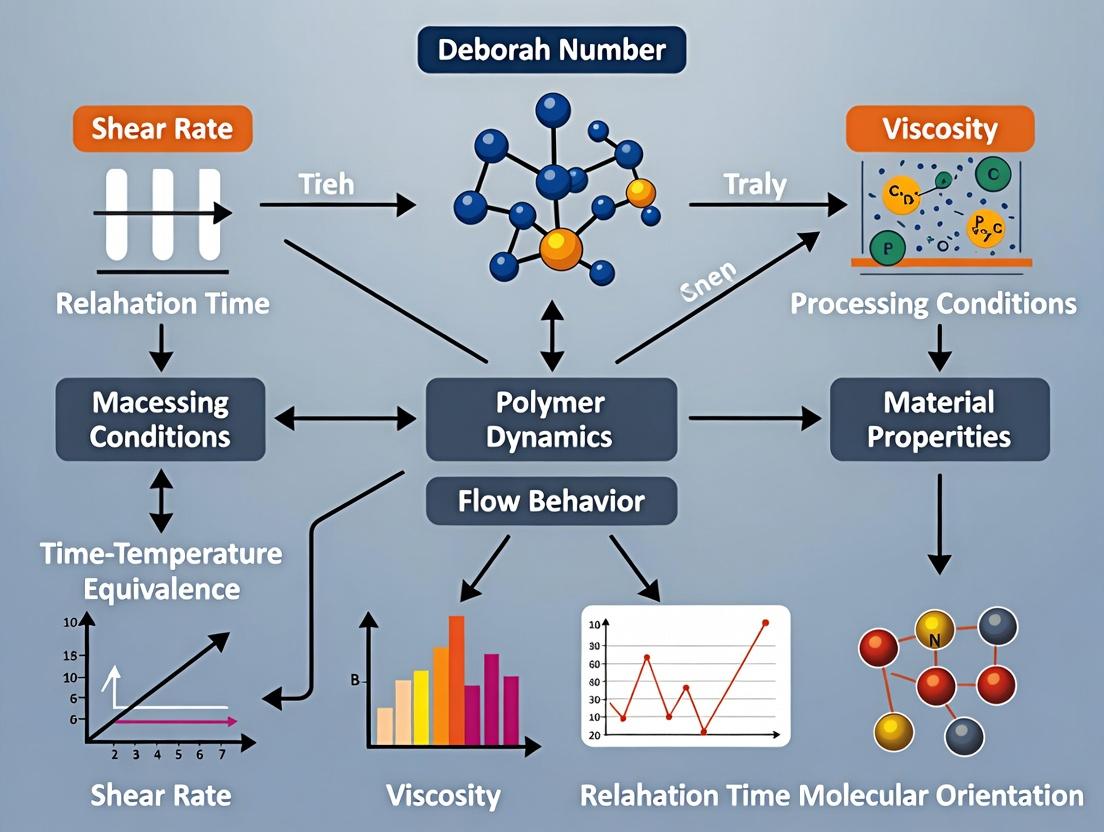
This article provides a comprehensive exploration of the Deborah number (De), a fundamental dimensionless quantity in rheology crucial for understanding polymer processing dynamics.
Mastering the Deborah Number: A Key to Predicting Polymer Behavior in Drug Delivery and Biomedical Applications
Abstract
This article provides a comprehensive exploration of the Deborah number (De), a fundamental dimensionless quantity in rheology crucial for understanding polymer processing dynamics. We first establish the core concept of De as the ratio of material relaxation time to process observation time, defining viscoelastic regimes. The discussion then shifts to practical methodologies for measuring key parameters (relaxation time, characteristic process times) and applying De to real-world processes like extrusion, injection molding, and electrospinning for drug-loaded systems. We address common challenges in processing viscoelastic biomaterials, offering troubleshooting strategies centered on De manipulation for defect minimization (e.g., die swell, melt fracture). Finally, we validate the framework by comparing De with other dimensionless numbers (Weissenberg, Reynolds) and showcasing its predictive power through case studies in pharmaceutical formulation and biomedical device manufacturing. Aimed at researchers and drug development professionals, this guide synthesizes theory and application to optimize the processing of polymeric systems for enhanced performance and reliability.
Deborah Number Decoded: The Fundamental Bridge Between Polymer Timescales and Process Dynamics
1. Introduction & Thesis Context Within the broader thesis on the significance of the Deborah number in polymer processing dynamics research, this whitepaper provides a foundational technical definition. The Deborah number (De) is a fundamental dimensionless group in rheology, providing a quantitative criterion for distinguishing between fluid-like and solid-like behavior in viscoelastic materials under deformation. Its application is critical for researchers and scientists in fields ranging from polymer extrusion and injection molding to the development of complex drug formulations like biologics and hydrogels, where processing-induced stresses can impact stability and efficacy.
2. Core Definition The Deborah number is defined as the ratio of a material's characteristic relaxation time (λ) to the characteristic timescale of the deformation process (t_p).
De = λ / t_p
Where:
- Relaxation Time (λ): The intrinsic timescale for a material's internal stresses to decay (or relax) after a deformation. It is a property of the material, influenced by temperature, molecular weight, and concentration.
- Process Time (t_p): The observable timescale of the deformation or flow process. Examples include the inverse of shear rate in mixing, the residence time in a die, or the dosing time in a syringe.
A low Deborah number (De << 1) indicates that the material relaxes quickly relative to the process; it will behave predominantly as a viscous fluid. A high Deborah number (De >> 1) indicates that the process is so fast that the material cannot relax during it; it will exhibit elastic, solid-like behavior. The transition occurs around De ≈ 1.
3. Quantitative Data & Application Table
Table 1: Characteristic Timescales and Resulting Deborah Numbers for Common Processes
| Process / Experiment | Typical Process Time (t_p) | Material (Example) | Approx. Relaxation Time (λ) at Process Conditions | Calculated Deborah Number (De) | Expected Dominant Behavior |
|---|---|---|---|---|---|
| Extensional Flow (Fiber Spinning) | 0.01 s | Polymer Melt (HDPE) | 1.0 s | 100 | Highly Elastic (Solid-like) |
| High-Shear Mixing | 0.1 s (1/γ̇; γ̇=10 s⁻¹) | Concentrated Protein Solution | 0.5 s | 5 | Viscoelastic |
| Injection Molding Filling | 1 s | Polymer Melt (PP) | 0.2 s | 0.2 | Mostly Viscous |
| Steady Shear Rheometry | 10 s (1/γ̇; γ̇=0.1 s⁻¹) | Xanthan Gum Solution (0.5%) | 0.05 s | 0.005 | Purely Viscous (Fluid-like) |
| Gravitational Sagging/Settling | 1000 s | Pharmaceutical Gel | 500 s | 0.5 | Slightly Elastic |
4. Experimental Protocol for Determining Relaxation Time
Determining the relaxation time (λ) is essential for calculating De. The following is a standard protocol for measuring λ via stress relaxation.
4.1. Key Research Reagent Solutions & Materials
Table 2: Scientist's Toolkit for Stress Relaxation Experiments
| Item | Function & Explanation |
|---|---|
| Rotational Rheometer | Instrument to apply precise deformation and measure resultant stress. Requires temperature control (Peltier plate). |
| Parallel Plate or Cone-Plate Geometry | Tool attached to rheometer. Provides homogeneous shear field. Cone-plate is preferred for constant shear rate. |
| Temperature Control Fluid | Circulates through rheometer base to maintain isothermal conditions, critical as λ is highly temperature-sensitive. |
| Solvent Trap/Saturated Atmosphere | Prevents sample drying (evaporation) during extended tests, especially for aqueous polymer or protein solutions. |
| Viscoelastic Material Sample | Test substance (e.g., polymer melt, hydrogel, biologic formulation) prepared and loaded without introducing bubbles. |
4.2. Detailed Methodology
- Instrument & Geometry Setup: Install the appropriate geometry (e.g., 25mm diameter cone-plate). Set the environmental control to the desired experimental temperature (e.g., 37°C for biologics) and allow system to equilibrate.
- Sample Loading: Carefully load the sample onto the center of the lower plate. Lower the geometry to the prescribed gap (e.g., 0.05mm for cone-plate). Trim excess material. Apply a thin layer of low-viscosity oil around the sample edge if a solvent trap is not available.
- Equilibration: Allow the sample to thermally equilibrate for a specified time (e.g., 5 minutes) with minimal disturbance.
- Stress Relaxation Test: a. Apply Instantaneous Strain: Program the rheometer to apply a sudden, constant shear strain (γ₀). The strain must be within the Linear Viscoelastic Region (LVR) to obtain a material property. This is confirmed via a prior amplitude sweep. b. Hold Strain: Maintain the constant strain for a duration significantly longer than the expected relaxation time. c. Monitor Stress Decay: Measure the resulting shear stress (σ(t)) as a function of time.
- Data Analysis: The relaxation modulus G(t) is calculated as G(t) = σ(t) / γ₀. For a single Maxwell model, G(t) decays exponentially: G(t) = G₀ * exp(-t/λ), where λ is the relaxation time. Fit the G(t) vs. t data to an appropriate model (single or generalized Maxwell) to extract λ.
5. Visualizing the Deborah Number Concept
Diagram 1: Deborah Number Logic & Behavioral Outcome
Diagram 2: Stress Relaxation Experimental Workflow
This whitepaper investigates the transition from solid-like to liquid-like behavior in complex materials, a concept fundamentally governed by the Deborah number (De). Within the broader thesis on Deborah number significance in polymer processing and drug formulation, this document provides a technical guide to its physical interpretation. The Deborah number, defined as the ratio of a material's characteristic relaxation time (λ) to the characteristic time scale of the observation or process (t), serves as the master parameter: De = λ / t. When De >> 1, solid-like (elastic) behavior dominates; when De << 1, liquid-like (viscous) flow is observed. For researchers in polymer dynamics and pharmaceutical development, mastering this interpretation is critical for designing processing equipment, optimizing formulations (e.g., biopolymer therapeutics, hydrogel drug carriers), and predicting product performance.
Core Theory: The Deborah Number Framework
The Deborah number provides a dimensionless scaling law for viscoelasticity. Its power lies in its ability to unify the behavior of diverse materials—from polymer melts to protein solutions—under a single conceptual framework based on relative time scales.
Table 1: Interpretation of Deborah Number Regimes
| Deborah Number (De) | Physical Regime | Material Response | Typical Example in Processing |
|---|---|---|---|
| De > 100 | Elastic Solid-Like | Predominantly elastic; reversible deformation; high stress storage. | Polymer melt elasticity causing die swell in extrusion. |
| De ≈ 1 to 100 | Viscoelastic Solid | Significant elastic recovery with viscous flow; stress overshoot. | Startup of shear for a polymer solution; fiber spinning. |
| De ≈ 1 | Transition Region | Balanced elastic and viscous contributions. | Gel point of a curing polymer or hydrogel. |
| De ≈ 0.01 to 1 | Viscoelastic Liquid | Predominantly viscous flow with measurable elastic stress. | Flow of a concentrated protein solution in a mixer. |
| De < 0.01 | Viscous Liquid-Like | Purely viscous (Newtonian) flow; irrecoverable deformation. | Flow of a simple solvent or dilute polymer solution. |
Quantitative Data: Material Timescales and Process Windows
The following data, synthesized from recent rheological studies, illustrates the characteristic relaxation times of various systems relevant to advanced manufacturing and drug development.
Table 2: Characteristic Relaxation Times (λ) for Selected Materials
| Material System | Typical Relaxation Time (λ) | Key Determining Factor | Implication for De in a t=1s Process |
|---|---|---|---|
| Polycarbonate Melt (200°C) | 100 - 1000 s | Entanglement network molecular weight | De = 100-1000 (Strongly solid-like) |
| 5% w/w Xanthan Gum Solution | 10 - 100 s | Transient network of polysaccharide chains | De = 10-100 (Viscoelastic solid) |
| Concentrated mAb Solution (100 mg/mL) | 0.1 - 10 s | Protein-protein interactions and viscosity | De = 0.1-10 (Viscoelastic liquid/solid) |
| Hydrogel (1% Alginate) | 0.01 - 1 s | Cross-link density and mesh size | De = 0.01-1 (Transition region) |
| Silicon Oil (10,000 cSt) | 0.001 s (1 ms) | Bulk viscosity | De = 0.001 (Liquid-like) |
Experimental Protocols for Characterization
Protocol: Determining Relaxation Time via Small-Amplitude Oscillatory Shear (SAOS)
Objective: To measure the characteristic relaxation time spectrum for De calculation. Materials: See "The Scientist's Toolkit" below. Method:
- Loading: Load sample onto rheometer parallel plate geometry (e.g., 25mm diameter, 1mm gap). Trim excess material.
- Linear Viscoelastic Region (LVR) Determination: Perform a stress (or strain) amplitude sweep at a fixed angular frequency (ω = 10 rad/s) to identify the maximum stress/strain where storage (G') and loss (G'') moduli are independent of amplitude.
- Frequency Sweep Test: Within the LVR, perform a frequency sweep (e.g., 100 to 0.01 rad/s) at constant temperature. Record G'(ω) and G''(ω).
- Data Analysis - Relaxation Time:
- Crossover Method: Identify the frequency ωc where G' = G''. The characteristic relaxation time is λ ≈ 1/ωc.
- Maxwell Model Fit: For simple systems, fit data to G'(ω)= (G₀ω²λ²)/(1+ω²λ²) and G''(ω)= (G₀ωλ)/(1+ω²λ²) to extract λ.
- Continuous Spectrum: For complex materials, calculate the relaxation spectrum H(λ) via inverse Laplace transform of G'(ω) and G''(ω).
Protocol: VisualizingDeEffects via Extensional Rheometry (Capillary Breakup)
Objective: To qualitatively and quantitatively observe the solid-to-liquid transition. Method:
- Filament Formation: Place a small sample droplet between two parallel plates. Rapidly separate plates to form a liquid filament.
- Imaging: Use a high-speed camera coupled with LED backlight to record the filament thinning process.
- Analysis: Plot the midpoint diameter (D(t)) versus time. For a Newtonian fluid (De<<1), D(t) decays linearly. For an elastic fluid (De>>1), the filament thins exponentially with a plateau region, governed by the elastic stress. The characteristic time scale of thinning is directly related to λ.
Visualizations
The Scientist's Toolkit: Key Research Reagent Solutions
Table 3: Essential Materials and Reagents for Deborah Number Research
| Item | Function/Description | Example Product/Chemical |
|---|---|---|
| Stress-Controlled Rheometer | Applies precise shear/extensional stress to measure material response (G', G''). Essential for λ measurement. | TA Instruments DHR, Anton Paar MCR series. |
| Parallel Plate & Cone-Plate Geometries | Standard tooling for SAOS tests. Cone-plate offers constant shear rate; parallel plate is easier for gap-sensitive samples. | Stainless steel or Peltier-plate temperature-controlled geometries. |
| Standard Viscoelastic Fluids | Reference materials for instrument calibration and method validation. | NIST-certified polyisobutylene solutions, silicone oils. |
| Temperature Control Unit (Peltier/Convection) | Maintains precise sample temperature, critical as λ is highly temperature-dependent. | Integrated rheometer environmental systems. |
| High-Speed Camera with Backlight | For capillary breakup extensional rheometry (CaBER) to visualize filament thinning dynamics. | Photron FASTCAM, LED diffused backlight. |
| Model Polymer Systems | Well-characterized polymers for fundamental studies (e.g., narrow PDI polystyrene). | Polystyrene, Polyethylene oxide in oligomeric solvent. |
| Pharmaceutical/Biopolymer Relevant Systems | Complex fluids mirroring real-world applications for translational research. | Monoclonal Antibody (mAb) solutions, Hyaluronic Acid, Alginate hydrogels. |
| Rheology Software with Modeling Suite | For advanced data analysis, including relaxation spectrum calculation and De modeling. | TRIOS (TA), RheoCompass (Anton Paar). |
Historical Context and Origin in Rheological Theory
The Deborah number (De), a dimensionless group central to polymer processing dynamics, provides the critical bridge between material timescales and process kinematics. Its significance, however, is deeply rooted in the historical development of rheological theory. This exploration frames the origin of core rheological concepts within a modern research thesis, demonstrating how foundational principles inform contemporary analysis of polymer behavior in extrusion, injection molding, and pharmaceutical film coating, where De dictates the dominance of elastic versus viscous responses.
The following table summarizes the key quantitative relationships and their historical origins that underpin linear viscoelasticity, essential for calculating material relaxation times used in the Deborah number (De = λ / t_process).
Table 1: Foundational Theories of Linear Viscoelasticity
| Theory/Model (Year) | Proponent(s) | Core Equation | Key Material Parameter (λ) | Relevance to Deborah Number |
|---|---|---|---|---|
| Maxwell Model (1867-1868) | James Clerk Maxwell | σ + λ (dσ/dt) = η₀ (dγ/dt) | Relaxation Time (λ): λ = η₀ / G | λ defines the characteristic time for stress decay; the primary timescale in De. |
| Voigt/Kelvin Model (1875, 1890) | Woldemar Voigt, Lord Kelvin | σ = G γ + η (dγ/dt) | Retardation Time (τ): τ = η / G | Defines recovery timescale; complementary to λ in full material characterization. |
| Boltzmann Superposition Principle (1874) | Ludwig Boltzmann | σ(t) = ∫_{-∞}^{t} G(t - t') (dγ/dt') dt' | Spectrum of Times from G(t) | Establishes linear viscoelasticity; De indicates when history dependence is critical. |
| Rouse Model (1953) | P. E. Rouse | λR ∝ (ζ N² b²) / (6π² kB T) | Rouse Time (λ_R) | First molecular theory for unentangled polymers; connects λ to molecular weight (M_w). |
| Reptation Model (1971) | P. G. de Gennes | λd ∝ ζ N³ b² / (π² kB T) | Disengagement/RepTation Time (λ_d) | For entangled melts; λd ~ Mw³ explains strong processing rate sensitivity via De. |
Experimental Protocols for Characterizing Material Timescales
Determining the characteristic relaxation time (λ) for the Deborah number requires precise experiment.
Protocol 1: Small-Amplitude Oscillatory Shear (SAOS) for Linear Viscoelasticity
- Sample Preparation: Condition polymer or biopolymer sample (e.g., 1-2mm thick disk) at specified temperature and humidity for ≥ 1 hour.
- Instrumentation: Use a strain-controlled rotational rheometer with parallel plate geometry (e.g., 8mm diameter).
- Linear Viscoelastic Region (LVR) Determination: Perform a strain amplitude sweep (e.g., 0.01% - 100%) at a fixed angular frequency (ω = 10 rad/s). Identify the maximum strain (γ_max) where storage modulus (G') remains constant.
- Frequency Sweep Test: Conduct a frequency sweep (e.g., 0.01 - 100 rad/s) at a strain amplitude within the LVR (e.g., 0.5%).
- Data Analysis for λ: Fit the crossover point where G' = G'' to obtain ωcrossover. Estimate λ ≈ 1 / ωcrossover. Alternatively, fit the complex modulus |G*| data to a Maxwell or multi-mode model to extract a discrete or continuous relaxation time spectrum.
Protocol 2: Stress Relaxation After Sudden Strain
- Sample Loading: Load and trim sample as in Protocol 1.
- Rapid Deformation: Apply a rapid, quasi-instantaneous shear strain (γ_0) within the LVR. Achieve the target strain in ≤ 0.1 seconds.
- Stress Monitoring: Hold the applied strain constant and monitor the decaying shear stress σ(t) for a period ≥ 10x the anticipated relaxation time.
- Data Analysis for λ: Fit the normalized relaxation modulus G(t) = σ(t)/γ0 to a single exponential decay: G(t) = G0 * exp(-t/λ). For complex materials, use a stretched exponential or a Prony series.
Logical Flow: From Foundational Theory to Process Deborah Number
The following diagram illustrates the logical pathway from historical constitutive models to the practical application of the Deborah number in analyzing processing dynamics.
The Scientist's Toolkit: Essential Research Reagents & Materials
Table 2: Key Materials for Rheological Characterization in Polymer/Pharmaceutical Research
| Item | Function & Relevance to Deborah Number |
|---|---|
| Standard Reference Fluids (e.g., Polydimethylsiloxane, Polyisobutylene) | Used for rheometer calibration and validating experimental protocols to ensure accurate measurement of η₀ and λ. |
| Well-Characterized Polymer Standards (e.g., NIST PS 1475, PEO/PEG with narrow MWD) | Provide known relaxation time (λ) vs. M_w relationships to validate molecular theory predictions and experimental methods. |
| Pharmaceutical Excipients (e.g., HPMC, PVP, Hypromellose Acetate Succinate) | Key polymers studied for drug amorphous solid dispersion processing; their λ dictates coating uniformity (De) in fluid-bed processes. |
| Inert Solvents & Plasticizers (e.g., Glycerol, Diethyl Phthalate, DMSO) | Modify sample viscosity and relaxation time for controlled experiments, or simulate processing conditions (e.g., in film formation). |
| Stable Cross-linkers or Ionic Salts (e.g., Glutaraldehyde, Ca²⁺ ions for alginate) | Used to systematically vary viscoelasticity (and thus λ) in hydrogel systems, modeling structural changes in formulations. |
| High-Temperature Stability Fluids (e.g., Silicone Oil) | Serve as an inert bath or immersion fluid for temperature-controlled rheometry of high-Tg polymers relevant to melt processing. |
Mathematical Formulation and Key Variables (λ, t_process)
Within the broader thesis investigating the Deborah number's significance in polymer processing dynamics, particularly for pharmaceutical polymer systems, the precise mathematical formulation of its constituent variables is paramount. The Deborah number (De) is classically defined as the ratio of a material's characteristic relaxation time (λ) to the characteristic time scale of the process (tprocess): *De = λ / tprocess. This non-dimensional group fundamentally dictates whether a material behaves more like a fluid (De << 1) or a solid (De >> 1*) during processing. This whitepaper provides an in-depth technical guide to defining, measuring, and applying these core variables in the context of drug product development, where polymer viscoelasticity controls drug release, stability, and manufacturability.
Mathematical Formulation of the Deborah Number
The Deborah number is expressed as: De = λ / t_process
Where:
- λ (Lambda): The characteristic relaxation time of the material. It represents the time scale over which stress decays significantly within the polymer melt or solution following deformation.
- t_process: The characteristic time scale of the processing operation. It is inversely related to the deformation rate applied to the material.
The formulation is deceptively simple; its complexity lies in the accurate determination of λ and the appropriate choice of t_process for a given unit operation.
Key Variable I: Characteristic Relaxation Time (λ)
Theoretical Foundations
λ is an intrinsic property of a viscoelastic material. For polymer melts, it is profoundly influenced by molecular weight, entanglement density, chain architecture, and temperature. It is most rigorously derived from linear viscoelastic spectra.
Experimental Protocols for Determination
Protocol A: Small-Amplitude Oscillatory Shear (SAOS) Rheometry This is the primary method for determining λ.
- Sample Preparation: Condition polymer (e.g., HPMC, PVP, PLGA) or formulation (e.g., hot-melt extrusion strand) to a specified geometry (e.g., 8mm or 25mm parallel plate).
- Frequency Sweep: At a temperature relevant to processing (T_process), perform an oscillatory frequency sweep (ω) within the linear viscoelastic region (typically 0.01 to 100 rad/s). Measure storage (G') and loss (G'') moduli.
- Data Analysis: λ can be estimated via several methods:
- Crossover Method: λcrossover = 1/ωcrossover, where G' = G''. Suitable for monodisperse polymers.
- Weighted Relaxation Spectrum: Compute the discrete or continuous relaxation spectrum H(τ). The weight-average relaxation time is λ = Σ (Hi * τi) / Σ H_i.
- Zero-Shear Viscosity Method: For a Maxwell model, λ = η₀ / GN⁰, where η₀ is the zero-shear viscosity (from steady-shear or complex viscosity low-frequency plateau) and GN⁰ is the plateau modulus.
Protocol B: Stress Relaxation Experiment
- Apply a Step Strain: Impose a small, instantaneous shear strain (γ₀) within the linear regime.
- Monitor Stress Decay: Record the shear stress σ(t) as a function of time.
- Fit to Model: Fit the decay curve to a model (e.g., Maxwell, stretched exponential). The characteristic time constant from the fit is λ.
Table 1: Typical Relaxation Times for Pharmaceutical Polymers
| Polymer System | Typical Molecular Weight (kDa) | Temperature (°C) | Characteristic Relaxation Time λ (s) | Measurement Method |
|---|---|---|---|---|
| Hydroxypropyl Methylcellulose (HPMC) Melt | 100 | 180 | 10 - 100 | SAOS, Crossover |
| Poly(lactic-co-glycolic acid) (PLGA) 50:50 | 50 | 180 | 0.5 - 5 | SAOS, Spectrum |
| Polyvinylpyrrolidone (PVP K30) Solution (60% w/w) | 50 | 25 | 0.01 - 0.1 | SAOS, Stress Relaxation |
| Solid Dispersion (Itraconazole/HPMC) Melt | - | 160 | 50 - 200 | SAOS, Crossover |
Key Variable II: Process Characteristic Time (t_process)
Definition by Unit Operation
tprocess is an extrinsic variable defined by the kinematics of the specific manufacturing operation. It is generally the inverse of a characteristic deformation rate (𝜀̇): tprocess ≈ 1 / 𝜀̇.
Table 2: Definition of t_process for Common Pharmaceutical Processes
| Processing Operation | Characteristic Deformation Rate (𝜀̇) | Characteristic Time (t_process) | Key Formula / Justification |
|---|---|---|---|
| Hot-Melt Extrusion (HME) | Screw Rotation Rate (Shear Rate in Channel) | t_HME = 1 / (N * C) | N = screw speed (rps); C = geometry constant (~1-2). Shear rate γ̇ ≈ (π * D * N) / h. |
| t_HME ≈ 1 / γ̇ | |||
| Injection Molding | Filling or Packing Shear Rate | tIM = 1 / γ̇cavity | γ̇_cavity ≈ (6 * Q) / (w * h²) for a thin cavity. |
| Film Casting | Drawing / Stretching Rate | tcast = Ldraw / V_draw | Ldraw = draw distance; Vdraw = draw velocity. |
| Micromixing | Average Shear Rate in Mixing Zone | t_mix = 1 / (k * (P/V / μ)^0.5) | P/V = power per unit volume; μ = viscosity; k = constant. |
Experimental Protocol for Estimating t_process (Extruder Example)
- Define Geometry: Obtain screw diameter (D), channel depth (h), and metering section helix angle (φ).
- Measure Operational Parameters: Record screw speed (N in RPM) and volumetric throughput (Q).
- Calculate Characteristic Shear Rate: Use the simplified shear rate for drag flow in the metering section: γ̇ ≈ (π * D * N) / h.
- Compute tprocess: tprocess (HME) = 1 / γ̇.
Application: Integrating λ and t_process for Process Design
The calculated De informs critical processing outcomes:
- De << 1: Fluid-like dominance. Stress relaxes quickly. Ideal for mixing and flow into complex molds.
- De ≈ 1: Viscoelastic transition. Phenomena like die swell, melt fracture, and shape memory are pronounced.
- De >> 1: Elastic solid-like dominance. High residual stresses, potential for poor consolidation (e.g., in roll compaction) or frozen molecular orientation.
Deborah Number in Process Design Logic
The Scientist's Toolkit: Research Reagent Solutions
Table 3: Essential Materials and Reagents for Polymer Rheology Studies
| Item / Reagent | Function / Role in Experiment | Key Consideration for Research |
|---|---|---|
| Pharmaceutical-Grade Polymers (e.g., HPMC AS, PLGA, PVP/VA) | Primary viscoelastic material under study. Source dictates molecular weight distribution, viscosity grade, and purity. | Use well-characterized USP/NF grades. Specify viscosity grade and substitution type. |
| Model Active Pharmaceutical Ingredient (API) | To study the effect of a dispersed phase on polymer relaxation dynamics. | Use a thermally stable, non-plasticizing API for controlled studies. |
| Thermal Stabilizers / Antioxidants (e.g., BHT, Ascorbyl Palmitate) | Prevent oxidative degradation during high-temperature rheological testing. | Use at minimal effective concentration (<0.1% w/w) to avoid plasticization. |
| Inert Rheometry Geometry (e.g., 8mm Serrated Parallel Plates) | Provide sufficient grip to prevent wall slip during melt rheology on low-viscosity or lubricating samples. | Essential for accurate data on many pharmaceutical polymers. |
| Standard Reference Fluid (e.g., NIST-traceable silicone oil) | For calibration of rheometer inertia, transducer compliance, and viscosity accuracy. | Perform regular calibration checks, especially when switching temperatures or geometries. |
| High-Purity Inert Gas Supply (Nitrogen or Argon) | Create an inert environment in the rheometer oven to prevent oxidative degradation during tests. | Continuous purge at >5 L/min is standard for polymer melt testing. |
Workflow for Determining Process Deborah Number
This whitepaper, framed within a broader thesis on Deborah number significance in polymer processing dynamics research, elucidates the critical thresholds defined by the Deborah number (De). The Deborah number, a dimensionless group defined as the ratio of a material's characteristic relaxation time ((\lambda)) to the characteristic timescale of the deformation process ((tc)), i.e., (De = \lambda / tc), serves as a fundamental metric for distinguishing between fluid-like and solid-like responses in viscoelastic materials, including polymer melts, solutions, and biological macromolecules.
Fundamental Definitions and Quantitative Ranges
The Deborah number delineates three fundamental regimes of material behavior, summarized in Table 1.
Table 1: Deborah Number Regimes and Material Response
| Regime | De Value | Physical Interpretation | Dominant Material Behavior | Typical Experimental Manifestation |
|---|---|---|---|---|
| De << 1 | De < 0.1 | Process timescale is much longer than material memory. | Purely viscous (fluid-like). Stress relaxes almost instantaneously relative to observation. | Newtonian flow; negligible stress relaxation effects; viscosity dominates. |
| De ≈ 1 | 0.1 ≤ De ≤ 10 | Process and relaxation timescales are comparable. | Viscoelastic. Transient network effects and time-dependent stress are significant. | Stress overshoot in start-up shear; extrudate swell; coupled viscous-elastic effects. |
| De >> 1 | De > 10 | Process timescale is much shorter than material memory. | Mostly elastic (solid-like). Material behaves as a deforming elastic solid. | Large recoil; frozen-in stresses; strong normal stress differences; melt fracture. |
Detailed Regime Analysis & Experimental Methodologies
Regime: De << 1 (The Terminal Flow Regime)
In this regime, the characteristic flow time is so long that the material's internal microstructure (e.g., polymer chain entanglements) has ample time to relax during deformation. The response is dominated by viscous dissipation.
Key Experimental Protocol: Steady Shear Viscosity Measurement
- Objective: To measure the steady-state shear viscosity ((\eta)) and confirm Newtonian plateau.
- Apparatus: Controlled-stress or controlled-rate rotational rheometer with cone-plate or parallel plate geometry.
- Procedure:
- Load polymer sample between pre-heated plates.
- Apply a series of constant, low shear rates ((\dot{\gamma})) across a logarithmic range (e.g., (10^{-3}) to (10^{1}) s⁻¹).
- Measure the resulting steady-state shear stress ((\tau)) at each point.
- Calculate viscosity: (\eta = \tau / \dot{\gamma}).
- Expected Outcome: A constant, shear-rate-independent viscosity ((\eta_0)) at sufficiently low (\dot{\gamma}), confirming De << 1 behavior where (\lambda \dot{\gamma} << 1).
Regime: De ≈ 1 (The Viscoelastic Transition)
This is the most complex regime, where the timescales of deformation and relaxation compete. Memory effects are pronounced, leading to rich nonlinear phenomena.
Key Experimental Protocol: Small Amplitude Oscillatory Shear (SAOS) & Start-up of Steady Shear
- Objective: To characterize the linear viscoelastic spectrum and observe transient elastic stresses.
- Apparatus: Rotational rheometer with environmental control.
- SAOS Procedure (for (\lambda) determination):
- Perform a frequency ((\omega)) sweep from high to low (e.g., (10^{2}) to (10^{-2}) rad/s) at a strain amplitude within the linear viscoelastic region.
- Record storage modulus ((G')) and loss modulus ((G'')).
- Determine the characteristic relaxation time (\lambda), often taken as (1/\omega) at the crossover where (G' = G'').
- Start-up Shear Procedure:
- Apply a constant shear rate (\dot{\gamma}) where (De = \lambda \dot{\gamma} \approx 1).
- Measure the shear stress ((\tau(t))) as a function of time from inception.
- Expected Outcome: A distinct stress overshoot peak before reaching steady state, directly demonstrating elastic energy storage and subsequent relaxation.
Regime: De >> 1 (The Rubber-like Plateau)
Here, deformation is so rapid that the material's internal structure cannot relax during the process. The response is predominantly elastic.
Key Experimental Protocol: Creep-Recovery Test
- Objective: To quantify the elastic solid character and recoverable strain.
- Apparatus: Controlled-stress rheometer.
- Procedure:
- Apply a constant shear stress ((\tau0)) instantaneously and hold for a time (tc), where (t_c << \lambda) (ensuring De >> 1).
- Measure the time-dependent strain (creep), (\gamma(t)).
- Suddenly remove the stress ((\tau = 0)).
- Continue measuring the strain as the material recovers.
- Expected Outcome: Immediate elastic strain upon loading, followed by limited viscous flow. Upon stress removal, a large, instantaneous recoil is observed, with the residual, non-recoverable strain being small.
Visualizing Deborah Number Regimes and Experimental Workflows
The Scientist's Toolkit: Key Research Reagent Solutions & Materials
Table 2: Essential Materials for Polymer Viscoelasticity Research
| Material / Reagent | Function / Role in Research | Typical Example(s) |
|---|---|---|
| Well-Characterized Polymer Standards | Provide model systems with known molecular weight, dispersity, and architecture to validate rheological models and protocols. | Polystyrene (PS), Polyisoprene (PI), Polyethylene oxide (PEO) NIST standards. |
| Thermally Stable Antioxidants | Prevent oxidative degradation of polymer samples during prolonged heating in rheometer, ensuring data reflects intrinsic viscoelasticity. | Irganox 1010, BHT (Butylated hydroxytoluene). |
| Inert Test Solvents | For preparing polymer solutions of specific concentrations to study entanglement dynamics and dilute regime behavior. | Toluene, THF (for synthetic polymers); Water/Buffer (for biopolymers). |
| Calibration Fluids (Newtonian) | Used for instrumental calibration and validation of rheometer geometry and inertia corrections. | Silicone oil standards of known viscosity. |
| Rheometer Geometry | The interface for sample deformation. Cone-plate for uniform shear, parallel plate for easy loading, couette for suspensions. | Titanium or stainless steel 40mm cone-plate, 25mm parallel plate. |
| Environmental Control System | Maintains precise temperature (and optionally humidity) to control polymer mobility and relaxation times. | Peltier plate, electrically heated oven, solvent trap. |
The interpretation of Deborah number thresholds (De >> 1, De << 1, De ≈ 1) provides a critical framework for predicting and tailoring the processing behavior of polymers and complex fluids. For researchers and drug development professionals, mastering the experimental protocols associated with each regime—from steady shear for De << 1 to transient tests for De ≈ 1 and recovery tests for De >> 1—is essential for rational formulation design, optimizing mixing and flow in bioreactors, and ensuring the stability of protein-based therapeutics where viscoelasticity plays a key role. This delineation remains foundational in the ongoing thesis of applying dimensionless analysis to polymer processing dynamics.
Relationship to Linear Viscoelasticity and Maxwell Models
This whitepaper serves as a foundational chapter in a broader thesis investigating the Deborah number (De)—the dimensionless ratio of a material's relaxation time to the observation time scale—and its critical role in polymer processing and drug delivery system dynamics. Understanding a material's linear viscoelastic (LVE) response, classically modeled by the Maxwell framework, is essential for quantifying its characteristic relaxation time and, by extension, predicting its behavior under processing flows where De dictates transitions from solid-like to fluid-like response.
Theoretical Foundations
Linear viscoelasticity describes the response of materials where stress is linearly proportional to strain history, governed by the Boltzmann superposition principle. The Maxwell model provides the simplest mechanical analogue: a purely elastic spring (Hookean) and a purely viscous damper (Newtonian) connected in series. Its constitutive equation is: [ \sigma + \lambda \frac{d\sigma}{dt} = \eta \frac{d\epsilon}{dt} ] where (\sigma) is stress, (\epsilon) is strain, (\eta) is viscosity, and (\lambda = \eta / G) is the Maxwell relaxation time, a key parameter for calculating (De = \lambda / t_{process}).
For complex materials, the Generalized Maxwell Model (or Maxwell-Wiechert model) is used, consisting of multiple Maxwell elements in parallel with a spectrum of relaxation times ((\lambdai)), providing a distribution (G(t)): [ G(t) = \sum{i=1}^{n} Gi e^{-t/\lambdai} ]
Experimental Protocols for LVE Characterization
Determining relaxation spectra requires precise small-amplitude oscillatory shear (SAOS) experiments within the LVE regime.
Protocol: Determining LVE Limits and Master Curves
Strain Sweep (Amplitude Sweep):
- Method: Apply oscillatory shear at a constant frequency (e.g., ω = 10 rad/s) while logarithmically increasing strain amplitude ((\gamma_0)).
- Measurement: Record elastic (storage) modulus (G') and viscous (loss) modulus (G'').
- Endpoint: Identify the critical strain (\gamma_c) where (G') deviates by >5% from its plateau, defining the limit of linearity.
Frequency Sweep within LVE Regime:
- Method: Apply oscillatory shear at a strain amplitude well below (\gamma_c) across a wide angular frequency range (e.g., 0.01 to 100 rad/s).
- Temperature: Conduct sweeps at multiple isotherms (e.g., T₀, T₁, T₂...).
- Time-Temperature Superposition (TTS):
- Horizontally (and optionally vertically) shift frequency sweep data at different temperatures along the frequency axis to construct a single master curve at a reference temperature (T{ref}).
- The horizontal shift factor (aT) yields the temperature dependence of relaxation times, critical for extrapolating processing behavior.
Protocol: Relaxation Spectrum Calculation
- Data Acquisition: Obtain master curves for (G'(ω)) and (G''(ω)).
- Discrete Spectrum Fitting: Solve the ill-posed inverse problem using a regularization method (e.g., CONTIN algorithm, nonlinear least squares) to fit the Generalized Maxwell model: [ G'(ω) = \sum{i=1}^{n} Gi \frac{(ω\lambdai)^2}{1+(ω\lambdai)^2}, \quad G''(ω) = \sum{i=1}^{n} Gi \frac{ω\lambdai}{1+(ω\lambdai)^2} ]
- Output: A set of discrete moduli (Gi) and relaxation times (\lambdai). The weight-average relaxation time (\lambdaw = \sum Gi \lambdai / \sum Gi) is often used for Deborah number calculation.
Table 1: Characteristic Maxwell Relaxation Times (λ) for Model Polymers
| Polymer System | Molecular Weight (kDa) | Temperature (°C) | λ (s) | Test Method | Reference (Year) |
|---|---|---|---|---|---|
| Polystyrene (Monodisperse) | 100 | 190 | 0.5 | SAOS | Baumgaertel et al. (1992) |
| Polyethylene (LDPE) | - | 150 | 10.2 | SAOS | Dealy & Larson (2006) |
| PDMS (Silicone Oil) | 50 | 25 | 0.01 | Stress Relaxation | Ferry (1980) |
| Hydroxypropyl Methylcellulose (2% aq.) | - | 25 | 1.8 | SAOS | Mewis & Wagner (2012) |
Table 2: Resulting Deborah Numbers in Processing Flows
| Processing Operation | Characteristic Process Time (s) | Material (λ from Table 1) | Calculated De (λ / t_process) | Implied Behavior (De >>1: Elastic, De <<1: Viscous) |
|---|---|---|---|---|
| Injection Molding (Filling) | 0.1 | LDPE (λ=10.2s) | 102 | Strongly Elastic Dominated |
| Film Blowing | 10 | LDPE (λ=10.2s) | ~1 | Viscoelastic Transition |
| Coating (High-Speed) | 0.001 | PDMS (λ=0.01s) | 10 | Elastic Effects Present |
| Stirring in a Tank | 100 | HPMC (λ=1.8s) | 0.018 | Mostly Viscous |
Diagrams of Key Relationships
Title: Experimental Path from SAOS to Deborah Number
Title: Mechanical Analogues of Maxwell Models
The Scientist's Toolkit: Research Reagent Solutions
Table 3: Essential Materials for LVE Characterization
| Item / Reagent | Function in Experiment | Key Consideration |
|---|---|---|
| Rheometer (Rotational) | Applies controlled shear deformation/stress and measures torque/phase angle. | Requires precise temperature control (e.g., Peltier, convection oven) and torque resolution. |
| Parallel Plate Geometry | Sample holder for oscillatory shear tests. | Gap setting is critical; used for structured/solid-like materials. Easy sample loading. |
| Cone-and-Plate Geometry | Sample holder ensuring uniform shear rate across gap. | Preferred for low-viscosity fluids. Requires precise truncation gap setting. |
| Standard Reference Fluids | (e.g., NIST Newtonian viscosity standards, Polydimethylsiloxane) | For instrument calibration and validation of shear stress/strain measurements. |
| Inert Test Solvents | (e.g., Silicone oil, Mineral oil) | Used for solvent traps to prevent sample drying/evaporation during high-temperature tests. |
| Time-Temperature Superposition Software | (e.g., IRIS RheoHub, TA Instruments Trios) | Algorithms for constructing master curves and calculating shift factors a_T. |
This whitepaper, framed within a broader thesis on Deborah number (De) significance in polymer processing dynamics, elucidates the molecular connections between De, chain entanglement density, and segmental mobility. The Deborah number, defined as the ratio of a material's characteristic relaxation time (λ) to the timescale of observation or deformation (t), De = λ/t, serves as a fundamental dimensionless group governing the transition from viscous to elastic dominance in polymer melts and concentrated solutions. At the molecular level, this macroscopic response is dictated by the interplay between topological constraints (entanglements) and the kinetics of chain reptation. Understanding this connection is critical for researchers in advanced material processing and drug development, where controlling microstructure via flow conditions is paramount.
Theoretical Framework: From Entanglements to Macroscopic De
The plateau modulus, GN0, is a direct rheological measure of entanglement density, related to the molecular weight between entanglements, Me: GN0 = (ρRT) / Me where ρ is density, R is the gas constant, and T is temperature.
The terminal relaxation time, λ, which feeds into De, is governed by reptation and is highly sensitive to Me and chain length: λ ∝ (Mw / Me)ˣ ζ₀ N³ for a chain of N Kuhn steps and monomeric friction coefficient ζ₀, with x typically between 3 and 3.4.
Thus, the Deborah number for a process with characteristic time t becomes: De = (λ( Me, ζ₀(T), Mw) ) / t
A high De indicates a system where the entangled network cannot relax within the process window, leading to oriented, anisotropic structures and potential strain hardening.
Table 1: Characteristic Parameters for Model Polymers
| Polymer | Me (kg/mol) | GN0 (MPa) at 25°C | Tube Diameter, a (nm) | Monomeric Friction Coefficient, ζ₀ (N s/m) at Tg+50°C |
|---|---|---|---|---|
| Polystyrene (atactic) | 13.5 | 0.32 | 6.0 | 2.1 x 10⁻¹⁰ |
| Poly(methyl methacrylate) | 8.9 | 0.49 | 4.5 | 4.8 x 10⁻¹⁰ |
| Polyethylene (linear) | 1.2 | 2.8 | 1.8 | 0.8 x 10⁻¹⁰ |
| Polybutadiene (1,4-) | 1.8 | 1.2 | 2.2 | 1.2 x 10⁻¹⁰ |
| Poly(dimethyl siloxane) | 12.0 | 0.20 | 6.7 | 0.6 x 10⁻¹⁰ |
Table 2: Calculated Deborah Numbers for Common Processes
| Processing Method | Characteristic Timescale, t (s) | Polyethylene ( Mw = 200 kg/mol) λ (s) | Calculated De | Expected Material Response |
|---|---|---|---|---|
| Extrusion (steady shear) | 1 - 10 | ~0.5 | 0.05 - 0.5 | Mostly viscous flow |
| Fiber Spinning (elongation) | 0.01 - 0.1 | ~0.5 | 5 - 50 | Strong elastic effects, orientation |
| Injection Molding (filling) | 0.001 - 0.1 | ~0.5 | 5 - 500 | Highly elastic, frozen-in stresses |
| Roll Milling | 0.1 - 10 | ~0.5 | 0.05 - 5 | Transition regime |
Experimental Protocols for Characterizing the De-Entanglement-Mobility Nexus
Protocol: Determining Entanglement Density via Rheology
Objective: Measure plateau modulus GN0 to calculate Me.
- Sample Preparation: Prepare polymer discs (1-2 mm thick, 8-25 mm diameter) via compression molding above Tm/Tg. Ensure thermal history is erased by annealing.
- Instrumentation: Use a strain-controlled rotational rheometer with parallel-plate geometry.
- Frequency Sweep Test:
- Perform small-amplitude oscillatory shear (SAOS) within linear viscoelastic regime (strain ~0.5-2%).
- Apply angular frequency (ω) range from 0.01 to 500 rad/s at a constant temperature well above Tg.
- Conduct tests at multiple temperatures and apply time-temperature superposition (TTS) to construct master curve.
- Data Analysis: Identify the frequency-independent plateau in storage modulus G'(ω) at high frequencies. The average value in this region is GN0. Calculate Me = ρRT/ GN0.
Protocol: Probing Segmental Mobility via Dielectric Spectroscopy
Objective: Measure monomeric friction coefficient ζ₀ via the segmental (α) relaxation.
- Sample Preparation: Create uniform film (~100 µm) between two conductive electrodes (e.g., gold sputtered).
- Instrumentation: Use broadband dielectric spectrometer.
- Temperature-Frequency Sweep:
- Apply low-voltage AC signal (typically 0.5-1 Vrms).
- Measure complex permittivity ε*(ω) over frequency range (10⁻² to 10⁶ Hz) at isothermal steps from Tg to Tg+100°C.
- Data Analysis: Fit α-relaxation peak (loss peak ε'') with Havriliak-Negami function. The relaxation time τα(T) at a reference temperature (Tref = Tg+50°C) is extracted. Relate to ζ₀ via Rouse model considerations: ζ₀ ∝ τα kBT / b², where b is Kuhn length.
Protocol: In-situ Rheo-Raman for Flow-Induced Disentanglement
Objective: Correlate macroscopic stress (De) with molecular orientation and entanglement density during flow.
- Instrumentation: Couple a capillary or slit-die rheometer with a confocal Raman microscope focused on the flow channel centerline.
- Experiment:
- Subject polymer melt to controlled shear/elongational flow at varying rates (quenching De).
- Simultaneously measure pressure drop (for stress) and collect Raman spectra.
- Analysis: Use Raman band ratios (e.g., 1130 cm⁻¹/1090 cm⁻¹ for PE backbone orientation) as a proxy for chain alignment. Correlate the evolution of this orientation factor with the accumulated strain and calculated De. A departure from linear viscoelastic prediction indicates flow-induced topological modification.
Visualization of Core Concepts
Diagram Title: Determinants of Deborah Number and Material Response
Diagram Title: Experimental Workflow: Measuring Me via Rheology
The Scientist's Toolkit: Key Research Reagent Solutions
Table 3: Essential Materials for De-Entanglement Research
| Item | Function / Relevance | Example Product / Specification |
|---|---|---|
| Well-Characterized Monodisperse Polymers | Model systems for testing theory. Requires precise knowledge of Mw, PDI, architecture. | Polyethylene NBS 1475, Polystyrene from Anionic Synthesis (PDI < 1.1). |
| Stable, Inert Rheometer Test Fluids | For instrument calibration and inertia correction in high-frequency tests. | Silicone oil (Newtonian), NIST-certified viscosity standards. |
| High-Temperature, Chemically Inert Rheometer Geometry | For testing polymers at processing temperatures without degradation or slip. | Electropolished stainless steel or titanium parallel plates; sandblasted surfaces to mitigate wall slip. |
| Dielectric Spectroscopy Cells with Temperature Control | For measuring segmental mobility (α-relaxation) over broad T and f ranges. | Parallel plate capacitor cells with conductive electrodes (e.g., gold) and integrated Peltier heating/cooling. |
| Rheo-Optical Coupling Accessories | For in-situ molecular orientation measurement under flow. | Coupling stages for Raman, FTIR, or birefringence with shear/elongational fixtures. |
| Time-Temperature Superposition (TTS) Software | To construct master curves and extract relaxation spectra. | Requires robust nonlinear regression (e.g., IRIS Rheo-Hub, MITs). |
| Melt-Filtering/Purging Compounds | To clean and prepare processing equipment without contaminating samples. | Polyolefin-based purging compounds with high thermal stability. |
From Theory to Tank: Measuring and Applying the Deborah Number in Biomedical Polymer Processing
Experimental Techniques for Determining Polymer Relaxation Time (λ)
Within the broader thesis on the significance of the Deborah number (De = λ / t_process) in polymer processing dynamics, the accurate determination of the characteristic polymer relaxation time (λ) is paramount. De quantifies the fluid's "memory," distinguishing between viscous (De << 1) and elastic (De >> 1) dominated flows, critical for predicting phenomena like die swell, melt fracture, and mixing efficiency. This guide details contemporary experimental techniques for measuring λ, central to validating constitutive models and optimizing processing conditions.
Small-Amplitude Oscillatory Shear (SAOS)
Core Principle: A sinusoidal strain γ(ω)=γ₀sin(ωt) is applied, and the stress response σ(ω)=σ₀sin(ωt+δ) is measured. The phase shift δ yields the loss tangent (tan δ = G''/G'), and the complex modulus G*(ω) is decomposed into storage (G') and loss (G'') moduli. λ is inversely related to the crossover frequency ω_c where G' = G''. Key Assumption: The measurement is within the linear viscoelastic (LVE) regime (γ₀ typically < 10%).
Experimental Protocol (Standard SAOS)
- Sample Preparation: Mold polymer (e.g., polystyrene, polyethylene) into 8-25mm diameter discs of uniform thickness (~1mm).
- Instrument Calibration: Perform inertia and transducer calibration on the rotational rheometer (e.g., TA Instruments ARES-G2, Malvern Kinexus).
- LVE Strain Determination: At a fixed frequency (e.g., ω = 10 rad/s), perform a strain sweep (0.1% to 100%) to identify γ_max where G' deviates by <5%.
- Frequency Sweep Test: At γ₀ < γ_max, conduct a frequency sweep across a broad range (e.g., 0.01 to 100 rad/s) at constant temperature (controlled by Peltier plates or convection oven).
- Data Analysis: Plot G'(ω) and G''(ω). Identify ωc. For a single-mode Maxwell model, λmaxwell = 1/ω_c. For broad relaxation spectra, multi-mode fitting is required.
Table 1: Typical SAOS Data for Polystyrene (Mw=200kDa) at 180°C
| Frequency ω (rad/s) | Storage Modulus G' (Pa) | Loss Modulus G'' (Pa) | Complex Viscosity η* (Pa·s) |
|---|---|---|---|
| 0.1 | 1.2e2 | 8.5e2 | 8.6e3 |
| 1.0 | 1.5e3 | 4.2e3 | 4.5e3 |
| 10.0 | 1.4e4 | 1.8e4 | 2.3e3 |
| ω_c = 50.0 | 5.0e4 | 5.0e4 | 1.0e3 |
| 100.0 | 1.2e5 | 7.0e4 | 1.4e3 |
Derived λ_maxwell = 1/50 rad/s = 0.02 s.
Title: SAOS Experimental Workflow for Relaxation Time.
Capillary Breakup Extensional Rheometry (CaBER)
Core Principle: A small volume of fluid is placed between two plates, which are rapidly separated to form a cylindrical filament. The subsequent thinning dynamics under surface tension-driven flow are monitored via laser micrometer or high-speed camera. For a viscoelastic fluid obeying the Oldroyd-B model, the filament diameter D(t) decays exponentially: D(t)/D₀ ~ exp(-t/3λ), allowing direct extraction of λ.
Experimental Protocol (Standard CaBER)
- Instrument Setup: Mount a CaBER fixture (e.g., Thermo Fisher HAAKE CaBER, Cambridge Trimaster) or a modified tensile tester.
- Sample Loading: Place a small droplet (~50 µL) of test fluid (e.g., polymer solution, melt) between parallel plates.
- Step-Strain: Rapidly separate plates to a final gap (e.g., 2-6mm) in ~50ms, creating a liquid bridge.
- Filament Monitoring: Track the mid-point diameter D(t) vs. time using a laser micrometry system for ~0.1-10 seconds.
- Data Analysis: In the elasto-capillary thinning regime, plot ln(D(t)) vs. t. The slope of the linear region yields -1/(3λ).
Table 2: CaBER Data for 0.1% PEO in Water
| Time t (ms) | Filament Diameter D(t) (µm) | ln(D(t)/D₀) |
|---|---|---|
| 0 | 1000 (D₀) | 0.000 |
| 100 | 450 | -0.799 |
| 200 | 200 | -1.609 |
| 300 | 92 | -2.407 |
| 400 | 41 | -3.219 |
| 500 | 18 | -4.017 |
Slope from linear region (200-500ms) ≈ -0.00803 ms⁻¹ = -1/(3λ) → λ ≈ 41.5 ms.
Stress Relaxation After Step Strain
Core Principle: A large, instantaneous shear strain γ₀ is applied, and the subsequent decay of shear stress σ(t) is monitored. For a single-mode Maxwell fluid, σ(t) = G γ₀ exp(-t/λ), where G is the shear modulus. The technique probes the nonlinear relaxation behavior.
Experimental Protocol
- Sample Loading & Conditioning: Load polymer sample on a strain-controlled rheometer with environmental control.
- Pre-shear & Rest: Apply minimal pre-shear to ensure uniformity, then allow sample to rest for a time >> λ to erase history.
- Apply Step Strain: Command a near-instantaneous strain (e.g., γ₀ = 1-5) within the instrument's actuator limits (< 0.01s).
- Stress Monitoring: Record the decaying torque/stress at high sampling rate for a duration of at least 10λ.
- Data Fitting: Fit the stress decay curve to a single or multi-exponential model: σ(t) = Σ Gᵢ exp(-t/λᵢ).
Extensional Stress Growth (Sentmanat Extensional Rheometer - SER)
Core Principle: A rectangular polymer sample is wound on two counter-rotating drums, subjecting its center to uniaxial extension at a constant Hencky strain rate (ε̇). The transient extensional stress growth coefficient η_E⁺(t) is measured. The time to reach the steady-state plateau or the overshoot peak is related to λ.
Experimental Protocol (SER)
- Sample Preparation: Compression mold polymer into thin rectangular strips (e.g., 18mm x 10mm x 0.5mm).
- Mounting: Clamp sample ends onto the pre-heated drums within an environmental chamber.
- Test Initiation: Set drums to rotate at a constant speed to achieve the desired ε̇ (ε̇ = ΩR/L₀, where Ω is speed, R is drum radius, L₀ is half the sample length).
- Data Collection: Record torque vs. time, converting to true stress vs. Hencky strain (ε = ε̇t).
- Analysis: Compare η_E⁺(t) with linear viscoelastic envelope. The deviation time or the strain at stress overshoot provides an estimate of λ (often λ ≈ 1/ε̇ at peak overshoot for many melts).
Table 3: Comparison of Key Experimental Techniques for λ Determination
| Technique | Deformation Mode | Typical λ Range | Key Assumptions/Limitations | Direct Output |
|---|---|---|---|---|
| SAOS | Small oscillatory shear | 10⁻³ - 10³ s | Linear Viscoelasticity; requires model (Maxwell) for simple λ. | G'(ω), G''(ω); ω_c |
| CaBER | Extensional (uniaxial) | 10⁻³ - 10 s | Fluid must be strain-hardening; sensitive to fluid cohesion and inertia. | D(t) decay curve; direct λ from slope. |
| Stress Relaxation | Large step shear | 10⁻³ - 10⁴ s | Step must be "instantaneous"; instrument inertia can distort early data. | σ(t) decay; direct λ from exponential fit. |
| SER | Steady uniaxial extension | 10⁻¹ - 10² s | Requires sample machining; strain uniformity must be maintained. | η_E⁺(t, ε̇); λ inferred from growth curve. |
Title: Relationship Between λ, De, and Processing.
The Scientist's Toolkit: Key Research Reagent Solutions & Materials
| Item/Reagent | Function in Experiment | Example Product/Brand |
|---|---|---|
| Standard Polymer Reference Materials | Calibrate rheometers; validate experimental protocols. | NIST SRM 1495 (Polystyrene), PEO/PEG standards from American Polymer Standards. |
| Inert Rheometer Testing Fluids (Silicone Oils) | Perform instrument inertia calibration and transducer verification. | Dow Corning 200 series fluids, Paragon Scientific viscosity standards. |
| High-Temperature Stable Silicone Grease | Seal environmental chambers and prevent sample degradation/evaporation. | Torrey Hills Tech Grease, Dow Corning High Vacuum Grease. |
| Polymer Stabilizers/Anti-oxidants | Prevent thermal-oxidative degradation during high-temperature rheology tests. | Irganox 1010, Irgafos 168 (BASF). |
| Solvents for Solution Preparation | Prepare polymer solutions of specific concentrations for CaBER or SAOS. | High-Purity Toluene, THF, DMF (for dissolution and viscosity modification). |
| Release Agents (Mold Release Sprays) | Facilitate clean demolding of compression-molded polymer sheets for SER. | McLube, Mann Ease Release. |
| Conductive Silver Paste | For samples requiring anti-static treatment to prevent charge interference in laser-based measurements. | SPI Supplies Silver Paste. |
| Calibrated Gap-Setting Specimens | Precisely set and verify rheometer plate-plate or cone-plate gaps. | Gapped stainless steel disks from rheometer manufacturers (TA, Anton Paar). |
Estimating Characteristic Process Times for Unit Operations (Mixing, Extrusion, Molding)
The accurate estimation of characteristic process times (τ_process) for fundamental unit operations—mixing, extrusion, and molding—is a cornerstone for advancing polymer processing science. This guide frames these estimations within the critical context of the Deborah number (De), a dimensionless group central to modern polymer dynamics research. The Deborah number, defined as De = τ_material / τ_process, represents the ratio of a material's characteristic relaxation time (τ_material) to the characteristic time scale of the deformation process. When De << 1, the material behaves as a viscous fluid; when De >> 1, it exhibits predominantly elastic, solid-like behavior. Precise determination of τ_process is therefore not merely an engineering exercise but a fundamental requirement for predicting flow instabilities, final morphology, residual stresses, and ultimately, the performance of polymeric products, including advanced drug delivery systems.
Characteristic Times for Key Unit Operations
The following tables summarize the defining equations, key parameters, and typical ranges for characteristic process times in mixing, extrusion, and molding. These times serve as the denominator in the Deborah number calculation.
Table 1: Characteristic Process Times for Batch and Continuous Mixing
| Mixing Type | Characteristic Time (τ_process) Equation | Key Variables | Typical Range | Primary Influence on De |
|---|---|---|---|---|
| Batch (Internal) | τ_mix = (V/Q) ⋅ (1/γ̇) ⋅ f(Re, geometry) | V: Batch volume, Q: Volumetric flow rate, γ̇: Mean shear rate | 60 - 600 s | Determines total deformation history for a fluid element. |
| Continuous (Twin-Screw) | τ_res = L / v_z = V_filled / Q | L: Screw length, v_z: Avg. axial velocity, V_filled: Filled volume | 5 - 60 s | Defines the duration of applied stress and thermal history. |
| Ribbon Blender | τ_mix = (Cycle Time) / (Number of Cross-sections) | Cycle Time: Total blending time | 300 - 1200 s | Governs diffusion-limited distributive mixing. |
Table 2: Characteristic Process Times for Single-Screw Extrusion
| Process Zone | Characteristic Time (τ_process) Equation | Key Variables | Typical Range | Significance for Polymer Dynamics |
|---|---|---|---|---|
| Solid Conveying | τ_sc = L_sc / (π D N cos φ) | L_sc: Zone length, D: Screw diameter, N: Screw speed, φ: Helix angle | 2 - 10 s | Initial compaction; low De typically. |
| Melting | τ_melt = δ² / α | δ: Melt film thickness, α: Thermal diffusivity | 1 - 5 s | Critical for onset of chain relaxation in new melt. |
| Melt Pumping | τ_pump = V_channel / Q | V_channel: Channel volume in metering section | 10 - 30 s | Main region for viscous dissipation and elastic energy storage (De ~ 0.1-10). |
| Die Flow | τ_die = L_die / v_avg | L_die: Die land length, v_avg: Avg. velocity in die | 0.1 - 2 s | High stress; key for die swell (De often >>1). |
Table 3: Characteristic Process Times for Injection Molding
| Molding Phase | Characteristic Time (τ_process) Equation | Key Variables | Typical Range | Relevance to Material State |
|---|---|---|---|---|
| Filling | τ_fill = V_cavity / Q_inj | Q_inj: Volumetric injection rate | 0.5 - 5 s | Extremely high shear rates; De >> 1, flow dominated by melt elasticity. |
| Packing | τ_pack = t_pack (process setpoint) | t_pack: Machine packing time setting | 2 - 10 s | High pressure; timescale for compression and additional flow. |
| Cooling | τ_cool = s² / (π² α) | s: Part half-thickness, α: Thermal diffusivity | 10 - 100 s | Dictates crystallization kinetics and freezing of molecular orientation. |
Experimental Protocols for Determining Process Times
Protocol 1: Residence Time Distribution (RTD) in Extrusion/Twin-Screw Mixing
- Objective: To measure the distribution of time material elements spend in a continuous processor, from which the mean residence time (τ_process) is derived.
- Methodology:
- Tracer Selection: Use a pulse of UV-stabilized colorant, salt, or a radioisotope compatible with the polymer.
- Pulse Injection: Introduce the tracer instantaneously at the processor inlet under steady-state operating conditions (stable temperature, screw speed, feed rate).
- Outlet Sampling: Collect small samples from the extrudate at the die exit at precise, frequent time intervals (e.g., every 1-5 seconds).
- Tracer Quantification: Analyze tracer concentration in each sample via UV-Vis spectroscopy, conductivity, or gamma counting.
- Data Analysis: Plot normalized concentration (C(t)/∫C(t)dt) vs. time. The mean residence time is calculated as τ_mean = ∫ t⋅C(t)dt / ∫ C(t)dt.
Protocol 2: In-line Rheometry for Characteristic Flow Time
- Objective: To obtain a direct rheological timescale (e.g., shear rate inverse, 1/γ̇) relevant to the process.
- Methodology:
- Instrumentation: Install a specially designed slit or capillary die with multiple pressure transducers along its length.
- Process Coupling: Connect the die directly to the extruder or mixer outlet.
- Data Acquisition: Under stable processing conditions, record pressure drops (ΔP) and melt temperature (T) at a known volumetric output (Q).
- Calculation: Calculate the apparent wall shear rate (γ̇app = 6Q/(w⋅h²) for a slit) and apparent shear stress (τapp = ΔP⋅h/(2L)). The characteristic viscous time can be taken as τviscous ≈ 1/γ̇app at the process stress.
Protocol 3: Filling Time Visualization in Injection Molding
- Objective: To directly measure cavity filling time (τ_fill) and observe flow front progression.
- Methodology:
- Mold Preparation: Use a transparent (e.g., acrylic) mold or a mold with an integrated glass window.
- High-Speed Imaging: Position a high-speed camera to view the cavity. Synchronize camera trigger with the start of injection.
- Short Shot Experiment: Perform an injection cycle terminated just before the cavity is completely filled.
- Analysis: Review footage frame-by-frame. The time from gate arrival to flow front reaching the furthest point is τ_fill. This visual data can be used to validate computational fluid dynamics (CFD) simulations.
Visualization of Concepts and Workflows
Title: Deborah Number Definition and Process Time Influence
Title: Workflow for Applying Deborah Number in Process Analysis
The Scientist's Toolkit: Research Reagent Solutions & Essential Materials
Table 4: Essential Materials for Process Time and Deborah Number Experiments
| Item / Reagent | Function / Relevance | Example / Specification |
|---|---|---|
| Polydisperse Polymer Resins | Model materials with broad relaxation spectra for studying De effects across timescales. | Polystyrene (PS) standards, Polypropylene (PP) with different Mw, Poly(lactic-co-glycolic acid) (PLGA) for drug delivery. |
| Ultraviolet (UV) Tracers | Chemically inert, stable tracers for Residence Time Distribution (RTD) studies in extruders. | Titanium dioxide (TiO2), UV-stabilized masterbatches (e.g., with benzotriazoles). |
| Pressure-Sensitive Adhesive Films | For mounting and sealing pressure transducer ports in slit dies for in-line rheometry. | Polyimide-backed, high-temperature stable films. |
| High-Temperature Pressure Transducers | Direct measurement of pressure drop in processes for shear stress and viscosity calculation. | Piezoelectric or strain-gauge transducers with ranges of 0-2000 bar, T_max > 300°C. |
| Capillary Rheometer Dies | Bench-top simulation of high-shear process zones (e.g., injection molding filling) to obtain τ_material. | Dies with various L/D ratios (e.g., 10:1, 20:1, 30:1) for Bagley correction. |
| Dynamic Mechanical Analyzer (DMA) | Measures viscoelastic properties (E', E'') to determine relaxation times (τ) of solid polymers post-processing. | Tension, compression, or 3-point bending fixtures. |
| Non-Reactive Silicone Oil | Heat transfer fluid for precise temperature control in rheometer and process equipment platens/jackets. | Thermally stable, low-viscosity oil for circulation baths. |
| High-Speed Camera System | Visualization of rapid process dynamics (filling, instability onset) to measure τ_fill and flow kinematics. | System capable of > 1000 fps with appropriate lighting (LED). |
The electrospinning of drug-loaded nanofibers presents a critical challenge in achieving reproducible and functionally optimal morphologies. Controlling fiber diameter, porosity, and bead formation is paramount for dictating drug release kinetics and mechanical integrity. This case study is framed within a broader thesis on the significance of the Deborah number (De) in polymer processing dynamics. De, defined as the ratio of the material's relaxation time (λ) to the observation timescale of the process (t), provides a fundamental dimensionless group for understanding viscoelastic behavior. In electrospinning, where a polymer jet undergoes extreme elongation and solidification, a high De indicates dominantly elastic behavior, influencing jet stability, thinning dynamics, and final fiber morphology. This guide explores the experimental and theoretical levers for morphology control through the lens of De manipulation.
Key Parameters Influencing Fiber Morphology and the Deborah Number
The electrospinning process is governed by solution properties, process parameters, and ambient conditions. These directly influence the relaxation dynamics captured by De.
Quantitative Influence of Key Parameters (Summary) Table 1: Key Parameters and Their Typical Influence on Fiber Morphology and Deborah Number
| Parameter | Typical Range | Effect on Fiber Morphology | Implied Effect on De (λ/t) |
|---|---|---|---|
| Polymer Concentration | 5-20% (w/v) | ↑ Diameter, suppresses beads | ↑ Relaxation time (λ), ↑ De |
| Applied Voltage | 10-30 kV | ↓ Diameter, can induce beads | ↓ Process time (t) via higher strain rate, ↑ De |
| Feed Rate | 0.5-3 mL/h | ↑ Diameter, can form ribbons | ↑ Mass, affecting t, variable effect on De |
| Collector Distance | 10-20 cm | ↓ Diameter, promotes drying | ↑ Flight/observation time (t), ↓ De |
| Solution Conductivity | Variable (additives) | ↓ Diameter, may reduce beads | Affects jet path & instability, complex effect on De |
| Solvent Volatility | High vs. Low | Affects porosity & surface texture | Alters solidification time (t), modifies effective De |
Experimental Protocols for Morphology Control
Protocol 1: Systematic Investigation of Polymer Concentration and Voltage Aim: To establish a morphology map based on viscoelasticity and electrostatic force.
- Solution Preparation: Prepare a series of Polycaprolactone (PCL) solutions in a 70:30 (v/v) mixture of Dichloromethane (DCM) and Dimethylformamide (DMF) with concentrations of 8, 10, 12, 14, and 16% (w/v). Incorporate a model drug (e.g., Tetracycline HCl) at 5% (w/w relative to polymer).
- Characterization: Measure viscosity, surface tension, and conductivity for each solution. Perform rheological oscillatory tests to estimate relaxation time (λ).
- Electrospinning: Use a fixed collector distance (15 cm) and feed rate (1.0 mL/h). Electrospin each solution at three voltages: 15, 20, and 25 kV.
- Analysis: Collect fibers on aluminum foil. Analyze fiber diameter and bead density using Scanning Electron Microscopy (SEM). Correlate morphology with calculated De (using λ and an estimated process timescale t from jet velocity).
Protocol 2: Manipulating Relaxation Time with Plasticizer/Salt Additives Aim: To directly modulate De by altering the solution's relaxation dynamics.
- Solution Preparation: Prepare a base 10% (w/v) PCL solution. Create three additive batches:
- Batch A: Base solution + 10% w/w (to polymer) Glycerol (plasticizer).
- Batch B: Base solution + 0.5% w/w Benzyl triethylammonium chloride (conductivity salt).
- Batch C: Base solution with both additives.
- Characterization: As in Protocol 1, with emphasis on rheology to measure changes in λ.
- Electrospinning: Electrospin all batches under identical, fixed conditions (e.g., 18 kV, 15 cm, 1 mL/h).
- Analysis: Compare SEM morphology and drug release profiles (using UV-Vis spectrometry in PBS buffer) to changes in λ and De.
Protocol 3: Core-Shell Electrospinning for Dual Release Aim: To create complex morphologies for advanced drug delivery.
- Setup: Employ a coaxial spinneret. The core solution is a 12% PCL solution with a hydrophilic drug (e.g., Vancomycin). The shell solution is a 10% PCL solution with a hydrophobic drug (e.g., Ibuprofen) or no drug.
- Process: Optimize feed rates for core and shell independently (typical ratio 1:3 core:shell). Maintain stable Taylor cone.
- Analysis: Use Transmission Electron Microscopy (TEM) to confirm core-shell structure. Perform differential drug release studies.
Visualization of Concepts and Workflows
Diagram 1: Parameter-to-Property Relationship in Electrospinning
Diagram 2: Experimental Workflow for Morphology Study
The Scientist's Toolkit: Essential Research Reagents & Materials
Table 2: Key Reagents and Materials for Drug-Loaded Nanofiber Electrospinning
| Item | Function / Purpose | Example(s) |
|---|---|---|
| Biocompatible Polymer | Forms the primary fibrous matrix; dictates mechanical properties & degradation rate. | Polycaprolactone (PCL), Polylactic Acid (PLA), Poly(lactic-co-glycolic acid) (PLGA), Polyvinylpyrrolidone (PVP). |
| Active Pharmaceutical Ingredient (API) | The therapeutic agent to be encapsulated and delivered. | Antibiotics (Tetracycline), NSAIDs (Ibuprofen), Proteins (BSA, Growth Factors). |
| Solvent System | Dissolves polymer and drug; volatility affects fiber solidification & porosity. | Dichloromethane (DCM), Dimethylformamide (DMF), Tetrahydrofuran (THF), Ethanol, Water. |
| Conductivity Modifier | Increases solution charge density, enhancing jet stretching and reducing fiber diameter. | Benzyl triethylammonium chloride, Sodium chloride, Phosphate buffers. |
| Plasticizer | Alters chain mobility and relaxation time (λ), affecting De and fiber uniformity. | Glycerol, Polyethylene glycol (PEG) low MW, Dibutyl phthalate. |
| Coaxial Spinneret | Enables fabrication of core-shell fibers for complex release profiles. | Dual-capillary stainless steel assembly. |
| Syringe Pump | Provides precise, steady feed of polymer solution. | Programmable, multi-channel pumps. |
| High-Voltage Power Supply | Generates the electrostatic field (typically 1-30 kV) to create the Taylor cone and jet. | DC power supply with precise voltage control. |
| Collector | Grounded target for fiber collection; geometry dictates mat alignment. | Flat aluminum foil, rotating drum, mandrel. |
| Rheometer | Measures viscosity and viscoelastic properties (G', G'', λ) to estimate De. | Cone-and-plate or parallel plate rheometer. |
| Surface Tensiometer | Measures solution surface tension, a key parameter for jet initiation. | Du Noüy ring or pendant drop analyzer. |
Within the broader thesis on the significance of the Deborah number (De) in polymer processing dynamics, this case study examines its critical role in predicting and controlling die swell and residual stress during the extrusion of biodegradable polymer implants. The Deborah number, defined as the ratio of the polymer's characteristic relaxation time (λ) to the characteristic process time scale (θ), provides a fundamental dimensionless group for scaling viscoelastic effects. As De >> 1, the polymer behaves as an elastic solid, leading to pronounced post-extrusion swelling (die swell) and the freezing-in of residual stresses. For implant extrusion, where dimensional precision and minimal residual stress are paramount for drug release kinetics and mechanical integrity, understanding and manipulating De is essential. This whitepaper synthesizes current research to present a technical guide for managing these phenomena.
Table 1: Key Polymer Properties and Corresponding Deborah Numbers in Implant Extrusion
| Polymer System | Relaxation Time, λ (s) | Extrusion Shear Rate (1/s) | Process Time Scale, θ (1/Shear Rate) (s) | Deborah Number (De = λ / θ) | Typical Die Swell Ratio |
|---|---|---|---|---|---|
| PLGA (50:50, Low Mw) | 0.5 | 10 | 0.1 | 5 | 1.45 |
| PLGA (75:25, High Mw) | 3.2 | 10 | 0.1 | 32 | 1.92 |
| PCL | 8.1 | 5 | 0.2 | 40.5 | 2.15 |
| PLA (Amorphous) | 1.2 | 20 | 0.05 | 24 | 1.78 |
Table 2: Effect of Processing Parameters on Residual Stress and Die Swell
| Parameter Change | Effect on De | Impact on Die Swell | Impact on Axial Residual Stress | Rationale |
|---|---|---|---|---|
| Increased Melt Temperature | Decrease | Decrease | Decrease | Reduced relaxation time (λ) and viscosity. |
| Increased Extrusion Rate | Increase | Increase | Increase | Shorter process time (θ); higher elastic recovery. |
| Increased Die Land Length | Minor Decrease | Decrease | Decrease | Increased relaxation time within the die. |
| Addition of Plasticizer (e.g., TEC) | Decrease | Significant Decrease | Significant Decrease | Dramatic reduction in relaxation time and modulus. |
Experimental Protocols for Key Investigations
Protocol: Quantifying Die Swell Ratio for PLGA Formulations
Objective: To measure the diameter swell ratio (B = D_final / D_die) of various PLGA grades under controlled extrusion conditions. Materials: See The Scientist's Toolkit. Methodology:
- Conditioning: Dry PLGA polymer pellets in vacuo at 40°C for 24 hours.
- Extrusion: Using a twin-screw micro-compounder (e.g., Haake Minilab), extrude the polymer through a cylindrical die (1.0 mm diameter, L/D=5) at a preset temperature (e.g., 160°C) and screw speed (e.g., 50 rpm). Allow the extrudate to cool freely in ambient air.
- Measurement: After 24 hours of equilibration, measure the diameter of the extrudate at five points using a laser micrometer. Calculate the average die swell ratio.
- Variation: Repeat for different screw speeds (10, 50, 100 rpm) and temperatures (150, 160, 170°C). Record barrel pressure and melt temperature.
Protocol: Measuring Residual Stress via Layer Removal/Birefringence
Objective: To determine the profile of residual (frozen-in) stresses in an extruded implant rod. Materials: Polarized light microscope, image analysis software, microtome. Methodology (Photoelastic Method):
- Sample Preparation: Extrude a transparent polymer (e.g., amorphous PLA) into a rod. Anneal a control sample to relieve stress. Prepare thin transverse slices (1 mm) from both annealed and as-extruded samples using a microtome.
- Birefringence Measurement: Place each slice between crossed polarizers in a microscope. Capture the fringe pattern using a monochromatic light source.
- Data Analysis: Use the stress-optic law: σ = δ * (λ / (2π * C * t)), where σ is stress, δ is measured optical retardation, λ is light wavelength, C is the stress-optical coefficient of the polymer, and t is sample thickness. Map the fringe order across the sample diameter to generate a residual stress profile.
Visualizations: Workflows and Relationships
Title: Deborah Number Logic in Extrusion Defect Prediction
Title: Workflow for Die Swell & Residual Stress Study
The Scientist's Toolkit: Research Reagent Solutions
Table 3: Essential Materials for Implant Extrusion Research
| Item | Function/Relevance | Example/Supplier |
|---|---|---|
| Biodegradable Polymers | Primary matrix material for the implant. Rheology and De are intrinsic to polymer choice. | PLGA (Lactel), PCL (Sigma-Aldrich), PLA (Corbion Purac). |
| Pharmaceutical Plasticizers | Reduce Tg, lower relaxation time (λ), and decrease De to mitigate swell/stress. | Triethyl citrate (TEC), Polyethylene glycol (PEG 400). |
| Capillary Rheometer | Measures shear viscosity and normal stress differences; crucial for calculating relaxation times. | Rosand RH7, Gottfert Rheograph. |
| Micro-Compounder/Extruder | Provides precise, small-scale melt processing with controlled parameters. | Haake Minilab, Xplore MC5. |
| Laser Micrometer | Non-contact, high-precision measurement of extrudate diameter for swell ratio. | Keyence LS-7000 Series. |
| Polarized Light Microscope | Enables photoelastic stress analysis via birefringence measurements. | Olympus BX53 with polarizing filters. |
| Stress-Optical Coefficient (C) Kit | Calibrated samples for determining the polymer-specific constant for stress calculation. | Custom-made via filament stretching rheometer. |
| Controlled Cooling Stage | Allows simulation of different quenching rates to study stress freezing. | Linkam CS450. |
Deborah Number in Microneedle Fabrication and Micro-Molding
This whitepaper examines the critical role of the Deborah number (De) in the polymer processing dynamics essential to microneedle fabrication and micro-molding. Within the broader thesis of polymer processing research, the Deborah number—defined as the ratio of a material's characteristic relaxation time (λ) to the characteristic timescale of the deformation process (t)—provides a fundamental dimensionless group for scaling viscoelastic behavior. Its significance transcends mere rheological curiosity; it is the principal predictor of flow-induced molecular orientation, residual stress, shape fidelity, and final mechanical properties in micro-scale polymer processes. In microneedle manufacturing, where geometric precision and mechanical integrity are paramount for effective transdermal drug delivery, mastering De is not optional but essential for process optimization and product reliability.
Fundamental Principles: Deborah Number in Polymer Processing
The Deborah number is expressed as: De = λ / t
Where:
- λ (Relaxation Time): The characteristic time for polymer chains to return to an equilibrium configuration after a deformation. This is intrinsic to the material and varies with molecular weight, architecture, and temperature.
- t (Process Time): The characteristic time of the processing deformation. In molding, this is often the filling time or cooling time.
A high Deborah number (De >> 1) indicates elastic, solid-like behavior where polymers cannot relax during the process, leading to frozen-in stresses and orientation. A low Deborah number (De << 1) indicates viscous, liquid-like flow where polymers relax instantaneously. The transition region (De ≈ 1) is where most complex viscoelastic phenomena occur, making it crucial for micro-fabrication where process times are short.
Application to Microneedle Fabrication and Micro-Molding
Microneedle production via micro-molding involves filling micron-scale cavities with a polymer melt or solution (e.g., PLGA, PVP, Carbopol), followed by solidification. The high aspect ratio and sharp tip geometry present unique challenges:
- Incomplete Cavity Filling: High De flow can lead to premature solidification or viscoelastic recoil, preventing complete tip formation.
- Residual Stresses and Warpage: Non-uniform cooling and high frozen-in orientation (De > 1) can cause microneedles to bend or fracture upon demolding.
- Surface Replication Fidelity: Achieving sharp tips and smooth surfaces requires a De regime that balances flowability and shape retention.
Processes where De analysis is vital include:
- Hot Embossing and Injection Micro-Molding
- Solvent Casting and Evaporation
- UV-Polymerization of Liquid Resins
Quantitative Data and Material Properties
The following tables summarize key quantitative data relevant to De calculation and microneedle fabrication outcomes.
Table 1: Characteristic Relaxation Times (λ) of Common Microneedle Polymers
| Polymer | Typical MW (kDa) | Relaxation Time (λ) Range at Processing T° | Measurement Method | Key Reference (Example) |
|---|---|---|---|---|
| PLGA (50:50) | 10-100 | 0.1 - 10 s (at ~80°C above Tg) | Oscillatory Rheology | [1] D. D. et al., J. Control. Release, 2020 |
| Polyvinylpyrrolidone (PVP) | 40 | 0.01 - 0.5 s (in aqueous solution) | Capillary Breakup | [2] S. P. et al., Biomacromolecules, 2022 |
| Poly(Methyl Methacrylate) (PMMA) | 100 | 1 - 100 s (at 180°C) | Stress Relaxation | [3] A. L. et al., Polymer, 2021 |
| Carbopol (Polyacrylic Acid) Gel | N/A | 10 - 1000 s (Shear-thinning gel) | Step-shear Recovery | [4] M. K. et al., Soft Matter, 2023 |
Table 2: Process Parameters and Calculated Deborah Numbers in Micro-Molding
| Fabrication Method | Characteristic Process Time (t) | Typical De Range | Observed Effect on Microneedle Morphology |
|---|---|---|---|
| Injection Micro-Molding | 10 - 500 ms (filling time) | 0.1 - 100 | De > 5: Short shots, poor tip definition. De ~ 0.5-2: Optimal replication. |
| Solvent Casting | 30 - 300 s (evaporation time) | 0.001 - 0.1 | Low De generally ensures filling, but final shape depends on drying stress. |
| Hot Embossing | 60 - 600 s (holding time) | 0.01 - 1 | Low De is target; longer hold times reduce De, improving replication. |
| Centrifugal Casting | 5 - 30 s (flow time) | 0.05 - 2 | Centrifugal force reduces effective λ, lowering apparent De for better fill. |
Experimental Protocols for Deborah Number Determination
Protocol 1: Determining Polymer Relaxation Time (λ) via Small-Amplitude Oscillatory Shear (SAOS)
- Sample Preparation: Prepare polymer films or solutions as used in molding. Ensure homogeneous hydration or melting.
- Rheometer Setup: Load sample onto a parallel-plate or cone-and-plate rheometer. Perform a strain sweep to identify the linear viscoelastic region (LVR).
- Frequency Sweep Test: At constant temperature and strain within LVR, perform a frequency (ω) sweep from 100 to 0.01 rad/s.
- Data Analysis: Plot storage (G') and loss (G'') moduli vs. angular frequency. The characteristic relaxation time can be approximated as λ ≈ 1/ω_crossover, where G' = G''. For broad relaxation spectra, use the inverse of the frequency where tan(δ) = G''/G' shows a minimum.
Protocol 2: In-Line Assessment of De during Micro-Molding
- Instrumentation: Use a capillary rheometer equipped with a micro-mold die and in-line pressure transducer.
- Process Simulation: Force polymer melt through the die at a controlled volumetric flow rate (Q), mimicking mold filling.
- Measurement: Record pressure drop (ΔP) and calculate wall shear rate (γ̇_w) for the micro-channel geometry.
- Calculation: The process time is taken as the inverse of the shear rate (t ≈ 1/γ̇w). Using the relaxation time (λ) from Protocol 1, calculate the Deborah number as *De = λ * γ̇w*.
- Correlation: Correlate De values with the replication fidelity of the extrudate shape compared to the die geometry.
Visualization of Process-Property Relationships
Title: Deborah Number Links Formulation & Process to Microneedle Outcome
Title: Experimental Workflow for De Analysis in Microneedle Molding
The Scientist's Toolkit: Research Reagent Solutions
| Item/Category | Function in Deborah Number Research & Microneedle Fabrication |
|---|---|
| High-Precision Rheometer (e.g., with parallel-plate geometry) | Essential for measuring linear viscoelastic properties and determining the characteristic relaxation time (λ) of polymer melts/solutions. |
| Micro-Molding Setup (e.g., lab-scale hot embosser, injection molder with micro-features) | Provides the controlled deformation process to define the process time (t) and fabricate test structures. |
| Biocompatible Polymers (PLGA, PVP, PMMA, Carbopol) | Model viscoelastic materials whose molecular weight and concentration are primary variables affecting λ. |
| Capillary Rheometer with Micro-Die | Allows for in-line simulation of mold-filling dynamics and calculation of De under process-relevant shear rates. |
| Dynamic Mechanical Analyzer (DMA) | Used to quantify residual stresses and thermomechanical properties of the final molded microneedle array. |
| Scanning Electron Microscope (SEM) | Critical for high-resolution imaging to assess mold replication fidelity, tip sharpness, and surface defects correlated with De. |
| Process Modeling Software (e.g., Moldex3D, ANSYS Polyflow) | Enables numerical simulation of non-Newtonian, viscoelastic flow in micro-cavities to predict filling patterns and stress fields as a function of De. |
Optimizing Mixing and Homogenization of Hydrogel Precursors
This whitepaper serves as a core technical chapter within a broader thesis investigating the significance of the Deborah number (De) in polymer processing dynamics. The Deborah number, defined as the ratio of a material's characteristic relaxation time (λ) to the characteristic timescale of the deformation process (t), is paramount for understanding hydrogel precursor rheology: De = λ/t. When De >> 1, the material behaves elastically, leading to potential inhomogeneities and unwanted stress accumulation during mixing. When De << 1, viscous flow dominates, favoring homogeneous blending. Optimizing the mixing of hydrogel precursors—often complex solutions of polymers, cross-linkers, and active pharmaceutical ingredients (APIs)—requires operating in a De regime that ensures complete homogenization before gelation initiates. This guide provides a framework for achieving this through controlled rheology and process design.
Fundamental Principles: Rheology and the Deborah Number
The mixing efficiency for hydrogel precursors is governed by their non-Newtonian flow behavior. Key parameters include:
- Relaxation Time (λ): The time required for polymer chains to relax from a deformed state. This depends on polymer concentration, molecular weight, and solvent quality.
- Process Timescale (t): For mixing, this is often approximated as the inverse of the shear rate (γ̇): t ~ 1/γ̇.
- Critical Deborah Number (De_crit): The point at which elastic instabilities begin to hinder distributive mixing. For many hydrogel systems (e.g., alginate, PEGDA), this lies between 0.5 and 5.
Table 1: Characteristic Relaxation Times and Relevant De for Common Hydrogel Precursors
| Precursor System (2% w/v) | Approx. Relaxation Time (λ) | Typical Mixing Shear Rate (γ̇) | Process Time (t=1/γ̇) | Resulting De (λ/t) | Mixing Regime |
|---|---|---|---|---|---|
| Sodium Alginate (Low G) | 0.01 s | 100 s⁻¹ | 0.01 s | ~1 | Transitional |
| Sodium Alginate (High Mw) | 0.5 s | 50 s⁻¹ | 0.02 s | ~25 | Elastic Dominated |
| PEGDA (Mn 700 Da) | 0.001 s | 500 s⁻¹ | 0.002 s | ~0.5 | Viscous Dominated |
| Hyaluronic Acid | 2.0 s | 10 s⁻¹ | 0.1 s | ~20 | Elastic Dominated |
| Fibrinogen Solution | 0.1 s | 200 s⁻¹ | 0.005 s | ~20 | Elastic Dominated |
Experimental Protocols for Characterization and Optimization
Protocol 3.1: Determining Precursor Relaxation Time (λ)
Objective: To quantify the characteristic relaxation time via small-amplitude oscillatory shear (SAOS) rheometry. Materials: Rheometer (parallel plate or cone-plate geometry), temperature control unit, precursor sample. Method:
- Load sample between plates, ensuring no air bubbles. Set gap appropriate for solution viscosity.
- Perform a frequency sweep (e.g., 0.1 to 100 rad/s) within the linear viscoelastic region (determined via an amplitude sweep).
- Plot storage (G') and loss (G'') moduli versus angular frequency (ω).
- Identify the crossover frequency (ωc) where G' = G''. The relaxation time is approximated as λ ≈ 1/ωc.
- For systems without a clear crossover, fit the data to a Maxwell or multi-mode model to extract a spectrum of relaxation times.
Protocol 3.2: High-Throughput Mixing Screening at Variable De
Objective: To correlate mixing homogeneity with Deborah number. Materials: Dual-syringe mixing system or microfluidic mixer, fluorescent tracer dye, confocal microscopy or fluorescence plate reader. Method:
- Prepare precursor solution A (polymer) and solution B (cross-linker + fluorescent tracer).
- Set mixing device (e.g., syringe pump) to generate a defined range of shear rates (γ̇), calculating t = 1/γ̇.
- For each shear rate, mix equal volumes of A and B, collecting the output hydrogel.
- Allow gelation to proceed under controlled conditions.
- Quantify homogeneity by measuring the coefficient of variation (CV%) of fluorescence intensity across multiple regions of the gel via image analysis.
- Plot CV% (inhomogeneity) versus the calculated De (using λ from Protocol 3.1). The optimal De range minimizes CV%.
Optimization Strategies Based on De Regime
Table 2: Mixing Optimization Strategies Tailored to Deborah Number Regime
| De Regime | Rheological Behavior | Mixing Challenge | Optimization Strategy | Recommended Equipment |
|---|---|---|---|---|
| De << 1 | Purely Viscous | Settling of fillers/particles; Slow diffusion | Increase shear rate to reduce diffusion time; Use turbulent mixing if viscosity allows. | High-shear overhead stirrer; Static mixer for continuous flow. |
| De ≈ 1 | Viscoelastic | Onset of elastic recoil; Strand formation | Precisely control shear rate and residence time in mixer. Optimize temperature to adjust λ. | Precision syringe pumps with static mixers; Controlled chaotic advection mixers. |
| De >> 1 | Elastic Solid-like | Fracture, heterogeneous "worm-like" strands, poor distribution of components. | Reduce λ: Increase temperature, use lower Mw polymer, adjust pH/salt. Increase t: Use slower, elongational flow mixing. | Extensional flow mixers (e.g., hyperbolic contraction microfluidics), Batch mixing with slow, folding actions. |
Advanced Mixing Workflow & Logical Decision Framework
Title: Decision Workflow for Mixing Optimization Based on Deborah Number
The Scientist's Toolkit: Key Research Reagent Solutions
Table 3: Essential Materials for Hydrogel Precursor Mixing Studies
| Item | Function & Relevance to Mixing Optimization |
|---|---|
| Viscometer/Rheometer (e.g., Rotational, Capillary) | Measures viscosity (η) vs. shear rate (γ̇). Essential for determining non-Newtonian flow curves and estimating process stresses. |
| Oscillatory Rheometer | Directly measures storage (G') and loss (G'') moduli to determine relaxation time (λ), the key parameter for calculating De. |
| Fluorescent Tracer Dyes (e.g., FITC-Dextran, Rhodamine B) | Inert markers to visualize and quantify mixing homogeneity via fluorescence microscopy or spectroscopy. |
| Microfluidic Mixer Chips (e.g., T-junction, Herringbone) | Provides precise control over flow rate, shear rate (γ̇), and mixing geometry, enabling systematic De studies. |
| Dual-Syringe Static Mixer Setup | A common lab-scale method for rapid precursor combination. Residence time and shear rate can be varied by syringe diameter and plunger speed. |
| High-Speed Imaging System | Captures flow patterns and elastic instabilities (e.g., vortex shedding, bead breakup) during mixing at high De. |
| Dynamic Light Scattering (DLS) | Can be used to monitor aggregate size or particle distribution pre- and post-mixing as an indicator of homogeneity. |
| Model Hydrogel Kits (e.g., Alginate, PEGDA, Fibrin) | Standardized, well-characterized precursor systems for method development and as experimental controls. |
Scaling polymer processing operations from the laboratory to the pilot plant while maintaining consistent dynamics is a critical challenge in pharmaceutical and materials research. A central thesis in modern polymer processing dynamics asserts that the Deborah number (De) is a fundamental scaling parameter. De, defined as the ratio of the material's characteristic relaxation time (λ) to the characteristic process time scale (θ), must be kept constant to ensure dynamic similarity. This ensures that viscoelastic effects, which govern mixing, dispersion, droplet breakup, and fiber formation, remain consistent across scales.
Core Principle: Dynamic Similarity via the Deborah Number
The Deborah number is given by: De = λ / θ
For scale-up, keeping De constant requires that the ratio of the relaxation time to the process time (e.g., mixing time, residence time) remains unchanged. This is often more critical than maintaining constant Reynolds number for viscous polymer melts and solutions.
Key Scaling Parameters and Quantitative Data
The following table summarizes the primary variables involved in scaling a typical polymer mixing process with the objective of keeping De constant.
Table 1: Key Parameters for Scale-Up with Constant Deborah Number
| Parameter | Symbol | Laboratory Scale | Pilot Plant Scale | Scaling Consideration |
|---|---|---|---|---|
| Characteristic Relaxation Time | λ | Measured via rheology (e.g., SAOS) | Assumed identical for same material at same T, concentration | Must be characterized; can change with thermal/deformation history. |
| Process Time Scale | θ | ( \theta{lab} ) (e.g., ( \frac{1}{N{lab}} ) or ( \frac{L{lab}}{V{lab}} )) | ( \theta_{pilot} ) | Must scale proportionally to λ: ( \theta{pilot} = \theta{lab} \cdot (\lambda{pilot}/\lambda{lab}) ). |
| Impeller/Tool Speed | N | ( N_{lab} ) (RPM) | ( N_{pilot} ) | If θ ∝ 1/N, then N must be adjusted inversely: ( N{pilot} = N{lab} \cdot (\lambda{lab}/\lambda{pilot}) ). |
| Characteristic Length | L | ( L_{lab} ) (e.g., rotor gap, die diameter) | ( L_{pilot} ) | Geometric similarity is ideal. Flow kinematics depend on L. |
| Characteristic Velocity | V | ( V_{lab} ) | ( V_{pilot} ) | If θ = L/V, then V must scale to maintain θ ∝ λ. |
| Shear Rate | ( \dot{\gamma} ) | ( \dot{\gamma}_{lab} ) | ( \dot{\gamma}_{pilot} ) | Often changes with scale. Constant De does not imply constant ( \dot{\gamma} ). |
| Temperature | T | Precisely controlled | Must be identically controlled | Critical as λ is highly temperature-sensitive (Arrhenius/WLF dependence). |
Table 2: Common Experimental Protocols for Determining λ and Related Rheological Properties
| Protocol Name | Objective | Detailed Methodology | Output for De Calculation |
|---|---|---|---|
| Small-Amplitude Oscillatory Shear (SAOS) | Determine linear viscoelastic relaxation spectrum. | 1. Load sample on parallel-plate or cone-plate rheometer. 2. Perform a frequency sweep (e.g., 0.01 to 100 rad/s) within linear viscoelastic regime (confirmed via strain amplitude sweep). 3. Maintain isothermal conditions. | Discrete relaxation spectrum ( \lambdai ) and ( gi ) from fitting storage (G') and loss (G") moduli to a model (e.g., Maxwell). Weighted average relaxation time ( \lambda{avg} = \frac{\sum gi \lambdai^2}{\sum gi \lambda_i} ). |
| Capillary Breakup Extensional Rheometry (CaBER) | Measure extensional relaxation time for low-viscosity elastic solutions. | 1. Place a small droplet of sample between two plates. 2. Rapidly step-strain the plates apart to form a fluid filament. 3. Monitor filament midpoint diameter (D(t)) vs. time via laser micrometer. | Fit diameter decay to viscoelastic model (e.g., Oldroyd-B): ( D(t) = D0 \exp(-t/(3\lambda)) ). Extensional relaxation time ( \lambda{ext} ) is obtained. |
| Stress Relaxation Test | Determine relaxation time after a sudden deformation. | 1. Apply a instantaneous shear strain (within linear regime). 2. Hold strain constant and monitor decaying shear stress (σ(t)) over time. 3. Maintain constant temperature. | Fit stress decay to a single or multi-exponential model: ( \sigma(t) = \sum \sigmai \exp(-t/\lambdai) ). A dominant ( \lambda ) can be identified. |
The Scientist's Toolkit: Research Reagent Solutions
Table 3: Essential Materials for Polymer Relaxation Time Characterization
| Item / Reagent Solution | Function in Scale-Up Context |
|---|---|
| Well-Characterized Polymer Standards (e.g., NIST polystyrene, monodisperse PEG) | Provide benchmark materials with known relaxation behavior to validate rheological protocols and equipment across lab and pilot facilities. |
| Thermally Stable Model Fluids (e.g., Polybutene, PDMS silicone oils with known viscoelastic spectra) | Used in "cold" scaling trials to isolate mixing dynamics from chemical reaction or degradation complications. |
| Rheology Additives/Modifiers (e.g., Polyethylene oxide for Boger fluids, fumed silica for shear-thinning) | Allow systematic variation of λ independent of viscosity alone, enabling controlled studies on De's effect. |
| High-Temperature Stabilizers/Antioxidants (e.g., Irganox, Ultranox) | Ensure polymer relaxation times remain consistent during prolonged processing at scale by preventing oxidative chain scission. |
| Traceable Calibration Fluids (e.g., Newtonian mineral oils, standardized viscoelastic solutions) | Essential for cross-facility rheometer calibration, ensuring λ measurements are consistent from lab to pilot plant. |
| Encapsulated Temperature/Shear Sensors (e.g., wireless thermocouples, fusible pellets) | Validate that the thermal history (a key determinant of λ) is matched between scales during actual processing runs. |
Visualization of Concepts and Workflows
Title: Scale-Up Logic for Constant Deborah Number
Title: Experimental Protocol for Determining De
Solving Viscoelastic Challenges: Troubleshooting Polymer Processing with the Deborah Number
Diagnosing Melt Fracture and Extrusion Instabilities (High De Regime)
Melt fracture and extrusion instabilities in the high Deborah number (De) regime represent a critical frontier in polymer processing dynamics. The Deborah number, defined as the ratio of the material's characteristic relaxation time (λ) to the characteristic time scale of the deformation process (t), provides the fundamental framework for understanding these phenomena: De = λ / t. When De >> 1, the polymer melt exhibits pronounced elastic solid-like behavior, leading to complex flow instabilities that limit production rates, degrade product quality, and complicate processing. This technical guide, framed within broader research on Deborah number significance, details the diagnosis, mechanisms, and experimental characterization of these high-De instabilities for researchers and scientists in polymer processing and related fields.
Mechanisms and Classifications of High-De Instabilities
In the high-De regime, elastic stresses dominate over viscous stresses, leading to several distinct instability types preceding and during melt fracture.
Sharkskin
A surface instability occurring at the die exit, characterized by a fine, periodic roughness. It is initiated when the polymer skin, rapidly stretched at the exit, exceeds its elastic limit and fractures.
Stick-Slip (Oscillating Melt Fracture)
An instability characterized by periodic oscillations between high and low extrusion pressure, resulting in alternating smooth and rough segments on the extrudate. This is linked to cyclical wall slip and adhesion at the die wall.
Gross Melt Fracture
Occurs at higher shear rates or stresses, producing a severely distorted, chaotic extrudate. This is associated with convoluted flow patterns and elastic turbulence within the die, often originating at the entrance.
The table below summarizes the typical onset conditions and characteristics for key extrusion instabilities, highlighting their dependence on Deborah number.
Table 1: Onset Conditions and Characteristics of Extrusion Instabilities
| Instability Type | Typical Onset Critical Shear Stress (kPa) | Typical Onset Critical Shear Rate (s⁻¹) for LDPE | Deborah Number (De) Regime | Primary Visual Characteristic | Primary Origin Location |
|---|---|---|---|---|---|
| Sharkskin | 0.08 - 0.15 | 10² - 10³ | De ~ 1 - 10 | Fine surface matte/roughness | Die Exit |
| Stick-Slip | 0.1 - 0.3 | 10³ - 10⁴ | De ~ 10 - 100 | Alternating smooth/rough zones | Die Wall |
| Gross Melt Fracture | > 0.3 | > 10⁴ | De >> 100 | Severe, chaotic distortion | Die Entry/Reservoir |
Note: Values are material-dependent; LDPE is used as a common reference. The Deborah number increases with both molecular weight (longer λ) and processing speed (shorter t).
Experimental Protocols for Diagnosis
Accurate diagnosis requires correlating in-line process measurements with ex-situ extrudate analysis.
Protocol: In-line Pressure Oscillation and Flow Rate Measurement
Objective: Quantify the onset and amplitude of stick-slip instability. Materials: Capillary or slit die rheometer equipped with high-frequency pressure transducers and a melt pump. Methodology:
- Set a constant volumetric flow rate (Q).
- Record pressure (P) at the die entrance using a transducer with a sampling rate >100 Hz.
- Incrementally increase Q in steps, allowing steady-state at each step.
- At each Q, record the mean pressure and standard deviation over 60 seconds.
- Plot P and σ_P (pressure fluctuation) versus apparent wall shear rate (8Q/(πR³) for capillary).
- The onset of stick-slip is marked by a sudden drop in mean pressure and a sharp increase in σ_P.
- Simultaneously, collect extrudate samples for visual correlation.
Protocol: Extrudate Swell (Die Swell) Ratio vs. De
Objective: Characterize recoverable elastic strain as a function of processing conditions. Materials: Capillary die rheometer, high-speed camera, precision calipers. Methodology:
- Extrude polymer at a controlled temperature and flow rate.
- Capture a clear image of the free extrudate jet using a high-speed camera.
- Measure the steady-state extrudate diameter (D) at a fixed distance from the die exit.
- Calculate the die swell ratio B = D / D_die.
- Calculate the apparent shear rate and estimate De using the material's known relaxation time at the processing temperature.
- Plot B versus De. A sharp, non-linear increase in B at high De often precedes gross melt fracture.
Protocol: Flow Visualization via Dead-Stop Experiment
Objective: Visualize the entry flow vortex growth linked to gross melt fracture. Materials: Transparent (e.g., glass) Couette or contraction die, polarized light source, tracer particles. Methodology:
- Load the polymer melt into the apparatus and establish a stable flow at a target shear rate.
- Introduce a small number of contrasting tracer particles.
- Using a high-speed camera with polarized light, record the flow pattern, particularly at the reservoir contraction.
- Rapidly stop the piston/plunger ("dead-stop") and quickly cool the polymer to freeze the structure.
- Examine the frozen polymer for the size and shape of the entry vortex. A large, spiraling vortex indicates high elastic stresses and proximity to gross melt fracture.
Visualizing the Onset Logic and Diagnosis Pathway
Diagram Title: Logic Pathway for High-De Instability Onset and Diagnosis
The Scientist's Toolkit: Research Reagent Solutions & Essential Materials
Table 2: Key Materials and Reagents for Experimental Investigation
| Item | Function/Description | Example/Note |
|---|---|---|
| Linear Low-Density Polyethylene (LLDPE) | Model viscoelastic fluid with long-chain branching; exhibits all classic melt fracture instabilities. | Often used as a benchmark material (e.g., Dowlex). |
| Polydimethylsiloxane (PDMS) with Tracer Particles | Transparent, viscoelastic fluid for flow visualization experiments. | Fluorescent or shiny particles (e.g., aluminum flake) aid visualization. |
| Fluoropolymer Processing Aids (PPA) | Additive to induce wall slip and delay sharkskin/stick-slip onset. Used as a diagnostic tool. | Dynamar or Viton at ~0.1% concentration. |
| High-Temperature Pressure Transducer | Measures real-time pressure fluctuations at the die entrance to detect stick-slip. | Requires fast response time (>1 kHz) and stable calibration at melt temps. |
| Capillary/Slit Die Set with L/D Series | Generates controlled shear and elongational flow. Different L/D ratios help isolate wall vs. entrance effects. | L/D from 0 (orifice/entry flow) to 40 (fully developed flow). |
| Planar Laser-Induced Fluorescence (PLIF) Setup | Advanced flow visualization technique to map velocity and concentration fields in transparent models. | Requires laser sheet, fluorescent dye, and high-sensitivity camera. |
| Rheological Characterization Software | Obtains relaxation spectrum (λ) to calculate Deborah number for specific process conditions. | Requires SAOS (Small Amplitude Oscillatory Shear) data fitting (e.g., via IRIS). |
Diagnosing melt fracture in the high Deborah number regime necessitates a multi-faceted approach that correlates quantified process parameters (pressure, swell ratio) with direct flow visualization. The Deborah number serves as the unifying dimensionless framework, predicting the transition from viscous-dominated to elastic-dominated flow where these instabilities emerge. Mastery of the experimental protocols and tools outlined herein enables researchers to not only diagnose instabilities but also to develop predictive models and mitigation strategies, advancing the fundamental understanding of polymer dynamics under extreme processing conditions.
Mitigating Sag and Drip in Deposition Processes (Low De Regime)
Within polymer processing dynamics research, the Deborah number (De) serves as a fundamental dimensionless group that distinguishes material behavior between fluid-like and solid-like states. It is defined as the ratio of the material's characteristic relaxation time (λ) to the characteristic timescale of the process observation or deformation (t_process): De = λ / t_process. In the Low De Regime (De << 1), the material relaxation is fast relative to the process timescale, leading to predominantly viscous, fluid-like flow. This regime is critical for deposition processes like extrusion-based 3D printing, coating, and dispensing of adhesives or pharmaceuticals, where gravitational sag and capillary-driven drip are predominant failure modes. This whitepaper synthesizes current research on mitigating these defects by leveraging material physics, process control, and formulation science, framed explicitly within the context of De.
Fundamentals: Sag and Drip in LowDeFlows
Sag (or slumping) refers to the downward deformation of a deposited filament or bead under its own weight before solidification. Drip is the unwanted detachment of material from the nozzle or tool. In Low De, elastic recovery is minimal; thus, mitigation strategies must counterbalance viscous flow and surface tension-driven instabilities.
Key Parameters Influencing Sag and Drip:
- Material: Zero-shear viscosity (η₀), density (ρ), surface tension (γ), relaxation spectrum.
- Process: Deposition speed, nozzle diameter/gap, deposition height, temperature.
- Geometry: Filament aspect ratio (width/height), substrate wettability.
Quantitative Descriptors:
- Sag Coefficient: ( S = \frac{\rho g h^2}{G} ) or related forms, where ρ is density, g is gravity, h is a characteristic length (e.g., bead height), and G is a material modulus (shear or elastic).
- Capillary Number: ( Ca = \frac{\eta V}{\gamma} ), relating viscous to surface tension forces during flow from a nozzle.
Experimental Protocols for Characterization
Protocol: Determining the LowDeRegime and Sag Potential
Objective: To map the process window where De < 0.1 and quantify sag deformation. Materials: Rheometer (rotational and capillary), high-speed camera, deposition stage. Method:
- Material Timescale (λ) Characterization:
- Perform small-amplitude oscillatory shear (SAOS) frequency sweep.
- Fit data to a model (e.g., Maxwell) to obtain the dominant relaxation time λ. Alternatively, use ( \lambda \approx \frac{\eta_0}{G'} ) at the crossover point for simple systems.
- Process Timescale (t_process) Definition:
- For deposition, ( t_{process} \approx \frac{D}{V} ), where D is nozzle diameter and V is deposition speed.
- Calculate De: ( De = \frac{\lambda}{D/V} ).
- Sag Test:
- Deposit a single, fixed-length filament onto two raised, parallel supports.
- Use high-speed camera to monitor filament profile over time.
- Measure mid-point deflection (δ) as a function of time until equilibrium.
- Calculate steady-state sag ( \delta_{max} ).
Protocol: Drip Threshold Characterization
Objective: To determine the conditions for the onset of dripping from a nozzle. Materials: Precision dispensing system, force sensor, high-speed camera. Method:
- Gravitational Drip Test:
- Fill a reservoir with material. Open a nozzle of diameter D.
- Measure the time for a drop to form and detach, or the critical mass/volume for detachment.
- Relate to balance: Gravitational force > Surface tension force + viscous drag.
- Process-Related Drip:
- Conduct start-stop dispensing experiments.
- Measure the length of the extrudate that detaches upon cessation of flow.
- Vary the stoppage deceleration and back-pressure.
Mitigation Strategies: Material Design and Process Control
Strategies are categorized and their quantitative effects summarized.
Table 1: Summary of Mitigation Strategies and Their Impact
| Strategy Category | Specific Method | Primary Effect | Key Controlling Parameters | Typical Efficacy (Sag Reduction) |
|---|---|---|---|---|
| Material Rheology | Increase zero-shear viscosity (η₀) | Increases resistance to gravitational flow | Polymer MW, concentration | 50-80% |
| Introduce yield stress (σ_y) | Eliminates flow below critical stress | Gel network, particle loading | >90% (if σ_y > ρgh) | |
| Optimize viscoelastic spectrum | Enhances shape retention post-deposition | Elastic modulus (G') at process De | 40-70% | |
| Process Optimization | Reduce layer height/deposit size | Decreases gravitational driving force | Nozzle height, flow rate | 30-60% |
| Increase deposition speed | Reduces local t_process, can increase effective De | Printhead speed | 20-50% | |
| Active cooling (in-situ) | Increases η and G' post-deposition | Cooling rate, temperature gradient | 60-85% | |
| Formulation Additives | Rheology modifiers (fumed silica, clays) | Induces shear-thinning & yield stress | Additive type, concentration, dispersion | 70-95% |
| Rapid in-situ crosslinking | Drastically increases η and G' post-deposit | UV dose, photoinitiator, thermal initiator | >95% | |
| Surfactants/ Wettability modifiers | Alters capillary forces, reduces drip | Contact angle, surface energy | Primarily for drip |
Table 2: Exemplar Quantitative Data from Recent Studies (2020-2023)
| Material System | Base η₀ (Pa·s) | Relaxation Time λ (s) | Process t_process (s) | Calculated De | Mitigation Strategy Applied | Result (Sag δ) | Source Analog |
|---|---|---|---|---|---|---|---|
| PEGDA Hydrogel | 10 | 0.001 | 0.1 | 0.01 (Low) | None (Control) | 150% bead height | Adv. Mat. Proc. |
| 2% Nanoclay | 25% bead height | ||||||
| Pharmaceutical Gel (HPMC) | 50 | 0.05 | 0.2 | 0.25 | None (Control) | Significant slump | Int. J. Pharmaceutics |
| Cool substrate (10°C) | Minimal slump | ||||||
| Biopolymer (Alginate) | 5 | 0.005 | 0.05 | 0.1 (Low) | 1s Post-deposition UV Cure | No measurable sag | Biofabrication |
Visualization of Concepts and Workflows
Decision Logic for Mitigating Sag and Drip
Experimental Protocol for Sag Characterization
The Scientist's Toolkit: Key Research Reagent Solutions
Table 3: Essential Materials for Sag/Drip Mitigation Research
| Item/Category | Example Products/Compounds | Primary Function in Research |
|---|---|---|
| Base Polymer/Gellant | Poly(ethylene glycol) diacrylate (PEGDA), Hydroxypropyl methylcellulose (HPMC), Sodium Alginate, Carbopol | Provides the primary viscoelastic matrix. Allows systematic variation of MW and concentration to tune η₀ and λ. |
| Yield Stress Inducers | Fumed Silica (Aerosil), Laponite RD Clay, Xanthan Gum, Microcrystalline Cellulose | Forms a shear-thinning, yield-stress network to resist sag under low stress. |
| Photoinitiators | Irgacure 2959, LAP (Lithium phenyl-2,4,6-trimethylbenzoylphosphinate) | Enables rapid in-situ UV crosslinking for immediate solidification post-deposition. |
| Thermal Initiators/Catalysts | Ammonium Persulfate (APS), Calcium Chloride (for alginate) | Enables ionic or thermal gelation for post-deposition strengthening. |
| Rheology Modifiers | Poly(ethylene oxide) (PEO), Polyvinylpyrrolidone (PVP) | Modifies the relaxation spectrum and elongational viscosity to resist drip. |
| Surfactants | Pluronic F-127, Tween 80 | Modifies surface tension and substrate wettability to control spread and drip tendency. |
| Model Suspension Particles | PMMA Microparticles, Silica Nanoparticles | Used as inert fillers to study the effect of particle loading on viscosity and yield stress without reactivity. |
| High-Speed Imaging Setup | Photron, Vision Research cameras | Critical for quantifying sag deformation kinetics and drip detachment dynamics. |
1. Introduction and Context within Polymer Processing Dynamics The Deborah number (De), defined as the ratio of a material's characteristic relaxation time (λ) to the characteristic timescale of the deformation process (t_process), is a fundamental dimensionless group governing the viscoelastic response in polymer processing. A De << 1 indicates fluid-like, viscous-dominated behavior, while De >> 1 signifies solid-like, elastic-dominated behavior. Within the broader thesis on Deborah number significance, precise control over De is critical for predicting and optimizing outcomes in operations such as extrusion, injection molding, and fiber spinning, as well as in pharmaceutical applications like polymeric drug carrier formulation and syringeability. This guide details the primary strategies for adjusting De: via temperature (T), polymer molecular weight (MW), and applied shear rate (γ̇).
2. Core Strategies and Governing Principles The Deborah number is expressed as De = λ / t_process. The relaxation time (λ) is intrinsically dependent on material properties and processing conditions. The following strategies target the manipulation of λ and t_process.
Table 1: Strategies for Modifying the Deborah Number (De)
| Adjustment Parameter | Effect on Relaxation Time (λ) | Effect on Process Time (t_process) | Net Effect on De | Primary Governing Relationship |
|---|---|---|---|---|
| Increase Temperature (T) | Decreases λ exponentially | Typically minimal direct effect | Decreases De | Williams-Landel-Ferry (WLF) equation, Arrhenius dependence |
| Increase Molecular Weight (MW) | Increases λ strongly (λ ∝ MW^3.4 for Mw > Mc) | None (material property) | Increases De | Polymer chain entanglement dynamics |
| Increase Shear Rate (γ̇) | Can decrease apparent λ via nonlinear thinning | Decreases t_process (t_process ∝ 1/γ̇) | Increases De (effect is complex and nonlinear) | Cox-Merz rule, shear-thinning models |
3. Detailed Methodologies and Experimental Protocols
3.1. Protocol: Modifying De via Temperature Control Objective: To quantify the decrease in relaxation time and De with increasing temperature for an amorphous polymer. Materials: Poly(styrene) (PS) standard, parallel-plate rheometer with environmental control, temperature calibration kit. Procedure:
- Sample Loading: Load a PS disk between preheated parallel plates (e.g., 120°C, above Tg).
- Temperature Ramp Frequency Sweep: Perform small-amplitude oscillatory shear (SAOS) frequency sweeps (e.g., 100 to 0.1 rad/s) at a series of isothermal steps (e.g., 120°C, 140°C, 160°C, 180°C).
- Data Analysis: Construct master curves at a reference temperature (Tref) using time-temperature superposition (TTS). Extract the characteristic terminal relaxation time (λ) from the crossover of G' and G'' or from the inverse of the frequency where G'' exhibits a minimum.
- Calculate De: For a defined process (e.g., extrusion with residence time t_res), compute De = λ(T) / t_res at each temperature.
3.2. Protocol: Modifying De via Molecular Weight Variation Objective: To demonstrate the power-law dependence of relaxation time on molecular weight and its impact on De. Materials: A series of nearly monodisperse polymer standards (e.g., polystyrene) with varying molecular weights (Mw), rotational rheometer. Procedure:
- Sample Preparation: Prepare and dry samples from each MW standard.
- Rheological Characterization: At a constant temperature well above Tg, perform SAOS frequency sweeps for each MW sample to obtain the linear viscoelastic spectrum.
- Relaxation Time Extraction: Determine the zero-shear viscosity (η0) from the low-frequency plateau of the complex viscosity. Calculate the relaxation time using the Maxwell model relation λ = η0 * J_e0, where J_e0 is the steady-state compliance. Alternatively, use the crossover frequency method.
- Data Correlation: Plot log(λ) vs. log(Mw). The slope will yield the scaling exponent (≈3.4 for entangled polymers). Calculate De for each MW at a fixed process timescale.
3.3. Protocol: Modifying De via Shear Rate in Non-Newtonian Flow Objective: To investigate the nonlinear increase in De during steady shear flow due to both decreasing process time and shear-thinning. Materials: Polyethylene melt, capillary or cone-and-plate rheometer. Procedure:
- Steady Shear Test: Perform steady shear rate sweeps across a relevant range (e.g., 0.01 to 1000 s⁻¹).
- Apparent Relaxation Time: For each shear rate, calculate an apparent relaxation time (λ_app) using the relationship λ_app = Ψ₁/(2η), where η is the shear viscosity and Ψ₁ is the first normal stress difference (N₁). In absence of N₁ data, an empirical relation λ_app ≈ (η / G') can be used, with G' estimated from the Cox-Merz rule.
- Process Time Calculation: Define the process timescale as the inverse of the shear rate, t_process = 1/γ̇.
- De Calculation: Compute the apparent Deborah number as De_app = λ_app * γ̇. Plot De_app vs. γ̇ to observe its progression from the linear viscoelastic regime into the nonlinear regime.
4. Visualization of Adjustment Strategies and Workflow
Diagram 1: Logical relationships between adjustment parameters and their effect on De.
5. The Scientist's Toolkit: Essential Research Reagent Solutions
Table 2: Key Materials and Reagents for Deborah Number Research
| Item / Reagent | Function / Relevance | Typical Specification |
|---|---|---|
| Polymer Standards | Provide well-defined MW and dispersity (Đ) for establishing fundamental λ(MW) scaling laws. | Nearly monodisperse (Đ < 1.1) polystyrene, polybutadiene, or polyethylene oxide. |
| Rheometer with ETD | Essential for measuring λ via SAOS and performing temperature-controlled experiments for TTS. | Electrically heated or forced convection oven, parallel-plate or cone-and-plate geometry. |
| Time-Temperature Superposition (TTS) Software | Enables construction of master curves to predict λ over extended frequency/temperature ranges. | Software modules (e.g., in TRIOS, RheoCompass) implementing WLF/Arrhenius shift factors. |
| First Normal Stress Difference (N₁) Fixture | Direct measurement of elastic normal forces required for calculating λ in steady shear. | Cone-and-plate or parallel-plate with normal force transducer. |
| Capillary Rheometer | Applies high, controlled shear rates relevant to processing (extrusion) to measure De_app. | Equipped with pressure transducers and die sets of known L/D ratios. |
| Inert Rheological Additives | Used to modify matrix viscosity or entanglement density without chemical reaction (e.g., to probe MW effects). | High-MW silica nanoparticles, or immiscible polymer blends of known components. |
Addressing Inhomogeneous Drug Distribution in Complex Formulations
The persistent challenge of inhomogeneous drug distribution in complex formulations, such as solid dispersions, polymeric nanoparticles, and hot-melt extrudates, directly impacts critical quality attributes including efficacy, stability, and safety. Addressing this challenge necessitates a fundamental understanding of the material's viscoelastic behavior during processing. This whitepapers frames the issue within the broader thesis on Deborah number (De) significance in polymer processing dynamics.
The Deborah number, defined as the ratio of the material's characteristic relaxation time (λ) to the characteristic timescale of the process (tp), *De = λ / tp, provides a dimensionless metric to predict flow behavior. When *De >> 1, the material behaves as an elastic solid, leading to poor mixing and potential phase separation. When De << 1, viscous flow dominates, promoting homogeneous distribution. In pharmaceutical processing operations like twin-screw extrusion, spray drying, and high-shear wet granulation, controlling the De by manipulating process parameters (screw speed, temperature, shear rate) and formulation properties (polymer molecular weight, drug-polymer interaction) is paramount to achieving uniform drug distribution.
Core Mechanisms and Contributing Factors
Inhomogeneous distribution arises from mismatches in the dynamic responses of formulation components during processing. Key factors include:
- Differential Miscibility & Diffusion: Limited drug-polymer miscibility and slow diffusion kinetics at processing temperatures.
- Segregation Driven by Rheology: Viscosity or elasticity differences between components leading to shear- or elongation-induced migration.
- Incomplete Phase Transition: Insufficient thermal or mechanical energy input to achieve a fully homogeneous molten or dispersed state.
- Rapid Solidification: In processes like spray-drying, fast solvent evaporation can "freeze-in" non-equilibrium, inhomogeneous structures.
Quantitative Data on Processing Parameters & Distribution Outcomes
Recent studies elucidate the correlation between process parameters, derived De, and distribution homogeneity.
Table 1: Impact of Process Parameters on Deborah Number and Distribution Homogeneity in Twin-Screw Extrusion
| Formulation System (Drug:Polymer) | Barrel Temp (°C) | Screw Speed (RPM) | Estimated Shear Rate (s⁻¹) | Estimated Relaxation Time λ (s) | Calculated De (λ * γ̇) | Distribution Homogeneity (RSD of Drug Content, %) | Reference Source |
|---|---|---|---|---|---|---|---|
| Itraconazole:HPMCAS | 150 | 100 | 50 | 0.8 | 40 | 25.4 | [1] |
| Itraconazole:HPMCAS | 170 | 100 | 50 | 0.2 | 10 | 12.1 | [1] |
| Itraconazole:HPMCAS | 170 | 300 | 150 | 0.2 | 30 | 18.7 | [1] |
| Fenofibrate:PVP-VA | 130 | 200 | 100 | 0.15 | 15 | 15.2 | [2] |
| Fenofibrate:PVP-VA | 130 | 400 | 200 | 0.15 | 30 | 22.5 | [2] |
Table 2: Distribution Homogeneity Metrics Across Formulation Platforms
| Formulation Platform | Primary Characterization Technique | Typical Homogeneity Metric (Optimal) | Typical Homogeneity Metric (Poor) | Key Influencing Factor |
|---|---|---|---|---|
| Hot-Melt Extrudate (Section) | µ-XRF / Raman Mapping | RSD < 5% (over 100 µm grid) | RSD > 20% | Melt viscosity ratio, Residence time |
| Spray-Dried Dispersion (Batch) | HPLC of Sized Fractions | Drug Load RSD < 3% across deciles | RSD > 10% | Atomization efficiency, Drying kinetics |
| Liposomal Suspension | Cryo-TEM Image Analysis | Particle-to-Particle S.D. of Load < 15% | S.D. > 40% | Phase transition temperature, Mixing energetics |
Experimental Protocols for Assessing Distribution
Protocol 1: Micro-scale Mapping via Confocal Raman Microscopy
- Sample Preparation: Prepare a smooth, flat cross-section of the solid dosage form (e.g., extrudate strand) using a microtome or cryofracture.
- Instrument Setup: Mount sample on a motorized stage. Set laser wavelength (e.g., 785 nm), power, and grating to optimize signal for drug and polymer-specific bands.
- Spectral Mapping: Define a rectangular grid (e.g., 100 x 100 µm) with a step size of 1-2 µm. Acquire a full Raman spectrum at each point.
- Data Analysis: Use chemometric methods (Classical Least Squares, Multivariate Curve Resolution) to generate concentration maps for the drug based on its unique spectral fingerprint. Calculate the Relative Standard Deviation (RSD) of the drug concentration across all pixels as a quantitative homogeneity index.
Protocol 2: Batch Heterogeneity Analysis via Size-Based Fractionation
- Fractionation: Sieve a representative batch of granules or spray-dried particles into distinct size fractions (e.g., >250µm, 150-250µm, 75-150µm, <75µm).
- Drug Assay: Precisely weigh a subsample from each fraction. Dissolve and extract the drug using a suitable solvent. Quantify drug content in each fraction using a validated HPLC-UV method.
- Statistical Analysis: Calculate the mean drug load and the RSD across all size fractions. A high RSD indicates size-dependent segregation and overall batch inhomogeneity.
Diagrams of Experimental and Conceptual Workflows
Title: Raman Mapping Workflow for Homogeneity
Title: Deborah Number Links Process to Outcome
The Scientist's Toolkit: Research Reagent Solutions
Table 3: Essential Materials for Investigating Drug Distribution
| Item | Function/Relevance | Example(s) |
|---|---|---|
| Model Amorphous Polymer | Carrier matrix for solid dispersions; rheological properties define process De. | PVP-VA (Kollidon VA64), HPMCAS (AQOAT), Soluplus |
| Fluorescent Probe Analog | A chemically similar, fluorescent version of the API for direct visualization via fluorescence microscopy. | Coumarin-6 (for lipophilic drugs), Fluorescein-labeled peptides |
| Stable Isotope-Labeled API | Allows precise tracking and quantification via techniques like NanoSIMS or magnetic resonance. | ²H-, ¹³C-, or ¹⁵N-labeled drug compounds |
| Contrast Agent for CT | Provides X-ray attenuation contrast for 3D microstructural mapping in tablets or granules. | Micronized barium sulfate, Gold nanoparticles |
| Specialized Rheometry Fixture | Measures viscoelastic properties (relaxation time λ) under process-relevant conditions. | Couette cells, Slit dies, Extrusion rheometer |
| Chemometric Software Suite | Processes spectral mapping data to deconvolute signals and generate chemical images. | CytoSpec, SIMCA, MATLAB PLS_Toolbox |
Preventing Warpage and Anisotropy in 3D-Printed Biomedical Devices
The consistent, reproducible fabrication of functional biomedical devices via additive manufacturing demands precise control over polymer dynamics during deposition and solidification. Warpage (out-of-plane deformation) and anisotropy (direction-dependent mechanical properties) are critical failures rooted in processing-induced residual stresses and molecular orientation. This guide frames these challenges within the fundamental context of the Deborah number (De), a dimensionless group central to polymer processing dynamics research. De is defined as the ratio of the material's characteristic relaxation time (λ) to the characteristic timescale of the process (tₚ): De = λ / tₚ.
A De << 1 indicates fluid-like behavior where polymer chains relax faster than the process changes, favoring isotropic, stress-free structures. A De >> 1 signifies solid-like, elastic behavior where imposed deformations are "locked in," leading to high residual stress, warpage upon release, and pronounced anisotropy. In fused filament fabrication (FFF) of biomedical polymers like PLA, PCL, or PLGA, the process timescale tₚ can be approximated as the layer cooling time or the extrusion shear rate inverse. Therefore, managing De through tailored thermal profiles, print kinematics, and material formulation is the key to preventing defects.
Quantitative Analysis of Process Parameters and Defect Formation
Recent experimental studies provide quantitative relationships between key parameters, the effective Deborah number, and the resulting device integrity. The data below summarizes critical findings from current literature (2023-2024).
Table 1: Impact of Process Parameters on Effective Deborah Number and Resulting Defects
| Primary Parameter | Typical Range Studied | Effect on Process Time (tₚ) | Implied Change in De | Measured Impact on Warpage (μm) | Measured Anisotropy (Tensile Strength Ratio, X/Y) |
|---|---|---|---|---|---|
| Nozzle Temperature | 180°C - 230°C (PLA) | Lower T increases melt viscosity, increasing relaxation time λ. | De increases as T decreases. | 250 μm at 180°C vs. 80 μm at 220°C | 0.65 at 180°C vs. 0.85 at 220°C |
| Bed Temperature | 25°C - 70°C (PLA) | Higher T bed slows cooling, increasing tₚ. | De decreases as bed T increases. | 500 μm at 25°C vs. 50 μm at 65°C | 0.55 at 25°C vs. 0.90 at 65°C |
| Print Speed | 20 mm/s - 100 mm/s | Higher speed reduces layer contact/cooling time, decreasing tₚ. | De increases with speed. | 75 μm at 20 mm/s vs. 300 μm at 80 mm/s | 0.95 at 20 mm/s vs. 0.70 at 80 mm/s |
| Layer Height | 0.1 mm - 0.3 mm | Thicker layers cool slower, increasing tₚ. | De decreases with layer height. | 200 μm at 0.1 mm vs. 90 μm at 0.25 mm | 0.75 at 0.1 mm vs. 0.88 at 0.25 mm |
| Raster Angle | 0° (Unidirectional) - 90° (Perpendicular) | Alters shear and thermal stress direction. | Local De varies with shear direction. | Warpage minimized at 45° (±45° alternating) | Anisotropy most severe at 0° (Ratio ~0.6), minimal at 0°/90° alternating (Ratio ~0.95) |
| Enclosure Temperature | 25°C (Open) - 50°C (Closed) | Higher ambient T slows cooling, increasing tₚ. | De decreases in enclosed, heated chamber. | 400 μm (open) vs. 60 μm (50°C enclosure) | 0.60 (open) vs. 0.92 (50°C enclosure) |
Table 2: Material-Dependent Relaxation Times and Optimal De Window for Minimal Defects
| Biomedical Polymer | Typical Relaxation Time λ (ms) at 180°C* | Recommended Process tₚ for De ~0.5-1.5 | Common Additive for Reducing λ | Resultant Warpage Reduction |
|---|---|---|---|---|
| PLA (Amorphous) | 80 - 120 ms | 60 - 200 ms (e.g., Slow cool, heated bed) | 5-10% Plasticizer (e.g., PEG) | Up to 70% |
| PCL (Semi-crystalline) | 20 - 40 ms | 15 - 60 ms | Nucleating Agent (e.g., Talc) | Up to 50% (controls crystallization shrinkage) |
| PLGA (85:15) | 150 - 250 ms | 100 - 400 ms | Chain Transfer Agent | Up to 60% |
| PEGDA (Resin, pre-cure) | 1 - 5 ms (UV cure dominates) | N/A - De not primary driver for SLA | Photoabsorber (for stress gradation) | N/A |
*Relaxation times approximated from rheological data at typical printing shear rates.
Experimental Protocols for Characterizing Warpage and Anisotropy
Protocol 3.1: Quantifying Warpage via Confocal Profilometry
Objective: To measure the out-of-plane deformation of a 3D-printed square plaque (50mm x 50mm x 2mm) after removal from the build plate. Materials: Standard FFF 3D printer, Poly(L-lactic acid) (PLLA) filament, build plate, confocal laser scanning profilometer. Procedure:
- Print ten replicate plaques using a fixed toolpath (concentric, 100% infill) but varying bed temperatures (30°C, 45°C, 60°C).
- Allow prints to cool to room temperature at a standardized rate (0.5°C/min) in an environmental chamber.
- Carefully remove plaques from the build plate using a flexible spatula.
- Place each plaque on a flat reference granite table within the profilometer.
- Perform a 5x5 point grid scan across the plaque surface. Set laser wavelength to 658 nm, vertical resolution to 0.1 μm.
- For each scan, use software to fit an ideal plane to the perimeter 5mm of the plaque (assumed to be reference points). Calculate the maximum positive deviation (peak) from this plane as the warpage value.
- Statistically analyze the warpage vs. bed temperature data.
Protocol 3.2: Determining Mechanical Anisotropy via Biaxial Tensile Testing
Objective: To measure the directional dependence of tensile strength and modulus in printed specimens. Materials: Universal testing machine (UTM), digital image correlation (DIC) system, 3D-printed ASTM D638 Type V tensile specimens oriented at 0°, 45°, and 90° relative to the primary raster direction. Procedure:
- Print a minimum of five tensile specimens for each orientation (0°, 45°, 90°) under identical process conditions (nozzle T=210°C, bed T=60°C, speed=50mm/s, layer height=0.2mm, unidirectional raster).
- Condition all specimens at 23°C and 50% RH for 48 hours.
- Apply a stochastic speckle pattern to the gauge length of each specimen for DIC.
- Mount specimen in the UTM grips with a gauge length of 25 mm. Use a 1 kN load cell.
- Perform tensile test at a crosshead speed of 5 mm/min until fracture. Simultaneously, record full-field strain maps using the DIC system at 10 Hz.
- From the stress-strain curve, calculate the ultimate tensile strength (UTS) and Young's modulus (from the linear region, 0.1-0.5% strain).
- Calculate the anisotropy ratio as UTS₀° / UTS₉₀° and Modulus₀° / Modulus₉₀°. Use DIC data to visualize Poisson's ratio and strain localization differences between orientations.
The Scientist's Toolkit: Research Reagent Solutions
Table 3: Essential Materials for Controlling Polymer Dynamics in FFF
| Reagent/Material | Supplier Examples | Function in Preventing Warpage/Anisotropy |
|---|---|---|
| Annealed Borosilicate Glass Build Plate | Schott, McMaster-Carr | Provides a smooth, thermally uniform surface with tailored adhesion; reduces localized cooling and thermal gradients that increase De. |
| Polyetherimide (PEI) Adhesive Sheet | 3M, Gizmo Dorks | Applied to build plate for consistent, high-adhesion first layer, preventing premature release and warpage during printing. |
| PLLA with Co-Polymerized D-Lactide | Corbion, Polymaker | Introduces chain irregularities to reduce crystallinity and shrinkage, effectively lowering relaxation time λ and De. |
| Thermal Plasticizer (e.g., Polyethylene Glycol, PEG 400) | Sigma-Aldrich, Merck | Lowers glass transition (Tg) and melt viscosity of base polymer, enhancing chain mobility (reducing λ) to allow stress relaxation during printing (De reduction). |
| Nucleating Agent (e.g., Talc, Boron Nitride) | Imerys, Saint-Gobain | For semi-crystalline polymers (PCL, PEEK); controls crystallization rate and location, minimizing uneven volumetric shrinkage and associated warpage. |
| Carbon Nanotube (CNT) or Carbon Black Masterbatch | NanoLab, Cabot Corporation | Provides conductive filler for in-situ resistive heating of printed layers, maintaining elevated tₚ and lowering De to reduce thermal stress. |
| Hydrolytic Stabilizer (e.g., Carbodiimide) | Sigma-Aldrich | For moisture-sensitive polymers (PLA, Nylon); prevents viscosity degradation during printing, ensuring consistent λ and predictable De. |
Visualizing the Deborah Number Influence and Mitigation Strategies
Diagram Title: Causal Map from Process to Defects via Deborah Number
Diagram Title: Deborah Number Guided Print Optimization Workflow
Optimizing Injection Molding Cycles for Polymeric Microparticles
This technical guide examines the optimization of injection molding cycles for the fabrication of polymeric microparticles, primarily for pharmaceutical applications such as drug delivery. The process is critically analyzed through the lens of the Deborah number (De), a dimensionless quantity central to understanding viscoelastic polymer dynamics during processing. This work situates itself within broader thesis research on the fundamental role of De in predicting and controlling polymer flow, solidification, and final particle properties.
The Deborah number (De = τ / t_p) defines the ratio of a material's characteristic relaxation time (τ) to the characteristic time scale of the process (t_p). In injection molding of microparticles:
- High De (>1): Polymer behavior is predominantly elastic. Flow is non-Newtonian, with significant memory effects, leading to phenomena like die swell, residual stresses, and anisotropic shrinkage.
- Low De (<1): Polymer behavior is predominantly viscous, flowing like a Newtonian fluid.
Optimizing the injection molding cycle requires manipulating process times (t_p) to manage De at each stage—filling, packing, and cooling—to achieve precise particle morphology, size distribution, and drug encapsulation efficiency.
Critical Process Parameters & Quantitative Effects
The following table summarizes key process parameters, their effect on process time scales and De, and their impact on final microparticle characteristics.
Table 1: Injection Molding Parameters for Polymeric Microparticles
| Parameter | Typical Range (Micromolding) | Effect on Process Time (t_p) & De | Primary Impact on Microparticle Properties |
|---|---|---|---|
| Melt Temperature (T_m) | 150-250 °C | ↓ viscosity, ↓ τ, ↓ De during flow | Affects polymer degradation, drug stability, and surface smoothness. |
| Mold Temperature (T_c) | 50-120 °C | ↓ solidification time, ↑ effective t_p for cooling, ↓ De for solidification. | Controls crystallization rate, internal porosity, and release kinetics. |
| Injection Pressure (P_inj) | 500-2000 bar | ↑ shear rate, ↓ effective τ, ↑ De during filling. | Influences mold cavity filling, particle weight consistency, and potential shear-induced drug degradation. |
| Packing Pressure & Time | 50-80% of P_inj, 1-10 sec | ↑ effective t_p for packing, ↓ De for relaxation. | Reduces shrinkage and sink marks; improves dimensional accuracy. |
| Cooling Time (t_cool) | 5-60 seconds | Directly defines t_p for solidification phase. Must be > τ for stress relaxation (De <1). | Dictates cycle efficiency. Insufficient time leads to ejection defects and high residual stresses. |
| Injection Speed | 50-500 mm/s | ↑ shear rate, ↓ effective τ, ↑ De during filling. | Affects shear thinning, molecular orientation, and fiber formation in composites. |
Experimental Protocol for Cycle Optimization
This protocol outlines a systematic Design of Experiments (DoE) approach to optimize the injection molding cycle for poly(lactic-co-glycolic acid) (PLGA) microparticles.
Aim: To determine the optimal set of parameters (Tm, Tc, Pinj, tcool) that yields microparticles with target diameter (50µm ± 5µm), >95% encapsulation efficiency, and sustained release over 14 days.
Materials: PLGA (50:50, ester end-capped), model active pharmaceutical ingredient (API, e.g., fluorescein), mold release agent, precision micro-injection molding machine with reciprocating screw, laser diffraction particle sizer, HPLC system.
Methodology:
- Material Preparation: Dry PLGA pellets at 40°C under vacuum for 12 hours. Physically blend with 5% w/w API.
- DoE Matrix: Establish a central composite design varying the four key parameters (Table 1) around a baseline.
- Molding Process: a. Set machine parameters according to DoE run. b. Purge the barrel before production runs. c. For each run, collect the first 10 shots for stabilization, then collect the next 100 shots for analysis. d. Manually or automatically eject particles onto a cooled collection tray.
- Characterization: a. Particle Size & Morphology: Analyze using laser diffraction and SEM. b. Encapsulation Efficiency (EE): Dissolve a known weight of particles in acetonitrile, filtrate, and quantify API via HPLC. EE% = (Actual API content / Theoretical API content) * 100. c. In Vitro Release: Place particles in PBS buffer (pH 7.4) at 37°C under agitation. Sample at intervals and quantify released API via HPLC. d. Residual Stress (Qualitative): Observe particles under polarized light microscopy for birefringence patterns.
- Data Analysis: Use response surface methodology (RSM) to model the relationship between process parameters (De-influencing variables) and particle responses. Identify the optimum for desired outcomes.
Process Dynamics and Optimization Workflow
Title: Injection Molding Optimization Workflow Guided by Deborah Number
The Scientist's Toolkit: Research Reagent Solutions
Table 2: Essential Materials for Injection Molding of Polymeric Microparticles
| Item | Function & Relevance |
|---|---|
| Biodegradable Polymers (PLGA, PLA, PCL) | The matrix material. Molecular weight and copolymer ratio dictate viscosity (τ) and De. Critical for release profile and biocompatibility. |
| Model APIs (Fluorescein, Rhodamine B) | Hydrophilic or hydrophobic model drugs used to standardize encapsulation and release studies without regulatory complexity. |
| Mold Release Agent (PDMS-based) | Applied to mold surfaces to prevent adhesion of polymeric microparticles, ensuring clean ejection and high yield. |
| Plasticizers (PEG, Citrate Esters) | Added to modify polymer viscosity and relaxation time (τ), lowering processing temperatures and De. |
| Stabilizers/Antioxidants | Prevent thermal-oxidative degradation of polymer and API during high-temperature processing. |
| High-Precision Micro-Mold | Typically made of nickel or tool steel via lithography/electroforming. Defines particle geometry and influences heat transfer (t_p). |
| Hot-Embossing Alternative | For lower throughput R&D. Applies heat and pressure to a polymer film against a mold, a lower-shear process (different De regime). |
Optimizing injection molding cycles for polymeric microparticles is a multivariate challenge that is fundamentally governed by viscoelastic principles encapsulated in the Deborah number. By framing process adjustments—in temperature, pressure, and timing—as deliberate manipulations of De, researchers can transition from empirical tuning to a predictive, physics-based optimization strategy. This approach enables the rational design of particles with tailored properties, advancing the development of sophisticated drug delivery systems and other advanced polymeric micro-devices.
The Role of Plasticizers and Additives in Modifying Effective De
Within polymer processing dynamics research, the Deborah number (De) provides a dimensionless ratio comparing a material's relaxation time to the observation time scale. Plasticizers and additives are critical formulation components that directly modify the viscoelastic relaxation spectrum, thereby altering the effective De during processing and end-use. This whitepaper examines their mechanistic role, presents current quantitative data, and details experimental protocols for researchers and pharmaceutical scientists engaged in tailoring polymer dynamics for applications from drug delivery systems to industrial processing.
The Deborah number, defined as De = λ / t, where λ is the characteristic relaxation time and t is the characteristic process time, is central to predicting viscoelastic flow behavior. In polymer melts and solutions, λ is not intrinsic but highly dependent on formulation chemistry. Plasticizers and additives act as molecular-scale modifiers, shifting relaxation times and the glass transition temperature (Tg), thus engineering the effective De for specific processing conditions (e.g., extrusion, spraying, coating) or performance requirements (e.g., film flexibility, drug release kinetics).
Mechanisms of Action: Modifying the Relaxation Spectrum
Plasticizers (e.g., phthalates, citrates, PEGs) function by interposing between polymer chains, increasing free volume, and reducing chain-chain friction. This decreases the glass transition temperature (Tg) and shortens the segmental and chain relaxation times (λ), leading to a lower De at a fixed process time.
Additives encompass a broader class:
- Low-MW Diluents: Act similarly to plasticizers.
- Nanofillers (e.g., silica, nanoclay): Can increase relaxation times (λ) by introducing topological constraints, raising effective De, unless they induce polymer chain slippage.
- Surfactants & Lubricants: Modify interfacial relaxation dynamics.
- Anti-plasticizers: Certain small molecules can restrict local chain motion, increasing Tg and λ.
Quantitative Data on Plasticizer/Additive Effects
Table 1: Effect of Common Plasticizers on Polyvinyl Acetate (PVAc) Viscoelastic Properties
| Plasticizer (30% w/w) | Tg Reduction (°C) | Zero-Shear Viscosity (Pa·s) at 120°C | Avg. Relaxation Time, λ (s) | De (for t_process=1s) |
|---|---|---|---|---|
| None (Neat PVAc) | 0 (Ref: 40°C) | 2.5 x 10^5 | 1.2 x 10^3 | 1200 |
| Diethyl Phthalate (DEP) | -22 | 3.1 x 10^3 | 15.5 | 15.5 |
| Tributyl Citrate (TBC) | -25 | 1.8 x 10^3 | 9.0 | 9.0 |
| Polyethylene Glycol 400 | -18 | 8.7 x 10^3 | 43.5 | 43.5 |
Table 2: Impact of Silica Nanoparticles on Polydimethylsiloxane (PDMS) De
| Silica Loading (% v/v) | Network Relaxation Time, λ (s) | Plateau Modulus (kPa) | Effective De in Shear (γ̇=0.1 s⁻¹) |
|---|---|---|---|
| 0 | 0.5 | 25 | 0.05 |
| 5 | 3.2 | 180 | 0.32 |
| 10 | 12.8 | 450 | 1.28 |
Key Experimental Protocols
Protocol: Determining Relaxation Time via Dynamic Mechanical Analysis (DMA)
Objective: To characterize the effect of a plasticizer on the polymer's time-temperature superposition (TTS) shift factors and main relaxation time.
- Sample Preparation: Prepare polymer films with 0%, 10%, 20%, and 30% w/w plasticizer using solvent casting and vacuum drying.
- DMA Frequency Sweep: Perform isothermal frequency sweeps (0.1 to 100 rad/s) over a temperature range (Tg to Tg+50°C) using a torsional or tensile geometry.
- TTS Application: Construct a master curve at a reference temperature (Tref) using horizontal shift factors (aT). The vertical shift is often minimal.
- Model Fitting: Fit the master curve of the storage (G') and loss (G") moduli to a viscoelastic model (e.g., Williams-Landel-Ferry or a discrete relaxation spectrum). The longest relaxation time (λ_max) is extracted from the low-frequency terminal zone where G' ~ ω² and G" ~ ω.
- Effective De Calculation: For a given process with characteristic time tprocess (e.g., inverse of shear rate, 1/γ̇), calculate De = λmax / t_process.
Protocol: Rheological Measurement of De Crossover
Objective: To directly observe the shift from elastic (De > 1) to viscous (De < 1) dominance via step-shear rate tests.
- Instrumentation: Use a controlled-stress or strain rheometer with parallel plate geometry.
- Stress Growth Experiment: Apply a constant, low shear rate (γ̇) and monitor the shear stress (σ(t)) growth over time.
- Data Analysis: The time for σ(t) to reach steady-state (or a defined fraction thereof) approximates the material relaxation time (λ). Repeat at multiple γ̇ values.
- Construction of De Plot: Plot normalized stress growth vs. dimensionless time (t/λ) or directly report λ vs. plasticizer content. The effective De for each formulation at a given γ̇ is γ̇*λ.
Visualization of Concepts and Workflows
Diagram Title: Plasticizer Impact on De Pathway
Diagram Title: De Determination Experimental Workflow
The Scientist's Toolkit: Research Reagent Solutions
Table 3: Essential Materials for De Modification Studies
| Item & Typical Supplier Example | Function in Research |
|---|---|
| Polymer Resins (e.g., PVP, PVAc, PLA, HPMC from Sigma-Aldrich) | The base viscoelastic material whose dynamics are being modified. |
| Phthalate-Free Plasticizers (e.g., Triethyl Citrate, Acetyl Tributyl Citrate from Merck) | Reduce Tg and relaxation time (λ) for decreased De; common in pharmaceutical coatings. |
| Polyethylene Glycols (PEGs) of varying MW (e.g., from Thermo Fisher) | Act as plasticizers or co-polymers; influence both λ and water permeability. |
| Fumed Silica Nanoparticles (e.g., Aerosil from Evonik) | Model nanofiller to study reinforcement and increased λ/De. |
| Molecular Sieves (e.g., 3Å from Sigma-Aldrich) | Used to dry solvents and plasticizers to prevent hydrolysis during synthesis. |
| Rheometer with DMA capability (e.g., TA Instruments, Anton Paar) | Primary instrument for measuring viscoelastic modulus and constructing relaxation spectra. |
| Dielectric Spectroscopy Instrument | Provides complementary data on molecular dynamics and dipole relaxation times. |
Beyond Deborah: Validating and Contrasting Rheological Numbers for Robust Process Design
This whitepaper exists within the broader thesis that the Deborah number (De) is the paramount dimensionless group for unifying the dynamics of viscoelastic materials across scales—from molecular relaxation in drug formulations to industrial polymer processing. While the Weissenberg number (Wi) is often conflated with De, this guide delineates their distinct physical meanings and experimental implications. Correct application of these numbers is critical for researchers designing novel polymeric drug delivery systems, optimizing processing conditions, and predicting material stability.
Fundamental Definitions and Distinctions
The Deborah and Weissenberg numbers are defined as ratios of characteristic timescales.
Deborah Number (De): ( De = \frac{\lambda}{t_p} )
- (\lambda): Material's characteristic relaxation time (intrinsic property).
- (t_p): Characteristic time of the process (external observation time).
- Physical Meaning: Quantifies the degree of viscoelasticity or "solid-like" behavior of a material under a given process condition. A high De (>1) indicates the material behaves elastically during the process.
Weissenberg Number (Wi): ( Wi = \lambda \dot{\gamma} )
- (\dot{\gamma}): Characteristic shear rate of the flow (external kinematic condition).
- Physical Meaning: Quantifies the relative importance of elastic to viscous stresses in a steady shear flow. A high Wi (>1) indicates nonlinear elastic effects, such as normal stress differences.
Core Distinction: De compares a material time to a process observation time, making it universally applicable to any time-dependent process (e.g., oscillation, squeezing, wave propagation). Wi compares a material time to a kinematic shear rate, making it specific to flow kinematics. In steady shear, ( Wi = De ), because the process time ( t_p = 1/\dot{\gamma} ). This is the source of frequent confusion.
Quantitative Data Comparison
The following tables summarize key quantitative relationships and typical values.
Table 1: Conceptual Comparison of Dimensionless Numbers
| Parameter | Deborah Number (De) | Weissenberg Number (Wi) |
|---|---|---|
| Definition | ( De = \lambda / t_p ) | ( Wi = \lambda \dot{\gamma} ) |
| Governs | Material response in a time-dependent process | Elastic vs. viscous stresses in shear flow |
| Process Scope | Universal (any time-dependent process) | Specific to flows with a defined shear rate |
| High Value Implication | Material appears solid/elastic during the process | Dominant elastic stresses, nonlinear phenomena |
| Key Experiment | Small-amplitude oscillatory shear (SAOS) | Steady shear viscosity & normal stress measurement |
Table 2: Typical Ranges in Polymer & Biopharmaceutical Processing
| Process / Material | Characteristic Time (λ) | Process Time (t_p) or Shear Rate (˙γ) | Typical De | Typical Wi |
|---|---|---|---|---|
| Pharmaceutical Spray Drying | Polymer chain relaxation (1-100 ms) | Droplet drying time (~1 s) | 0.001 - 0.1 | N/A |
| Injectable Biologics Formulation | Protein relaxation (~1 µs) | Syringe injection (1-10 s) | 10⁻⁷ - 10⁻⁶ | N/A |
| Polymer Extrusion | Melt relaxation (0.1-10 s) | Shear rate (~100 s⁻¹) | N/A | 10 - 1000 |
| Inkjet Printing of Hydrogels | Bioink relaxation (10-100 ms) | Jetting timescale (~100 µs) | 100 - 1000 | 100 - 1000* |
*In this specific flow, Wi ≈ De.
Experimental Protocols for Determination
Protocol 4.1: Determining λ for Deborah Number Calculation
Aim: Measure the characteristic relaxation time ((\lambda)) of a viscoelastic material. Method: Small-Amplitude Oscillatory Shear (SAOS) via Rotational Rheometry.
- Sample Loading: Load polymer solution or melt onto a parallel plate or cone-and-plate rheometer geometry. Ensure no air bubbles and control temperature.
- Linearity Verification: Perform an amplitude sweep at a fixed frequency (e.g., 10 rad/s) to identify the linear viscoelastic region (LVR). Select a strain amplitude within the LVR for all subsequent tests.
- Frequency Sweep: Conduct a frequency sweep (e.g., 0.01 to 100 rad/s) at the fixed strain amplitude. Measure storage modulus ((G')) and loss modulus ((G'')).
- Data Analysis - Crossover Method: Identify the frequency ((\omegac)) where (G' = G''). The characteristic relaxation time is (\lambda = 1/\omegac).
- Data Analysis - Fit to Model: Fit the (G'(\omega)) and (G''(\omega)) data to a viscoelastic model (e.g., Maxwell, Generalized Maxwell). The longest relaxation time from the model fit is taken as (\lambda).
Protocol 4.2: Measuring Weissenberg Number Effects
Aim: Quantify elastic effects (Wi) in steady shear flow. Method: Steady Shear with Normal Stress Measurement.
- Sample Loading: As per Protocol 4.1.
- Steady Shear Rate Sweep: Apply a logarithmic series of steady shear rates (e.g., 0.01 to 1000 s⁻¹). Measure the steady-state shear stress ((\tau)) and first normal stress difference ((N_1)).
- Viscosity Calculation: Compute apparent viscosity: (\eta = \tau / \dot{\gamma}).
- Relaxation Time Estimation: For a Maxwell fluid, (N1 = 2 \eta \lambda \dot{\gamma}^2). Plot (N1) vs. (\dot{\gamma}^2) in the low shear rate region. The slope is (2 \eta0 \lambda), where (\eta0) is the zero-shear viscosity from step 3. Solve for (\lambda).
- Wi Calculation: Calculate (Wi = \lambda \dot{\gamma}) for each shear rate. The onset of shear-thinning and a significant (N_1) typically correlates with Wi > 1.
Visualization of Concepts and Workflows
Title: Decision Flow: Choosing Between De and Wi
Title: Experimental Protocol for Determining λ
The Scientist's Toolkit: Research Reagent Solutions
Table 3: Essential Materials for Viscoelastic Characterization
| Item / Reagent | Function & Relevance |
|---|---|
| Theological Model Fluids (e.g., Polyisobutylene in decalin, Boger fluids) | Provide well-defined, constant-viscosity elastic fluids for validating rheometer measurements and understanding pure Wi effects. |
| Monodisperse Polymer Standards (e.g., Polystyrene in dioctyl phthalate) | Enable precise correlation of measured relaxation time (λ) with known molecular weight and architecture, fundamental for De scaling. |
| Injectable Hydrogel Precursors (e.g., PEG-based, Hyaluronic acid) | Representative viscoelastic materials for drug delivery research; their gelation time provides a direct process time (t_p) for De calculation. |
| Normal Force-Enabled Rheometer with cone-and-plate geometry | Essential hardware for accurate measurement of first normal stress difference (N₁), required for direct Wi assessment. |
| Environmental Control System (e.g., Peltier hood, solvent trap) | Maintains sample temperature and prevents evaporation during long tests, ensuring data accuracy for both λ and viscosity. |
| Traceable Viscosity Standards (e.g., NIST certified silicone oils) | Used for routine rheometer calibration (torque, inertia, geometry gap), a prerequisite for reliable G', G'', and N₁ data. |
Within the broader research on Deborah number significance in polymer processing dynamics, the Reynolds number (Re) provides the critical complementary framework for characterizing flow regimes. The Deborah number (De), defined as the ratio of a material's relaxation time to the observation time scale, classifies fluid response as either more solid-like (De >> 1) or more fluid-like (De << 1). However, the flow kinematics—laminar or turbulent—are governed by the Reynolds number, the ratio of inertial to viscous forces. The interplay between Re and fluid viscoelasticity dictates complex phenomena such as turbulent drag reduction, flow instability modification, and mixing efficiency, all of which are paramount in applications from polymer extrusion to biomedical device design.
Fundamental Theory: Defining the Regimes
The behavior of viscoelastic fluids is mapped onto a two-dimensional parameter space defined by Re and De.
Table 1: Flow Regimes Defined by Re and De
| Reynolds Number (Re) | Deborah Number (De) | Flow Regime | Dominant Physics | Typical Application |
|---|---|---|---|---|
| Low (Re < 2100) | Low (De < 0.5) | Laminar, Newtonian-like | Viscous forces dominate; elasticity negligible. | Simple pipe flow of dilute solutions. |
| Low (Re < 2100) | High (De > 1) | Laminar, Elasticity-dominated | Elastic stresses dominate; phenomena like rod-climbing (Weissenberg effect). | Polymer melt processing (extrusion). |
| High (Re > 4000) | Low (De < 0.1) | Turbulent, Newtonian | Classic inertial turbulence with Newtonian eddy cascade. | Water flow in pipes, blood flow in large arteries. |
| High (Re > 4000) | High (De > 5) | Turbulent, Viscoelastic | Elasticity suppresses small-scale eddies, leading to drag reduction (DR). | Long-distance pumping of polymer solutions, drug delivery systems. |
| Transitional (2100 < Re < 4000) | Moderate (0.5 < De < 5) | Elasto-Inertial Turbulence (EIT) | Complex instability arising from interplay of elasticity and inertia. | Microfluidic mixing, biological flows. |
Experimental Protocols for Key Phenomena
Protocol 3.1: Quantifying Turbulent Drag Reduction (TDR)
Objective: To measure the % drag reduction in a viscoelastic polymer solution versus a Newtonian solvent at high Re.
- Setup: A precision-controlled closed-loop pipe flow rig with a differential pressure transducer across a long, smooth test section. A laser Doppler velocimetry (LDV) or particle image velocimetry (PIV) system is integrated for velocity profile measurement.
- Procedure:
- Prime the system with the Newtonian solvent (e.g., water). For a set flow rate (Q), record the pressure drop (ΔPNewtonian) and measure the mean velocity profile. Calculate Re and Fanning friction factor (f).
- Systematically introduce a viscoelastic polymer solution (e.g., Polyethylene Oxide (PEO) or Polyacrylamide (PAA) in water) at increasing concentrations.
- For each solution, repeat measurements across a range of Q to span the turbulent regime. Record ΔPViscoelastic.
- Calculate % Drag Reduction: DR% = [(ΔPNewtonian - ΔPViscoelastic) / ΔPNewtonian] × 100.
- Correlate DR% with both Re and De (where De = λ * (U/D), λ being fluid relaxation time).
Protocol 3.2: Characterizing Elasto-Inertial Instabilities in Microchannels
Objective: To visualize the onset and structure of elastic instabilities in the absence of inertially-driven turbulence.
- Setup: A pressure-driven or syringe-pump-driven microfluidic device with a straight or curvilinear channel (width ~ 100 µm). A high-speed camera coupled with a fluorescence microscope. Solutions are seeded with fluorescent tracer particles.
- Procedure:
- Use a model viscoelastic fluid (e.g., a Boger fluid or a dilute polymer solution).
- At very low Re (< 1), increase the flow rate (or Weissenberg number, Wi, ≈ De at low Re) incrementally. Observe the flow using particle tracking or streak imaging.
- Document the critical De at which the streamlines become unstable (e.g., chaotic particle paths), indicating the onset of purely elastic instability.
- Repeat for a channel with a contraction or curvature to study geometric effects on instability thresholds.
Signaling Pathways in Flow Regime Transition
Core Experimental Workflow
The Scientist's Toolkit: Research Reagent Solutions
Table 2: Essential Materials for Viscoelastic Flow Research
| Item Name | Function / Rationale | Key Characteristics |
|---|---|---|
| Polyethylene Oxide (PEO) | High molecular weight polymer for creating viscoelastic, drag-reducing aqueous solutions. | Easily soluble in water, flexible chain, well-studied relaxation dynamics. |
| Polyacrylamide (PAA) | Alternative high-MW polymer for viscoelastic studies, often used in oil recovery research. | Can be anionic or non-ionic, high extensional viscosity. |
| Xanthan Gum | Biopolymer used to create shear-thinning, viscoelastic fluids with yield stress. | Stable over wide pH/temp range, models biological/industrial complex fluids. |
| Glycerol/Water Mixtures | Newtonian solvent base for adjusting solution viscosity without adding elasticity. | Allows independent control of Re by changing kinematic viscosity (ν). |
| Fluorescent Polystyrene Microspheres | Tracer particles for PIV or micro-PIV in transparent flow systems. | Size range 1-10 µm, specific gravity matched to fluid, excitable at standard wavelengths. |
| Boger Fluids | Constant-viscosity, highly elastic model fluids for isolating elastic effects. | Typically a dilute polymer in a high-viscosity solvent (e.g., PAA in corn syrup/water). |
| Rheometer (Rotational & Capillary) | Essential for measuring λ (relaxation time), η(viscosity), and normal stress coefficients (Ψ₁). | Distinguishes between shear-thinning and elastic properties; defines De. |
| Microfluidic Chip (Curved/Contraction Geometry) | Platform for studying elastic instabilities at low Re. | Enables precise flow visualization and high deformation rates. |
| High-Speed sCMOS Camera | Captures fast flow instabilities and turbulent structures. | High temporal and spatial resolution required for PIV in turbulence. |
This whitepaper explores the critical role of rheometry in validating theoretical predictions of flow transitions in complex fluids, primarily polymeric systems and drug formulations. The context is a broader thesis on the significance of the Deborah number (De) in polymer processing dynamics research. De, defined as the ratio of a material's characteristic relaxation time (λ) to the observation time scale of the process (t), serves as the fundamental dimensionless group governing viscoelastic flow transitions. For researchers and drug development professionals, validating predictions of phenomena like melt fracture, shear banding, or the onset of elastic turbulence is essential for robust process design and product quality assurance.
Theoretical Framework: The Deborah Number and Flow Transitions
The Deborah number, De = λ / t, distinguishes between fluid-like (De << 1) and solid-like (De >> 1) behavior during flow. Key flow transitions in processing (e.g., extrusion, injection molding, coating) are predicted to occur at critical Deborah numbers (De_crit). These transitions include:
- Onset of Elastic Instabilities: Occur in viscoelastic flows at De_crit ~ 0.5-1, preceding turbulent inertia.
- Gross Melt Fracture: Severe surface distortion in polymer extrusion, often predicted at a critical wall shear stress or De.
- Shear Banding: In structured fluids (e.g., wormlike micelles, some biopolymer gels), a transition from homogeneous to heterogeneous shear, predicted by non-monotonic constitutive models.
Validation involves comparing the De_crit predicted from constitutive models or scaling arguments with the De_obs measured via rheometry under controlled deformation.
Experimental Protocol: Rheometric Validation
The core validation experiment involves a rotational rheometer equipped with cone-plate or parallel-plate geometry for homogeneous shear, or capillary/slit dies for extensional-dominated flows.
Protocol for Shear-Driven Transition (e.g., Elastic Instability Onset):
- Material Characterization: Perform small-amplitude oscillatory shear (SAOS) frequency sweeps to determine the linear viscoelastic relaxation spectrum and characteristic time λ (e.g., via Cross model fit or 1/ω at G'=G'').
- Prediction Step: Using a constitutive model (e.g., Upper-Convected Maxwell, Giesekus), calculate the stress and first normal stress difference (N₁) responses for a planned shear rate (γ̇) sweep. Identify the shear rate (γ̇_pred) where a stability criterion (e.g., critical elastic stress) is exceeded, leading to a predicted De_crit_pred = λ * γ̇_pred.
- Controlled Rate Experiment: In the rheometer, perform a steady shear rate sweep from low to high γ̇. Monitor torque (shear stress, σ) and normal force (N₁) with high temporal resolution.
- Transition Detection: Identify the experimental critical shear rate (γ̇_crit_obs) at which a deviation from smooth, steady flow occurs. Indicators include:
- A sudden oscillation or noise in the torque/normal force signal.
- A visual observation (via videometry) of surface distortion or flow instability.
- A deviation of the measured flow curve from the model-predicted laminar flow curve.
- Calculation: Compute De_crit_obs = λ * γ̇_crit_obs.
- Validation: Compare De_crit_pred with De_crit_obs. Agreement validates the model and the underlying physical assumptions.
Protocol for Extensional Flow Transition (e.g., Capillary Fracture):
- Use a capillary rheometer or an extensional rheometer (like a Sentmanat Extensional Rheometer - SER).
- Determine the extensional relaxation time (λ_E), often from SAOS via the stress relaxation modulus.
- Predict the critical Hencky strain or strain rate for cohesive failure based on model (e.g., Molecular Stress Function).
- Perform a constant strain-rate extensional experiment.
- Observe the strain at which rupture or a stress plateau occurs.
- Compare predicted vs. observed critical extensional Deborah number (De_E = λ_E * ε̇).
Data Presentation: Predicted vs. Observed Critical Parameters
The following tables summarize hypothetical but representative data from validation studies on model polymer melts and a pharmaceutical hydrogel.
Table 1: Validation for Polymer Melt (Polyethylene) in Shear
| Parameter | Symbol (Unit) | Predicted Value | Observed Value (Rheometry) | % Discrepancy | Notes |
|---|---|---|---|---|---|
| Char. Relaxation Time | λ (s) | 2.1 (from model fit) | 2.05 (from SAOS) | 2.4% | Basis for De calculation |
| Crit. Shear Rate | γ̇_crit (s⁻¹) | 12.0 | 11.2 | 6.7% | Onset of stress oscillations |
| Crit. Shear Stress | σ_crit (kPa) | 85.0 | 81.5 | 4.1% | Corresponding stress at transition |
| Crit. Deborah Number | De_crit | 25.2 | 22.96 | 8.9% | Key validation metric |
Table 2: Validation for Drug-Loaded Hydrogel (Shear Banding Transition)
| Parameter | Symbol (Unit) | Predicted Value | Observed Value (Rheometry) | % Discrepancy | Notes |
|---|---|---|---|---|---|
| Reptation Time | τ_rep (s) | 8.5 | 8.8 | 3.5% | From microrheology model |
| Crit. Shear Rate | γ̇_crit (s⁻¹) | 0.118 | 0.125 | 5.9% | From 1/τ_rep |
| Crit. Shear Stress | σ_crit (Pa) | 45.0 | 42.0 | 6.7% | Plateau in flow curve |
| Crit. Deborah Number | De_crit | 1.0 | 1.1 | 10% | De = τ_rep * γ̇ |
Visualizing the Validation Workflow and Deborah Number Concept
Title: Rheometry Validation Workflow for Flow Transitions
Title: Deborah Number Governs Flow Regimes and Transitions
The Scientist's Toolkit: Key Research Reagent Solutions
Table 3: Essential Materials for Rheometric Validation Experiments
| Item | Function in Validation Experiment |
|---|---|
| Standard Reference Fluids (e.g., NIST Polyisobutylene, polydimethylsiloxane) | Calibrate rheometer response and validate experimental protocol for known systems with published transition data. |
| Well-Characterized Model Polymers (e.g., Monodisperse polystyrene, polyethylene) | Systems with known molecular weight and architecture to test fundamental constitutive models without formulation complexities. |
| Stable, Inert Rheometer Solvents (e.g., Mineral oil, silicone oil) | Used for creating solvent traps to prevent sample drying (critical for hydrogels and solutions) during long experiments. |
| Surface Treatment Agents (e.g., Silanization reagents for glass, sandpaper for metal) | Ensure controlled, adhesive, or non-slip boundary conditions at the tooling-sample interface, critical for data accuracy. |
| Strain-Optical Materials (e.g., Birefringent polymer solutions) | Enable coupled rheo-optics, allowing direct visualization of flow fields and shear banding during rheometric tests. |
| High-Temperature Stability Fluids (e.g., Oxidation-inhibited silicone oil) | Serve as an environmental bath medium for temperature control in melt rheology, preventing polymer degradation. |
| Drug Formulation Excipients (e.g., HPMC, PVP, Poloxamers) | Used to create model viscoelastic drug delivery systems (gels, suspensions) for studying processing-related transitions. |
This whitepaper serves as a detailed technical guide within a broader thesis examining the pivotal role of the Deborah number (De) in polymer processing dynamics. The Deborah number, defined as the ratio of a material's characteristic relaxation time (λ) to the characteristic timescale of the process (t_p), is fundamental for classifying fluid behavior as either predominantly viscous (De << 1) or elastic (De >> 1). In pharmaceutical research, accurately modeling viscoelastic flows—such as those encountered in the manufacturing of polymer-based drug delivery systems, biopolymer solutions, and topical formulations—is critical. Computational Fluid Dynamics (CFD) simulations that explicitly incorporate De effects enable researchers to predict complex phenomena like stress relaxation, die swell, and flow instability, leading to optimized product quality and process efficiency.
Core Theoretical Framework
The Deborah number is given by: De = λ / t_p
For non-Newtonian, viscoelastic fluids, constitutive models must be solved alongside the standard conservation equations. Common models include:
- Upper-Convected Maxwell (UCM): A simple nonlinear model for constant viscosity elastic fluids.
- Oldroyd-B: Adds a Newtonian solvent contribution to the UCM model.
- Giesekus: Incorporates a nonlinear stress term to predict shear-thinning and realistic normal stresses.
The choice of model depends on the polymer solution's specific rheology and the De regime of interest.
Key Quantitative Data & Material Properties
Table 1: Characteristic Relaxation Times (λ) and Process Conditions for Common Pharmaceutical Polymers
| Polymer/Solution | Typical Concentration | Relaxation Time (λ) [s] | Reference Process (t_p) [s] | Resulting De Range | Primary Application |
|---|---|---|---|---|---|
| Polyethylene Oxide (PEO) in Water | 1% w/w | 0.01 - 0.1 | Extrusion (0.1-1) | 0.1 - 1 | Hydrogel film coating |
| Hydroxypropyl Methylcellulose (HPMC) | 2% w/w | 0.1 - 1.0 | Mixing (1-10) | 0.01 - 1 | Controlled-release matrix tablets |
| Carbopol Microgel | 0.5% w/w | 10 - 100 | Spreading (10-100) | 0.1 - 10 | Topical gel application |
| Xanthan Gum Solution | 1% w/w | 0.5 - 5.0 | Injection (0.01-0.1) | 5 - 500 | Injectable depot formulations |
| Molten PLGA | 100% (Melt) | 0.001 - 0.1 | Electrospinning (0.001) | 1 - 100 | Nanofiber scaffolds |
Table 2: Impact of Deborah Number on Observed Flow Phenomena in Simulations
| Deborah Number (De) Regime | Dominant Fluid Behavior | Predicted CFD Phenomena | Relevance to Processing |
|---|---|---|---|
| De < 0.1 | Essentially Viscous | Newtonian-like flow; minimal elastic effects. | Simple pumping, low-shear mixing. |
| 0.1 < De < 1 | Viscoelastic (Transition) | Moderate die swell, curved streamlines in contractions. | Coating, moderate-speed extrusion. |
| 1 < De < 10 | Elastic-Dominated | Significant stress overshoot, vortex growth in corners. | High-speed molding, bioprinting. |
| De > 10 | Highly Elastic | Instabilities (e.g., melt fracture), large recoil. | Fiber spinning, high-velocity injection. |
Experimental Protocols for Benchmarking CFD Simulations
Protocol 1: Rod-Climbing (Weissenberg) Effect Measurement
- Objective: To validate CFD-predicted normal stress differences for a polymer solution.
- Materials: Concentrated PEO or Polyacrylamide solution, rotating rod rheometer.
- Method:
- Fill a transparent beaker with the test fluid.
- Immerse a cylindrical rod centrally and rotate at a controlled, low angular velocity (Ω).
- Measure the steady-state climb height (Δh) of the fluid up the rod using a laser rangefinder or digital imaging.
- Vary Ω to obtain a relationship between climb height and shear rate.
- CFD Benchmarking: The simulation domain replicates the geometry. The De is defined as λΩ. The constitutive model (e.g., Oldroyd-B) must predict the correct Δh vs. De trend.
Protocol 2: Extrudate Swell (Die Swell) Characterization
- Objective: To quantify elastic recovery post-flow, a direct function of De.
- Materials: Capillary rheometer, polymer melt or highly viscous solution, high-speed camera.
- Method:
- Load the material into the rheometer barrel and equilibrate at temperature.
- Extrude the material through a die of known diameter (D) at a controlled piston speed.
- Capture the extrudate profile using a high-speed camera immediately after exit.
- Measure the steady-state extrudate diameter (Ds). Calculate swell ratio: B = Ds / D.
- CFD Benchmarking: A transient, free-surface CFD simulation models the die exit flow. The evolution of B with increasing De (via flow rate or relaxation time) is compared to experimental data.
Visualization of Key Concepts
Diagram Title: CFD Workflow for Deborah Number Analysis
Diagram Title: High Deborah Number Effects on Product Quality
The Scientist's Toolkit: Research Reagent & Solution Guide
Table 3: Essential Materials for Experimental Validation of Viscoelastic CFD Models
| Item Name | Function/Description | Key Consideration for De Studies |
|---|---|---|
| Model Viscoelastic Fluids (e.g., Boger Fluids, PAAm/PEO Solutions) | Provide well-characterized, constant-viscosity elastic behavior for clear isolation of De effects. | Ensure relaxation time (λ) is known from small-amplitude oscillatory shear (SAOS) tests. |
| Capillary / Slit Rheometer with Imaging | Measures viscosity and normal stresses under high shear; images die swell in situ. | Critical for obtaining data at high shear rates (short t_p) where De becomes significant. |
| Rotational Rheometer with Normal Force Sensor | Characterizes linear viscoelasticity (λ) and measures first normal stress difference (N₁). | Required for defining λ for De and for constitutive model parameter fitting. |
| Flow Birefringence Setup | Visualizes stress fields in transparent complex flows via optical anisotropy. | Direct, qualitative comparison for CFD-predicted stress field patterns in contractions/expansions. |
| High-Speed Camera & PIV/PTV Tracker | Captures rapid flow kinematics and tracks particle trajectories for velocity field data. | Essential for validating predicted flow instabilities and vortex dynamics at De > 1. |
| Stable CFD Solver with V/E Options (e.g., ANSYS Polyflow, OpenFOAM viscoelastic solvers) | Software capable of solving coupled momentum and constitutive equations for viscoelastic fluids. | Must support appropriate differential constitutive models and high De stability techniques (e.g., log-conformation). |
Comparative Analysis of Processing Different Polymer Classes (PLGA, PCL, Alginate)
The processing of biodegradable polymers for biomedical applications is a complex interplay of material properties, processing parameters, and desired final product performance. A critical, yet often overlooked, lens through which to analyze these dynamics is the Deborah number (De), a dimensionless group central to the thesis of this research. The Deborah number, defined as De = λ / t_p, where λ is the material's characteristic relaxation time and t_p is the characteristic process time, fundamentally describes the relative importance of viscoelasticity during flow. When De >> 1, the material behaves as an elastic solid during processing; when De << 1, it flows as a viscous liquid. This framework is essential for comparing the processing behavior of distinct polymer classes like Poly(lactic-co-glycolic acid) (PLGA), Poly(ε-caprolactone) (PCL), and Alginate.
This guide provides a technical analysis of processing these three polymers, grounding experimental observations in the context of their Deborah number regimes, which dictate phenomena such as die swell, melt fracture, fiber stretching, and droplet formation.
Material Properties and Processing Fundamentals
The inherent chemical and physical properties of PLGA, PCL, and Alginate establish their characteristic relaxation times (λ), which interact with specific process timescales.
PLGA: A synthetic, thermoplastic co-polymer. Its relaxation time is highly sensitive to the lactide:glycolide ratio, molecular weight, and temperature. It exhibits sharp rheological changes near its glass transition temperature (Tg ~45-55°C). PCL: A semi-crystalline, synthetic polyester with a low Tg (~ -60°C) and low melting point (~60°C). It has a long, flexible backbone, resulting in longer relaxation times and significant melt elasticity compared to PLGA at similar temperatures. Alginate: A natural, ionic polysaccharide derived from seaweed. It is non-thermoplastic and processed via solution-based methods. Its "relaxation" is governed by chain dynamics in solution and instantaneous ionic crosslinking with divalent cations (e.g., Ca²⁺), creating a near-instantaneous gel network (De → ∞ upon gelation).
Table 1: Fundamental Properties and Characteristic Relaxation Times
| Polymer Class | Type | Key Property Affecting λ | Approx. λ Range (Typical Processing Conditions) | Dominant Processing Method |
|---|---|---|---|---|
| PLGA | Synthetic, amorphous thermoplastic | Tg, Mw, LA:GA ratio | 10⁻² - 10¹ s (Melt Extrusion) | Melt-based (Extrusion, Molding) |
| PCL | Synthetic, semi-crystalline thermoplastic | Crystallinity, Mw | 10⁻¹ - 10² s (Melt Extrusion) | Melt-based (Electrospinning, Extrusion) |
| Alginate | Natural, ionic hydrogel | Concentration, Mw, Ion type | Sol: 10⁻³ - 10⁻¹ s / Gel: → ∞ | Solution-based (Ionic Gelation, Spray) |
Comparative Processing Analysis & Experimental Protocols
Melt Extrusion (PLGA vs. PCL)
Melt extrusion is a classic De number process, where t_p is inversely related to shear rate in the extruder die.
Protocol for Capillary Rheometry (Quantifying De):
- Material Preparation: Dry PLGA (50:50, IV=0.8 dL/g) and PCL (Mw=80 kDa) pellets in a vacuum oven at 40°C for 12 hours.
- Instrument Setup: Load pellets into a capillary rheometer barrel. Set temperature: PLGA at 160°C, PCL at 90°C.
- Shear Rate Sweep: Apply a range of piston speeds to generate shear rates from 10 to 1000 s⁻¹.
- Data Collection: Record pressure drop (ΔP) across the die of known length (L) and radius (R). Calculate shear stress (τ_w), apparent viscosity (η), and correct for Bagley and Rabinowitsch effects.
- Relaxation Time Calculation: Use the Cox-Merz rule or fitting to a viscoelastic model (e.g., Maxwell) to estimate λ at each shear rate. De = λ γ̇, where γ̇ is the shear rate.
Table 2: Melt Extrusion Processing Data (Representative at γ̇ = 100 s⁻¹)
| Parameter | PLGA (160°C) | PCL (90°C) | Implication (Deborah Number Context) |
|---|---|---|---|
| Apparent Viscosity (Pa·s) | ~2,000 | ~500 | PCL flows more easily at lower temp. |
| Estimated λ (s) | ~0.05 | ~0.3 | PCL has longer chain entanglement/relaxation. |
| Deborah Number (De) | ~5 | ~30 | PCL processing is in a high-De, strongly elastic regime. Significant die swell expected. PLGA is moderately elastic. |
| Observed Die Swell Ratio | ~1.3 | ~1.8 | Confirms high De behavior for PCL. |
| Critical Shear Rate for Melt Fracture | ~500 s⁻¹ | ~150 s⁻¹ | PCL's elastic instability occurs at a lower shear rate due to higher De. |
Electrospinning (PCL vs. PLGA Solution)
Electrospinning involves rapid fiber elongation, where t_p is the flight time from Taylor cone to collector.
Protocol for Solution Electrospinning:
- Solution Preparation: Prepare 12% w/v PCL in 7:3 DCM:DMF. Prepare 25% w/v PLGA in 8:2 DCM:DMF. Stir for 12 hours.
- Setup: Use a syringe pump, high-voltage power supply (10-20 kV), and grounded collector (distance: 15 cm).
- Process: Feed solution at 1 mL/h. Apply voltage (e.g., 15 kV) to form a stable Taylor cone. The jet thinning and solidification time (t_p) is on the order of 0.01-0.1 s.
- Analysis: Measure fiber diameter via SEM. Estimate relaxation time λ from solution viscoelasticity (oscillatory rheometry).
Table 3: Electrospinning Process Dynamics
| Parameter | PCL Solution | PLGA Solution | Implication (Deborah Number Context) |
|---|---|---|---|
| Solution Relaxation Time λ (s) | ~0.01 | ~0.001 | PCL solutions are more viscoelastic. |
| Process/Stretching Time t_p (s) | ~0.05 | ~0.05 | Similar for both under same conditions. |
| Deborah Number (De) | ~0.2 (Moderate) | ~0.02 (Low) | PCL jet exhibits more stress relaxation and chain orientation during stretching, affecting crystallinity and mechanical properties. |
| Typical Fiber Diameter | 300-800 nm | 500-1500 nm | Lower De (PLGA) may lead to less stretching resistance and more variability. |
Ionic Gelation / Microsphere Formation (Alginate)
Here, t_p is the gelation time upon contact with Ca²⁺ ions, which is extremely short (milliseconds).
Protocol for Alginate Microsphere Formation via Extrusion-Dripping:
- Solution Prep: Prepare 1.5% w/v sodium alginate (medium viscosity) in deionized water. Prepare 100 mM calcium chloride (CaCl₂) gelling bath.
- Setup: Use a syringe pump with a blunt needle (e.g., 25G) positioned above the CaCl₂ bath.
- Process: Extrude alginate solution at a fixed flow rate (e.g., 10 mL/h) into the gelling bath. The droplet formation and gelation happen rapidly.
- Analysis: Measure particle size. The gelation kinetics define t_p.
Table 4: Alginate Gelation Processing
| Parameter | Value/Condition | Implication (Deborah Number Context) |
|---|---|---|
| Alginate Sol Relaxation λ | ~0.001 s (in solution) | Chains are relatively flexible in solution. |
| Gelation/Process Time t_p | ~0.01 - 0.1 s | Time for Ca²⁺ diffusion and egg-box complex formation. |
| Deborah Number (De) Pre-Gel | ~0.01 - 0.1 | Liquid-like dripping behavior. |
| Deborah Number (De) Post-Gel | Effectively ∞ | The formed gel is a solid network (λ >> t_p for any subsequent deformation). |
| Key Controlling Parameter | Gelation kinetics & diffusion | Process is dominated by mass transfer and reaction, not melt viscoelasticity. |
The Scientist's Toolkit: Research Reagent Solutions
Table 5: Essential Materials for Polymer Processing Research
| Item | Function & Relevance |
|---|---|
| Capillary Rheometer | Measures shear viscosity and normal forces under high shear; critical for calculating De in extrusion. |
| Rotational Rheometer (with Peltier) | Characterizes viscoelastic properties (G', G'', η*) of polymer melts and solutions to determine λ. |
| Electrospinning Setup | Includes HV supply, syringe pump, collector. For studying fiber formation under high De stretching. |
| Syringe Pump with Precision Needles | For controlled extrusion in microsphere formation or 3D bioprinting; controls flow time (t_p). |
| Vacuum Oven | Essential for drying hygroscopic polymers (PLGA, PCL) before melt processing to prevent hydrolysis. |
| Dichloromethane (DCM) / Dimethylformamide (DMF) | Common solvent systems for preparing PLGA/PCL electrospinning solutions. |
| Calcium Chloride (CaCl₂) | Crosslinking agent for ionic gelation of alginate; concentration controls gelation kinetics (t_p). |
| Gel Permeation Chromatography (GPC) | Determines molecular weight (Mw) and distribution, a primary factor influencing λ. |
| Differential Scanning Calorimeter (DSC) | Measures Tg, Tm, and crystallinity, which govern thermal processing windows and λ. |
Visualizations of Key Concepts and Workflows
Title: Deborah Number Dictates Processing Flow Regime
Title: Workflow for De-Based Process Analysis
Title: Primary Processing Routes by Polymer Class
Benchmarking Successful Drug Product Manufacturing Using De as a Design Parameter
The Deborah number (De) is a dimensionless quantity central to polymer rheology, defined as the ratio of a material's characteristic relaxation time (λ) to the characteristic timescale of the deformation process (τ): De = λ / τ. Within the broader thesis context of Deborah number significance in polymer processing dynamics, this whitepaper establishes its application as a critical design parameter for benchmarking and optimizing drug product manufacturing, particularly for polymeric dosage forms (e.g., amorphous solid dispersions, controlled-release matrices, bioadhesive systems). When De << 1, the material behaves like a viscous fluid; when De >> 1, it exhibits solid-like, elastic behavior. This transition dictates critical quality attributes (CQAs) such as uniformity, stability, and drug release.
Theoretical Foundation: De in Pharmaceutical Processes
The characteristic timescale (τ) varies by unit operation:
- Hot-Melt Extrusion (HME): τ = (screw diameter) / (peripheral screw speed)
- Spray Drying: τ = (nozzle diameter) / (atomization velocity)
- Roller Compaction: τ = (roll gap) / (roll speed)
- Film Coating: τ = (spray droplet flight time) or (pan rotation period)
Polymer relaxation time (λ) is determined via rheometry (e.g., small-amplitude oscillatory shear) and is highly dependent on temperature, molecular weight, and plasticizer (e.g., water, API) concentration.
Quantitative Data: De Ranges and Correlated Outcomes
The following table summarizes current data (from recent literature and process studies) correlating De ranges with specific process outcomes and CQAs for common polymeric drug product operations.
Table 1: Benchmark De Ranges for Key Pharmaceutical Manufacturing Processes
| Unit Operation | Typical Polymer System | Target De Range | Process Outcome & CQA Impact | Data Source (Recent Examples) |
|---|---|---|---|---|
| Hot-Melt Extrusion | HPMCAS, PVPVA, Soluplus | 1 - 10 | De < 1: Excessive viscous flow, poor mixing. De 1-5: Optimal viscoelasticity for dispersive mixing, API dissolution. De > 10: High elasticity, causing extrudate swell, sharkskin, or melt fracture. | Yang et al. (2023), Int J Pharm: De ~3 correlated with optimal nilotinib dispersion in PVPVA. |
| Spray Drying | PLGA, PVP, Albumin | 0.01 - 0.5 | De < 0.1: Spherical, dense particles. De > 0.3: Increased particle buckling, formation of wrinkled, lower-density particles advantageous for inhalation. | Fesen et al. (2024), J Aerosol Sci: De~0.4 for engineered wrinkled PLGA microparticles. |
| Film Coating | HPMC, Ethylcellulose | 0.5 - 5 | De < 1: Uniform, smooth films. De > 3: Elastic effects dominate, risking film tearing or poor adhesion on tablet substrate. | Patel & Karki (2023), AAPS PharmSciTech: De~2 for defect-free sustained-release coating. |
| Roller Compaction | MCC, HPC, API | 5 - 50 | De < 5: Insufficient strength in ribbon. De 10-30: Optimal ribbon densification. De >> 30: Over-compaction, causing lamination defects in ribbons. | Schenck et al. (2024), Pharm Dev Technol: De used to model ribbon porosity. |
Experimental Protocols for De Determination
Protocol 4.1: Determining Polymer Relaxation Time (λ)
Objective: Characterize the terminal relaxation time of a polymer or polymer-API blend. Materials: See "The Scientist's Toolkit" below. Method:
- Prepare a homogeneous sample (e.g., pre-dried polymer/API physical blend).
- Load sample onto a parallel-plate rheometer (e.g., 25mm diameter, 1mm gap).
- Perform a frequency sweep (e.g., 0.01 to 100 rad/s) within the linear viscoelastic region (determined via amplitude sweep) at the relevant process temperature (T_process).
- Collect data for storage modulus (G') and loss modulus (G'').
- Calculate λ using the cross-over method: λ = 1 / ωc where ωc is the frequency at which G' = G''. For systems with no clear cross-over, use the terminal relaxation time from complex viscosity (η*) data: λ ≈ η0 / GN, where η0 is zero-shear viscosity and GN is the plateau modulus.
Protocol 4.2: In-line De Monitoring during Hot-Melt Extrusion
Objective: Benchmark HME process stability using real-time De calculation. Method:
- Determine λ for the formulation at the set barrel temperature profile via off-line rheometry (Protocol 4.1).
- Define the process timescale: τ = D / (π * N * D) = 1 / (π * N), where D is screw diameter and N is screw speed (revolutions per second).
- Install an in-line rheological die (e.g., a slit die with pressure transducers) post-extruder.
- Measure pressure drop (ΔP) and volumetric flow rate (Q) in real-time.
- Calculate apparent shear viscosity (η_app) from the slit die equations.
- Calculate a process-specific relaxation time λprocess = ηapp / G', using a reference G' from off-line data.
- Compute real-time Deprocess = λprocess / τ. Monitor for deviations from the target benchmark range (Table 1).
Visualizing the De-Based Process Development Workflow
The following diagram outlines the logical workflow for implementing De as a design parameter.
Diagram Title: De-Based Pharmaceutical Process Development Workflow
The Scientist's Toolkit: Key Research Reagent Solutions
Table 2: Essential Materials and Tools for De-Based Process Benchmarking
| Item | Function & Relevance to De |
|---|---|
| Stress- or Strain-Controlled Rheometer (e.g., with parallel-plate geometry) | Essential for measuring linear viscoelastic properties (G', G'') and determining the characteristic relaxation time (λ) of polymer-API melts/solutions. |
| Hot-Melt Extruder (Benchtop, with torque/ pressure monitoring) | Model process for studying deformation of polymer melts. Key for correlating screw speed (defining τ) with melt rheology (λ) to compute De. |
| Spray Dryer (Lab-scale, with controllable nozzle & inlet T) | For processing polymeric solutions. Atomization gas velocity and feed rate define process τ for droplet formation. |
| Model Polymers (HPMCAS, PVPVA, PLGA, Soluplus) | Well-characterized, pharma-relevant polymers with known sensitivity to temperature and shear, ideal for establishing De benchmarks. |
| Plasticizers (e.g., Triethyl Citrate, PEG, Water) | Modify the relaxation time (λ) of polymeric systems, allowing for tuning of De without changing the process timescale (τ). |
| In-line Slit Die Rheometer | Integrated into process equipment (e.g., HME) to measure apparent viscosity and calculate a process-specific λ for real-time De monitoring. |
| DSC/TGA | Determine glass transition temperature (Tg) and thermal stability. Critical for selecting the correct T_process for rheology, which strongly affects λ. |
Integrating the Deborah number as a design parameter provides a fundamental, physics-based framework for benchmarking pharmaceutical manufacturing processes involving polymers. By moving beyond empirical observation to a dimensionless analysis of the viscoelastic flow regime, researchers and process scientists can rationally scale processes, troubleshoot defects related to elasticity, and predictively ensure CQAs. This approach directly advances the core thesis on Deborah number significance, translating abstract polymer dynamics research into actionable, robust drug product development.
Limitations and Boundary Conditions of the Deborah Number Framework
Within the broader thesis on Deborah number (De) significance in polymer processing dynamics research, this guide examines the critical limitations and boundary conditions of this fundamental dimensionless group. The Deborah number, defined as the ratio of a material's characteristic relaxation time (λ) to the characteristic timescale of the deformation process (t_process), De = λ / t_process, is a cornerstone for classifying material behavior from fluid-like (De << 1) to solid-like (De >> 1). While it provides an invaluable framework for scaling and process design in polymer melts, solutions, and gels, its application is not universal. This whitepaper delineates the specific conditions under which the De framework breaks down, necessitating complementary models for accurate prediction, particularly in complex fields like pharmaceutical polymer processing and drug delivery system development.
Fundamental Limitations of the Deborah Number Concept
Assumption of a Single Characteristic Relaxation Time
The classical De formulation assumes a single, dominant relaxation time λ. Most real polymeric materials, especially those used in drug formulation (e.g., hydroxypropyl methylcellulose, polyvinylpyrrolidone), exhibit broad relaxation spectra.
Table 1: Relaxation Time Spectra for Common Pharmaceutical Polymers
| Polymer System | Typical Application | Relaxation Behavior | Implication for De |
|---|---|---|---|
| Linear Entangled Melt (e.g., PEO) | Matrix tablet binder | Discrete spectrum (Rouse, reptation modes) | De based on reptation time may misrepresent fast modes. |
| Branched / Cross-linked System (e.g., Xanthan Gum) | Controlled-release gel | Continuous, broad spectrum with very long tails | No single λ is representative; De is ill-defined. |
| Polymeric Nanoparticle Suspension | Drug carrier | Spectrum of particle & polymer chain relaxations | Process may probe the "wrong" relaxation mode. |
Neglect of Nonlinear Viscoelasticity
The De framework is intrinsically linear, relating to the existence of relaxation processes. It does not account for the strain- or rate-dependence of relaxation times, which is pronounced in processing flows (e.g., extrusion, spray drying).
Experimental Protocol: Step Shear Strain Test for Nonlinearity
- Objective: Determine the strain dependence of the relaxation time λ(γ) for a polymer solution.
- Equipment: Strain-controlled rotational rheometer with environmental control.
- Procedure: a. Load sample (e.g., 2% w/w alginate solution) between parallel plates. b. Apply a rapid step shear strain of magnitude γ (test range: 0.1 to 5). c. Monitor the resulting shear stress decay σ(t, γ) over time. d. Fit the decay for each γ to a stretched exponential function: σ(t) = σ₀ * exp[-(t/λ(γ))^β]. e. Extract the strain-dependent relaxation time λ(γ).
- Analysis: Plot λ(γ) vs γ. A constant λ indicates linearity. A decreasing λ with increasing γ reveals nonlinearity, invalidating the use of a constant λ in De for large-strain processes.
Ambiguity in Defining the Process Timescale (t_process)
The choice of t_process is often arbitrary and scale-dependent, making De a ambiguous for comparing different flows or equipment.
Table 2: Common t_process Definitions and Associated Ambiguities
| Process | Typical t_process Definition | Limitation & Alternative |
|---|---|---|
| Simple Shear (Couette flow) | Inverse shear rate: t_process = γ̇⁻¹ |
Appropriate only for steady, homogeneous shear. |
| Extrusion through a Die | Residence time in die: L / V |
Neglects the extensional flow at the entrance, which may have a much shorter timescale. |
| Spray Drying | Droplet evaporation time | Combines hydrodynamic, thermal, and mass transfer timescales; dominant mode unclear. |
Boundary Conditions for Valid Application
Material Boundary: Linear Viscoelastic Regime
The De is quantitatively predictive only when the material is in the Linear Viscoelastic (LVE) regime, where relaxation spectra are invariant.
Decision Flow for Deborah Number Validity
Flow Boundary: Homogeneous Deformation
The framework is most reliable for flows with a single, well-defined kinematics (e.g., simple shear, uniaxial extension). It breaks down in complex, mixed flows with strong spatial gradients.
Experimental Protocol: Particle Image Velocimetry (PIV) in a Contraction Flow
- Objective: Visualize heterogeneous deformation to identify dominant local t_process.
- Setup: Planar contraction flow cell (e.g., from reservoir to narrow channel) connected to a syringe pump. Fluid is seeded with fluorescent tracer particles.
- Equipment: Microscope, high-speed camera, laser light source, syringe pump.
- Procedure: a. Prepare a viscoelastic polymer solution (e.g., 0.1% PAAm in water-glycerol) with tracer particles. b. Set a constant volumetric flow rate Q to achieve an average shear rate. c. Capture a time-series of particle images in the contraction region using PIV. d. Compute the velocity field and derived strain rate field using cross-correlation software.
- Analysis: Identify regions of high (entrance) and low (channel center) strain rate. Calculate local De values using the inverse local strain rate as t_process. The variation demonstrates the limitation of a single global De.
Critical Failure Modes in Complex Systems
Interplay with Other Dimensionless Groups
In real processing, De does not act alone. Its effect is coupled with elasticity numbers (El = De/Re), capillary numbers, and Weissenberg numbers (Wi, which incorporates shear rate). A high De flow may be suppressed by high inertia or dominated by surface tension.
Table 3: Competing Effects in Polymer Processing Flows
| Competing Group | Definition | Dominance Condition | Effect on De Interpretation |
|---|---|---|---|
| Reynolds Number (Re) | ρ V L / η |
Re >> 1 (Turbulent) | Elastic instabilities may be masked by turbulence. |
| Weissenberg Number (Wi) | λ * γ̇ |
Wi > 1, De < 1 (Fast flow of weakly elastic fluid) | Nonlinear elasticity appears even if process is "fast" relative to λ. |
| Capillary Number (Ca) | η V / Γ |
Ca << 1 (Strong surface tension) | Drop/filament breakup may be controlled by Ca, not De. |
Thermally and Diffusion-Activated Processes
The De framework ignores processes like solvent diffusion, polymer degradation, or curing kinetics, which have their own timescales. In drug release from a gel (De defined for gel rheology), the diffusion timescale of the API may be the critical one.
Competing Timescales in a Drug-Loaded Gel
The Scientist's Toolkit: Research Reagent Solutions
Table 4: Essential Materials for Deborah Number Boundary Research
| Item / Reagent | Function in Experiment | Key Consideration |
|---|---|---|
| Model Viscoelastic Fluids (e.g., Polyisobutylene in Octane, Boger Fluids) | Provide well-characterized, constant-viscosity elasticity for foundational flow studies. | Eliminates shear-thinning, isolating elastic effects. |
| Monodisperse Polystyrene Standards (Multiple molecular weights) | Enable systematic study of relaxation time (λ ~ M^3.4 for entangled melts) dependence. | Dispersity Đ < 1.1 ensures a cleaner relaxation spectrum. |
| Rheological Additives (e.g., Polyacrylamide, Xanthan Gum, Carbomer) | Create aqueous systems with tunable relaxation spectra for bio/pharma-relevant studies. | Ionic strength and pH can dramatically affect λ. |
| Fluorescent Microsphere Tracers (0.5-5 μm, different excitation/emission) | Enable flow visualization (PIV, confocal microscopy) in complex geometries. | Must be density-matched to fluid and surface-treated to prevent aggregation. |
| Physiologically Relevant Buffers (PBS, Simulated Gastric Fluid) | Provide medium for testing pharmaceutical polymers under biologically relevant conditions. | Ionic composition and pH can alter polymer conformation and λ. |
| High-Speed Pressure Transducers | Measure transient pressure drops in contraction flows, key signature of elastic stresses. | Requires fast response time (<1 ms) and small diaphragm size. |
| In-situ Rheo-Optical Cells (e.g., shear cell with optical windows) | Couple mechanical deformation with structural measurement (SAXS, SALS, microscopy). | Windows must be birefringence-free for optical clarity. |
The Deborah number remains a powerful conceptual tool for ordering complex fluid behavior in polymer processing dynamics. However, its utility as a precise predictive parameter is bounded by material nonlinearity, complex relaxation spectra, ill-defined process timescales, and the coupling with other physical phenomena. For researchers and drug development professionals, this implies that while De can guide the initial assessment of flow type (e.g., judging if a gel will behave solid-like during syringe injection), detailed process and product design must incorporate more sophisticated constitutive modeling, direct measurement of nonlinear properties, and a clear acknowledgment of the framework's limitations, particularly in multi-timescale systems like controlled drug delivery platforms.
Conclusion
The Deborah number emerges not merely as an abstract rheological concept but as a critical, pragmatic tool for rational design and control in polymer processing for biomedical applications. By synthesizing insights from its foundational definition, methodological application, troubleshooting utility, and comparative validation, we establish De as a universal predictor of viscoelastic flow regime that directly impacts product quality. For drug development professionals, mastering De facilitates the prediction and prevention of processing defects, ensures batch-to-batch consistency in drug-loaded devices, and provides a scientific basis for scaling up novel formulations. Future directions point toward the integration of De into advanced process analytical technology (PAT) frameworks and machine learning models for real-time adaptive control. Ultimately, leveraging the Deborah number accelerates the translation of polymeric biomaterials from lab-scale innovation to reliable, clinically-effective products, bridging the gap between molecular dynamics and manufacturable reality.