Plasticizers and the Glass Transition Temperature: Mechanisms, Measurement, and Applications in Amorphous Pharmaceutical Solids
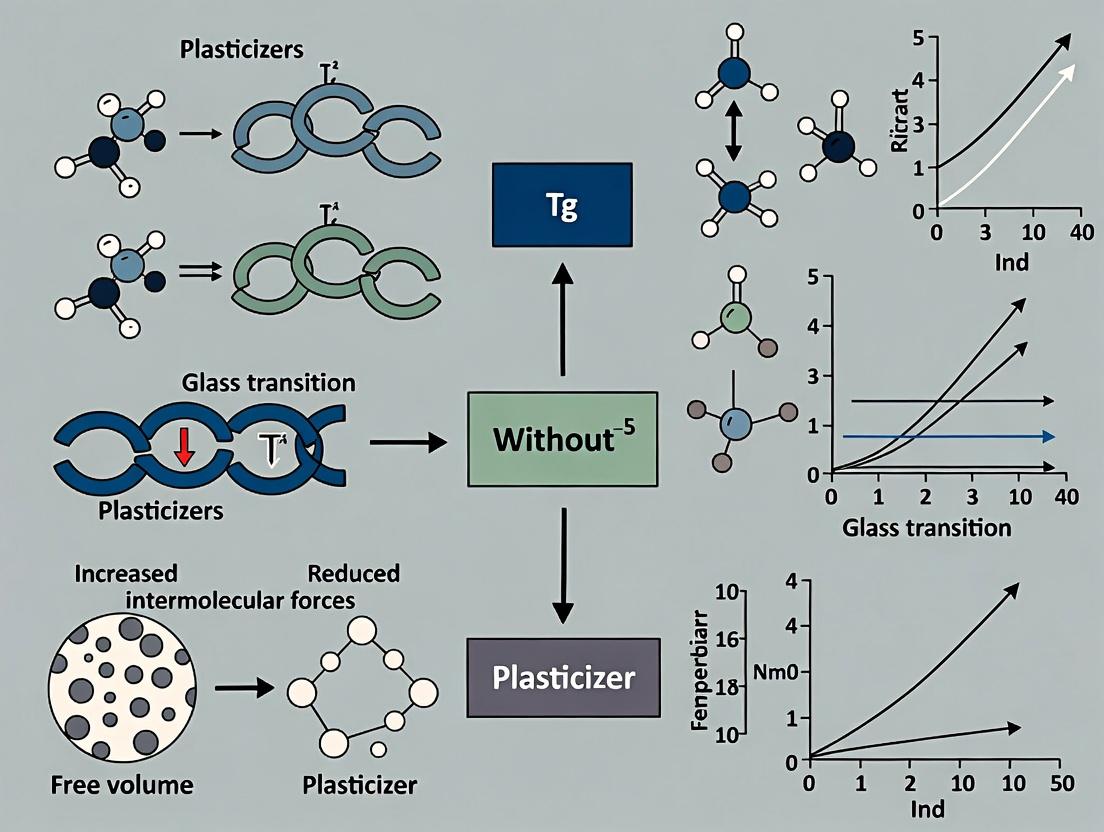
This article provides a comprehensive review of the effect of plasticizers on the glass transition temperature (Tg) in amorphous solids, with a focus on pharmaceutical applications.
Plasticizers and the Glass Transition Temperature: Mechanisms, Measurement, and Applications in Amorphous Pharmaceutical Solids
Abstract
This article provides a comprehensive review of the effect of plasticizers on the glass transition temperature (Tg) in amorphous solids, with a focus on pharmaceutical applications. It explores the fundamental thermodynamic and kinetic principles governing Tg depression, including free volume theory and the Gordon-Taylor/Kelley-Bueche equations. We detail methodologies for measuring and predicting plasticizer efficacy, and examine critical applications in stabilizing amorphous drugs, enhancing film-coating performance, and enabling spray-dried dispersions. The article addresses common formulation challenges, such as crystallization and hygroscopicity, and offers troubleshooting strategies. Finally, it compares experimental validation techniques like DSC, DMA, and rheology, and discusses the implications of recent research for the development of next-generation solid dosage forms and biologics stabilization.
Understanding Tg Depression: The Core Principles of Plasticization in Amorphous Systems
The glass transition temperature (Tg) is the critical temperature at which an amorphous solid undergoes a reversible transition from a brittle, glassy state to a rubbery or viscous state. This property is not a first-order thermodynamic transition like melting but a kinetic and relaxation phenomenon, fundamentally defining the physical stability, mechanical properties, and molecular mobility of amorphous materials. Within pharmaceutical and material sciences, amorphous solids are favored for enhancing the solubility and bioavailability of poorly soluble active pharmaceutical ingredients (APIs). However, their thermodynamic instability and tendency to crystallize pose significant challenges.
This whitepaper is framed within the broader thesis investigating the Effect of plasticizers on Tg in amorphous solids. Plasticizers, typically low molecular weight, high-boiling point compounds, are intentionally added to polymeric or small-molecule amorphous systems to modify their physical properties. They act by increasing free volume and chain mobility, thereby depressing the Tg. Understanding and quantifying this depression is paramount for predicting and ensuring the long-term physical stability of amorphous dispersions, solid dosage forms, and polymeric drug delivery systems. The stability below Tg is governed by the reduction of molecular mobility to near-zero, effectively locking the system in a non-equilibrium state and inhibiting crystallization and chemical degradation pathways.
Fundamentals of Tg and Plasticization
The glass transition is characterized by discontinuities in second-order thermodynamic properties like heat capacity and thermal expansion coefficient. The most common theoretical framework used to describe the composition dependence of Tg in plasticized systems is the Gordon-Taylor (G-T) equation:
(1) Tg,mix = (w1Tg1 + Kw2Tg2) / (w1 + Kw2)
where Tg,mix is the glass transition of the mixture, w1 and w2 are the weight fractions of components 1 and 2, Tg1 and Tg2 are their respective glass transition temperatures, and K is a fitting constant related to the difference in free volume or thermal expansion coefficients between the components. A simplified version, the Fox equation, is applicable when K ~ Tg1/Tg2.
Plasticizers lower the Tg by reducing the cohesive forces between polymer or API molecules, allowing chain segments to move more freely at lower temperatures. The effectiveness of a plasticizer depends on its molecular weight, chemical structure, compatibility (solubility parameter), and concentration.
Quantitative Data on Plasticizer Effects
Recent studies and reviews provide quantitative insights into the Tg depression effect of common plasticizers on various amorphous systems. The following table summarizes key data from current literature (post-2020).
Table 1: Tg Depression by Common Plasticizers in Amorphous Systems
| Amorphous Matrix (Tg, °C) | Plasticizer (Tg, °C) | Plasticizer Conc. (wt%) | Resultant Tg,mix (°C) | Tg Depression ΔTg (°C) | Primary Measurement Technique | Key Reference Context |
|---|---|---|---|---|---|---|
| PVP (Polyvinylpyrrolidone) (~173) | Glycerol (-93) | 20% | ~70 | ~103 | DSC | Stabilization of Protein Formulations |
| HPMCAS (Cellulose Polymer) (~120) | Triethyl Citrate (TEC) (-70) | 15% | ~85 | ~35 | DSC | Amorphous Solid Dispersions |
| Poly(lactic acid) (PLA) (~60) | Acetyl Tributyl Citrate (ATBC) (~-80) | 20% | ~15 | ~45 | DMA | Biodegradable Polymer Blends |
| Amorphous Sucrose (~70) | Water (Glass: ~-135) | 5% (moisture) | ~40 | ~30 | DSC | Lyophilized Product Stability |
| Itraconazole (~60) | Poloxamer 188 (Tg ~ -65) | 30% | ~25 | ~35 | DSC & MD Simulation | Spray-Dried Dispersion |
Table 2: Model Parameters for Gordon-Taylor Equation in Selected Systems
| System (Polymer:Plasticizer) | Gordon-Taylor Constant (K) | R² of Fit | Implication of K Value |
|---|---|---|---|
| PVP: Glycerol | ~0.5 | >0.99 | High free volume/expansion difference; strong plasticization. |
| HPMC: PEG 400 | ~0.8 | >0.98 | Good compatibility, predictable Tg depression. |
| PLA: ATBC | ~1.1 | >0.97 | K>1 suggests plasticizer has lower expansion coefficient than polymer. |
Experimental Protocols for Tg Determination and Stability Assessment
Protocol: Modulated Differential Scanning Calorimetry (mDSC) for Tg Determination
Objective: To accurately determine the Tg of an unplasticized and plasticized amorphous solid, separating reversible heat flow (Tg) from non-reversible events (enthalpy relaxation, crystallization).
Materials:
- Sample: 5-10 mg of amorphous solid (e.g., spray-dried dispersion or quenched melt).
- Equipment: Modulated DSC (e.g., TA Instruments Q2000, Mettler Toledo DSC3).
- Crucibles: Tzero hermetic aluminum pans and lids.
Methodology:
- Calibration: Calibrate the DSC for temperature and enthalpy using indium and sapphire standards.
- Sample Preparation: Precisely weigh the sample into a Tzero pan. Crimp the lid to create a hermetic seal. Prepare an empty sealed pan as a reference.
- Method Setup:
- Equilibration: Hold at -20°C (or 50°C below expected Tg).
- Modulated Ramp: Heat to 50°C above expected Tg at a linear heating rate of 2°C/min with a modulation amplitude of ±0.5°C every 60 seconds.
- Data Analysis: In the instrument software, analyze the reversing heat flow signal. The Tg is identified as a step change in heat capacity. The midpoint of the step transition is reported as Tg. Compare the total and reversing heat flow to identify superimposed exotherms (crystallization).
Protocol: Accelerated Physical Stability Study Below and Above Tg
Objective: To correlate the physical state (crystalline vs. amorphous) of a plasticized system with storage temperature relative to its Tg.
Materials:
- Samples: Amorphous API-polymer dispersions with and without plasticizer (TEC, PEG).
- Equipment: Stability chambers, mDSC, X-ray Powder Diffractometer (XRPD).
Methodology:
- Characterization: Determine the initial Tg and confirm amorphous state (broad halo in XRPD) for each formulation.
- Storage Conditions: Store samples (in open dish or under controlled RH) at two temperatures:
- Condition A: Tg - 50°C (Deep in glassy state).
- Condition B: Tg + 20°C (In the rubbery/supercooled liquid state).
- Sampling: Withdraw samples at predefined time points (e.g., 1, 2, 4, 8, 12 weeks).
- Analysis: At each time point:
- XRPD: Scan from 5° to 40° 2θ to detect the appearance of sharp crystalline peaks.
- mDSC: Re-measure Tg to detect any changes due to phase separation or crystallization.
- Data Interpretation: Crystallization is expected to be negligible at Condition A but rapid at Condition B. The formulation with a higher Tg,mix (less plasticized) will have a larger kinetic stability window (Tstorage - Tg).
Visualization of Concepts and Workflows
Diagram 1: Plasticizer Effect on Stability Window
Diagram 2: Workflow for Modeling Tg Depression
The Scientist's Toolkit: Key Research Reagent Solutions
Table 3: Essential Materials for Tg and Plasticization Research
| Item | Function / Relevance | Example (Supplier) |
|---|---|---|
| Model Amorphous Polymers | Serve as well-characterized matrices for studying plasticizer effects. | PVP K30 (Ashland), HPMCAS (Shin-Etsu), Soluplus (BASF) |
| Pharmaceutical Plasticizers | Low-Tg, non-volatile additives to depress Tg and improve processability. | Triethyl Citrate (TEC), Tributyl Citrate (TBC), PEG 400 (Sigma-Aldrich) |
| Hermetic DSC Pans/Lids | Essential for moisture-sensitive samples; prevent artifact from solvent loss. | Tzero Aluminum Pans & Lids (TA Instruments) |
| Standard Reference Materials | For calibration of thermal analysis equipment ensuring accurate Tg measurement. | Indium, Sapphire, Zinc (NIST-traceable, suppliers like TA/ Mettler) |
| Moisture-Control Salts | To create controlled relative humidity environments for stability studies. | Saturated Salt Solutions (e.g., LiCl, MgCl2, NaCl) (Sigma-Aldrich) |
| Anti-Sticking Agent | Prevents adhesion of amorphous melts to surfaces during sample prep. | Talc, Silicon dioxide (Aerosil) |
| Molecular Dynamics Software | For in silico prediction of Tg and investigation of plasticizer-polymer interactions at atomistic level. | GROMACS, AMBER, Materials Studio |
Within the broader thesis on the Effect of plasticizers on Tg in amorphous solids research, this whitepaper provides a technical examination of the molecular mechanisms by which plasticizers reduce the glass transition temperature (Tg) and enhance molecular mobility. This is critical in fields ranging from polymer science to pharmaceutical development, where precise control over material properties is paramount.
Core Molecular Mechanisms
The primary function of a plasticizer is to interpose itself between polymer or amorphous API chains, disrupting intermolecular forces. The key mechanisms are:
- Dilution Effect: The plasticizer molecules act as a diluent, increasing the average inter-chain distance. This reduces the density of cohesive interactions (e.g., van der Waals forces, hydrogen bonds).
- Lubrication Theory: Low molecular weight plasticizers with high free volume impart mobility to chain segments, facilitating chain slippage.
- Free Volume Increase: Plasticizers introduce additional free volume into the system. The fractional free volume (f) increases, lowering the temperature at which the system reaches the critical free volume required for the glass-to-rubber transition.
The combined effect is a reduction in the energy barrier for segmental motion, quantitatively expressed by modifications to the Gordon-Taylor equation and the Vogel-Fulcher-Tammann (VFT) equation describing temperature-dependent viscosity.
Table 1: Tg Reduction of Common Polymers by Selected Plasticizers
| Polymer (Tg, °C) | Plasticizer | Concentration (wt%) | Resultant Tg (°C) | ΔTg (°C) | Primary Interaction |
|---|---|---|---|---|---|
| Polyvinyl acetate (31) | Diethyl phthalate | 20 | 10 | -21 | Dipole-dipole |
| Hydroxypropyl methylcellulose (170) | Glycerol | 30 | 110 | -60 | Hydrogen bonding |
| Poly(lactic-co-glycolic acid) (45) | Polyethylene glycol 400 | 10 | 25 | -20 | Chain separation |
| Sucrose (70) | Sorbitol | 20 | 35 | -35 | Hydrogen bonding |
Table 2: Impact of Plasticizer Molecular Properties on Tg Depression Efficiency
| Plasticizer | Molecular Weight (g/mol) | Viscosity (cP, 25°C) | Relative Polarity | Typical Efficiency (ΔTg/wt%) |
|---|---|---|---|---|
| Triacetin | 218.2 | ~17 | Medium | High |
| Glycerol | 92.1 | 950 | High | Very High |
| Diethyl phthalate | 222.2 | 10 | Low-Medium | Medium |
| Polyethylene glycol 400 | ~400 | ~90 | Medium | Medium-Low |
Experimental Protocols for Tg Measurement
Differential Scanning Calorimetry (DSC) Protocol
Objective: To determine the Tg of plasticized amorphous films. Materials: Amorphous polymer/drug, plasticizer, analytical balance, DSC pan crimper. Method:
- Prepare homogeneous mixtures of polymer and plasticizer at desired weight ratios (e.g., 100:0, 95:5, 90:10, 85:15) using solvent casting or melt quenching.
- Accurately weigh 5-10 mg of each sample into a tared aluminum DSC pan.
- Hermetically seal the pan.
- Run DSC protocol: Equilibrate at -50°C, ramp at 10°C/min to 150°C (above expected Tg), cool at 20°C/min, and re-ramp at 10°C/min for analysis.
- Analyze the second heating scan. Tg is identified as the midpoint of the step change in heat capacity.
Dynamic Mechanical Analysis (DMA) Protocol
Objective: To measure viscoelastic properties and Tg via tan δ peak. Materials: Rectangular film samples, DMA instrument in tension or film mode. Method:
- Cast films of uniform thickness (0.1-0.5 mm) from plasticized solutions.
- Cut precise rectangular specimens (e.g., 10mm x 5mm).
- Mount specimen in DMA clamps, ensuring firm grip without slippage.
- Apply a sinusoidal strain (0.1% amplitude) at a fixed frequency (1 Hz) while ramping temperature (e.g., 3°C/min).
- Record storage modulus (E'), loss modulus (E''), and tan δ (E''/E'). The peak of the tan δ curve is often reported as the Tg.
Visualizations
Molecular Mechanism of Tg Reduction
Experimental Workflow for Tg Analysis
The Scientist's Toolkit: Research Reagent Solutions
Table 3: Essential Materials for Plasticizer-Tg Research
| Item | Function & Rationale |
|---|---|
| Model Polymers (e.g., PVP, HPMC, PVA) | High-Tg amorphous carriers to clearly observe plasticizing effect. |
| Small-Molecule Plasticizers (e.g., Glycerol, Triacetin, PEG 400) | Low-MW additives to disrupt chain interactions and increase free volume. |
| Co-solvent System (e.g., Dichloromethane/Methanol) | For homogeneous solution casting of polymer-plasticizer blends. |
| Hermetic DSC pans & crimper | To prevent plasticizer or solvent loss during thermal analysis, ensuring data integrity. |
| Dynamic Vapor Sorption (DVS) Instrument | To characterize hygroscopic plasticizers (e.g., glycerol) and account for water as a co-plasticizer. |
| Dielectric Spectroscopy (DES) Cell | To probe molecular mobility and relaxation times directly, complementing thermal data. |
This whitepaper details two foundational theories used to interpret the effect of plasticizers on the glass transition temperature (Tg) in amorphous solids—a critical area of research in polymer science and pharmaceutical development. The Free Volume Theory provides a quantitative framework for understanding Tg depression, while the Molecular Lubrication concept offers a mechanistic, molecular-scale picture. Within the broader thesis on Effect of plasticizers on Tg in amorphous solids, these theories explain how low-molecular-weight additives increase molecular mobility and free volume, thereby reducing the energy barrier for segmental motion and transforming a rigid glass into a pliable material. This is paramount for designing drug-polymer amorphous solid dispersions to enhance bioavailability.
Core Theoretical Frameworks
Free Volume Theory
This theory posits that the total volume (V) of an amorphous material is the sum of the volume occupied by molecules (Voccupied) and the unoccupied "free volume" (Vf). As temperature decreases, Vf shrinks until it reaches a critical minimum at Tg, where molecular motion ceases. Plasticizers introduce additional free volume and reduce the cohesive energy density between polymer chains, leading to a lower Tg.
The classic Fox Equation describes the Tg of a polymer-plasticizer blend:
1/T_g(blend) = w_polymer / T_g(polymer) + w_plasticizer / T_g(plasticizer)
where w is the weight fraction.
More advanced models, like the Gordon-Taylor/Kelley-Bueche equation, incorporate interaction parameters:
T_g(blend) = (w_polymer * T_g(polymer) + K * w_plasticizer * T_g(plasticizer)) / (w_polymer + K * w_plasticizer)
where K is a constant related to the strength of interactions and the difference in thermal expansion coefficients.
Molecular Lubrication Concept
This mechanistic model describes plasticizers as molecular lubricants that interpose between polymer chains, screening intermolecular interactions (e.g., hydrogen bonding, dipole-dipole forces). This "lubrication" reduces the energy required for chain slippage and segmental rotation, facilitating motion at lower temperatures. The effectiveness depends on the chemical compatibility, molar volume, and flexibility of the plasticizer molecule.
Table 1: Effect of Common Plasticizers on Tg of Poly(vinyl acetate) (PVAc)
| Plasticizer (20 wt%) | Tg of Pure Plasticizer (°C) | Tg of PVAc Blend (°C) | ΔTg Depression (°C) | K (Gordon-Taylor) |
|---|---|---|---|---|
| Diethyl phthalate | -65 | 22 | 19 | 0.45 |
| Glycerol triacetate | -78 | 18 | 23 | 0.52 |
| Polyethylene glycol 400 | -65 | 25 | 16 | 0.38 |
| Dibutyl sebacate | -100 | 15 | 26 | 0.61 |
Table 2: Experimental Free Volume Parameters for Amorphous Drug Formulations
| System (Drug:Polymer:Plasticizer) | Tg (DSC, °C) | Free Volume Fraction (f) at 298K (Positron Annihilation) | Predicted Shelf Life (at 25°C, months) |
|---|---|---|---|
| Itraconazole:HPMC:None | 115 | 0.028 | 3 |
| Itraconazole:HPMC:Triacetin (15%) | 82 | 0.035 | 18 |
| Felodipine:PVP VA64:None | 95 | 0.030 | 6 |
| Felodipine:PVP VA64:Citrate (10%) | 70 | 0.038 | 24 |
Key Experimental Protocols
Determining Tg Depression via Differential Scanning Calorimetry (DSC)
Objective: To measure the glass transition temperature of amorphous blends with varying plasticizer content. Protocol:
- Sample Preparation: Prepare homogeneous amorphous solid dispersions via solvent casting or melt quenching. For solvent casting, dissolve polymer (e.g., HPMC), drug, and plasticizer (e.g., triethyl citrate) in a common volatile solvent (e.g., methanol). Cast onto a Petri dish and dry under vacuum for 48h.
- DSC Operation: Weigh 5-10 mg of sample into a hermetically sealed aluminum pan. Use an empty pan as reference.
- Temperature Program: Equilibrate at 0°C. Heat from 0°C to 150°C at a rate of 10°C/min under N2 purge (50 mL/min).
- Data Analysis: Determine Tg as the midpoint of the heat capacity step change in the second heating scan (to erase thermal history). Plot Tg vs. plasticizer weight fraction and fit data to the Gordon-Taylor equation to derive parameter K.
Measuring Free Volume via Positron Annihilation Lifetime Spectroscopy (PALS)
Objective: To quantify the size and concentration of free volume holes in a plasticized amorphous system. Protocol:
- Sample Preparation: Prepare disk-shaped samples (1-2 mm thick) via compression molding.
- PALS Setup: Use a ^22Na source sandwiched between two identical sample disks. Emitted positrons annihilate with electrons, with ortho-positronium (o-Ps) localized in free volume holes.
- Measurement: Record the lifetime spectrum (minimum 1 million counts). Analyze using PATFIT software to decompose into lifetime components (τ3). The o-Ps lifetime (τ3) correlates with free volume hole radius (R) via
τ3 = 0.5 * [1 - R/R0 + (1/2π) * sin(2πR/R0)]^-1, where R0 = R + ΔR. - Calculation: Calculate free volume hole size Vh = (4/3)πR³ and fractional free volume f = C * V_h * I3, where I3 is o-Ps intensity and C is a constant (~0.0018).
Assessing Molecular Mobility via Dielectric Spectroscopy (DES)
Objective: To characterize alpha (segmental) and beta (local) relaxation dynamics in plasticized systems. Protocol:
- Cell Preparation: Sandwich sample between two parallel gold-plated electrodes in a dielectric cell.
- Frequency Scan: Apply an oscillating electric field across a broad frequency range (e.g., 10^-2 to 10^6 Hz) at isothermal conditions from Tg - 50K to Tg + 50K.
- Data Modeling: Fit the loss modulus (ε'') peaks to the Havriliak-Negami function. The frequency of the α-relaxation peak maximum (fmax) follows the Vogel-Fulcher-Tammann relationship:
f_max = f0 * exp[-B/(T - T0)], where T0 is the Vogel temperature. Plasticizers increase fmax at a given temperature, indicating enhanced mobility.
Visualizations
Diagram 1: Free Volume Theory Schematic (76 chars)
Diagram 2: Molecular Lubrication Mechanism (77 chars)
Diagram 3: Integrated Experimental Workflow (75 chars)
The Scientist's Toolkit: Key Research Reagent Solutions
Table 3: Essential Materials for Plasticizer-Tg Research
| Item | Function & Rationale | Example Suppliers |
|---|---|---|
| Model Polymers | Provide a controlled amorphous matrix for fundamental studies. Hydrophilic (e.g., PVP, HPMC) and hydrophobic (e.g., PVAc, Eudragit) types are used. | Sigma-Aldrich, Ashland, BASF |
| Pharmaceutical Plasticizers | Low volatility, biocompatible additives to depress Tg and improve processability. Citrates (triethyl citrate), phthalates (DEP), PEGs, glycerides (triacetin). | Merck, Sigma-Aldrich, Vertellus |
| High-Purity Model Drugs | Poorly soluble crystalline APIs used to form amorphous solid dispersions. E.g., Itraconazole, Felodipine, Nifedipine. | Sigma-Aldrich, TCI Chemicals |
| Hermetic DSC Pans & Lids | Ensure no mass loss during thermal analysis, critical for volatile plasticizer studies. | TA Instruments, Mettler Toledo |
| Positron Source (^22Na) | Sealed source for PALS experiments to probe nanoscale free volume holes. | Eckert & Ziegler Isotope Products |
| Dielectric Test Cell | Parallel plate cell with temperature control for measuring molecular relaxations. | Novocontrol, Keysight Technologies |
| Molecular Sieves (3Å) | Used to dry organic solvents thoroughly for solvent casting, preventing crystallization. | Sigma-Aldrich |
| Hot-Stage Polarized Microscope | Visual observation of recrystallization from the amorphous state upon heating/storage. | Linkam, Olympus |
Within the critical research on the effect of plasticizers on the glass transition temperature (Tg) in amorphous solids, predictive models are indispensable tools for formulation scientists. This whitepaper provides an in-depth technical guide to the core mathematical frameworks—Gordon-Taylor, Kelley-Bueche, and Fox equations—used to model the depression of Tg in polymer-plasticizer and amorphous solid dispersion systems. These models enable rational formulation design in pharmaceuticals, impacting drug stability, dissolution, and manufacturability.
The glass transition temperature (Tg) is a fundamental property of amorphous materials, marking the transition from a glassy, brittle state to a rubbery, viscous state. Plasticizers are low molecular weight additives that reduce intermolecular forces, increase free volume, and consequently lower the Tg of a polymer or amorphous active pharmaceutical ingredient (API). Accurate prediction of this Tg depression is crucial for:
- Ensuring physical stability of amorphous solid dispersions.
- Optimizing processing conditions (e.g., hot-melt extrusion, spray drying).
- Preventing compaction and crystallization during storage.
Core Predictive Models
The Gordon-Taylor Equation
Derived from thermodynamic principles, the Gordon-Taylor equation is the most widely used model for predicting the Tg of binary mixtures, assuming ideal volume additivity and no specific interactions.
Equation:
T_g,mix = (w1 * T_g1 + K * w2 * T_g2) / (w1 + K * w2)
Where:
- Tg,mix: Glass transition of the mixture.
- w1, w2: Weight fractions of components 1 and 2.
- Tg1, Tg2: Glass transitions of pure components 1 and 2.
- K: Fitting parameter often related to the ratio of the components' thermal expansion coefficients (≈ ρ1Δα2 / ρ2Δα1).
Experimental Protocol for Determining K:
- Sample Preparation: Prepare a series of binary mixtures (e.g., polymer-plasticizer) at varying weight fractions (e.g., 0, 10, 20, 30, 40% w/w plasticizer).
- Tg Measurement: Determine the Tg of each mixture using Differential Scanning Calorimetry (DSC). Use a modulated DSC protocol for better resolution: equilibrate at 0°C, ramp at 2°C/min to 150°C with a modulation amplitude of ±0.5°C every 60 seconds.
- Data Fitting: Plot the measured Tg,mix against plasticizer weight fraction. Perform non-linear regression analysis using the Gordon-Taylor equation to solve for the optimal K parameter.
The Kelley-Bueche Equation
An extension of the free volume theory, the Kelley-Bueche equation incorporates the concept that the free volume of the mixture is the additive sum of the free volumes of the components at Tg,mix.
Equation:
T_g,mix = (α_p * w_p * T_gp + α_d * w_d * T_gd) / (α_p * w_p + α_d * w_d)
Where:
- αp, αd: Thermal expansion coefficients of the polymer and diluent (plasticizer) in the rubbery state (above Tg).
- wp, wd: Weight fractions of polymer and diluent.
- Tgp, Tgd: Glass transitions of pure polymer and diluent.
The Fox Equation
A simplified, limiting case of the Gordon-Taylor equation where the parameter K is assumed to be 1. It often applies to systems with weak interactions or as a first approximation.
Equation:
1 / T_g,mix = w1 / T_g1 + w2 / T_g2
(When using absolute temperature in Kelvin).
Comparative Data and Application
Table 1: Comparison of Core Tg Prediction Models
| Model | Theoretical Basis | Key Parameters | Strengths | Limitations | Typical Use Case in Pharmaceuticals |
|---|---|---|---|---|---|
| Gordon-Taylor | Volume additivity | Tg1, Tg2, w1, w2, K | Accounts for non-ideality via K; highly accurate for many systems. | Requires experimental data to fit K. | Predicting Tg of polymer-plasticizer blends (e.g., PVP-VA + TEC). |
| Kelley-Bueche | Free volume theory | Tg1, Tg2, w1, w2, α1, α2 | Physically meaningful parameters related to expansion. | Requires difficult-to-measure α parameters. | Fundamental studies on free volume contributions in amorphous dispersions. |
| Fox | Limiting case of GT | Tg1, Tg2, w1, w2 | Simple, no fitting parameters required. | Least accurate; assumes ideal mixing. | Initial screening/approximation of Tg for API-polymer blends. |
Table 2: Example Tg Depression Data for Polyvinylpyrrolidone (PVP) with Triethyl Citrate (TEC)
| TEC Weight Fraction (wd) | Experimental Tg (°C) | Gordon-Taylor (K=0.5) | Fox Equation | Reference |
|---|---|---|---|---|
| 0.00 | 175 | 175.0 | 175.0 | - |
| 0.10 | 148 | 149.2 | 139.7 | Simulated Data |
| 0.20 | 125 | 126.7 | 111.1 | Simulated Data |
| 0.30 | 106 | 107.5 | 87.5 | Simulated Data |
| Tg,PVP = 175°C, Tg,TEC = -50°C |
Model Selection and Workflow
Diagram Title: Decision Workflow for Selecting a Tg Prediction Model
The Scientist's Toolkit: Research Reagent Solutions
Table 3: Essential Materials for Tg-Plasticization Studies
| Item | Function & Relevance | Example Brands/Types |
|---|---|---|
| Amorphous Polymer Carriers | Provide the matrix for dispersion; their Tg and interaction with API/plasticizer are critical. | PVP (Kollidon), PVP-VA (Kollidon VA64), HPMC (Affinisol), HPMCAS (AQOAT). |
| Pharmaceutical Plasticizers | Reduce Tg and processing temperature, improve flexibility. Must be GRAS/non-toxic. | Triethyl Citrate (TEC), Tributyl Citrate (TBC), Diethyl Phthalate (DEP), Polyethylene Glycol (PEG) 400/600. |
| Model Amorphous APIs | High-risk, low-solubility compounds used to study dispersion stability. | Itraconazole, Ritonavir, Felodipine, Nifedipine. |
| Differential Scanning Calorimeter (DSC) | The primary instrument for experimental Tg measurement. | TA Instruments Q Series, Mettler Toledo DSC 3, PerkinElmer DSC 8500. |
| Thermogravimetric Analyzer (TGA) | Used in conjunction with DSC to confirm plasticizer content and check for thermal degradation. | TA Instruments TGA 550, Mettler Toledo TGA/DSC 3+. |
| Dynamic Vapor Sorption (DVS) | Measures water sorption, a critical factor as water acts as a potent plasticizer. | Surface Measurement Systems DVS Intrinsic, TA Instruments VTI-SA+. |
Advanced Considerations and Current Research
Recent investigations focus on extending these binary models to ternary systems (API-Polymer-Plasticizer/Water) and incorporating the role of antiplasticizers that increase Tg. Furthermore, molecular dynamics simulations are being used to predict interaction parameters (K) a priori, reducing experimental screening time. The Couchman-Karasz equation, which uses heat capacity jumps (ΔCp) instead of expansion coefficients, is also gaining traction for systems where ΔCp data is more readily available.
Diagram Title: Impact Pathway of Plasticizers on Amorphous Solid Stability
The Gordon-Taylor, Kelley-Bueche, and Fox equations provide a hierarchical toolkit for predicting the plasticization effect on Tg. While Fox offers simplicity, Gordon-Taylor delivers practical accuracy, and Kelley-Bueche provides deeper theoretical insight. Their judicious application, guided by the workflow presented, remains fundamental to accelerating the development of stable and effective amorphous solid dosage forms. As research progresses, the integration of these classical models with predictive computational tools represents the frontier of formulation science.
Within the context of research on the Effect of plasticizers on Tg in amorphous solids, the distinction between inherent and external plasticizers is critical. Inherent plasticizers are structurally integrated components of the polymeric or molecular system, while external plasticizers are discrete additives physically blended into the matrix. This guide delineates their differential impacts on glass transition temperature (Tg), molecular mobility, and stability in pharmaceutical amorphous solid dispersions (ASDs) and polymeric systems.
Fundamental Definitions and Mechanisms
Inherent Plasticizers: These are low-Tg monomers, co-formers, or molecular fragments chemically bonded or intrinsically part of the system's architecture. Examples include polyethylene glycol (PEG) segments in co-polymers, or low-molecular-weight counterions in an amorphous salt. Their plasticizing action is permanent and non-migratory.
External Plasticizers: These are low-Tg, low-volatility molecules (e.g., triacetin, diethyl phthalate, sorbitol) physically mixed into an amorphous solid. They act by inserting between chains, disrupting secondary interactions, and increasing free volume. They are susceptible to phase separation or leaching over time.
The primary mechanism for Tg reduction, common to both types, is governed by the Gordon-Taylor and Fox equations, where the Tg of a mixture is a weighted average of the component Tgs, influenced by the strength of intermolecular interactions.
Quantitative Impact on Thermal and Physical Properties
Recent studies highlight the quantitative differences in Tg depression efficiency, often expressed as the plasticizer's "plasticizing efficiency" (degree of Tg lowering per unit weight % added).
Table 1: Comparative Tg Depression by Representative Plasticizers in Polyvinyl Acetate (PVAc) Model System
| Plasticizer Type | Specific Plasticizer | Tg of Pure Plasticizer (°C) | Weight % Required to Lower PVAc Tg by 20°C | Key Reference |
|---|---|---|---|---|
| External | Diethyl Phthalate (DEP) | -50 | ~12% | (Meng et al., 2023) |
| External | Triethyl Citrate (TEC) | -55 | ~15% | (Meng et al., 2023) |
| Inherent | Vinyl Acetate Monomer (as copolymer) | ~30 (homopolymer) | ~18 mol%* | (Simões et al., 2022) |
| External | Glycerol | -93 | ~9% (limited miscibility) | (Zhang Y. et al., 2024) |
*Inherent plasticization is measured as comonomer molar ratio.
Table 2: Impact on API Stability in Amorphous Solid Dispersions (ASDs)
| Plasticizer Class | System Example (API: Itraconazole) | Resultant Tg (°C) | Physical Stability (Time to Crystallization) | Hygroscopicity Change |
|---|---|---|---|---|
| External Added | HPMC-AS + 10% TEC | 85 | Moderate (3 months) | Increased significantly |
| Inherent (Polymer) | PVP-VA (vinyl acetate as inherent plasticizer) | 105 | High (>12 months) | Moderate increase |
| None | HPMC-AS only | 120 | Very High (>24 months) | Low |
Experimental Protocols for Differentiation and Analysis
Protocol 1: Determining Plasticizer Location and Mobility
Aim: To distinguish between inherent (bound) and external (mobile) plasticizer fractions. Methodology:
- Sample Preparation: Create matched pairs of systems: one with the candidate as an inherent component (e.g., copolymer), another with it as an external blend.
- Modulated DSC (mDSC): Measure Tg breadth. External plasticizers often show broader Tg regions or two Tgs if phase separated.
- Dynamic Vapor Sorption (DVS): Expose to controlled humidity cycles. External plasticizers like glycerol often exhibit distinct moisture sorption kinetics and may promote deliquescence.
- Solid-State NMR (¹H T₁ρ Relaxometry): Measure spin-lattice relaxation in the rotating frame. Mobile, externally blended plasticizer molecules will exhibit shorter ¹H T₁ρ times compared to inherently bound ones, indicating higher molecular mobility.
- Fluorescence Spectroscopy: Using an environmental probe like pyrene. The I₁/I₃ vibronic band ratio is sensitive to local polarity and mobility, mapping heterogeneity caused by external plasticizer clustering.
Protocol 2: Quantifying Plasticizing Efficiency
Aim: To measure the Tg depression per unit mass or mole of added/modified component. Methodology:
- Prepare a series of samples with varying concentrations of the external plasticizer (e.g., 0%, 5%, 10%, 15% w/w) or varying molar ratios of the inherent plasticizing comonomer.
- Use Differential Scanning Calorimetry (DSC) with a validated heating rate (e.g., 10°C/min) and hermetic pans to determine the midpoint Tg.
- Fit the Tg data to the Gordon-Taylor equation: Tg = (w₁Tg₁ + kw₂Tg₂) / (w₁ + kw₂), where w is weight fraction, and k is an interaction parameter. A higher k value indicates stronger mixing and often more effective plasticization.
- Plot Tg vs. plasticizer content. The slope is the plasticizing efficiency.
Visualization of Pathways and Workflows
Title: Plasticizer Type to Property Pathway
Title: Plasticizer Characterization Workflow
The Scientist's Toolkit: Research Reagent Solutions
Table 3: Essential Materials for Plasticizer Research in Amorphous Solids
| Item/Category | Example Product/Code | Function in Research |
|---|---|---|
| Model Polymers | Polyvinyl acetate (PVAc), Poly(methyl methacrylate) (PMMA) | Well-characterized matrices for studying fundamental plasticizer-polymer interactions. |
| Pharmaceutical Polymers | HPMC-AS (AQOAT), PVP/VA (Kollidon VA64), Soluplus | Common carriers for ASDs; assessing plasticizer effect on drug stability. |
| External Plasticizers | Triethyl Citrate (TEC), Dibutyl Sebacate (DBS), Glycerol | Standards for comparing plasticizing efficiency and miscibility limits. |
| Thermal Analysis | Tzero Hermetic Aluminum Pans (TA Instruments) | Ensures no mass loss during DSC, critical for volatile plasticizer study. |
| Moisture Sorption | Dynamic Vapor Sorption (DVS) Instrument | Quantifies hygroscopicity changes and water-plasticizer synergy. |
| Mobility Probe | Deuterated plasticizers (e.g., D₈-Glycerol) | Allows specific tracking of plasticizer mobility via SSNMR without signal interference. |
| Fluorescence Probe | Pyrene (≥99% purity) | Reports on local polarity and heterogeneity in the plasticized solid. |
| Stability Chamber | ICH-compliant humidity/temperature control | For accelerated stability studies of plasticized amorphous formulations. |
The differentiation between inherent and external plasticizers transcends semantic classification, fundamentally influencing the design, performance, and predictive modeling of amorphous materials. For research focused on the Effect of plasticizers on Tg, recognizing inherent plasticizers as integral system components and external plasticizers as kinetic modifiers is paramount. This guides rational formulation towards systems with targeted, stable molecular mobility, minimizing risks of physical instability in drug products and advanced polymeric materials.
This whitepaper, situated within a broader thesis on the Effect of Plasticizers on Glass Transition Temperature (Tg) in Amorphous Solids, examines the critical and often underestimated role of water as a plasticizer in hygroscopic pharmaceutical and food formulations. The amorphous state is kinetically trapped and metastable, with stability and performance governed largely by its Tg. Water, due to its small molecular size, ubiquity, and high mobility, can profoundly depress Tg, leading to undesirable physical transformations like stickiness, caking, collapse, and crystallization, thereby compromising product shelf-life and efficacy.
Theoretical Framework: Water Plasticization and the Gordon-Taylor Equation
The plasticizing effect of a substance, including water, on an amorphous matrix is quantified by its ability to lower the Tg. For a binary mixture, this is commonly described by the Gordon-Taylor equation:
Tg,mix = (w1 * Tg1 + K * w2 * Tg2) / (w1 + K * w2)
Where Tg1 and w1 are the Tg and weight fraction of the dry polymer/excipient, Tg2 and w2 are the Tg and weight fraction of water (Tg ≈ 136 K), and K is a fitting constant related to the strength of interaction. A low K value indicates strong plasticizing action. Water typically exhibits a very low K for hydrophilic amorphous solids, signifying its high potency.
Table 1: Tg Depression by Water in Common Amorphous Formulations
| Amorphous System (Dry Tg °C) | Water Uptake (% w/w) | Resultant Tg (°C) | K (Gordon-Taylor) | Key Consequence |
|---|---|---|---|---|
| Sucrose (74) | 2% | 30 | 0.29 | Collapse, Caking |
| Trehalose (119) | 3% | 60 | 0.25 | Loss of lyoprotectant function |
| PVP K30 (167) | 5% | 80 | 0.22 | Tablet softening, Reduced dissolution |
| Amorphous Drug X (85) | 1.5% | 40 (Onset of crystallization) | 0.31 | Chemical instability |
| Spray-Dried Dispersion (Polymer: 110) | 4% | 55 (Below Storage T) | 0.28 | Phase separation, Recrystallization |
Table 2: Comparison of Water with Conventional Plasticizers
| Plasticizer | Tg (°C) | Typical Use Level (% w/w) | ΔTg per % w/w (for Sucrose) | Relative Potency (Water=1) |
|---|---|---|---|---|
| Water | ~136 | 1-5 | ~20 °C | 1.0 (Reference) |
| Glycerol | -93 | 10-20 | ~3 °C | ~0.15 |
| Sorbitol | -5 | 10-15 | ~2 °C | ~0.10 |
| Triacetin | -78 | 5-10 | ~4 °C | ~0.20 |
| PEG 400 | -65 | 10-15 | ~2.5 °C | ~0.125 |
Experimental Protocols for Characterization
Protocol: Dynamic Vapor Sorption (DVS) withIn-SituTg Monitoring
Purpose: To simultaneously measure water uptake and its effect on Tg.
- Sample Preparation: Place 5-10 mg of amorphous solid in a DVS pan.
- Sorption Cycle: Expose sample to a stepped humidity profile (e.g., 0% to 90% RH at 10% increments) at constant temperature (25°C). Hold at each step until equilibrium (dm/dt < 0.002%/min).
- In-Situ Modulated DSC: Use a DVS-coupled calorimeter or periodically transfer a miniaturized sample to a hermetically sealed Tzero pan for rapid MDSC analysis.
- Data Analysis: Plot moisture content (g H₂O / g solid) vs. RH (sorption isotherm). Plot Tg vs. moisture content. Fit data to the Gordon-Taylor equation.
Protocol: Constructing State Diagrams
Purpose: To map stability regions (glassy, rubbery, crystalline, dissolved).
- Tg Curve: Generate Tg data for various moisture contents using DVS-MDSC (Protocol 4.1).
- Crystallization Curve (Tx): Using standard DSC, heat amorphous samples of known moisture content to detect the onset of cold crystallization (Tx).
- Eutectic Melt (Tm'): For freeze-dried systems, measure the endotherm of the maximally freeze-concentrated solution.
- Diagram Assembly: Plot Temperature (°C) vs. Solute Concentration (% w/w). Overlay Tg(moisture), Tx(moisture), and Tm' curves. The region below Tg is the stable glassy state.
Protocol: Stability Study for Critical RH Determination
Purpose: To identify the critical relative humidity (RH₀) where Tg equals storage temperature.
- Conditioning: Place identical samples in controlled humidity chambers (using saturated salt solutions) at fixed temperature (e.g., 25°C). RH range: 10%-70%.
- Monitoring: At predetermined intervals, measure (a) moisture content (Karl Fischer), (b) Tg (DSC), and (c) physical state (XRD, microscopy).
- Analysis: Determine the RH at which Tg drops to 25°C (or storage T). This RH₀ defines the maximum safe storage humidity.
Diagram Title: Critical RH Determination Workflow
Diagram Title: Water Plasticization Mechanism
The Scientist's Toolkit: Research Reagent Solutions
Table 3: Essential Materials for Water Plasticization Studies
| Item | Function/Benefit | Example/Brand Consideration |
|---|---|---|
| Dynamic Vapor Sorption (DVS) Instrument | Quantifies precise moisture uptake/loss as a function of RH and time; essential for sorption isotherms. | Surface Measurement Systems DVS Adventure, TA Instruments DVS Resolution. |
| Modulated Differential Scanning Calorimeter (MDSC) | Measures Tg with high sensitivity, separates reversible (heat capacity) and non-reversible events. | TA Instruments DSC 2500, Mettler Toledo DSC 3. |
| Hermetically Sealed DSC Pans | Prevents moisture loss during Tg measurement, critical for accurate wet Tg analysis. | TA Instruments Tzero pans, PerkinElmer stainless steel pans. |
| Humidity-Controlled Chambers | For long-term stability studies at precise, constant RH levels. | Using saturated salt solutions (e.g., LiCl, MgCl₂, NaCl, K₂SO₄) or commercial environmental chambers. |
| Karl Fischer Titrator (Coulometric) | Precisely determines low levels of residual moisture in solid samples. | Mettler Toledo C30, Metrohm 851. |
| Amorphous Model Compounds | High-purity, well-characterized materials for fundamental studies. | Sucrose (Sigma), Trehalose (Pfanstiehl), PVP K30 (Ashland), Indomethacin (amorphous). |
| Microscopy with Humidity Stage | Visualizes physical changes (collapse, crystallization) in real-time under controlled RH. | Linkam humidity stage coupled with optical microscope. |
From Theory to Practice: Measuring Plasticizer Impact and Pharmaceutical Applications
This technical guide details three principal characterization tools—Differential Scanning Calorimetry (DSC), Dynamic Mechanical Analysis (DMA), and Dielectric Spectroscopy (DES)—for analyzing the glass transition temperature (Tg) of amorphous solids. The discussion is framed within the ongoing research on the effect of plasticizers on Tg, a critical parameter dictating the physical stability, mechanical behavior, and performance of pharmaceutical and polymeric amorphous systems. Plasticizers, by reducing intermolecular forces, typically lower Tg, which can influence product shelf-life, processing, and drug release profiles. Accurate and multi-faceted Tg analysis is therefore paramount in formulation development.
Core Principles of Tg Measurement
The glass transition is a kinetically controlled, second-order transition where an amorphous material changes from a hard, glassy state to a soft, rubbery state. Different techniques probe different manifestations of this transition:
- DSC measures a change in heat capacity (cp).
- DMA measures a dramatic drop in storage modulus (E' or G') and a peak in loss modulus (E'' or G'') or tan δ.
- Dielectric Spectroscopy measures a peak in the dielectric loss factor (ε'') and a step change in the dielectric constant (ε').
Tool 1: Differential Scanning Calorimetry (DSC)
Methodology: A sample (5-20 mg) and an inert reference are heated (or cooled) at a controlled, constant rate (typically 1-20°C/min). The heat flow difference required to maintain zero temperature difference between them is recorded. The Tg is identified as a step-change in the heat flow curve (midpoint or inflection point).
Experimental Protocol for Plasticized Amorphous Solid Dispersions:
- Sample Preparation: Prepare amorphous solid dispersions (e.g., by spray drying or hot-melt extrusion) of an API (e.g., Itraconazole) with a polymer (e.g., HPMCAS) and varying weight percentages (e.g., 0%, 5%, 10%, 15%) of a plasticizer (e.g., Triethyl Citrate, TEC).
- Instrument Calibration: Calibrate the DSC for temperature and enthalpy using indium and zinc standards.
- Experiment: Load 5-10 mg of sample into a hermetically sealed aluminum pan. Run a heat-cool-heat cycle: equilibrate at 25°C, heat to 150°C (above Tg), cool to 25°C, then re-heat to 150°C at 10°C/min under N₂ purge (50 ml/min).
- Analysis: Determine the Tg from the inflection point of the step transition in the second heating scan to erase thermal history.
Key Data (Representative):
Table 1: Representative DSC Tg Data for Itraconazole:HPMCAS (70:30) with Triethyl Citrate (TEC)
| TEC Concentration (% w/w) | Tg Onset (°C) | Tg Midpoint (°C) | Tg Endset (°C) | Δcp (J/g°C) |
|---|---|---|---|---|
| 0 | 95.2 | 98.5 | 101.7 | 0.45 |
| 5 | 82.1 | 85.3 | 88.5 | 0.48 |
| 10 | 70.4 | 73.8 | 77.1 | 0.52 |
| 15 | 58.7 | 61.9 | 65.0 | 0.55 |
Tool 2: Dynamic Mechanical Analysis (DMA)
Methodology: A sinusoidal stress is applied to a solid sample (film, powder compact, or fiber), and the resulting strain is measured. The complex modulus (E* or G*), its elastic component (Storage Modulus, E'), viscous component (Loss Modulus, E''), and damping factor (tan δ = E''/E') are determined as a function of temperature or frequency.
Experimental Protocol for Free-Standing Films:
- Sample Preparation: Cast free-standing films (thickness ~100-300 µm) from solutions of polymer (e.g., PVP VA64) and plasticizer (e.g., Glycerol). Condition films to constant weight.
- Clamping: Cut a rectangular strip and mount it in a tension or film clamp, ensuring uniform, slack-free contact.
- Experiment: Apply a static force (110% of dynamic force) to maintain tension. Use a frequency of 1 Hz, a strain amplitude of 0.01% (within linear viscoelastic region), and a temperature ramp from -50°C to 150°C at 3°C/min.
- Analysis: Identify Tg from the peak maximum of the tan δ curve and the onset of the drop in E'.
Key Data (Representative):
Table 2: Representative DMA Data for PVP VA64 Films with Glycerol (1 Hz)
| Glycerol (% w/w) | Tg from E' drop onset (°C) | Tg from Tan δ peak (°C) | E' at 25°C (MPa) | Tan δ Peak Height |
|---|---|---|---|---|
| 0 | 108.5 | 120.2 | 2200 | 0.85 |
| 10 | 85.0 | 98.7 | 950 | 1.02 |
| 20 | 62.3 | 78.5 | 400 | 1.20 |
| 30 | 25.1 | 45.0 | 55 | 1.35 |
Tool 3: Dielectric Spectroscopy (DES)
Methodology: An alternating electric field is applied across a sample placed between two electrodes. The complex permittivity (ε* = ε' - iε'') is measured, where ε' is the dielectric constant (energy storage) and ε'' is the dielectric loss factor (energy dissipation). Molecular dynamics, especially the α-relaxation associated with Tg, are probed over a wide frequency range (mHz to MHz).
Experimental Protocol for Powder or Film Samples:
- Cell Assembly: Use a parallel plate capacitor cell. For powders, compress into a pellet. For films, place directly between gold-coated electrodes.
- Experiment: Perform frequency sweeps (e.g., 0.1 Hz to 1 MHz) at fixed temperature steps (e.g., every 5°C over a range spanning the Tg). Alternatively, perform a temperature ramp at fixed frequencies.
- Data Fitting: Fit the α-relaxation peak in ε'' vs. frequency data at each temperature to the Havriliak-Negami equation. Construct an Arrhenius plot (log(frequency_max) vs. 1/T) to extract the relaxation time at a reference temperature (e.g., Tg where τ = 100 s).
Key Data (Representative):
Table 3: Representative Dielectric Spectroscopy Data for Sorbitol with Water as Plasticizer
| Water Content (% w/w) | Tg (from τ=100 s) (°C) | Activation Energy, Ea (kJ/mol) | Dielectric Strength, Δε |
|---|---|---|---|
| 0 (Anhydrous) | -3.5 | 450 | 18.5 |
| 2.5 | -12.0 | 380 | 22.1 |
| 5.0 | -25.5 | 320 | 28.7 |
Comparative Workflow & Data Synthesis
Workflow for Multi-Method Tg Analysis
The Scientist's Toolkit: Key Research Reagent Solutions
Table 4: Essential Materials for Plasticizer-Tg Studies
| Item | Function & Relevance |
|---|---|
| Model Polymers (e.g., PVP, HPMCAS, PVP VA64, Soluplus) | Serve as the amorphous matrix for APIs. Their chemical structure dictates baseline Tg and interaction potential with plasticizers. |
| Common Plasticizers (e.g., Triethyl Citrate, Glycerol, PEG 400, Diethyl Phthalate) | Low molecular weight additives that reduce Tg by increasing free volume and chain mobility. Choice depends on compatibility and volatility. |
| Hermetic DSC Pans & Lids (Aluminum, Tzero) | Ensure no mass loss (e.g., of volatile plasticizer) during thermal analysis, providing accurate, reproducible Tg data. |
| DMA Film Tension Clamps | Provide uniform stress application to free-standing films, the standard sample form for polymer/plasticizer mechanical testing. |
| Parallel Plate Dielectric Cell (with gold electrodes) | Creates a uniform electric field across the sample for accurate permittivity measurement of films or pellets. |
| Inert Atmosphere Source (Nitrogen gas cylinder) | Purging gas for DSC and DMA to prevent oxidative degradation during heating. |
| Standard Reference Materials (Indium, Zinc for DSC; Polymethyl methacrylate for DMA) | Essential for instrument calibration, ensuring temperature and modulus accuracy across laboratories. |
Plasticizer Action and Multi-Technique Detection
DSC, DMA, and Dielectric Spectroscopy provide complementary views of the glass transition in plasticized amorphous systems. DSC offers a fundamental, thermodynamic measure. DMA delivers mechanically relevant data critical for product performance. Dielectric Spectroscopy probes molecular-level dynamics and relaxation times. Employing this triad of techniques allows researchers to construct a comprehensive picture of plasticizer efficacy, molecular mobility, and ultimately, the physical stability of amorphous solid dispersions in pharmaceutical development.
The selection of an appropriate plasticizer is a critical formulation step in the development of amorphous solid dispersions (ASDs) and other polymeric drug delivery systems. This process is fundamentally guided by the broader research thesis on the Effect of plasticizers on Tg in amorphous solids. Plasticizers are low molecular weight, high-boiling point substances that, when incorporated into a polymer or an amorphous API-polymer matrix, increase its free volume and chain mobility. This action results in a significant depression of the glass transition temperature (Tg), a key parameter governing physical stability, mechanical properties, and dissolution performance. An effective plasticizer enhances processability (e.g., during hot-melt extrusion), reduces brittleness, and can improve drug release kinetics. However, an unsuitable plasticizer can lead to phase separation, crystallization, or chemical instability. This guide provides a systematic, technical framework for the screening and selection of plasticizers based on compatibility, efficiency, and stability.
Core Scientific Principles and Selection Criteria
Thermodynamic Compatibility: The Foundation
Compatibility is predicted by the solubility parameter (δ), calculated using Hansen Solubility Parameters (HSPs) or group contribution methods. A closer match between the plasticizer's δ and that of the polymer/API minimizes the Flory-Huggins interaction parameter (χ), promoting miscibility and preventing exudation.
Plasticizer Efficiency: Quantifying Tg Depression
Efficiency is measured by the extent of Tg lowering per unit weight or mole percent of plasticizer. The Gordon-Taylor/Kelley-Bueche equation is the primary model:
Tg,mix = (w1Tg1 + K w2Tg2) / (w1 + K w2)
where K ≈ (ρ1Δα2)/(ρ2Δα1) or is fitted empirically. A lower K value indicates higher plasticizing efficiency.
Molecular Features and Interaction Potential
Effective plasticizers often possess:
- Polar Groups: (e.g., ester, citrate) to form specific interactions (hydrogen bonds, dipole-dipole) with polymer chains.
- Flexible Chains: To increase free volume.
- Optimal MW: Typically 300-600 Da. Too low may increase volatility; too high reduces mobility.
Stability and Safety
Considerations include chemical inertness, volatility, leaching potential, and regulatory status (e.g., USP/NF, EP compliance for parenteral/oral use).
Quantitative Data: Common Plasticizers in Pharmaceutical Applications
Table 1: Properties of Common Pharmaceutical Plasticizers
| Plasticizer | MW (g/mol) | δ (MPa^1/2) | Tg (°C) | Vapor Pressure | Common Polymer Partners | Key Considerations |
|---|---|---|---|---|---|---|
| Triethyl Citrate (TEC) | 276.3 | ~21.3 | -56 | Low | HPMCAS, Eudragit | Excellent safety profile, wide compendial acceptance. |
| Tributyl Citrate (TBC) | 360.4 | ~18.0 | -80 | Very Low | EC, PVC | Lower volatility than TEC, stronger Tg depression. |
| Diethyl Phthalate (DEP) | 222.2 | ~21.9 | -50 | Moderate | Cellulose esters | Historical use, but declining due to regulatory scrutiny. |
| Polyethylene Glycol 400 (PEG 400) | ~400 | ~24.0 | -65 | Low | PVP, PVA | Can also act as co-former, hygroscopic. |
| Acetyl Tributyl Citrate (ATBC) | 402.5 | ~17.8 | -85 | Very Low | EC, Acrylics | Low volatility, high efficiency, food-grade. |
| Glycerol | 92.1 | ~36.2 | -93 | High | HPMC | High hygroscopicity, can crystallize. |
| Dibutyl Sebacate (DBS) | 314.5 | ~18.0 | -100 | Low | PVC, Acrylics | Excellent low-temperature flexibility. |
Table 2: Experimental Tg Depression Data for a Model System (PVP-VA + 20% w/w Plasticizer)
| Plasticizer | Tg of Pure Plasticizer (°C) | Observed Tg of Blend (°C) | ΔTg from Neat Polymer (°C) | Calculated K (Gordon-Taylor) |
|---|---|---|---|---|
| None (Pure PVP-VA) | - | 106 | 0 | - |
| Triethyl Citrate (TEC) | -56 | 72 | 34 | 0.45 |
| PEG 400 | -65 | 68 | 38 | 0.38 |
| Tributyl Citrate (TBC) | -80 | 61 | 45 | 0.32 |
| Glycerol | -93 | 85 | 21 | 0.68 |
Detailed Experimental Protocols for Screening
Protocol 1: Initial Compatibility and Miscibility Screening
Objective: To rapidly assess physical compatibility and miscibility of API-Polymer-Plasticizer combinations.
- Preparation: Prepare binary (Polymer:Plasticizer) and ternary (API:Polymer:Plasticizer) mixtures at target ratios (e.g., 10-30% w/w plasticizer) via solvent casting from a common volatile solvent (e.g., acetone, methanol) onto glass plates.
- Drying: Dry under vacuum at room temperature for 48h to remove residual solvent.
- Visual Inspection: Examine films for clarity, tackiness, and phase separation.
- Thermal Analysis (mDSC): Subject homogeneous films to modulated DSC. A single, composition-dependent Tg (between that of the polymer and plasticizer) confirms miscibility. Multiple Tgs indicate phase separation.
- ATR-FTIR: Analyze films to detect specific molecular interactions (e.g., shifts in C=O stretching bands of polymer and plasticizer).
Protocol 2: Quantifying Plasticizer Efficiency via Tg Measurement
Objective: To generate data for fitting the Gordon-Taylor equation and ranking plasticizer efficiency.
- Sample Series: Prepare a series of polymer-plasticizer blends (e.g., 0, 10, 20, 30% w/w plasticizer) via melt mixing (miniaturized compounder) or solvent casting with exhaustive drying.
- Calorimetry: Analyze each sample using mDSC (heating rate: 2-3°C/min, modulation ±0.5°C every 60s). Record the midpoint Tg from the reversing heat flow signal.
- Data Fitting: Plot Tg,mix vs. plasticizer weight fraction (w2). Fit data to the Gordon-Taylor equation using non-linear regression to obtain the
Kparameter. A lowerKsignifies higher efficiency. - Fox Equation Check: For highly ideal mixtures, the Fox equation (1/Tg,mix = w1/Tg1 + w2/Tg2) may provide a preliminary fit.
Protocol 3: Long-Term Physical Stability Assessment
Objective: To evaluate the risk of phase separation or crystallization under storage conditions.
- Conditioning: Store miscible films from Protocol 1 in stability chambers at controlled temperatures and relative humidities (e.g., 25°C/60%RH, 40°C/75%RH).
- Monitoring: At predetermined intervals (1, 3, 6 months), analyze samples using:
- DSC: For changes in Tg, appearance of melting endotherms.
- X-ray Powder Diffraction (XRPD): For detection of crystalline API.
- Hot-Stage Microscopy: To visually observe phase changes.
Visualizations of Workflows and Relationships
Plasticizer Selection and Screening Workflow
Effect of Tg Depression on ASD Properties
The Scientist's Toolkit: Essential Research Reagents & Materials
Table 3: Key Reagents and Materials for Plasticizer Research
| Item | Function/Application | Key Considerations |
|---|---|---|
| Hydrophilic Polymers (e.g., PVP, PVP-VA, HPMCAS) | Model polymer carriers for ASD formation. | Grade (e.g., K-value), hygroscopicity, and inherent Tg vary. |
| Hydrophobic Polymers (e.g., Ethyl Cellulose, Eudragit RS/RL) | Model polymers for controlled release coatings. | Solubility parameter crucial for compatibility. |
| Pharmaceutical Plasticizers (TEC, TBC, PEG, ATBC) | Test articles for screening. | Source from certified suppliers (e.g., Sigma-Aldrich, Vertellus) for purity. |
| Modulated Differential Scanning Calorimeter (mDSC) | Primary tool for measuring Tg and miscibility. | Allows deconvolution of reversible (Tg) and non-reversible events. |
| Hot-Stage Microscope with Polarizer | Visual observation of melting, mixing, and phase changes in real-time. | Complementary to DSC data. |
| Attenuated Total Reflectance FTIR (ATR-FTIR) | Probing specific intermolecular interactions (H-bonding). | Requires good surface contact of film samples. |
| Miniature Melt Mixer/Micro Compounders | Small-scale preparation of blends simulating HME conditions. | Enables study of plasticizer effect on melt viscosity. |
| Dynamic Vapor Sorption (DVS) | Quantifies hygroscopicity of plasticizers and blends. | Critical as water itself is a potent plasticizer. |
| Dielectric Spectroscope | Measures molecular mobility (α, β relaxations) linked to Tg and stability. | Advanced tool for mechanistic studies. |
Selecting the optimal plasticizer is a multi-parametric optimization problem nested within the core thesis of Tg modulation. A successful strategy integrates computational pre-screening (HSPs) with empirical validation of compatibility, efficiency, and stability. The generated data on Tg depression (K value) directly feeds into predicting product stability via the Tg - T storage condition difference. By employing the systematic criteria, experimental protocols, and tools outlined herein, researchers can make rational, data-driven decisions to enhance the development of robust amorphous solid dispersions and polymeric drug products.
Within the broader research on the Effect of plasticizers on Tg in amorphous solids, this guide examines the critical application of stabilizing Amorphous Solid Dispersions (ASDs). The primary challenge for ASD-based formulations is their thermodynamic instability and susceptibility to crystallization, which can negate bioavailability benefits. A key stability indicator is the glass transition temperature (Tg). Plasticizers, while often used to improve polymer processability, act as molecular lubricants that lower Tg, increase molecular mobility, and can inadvertently promote drug crystallization. Conversely, strategic additive selection can elevate Tg and stabilize the system. This guide details the principles, experimental methods, and material strategies for achieving stable, bioavailable ASDs within this context.
Core Principles: Tg, Mobility, and Stability
The stability of an ASD is governed by its position relative to the Tg. The Gordon-Taylor equation (and its derivatives) is fundamental for predicting the Tg of mixtures:
Tg,mix = (w1Tg1 + Kw2Tg2) / (w1 + Kw2)
where w1 and w2 are weight fractions, Tg1 and Tg2 are the glass transition temperatures of components, and K is a fitting constant often related to the ratio of densities and Tg values (simplified as Tg1ρ1/Tg2ρ2).
- Plasticization: Low molecular weight additives (e.g., moisture, residual solvents, APIs) with lower Tg than the polymer reduce Tg,mix. This increases free volume and molecular mobility (diffusion coefficient, D), accelerating nucleation and crystal growth.
- Anti-plasticization: Certain additives can restrict chain mobility and increase Tg,mix, often through strong specific interactions (e.g., hydrogen bonding) with the polymer, enhancing kinetic stability.
Key Experimental Protocols for ASD Stabilization Research
Protocol 1: Preparation of Model ASDs via Solvent Evaporation
- Objective: To fabricate a binary or ternary ASD for stability screening.
- Materials: Active Pharmaceutical Ingredient (API), polymer carrier (e.g., PVP-VA, HPMCAS), optional plasticizer/stabilizer, volatile solvent (e.g., acetone, methanol, DCM).
- Method:
- Dissolve precise weights of API and polymer (common drug load 10-30% w/w) in a common solvent under magnetic stirring.
- For ternary systems, add the third component (e.g., plasticizer) to the solution.
- Rapidly evaporate the solvent using a rotary evaporator (40-60°C water bath) or by casting onto a Petri dish under a nitrogen stream.
- Further dry the solid film/dispersion in a vacuum oven (e.g., 40°C, <5 mmHg) for 24-48 hours to remove residual solvent.
- Mill or grind the dried mass and sieve to obtain a uniform particle size fraction.
Protocol 2: Modulated Differential Scanning Calorimetry (mDSC) for Tg Determination
- Objective: To measure the glass transition temperature (Tg) of the ASD accurately, separating reversible (heat capacity) from non-reversible (enthalpic relaxation, crystallization) events.
- Method:
- Seal 5-10 mg of ASD sample in a T-zero aluminum hermetic pan.
- Equilibrate the mDSC at 0°C.
- Run a heat-cool-heat cycle: Heat from 0°C to a temperature 20°C above the expected Tg at a linear rate of 2-3°C/min with a modulation amplitude of ±0.5-1.0°C every 60 seconds.
- Hold isothermally for 2 minutes, then cool back to 0°C.
- Reheat using the same modulated parameters.
- Analyze the reversing heat flow signal from the second heating cycle. The midpoint of the step-change in heat capacity is reported as Tg.
Protocol 3: Stability Study Under Accelerated Conditions
- Objective: To correlate Tg and plasticizer content with physical stability (crystallization resistance).
- Method:
- Place aliquots of ASD powder in open vials or under controlled humidity (using saturated salt solutions) in sealed containers.
- Store samples in stability chambers at accelerated conditions (e.g., 40°C/75% RH, 25°C/60% RH).
- At predetermined time points (e.g., 1, 2, 4, 8 weeks), remove samples and analyze by:
- X-ray Powder Diffraction (XRPD): To detect crystalline API.
- mDSC: To monitor Tg changes and detect crystallization exotherms/endotherms.
- HPLC: To assess chemical stability.
Table 1: Effect of Common Components on Tg of Model ASDs
| Component | Role | Typical Tg Range (°C) | Effect on ASD Tg (General) | Key Interaction Mechanism |
|---|---|---|---|---|
| PVP-VA | Polymer Carrier | 100-110 | Reference High Tg | Hydrogen bond acceptor, inhibits diffusion. |
| HPMCAS | Polymer Carrier | 120-135 | Reference High Tg | Ionic & H-bonding, pH-dependent solubility. |
| Sorbitol | Plasticizer | -5 to -3 | Decrease Strong | Hydrophilic, disrupts polymer H-bonding. |
| Triacetin | Plasticizer | -80 to -70 | Decrease Strong | Hydrophobic, increases free volume. |
| Water | (Inadvertent) Plasticizer | -138 | Decrease Severe | Universal plasticizer, highly mobile. |
| TPGS | Stabilizer/Plasticizer | ~ -65 | Variable (often decrease) | Surfactant, may inhibit crystal growth. |
Table 2: Stability Outcomes of Model Itraconazole ASDs (40°C/75% RH)
| Formulation (Itraconazole:Polymer:Additive) | Initial Tg (mDSC) (°C) | % Crystallinity (XRPD) at 4 Weeks | Time to 10% Crystallinity (Weeks) |
|---|---|---|---|
| 20:80 : HPMCAS : None | 85.2 | < 1% | > 12 |
| 20:80 : HPMCAS : 5% Water* | 62.5 | 45% | ~ 2 |
| 20:80 : PVP-VA : None | 78.4 | 5% | ~ 8 |
| 20:80 : PVP-VA : 3% Sorbitol | 54.1 | 65% | < 1 |
| 30:70 : HPMCAS : 5% TPGS | 72.8 | 3% | > 12 |
*Moisture absorbed under stability conditions.
Visualization of Concepts and Workflows
Plasticizer Impact on ASD Stability Pathway
ASD Preparation and Stability Workflow
The Scientist's Toolkit: Key Research Reagent Solutions
| Item | Function in ASD Stabilization Research |
|---|---|
| Polyvinylpyrrolidone-vinyl acetate (PVP-VA) | A common amorphous copolymer carrier. Its amide group acts as a hydrogen bond acceptor, inhibiting API crystallization. |
| Hypromellose acetate succinate (HPMCAS) | A cellulose-based pH-dependent polymer. Provides dissolution enhancement in intestinal pH and inhibits crystallization via multiple interactions. |
| Modulated Differential Scanning Calorimeter (mDSC) | The critical instrument for accurately measuring Tg, separating it from enthalpic recovery, and detecting amorphous phase separation. |
| Dynamic Vapor Sorption (DVS) Analyzer | Quantifies moisture uptake (a potent plasticizer) of ASDs as a function of humidity, crucial for understanding hygroscopicity-driven Tg depression. |
| Saturated Salt Solutions (e.g., MgCl₂, NaCl, K₂CO₃) | Used in desiccators to create precise, constant relative humidity environments for controlled stability studies. |
| Hot-Stage Microscopy (HSM) with Polarizer | Allows direct visual observation of crystallization events (nucleation and growth) in ASD films upon heating or humidity exposure. |
| Dielectric Spectroscopy (DES) | Probes molecular mobility (α- and β-relaxations) directly, providing a more fundamental link between plasticizer content, mobility, and instability. |
This technical guide situates the optimization of polymer-based film coatings within the foundational research on the Effect of Plasticizers on Glass Transition Temperature (Tg) in Amorphous Solids. The Tg is a critical material property dictating the mechanical behavior, stability, and diffusion characteristics of polymeric films used in pharmaceutical coatings. Plasticizers, by reducing intermolecular forces along polymer chains, lower the Tg, transforming a brittle glassy film into a more flexible and workable rubbery state. This manipulation directly controls key performance metrics: at temperatures above the depressed Tg, polymer chain mobility increases, enabling targeted drug diffusion for modified release. Conversely, a well-plasticized, coherent film with reduced free volume and micro-cracks provides superior moisture barrier properties. Therefore, systematic plasticizer selection and quantification of their Tg-depressing efficiency are paramount for designing coatings for either modified release or protective functions.
Core Principles: Plasticizers, Tg, and Film Performance
The primary relationship is governed by the Gordon-Taylor equation (a variant of the Fox equation for mixtures), which predicts the Tg of a polymer-plasticizer blend:
Tg,mix = (w1 * Tg1 + K * w2 * Tg2) / (w1 + K * w2)
Where:
- Tg,mix = Glass transition of the blend
- w1, Tg1 = Weight fraction and Tg of component 1 (polymer)
- w2, Tg2 = Weight fraction and Tg of component 2 (plasticizer)
- K = A fitting constant related to the strength of polymer-plasticizer interaction (often approximated by the ratio of polymer and plasticizer density * thermal expansion coefficient difference).
A lower plasticizer Tg (Tg2) and a favorable interaction parameter (K) lead to a more pronounced depression of Tg,mix. The resulting film properties are a direct consequence:
- For Modified Release: A coating formulation with a Tg,mix below the storage/body temperature (e.g., 37°C) is rubbery, allowing for controlled drug diffusion via water penetration and polymer chain relaxation. The release rate can be tuned by the extent of Tg depression and the hydrophilicity of the components.
- For Moisture Protection: A coating formulation with a Tg,mix well above storage temperature is glassy, providing a rigid, low-permeability barrier. Adequate plasticization is still essential to ensure film coalescence, prevent cracking during handling or storage, and maintain barrier integrity, but without excessively lowering Tg into the rubbery state at ambient conditions.
Key Experimental Protocols
Protocol for Determining Tg of Polymer-Plasticizer Blends via Differential Scanning Calorimetry (DSC)
Objective: To quantitatively measure the depression of Tg as a function of plasticizer type and concentration. Methodology:
- Sample Preparation: Prepare amorphous films of the polymer (e.g., hypromellose, ethylcellulose, polyvinyl acetate) with varying concentrations (e.g., 5%, 10%, 20% w/w) of different plasticizers (e.g., triethyl citrate (TEC), polyethylene glycol (PEG), dibutyl sebacate (DBS)). Use solvent casting or melt quenching.
- DSC Instrument Calibration: Calibrate the DSC cell for temperature and enthalpy using indium and zinc standards.
- Measurement: Seal 5-10 mg of film samples in hermetic pans. Run a heat-cool-heat cycle under nitrogen purge (50 mL/min):
- First Heat: -20°C to 150°C at 10°C/min (to erase thermal history).
- Cool: 150°C to -20°C at 20°C/min.
- Second Heat: -20°C to 150°C at 10°C/min (analysis cycle).
- Data Analysis: Determine the Tg from the second heating curve using the midpoint method in the instrument software. Plot Tg vs. plasticizer weight fraction for each system.
Protocol for Measuring Moisture Vapor Transmission Rate (MVTR)
Objective: To evaluate the moisture protective efficacy of coated dosage forms. Methodology (Gravimetric Cup Method):
- Coating Application: Apply the film coating to placebo tablets or a film barrier using a pan coater or fluid bed dryer to a specified weight gain (e.g., 2-5%).
- Assembly: Place a desiccant (anhydrous calcium chloride) in a permeation cup. Seal the coated substrate or a free-standing film over the cup opening, creating a barrier.
- Conditioning: Place the assembly in a controlled stability chamber at accelerated conditions (e.g., 40°C ± 2°C / 75% ± 5% RH).
- Weighing: Weigh the cups at regular intervals (e.g., 24, 48, 72, 96 hours) to determine moisture uptake.
- Calculation: Calculate MVTR as: MVTR = (Weight Gain) / (Area * Time) (units: g·mm/m²·day). Lower MVTR indicates superior moisture protection.
Protocol forIn VitroDrug Release Testing of Modified Release Coatings
Objective: To characterize the drug release profile from coated multiparticulates or tablets. Methodology (USP Apparatus I or II):
- Dissolution Media: Select media simulating gastrointestinal pH progression (e.g., 0.1N HCl for 2 hours, then pH 6.8 phosphate buffer).
- Operation: Place coated units into dissolution vessels (n=6). Maintain media at 37°C ± 0.5°C. Use paddles (Apparatus II) at 50-100 rpm or baskets (Apparatus I) at 100 rpm.
- Sampling: Withdraw samples at predetermined time points (e.g., 1, 2, 4, 6, 8, 12, 24 hours).
- Analysis: Analyze samples via UV-Vis spectroscopy or HPLC. Calculate cumulative percentage drug released.
- Modeling: Fit release data to kinetic models (e.g., zero-order, Higuchi, Korsmeyer-Peppas) to elucidate release mechanisms.
Data Presentation
Table 1: Effect of Common Plasticizers on Tg of Ethylcellulose (EC) Films
Data derived from recent literature and proprietary studies.
| Plasticizer (20% w/w) | Tg of Pure Plasticizer (°C) | Tg of EC Blend (°C) | ΔTg from Pure EC (°C) | Suited Primary Application |
|---|---|---|---|---|
| None (Pure EC) | - | ~133 | 0 | Barrier (if defect-free) |
| Triethyl Citrate (TEC) | -55 | 52 | -81 | Modified Release |
| Tributyl Citrate (TBC) | -85 | 35 | -98 | Modified Release |
| Acetyl Tributyl Citrate (ATBC) | -92 | 29 | -104 | Modified Release |
| Polyethylene Glycol 400 (PEG 400) | -65 | 45 | -88 | Modified Release |
| Dibutyl Sebacate (DBS) | -100 | 22 | -111 | Modified Release |
| Triacetin | -70 | 68 | -65 | Moisture Protection / Modified Release |
Table 2: Performance Data for Coated Formulations
Hypothetical data based on standard experimental outcomes.
| Formulation (Polymer: Plasticizer) | Coating Weight Gain (%) | Tg of Film (°C) | MVTR (g·mm/m²·day) @ 40°C/75% RH | Drug Release T90 (hours) | Dominant Release Mechanism |
|---|---|---|---|---|---|
| EC: TEC (4:1) | 3 | 52 | 15.2 | 12 | Anomalous (Diffusion & Relaxation) |
| EC: TEC (9:1) | 3 | 89 | 8.5 | >24 | Diffusion (Higuchi) |
| HPMC: PEG 400 (4:1) | 5 | 45 | High (>50) | 6 | Swelling/Erosion |
| PVAP: ATBC (4:1) | 4 | 60 | 10.1 | 8 (pH>5) | pH-Dependent Dissolution |
EC: Ethylcellulose; HPMC: Hypromellose; PVAP: Polyvinyl acetate phthalate; T90: Time for 90% drug release.
Mandatory Visualizations
Title: How Plasticizer Choice Drives Coating Function
Title: Film Coating Optimization Workflow
The Scientist's Toolkit: Key Research Reagent Solutions
| Item | Function in Research |
|---|---|
| Polymer(s):• Hypromellose (HPMC)• Ethylcellulose (EC)• Methacrylate Copolymers (Eudragit) | Film-forming backbone. Determines inherent Tg, permeability, solubility, and mechanical properties. |
| Plasticizers:• Triethyl Citrate (TEC)• Acetyl Tributyl Citrate (ATBC)• Polyethylene Glycol (PEG) | Reduce Tg, improve film flexibility, enhance polymer processing, and prevent cracking. |
| Anti-tack Agents:• Talc• Glyceryl Monostearate | Prevent agglomeration of coated units during processing by reducing film tackiness. |
| Solvents/Co-solvents:• Acetone• Ethanol• Water• Methylene Chloride (historical) | Dissolve or disperse coating components for spray application. Evaporation rate impacts film morphology. |
| Differential Scanning Calorimeter (DSC) | Critical instrument for measuring the Tg of polymers and plasticized blends. |
| Dynamic Vapor Sorption (DVS) Analyzer | Measures moisture sorption/desorption isotherms of films, critical for barrier design. |
| Fluid Bed Coater / Pan Coater (Lab-scale) | Equipment for applying film coatings to tablets, pellets, or particles in a controlled manner. |
| USP-Compliant Dissolution Apparatus | Standard equipment for testing the drug release profile of coated dosage forms. |
| Permeation Cells / Gravimetric Cups | Used for measuring moisture vapor transmission rate (MVTR) through free films. |
Orally Disintegrating Films (ODFs) represent a critical case study in the broader thesis on the effect of plasticizers on the glass transition temperature (Tg) in amorphous solid dispersions. As flexible, polymeric, often amorphous drug delivery systems, ODFs rely on the strategic use of plasticizers to modulate the mechanical properties (flexibility, tensile strength) and stability of the polymeric matrix. The primary polymers (e.g., HPMC, pullulan, PVA) are typically glassy at room temperature. Incorporating a plasticizer reduces intermolecular forces along polymer chains, increasing free volume and lowering the Tg. This depression of Tg below storage or use temperature is essential to impart the desired ductility and prevent brittleness, directly linking formulation performance to fundamental polymer science principles of plasticization.
Core Polymers & Plasticizers: Quantitative Comparison
The selection of polymer and plasticizer, and their ratio, dictates the final film properties. The following tables summarize key quantitative data from recent research.
Table 1: Common ODF Polymers and Their Key Properties
| Polymer | Typical Tg (Dry) (°C) | Common Solvent | Key Functional Attributes for ODFs |
|---|---|---|---|
| Hydroxypropyl Methylcellulose (HPMC E5) | ~170-180 | Water | Good film-forming, clear, non-ionic, pH-insensitive |
| Polyvinyl Alcohol (PVA, Partially Hydrolyzed) | ~85 | Water | Excellent tensile strength, good oxygen barrier |
| Pullulan | ~250-300 | Water | Excellent clarity & gloss, high oxygen barrier, natural origin |
| Polyvinylpyrrolidone (PVP K90) | ~175 | Water/EtOH | Excellent solubility enhancer, good adhesion |
| Maltodextrin | ~150-200 | Water | Low cost, good solubility, can be brittle |
Table 2: Effect of Common Plasticizers on Tg Depression in ODF Polymers Data based on Differential Scanning Calorimetry (DSC) studies.
| Plasticizer | Typical Loading (% w/w of Polymer) | Tg Depression in HPMC (°C)* | Tg Depression in PVA (°C)* | Hygroscopicity | Key Consideration |
|---|---|---|---|---|---|
| Glycerol | 10-30% | 15-50 | 10-40 | High | Potent, but can migrate and cause tackiness. |
| Propylene Glycol | 10-25% | 10-40 | 8-35 | High | Similar to glycerol, slightly less potent. |
| Polyethylene Glycol 400 (PEG 400) | 10-20% | 5-30 | 5-25 | Moderate | Good compatibility, less migration. |
| Triacetin | 10-20% | 8-35 | 5-25 | Low | Less hygroscopic, can affect taste. |
| Sorbitol | 15-30% | 5-25 | 5-20 | Moderate | Also acts as a sweetener, less Tg depression. |
Note: Depression range depends on specific polymer grade and plasticizer concentration. Higher loading increases Tg depression.
Table 3: Impact of Plasticizer Type & Concentration on Critical ODF Performance Parameters
| Formulation Variable | Disintegration Time (sec) | Tensile Strength (MPa) | Percent Elongation at Break (%) | Moisture Content (%) |
|---|---|---|---|---|
| Control (No Plasticizer) | Fast (<30) | High (>20), Brittle | Very Low (<5) | Low (<5) |
| Glycerol (20%) | Moderate increase (30-60) | Significant decrease (5-10) | Large increase (20-60) | High increase (8-12) |
| PEG 400 (20%) | Slight increase (25-40) | Moderate decrease (10-15) | Moderate increase (10-25) | Moderate increase (6-9) |
| Triacetin (20%) | Slight increase (30-50) | Moderate decrease (12-18) | Moderate increase (15-30) | Minimal increase (5-7) |
Experimental Protocols for Tg & ODF Characterization
Protocol 3.1: Sample Preparation for Tg Analysis via DSC
Objective: To prepare amorphous solid films of polymer/plasticizer/drug for thermal analysis.
- Solution Casting: Dissolve the primary polymer (e.g., HPMC E5) at 2-5% w/v in purified water under magnetic stirring (500 rpm, 60°C, 2 hrs). Allow to cool to room temperature.
- Plasticizer Addition: Add the plasticizer (e.g., glycerol) at 10-30% w/w of polymer solid. Stir for 1 hour.
- Drug Loading (Optional): Incorporate a model API (e.g., 10% w/w of polymer) and stir until homogeneously dispersed/solubilized.
- Casting & Drying: Pour 20-50 g of the solution onto a leveled silicone-coated release liner or Petri dish. Dry in a forced-air oven at 40°C for 12-18 hours.
- Conditioning: Peel the dried film and store in a desiccator over phosphorus pentoxide (P₂O₅) for 48 hours to remove residual moisture prior to DSC.
Protocol 3.2: Determining Glass Transition Temperature (DSC Method)
Objective: To measure the Tg of the formulated film, quantifying plasticizer effect.
- Instrument Calibration: Calibrate the Differential Scanning Calorimeter (DSC) using indium and zinc standards.
- Sample Preparation: Precisely weigh 5-10 mg of the conditioned film. Seal in a hermetic aluminum Tzero pan with a perforated lid.
- Temperature Program:
- Equilibration: -20°C
- Ramp 1: Heat to 150°C at 10°C/min (to erase thermal history).
- Cooling: Quench cool to -20°C at 50°C/min.
- Ramp 2 (Measurement): Re-heat to 150°C at 10°C/min under nitrogen purge (50 ml/min).
- Data Analysis: Use the instrument software to identify the Tg as the midpoint of the step-change in heat capacity on the second heating ramp. Report the inflection point.
Protocol 3.3: Fabrication and Evaluation of ODFs
Objective: To produce and test ODFs for critical quality attributes.
- Master Formula: Prepare a casting solution with polymer (3-5% w/v), plasticizer (15-25% w/w polymer), API, sweetener/flavor (optional), and water.
- Deaeration: Subject the solution to sonication or vacuum desiccation to remove air bubbles.
- Casting: Cast the solution using a precision film applicator (e.g., with a 500 μm gap) onto a release liner.
- Drying: Dry in a controlled oven at 40-50°C for 20-30 minutes.
- Cutting: Die-cut into uniform units (e.g., 2x2 cm²).
- Evaluation Tests:
- Disintegration Time (n=6): Use USP disintegration apparatus with water at 37°C or a modified petri dish method. Time to complete disintegration/fragmentation is recorded.
- Tensile Testing (n=5): Use a texture analyzer with a film tension grip. Clamp a strip (e.g., 60x10 mm²) and extend at 1 mm/sec until break. Record tensile strength and % elongation.
- Folding Endurance: Manually fold a film at the same spot repeatedly until it breaks. The number of folds is the endurance value.
- Moisture Content (n=3): Use a Karl Fischer titrator or a halogen moisture analyzer on film pieces.
Visualizing Relationships and Workflows
Diagram Title: Plasticizer Role in ODF Development Workflow
Diagram Title: Plasticizer Mechanism: Reducing Tg
The Scientist's Toolkit: Key Research Reagent Solutions
Table 4: Essential Materials for ODF & Tg Research
| Item | Function & Rationale | Example Product/CAS |
|---|---|---|
| Film-Forming Polymer (Hydrophilic) | Provides the primary matrix structure. Must be soluble, have good film-forming properties, and be generally recognized as safe (GRAS). | HPMC (Hypromellose) E5 (9004-65-3); Partially Hydrolyzed PVA (9002-89-5). |
| Pharmaceutical Plasticizer | Reduces Tg, imparts flexibility, reduces brittleness by interrupting polymer-polymer interactions. Choice affects stability and moisture sensitivity. | Glycerol (56-81-5); Polyethylene Glycol 400 (25322-68-3). |
| Model API | A drug substance for proof-of-concept studies. Often a poorly soluble drug to demonstrate solubility enhancement in amorphous films. | Ritonavir (155213-67-5); Fenofibrate (49562-28-9). |
| Differential Scanning Calorimeter (DSC) | Critical instrument for measuring the glass transition temperature (Tg) of amorphous films to quantify plasticizer effect. | TA Instruments Q20, Mettler Toledo DSC 3. |
| Texture Analyzer / Universal Testing Machine | Quantifies mechanical properties (tensile strength, % elongation, Young's modulus) essential for flexible dosage form design. | Stable Micro Systems TA.XTplus, Instron 5944. |
| Controlled Drying Oven | For reproducible, gentle drying of cast films to prevent crystallization of drug/polymer and control residual solvent. | Memmert UF110, with forced air convection. |
| Karl Fischer Titrator | Precisely measures residual moisture content in films, a critical parameter affecting Tg, stability, and physical properties. | Metrohm 851 Titrando with oven sample processor. |
| Release Liner (Silicone-Coated) | Provides a non-stick surface for casting and drying films, allowing easy peeling of the final ODF. | 3M Scotchpak 9744 Release Liner. |
| Film Applicator/Casting Knife | Ensures uniform thickness of the wet cast film, a key variable in final ODF properties and drug content uniformity. | BYK-Gardner Bird Film Applicator (e.g., 250-500 μm gap). |
This technical guide examines the role of plasticizers in modulating the glass transition temperature (Tg) of amorphous solid matrices used in spray-dried powders and lyophilized biologics. The physical stability of these formulations is critically dependent on maintaining the amorphous stabilizer (e.g., sucrose, trehalose) in a high-Tg, rigid glassy state. Plasticizers, primarily water but also small molecules like glycerol or sorbitol, lower the Tg, increasing molecular mobility and potentially accelerating degradation pathways. This document situates plasticizer effects within the broader research thesis on "Effect of plasticizers on Tg in amorphous solids," providing methodologies, data, and tools for formulation scientists.
The Role of Tg and Plasticization in Formulation Stability
The primary stability challenge for biologics in amorphous solids is to store the product well below the Tg of the formulation. The Tg serves as a proxy for molecular mobility. Plasticizers are compounds that, when mixed with a polymer or amorphous matrix, increase chain mobility and free volume, thereby decreasing Tg. The relationship is often described by the Gordon-Taylor equation, which predicts the Tg of a mixture.
Table 1: Common Plasticizers and Their Impact on Model Formulation Tg
| Plasticizer | Typical Use Concentration (% w/w) | ΔTg per 1% w/w added (°C)* | Primary Mechanism | Common in Biologics? |
|---|---|---|---|---|
| Water (Residual) | 0.5 - 3.0 | -10 to -20 | Hydrogen bonding, free volume increase | Yes (unavoidable) |
| Glycerol | 0.1 - 2.0 | -4 to -8 | Hydroxyl group interaction, spacing | Limited (pre-clinical) |
| Sorbitol | 0.1 - 1.5 | -3 to -6 | Hydrogen bonding | Yes (stabilizer/plasticizer) |
| PEG 400 | 0.5 - 2.0 | -5 to -7 | Hydrophilic interaction, chain flexibility | Sometimes |
| Sucrose (as matrix) | High (bulk former) | + (increases Tg of proteins) | Forms high-Tg glass, anti-plasticizer to protein | Yes (primary stabilizer) |
*Approximate range; dependent on base formulation (e.g., sucrose vs. trehalose matrix).
Experimental Protocols for Characterizing Plasticizer Effects
Protocol: Determination of Tg by Differential Scanning Calorimetry (DSC)
Objective: To measure the glass transition temperature of a spray-dried or lyophilized powder as a function of plasticizer content. Materials: DSC instrument, hermetic Tzero pans, dry box, microbalance. Procedure:
- Sample Preparation: Precisely adjust sample water content by equilibrating over saturated salt solutions (e.g., LiCl for ~11% RH, CH₃COOK for ~23% RH) for 7 days. For non-aqueous plasticizers, prepare by co-dissolving with stabilizer (e.g., sucrose) and model protein prior to spray-drying/lyophilization.
- Loading: Weigh 3-10 mg of powder into a hermetic pan and seal immediately in a dry environment (<5% RH).
- DSC Run: Perform a heat-cool-heat cycle. Equilibrate at -20°C, heat to 150°C at 10°C/min (first heating), cool at 20°C/min, then heat again at 10°C/min (second heating). Use nitrogen purge.
- Analysis: Analyze the second heating curve. Tg is identified as the midpoint of the step change in heat capacity. Report onset, midpoint, and endpoint temperatures.
Protocol: Accelerated Stability Study Linking Tg to Degradation
Objective: To correlate plasticizer-induced Tg reduction with rates of protein aggregation or chemical degradation. Materials: Stability chambers controlling temperature and humidity, HPLC-SEC, microbalance, Karl Fischer titrator. Procedure:
- Formulation Matrix: Prepare a series of lyophilized cakes containing a model monoclonal antibody (e.g., 10 mg/mL), sucrose (as stabilizer, 1:5 protein:sugar ratio), and varying glycerol concentrations (0%, 0.5%, 1%, 2% w/w of solid).
- Conditioning: Place vials in stability chambers at temperatures that are a fixed ΔT above their measured Tg (e.g., Tg + 5°C, Tg + 20°C). Control humidity to maintain constant water content.
- Sampling: Withdraw triplicate vials at predefined timepoints (e.g., 0, 1, 2, 4, 8 weeks).
- Analysis: Reconstitute samples. Quantify soluble aggregates by Size-Exclusion Chromatography (SEC-HPLC). Measure chemical degradation (e.g., deamidation) by peptide mapping.
- Modeling: Plot degradation rate constant (k) against storage temperature normalized by Tg (T - Tg). Fit to the Williams-Landel-Ferry (WLF) equation.
Visualizing Relationships and Workflows
Diagram 1: Plasticizer Impact on Stability Pathways (94 chars)
Diagram 2: Experimental Workflow for Plasticizer Study (79 chars)
The Scientist's Toolkit: Key Research Reagent Solutions
Table 2: Essential Materials for Plasticizer and Tg Research
| Item/Category | Example Product/Specification | Function in Research |
|---|---|---|
| Amorphous Stabilizers | Sucrose (USP/Ph. Eur.), Trehalose Dihydrate (BP) | Primary matrix former; creates high-Tg glass; protects protein native structure. |
| Model Plasticizers | Glycerol (Anhydrous, ≥99%), D-Sorbitol | Controlled agents to systematically depress Tg and study mobility-stability link. |
| Humidity Control Salts | Saturated Salt Solutions (LiCl, MgCl₂, K₂CO₃, NaCl) | To precisely equilibrate solid powder water content (a key plasticizer) for studies. |
| Hermetic DSC Pans | Tzero Aluminum Hermetic pans & lids (TA Instruments) | Prevent moisture loss/gain during Tg measurement, ensuring data accuracy. |
| Model Protein | Lysozyme, Bovine Serum Albumin (BSA), or a monoclonal IgG1 | A stable, well-characterized biologic to monitor degradation kinetics. |
| Spray-Drying Excipient | Mannitol (for comparison crystalline filler) | Compare amorphous vs. crystalline behavior; manitol can crystallize, changing Tg. |
| Karl Fischer Reagent | HYDRANAL-Coulomat AG or similar coulometric reagent | Precisely measure trace water content, the most potent plasticizer. |
| SEC-HPLC Column | TSKgel G3000SWxl or equivalent (4.6 mm I.D. × 30 cm) | Separate and quantify monomer, aggregates, and fragments of the model protein. |
Data Analysis and Application
The Gordon-Taylor equation is pivotal for predicting Tg of mixtures:
Tg,mix = (w1*Tg1 + K*w2*Tg2) / (w1 + K*w2), where w is weight fraction, and K is a fitting constant related to the strength of interaction. For water in sucrose, K is ~5-7. Data from model systems should be used to parameterize this equation for predictive formulation design.
Table 3: Example Experimental Data Set for Sucrose-Glycerol System
| Sucrose:Glycerol Ratio (w/w) | Measured Water Content (% w/w) | Tg (midpoint) via DSC (°C) | Predicted Tg by G-T Eq (°C)* | SEC Aggregates after 4w at Tg+10°C (%) |
|---|---|---|---|---|
| 100:0 | 1.5 | 72 | 72 | 0.5 |
| 98:2 | 1.6 | 65 | 64 | 0.9 |
| 95:5 | 1.7 | 56 | 55 | 2.1 |
| 90:10 | 1.9 | 45 | 43 | 5.8 |
*Assuming Tg(sucrose)=72°C, Tg(glycerol)=-93°C, K=4.5.
Minimizing the plasticizing effect of water is the paramount concern for stable lyophilized and spray-dried biologics. This involves rigorous control of residual moisture and the use of moisture-protective closures. The intentional addition of small molecule plasticizers is generally avoided in commercial products but can be a useful tool in pre-clinical formulations to modulate viscosity for spray-drying or to achieve specific release profiles. The foundational thesis—that plasticizers lower Tg and increase degradation rates via the WLF relationship—provides a quantitative framework for designing stable amorphous solid formulations by ensuring a sufficient margin between storage temperature and the plasticized Tg of the system.
Solving Formulation Challenges: Stability, Crystallization, and Performance Issues
1. Introduction: The Plasticization Paradox in Amorphous Solids
Within the critical research on the Effect of plasticizers on Tg in amorphous solids, plasticizers are essential for modulating the glass transition temperature (Tg) to enhance processability and physical stability. The core thesis is that while optimal plasticizer concentration depresses Tg to a desired target, exceeding this threshold—over-plasticization—induces detrimental physical instabilities. This guide details the recognition and mitigation of over-plasticization, characterized by stickiness/agglomeration and a marked reduction in mechanical strength, moving beyond Tg prediction to functional performance.
2. Quantitative Manifestations of Over-Plasticization
The following tables consolidate key quantitative relationships observed in recent studies.
Table 1: Impact of Over-Plasticization on Key Physicochemical Properties
| Property | Optimal Plasticization | Over-Plasticization | Measurement Technique |
|---|---|---|---|
| Glass Transition Temp (Tg) | Controlled reduction to target (e.g., 50°C). | Excessive depression (e.g., below 40°C). | DSC, DMA. |
| Cohesive Strength | Sufficient for handling, tablet compaction. | Drastically reduced, leading to powder caking. | Shear cell testing, FT4. |
| Surface Tackiness | Minimal, free-flowing powder. | High, leading to agglomeration. | Tack testing, humidity-induced caking studies. |
| Tensile Strength | Maintained or optimized for dosage form. | Significant reduction in films/compact. | Texture analysis, tensile testing. |
| Critical Relative Humidity (RH₀) | Higher, stable under processing conditions. | Significantly lowered, hygroscopic. | Dynamic Vapor Sorption (DVS). |
Table 2: Experimental Indicators and Thresholds for Common Plasticizers (e.g., in Polymer Films)
| Plasticizer (e.g., PEG 400) | Concentration (wt%) | Resultant Tg (°C) | Tensile Strength (MPa) | Observation |
|---|---|---|---|---|
| 0% | 75 | 45.2 | Free-flowing powder. | |
| 10% | 55 | 38.5 | Optimal compaction. | |
| 20% | 42 | 28.1 | Slight stickiness at 40% RH. | |
| 30% | 31 | 18.4 | Severe agglomeration, low strength. |
3. Detailed Experimental Protocols for Diagnosis
Protocol 1: Determining the Onset of Stickiness (Tₛᵣᵢᵣₖ) Objective: To identify the temperature and humidity at which a plasticized amorphous system becomes adhesive. Methodology:
- Prepare samples with incremental plasticizer content (5-30% w/w).
- Use a Dynamic Vapor Sorption (DVS) instrument equipped with a microbalance and in-situ visualization.
- Expose each sample to a ramping humidity profile (0-80% RH) at a constant temperature (e.g., 25°C).
- Monitor mass change and visually observe (via camera) the point of particle agglomeration or film adhesion.
- The Sticky Point (RH₀) is defined as the relative humidity at which a rapid mass increase coincides with observed adhesion.
- Alternatively, use a controlled shear cell rheometer to measure the drastic drop in flow energy as stickiness initiates.
Protocol 2: Measuring Plasticizer-Effect on Tensile Strength of Free Films Objective: To quantify the loss of mechanical integrity due to over-plasticization. Methodology:
- Cast free films from polymer/plasticizer solutions (e.g., HPMC/PEG 400 in water-ethanol).
- Condition films at controlled RH (e.g., 25°C/60% RH) for 48 hours.
- Cut films into dog-bone shapes (ASTM D638 standard).
- Perform uniaxial tensile testing using a texture analyzer or universal testing machine.
- Parameters: gauge length (e.g., 20 mm), crosshead speed (e.g., 5 mm/min).
- Record stress-strain curves. Calculate tensile strength at break and elongation at break. Over-plasticization is indicated by a steep decline in tensile strength despite increased elongation.
4. Mechanistic Pathways and Workflow Visualization
Title: Mechanism of Over-Plasticization Effects
Title: Experimental Workflow for Diagnosis
5. The Scientist's Toolkit: Key Research Reagent Solutions
Table 3: Essential Materials and Analytical Tools
| Item / Reagent | Function / Rationale |
|---|---|
| Polyvinylpyrrolidone (PVP K30) | Model amorphous polymer for film and solid dispersion studies. |
| Polyethylene Glycol 400 (PEG 400) | Common hygroscopic plasticizer; model for studying concentration-dependent effects. |
| Differential Scanning Calorimeter (DSC) | Gold-standard for direct measurement of Tg depression. |
| Dynamic Vapor Sorption (DVS) | Quantifies moisture uptake and identifies sticky point (RH₀). |
| Texture Analyzer with Film/Fixture | Precisely measures tensile strength and adhesive force. |
| Polarized Light Microscope with Hot Stage | Visualizes morphological changes (caking, melting) upon heating/humidity exposure. |
| Fourier-Transform Infrared (FTIR) Spectrometer | Probes molecular interactions (e.g., H-bonding) between polymer and plasticizer. |
| Discrete Element Modeling (DEM) Software | Models powder flow and agglomeration behavior based on cohesive forces. |
6. Mitigation Strategies within the Tg Research Framework
Addressing over-plasticization requires a return to the core thesis: Tg is not the sole endpoint. Strategies include:
- Anti-Plasticizer Additives: Incorporating small, rigid molecules (e.g., citric acid at low concentrations) can counteract excessive mobility without significantly raising Tg.
- Plasticizer Combination: Using a blend of a primary plasticizer with a secondary, higher-Tg plasticizer (e.g., triacetin with sorbitol) for a more balanced profile.
- Coating/Encapsulation: Applying a thin, high-Tg polymer coat (e.g., Eudragit E PO) on over-plasticized particles to create a non-tacky barrier.
- Process Control: Tightly controlling the relative humidity during manufacturing to stay below the identified RH₀ of the formulation.
7. Conclusion
Recognizing over-plasticization is a critical extension of Tg-focused research. It necessitates a multi-faceted analytical approach that couples traditional thermal analysis with direct assessment of adhesive and mechanical properties. By integrating the protocols and diagnostics outlined herein, researchers can not only predict Tg but also design robust amorphous solid dispersions and polymeric dosage forms that are functionally stable, avoiding the costly pitfalls of stickiness and mechanical failure.
This whitepaper explores the dualistic role of plasticizers in the physical stability of amorphous solid dispersions (ASDs), a critical area of research within the broader thesis on "Effect of plasticizers on Tg in amorphous solids." Amorphous active pharmaceutical ingredients (APIs) offer enhanced solubility but are thermodynamically unstable and prone to crystallization. Plasticizers, commonly used to modulate polymer mechanical properties, profoundly impact the glass transition temperature (Tg) and the crystallization kinetics of the API, presenting a complex crystallization risk that requires meticulous management.
Core Mechanisms: Plasticizer Effects on Tg and Molecular Mobility
The primary action of a plasticizer is to lower the Tg of an amorphous polymer system by increasing free volume and chain mobility. This is described by the Gordon-Taylor equation. However, the relationship between Tg reduction, molecular mobility, and crystallization is non-linear. A moderate increase in mobility can facilitate nucleation, while a significant reduction in Tg (bringing storage temperature closer to or above Tg) can accelerate both nucleation and crystal growth. Conversely, specific plasticizer-API interactions can inhibit recrystallization by disrupting API self-association.
Key Quantitative Relationships
The following table summarizes critical equations and their implications.
Table 1: Key Quantitative Relationships Governing Plasticizer Effects
| Equation / Parameter | Formula / Description | Implication for Crystallization Risk |
|---|---|---|
| Gordon-Taylor | Tg,mix = (w1Tg1 + Kw2Tg2) / (w1 + Kw2) where K ≈ ρ1Δα2/ρ2Δα1 |
Predicts Tg depression of API-polymer blend upon plasticizer addition. Greater depression often correlates with increased mobility. |
| Fragility (m) | m = d(log₁₀ τ)/d(Tg/T)⎮T=Tg |
High fragility systems show non-Arrhenius mobility increase above Tg. Plasticizers can alter fragility, changing crystallization onset. |
| Crystallization Driving Force | ΔG = - (RT/V) ln(S) where S is supersaturation |
Plasticizers can alter apparent solubility (S) of API in the matrix, modulating thermodynamic driving force. |
| Nucleation Rate (J) | J = A exp[-ΔG*/(kT)] where ΔG* is activation energy |
Plasticizer affects both pre-exponential factor (A, related to mobility) and ΔG* (by altering interfacial energy). |
Experimental Protocols for Assessment
To systematically evaluate plasticizer effects, the following experimental protocols are essential.
Protocol 1: Tg and Phase Diagram Mapping
Objective: Determine the plasticizing efficiency and identify regions of instability. Methodology:
- Sample Preparation: Prepare binary (polymer-plasticizer) and ternary (API-polymer-plasticizer) mixtures via solvent casting or melt quenching. Use controlled humidity conditions.
- DSC Analysis: Perform modulated DSC to measure Tg of each composition. Use heating rates of 3-5°C/min under N₂ purge.
- Data Fitting: Fit Tg-composition data to the Gordon-Taylor equation to obtain the parameter K.
- Construction: Generate a ternary phase diagram with axes for API, polymer, and plasticizer, contouring Tg values and marking observed crystallization exotherms.
Protocol 2: Crystallization Kinetics Study via Isothermal Calorimetry
Objective: Quantify nucleation and crystal growth rates under plasticized conditions. Methodology:
- Conditioning: Place amorphous samples in hermetically sealed pans.
- Isothermal Hold: Insert samples rapidly into a microcalorimeter held at a temperature T (where Tg < T < Tm). Typical range: Tg + 20°C to Tg + 50°C.
- Measurement: Monitor heat flow over time (24-168 hrs). The exothermic peak corresponds to crystallization.
- Analysis: Fit data to Avrami equation:
X(t) = 1 - exp(-ktⁿ), where X is fraction crystallized, k is rate constant, n is Avrami exponent. Deconvolute nucleation and growth contributions.
Protocol 3: Molecular Interaction Mapping via FTIR and NMR
Objective: Identify specific API-plasticizer-polymer interactions that inhibit or promote crystallization. Methodology:
- FTIR Spectroscopy: Acquire spectra for individual components and blends in attenuated total reflectance (ATR) mode. Resolution: 2 cm⁻¹, scans: 64.
- Spectral Analysis: Identify shifts in key functional group bands (e.g., API carbonyl, polymer hydroxyl, plasticizer ester). Use difference spectroscopy.
- Solid-State NMR: Perform ¹³C CP/MAS NMR to probe molecular environments and confirm hydrogen bonding suggested by FTIR.
Diagram Title: Dual Pathways of Plasticizer Action on Recrystallization
Data Synthesis: Plasticizer Performance
Recent studies highlight the concentration-dependent dual role of common plasticizers. The table below consolidates experimental data.
Table 2: Comparative Effects of Common Plasticizers on API Recrystallization
| Plasticizer | Typical Wt% in ASD | Tg Depression (ΔTg per % w/w) | Effect on Nucleation Rate (at T = Tg+30°C) | Effect on Crystal Growth Rate | Proposed Mechanism & Notes |
|---|---|---|---|---|---|
| Triethyl Citrate (TEC) | 5-15% | ~1.8°C/% | Increase by 2-5x (at >10%) | Accelerated | Strong polymer plasticization dominates. Risk high at elevated humidity. |
| Polyethylene Glycol 400 (PEG 400) | 5-10% | ~2.1°C/% | Increase by 3-8x | Strongly Accelerated | Hygroscopic. Can phase separate, creating API-rich domains that crystallize. |
| Glycerol | 3-8% | ~2.3°C/% | Increase by 1-4x | Accelerated | High hygroscopicity. Risk is highly humidity-dependent. |
| Dibutyl Sebacate (DBS) | 5-10% | ~1.5°C/% | Minimal change to slight decrease (at <8%) | Inhibited | Hydrophobic. May interact with hydrophobic APIs, inhibiting assembly. |
| Sorbitol | 2-5% | ~0.9°C/% | Decrease by 50-70% | Inhibited | Forms extensive H-bonds with polymer, reducing API mobility despite small ΔTg. |
Diagram Title: Experimental Workflow for Plasticizer Risk Assessment
The Scientist's Toolkit: Research Reagent Solutions
Table 3: Essential Materials for Plasticizer-API Crystallization Studies
| Item / Reagent | Function & Rationale |
|---|---|
| Model Polymers: HPMCAS, PVPVA, PVP K30 | Commonly used ASD carriers with different hygroscopicities and Tg, allowing study of polymer-plasticizer synergy. |
| Model Plasticizers: TEC, PEG 400, DBS, Glycerol | Represent different chemical classes (citrates, polyols, esters) and polarities to probe mechanism. |
| Model APIs: Itraconazole, Ritonavir, Felodipine | High glass-forming ability, well-studied crystallization kinetics, diverse functional groups for interaction mapping. |
| Modulated Differential Scanning Calorimeter (mDSC) | Essential for accurate Tg measurement in complex mixtures and detecting weak crystallization events. |
| Dynamic Vapor Sorption (DVS) System | Quantifies plasticizer and moisture uptake, critical as water is a potent plasticizer. |
| Isothermal Microcalorimeter | Directly measures very slow crystallization rates under near-storage conditions. |
| ATR-FTIR Spectrometer with Environmental Control | Probes molecular interactions in situ under controlled temperature and humidity. |
| High-Resolution Optical Microscope with Hot Stage | Visualizes crystal nucleation and growth in real time. |
Plasticizers are a double-edged sword. Their role as a crystallization inhibitor or accelerator is determined by the delicate balance between their Tg-depressing effect (increasing global mobility) and their potential for forming specific, crystallization-inhibiting interactions with the API. Mitigation requires a systematic approach: 1) Mapping the ternary phase diagram, 2) Kinetic profiling at relevant conditions, and 3) Interaction analysis to select plasticizers that engage the API. This integrated methodology, framed within the core thesis on Tg modulation, is essential for robust amorphous product development.
1. Introduction & Thesis Context This guide addresses the critical challenge of hygroscopicity within the broader research thesis on the Effect of Plasticizers on Tg in Amorphous Solids. Hygroscopic plasticizers, such as low molecular weight polyols and polymers (e.g., glycerol, polyethylene glycol), are potent Tg depressants used to enhance the processability and physical stability of amorphous solid dispersions (ASDs) and other pharmaceutical formulations. However, their affinity for water absorption poses a significant risk, as sorbed water acts as a secondary plasticizer, further lowering the Tg, potentially inducing phase separation, crystallization, and chemical degradation. Effective management of hygroscopicity is therefore integral to understanding and predicting the true Tg and long-term stability of plasticized amorphous systems.
2. Mechanisms: Water Sorption and Its Impact on Tg Water interacts with hygroscopic formulations through adsorption and absorption. In systems containing hydrophilic plasticizers, water molecules form hydrogen bonds with polar groups, effectively increasing free volume and molecular mobility. The combined plasticizing effect of the primary plasticizer and water can be approximated by the Gordon-Taylor equation, where water acts as a second component.
3. Quantitative Data on Hygroscopic Plasticizers The following table summarizes key properties of common hygroscopic plasticizers relevant to amorphous solid formulations.
Table 1: Properties of Common Hygroscopic Plasticizers and Their Interaction with Water
| Plasticizer | Typical Mw (Da) | Tg of Pure Compound (°C) | Hygroscopicity (Equilibrium Moisture Uptake at 60% RH, %) | Key Mechanism & Risk |
|---|---|---|---|---|
| Glycerol | 92 | -93 | High (~50) | Strong H-bonding; drastically lowers Tg, high risk of deliquescence. |
| Propylene Glycol | 76 | - | High | Similar to glycerol; often used in co-solvent systems. |
| Polyethylene Glycol 400 (PEG 400) | ~400 | -65 to -50 | Moderate to High (~30) | Ether oxygen absorption sites; can promote crystallization of API. |
| Triethyl Citrate (TEC) | 276 | -50 | Moderate (~15) | Ester groups attract water; more hydrophobic than polyols. |
| Sorbitol | 182 | -5 | High (~30) | Multiple hydroxyl groups; can crystallize upon water sorption. |
Table 2: Effect of Moisture on Tg of Model Plasticized Amorphous Systems (Example Data)
| Formulation (API:Polymer:Plasticizer) | Initial Dry Tg (°C) | Tg after 1 month at 25°C/60% RH (°C) | % Moisture Gained | Observed Physical Stability |
|---|---|---|---|---|
| 20:70:10 (PEG 400) | 45 | 18 | 5.2 | Phase separation, API crystallization |
| 20:70:10 (TEC) | 52 | 42 | 2.1 | Amorphous structure maintained |
| 20:75:5 (Glycerol) | 58 | <0 (rubbery) | 7.8 | Significant stickiness, collapse |
4. Core Mitigation Strategies
- Material Selection & Blending: Use less hygroscopic plasticizers (e.g., citrate esters over polyols) or hydrophobic polymers (e.g., ethylcellulose over PVP/VA). Implement binary plasticizer systems to balance hygroscopicity and Tg depression efficiency.
- Barrier Coatings: Apply functional coatings (e.g., ethylcellulose, methacrylic acid copolymers) to core particles or tablets to delay moisture penetration.
- Processing & Packaging: Utilize hot-melt extrusion under controlled, low-humidity conditions. Employ hermetic or desiccant-containing packaging (e.g., foil blisters with canisters).
5. Experimental Protocols for Assessment
Protocol 5.1: Dynamic Vapor Sorption (DVS) Analysis
- Objective: To determine the equilibrium moisture uptake and kinetics of water sorption for a plasticized amorphous formulation.
- Method:
- Pre-dry ~10-20 mg of sample under a dry nitrogen purge at 25°C until constant mass.
- Subject the sample to a stepped humidity profile (e.g., 0% RH to 90% RH in 10% increments).
- At each step, hold until equilibrium (dm/dt < 0.002% min⁻¹) or for a maximum time.
- Record the mass change at each RH. Plot uptake (%) vs. %RH (sorption isotherm).
- Key Output: Identify critical RH for rapid uptake; classify isotherm type (II, III, IV).
Protocol 5.2: Modulated Differential Scanning Calorimetry (mDSC) for Tg Measurement Post-Humidity Exposure
- Objective: To measure the plasticizing effect of sorbed water on the Tg of the formulation.
- Method:
- Condition powder samples in controlled humidity desiccators (e.g., 25°C/30%, 60%, 75% RH) for 2 weeks.
- Hermetically seal conditioned samples in Tzero pans.
- Run mDSC from -50°C to 150°C (or above predicted dry Tg) at 2°C/min with modulation ±0.5°C every 60 seconds under dry N₂ purge (50 mL/min).
- Analyze the reversing heat flow signal to obtain Tg (midpoint).
- Key Output: Tg depression as a function of equilibrium moisture content.
6. Visualization of Workflow and Relationships
Diagram Title: Hygroscopicity Risk Assessment Workflow
Diagram Title: Hygroscopicity Instability Pathway
7. The Scientist's Toolkit: Key Research Reagent Solutions
Table 3: Essential Materials for Hygroscopicity Management Studies
| Item | Function/Description | Example Vendor/Product |
|---|---|---|
| Dynamic Vapor Sorption (DVS) Instrument | Precisely measures mass change of a sample as a function of RH and time. | Surface Measurement Systems (SMS) DVS Intrinsic; TA Instruments DVS Resolution. |
| Modulated DSC (mDSC) | Accurately measures Tg, separating reversible transitions from kinetic events, crucial for wet samples. | TA Instruments Discovery DSC; Mettler Toledo DSC 3. |
| Controlled Humidity Chambers | For long-term stability conditioning of samples at precise, constant humidity levels. | Espec or Caron humidity cabinets; laboratory-made desiccators with saturated salt solutions. |
| Hydrophobic Polymers | Used as barrier coatings or less hygroscopic matrix formers. | Ethylcellulose (Aqualon), Eudragit RL/RS (Evonik). |
| Less-Hygroscopic Plasticizers | Citrate esters or other alternatives to polyols for reduced water affinity. | Triethyl citrate (TEC), Acetyl tributyl citrate (ATBC) (e.g., from Morflex). |
| High-Barrier Packaging Simulants | For studying the protective effect of packaging. | Aluminum foil laminate pouches with desiccant canisters. |
| Saturated Salt Solutions | Provides low-cost, constant RH environments for small-scale conditioning. | MgCl₂ (33% RH), Mg(NO₃)₂ (53% RH), NaCl (75% RH) at 25°C. |
This whitepaper provides an in-depth technical examination of plasticizer compatibility and migration within amorphous pharmaceutical solid dispersions, framed within the critical research thesis on the effect of plasticizers on the glass transition temperature (Tg). The primary objective is to elucidate the mechanisms governing long-term stability, focusing on thermodynamic and kinetic factors that prevent leaching and ensure drug product performance. This guide is intended for researchers and drug development professionals engaged in formulating solid dispersions for enhanced bioavailability.
Within amorphous solid dispersions (ASDs), plasticizers are low molecular weight additives that increase polymer chain mobility, thereby reducing the glass transition temperature (Tg) of the polymeric matrix. This reduction is central to the thesis that plasticizer efficacy directly governs processing conditions (e.g., hot-melt extrusion) and physical stability. However, inadequate compatibility between the plasticizer, polymer, and active pharmaceutical ingredient (API) can lead to phase separation and plasticizer migration (leaching) over time. This compromises the modified Tg, potentially leading to recrystallization of the API, changes in drug release profiles, and product failure. This document details the principles and methods to assess compatibility and prevent migration.
Core Principles: Thermodynamics and Kinetics
Thermodynamic Compatibility
Compatibility is governed by the Flory-Huggins interaction parameter (χ). A negative or low positive χ value indicates miscibility. The simplified equation for a ternary system (polymer, plasticizer, API) is: ΔGmix = RT (np ln φp + nd ln φd + na ln φa + χpd φp φd + χpa φp φa + χda φd φa) Where subscripts p, d, a denote polymer, plasticizer, and API, respectively.
Kinetics of Migration
Leaching is a diffusion-controlled process influenced by concentration gradients and matrix viscosity (itself dependent on Tg). The diffusion coefficient (D) can be estimated by the Williams-Landel-Ferry (WLF) equation near Tg: log (DT / DTg) = [-C1 (T - Tg)] / [C2 + (T - Tg)]
Table 1: Common Pharmaceutical Plasticizers and Their Tg Reduction Efficacy
| Plasticizer | Molecular Weight (g/mol) | Tg of Pure Compound (°C) | Tg Reduction per 10% w/w in PVPVA (°C)* | Hansen Solubility Parameter (δ, MPa^1/2) | Typical Use Level (%) |
|---|---|---|---|---|---|
| Triethyl Citrate (TEC) | 276.3 | -50 | 8-10 | 20.3 | 10-25 |
| Dibutyl Sebacate (DBS) | 314.5 | -75 | 12-15 | 18.8 | 5-15 |
| Polyethylene Glycol 400 (PEG 400) | ~400 | -65 | 6-9 | 21.1 | 5-20 |
| Acetyl Tributyl Citrate (ATBC) | 402.5 | -80 | 14-18 | 19.2 | 10-20 |
| Glycerol | 92.1 | -93 | 15-20 (but high hydrophilicity) | 33.8 | 5-15 |
*Data is polymer-specific; values approximate for PVPVA (Tg ~105°C). Current literature suggests batch-to-batch variability.
Table 2: Experimental Techniques for Compatibility & Migration Assessment
| Technique | Measured Parameter | Information Provided | Typical Experiment Duration |
|---|---|---|---|
| Differential Scanning Calorimetry (DSC) | Single Tg of blend vs. components | Initial miscibility; Gordon-Taylor analysis | 1-2 hours |
| Dynamic Mechanical Analysis (DMA) | Tan δ peak; modulus vs. temperature | Tg breadth, homogeneity, phase separation | 1-3 hours |
| Fourier Transform Infrared (FTIR) Spectroscopy | Peak shifts (e.g., C=O, O-H) | Specific molecular interactions (hydrogen bonding) | 30 minutes |
| Atomic Force Microscopy (AFM) with nanoscale Thermal Analysis (nanoTA) | Local Tg and modulus mapping | Micro- to nano-scale heterogeneity, early phase separation | 4-8 hours |
| Gravimetric Analysis / Sorption | Weight gain/loss in controlled humidity/temp | Plasticizer/water uptake, leaching potential in stability studies | Days to weeks |
| HPLC Analysis of Simulant Media | Concentration of leached plasticizer | Quantification of migration rates under accelerated conditions | Weeks to months |
Detailed Experimental Protocols
Protocol: Gordon-Taylor Analysis for Predicting Miscibility
Objective: To theoretically and experimentally assess polymer-plasticizer miscibility and predict Tg of the blend. Materials: Amorphous polymer, plasticizer, analytical balance, DSC, mortar and pestle or mixer. Procedure:
- Prepare binary mixtures of polymer and plasticizer at 5-10 weight intervals (e.g., 0%, 5%, 10%, 20%, 30% plasticizer).
- Ensure homogeneous mixing via co-dissolution in a common volatile solvent (e.g., acetone, methanol) followed by thorough vacuum drying, or by melt-mixing.
- Accurately weigh 5-10 mg of each sample into a sealed DSC pan.
- Run DSC using a modulated temperature program (e.g., heat from -50°C to 200°C at 2°C/min, modulation ±0.5°C every 60s) to determine the Tg (midpoint of inflection).
- Fit the experimental Tg data to the Gordon-Taylor equation: Tgblend = (wp * Tgp + K * wd * Tgd) / (wp + K * w_d) where w is weight fraction, subscripts p and d for polymer and plasticizer, and K is a fitting constant related to interaction strength.
- A linear or near-linear fit with a constant K indicates good predictability and miscibility. Significant deviation suggests poor interaction or phase separation.
Protocol: Accelerated Migration Testing via HPLC
Objective: To quantify plasticizer leaching from an ASD film or compact into a simulant medium under accelerated conditions. Materials: ASD film/compact, suitable simulant (e.g., 50% ethanol/water for accelerated study), HPLC system with UV detector, stability chamber, analytical vials. Procedure:
- Precisely prepare ASD compacts (e.g., 100 mg, 10 mm diameter) via compression.
- Immerse each compact in 50 mL of pre-warmed simulant medium (e.g., 40°C) in a sealed vial. Use triplicates.
- Place vials in a stability chamber set at 40°C with agitation (50 rpm).
- At predetermined time points (e.g., 1, 3, 7, 14, 28 days), withdraw 1 mL of medium, ensuring replacement with fresh pre-warmed simulant to maintain sink conditions.
- Filter the aliquot through a 0.22 μm nylon filter and analyze via a validated HPLC-UV method.
- Quantify leached plasticizer concentration against a standard calibration curve.
- Plot concentration vs. time (or sqrt(time) for Fickian diffusion analysis) to determine migration kinetics.
Visualization of Key Concepts
Workflow for Assessing Plasticizer Compatibility & Migration Risk
Mechanistic Pathway of Plasticizer Leaching from ASD Matrix
The Scientist's Toolkit: Essential Research Reagents & Materials
Table 3: Key Reagents and Materials for Compatibility/Migration Research
| Item | Function / Role in Experiment | Example Vendor / Product Note |
|---|---|---|
| Polymer Carriers | Provide the amorphous matrix; choice dictates interaction potential with plasticizer and API. | PVPVA (e.g., BASF Kollidon VA64), HPMCAS (e.g., Shin-Etsu AQOAT), Soluplus. |
| Pharma-Grade Plasticizers | Reduce Tg, improve processability. Must be of low toxicity and regulatory acceptance. | Triethyl citrate, Acetyl tributyl citrate, PEG 400, Tributyl citrate. |
| Common Solvents (HPLC Grade) | For sample preparation (co-precipitation), cleaning, and HPLC mobile phase preparation. | Acetone, Methanol, Acetonitrile, Dichloromethane (with appropriate safety). |
| DSC Sealed Crucibles | To prevent plasticizer volatilization during thermal analysis, ensuring accurate Tg measurement. | Aluminum pans with hermetic lids (e.g., TA Instruments). |
| Simulant Media | To mimic physiological or exaggerated conditions for migration testing. | Phosphate buffer (pH 6.8), 10-50% Ethanol/water solutions. |
| HPLC Columns (C18, C8) | For analytical quantification of leached plasticizer and potential degradation products. | Waters Symmetry C18, Phenomenex Luna C8(2). |
| AFM Probes for nanoTA | Specialized probes with a thermal micro-sensor to map local thermal properties (Tg) at nanoscale. | Bruker AN2-200 or equivalent nanoTA probes. |
| Controlled Stability Chambers | To maintain precise temperature and relative humidity for long-term and accelerated stability studies. | Binder, Thermo Fisher Scientific. |
Ensuring long-term stability in plasticized amorphous solid dispersions requires a multi-faceted approach grounded in the fundamental thesis of Tg modulation. By rigorously assessing thermodynamic compatibility through theoretical and experimental screening (DSC, FTIR) and evaluating kinetic migration risks via accelerated and long-term studies (HPLC, stability Indicating methods), researchers can design robust formulations. The integration of advanced characterization tools like AFM-nanoTA provides critical insights into micro-scale homogeneity. A proactive strategy focusing on molecular interactions and diffusion barriers is paramount to preventing plasticizer leaching and securing the therapeutic performance of the drug product over its shelf life.
This guide is framed within a broader research thesis investigating the Effect of Plasticizers on Tg in Amorphous Solids. The glass transition temperature (Tg) is a critical property dictating the physical stability, mechanical behavior, and processability of amorphous pharmaceutical systems, such as solid dispersions and freeze-dried formulations. Plasticizers, while essential for improving processability (e.g., reducing compaction pressure, lowering melt viscosity), inherently depress Tg. This depression can compromise physical stability by increasing molecular mobility, potentially leading to crystallization, chemical degradation, and loss of desired amorphous characteristics. This optimization workflow provides a systematic, step-by-step methodology to balance the often-competing requirements of a lowered Tg for processing with a sufficiently high Tg for long-term stability.
Core Principles and Quantified Effects
The primary relationship governing this balance is the Gordon-Taylor equation (a form of the Fox equation for mixtures), which predicts the Tg of a binary mixture (e.g., API + polymer + plasticizer):
1 / Tg_mix = w1 / Tg1 + w2 / Tg2
Where Tg_mix is the glass transition of the mixture, w1 and w2 are the weight fractions of components 1 and 2, and Tg1 and Tg2 are their respective glass transition temperatures (in Kelvin).
Plasticizers are low-Tg, low-molecular-weight additives that increase free volume and chain mobility. Their impact is quantifiable. The following table summarizes data from recent literature on common pharmaceutical plasticizers and their effects.
Table 1: Common Pharmaceutical Plasticizers and Their Typical Impact on Tg and Process Parameters
| Plasticizer | Typical Tg (°C) | Common Use Concentration (w/w%) | Avg. Tg Depression per 1% w/w (°C)* | Key Process Benefit | Stability Risk Consideration |
|---|---|---|---|---|---|
| Triethyl Citrate (TEC) | ~-50 | 5-20 | 1.5 - 2.2 | Reduces hot-melt extrusion torque & temp. | Hygroscopic; can promote crystallization at high loadings. |
| Polyethylene Glycol 400 (PEG 400) | ~-65 | 5-15 | 2.0 - 3.0 | Lowers compaction pressure; improves tabletability. | Can phase separate over time; may increase chemical degradation. |
| Glycerol | ~-93 | 2-10 | 2.5 - 4.0 | Plasticizes hydrophilic films effectively. | Highly hygroscopic; significant stability risk if not controlled. |
| Dibutyl Sebacate (DBS) | ~-100 | 5-15 | 1.8 - 2.5 | Excellent for hydrophobic polymers (e.g., EC). | Low water solubility; potential uniformity challenges. |
| Propylene Glycol (PG) | ~-59 | 5-12 | 2.0 - 2.8 | Versatile solvent/plasticizer in film coating. | Similar hygroscopicity risks to glycerol. |
*Data range compiled from recent studies (2020-2023). Depression is system-dependent (polymer/API specific).
Table 2: Stability Criteria Mapping to Tg-Based Metrics
| Stability Metric | Target Relationship | Rationale & Supporting Data |
|---|---|---|
| Physical Stability (Crystallization) | Tgmix - Tstorage > 50°C (Rule of Thumb) | Molecular mobility is significantly reduced when storage temp (T) is ~50°C below Tg. Studies show crystallization rates increase exponentially as (Tg - T) decreases. |
| Chemical Stability | Tgmix > Tstorage + 20°C | While chemical degradation pathways vary, a higher Tg generally correlates with reduced diffusion-controlled reaction rates. |
| Long-Term (25°C/60%RH) | Tg_mix > ~70°C (Recommended) | Accounts for moisture-induced plasticization (Tg lowering) upon storage. A target Tg >70°C often ensures the "50°C rule" is maintained under humid conditions. |
| Process Feasibility | Processing Temp (Tproc) > Tgmix + 30-50°C | Ensures adequate molecular mobility for densification (e.g., in HME) or deformation (e.g., in compaction). T_proc must be below degradation temps. |
Step-by-Step Optimization Workflow
The following diagram illustrates the iterative, decision-based optimization workflow.
Diagram Title: Workflow for Balancing Tg, Processability, and Stability
Detailed Experimental Protocols
Protocol: Determination of Tg via Differential Scanning Calorimetry (DSC)
Objective: To measure the glass transition temperature of pure components and formulations. Methodology:
- Sample Preparation: Accurately weigh 3-5 mg of sample (pure API, polymer, plasticizer, or blended formulation) into a tared, hermetic DSC pan. Crimp the lid to ensure an airtight seal.
- Instrument Calibration: Calibrate the DSC (e.g., TA Instruments Q200, Mettler Toledo DSC3) for temperature and enthalpy using indium and zinc standards.
- Method Programming:
- Equilibrate at 0°C.
- Ramp temperature from 0°C to 200°C (or 30°C above expected degradation) at a rate of 10°C/min.
- Use a nitrogen purge gas at 50 mL/min.
- Data Analysis: Analyze the thermogram using the instrument's software. Identify the Tg as the midpoint of the heat capacity change step. Perform triplicate runs (n=3).
Protocol: Hot-Melt Extrusion (HME) Processability Assessment
Objective: To evaluate the effect of plasticizer on extrusion parameters and amorphous solid dispersion formation. Methodology:
- Pre-blending: Pre-mix the API, polymer (e.g., HPMCAS, PVPVA), and plasticizer at target ratios in a turbula mixer for 10 minutes.
- Extrusion: Use a twin-screw extruder (e.g., Leistritz Nano-16) with a temperature profile gradually increasing toward the die. The die temperature is set based on the Gordon-Taylor predicted Tgmix (typically Tgmix + 50°C).
- Key Data Collection:
- Record torque (% of maximum) and specific mechanical energy (SME) input.
- Monitor melt pressure at the die.
- Observe the melt appearance (clear vs. cloudy).
- Output Analysis: Collect the extrudate, allow it to cool, and mill. Analyze by DSC and XRD to confirm amorphous state.
Protocol: Accelerated Stability Study
Objective: To correlate Tg with physical stability under stress conditions. Methodology:
- Sample Storage: Place 1-2g of millized formulation (in open glass vials or at controlled RH) in stability chambers under two conditions: 40°C/75% RH (accelerated) and 25°C/60% RH (long-term).
- Time Points: Remove samples at 0, 1, 2, 3, and 6 months.
- Analysis: At each time point, analyze samples by:
- X-Ray Powder Diffraction (XRPD): To detect crystallinity.
- DSC: To monitor any change in Tg.
- HPLC: To assess chemical potency and degradation products.
- Stability Endpoint: The formulation is considered unstable if crystallinity >5% or chemical degradation >2% occurs before the target shelf-life time point.
Critical Pathways and Relationships
The following diagram details the fundamental scientific relationships and trade-offs at the core of this workflow.
Diagram Title: Plasticizer's Dual Effect on Tg and Resulting Trade-Offs
The Scientist's Toolkit: Essential Research Reagents & Materials
Table 3: Key Research Reagent Solutions for Tg/Plasticizer Studies
| Item / Reagent | Function in Workflow | Key Consideration / Example |
|---|---|---|
| Model Amorphous API | A poorly soluble, crystallizable compound to test the system. | Example: Itraconazole, Griseofulvin, Felodipine. Chosen for known crystallization tendency. |
| Polymer Carriers | Primary matrix to form amorphous solid dispersion, provides initial Tg. | Examples: HPMCAS (Tg ~120°C), PVP-VA64 (Tg ~106°C), Soluplus (Tg ~70°C). Miscibility with API is critical. |
| Pharmaceutical Plasticizers | Agents to modify Tg/processability. Must be miscible. | See Table 1. TEC, PEG 400 are common starting points for screening. |
| Hermetic DSC Pans & Lids | For accurate Tg measurement without moisture loss/ gain during scan. | Supplier: TA Instruments, Mettler Toledo. Required for reliable Tg data. |
| Dynamic Vapor Sorption (DVS) Instrument | To quantify hygroscopicity and water-induced Tg depression. | Critical for understanding stability under humidity. Measures moisture uptake vs. %RH. |
| Hot-Melt Extruder (Bench-top) | To simulate and study the manufacturing process. | Examples: Leistritz Nano-16, Haake Minilab. Allows measurement of torque, SME, and melt temp. |
| X-Ray Powder Diffractometer (XRPD) | Gold standard for detecting crystallinity in solid-state stability studies. | Used at all stages (pre/post-extrusion, stability time points) to confirm amorphous nature. |
| Modulated DSC (mDSC) | Advanced technique to separate reversing (Tg) from non-reversing (relaxation, crystallization) events. | Provides clearer Tg signal in complex formulations. |
Within the broader thesis investigating the Effect of plasticizers on Tg in amorphous solids, understanding the regulatory and safety landscape is paramount. Plasticizers, essential for modulating the glass transition temperature (Tg) and mechanical properties of amorphous solid dispersions, film coatings, and polymeric drug delivery systems, must be evaluated for their toxicological profiles and permissible use levels. The U.S. Food and Drug Administration (FDA)'s Generally Recognized as Safe (GRAS) designation is a critical regulatory benchmark for substances intentionally added to food, which often extends to pharmaceutical applications via ingestion. This guide provides a technical analysis of GRAS status, specific limits, and safety considerations for common pharmaceutical plasticizers, integrating this knowledge into the framework of pharmaceutical materials science research.
GRAS Status: Definition and Relevance to Pharmaceutical Research
GRAS is an FDA designation for substances considered safe by experts based on a long history of common use in food or on substantial scientific evidence. For pharmaceutical researchers, utilizing GRAS-listed plasticizers can streamline the development of oral dosage forms by leveraging established safety data. However, it is crucial to note that GRAS status is often specific to certain food uses and levels; direct extrapolation to all pharmaceutical contexts requires careful consideration of dosage, route of administration, and patient population. The GRAS notification program is a voluntary procedure where the FDA reviews a sponsor's determination of GRAS status.
Common Pharmaceutical Plasticizers: GRAS Status, Limits, and Key Data
The following table summarizes quantitative regulatory and safety data for frequently used plasticizers, compiled from recent FDA GRAS notices, CFR (Code of Federal Regulations) listings, and other regulatory assessments. This data is essential for designing experiments within Tg modification studies.
Table 1: GRAS Status, Acceptable Daily Intakes (ADIs), and Typical Use Levels for Common Plasticizers
| Plasticizer (CAS) | Common Use in Pharmaceuticals | GRAS Status (FDA Source) | ADI or Permitted Level (Source) | Typical Concentration Range in Pharma Polymers (w/w%) | Key Safety Considerations |
|---|---|---|---|---|---|
| Triethyl Citrate (TEC) (77-93-0) | Film coating, capsule shells, matrix tablets | GRAS (21 CFR 184.1911) | ADI: Not specified. Level in food: GMP* (CFR) | 10-35% | Considered of low toxicity. Hydrolyzes to citric acid and ethanol. |
| Acetyl Tributyl Citrate (ATBC) (77-90-7) | Film coating, controlled-release systems | GRAS (GRAS Notice GRN 000587) | ADI: 0-10 mg/kg bw (JECFA). Approved for specific food contact. | 15-40% | Low toxicity profile. Primary metabolite is tributyl citrate. |
| Diethyl Phthalate (DEP) (84-66-2) | Coating, binding agent | Not GRAS for food use. Listed for pharmaceutical use. | No ADI established. Permitted as pharma excipient (FDA IID). | 10-30% | Use is declining due to general phthalate concerns, though considered low risk in pharmaceuticals. |
| Polyethylene Glycol 400 (PEG 400) (25322-68-3) | Plasticizer, solvent, vehicle | GRAS (21 CFR 172.820) | ADI: 0-10 mg/kg bw for PEG 300-400 (JECFA). | 5-30% | Laxative effect at high oral doses. Can lower Tg effectively. |
| Glycerol (Glycerin) (56-81-5) | Plasticizer for capsule shells, films | GRAS (21 CFR 182.1320) | ADI: Not specified. Level in food: GMP (CFR). | 10-25% | Hygroscopic. High levels may cause gastrointestinal discomfort. |
| Triacetin (102-76-1) | Film coating, enhancer | GRAS (21 CFR 184.1901) | ADI: Not specified. Level in food: GMP (CFR). | 5-20% | Metabolizes to glycerol and acetic acid. |
*GMP: Good Manufacturing Practice, meaning the quantity added does not exceed the amount reasonably required to achieve its intended physical or technical effect. *JECFA: Joint FAO/WHO Expert Committee on Food Additives.*
Integrating Safety Considerations into Tg Research: Experimental Protocols
When investigating plasticizer efficacy in reducing Tg, the selected concentration must be justified within safety limits. Below is a generalized protocol for a key experiment correlating plasticizer concentration with Tg, incorporating safety thresholds.
Protocol: Determination of Tg as a Function of Plasticizer Concentration within Safe Use Limits
Objective: To model and measure the depression of glass transition temperature (Tg) in a model polymer (e.g., HPMCAS) by a GRAS-listed plasticizer (e.g., Triethyl Citrate) across a concentration range up to the typical maximum safe use level.
Materials & Reagent Solutions:
- Model Polymer: Hypromellose Acetate Succinate (HPMCAS, LF grade). Function: Model amorphous solid dispersion carrier.
- Plasticizer: Triethyl Citrate (TEC). Function: GRAS-listed plasticizer to modify polymer chain mobility.
- Solvent: Anhydrous Acetone. Function: Volatile solvent for solution-based film casting.
- Desiccant: Phosphorus pentoxide (P₂O₅). Function: To maintain a dry environment for film conditioning.
Methodology:
- Formulation: Prepare homogeneous solutions of HPMCAS and TEC in acetone. Vary TEC concentration at 0%, 10%, 20%, 30%, and 35% (w/w of polymer). This range brackets the typical maximum pharmaceutical use level for TEC.
- Film Casting: Cast each solution onto a leveled PTFE plate. Allow solvents to evaporate slowly under a glass funnel for 24 hours.
- Drying: Further dry the films in a vacuum desiccator over P₂O₅ at room temperature for 48 hours to remove residual solvent.
- Tg Measurement (DSC): a. Calibrate the Differential Scanning Calorimeter (DSC) using indium and zinc standards. b. Precisely weigh 5-10 mg of each film into a hermetic aluminum pan and seal it. c. Run a heat-cool-heat cycle: Equilibrate at -20°C, heat to 150°C at 10°C/min (first heating), cool to -20°C at 20°C/min, and re-heat to 150°C at 10°C/min (second heating). d. Analyze the second heating curve. Determine the Tg as the midpoint of the step transition in heat flow.
- Data Analysis: Plot Tg (y-axis) versus TEC concentration (x-axis). Fit the data to the Gordon-Taylor equation to model the plasticization efficiency. Compare the concentration required for target Tg depression against the GRAS-based use limits.
The Scientist's Toolkit: Key Research Reagent Solutions
Table 2: Essential Materials for Plasticizer-Tg Research
| Item | Function/Relevance in Research |
|---|---|
| Differential Scanning Calorimeter (DSC) | Primary tool for direct measurement of Tg via heat flow changes. |
| Dynamic Mechanical Analyzer (DMA) | Measures viscoelastic properties (e.g., storage/loss modulus) to determine Tg mechanically. |
| Hermetic Sealed DSC Pans | Prevents moisture loss/uptake during Tg measurement, critical for hygroscopic samples. |
| Model Polymers (e.g., HPMC, PVPVA, HPMCAS) | Well-characterized amorphous carriers for studying plasticizer-polymer interactions. |
| GRAS Plasticizer Standards (TEC, ATBC, PEG) | High-purity chemicals for controlled formulation studies within safety frameworks. |
| Molecular Modeling Software | To simulate polymer-plasticizer interactions and predict Tg depression computationally. |
| Vacuum Desiccator & P₂O₅ | Ensures complete drying of samples to eliminate confounding Tg effects from water. |
Regulatory Decision Pathway for Plasticizer Selection
The following diagram outlines the logical decision process a formulation scientist must undertake when selecting a plasticizer for an amorphous solid dispersion, integrating Tg modification goals with regulatory safety.
Title: Plasticizer Selection: Integrating Tg Goals & Regulatory Safety
Experimental Workflow for Safety-Focused Tg Study
This workflow details the stepwise integration of material science and regulatory science in a plasticizer research project.
Title: Workflow for Safety-Focused Plasticizer-Tg Research
For researchers within the field of amorphous solids, the strategic selection of plasticizers must be a dual-function optimization: achieving the desired Tg depression and associated material properties while unequivocally adhering to regulatory safety limits. GRAS status provides a robust starting point, but the specific pharmaceutical application dictates the final acceptable level. Integrating the experimental protocols for Tg analysis with the safety thresholds outlined here ensures that formulation development is both scientifically sound and aligned with the imperative of patient safety, a core tenet of pharmaceutical research and development.
Validating Performance: Comparative Analysis of Plasticizers and Measurement Techniques
The glass transition temperature (Tg) of amorphous solids is a critical parameter in material science and pharmaceutical formulation, dictating stability, mechanical properties, and release kinetics. Plasticizers, low molecular weight additives, are incorporated to reduce intermolecular forces, increase free volume, and thereby lower the Tg and brittleness of polymeric systems. This whitepaper provides a comparative analysis of four major plasticizer classes within the context of their effect on Tg depression in amorphous solid dispersions, films, and related matrices. The analysis is framed by the fundamental Gordon-Taylor and Fox equations, which describe the compositional dependence of Tg in polymer-plasticizer blends.
Chemical Classes & Primary Mechanisms of Action
- Polyethylene Glycol (PEG): Hydrophilic polyethers that disrupt hydrogen bonding between polymer chains, primarily through steric interference and their own flexible backbone, increasing free volume.
- Citrates (e.g., Acetyl Tributyl Citrate - ATBC): Biocompatible esters of citric acid. They act by intercalating between polymer chains, reducing chain-chain interactions via dipole-dipole and van der Waals forces.
- Phthalates (e.g., Diethyl Phthalate - DEP): Traditional, high-efficiency plasticizers for hydrophobic polymers. Their mechanism involves solvating polymer chains via aromatic ring interactions and dipole induction, leading to significant chain separation. Due to toxicity concerns, they are included here as a comparator for alternative systems.
- Glycerol: A small, triol sugar alcohol. It forms extensive hydrogen bonds with polymers, effectively breaking polymer-polymer H-bonds. Its high polarity and small size lead to pronounced Tg depression at low concentrations, but risks antiplasticization at higher loadings.
Quantitative Comparison of Plasticizer Properties
Table 1: Physicochemical & Performance Properties of Common Plasticizers
| Property | PEG 400 | Acetyl Tributyl Citrate (ATBC) | Diethyl Phthalate (DEP) | Glycerol |
|---|---|---|---|---|
| Molecular Weight (g/mol) | ~400 | 402.5 | 222.24 | 92.09 |
| Log P (Octanol-Water) | -0.6 to -0.2 | 4.01 (est.) | 2.47 | -1.76 |
| Typical Loading Range (w/w%) | 5-20% | 10-30% | 10-30% | 5-15% |
| Relative Tg Depression Efficiency* | Moderate | High | Very High | Very High (at low load) |
| Primary Compatibility | Hydrophilic Polymers (HPMC, PVP) | Hydrophobic/ Hydrophilic (EC, PVAc) | Hydrophobic Polymers (EC, Cellulose Esters) | Hydrophilic Polymers (Proteins, Polysaccharides) |
| Key Regulatory & Safety Notes | GRAS, widely approved. | Green plasticizer, biocompatible. | Toxicity concerns (endocrine disruption). Restricted in many applications. | GRAS, biocompatible, hygroscopic. |
*Efficiency is system-dependent; normalized for comparison within a typical polymer matrix.
Table 2: Experimental Tg Depression Data in Model Systems (Hypothetical Polymer Tg = 150°C)
| Plasticizer | Concentration (wt%) | Observed Tg (°C) | ΔTg (°C) | Primary Method |
|---|---|---|---|---|
| PEG 400 | 10% | 128 | -22 | DSC |
| ATBC | 10% | 115 | -35 | DSC |
| DEP | 10% | 105 | -45 | DSC |
| Glycerol | 10% | 98 | -52 | DSC |
| Glycerol | 20% | 125 (Antiplasticization) | -25 | DSC |
Detailed Experimental Protocols for Tg Measurement
Sample Preparation (Solvent Casting)
Objective: To prepare a homogeneous polymer-plasticizer film for Tg analysis. Protocol:
- Solution Preparation: Accurately weigh the polymer (e.g., 900 mg of Hydroxypropyl methylcellulose - HPMC) and the plasticizer (e.g., 100 mg of ATBC for a 10% w/w blend) into a glass vial.
- Dissolution: Add a suitable volatile solvent (e.g., dichloromethane for hydrophobic systems, water/ethanol for hydrophilic) to achieve ~5% w/v total solids concentration. Cap and stir on a magnetic stirrer for 6 hours or until complete dissolution.
- Casting: Pour the solution onto a leveled, solvent-resistant plate (e.g., Teflon or glass). Cover loosely with a lid to allow slow, controlled evaporation (24-48 hours).
- Drying: Transfer the dried film to a vacuum desiccator over dried silica gel for a minimum of 48 hours to remove residual solvent.
- Storage: Store the film in a desiccator at room temperature until analysis.
Differential Scanning Calorimetry (DSC) Protocol for Tg Determination
Objective: To measure the glass transition temperature of the prepared film. Protocol:
- Instrument Calibration: Calibrate the DSC (e.g., TA Instruments Q2000, Mettler Toledo DSC 3) for temperature and enthalpy using indium and zinc standards.
- Sample Preparation: Precisely cut 5-10 mg of the film using a clean blade. Seal it in a standard aluminum T-zero pan with a pierced lid.
- Method Programming:
- Equilibration: -20°C (or 50°C below expected Tg).
- Ramp 1: Heat to 50°C above the expected Tg at a rate of 10°C/min.
- Isotherm: Hold for 5 minutes to erase thermal history.
- Ramp 2: Cool to the starting temperature at 20°C/min.
- Ramp 3 (Analysis Scan): Re-heat to 50°C above Tg at 10°C/min. Record this scan.
- Data Analysis: Using the instrument software, identify the Tg as the midpoint of the step change in heat capacity on the second heating ramp (Ramp 3). Perform triplicate measurements.
Dynamic Mechanical Analysis (DMA) Protocol
Objective: To measure the viscoelastic properties and Tg via the peak in tan δ. Protocol:
- Sample Preparation: Cut film into a rectangular strip of precise dimensions (e.g., 15mm x 5mm).
- Mounting: Clamp the sample in the DMA (e.g., TA Instruments DMA Q800) in tension or film/fiber mode, ensuring proper torque.
- Method Programming:
- Frequency: 1 Hz.
- Strain: 0.1% (within linear viscoelastic region).
- Temperature Ramp: -50°C to 150°C at 3°C/min.
- Data Analysis: Identify Tg as the peak temperature of the tan δ (loss factor) curve. The storage modulus (E') drop provides complementary data.
Visualization of Core Concepts
Title: Plasticizer Action Mechanisms Lowering Tg
Title: Tg Analysis Experimental Workflow
The Scientist's Toolkit: Key Research Reagent Solutions
Table 3: Essential Materials for Plasticizer-Tg Research
| Item | Function / Relevance | Example Product/Note |
|---|---|---|
| Model Polymers | Serve as the amorphous matrix for plasticizer testing. Choice dictates compatibility. | HPMC (hydrophilic), Ethyl Cellulose (hydrophobic), PVP/VA, Eudragit polymers. |
| Analytical Balance | Precise weighing of polymer and plasticizer for accurate composition. | Mettler Toledo MS105DU (0.01 mg readability). |
| Volatile Solvents | Medium for creating homogeneous polymer-plasticizer blends via solvent casting. | Dichloromethane, Acetone, Ethanol, Water (HPLC grade). |
| Vacuum Desiccator | Critical for removing residual solvent from cast films to avoid confounding Tg results. | With Drierite or phosphorus pentoxide. |
| Differential Scanning Calorimeter (DSC) | Primary instrument for direct, rapid Tg measurement of small samples. | TA Instruments Q Series, Mettler Toledo DSC 3. |
| Hermetic DSC Pans & Lids | For encapsulating samples to prevent moisture/weight loss during heating. | TA Instruments Tzero pans, 40µL. |
| Dynamic Mechanical Analyzer (DMA) | For measuring Tg via mechanical loss peak and understanding viscoelasticity. | TA Instruments Q800, PerkinElmer DMA 8000. |
| Moisture Analyzer / TGA | To quantify residual solvent/water content in films, which acts as an unintended plasticizer. | Mettler Toledo HS153 Moisture Analyzer. |
| Gordon-Taylor/Fox Equation Calculator | To model and predict Tg of blends and assess plasticizer efficiency (parameter k). | Custom spreadsheet or data analysis software (Origin, Prism). |
1. Introduction This technical guide details methodologies for correlating the glass transition temperature (Tg) obtained from Differential Scanning Calorimetry (DSC) with key rheological and mechanical properties. This correlation is critical within broader research on the effect of plasticizers on Tg in amorphous solids, such as polymeric drug delivery systems and amorphous solid dispersions. Plasticizers lower Tg, profoundly altering material viscoelasticity and mechanical stability, which directly impacts product performance, processing, and shelf-life.
2. Core Techniques and Correlative Data
2.1 Differential Scanning Calorimetry (DSC) for Tg Determination
- Protocol: Samples (3-10 mg) are sealed in hermetic pans. A common method uses a heat-cool-heat cycle: equilibrate at -20°C, heat to 150°C at 10°C/min (first heating to erase thermal history), cool at 10°C/min, then reheat at 10°C/min. Tg is identified from the midpoint of the heat capacity change (ΔCp) in the second heating ramp, using tangent intersection methods. Modulated DSC (MDSC) can separate reversible and non-reversible events.
- Key Output: Tg (midpoint), ΔCp at Tg.
2.2 Rheological Property Correlation The reduction in Tg via plasticization corresponds to a dramatic decrease in zero-shear viscosity (η₀) and a shift in viscoelastic relaxation times.
- Protocol: Oscillatory Frequency Sweep. Using a parallel-plate or cone-and-plate rheometer, a temperature sweep is performed at a constant frequency (e.g., 1 Hz) and strain (within linear viscoelastic region) to identify the temperature at which the storage modulus (G') and loss modulus (G'') crossover (T_crossover). Alternatively, isothermal frequency sweeps are conducted at multiple temperatures above and below the DSC Tg. Data is fitted to time-temperature superposition (TTS) principles, generating a master curve referenced to a chosen temperature (often DSC Tg).
- Key Correlations:
- Viscosity-Tg (Williams-Landel-Ferry Equation): log(η) = A - [B(T - Tg)] / [C + (T - Tg)], where A, B, C are constants.
- Tg vs. Flow Temperature: The temperature at which complex viscosity (η*) drops to a critical value (e.g., 10³ Pa·s) correlates strongly with DSC Tg.
Table 1: Correlation of DSC Tg with Rheological Parameters for Model Polymer-Plasticizer Systems
| Polymer (API/Polymer) | Plasticizer (Conc. w/w%) | DSC Tg (°C) | Rheological T_crossover (°C) | η₀ at Tg+50°C (Pa·s) | WLF Constants (C1, C2) |
|---|---|---|---|---|---|
| PVP VA64 | None | 105 | 112 | 1.2 x 10⁶ | 17.4, 51.6 |
| PVP VA64 | Triacetin (20%) | 68 | 74 | 8.5 x 10³ | 15.2, 45.1 |
| HPMCAS | None | 120 | 128 | 3.5 x 10⁷ | 18.1, 55.2 |
| HPMCAS | PEG 400 (15%) | 85 | 90 | 2.1 x 10⁴ | 16.3, 48.9 |
2.3 Mechanical Property Correlation Tg defines the transition from a glassy (brittle, high modulus) to a rubbery (ductile, low modulus) state, directly influencing tensile strength and indentation properties.
- Protocol: Dynamic Mechanical Analysis (DMA). Samples are tested in tension or film tension mode. A temperature ramp (e.g., 3°C/min) at a fixed frequency (1 Hz) is applied. The peak in the loss modulus (E'') or tan δ (E''/E') is recorded as T_g,DMA. The storage modulus (E') at temperatures below and above Tg is measured.
- Protocol: Nanoindentation. Using a Berkovich tip, a hardness (H) and reduced modulus (Er) map is created across a sample surface. Measurements are taken as a function of temperature or on samples with different plasticizer contents. A sharp drop in H and Er occurs around Tg.
- Key Correlations:
- Modulus Drop: E' typically drops by 2-3 orders of magnitude near Tg.
- Brittle-Ductile Transition: The temperature of the E'' peak (T_g,DMA) correlates with the onset of ductile behavior in compaction and the reduction in tablet tensile strength.
Table 2: Correlation of DSC Tg with Mechanical Properties
| Formulation | DSC Tg (°C) | T_g,DMA (tan δ peak) (°C) | E' at 25°C (GPa) | Tablet Tensile Strength at Tg-50°C (MPa) |
|---|---|---|---|---|
| Amorphous Itraconazole | 60 | 65 | 6.5 | 2.1 |
| Itraconazole + 10% Citrate Ester | 45 | 49 | 4.1 | 1.5 |
| Amorphous Sucrose | 70 | 75 | 8.2 | 3.0 |
| Sucrose + 5% Glycerol | 50 | 56 | 5.0 | 1.8 |
3. Integrated Workflow for Benchmarking
Diagram 1: Integrated Tg Benchmarking Workflow
4. The Scientist's Toolkit: Essential Research Reagents & Materials
Table 3: Key Research Reagent Solutions
| Item | Function/Application |
|---|---|
| Hermetic DSC Pans & Lids | Ensures no mass loss during heating, critical for volatile plasticizers. |
| Standard Reference Materials (Indium, Zinc) | Calibration of DSC temperature and enthalpy scales. |
| Inert Gas Supply (N₂) | Prevents oxidation during thermal analysis in DSC and Rheometry. |
| Parallel-Plate or Cone-Plate Geometries | Standard tools for rheological analysis of viscous polymer melts. |
| Silicon Oil or Forced Air Oven | Temperature control system for rheometer and DMA. |
| DMA Film Tension Clamps | For measuring mechanical properties of thin-film amorphous dispersions. |
| Standard Polymer Films (e.g., Polycarbonate) | Calibration of DMA stiffness and temperature. |
| Nanoindenter with Hot Stage | Enables localized mechanical property mapping as a function of temperature. |
| Molecular Sieves | Used to dry hygroscopic polymers/plasticizers before testing, as water acts as a plasticizer. |
| Statistical Software | For fitting WLF, Arrhenius, or other models to correlated data. |
5. Data Integration and Predictive Modeling The ultimate goal is to create a predictive framework. By establishing quantitative relationships (e.g., WLF constants) between the fundamental DSC Tg and functional rheological/mechanical properties, researchers can:
- Predict Processing Conditions: Estimate the temperature required for hot-melt extrusion (e.g., where η* ≈ 10³–10⁵ Pa·s) based on a simple DSC measurement of a plasticized formulation.
- Forecast Physical Stability: Use the difference between storage temperature and Tg (T - Tg) to predict molecular mobility and thus crystallization propensity.
- Design Robust Formulations: Rational selection of plasticizer type and concentration to achieve target mechanical properties (e.g., ductility for tabletability) while maintaining adequate Tg for shelf-life.
Diagram 2: From DSC Tg to Predictive Properties
This integrated benchmarking approach provides a robust scientific framework for understanding and exploiting the plasticization of amorphous solids in pharmaceutical development.
1. Introduction This whitepaper, framed within the broader thesis on the Effect of Plasticizers on Tg in Amorphous Solids, examines the critical validation of theoretical models for glass transition temperature (Tg) depression against experimental data from real-world formulations. Accurate prediction of Tg is paramount in pharmaceutical and polymer science for ensuring the stability, mechanical properties, and shelf-life of amorphous solid dispersions, thin films, and other solid dosage forms. This guide presents case studies highlighting the convergence and divergence between predicted and observed Tg values, exploring the underlying causes.
2. Theoretical Frameworks for Tg Prediction The Tg of a plasticized amorphous system is primarily governed by the extent of molecular mobility imparted by the plasticizer. Two foundational models are used for prediction:
- The Gordon-Taylor (G-T) Equation:
Tg,mix = (w1Tg1 + Kw2Tg2) / (w1 + Kw2), wherewis weight fraction, andKis a fitting parameter often approximated by the ratio of the components' density and thermal expansion coefficients (K ≈ ρ1Δα2 / ρ2Δα1). - The Couchman-Karasz (C-K) Equation:
ln(Tg,mix) = (w1ΔCp1 lnTg1 + w2ΔCp2 lnTg2) / (w1ΔCp1 + w2ΔCp2), whereΔCpis the change in heat capacity at Tg for each component.
3. Case Studies: Data & Analysis The following table summarizes data from recent studies comparing predicted (using G-T and C-K) and actual Tg values for various API-polymer-plasticizer systems.
Table 1: Comparison of Predicted vs. Experimental Tg Depression in Model Formulations
| System (API-Polymer:Plasticizer) | Plasticizer Wt.% | Tg (Exp.) (°C) | Tg (G-T) (°C) | Tg (C-K) (°C) | Key Observation | Reference (Year) |
|---|---|---|---|---|---|---|
| Itraconazole-HPMCASGlycerol | 15% | 72.5 | 68.1 | 69.8 | Prediction ~3-4°C low; suggests specific H-bonding. | (2023) |
| PVP K30Polyethylene Glycol 400 (PEG 400) | 20% | 112.3 | 115.7 | 114.2 | Good agreement (~2°C); ideal mixing behavior. | (2024) |
| Felodipine-PVPVA64Triacetin | 10% | 65.8 | 78.2 | 76.5 | Severe over-prediction; indicates anti-plasticization at low conc. | (2023) |
| Sildenafil Citrate-SoluplusPropylene Glycol | 10% | 85.1 | 82.4 | 83.0 | Excellent agreement (<2°C); model reliable for this system. | (2024) |
| Acetaminophen-PVP K90Diethyl Phthalate | 15% | 91.5 | 87.2 | 88.9 | Moderate under-prediction; suggests incomplete miscibility. | (2022) |
4. Experimental Protocols for Validation 4.1. Sample Preparation (Solvent Casting)
- Materials: API, polymer, and plasticizer are co-dissolved in a common volatile solvent (e.g., dichloromethane, acetone/ethanol mix).
- Procedure: The solution is stirred for 24 hours, cast onto a leveled Petri dish, and dried under controlled conditions (e.g., 25°C, dry N₂ purge) for 48 hours. The resulting film is further dried under vacuum (40°C, 24h) to remove residual solvent.
- Confirmation: Absence of residual solvent is confirmed by TGA and FTIR. Physical homogeneity is checked by polarized light microscopy.
4.2. Tg Measurement (Modulated DSC)
- Instrument: Standard or modulated differential scanning calorimeter (DSC).
- Protocol: 3-5 mg sample is hermetically sealed in an aluminum pan. Method: Equilibrate at 0°C, modulate ±0.5°C every 60s, ramp at 2°C/min to 180°C under dry N₂ purge (50 ml/min).
- Analysis: Tg is taken as the midpoint of the transition in the reversible heat flow signal. Triplicate runs ensure reproducibility (±1°C).
5. The Scientist's Toolkit: Key Research Reagent Solutions
Table 2: Essential Materials for Tg Depression Studies
| Item | Function & Rationale |
|---|---|
| Polyvinylpyrrolidone (PVP K30, K90) | Model hydrophilic polymer; forms robust amorphous solid dispersions with a wide range of APIs. |
| Hydroxypropyl Methylcellulose Acetate Succinate (HPMCAS) | pH-dependent polymer for enteric coatings; commonly studied for spray-dried dispersions. |
| Polyethylene Glycol 400 (PEG 400) | Common small-molecule plasticizer; hygroscopic, reduces Tg via chain mobility and water sorption. |
| Triacetin (Glycerol Triacetate) | Hydrophobic plasticizer; used in controlled release and film coatings. Can show anti-plasticization. |
| Modulated DSC (mDSC) | Essential instrument; separates reversible (Tg) from non-reversible (enthalpy relaxation, evaporation) thermal events. |
| Dynamic Vapor Sorption (DVS) | Quantifies moisture uptake (a potent plasticizer) and its impact on Tg under varying RH. |
| Kapton-Tape Sample Preparation Kit | For preparing perfectly flat, thin films for nano-thermal analysis (nano-TA) or other localized techniques. |
6. Analysis of Discrepancies: A Logical Workflow The pathway below outlines the decision process when predicted and actual Tg values diverge.
Troubleshooting Tg Prediction Discrepancies
7. Conclusion Validation remains a crucial step in applying Tg depression models to real formulations. While the Gordon-Taylor and Couchman-Karasz equations provide excellent first approximations, deviations arise from residual solvents, specific molecular interactions, anti-plasticization phenomena, and partial miscibility. A systematic experimental approach, combining precise DSC with complementary analytical techniques, is essential to diagnose these deviations and refine predictive models, ultimately advancing the rational design of stable amorphous solid formulations.
This technical guide details advanced thermal analysis techniques central to a broader thesis investigating The Effect of Plasticizers on Glass Transition Temperature (Tg) in Amorphous Solid Dispersions. The physical stability and performance of such materials are governed by their glass transition behavior and homogeneity. Plasticizers lower the bulk Tg, but can also induce nanoscale compositional heterogeneity, impacting drug release and stability. Traditional bulk techniques may average out these critical local variations. This whitepaper demonstrates how Modulated DSC (mDSC) and Local Thermal Analysis (LTA) are employed synergistically to deconvolute complex thermal events and directly probe spatial heterogeneity in plasticized amorphous systems.
Core Techniques: Principles and Applications
Modulated DSC (mDSC)
mDSC applies a sinusoidal temperature modulation overlay to a conventional linear heating ramp. This allows for the simultaneous measurement of total heat flow (equivalent to standard DSC) and its separation into reversing (heat capacity-related, e.g., Tg) and non-reversing (kinetic, e.g., enthalpy relaxation, crystallization, evaporation) components. This is critical for accurately determining the Tg in complex systems where overlapping events obscure the transition.
Local Thermal Analysis (LTA)
LTA, often performed using techniques like nano-TA or micro-TA, combines high-resolution imaging (e.g., AFM) with a miniaturized thermal probe. The probe is positioned on a specific microscopic location (down to ~50 nm) and heated, allowing direct measurement of local thermal transitions (e.g., Tg, melting) at that precise point. This maps heterogeneity in multi-component systems.
Experimental Protocols
Protocol 1: mDSC for Bulk Tg and Event Deconvolution
- Sample Preparation: Precisely weigh 5-10 mg of the amorphous solid dispersion (e.g., API + polymer ± plasticizer) into a hermetic Tzero aluminum pan. Seal the pan with a lid.
- Instrument Calibration: Calibrate the mDSC (e.g., TA Instruments Q2000, Mettler Toledo DSC 3) for temperature and enthalpy using indium and heat capacity using sapphire.
- Method Parameters:
- Equilibration: 20°C
- Ramp Rate: 2°C/min (underlying)
- Modulation Amplitude: ±0.5°C
- Modulation Period: 60 seconds
- Purge Gas: Nitrogen at 50 ml/min
- Temperature Range: -20°C to 150°C (or as required)
- Data Analysis: Analyze the Reversing Heat Flow signal to identify the Tg (midpoint). Identify enthalpic relaxations or cold crystallization in the Non-Reversing Heat Flow signal. Use the Total Heat Flow for overall thermal profile.
Protocol 2: LTA for Spatial Heterogeneity Mapping
- Sample Preparation: Prepare a smooth, flat surface of the amorphous solid dispersion film via spin-coating or microtoming. Attach firmly to a metallic sample puck.
- Topographical Imaging: Mount the sample in an LTA-capable AFM (e.g., Bruker Nano-TA, TA Instruments nano-TA). Acquire a topographical or phase-contrast image (e.g., 20 µm x 20 µm) to identify regions of interest (e.g., polymer-rich vs. API-rich domains).
- Local Thermal Analysis:
- Position the thermal probe (silicon probe with resistive heater) on a selected spot.
- Execute a local heating ramp (e.g., 10°C/s) from ambient to ~250°C while monitoring probe deflection (indicative of softening/melting).
- The onset of probe penetration is identified as the local thermal transition temperature.
- Mapping: Perform point measurements on a grid (e.g., 10x10 points over the 20 µm area) to create a 2D map of transition temperatures correlating to compositional heterogeneity.
Data Presentation: Key Findings in Plasticized Systems
Table 1: mDSC Data for Plasticized Amorphous Solid Dispersions (Hypothetical API-PVP System)
| Plasticizer (Conc. w/w%) | Bulk Tg from Total HF (°C) | Tg from Reversing HF (°C) | ΔCp at Tg (J/g°C) | Non-Reversing Event Enthalpy (J/g) | Event Assignment |
|---|---|---|---|---|---|
| None (Control) | 165.2 | 165.5 | 0.45 | -12.8 | Enthalpy Relaxation |
| PEG 400 (10%) | 142.7 | 143.1 | 0.48 | -5.2 | Enthalpy Relaxation |
| TEC (15%) | 118.4 | 119.0 | 0.51 | +8.5 | Cold Crystallization |
| Citrate (10%) | 135.5 | 148.3 / 132.1 | 0.32 | -2.1 | Phase Separation |
Table 2: LTA Point Measurements on a Citrate-Plasticized Film
| Measurement Point | Topographic Feature (from AFM) | Local Transition Temp (°C) | Inferred Domain Composition |
|---|---|---|---|
| 1 | Smooth Matrix | 148.5 ± 2.1 | Polymer-Rich (Higher Tg) |
| 2 | Smooth Matrix | 147.8 ± 1.9 | Polymer-Rich (Higher Tg) |
| 3 | Particulate Inclusions | 131.5 ± 3.5 | API/Plasticizer-Rich (Lower Tg) |
| 4 | Particulate Inclusions | 133.2 ± 2.8 | API/Plasticizer-Rich (Lower Tg) |
| 5 | Interface Region | 138.7 ± 4.1 | Mixed Phase |
Visualized Workflows and Relationships
Title: mDSC Signal Deconvolution Workflow
Title: Integrated Analysis for Plasticizer Thesis
The Scientist's Toolkit: Essential Research Reagents & Materials
Table 3: Key Reagent Solutions and Materials for Featured Experiments
| Item | Function / Relevance | Example & Notes |
|---|---|---|
| Model Amorphous Polymer | Primary matrix former for the solid dispersion. | Polyvinylpyrrolidone (PVP K30), Copovidone (PVP-VA64), HPMCAS. Chosen for their glass-forming ability and common use in ASD formulations. |
| Model API (Active Pharmaceutical Ingredient) | Poorly water-soluble drug to be formulated. | Itraconazole, Fenofibrate, Ritonavir. Serve as model compounds with known amorphous phase behavior. |
| Plasticizers | Study agents to lower Tg and potentially induce heterogeneity. | Polyethylene Glycol 400 (PEG 400), Triethyl Citrate (TEC), Dibutyl Sebacate. Represent common plasticizers with varying miscibility and volatility. |
| Hermetic DSC Pans & Lids | Essential for mDSC to prevent sample mass loss (e.g., solvent/plasticizer evaporation) during measurement. | TA Instruments Tzero Aluminum Hermetic Pans. Crucial for accurate data on plasticized systems. |
| Calibration Standards | For accurate temperature, enthalpy, and heat capacity calibration of mDSC. | Indium (Tm, ΔH), Sapphire (Cp). Required for quantitative, reproducible results. |
| Microtome / Spin Coater | Sample preparation for LTA to create an ultra-smooth, flat surface for reliable probe contact and imaging. | Leica Ultra-microtome with cryo-chamber or Laurell Spin Coater. |
| Conductive Adhesive Tape | To securely mount the prepared film sample to the LTA/AFM metal puck for analysis. | Double-sided carbon tape ensures good thermal and electrical contact. |
| Thermal AFM Probes | Specialized probes with an integrated heater for localized thermal analysis. | Bruker ANTA-125 or TA Instruments Nano-TA probe. The core component enabling LTA measurements. |
Within the broader research on the Effect of plasticizers on Tg in amorphous solids, molecular modeling has emerged as an indispensable tool for rational design. This whitepaper details how in silico techniques predict plasticizer efficiency—quantified by the magnitude of glass transition temperature (Tg) depression—and compatibility—assessed by miscibility and phase stability. By leveraging computational chemistry, researchers can screen vast chemical spaces rapidly, reducing experimental trial-and-error in pharmaceutical formulation development, particularly for amorphous solid dispersions.
Plasticizers are low molecular weight additives incorporated into amorphous polymers or active pharmaceutical ingredients (APIs) to increase chain mobility, thereby reducing Tg, improving processability, and enhancing physical stability. The core challenge is selecting plasticizers that are both efficient (producing maximal Tg depression per unit weight) and compatible (forming a homogeneous, stable single phase). Molecular modeling provides atomic-level insights into the interactions governing these properties.
Core Computational Methodologies
Molecular Dynamics (MD) Simulations
MD simulations track the temporal evolution of a system of interacting atoms under governed force fields, allowing direct computation of Tg and analysis of molecular mobility.
Experimental Protocol (In Silico):
- System Preparation: Construct an initial simulation box containing polymer/API chains and plasticizer molecules at desired weight ratios (e.g., 10-30% w/w). Use an amorphous builder tool.
- Force Field Selection: Apply an all-atom or united-atom force field (e.g., CHARMM, OPLS-AA, GAFF). Assign partial charges via quantum mechanics calculations (e.g., HF/6-31G*).
- Equilibration:
- Energy minimization (steepest descent/conjugate gradient).
- NVT ensemble equilibration (constant Number, Volume, Temperature) at 500 K for 1-5 ns to randomize structure.
- NPT ensemble equilibration (constant Number, Pressure, Temperature) at 500 K and 1 atm for 5-10 ns to achieve correct density.
- Gradual cooling to 300 K in NPT ensemble.
- Production Run & Tg Calculation: Perform NPT simulations over a temperature range (e.g., 200-500 K). Calculate specific volume (or density) at each temperature. Plot specific volume vs. temperature; Tg is identified as the intersection point of linear fits to the glassy and rubbery states.
Density Functional Theory (DFT) Calculations
DFT calculations quantum-mechanically compute interaction energies between plasticizer and polymer/API, predicting compatibility.
Experimental Protocol (In Silico):
- Model System Creation: Extract representative dimer or trimer fragments of the polymer/API. Generate a complex with one plasticizer molecule.
- Geometry Optimization: Optimize the geometry of the isolated fragments and the complex using a functional (e.g., B3LYP) and basis set (e.g., 6-31G(d)).
- Interaction Energy Calculation: Calculate the binding energy (ΔE) using the supermolecular approach: ΔE = E(complex) – [E(polymer fragment) + E(plasticizer)]. Apply basis set superposition error (BSSE) correction.
Monte Carlo (MC) Simulations
MC methods, particularly Gibbs Ensemble Monte Carlo (GEMC), predict thermodynamic compatibility and phase behavior by sampling molecular configurations based on energy criteria.
Experimental Protocol (In Silico):
- Ensemble Setup: Set up a Gibbs Ensemble simulation with two simulation boxes representing polymer-rich and plasticizer-rich phases.
- Move Selection: Implement four move types: particle translation/rotation, volume exchange, and particle transfer between boxes.
- Equilibration & Production: Run millions of MC steps to achieve equilibrium distribution. Calculate chemical potentials and construct phase diagrams.
Quantitative Predictions and Data
Table 1: Predicted vs. Experimental Tg Depression for Common Plasticizers in Poly(vinyl acetate) (PVAc)
| Plasticizer | Predicted Tg (K) (MD-OPLS) | Experimental Tg (K) (DSC) | Tg Depression ΔTg (K) | Computational Efficiency Score* |
|---|---|---|---|---|
| Diethyl phthalate (DEP) | 285 | 281 | 54 | 0.92 |
| Dibutyl phthalate (DBP) | 276 | 273 | 62 | 1.05 |
| Triethyl citrate (TEC) | 289 | 285 | 50 | 0.85 |
| Glycerol | 305 | 312 | 23 | 0.39 |
*Efficiency Score normalized to DBP=1.0, based on ΔTg per mol%.
Table 2: DFT-Calculated Interaction Energies and Flory-Huggins χ Parameter
| Polymer-Plasticizer Pair | ΔE (kcal/mol) | Hydrogen Bond Count | Predicted χ (298 K) | Compatibility Prediction |
|---|---|---|---|---|
| PVP-VA / Sorbitol | -9.2 | 3 | 0.08 | Fully Compatible |
| HPMCAS / PEG 400 | -6.5 | 1 | 0.35 | Conditionally Compatible |
| PVP / Triacetin | -4.8 | 0 | 1.12 | Risk of Phase Separation |
Visualizing Workflows and Relationships
In Silico Tg Prediction via Molecular Dynamics
Workflow for Predicting Plasticizer Compatibility
The Scientist's Toolkit: Key Research Reagent Solutions
Table 3: Essential Software and Computational Resources for In Silico Plasticizer Research
| Item Name (Software/Resource) | Category | Primary Function in Plasticizer Research |
|---|---|---|
| GROMACS | Molecular Dynamics | High-performance MD engine for simulating large polymer/plasticizer systems and calculating Tg. |
| AMBER | Molecular Dynamics | Suite for MD simulations with advanced force fields, suitable for pharmaceutical polymers. |
| Gaussian | Quantum Chemistry | Performs DFT calculations to determine precise interaction energies and electron density maps. |
| Materials Studio | Integrated Suite | Provides a unified environment for modeling, simulation (DFT, MD, MC), and analysis of materials. |
| CHARMM General Force Field (CGenFF) | Force Field | Parameterizes a wide range of drug-like molecules and polymers for consistent MD simulations. |
| PubChem | Database | Source for 3D chemical structures of candidate plasticizer molecules for initial modeling. |
| Cambridge Structural Database (CSD) | Database | Provides experimental crystallographic data for validating modeled conformations and interactions. |
| Python (MDAnalysis, RDKit) | Programming/Analysis | Custom scripting for trajectory analysis, automated parameter calculation, and high-throughput screening. |
Integration with Broader Thesis Research
The in silico prediction of plasticizer efficiency and compatibility directly feeds into the experimental pipeline of the broader thesis. Predicted lead candidates from virtual screening are prioritized for experimental validation using Differential Scanning Calorimetry (DSC) for Tg measurement and techniques like Fourier-Transform Infrared Spectroscopy (FTIR) to confirm predicted molecular interactions. This synergistic computational-experimental approach accelerates the development of stable amorphous solid dispersions with optimized mechanical and dissolution properties.
Within the broader thesis on the effect of plasticizers on the glass transition temperature (Tg) in amorphous solid dispersions (ASDs), a critical yet often underexplored frontier is the performance of these systems beyond the fundamental Tg. While plasticizers are primarily studied for their Tg-depressing effects, their ultimate impact on critical drug product attributes—dissolution performance, physical/chemical shelf-life, and patient-centric properties—determines clinical and commercial viability. This guide provides a technical framework for evaluating these downstream performance metrics, integrating the latest research and methodologies.
The Critical Link: Plasticizer-Induced Tg Reduction and Performance Outcomes
The incorporation of plasticizers (e.g., polymers like PVP-VA, surfactants like TPGS, or small molecules like citrates) into amorphous APIs lowers the system's Tg. This thermodynamic manipulation has kinetic consequences that ripple through the product lifecycle.
Table 1: Common Plasticizers in ASDs and Their Primary Impact Pathways
| Plasticizer Category | Example Compounds | Typical Wt.% Load | Primary Impact on Tg | Key Secondary Impact Pathway |
|---|---|---|---|---|
| Polymeric | PVP, PVP-VA, HPMCAS | 10-50% | Significant reduction | Inhibition of crystallization via steric hindrance & antiplasticization at high loads |
| Surfactant | TPGS, Poloxamer, SLS | 1-10% | Moderate reduction | Enhanced wetting & micelle-mediated solubilization |
| Small Molecule | Citrates, Glycerol, PEG 400 | 5-20% | Pronounced reduction (strongly concentration-dependent) | Potential for phase separation & recrystallization at high humidity |
Diagram 1: Impact Pathways from Plasticization to Performance
Evaluating Impact on Dissolution Performance
A lower Tg can increase molecular mobility in the solid state, potentially leading to phase separation or crystallization during storage, which harms dissolution. Conversely, optimal plasticization can maintain supersaturation upon dissolution.
Experimental Protocol:In VitroDissolution Under Non-Sink Conditions
- Apparatus: USP Type II (paddle), 50-75 rpm, 37±0.5°C.
- Media: Biorelevant media (e.g., FaSSIF, FeSSIF) preferred over simple buffers. Volume: 500 mL.
- Sample: ASD ground and sieved (125-250 µm) or compressed into non-disintegrating tablets.
- Analysis: Withdraw samples at 5, 10, 15, 30, 45, 60, 90, 120 min. Filter (0.45 µm). Quantify via HPLC-UV.
- Key Metrics: Calculate Area Under the dissolution Curve (AUC), maximum concentration (Cmax), and time to achieve it (Tmax). Monitor for precipitation.
Table 2: Dissolution Performance vs. Tg for Model API Itraconazole (ASD with HPMCAS)
| Plasticizer (20% load) | System Tg (°C) | Cmax (µg/mL) @ 120 min in FaSSIF | AUC0-120 (µg*min/mL) | Observed Physical State Post-Dissolution |
|---|---|---|---|---|
| None (Control) | 105 | 1.8 | 185 | Gel layer formation, slow erosion |
| TPGS | 87 | 6.5 | 612 | Clear solution, sustained supersaturation |
| PEG 400 | 73 | 8.2 | 740 | Initial supersaturation, precipitation after 45 min |
| Citric Acid | 68 | 4.1 | 398 | Rapid crystallization on particle surface |
Assessing Physical & Chemical Shelf-Life
The difference between storage temperature (T) and Tg (T-Tg) is a primary predictor of stability. A general rule: for long-term stability, T should be at least 50°C below Tg.
Experimental Protocol: Accelerated Stability Studies
- Sample Preparation: Place 200 mg of ASD in open glass vials or under controlled RH chambers.
- Storage Conditions: Standard ICH conditions: 25°C/60% RH, 30°C/65% RH, 40°C/75% RH. Include a dry condition (e.g., desiccated at 25°C) as control.
- Time Points: 0, 1, 2, 3, 6 months.
- Analysis:
- Physical State: XRPD for crystallinity, mDSC for Tg measurement.
- Chemical Stability: HPLC for assay and related substances.
- Moisture Content: Karl Fischer titration.
Table 3: Shelf-Life Indicators at Accelerated Conditions (40°C/75% RH) for 3 Months
| Formulation (API: Celecoxib) | Initial Tg (°C) | T-Tg (°C) @ 40°C | % Crystallinity (XRPD) @ 3 Mos. | % Potency Remaining | Key Degradation Product |
|---|---|---|---|---|---|
| Spray-dried Dispersion (SDD) w/ PVP-VA | 95 | -55 | <1% | 99.5% | None detected |
| SDD w/ PVP-VA + 5% Sorbital | 72 | -32 | 15% | 98.8% | <0.1% |
| Hot-Melt Extrudate (HME) w/ HPMCAS | 110 | -70 | <1% | 99.7% | None detected |
| HME w/ HPMCAS + 10% Citrate | 65 | +25 | 62% | 95.2% | Oxidative impurity (0.5%) |
Measuring Patient-Centric Attributes
Patient-centric properties include manufacturability (flow, compression), dose administration (disintegration, palatability), and packaging requirements.
The Scientist's Toolkit: Key Research Reagent Solutions
| Item | Function/Explanation | Example Vendor/Product |
|---|---|---|
| Bioreslevant Dissolution Media (FaSSIF/FeSSIF powders) | Simulates intestinal fluid composition & micelle formation, critical for predicting in vivo performance of ASDs. | Biorelevant.com |
| Dynamic Vapor Sorption (DVS) Instrument | Precisely measures moisture uptake/loss vs. RH. Critical for modeling plasticization by water (Tg depression). | Surface Measurement Systems |
| Modulated DSC (mDSC) | Separates reversible (Tg) and non-reversible (enthalpic relaxation, crystallization) thermal events for accurate Tg measurement. | TA Instruments, Mettler Toledo |
| High-Throughput (HT) Crystallization Screening Plate | 96-well plates with varied humidity/T controls to simultaneously screen multiple ASD formulations for physical instability. | Polymer Char, in-house 3D printed designs |
| Triboelectric Charge Tester | Measures electrostatic charge of ASD powders. Plasticizers can alter flow and handling, critical for direct compression. | Hosokawa Powder Tester |
Diagram 2: Experimental Workflow for Performance Evaluation
The data underscores that while plasticizers effectively depress Tg, the net impact on product performance is multidimensional. An optimal plasticizer achieves a balance: it depresses Tg enough for processing but not so much that storage stability is compromised (maintaining T-Tg < 0 under intended storage). It enhances dissolution without inducing precipitation and improves patient-centric attributes without harming chemical stability. Researchers must move beyond viewing Tg as a sole endpoint and adopt the integrated evaluation framework presented here to design robust, effective amorphous solid dispersions.
Conclusion
The strategic use of plasticizers to modulate the glass transition temperature is a cornerstone of modern amorphous pharmaceutical development. This synthesis underscores that successful formulation requires moving beyond simple Tg depression to a holistic understanding of plasticizer-polymer-API interactions, as detailed in the foundational and methodological sections. The troubleshooting insights highlight that the optimal plasticizer must balance enhanced processability with long-term physical stability, mitigating risks like crystallization and moisture uptake. Comparative validation emphasizes the need for multi-technique characterization to fully predict in vivo performance. Future directions point toward the development of novel, biomimetic, and multi-functional plasticizers for next-generation amorphous systems, including biologics, where stabilization at minimal Tg reduction is critical. Ultimately, mastering plasticizer science enables the reliable design of advanced solid dosage forms that meet evolving clinical and regulatory demands.