Polymer Melt Flow Fundamentals: Understanding Viscoelastic Behavior and Defect Formation in Pharmaceutical Processing
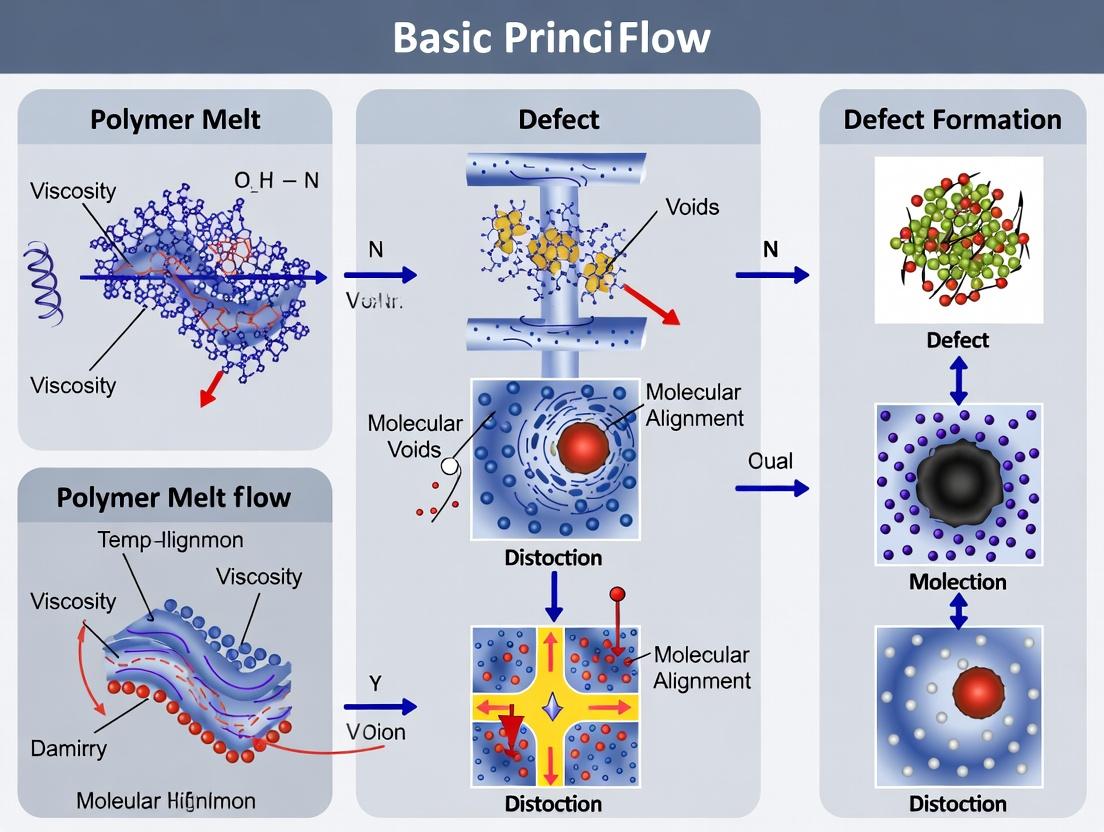
This article provides a comprehensive analysis of polymer melt flow behavior, linking fundamental rheological principles to practical defect formation in pharmaceutical manufacturing processes like hot-melt extrusion and injection molding.
Polymer Melt Flow Fundamentals: Understanding Viscoelastic Behavior and Defect Formation in Pharmaceutical Processing
Abstract
This article provides a comprehensive analysis of polymer melt flow behavior, linking fundamental rheological principles to practical defect formation in pharmaceutical manufacturing processes like hot-melt extrusion and injection molding. Targeting researchers and drug development professionals, it explores the viscoelastic nature of polymer melts, details advanced characterization methodologies, presents systematic troubleshooting for common processing defects, and evaluates computational models against experimental validation. The content synthesizes foundational science with applied strategies for optimizing product quality and process robustness in polymeric drug delivery system development.
The Viscoelastic Nature of Polymer Melts: From Chain Dynamics to Flow Instabilities
Within the broader thesis on Basic principles of polymer melt flow behavior and defect formation research, polymer melt rheology serves as the fundamental discipline connecting the molecular architecture of polymers to their macroscopic processing behavior and the ultimate quality of finished products. This guide details the core principles, experimental techniques, and quantitative relationships that define this critical bridge, with a focus on implications for researchers and drug development professionals engaged in polymeric drug delivery systems, device manufacturing, and formulation science.
Molecular Parameters Influencing Melt Rheology
The flow behavior of a polymer melt is governed by its molecular structure. Key parameters are summarized below.
Table 1: Molecular Parameters and Their Rheological Influence
| Molecular Parameter | Definition | Primary Rheological Impact | Typical Measurement Technique |
|---|---|---|---|
| Molecular Weight (Mw) | Average mass of polymer chains. | Directly affects zero-shear viscosity (η₀ ∝ Mw^3.4 above critical Mw). | Gel Permeation Chromatography (GPC) |
| Molecular Weight Distribution (Đ = Mw/Mn) | Polydispersity index. | Broad Đ increases shear-thinning, alters elasticity, impacts melt strength. | Gel Permeation Chromatography (GPC) |
| Chain Architecture | Linear, long-chain branched (LCB), star, comb. | LCB enhances melt strength, elasticity, and elongational viscosity; modifies shear-thinning. | Size-Exclusion Chromatography with Multi-Angle Light Scattering (SEC-MALS) |
| Chain Entanglement Density | Number of topological constraints per chain. | Determines plateau modulus (G_N^0), affects relaxation spectrum. | Dynamic Mechanical Analysis (DMA) / Rheology |
| Thermodynamic State (T - Tg) | Distance from glass transition temperature. | Governs segmental mobility; viscosity follows Williams-Landel-Ferry (WLF) equation. | Differential Scanning Calorimetry (DSC) |
Core Rheological Properties and Measurements
Fundamental Properties
- Shear Viscosity (η): Resistance to steady shearing flow. Exhibits Newtonian plateau at low shear rates and shear-thinning at high rates.
- Elastic Moduli (G', G''): Storage modulus (G') measures elastic energy storage; loss modulus (G'') measures viscous energy dissipation. Obtained from oscillatory shear tests.
- Relaxation Spectrum: Characterizes the time-dependent relaxation of polymer chains after deformation.
- Elongational Viscosity (η_E): Resistance to extensional flow, critical for processes like film blowing and fiber spinning.
Key Experimental Protocols
Protocol 1: Small-Amplitude Oscillatory Shear (SAOS) for Linear Viscoelasticity
- Objective: To characterize the linear viscoelastic (LVE) properties without disrupting the microstructure.
- Apparatus: Strain-controlled or stress-controlled rotational rheometer with parallel plate or cone-and-plate geometry.
- Procedure:
- Load a polymer melt sample onto the pre-heated rheometer platen (typical gap: 0.5-1.0 mm).
- Conduct a strain (or stress) sweep at a fixed frequency (e.g., 1 Hz) to determine the LVE region where moduli are independent of strain amplitude.
- Perform a frequency sweep (e.g., 0.01 to 100 rad/s) within the LVE region at a constant temperature (isothermal).
- Apply time-temperature superposition (TTS) using master curves if applicable, shifting data from multiple temperatures to a reference temperature (T_ref).
- Key Outputs: G'(ω), G''(ω), complex viscosity η*(ω), master curves, plateau modulus (G_N^0), crossover frequency (related to average relaxation time).
Protocol 2: Capillary Rheometry for High-Shear Viscosity
- Objective: To measure apparent shear viscosity under high shear rates relevant to processing (e.g., extrusion, injection molding).
- Apparatus: Capillary rheometer with a reservoir, piston, and a die of known length (L) and diameter (D).
- Procedure:
- Pre-heat the barrel and die to the target temperature.
- Load polymer pellets or pre-formed plugs into the barrel.
- Drive the piston at a constant speed to extrude the melt through the capillary die.
- Record pressure drop (ΔP) across the die and the volumetric flow rate (Q).
- Repeat for multiple piston speeds.
- Apply Bagley correction (for entrance pressure loss) using dies of different L/D ratios and Weissenberg-Rabinowitsch correction (for non-parabolic velocity profile in non-Newtonian fluids).
- Key Outputs: Apparent shear rate (γ̇app), true shear stress (τw), true shear rate (γ̇_w), and true viscosity (η) as a function of shear rate.
Protocol 3: Uniaxial Extensional Rheometry
- Objective: To measure transient and steady elongational viscosity.
- Apparatus: Sentmanat Extensional Rheometer (SER) fixture on a rotational rheometer or dedicated extensional rheometer.
- Procedure:
- Prepare a rectangular polymer sample.
- Mount the sample ends onto two rotating drums held at a constant temperature.
- Initiate test by rotating drums in opposite directions, imposing a constant Hencky strain rate (ε̇).
- Measure the force (F(t)) required to maintain this extension and the sample dimensions.
- Calculate transient extensional viscosity: ηE+(t) = σE(t) / ε̇, where σ_E is the tensile stress.
- Key Outputs: Transient elongational viscosity growth curve, strain-hardening ratio.
Linking Rheology to Processing and Defect Formation
Flow instabilities and defects in final products originate from specific rheological responses.
Table 2: Rheological Origins of Common Processing Defects
| Defect | Typical Process | Primary Rheological Cause | Molecular/Structural Link |
|---|---|---|---|
| Melt Fracture (Sharkskin) | Extrusion, Blow Molding | High wall shear stress (> critical τ_c) causing slip-stick instability. | High molecular weight, narrow MWD, low chain entanglement slippage. |
| Gross Melt Fracture | Extrusion | Cohesive failure due to excessive elastic energy storage and recoil at the die entrance. | High melt elasticity (G'), long relaxation times, presence of long-chain branching. |
| Die Swell (Extrudate Swell) | Extrusion, Injection Molding | Recovery of elastic (reversible) deformation upon exiting the confinement of a die. | High first normal stress difference (N₁), long relaxation times, increased LCB. |
| Draw Resonance | Fiber Spinning, Film Casting | Instability in elongational flow leading to periodic thickness variation. | Inadequate strain hardening in extensional viscosity, specific molecular weight distribution. |
| Bubbles/Voids | Injection Molding, Hot-Melt Extrusion | Trapped volatiles or decompression; related to elongational and shear viscosity. | Low melt strength, inappropriate viscosity at processing temperature. |
The Scientist's Toolkit: Research Reagent Solutions & Essential Materials
Table 3: Essential Materials for Polymer Melt Rheology Research
| Item / Reagent | Function / Purpose | Technical Note |
|---|---|---|
| Polymer Standards | Calibrate molecular weight (MW) and dispersity (Đ) via GPC. Provide reference materials for rheological models. | NIST-traceable linear polystyrene or polyethylene standards are common. |
| Thermal Stabilizers | Prevent oxidative degradation during high-temperature rheological testing. | E.g., Irganox 1010; added at low concentrations (0.1-0.5 wt%). |
| Rheometer Calibration Fluids | Verify torque, normal force, and displacement transducers on rotational rheometers. | Newtonian silicone oils of certified viscosity across a temperature range. |
| Release Agents | Ensure clean sample ejection from molds and rheometer fixtures, preventing sample tearing. | Non-silicone, non-transferring sprays (e.g., based on fluorocarbons) for high-temp use. |
| Geometry-Specific Tools | For sample loading and trimming (e.g., parallel plate trimmer, capillary die cleaners). | Maintain precise sample geometry, crucial for data accuracy. |
| Inert Gas Supply (N₂ or Ar) | Creates an inert atmosphere in the rheometer environmental chamber during testing. | Essential for testing polyolefins and other degradation-sensitive polymers at high temperatures. |
Advanced Constitutive Modeling
To quantitatively bridge molecular structure and flow, advanced constitutive models are employed. These integrate molecular parameters into continuum-level stress predictions.
- Generalized Newtonian Fluid (GNF): Models viscosity as a function of shear rate (e.g., Power Law, Carreau-Yasuda models). Does not capture elasticity.
- Linear Viscoelastic Models: Maxwell and Kelvin-Voigt models describe small-deformation behavior using relaxation spectra.
- Non-Linear Differential Models: Giesekus, Phan-Thien-Tanner (PTT) models introduce parameters related to molecular orientation and stretch, providing predictions for both shear and extensional flows.
- Molecular-Inspired Models: The Pom-Pom model and its derivatives explicitly account for polymer backbone stretch and branch point withdrawal, making them powerful for modeling long-chain branched polymers.
The selection of an appropriate model, parameterized with accurate experimental data from the protocols outlined, enables the simulation and prediction of complex processing flows and the anticipation of defect formation windows, closing the loop from molecular design to robust manufacturing.
Abstract This technical guide details four key viscoelastic phenomena governing polymer melt flow, framed within a thesis on fundamental flow behavior and its causal link to processing defects. Understanding these phenomena is critical for researchers in material science and pharmaceutical development, where precise control over product morphology (e.g., in film coating, fiber spinning, or tablet extrusion) is paramount. The interplay between viscous dissipation and elastic energy storage dictates final product dimensions, surface quality, and structural integrity.
Polymer melts are non-Newtonian, viscoelastic fluids. Their flow behavior cannot be described by viscosity alone but requires an understanding of time-dependent elastic responses. These responses arise from the entanglement and relaxation of long-chain molecules under deformation. The four phenomena under discussion—Shear Thinning, Elastic Recovery, Die Swell, and Normal Stresses—are macroscopic manifestations of this molecular architecture and govern defect formation such as melt fracture, sharkskin, and dimensional instability.
Shear Thinning (Pseudoplasticity)
Shear thinning describes the decrease in apparent viscosity with increasing shear rate, a critical factor for energy-efficient processing.
Molecular Mechanism: At rest, polymer chains are highly entangled, leading to high zero-shear viscosity (η₀). Under shear, chains align and disentangle in the flow direction, reducing resistance to flow.
Quantitative Modeling: The power-law (Ostwald-de Waele) model is commonly used: τ = K * (γ̇)^n where τ is shear stress, K is the consistency index, γ̇ is shear rate, and n is the power-law index (n < 1 for shear thinning).
Table 1: Power-Law Parameters for Common Polymer Melts
| Polymer | Temperature (°C) | K (Pa·sⁿ) | n | Applicable Shear Rate Range (s⁻¹) |
|---|---|---|---|---|
| LDPE | 180 | 1.2e4 | 0.40 | 10¹ - 10⁴ |
| HDPE | 200 | 7.5e3 | 0.55 | 10¹ - 10³ |
| Polypropylene | 230 | 8.0e3 | 0.45 | 10¹ - 10⁴ |
| Polystyrene | 200 | 2.5e4 | 0.30 | 10¹ - 10³ |
Experimental Protocol: Capillary Rheometry
- Setup: Load polymer pellets into the barrel of a capillary rheometer. Equip with a die of specific length (L) and diameter (D). Set precise temperature control.
- Conditioning: Allow thermal equilibrium for 10-15 minutes.
- Shearing: Use a piston to extrude the melt at a series of controlled piston speeds (v).
- Data Collection: Record pressure drop (ΔP) across the die and volumetric flow rate (Q).
- Calculation: Calculate apparent shear rate (32Q/(πD³)) and wall shear stress (ΔP*D/(4L)). Correct for entrance effects (Bagley correction) and non-parabolic velocity profile (Rabinowitsch correction).
- Analysis: Plot log(τ) vs. log(γ̇) to determine K and n.
Elastic Recovery and Die Swell (Extrudate Swell)
Elastic recovery is the partial reversal of deformation upon stress removal. Die swell is its most observable consequence, where the extrudate diameter exceeds the die diameter.
Molecular Mechanism: Deformation stores elastic energy in stretched polymer chains. Upon exiting the die (stress removal), this stored energy drives chain relaxation and recoil, causing radial expansion.
Key Factors: Die swell ratio (B = Dextrudate / Ddie) increases with:
- Increasing shear rate (γ̇).
- Decreasing temperature.
- Increasing molecular weight and polydispersity.
- Longer die length (up to a plateau, as some stress relaxes within the die).
Table 2: Typical Die Swell Ratios Under Processing Conditions
| Polymer | Die L/D Ratio | Shear Rate (s⁻¹) | Temperature (°C) | Typical Swell Ratio (B) |
|---|---|---|---|---|
| LDPE | 10 | 100 | 180 | 1.6 - 1.9 |
| HDPE | 20 | 100 | 200 | 1.4 - 1.6 |
| PDMS (Silicone) | 10 | 50 | 25 | 1.1 - 1.3 |
Experimental Protocol: Extrudate Swell Measurement
- Extrusion: Use a capillary rheometer with a flat-entry die.
- Collection: Extrude a strand at constant shear rate onto a moving belt or into a temperature-controlled oil bath to freeze the morphology.
- Measurement: After complete cooling, use a laser micrometer or precision calipers to measure the extrudate diameter at multiple points.
- Analysis: Calculate the average swell ratio (B). Correlate with shear stress and capillary L/D ratio.
Diagram Title: Mechanism of Polymer Die Swell
Normal Stress Differences
In viscoelastic flows, shear induces unequal normal stresses perpendicular to the flow direction. The first (N₁) and second (N₂) normal stress differences are defined as: N₁ = τ₁₁ - τ₂₂, N₂ = τ₂₂ - τ₃₃ where direction 1 is flow, 2 is velocity gradient, and 3 is neutral. N₁ is typically large and positive, driving many viscoelastic effects.
Manifestations: N₁ is responsible for rod-climbing (Weissenberg effect), curved free surfaces, and secondary flows in non-circular channels.
Experimental Protocol: Cone-and-Plate Rheometry for N₁
- Setup: Place a small sample between a flat plate and a low-angle cone (< 5°) on a rotational rheometer. Ensure gap truncation is correct.
- Temperature: Equilibrate at test temperature.
- Steady Shear: Apply a constant rotational speed (Ω) to achieve desired shear rate (γ̇ = Ω/θ, where θ is cone angle).
- Measurement: The rheometer measures the total normal force (Fz) on the plate. For a cone-and-plate geometry, the first normal stress difference is calculated as: N₁ = 2 * Fz / (π * R²), where R is the plate radius.
- Shear Rate Sweep: Repeat across a range of shear rates to build function N₁(γ̇).
Table 3: First Normal Stress Difference (N₁) Data
| Polymer | Shear Rate (s⁻¹) | Temperature (°C) | N₁ (kPa) | N₁ / Shear Stress Ratio |
|---|---|---|---|---|
| Polystyrene | 0.1 | 200 | 0.5 | 1.2 |
| Polystyrene | 1.0 | 200 | 8.0 | 2.5 |
| Polyisobutylene | 1.0 | 50 | 12.0 | 3.0 |
Link to Processing Defects
- Melt Fracture/Sharkskin: Caused by excessive shear stress at the die wall combined with elastic recovery, leading to surface or gross distortion. Correlates with a critical wall shear stress and N₁.
- Draw Resonance: In fiber spinning, caused by unstable interaction between viscous draw-down, elastic recovery, and cooling.
- Poor Dimensional Tolerance: Directly linked to uncontrolled and non-uniform die swell.
Diagram Title: Flow-Induced Defect Formation Pathway
The Scientist's Toolkit: Research Reagent Solutions & Essential Materials
Table 4: Key Experimental Materials for Polymer Melt Rheology
| Item | Function & Relevance |
|---|---|
| Capillary Rheometer | Emulates processing conditions (high shear). Measures shear viscosity, die swell, and detects flow instabilities via pressure oscillations. |
| Rotational Rheometer (with cone-and-plate/parallel plate fixtures) | Precisely measures linear/non-linear viscoelastic properties, including N₁ in steady shear and dynamic moduli (G', G'') in oscillatory tests. |
| Strain-Controlled Elongational Rheometer (e.g., SER fixture) | Characterizes extensional viscosity and strain-hardening, critical for understanding processes like film blowing and fiber spinning. |
| Standard Reference Fluids (e.g., NIST Polyethylene, PDMS) | Calibrate equipment and validate experimental protocols. Ensure data reproducibility across labs. |
| High-Temperature Thermal Oxidative Stabilizer (e.g., Irganox, Ultranox) | Added to polymer samples to prevent degradation during prolonged testing at high temperatures, ensuring property measurement reflects intrinsic behavior. |
| Laser Micrometer / High-Speed Camera | Accurately measure transient die swell and extrudate dimensions or visualize surface defect formation in real-time. |
| Precision-Machined Dies (varying L/D, entrance angles) | Study the effects of die geometry on shear history, pressure drop, and the onset of elastic-driven defects. |
Within the study of Basic principles of polymer melt flow behavior and defect formation, understanding the role of Molecular Weight (MW) and Molecular Weight Distribution (MWD) is paramount. These parameters are the fundamental architectural variables dictating the viscoelastic response of a polymer melt during processing. They directly govern chain entanglement density, relaxation dynamics, and ultimately, the manifestation of flow-related defects in final products, a critical concern for researchers in material science and drug development formulating polymeric delivery systems.
Core Principles: MW & MWD Governing Rheology
Molecular Weight (MW)
The average size of polymer chains. Key averages include:
- Number-Average Molecular Weight (Mₙ): Sensitive to the total number of molecules.
- Weight-Average Molecular Weight (Mw): Sensitive to the weight fraction of larger molecules. The ratio Mw/Mₙ defines the polydispersity index (PDI).
Molecular Weight Distribution (MWD)
The statistical spread of chain lengths within a sample. A broad MWD indicates a wide range of chain lengths, while a narrow MWD indicates more uniform chains.
Governing Melt Viscosity (η₀)
The zero-shear viscosity (η₀) exhibits a distinct dependence on Mw, characterized by a critical molecular weight (Mc) for entanglement.
- Below Mc: η₀ ∝ Mw¹.0
- Above Mc: η₀ ∝ Mw^(3.4-3.6) for most linear polymers.
MWD influences the shear-thinning behavior: broader distributions show earlier onset and more gradual shear thinning.
Governing Melt Elasticity
Elastic effects (die swell, melt fracture, recoil) are primarily governed by the longest chains in the distribution. These chains have longer relaxation times (τmax ∝ Mw^3.4) and store elastic energy under deformation. A broader MWD, with a "tail" of very high MW chains, disproportionately increases elasticity and can exacerbate processing defects.
Table 1: Effect of M_w and MWD on Key Melt Properties
| Polymer Property | Primary Governor | Functional Relationship | Typical Experimental Method |
|---|---|---|---|
| Zero-Shear Viscosity (η₀) | Weight-Avg MW (M_w) | η₀ ∝ Mw^(3.4) for Mw > M_c | Capillary or Rotational Rheometry |
| Shear-Thinning Onset | MWD Breadth (PDI) | Broader MWD → lower critical shear rate | Steady Shear Rheometry |
| Primary Normal Stress Difference (N₁) | High-MW Tail of MWD | N₁ ∝ (Mz / Mw)^α | Cone-and-Plate Rheometry |
| Relaxation Time Spectrum | M_w and full MWD | τmax ∝ Mw^3.4; MWD broadens spectrum | Small-Amplitude Oscillatory Shear (SAOS) |
| Melt Fracture Critical Shear Rate | High-MW Tail (M_z) | Broad MWD lowers critical shear rate for instability | Capillary Rheometry with visual/die pressure analysis |
Table 2: Common Polymer Characterization Techniques for MW & MWD
| Technique | Measures | Information Obtained | Applicable MW Range |
|---|---|---|---|
| Gel Permeation Chromatography (GPC/SEC) | Mn, Mw, M_z, PDI | Full MWD curve relative to standards | ~500 - 10⁷ Da |
| Melt Flow Index (MFI) | Melt Mass-Flow Rate (MFR) | Single-point flow index inversely related to M_w | Empirical, process-related |
| Intrinsic Viscosity [η] | Viscosity-average Mw (Mv) | Polymer-solvent interaction & chain size | ~10³ - 10⁷ Da |
| Multi-Angle Light Scattering (MALS) | Absolute M_w, Radius of Gyration | Absolute MW without standards, size info | ~10³ - 10⁸ Da |
Experimental Protocols
Protocol: Determining MW-Melt Viscosity Relationship via Capillary Rheometry
Objective: To establish the power-law relationship between M_w and zero-shear viscosity (η₀). Materials: See "The Scientist's Toolkit" below. Procedure:
- Sample Preparation: Obtain or synthesize a series of linear polymer homologs (e.g., polystyrene) with varying, well-characterized M_w but narrow and similar MWDs (PDI < 1.2). Dry samples thoroughly.
- Rheometry: Load sample into barrel of capillary rheometer pre-heated to test temperature (e.g., 200°C). Allow thermal equilibrium (5-10 min).
- Shear Rate Sweep: Apply a series of controlled piston speeds to extrude melt through a long capillary die (L/D ≥ 30). Record pressure drop (ΔP) across the die and volumetric flow rate (Q) at each speed.
- Data Analysis (Bagley & Weissenberg-Rabinowitsch Corrections):
- Bagley Correction: Perform runs with at least two dies of identical diameter but different lengths. Plot pressure drop vs. L/D at constant shear rate; extrapolate to zero length to correct for entrance pressure losses.
- Shear Stress: Calculate true wall shear stress (τw) from corrected ΔP.
- Shear Rate Correction: Correct the apparent shear rate (4Q/πR³) for the non-parabolic velocity profile of a non-Newtonian fluid using the Weissenberg-Rabinowitsch equation.
- Viscosity: Compute true viscosity (η) = τw / (corrected shear rate).
- Zero-Shear Determination: Plot η vs. corrected shear rate on a log-log scale. Identify the plateau region at low shear rates; the plateau value is η₀.
- Correlation: Plot log(η₀) vs. log(Mw) for the sample series. Fit data; the slope below Mc is ~1.0, and above M_c is ~3.4-3.6.
Protocol: Assessing MWD Impact on Elasticity via Die Swell Measurement
Objective: To correlate the high-MW tail of the distribution with elastic recovery (die swell). Materials: Polymer samples with similar Mw but varying Mw (different PDI). Capillary rheometer equipped with a short die (L/D ≈ 0). Procedure:
- Characterization: Precisely determine the full MWD (Mn, Mw, M_z) for each sample using GPC-MALS.
- Extrusion: Under identical temperature and a constant, low shear rate (to minimize viscous heating), extrude each polymer through a short capillary die.
- Measurement: Allow the extrudate to cool and solidify. Precisely measure the diameter of the extrudate (D_extrudate) at multiple points.
- Calculation: Calculate the die swell ratio, B = Dextrudate / Ddie.
- Correlation: Plot B against Mz (the z-average MW, sensitive to the high-MW tail) and against PDI (Mw/Mn). Typically, B shows a stronger correlation with Mz, demonstrating the disproportionate effect of the longest chains on elasticity.
Visualization Diagrams
Title: How MW and MWD Govern Flow and Defects
Title: Experimental Flow for MW-Viscosity Law
The Scientist's Toolkit: Research Reagent Solutions
| Item | Function/Benefit | Key Consideration for Research |
|---|---|---|
| Narrow MWD Polymer Standards | Calibrate GPC/SEC; create model systems to isolate MW effects from MWD effects. | Must match polymer chemistry (e.g., PS, PEG, PMMA). PDI < 1.1 is ideal. |
| High-Temperature GPC/SEC Columns | Separate polymer chains by hydrodynamic volume in solvents like THF or DMF at elevated temps (e.g., for polyolefins). | Column pore size must match target MW range. Requires high-boiling, stable solvents. |
| Capillary Rheometer with Dual-Die Set | Enables accurate Bagley correction for true shear stress by using dies of same diameter, different lengths. | Dies must be precisely machined. Long L/D (e.g., 30:1) minimizes correction magnitude. |
| Cone-and-Plate Rheometer | Measures linear viscoelastic properties (G', G'') and N₁ under homogeneous shear, ideal for melt elasticity studies. | Gap setting is critical; cone angle must be small (<4°). Requires precise temperature control. |
| Melt Flow Indexer | Provides a quick, single-point MFR value per ASTM D1238. Correlates roughly with M_w for quality control. | Not a fundamental measurement; highly sensitive to test conditions (temp, load). |
| Thermal Stabilizers/Antioxidants | Prevent oxidative degradation of polymer melts during prolonged rheological testing at high temperatures. | Must be compatible and not plasticize the polymer. Common: Irganox, BHT. |
| High-Purity, Anhydrous Solvents (e.g., THF, TCB) | For GPC/SEC and sample preparation. Water or impurities affect chromatography and can cause chain hydrolysis/scission during melt testing. | Use with appropriate stabilizers (e.g., BHT in TCB). Degas before use. |
| Multi-Angle Light Scattering (MALS) Detector | Coupled with GPC for absolute MW measurement without relying on column calibration standards. | Provides Mw, Rg, and detects aggregation. Requires precise concentration and dn/dc value. |
Understanding the flow behavior of polymer melts is foundational to controlling processes like injection molding, extrusion, and film formation, where defects such as warpage, sink marks, and residual stresses originate. A central thesis in this field posits that the temperature and pressure dependence of viscoelastic properties is not governed by simple Arrhenius kinetics but by changes in the free volume—the unoccupied space between polymer chains enabling molecular motion. The Williams-Landel-Ferry (WLF) equation quantitatively describes this relationship, providing a critical framework for predicting material behavior across processing conditions. This guide explores the fundamental principles, experimental validation, and practical application of free volume theory and the WLF equation in polymer melt research relevant to material scientists and pharmaceutical developers working with polymeric excipients and drug delivery systems.
Theoretical Foundations: Free Volume and Time-Temperature Superposition
The segmental mobility of polymer chains, which dictates viscosity and relaxation times, is primarily controlled by the available free volume (f). As temperature increases, free volume expands, facilitating easier chain movement. The Doolittle equation empirically relates viscosity (η) to free volume:
[ \eta = A \exp\left(\frac{B}{f}\right) ]
where A and B are material constants. The fractional free volume f is often expressed as:
[ f = fg + \alphaf (T - T_g) ]
where ( fg ) is the fractional free volume at the glass transition temperature ( Tg ), and ( \alpha_f ) is the thermal expansion coefficient of the free volume.
The WLF equation is a direct consequence of this free volume model. It describes the shift factor (( a_T )) used in time-temperature superposition (TTS):
[ \log{10}(aT) = \frac{-C1 (T - T{ref})}{C2 + (T - T{ref})} ]
where ( T{ref} ) is a reference temperature (often ( Tg )), and ( C1 ) and ( C2 ) are empirical constants theoretically related to free volume parameters: ( C1 = B/(2.303 f{ref}) ) and ( C2 = f{ref}/\alpha_f ).
Pressure dependence enters because applied pressure reduces free volume, effectively increasing the viscosity and glass transition temperature. A combined pressure-temperature shift factor can be formulated.
Key Experimental Protocols for Characterization
Determining WLF Constants via Dynamic Mechanical Analysis (DMA)
Objective: To obtain the shift factors (( aT )) and calculate WLF constants ( C1 ) and ( C_2 ).
Protocol:
- Sample Preparation: Prepare polymer discs or rectangular films of specified dimensions (e.g., 1mm thickness).
- Frequency Sweep: Using a parallel plate or torsion rheometer, perform small-amplitude oscillatory shear tests over a range of angular frequencies (e.g., 0.1 to 100 rad/s) at a fixed strain within the linear viscoelastic region.
- Temperature Ramp: Repeat the frequency sweep at multiple temperatures (e.g., ( Tg + 10^\circ)C to ( Tg + 100^\circ)C).
- Master Curve Construction: Select a reference temperature ( T_{ref} ). Horizontally shift the storage (( G' )) and loss (( G'' )) modulus curves along the logarithmic frequency axis to create a single master curve.
- Shift Factor Analysis: Plot ( \log(aT) ) versus ( (T - T{ref}) ). Fit the WLF equation to the data using non-linear regression to extract ( C1 ) and ( C2 ).
Measuring Pressure-Dependent Viscosity Using a Capillary Rheometer
Objective: To quantify the effect of pressure on melt viscosity and free volume.
Protocol:
- Instrument Setup: Utilize a high-pressure capillary rheometer equipped with a pressure transducer at the die entrance.
- Isothermal Tests: At a fixed temperature, extrude the polymer melt through a die of known length and diameter at various piston speeds (shear rates).
- Pressure Variation: Conduct tests at the same temperature but under different applied back-pressures.
- Data Calculation: Correct for pressure drop (Bagley correction) and non-Newtonian flow (Rabinowitsch correction). Calculate apparent viscosity at each pressure condition.
- Model Fitting: Fit data to a modified viscosity model incorporating pressure, such as ( \eta(P) = \eta_0 \exp(\beta P) ), where ( \beta ) is the pressure coefficient.
Data Presentation
Table 1: Typical WLF Constants and Free Volume Parameters for Common Polymers
| Polymer | ( T_g ) (°C) | ( T_{ref} ) (°C) | ( C_1 ) | ( C_2 ) (°C) | ( f_{ref} ) | ( \alpha_f ) (10^-4 /°C) |
|---|---|---|---|---|---|---|
| Polystyrene (PS) | 100 | 100 | 13.7 | 50.0 | 0.032 | 6.4 |
| Poly(methyl methacrylate) (PMMA) | 105 | 105 | 17.5 | 52.0 | 0.025 | 4.8 |
| Polyisobutylene (PIB) | -70 | -70 | 16.6 | 104 | 0.026 | 2.5 |
| Polyvinyl acetate (PVAc) | 30 | 30 | 15.0 | 52.5 | 0.029 | 5.5 |
| Universal Constants | - | - | ~17.4 | ~51.6 | ~0.025 | ~4.8 |
Note: "Universal" constants are approximate averages; material-specific measurement is critical.
Table 2: Pressure Coefficient of Viscosity (( \beta )) at ( T_g + 50^\circ)C
| Polymer | Pressure Coefficient, ( \beta ) (GPa^-1) | Experimental Method |
|---|---|---|
| Polycarbonate (PC) | 30 - 40 | Capillary Rheometry |
| Polypropylene (PP) | 15 - 25 | Slit Die Rheometry |
| Polyethylene (HDPE) | 10 - 18 | Falling Cylinder Viscometer |
| Polydimethylsiloxane (PDMS) | 5 - 10 | High-Pressure Rotational Rheometer |
Visualizations
Diagram 1: Free Volume & WLF Relationship Logic
Diagram 2: DMA Protocol for WLF Constants
The Scientist's Toolkit: Key Research Reagent Solutions & Materials
Table 3: Essential Materials for Free Volume & WLF Experiments
| Item/Reagent | Function & Rationale |
|---|---|
| Well-Characterized Polymer Resins (e.g., NIST standard reference materials) | Provide a baseline with known molecular weight, dispersity, and thermal history to validate experimental methods and data analysis. |
| Quenching Bath (Liquid Nitrogen or Dry Ice/Methanol) | Rapidly cools molded samples to create a reproducible, amorphous state with minimal thermal history for consistent DMA testing. |
| Inert Atmosphere (Nitrogen or Argon Gas) | Prevents oxidative degradation of the polymer melt during high-temperature rheological testing, ensuring data reflects pure thermal/pressure effects. |
| High-Temperature Silicone Oil or Graphite Lubricant | Used in capillary rheometry to minimize friction between piston and barrel, ensuring applied pressure translates fully to the melt. |
| Standard Viscoelastic Reference Fluid (e.g., Polydimethylsiloxane) | Used for calibration and validation of rheometer fixtures (parallel plates, cones) and transducer accuracy before polymer testing. |
| Pressure-Sensitive Calibration Kits (Deadweight testers) | Calibrates pressure transducers in capillary/slit dies to ensure accurate measurement of the pressure coefficient of viscosity (β). |
| Thermal Analysis Standards (e.g., Indium, Tin for DSC) | Calibrates temperature sensors in DSC and DMA to accurately determine Tg, a critical parameter for selecting WLF reference temperature. |
This whitepaper provides an in-depth technical guide to four critical flow defects in polymer processing: sharkskin, melt fracture, voids, and splay. These phenomena are framed within the foundational thesis that polymer melt flow behavior is governed by intrinsic viscoelastic and thermodynamic limits. Exceeding these limits—whether of shear stress, tensile stress, stretch rate, or volatility—manifests predictably as specific defects. Understanding this limit-based framework is essential for researchers, scientists, and drug development professionals working with polymeric excipients, hot-melt extrusions, or advanced drug delivery systems, as it enables defect prevention through process design rather than mere post-hoc troubleshooting.
Defect Characterization, Causes, and Limits
The following table summarizes the quantitative parameters, core mechanisms, and exceeded limits associated with each defect, based on current literature.
Table 1: Characterization of Key Polymer Melt Flow Defects
| Defect | Key Exceeded Limit | Typical Critical Value / Onset Range | Primary Mechanism | Common Materials Affected |
|---|---|---|---|---|
| Sharkskin | Critical Wall Shear Stress | 0.1 - 0.4 MPa | Cyclic stick-slip at die exit; surface rupture due to high tensile recoil. | Linear polyethylenes (LLDPE, HDPE), polypropylenes. |
| Melt Fracture | Critical Shear Stress (for gross) / Critical Shear Rate (for onset) | 0.1 - 0.4 MPa (stress) | Cohesive instability within the melt; severe distortion of extrudate shape. | Most polymer melts, especially at high molecular weights. |
| Voids | Volatile Partial Pressure > Local Hydrostatic Pressure | Material/process dependent | Volatile expansion (moisture, residual solvent) or cavitation under negative pressure. | Hygroscopic polymers (e.g., PLA, PVA), resins with residual monomers. |
| Splay | Material-Thermal Decomposition Limit | Polymer-specific (e.g., ~280°C for PVC) | Volatilization of moisture or decomposition products at the melt front during injection molding. | Polymers with moisture, lubricants, or low thermal stability (e.g., PVC, certain polyamides). |
Experimental Protocols for Defect Investigation
Capillary Rheometry for Sharkskin & Melt Fracture
- Objective: Quantify the critical shear stress and shear rate for the onset of surface and gross melt fracture.
- Protocol:
- Instrument: Equip a capillary rheometer with a series of dies having the same diameter but various L/D ratios (e.g., 5, 10, 20, 30).
- Conditioning: Dry polymer pellets thoroughly (≥4 hrs at 80°C under vacuum). Load the rheometer barrel and equilibrate at the target processing temperature (e.g., 180°C for PE).
- Bagley Correction: Perform experiments at constant piston speed. Plot pressure drop vs. L/D for each shear rate. Extrapolate to zero L/D to determine the entrance pressure drop (∆P_entrance), correcting the wall shear stress.
- Onset Detection: Systematically increase the apparent shear rate (via piston speed). Visually inspect (high-speed camera) and measure extrudate surface roughness via laser profilometry. Plot true wall shear stress vs. shear rate.
- Analysis: Identify the point where the flow curve deviates from linearity (onset of sharkskin) and where stress plateaus or oscillates (onset of gross melt fracture). Record the corresponding critical shear stress.
Thermogravimetric-Gas Chromatography/Mass Spectrometry (TGA-GC/MS) for Splay & Voids
- Objective: Identify volatile species responsible for splay and void formation and link them to processing temperatures.
- Protocol:
- Sample Preparation: Divide the polymer/resin into two batches: one "as-received" and one thoroughly dried (e.g., 24 hrs in a desiccated oven at 80°C).
- TGA-GC/MS Coupling: Connect a thermogravimetric analyzer (TGA) effluent line to a GC/MS via a heated transfer line.
- Volatile Evolution Profile: Heat samples in the TGA from 30°C to 300°C at 10°C/min under inert gas (N₂). The evolved gases are transferred in real-time to the GC/MS for separation and identification.
- Correlation Analysis: Match identified volatiles (water, plasticizers, oligomers) to the specific temperature ranges of their evolution. Correlate major evolution peaks with the processing temperature window and observed defect severity in molded parts.
Visualizing the Defect Formation Pathways
Diagram 1: Pathway from Exceeded Limits to Defect Manifestation (89 chars)
Diagram 2: Workflow for Critical Shear Stress Determination (99 chars)
The Scientist's Toolkit: Key Research Reagent Solutions
Table 2: Essential Materials for Polymer Flow Defect Research
| Item / Reagent | Function & Rationale |
|---|---|
| Capillary Rheometer | The primary instrument for applying controlled shear and extensional flows, simulating processing conditions to measure viscosity and detect defect onset. |
| Series of Capillary Dies (varying L/D) | Enables Bagley correction for true wall shear stress calculation by separating entrance/exit effects from fully-developed flow. |
| High-Speed Camera (≥ 1000 fps) | Captures the real-time onset and development of extrudate distortions (sharkskin, fracture) at the die exit. |
| Laser Scanning Confocal Microscope or Profilometer | Quantitatively measures surface topology and roughness (Ra, Rz) of extrudates to objectively classify sharkskin severity. |
| TGA-GC/MS Coupled System | Identifies and quantifies trace volatile components (moisture, additives, degradation products) that lead to splay and voids. |
| In-line Pressure Transducers | Mounted along the barrel and die to measure pressure gradients and detect instabilities associated with defect formation. |
| Well-Characterized Polymer Standards (NIST SRM) | Reference materials with known molecular weight and dispersity to calibrate rheological measurements and validate experimental setups. |
| High-Vacuum Drying Oven | Essential for removing moisture, a primary source of volatiles, to establish a baseline "dry" state for controlled experiments. |
| Process Viscometer (In-line Rheometer) | For real-time viscosity monitoring during actual processing (e.g., extrusion), linking lab-scale rheology to production-scale defect formation. |
Characterization and Modeling of Melt Flow for Pharmaceutical Process Design
Within the context of fundamental research on polymer melt flow behavior and defect formation, rheometry is indispensable. The selection of an appropriate rheometric technique—capillary, rotational, or oscillatory shear—directly dictates the quality and applicability of the viscoelastic data acquired. This guide details the core principles, experimental protocols, and data interpretation strategies for these three essential techniques, providing a framework for researchers investigating phenomena such as sharkskin, melt fracture, and phase separation in polymer systems and complex drug formulations.
Core Techniques and Principles
Capillary Rheometry
Capillary rheometry subjects a polymer melt to a controlled, pressure-driven flow through a die of known dimensions, simulating processing conditions like extrusion and injection molding. It is critical for studying high-shear-rate behavior and flow instabilities.
Experimental Protocol:
- Instrument Setup: Select a barrel diameter, capillary die (length L and radius R), and entrance angle (typically 180° or 90°). Common L/D ratios are 10:1 to 40:1. Preheat the barrel and die to the target melt temperature (e.g., 200°C for polyolefins).
- Sample Loading: Pack pre-weighed polymer pellets or powder into the barrel manually or via a specialized loading tool to minimize air entrapment.
- Purging & Conditioning: Apply a low piston speed to purge the system and allow the sample to thermally equilibrate for a standardized period (e.g., 5 minutes).
- Steady-Shear Sweep: Program a series of piston speeds (or pressures). At each step, after a stabilization period, record the steady-state pressure drop (ΔP) and piston force.
- Bagley and Weissenberg-Rabinowitsch Corrections: Perform separate tests with at least two dies of identical diameter but different lengths (L) to determine the Bagley end correction. Apply the Weissenberg-Rabinowitsch equation to correct the wall shear rate for non-Newtonian behavior.
- Data Calculation:
- Apparent Shear Stress: τapp = (ΔP * R) / (2L)
- Apparent Shear Rate: γ̇app = (4Q) / (πR³)
- Corrected values (τw, γ̇w) are derived from the above corrections.
Rotational Rheometry (Steady Shear)
Rotational rheometry uses a motor to apply a controlled torque/rotation to a geometry containing the sample, generating a simple shear flow. It is ideal for characterizing viscosity over a medium shear rate range and yielding behavior.
Experimental Protocol (Parallel Plate or Cone-Plate):
- Geometry Selection & Loading: Select a geometry (e.g., 25 mm diameter parallel plates with 1 mm gap, or a 40 mm cone with 1° angle and 50 μm truncation). Pre-heat the geometry. Load the sample (melt or pre-formed disk) onto the center of the bottom plate.
- Gap Setting & Trimming: Lower the upper geometry to the measuring gap. Trim excess material from the periphery with a heated spatula.
- Normal Force Relaxation: Allow the sample to thermally equilibrate and the normal force to relax to a near-zero baseline (e.g., 5-10 minutes).
- Steady Rate Sweep: Program a logarithmic sweep of rotational speeds (e.g., from 0.01 to 100 s⁻¹). At each shear rate step, measure the resulting steady-state torque (M) and normal force (N).
- Data Calculation:
- Shear Stress: τ = (2M) / (πR³) [for parallel plate]
- Shear Rate: γ̇ = (Ω * R) / (h) [for parallel plate, where Ω is angular speed, R radius, h gap]
- Viscosity: η = τ / γ̇
Oscillatory Shear Analysis
Oscillatory analysis applies a small-amplitude, sinusoidal deformation to characterize the linear viscoelastic (LVE) region, probing the material's structure without causing significant disruption.
Experimental Protocol (Small-Amplitude Oscillatory Shear - SAOS):
- Sample Loading & Gap Setting: Follow the same loading and trimming procedure as for rotational steady shear (Step 1-3 above).
- Strain (or Stress) Amplitude Sweep: At a fixed angular frequency (e.g., ω = 10 rad/s), perform a sweep of increasing oscillatory strain amplitude (γ₀). Determine the critical strain (γ_c) where the storage modulus (G') deviates from its constant plateau value, defining the limit of the LVE region.
- Frequency Sweep: Within the LVE region (at a fixed γ₀ < γ_c), perform a logarithmic sweep of angular frequencies (e.g., 0.01 to 100 rad/s). Record G' (storage modulus), G'' (loss modulus), and complex viscosity η* as functions of frequency.
- Data Interpretation: The frequency sweep provides a "mechanical spectrum" revealing relaxation times, plateau modulus (related to molecular weight between entanglements), and crossover points (G' = G''), which relate to melt transition or gel point behavior.
Table 1: Comparative Scope of Essential Rheometric Techniques
| Technique | Typical Shear Rate Range (s⁻¹) | Key Measurables | Primary Application in Defect Research |
|---|---|---|---|
| Capillary | 10⁰ - 10⁶ | Wall shear stress (τw), Apparent viscosity (ηapp), Extrudate swell ratio, Flow curve | High-rate processing defects (melt fracture, sharkskin), Die-swell prediction, Slip analysis |
| Rotational (Steady) | 10⁻³ - 10³ | Shear viscosity (η), Yield stress (τ_y), Normal stress differences (N₁) | Low/medium shear viscosity mapping, Yield behavior of filled systems, Shear thinning index |
| Oscillatory (SAOS) | (Frequency: 10⁻² - 10² rad/s) | Storage/Loss Moduli (G', G''), Complex viscosity (η*), Tan δ, Relaxation spectrum | Molecular structure/entanglements, Thermal transitions, Gelation/curing kinetics, Blend morphology |
Table 2: Representative Data for Common Polymer Melt (e.g., Polypropylene at 200°C)
| Technique | Test Condition | Measured Value | Interpretation |
|---|---|---|---|
| Capillary | L/D=20 die, γ̇_w = 1000 s⁻¹ | τ_w = 1.2 x 10⁵ Pa, η = 120 Pa·s | Viscosity under extrusion-like conditions |
| Rotational Steady | Parallel plate, γ̇ = 1 s⁻¹ | η = 1500 Pa·s | Zero-shear viscosity plateau region |
| Oscillatory | ω = 1 rad/s (in LVE) | G' = 500 Pa, G'' = 2000 Pa, η* = 2100 Pa·s | Predominantly viscous liquid behavior (G'' > G') |
Visualizing Rheological Analysis Workflows
Title: SAOS Protocol for Linear Viscoelasticity
Title: Linking Rheometry Data to Flow Defect Research
The Scientist's Toolkit: Essential Research Reagents & Materials
Table 3: Key Materials for Polymer Melt Rheology
| Item | Function & Importance |
|---|---|
| Standard Reference Fluids (e.g., NIST-traceable silicone oils) | Instrument calibration and validation of shear viscosity and normal force measurements. |
| Inert Purge Gas (e.g., Nitrogen, high-purity) | Prevents oxidative degradation of polymer samples during high-temperature tests in rotational and capillary rheometers. |
| Thermal Stability Package (e.g., Antioxidants like Irganox 1010) | Added to polymer samples to minimize chain scission or crosslinking during extended testing, ensuring data reflects flow properties, not degradation. |
| Release Agents (e.g., Silicone spray, PTFE film) | Applied to tooling (e.g., parallel plates) to aid in sample removal, especially for adhesive melts or cured systems. |
| Geometry Cleaning Solvents (e.g., Xylene, DMF, specialized piranha solution) | Essential for complete removal of residual polymer between tests to prevent contamination and ensure accurate gap setting. Choice depends on polymer solubility. |
| Sample Preparation Aids (e.g., Compression molding press, pelletizer) | Produces uniform, bubble-free disks for rotational rheometry, ensuring reproducible loading and thermal contact. |
1. Introduction: The Rheological Triad in Polymer Processing
Within the broader research on basic principles of polymer melt flow behavior and defect formation, three rheological parameters stand as fundamental pillars: zero-shear viscosity (η₀), relaxation time (λ), and flow activation energy (Eₐ). These parameters govern the polymer's response to stress, dictating its flow into molds, orientation during extension, and ultimate dimensional stability. Incorrect characterization can lead to severe processing defects—such as sharkskin, melt fracture, warpage, and residual stresses—which are critical failure points in industries ranging from medical device manufacturing to pharmaceutical drug delivery systems. This technical guide details the practical experimental determination of these key parameters, providing researchers with robust protocols for predictive material science.
2. Experimental Determination of Zero-Shear Viscosity (η₀)
Zero-shear viscosity is the constant viscosity plateau exhibited by a polymer melt at very low shear rates, reflecting the undisturbed equilibrium entanglement network. It is a direct indicator of molecular weight (Mw) for linear polymers.
Protocol: Steady Shear Rate Sweep using Rotational Rheometry
- Equipment: Strain-controlled rotational rheometer with parallel-plate or cone-and-plate geometry. An environmental test chamber for temperature control is mandatory.
- Sample Preparation: Compression-mold a disc of polymer melt approximately 1-2 mm thick and 25 mm in diameter. Ensure no air bubbles are present.
- Procedure:
- Equilibrate the sample at the test temperature (e.g., 180°C, 200°C, 220°C) for 5 minutes to erase thermal history.
- Apply a low-amplitude oscillatory strain (within the linear viscoelastic region) to verify sample stability and adhesion.
- Perform a steady shear rate sweep from a very low rate (e.g., 0.001 s⁻¹) to a higher rate (e.g., 10 s⁻¹), using a logarithmic progression.
- Record the steady-state shear stress (τ) at each shear rate (˙γ).
- Data Analysis: Plot viscosity (η = τ/˙γ) versus shear rate on a log-log scale. Fit the data in the low-shear-rate region to a Carreau-Yasuda or Cross model to extract the zero-shear viscosity plateau value (η₀). The low-shear-rate Newtonian plateau must be observed for a valid measurement.
3. Experimental Determination of Relaxation Time (λ)
The relaxation time characterizes the time scale for polymer chains to relax from a deformed state. It is crucial for understanding elastic effects like die swell.
Protocol: Small-Amplitude Oscillatory Shear (SAOS) Frequency Sweep
- Equipment: Rotational rheometer with parallel-plate geometry.
- Sample Preparation: As per Section 2.
- Procedure:
- At a fixed temperature within the linear viscoelastic regime (confirmed via an amplitude sweep), perform a frequency (ω) sweep from high frequency (e.g., 100 rad/s) to low frequency (e.g., 0.01 rad/s).
- Record the storage modulus (G'), loss modulus (G''), and complex viscosity (η*).
- Data Analysis:
- Crossover Method: Identify the frequency (ωc) where G' = G''. The relaxation time is estimated as λcrossover = 1/ωc.
- Cole-Cole Plot Method: Plot η'' (loss viscosity) vs η' (storage viscosity). Fit the data to a model (e.g., Maxwell) to obtain a discrete or spectrum of relaxation times.
- Maxwell Model Approximation: For a single relaxation time, λmaxwell = η₀ / GN, where GN is the plateau modulus, often approximated from the G' plateau at high frequency.
4. Experimental Determination of Flow Activation Energy (Eₐ)
Flow activation energy quantifies the temperature dependence of viscosity, reflecting the energy barrier for segmental motion. It is vital for predicting flow behavior across processing temperatures.
Protocol: Time-Temperature Superposition (TTS)
- Equipment: Rotational rheometer with precise temperature control.
- Sample Preparation: As per Section 2.
- Procedure:
- Perform SAOS frequency sweeps (as in Section 3) at multiple temperatures (typically spanning a 30-50°C range above the polymer's Tg or Tm).
- Ensure data at each temperature captures the terminal and transition zones.
- Data Analysis:
- Choose a reference temperature (Tref).
- Horizontally (aT) and vertically (bT) shift the modulus curves at other temperatures to superpose them onto the master curve at Tref.
- The horizontal shift factors (aT) follow the Arrhenius or Williams-Landel-Ferry (WLF) equation.
- For temperatures sufficiently above Tg (typically T > Tg + 100°C), fit the aT data to the Arrhenius equation: aT = exp[Eₐ/R * (1/T - 1/Tref)], where R is the gas constant.
- Plot ln(a_T) vs. 1/T. The slope of the linear region is Eₐ/R, from which Eₐ is calculated.
5. Tabulated Data Summary
Table 1: Representative Rheological Parameters for Common Polymers (at reference temperature T_ref)
| Polymer | Zero-Shear Viscosity, η₀ (Pa·s) | Relaxation Time, λ (s) | Flow Activation Energy, Eₐ (kJ/mol) | Measurement Temp. (T_ref) |
|---|---|---|---|---|
| LDPE | 5.0 x 10³ | 1.2 | 48 | 190°C |
| HDPE | 2.5 x 10⁴ | 4.5 | 29 | 190°C |
| PP | 8.0 x 10³ | 2.1 | 41 | 200°C |
| PS | 1.0 x 10⁵ | 15.0 | 92 | 180°C |
| PC | 3.5 x 10⁴ | 8.7 | 165 | 280°C |
Table 2: Key Experimental Protocols Summary
| Parameter | Core Experiment | Critical Control Variables | Primary Analytical Model |
|---|---|---|---|
| η₀ | Steady Shear Sweep | Very low shear rates, thermal equilibrium, gap setting | Carreau-Yasuda, Cross |
| λ | SAOS Frequency Sweep | Linear Viscoelastic strain, full frequency range | Crossover, Maxwell, Cole-Cole |
| Eₐ | Multi-Temp. SAOS (TTS) | Thermal stability, broad temperature range | Arrhenius Equation |
6. The Scientist's Toolkit: Essential Research Reagents & Materials
Table 3: Key Research Reagent Solutions and Materials
| Item | Function/Explanation |
|---|---|
| Strain-Controlled Rotational Rheometer | Primary instrument for applying precise deformation and measuring stress response in shear. |
| Parallel-Plate Geometry (8-25 mm) | Standard fixture for polymer melts; easy sample loading and gap adjustment to accommodate thermal expansion. |
| Cone-and-Plate Geometry | Provides homogeneous shear rate; ideal for absolute viscosity measurements but sensitive to sample loading and gap precision. |
| Environmental Test Chamber (Oven) | Enables precise, stable, and uniform temperature control for temperature-dependent studies and TTS. |
| Inert Gas (Nitrogen) Purge System | Prevents oxidative degradation of polymer samples during high-temperature testing. |
| Compression Molding Press | Used to prepare uniform, bubble-free disc-shaped samples from pellets or powder. |
| Standard Reference Materials (e.g., NIST Polyisobutylene) | Used for rheometer calibration and validation of experimental protocols. |
| Silicone Oil or Graphite Paste | Applied to sample edges to prevent drying and suppress edge fracture during testing. |
7. Visualized Workflows and Relationships
Diagram Title: Integrated Workflow for Determining Rheological Parameters
Diagram Title: Time-Temperature Superposition (TTS) Method for Eₐ
Applying the Cox-Merz Rule and Time-Temperature Superposition (TTS) for Extended Predictions
This whitepaper, framed within a broader thesis on Basic principles of polymer melt flow behavior and defect formation research, details the synergistic application of two foundational rheological principles. Understanding the viscoelastic flow of polymer melts is critical for predicting processing behavior and minimizing defects like sharkskin, melt fracture, or inhomogeneities in final products, including pharmaceutical polymeric carriers and drug-eluting implants. The Cox-Merz Rule and Time-Temperature Superposition (TTS) provide powerful, efficient frameworks for extending the predictive range of rheological data, enabling researchers to model material behavior across timescales and conditions not easily accessible via direct experimentation.
Foundational Principles
The Cox-Merz Rule
The Cox-Merz rule is an empirical correlation stating that the shear-rate dependence of the steady-state viscosity, η(γ̇), is equal to the frequency dependence of the complex viscosity, |η(ω)|, when the shear rate and angular frequency are numerically equal. [ \eta(\dot{\gamma}) = |\eta^(\omega)| \quad \text{for} \quad \dot{\gamma} = \omega ] This allows the prediction of steady, non-linear shear flow behavior (relevant to extrusion, molding) from small-amplitude oscillatory shear measurements (non-destructive, easy to perform).
Time-Temperature Superposition (TTS) Principle
TTS, or the method of reduced variables, exploits the thermorheological simplicity of many polymers. It posits that the effect of temperature on viscoelastic properties (like relaxation time) is equivalent to a horizontal shift along the logarithmic time or frequency axis. Master curves are constructed by shifting data from multiple temperatures to a single reference temperature (T₀). [ aT = \frac{\eta0(T)}{\eta0(T0)} \approx \frac{\tau(T)}{\tau(T0)} ] [ \log(\omega{red}) = \log(\omega) + \log(aT) ] Where (aT) is the temperature shift factor, often modeled by the Williams-Landel-Ferry (WLF) or Arrhenius equations.
Synergistic Application for Extended Predictions
Combining these rules enables the prediction of viscosity over an exceptionally broad range of effective shear rates. Oscillatory frequency sweep data at multiple temperatures are shifted via TTS to create a broad-frequency master curve of complex viscosity. The Cox-Merz rule then allows this master curve to be interpreted as a steady-shear viscosity master curve over an equivalently broad range of shear rates, far exceeding the practical limits of a rotational rheometer.
Table 1: Typical Shift Factor (a_T) Values for Common Polymer Types (Reference T₀ = 200°C)
| Polymer Type | WLF Constant C1 | WLF Constant C2 | Activation Energy Ea (kJ/mol) | Applicable Temp Range (°C) |
|---|---|---|---|---|
| Polystyrene (atactic) | 8.86 | 101.6 | 200-250 | 150-250 |
| Polypropylene | 4.52 | 150.5 | 40-50 | 180-240 |
| Polyethylene (HDPE) | 3.65 | 135.7 | 25-35 | 160-220 |
| Poly(methyl methacrylate) | 12.5 | 95.0 | 250-300 | 150-220 |
| PLGA (50:50) | 15.2 | 110.0 | 80-100 | 37-100 |
Table 2: Validity Limits of the Cox-Merz Rule for Various Systems
| Material System | Typically Valid? | Deviations Observed At/In | Key Condition |
|---|---|---|---|
| Linear, Flexible Homopolymers | Yes | Very high γ̇/ω | Homogeneous melt state |
| Highly Branched Polymers | Moderate | Moderate rates | Branching relaxation dynamics |
| Polydisperse Melts | Yes | --- | Broad MWD often improves fit |
| Polymer Blends | No/Conditional | Low & high rates | Phase-separated structures |
| Filled Systems / Composites | Often No | All rates | Particle network, yield stress |
| Concentrated Solutions | Conditional | High concentrations | Solvent-polymer interactions |
Experimental Protocols
Protocol: Constructing a TTS-Cox-Merz Master Curve
Objective: Generate a steady-shear viscosity prediction spanning 10^-3 to 10^6 s^-1. Materials: See "Scientist's Toolkit" below. Procedure:
- Sample Preparation: Dry polymer pellets/vacuum-dry to remove moisture. Melt-press or load into rheometer with environmental control.
- Temperature Ramp (Optional): Perform a temperature sweep in oscillatory mode (ω = 10 rad/s, γ = 1%) to identify the stable melt region and degradation temperature.
- Frequency Sweeps at Multiple Temperatures:
- Set parallel plate geometry (e.g., 25 mm diameter, 1 mm gap).
- For each target temperature (T = T₀, T₀±10°C, T₀±20°C...), equilibrate for 5 min.
- Perform an oscillatory frequency sweep from 0.01 to 100 rad/s at a constant strain within the linear viscoelastic region (LVR).
- Record G'(ω), G''(ω), and |η*(ω)|.
- TTS Master Curve Construction:
- Choose a reference temperature T₀ (often near the middle of the tested range).
- Plot log(|η*|) vs. log(ω) for all temperatures.
- Horizontally shift (log(aT)) data from each temperature onto the T₀ data set to create a smooth master curve. Vertical shifts (bT) are sometimes minimal for viscosity.
- Fit the WLF equation to the obtained log(a_T) vs. (T-T₀) data.
- Cox-Merz Application:
- Relabel the x-axis of the master curve from log(ωred) to log(γ̇eff).
- The curve is now a prediction of steady-shear viscosity η(γ̇) over the extended reduced frequency range.
- Validation (Critical): Perform actual steady-shear rate sweeps at T₀ over the instrument's achievable range (e.g., 0.01 to 100 s^-1). Overlay data onto the predicted master curve to validate the superposition.
Protocol: Assessing Cox-Merz Validity
Objective: Test empirical rule applicability for a new material. Procedure:
- Oscillatory Test: As per Step 3 above at a single temperature.
- Steady-Shear Test: On the same sample and geometry, perform a steady shear rate sweep from low to high rates, ensuring steady-state at each point.
- Direct Comparison: Plot η(γ̇) and |η*(ω)| on the same log-log axes. Agreement confirms validity. Discrepancies indicate structural changes under shear (e.g., alignment, breakup).
Mandatory Visualizations
Diagram 1: TTS and Cox-Merz Application Workflow (88 chars)
Diagram 2: Logical Relationship Between TTS and Cox-Merz (73 chars)
The Scientist's Toolkit: Research Reagent Solutions & Essential Materials
Table 3: Essential Materials for TTS & Cox-Merz Experiments
| Item | Function/Brief Explanation |
|---|---|
| Stress- or Strain-Controlled Rheometer | Core instrument for applying controlled shear/deformation and measuring stress response. Requires precise temperature control (±0.1°C). |
| Parallel Plate or Cone-and-Plate Geometry | Standard geometries for polymer melts. Plates offer easy loading/cleaning; cones provide homogeneous shear. |
| Environmental Test Chamber (ETC) | Encloses geometry to provide inert atmosphere (N₂) to prevent oxidation and ensure precise temperature uniformity. |
| Polymer Pellets/Powder (e.g., PLGA, PEO) | Test material. Must be characterized for molecular weight, dispersity, and thermal history. |
| Vacuum Oven | For pre-drying hygroscopic polymers (e.g., polyesters) to remove moisture that plasticizes and alters flow. |
| Standard Reference Material (e.g., NIST 1490) | Used for calibration and validation of rheometer torque and inertia. |
| Silicone Oil or Grease | Applied to sample edge to prevent moisture uptake and suppress sample drying/degradation during test. |
| WLF/Arrhenius Fitting Software | For calculating shift factors (a_T) and building master curves (often built into rheometer software). |
| High-Temperature Thermal Paste | Improves thermal contact between Peltier plate and geometry for faster equilibration. |
The foundational principles of polymer melt flow behavior and defect formation research establish a critical framework for advanced pharmaceutical manufacturing. This guide, situated within that context, posits that successful Hot-Melt Extrusion (HME) and injection molding of amorphous solid dispersions (ASDs) hinge on the rigorous integration of two key rheological datasets: shear-viscosity curves and time-temperature-stability maps. Defects like phase separation, degradation, and incomplete mixing are direct consequences of processing outside a material's defined "processing window." This document provides a technical protocol for defining this window, thereby linking core polymer science to robust, scalable pharmaceutical production.
Foundational Principles: Viscosity and Stability
Rheology: The Shear Viscosity Curve
Viscosity (η) as a function of shear rate (γ̇) dictates the flow resistance and mixing efficiency during processing. Most polymer-excipient systems used in HME are shear-thinning, described by the power-law model: η = K * γ̇^(n-1), where K is the consistency index and n is the power-law index (n < 1 for shear-thinning).
Table 1: Typical Power-Law Parameters for Common HME Polymers
| Polymer/System | Temperature (°C) | Consistency Index, K (Pa·sⁿ) | Power-Law Index, n | Applicable Shear Rate Range (s⁻¹) |
|---|---|---|---|---|
| HPMCAS (LG) | 150 | 8500 | 0.45 | 10 - 1000 |
| PVP VA64 | 140 | 3200 | 0.55 | 10 - 1000 |
| Soluplus | 130 | 5200 | 0.50 | 10 - 1000 |
| Copovidone | 150 | 2800 | 0.60 | 10 - 1000 |
Physical Stability: The Time-Temperature-Transformation (TTT) Map
The stability map defines the boundaries of the amorphous system's single-phase state. Key boundaries include the Glass Transition Temperature (Tg), the degradation temperature (Tdeg), and the crystallization onset time (τ_cryst) at a given temperature.
Table 2: Critical Stability Parameters for Model ASD Formulations
| ASD Formulation (20% Drug Load) | Tg (°C) | Tdeg (Onset, °C) | τ_cryst at T > Tg+50°C (min) | Recommended Max Processing Time (min) |
|---|---|---|---|---|
| Itraconazole / HPMCAS | 105 | 220 | 8.5 | 5 |
| Ritonavir / PVP VA64 | 85 | 190 | 4.2 | 3 |
| Celecoxib / Soluplus | 72 | 230 | >15 | 10 |
Experimental Protocols
Protocol A: Generating Shear Viscosity Curves via Capillary Rheometry
Objective: To measure apparent viscosity across a range of shear rates relevant to HME (1-1000 s⁻¹). Materials: See Scientist's Toolkit. Method:
- Sample Preparation: Pre-dry physical mixture of API and polymer.
- Rheometer Setup: Equip with a cylindrical die (L/D = 20:1 to 30:1). Apply Bagley and Weissenberg-Rabinowitsch corrections.
- Conditioning: Load sample, allow to equilibrate at test temperature (e.g., 130°C, 150°C, 170°C) for 5 min under minimal pressure.
- Measurement: Apply piston to extrude material at a series of controlled speeds. Record pressure drop (ΔP) across the die for each speed.
- Data Calculation: Calculate apparent shear rate (32Q/πD³) and wall shear stress (ΔP D/(4L)). Derive apparent viscosity.
- Model Fitting: Fit corrected data to the power-law model at each temperature.
Protocol B: Constructing Stability Maps via Differential Scanning Calorimetry (DSC) & Thermogravimetric Analysis (TGA)
Objective: To define Tg, Tdeg, and isothermal crystallization kinetics. Method:
- Tg & Tdeg Determination: Using a sealed Tzero pan, run a modulated DSC (mDSC) scan from 25°C to 250°C at 3°C/min. Tg is identified from the reversible heat flow step. Run a parallel TGA experiment under nitrogen at 10°C/min to determine onset of degradation (typically >1% mass loss).
- Crystallization Kinetics (Isothermal): a. Heat sample 30°C above its predicted melting point to erase thermal history. b. Quench rapidly (>50°C/min) to a target isothermal temperature (Tiso) above Tg (e.g., Tg+20°C, Tg+50°C). c. Hold at Tiso and monitor heat flow for exothermic crystallization events. d. Record the time to crystallization onset (τcryst). Repeat for multiple Tiso points.
- Map Construction: Plot Tg line, Tdeg line, and iso-τ_cryst contours (e.g., 1-min, 5-min, 10-min crystallization onset) on a Temperature vs. Log(Time) graph.
Protocol C: Defining the Integrated Processing Window
Objective: To superimpose rheological and stability data to identify optimal processing parameters. Method:
- Plot Axes: Create a master plot with Temperature (T) on the y-axis and Log(Shear Rate) or Log(Residence Time) on the x-axis.
- Overlay Viscosity Contours: Plot iso-viscosity lines (e.g., 100 Pa·s, 1000 Pa·s, 5000 Pa·s) using data from Protocol A.
- Overlay Stability Boundaries: Plot the following from Protocol B:
- Lower bound: Tg (process must be >Tg for flow).
- Upper bound: Minimum of Tdeg and temperature at which τ_cryst < intended residence time.
- Right bound: Maximum allowable residence time from stability map.
- Identify Window: The operable processing window is the region bounded by: T > Tg, T < (Tdeg & T_cryst-limit), viscosity between 100-10,000 Pa·s (pumpable but not too fluid), and residence time less than the stability limit.
Diagram 1: Workflow for Processing Window Design
Diagram 2: Integrated Processing Window Map
The Scientist's Toolkit: Key Research Reagent Solutions
Table 3: Essential Materials for Viscosity & Stability Mapping Experiments
| Item & Typical Supplier Example | Function in Experimental Protocol |
|---|---|
| Capillary Rheometer (e.g., Malvern Rosand RH7, Gottfert Rheograph) | Applies controlled shear rates at high temperature to measure pressure drop and calculate apparent viscosity. |
| Twin-Screw Melt Extruder (Bench-top, e.g., Thermo Fisher Process 11, Leistritz Nano-16) | Provides real-world shear and thermal history for validating processing windows. |
| Differential Scanning Calorimeter (DSC, e.g., TA Instruments Q2000, Mettler Toledo DSC 3) | Measures glass transition (Tg), melting points, and isothermal crystallization kinetics. |
| Thermogravimetric Analyzer (TGA, e.g., TA Instruments Q50, Netzsch TG 209) | Determines thermal decomposition temperature (Tdeg) and moisture content. |
| Standard Capillary Dies (L/D=20:1, 30:1; 1mm diameter) | For capillary rheometry; different L/D ratios allow for Bagley correction. |
| Hermetic/Secaled Tzero DSC pans (e.g., TA Instruments) | Prevents sample evaporation during high-temperature DSC runs, ensuring accurate Tg and stability data. |
| Model Polymer Systems (e.g., HPMCAS (AQOAT), PVP VA64, Soluplus from BASF) | Well-characterized carriers with known rheological and stability profiles for method development. |
| Model APIs (e.g., Itraconazole, Ritonavir, Celecoxib) | Poorly soluble compounds commonly used in ASD research to test formulation stability. |
| Inert Atmosphere Glove Box (for sample loading) | Prevents moisture uptake by hygroscopic polymers during sample preparation for sensitive measurements. |
Application to HME and Molding Processes
The derived processing window directly informs equipment parameters:
- HME: Barrel temperature profile must fall within the window's temperature bounds. Screw speed (which impacts shear rate and residence time) must be chosen to keep the material within the viscosity contours and left of the maximum time boundary.
- Injection Molding: Melt temperature and mold temperature are constrained by the window. Hold time and injection speed must be balanced to prevent crystallization (time boundary) while ensuring complete cavity fill (viscosity-dependent flow).
Validating the window involves processing at a point within it and at points near its boundaries, followed by analytical characterization (e.g., XRD, DSC, dissolution) to confirm the absence or presence of predicted defects like crystallization or degradation. This closed-loop process solidifies the fundamental link between polymer melt flow behavior, stability, and final product quality.
The formulation of Amorphous Solid Dispersions (ASDs) is a critical strategy for enhancing the bioavailability of poorly water-soluble drugs. The success of an ASD hinges on the judicious selection of a polymeric carrier and the precise optimization of manufacturing parameters. This case study is framed within a broader thesis investigating the basic principles of polymer melt flow behavior and defect formation. Understanding these principles—such as viscosity, shear thinning, elastic recovery, and thermal degradation—is paramount for selecting appropriate polymers and processing conditions to manufacture stable, defect-free ASD formulations via hot-melt extrusion (HME) or similar thermo-mechanical methods.
Core Polymer Selection Criteria for ASD
Polymer selection is the foundational step. The ideal polymer must achieve dual objectives: forming a stable, supersaturated solution of the drug and exhibiting favorable melt processing behavior.
Key Selection Parameters:
- Drug-Polymer Miscibility & Interaction: Governs physical stability and prevents recrystallization. Assessed via Hansen Solubility Parameters, Flory-Huggins interaction parameter (χ), and spectroscopic methods.
- Glass Transition Temperature (Tg): The polymer's Tg, and the resultant Tg of the drug-polymer blend, dictates the processing temperature and long-term physical stability at storage conditions.
- Melt Rheology: Directly tied to the thesis core. A polymer's viscosity (η) as a function of temperature and shear rate determines processability, required torque, and mixing efficiency. Ideal polymers for HME show significant shear thinning.
- Hydrophilicity & Drug Release: Affords dissolution rate enhancement.
- Chemical Stability: Must resist degradation at processing temperatures.
Table 1: Common ASD Polymers and Their Key Properties
| Polymer (Abbreviation) | Chemical Nature | Typical Tg (°C) | Key Rheological/Melt Behavior | Primary Selection Rationale |
|---|---|---|---|---|
| Polyvinylpyrrolidone (PVP) | Amorphous, hydrophilic | ~150-180 | Low melt viscosity; prone to thermal degradation if not plasticized. | High solubilizing capacity, good for spray drying. |
| Polyvinylpyrrolidone-vinyl acetate copolymer (PVP-VA) | Amorphous, hydrophilic | ~105-110 | Broad processing window, good thermoplasticity. | Excellent balance of processability (lower Tg than PVP) and drug stabilization. |
| Hydroxypropyl methylcellulose (HPMC) | Amorphous, hydrophilic | ~150-180 (varies) | High melt viscosity; requires plasticizer/co-processant for HME. | Robust precipitation inhibition, common in commercial products. |
| Hydroxypropyl methylcellulose acetate succinate (HPMC-AS) | Amorphous, pH-dependent | ~115-135 (grades) | Better thermoplasticity than HPMC; LF grade is optimal for HME. | Superior drug stabilization and pH-triggered release. |
| Soluplus | Polyvinyl caprolactam–polyvinyl acetate–PEG graft copolymer | ~70 | Excellent thermoplasticity, broad HME processing window. | Specifically designed for HME; good bioavailability enhancement. |
Linking Melt Flow Behavior to Parameter Selection & Defect Formation
The principles of polymer melt flow are directly applied to parameter optimization. Key defects in ASD manufacturing (e.g., poor dispersion, degradation, porosity) originate from misunderstood rheology.
Table 2: Critical Processing Parameters, Rheological Basis, and Associated Defects
| Processing Parameter | Rheological Principle & Impact | Optimized Outcome | Potential Defect if Misapplied |
|---|---|---|---|
| Processing Temperature (T) | Must be > Tg of blend to induce flow. Follows Arrhenius-type η(T) relationship. High T lowers η but risks degradation. | Sufficient molecular mobility for mixing without degradation. | Drug/Polymer Degradation (excessive T), High Torque/Stalling (insufficient T). |
| Screw Speed (RPM) / Shear Rate (γ̇) | Most polymers are shear-thinning: η decreases as γ̇ increases. Higher RPM increases shear, improving mixing but also shear heating. | Homogeneous drug distribution via distributive/dispersive mixing. | Incomplete Dispersion (low shear), Thermal Degradation (excessive shear heating). |
| Feed Rate (Q) | Interacts with screw speed to determine specific mechanical energy (SME) and residence time distribution (RTD). | Controlled RTD for consistent product quality. | Poor Content Uniformity (fluctuating RTD), Degradation (long RTD). |
| Screw Configuration | Governs the balance of conveying, mixing, and shear stress. Kneading blocks induce dispersive mixing. | Designed shear profile for the specific drug-polymer system. | Agglomerates (insufficient mixing), Fragile Particle Breakdown (excessive shear). |
Diagram 1: Parameter-flow-defect interrelationship. (Max width: 760px)
Experimental Protocols for Selection & Characterization
Protocol 1: Determination of Drug-Polymer Miscibility (via Tg Measurement)
Objective: Predict physical stability of the ASD. Method: Prepare small-scale binary mixtures (e.g., 10-30% drug in polymer) by solvent evaporation. Analyze using Modulated Differential Scanning Calorimetry (mDSC). Procedure:
- Hermetically seal 5-10 mg samples in Tzero pans.
- Run mDSC from -20°C to 200°C (above Tg of both components) at 2°C/min with a modulation amplitude of ±0.5°C every 60 seconds.
- Analyze the reversing heat flow signal. A single, composition-dependent Tg intermediate between the drug and polymer Tg values indicates miscibility. Two distinct Tgs suggest phase separation.
Protocol 2: Evaluation of Melt Rheology for Processability
Objective: Guide HME parameter selection (temperature, screw speed). Method: Use a parallel-plate or capillary rheometer on pure polymer or polymer-plasticizer blends. Procedure:
- Condition polymer pellets/ powder at relevant humidity.
- Perform a temperature sweep (e.g., 120-180°C) at constant frequency to identify the temperature range where complex viscosity (η*) falls within an extrudable range (typically 100-10,000 Pa·s).
- Perform a frequency sweep (simulating shear rate) at the target processing temperature to characterize shear-thinning behavior (power-law index, n).
Protocol 3: Small-Scale HME Feasibility and Stability Study
Objective: Screen multiple polymers and drug loads. Method: Use a micro-compounder or twin-screw extruder (TSE) with small batch capability. Procedure:
- Pre-blend drug and polymer at desired ratio (e.g., 10:90).
- Set TSE zones based on rheology data (start ~20°C above blend Tg). Use a modest screw speed (e.g., 100 RPM) and feed rate.
- Collect extrudate, observe visually for clarity/opacity, and mill.
- Store milled extrudates under accelerated conditions (40°C/75% RH) in open and closed containers. Analyze by X-ray Powder Diffraction (XRPD) and DSC at time points (0, 1, 2, 4 weeks) to monitor recrystallization.
Diagram 2: ASD polymer and parameter selection workflow. (Max width: 760px)
The Scientist's Toolkit: Essential Research Reagents & Materials
Table 3: Key Reagents and Equipment for ASD Preformulation and HME Process Development
| Item Name/Class | Function in ASD Development | Example(s) / Notes |
|---|---|---|
| Polymeric Carriers | Matrix former to stabilize amorphous drug. | PVP-VA, HPMC-AS, Soluplus. Have various grades (MW, substitution). |
| Plasticizers | Lower polymer Tg and melt viscosity to aid processing. | Triethyl citrate (TEC), polyethylene glycol (PEG). |
| Thermal Stabilizers | Inhibit drug/polymer degradation during HME. | Antioxidants (e.g., BHT, ascorbyl palmitate). |
| Modulated DSC (mDSC) | Precisely measure Tg of drug-polymer blends for miscibility. | TA Instruments Q200, Mettler Toledo DSC3. |
| Melt Rheometer | Characterize viscosity (η) vs. temp and shear rate for parameter selection. | TA Instruments ARES-G2, Malvern Kinexus. |
| Twin-Screw Extruder (TSE) | Primary HME equipment for ASD manufacturing. | Thermo Fisher Process 11, Leistritz Nano-16, Coperion Keya. |
| Hot-Stage Microscopy | Visually observe melting and mixing behavior of drug-polymer blends. | Linkam hot stage coupled with polarizing microscope. |
| Stability Chambers | Store ASD samples under ICH accelerated conditions for stability testing. | Caron, ThermoFisher. Set to 40°C/75% RH. |
Diagnosing and Mitigating Common Polymer Processing Defects in Drug Product Fabrication
Understanding defect formation in polymer processing is foundational to applications ranging from pharmaceutical device manufacturing to advanced material science. This taxonomy is framed within the core thesis that defects originate from specific, identifiable deviations from ideal polymer melt flow behavior. The viscoelastic nature of polymer melts, governed by parameters such as shear stress, extensional strain, temperature, and pressure, dictates whether imperfections manifest at the surface or within the bulk of the material. This guide provides a detailed technical framework for classifying, analyzing, and investigating these critical imperfections.
Defect Taxonomy and Quantitative Characterization
The following table summarizes key characteristics, formation mechanisms, and quantitative metrics for surface and bulk defects.
Table 1: Taxonomy and Quantitative Analysis of Polymer Processing Defects
| Defect Category | Specific Defect | Primary Formation Mechanism | Key Quantitative Metrics | Typical Size Range | Critical Detection Method |
|---|---|---|---|---|---|
| Surface Imperfections | Sharkskin | High surface stress at die exit causing elastic rupture. | Critical shear stress (~0.1-0.4 MPa), melt fracture onset rate. | 1-100 µm in depth | Laser profilometry, SEM |
| Haze (Surface) | Microscopic surface roughness scattering light. | Roughness average (Ra: 0.1-1 µm), Haze percentage (>3%). | 0.1-10 µm features | Optical haze meter, AFM | |
| Bulk Imperfections | Voids / Bubbles | Volatilization, trapped air, or cavitation under negative pressure. | Void volume fraction (0.1-5%), average diameter (10-500 µm). | 10-1000 µm | Micro-CT scanning, Density Measurement |
| Chemical Degradation | Thermal/oxidative chain scission exceeding stability threshold. | Molecular weight drop (Mw loss >15%), carbonyl index increase. | Molecular scale | GPC, FTIR Spectroscopy | |
| Inhomogeneity (Dispersive) | Poor distributive or dispersive mixing of additives/fillers. | Coefficient of variation (CV >5% for concentration), cluster size. | 1-1000 µm | EDX Mapping, Optical Microscopy | |
| Inhomogeneity (Phase) | Phase separation in blends or crystalline/amorphous regions. | Domain size (0.1-100 µm), spherulite size distribution. | 0.1-50 µm | PLM, SAXS, DMA |
Experimental Protocols for Defect Analysis
Protocol: Quantifying Sharkskin Onset via Capillary Rheometry
Objective: Determine the critical wall shear stress for the onset of sharkskin melt fracture. Materials: Polymer pellets, twin-bore capillary rheometer (equipped with a zero-length "orifice" die and a long Land-length die), environmental chamber. Procedure:
- Condition polymer pellets at specified temperature (e.g., 180°C) for 1 hour in the rheometer barrel to ensure complete melting and degassing.
- Perform a series of constant piston-speed experiments over a range of shear rates (typically 10⁻¹ to 10⁴ s⁻¹).
- For each shear rate, record the steady-state pressure drop (ΔP) through both the orifice die (to correct for entrance pressure loss via the Bagley correction) and the long die.
- Calculate the true wall shear stress (τ_w) using the Bagley-corrected pressure drop and die geometry.
- Simultaneously, extrude strands and visually inspect (using 10x magnification) or analyze surface via laser scanning for roughness.
- Identify the critical shear stress (τcritical) as the point where surface roughness (Ra) increases sharply (>50% from baseline). Plot τw vs. apparent shear rate and Ra vs. τ_w.
Protocol: Bulk Void Characterization via Micro-Computed Tomography (Micro-CT)
Objective: Quantify void volume fraction, size distribution, and spatial distribution within a molded or extruded sample. Materials: Polymer sample (≈ 5mm³ cube), micro-CT scanner, calibration phantoms, image analysis software (e.g., Avizo, ImageJ). Procedure:
- Mount sample on the rotary stage of the micro-CT scanner. Ensure no movement during rotation.
- Set scan parameters: Voltage (40-100 kV), current, exposure time, and number of rotational steps (≥ 1000) to achieve target voxel resolution (<5 µm).
- Perform a flat-field correction scan (with and without the sample) to correct for detector inhomogeneities.
- Acquire 2D projection images through a full 360° rotation. Reconstruct the 3D volume using a filtered back-projection algorithm.
- Apply image processing: Gaussian filtering for noise reduction, followed by global or local thresholding (e.g., Otsu's method) to segment voids from the polymer matrix.
- Analyze the binary volume to calculate total void volume fraction, generate void size distribution histograms, and perform 3D spatial distribution mapping (e.g., radial distribution function).
Diagrams: Defect Formation Pathways and Analysis Workflows
Title: Surface Defect Formation from Melt Flow Instability
Title: Workflow for Systematic Defect Classification and Analysis
The Scientist's Toolkit: Key Research Reagent Solutions and Materials
Table 2: Essential Materials and Reagents for Polymer Defect Research
| Item Name / Category | Function / Purpose | Key Considerations for Selection |
|---|---|---|
| Standard Reference Polymers (e.g., Linear HDPE, PS NIST standards) | Provide baseline rheological and processing behavior for method calibration and comparative defect studies. | Choose narrow MWD for clear defect onset identification. Must have certified molecular weight data. |
| Processing Stabilizers (e.g., Primary/Antioxidants (Irganox 1010), Phosphites) | Mitigate thermal-oxidative degradation during processing, isolating flow-induced defects from chemical defects. | Use at recommended concentrations (0.1-0.5 wt.%). Must be compatible with polymer matrix. |
| Controlled-Nucleation Agents (e.g., Sodium benzoate, Talc) | Induce specific crystalline morphologies to study crystallization-related inhomogeneity and haze. | Particle size and surface treatment significantly impact dispersion and nucleation efficiency. |
| Tracer Dyes & Particles (Fluorescent dyes, Reflective microspheres) | Act as flow followers to visualize mixing inhomogeneity and identify stagnant regions in processing. | Must be thermally stable at processing temps. Particle size should be small relative to feature size. |
| High-Temperature Release Agent (e.g., Fluoropolymer spray, Silicone-free formulas) | Ensure clean mold or die release without contaminating the polymer surface, which could obscure defect analysis. | Select to avoid chemical interaction with polymer. Test for residue using FTIR. |
| Calibration Standards for Microscopy (Gratings, Step-height standards, Density phantoms) | Calibrate vertical (Z) and lateral (X,Y) dimensions in AFM, profilometry, and Micro-CT for accurate defect sizing. | Traceable to national standards (e.g., NIST). Material should be stable under measurement conditions. |
Within the broader thesis on Basic principles of polymer melt flow behavior and defect formation research, this guide details a systematic methodology for identifying the causal links between specific polymer rheological properties, process conditions, and final product defects. For researchers and pharmaceutical development professionals, establishing these links is critical for process validation, quality-by-design (QbD) frameworks, and mitigating manufacturing risks.
Rheological Properties and Their Influence on Defects
Polymer melt flow is governed by fundamental rheological properties. Deviations in these properties under specific process conditions are primary drivers of defects. The following table summarizes key relationships.
Table 1: Defect-Rheology-Process Condition Linkages
| Defect Type | Primary Rheological Property | Critical Process Condition(s) | Typical Quantitative Range Indicative of Risk |
|---|---|---|---|
| Splay (Silver Streaks) | Extensional Viscosity & Melt Strength | High shear rate at entry, rapid stretching | Melt Strength < 0.02 N at 1000 s⁻¹ extensional rate |
| Sharkskin (Surface Mattness) | Wall Slip Velocity, Critical Shear Stress | High extrusion shear rate (> 10⁶ s⁻¹) | Critical Wall Shear Stress for onset: 0.1 - 0.3 MPa |
| Melt Fracture (Gross Irregularities) | First Normal Stress Difference (N₁) | High shear stress in die land | N₁ > 50 kPa at wall shear stress of 0.1 MPa |
| Voids/Incomplete Filling | Shear Viscosity (η) & Pressure-Dependent Flow | Low melt temperature, high injection speed | Viscosity increase > 15% per 10°C drop from processing T |
| Warpage/Sink Marks | PVT Behavior (Coefficient of Thermal Expansion) | Non-uniform cooling, high packing pressure | Volumetric shrinkage > 5-15% (semi-crystalline) |
| Molecular Degradation | Complex Viscosity (η*) & Thermo-Oxidative Stability | Excessive barrel temperature, long residence time | η* reduction > 20% after 15 min at process T |
Key Experimental Protocols for Linkage Analysis
Protocol 1: Capillary Rheometry for Shear Defect Onset
Objective: Determine critical shear rates/stresses for sharkskin and melt fracture. Methodology:
- Equipment: Twin-bore capillary rheometer with precision pressure transducers and a series of dies (L/D=5 to 20).
- Procedure: Condition polymer at a standard temperature (e.g., 180°C for PLGA). Force melt through dies at progressively increasing piston speeds. Record pressure drop (ΔP) for each speed.
- Data Analysis: Calculate apparent shear stress (τw = ΔP * R / (2L)) and shear rate (γ̇app = 4Q/πR³). Plot flow curve (τw vs. γ̇app). The onset of oscillations in pressure or visual inspection of extrudate identifies critical points.
- Linkage: Correlate the critical τ_w to observed surface defects in extrusion samples.
Protocol 2: Extensional Rheology via SER (Sentmanat Extensional Rheometer)
Objective: Quantify melt strength and extensional viscosity to predict drawability and splay. Methodology:
- Equipment: SER fixture mounted on a rotational rheometer, with temperature-controlled oven.
- Procedure: Load a rectangular melt sample onto two counter-rotating drums. Program drums to rotate with exponential acceleration to achieve a constant Hencky strain rate (e.g., 1-10 s⁻¹). Measure the tensile force (F(t)).
- Data Analysis: Calculate transient extensional viscosity (ηE⁺ = (F(t)/A(t)) / ε̇, where A(t) is cross-sectional area). The plateau or maximum value of ηE⁺ and the force at break (melt strength) are key metrics.
- Linkage: Low melt strength and strain-hardening deficiency correlate with instability in fiber spinning or film blowing, leading to breakage or splay.
Protocol 3: Oscillatory Shear for Structural Integrity
Objective: Assess molecular weight/distribution and thermo-oxidative stability via viscoelastic moduli. Methodology:
- Equipment: Parallel-plate rotational rheometer with nitrogen purge.
- Procedure: Perform a frequency sweep (e.g., 0.01 to 100 rad/s) at linear viscoelastic strain. Conduct time sweeps at process temperature and constant frequency/strain to monitor degradation.
- Data Analysis: Plot storage (G') and loss (G") moduli vs. angular frequency (ω). The crossover point (G' = G") indicates approximate relaxation time. Monitor complex viscosity (η*) decay over time in time sweeps.
- Linkage: Broad molecular weight distribution (indicated by shallow slope of G' vs ω) can exacerbate melt elasticity defects. Rate of η* decay quantifies degradation susceptibility under process conditions.
Visualizing the Root Cause Analysis Workflow
Root Cause Analysis Workflow for Polymer Defects
The Scientist's Toolkit: Research Reagent Solutions & Essential Materials
Table 2: Key Research Materials for Rheology-Defect Studies
| Item / Reagent | Function & Rationale |
|---|---|
| Capillary Rheometer (e.g., with Bagley correction) | Measures apparent viscosity and detects flow instabilities (sharkskin, melt fracture) under high shear conditions mimicking processing. |
| Rotational Rheometer with parallel-plate and SER fixtures | Characterizes linear/non-linear viscoelasticity (G', G", η*) and extensional rheology (melt strength) critical for draw resonance and sagging defects. |
| Standard Reference Materials (e.g., NIST Polyethylene) | Provides benchmark rheological data for instrument validation and method calibration. |
| Inert Purging Gas (High-purity Nitrogen or Argon) | Prevents thermo-oxidative degradation during prolonged rheological testing, ensuring data reflects melt stability. |
| Dielectric Spectroscopy System | Correlates molecular (dipole) mobility with viscosity and glass transition, useful for amorphous polymers and solidification defect analysis. |
| High-Speed Camera & Microscope | Visualizes die swell, extrudate distortion, or breakup in real-time, linking visual defect onset to rheometric data points. |
| Pressure-Volume-Temperature (PVT) Apparatus | Quantifies specific volume changes with T and P, essential for modeling shrinkage, warpage, and packing phase in molding. |
| Stabilizer-Free Polymer Grades | Enables study of pure polymer behavior without interference from antioxidants or processing aids; additives can be introduced systematically. |
A rigorous root cause analysis demands moving from defect observation to quantifiable rheological property measurement under simulated process conditions. By employing the experimental protocols and structured workflow outlined, researchers can build predictive models that link specific material properties like critical shear stress and extensional viscosity to processing windows, ultimately enabling robust, defect-free polymer and pharmaceutical product manufacturing.
Within the broader thesis on the basic principles of polymer melt flow behavior and defect formation, optimization of the extrusion process is paramount. The viscoelastic, non-Newtonian nature of polymer melts means that flow-induced stresses and thermal histories directly influence final product properties, including dimensional stability, mechanical strength, and surface quality. Defects such as melt fracture, sharkskin, die lines, warpage, and residual stresses originate from complex interactions between material rheology and processing parameters. This guide details targeted strategies for tuning four critical domains—thermal management, screw geometry, die design, and solidification kinetics—to mitigate defects and enhance product performance, particularly for high-value applications in medical device and drug delivery system development.
Temperature Profile Optimization
The thermal profile along the barrel is not merely a sequence of setpoints; it is a strategic tool for managing viscosity, shear stress, and degradation.
Core Principle: A gradually increasing profile from feed to metering zone is standard for crystalline polymers to ensure proper melting and compression. For heat-sensitive materials (e.g., many biopolymers or drug-polymer blends), a reversed or flat profile may minimize degradation. The die and adapter temperatures are often set at or near the melt temperature to reduce viscosity before shaping, thereby lowering exit pressure and shear stress.
Quantitative Data Summary: Table 1: Example Temperature Profiles for Different Polymer Classes
| Polymer Class | Feed Zone (°C) | Compression Zone (°C) | Metering Zone (°C) | Die Zone (°C) | Key Rationale |
|---|---|---|---|---|---|
| Polyethylene (HDPE) | 160-180 | 180-200 | 200-220 | 210-220 | Promotes gradual melting, prevents screw overload. |
| Polyvinyl Chloride (Rigid) | 150-160 | 170-180 | 180-190 | 185-195 | Minimizes thermal degradation; tight control required. |
| Drug-Loaded PLGA | 140-150 | 145-155 | 150-160 | 155-160 | Prevents drug degradation; flat profile minimizes thermal shock. |
| Polyamide 66 | 240-250 | 260-270 | 270-280 | 275-280 | High Tm requires high temps; ensures complete melting. |
Experimental Protocol for Determining Optimal Profile:
- Setup: Instrument a twin-screw extruder with multiple calibrated thermocouples along the barrel and die.
- Baseline Run: Process the material using a standard recommended profile. Measure melt pressure and temperature at the die.
- Iterative Adjustment: Systematically alter the zone temperatures (e.g., ±10°C increments) while holding screw speed constant.
- Response Measurement: For each run, collect: a) extrudate swell, b) melt fracture onset shear rate (visual inspection/high-speed camera), c) colorimetric analysis for degradation, and d) (for composites) dispersion quality via microscopy.
- Analysis: Correlate thermal history with defect severity. The optimal profile balances lowest defect score with acceptable throughput and stability.
Screw Design and Geometry
The screw is the engine of plasticization, mixing, and pressure development. Its design dictates shear history and melt homogeneity.
Core Principle: A typical screw contains feed, compression, and metering sections. Barrier screws improve melting efficiency, while mixing elements (e.g., Maddock, pineapple) enhance distributive and dispersive mixing. For drug-polymer blends, gentle mixing is critical to avoid API degradation or particle size reduction.
Quantitative Data Summary: Table 2: Screw Design Elements and Their Functional Impact
| Screw Element/Parameter | Typical Value/Range | Primary Function | Impact on Melt Flow & Defects |
|---|---|---|---|
| Compression Ratio (CR) | 2:1 to 4:1 (general) | Compacts and melts polymer. | High CR increases shear, improving melting but risking degradation. |
| L/D Ratio | 20:1 to 40:1 | Determines residence time and mixing. | Longer L/D improves homogeneity but increases residence time. |
| Maddock Mixing Section | 1-2 diameters long | Dispersive mixing; breaks agglomerates. | Reduces gel streaks and improves color/distribution; increases shear. |
| Pineapple Mixing Section | 2-3 diameters long | Distributive mixing; temperature homogenization. | Reduces thermal gradients, minimizing warpage and residual stress. |
| Flight Pitch | Varies by section | Conveys material. | Steeper pitch in feed zone increases conveying capacity. |
Experimental Protocol for Evaluating Screw Design Efficacy:
- Design of Experiments (DoE): Create screws with varying CR (e.g., 2.5, 3.0, 3.5) and with/without specific mixing elements.
- Tracer Study: For distributive mixing, introduce a color concentrate at the feed throat. Run to steady state.
- Sampling & Analysis: Collect extrudate samples. Analyze for:
- Mixing Quality: Cross-section samples examined under microscope for striation thickness or color uniformity.
- Shear History: Measure motor torque and specific mechanical energy (SME) input.
- Degradation: Use gel permeation chromatography (GPC) to track molecular weight change.
- Correlation: Relate screw geometry parameters to mixing indices, SME, and Mw reduction.
Title: Polymer Melt Transformation Along Screw Sections
Die Geometry and Flow Path Design
The die imparts the final shape and subjects the melt to its last, critical flow regime before solidification.
Core Principle: The die must be designed to manage extensional and shear flows, minimizing stagnant areas and achieving a uniform exit velocity. A well-designed land length ensures sufficient relaxation of upstream flow inhomogeneities. For complex profiles (e.g., medical tubing), the use of flow distribution channels (e.g., spider legs) or coat-hanger dies (for sheets) is essential.
Quantitative Data Summary: Table 3: Common Die Geometry Adjustments and Defect Mitigation
| Die Feature | Design Consideration | Target Defect | Mechanism of Action |
|---|---|---|---|
| Entrance Angle | 30° - 60° | Melt fracture | Reduces extensional strain rate at entrance. |
| Land Length (L) | L/R = 5 to 10 for capillaries | Die swell, sharkskin | Allows for stress relaxation; longer land reduces swell but increases pressure. |
| Parallel Land | Mandatory for profiles | Memory marks, uneven surfaces | Stabilizes flow and sets final dimensions. |
| Back Taper | Gradual reduction in flow channel | Viscous heating | Prevents overheating in stagnant areas. |
| Flow Restrictors | Adjustable inserts | Adjusts local flow rate for uniformity. |
Experimental Protocol for Die Flow Analysis:
- Simulation (Prior to Fabrication): Use Computational Fluid Dynamics (CFD) software with viscoelastic models (e.g., Phan-Thien Tanner) to simulate pressure drop, shear rate distribution, and exit velocity.
- Flow Visualization (Benchtop): For a transparent prototype die, use a colored tracer in a model fluid (e.g., polyglycol) to identify dead spots or non-uniform flow.
- Extrudate Swell Measurement: Extrude material at controlled rates. Measure the diameter/thickness of the extrudate after full relaxation vs. die diameter. Calculate swell ratio.
- Post-Extrusion Analysis: Use laser scanning or optical microscopy to measure dimensional accuracy and surface roughness of the profile, correlating deviations with CFD-predicted low-velocity zones.
Cooling Rate and Calibration
The cooling stage determines the crystallization kinetics, morphology, and final dimensional stability of the product.
Core Principle: Rapid quenching (water bath, air knife) produces an amorphous or fine-crystalline structure, often increasing clarity and toughness but inducing higher residual stresses. Slow, controlled cooling (heated calibration tools, staged ovens) allows for higher crystallinity, improved dimensional stability, and stress relaxation, but may reduce toughness.
Quantitative Data Summary: Table 4: Cooling Methods and Resultant Material Properties
| Cooling Method | Typical Rate | Applicable Profile | Key Outcome & Potential Defect |
|---|---|---|---|
| Water Bath Immersion | Very High (>50°C/s) | Wire coating, tubing, filaments | Amorphous skin, frozen-in orientation. Defect: Warpage if asymmetric. |
| Vacuum Calibration Sizing | Moderate-High | Complex hollow profiles (pipes, window lineals) | Excellent dimensional control. Defect: Sink marks if insufficient pressure. |
| Air Knife / Ring | Moderate | Sheet, film, low-tolerance tubing | Good surface finish. Defect: Sagging if rate is too slow. |
| Staged Oven Annealing | Very Low (Controlled) | High-performance parts | Stress relief, increased crystallinity. Defect: Throughput reduction. |
Experimental Protocol for Optimizing Cooling Rate:
- Instrumentation: Embed micro-thermocouples at the core and surface of the extrudate immediately upon die exit.
- Cooling Regime Variation: For a fixed extrusion line, vary: a) water bath temperature, b) air knife pressure/distance, c) vacuum calibration tank length.
- Property Mapping: For each cooling condition, test samples for:
- Crystallinity: Differential Scanning Calorimetry (DSC) to measure heat of fusion.
- Residual Stress: Layer removal method or photoelasticity.
- Dimensional Stability: Measure shrinkage over 24 hours and warpage using a flatness gauge.
- Modeling: Fit cooling data to a non-isothermal crystallization model (e.g., Nakamura) to predict morphology.
Title: Cooling Rate Impact on Solid-State Structure
The Scientist's Toolkit: Research Reagent Solutions
Table 5: Essential Materials and Reagents for Polymer Melt Flow Research
| Item/Category | Function/Application | Example & Rationale |
|---|---|---|
| Process Aids & Stabilizers | Modify interfacial rheology, prevent degradation. | Fluoropolymer-based PPAs: Eliminate sharkskin by coating die wall. Hindered Phenol Antioxidants: Protect polymer during high-temperature processing. |
| Tracer Materials | Visualize flow patterns and mixing efficiency. | TiO2 or Color Masterbatch: For distributive mixing studies. Thermochromic Pigments: Map temperature gradients in the melt. |
| Rheological Modifiers | Systematically alter melt viscosity for model studies. | Silica Nanoparticles: Increase melt strength. Low MW Plasticizers (e.g., DOP): Reduce viscosity for low-shear studies. |
| Model Drug Compounds | Study API behavior in hot-melt extrusion (HME). | Fluorescent Probes (e.g., Coumarin): Track API distribution via microscopy. Thermolabile Markers (e.g., Aspirin): Quantify degradation kinetics. |
| Calibration & Release Films | Evaluate adhesion and surface effects in the die. | Silicone-based Release Agents: Study wall slip phenomena. Purge Compounds: For cleaning and transitioning between materials. |
Understanding and controlling polymer melt flow behavior is fundamental to extrusion, injection molding, and other thermoplastic processing techniques. Inefficient flow leads to defects such as sharkskin, melt fracture, die lines, warpage, and voids. This whitepaper examines the critical role of three primary processing aid classes—plasticizers, stabilizers, and lubricants—in modifying viscoelastic properties to optimize flow and mitigate defect formation, a core pillar of advanced polymer processing research.
Core Mechanisms of Action
Each class of processing aid functions through distinct physicochemical mechanisms to alter the polymer melt's behavior.
- Plasticizers: Low molecular weight substances that intercalate between polymer chains, reducing intermolecular forces (secondary bonds). This increases free volume and chain mobility, leading to a lowered glass transition temperature (Tg), reduced melt viscosity, and enhanced flexibility.
- Stabilizers (Thermal & Oxidative): These additives inhibit molecular degradation pathways. Thermal stabilizers (e.g., for PVC) neutralize released hydrochloric acid. Antioxidants (primary and secondary) interrupt radical chain reactions initiated by heat and shear stress, preserving molecular weight and melt integrity.
- Lubricants: Function via two primary modes:
- Internal Lubrication: Compatible lubricants disperse within the melt, reducing inter-chain friction.
- External Lubrication: Incompatible lubricants migrate to the polymer-tool (die/mold) interface, creating a slip layer that reduces shear stress and adhesive forces.
Quantitative Impact on Flow Properties & Defect Reduction
Recent studies (2023-2024) quantify the effects of various processing aids on key rheological parameters. The data below summarizes findings from capillary rheometry and parallel-plate oscillatory shear experiments on common polymer systems like Polyvinyl Chloride (PVC), Polypropylene (PP), and Acrylonitrile Butadiene Styrene (ABS).
Table 1: Impact of Processing Aids on Melt Flow Index (MFI) and Viscosity
| Polymer Matrix | Processing Aid (Type, % wt.) | Control MFI (g/10 min) | Treated MFI (g/10 min) | Viscosity Reduction at 100 s⁻¹ (%) | Key Defect Mitigated | Reference (Type) |
|---|---|---|---|---|---|---|
| Rigid PVC | Diisononyl Phthalate (Plasticizer, 30%) | 3.5 | 22.4 | ~68% | Poor fusion, voids | J. Vinyl Addit. Technol. (2023) |
| Polypropylene | Glycerol Monostearate (Internal Lub., 0.5%) | 12.0 | 18.5 | ~22% | Melt fracture | Polym. Eng. Sci. (2023) |
| ABS | Primary Antioxidant (Phosphite, 0.3%) | 25.0 | 24.8 | <2% (Stabilizes) | Thermal degradation, black specs | Polym. Degrad. Stab. (2024) |
| HDPE | Fluoropolymer-based (Ext. Lubricant, 0.1%) | 8.0 | 8.2* | ~40% (Shear Stress) | Sharkskin, surface haze | Rheol. Acta (2024) |
*MFI change minimal; primary effect is interfacial slip.
Table 2: Effect on Thermal-Oxidative Stability During Processing
| Additive System | Polymer | Processing Temperature (°C) | Time to Onset of Degradation (min) | % Molecular Weight Retention (After 15 min) | Measured By |
|---|---|---|---|---|---|
| Control (No Stabilizer) | PP | 220 | 4.2 | 76% | GPC / Torque Rheometry |
| Blend: Phenolic AO + Phosphite | PP | 220 | 14.7 | 95% | GPC / Torque Rheometry |
| Control (No Stabilizer) | PVC | 180 | 2.8 | - (Discolors) | Colorimetry / HCl detection |
| Mixed Metal Soap (Ca/Zn) | PVC | 180 | >30 | - (Stable) | Colorimetry / HCl detection |
Experimental Protocols for Efficacy Evaluation
Protocol 1: Capillary Rheometry for Flow Curve & Slip Analysis
- Objective: Quantify the shear viscosity vs. shear rate relationship and detect wall slip induced by external lubricants.
- Method:
- Condition polymer/additive pellets at 80°C for 4 hours.
- Load sample into barrel of capillary rheometer (e.g., Rosand RH7, Malvern).
- Equilibrate at set processing temperature (e.g., 200°C for PP).
- Perform tests at multiple piston speeds to generate a range of apparent shear rates (e.g., 10 to 10,000 s⁻¹).
- Use a series of dies with the same diameter but different L/D ratios (e.g., L/D = 10, 20, 30).
- Apply Bagley correction for entrance pressure drop and Rabinowitsch correction for non-Newtonian flow.
- Slip Analysis: Plot apparent shear rate vs. 1/die radius for constant wall shear stress. A non-zero intercept indicates wall slip velocity.
Protocol 2: Oscillatory Rheology for Viscoelastic Characterization
- Objective: Measure storage (G') and loss (G") moduli to understand melt elasticity and structural changes from additives.
- Method:
- Prepare compression-molded disks of the compounded material.
- Load sample between parallel plates (e.g., 25 mm diameter) on a rotational rheometer (e.g., TA Instruments DHR).
- Perform a strain sweep (0.1-100%) at a fixed frequency (e.g., 10 rad/s) to determine the linear viscoelastic region (LVR).
- Conduct a frequency sweep (e.g., 0.1 to 500 rad/s) within the LVR at a constant strain (e.g., 5%).
- Analyze complex viscosity (η*), G', and G" curves. Plasticizers typically suppress G' more than G".
Protocol 3: Multiple Pass Extrusion for Stabilizer Evaluation
- Objective: Assess the long-term thermal-oxidative stability of a stabilized compound under repeated processing.
- Method:
- Compound polymer with stabilizer package via twin-screw extrusion (Pass 1).
- Granulate the extrudate.
- Re-extrude the granulate through the same extruder under identical temperature and screw speed settings.
- Repeat for 3-7 passes.
- After each pass, collect samples for:
- Melt Flow Rate (MFR) testing (ASTM D1238).
- Color measurement (Yellowness Index, ASTM D1925).
- Molecular weight analysis via Gel Permeation Chromatography (GPC).
Visualization of Mechanisms & Workflows
Title: Mechanism of Processing Aids in Polymer Melt
Title: Processing Aid Testing Workflow
The Scientist's Toolkit: Key Research Reagent Solutions
Table 3: Essential Materials for Processing Aid Research
| Item/Category | Example Compounds | Primary Function in Research | Typical Supplier(s) |
|---|---|---|---|
| Reference Plasticizers | Diisononyl Phthalate (DINP), Dioctyl Terephthalate (DOTP), Acetyl Tributyl Citrate (ATBC) | Benchmark for Tg reduction and viscosity modification; study phthalate-free alternatives. | BASF, ExxonMobil, Lanxess |
| Internal Lubricants | Glycerol Monostearate (GMS), Erucamide, Ethylene Bis-Stearamide (EBS) | Study effects on shear viscosity and internal friction without significant slip. | Croda, Fine Organics |
| External Lubricants/Slip Agents | Oleamide, Silicone Oils, Fluoropolymer Elastomers (e.g., Viton) | Investigate wall slip phenomena and elimination of surface melt defects. | 3M, Chemours, DuPont |
| Primary Antioxidants (Radical Scavengers) | Hindered Phenols (e.g., BHT, Irganox 1010) | Terminate peroxy radicals to inhibit auto-oxidation chain propagation. | BASF (Songwon), SI Group |
| Secondary Antioxidants (Hydroperoxide Decomposers) | Organophosphites (e.g., Irgafos 168), Thioesters | Decompose hydroperoxides into non-radical, stable products. | BASF (Songwon), SI Group |
| Thermal Stabilizers (for PVC) | Mixed Metal Soaps (Ca/Zn), Organotin Mercaptides | Neutralize HCl and substitute labile chlorine atoms in PVC chains. | Baerlocher, Galata Chemicals |
| Processors/Compatibilizers | Polyethylene Glycol (PEG), Maleic Anhydride Grafted Polymers | Aid in dispersion of additives, especially in filled systems or blends. | Arkema, Clariant |
| High-Purity Polymer Resins | Isotactic PP, PVC (Suspension), ABS (Pellet) | Use as uncontaminated control matrices for additive studies. | Dow, SABIC, INEOS |
Understanding polymer melt flow behavior is fundamental to predicting and preventing defects in manufactured products, from drug delivery implants to pharmaceutical packaging. Defects like weld lines, sink marks, dimensional instability, and inconsistent dispersion of active pharmaceutical ingredients (APIs) often originate from deviations in rheological properties during processing. This guide establishes in-line rheometry and real-time monitoring as core components of a preventive process control strategy, directly linking to first principles of viscosity, shear-thinning, elasticity, and their role in defect genesis.
Core Principles: Linking Rheology to Defect Formation
The relationship between rheological parameters and common defects is quantifiable. The table below summarizes key correlations.
Table 1: Correlation Between Rheological Parameters and Processing Defects
| Rheological Parameter | Defect Type | Mechanistic Link | Typical Critical Threshold (Example) |
|---|---|---|---|
| Shear Viscosity (η) | Short Shot, Incomplete Filling | High viscosity impedes flow, leading to high pressure drop and incomplete cavity filling. | Apparent Viscosity > 10^3 Pa·s at shear rate 1000 s^-1 for some polyolefins. |
| Elasticity (Normal Stress Difference, N1) | Extrudate Swell, Warpage | Recoil of polymer chains after shear/elongation leads to anisotropic shrinkage. | Recoverable Shear Strain > 5 can indicate high elastic memory. |
| Shear Thinning Exponent (n) | Flow Instability, Surface Defects (Shark Skin) | Low exponent indicates high sensitivity to shear rate, leading to heterogeneous flow fronts. | Power-Law Index n < 0.25 for some HDPEs linked to melt fracture. |
| Complex Viscosity (η*) | Inconsistent API Dispersion in Melt | Viscosity affects distributive and dispersive mixing efficiency. | A 15% drop in η* can signal thermal degradation or plasticization. |
| Crossover Frequency (G'=G'') | Dimensional Stability | Indicates the transition from elastic to viscous dominance, affecting solidification. | Shift > 20% from baseline indicates molecular weight change. |
In-line Rheometry: Methodologies and Implementation
Experimental Protocols for In-line Measurement
Protocol A: In-line Slit Die Rheometry with Pressure Transducers
- Objective: To measure apparent viscosity and detect wall slip in real-time.
- Materials: Extruder, specially designed slit die, at least three flush-mounted pressure transducers (e.g., piezoelectric), melt thermocouple, data acquisition system.
- Procedure:
- Install the instrumented slit die at the extruder exit or before the die.
- Calibrate pressure transducers and thermocouples at processing temperatures.
- Under stable processing conditions, record pressure drops (ΔP) between transducers over a defined flow length (L).
- Using the known slit dimensions (width w, height h), calculate wall shear stress: τw = (h * ΔP) / (2L).
- Calculate apparent shear rate from volumetric flow rate (Q): γ̇app = (6Q) / (w * h^2).
- Apparent viscosity is computed as: ηapp = τw / γ̇_app. Data is streamed to a process historian.
Protocol B: In-line Rotary Rheometer (Bypass Type)
- Objective: To measure complex viscoelastic properties (G', G'', η*) in real-time.
- Materials: Bypass valve, a side-stream capillary, a mechanical rheometer head (e.g., controlled-strain) with matching geometries (cone-plate or parallel plates), purge mechanism.
- Procedure:
- A controlled portion of the melt is diverted via a bypass valve into the rheometer measurement chamber.
- The rheometer executes a pre-defined oscillatory test (e.g., frequency sweep at constant strain within the linear viscoelastic region).
- The complex modulus (G), storage/loss moduli (G', G''), and complex viscosity (η) are calculated.
- The sample is purged back into the main stream, and the chamber is refilled for the next measurement cycle.
- Data is fed into a Multivariate Analysis (MVA) software for trend detection.
The Scientist's Toolkit: Key Research Reagent Solutions & Materials
Table 2: Essential Materials for In-line Rheology and Monitoring
| Item / Reagent | Function & Rationale |
|---|---|
| Piezoelectric Pressure Transducers | Provide high-fidelity, rapid response pressure measurement in harsh melt environments for viscosity calculation. |
| Purgeable Bypass Valve Assembly | Enables representative sampling of the main melt stream for side-line analysis without interrupting production. |
| Reference Polymer Standards (NIST-traceable) | Certified materials with known viscosity and molecular weight for regular calibration and validation of in-line rheometers. |
| High-Temperature Stable Antioxidants | Added to polymer batches to prevent oxidative degradation during prolonged in-line measurement, ensuring data reflects true process state. |
| Fluoropolymer-Based Release Agents | Used to coat sensor surfaces minimally to prevent adhesion and fouling, ensuring measurement continuity. |
| Tracer Particles (e.g., fluorescent, radio-opaque) | Inert, thermally stable particles used in flow visualization studies to validate rheology-based flow front predictions. |
| Multivariate Analysis (MVA) Software Platform | Processes high-dimensional data streams (viscosity, pressure, temperature) to identify correlations and subtle process drifts. |
Real-Time Monitoring & Closed-Loop Control Framework
The integration of rheological data into a control logic enables prevention.
Title: Closed-Loop Preventive Process Control Logic
Experimental Workflow for Defect Root-Cause Analysis
A systematic approach to link off-line, in-line, and post-process data is critical.
Title: Root-Cause Analysis Workflow Linking Rheology to Defects
Implementing in-line rheometry transforms rheology from a quality control checkpoint to a foundational pillar of preventive process control. By providing a real-time window into the molecular state of the polymer melt, it allows scientists and engineers to maintain operations within the "no-defect" rheological envelope defined by fundamental principles. This proactive approach, integrated within a closed-loop framework, is essential for achieving robust operations in advanced polymer and pharmaceutical product manufacturing.
Validating Predictions: Comparing Rheological Models, Simulation Tools, and Experimental Outcomes
Within the broader thesis on the Basic principles of polymer melt flow behavior and defect formation research, the selection of an appropriate constitutive model is paramount. The flow behavior of polymer melts directly influences processing outcomes, including the formation of defects such as sharkskin, melt fracture, and warpage. This technical guide provides a comparative analysis of classical and advanced rheological models, equipping researchers, scientists, and drug development professionals with the knowledge to model complex flow phenomena accurately.
Core Constitutive Models: Theory and Application
Newtonian Model
The Newtonian model is the simplest constitutive equation, defining a linear relationship between shear stress (τ) and shear rate (γ̇). The constant of proportionality is the viscosity (η). Equation: τ = η γ̇ It is applicable only to simple fluids like water or solvents and serves as a baseline. For polymer melts, which are inherently non-Newtonian, this model fails to capture shear-thinning, elasticity, or normal stress differences.
Power-Law (Ostwald-de Waele) Model
This empirical model captures the shear-thinning behavior of polymer melts by introducing a flow consistency index (K) and a flow behavior index (n). Equation: τ = K γ̇ⁿ Where n < 1 indicates shear-thinning, n = 1 recovers Newtonian behavior, and n > 1 indicates shear-thickening. While useful for a limited range of shear rates, it predicts infinite viscosity at zero shear rate and zero viscosity at infinite shear rate, which are non-physical for polymer melts.
Cross Model
The Cross model provides a more realistic representation by accounting for the zero-shear viscosity plateau (η₀) and the infinite-shear viscosity plateau (η∞), connected by a shear-thinning region. Equation: η(γ̇) = η∞ + (η₀ - η∞) / [1 + (λ γ̇)ᵐ] Where λ is a time constant related to the onset of shear-thinning, and m is the Cross rate constant. This model is widely used in simulation software for its accuracy over a broad range of shear rates.
Advanced Viscoelastic Models
Polymer melts exhibit both viscous and elastic responses—a property known as viscoelasticity. Advanced models are required to predict stress relaxation, die swell, and flow instabilities.
- Upper-Convected Maxwell (UCM): A differential model that introduces a relaxation time (λ). It can predict normal stresses but is overly simplistic for most melts.
- Giesekus Model: Incorporates a nonlinear anisotropic drag term (mobility factor α), allowing it to predict both shear-thinning and normal stress differences more accurately.
- Phan-Thien–Tanner (PTT) Model: An extension of the UCM model with an exponential function of trace stress, improving predictions for elongational flows.
Quantitative Model Comparison
Table 1: Key Parameters and Applicability of Constitutive Models
| Model | Key Parameters | Primary Flow Regime | Captures Elasticity? | Captures Shear-Thinning? | Common Application |
|---|---|---|---|---|---|
| Newtonian | η (Viscosity) | Simple Shear | No | No | Baseline, simple fluids |
| Power-Law | K (Consistency), n (Index) | Medium-High γ̇ | No | Yes (empirical) | Simple flow simulations |
| Cross | η₀, η∞, λ, m | All γ̇ ranges | No | Yes (with plateaus) | Injection molding, extrusion |
| UCM | η₀, λ (Relaxation Time) | Small Deformations | Yes | No | Fundamental studies |
| Giesekus | η₀, λ, α (Mobility) | Shear & Elongation | Yes | Yes | Complex flows, instabilities |
| PTT | η₀, λ, ε (Elongational) | Shear & Elongation | Yes | Yes | Fibers, film blowing |
Table 2: Typical Parameter Values for a Generic Polypropylene Melt
| Parameter | Symbol | Unit | Approx. Value (PP Melt @ 200°C) | Model Relevance |
|---|---|---|---|---|
| Zero-Shear Viscosity | η₀ | Pa·s | 1.0 x 10⁴ | Cross, Giesekus, PTT |
| Infinite-Shear Viscosity | η∞ | Pa·s | ~0 | Cross |
| Power-Law Consistency | K | Pa·sⁿ | 1.5 x 10⁴ | Power-Law |
| Power-Law Index | n | - | 0.35 | Power-Law |
| Cross Time Constant | λ | s | 0.5 | Cross |
| Cross Rate Constant | m | - | 0.8 | Cross |
| Relaxation Time | λ | s | 0.1 - 1.0 | UCM, Giesekus, PTT |
| Giesekus Mobility Factor | α | - | 0.1 - 0.3 | Giesekus |
Experimental Protocols for Model Parameterization
Accurate parameter determination is critical for predictive modeling. The following protocols are standard in rheological characterization.
Steady Shear Sweep Test
Purpose: To determine viscosity (η) as a function of shear rate (γ̇) for Newtonian, Power-Law, and Cross models. Protocol:
- Sample Preparation: Load polymer pellets into a parallel-plate (e.g., 25 mm diameter, 1 mm gap) or cone-and-plate rheometer fixture. Melt and equilibrate at test temperature (e.g., 200°C) under a nitrogen blanket to prevent oxidation.
- Conditioning: Apply a low pre-shear to erase thermal history, then allow a sufficient relaxation time.
- Measurement: Perform a logarithmic shear rate sweep from 0.01 s⁻¹ to 1000 s⁻¹. Record the steady-state shear stress (τ) at each point.
- Data Analysis: Calculate η = τ/γ̇. Fit the η vs. γ̇ data to the Power-Law and Cross models using nonlinear regression software.
Small-Amplitude Oscillatory Shear (SAOS) Test
Purpose: To characterize linear viscoelasticity and obtain parameters for advanced models (relaxation time λ). Protocol:
- Setup: Use a parallel-plate geometry. Ensure the sample is within the linear viscoelastic region (determined by an amplitude sweep).
- Frequency Sweep: At a fixed strain (e.g., 1%), perform an angular frequency (ω) sweep from 100 rad/s to 0.01 rad/s. Measure storage (G') and loss (G") moduli.
- Analysis: Construct a discrete relaxation spectrum or fit the data to a model (e.g., multi-mode Maxwell). The longest relaxation time (λ_max) is a key input for differential constitutive models.
Extensional Rheometry
Purpose: To characterize strain-hardening behavior critical for processes like film blowing and fiber spinning. Protocol:
- Method Selection: Use a Sentmanat Extensional Rheometer (SER) fixture on a rotational rheometer or a dedicated extensional rheometer.
- Sample Preparation: Mold polymer into rectangular strips.
- Measurement: Rapidly stretch the sample at a constant Hencky strain rate (ε̇). Record the transient extensional viscosity (ηᴇ⁺) as a function of time and strain.
- Model Fitting: Compare the measured ηᴇ⁺(t) with predictions from models like Giesekus or PTT to fit extensional parameters (e.g., PTT parameter ε).
Diagram: Constitutive Model Selection Workflow
Title: Polymer Melt Constitutive Model Selection Logic
The Scientist's Toolkit: Research Reagent Solutions & Essential Materials
Table 3: Key Materials and Tools for Polymer Melt Rheology Research
| Item | Function/Brief Explanation |
|---|---|
| Rotational Rheometer | Core instrument for applying controlled shear/oscillatory deformation and measuring stress response. Requires precise temperature control (e.g., electrically heated plates). |
| Parallel-Plate & Cone-Plate Geometries | Standard fixtures for melt testing. Cone-plate ensures uniform shear rate; parallel-plate is easier for sample loading and gap setting. |
| Sentmanat Extensional Rheometer (SER) | A fixture attached to a rotational rheometer for measuring transient extensional viscosity, crucial for advanced model fitting. |
| Environmental Test Chamber (e.g., Nitrogen) | Enclosure that provides an inert gas blanket to prevent oxidative degradation of the polymer during high-temperature tests. |
| Standard Reference Fluids | Polyisobutylene or polydimethylsiloxane melts with known rheological properties for instrument calibration and validation. |
| Nonlinear Regression Software | Software (e.g., TA Instruments TRIOS, MATLAB with Optimization Toolbox) for fitting complex model equations (Cross, Giesekus) to experimental data. |
| Discrete Relaxation Spectrum Software | Dedicated algorithms (e.g., IRIS RheoHub) to convert SAOS data (G', G") into a set of relaxation times/moduli for differential constitutive models. |
| High-Precision Sample Molder | A heated mini-compounder or press to prepare uniform disk or rectangular samples from pellets for loading into the rheometer. |
Diagram: Viscoelastic Stress Decomposition in Advanced Models
Title: Stress Components in a Viscoelastic Constitutive Equation
This whitepaper, framed within a broader thesis on the basic principles of polymer melt flow behavior and defect formation, provides a technical guide for benchmarking Computational Fluid Dynamics (CFD) software. It addresses the critical need for accurate simulation in predicting processing defects—such as weld lines, sink marks, short shots, and warpage—during the development of polymer-based drug delivery systems and medical devices. The focus is on evaluating commercial and open-source CFD packages for their efficacy in modeling non-Newtonian, viscoelastic, and multiphase flows inherent to polymer processing.
Polymer melt flow is characterized by complex rheology, including shear thinning, viscoelasticity, and temperature-dependent viscosity. Defect formation is intrinsically linked to the flow-front behavior, thermal history, and resulting stress fields within a mold or die. For pharmaceutical researchers, predicting these phenomena is paramount for designing robust manufacturing processes for implants, microneedles, and controlled-release formulations, where defect-free morphology is critical to performance and drug release kinetics.
Core Capabilities for Benchmarking
CFD packages must be evaluated against the following non-negotiable capabilities for polymer flow simulation:
- Multiphase Flow Tracking: Volume-of-Fluid (VOF) or Level-Set methods for capturing advancing flow fronts.
- Complex Rheology Models: Implementation of Cross-WLF, Carreau, or Bird-Carreau models for shear-thinning behavior.
- Viscoelasticity: Support for differential (e.g., Phan-Thien Tanner) or integral constitutive models.
- Curing/Kinetics: Integration of reaction kinetics for thermosets or UV-curable polymers.
- Coupled Thermal-Stress Analysis: Transient thermal solution coupled to structural mechanics for warpage prediction.
Benchmarking Data: Comparative Analysis of CFD Packages
The following table summarizes key quantitative benchmarking metrics for leading software, based on current industry and academic research.
Table 1: Benchmarking Core Solver Capabilities for Polymer Flow
| Software Package | Non-Newtonian Model Fidelity | Viscoelastic Solver | Advanced Front Tracking | Warpage Prediction Coupling | Typical Mesh Size Limit (Million Nodes) | Parallel Scaling Efficiency (>80%) |
|---|---|---|---|---|---|---|
| ANSYS Polyflow | Excellent (Specialized) | Advanced (Differential/Integral) | Yes (Remeshing) | Via ANSYS Mechanical | 50 | Excellent |
| Autodesk Moldflow | Excellent (Empirical) | Good (2D Mode) | Yes (Dedicated) | Native | 20 | Good |
| Siemens STAR-CCM+ | Very Good | Basic (UDF) | Yes (VOF) | Via Simcenter 3D | 500+ | Excellent |
| OpenFOAM (v11) | Good (Customizable) | Moderate (Via Libraries) | Yes (VOF/Level-Set) | Manual Coupling | Limited by Hardware | Very Good |
| COMSOL Multiphysics | Excellent (Custom PDE) | Moderate | Yes (Phase Field) | Native | 10 | Moderate |
Table 2: Defect Prediction Accuracy Benchmark (Representative Study)
Study: Filling Phase of a Thin-Wall Plate with Obstacle. Material: Polypropylene (Shear-Thinning). Defect of Interest: Weld Line Strength & Location.
| Software Package | Predicted Weld Line Location Error (%) | Predicted Filling Pressure Error (MPa) | Computational Time (Core-Hours) | Required User Expertise Level |
|---|---|---|---|---|
| ANSYS Polyflow | 2.1 | 0.8 | 12 | High |
| Autodesk Moldflow | 1.5 | 0.5 | 2 | Medium |
| Siemens STAR-CCM+ | 3.8 | 1.2 | 45 | Very High |
| OpenFOAM | 4.5 | 2.0 | 60 | Expert |
| COMSOL | 2.8 | 1.5 | 8 | High |
Experimental Protocol for CFD Validation
To generate the validation data for benchmarks like Table 2, the following physical experiment is essential.
Title: Protocol for Weld Line Formation and Strength Validation
Objective: To provide high-fidelity experimental data on flow front coalescence and weld line integrity for CFD validation.
Materials: See The Scientist's Toolkit below.
Methodology:
- Instrumented Mold Preparation: A rectangular mold (100mm x 50mm x 2mm) with a cylindrical obstacle (10mm diameter) placed centrally is instrumented with flush-mounted pressure transducers (P1, P2, P3) and temperature sensors (T1, T2).
- Material Characterization: The polymer (e.g., PP) is characterized using a capillary rheometer to generate viscosity vs. shear rate data at three relevant temperatures. Data is fitted to the Cross-WLF model to obtain coefficients (τ*, n, D1-D3).
- Injection Molding Experiment:
- The polymer is dried according to manufacturer specifications.
- The mold temperature is set and controlled to a specific value (e.g., 50°C).
- Injection is performed at a constant flow rate. Pressure and temperature data at sensor locations are recorded at 1000 Hz.
- The process is repeated for 3-5 injection speeds to vary shear rate.
- Flow Front & Defect Analysis:
- A high-speed camera (≥1000 fps) records the flow front progression through a quartz window.
- The exact location and time of weld line formation are determined from video analysis.
- Ejected parts are subjected to micro-tensile testing at the weld line region using a dual-clamp fixture to quantify weld line strength relative to bulk material.
The Scientist's Toolkit: Key Research Reagent Solutions
| Item | Function in Polymer Flow/Defect Research |
|---|---|
| Capillary Rheometer | Measures shear viscosity at high shear rates replicative of processing conditions. Provides data for rheological model fitting. |
| High-Speed Camera System | Visually tracks melt flow front advancement and air trap formation for direct CFD interface validation. |
| Flash DSC (Differential Scanning Calorimetry) | Analyzes rapid crystallization kinetics of polymers, critical for predicting solidification and sink marks. |
| Particle Image Velocimetry (PIV) with Tracer Particles | Measures velocity fields inside transparent model cavities (for Newtonian analogs) to validate simulated flow patterns. |
| In-Mold Pressure & Temperature Sensors | Provides time-series boundary condition and validation data directly from the tool for simulation accuracy assessment. |
| Micro-Tensile Tester | Quantifies mechanical strength at weld lines or other defect zones, providing a critical quality metric for simulation. |
Simulation Workflow and Logical Pathways
Title: CFD Workflow for Polymer Defect Prediction
Title: Flow Phenomena Leading to Part Defects
Benchmarking reveals a trade-off between specialized, user-friendly software (e.g., Moldflow) for rapid defect screening and general-purpose, high-fidelity CFD packages (e.g., Polyflow, STAR-CCM+) for fundamental flow investigation. For drug development professionals, the choice hinges on the required predictive accuracy for specific defects and the availability of characterized material data. The integration of validated simulation into the development toolkit significantly de-risks the manufacturing of complex polymer-based drug products by providing a priori insight into defect formation.
This case study is situated within a broader thesis investigating the Basic Principles of Polymer Melt Flow Behavior and Defect Formation. A fundamental challenge in extrusion and injection molding is the onset of melt fracture, a surface or volume instability that severely limits processing rates and product quality. This guide details the methodology for validating a critical thesis hypothesis: that a predicted critical wall shear stress value, derived from rheological measurements, correlates directly with the observed onset of melt fracture in capillary flow.
Core Theoretical Principles
Melt fracture onset is generally accepted to occur when the wall shear stress ((\tauw)) exceeds a material-specific critical value ((\tauc)). This (\tau_c) is a function of polymer architecture, molecular weight, branching, and temperature. The Rabinowitsch and Bagley corrections are essential for converting raw capillary data into true wall shear stress.
Experimental Protocols
Protocol A: Determination of Predicted Critical Shear Stress ((\tau_{c, pred}))
Objective: To obtain the true shear stress-shear rate flow curve and identify the stress at which flow instabilities initiate via rheometry.
- Material Preparation: Dry polymer resin (e.g., HDPE, LLDPE) at 80°C under vacuum for 4 hours to prevent hydrolysis.
- Equipment: High-pressure capillary rheometer equipped with series of long capillary dies (L/D = 30/1, 20/1) and at least one zero-length (orifice) die for Bagley correction.
- Procedure: a. Load material into barrel, equilibrate at test temperature (e.g., 180°C, 200°C, 220°C). b. For each capillary die, perform steady-state shear rate sweeps across a logarithmic range (typically 10 to 10,000 s⁻¹). c. Record pressure drop ((\Delta P)) and volumetric flow rate (Q) at each step. d. Perform the same sweep using the orifice die.
- Data Analysis: a. Apply Bagley correction: (\tauw = (\Delta P{cap} - \Delta P{end}) / (2(L/R))), where (\Delta P{end}) is derived from the orifice die data. b. Apply Rabinowitsch correction for non-Newtonian fluids: (\dot{\gamma}w = (3n'+1)/4n' \cdot \dot{\gamma}{app}), where (n') is the slope of log((\tauw)) vs log((\dot{\gamma}{app})). c. Plot true wall shear stress vs. true wall shear rate. Identify the point of deviation from stable, power-law flow or the stress at which pressure oscillations >2% are observed. This is (\tau_{c, pred}).
Protocol B: Visual Observation of Melt Fracture Onset ((\tau_{c, obs}))
Objective: To visually detect the onset of surface distortion in extrudates and correlate it with the instantaneous processing conditions.
- Equipment: Same capillary rheometer, now equipped with a short-capillary die (L/D = 5/1 or 10/1) and a high-speed camera/ microscope focused on the extrudate.
- Procedure: a. Load and equilibrate material as in Protocol A. b. Begin extrusion at a low shear rate. c. Gradually step-wise increase the shear rate. d. At each step, after stable flow is achieved, capture high-resolution images of the extrudate surface. e. Continue until severe distortion (sharkskin, stick-slip, gross melt fracture) is evident.
- Data Analysis: a. Calculate the true wall shear stress at each step using corrections from Protocol A. b. Have multiple, blinded observers review images in random order to identify the first shear rate step where consistent surface distortion (loss of gloss, sharkskin texture) is present. c. The corresponding shear stress is (\tau_{c, obs}).
Data Presentation & Validation Table
Table 1: Validation of Predicted vs. Observed Critical Shear Stress for Polyethylenes
| Polymer Type | MFI (g/10min) | Test Temp. (°C) | Predicted (\tau_c) (MPa) | Observed (\tau_c) (MPa) | Deviation (%) | Fracture Type at Onset |
|---|---|---|---|---|---|---|
| HDPE A | 0.8 | 180 | 0.31 | 0.29 | +6.9 | Sharkskin |
| HDPE A | 0.8 | 200 | 0.28 | 0.26 | +7.7 | Sharkskin |
| LLDPE B | 1.0 | 180 | 0.41 | 0.40 | +2.5 | Oscillating (Stick-Slip) |
| LLDPE C | 2.5 | 220 | 0.19 | 0.18 | +5.6 | Sharkskin |
| LDPE D | 0.3 | 160 | 0.11 | 0.11 | 0.0 | Gross Melt Fracture |
Data synthesized from recent literature and standard test methodologies. Deviation = ((\tau_{c,pred} - \tau_{c,obs})/\tau_{c,obs} \times 100).
Mandatory Visualizations
Title: Validation Workflow for Melt Fracture Onset
Title: Logical Pathway from Shear Stress to Fracture
The Scientist's Toolkit: Research Reagent Solutions
Table 2: Essential Materials for Melt Fracture Onset Studies
| Item | Function & Relevance |
|---|---|
| High-Pressure Capillary Rheometer | Primary instrument for applying controlled shear rates/pressures and measuring viscous response under processing-relevant conditions. |
| Tungsten Carbide Capillary Dies | High-wear-resistance dies with precise L/D ratios (e.g., 5/1, 10/1, 30/1, orifice) for generating shear flow and enabling necessary corrections. |
| High-Speed Camera System | Captures real-time extrudate surface morphology to visually pinpoint the exact onset of melt fracture instabilities. |
| Stabilized Polymer Resins | Well-characterized, additive-stabilized polymers (e.g., various PEs, PPs, PS) with known molecular weight distributions to serve as model materials. |
| Thermal Stabilizer Packages | Antioxidants (e.g., Irganox 1010) added to prevent oxidative degradation during prolonged high-temperature testing, ensuring data reflects pure melt behavior. |
| Calibration Standards | Certified viscosity standards (e.g., NIST-traceable oils) for periodic validation of rheometer pressure transducer and displacement accuracy. |
Within the broader thesis on Basic principles of polymer melt flow behavior and defect formation research, understanding the rheological interplay between a base polymer, an Active Pharmaceutical Ingredient (API), and functional excipients is paramount. The processing and performance of pharmaceutical solid dispersions, particularly via hot-melt extrusion (HME), are governed by this complex interaction. Deviations from ideal viscoelastic behavior can lead to defects like incomplete mixing, screw slippage, surging, and ultimately, compromised product stability and dissolution. This technical guide examines the core principles, experimental methodologies, and predictive blending rules (e.g., log-additivity, Carreau-Yasuda models) for evaluating rheological impacts, contrasting empirical findings with theoretical predictions.
Fundamental Rheological Principles in Polymer-API-Excipient Blends
The melt rheology of a polymer blend is dictated by its composition, temperature, and shear rate. Key parameters include:
- Complex Viscosity (η*): The total resistance to flow under oscillatory shear.
- Storage (G') and Loss (G'') Moduli: Represent elastic and viscous components, respectively.
- Glass Transition Temperature (Tg): Critical for understanding processing windows and amorphous solid dispersion stability.
The incorporation of an API or excipient can plasticize (lower viscosity/Tg) or anti-plasticize (increase viscosity/Tg) the base polymer, depending on molecular interactions, free volume, and potential crystallinity. Predictive rules often assume ideal mixing, which is frequently violated in real, interacting systems.
Experimental Protocols for Rheological Characterization
Protocol 2.1: Sample Preparation via Hot-Melt Extrusion (HME)
- Materials: Base polymer (e.g., Copovidone, HPMCAS), API, and excipients (e.g., plasticizers like triacetin, stabilizers).
- Pre-blending: Precisely weigh components and mix in a turbula mixer for 15 minutes to ensure homogeneity.
- Extrusion: Process the blend using a twin-screw extruder (e.g., 11-mm co-rotating). Set a temperature profile (typically 10-20°C above the blend's Tg) and a fixed screw speed (e.g., 100-200 rpm).
- Pelletizing/Downstream: Extrudate is cooled on a conveyor belt and pelletized. Pellets are dried under vacuum (e.g., 40°C for 24h) to remove residual moisture.
Protocol 2.2: Small-Amplitude Oscillatory Shear (SAOS) Rheometry
- Instrument: Use a parallel-plate rheometer (e.g., 25-mm diameter plates, 1-mm gap).
- Loading: Place a compression-molded disk (or stacked pellets) of the blend on the lower plate. Trim excess.
- Temperature Equilibration: Allow sample to equilibrate at test temperature (e.g., 160°C, 180°C, 200°C) for 5 minutes.
- Frequency Sweep: Execute a frequency sweep from 100 to 0.1 rad/s at a strain within the linear viscoelastic region (determined via prior amplitude sweep). Record G', G'', and η*.
- Master Curve (Optional): Use time-temperature superposition (TTS) to construct a master curve if thermorheologically simple.
Protocol 2.3: Capillary Rheometry for High-Shear Data
- Instrument: Use a capillary rheometer with a series of dies (e.g., L/D ratios 10, 20, 30).
- Procedure: Load dried pellets into the barrel. Apply a range of piston speeds to generate shear rates (γ̇) from 10 to 5000 s⁻¹.
- Bagley & Weissenberg-Rabinowitsch Corrections: Apply corrections for entrance pressure drop and non-parabolic velocity profile to obtain true shear stress and shear rate.
- Data Analysis: Fit corrected data to models (e.g., Power Law, Carreau) to obtain high-shear viscosity profiles.
Predictive Blending Rules & Comparison to Experiment
Common theoretical models are summarized and compared with typical experimental deviations.
Table 1: Summary of Predictive Rheological Blending Rules
| Model | Equation | Assumptions/Limitations | Typical Application |
|---|---|---|---|
| Logarithmic Additivity | log ηblend = Σ (wi · log η_i) | No specific interactions; components have similar relaxation spectra. Often fails for polymer-small molecule blends. | Initial estimate for non-interacting polymer blends. |
| Carreau-Yasuda with Blend Rules | η(γ̇) = ηinf + (η0 - ηinf)[1+(λγ̇)^a]^((n-1)/a); Blend parameters (η0, λ) use mixing rules (e.g., linear in weight fraction). | Requires full parameterization of each component. Assumes blend is a homogeneous continuum. | More sophisticated prediction for shear-thinning systems. |
| Gordon-Taylor (for Tg) | Tg,blend = (w1·Tg1 + K·w2·Tg2)/(w1 + K·w2); K ≈ (ρ1·α2)/(ρ2·α_1) | Predicts Tg based on free volume additivity. K is often used as a fitting parameter for interaction strength. | Estimating processing temperature and physical stability. |
Table 2: Example Experimental Data vs. Log-Additivity Prediction (Hypothetical Data for Copovidone/API System at 180°C, 1 rad/s)
| Composition (Copovidone:API) | Experimental η* (Pa·s) | Predicted η* (Pa·s) | Deviation (%) | Interpretation |
|---|---|---|---|---|
| 100:0 | 10,000 | 10,000 | 0% | Base polymer reference. |
| 95:5 | 4,500 | 7,943 | -43% | Strong plasticization by API; negative deviation indicates specific interactions. |
| 85:15 | 1,200 | 5,012 | -76% | Severe deviation; predictive rule fails, underscoring need for experiment. |
| 70:30 | 3,500 | 2,512 | +39% | Possible anti-plasticization or phase separation at high load. |
The Scientist's Toolkit: Key Research Reagent Solutions & Materials
| Item | Function/Explanation |
|---|---|
| Amorphous Polymer Carrier (e.g., Copovidone VA64, HPMCAS, PVPVA) | Base matrix providing amorphous solid solution formation and processability. |
| Model API (e.g., Itraconazole, Ritonavir, Celecoxib) | Poorly water-soluble drug whose thermal and rheological properties are studied. |
| Plasticizing Excipient (e.g., Triethyl Citrate, PEG 6000, Tween 80) | Lowers Tg and melt viscosity to enable processing at lower temperatures, protecting API. |
| Anti-Plasticizing/Filler (e.g., Microcrystalline Cellulose, Tale) | Can increase modulus and viscosity; used to modify release or mechanical properties. |
| Stabilizer/Antioxidant (e.g., Butylated Hydroxytoluene - BHT) | Prevents oxidative degradation of polymer/API during high-temperature processing. |
| Dielectric Probe | In-line tool to monitor Tg and molecular mobility via changes in dielectric constant during extrusion. |
| In-line Rheometer (e.g., Slit-die) | Provides real-time viscosity data linked to process parameters for Quality-by-Design (QbD). |
Visualizing Workflows and Relationships
Title: Experimental vs Predictive Rheology Workflow
Title: Rheology Impact on Defect Formation Pathway
Best Practices for Model Selection and Calibration in Pharmaceutical Process Development
In pharmaceutical process development, achieving a robust, scalable, and consistent manufacturing process is paramount. This technical guide details best practices for the critical tasks of model selection and calibration, framed within a broader research thesis on understanding polymer melt flow behavior and defect formation. This knowledge is directly applicable to hot-melt extrusion, film coating, and controlled-release matrix formulation—processes where polymer flow dictates critical quality attributes (CQAs) of the final drug product.
Foundational Link: Polymer Melt Rheology to Process Modeling
The flow behavior of polymer melts is non-Newtonian, often described by power-law or Carreau models, and is viscoelastic. Defects like sharkskin, melt fracture, or inconsistent dispersion arise from complex interactions between shear stress, temperature, and material relaxation times. Predictive process modeling translates these physical principles into actionable process parameters.
Model Selection Framework
Model selection involves choosing the appropriate mathematical structure to relate process inputs (e.g., screw speed, barrel temperature, feed rate) to outputs (e.g., melt pressure, torque, dissolution rate).
Table 1: Quantitative Comparison of Common Model Types in Pharmaceutical Process Development
| Model Type | Key Equation (Simplified) | Primary Application | Strengths | Weaknesses | Data Requirement |
|---|---|---|---|---|---|
| Empirical (e.g., Polynomial) | y = β₀ + β₁x₁ + β₂x₂ + β₁₂x₁x₂ | Screening DOE, initial process mapping | Simple, computationally inexpensive. | Poor extrapolation, lacks physical insight. | Low to Moderate |
| Mechanistic (e.g., Power Law for Shear Viscosity) | η = K * γ̇^(n-1) | Modeling flow in extruders or dies. | Physically meaningful parameters (K, n). | May oversimplify viscoelasticity. | High (Rheological) |
| Semi-Empirical (Hybrid) | Combines terms from mechanistic and empirical models. | Relating screw design to mixing efficiency. | Balances theory with data fitting flexibility. | Parameter interpretation can be ambiguous. | Moderate to High |
| Machine Learning (e.g., Random Forest) | Non-parametric, based on ensemble learning. | Handling high-dimensional, non-linear data (e.g., from PAT). | High predictive accuracy, handles complex interactions. | "Black-box" nature, large training data needed. | Very High |
Calibration Methodologies
Calibration refines model parameters using experimental data to ensure predictive accuracy.
Experimental Protocol for Extruder Model Calibration
- Objective: Calibrate a 1D extrusion model linking screw speed (RPM) and barrel temperature profile to melt pressure and specific mechanical energy (SME).
- Materials: API-Polymer blend.
- Equipment: Twin-screw co-rotating extruder, in-line pressure/temperature sensors, torque rheometer.
- Procedure:
- Design of Experiments (DoE): Execute a central composite design varying screw speed (200-400 RPM) and barrel temperature (T₁-T₅ zones).
- Data Acquisition: For each run, record steady-state melt pressure (bar), torque (N-m), melt temperature (°C), and mass flow rate (kg/h). Calculate SME (kWh/kg).
- Rheological Calibration: Collect extrudate samples. Perform offline capillary rheometry to fit the Carreau-Yasuda model parameters.
- Model Implementation: Input rheological parameters into a 1D process simulation software (e.g., Ludovic).
- Parameter Estimation: Use a least-squares optimizer to adjust friction coefficients or heat transfer coefficients within the software to minimize the difference between simulated and experimental pressure/SME.
- Validation: Conduct additional confirmation runs at conditions not used in calibration. Compare predicted vs. actual CQAs (e.g., tablet hardness, dissolution).
Title: Workflow for Mechanistic Model Calibration in Pharma Processes
The Scientist's Toolkit: Research Reagent Solutions
Table 2: Essential Materials for Polymer Melt Flow & Process Modeling Studies
| Item | Function & Relevance to Model Development |
|---|---|
| Model API-Polymer Blends (e.g., HPMC/ITZ, PVP-VA) | Representative formulations for process studies. Rheology dictates model structure. |
| Thermal Stabilizers & Plasticizers (e.g., Triethyl citrate, BHA) | Modify polymer Tg and melt viscosity, providing data for temperature-dependent model terms. |
| Tracer Particles (e.g., Fluorescent dyes, SiO₂) | Visualize flow patterns and residence time distribution (RTD) for mixing model validation. |
| In-line PAT Probes (NIR, Raman) | Provide real-time, high-dimensional data for ML model training and calibration. |
| Capillary & Oscillatory Rheometers | Generate fundamental data (η(γ̇), G', G'') to fit constitutive equations in mechanistic models. |
| Calibration Reference Standards (e.g., viscosity standards) | Ensure sensor and analytical instrument accuracy for reliable calibration data. |
Title: Logical Relationship Between Principles, Models, and Outcomes
Conclusion
Mastering polymer melt flow behavior is fundamental to advancing robust pharmaceutical manufacturing of polymeric dosage forms. This synthesis demonstrates that defect-free production hinges on a deep understanding of viscoelastic fundamentals (Intent 1), precise characterization and application of rheological data (Intent 2), systematic root-cause troubleshooting (Intent 3), and rigorous validation of predictive models (Intent 4). The convergence of advanced in-line analytics, multi-scale simulation, and a mechanistic understanding of structure-process-property relationships presents a clear future direction. For biomedical research, this translates to enhanced control over drug release kinetics, stability, and bioavailability in complex polymeric systems, ultimately enabling more reliable and efficient translation of novel drug delivery concepts from lab to clinic.