Thermoplastic Polymers: Properties, Biomedical Applications, and Advanced Material Design for Drug Delivery
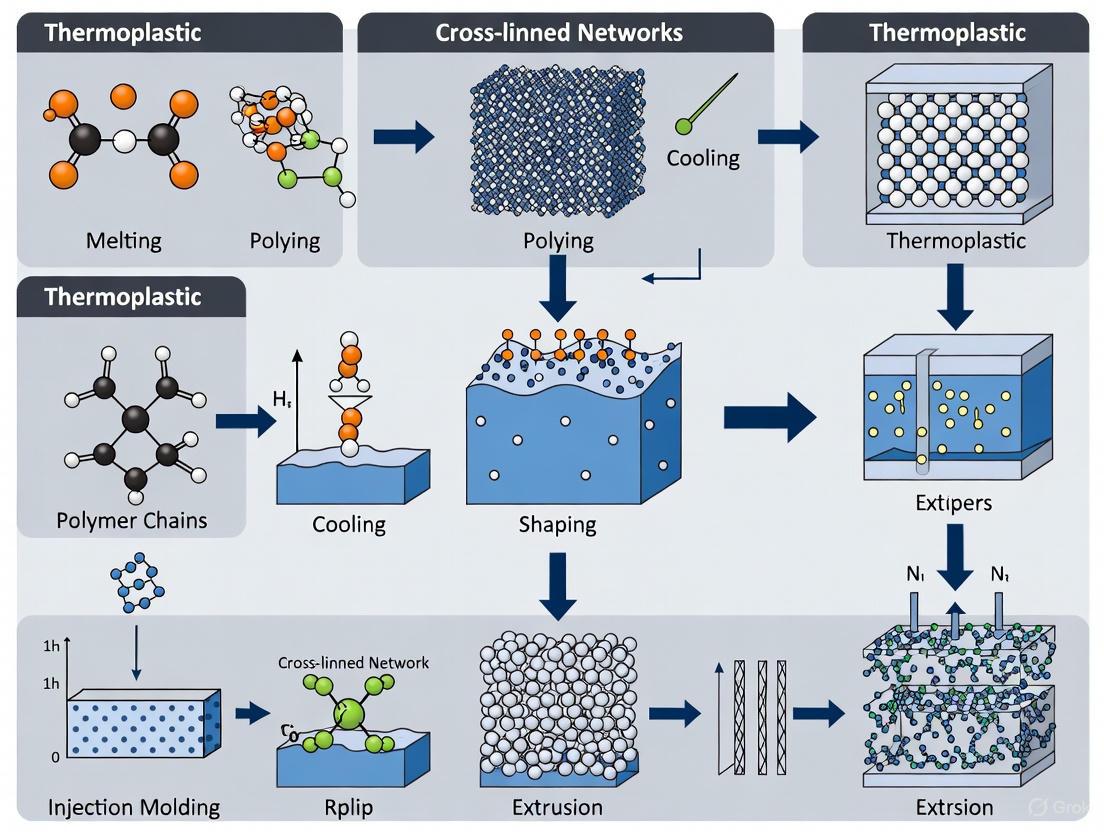
This article provides a comprehensive analysis of thermoplastic polymers, tailored for researchers and drug development professionals.
Thermoplastic Polymers: Properties, Biomedical Applications, and Advanced Material Design for Drug Delivery
Abstract
This article provides a comprehensive analysis of thermoplastic polymers, tailored for researchers and drug development professionals. It explores fundamental material properties, structure-property relationships, and advanced processing techniques like additive manufacturing. The scope includes specialized applications in controlled drug delivery, tissue engineering, and smart thermo-responsive systems, alongside critical discussions on material selection, troubleshooting processing challenges, and validation through standardized testing. The content synthesizes current research and future directions to guide the development of next-generation biomedical devices and therapies.
Understanding Thermoplastic Polymers: Molecular Structures and Fundamental Properties
This technical guide provides an in-depth examination of thermoplastic polymers, focusing on their defining reversible thermal behavior and fundamental distinctions from thermosetting polymers. Within the broader context of advanced polymer research, this paper details the molecular mechanisms underpinning thermoplasticity, presents comparative quantitative data, and explores advanced applications driving innovation in aerospace, electronics, and biomedical fields. The content is structured to serve researchers and scientists by synthesizing current material properties, research trends, and standardized experimental protocols essential for material selection and development in high-performance applications.
Polymers are broadly classified into two categories based on their behavioral response to thermal energy: thermoplastics and thermosets. This differentiation is not merely procedural but is rooted in fundamental molecular architecture, which dictates processing methodologies, material properties, and end-of-life options, such as recyclability [1] [2].
Thermoplastics are characterized by polymer chains that are linear or slightly branched, lacking permanent covalent bonds between the chains. This structure allows them to be repeatedly softened and melted when heated and solidified upon cooling, a process that is fundamentally reversible [1] [3]. This reversibility enables recycling and remolding, making them highly versatile.
In contrast, thermosetting plastics (thermosets) undergo an irreversible chemical curing process. During this process, polymer chains form a dense, three-dimensional network of covalent bonds, known as cross-links [1] [4]. This cross-linked structure prevents thermosets from being remelted or reshaped upon reheating; instead, they will chemically degrade and char [1].
The selection between thermoplastic and thermoset materials is critical in product design, impacting everything from manufacturing costs and production rates to structural integrity, thermal performance, and environmental sustainability [1] [5].
Fundamental Mechanism of Thermoplasticity
Molecular Structure and Reversible Thermal Transitions
The defining property of thermoplastics—their reversible thermal behavior—stems directly from their molecular structure. These polymers consist of long, discrete molecular chains held together by weak secondary intermolecular forces, such as van der Waals forces and hydrogen bonding [1] [3].
- Linear and Branched Chains: Unlike the permanently cross-linked networks in thermosets, the chains in thermoplastics are physically entangled but not chemically bound to each other [3] [2].
- Effect of Heat: When heat is applied, the input of thermal energy overcomes the weak secondary forces between the chains. This allows the chains to slide past one another, rendering the material soft and pliable (melted) [1].
- Reversibility: Upon cooling, the molecular motion slows, and the secondary intermolecular forces re-establish, causing the material to regain its solid-state rigidity. This heating-cooling cycle can be repeated multiple times with minimal degradation of the polymer's inherent properties, enabling reprocessing and recycling [3] [5].
The following diagram illustrates the reversible thermal process and molecular dynamics of thermoplastics, contrasting with the irreversible curing of thermosets.
Classification of Thermoplastics
Thermoplastics are further categorized based on their structural order, which significantly influences their optical, mechanical, and thermal properties.
Amorphous Thermoplastics: These possess a randomly ordered, entangled molecular structure, lacking long-range arrangement. They do not have a sharp melting point but instead soften gradually over a wide temperature range as they pass through their glass transition temperature (Tg). This structure typically results in materials that are translucent or transparent, exhibit low shrinkage, and have poor chemical resistance. Examples include Polystyrene (PS), Polyvinyl Chloride (PVC), and Acrylonitrile Butadiene Styrene (ABS) [3] [6].
Semi-Crystalline Thermoplastics: These feature regions of highly ordered, packed molecular chains (crystallites) embedded within amorphous regions. This structure gives them a sharp melting point (Tm), higher chemical resistance, greater strength, and higher shrinkage during molding. They are typically opaque or translucent. Common examples are Polyethylene (PE), Polypropylene (PP), Polyamide (PA, Nylons), and Polyether Ether Ketone (PEEK) [3] [6].
Furthermore, thermoplastics are often graded by performance and cost into commodity (e.g., PE, PP, PVC), engineered (e.g., PC, POM, PA), and high-performance (e.g., PEEK, PPS, LCP) categories, each serving distinct application sectors [3] [6].
Comparative Analysis: Thermoplastics vs. Thermosets
The molecular-level differences between thermoplastics and thermosets manifest as distinct practical characteristics. The table below provides a direct comparison of their key properties.
Table 1: Quantitative and Qualitative Comparison of Thermoplastics and Thermosets
| Property | Thermoplastics | Thermosets |
|---|---|---|
| Molecular Structure | Linear or branched chains [4] [2] | Cross-linked, 3D network [4] [2] |
| Response to Heat | Softens/melts reversibly [1] [3] | Chars/degrades irreversibly [1] |
| Recyclability | Highly recyclable [1] [5] | Non-recyclable [1] [5] |
| Typical Melting Point (Tm) | Distinct Tm for semi-crystalline types [3] | Does not melt, degrades at high T [1] |
| Continuous Use Temperature | Generally lower | Higher (e.g., >200°C for epoxies) [1] |
| Dimensional Stability | Prone to creep over time/load [3] | Excellent, high rigidity [1] [5] |
| Chemical Resistance | Moderate to good, varies by type [3] | Superior (e.g., to fuels, solvents) [1] [7] |
| Impact Resistance | Generally high [1] [5] | Can be brittle [1] |
| Manufacturing Cost | Higher material cost, efficient processing [1] [5] | Lower material cost, longer cycle times [1] |
| Primary Processing Methods | Injection Molding, Extrusion, Thermoforming [3] [8] | Reaction Injection Molding (RIM), Resin Transfer Molding (RTM) [1] [8] |
Performance Trade-offs and Selection Criteria
The data in Table 1 highlights inherent performance trade-offs. Thermosets provide superior thermal stability, structural integrity, and chemical resistance due to their cross-linked matrix, making them indispensable for under-the-hood automotive components, electrical insulators, and aerospace composites that must withstand extreme environments [1] [2].
Thermoplastics, while generally having lower maximum service temperatures, offer unparalleled manufacturing flexibility, impact resistance, and sustainability benefits through their recyclability. The emergence of High-Performance Thermoplastics (HPTPs) like PEEK and PPS has significantly narrowed the thermal and mechanical performance gap, enabling their adoption in demanding sectors [7] [6].
Advanced Applications and Research Trends
Advanced thermoplastics are experiencing rapid growth, driven by global trends in lightweighting, electrification, and sustainability.
High-Performance Thermoplastics in Avionics and Aerospace
The aerospace industry is leveraging high-performance thermoplastics like PEEK, PEI (Ultem), and PPS to achieve significant weight reduction, which directly translates to improved fuel efficiency and lower emissions [7]. These materials are critical in next-generation aircraft, such as the Airbus A350 and Boeing 787, which are approximately 50% composite materials [7].
- Key Applications: Sensor housings, cable insulation, brackets, and bushings [7].
- Material Demands: Must maintain structural integrity under extreme thermal cycling (e.g., -55°C to +95°C), exhibit low outgassing in vacuum (per NASA ASTM E595), and resist jet fuels and hydraulic fluids [7]. PEEK, for instance, has a continuous service temperature of 260°C and a melting point of 343°C [7].
Electrification and Automotive Lightweighting
The markets for electric vehicles (EVs) and e-mobility are major drivers for engineering thermoplastics.
- EV Applications: PBT, Polyamide (Nylon), and Polycarbonate blends are central to battery housings, connectors, charging systems, and power electronics, where they provide electrical insulation, thermal management, and flame retardancy [9].
- Market Growth: The Advanced Engineering Thermoplastics (AETs) market is projected to grow from USD 13.8 billion in 2025 to USD 24.5 billion by 2032, with a strong CAGR of 7.6% [9].
Sustainability and Material Innovation
Growing environmental regulations are accelerating research into sustainable material solutions.
- Recyclability: The innate recyclability of thermoplastics positions them favorably in a circular economy model [9] [5].
- Bio-based Thermoplastics: Innovations like large-scale sugarcane-based Polylactic Acid (PLA) production are gaining market traction, reducing reliance on petrochemical feedstocks [9].
- Polymer Compatibilizers: Research is intensifying in using thermoplastic elastomer-grafted compatibilizers (e.g., MAH-g-SEBS, GMA-g-POE) to enhance the compatibility and properties of polymer blends and composites, facilitating the use of recycled content and bio-based polymers [10].
Experimental Protocols for Material Characterization
Standardized testing is crucial for validating material properties for research and qualification. Below are protocols for key experiments relevant to thermoplastic analysis.
Thermal Cycling for Avionics Components
Objective: To evaluate the dimensional stability and integrity of thermoplastic components subjected to in-flight temperature extremes [7].
Workflow Diagram:
Methodology:
- Sample Preparation: Condition test specimens at 50% relative humidity for 24 hours [7].
- Test Parameters: Program an environmental chamber to cycle between -55°C and +85°C (or up to +95°C for more severe testing). The standard transition rate is 10°C per minute to simulate rapid altitude changes [7].
- Cycling: Expose the components to a predetermined number of cycles (e.g., 50-1000 cycles).
- Post-Test Analysis: Visually and microscopically inspect for failures such as warpage, cracking, or solder joint fatigue. Measure critical dimensions to quantify dimensional stability [7].
Outgassing Measurement for Space-Grade Components
Objective: To determine the suitability of thermoplastics for vacuum (space) environments by measuring volatile content per NASA standards [7].
Methodology:
- Pre-conditioning: Weigh samples and condition at 50% relative humidity for 24 hours [7].
- Vacuum Exposure: Place samples in a vacuum chamber at 125°C for 24 hours [7].
- Measurement:
- Total Mass Loss (TML): Weigh the sample after exposure. TML must be ≤ 1.0%.
- Collected Volatile Condensable Materials (CVCM): Measure the mass of volatiles that condense on a cooled collector plate (typically 25°C). CVCM must be ≤ 0.10%. For highly sensitive optical applications, CVCM < 0.01% may be required [7].
Analysis of Polymer Blends Using Compatibilizers
Objective: To improve the interfacial compatibility and mechanical properties of immiscible polymer blends, a key area in polymer research [10].
Methodology:
- Selection: Choose an appropriate compatibilizer based on the blend components. Common compatibilizers include Maleic Anhydride-grafted-SEBS (MAH-g-SEBS) for polyolefin blends or Glycidyl Methacrylate-grafted-POE (GMA-g-POE) for blends involving reactive groups [10].
- Melt Blending: Use a twin-screw extruder to compound the base polymer matrix, dispersed phase, and compatibilizer (typically 1-5% by weight). Key parameters are screw speed, temperature profile, and feed rate [10].
- Characterization:
- Morphology: Use Scanning Electron Microscopy (SEM) to analyze phase dispersion and interface quality.
- Mechanical Testing: Perform tensile and impact tests to quantify improvements in toughness and strength [10].
The Scientist's Toolkit: Key Research Reagents and Materials
Table 2: Essential Materials for Advanced Thermoplastics Research
| Research Material / Reagent | Function and Application |
|---|---|
| PEEK (Polyetheretherketone) | High-performance matrix for extreme environments; used in sensor housings, avionics brackets for its high melting point (343°C) and chemical resistance [7]. |
| MAH-g-SEBS (Maleic Anhydride-grafted-Styrene-Ethylene-Butylene-Styrene) | Reactive compatibilizer; enhances toughness and interfacial adhesion in polyolefin blends and composites [10]. |
| PEI (Polyetherimide, Ultem) | Amorphous high-performance thermoplastic; used for lightweight structural brackets and ducting requiring high flame, smoke, and heat resistance [7]. |
| GMA-g-POE (Glycidyl Methacrylate-grafted-Polyethylene-Octene) | Reactive compatibilizer; the epoxy functional group of GMA can react with polymers like polyamide or polyester, improving blend compatibility [10]. |
| Carbon Fiber Reinforcements | Dispersed phase additive; significantly increases tensile strength, modulus, and thermal stability of thermoplastic composites [7] [6]. |
The fundamental identity of thermoplastic polymers is defined by their reversible thermal behavior, a direct consequence of their linear or branched molecular structure held by secondary intermolecular forces. This stands in stark contrast to the irreversibly cross-linked network of thermosets. This foundational difference propagates through every aspect of material performance, from the superior recyclability and manufacturing flexibility of thermoplastics to the exceptional thermal stability and structural rigidity of thermosets.
Current research and market trends indicate a growing dominance of advanced engineering and high-performance thermoplastics, driven by the critical needs for lightweighting in aerospace and automotive electrification, enhanced material sustainability, and the development of sophisticated polymer blends through compatibilizer technology. A deep understanding of the principles, properties, and characterization methods detailed in this guide is therefore essential for researchers and scientists pushing the boundaries of polymer science and its applications in modern technology.
The molecular architecture of a polymer—the way in which its chains are arranged and interconnected—serves as the fundamental determinant of its macroscopic properties and ultimate applications. For researchers focused on thermoplastic polymers, understanding the distinction between linear and cross-linked architectures is paramount, as this distinction directly dictates material processability, mechanical performance, and thermal stability [11] [12]. Linear polymers, characterized by long, chain-like molecules resembling spaghetti, are held together primarily by weaker secondary forces such as van der Waals forces or hydrogen bonding [12]. In contrast, cross-linked polymers form a three-dimensional network where polymer chains are connected via strong covalent bonds, creating a permanent, interconnected structure [11]. This foundational difference in molecular structure creates a divergence in material behavior, particularly in response to heat, which classifies polymers into two broad categories: thermoplastics (typically linear or branched) and thermosets (cross-linked or networked) [1].
Within the context of advanced materials research, the deliberate manipulation of polymer architecture provides a powerful pathway for tailoring properties to meet specific application demands. The ability to design polymers with precise control over branching, cross-link density, and network formation enables scientists to engineer materials with unprecedented combinations of strength, toughness, and environmental resistance [11] [13]. This technical guide explores the fundamental structure-property relationships in linear and cross-linked polymers, providing detailed experimental methodologies and analytical frameworks for researchers engaged in the development of next-generation polymeric materials.
Fundamental Structures and Their Characteristics
Linear Polymers
Linear polymers consist of a primary backbone of repeating monomer units without any covalent connections between different chains [12]. This relatively simple structure allows the polymer chains to pack efficiently, often resulting in semi-crystalline morphologies where ordered crystalline regions coexist with disordered amorphous domains. The absence of permanent interchain connections means that the material relies on temporary, physical entanglements and weaker intermolecular forces (e.g., van der Waals forces, dipole-dipole interactions, or hydrogen bonding) to maintain structural integrity [12]. When sufficient thermal energy is applied, these weak forces are readily overcome, allowing the chains to slide past one another and enabling the polymer to be repeatedly melted and reshaped—a defining characteristic of thermoplastic behavior [1] [14].
The physical properties of linear polymers are significantly influenced by their molecular weight and chain length. Higher molecular weights generally lead to increased chain entanglements, resulting in enhanced mechanical strength, toughness, and melt viscosity [11]. However, linear polymers exhibit a distinct limitation: they will eventually dissolve in compatible solvents or swell significantly when exposed to chemical agents, as solvent molecules can penetrate and separate the polymer chains without breaking primary covalent bonds [15]. Common examples of linear polymers prevalent in research and industrial applications include polyethylene (PE), polypropylene (PP), polyvinyl chloride (PVC), and nylon [16] [12].
Cross-linked Polymers
Cross-linked polymers possess a fundamentally different architecture characterized by covalent bonds connecting adjacent polymer chains into a permanent three-dimensional network [11] [15]. These cross-links, often referred to as "chemical bridges," effectively transform multiple individual polymer chains into a single macromolecular network. This network structure profoundly alters the material's response to environmental stimuli compared to its linear counterparts. Unlike linear polymers, cross-linked structures cannot melt or flow upon heating because the covalent cross-links remain intact even at elevated temperatures [1] [17]. Instead of flowing, highly cross-linked polymers will typically degrade or char when exposed to excessive heat, as the thermal energy is sufficient to break the primary chains themselves before the cross-links fail [1].
The cross-link density—the number of cross-links per unit volume—serves as a critical parameter determining the final properties of the material. A low degree of cross-linking, as seen in elastomers like vulcanized rubber, restricts permanent chain slippage while still allowing for substantial chain mobility and elongation, resulting in highly elastic materials [15] [13]. As cross-link density increases, the polymer becomes more rigid, dimensionally stable, and resistant to creep, ultimately forming hard, glassy thermosets such as epoxies and phenolic resins [11] [13]. This architectural transformation renders cross-linked polymers insoluble in all solvents, though they may exhibit varying degrees of swelling depending on the cross-link density and polymer-solvent compatibility [15]. The swollen state represents an equilibrium between the elastic retraction force of the stretched network and the osmotic driving force for solvent penetration.
Table 1: Comparative Characteristics of Linear and Cross-linked Polymers
| Property | Linear Polymers | Cross-linked Polymers |
|---|---|---|
| Interchain Forces | Weak van der Waals, hydrogen bonds [12] | Strong covalent bonds [11] |
| Response to Heat | Melt upon heating, can be remolded [1] | Do not melt, degrade at high temperatures [1] |
| Solubility | Soluble in appropriate solvents [15] | Insoluble, may swell [15] |
| Primary Material Class | Thermoplastics [12] | Thermosets [1] |
| Recyclability | Recyclable and reshapable [14] | Generally non-recyclable [14] |
| Typical Examples | PE, PP, PVC, Nylon [16] | Epoxy, Vulcanized Rubber, Phenolics [11] |
Structure-Property Relationships
The relationship between molecular architecture and macroscopic properties represents a cornerstone of polymer science, enabling researchers to predict and engineer material behavior through structural design.
Mechanical Properties
The mechanical performance of polymers exhibits a strong dependence on architectural structure. Linear polymers generally demonstrate good toughness and impact resistance, but may be susceptible to creep (time-dependent deformation under load) due to chain slippage over time [11] [13]. Their mechanical properties are highly dependent on molecular weight—increasing chain length enhances mechanical strength up to a critical point where entanglement density provides sufficient load distribution across chains [11].
Cross-linked polymers exhibit markedly different mechanical behavior dictated by their network structure. The introduction of cross-links dramatically enhances tensile strength, hardness, and dimensional stability by preventing permanent chain slippage [11] [13]. The cross-link density serves as the primary regulator of mechanical behavior: low cross-link densities produce elastomeric materials capable of large, reversible deformations (e.g., rubber bands), while high cross-link densities yield rigid, glassy materials with high modulus but limited elongation (e.g., epoxy resins) [15] [13]. An important mechanical limitation of highly cross-linked systems is their tendency toward brittle fracture with reduced impact resistance, as the densely cross-linked network impedes plastic deformation mechanisms that dissipate energy [14].
Thermal Properties
Thermal behavior represents one of the most distinguishing characteristics between linear and cross-linked architectures. Linear polymers undergo several important thermal transitions. The glass transition temperature (Tg) marks the transition from a glassy to a rubbery state in amorphous regions, while the melting temperature (Tm) corresponds to the disruption of crystalline domains [11]. Above these transitions, linear polymers flow as viscous liquids, enabling thermoplastic processing techniques such as injection molding and extrusion [1].
Cross-linked polymers display fundamentally different thermal behavior due to their continuous network structure. These materials do not exhibit a true melting transition and instead maintain their structural integrity up to the thermal decomposition temperature [1] [17]. Cross-linking typically increases the glass transition temperature (Tg) by restricting chain segment mobility in the amorphous regions, with the magnitude of this increase being proportional to cross-link density [11]. This enhanced thermal stability makes cross-linked polymers indispensable for applications requiring prolonged exposure to elevated temperatures, such as automotive components, aerospace composites, and thermal insulation systems [11] [1].
Chemical Resistance
Chemical resistance varies significantly between linear and cross-linked polymer architectures. Linear polymers are generally susceptible to attack by solvents and chemicals that disrupt the secondary forces between chains, leading to dissolution or swelling depending on the polymer-solvent compatibility [15]. This susceptibility can limit their use in aggressive chemical environments.
Cross-linked polymers exhibit superior chemical resistance due to their interconnected network, which acts as a barrier against solvent penetration and chemical attack [11]. Rather than dissolving, these materials may reach an equilibrium swelling state where solvent uptake is balanced by the elastic retraction of the stretched network [15]. The degree of swelling is inversely related to cross-link density—higher cross-link densities result in less swelling. Different cross-linked systems offer specialized chemical resistance profiles; for example, vinyl ester resins demonstrate excellent resistance to acids, alkalis, and oxidizing agents, while epoxy resins show broad resistance to various chemicals including bases [11].
Table 2: Thermal and Chemical Property Comparison
| Property | Linear Polymers | Cross-linked Polymers |
|---|---|---|
| Melting Behavior | Distinct melting point [1] | No melting point, degrades instead [1] |
| Glass Transition (Tg) | Distinct Tg, affected by molecular weight [11] | Increased Tg, proportional to cross-link density [11] |
| Thermal Stability | Limited by melting temperature [1] | High, maintains shape until decomposition [17] |
| Solvent Resistance | Dissolves in compatible solvents [15] | Insoluble, limited swelling [15] |
| Acid/Base Resistance | Varies by polymer chemistry | Excellent, especially vinyl esters and epoxies [11] |
Experimental Protocols for Architectural Analysis
Synthesis and Cross-linking Methodologies
The experimental creation and characterization of polymer architectures requires precise control of synthesis parameters and cross-linking protocols. The following methodologies represent key approaches for generating and analyzing linear and cross-linked polymer systems.
Chemical Cross-linking Protocol
Chemical cross-linking represents the most common method for creating permanent, three-dimensional polymer networks. The following protocol describes a generalized procedure for cross-linking polyolefins using dicumyl peroxide (DCP) as a model cross-linking agent [11].
Materials Required:
- Polymer substrate (e.g., polyethylene, polypropylene)
- Cross-linking agent (e.g., dicumyl peroxide, 98% purity)
- Internal mixer (e.g., Brabender Plastograph) or twin-screw extruder
- Compression molding press
- Analytical balance (±0.0001 g accuracy)
Procedure:
- Formulation Preparation: Weigh predetermined quantities of polymer and DCP cross-linker (typical concentration range: 0.5-3.0 phr [parts per hundred resin]) using an analytical balance.
- Melt Blending: Feed the polymer and cross-linker mixture into an internal mixer preheated to 20-30°C above the polymer's melting point but below the peroxide decomposition temperature (e.g., 130°C for polyethylene with DCP). Mix at 60 rpm for 5-8 minutes until torque stabilization indicates uniform dispersion.
- Cross-linking Activation: Increase mixer temperature to the peroxide activation temperature (e.g., 160-180°C for DCP) for 5-10 minutes to initiate the cross-linking reaction, monitoring torque increase as evidence of network formation.
- Sheet Formation: Transfer the cross-linked material to a preheated compression mold and press at 10-15 MPa for 5-10 minutes at the cross-linking temperature, followed by cooling under pressure to room temperature.
- Post-processing: Machine the cross-linked sheets into appropriate specimens for subsequent characterization.
Key Experimental Variables:
- Cross-linker concentration (directly controls cross-link density)
- Processing temperature and time (affects cross-linking efficiency and potential degradation)
- Polymer molecular characteristics (molecular weight, branching)
Characterization Techniques
Analytical characterization provides essential data for understanding the relationship between polymer architecture and material properties.
Solvent Extraction Testing
Solvent extraction represents a straightforward, quantitative method for determining the degree of cross-linking in polymer networks by measuring the insoluble gel fraction [15].
Materials Required:
- Solvent reflux apparatus (round-bottom flask, condenser, heating mantle)
- Appropriate solvent (e.g., xylene for polyolefins, toluene for rubbers)
- Precision balance (±0.0001 g)
- Drying oven
- Stainless steel mesh cages or tea bags
Procedure:
- Sample Preparation: Precisely weigh (W₀) approximately 0.5g of cross-linked polymer and place it in a pre-weighed stainless steel mesh cage.
- Extraction: Immerse the sample in boiling solvent for 12-24 hours to extract all soluble (uncross-linked) material.
- Recovery: Remove the sample from solvent and dry in a vacuum oven at elevated temperature (e.g., 80°C) until constant weight is achieved (typically 24 hours).
- Final Weighing: Precisely determine the final weight of the dried, extracted sample (Wƒ).
- Calculation: Calculate the gel fraction (cross-linked portion) using the formula: Gel Fraction (%) = (Wƒ / W₀) × 100
Interpretation:
- Values approaching 100% indicate highly cross-linked networks
- Lower values suggest incomplete cross-linking or network defects
- Comparison across samples provides relative cross-link density assessment
Melt Flow Index (MFI) Monitoring
Melt Flow Index measurement provides an efficient method for monitoring the progression of cross-linking in polyolefin systems by tracking changes in melt processability [11].
Materials Required:
- Melt flow indexer (standard ASTM D1238 apparatus)
- Temperature control unit (±0.1°C accuracy)
- Analytical balance (±0.0001 g)
- Timing device
Procedure:
- Instrument Preparation: Preheat the MFI apparatus to the standard temperature for the polymer being tested (e.g., 190°C for polyethylene, 230°C for polypropylene).
- Sample Loading: Charge the barrel with approximately 4-5g of polymer sample.
- Equilibration: Allow the sample to thermally equilibrate for 4-5 minutes.
- Measurement: Apply the standard weight (2.16 kg for polyethylene) and collect extrudate over a timed interval (typically 2-10 minutes, depending on flow rate).
- Calculation: Weigh the extrudate and calculate the melt flow rate in g/10 min according to ASTM D1238.
Data Interpretation:
- Decreasing MFI values indicate increasing molecular weight and cross-link formation
- Drastic MFI reduction suggests extensive network formation
- Complete absence of flow may indicate high cross-link density
Table 3: Essential Research Reagents and Materials
| Reagent/Material | Function/Application | Research Considerations |
|---|---|---|
| Dicumyl Peroxide (DCP) | Free radical generator for polyolefin cross-linking [11] | Concentration controls cross-link density; thermal decomposition characteristics critical |
| Sulfur | Traditional vulcanizing agent for rubber [11] [15] | Forms polysulfide bridges between unsaturated chains; accelerator systems often required |
| Epoxy Resins (DGEBA) | Form highly cross-linked networks with hardeners [11] | Stoichiometric balance with curing agent critical; wide range of hardeners available |
| Divinylbenzene | Cross-linking co-monomer in polymerization [13] | Provides pendant vinyl groups for network formation; used in styrenic systems |
| Toluene/Xylene | Solvents for extraction testing [15] | Polymer-specific selection; reflux conditions required for complete extraction |
Advanced Architectural Systems and Research Applications
Hybrid and Complex Architectures
Beyond simple linear and cross-linked systems, advanced polymer architectures offer enhanced property profiles and functionality. Branched polymers represent an intermediate architecture where side chains extend from the main backbone, disrupting chain packing and reducing crystallinity compared to linear analogs [13] [12]. Low-density polyethylene (LDPE), with its substantial short-chain and long-chain branching, exemplifies how branching can improve processability and flexibility while reducing density [13].
Network polymers constitute an extreme case of cross-linking where a high density of three-dimensional connections creates a continuous network structure [13] [12]. These materials, including epoxy resins and phenol-formaldehyde systems, exhibit exceptional thermal stability, mechanical strength, and chemical resistance, but are typically brittle and cannot be processed after curing [13]. Recent research focuses on controlled cross-linking methodologies that enable precise spatial and density control of cross-links, potentially allowing for optimization of both strength and toughness in the same material.
Emerging Research Directions
Contemporary research in polymer architectures explores several promising directions with significant implications for advanced applications. Supramolecular polymers utilize reversible non-covalent interactions (hydrogen bonding, ionic interactions, π-π stacking) to create physically cross-linked networks that can be reprocessed while maintaining thermoset-like properties [11]. These materials offer potential solutions to the recyclability challenges associated with conventional thermosets.
Stimuli-responsive networks incorporate cross-links that respond to specific environmental triggers such as pH, light, or redox conditions, enabling dynamically tunable material properties [11]. In biomedical applications, research continues on degradable cross-linked systems for drug delivery and tissue engineering, where controlled network breakdown enables predictable release profiles or scaffold remodeling [11]. Additionally, advanced characterization techniques including solid-state NMR, neutron scattering, and high-resolution rheology provide unprecedented insights into network topology and dynamics, facilitating more precise structure-property relationships.
Visualizing Architectural Transitions and Experimental Workflows
The following diagrams illustrate key concepts and experimental approaches for analyzing polymer architectures, providing visual representations of the structural relationships and characterization methodologies discussed in this guide.
Polymer Architecture Transition Pathways
Polymer Cross-linking Analysis Workflow
For researchers and scientists engaged in thermoplastic polymers research, a rigorous understanding of critical thermal properties is fundamental to material selection, polymer design, and predicting product performance. These properties dictate a polymer's behavior during processing and its ultimate service conditions. Within the context of drug development, this knowledge is crucial for applications ranging from medical device housing and surgical instruments to drug delivery systems and labware, where materials must maintain structural integrity under thermal stress. This guide provides an in-depth examination of three cornerstone thermal properties: Glass Transition Temperature (Tg), Melting Point (Tm), and Heat Deflection Temperature (HDT). It is structured to serve as a technical reference, complete with comparative data tables, detailed experimental protocols, and essential resource lists to support research and development activities.
Defining the Critical Thermal Properties
Glass Transition Temperature (Tg)
The Glass Transition Temperature (Tg) is the temperature region where an amorphous polymer transitions from a hard, glassy state to a soft, rubbery state [18]. This transition marks the onset of long-range, coordinated molecular motion in the polymer chains, which occurs over a temperature range rather than at a single sharp point [19]. It is a second-order transition associated with a change in the heat capacity and the coefficient of thermal expansion, but without a latent heat of transition. The value of Tg profoundly influences mechanical properties such as stiffness, brittleness, and impact resistance at a given use temperature [19]. For a semi-crystalline polymer, the amorphous regions undergo this transition, while the crystalline regions remain ordered until the melting point.
Melting Point (Tm)
The Melting Point (Tm) is the temperature at which the crystalline regions of a semi-crystalline polymer melt, transforming from an ordered solid to a disordered liquid melt [19]. This is a first-order transition characterized by an endothermic peak and an associated latent heat. The Tm defines the upper limit for melt-processing techniques like injection molding and extrusion and sets the maximum service temperature for applications requiring structural integrity. It is always higher than the Tg for a given semi-crystalline polymer, with an empirical relationship often noted as ( Tm \approx 1.5 Tg ) when both are expressed in Kelvin [19].
Heat Deflection Temperature (HDT)
The Heat Deflection Temperature (HDT), also known as the Deflection Temperature Under Load (DTUL), is a pragmatic measure of a polymer's short-term resistance to deformation under a specified flexural load at elevated temperatures [20] [21]. Essentially, it is the temperature at which a standard polymer test bar deflects by 0.25 mm under a defined load in a uniformly heated fluid bath [20]. Unlike Tg and Tm, which are intrinsic material properties, HDT is a comparative index of thermal performance under load, heavily influenced by factors like polymer composition, fillers, and reinforcement [20]. It is critically important for screening materials for structural applications in elevated temperature environments, such as automotive components and electronics housing [20].
Table 1: Comparative Overview of Key Thermal Properties
| Property | Nature of Transition | Molecular Scale Phenomenon | Primary Influence on Material |
|---|---|---|---|
| Glass Transition Temperature (Tg) | Second-order transition (change in slope of property curve) | Onset of long-range coordinated motion in amorphous regions [19] [18] | Transforms from a hard/glassy to a soft/rubbery material; affects stiffness and toughness [19] |
| Melting Point (Tm) | First-order transition (endothermic peak with latent heat) | Melting of crystalline regions into an amorphous melt [19] | Loss of structural integrity; defines upper limit for melt processing [19] |
| Heat Deflection Temperature (HDT) | Empirical property measured under specific test conditions | A practical measure of stiffness retention under load and heat [20] [21] | Indicates the upper service temperature for a material under a specific mechanical load [20] |
Quantitative Data and Comparative Analysis
The following tables provide representative data for common thermoplastics, allowing for direct comparison and initial material screening. Note that specific grades, additives, and reinforcements can significantly alter these values.
Table 2: Thermal Properties of Common Thermoplastics
| Polymer Name | Tg (°C) | Tm (°C) | HDT @ 1.8 MPa (°C) |
|---|---|---|---|
| ABS | ~105 [22] | - | 88 - 100 [20] [21] |
| Polycarbonate (PC), high heat | ~150 [19] | - | 140 - 180 [21] |
| Polyetheretherketone (PEEK) | ~143 | ~343 | 150 - 160 [21] |
| Polyetherimide (ULTEM) | ~217 | - | 190 - 200 [21] |
| Polypropylene (PP) Homopolymer | ~-20 | ~160 | 50 - 60 [21] |
| PP, 30-40% Glass Fiber | ~-20 | ~160 | 125 - 140 [21] |
| Polysulfone (PSU) | ~190 | - | 160 - 174 [21] |
Table 3: Factors Influencing Thermal Properties
| Factor | Effect on Tg | Effect on Tm | Effect on HDT |
|---|---|---|---|
| Molecular Weight | Increases with molecular weight due to chain entanglement [19] | Increases with molecular weight [19] | Generally increases |
| Chain Rigidity / Aromatic Groups | Increases significantly | Increases significantly | Increases significantly |
| Polar Groups / Hydrogen Bonding | Increases | Increases | Increases |
| Crystallinity | Minor direct effect (affects amorphous phase) | Defines the transition; higher crystallinity sharpens Tm | Increases HDT [20] |
| Plasticizers | Decreases Tg by increasing free volume [19] | Little to no effect | Decreases HDT [20] |
| Fillers & Reinforcement (e.g., Glass Fiber) | Very little effect (an intrinsic property) [20] | Very little effect (an intrinsic property) [20] | Increases HDT substantially [20] [21] |
| Crosslinking | Increases Tg by restricting chain mobility [19] | Increases and broadens Tm | Increases |
Experimental Protocols for Measurement
Accurate characterization of thermal properties requires standardized methods. The following sections detail the primary experimental protocols cited in research and industry.
Measuring Glass Transition Temperature (Tg)
1. Differential Scanning Calorimetry (DSC) - Principle: This technique detects changes in the heat capacity of a polymer as it undergoes the glass transition. The sample and a reference are heated at a controlled rate, and the difference in heat flow required to maintain both at the same temperature is measured [19]. - Protocol: A small sample (5-20 mg) is sealed in a crucible and placed in the DSC cell alongside an empty reference crucible. The experiment is run with a heating rate typically between 10-20°C/min under an inert nitrogen atmosphere. The glass transition appears as a step change in the heat flow curve. The Tg value is typically reported as the midpoint of this step [22] [19]. - Advantages: Requires a very small sample size, is quick and highly reproducible [22].
2. Dynamic Mechanical Analysis (DMA) - Principle: DMA measures the viscoelastic response (storage modulus E', loss modulus E", and tan δ) of a material as a function of temperature, frequency, or time. The glass transition is associated with a dramatic drop in the storage modulus and a peak in the loss modulus and tan δ [22] [19]. - Protocol: A polymer bar or film of defined geometry is clamped and subjected to a small oscillating stress. The temperature is ramped, usually at 2-5°C/min. The Tg can be reported as the onset of the drop in E', the peak of E", or the peak of tan δ, with the tan delta peak typically being several degrees higher than the DSC midpoint [22]. - Advantages: Extremely sensitive to subtle molecular motions and provides mechanical context to the transition.
3. Thermomechanical Analysis (TMA) - Principle: TMA monitors dimensional changes (expansion or penetration) in a sample as a function of temperature. The coefficient of thermal expansion (CTE) changes significantly at the Tg [22] [19]. - Protocol: A probe rests on the sample with a small, constant force. The temperature is increased, and the probe's displacement is tracked. The Tg is determined from the intersection of the tangents drawn from the glassy and rubbery expansion regions on the thermal expansion curve [22]. - Advantages: Directly measures dimensional stability and CTE.
Measuring Melting Point (Tm)
Differential Scanning Calorimetry (DSC) - Principle: As a semi-crystalline polymer heats up, its crystalline regions absorb energy (latent heat of fusion) and melt, producing a characteristic endothermic peak in the DSC curve. - Protocol: Using a similar setup to the Tg measurement, the sample is heated through its melting region. The Tm is universally reported as the extrapolated onset temperature or the peak temperature of the endothermic melting event [19]. The area under the peak corresponds to the heat of fusion, which can be used to calculate the degree of crystallinity.
Measuring Heat Deflection Temperature (HDT)
ASTM D648 / ISO 75 - Principle: This test determines the temperature at which a standard polymer test bar deflects 0.25 mm under a defined three-point bending load while the surrounding fluid bath is heated at a uniform rate [20] [21]. - Protocol: - A test bar (typically 127 mm x 13 mm x 3 mm) is placed on two supports 100 mm apart. - A specified load is applied to the midpoint of the bar edgewise. - The entire assembly is submerged in a heat-transfer fluid (usually oil), which is heated at 2°C/min. - The temperature at which the bar deflects by 0.25 mm is recorded as the HDT. - Common Loads: - 0.46 MPa (67 psi): Used for comparing softer materials or for applications with lower loads. - 1.8 MPa (264 psi): The most common load, used for comparing rigid materials and predicting maximum service temperatures under significant mechanical load [20] [21].
Diagram 1: Thermal Property Measurement Workflow
The Scientist's Toolkit: Research Reagent Solutions
This table details key equipment, materials, and standards essential for conducting thermal analysis in a research setting.
Table 4: Essential Materials and Equipment for Thermal Analysis
| Item / Solution | Function / Description | Key Considerations |
|---|---|---|
| Differential Scanning Calorimeter (DSC) | Measures heat flow associated with phase transitions (Tg, Tm, crystallization) as a function of temperature [19]. | Ideal for small sample sizes (5-20 mg). Provides data on enthalpy and specific heat capacity. |
| Dynamic Mechanical Analyzer (DMA) | Applies oscillating stress to measure viscoelastic properties (modulus, damping) and determine Tg with high sensitivity [22] [19]. | Multiple clamping fixtures (tension, 3-point bend, shear) are required for different sample geometries. |
| Thermomechanical Analyzer (TMA) | Measures dimensional changes (thermal expansion, softening) of a sample under a negligible load vs. temperature [22] [19]. | Crucial for measuring coefficient of thermal expansion (CTE) and Tg via penetration or expansion modes. |
| HDT Test Apparatus | Dedicated equipment for performing ASTM D648/ISO 75. Consists of a fluid bath, heating system, loading mechanism, and deflection measurement [20] [21]. | Requires standardized test bars. The oil bath must provide uniform heating at 2°C/min. |
| High-Purity Inert Gas (N₂) | Purging gas for DSC, TMA, and DMA instruments to prevent oxidative degradation of samples at high temperatures. | Essential for obtaining clean, reproducible data, especially for materials prone to oxidation. |
| Standard Reference Materials | Certified materials (e.g., Indium, Zinc) with known melting points and enthalpies for temperature and enthalpy calibration of DSC. | Regular calibration is mandatory for data integrity and cross-lab comparability. |
| ASTM D648 / ISO 75 Standards | Definitive test protocols for determining the Heat Deflection Temperature of plastics [20] [21]. | Must be strictly followed to ensure results are valid and comparable to published data. |
Interrelationships and Research Implications
Understanding the relationships between Tg, Tm, and HDT is critical for polymer design. For semi-crystalline polymers, the gap between Tg and Tm defines the temperature window for processing operations like thermoforming. A material's HDT is not a fundamental property but a practical one that reflects the combined influence of stiffness (modulus) and the thermal transitions (Tg and Tm) on which that modulus depends [20]. For amorphous polymers, the HDT typically occurs close to or just above the Tg, as the drastic drop in modulus in the rubbery state leads to deformation under load. For semi-crystalline polymers, the HDT can be much closer to the Tm, as the crystalline lattice maintains stiffness well above Tg.
Diagram 2: Logical Relationship from Structure to Application
In drug development, this knowledge is applied precisely. A polymer for a surgical tool must have a Tg and HDT high enough to withstand repeated sterilization cycles (e.g., autoclaving at 121°C). Conversely, a polymer for a flexible catheter may require a Tg below body temperature to remain pliable. For drug delivery systems, the Tg of the polymer matrix can control the rate of drug release. Therefore, mastering these thermal properties enables researchers to rationally design, select, and process thermoplastic polymers to meet the demanding specifications of modern pharmaceutical and medical applications.
Thermoplastic polymers represent a cornerstone of modern material science, with their utility spanning from everyday consumer goods to critical applications in the automotive, aerospace, and healthcare industries [6]. The performance of these materials in demanding environments is governed by a complex interplay of their mechanical integrity—encompassing strength, stiffness, and toughness—and their chemical resistance to solvents and other aggressive media [23] [24]. For researchers and drug development professionals, a deep understanding of these characteristics is not merely academic but fundamental to the rational design of components ranging from structural parts to advanced drug delivery systems [25] [26].
This whitepaper provides an in-depth analysis of the mechanical and chemical properties of thermoplastic polymers, framed within the context of ongoing research aimed at enhancing material performance through formulation, processing, and characterization. The objective is to bridge fundamental material properties with practical experimental methodologies, offering a technical guide that supports material selection and innovation in research and development.
Fundamental Thermoplastic Polymer Properties
Mechanical Characteristics
The mechanical behavior of thermoplastics under stress is characterized by several key properties. Strength is defined as the material's resistance to external stress, while stiffness (often measured as the modulus of elasticity) quantifies its resistance to deformation. Hardness indicates resistance to localized deformation, and toughness measures the energy a material can absorb before fracture, typically assessed via impact tests like Charpy or Izod [24]. These properties are not intrinsic but are profoundly influenced by the polymer's molecular structure, degree of crystallinity, and the presence of additives or reinforcements.
The addition of fillers and reinforcements, such as glass fibers (GF) or carbon fibers (CF), is a prevalent strategy for enhancing mechanical performance. These additives improve stiffness, strength, and creep resistance, particularly in engineering thermoplastics [6] [24]. For instance, in injection-molded samples, fiber reinforcement significantly boosts tensile and flexural strength, though the effect can be more limited in extruded forms [24]. Furthermore, the emergence of thermoplastic nanocomposites (TPNCs) has demonstrated that small loadings of nanoparticle fillers can substantially improve modulus, strength, durability, and thermal stability [6].
Chemical Resistance and Solvent Interaction
Chemical resistance describes a polymer's ability to withstand chemical attack or dissolution when exposed to solvents, oils, or other aggressive environments, which is critical for ensuring the safety and long-term reliability of plastic components [23]. The compatibility between a polymer and a solvent is governed by a complex interplay of chemical factors, including molecular structure, polarity, and molecular weight.
Theoretical frameworks for predicting chemical resistance and solubility are well-established. The Hildebrand solubility parameter (δ) provides a one-dimensional measure of solubility based on cohesive energy density, embodying the "like dissolves like" principle [25] [23]. This was later expanded by Hansen into Hansen Solubility Parameters (HSP), which decompose the total solubility parameter into three components accounting for dispersion forces, polar interactions, and hydrogen bonding [25] [23]. The Flory-Huggins interaction parameter (χ) offers a thermodynamic framework based on statistical mechanics, where the mixing free energy of a polymer-solvent system is expressed using χ [23]. Lower values of χ generally indicate higher compatibility.
Recent advances have seen the application of machine learning to predict chemical resistance. Data-driven models can analyze over 2,200 polymer-solvent combinations, incorporating molecular descriptors from simulations and quantum chemical calculations to achieve generalizable and interpretable classification [23]. These models have identified that polymer crystallinity and density, along with solvent polarity, are key governing factors for chemical resistance [23].
Quantitative Analysis of Mechanical Properties
The mechanical performance of thermoplastics can be quantitatively compared using standardized test methods. The following tables summarize key properties for a selection of common engineering and high-performance thermoplastics, both unfilled and reinforced.
Table 1: Tensile and Flexural Properties of Selected Thermoplastics
| Material | Tensile Strength (MPa) | Flexural Strength (MPa) | Tensile Modulus (MPa) | Flexural Modulus (MPa) |
|---|---|---|---|---|
| PEEK (Unfilled) | 100 | 170 | 3,800 | 3,900 |
| PEEK (30% CF) | 205 | 295 | 18,000 | 16,500 |
| PA 6 (Unfilled) | 80 | 110 | 3,200 | 3,000 |
| PA 6 (30% GF) | 185 | 270 | 11,000 | 10,000 |
| POM-H | 70 | 95 | 3,100 | 2,900 |
| PET | 80 | 135 | 3,500 | 3,400 |
| PI (TECASINT 4111) | 120 | 170 | 3,200 | 3,300 |
Table 2: Toughness and Hardness of Selected Thermoplastics
| Material | Impact Strength, Notched (kJ/m²) | Ball Indentation Hardness (MPa) | Compressive Strength at 2% Deformation (MPa) |
|---|---|---|---|
| PEEK (Unfilled) | 8.5 | 130 | 45 |
| PEEK (30% CF) | 10.5 | 180 | 105 |
| PA 6 (Unfilled) | 6.0 | 110 | 35 |
| PA 6 (30% GF) | 12.0 | 165 | 95 |
| POM-H | 7.5 | 125 | 40 |
| PET | 4.5 | 135 | 50 |
| PI (TECASINT 4111) | 9.5 | 140 | 120 |
Data derived from manufacturer specifications and standardized tests on specimens machined from semi-finished products [24]. The values are indicative and can vary based on specific grade, processing conditions, and testing standards. The tables illustrate the significant enhancement in mechanical properties achievable with fiber reinforcement. For instance, adding 30% carbon fiber to PEEK more than doubles its tensile strength and increases its tensile modulus by nearly a factor of five [24]. Similarly, glass fibers substantially improve the strength and stiffness of Polyamide 6 (PA 6). Notably, fiber reinforcement often also leads to improved toughness (impact strength) and hardness [24]. For compressive strength, it is important to note that for many ductile thermoplastics, a clear break point is not observed; therefore, the strength is often reported at a defined deformation (e.g., 2%) rather than at failure [24].
Experimental Protocols for Characterization
Rheological Characterization for Injection Molding
Accurate rheological data is crucial for simulating and optimizing injection molding processes. A novel, cost-effective procedure using a Melt Flow Index (MFI) tester, as an alternative to expensive capillary rheometers, has been developed for this purpose [27].
Procedure:
- Material Preparation: Dry the polymer (e.g., PA6GF30) at 80°C for 6 hours to remove moisture [27].
- MFI Testing: Using an MFI instrument (e.g., XNR-400C), load approximately 5 g of polymer into the barrel, pre-heated to the test temperature (e.g., 245°C, 260°C, 275°C). After a pre-heating period, apply a dead load to the piston. Measure the mass of polymer extruded in a specific time to calculate the mass flow rate [27].
- Initial Viscosity Curve: Generate initial viscosity vs. shear rate data points from the MFI test and fit them with a viscosity model (e.g., Cross-WLF) [27].
- Simulation-Driven Optimization: Develop a finite element model of the MFI test in simulation software (e.g., Autodesk Moldflow Insight). Couple this with an optimization platform (e.g., modeFRONTIER) to iteratively adjust the Cross-WLF parameters. The objective is to minimize the discrepancy between the simulated and experimental pressure values recorded during the MFI test [27].
- Validation: Compare the optimized viscosity curves with those obtained from a conventional capillary rheometer to validate the methodology [27].
This workflow integrates numerical simulation with experimental data to refine rheological models, providing a practical and accurate characterization method for industrial processors.
Diagram 1: Rheological characterization workflow
Assessing Drug-Polymer Miscibility in Solid Dispersions
In pharmaceutical research, understanding the miscibility of Active Pharmaceutical Ingredients (APIs) within a polymeric matrix is vital for creating stable amorphous solid dispersions, which can enhance the bioavailability of poorly soluble drugs [25].
Procedure:
- Solution Preparation: Dissolve the polymer (e.g., HPMCAS) and model drugs (e.g., Ibuprofen, Naproxen, Malonic Acid) in a suitable solvent mixture (e.g., Acetone/Chloroform 3:2 v/v) [25].
- Film Casting: Cast the solution onto a plate and allow the solvent to evaporate at room temperature for at least one week to ensure complete drying and form a solid film [25].
- Solubility Parameter Calculation: Calculate the Hansen and Hildebrand solubility parameters for each drug and the polymer using group contribution methods to theoretically predict miscibility. Miscibility is generally predicted if the difference in solubility parameters (δ) is not greater than 7 MPa¹/² [25].
- Thermal Analysis: Use Differential Scanning Calorimetry (DSC) to measure the Glass Transition Temperature (Tg) of the pure polymer and the drug-polymer films. A single, composition-dependent Tg indicates miscibility, while multiple Tgs suggest phase separation [25].
- Phase Separation Analysis: Identify the API saturation concentration in the polymer matrix by observing the point at which further API addition leads to crystal formation and phase separation, as detected by techniques like X-ray Diffraction (XRD) [25].
Diagram 2: Drug-polymer miscibility assessment
Electrospinning for Orally Dispersible Films
Electrospinning is a versatile technique for creating nanofiber membranes with high surface area, suitable for drug delivery applications such as orally dispersible films (ODFs) [26].
Procedure:
- Polymer Blend Preparation: Prepare solutions with varying compositions of pharmaceutically applicable polymers (e.g., HPMC, PVP, PEG) and a model drug (e.g., Meloxicam) in a suitable solvent like Dimethyl Sulfoxide (DMSO) [26].
- Pre-electrospinning Characterization: Measure the viscosity and conductivity of the polymer solutions, as these properties significantly impact fiber formation [26].
- Needleless Electrospinning: Use a needleless electrospinning setup (e.g., using a cylindrical electrode) to produce nanofibers. Key parameters include the applied high voltage, distance between electrode and collector, and the rewinding speed of the collector substrate [26].
- Post-electrospinning Characterization:
- Morphology: Use Scanning Electron Microscopy (SEM) to analyze fiber diameter distribution and membrane morphology [26].
- Mechanical Properties: Test the tensile strength and elongation of the formed films [26].
- Disintegration and Dissolution: Assess the disintegration time of the ODFs and the drug release profile using standardized dissolution testing [26].
The Scientist's Toolkit: Research Reagent Solutions
Table 3: Essential Materials for Polymer Research and Development
| Reagent/Material | Function and Application | Research Context |
|---|---|---|
| Hypromellose Acetate Succinate (HPMCAS) | A polymer carrier used in amorphous solid dispersions to enhance drug solubility and inhibit crystallization. | Drug-polymer miscibility studies for pharmaceutical formulations [25]. |
| Polyvinylpyrrolidone (PVP) & Polyethylene Glycol (PEG) | Polymers used in blends to formulate nanofiber membranes via electrospinning; impact fiber morphology and disintegration. | Production of orally dispersible films (ODFs) for drug delivery [26]. |
| Glass Fibers (GF) / Carbon Fibers (CF) | Reinforcing fillers added to polymer matrices to significantly improve mechanical strength, stiffness, and thermal stability. | Enhancing mechanical properties of engineering thermoplastics for structural applications [6] [24] [27]. |
| Hansen Solubility Parameters (HSP) | A theoretical framework to predict polymer-solvent miscibility and chemical resistance based on dispersion, polar, and hydrogen-bonding forces. | Screening polymer-solvent pairs for compatibility in processing and end-use applications [25] [23]. |
| Melt Flow Index (MFI) Tester | An instrument for measuring the melt flow rate of a polymer, providing a simple and cost-effective method for rheological quality control. | Initial rheological characterization and quality assurance of thermoplastic resins [27]. |
The mechanical and chemical characteristics of thermoplastic polymers are interdependent properties that can be systematically engineered through molecular design, blending, and the incorporation of fillers. The experimental protocols outlined—from advanced rheological characterization to the preparation of drug-loaded polymeric films—provide a robust framework for research and development. The growing integration of data-driven approaches, such as machine learning for predicting chemical resistance, is poised to accelerate the discovery and rational design of next-generation polymer materials [23]. For researchers and scientists, particularly in the field of drug development, a mastery of these principles and techniques is essential for innovating and optimizing polymeric materials to meet the complex demands of both existing and emerging applications.
Thermoplastic polymers represent a cornerstone of modern material science, characterized by linear or slightly branched polymer chains that soften upon heating and harden upon cooling, a process that is fully reversible and allows for recycling [28] [29]. This fundamental thermal behavior differentiates them from thermosetting plastics, which undergo an irreversible chemical curing process forming rigid, cross-linked networks [28]. Within the broad family of thermoplastics, materials are systematically classified into three primary categories based on their performance characteristics, thermal properties, and cost: commodity plastics, engineering plastics, and high-performance thermoplastics [30].
This classification framework is not merely academic; it provides an essential structure for researchers and development professionals to navigate the selection of polymeric materials for applications ranging from simple packaging to demanding roles in aerospace and precision drug delivery. The hierarchy ascends from cost-effective, high-volume commodities to specialized polymers capable of replacing traditional materials like metals and ceramics in extreme environments [31] [29]. Understanding the properties that define each category is crucial for aligning material choice with application requirements, particularly in scientific and industrial contexts where performance cannot be compromised.
Fundamental Classifications and Distinctions
Commodity Plastics
Commodity plastics are high-volume, low-cost polymers suitable for applications where exceptional mechanical or thermal properties are not critical [32]. They are mass-produced for single-use items and disposable products but also find use in durable goods where their specific properties are adequate [32] [29].
Key Characteristics:
- Cost: Low-cost materials, prioritizing economies of scale [32] [29].
- Production Volume: Mass-produced in extremely high volumes [32].
- Performance: Selected for adequate, non-critical mechanical properties rather than superior strength or thermal resistance [32] [29].
Table 1: Common Commodity Plastics and Their Applications
| Polymer | Key Applications | Notable Properties |
|---|---|---|
| Polyethylene (PE) | Plastic bags, packaging film [29] | Versatility, moisture resistance [33] |
| Polypropylene (PP) | Chairs, luggage, sterile bottles [29] | Robustness, chemical stress resistance [33] |
| Polystyrene (PS) | Yogurt pots, CD cases, foam packaging [29] | Rigidity, thermal insulation [33] |
| Polyvinyl Chloride (PVC) | Pipes, fittings, building profiles [33] | Weathering resistance, electrical insulation [33] |
| Polyethylene Terephthalate (PET) | Beverage bottles, synthetic fibers [29] | Clarity, strength-to-weight ratio, recyclability [33] |
Engineering Plastics
Engineering plastics are defined by their enhanced mechanical and thermal properties, making them suitable for use as load-bearing components, often replacing traditional materials like metal, wood, or glass [32] [34]. They are typically produced in lower volumes than commodity plastics and at a higher cost, justified by their performance in challenging environments [32].
Key Characteristics:
- Performance: High mechanical strength, heat resistance, chemical stability, and often self-lubrication [32].
- Cost: Significantly more expensive than commodity plastics [32] [29].
- Production Volume: Produced in lower, more specialized quantities [32].
Table 2: Common Engineering Plastics and Their Applications
| Polymer | Key Applications | Notable Properties |
|---|---|---|
| Polyamide (PA / Nylon) | Gears, bearings, clothing fibers [29] | Toughness, wear resistance [34] |
| Polycarbonate (PC) | Safety helmets, bullet-proof glazing, mobile phone casings [34] [29] | High impact resistance and toughness [34] |
| Polyoxymethylene (POM / Acetal) | Springs, gears, hinges [29] | High stiffness, low friction [34] |
| Polybutylene Terephthalate (PBT) | Electrical components, computer keys [29] | Good electrical properties, dimensional stability |
| Acrylonitrile Butadiene Styrene (ABS) | Children's toys, electronic casings [29] | Good impact resistance and surface finish |
High-Performance Thermoplastics
High-performance thermoplastics (HPTPs) represent the apex of thermoplastic polymer performance, designed to withstand extreme thermal, chemical, and mechanical stresses. These materials can tolerate continuous operating temperatures often exceeding 150°C and in some cases up to 260°C, filling critical roles in advanced industries [31] [35].
Key Characteristics:
- Thermal Resistance: Continuous use temperatures significantly higher than standard engineering plastics, typically above 150°C and up to 250°C [31] [35].
- Mechanical Properties: Retain high strength, stiffness, and creep resistance at elevated temperatures [31].
- Cost: Premium materials with high raw-material and compounding costs [35].
Table 3: High-Performance Thermoplastics and Their Applications
| Polymer | Key Applications | Notable Properties |
|---|---|---|
| Polyetheretherketone (PEEK) | Piston parts, medical implants, aerospace components [31] [29] | Continuous use to ~260°C, high mech. strength, biocompatibility [31] [35] |
| Polyetherimide (PEI) | Aerospace, medical sterilizable tools [31] | High dielectric strength, flame resistance, steam sterilizable [31] |
| Polyphenylene Sulfide (PPS) | Chemical resistant parts, tight-tolerance components [31] | Excellent chemical resistance, dimensional stability [31] |
| Polyamide-imide (PAI) | Aerospace, oil & gas components [31] | Extreme compressive & impact strength, continuous use to ~250°C [31] |
| Polyimide (PI) | Aircraft/automobile structural parts [31] | High strength, low creep, excellent sliding characteristics [31] |
Molecular Structures and Thermal Properties
The properties of thermoplastics are fundamentally governed by their molecular architecture. Two primary molecular arrangements exist: amorphous and semi-crystalline [34] [30]. This distinction profoundly influences mechanical behavior, thermal transitions, and optical properties, and it is a critical consideration for researchers selecting materials for specific experimental or application conditions.
Molecular Structure and Property Relationships in Thermoplastics
Amorphous Polymers
Amorphous polymers possess a random, entangled arrangement of polymer chains, analogous to a plate of spaghetti [34]. This lack of order means they do not have a true melting point but instead soften gradually upon heating as they pass through the glass transition temperature (Tg). Below the Tg, the material is in a hard and rigid "glassy" state; above it, it enters a soft and flexible "rubbery" state [34]. This structure allows light to pass through with less scattering, making most amorphous polymers transparent or translucent [30]. They also exhibit lower shrinkage and warpage during processing compared to semi-crystalline polymers [30].
Semi-Crystalline Polymers
Semi-crystalline polymers feature a mixed morphology with densely packed, ordered crystalline regions surrounded by disordered amorphous regions [34]. This dual structure provides a sharp melting point (Tm) corresponding to the breakdown of crystalline domains. The crystalline regions act as physical cross-links, granting superior chemical resistance, creep resistance, and fatigue endurance [34] [30]. However, these ordered regions scatter light, rendering semi-crystalline polymers naturally opaque or translucent. They also experience greater and more anisotropic shrinkage during molding due to the crystallization process [30].
Table 4: Thermal Transition Temperatures of Selected Thermoplastics
| Polymer | Type | Glass Transition (Tg) | Melting Temperature (Tm) |
|---|---|---|---|
| Polypropylene (PP) | Semi-crystalline | -10 °C | 175 °C [34] |
| Polystyrene (PS) | Amorphous | 100 °C | - [34] |
| Polycarbonate (PC) | Amorphous | 150 °C | - [34] |
| Polyethylene Terephthalate (PET) | Semi-crystalline | 70 °C | 265 °C [34] |
| Nylon 6 (PA6) | Semi-crystalline | 50 °C | 215 °C [34] |
| Polyetheretherketone (PEEK) | Semi-crystalline | 145 °C | 335 °C [34] |
Experimental Characterization Methodologies
Thermal Analysis: DSC and TGA
Differential Scanning Calorimetry (DSC) is a fundamental technique for characterizing thermal transitions.
- Purpose: To measure key thermal properties including glass transition temperature (Tg), melting temperature (Tm), crystallization temperature (Tc), and degree of crystallinity.
- Sample Preparation: Precisely weigh 5-15 mg of polymer sample (film, pellet, or powder) into a standard aluminum crucible. Ensure good thermal contact by hermetically sealing the crucible. An empty, sealed crucible is used as a reference.
- Experimental Protocol:
- Purge the DSC cell with an inert gas (e.g., Nitrogen at 50 mL/min).
- Execute a heat-cool-heat cycle: equilibrate at -50°C, heat to a temperature 30°C above the polymer's expected melt point at a controlled rate (e.g., 10°C/min), hold isothermally for 5 minutes to erase thermal history, cool back to -50°C at 10°C/min, and finally reheat to the upper temperature limit at the same rate.
- Analyze the first heating cycle for the material's "as-received" thermal history, and the second heating cycle for its intrinsic properties without processing history.
- Data Analysis: The Tg is identified as a step-change in the heat flow curve. The Tm and crystallization exotherm (Tc) are identified as peak minima/maxima. The enthalpy of fusion (ΔHf) is calculated from the area under the melting peak, and the percentage crystallinity is determined by comparing ΔHf to the theoretical ΔHf for a 100% crystalline polymer.
Thermogravimetric Analysis (TGA) assesses thermal stability and composition.
- Purpose: To determine the thermal decomposition temperature, moisture content, filler content, and ash/residue content.
- Sample Preparation: Weigh 10-20 mg of sample into a platinum or alumina TGA pan.
- Experimental Protocol:
- Purge the system with an inert gas (N2) or air, depending on whether oxidative or inert stability is being tested.
- Heat the sample from room temperature to 800°C at a constant rate of 20°C/min.
- Monitor the mass change as a function of temperature.
- Data Analysis: The onset of decomposition is typically taken as the temperature at which 5% mass loss occurs. The residual mass at a high temperature (e.g., 600°C or 800°C) indicates the inorganic filler or ash content.
Mechanical Testing
Tensile Testing (according to ASTM D638 or ISO 527) evaluates fundamental mechanical properties.
- Purpose: To measure tensile strength, elongation at break, and elastic (Young's) modulus.
- Sample Preparation: Use standard dog-bone-shaped specimens, either injection molded or machined from plaques.
- Experimental Protocol:
- Mount the specimen in the tensile tester's grips.
- Apply a constant crosshead displacement rate (e.g., 5 or 50 mm/min, depending on material ductility) until the specimen fractures.
- Use an extensometer for accurate strain measurement.
- Data Analysis: The stress-strain curve is generated. The slope of the initial linear region gives the Young's Modulus. The maximum stress is the tensile strength, and the strain at specimen failure is the elongation at break.
Impact Testing (Izod or Charpy, per ASTM D256) assesses toughness and notch sensitivity.
- Purpose: To determine the energy absorbed by a notched specimen during a high-speed impact.
- Sample Preparation: Prepare bar specimens with a standardized notch machined into them.
- Experimental Protocol: A pendulum of known mass is released from a fixed height, striking and breaking the clamped (Izod) or simply supported (Charpy) specimen. The energy absorbed is calculated from the height the pendulum reaches after breaking the specimen.
- Data Analysis: Report the impact energy in Joules or ft-lb/in of notch.
Experimental Workflow for Thermoplastic Characterization
The Scientist's Toolkit: Key Research Reagents and Materials
Table 5: Essential Research Reagents for Thermoplastic Analysis
| Reagent / Material | Function / Purpose | Application Notes |
|---|---|---|
| Aluminum DSC Crucibles | Hermetically sealed containers for DSC sample analysis. | Ensure lids are crimped properly to prevent vapor loss and ensure good thermal contact [34]. |
| Inert Gas (N₂) | Purging atmosphere for DSC and TGA to prevent oxidative degradation. | Essential for obtaining accurate Tm and Tg values without decomposition artifacts [34]. |
| Tensile Test Specimen Mold | Produces standardized dog-bone shapes for mechanical testing (ASTM D638). | Critical for generating reproducible and comparable tensile property data. |
| Notching Tool | Creates a standardized notch for Izod/Charpy impact tests (ASTM D256). | A precise notch geometry is vital for obtaining accurate and reproducible impact energy values. |
| Polymer Standards | Certified reference materials for instrument calibration. | Used to verify the accuracy of DSC, TGA, and other analytical equipment. |
| Solvents (e.g., DMF, CHCl₃) | Dissolving polymers for solution casting or viscosity measurements. | Select solvent based on polymer solubility; e.g., DMF for polysulfones [35]. |
Advanced Applications: Engineered Polymers in Drug Delivery
The precision afforded by high-performance and engineered thermoplastics has catalyzed revolutionary advances in drug delivery. Engineered polymers form the backbone of controlled release systems, designed to maintain plasma drug concentration within a therapeutic window for prolonged periods, unlike conventional formulations which result in sharp peaks and troughs [36]. This is achieved through various platforms, including hydrogels, nano- and micro-particles, and polymer-drug conjugates [36].
A pivotal innovation in this field is the development of "smart" or stimuli-responsive polymers. These advanced materials can be engineered to respond to specific physiological or external triggers, leading to precise, pulsatile drug release [36]. These triggers include:
- Physical: Temperature, ultrasound, light, magnetic fields [36].
- Chemical: pH, ionic strength, redox potential [36].
- Biological: Specific enzyme concentrations or biomolecules [36].
For example, thermo-sensitive polymers like PNIPAAm or Pluronic (PEO/PPO) exhibit a Lower Critical Solution Temperature (LCST), transitioning from a solution to a gel state at body temperature, making them ideal injectable depots for proteins or hydrophobic drugs [36]. Similarly, pH-sensitive polymers, such as those containing poly(acrylic acid) groups, can be designed to release their payload specifically in the acidic environment of a tumor or the stomach [36]. The versatility of monomer combinations allows for the tuning of polymer sensitivity within a narrow range, enabling highly accurate and programmable drug delivery systems for precision medicine applications [36].
The classification of thermoplastic polymers into commodity, engineering, and high-performance categories provides a critical framework for material selection in research and industry. This hierarchy is defined by a progressive enhancement in thermal, mechanical, and chemical properties, meeting the demands of increasingly challenging applications from mass-produced packaging to life-saving medical implants and lightweight aerospace components. The fundamental understanding of amorphous versus semi-crystalline molecular structures, coupled with rigorous experimental characterization methodologies, allows scientists to predict and tailor material performance. As polymer science advances, the development of intelligent, stimuli-responsive materials continues to push the boundaries of this field, enabling next-generation applications in areas such as personalized medicine and sustainable technology.
Advanced Processing and Biomedical Applications of Thermoplastic Polymers
Thermoplastic polymers represent a cornerstone of modern manufacturing, with their properties being intrinsically linked to the processing techniques employed. This whitepaper provides an in-depth technical examination of three pivotal manufacturing methods: injection molding, extrusion, and high-temperature additive manufacturing. Within the broader context of thermoplastic polymers research, understanding the processing-structure-properties relationship is paramount for researchers and drug development professionals seeking to engineer materials with tailored characteristics for specific applications [37]. These manufacturing techniques enable the transformation of raw polymeric materials into complex components, with each method imposing unique thermodynamic and flow conditions that ultimately dictate the final material's crystallinity, mechanical performance, and functional capabilities [38] [37]. The following sections detail the core principles, technological variations, and experimental protocols for each technique, providing a comprehensive framework for material scientists operating across diverse sectors including biomedical, aerospace, and consumer goods.
Injection Molding of Thermoplastics
Core Principles and Process Parameters
Injection molding is a cyclic process predominantly used for mass production of plastic components with complex geometries [38]. The technology involves plasticizing thermoplastic material under elevated temperatures, injecting the melt under high pressure into a mold cavity, and cooling the material to solidify into the desired product shape [38] [39]. The process parameters critically influence the final properties of moldings, with key variables including melt temperature, mold temperature, injection pressure, packing pressure, holding time, and cooling time [38] [37]. Research by Farotti et al. confirmed that mold temperature and injection pressure significantly affect mechanical behavior, where inappropriate parameter selection can lead to product distortion [38]. The flexibility of obtaining specially designed shapes with high precision and repeatability makes this technology indispensable across industries ranging from medical devices to automotive components [38].
Advanced Injection Molding Techniques
Recent technological advancements have led to the development of specialized injection molding methods designed to address specific application challenges:
- Water-Assisted and Gas-Assisted Injection Molding: These techniques introduce pressurized fluid (water or gas) into the polymer melt to create hollow sections, reduce weight, minimize sink marks, and improve surface quality [38].
- Microcellular Injection Molding: This process incorporates supercritical fluid to produce microscopic cells within the part, reducing material usage while maintaining mechanical integrity [38]. Research by Kosciuszko et al. demonstrated that this method, combined with extended holding phases, effectively reduces gas pores and associated part imperfections [38].
- Variable Mold Temperature Technologies: These systems rapidly alternate mold surface temperatures to improve surface finish, reduce weld lines, and enhance flow characteristics [38].
- Multi-Flow Vibration Injection Molding (MFVIM): Zhang et al. implemented vibration during the packing stage, resulting in substantially improved mechanical properties—66.5 MPa tensile strength and 981.4 MPa tensile modulus for HDPE/PA6 blends, representing increases of 91% and 32% respectively compared to conventional injection molding [37].
Table 1: Key Parameters in Advanced Injection Molding Techniques
| Technique | Core Innovation | Property Enhancement | Research Findings |
|---|---|---|---|
| Gas-Assisted Injection Molding | Introduction of pressurized gas during injection | Weight reduction, minimized sink marks | Creates hollow sections; improves surface quality [38] |
| Microcellular Injection Molding | Incorporation of supercritical fluid | Material reduction, maintained mechanical properties | Reduces gas pores and part imperfections with extended holding phase [38] |
| Multi-Flow Vibration Injection Molding (MFVIM) | Vibration application during packing stage | Enhanced tensile strength and modulus | HDPE/PA6 showed 91% increase in tensile strength vs. conventional IM [37] |
| Variable Mold Temperature | Rapid alternation of mold surface temperature | Improved surface finish, reduced weld lines | Enhances flow characteristics; beneficial for visual components [38] |
Material Considerations and Experimental Protocols
Material selection for injection molding spans commodity thermoplastics like polypropylene (PP) and polyethylene (PE) to engineering thermoplastics such as polycarbonate (PC) and polyetherimide (PEI) [38] [39]. Research by Andrzejewski et al. explored alternative fillers like buckwheat hulls as sustainable replacements for wood fiber in PP composites [38]. Similarly, investigations into single-polymer composites (SPCs) using PP have demonstrated significant effects of cylinder temperature, injection pressure, and holding time on sample weight and tensile properties [38].
Experimental Protocol: Process Parameter Optimization
- Material Preparation: Dry hygroscopic polymers (e.g., PA6, PC) according to manufacturer specifications—typically 2-4 hours at 70-120°C [39].
- Machine Setup: Configure injection molding machine with baseline parameters: nozzle temperature (material-dependent), injection pressure (50-80% of machine maximum), and mold temperature (recommended for specific material) [39] [37].
- Design of Experiment (DOE): Implement a systematic variation of critical parameters: melt temperature (±20°C from baseline), injection speed (gradient from slow to fast), packing pressure (50-100% of injection pressure), and cooling time (incremental reduction until part distortion observed) [37].
- Characterization: Evaluate molded parts for mechanical properties (tensile, impact), dimensional stability (shrinkage), and morphological features (crystallinity, fiber orientation) [38] [37].
Extrusion Processes for Thermoplastics
Fundamentals of Polymer Extrusion
Thermoplastic extrusion is a continuous process that involves heating raw polymer material and forcing it through a die to create products with constant cross-sectional profiles [40]. The process leverages the unique property of thermoplastics to become pliable above specific temperatures and harden upon cooling, allowing for repeated reshaping [40]. Key advantages of extrusion include cost-effectiveness due to minimal raw material waste, consistent control over dimensional tolerances, material versatility accommodating various polymer resins, and scalability from prototype to full production volumes [40]. Modern extruders incorporate advanced monitoring systems that track temperature, pressure, and material flow in real-time, resulting in fewer defects and higher quality outputs [40].
Applications and Material Considerations
Extrusion technology serves diverse industries, including medical (catheters, IV lines), automotive (sealing components, custom profiles), construction (window frames, insulation), and consumer goods (electrical tubing, furniture profiles) [40]. The flexibility of extrusion accommodates numerous thermoplastic grades including PVC, polyethylene, and high-performance polymers, with specific material selection dependent on application requirements for temperature resistance, chemical compatibility, and impact strength [40]. When comparing extrusion materials to alternatives like aluminum, thermoplastics offer advantages in cost-effectiveness, design flexibility for complex shapes, impact resistance, and inherent corrosion resistance without requiring additional coatings [41].
Table 2: Thermoplastic Polymers in Extrusion and Injection Molding Applications
| Polymer | Key Properties | Common Applications | Processing Considerations |
|---|---|---|---|
| Polypropylene (PP) | Low melt viscosity, chemical resistance, low cost [38] | Packaging, automotive parts, household goods [38] [39] | Sensitive to mold temperature and injection pressure; affects mechanical properties [38] |
| Polyethylene (PE) | Flexibility, chemical resistance, moisture barrier [38] [39] | Packaging, bottles, toys, industrial containers [38] [39] | Varies by type (LDPE, HDPE, LLDPE); shrinkage management critical [38] [39] |
| Polycarbonate (PC) | High impact strength, clarity, heat resistance [42] [39] | Electrical components, lighting, automotive parts [42] [39] | Requires drying; high processing temperatures; used in blends with PEI for FFF [42] [39] |
| Polyetherimide (PEI) | High tensile strength, flame retardant, chemical resistant [42] [39] | Aerospace, medical, electrical, automotive [42] [39] [43] | High glass transition temperature (217°C); requires high processing temperatures [42] |
| Acrylonitrile Butadiene Styrene (ABS) | Impact resistance, flame retardancy, mechanical strength [39] [37] | Automotive, medical, electrical, consumer goods [39] [37] | Good balance of properties; used in compliant mechanism research [37] |
Experimental Protocol: Extrusion Process Optimization
Methodology for Single-Screw Extrusion
- Material Preparation: Pre-dry polymers to moisture content below 0.02% for hygroscopic resins (e.g., PA, PC) using desiccant dryers [40].
- Barrel Temperature Profile: Establish graduated temperature zones from feed throat to die: 150-180°C (rear), 180-210°C (middle), 210-230°C (front), and 220-235°C (die) for typical polymers like HDPE [40].
- Screw Design Selection: Choose screw configuration based on material type—general purpose for commodity resins, barrier screws for difficult-to-process materials, and vented screws for moisture-sensitive polymers requiring devolatilization [40].
- Process Monitoring: Track melt pressure (1500-5000 psi), melt temperature (±5°C of target), motor load (60-90% of maximum), and output rate (kg/h) to maintain stability [40].
- Product Characterization: Measure dimensional accuracy (wall thickness, diameter), mechanical properties (tensile strength, elongation), and surface quality [40].
High-Temperature Additive Manufacturing
Material Extrusion for High-Performance Polymers
Additive Manufacturing (AM), specifically Material Extrusion (MEX) technologies like Fused Filament Fabrication (FFF), has expanded to incorporate high-temperature thermoplastics suitable for demanding applications in aerospace, automotive, and medical sectors [42] [43]. This process involves heating thermoplastic filament to its molten state and depositing it layer-by-layer to construct three-dimensional components [42]. High-performance polymers such as polyether ether ketone (PEEK), polyether ketone ketone (PEKK), and polyetherimide (PEI) are increasingly used in AM due to their superior mechanical properties, chemical resistance, and high operating temperatures compared to conventional materials like ABS or PLA [43]. The transition of MEX from prototyping to full-scale manufacturing faces challenges including poor layer adhesion, anisotropic mechanical properties, and limited material options for high-performance applications [42].
Polymer Blends and Process Innovations
Research has focused on developing polymer blends to overcome the limitations of pristine high-temperature materials. Blanco et al. developed PEI and polyethylene terephthalate glycol (PETG) blends to improve processability by lowering glass transition temperature and viscosity [42]. Magri et al. created PEI/PEEK blends that increased service temperature by 20°C while reducing processing temperature by 20°C without compromising tensile strength [42]. Recent investigations into PEI and PC blends have demonstrated significant improvements in material properties, with optimized PEI:PC (70:30) blends with compatibilizer showing a 49% higher storage modulus than neat PEI and a 40% greater storage modulus than commercial ULTEM9085 [42]. The addition of PC improved processability, enabling successful extrusion at 290-310°C, while compatibilizers created homogeneous microstructures essential for consistent performance [42].
Experimental Protocol: FFF of High-Temperature Thermoplastics
- Filament Preparation: Dry high-temperature filaments (PEI, PEEK, PEKK) for 4-12 hours at 120-150°C in a vacuum oven to minimize hydrolytic degradation [42] [43].
- Printer Configuration: Utilize a system with capable hotend (≥400°C), heated build chamber (150-200°C), and active temperature monitoring to ensure thermal stability [43].
- Parameter Optimization: Employ Design of Experiment (DOE) to determine optimal values for nozzle temperature (340-400°C, material dependent), bed temperature (150-180°C for PEI), chamber temperature (90-160°C), print speed (20-60 mm/s), and layer height (0.1-0.3 mm) [42].
- Environmental Control: For low-pressure studies, implement vacuum systems capable of achieving 1 Pa-1 mPa to simulate space manufacturing conditions [43].
- Post-Processing: Apply thermal treatments (annealing) where appropriate to enhance crystallinity and reduce internal stresses [43].
Low-Pressure and In-Space Manufacturing Applications
Research has expanded to examine AM under low-pressure conditions relevant to space manufacturing [43]. Studies investigating the impact of low pressure on high-temperature FFF have revealed significant material behavior changes. Liu et al. reported increased crystallinity in PEEK specimens from 14.9% to 27.8% when printed under low pressure (100 Pa) compared to atmospheric conditions, resulting in improved tensile strength and modulus [43]. Ortega Varela de Seijas et al. manufactured PEEK, PEKK, and ULTEM 9085 specimens in high vacuum (1 mPa), noting that reduced cooling under vacuum generally results in improved mechanical performance compared to manufacture in atmosphere [43]. This research has important implications for in-space manufacturing, where the reduced convection in vacuum environments alters the thermal dynamics of the printing process, potentially enabling production of components with enhanced properties compared to Earth-based manufacturing [43].
Table 3: High-Temperature Thermoplastics for Additive Manufacturing
| Polymer | Glass Transition Temp. (°C) | Key Characteristics | Research Findings |
|---|---|---|---|
| PEEK | ~143 [43] | High mechanical strength, chemical resistance, biocompatibility | 42% increase in tensile strength at 100 Pa vs. atmospheric pressure; crystallinity increased to 27.8% [43] |
| PEI (ULTEM 9085) | ~185 [42] | Flame resistance, high strength-to-weight ratio | Used in aerospace; improved interlayer adhesion when printed at low pressure [42] [43] |
| PEI (ULTEM 1010) | ~217 [42] | Highest heat resistance, superior mechanical properties | Could not be manufactured in ambient atmosphere but successfully printed under low-pressure conditions [43] |
| PEKK | ~156 [43] | Excellent mechanical properties, good processability | Suitable for space applications; recyclability investigated for sustainable manufacturing [43] |
| PEI:PC Blend | Varies with ratio [42] | Enhanced processability, improved storage modulus | 70:30 PEI:PC with compatibilizer showed 49% higher storage modulus than neat PEI [42] |
The Scientist's Toolkit: Research Reagent Solutions
Table 4: Essential Materials and Reagents for Thermoplastics Research
| Material/Reagent | Function/Application | Research Context |
|---|---|---|
| Polyetherimide (PEI) | High-performance matrix polymer | Base polymer for high-temperature applications; studied in blends with PC for enhanced properties [42] |
| Polycarbonate (PC) | Toughness modifier in blends | Improves processability and impact resistance in PEI blends for additive manufacturing [42] |
| Compatibilizers | Interface modification in polymer blends | Enhances adhesion between immiscible polymer phases; creates homogeneous microstructures in PEI:PC blends [42] |
| Glass Fibers | Reinforcement agent | Improves mechanical properties; 30% GF-reinforced PA66 composites studied for radiation modification [37] |
| β Radiation Source | Material modification technique | Alters surface energy and improves mechanical properties via cross-linking; optimal dose 145-150 kGry for HDPE [37] |
| Alumina (Al₂O₃) Particles | Thermal conductivity enhancement | Improves thermal conductivity in polyolefin elastomer/paraffin wax phase-change materials [37] |
| Graphene Nanoplatelets (GNPs) | Conductive filler and property modifier | Establishes 3D thermal conductive pathways in composites; used with alumina for synergistic effect [37] |
| Polyamide 6 (PA6) | Engineering thermoplastic and blend component | Forms in-situ microfibrils in HDPE matrix under vibration injection molding [37] |
Injection molding, extrusion, and high-temperature additive manufacturing represent three foundational techniques for processing thermoplastic polymers, each offering distinct advantages and challenges for research and industrial applications. The processing-structure-properties relationship remains a critical research focus, with advances in material blends, process parameter optimization, and environmental control continuously expanding application possibilities. For researchers and drug development professionals, understanding these manufacturing techniques provides essential insights into how processing conditions influence material performance—knowledge that is crucial for selecting appropriate manufacturing strategies for specific therapeutic applications. Future developments will likely focus on further refining polymer blends for enhanced properties, advancing real-time process monitoring for quality control, and expanding the capabilities of in-space manufacturing technologies for specialized applications where terrestrial manufacturing constraints limit possibilities.
Thermo-responsive smart polymers represent a advanced class of materials that undergo reversible physicochemical changes in response to temperature variations, making them particularly valuable for controlled drug delivery applications. These polymers are categorized based on their phase separation behavior, primarily defined by their Lower Critical Solution Temperature (LCST) and Upper Critical Solution Temperature (UCST). LCST-type polymers transition from hydrophilic to hydrophobic upon heating above their critical temperature, while UCST-type polymers exhibit the inverse behavior, becoming hydrophilic when cooled below their critical point. The fundamental distinction between these behaviors provides a versatile toolkit for designing drug delivery systems that can release therapeutic agents in response to specific physiological temperature triggers or externally applied thermal stimuli [44].
The significance of these materials extends throughout biomedical engineering, where they enable precise spatial and temporal control over drug release profiles. This capability is especially valuable for therapeutics requiring sustained release or targeting to specific tissues and organs. Within the broader context of thermoplastic polymer research—focusing on materials that become pliable or moldable above specific temperatures and solidify upon cooling—thermo-responsive polymers stand out for their sharp, reversible transitions that can be finely tuned through molecular design. Current research focuses on developing increasingly sophisticated systems that combine multiple responsive elements and enhanced biocompatibility, pushing the boundaries of what is possible in personalized medicine and targeted therapeutic interventions [44].
Fundamental Mechanisms: LCST and UCST Behavior
Lower Critical Solution Temperature (LCST) Polymers
LCST behavior is characterized by a phase transition from hydrophilic to hydrophobic as the temperature increases beyond a critical point. Below the LCST, the polymer chains remain in an expanded, solvated state through favorable hydrogen bonding with water molecules. However, when the temperature exceeds the LCST, these hydrogen bonds are disrupted, leading to dehydration of the polymer chains and subsequent chain collapse and aggregation. This transition results in a visible change from a clear solution to a cloudy, phase-separated state [44].
The most extensively studied LCST polymer is poly(N-isopropylacrylamide) (PNIPAm), which exhibits a sharp phase transition near 32°C—conveniently close to human body temperature. This property makes PNIPAm exceptionally useful for biomedical applications, particularly drug delivery systems designed to release payloads in response to physiological temperatures or mild hyperthermia. The LCST of PNIPAm-based systems can be precisely tuned through copolymerization with more hydrophilic or hydrophobic monomers, allowing customization of the transition temperature for specific therapeutic applications. For instance, incorporating hydrophilic comonomers raises the LCST, while hydrophobic comonomers lower it, providing a versatile platform for material design [44] [45].
Upper Critical Solution Temperature (UCST) Polymers
In contrast to LCST polymers, UCST-type systems demonstrate inverse thermal responsiveness, transitioning from a hydrophobic, collapsed state below the UCST to a hydrophilic, solubilized state above it. This behavior arises from the temperature-dependent balance of hydrophobic interactions and hydrogen bonding, where interchain hydrogen bonds dominate at lower temperatures, maintaining the polymer in a collapsed state. As temperature increases, these bonds are disrupted, allowing water molecules to interact with polar groups on the polymer backbone and leading to chain hydration and expansion [44].
Gelatin represents a naturally derived UCST polymer with a transition temperature around 40°C, below which it forms a physical gel and above which it transitions to a liquid state. This unique property has been exploited in various biomedical applications, including injectable drug delivery systems that gel upon administration to form localized depots. Other UCST polymers include certain types of poly(acrylamide) derivatives and interpenetrating polymer networks that combine multiple polymer systems to achieve the desired transition temperature and mechanical properties. While less extensively studied than LCST polymers, UCST systems offer complementary functionality for drug delivery applications requiring cold-induced activation or release [45].
Dual and Multi-Responsive Systems
Advanced drug delivery platforms increasingly incorporate dual thermo-responsive systems that combine both LCST and UCST behaviors within a single material. These "schizophrenic" polymers exhibit complex dissolution characteristics that can be precisely controlled through temperature modulation. For example, research has demonstrated successful integration of PNIPAm (LCST) with gelatin (UCST) to create nanocomposite gels with tunable physicochemical properties across different temperature ranges. Such systems enable more sophisticated release kinetics, including sequential or pulsed drug delivery in response to specific temperature profiles [45].
Furthermore, thermo-responsive polymers are frequently combined with additional responsive elements that react to pH, light, magnetic fields, or biological signals, creating multi-stimuli-responsive platforms. These sophisticated materials can respond to the complex physiological environment of diseased tissues, such as the slightly acidic pH of tumor microenvironments combined with localized hyperthermia, enabling highly specific drug targeting while minimizing off-target effects [44].
Table 1: Characteristics of LCST and UCST Polymer Systems
| Property | LCST Polymers | UCST Polymers |
|---|---|---|
| Phase Transition | Soluble below LCST, insoluble above | Insoluble below UCST, soluble above |
| Transition Mechanism | Breakdown of hydrogen bonds with water above LCST | Disruption of interchain bonds below UCST |
| Key Examples | PNIPAm, Poly(ethylene oxide), Poly(2-oxazoline)s | Gelatin, certain poly(acrylamide) derivatives |
| Transition Temperature | PNIPAm: ~32°C | Gelatin: ~40°C |
| Drug Release Trigger | Heating above LCST | Cooling below UCST |
| Tunability | Copolymerization with hydrophilic/hydrophobic monomers | Variation of polymer composition and architecture |
Key Thermo-responsive Polymer Systems
Poly(N-isopropylacrylamide) (PNIPAm) and Derivatives
PNIPAm stands as the most extensively researched LCST polymer, prized for its sharp phase transition near physiological temperature. The molecular structure of PNIPAm features both hydrophilic amide groups and hydrophobic isopropyl groups, creating the amphiphilic balance necessary for temperature-responsive behavior. Below its LCST of approximately 32°C, PNIPAm chains are fully hydrated and expanded, forming a homogeneous solution. When temperature increases above the LCST, the polymer undergoes rapid dehydration and chain collapse, leading to the formation of a dense, hydrophobic matrix that can encapsulate and retain therapeutic agents [44].
Recent advancements in PNIPAm-based systems have focused on copolymerization strategies and nanocomposite formulations to enhance their functionality for drug delivery applications. For instance, PNIPAm has been grafted with various monomers to adjust its LCST, improve its biocompatibility, or introduce additional responsive elements. In one innovative approach, PNIPAm was combined with gelatin to create an injectable, self-healing nanocomposite gel crosslinked with terephthalaldehyde-based nanoparticles. This system demonstrated temperature-dependent viscoelastic properties, with storage modulus significantly increasing above 40°C, confirming its thermosensitive behavior. The incorporation of dynamic imine linkages through Schiff base chemistry further provided self-healing capabilities and injectability, making it promising for minimally invasive drug delivery applications [45].
Gelatin-Based Systems
As a natural UCST polymer, gelatin offers inherent advantages of biocompatibility, biodegradability, and low immunogenicity, making it particularly attractive for biomedical applications. Derived from collagen, gelatin contains arginine-glycine-aspartic acid (RGD) sequences that promote cell adhesion and proliferation, further enhancing its utility in tissue engineering and regenerative medicine applications. Below its UCST of approximately 40°C, gelatin forms a physical gel through the reorganization of triple-helix structures, while above this temperature, it transitions to a soluble random coil conformation [45].
The combination of gelatin with synthetic polymers like PNIPAm creates hybrid systems that leverage the advantages of both natural and synthetic materials. Research has demonstrated that varying the ratio of NIPAm to gelatin (e.g., P4G6: 40% NIPAm/60% gelatin, P5G5: 50% NIPAm/50% gelatin, P6G4: 60% NIPAm/40% gelatin) significantly influences the miscibility and resultant properties of the polymeric solution. The P5G5 formulation (50:50 ratio) has shown particularly favorable miscibility for creating homogeneous nanocomposite gels, highlighting the importance of composition optimization in achieving desired material characteristics [45].
Polyester-Based Thermoresponsive Systems
While not intrinsically thermo-responsive in the LCST/UCST context, polyester polymers like polylactic acid (PLA) and polycaprolactone (PCL) can be engineered to exhibit temperature-sensitive drug release behavior through blending with responsive polymers or morphological design. For instance, phase-separated polymer blends of PLA with hydroxypropyl methylcellulose (HPMC) have been developed to create matrices where the morphology dictates the drug release profile. In these systems, the hydrophilic HPMC acts as a channeling agent, creating a porous network upon dissolution that controls the release kinetics of encapsulated therapeutics [46].
Research has demonstrated that varying the ratio of PLA to HPMC (e.g., 30/70, 50/50, and 70/30) results in significantly different drug release profiles. The 70/30 PLA/HPMC dispersion exhibited a very slow, almost linear release profile, with only 20% of the total drug content released after 6 hours. This extended release behavior stems from the morphology of the phase-separated matrix, where the connectivity of the HPMC phase plays a crucial role in determining drug release rates. Such systems highlight how traditional thermoplastics can be engineered to achieve controlled drug release through morphological control rather than intrinsic thermo-responsiveness [46].
Table 2: Performance Characteristics of Thermo-responsive Polymer Systems in Drug Delivery
| Polymer System | Transition Temperature | Drug Release Mechanism | Release Duration | Key Advantages |
|---|---|---|---|---|
| PNIPAm-based | ~32°C (adjustable via copolymerization) | Chain collapse/aggregation above LCST | Hours to days | Sharp transition, easily tunable, rapid response |
| Gelatin-based | ~40°C (UCST) | Gel-sol transition below UCST | Hours to weeks | inherent biocompatibility, natural cell adhesion motifs |
| PLA/HPMC Blends | N/A (morphology-controlled) | Diffusion through porous network | Hours to weeks | Extended release, high physical stability |
| PNIPAm-Gelatin Nanocomposite | Dual-responsive (LCST & UCST) | Combined swelling/dissolution | Hours to days | Self-healing, injectable, multi-responsive |
Experimental Methodologies and Characterization
Synthesis of PNIPAm-Gelatin Nanocomposite Gels
The creation of dual thermo-responsive PNIPAm-gelatin nanocomposite gels involves a multi-step synthesis process that combines free radical polymerization with Schiff base chemistry for crosslinking. The following protocol outlines the key steps for preparing these advanced materials:
Preparation of PNIPAm-Gelatin Polymer System (P5G5):
- Dissolve 1 g of NIPAm monomer and 0.014 g of azobisisobutyronitrile (AIBN) initiator in 100 mL of 1 wt% gelatin solution using a methanol:water (1:9) solvent system.
- React the mixture under nitrogen atmosphere at room temperature for 48 hours with continuous stirring to achieve polymerization.
- Concentrate the resulting polymeric solution to one-fourth of its initial volume by carefully removing solvent under reduced pressure.
Synthesis of Aldehyde-based Nanoparticles:
- Dissolve 0.2 g of terephthalaldehyde (TA) in 40 mL of methanol.
- Subject the solution to solvothermal treatment in an autoclave at 180°C for 12 hours.
- Filter the resulting yellow solution through a 0.22 μm syringe filter and evaporate the solvent to obtain TN nanoparticles in powder form.
Fabrication of Nanocomposite Hydrogels:
- Mix the concentrated P5G5 polymer solution with varying weight percentages of TN nanoparticles (2.5%, 5%, 7.5%, and 10%) dissolved in ethanol.
- Adjust the pH of the solution to 8 and allow the reaction to proceed at 70°C for 24 hours to form crosslinked gels via imine bond formation.
- The resulting yellow gels are then ready for characterization and drug loading studies [45].
Characterization Techniques for Thermo-responsive Polymers
Comprehensive characterization of thermo-responsive polymer systems requires multiple analytical techniques to evaluate their physicochemical properties and drug release behavior:
Structural Analysis:
- Fourier-Transform Infrared Spectroscopy (FT-IR): Confirm chemical structure and crosslinking through identification of characteristic functional groups, particularly the imine bond (C=N) stretch at approximately 1640-1680 cm⁻¹ in Schiff base-crosslinked systems.
- Nuclear Magnetic Resonance (NMR): Determine polymer composition and verify successful conjugation using ¹H-NMR spectroscopy with appropriate deuterated solvents.
Thermal and Phase Transition Analysis:
- Differential Scanning Calorimetry (DSC): Measure LCST/UCST transitions through endothermic or exothermic peaks during heating/cooling cycles. Typical scanning rates of 1-5°C/min are employed across a temperature range spanning the expected transition.
- UV-Vis Spectroscopy: Quantify cloud point temperatures by monitoring transmittance changes at 500 nm while gradually heating or cooling polymer solutions (0.1-1 mg/mL) with a temperature ramp rate of 0.1-0.5°C/min.
Morphological Characterization:
- Scanning Electron Microscopy (SEM): Evaluate the microstructure and porosity of freeze-dried hydrogel samples after critical point drying and gold sputter coating. Nanoparticle-crosslinked gels typically show reduced pore sizes (4-5 μm compared to 30-40 μm in uncrosslinked gels).
- Dynamic Light Scattering (DLS): Determine the hydrodynamic diameter and size distribution of nanoparticles and polymer assemblies in solution at various temperatures.
Rheological Studies:
- Oscillatory Rheometry: Characterize viscoelastic properties through temperature sweeps (e.g., 25-50°C) at constant frequency (1 Hz) and strain (0.5-1%). Thermosensitive gels typically exhibit significant increases in storage modulus (G') above their transition temperatures [45].
Drug Release Kinetics and Mathematical Modeling
Understanding and predicting drug release behavior from thermo-responsive polymer systems requires systematic dissolution studies and appropriate mathematical modeling:
In Vitro Release Studies:
- Incubate drug-loaded hydrogels (5-20 mg) in release medium (e.g., phosphate-buffered saline, pH 7.4) under sink conditions at temperatures below and above the polymer's transition point.
- Withdraw aliquots (200-500 μL) at predetermined time intervals and replace with fresh medium to maintain constant volume.
- Analyze drug concentration using UV-Vis spectroscopy, HPLC, or other appropriate analytical methods against standard calibration curves.
Release Kinetics Analysis:
- Fit experimental release data to various mathematical models to elucidate the predominant release mechanisms:
- Higuchi Model: Q = kH × t¹/² (Fickian diffusion-controlled release)
- Korsmeyer-Peppas Model: Q/Q∞ = k × tⁿ (to distinguish between Fickian diffusion and Case-II transport)
- Zero-Order Model: Q = Q0 + k0 × t (constant release rate)
- First-Order Model: ln(1-Q/Q∞) = -k1 × t (concentration-dependent release)
- Fit experimental release data to various mathematical models to elucidate the predominant release mechanisms:
Temperature-Responsive Release Profiling:
- Conduct release studies with temperature cycling (e.g., alternating between below and above LCST/UCST) to demonstrate reversible on-off release behavior.
- Compare release rates and mechanisms at different temperatures to establish thermoresponsive control over drug delivery [47].
The Scientist's Toolkit: Essential Research Reagents and Materials
Table 3: Essential Research Reagents for Thermo-responsive Polymer Studies
| Reagent/Material | Function/Application | Key Characteristics | Example Use Case |
|---|---|---|---|
| N-isopropylacrylamide (NIPAm) | Monomer for LCST polymer synthesis | Provides sharp phase transition ~32°C | Primary component in PNIPAm-based responsive systems |
| Azobisisobutyronitrile (AIBN) | Free radical initiator for polymerization | Decomposes thermally to generate radicals | PNIPAm polymerization at 60-70°C |
| Gelatin | Natural UCST polymer | Thermoreversible gelation ~40°C | Component in dual-responsive blends with PNIPAm |
| Terephthalaldehyde (TA) | Crosslinking agent via Schiff base chemistry | Dialdehyde functionality for imine bond formation | Nanoparticle synthesis and polymer crosslinking |
| Methanol, Ethanol | Solvents for polymerization and processing | Appropriate polarity for polymer dissolution | Reaction medium for PNIPAm-gelatin system |
| Dulbecco's Modified Eagle Medium (DMEM) | Cell culture medium for biocompatibility testing | Provides essential nutrients for cell growth | In vitro cytotoxicity assessment using L929 fibroblasts |
| MTT Reagent | Cell viability assay compound | Yellow tetrazolium reduced to purple formazan | Quantitative measurement of cell metabolic activity |
Current Research and Future Perspectives
Recent advances in thermo-responsive polymers for drug delivery have expanded toward multi-functional systems that combine temperature sensitivity with other smart behaviors. The integration of self-healing capabilities through dynamic covalent chemistry (e.g., imine bonds, Diels-Alder adducts) or non-covalent interactions (e.g., hydrogen bonding, host-guest complexes) represents a particularly promising direction. These systems can autonomously repair damage incurred during implantation or use, significantly extending their functional lifespan in biomedical applications. Research on PNIPAm-gelatin nanocomposite gels has demonstrated instant self-healing features attributed to the reversible nature of imine linkages, alongside fluorescent properties enabled by nanoparticle incorporation for potential optical tracking of drug delivery implants [45].
The development of dual and multi-stimuli-responsive platforms constitutes another frontier in smart polymer research. These advanced systems respond to combinations of temperature, pH, light, magnetic fields, or enzymatic activity, enabling more precise spatial and temporal control over drug release. For instance, temperature and pH dual-responsive carriers can leverage both the slight acidity of tumor microenvironments and applied local hyperthermia to achieve highly specific anticancer drug targeting. Such multi-modal approaches significantly enhance therapeutic efficacy while minimizing systemic side effects through sophisticated targeting mechanisms [44].
Future research directions will likely focus on enhancing the biocompatibility and biodegradability profiles of thermo-responsive systems, particularly for synthetic polymers like PNIPAm. While PNIPAm has demonstrated excellent thermo-responsive properties, concerns regarding the potential cytotoxicity of its degradation products have stimulated investigation into alternative polymers with more favorable toxicological profiles. Additionally, advancing the clinical translation of these sophisticated systems requires addressing challenges related to long-term stability, scalability, reproducibility, and regulatory compliance. As research progresses, thermo-responsive smart polymers are poised to play an increasingly important role in personalized medicine, enabling patient-specific dosing regimens and targeted therapeutic interventions through externally triggered or physiologically responsive drug release mechanisms [44].
The field of tissue engineering and regenerative medicine has been revolutionized by the adoption of advanced manufacturing technologies and the development of novel biomaterials. Among these, thermoplastic polymers have emerged as a cornerstone material class for constructing scaffolds and implants, owing to their versatile mechanical properties, tunable degradation profiles, and excellent processability [48]. These materials bridge the gap between structural functionality and biological compatibility, enabling the creation of patient-specific implants that can address complex clinical challenges in bone defect reconstruction and other regenerative applications [49].
The evolution from traditional fabrication methods to additive manufacturing (AM) has been particularly transformative, allowing for unprecedented control over scaffold architecture and composition. AM enables the production of customized bone implants tailored to the individual anatomical and clinical needs of each patient, with precise control over geometry and internal structure [48]. This technological advancement, coupled with the fundamental properties of thermoplastics, has accelerated the development of next-generation regenerative solutions that more accurately mimic the hierarchical organization of native tissues [49].
This technical guide provides a comprehensive examination of thermoplastic materials in tissue engineering, with a focus on their properties, processing methodologies, and applications in regenerative medicine. By synthesizing current research and clinical trends, this review aims to equip researchers and clinicians with the knowledge necessary to select appropriate materials and manufacturing strategies for specific tissue engineering applications.
Fundamental Properties of Thermoplastic Polymers in Tissue Engineering
Thermoplastic polymers used in tissue engineering applications are broadly categorized into bioresorbable and non-resorbable polymers, each with distinct material characteristics suited to different clinical scenarios [48]. Bioresorbable polymers such as polycaprolactone (PCL) and polylactic acid (PLA) are designed to gradually degrade within the body, providing temporary support during tissue regeneration before being replaced by natural tissue. In contrast, non-resorbable high-performance polymers like polyether ether ketone (PEEK) and polymethyl methacrylate (PMMA) offer permanent structural replacement with superior mechanical properties for load-bearing applications [48].
The biocompatibility of these materials is paramount, as implanted constructs must support cell adhesion, proliferation, and differentiation while integrating with surrounding host tissue without eliciting negative immune responses [48]. Additionally, the concept of osteoconductivity—the ability of a material to serve as a scaffold that supports bone cell attachment, migration, and growth—is particularly critical in bone tissue engineering, with many thermoplastic composites incorporating bioactive ceramic phases such as hydroxyapatite (HAp) to enhance this property [48].
Table 1: Key Thermoplastic Polymers in Tissue Engineering
| Polymer | Degradation Profile | Key Properties | Primary Applications | Notable Modifications |
|---|---|---|---|---|
| PCL | Slow degradation (2-3 years) | Excellent viscoelasticity, low melting point (60°C) | Long-term resorbable scaffolds, drug delivery systems | Often blended with ceramics (HAp) to improve bioactivity and mechanical strength |
| PLA | Moderate degradation (months to years) | High tensile strength, brittle behavior | Temporary resorbable scaffolds, sutures, fixation devices | Copolymerized with PGA to form PLGA with tunable degradation rates |
| PEEK | Non-resorbable | High mechanical strength, chemical resistance, modulus similar to bone | Permanent load-bearing implants, spinal fusion devices | Bioinert; requires surface modification or composite formulation with HAp for improved osseointegration |
| PMMA | Non-resorbable | High compressive strength, transparent | Bone cement, craniofacial implants, dental applications | Antibiotic-loaded formulations for infection prevention; porosity modifications |
The mechanical properties of thermoplastics must be carefully matched to their target tissue environment. For instance, PEEK exhibits a modulus of elasticity of approximately 2-3 GPa, which is comparable to that of cranial bone (about 4-5 GPa) and significantly lower than titanium (102-110 GPa) [48]. This modulus matching helps reduce stress shielding—a phenomenon where mismatched mechanical properties between implant and native tissue leads to bone resorption—which is a major cause of failure in metallic implants [48].
Manufacturing and Processing Technologies
Additive Manufacturing Approaches
Additive manufacturing (AM), commonly known as 3D printing, has emerged as a pivotal technology for fabricating patient-specific scaffolds with controlled architectures. The layer-by-layer deposition approach allows for precise control over scaffold geometry, porosity, and internal architecture, enabling the creation of constructs that closely mimic the complex structures of native tissues [48] [49]. Among AM techniques, extrusion-based methods such as fused deposition modeling (FDM) are particularly suited for thermoplastics, as these materials can be melted at elevated temperatures and solidified upon cooling [48].
The advantages of AM over conventional techniques (e.g., solvent casting, particulate leaching, gas foaming, freeze-drying) include greater control over scaffold geometry and superior reproducibility [48]. This control extends to the creation of complex, patient-specific implants with controlled repeatability, requiring minimal post-processing [48]. The high level of personalization is particularly valuable in bone tissue engineering, where defect size and shape vary considerably between patients [48].
Integrating Traditional Manufacturing with AM
Despite the advantages of AM, limitations in printing resolution and single-process capabilities make it challenging to replicate the complex multiscale hierarchical structures inherent in native bone [49]. Consequently, research has increasingly focused on hybrid approaches that integrate AM with conventional fabrication techniques such as freeze-drying, gas foaming, and electrospinning [49]. These integrated strategies enable continuous modeling and hierarchical control from macroscopic geometry down to micro- and nanoscale features, providing a more faithful reconstruction of native tissue heterogeneity [49].
Emerging in situ fabrication strategies, including in situ foaming and mineralization, show particular promise for creating spatially resolved and functionally graded architectures [49]. These approaches recognize that bone tissue is a highly heterogeneous, multiscale structural system with well-defined hierarchical and gradient organization across macroscopic, mesoscopic, and microscopic levels [49]. By combining AM with traditional methods, researchers can better replicate this natural complexity in engineered scaffolds.
Diagram 1: Integrated Scaffold Fabrication Workflow. This diagram illustrates the complementary relationship between additive manufacturing and traditional methods in creating advanced tissue engineering scaffolds.
Porosity and Scaffold Architecture Design
Porosity represents a critical design parameter in tissue engineering scaffolds, directly influencing both mechanical properties and biological performance [50]. The International Union of Pure and Applied Chemistry (IUPAC) defines porosity as "a concept related to texture, referring to the pore space in a material" [50]. In scaffold design, porosity parameters including pore size, geometry, distribution, and interconnectivity collectively determine cellular behavior by regulating nutrient diffusion, oxygen transport, and metabolic waste removal [50].
The classification of porosity includes two main categories: intraparticle porosity (voids confined within particles or polymer networks) and interparticle porosity (void spaces between particles, fibers, or polymer chains) [50]. For tissue engineering applications, pores in the micrometric range (typically 250-500 μm) hold particular biological relevance as they facilitate essential processes including cell infiltration, nutrient transport, and extracellular matrix formation [49] [50]. Nanoscale porosity, while influential for cell interaction and biomolecule absorption, remains challenging to control precisely with current additive manufacturing techniques [50].
Advanced design approaches incorporate triply periodic minimal surface (TPMS) structures and unit cell lattices that demonstrate optimal pore sizes for osteogenesis and vascularization [49]. However, excessively large pores or suboptimal structural configurations can substantially compromise mechanical strength, necessitating careful balance in architectural design [49]. Computational modeling, particularly finite element analysis (FEA), has emerged as an essential predictive tool for optimizing scaffold designs under physiological loading conditions [50].
Table 2: Porosity Parameters and Their Biological Significance
| Parameter | Optimal Range | Biological Influence | Design Considerations |
|---|---|---|---|
| Pore Size | 250-500 μm (bone) | Affects cell adhesion, vascularization, tissue ingrowth | Larger pores enhance vascularization but reduce mechanical strength |
| Interconnectivity | High (>80% connected) | Enables cell migration, nutrient diffusion, waste removal | Critical for homogeneous tissue formation throughout scaffold |
| Pore Geometry | Tissue-specific | Influences mechanical properties, cell alignment | TPMS structures provide superior mechanical efficiency |
| Overall Porosity | 50-90% | Balances mechanical function with bioactivity | Higher porosity enhances biological activity but reduces strength |
Key Material Systems and Applications
Polycaprolactone (PCL) and Polylactic Acid (PLA)
PCL and PLA represent the most widely used bioresorbable thermoplastics in tissue engineering applications. PCL is characterized by its slow degradation profile (2-3 years), excellent viscoelastic properties, and low melting point (approximately 60°C), making it particularly suitable for long-term resorbable scaffolds and drug delivery systems [48]. PLA offers higher tensile strength but more brittle behavior, with degradation occurring over months to years depending on molecular weight and crystallinity [48].
These materials are frequently modified with ceramic phases such as hydroxyapatite (HAp) to enhance their bioactive properties. The inclusion of HAp improves osteoconductivity and mechanical strength, addressing the inherent bioinertness of the pure polymer forms [48]. Additionally, copolymerization approaches (e.g., PLGA) enable precise tuning of degradation rates to match specific tissue regeneration timelines [48].
Polyether Ether Ketone (PEEK) and PMMA
PEEK has gained significant attention as a high-performance thermoplastic for load-bearing applications due to its impressive mechanical properties, high-temperature resistance, and chemical stability [48]. With a modulus of elasticity (2-3 GPa) comparable to human bone, PEEK minimizes stress shielding effects commonly associated with metallic implants [48]. Furthermore, PEEK does not cause artifacts during radiographic imaging, computed tomography (CT), or magnetic resonance imaging (MRI), providing significant advantages in postoperative assessment [48].
The primary limitation of PEEK is its bioinertness, which results in poor osseointegration and inability to form direct bone apposition [48]. To address this challenge, researchers have developed composites incorporating hydroxyapatite and other bioactive ceramics, as well as surface modification techniques including coating with nanoHAp and stabilized zirconium oxide (YSZ) using ion beam-assisted deposition technology [48].
PMMA is predominantly used as bone cement in orthopedic applications, particularly in joint arthroplasty and vertebroplasty procedures [48]. Its high compressive strength and transparency make it valuable for craniofacial and dental applications [48]. Antibiotic-loaded PMMA formulations have become a mainstay for infection prevention in bone surgery, while ongoing research focuses on modifying porosity to enhance biological integration [48].
Experimental Protocols and Methodologies
Composite Scaffold Fabrication via Fused Deposition Modeling
The fabrication of thermoplastic composite scaffolds through FDM represents a widely employed methodology in tissue engineering research. The following protocol outlines a standardized approach for creating PCL/HAp composite scaffolds:
- Material Preparation: Prepare composite filaments by melt blending medical-grade PCL pellets with nano-hydroxyapatite (nHAp) powder at predetermined ratios (typically 10-30% nHAp by weight). Ensure homogeneous dispersion through twin-screw extrusion at 90-110°C, then pelletize and respool into uniform diameter filaments (1.75 mm or 2.85 mm).
- Scaffold Design: Create a 3D CAD model of the desired scaffold architecture using engineering software (e.g., SolidWorks, AutoCAD). For bone tissue engineering, incorporate pore sizes of 250-500 μm with high interconnectivity. Convert the model to STL format and slice into layers corresponding to the target printing resolution (typically 100-300 μm) using slicing software.
- Printing Parameters: Load composite filament into the FDM printer and establish optimal printing parameters: nozzle temperature 90-120°C (material-dependent), build plate temperature 50-60°C, printing speed 5-20 mm/s, layer height 100-300 μm, and infill density 30-70%. Conduct test prints to validate parameter suitability.
- Post-processing: Remove completed scaffolds from the build platform and clean with ethanol to remove support material or debris. For enhanced bioactivity, immerse scaffolds in simulated body fluid (SBF) for 7-14 days to promote apatite formation on surfaces.
- Sterilization: Terminally sterilize scaffolds using ethylene oxide gas or gamma irradiation (25 kGy), avoiding autoclaving which may deform thermoplastic structures.
In Vitro Biological Characterization
Evaluation of scaffold biological performance requires standardized in vitro testing methodologies:
- Cell Seeding: Sterilize scaffolds (typically 5×5×3 mm) by UV exposure per side (30 minutes) or ethanol immersion (70%, 2 hours) followed by PBS rinsing. Seed with appropriate cell lines (e.g., MC3T3-E1 pre-osteoblasts, hMSCs) at densities of 50,000-100,000 cells/scaffold in low-attachment plates. Allow 2-4 hours for cell attachment before adding complete culture medium.
- Proliferation Assessment: Quantify cell proliferation at 1, 3, 7, and 14 days using AlamarBlue assay or MTT assay according to manufacturer protocols. Briefly, incubate scaffold-cell constructs with reagent solution (10% v/v in culture medium) for 2-4 hours at 37°C, then measure fluorescence/absorbance using a plate reader.
- Osteogenic Differentiation: Culture mesenchymal stem cells in osteogenic differentiation medium (DMEM supplemented with 10% FBS, 10 mM β-glycerophosphate, 50 μg/mL ascorbic acid, and 100 nM dexamethasone) for up to 21 days. Assess differentiation by quantifying alkaline phosphatase (ALP) activity at 7 and 14 days (colorimetric assay using pNPP substrate) and mineral deposition at 21 days (Alizarin Red S staining).
- Imaging and Morphology: After appropriate culture periods, fix constructs in 4% paraformaldehyde for 30 minutes, dehydrate through ethanol series, and critical point dry. Sputter coat with gold/palladium and examine cell morphology and distribution using scanning electron microscopy (SEM) at accelerating voltages of 5-15 kV.
The Scientist's Toolkit: Essential Research Reagents and Materials
Table 3: Essential Research Materials for Thermoplastic Scaffold Development
| Reagent/Material | Function/Application | Examples/Specifications |
|---|---|---|
| Medical-Grade Thermoplastics | Base scaffold material providing structural framework | PCL (Mn 45,000-100,000), PLA (PURASORB), PEEK (medical grade) |
| Bioactive Ceramics | Enhance osteoconductivity and mechanical properties | Nano-hydroxyapatite (nHAp, <200 nm), β-tricalcium phosphate (β-TCP) |
| Solvent Systems | For polymer dissolution and electrospinning | Chloroform, dichloromethane, hexafluoroisopropanol (HFIP) |
| Crosslinking Agents | Improve mechanical stability of polymer constructs | Genipin, glutaraldehyde (for natural polymer composites) |
| Cell Culture Reagents | Biological assessment of scaffold performance | Mesenchymal stem cells, osteoblast cell lines, osteogenic media supplements |
| Characterization Reagents | Material and biological evaluation | AlamarBlue, MTT, ALP assay kits, Alizarin Red S, Phalloidin/DAPI stains |
Emerging Trends and Future Perspectives
The field of thermoplastic scaffolds in tissue engineering continues to evolve through several emerging trends. Four-dimensional (4D) printing has recently gained attention as a groundbreaking advancement that introduces the dimension of time into material design and function [51]. This approach utilizes smart biomaterials, including shape-memory polymers (SMPs) and stimuli-responsive polymers, that can actively respond to external stimuli such as temperature, pH, light, or humidity after fabrication [51]. These dynamic materials enable the production of constructs capable of real-time adaptation, offering behaviors that more closely resemble the dynamic nature of native biological tissues [51].
The development of low-cost production technologies represents another significant trend, with companies increasingly investing in research and development to create advanced materials that meet technical demands while improving economic viability [52]. Collaborative efforts between industry and academia are pioneering cost-effective manufacturing approaches that maintain material performance while enhancing accessibility [52] [53].
Multiscale design strategies that integrate structural considerations from macroscopic dimensions down to nanoscale features are emerging as essential for creating truly biomimetic scaffolds [49]. This approach recognizes that materials with different structural scales can significantly induce distinct biological effects, and appropriately aligning these scales with corresponding biological functions forms the foundation for precise biomimetic design [49]. The integration of computational modeling with experimental validation provides powerful tools for optimizing these complex, hierarchical structures before fabrication [50].
Diagram 2: Evolution of Scaffold Material Design. This diagram illustrates the progression from basic thermoplastic materials to advanced multifunctional systems incorporating bioactivity, responsiveness, and hierarchical organization.
Despite significant progress, challenges remain in the clinical translation of thermoplastic-based tissue engineering solutions. The need for standardized methodologies for characterizing and comparing porosity parameters across different studies represents one significant hurdle [50]. Additionally, the biocompatibility and long-term safety of these materials still require further clinical validation, particularly for novel composite formulations and smart material systems [48] [51]. Future research directions will likely focus on developing unified characterization systems, enhancing nanoscale resolution in bioprinting technologies, and establishing robust regulatory pathways for clinical implementation [50].
Thermoplastic polymers have established themselves as fundamental materials in tissue engineering and regenerative medicine, offering versatile platforms for creating scaffolds and implants with tailored properties. The integration of advanced manufacturing technologies, particularly additive manufacturing, with traditional fabrication techniques has enabled unprecedented control over scaffold architecture across multiple scales. Ongoing research continues to address limitations in bioactivity, mechanical performance, and dynamic functionality through composite material systems, surface modifications, and innovative 4D printing approaches.
As the field progresses toward more clinically viable solutions, the emphasis on biomimetic design principles—replicating the hierarchical organization and dynamic nature of native tissues—will drive the development of next-generation regenerative therapies. By continuing to advance our understanding of material-cell interactions and refining manufacturing capabilities, thermoplastic-based scaffolds hold significant promise for addressing complex clinical challenges in tissue regeneration and personalized medicine.
The development of advanced drug delivery systems represents a cornerstone of modern therapeutics, enabling the targeted and controlled release of pharmaceutical agents to improve efficacy and reduce side effects. Within this domain, the selection of appropriate polymeric materials is paramount, dictated primarily by their biocompatibility and degradation profiles. These characteristics determine the polymer's interaction with biological systems and its lifetime within the body, directly impacting drug release kinetics, therapeutic safety, and overall treatment success. This technical guide examines the core properties of polymers used in drug delivery, with a specific focus on thermoplastic polymers, providing a structured framework for researchers and drug development professionals engaged in material selection for therapeutic applications.
The growing dependence on polymers in medicine is evidenced by annual production exceeding 400 million tons, with the medical industry accounting for a small but critical portion of this output [54]. The shift towards biodegradable polymers addresses significant environmental and clinical concerns, particularly the need to avoid secondary removal surgeries and prevent long-term foreign-body reactions. By understanding the structural characteristics, mechanisms of biodegradation, and compatibility matrices of these materials, scientists can better tailor delivery systems for specific biomedical, environmental, and industrial uses [54].
Classification and Properties of Polymers for Drug Delivery
Polymers utilized in drug delivery are broadly categorized based on their origin and behavior in biological environments. A fundamental distinction exists between natural and synthetic polymers, with thermoplastic polymers—particularly polyesters—representing a significant segment of synthetic materials engineered for controlled drug release.
Natural vs. Synthetic Polymers
Natural polymers, including collagen, chitosan, alginate, and hyaluronic acid, are derived from biological sources [54] [55]. Their primary advantage lies in their inherent bioactivity, biocompatibility, and structural similarity to the native extracellular matrix, which promotes cell adhesion and proliferation [54] [56]. However, they often suffer from batch-to-batch variability, potential immunogenicity, and generally exhibit lower mechanical strength, which limits their use in load-bearing applications without modification or blending with other materials [54] [57].
Synthetic polymers, particularly thermoplastic polyesters, offer superior tunability of mechanical and degradation properties, greater predictability in degradation kinetics, and reduced immunogenicity compared to their natural counterparts [57] [58]. Their synthetic nature allows for precise control over molecular weight, crystallinity, and copolymer composition, enabling engineers to tailor materials for specific drug release profiles and application requirements [58]. A primary limitation of some synthetic polymers is their lack of natural bioactivity, though this is often addressed through surface modification or combination with bioactive materials [54].
Table 1: Key Characteristics of Common Thermoplastic Polymers in Drug Delivery
| Polymer | Origin | Degradation Mechanism | Degradation Time | Key Advantages | Key Limitations |
|---|---|---|---|---|---|
| PLA (Polylactic Acid) | Synthetic | Hydrolysis of ester bonds | Months to years [54] | Good mechanical strength, tunable degradation [54] | Can provoke inflammatory reactions [54] |
| PLGA (Poly(lactic-co-glycolic acid)) | Synthetic | Hydrolysis of ester bonds | Weeks to months [57] | FDA-approved, highly tunable degradation rate [57] | Acidic degradation products may affect stability of some drugs [57] |
| PCL (Poly(ε-caprolactone)) | Synthetic | Hydrolysis of ester bonds | Years [58] | Slow degradation, good drug permeability [58] | Very slow degradation unsuited for short-term therapy [58] |
| Chitosan | Natural | Enzymatic degradation [55] | Variable, depends on degree of deacetylation [55] | Mucoadhesive, biocompatible, permeation-enhancing [55] | Poor mechanical strength, variable solubility [55] |
| PGA (Poly(glycolic acid)) | Synthetic | Hydrolysis of ester bonds | Weeks to months [57] | High tensile strength, rapid degradation [57] | Poor solubility, rapid degradation can be limiting [57] |
Essential Properties for Drug Delivery Applications
The successful application of polymers in drug delivery hinges on a set of key physicochemical and biological properties.
Biocompatibility: This is the fundamental requirement that a material must not elicit an adverse biological response. Biocompatibility assessment involves evaluating toxicity, allergic potential, and immunogenicity using relevant cell lines or tissue models [54]. It is crucial to note that even polymers generally regarded as safe, such as PEG and PLA, can sometimes induce unexpected immune responses, such as the formation of anti-PEG antibodies or inflammatory reactions, highlighting the need for thorough, long-term testing [54].
Degradation Mechanisms: Polymer degradation occurs primarily through hydrolysis and enzymatic cleavage [54]. In hydrolytic degradation, water molecules cleave the backbone bonds of the polymer, such as ester bonds in PLA and PLGA. This process is highly influenced by environmental factors like temperature, pH, and the presence of catalysts. Enzymatic degradation involves specific enzymes (e.g., lipases, esterases) breaking down the polymer chain. The degradation pathway determines the release of drug payloads and the eventual clearance of the polymer from the body [54] [57].
Mechanical and Thermal Properties: These properties determine the suitability of a polymer for specific application sites. For instance, load-bearing applications like bone tissue engineering require materials with high mechanical strength, which is often inherent in synthetic polymers like PLA or achieved by reinforcing natural polymers with inorganic substances [54]. Thermal properties, including glass transition temperature (Tg) and melting point (Tm), are critical for processing (e.g., extrusion, 3D printing) and ensuring the stability of the dosage form during storage and use. Techniques like Differential Scanning Calorimetry (DSC) and Thermogravimetric Analysis (TGA) are indispensable for characterizing these properties [54].
Degradation Kinetics and Drug Release Mechanisms
Understanding the interplay between polymer degradation and drug release is essential for designing systems with precise temporal control over drug delivery. Release can be governed by diffusion, polymer erosion, or a combination of both.
Fundamental Release Mechanisms
Drug release from polymeric systems is driven by three main processes: diffusion, swelling, and degradation/erosion [59] [47]. In diffusion-controlled systems, the drug moves through the polymer matrix or through pores filled with fluid. The release kinetics can be described by Fick's laws of diffusion, and for dispersed drug systems, the Higuchi model provides a simplified solution [59]. In solvent-activated or swelling-controlled systems, the polymer imbibes water, transitioning from a glassy to a rubbery state, which increases chain mobility and allows the dissolved drug to diffuse out. This often leads to complex, moving diffusion and swelling fronts within the matrix [59]. For degradable systems, drug release is coupled to the cleavage of the polymer's chemical bonds. In bulk erosion, degradation occurs throughout the entire polymer matrix, while in surface erosion, the polymer is progressively removed from the surface inward, which can potentially enable near-zero-order release kinetics [57] [59].
Mathematical Modeling of Release Kinetics
Mathematical models are vital tools for predicting and elucidating drug release behavior, bridging the gap between macroscopic data and molecular-level transport mechanisms [47]. The power-law expression, ( \frac{Mt}{M\infty} = kt^n ), is a widely used empirical model where ( Mt / M\infty ) is the fraction of drug released, ( k ) is a constant incorporating structural and geometric characteristics, and ( n ) is the release exponent indicative of the underlying release mechanism [59]. The value of ( n ) provides insight into the transport mechanism: for thin films, ( n = 0.5 ) indicates Fickian diffusion, ( n = 1.0 ) indicates Case-II transport (relaxation-controlled), and values between 0.5 and 1.0 indicate anomalous transport where both diffusion and polymer relaxation are consequential [59]. For more complex systems, robust models that integrate multiple driving forces are required to accurately describe the release profile.
Diagram 1: Drug release mechanism pathways from polymeric systems.
Experimental Protocols for Characterization
Rigorous characterization of polymers is non-negotiable for the development of safe and effective drug delivery systems. The following protocols outline key methodologies for evaluating biocompatibility, degradation, and release kinetics.
Biocompatibility and Cytotoxicity Assessment
Objective: To evaluate the safety of the polymer and its degradation products on biological systems. Materials: Test polymer (e.g., PLGA, PLA), solvent for polymer processing, relevant cell line (e.g., L929 fibroblasts, human primary cells), cell culture media, reagents for cytotoxicity assays (e.g., MTT, XTT, Alamar Blue), multi-well plates, CO₂ incubator, microplate reader. Protocol:
- Sample Preparation: Fabricate polymer films or extracts per ISO 10993 standards. For extract testing, sterilize the polymer and incubate in culture media at 37°C for 24 hours. For direct contact tests, use sterile polymer disks.
- Cell Seeding: Seed cells in a multi-well plate at a standardized density and culture until 70-80% confluent.
- Exposure: Replace the medium with the polymer extract or place the polymer disk directly onto the cell monolayer. Include a negative control (media only) and a positive control (e.g., latex or cytotoxic chemical).
- Incubation: Incubate the plate for a predetermined period (typically 24-72 hours) at 37°C in a 5% CO₂ atmosphere.
- Viability Assessment: Perform the MTT assay by adding MTT reagent to each well. After incubation, solubilize the formed formazan crystals and measure the absorbance at 570 nm using a microplate reader.
- Data Analysis: Calculate cell viability as a percentage of the negative control. A viability of >70% is typically considered to indicate no significant cytotoxicity [54] [56].
In Vitro Degradation and Drug Release Study
Objective: To monitor the mass loss of the polymer and the release profile of the encapsulated drug over time. Materials: Drug-loaded polymer nanoparticles or scaffolds, phosphate buffered saline (PBS) at physiological (pH 7.4) and acidic (pH 5.0) pH, shaking water bath, centrifuge, analytical technique for drug quantification (e.g., HPLC, UV-Vis spectrophotometer), vacuum oven, analytical balance. Protocol:
- Sample Preparation: Pre-weigh (W₀) a set number of drug-loaded polymer matrices (e.g., n=5 per time point).
- Incubation: Place each sample in a vial containing PBS and maintain it in a shaking water bath at 37°C to simulate physiological conditions.
- Sampling: At predetermined time intervals, remove vials from the bath. Centrifuge if necessary to separate the release medium from the polymer.
- Drug Release Analysis: Analyze the supernatant using HPLC or UV-Vis to determine the drug concentration (C_t). Calculate the cumulative drug release. Replace the medium with fresh PBS to maintain sink conditions.
- Polymer Mass Loss Analysis: After removing the release medium, rinse the remaining polymer matrix, dry it in a vacuum oven to a constant weight (Wd), and calculate the mass loss: ( \frac{(W0 - Wd)}{W0} \times 100 ) [54] [57] [47].
- Kinetic Modeling: Fit the cumulative release data to mathematical models (e.g., Higuchi, Korsmeyer-Peppas, zero-order) to determine the dominant release mechanism.
Table 2: Essential Research Reagent Solutions for Polymer Characterization
| Reagent/Material | Function in Experimentation | Key Considerations |
|---|---|---|
| Phosphate Buffered Saline (PBS) | Simulates physiological ionic strength and pH for degradation/release studies. | pH should be monitored and maintained; can be modified to simulate pathological conditions (e.g., acidic pH in tumors) [47]. |
| MTT/XTT Reagent | Measures cell metabolic activity as a marker of cytotoxicity and biocompatibility. | The yellow tetrazolium salt is reduced to purple formazan in living cells; requires a solubilization step [54]. |
| Enzymes (e.g., Lipase, Esterase) | Used to study enzymatic degradation pathways of polymers like PLA and PCL. | Concentration and activity of enzymes must be standardized to ensure reproducible results [54]. |
| Dichloromethane (DCM) / DMF | Organic solvents for processing synthetic polymers into films, particles, or scaffolds. | High purity required; residual solvent must be thoroughly removed due to toxicity concerns [57]. |
| HPLC/UPLC Systems | Gold standard for precise and accurate quantification of drug concentration in release studies. | Method development is critical to separate the drug from potential polymer degradation products [47]. |
The Scientist's Toolkit: Analytical Techniques
A suite of analytical techniques is employed to characterize the physicochemical properties of polymers, providing insights that guide material selection and optimization.
- Differential Scanning Calorimetry (DSC): Used to determine thermal transitions such as the glass transition temperature (Tg), melting point (Tm), and crystallinity of the polymer. These parameters influence drug loading, stability, and release rate [54].
- Thermogravimetric Analysis (TGA): Measures the thermal stability of the polymer and the composition of polymer-drug composites by monitoring mass change as a function of temperature [54].
- Gel Permeation Chromatography (GPC): Tracks changes in the molecular weight and dispersity (Đ) of the polymer throughout the degradation process, providing evidence of chain scission [57].
- Scanning Electron Microscopy (SEM): Visualizes the surface morphology and porosity of the polymer matrix before and during degradation, revealing evidence of surface erosion or bulk degradation [57].
- Nuclear Magnetic Resonance (NMR): Confirms polymer structure, monitors copolymer composition, and can be used to track the hydrolysis of specific chemical bonds in real-time [57].
Diagram 2: Key analytical techniques for polymer characterization.
The rational selection of polymers based on a deep understanding of their biocompatibility and degradation profiles is fundamental to the advancement of drug delivery systems. Thermoplastic polymers, especially biodegradable polyesters like PLA, PLGA, and PCL, offer a powerful platform due to their tunable properties and proven utility in clinical applications. The future of this field lies in the development of increasingly sophisticated "smart" materials. These include stimuli-responsive polymers that release their payload in response to specific disease microenvironment triggers (e.g., pH, enzymes, redox potential) and 3D-printed personalized medical devices [54] [60] [55]. Furthermore, the integration of nanomaterials and the pursuit of advanced biomimetic polymers promise to further enhance targeting, biocompatibility, and therapeutic outcomes [56]. As the field progresses, overcoming challenges related to the potential toxicity of degradation products, the complexity of manufacturing, and navigating stringent regulatory pathways will be crucial for translating these innovative material solutions from the laboratory to the clinic, ultimately enabling more precise, effective, and safe therapies.
High-performance thermoplastic composites represent a transformative class of materials rapidly advancing clinical applications through their exceptional property profiles and processing advantages. These materials, consisting of a thermoplastic matrix reinforced with fibers, are increasingly displacing traditional materials in demanding medical environments due to their unique combination of lightweight characteristics, excellent mechanical properties, and superior chemical resistance [61]. Within clinical contexts, this translates to advanced medical devices, diagnostic equipment, and implant technologies that offer enhanced performance while addressing critical requirements such as biocompatibility, radiolucency, and sterilization capability [62].
The fundamental distinction between thermoplastic and thermoset composites lies in their molecular architecture and processing behavior. Unlike thermosets, which undergo irreversible cross-linking during curing, thermoplastics become pliable when heated and solidify upon cooling, allowing them to be reprocessed and reshaped multiple times [63]. This inherent recyclability aligns with growing environmental sustainability initiatives in healthcare while enabling novel manufacturing approaches through processes like fusion bonding and thermoforming [63]. For clinical applications specifically, this material characteristic facilitates the creation of complex, patient-specific devices through efficient processing techniques.
Material Properties and Clinical Performance Advantages
High-performance thermoplastic composites offer a spectrum of properties that can be precisely tailored to meet the rigorous demands of clinical environments. Their performance advantages stem from both the unique characteristics of the thermoplastic matrix and the synergistic effects achieved through fiber reinforcement.
Key Property Advantages for Clinical Applications
- X-ray Transparency: Carbon fiber-reinforced thermoplastics provide exceptional radiolucency, enabling clear medical imaging during diagnostic procedures and surgical interventions. This property is critical for components used in X-ray couches, mammography plates, and surgical targeting devices [64].
- Sterilization Resistance: Materials like PEEK and PPSU withstand repeated sterilization cycles using autoclave (steam), radiation (gamma/e-beam), or chemical (ETO) methods without significant property degradation, essential for reusable medical devices [62].
- Biocompatibility: Medical-grade thermoplastics such as PEEK Optima and Zeniva PEEK comply with ISO 10993 standards for biocompatibility, demonstrating minimal tissue reaction when used in implants or devices contacting body fluids [62].
- High Strength-to-Weight Ratio: Composite structures provide exceptional mechanical performance at significantly reduced weight, crucial for portable medical devices, prosthetics, and orthotics that must minimize patient fatigue during use [64].
- Chemical Resistance: Semi-crystalline thermoplastics exhibit superior resistance to hospital disinfectants, cleaning agents, and bodily fluids, ensuring long-term performance stability in clinical environments [62].
Material Systems and Their Clinical Applications
Table 1: High-Performance Thermoplastic Composite Systems for Clinical Applications
| Matrix Material | Key Characteristics | Reinforcement Options | Clinical Applications |
|---|---|---|---|
| PEEK | Excellent strength/stiffness, superior solvent resistance, autoclave stability | Carbon, glass fibers | Orthopedic implants, surgical instruments, spinal devices [64] [62] |
| PEI | High strength/stiffness, heat resistance, good chemical resistance | Carbon, glass fibers | Abdominal retractors, external fixators, surgical instruments [64] |
| PMMA | Progressive flex characteristics, customizable stiffness | Carbon fiber fabrics | Orthotic foot inserts, podiatric correcting insoles [64] |
| PAEK | Low moisture absorption, cost-effective performance | Carbon fibers | X-ray components, surgical target devices [64] |
| PPS | Electrical insulation properties, thermal resistance | Glass, mineral fillers | Medical devices requiring dielectric strength [62] |
Quantitative Mechanical Properties
Table 2: Mechanical Properties of Toray Cetex TC951 Thermoplastic Composites for Clinical Applications
| Laminate Style | Thickness (mm) | Rigidity (N-cm²) | Modulus (GPa) | Strength (MPa) | Clinical Applications |
|---|---|---|---|---|---|
| Semi-Flex | 1.78 | 124 | 11.0 | 363 | Flexible orthotic components [64] |
| Semi-Rigid | 2.29 | 240 | 9.7 | 337 | Moderate support orthotics [64] |
| Rigid | 2.79 | 424 | 9.0 | 282 | Structural braces and supports [64] |
| Ultra | 2.92 | 468 | 10.3 | 302 | High-stress orthotic components [64] |
| 3x1 Twill Weave | 2.95 | 1434 | 28.6 | 335 | Lower limb orthoses, ankle/knee bracing [64] |
Advanced Manufacturing and Joining Methodologies
The processing versatility of thermoplastic composites enables sophisticated manufacturing approaches specifically beneficial for clinical device fabrication. Unlike thermosets, thermoplastics can be joined and repaired using fusion bonding techniques that create continuous molecular bonds without adhesives.
Fusion Bonding Techniques for Medical Device Assembly
- Resistance Welding: Utilizes an embedded resistive element at the joint interface that generates heat when electrical current is applied. This method provides precise temperature control and is suitable for complex medical device assemblies requiring consistent, high-quality joints [63].
- Induction Welding: Employs an electromagnetic field to generate heat in a conductive implant or specially formulated susceptor material placed at the joint interface. This non-contact method is ideal for sterile environments and can create strong bonds in medical devices with complex geometries [63].
- Ultrasonic Welding: Applies high-frequency mechanical vibrations to the joint interface under pressure, creating friction heat that melts the thermoplastic matrix. This rapid process (often completing in fractions of a second) minimizes the heat-affected zone, making it suitable for delicate medical components and joining thermoplastics to thermosets [63].
Experimental Protocol: Resistance Welding of Thermoplastic Composite Medical Devices
Objective: To create a strong, consistent fusion bond between thermoplastic composite components for medical device applications using resistance welding.
Materials and Equipment:
- Thermoplastic composite components (e.g., PEEK/carbon fiber)
- Resistance welding element (stainless steel mesh or carbon fiber prepreg)
- Pressure application system (pneumatic or mechanical)
- Temperature control unit with thermocouple feedback
- Power supply with appropriate current capacity
- Fixturing apparatus to maintain alignment
Methodology:
- Surface Preparation: Clean joining surfaces with isopropyl alcohol to remove contaminants.
- Element Placement: Position resistive element between joining surfaces, ensuring complete coverage of the bond area.
- Assembly and Fixturing: Secure components in alignment fixture with pressure application system.
- Welding Cycle:
- Apply initial contact pressure (0.1-0.5 MPa)
- Initiate heating cycle: ramp to melt temperature (e.g., 343°C for PEEK) at controlled rate (typically 10-50°C/s)
- Maintain processing temperature for consolidation time (30-120 seconds)
- Apply higher consolidation pressure (0.5-1.0 MPa) during cooling phase
- Cooling and Solidification: Maintain pressure until temperature drops below glass transition temperature (143°C for PEEK)
- Post-Process Inspection: Visually inspect joint quality and perform non-destructive evaluation if required [63]
Quality Assessment:
- Lap shear strength testing per ASTM D3164
- Microstructural analysis of bond interface
- Sterilization cycle resistance testing
- Fatigue performance evaluation under simulated use conditions
Diagram 1: Resistance Welding Workflow for Medical Device Fabrication
The Researcher's Toolkit: Essential Materials and Methods
Research Reagent Solutions for Thermoplastic Composite Development
Table 3: Essential Research Materials for Developing Clinical Thermoplastic Composites
| Material/Reagent | Function/Application | Clinical Relevance |
|---|---|---|
| PEEK Optima (Invibio) | Biomedical-grade matrix polymer | Orthopedic implants, trauma devices, biocompatible components [62] |
| Carbon Fiber (Toray) | Primary reinforcement material | Provides structural strength, radiolucency for imaging components [64] |
| Stainless Steel Mesh | Resistance welding heating element | Joining medical device components without adhesives [63] |
| ISO 10993 Test Kit | Biocompatibility assessment | Verifying material safety for body contact applications [62] |
| Medical-Grade Glass Fiber | Translucent reinforcement option | Applications requiring partial radiolucency with structural performance [64] |
Material Selection Framework for Clinical Applications
The selection of appropriate thermoplastic composite materials for clinical applications requires systematic evaluation of multiple interrelated factors to ensure optimal performance, regulatory compliance, and patient safety.
Diagram 2: Material Selection Framework for Clinical Applications
Emerging Trends and Future Research Directions
The field of high-performance thermoplastic composites for clinical applications continues to evolve through several key research trajectories that promise to expand their utility in medical devices and healthcare environments.
Advanced Material Development
Research initiatives are focusing on developing bio-based thermoplastic resins derived from renewable sources to enhance environmental sustainability while maintaining the performance standards required for medical applications [65]. Additionally, there is growing interest in advanced elastomer composites that combine the flexibility and comfort of elastomers with the structural performance of reinforced thermoplastics, particularly for wearable medical devices and conformable orthotics [61].
Manufacturing Innovation
Additive manufacturing technologies are being increasingly adapted for thermoplastic composites, enabling the production of patient-specific medical devices with complex geometries that would be impossible to create using traditional manufacturing approaches [65]. The integration of automated fiber placement (AFP) technologies with thermoplastic tape-laying processes promises to enhance production efficiency while improving mechanical performance through optimized fiber orientation [65].
Sustainability and Circular Economy
The inherent recyclability of thermoplastic composites is being leveraged through developing closed-loop recycling systems specifically for medical applications, addressing growing concerns about healthcare waste while maintaining material performance [61]. Research into low-energy processing techniques aims to reduce the environmental footprint of medical device manufacturing while maintaining the stringent quality standards required for clinical use [53].
High-performance thermoplastic composites have established themselves as enabling materials for advanced clinical applications, offering an unparalleled combination of mechanical properties, chemical resistance, and processing versatility. Their unique characteristics—including biocompatibility, radiolucency, and sterilization resistance—make them particularly valuable for medical devices, diagnostic equipment, and implant technologies. As research continues to advance the development of novel material systems, manufacturing methodologies, and sustainable approaches, thermoplastic composites are poised to expand their role in clinical environments, ultimately contributing to improved patient outcomes through enhanced medical device performance and functionality.
Overcoming Challenges in Processing and Optimizing Thermoplastic Performance
The performance and service life of a thermoplastic polymer product are fundamentally dictated by the preservation of its molecular architecture during processing. Within the context of a broader thesis on the properties of thermoplastic polymers, managing material sensitivities to heat and moisture emerges as a critical research frontier. Thermal degradation and hydrolytic breakdown are molecular-level phenomena that induce chain scission, leading to a reduction in molecular weight and consequent deterioration of mechanical, thermal, and aesthetic properties [66] [67]. For researchers and scientists, particularly those in drug development where material consistency is paramount, a rigorous understanding of these processes is non-negotiable. This guide provides an in-depth analysis of the mechanisms, kinetic analysis, and experimental protocols essential for controlling these degradation pathways, ensuring that the intrinsic properties of polymers are faithfully translated from resin to final product.
Material Sensitivities and Fundamental Degradation Mechanisms
Classification of Polymer Moisture Sensitivity
The propensity of a polymer to absorb moisture from the ambient environment is a primary determinant of its pre-processing preparation requirements. Polymers are broadly classified into two categories based on their interaction with water:
Hygroscopic Polymers: These materials absorb moisture into the bulk of the pellet, necessitating the use of dehumidifying dryers for its removal. The moisture equilibrium content is a function of air dew point [68]. Examples include:
- Polyamide (PA): Particularly sensitive to oxidative degradation during drying if temperatures exceed recommendations [69].
- Polycarbonate (PC), Polyethylene Terephthalate (PET), Acrylonitrile Butadiene Styrene (ABS), and Polylactic Acid (PLA) [67] [68]. PLA, for instance, requires drying to below 250 ppm (with many processors targeting <100 ppm) prior to melt processing [67].
Non-Hygroscopic Polymers: These materials retain moisture only on their surface. While still requiring drying, this can often be accomplished with a continual blow of hot air rather than deep dehumidification [68]. Polyolefins like polyethylene (PE) and polypropylene (PP) typically fall into this category.
Fundamental Mechanisms of Thermal Degradation
Thermal degradation is the molecular deterioration of polymers at elevated temperatures, primarily involving changes to the molecular weight of the polymer backbone [66]. The mechanisms are complex and can proceed via several pathways, often simultaneously:
- Depolymerization (Unzipping): A free-radical process reverse to polymerization, where monomers are sequentially detached from a chain end, leading to a high yield of monomer. This is characteristic of polymers like poly(methyl methacrylate) (PMMA) and polystyrene (PS) [66].
- Random Chain Scission: The covalent bonds along the polymer backbone are broken at random points, resulting in a rapid reduction in molecular weight and the formation of smaller chain fragments. This is a dominant mechanism for polyolefins like polyethylene and polypropylene [66].
- Side-Group Elimination: Bonds between the main chain and side groups are broken. The detached side groups can then react with each other, often producing volatile small molecules. An example is the elimination of acetic acid from poly(vinyl acetate) [66].
The presence of oxygen during processing (thermo-oxidative degradation) can drastically accelerate these processes and lower the onset temperature of degradation through radical chain reactions involving peroxides [66].
Table 1: Fundamental Degradation Mechanisms in Thermoplastics
| Mechanism | Chemical Process | Primary Products | Example Polymers |
|---|---|---|---|
| Depolymerization | Sequential unzipping of monomers from chain end | Monomer, Oligomers | PMMA, PS, POM |
| Random Chain Scission | Breakage of backbone bonds at random points | Shorter polymer chains | PE, PP |
| Side-Group Elimination | Cleavage of bonds to side-groups | Volatile small molecules, Modified polymer chain | Poly(vinyl acetate) |
Hydrolytic Degradation
For condensation polymers like polyesters (PET, PLA) and polyamides (Nylon), hydrolytic degradation is a major concern. During melt processing, any residual moisture acts as a nucleophile, attacking the vulnerable ester or amide linkages in the polymer backbone in a chain scission reaction [69] [67]. This hydrolysis reaction significantly shortens the polymer chains, leading to a marked decrease in molecular weight and a catastrophic loss in mechanical properties such as impact and tensile strength [69] [68]. For hydrolyzable polymers like PA, PBT, and TPU, the reaction breaks the backbone itself, while for hydrophilic polymers like PPS, ABS, and POM, the water typically reacts with pendant groups, leading more to cosmetic issues [69].
Kinetic Analysis of Thermal Degradation
Understanding the rate and progression of thermal degradation is crucial for predicting material behavior and optimizing processing windows. Thermogravimetric analysis (TGA) is the primary tool for this investigation.
Isoconversional Kinetic Methods
The International Confederation for Thermal Analysis Calorimetry (ICTAC) recommends isoconversional methods for evaluating the complex, multi-step kinetics of solid-state reactions like polymer degradation [70] [71]. These methods calculate the activation energy (Eα) as a function of the extent of conversion (α), revealing changes in the degradation mechanism throughout the process. The fundamental rate equation is:
[ \frac{dα}{dt} = β \frac{dα}{dT} = Aα e^{(-Eα/RT)} f(α) ]
where (α) is the conversion, (β) is the heating rate (K min⁻¹), (Aα) is the pre-exponential factor (s⁻¹), (Eα) is the activation energy (kJ mol⁻¹), R is the gas constant, and (f(α)) is the reaction model [70] [71].
The following diagram illustrates the workflow for a kinetic study using TGA and isoconversional analysis:
Kinetic Analysis Workflow
Model Equations and Data Interpretation
The listed models are applied to TGA data obtained at multiple heating rates. The variable activation energies calculated provide deep insight into the degradation mechanism.
Table 2: Common Isoconversional Models for Kinetic Analysis [70] [71]
| Model | Type | Mathematical Form | Key Application |
|---|---|---|---|
| Friedman (FR) | Differential | (\ln(\beta \frac{dα}{dT}) = \ln[Aα f(α)] - \frac{Eα}{RT}) | Considered a general method due to its direct use of the conversion rate. |
| Flynn-Wall-Ozawa (FWO) | Integral | (\log(\beta) = \log[\frac{Aα Eα}{R g(α)}] - 2.315 - 0.4567 \frac{E_α}{RT}) | Often used for its accuracy without assumptions about the reaction model. |
| Kissinger-Akahira-Sunose (KAS) | Integral | (\ln(\frac{\beta}{T^2}) = \ln[\frac{Aα R}{Eα g(α)}] - \frac{E_α}{RT}) | A widely used integral method that provides reliable activation energy values. |
Quantitative Kinetic Data
Applying these models allows for the comparison of thermal stability across different polymers and the impact of catalysts.
Table 3: Activation Energy Ranges for Selected Plastics under Pyrolysis Conditions
| Polymer | Activation Energy Range (kJ mol⁻¹) | Notes | Source |
|---|---|---|---|
| Polylactic Acid (PLA) | Lower than PE/PP | Requires less energy to degrade thermally. | [70] |
| Polypropylene (PP) | 179 - 188 (Thermal) | Lower stability than PE; presence in blends can lower the activation energy of other polymers. | [71] |
| Low-Density Polyethylene (LDPE) | 215 - 221 (Thermal) | [71] | |
| High-Density Polyethylene (HDPE) | 238 - 247 (Thermal) | Higher stability than LDPE. | [71] |
| Polystyrene (PS) | ~140 (Thermal) | One of the least thermally stable common plastics. | [71] |
| PP/PS Blend (25:75) with Catalyst | 148 - 308 | Catalytic action can significantly reduce activation energy (Eₐ) compared to thermal processes. | [71] |
Experimental Protocols for Monitoring and Quantification
Protocol: Thermogravimetric Analysis (TGA) for Kinetic Studies
This protocol outlines the procedure for obtaining kinetic data on polymer degradation, as utilized in several studies [70] [71].
- Objective: To determine the kinetic triplet (activation energy Eₐ, pre-exponential factor A, and reaction model) for the thermal degradation of a polymer sample.
- Materials and Equipment:
- Methodology:
- Sample Preparation: If using pellets, manually cut or cryo-grind to an average particle size of 1–2 mm to ensure consistent heat transfer and avoid mass transport limitations [70].
- Instrument Calibration: Calibrate the TGA balance and temperature according to the manufacturer's specifications.
- Experimental Parameters:
- Atmosphere: Pure nitrogen at a constant flow rate (e.g., 20 mL min⁻¹) to provide an oxygen-free environment [71].
- Temperature Program: Non-isothermal. Heat the sample from room temperature to an upper limit (e.g., 750–1023 K) using at least three different heating rates (β). Typical heating rates are 5, 10, and 15 K min⁻¹ [70] [71].
- Data Replication: Perform each heating profile in triplicate to ensure data reproducibility.
- Data Collection: Record mass (mg) and derivative mass (DTG) as a function of temperature and time.
- Data Analysis:
- Conversion Calculation: For each heating rate, calculate the degree of conversion (α) at different temperatures (T) using the formula: (α = (mi - mT) / (mi - mf)), where (mi) is initial mass, (mT) is mass at temperature T, and (m_f) is final mass [71].
- Model Application: Apply the isoconversional models (e.g., Friedman, FWO, KAS) to the α-T data from the different heating rates to calculate the apparent activation energy (Eα) as a function of conversion.
Protocol: Evaluating Process-Induced Degradation via Melt Flow Rate (MFR)
This method is a practical industrial technique to quantify the change in molecular weight after processing, such as in injection molding [69].
- Objective: To assess the extent of polymer degradation during processing by measuring the change in Melt Flow Rate (MFR), which is inversely related to molecular weight.
- Materials and Equipment:
- Melt Flow Indexer
- Processed polymer sample (e.g., injection molded parts or extrudate)
- Unprocessed, virgin polymer (as a control)
- Analytical balance
- Methodology:
- Sample Preparation: Dry both processed and unprocessed polymer samples according to the material supplier's specifications to eliminate the confounding effect of moisture.
- MFR Testing: Follow ASTM D1238. For each material (virgin and processed), load the cylinder with a specified mass of polymer and apply a standard weight (specific to the polymer grade) after a pre-heating time.
- Measurement: After the dwell time, cut and weigh the extrudate at timed intervals. The MFR is the mass of polymer extruded in 10 minutes (g/10 min).
- Data Analysis:
- Calculate the percentage change in MFR:
%ΔMFR = [(MFR_processed - MFR_virgin) / MFR_virgin] * 100. - Interpretation: An increase in MFR indicates a reduction in average molecular weight due to chain scission. A 40% increase in MFR is roughly equivalent to a 10% reduction in average molecular weight and is often used as a threshold for significant degradation [69].
- Calculate the percentage change in MFR:
The Researcher's Toolkit: Key Reagents and Materials
Table 4: Essential Research Materials for Degradation Studies
| Item | Function/Application | Specific Examples |
|---|---|---|
| Thermogravimetric Analyzer (TGA) | To measure mass change as a function of temperature/time under controlled atmosphere for kinetic studies. | METTLER TOLEDO, NETZSCH [70] [71] |
| Melt Flow Indexer | To quantify molecular weight changes post-processing via Melt Flow Rate (MFR). | Standard capillary rheometer per ASTM D1238 [69] |
| Dehumidifying Drier | To remove moisture from hygroscopic resins to a level suitable for processing (<250 ppm for PLA). | Dryer with -40°F/C dew point air [67] [68] |
| Isoconversional Kinetic Models | To calculate the distributed activation energy and pre-exponential factor from TGA data. | Friedman, FWO, KAS, Starink models [70] [71] |
| Regenerated FCC Catalyst | To study catalytic pyrolysis, reducing activation energy and altering product distribution. | Catalyst from fluidized catalytic cracking units, regenerated with ethanol [71] |
Mitigation Strategies and Process Optimization
Controlling Processing Parameters
The primary levers for minimizing degradation during melt processing (e.g., injection molding, extrusion) are temperature, time, and shear.
- Melt Temperature: Excessive temperature is a primary driver of thermal degradation. Higher melt temperatures provide more energy for chain scission reactions. For instance, a study on PC and PET showed that elevated melt temperatures, especially when combined with long residence times, led to MFR increases of 37% and 63%, respectively, indicating degradation [69].
- Residence Time: The duration the polymer spends in the molten state in the machine barrel should be minimized. Extended residence times allow for cumulative thermal damage. The same study showed that long residence times alone could push PC to the threshold of significant degradation [69].
- Shear Rate: High screw rotation speeds (RPM) generate excessive shear heating, which can locally overheat the polymer melt, even if the barrel set temperatures are appropriate. Screw design, particularly compression ratio, also influences shear [69].
The interaction of these parameters is critical. A combination of high temperature and long residence time is particularly detrimental.
Table 5: Optimizing Processing Parameters to Minimize Degradation
| Parameter | Risk Factor | Mitigation Strategy | Experimental Evidence |
|---|---|---|---|
| Melt Temperature | High | Use the lowest possible melt temperature that allows for complete filling and homogenization. | PET at high melt temp and extended residence time showed 63% MFR increase [69]. |
| Residence Time | High | Optimize cycle times and purge procedures to avoid stagnant material in the barrel. | PC with lengthy residence time approached 40% MFR change threshold [69]. |
| Moisture Content | Critical for hygroscopic/hydrolyzable polymers | Dry hygroscopic polymers to very low levels (e.g., <100-250 ppm for PLA) using dehumidifying dryers with a dew point of -40°F/C or lower [67] [68]. | Wet PET showed a 529% MFR increase even at low temperatures [69]. |
| Screw Shear | Medium-High | Optimize screw RPM and backpressure. Use a screw with an appropriate compression ratio for the polymer. | Shear heating during injection can cause degradation even if the barrel melt is stable [69]. |
Material Stabilization and Additives
While the focus of this guide is on process control, material formulation plays a key role. The use of stabilizers is widespread in commercial polymers to inhibit thermal and oxidative degradation. These include:
- Antioxidants: Such as organic phosphites (e.g., IRGAFOS 168) and hindered phenols (e.g., IRGANOX 245), which scavenge free radicals and prevent the propagation of degradation reactions [66] [72].
- Acid Scavengers: Used in polymers like PLA to neutralize catalytic acid residues that can promote hydrolysis [67].
- Nanoparticles: Fillers like nanoclays can enhance the thermal stability of polymers by forming a barrier that retards the diffusion of volatile decomposition products and by interacting with the polymer surface, potentially through hydrogen or covalent bonds [66].
Within the broader research context of thermoplastic polymer properties, the control of moisture and thermal degradation during processing is not merely a manufacturing concern but a fundamental materials science challenge. The degradation mechanisms of chain scission and hydrolysis directly and irrevocably degrade the polymer's most critical attribute: its molecular weight. For researchers in both industrial and academic settings, the methodologies outlined here—from rigorous kinetic analysis using ICTAC-recommended models to the practical quantification of degradation via MFR—provide a framework for scientifically grounded material management. By understanding and applying these principles, scientists can ensure that their research and development efforts, particularly in critical fields like drug development, are built upon a foundation of consistent, high-integrity polymeric materials. Future research directions will continue to refine kinetic models and develop more robust stabilizers and catalysts, further closing the gap between a polymer's theoretical potential and its realized performance.
Controlling Crystallinity and Shrinkage for Dimensional Stability in Finished Products
Dimensional stability is a critical performance property for thermoplastic polymers, defined as the ability of a material to retain its size, form, and functional characteristics under varying environmental conditions throughout its lifecycle [73]. For semi-crystalline thermoplastics, this stability is governed primarily by the degree and morphology of crystallinity that develops during processing and post-processing phases. The crystallization process, where polymer chains fold and organize into ordered lamellar structures, creates a complex interplay between crystalline and amorphous regions that fundamentally controls material properties [74] [75].
Understanding and controlling these phenomena is particularly crucial for applications requiring precise dimensional tolerances, such as medical devices, aerospace components, and high-precision industrial parts where even minor dimensional variations can compromise functionality and safety [73] [76]. This technical guide synthesizes current research on the fundamental relationships between processing parameters, crystallinity development, and dimensional stability, providing researchers with both theoretical frameworks and practical methodologies for optimizing thermoplastic polymer performance.
Fundamental Mechanisms
Polymer Crystallization Kinetics
The crystallization of semi-crystalline thermoplastics follows a nucleation and growth mechanism. When cooled from the melt state, polymer chains fold into lamellar structures measuring 10–20 nm thick, which then organize into larger spherulitic domains up to 100 μm in diameter [74]. The formation of these crystalline structures requires crystallization nuclei, which can be provided by the smallest quantities of already crystalline polymers, foreign molecules, or intentionally added nucleating agents [75].
The Avrami equation remains the primary model for describing crystallization kinetics:
[ X(t) = 1 - \exp(-kt^n) ]
Where (X(t)) represents crystallinity development over time, (k) is the crystallization rate constant, and (n) is the Avrami exponent dependent on the nucleation mechanism [74]. For carbon fiber-reinforced PPS (CF/PPS), experimental studies show (n) values between 1.65 and 1.75 under isothermal conditions at 225–240°C, indicating mixed nucleation modes influenced by fiber surfaces rather than ideal spherulitic growth ((n = 3)) [74].
Shrinkage Mechanisms in Semi-Crystalline Polymers
During cooling of thermoplastic products, two distinct shrinkage mechanisms occur:
- Thermal shrinkage governed by the polymer's coefficient of thermal expansion
- Crystallization shrinkage resulting from increased molecular packing during crystal formation [77]
The crystallization-induced shrinkage occurs because crystalline regions are more densely packed than amorphous regions. For example, the melt density of HDPE is 0.74 g/cm³, while the solid-state density is 0.94 g/cm³, resulting in 27% crystalline shrinkage [77]. This phenomenon is particularly pronounced in semi-crystalline polymers with glass transition temperatures ((Tg)) below room temperature, such as polypropylene ((Tg) between -10°C and +15°C) and acetal ((T_g) of -78°C), which continue to crystallize and shrink significantly after molding [76].
Table 1: Comparative Shrinkage Behaviors of Thermoplastic Polymers
| Polymer Type | Shrinkage Magnitude (m/m) | Primary Shrinkage Mechanism | Timeframe for Stabilization |
|---|---|---|---|
| HDPE (High Crystallinity) | ~0.027 | Crystallization | 85% in 24 hours; 98% in 1 week; remainder over 3 months [77] |
| Polypropylene | 0.01-0.025 | Crystallization | Continues for up to 1000 hours post-molding [78] |
| Amorphous (PMMA) | 0.001-0.005 | Thermal contraction | 90-95% immediately; 100% within 3-4 hours [77] |
| PVC (Predominantly Amorphous) | Negligible | Thermal contraction | Minimal post-molding crystallization [77] |
Crystallinity-Property Relationships
Mechanical Properties
The relationship between crystallinity and mechanical properties presents a complex optimization challenge with significant trade-offs:
Stiffness and Strength: Crystalline domains act as physical crosslinks, restricting chain mobility under load. Storage modulus in CF/PPS increases 9.8% when crystallinity rises from 51% to 62%, while Young's modulus improves 9.2% [74]. However, these gains become nonlinear above 50% crystallinity due to stress concentration at spherulite boundaries [74].
Fracture Toughness: Higher crystallinity typically reduces impact resistance. Mode I fracture toughness of CF/PEEK drops 27.8% when crystallinity increases from 17% to 44% [74]. Ductile tearing in amorphous regions gives way to brittle cleavage through crystalline lamellae, with optimal toughness occurring at intermediate crystallinity (30–35%) where crystalline domains reinforce without creating continuous fracture paths [74].
Interlaminar Properties: Interlaminar shear strength (ILSS) in CF/PPS improves 14% with slower cooling (0.5°C/min vs 10°C/min) due to enhanced fiber-matrix adhesion from transcrystallinity [74]. However, rapid automated fiber placement processes (>5 m/min) reduce ILSS by 18% compared to autoclave consolidation, highlighting the trade-off between manufacturing speed and interfacial quality [74].
Thermal and Chemical Stability
Crystallinity dramatically affects service temperature limits and chemical resistance:
Thermal Performance: The glass transition temperature ((T_g)) of semi-crystalline PPS remains constant at 89°C, but the heat deflection temperature (HDT) increases from 135°C (20% crystallinity) to 260°C (60% crystallinity) – a 92% improvement that enables high-temperature applications [74].
Chemical Resistance: Crystalline regions impede solvent diffusion through reduced permeability. Weight gain in jet fuel immersion tests decreases from 1.2% (amorphous) to 0.3% (60% crystalline) for semi-crystalline polymers [74]. The tortuous path through crystalline lamellae increases activation energy for penetrant molecules by 15–25 kJ/mol [74].
Table 2: Crystallinity-Property Relationships in Semi-Crystalline Thermoplastics
| Property | Low Crystallinity (20-30%) | High Crystallinity (50-60%) | Change Magnitude |
|---|---|---|---|
| Young's Modulus | Lower stiffness | Higher stiffness | +9.2% (51% to 62% crystallinity) [74] |
| Fracture Toughness | Higher impact resistance | Lower impact resistance | -27.8% (17% to 44% crystallinity) [74] |
| Heat Deflection Temperature | Lower service temperature | Higher service temperature | +92% (20% to 60% crystallinity) [74] |
| Chemical Absorption | Higher permeability | Lower permeability | -75% weight gain in solvents [74] |
| Post-Molding Shrinkage | Lower initial shrinkage | Higher total shrinkage | +400% vs amorphous polymers [77] |
Process Parameter Optimization
Cooling Rate Control
As the dominant crystallization factor, cooling rate requires precise regulation as it directly influences crystal nucleation and growth dynamics [74]. The crystallization window concept helps balance competing properties – for CF/PPS, maintaining tool temperatures between 87°C (crystallization onset) and 270°C (melting point) enables isothermal crystallization during automated fiber placement [74]. This approach achieves 44.1% crystallinity at 380°C laser temperature and 120°C tool temperature, comparable to autoclave processing but with 80% faster cycle times [74].
Thermal History Management
Tool temperature ((T{tool})) directly impacts crystallization kinetics by modifying the cooling rate gradient through the laminate thickness and enabling isothermal crystal growth after deposition [74]. Experimental data shows CF/PPS crystallinity increases from 17.6% to 44.1% as (T{tool}) rises from 40°C to 120°C at constant laser power [74]. The relationship follows Arrhenius-type behavior:
[ \chic = A \exp\left(-\frac{Ea}{RT_{tool}}\right) ]
Where (\chic) is crystallinity, (Ea) the activation energy (453 kJ/mol for PPS), and (R) the gas constant [74]. Maintaining (T_{tool}) above 87°C extends crystallization time from 2.6 ms to 8.6 s, allowing spherulite development up to 10 μm in diameter [74].
Advanced Process-Specific Control
Automated Fiber Placement (AFP): In CF/PAEK composites manufactured via in-situ consolidation AFP, warpage deformation is controlled by managing through-thickness crystallinity gradients [79]. A tool-temperature-compensation isothermal consolidation (TTC-IC) method reduces these gradients by 19.8% and decreases warpage by 41.2% compared to conventional processes [79].
Injection Molding: For PEEK components, mold temperature critically controls crystallinity development. Temperatures of 170-200°C produce consistent 35% crystallinity, while temperatures below 150°C create darker, amorphous surface layers and inconsistent properties [80]. Cooling rates above approximately 700°C/minute can prevent crystallization, producing amorphous PEEK, though this is thickness-dependent [80].
The following diagram illustrates the complex relationships between processing parameters and the resulting material properties:
Diagram 1: Relationship between processing parameters and material properties. Processing parameters directly influence crystallinity development, which in turn determines key material properties including dimensional stability.
Experimental Characterization Methods
Thermal Analysis for Crystallinity Measurement
Differential Scanning Calorimetry (DSC) is the primary method for characterizing polymer crystallization behavior. DSC thermograms reveal:
- Cold crystallization peak ((T_{cc})) during heating
- Melting endotherm ((T_m))
- Crystallinity calculated by:
[ \chic = \frac{\Delta Hm - \Delta H{cc}}{\Delta Hm^0} \times 100\% ]
Where (\Delta H_m^0) is the enthalpy of a 100% crystalline polymer (80 J/g for PPS) [74]. Dual melting peaks in slow-cooled CF/PPS indicate separate bulk and transcrystalline morphologies [74].
Thermogravimetric Analysis (TGA) determines the thermal stability limits during processing. For CF/PAEK, the 5% weight loss temperature is 558.33°C at a heating rate of 10°C/min, establishing the upper temperature boundary for processing [79].
Structural Characterization
Scanning Electron Microscopy (SEM) of cryofractured surfaces reveals transcrystalline layers (5–15 μm thick) along fibers, spherulite size distribution (10–50 μm), and interlaminar fracture paths through amorphous regions [74].
X-ray Diffraction (XRD) quantifies crystallinity and molecular orientation through the Hermans orientation function:
[ f = \frac{3\langle\cos^2\phi\rangle - 1}{2} ]
Where (\phi) is the angle between polymer chains and the fiber axis. Highly oriented transcrystalline regions achieve (f > 0.85), compared to (f \approx 0.3) in bulk spherulites [74].
Dimensional Stability Assessment
Post-Molding Shrinkage Measurement: Following ISO 294-4 standards, linear shrinkage is calculated as:
[ S = \frac{LF - LT}{L_F} \times 100\% ]
Where (LF) is the mold cavity length and (LT) is the sample length after specified conditioning times [78]. Measurements should be taken at 1 h, 24 h, 48 h, 72 h, 168 h, and 504 h post-processing to capture both primary and secondary shrinkage phases [78].
3D Optical Scanning provides comprehensive dimensional analysis of complex geometries, detecting warpage and distortion patterns not apparent from linear measurements alone [78].
The Researcher's Toolkit: Experimental Materials and Methods
Table 3: Essential Research Reagents and Materials for Crystallinity Studies
| Material/Equipment | Function/Application | Experimental Considerations |
|---|---|---|
| Differential Scanning Calorimeter (DSC) | Quantify crystallinity degree, melting behavior, and crystallization kinetics | Use heating rate of 10°C/min for standard measurements; perform multiple heating cycles to assess reorganization [74] |
| Thermogravimetric Analyzer (TGA) | Determine thermal decomposition limits and processing temperature windows | Standardize heating rate (typically 10°C/min) under inert atmosphere; 5% weight loss defines upper processing limit [79] |
| Isotactic Polypropylene (e.g., Moplen HP 500N) | Model semi-crystalline polymer for crystallization studies | MFR = 12 g/10 min (230°C, 2.16 kg); modulus = 1550 MPa; suitable for injection molding studies [78] |
| CF/PAEK Prepreg (AECC Beijing Institute) | High-performance composite for AFP studies | 6.35 mm width, 0.135 mm thickness, 36% resin mass fraction; tensile strength = 5880 MPa [79] |
| Nucleating Agents | Modify crystallization kinetics and morphology | Experimentally determine optimal type and concentration for each polymer system [75] |
| Annealing Oven | Post-process crystallinity control and stress relief | Programmable temperature control to ±1°C; typical annealing at 230°C for PEEK [80] |
Standardized Experimental Protocol: Injection Molding Shrinkage Analysis
Materials Preparation:
- Material: Isotactic polypropylene (Moplen HP 500N, Basell Orlen Polyolefins)
- Pre-drying: 2 hours at 80°C (if hygroscopic)
- Conditioning: 504 hours at 23°C and 50% RH before testing [78]
Processing Parameters:
- Injection molding machine: Engel e-victory 110 hybrid (1100 kN clamp force)
- Mold: Four-cavity producing ISO 3167 A-type specimens (168 mm length, 4 mm thickness)
- Barrel temperatures: 230°C (nozzle), 230°C, 220°C, 200°C, 40°C (feed zone)
- Injection rate: 50 cm³/s
- Holding pressure: 19 MPa
- Mold temperatures: 20°C and 80°C (comparative study)
- Holding time: Adjusted to achieve constant sample mass (8.60 ± 0.02 g) [78]
Shrinkage Measurement Sequence:
- Initial measurement: 1 hour post-ejection
- Intermediate: 24 h, 48 h, 72 h, 168 h (7 days)
- Final: 504 h (21 days)
- Optional annealing: 24 hours at 140°C for accelerated aging studies [78]
Structural Characterization:
- Density measurements via gradient column method
- DSC analysis at 10°C/min heating rate
- Mechanical testing: tensile properties and impact strength
- 3D optical scanning for comprehensive dimensional analysis [78]
The following workflow diagram illustrates the complete experimental methodology for characterizing crystallization-induced shrinkage:
Diagram 2: Experimental workflow for crystallization and shrinkage analysis. The methodology progresses from material preparation through processing under controlled parameters to comprehensive characterization, enabling correlation between structure and properties.
Controlling crystallinity and shrinkage represents a fundamental challenge in achieving dimensional stability for thermoplastic products. The complex interrelationships between processing parameters, crystallization kinetics, and final material properties require systematic approaches that balance competing objectives of mechanical performance, dimensional accuracy, and manufacturing efficiency. Through careful management of thermal history, cooling rates, and post-processing conditions, researchers and engineers can tailor crystallinity development to meet specific application requirements.
The experimental methodologies and data frameworks presented in this guide provide researchers with standardized approaches for characterizing and optimizing these critical material behaviors. As thermoplastic polymers continue to expand into increasingly demanding applications, the precise control of crystallinity and its effects on dimensional stability will remain essential for advancing material performance and enabling new technological capabilities.
Optimizing Additive Manufacturing Parameters for High-Temperature Thermoplastics like PEEK
Polyetheretherketone (PEEK) is a high-performance semi-crystalline thermoplastic renowned for its exceptional mechanical properties, thermal stability, and chemical resistance [81]. With a glass transition temperature (Tg) of approximately 143°C and a melting temperature (Tm) around 343°C, PEEK maintains its structural integrity in demanding environments [81] [82]. These characteristics make it particularly valuable for aerospace, automotive, and biomedical applications, where it serves as a lightweight alternative to metals [83] [84]. The intrinsic properties of PEEK—including its biocompatibility, radiolucency for medical imaging, and resistance to sterilization processes—further enhance its suitability for advanced applications [83].
Additive manufacturing (AM), specifically fused deposition modeling (FDM), also known as fused filament fabrication (FFF), has emerged as a transformative approach for processing PEEK [81]. This technology enables the production of complex, customized geometries that are difficult or impossible to achieve with traditional manufacturing methods like injection molding or machining [81]. However, the high melting point and semi-crystalline nature of PEEK present significant challenges in the AM process, including warping, delamination, and poor layer adhesion [85]. These issues necessitate precise control over printing parameters to ensure the final parts meet the required mechanical and dimensional standards [86]. This guide provides a comprehensive examination of key parameters influencing the quality of 3D-printed PEEK components, supported by experimental data and methodologies tailored for researchers and development professionals.
Critical Printing Parameters and Their Effects
The mechanical properties and dimensional accuracy of 3D-printed PEEK are highly dependent on the printing parameters configured in the pre-processing and processing stages. Based on empirical studies, the following parameters have been identified as having the most significant impact on the final part quality.
Thermal Parameters
Nozzle Temperature: The temperature of the nozzle must be sufficiently high to ensure complete melting of the PEEK filament and promote strong interlayer adhesion. Studies indicate that an optimal nozzle temperature between 400°C and 440°C yields the highest mechanical strength [85] [86]. Temperatures below this range can result in poor layer bonding, while excessively high temperatures may lead to polymer degradation and reduced molecular weight.
Build Platform (Bed) Temperature: To mitigate warping caused by uneven cooling and thermal shrinkage, a heated build platform is essential. A platform temperature of 130°C has been shown to provide optimal bed adhesion and reduce residual stresses [85]. Some advanced printing setups also utilize a controlled chamber temperature, maintained at around 90°C–130°C, to further minimize thermal gradients throughout the build process [86].
Ambient Temperature: Maintaining a stable, elevated ambient temperature within the print chamber is crucial for PEEK. Research demonstrates that an ambient temperature of 60°C can significantly improve tensile strength by preventing rapid cooling and subsequent warping or delamination [81].
Structural and Mechanical Parameters
Infill Density and Pattern: The infill density directly influences the mechanical performance and material efficiency of the printed part. As shown in Table 1, increasing the infill density enhances mechanical strength and stiffness but can reduce ductility and energy absorption capacity [87]. A rectilinear infill pattern is commonly used, but studies suggest that triangular and cubic patterns can also improve stiffness and strength [87].
Layer Thickness: A smaller layer thickness typically results in better resolution and improved mechanical properties due to greater fusion between layers. A layer thickness of 0.15 mm to 0.2 mm is often recommended to optimize the balance between surface quality, printing time, and mechanical integrity [85] [86].
Raster Angle: The orientation of deposited rasters affects the anisotropy of the printed part. A raster angle of 0°/90° has been found to offer optimal mechanical properties for many applications, as it distributes loads more evenly across the layers [86].
Other Process Parameters
Printing Speed: A moderate printing speed of 20 mm/s to 40 mm/s is advisable for PEEK. Lower speeds allow for better heat transfer and layer adhesion, while higher speeds can induce defects such as under-extrusion or poor bonding [85] [86].
Filament Drying: Due to PEEK's hygroscopic nature, moisture absorption can severely degrade print quality and mechanical properties. It is critical to dry the filament at 120°C–150°C for 5–12 hours before printing to remove absorbed moisture [86].
Table 1: Effect of Infill Density on Mechanical Properties of 3D-Printed PEEK
| Infill Density (%) | Tensile Strength (MPa) | Compressive Strength (MPa) | Flexural Strength (MPa) | Key Observations |
|---|---|---|---|---|
| 40 | 63.96 ± 2.39 [87] | Information Missing | Information Missing | Lower strength, higher material efficiency, increased energy absorption capacity |
| 70 | 114.32 ± 11.95 [87] | Information Missing | Information Missing | Intermediate performance profile |
| 100 | 107.53 ± 6.29 [87] | Information Missing | Information Missing | Highest strength and stiffness, reduced ductility |
Note: The specific values for compressive and flexural strength under different infill densities were not explicitly detailed in the provided search results. The tensile strength data illustrates the general trend.
Experimental Protocols for Parameter Optimization
To systematically investigate the effect of printing parameters on the performance of 3D-printed PEEK, researchers should adhere to standardized experimental methodologies. The following protocols outline the key steps for conducting such studies.
Specimen Preparation and Printing
- CAD Model Design: Begin by designing test specimens according to relevant international standards. For tensile testing, ASTM D638-14 specifies the geometry of the specimens [87]. Similarly, ASTM D695-15 and ASTM D790-10 guide the design of compression and flexural test specimens, respectively [87].
- Slicing and G-code Generation: Import the CAD model into slicing software to configure the printing parameters, including layer thickness, infill density and pattern, nozzle temperature, bed temperature, and printing speed. The software then generates the G-code that controls the printer's toolpath [85].
- Filament Preparation: Prior to printing, precondition the PEEK filament by drying it in an oven at 120°C–150°C for a minimum of 5 hours to eliminate moisture [86].
- Printing Execution: Execute the print job on an FDM printer capable of reaching the required high temperatures. The printer should ideally have an enclosed chamber to maintain a stable, elevated ambient temperature [85].
Mechanical Characterization and Analysis
- Tensile Testing: Perform tensile tests on a universal testing machine according to ASTM D638-14. The test measures ultimate tensile strength, Young's modulus, and elongation at break [87].
- Compression Testing: Conduct compression tests following ASTM D695-15 to determine the compressive strength and modulus of the printed specimens [87].
- Flexural (Bending) Testing: Implement three-point bending tests as per ASTM D790-10 to evaluate the flexural strength and modulus [87].
- Dimensional Accuracy and Warpage Analysis: Use coordinate measuring machines (CMM) or 3D scanners to measure the dimensional deviations of the printed parts from the original CAD model. Warpage can be quantified by measuring the maximum deformation at the corners of a printed cuboid specimen [85].
- Microstructural Analysis: Employ scanning electron microscopy (SEM) to examine the fracture surfaces of tested specimens and the bonding between layers. This analysis reveals defects such as voids, poor adhesion, or inadequate fusion [85].
Visualization of Parameter-Property Relationships
The complex relationships between printing parameters and the resulting properties of PEEK can be effectively visualized through the following diagram, which maps the cause-and-effect pathways.
The Scientist's Toolkit: Essential Research Reagents and Materials
Successful research and development in the additive manufacturing of PEEK requires access to specific materials, equipment, and analytical tools. The following table details the key components of the research toolkit.
Table 2: Essential Research Toolkit for PEEK Additive Manufacturing
| Item | Function/Description | Examples/Specifications |
|---|---|---|
| PEEK Filament | Primary printing material; its quality is paramount. | Medical-grade (e.g., PEEK-OPTIMA), Industrial-grade (e.g., Victrex 450G, KetaSpire); Diameter: 1.75 mm ± 0.05 mm [86] [88]. |
| High-Temperature FDM Printer | Printer capable of reaching and maintaining PEEK's processing temperatures. | Nozzle temperature > 400°C; Heated bed > 130°C; Enclosed and heated chamber is highly recommended [85] [86]. |
| Filament Dryer | Removes moisture from hygroscopic PEEK filament to prevent printing defects. | Drying at 120°C–150°C for 5–12 hours before printing [86]. |
| Universal Testing Machine | Characterizes mechanical properties (tensile, compressive, flexural). | Compliance with ASTM D638, D695, D790 standards [87]. |
| Scanning Electron Microscope (SEM) | Analyzes fracture morphology, layer adhesion, and internal microstructure. | Used for post-failure analysis to identify defects [85]. |
| Thermal Analysis Equipment | Evaluates thermal properties and crystallinity of printed parts. | Differential Scanning Calorimetry (DSC) to measure Tg, Tm, and degree of crystallinity [86]. |
| Slicing Software | Translates CAD model into printer instructions (G-code). | Allows for precise control of all printing parameters (e.g., layer height, infill, speeds) [85]. |
The optimization of additive manufacturing parameters for high-temperature thermoplastics like PEEK is a multifaceted challenge that requires a systematic and empirical approach. The interplay between thermal management, structural design, and process dynamics directly dictates the mechanical performance, dimensional accuracy, and ultimate viability of the printed component. By adhering to the detailed experimental protocols and leveraging the insights from parameter-property relationships outlined in this guide, researchers and engineers can effectively navigate these complexities. The continued refinement of AM processes for PEEK promises to unlock new possibilities in fields ranging from personalized biomedical implants to lightweight aerospace components, solidifying its role as a critical material in advanced manufacturing.
Strategies for Improving Interlayer Adhesion and Mechanical Performance in 3D-Printed Parts
Interlayer adhesion remains a critical challenge in additive manufacturing, with weak interfacial bonds causing mechanical anisotropy and premature delamination failure in 3D-printed thermoplastic components. This technical guide synthesizes current research on enhancing layer bonding through material engineering, process parameter optimization, joint design innovations, and advanced characterization methods. Within the broader context of thermoplastic polymer research, we present quantitative data demonstrating that strategic interventions can nearly double interfacial strength in multimaterial systems, with PC/PETG joints achieving strength increases from 15.2 MPa to 29.9 MPa through optimized bonding strategies. By integrating experimental protocols, material selection frameworks, and performance validation methodologies, this whitepaper provides researchers and development professionals with a comprehensive toolkit for developing 3D-printed structures with enhanced mechanical reliability for demanding applications in aerospace, automotive, biomedical, and electronics manufacturing.
The fundamental challenge in material extrusion (MEX) additive manufacturing lies in achieving molecular-level bonding between successive polymer layers that typically reaches only 20-80% of bulk material strength [89]. This strength limitation originates from insufficient polymer chain diffusion across layer boundaries, thermal gradients during solidification that induce residual stresses (exceeding 10 MPa in some polymer systems), and process-induced microstructural anisotropy [90] [89]. The layer-by-layer deposition process inherent to fused filament fabrication (FFF) creates a unique microstructure with weak interlayer adhesion and internal porosity not found in injection-molded polymers, significantly influencing the final mechanical performance [90].
Understanding these adhesion mechanisms is particularly crucial within the broader research context of thermoplastic polymer properties, where the relationship between processing conditions, molecular architecture, and macroscopic performance dictates material selection and application potential. Modern research addresses these challenges through multidisciplinary strategies spanning material modification, process innovation, and interface engineering, enabling the production of functional parts with tailored properties for sectors requiring high reliability [91] [92].
Fundamental Adhesion Mechanisms in Thermoplastic Polymers
The effectiveness of polymer adhesion in 3D-printed structures depends on multiple interfacial interaction mechanisms that operate at different length scales. When thermoplastics are deposited layer-by-layer, several fundamental adhesion mechanisms come into play:
Molecular Diffusion: Upon extrusion, polymer chains from adjacent layers interdiffuse across the interface, creating entanglements that strengthen as the layer cools. This process depends critically on temperature being sufficiently above the glass transition temperature (Tg) to enable chain mobility [92].
Mechanical Interlocking: Surface roughness and intentional texturing create anchoring points that physically lock layers together. Research demonstrates that increasing the interfacial contact area through patterned surfaces significantly enhances bond strength [91].
Chemical Bonding: Functional groups in polymer chains can form covalent bonds across interfaces, particularly in reactive systems or with compatibility promoters. Multihydrazide compounds have been shown to enhance interfacial bonding in green bodies prior to fusing [89].
Thermal Fusion: Optimal thermal management during deposition enables complete fusion between layers. Controlled heating below the glass transition temperature after deposition has been shown to increase adhesion between layers without dimensional distortion [89].
The relative contribution of each mechanism depends on the specific thermoplastic system, processing parameters, and interface design. For amorphous thermoplastics like PC and ABS, molecular diffusion dominates adhesion formation, while semi-crystalline polymers like PLA and PA rely more on crystallinity development at interfaces.
Material Selection and Modification Strategies
Material selection forms the foundation of adhesion performance, with different thermoplastic families offering distinct advantages and challenges for 3D printing applications. The table below summarizes key mechanical properties of common FFF thermoplastics, noting the significant ranges attributable to process-induced anisotropy [90]:
Table 1: Mechanical Properties of Common FFF Thermoplastics
| Polymer | Tensile Strength Range (MPa) | Elongation at Break (%) | Notched Impact Strength (kJ/m²) | Key Characteristics |
|---|---|---|---|---|
| PLA | 15-65 | 1-10 | 1.5-4.5 | Biodegradable, easy to process, stiff but brittle |
| ABS | 20-50 | 3-50 | 6-40 | Good impact strength, susceptible to warping |
| PETG | 20-55 | 2-300 | 2.5-5.0 | Solid strength and flexibility, good layer adhesion |
| PC | 45-75 | 3-150 | 10-80 | High strength and thermal resistance, requires high printing temperatures |
| PVDF | 25-50 | 10-300 | 2-20 | Chemical resistance, piezoelectric properties |
Material modification strategies significantly enhance interlayer adhesion and mechanical performance:
Polymer Blending: Incorporating miscible polymers can dramatically improve adhesion. Studies show that adding 5-10 wt.% polycaprolactone (PCL) to PVDF matrices improves interfacial toughness, with failure mode shifting from adhesive to cohesive [93].
Nanocomposites: The addition of functionalized Janus nanosheets (0.5 phr) to ABS/PET blends has been shown to increase layer adhesion by 115.7% while simultaneously improving impact strength by 74% [89]. Similarly, TiO₂ nanoparticles in methacrylate resins improve physicochemical characteristics and reduce brittleness [89].
Fiber Reinforcement: Incorporating short carbon, glass, or natural fibers enhances stiffness and strength but presents challenges for interlayer adhesion. Fiber content typically ranging from 10-40 wt.% improves mechanical properties but may increase void formation at interfaces without optimized printing parameters [94].
Process Optimization and Joint Design Strategies
Controlling processing parameters represents the most direct approach to enhancing interlayer adhesion in 3D-printed components. The following experimental protocols have demonstrated significant improvements in mechanical performance:
Thermal Management Protocols
Active Interlayer Cooling: Implementing movable build platforms that alternate between deposition and cooling positions prevents layer collapse while optimizing thermal conditions for bonding. This approach maintains dimensional stability while enabling stronger interfacial bonding [89].
Sub-Tg Heating: Heating previously deposited layers to temperatures just below their glass transition temperature before depositing subsequent layers improves molecular diffusion without causing shape distortion. For most amorphous thermoplastics, this protocol involves heating to 5-15°C below the measured Tg [89].
Temperature Differential Extrusion: Extruding adjacent layers at controlled temperature differences of at least 5°C creates favorable thermal gradients for interlayer diffusion. This sequence of alternating temperatures enhances bonding between layers to improve overall strength [89].
Joint Design Methodologies
Innovative joint design significantly enhances adhesion in multimaterial systems, with experimental data demonstrating substantial improvements:
Table 2: Performance of Different Joint Designs in Multimaterial Systems [91] [92]
| Material Pair | Standard Butt Joint Strength (MPa) | Increased Contact Area Design Strength (MPa) | Interlayer Bonding Strategy Strength (MPa) | Percent Improvement |
|---|---|---|---|---|
| PC/PETG | 15.2 | 24.1 | 29.9 | 97% |
| PC/ASA | 18.5 | 26.8 | 31.2 | 69% |
| ASA/PETG | 16.3 | 22.5 | 25.8 | 58% |
| PLA/PETG | 14.7 | 19.2 | 21.4 | 46% |
The experimental protocol for evaluating these joint designs involves:
Specimen Fabrication: Print Type 1A tensile specimens according to ISO 527-1 using a standardized print profile (0.2 mm layer height, 100% infill, 150 mm/s print speed) on a multimaterial-capable MEX system [92].
Joint Configuration:
- Standard butt joint: Direct interface between materials with minimal surface preparation
- Increased contact area ('tooth' design): Geometrical interlocking features increasing interface area by 30-50%
- Interlayer bonding: Combination of geometrical features with applied interlayer pressure during deposition
Mechanical Testing: Conduct tensile testing using a calibrated universal testing machine (e.g., LabTest 6.50) at 5 mm/min crosshead speed, with n=10 specimens per condition for statistical significance [92].
Fracture Analysis: Examine fracture surfaces using digital microscopy (e.g., KEYENCE VHX-6000) at 30× and 150× magnification to characterize failure mechanisms [92].
Advanced Manufacturing and Characterization Techniques
Emerging Manufacturing Technologies
Multimaterial Pellet Printing: Unlike conventional filament-based FFF, pellet-based 3D printing directly feeds thermoplastic pellets with short or milled fibers into a screw extruder, enabling improved interfacial adhesion and continuous modulation of material composition for graded properties [94].
Embedded 3D Printing: Writing continuous fibers below the resin surface with simultaneous laser curing produces composite structures with minimized void density and superior fiber-matrix adhesion [94].
Functionally Graded Materials (FGMs): Implementing continuous composition gradient transition zones at multimaterial interfaces minimizes stress concentration and defect formation. Laser powder bed fusion (LPBF) with in-situ powder mixing enables smooth material transitions in metallic systems, with principles applicable to polymer composites [95].
Characterization Methodologies
Modified Double Cantilever Beam (DCB) Testing: Adapting ASTM D5528 for dissimilar materials by implementing piano hinge loading provides reliable Mode I fracture toughness measurements for thermoplastic-elastomer interfaces [93].
In-situ Process Monitoring: Advanced tools including digital image correlation (DIC) and infrared thermography capture real-time strain localization and thermal gradients during layer deposition, enabling process optimization [96].
Fracture Surface Analysis: Scanning electron microscopy (SEM) and digital microscopy quantify the effect of surface roughness, print orientation, and material selection on resulting adhesion mechanisms and failure modes [92] [93].
The following diagram illustrates the key strategies and their relationships in addressing interlayer adhesion challenges:
Adhesion Improvement Strategy Framework
The Scientist's Toolkit: Essential Research Reagents and Materials
Table 3: Key Research Materials for Interlayer Adhesion Studies
| Material/Reagent | Function in Research | Application Example |
|---|---|---|
| Polycaprolactone (PCL) | Miscibility promoter for polymer blends | 5-10 wt.% addition to PVDF to improve interfacial toughness [93] |
| Functionalized Janus Nanosheets | Compatibilizer and reinforcement | SAN-silica-epoxy JNS in ABS/PET blends enhances adhesion by 115.7% [89] |
| Multihydrazide Compounds | Chemical adhesion promoter | Adipic dihydrazide in binder fluids for green body strength [89] |
| TiO₂ Nanoparticles | Resin modifier and antibacterial agent | 0.001-0.1% wt. in methacrylate resins reduces brittleness [89] |
| Carbon Fiber (short) | Mechanical reinforcement | 20-40 wt.% in PEEK composites for enhanced stiffness and strength [94] |
| Thiol-Ene/Epxoy Monomers | Multimaterial resin component | Creates mechanically robust, recyclable regions in volumetric AM [89] |
This technical guide has synthesized current strategies for enhancing interlayer adhesion and mechanical performance in 3D-printed thermoplastic parts, contextualized within broader polymer property research. The experimental data and methodologies presented demonstrate that integrated approaches combining material engineering, process optimization, and interface design can overcome the inherent limitations of layer-by-layer fabrication.
Future research directions should focus on developing real-time adhesion monitoring systems, advancing multiscale modeling capabilities predicting interfacial performance, and creating standardized testing protocols specifically validated for additively manufactured interfaces. The integration of machine learning for process parameter optimization and the development of novel polymer architectures designed specifically for additive manufacturing present promising avenues for further improving the mechanical performance and reliability of 3D-printed components across demanding application sectors.
The adoption of Additive Manufacturing (AM), or 3D printing, for medical devices—from surgical guides to patient-specific implants—offers unprecedented design freedom but is fraught with specific manufacturing challenges. The mechanical integrity and biological performance of these devices are fundamentally governed by the properties of the thermoplastic polymers from which they are built. Defects such as warping, delamination, and incomplete fusion (or Lack of Fusion, LOF) are not merely surface imperfections; they are critical failures that originate from the complex interplay between a polymer's intrinsic characteristics and the chosen manufacturing parameters [97].
Understanding these defects is essential because they directly compromise the device's mechanical performance. For instance, porosity and LOF zones act as stress concentrators, significantly reducing tensile and fatigue strength, which can lead to catastrophic failure in load-bearing applications like orthopedic implants [97] [98]. Furthermore, from a sustainability perspective, these defects contribute to material and energy waste, undermining the potential environmental benefits of AM. One study notes that contamination is a key root cause, strongly influencing other defect types, while dimensional inaccuracy is often a resulting symptom [97]. This paper provides an in-depth technical guide, framing the analysis within broader thermoplastic polymer research. It aims to equip researchers and drug development professionals with the knowledge to not only diagnose and rectify these common defects but also to design and print more reliable, high-performance medical devices.
Theoretical Foundations: Linking Polymer Properties to Defect Formation
The occurrence of warping, delamination, and incomplete fusion is deeply rooted in the fundamental thermomechanical properties of the polymers used in AM processes like Fused Deposition Modeling (FDM).
Warping is primarily a consequence of differential crystallization and thermal shrinkage. As a printed layer cools, it undergoes volumetric shrinkage. Semicrystalline polymers, such as Polyetheretherketone (PEEK) or Polyphthalamide (PPA), are particularly susceptible due to their significant shrinkage upon crystallization [98] [97]. When this shrinkage is uneven—often because the new, hot layer is deposited on a cooler, already solidified layer—internal stresses exceed the material's yield strength, causing the part to curl or warp away from the build plate. A large, thin-walled part, for instance, may exhibit asymmetric curling due to insufficient rigidity relative to shrinkage stresses and the thermal gradient [97].
Delamination, the separation between printed layers, results from inadequate interlayer adhesion. The bond between layers is formed when the new deposition remelts the surface of the previous layer, allowing polymer chains to interdiffuse (heal). This process is governed by the polymer's viscoelasticity, surface energy, and thermal properties [99]. If the thermal energy is insufficient—due to low nozzle or chamber temperatures, high print speed, or excessive cooling—the polymer chains cannot interdiffuse adequately, creating a weak boundary. Analysis of failed parts has shown pronounced layer stratification and local separation, indicating poor adhesion due to marginal energy input and high interfacial stresses [97].
Incomplete Fusion (LOF) is a volumetric defect characterized by poor cohesion between adjacent raster lines or within a single layer, leading to porosity. This defect is a direct result of suboptimal thermal conditions and flow dynamics [97]. If the polymer melt is too viscous (e.g., due to low extrusion temperature) or the deposition path does not allow sufficient overlap between adjacent roads, the material cannot coalesce into a homogeneous mass. Studies on PEEK dental implants have shown that nozzle temperature is a key determinant of resolution and layer bonding, while chamber temperature significantly influences crystallinity, both critical for achieving full fusion [98].
Table 1: Fundamental Polymer Properties and Their Influence on Common AM Defects
| Polymer Property | Impact on Warping | Impact on Delamination | Impact on Incomplete Fusion |
|---|---|---|---|
| Coefficient of Thermal Expansion | High impact: Directly influences shrinkage magnitude. | Low impact | Low impact |
| Crystallization Kinetics & Shrinkage | High impact: Semicrystalline polymers (PEEK, PPA) are highly susceptible. | Medium impact | Medium impact |
| Glass Transition Temp. (Tg) | Medium impact: Affects the solidification temperature. | High impact: Determines the temperature window for layer bonding. | High impact |
| Melt Viscosity | Low impact | High impact: High viscosity hinders chain interdiffusion. | High impact: Affects coalescence of adjacent roads. |
| Thermal Conductivity | Medium impact: Influences rate of cooling and thermal gradients. | Medium impact: Affects heat penetration into previous layers. | Medium impact |
Material-Specific Considerations for Medical Applications
The selection of a thermoplastic is paramount, as each material presents a unique profile of properties that predisposes it to certain defects while mitigating others.
High-Performance Semicrystalline Polymers (PEEK, PPA/Cf): These materials, essential for load-bearing permanent implants, require meticulous thermal management. For PEEK, the chamber temperature is a key determinant of implant crystallinity, which is directly linked to mechanical performance and dimensional stability. Inadequate chamber temperatures can lead to high residual stress, warping, and LOF [98]. Similarly, carbon fiber-reinforced PPA (PPA/Cf) achieves superior tensile strength (75.8 MPa) and flexural strength (102.3 MPa) only when processed with optimal parameters, notably a 'Cross' infill pattern and 'Flat' print orientation [99].
Biodegradable Polyesters (PLA and its Blends): PLA is widely used in bioresorbable devices and prototypes. Its primary challenges are low thermal resistance and relatively poor impact strength [100]. Its slow crystallization rate and low glass transition temperature (~60°C) make it prone to warping and deformation under load or elevated temperature. Research focuses on modifying PLA to improve its heat deflection temperature (HDT can reach 130°C in modified blends) and impact strength (values close to 800 J/m, comparable to polycarbonate, have been reported) [100].
Other Engineering Thermoplastics (ABS, PETG): ABS, while offering good toughness, is susceptible to warping due to high thermal shrinkage and requires a heated build chamber. PETG is less prone to warping than ABS and offers good chemical resistance, but its susceptibility to moisture absorption can lead to void formation and LOF if the filament is not properly dried before processing [101]. Recycled PETG (rPETG) has been shown to have 9.19% lower average bending strength than virgin PETG, and repeated recycling can decrease impact strength by up to 30%, which must be considered for sustainable device manufacturing [101].
Experimental Protocols for Defect Analysis and Mitigation
A rigorous, scientific approach is required to diagnose the root causes of defects and develop effective mitigation strategies. The following protocols outline detailed methodologies for systematic investigation.
Protocol 1: Systematic Parameter Optimization Using Design of Experiments (DOE)
Objective: To quantitatively determine the influence of key FDM parameters (Material Type (MT), Infill Pattern (IP), Printing Direction (PD)) on tensile and flexural strength, and to identify parameter sets that minimize warping and delamination.
Materials & Equipment:
- 3D Printer: FDM-capable system with a heated build plate and enclosed chamber (e.g., QIDI Q1 Pro or equivalent).
- Materials: Medical-grade thermoplastics (e.g., PEEK, PLA, PPA/Cf, ABS).
- Software: Slicing software (e.g., Ultimaker Cura), statistical analysis software (e.g., Minitab).
- Testing Apparatus: Universal testing machine (for tensile/flexural tests per ISO 527 and ASTM D790), coordinate measuring machine (CMM) or optical profiler for warpage measurement.
Methodology:
- Experimental Design: Employ a Box-Behnken Design (BBD) or Taguchi L27 orthogonal array to structure the experiment efficiently. This approach varies multiple parameters simultaneously with a reduced number of experimental runs [99].
- Specimen Fabrication: Print standardized test specimens (e.g., tensile bars, flat plates for warpage analysis) according to the combinations of parameters defined by the DOE. Key variables to include:
- Nozzle Temperature: Set based on material's melting point (e.g., 200–220°C for PLA; 230–250°C for ABS; 380–450°C for PEEK) [98] [101].
- Build Plate/Chamber Temperature: Critical for adhesion and crystallinity (e.g., 60–70°C for PLA; 100–110°C for ABS; 80–120°C for PEEK chamber) [98].
- Print Speed: Typically 40–80 mm/s to balance quality and strength [101].
- Layer Height: 0.10–0.30 mm (finer layers generally improve strength but increase print time) [101].
- Infill Density/Pattern: 50–100%; patterns like 'Cross' or 'Gyroid' often provide better mechanical performance [99].
- Response Measurement: Test the fabricated specimens.
- Mechanical Testing: Perform tensile and flexural tests to determine strength and modulus [99].
- Dimensional Analysis: Measure warpage on flat plates using a CMM by quantifying deviation from a flat reference plane.
- Data Analysis: Conduct Analysis of Variance (ANOVA) on the results. This statistical method identifies which parameters have a statistically significant (p < 0.05) effect on the measured responses. For example, one study found that Material Type was the most dominant factor influencing tensile and flexural strength [99].
Protocol 2: Defect Characterization and Root Cause Analysis
Objective: To qualitatively and quantitatively characterize defect morphology and identify its root cause through thermal and microscopic analysis.
Materials & Equipment:
- Samples: 3D-printed specimens with visible defects (warping, delamination, porosity).
- Equipment: Scanning Electron Microscope (SEM), Differential Scanning Calorimeter (DSC), optical microscope.
Methodology:
- Macroscopic Imaging: Photograph the defective parts to document the scale and nature of the failure (e.g., angle of warp, location of delamination).
- Fractography: For parts that have failed mechanically, examine the fracture surfaces using SEM. This reveals features such as:
- Brittle fracture vs. ductile tearing.
- Evidence of LOF (smooth, non-fused surfaces) versus cohesive failure (fibrillation, indicating good bonding) [97].
- Thermal Analysis: Use DSC to analyze the thermal history of the material. Key metrics include:
- Degree of Crystallinity: Calculated from the melting enthalpy. Low crystallinity may indicate insufficient chamber temperature for polymers like PEEK [98].
- Glass Transition Temperature (Tg): Shifts in Tg can indicate residual stress or incomplete polymerization.
- Cross-Sectional Analysis: Cut the specimen transversely, polish the cross-section, and examine under an optical microscope or SEM to measure pore size, distribution, and interlayer gap.
Diagram: Defect Analysis Workflow. A systematic approach for characterizing and diagnosing the root causes of common 3D printing defects in medical devices.
Data Presentation: Quantitative Insights and Optimization
The following tables consolidate quantitative data from recent research, providing a reference for understanding the impact of materials and processes on defect formation and mechanical outcomes.
Table 2: Optimized FDM Parameters for High-Performance Medical Thermoplastics
| Material | Nozzle Temp. (°C) | Build Plate Temp. (°C) | Chamber Temp. (°C) | Layer Height (mm) | Infill Pattern | Key Outcome / Strength Achieved |
|---|---|---|---|---|---|---|
| PPA/Carbon Fiber | ~285* | ~100* | ~70* | 0.10-0.20 | Cross | Tensile: 75.8 MPa; Flexural: 102.3 MPa [99] |
| PEEK (Dental Implant) | 380-450 [98] | ~120 [98] | ~120 [98] | 0.10-0.20 | N/A | Passed FDA fatigue requirements [98] |
| PLA | 200-220 [101] | 60-70 [101] | Not critical | 0.10-0.30 | Gyroid | Good for low-stress prototypes [101] |
| ABS | 230-250 [101] | 100-110 [101] | ~60 | 0.10-0.30 | Cross | Better mechanical properties than PLA [101] |
| PETG/rPETG | 220-250 [101] | 70-80 [101] | Not critical | 0.10 [101] | 100% Density | Max impact strength (210% increase vs. default) [101] |
| PA12-CF | 265 [101] | ~90 | ~60 | 0.15 | 90% Density | Optimized via RSM/Grey Wolf [101] |
Note: Specific temperatures for PPA/Cf are estimated based on typical processing conditions for high-performance CF-reinforced polymers and context from [99].
Table 3: The Scientist's Toolkit: Essential Research Reagents and Materials
| Item | Function/Description | Relevance to Defect Mitigation |
|---|---|---|
| Carbon Fiber-Reinforced PPA (PPA/Cf) | High-performance composite filament; provides enhanced stiffness, strength, and thermal stability. | Minimizes warping due to low shrinkage; achieves high mechanical strength (102.3 MPa flexural) with correct parameters [99]. |
| Medical-Grade PEEK | Biocompatible, high-temperature semicrystalline thermoplastic; excellent mechanical properties and chemical resistance. | Requires precise thermal control (nozzle & chamber) to prevent LOF, manage crystallinity, and avoid warping [98]. |
| Dried PLA/PETG Filament | Hygroscopic polymers must be dried before printing to remove absorbed moisture. | Prevents vapor-induced porosity (LOF) and bubbling during extrusion, ensuring proper layer adhesion [101]. |
| Polymer Compatibilizers (e.g., Maleic Anhydride grafted PP - MAPP) | Chemicals used to improve the interfacial adhesion between immiscible polymers or between polymer and fiber in composites. | Enhances matrix-fiber bonding in composites, improving mechanical properties and reducing risk of delamination [102]. |
| Glass Fiber (e.g., ChopVantage HP 3299) | Short glass fibers used as reinforcement in thermoplastic composites. | Increases stiffness, strength, and creep resistance of the polymer matrix, reducing deformation under load [102]. |
Advanced Mitigation: Machine Learning and Process Monitoring
Beyond traditional optimization, advanced data-driven methods are proving highly effective for defect prediction and control.
Machine Learning (ML) for Predictive Modeling: ML algorithms can model the complex, non-linear relationships between printing parameters and mechanical outcomes. Gaussian Process Regression (GPR) has demonstrated exceptional accuracy in predicting the tensile and flexural strength of FDM-printed parts, achieving R² values above 0.99 and Mean Absolute Percentage Error (MAPE) as low as 0.54% on validation data [99]. These models allow for virtual optimization, drastically reducing the experimental cost and time required to find a robust printing solution for a new material or geometry.
In-Process Sensing and Monitoring: Integrating sensors (e.g., thermal cameras, inertial measurement units) into the AM system enables real-time quality control. One study used a hybrid CNN-LSTM deep learning model to process time-series sensor data, achieving a 99% correlation for tensile strength prediction [99]. This allows for the detection of anomalies as they occur, paving the way for closed-loop control systems that can correct parameters mid-print to prevent defects.
Solving the pervasive challenges of warping, delamination, and incomplete fusion in the 3D printing of medical devices demands a holistic approach grounded in a deep understanding of thermoplastic polymer science. Success is achieved not by adjusting a single parameter, but by strategically managing the entire process—from material selection and drying to the precise control of thermal environment and print kinematics. The integration of statistical experimental design, rigorous material characterization, and emerging data-driven technologies like machine learning provides a powerful framework for researchers. By adopting these methodologies, the field can advance towards the reliable, on-demand production of patient-specific medical devices that meet the stringent performance and safety standards required for clinical application.
Validation, Testing, and Comparative Analysis of Thermoplastic Materials
The qualification of thermoplastic polymers for demanding applications in industries such as medical devices and pharmaceutical development relies on a robust framework of international standards. These standardized test methods, established by organizations including ASTM International and the International Organization for Standardization (ISO), provide the foundation for generating comparable, reproducible, and reliable material property data. For researchers and scientists, these protocols are not merely procedural guidelines but essential tools that enable precise communication, ensure safety and efficacy, and facilitate innovation by providing a common language for material performance.
The critical importance of these standards is particularly evident in the context of thermoplastic polymers research, where material behavior is intensely sensitive to processing conditions, environmental factors, and testing parameters. Standards provide the controlled methodology necessary to isolate material properties from test method variables. This technical guide examines the core ISO and ASTM protocols that underpin the material qualification process, providing researchers with a detailed resource for experimental design and data interpretation within a rigorous scientific framework.
The ecosystem of standards governing thermoplastic polymers is extensive, covering mechanical, thermal, rheological, and compositional properties. The following table summarizes the primary standards relevant to the qualification of thermoplastic polymers.
Table 1: Key ASTM and ISO Standards for Thermoplastic Polymer Testing
| Property Category | Standard Number | Standard Title | Primary Application |
|---|---|---|---|
| Mechanical | ASTM D638 | Standard Test Method for Tensile Properties of Plastics [103] | Determines tensile strength, modulus, and elongation at break |
| Mechanical | ASTM D790 | Standard Test Methods for Flexural Properties of Plastics | Measures stiffness and strength in bending |
| Mechanical | ASTM D256 | Standard Test Methods for Determining the Izod Pendulum Impact Resistance of Plastics | Assesses impact resistance and toughness |
| Rheological | ASTM D3835 / ISO 11443 | Determination of Properties of Polymeric Materials with a Capillary Rheometer [104] | Characterizes melt flow properties for extrusion and injection molding design |
| Rheological | ASTM D1238 | Standard Test Method for Melt Flow Rates of Thermoplastics by Extrusion Plastometer [105] | Measures ease of flow of a polymer melt (Melt Flow Index) |
| Compositional | ASTM D5576 | Standard Practice for Determination of Structural Features in Polyolefins by Infrared Spectrophotometry (FT-IR) [106] | Identifies polymer structure and composition |
| Compositional | ASTM D5630 | Standard Test Method for Ash Content in Plastics [106] | Determates inorganic filler content |
| General Quality | ISO/ASTM 52924 | Additive Manufacturing of Polymers — Part Properties [107] | Establishes classes of part properties for AM polymer parts |
Detailed Experimental Protocols for Key Test Methods
Tensile Properties According to ASTM D638
The determination of tensile properties is fundamental to understanding a material's mechanical behavior under uniaxial tension.
3.1.1 Scope and Significance ASTM D638 covers the determination of the tensile properties of both unreinforced and reinforced plastics. The test method is applicable for any thickness up to 14 mm. It is designed to produce data for the control and specification of plastic materials, which are also useful for qualitative characterization and research and development [103]. The data obtained, such as tensile modulus, tensile strength, and elongation at break, are critical for engineering design, though their sensitivity to strain rate and environment must be considered [103].
3.1.2 Specimen Preparation and Geometry The standard specifies a dumbbell-shaped specimen. For rigid and semi-rigid materials, Type I specimen is most common. Specimens must be prepared by machining or die-cutting to ensure smooth, scratch-free edges that can minimize stress concentration. The critical gauge length must be clearly marked. Per section 1.2 of the standard, materials with a thickness greater than 14 mm must be machined down to the appropriate dimension [103].
3.1.3 Testing Procedure
- Conditioning: Condition specimens in accordance with Procedure A of ASTM D618.
- Setup: Measure the width and thickness of the specimen's narrow section to the nearest 0.025 mm. Insert the specimen firmly into the grips of the testing machine, ensuring the long axis of the specimen is aligned with the direction of pull.
- Testing: Start the machine and apply a continuous, constant rate of crosshead movement. ASTM D638 recommends several testing speeds based on the material type; Speed 5 mm/min is common for determining tensile strength and elongation of rigid plastics.
- Data Recording: Record the load-extension curve until failure occurs. A minimum of five replicates should be tested for a statistically significant result.
3.1.4 Data Analysis and Reporting
- Tensile Strength (MPa): Calculate as maximum load divided by the original minimum cross-sectional area.
- Elongation at Break (%): Calculate as the increase in gauge length at fracture divided by the original gauge length, multiplied by 100.
- Tensile Modulus (MPa): Determine from the slope of the initial linear portion of the stress-strain curve.
Rheological Properties via Capillary Rheometry (ASTM D3835 / ISO 11443)
The flow behavior of polymer melts is critical for designing and optimizing processing techniques like injection molding and extrusion.
3.2.1 Principle and Application ASTM D3835 and its ISO analogue, ISO 11443, lay out procedures to analyze the flow properties of polymer melts at high shear rates. The test is performed by forcing a polymer melt through a capillary die of a defined length and diameter at a controlled temperature. The pressure drop across the die and the volumetric flow rate are measured, allowing for the calculation of shear stress, shear rate, and apparent viscosity [104].
3.2.2 Experimental Workflow
- Instrument Setup: Use a capillary rheometer equipped with a force transducer, a temperature-controlled barrel, and a series of capillary dies (e.g., a diameter of 1 mm and length of 30 mm) [104].
- Material Loading: Pre-dry the polymer pellets or powder to eliminate moisture. Load the material into the barrel and compact it according to the standard procedure.
- Equilibration: Allow the material to thermally equilibrate at the test temperature for a specified period (e.g., 5-10 minutes) to ensure a uniform melt.
- Testing: Activate the piston to extrude the melt through the die at a series of pre-determined piston speeds (or shear rates). Record the steady-state pressure or force required for each speed.
- Bagley and Weissenberg-Rabinowitsch Corrections: Apply the Bagley correction to account for entrance pressure losses and the Weissenberg-Rabinowitsch correction to calculate the true shear rate for non-Newtonian fluids.
The workflow for this methodology is illustrated in the following diagram:
Classification of Additively Manufactured Parts (ISO/ASTM 52924)
For additive manufacturing processes, the standard ISO/ASTM 52924:2023 establishes a system for classifying the properties of as-built polymer parts.
3.3.1 Purpose and Scope This document provides a common framework for specifying and achieving classes of part properties for additive manufactured polymer parts. It is aimed at providers of manufacturing services and their customers, allowing for a traceable specification of required mechanical, physical, and geometrical properties [107]. It applies specifically to parts made from thermoplastic polymers via powder bed fusion (PBF) or material extrusion (MEX) in the as-built condition, with support structures removed but prior to any post-processing [107].
The Scientist's Toolkit: Essential Research Reagents and Materials
Successful execution of standardized tests requires the use of specific, well-defined materials and equipment. The following table details key solutions and consumables essential for the qualification of thermoplastic polymers.
Table 2: Essential Research Reagents and Materials for Polymer Qualification
| Item/Solution | Function/Description | Key Standard Reference |
|---|---|---|
| Standardized Polymer Pellets | Pre-qualified reference materials for instrument calibration and method validation. | ASTM D4000 [103] |
| Capillary Rheometer Dies | Precision-bored tungsten carbide or steel dies for measuring polymer melt flow; dimensions (L/D ratio) affect pressure drop calculations. | ASTM D3835 [104] |
| Karl Fischer Reagents | Hygroscopic chemicals (e.g., iodine, sulfur dioxide) used in coulometric or volumetric titration to determine moisture content in polymers. | ASTM D6869 [106] |
| FT-IR Calibration Standards | Polystyrene films or other stable materials for wavelength and intensity calibration of Fourier-Transform Infrared spectrometers. | ASTM D5477 [106] |
| Dumbbell Specimen Die | A precision mold or die for cutting or injecting standardized tensile test specimens (Type I, II, etc.). | ASTM D638 [103] |
| Gel Permeation Chromatography (GPC) Standards | Monodisperse polystyrene or other polymer standards for calibrating GPC systems to determine molecular weight averages. | ASTM D5296 [106] |
Advanced Applications and Future Trends in Standardization
The field of polymer standardization is dynamic, evolving to meet the challenges posed by new materials, processes, and sustainability demands. A significant trend is the development and integration of standards for additive manufacturing. The 2023 publication of ISO/ASTM 52924 exemplifies this, creating a common understanding of part quality for polymers processed via PBF and MEX [107]. This is crucial for industries like aerospace and medical devices, which typically specify additional requirements on top of foundational standards [107].
Concurrently, the market is witnessing a strong push towards sustainable and high-performance materials. The global thermoplastic polymers market, projected to grow from $37.8 billion in 2025 to $69.4 billion by 2033 (CAGR 8.90%), is being shaped by trends such as a focus on bio-based polymers, the rise of recyclable thermoplastic materials, and advances in polymers for automotive lightweighting [108]. These trends necessitate the creation of new test methods to reliably characterize bio-content, recyclability, and the performance of materials in new, demanding environments.
The interplay between market drivers and technological innovation, as shown in the diagram below, creates a continuous feedback loop that propels the development of new standards.
In the rapidly advancing field of biomedical engineering, the selection of polymer materials is a critical determinant in the success of medical devices and implants. Thermoplastics and thermosets represent two fundamentally distinct classes of polymers, each with unique properties, processing methodologies, and performance characteristics that make them suitable for specific clinical applications. This whitepaper provides a comprehensive technical analysis of these material families within the context of biomedical applications, focusing on their molecular characteristics, material properties, processing techniques, and performance in physiological environments. As the demand for more sophisticated, patient-specific, and biocompatible medical solutions grows, understanding the nuanced differences between these materials becomes paramount for researchers, scientists, and drug development professionals working at the intersection of materials science and medicine. The following sections present a detailed comparison to guide material selection for specific biomedical applications, supported by current research and experimental data.
Fundamental Material Differences: Thermoplastics vs. Thermosets
The primary distinction between thermoplastics and thermosets lies in their molecular architecture and its profound impact on their thermal and mechanical behaviors. Thermoplastics consist of linear or branched polymer chains with weak intermolecular forces between them, allowing them to be repeatedly softened when heated and hardened when cooled without undergoing significant chemical change [109] [110]. This reversible physical transformation enables extensive reprocessing and recycling of thermoplastics, making them highly versatile for manufacturing. Common biomedical thermoplastics include polyetheretherketone (PEEK), polypropylene (PP), polyethylene (PE), polycarbonate (PC), and nylon [109] [6].
In contrast, thermoset polymers form a permanent, irreversible three-dimensional network structure through covalent cross-links during the curing process [109] [110]. Once this cross-linking reaction occurs—typically initiated by heat, light, or chemical catalysts—the material cannot be re-melted or reshaped. Applying excessive heat to thermosets results not in melting but in thermal degradation and charring. This fundamental structural difference confers distinct advantages and limitations for each material class in biomedical contexts, influencing their mechanical performance, environmental stability, processing requirements, and ultimately, their suitability for specific medical applications such as implants, surgical instruments, and diagnostic devices [111] [112].
Table 1: Fundamental Characteristics of Thermoplastics and Thermosets
| Property | Thermoplastics | Thermosets |
|---|---|---|
| Molecular Structure | Linear or branched chains | Cross-linked, 3D network |
| Response to Heat | Softens/melts reversibly | Chars/decomposes irreversibly |
| Recyclability | Highly recyclable [109] | Not recyclable [109] |
| Typical Processing Methods | Injection molding, extrusion, 3D printing [109] [81] | Reaction injection molding, resin transfer molding [109] |
| Key Biomedical Examples | PEEK, PP, PE, PC, Nylon [81] [6] | Epoxy, Polyurethane, Silicone, Phenolic resin [109] [111] |
Material Properties and Performance in Biomedical Environments
The performance of polymeric materials in biomedical applications is governed by a complex interplay of mechanical, thermal, and chemical properties that must be maintained in the challenging environment of the human body. When selecting materials for medical devices and implants, engineers must consider factors such as mechanical compatibility with biological tissues, resistance to sterilization procedures, and long-term stability in physiological conditions.
Mechanical and Thermal Properties
Thermoplastics generally exhibit higher toughness and better impact resistance compared to thermosets, making them suitable for applications requiring some flexibility and durability under mechanical stress [109] [110]. For instance, thermoplastic polyurethanes are widely used in biomedical applications for their excellent elasticity and resistance to fatigue [113]. However, thermosets typically demonstrate superior mechanical strength, rigidity, and dimensional stability, particularly under elevated temperatures [110]. This makes them invaluable for structural applications where deformation under load must be minimized. Thermosets also generally exhibit higher heat deflection temperatures compared to thermoplastics, maintaining their structural integrity at temperatures that would cause thermoplastics to soften or melt [109]. This property is particularly advantageous for devices requiring repeated sterilization cycles.
Chemical and Biological Resistance
In biomedical applications, resistance to bodily fluids, cleaning agents, and sterilization processes is essential for device longevity and safety. Thermoset composites demonstrate exceptional resistance to corrosion and chemical degradation, maintaining their integrity even when exposed to aggressive biological environments [111]. Their cross-linked structure creates a barrier that is impermeable to many chemicals, making them suitable for surgical instruments, diagnostic equipment, and implants that undergo repeated sterilization. Many thermoset composites can also be engineered with inherent antimicrobial properties, reducing the risk of healthcare-associated infections—a valuable characteristic for surfaces in clinical settings [111].
Thermoplastics offer varying degrees of chemical resistance depending on their specific composition. While generally resistant to many chemicals, some thermoplastics can be susceptible to organic solvents, hydrocarbons, and other specific chemical agents [109]. Biomedical-grade thermoplastics are specifically formulated to withstand exposure to bodily fluids and conventional sterilization methods without significant degradation or leaching of harmful substances.
Table 2: Performance Comparison of Representative Biomedical Polymers
| Property | Thermoplastic (PEEK) | Thermoset (Epoxy) | Significance in Biomedical Applications |
|---|---|---|---|
| Heat Deflection Temperature | Lower HDT compared to thermosets [109] | Exceptionally high HDT [109] | Determines suitability for heat sterilization |
| Elastic Modulus | ~3-4 GPa (similar to cortical bone) [81] | Typically higher than thermoplastics | Bone-like modulus reduces stress shielding in implants |
| Chemical Resistance | Poor resistance to certain chemicals [109] | High chemical resistance [109] | Withstands corrosive bodily fluids and cleaning agents |
| Biocompatibility | Excellent [81] [61] | Generally biocompatible [111] | Direct contact with tissues and bodily fluids |
| Toughness | Higher toughness [109] | More brittle due to cross-linking [109] | Resistance to impact and mechanical fatigue |
Processing Technologies and Manufacturing Considerations
The manufacturing processes for thermoplastics and thermosets differ significantly due to their distinct molecular architectures, with important implications for device design, production efficiency, and customization potential in biomedical applications.
Thermoplastic Processing Methods
Thermoplastics offer versatile processing options, particularly advantageous for producing complex, patient-specific medical devices. Conventional methods like injection molding are suitable for mass production of components with complex geometries, while extrusion is commonly used to produce rods, sheets, and filaments for further processing [81] [6]. More recently, additive manufacturing (3D printing) has emerged as a transformative approach for thermoplastic processing in biomedical applications [81]. Techniques like fused deposition modeling (FDM) enable the creation of customized implants with tailored characteristics, including surface texture, porosity, and mechanical strength [81]. However, processing high-performance thermoplastics like PEEK requires specialized equipment due to their high melting points (∼343°C) and need for precise temperature control to prevent degradation and ensure optimal properties [81].
Thermoset Processing Methods
Thermoset processing typically involves molding techniques where the cross-linking reaction occurs simultaneously with shaping. Common methods include reaction injection molding and resin transfer molding, which are well-suited for producing high-strength, dimensionally stable components [109] [111]. Once cured, thermosets cannot be reprocessed or reshaped, which limits design flexibility but provides exceptional dimensional stability in finished products [111]. This permanent set is particularly valuable for applications requiring precise, unchanging dimensions under varying environmental conditions, such as in surgical guides or diagnostic equipment components.
Advanced and Emerging Applications in Biomedicine
The distinct properties of thermoplastics and thermosets have led to their adoption in specialized biomedical applications where their specific characteristics provide clinical advantages.
Thermoplastic Applications
Thermoplastics have enabled significant advances in patient-specific implants and minimally invasive medical devices. PEEK has emerged as a particularly valuable thermoplastic for orthopedic and spinal implants due to its elastic modulus similarity to cortical bone, which helps reduce stress shielding—a common issue with stiffer metallic implants [81]. Its radiolucency and compatibility with magnetic resonance imaging make it ideal for implants requiring post-operative monitoring [81]. Advanced processing techniques, particularly 3D printing, have expanded PEEK's applications to include customized cranial implants, spinal cages, and complex prosthetic components [81]. Shape memory thermoplastics represent another emerging class with significant potential for minimally invasive implants that can be inserted in a compact temporary shape and then expanded to their functional permanent shape in response to body heat [114].
Thermoset Applications
Thermosets excel in applications demanding extreme dimensional stability, durability, and resistance to repeated sterilization cycles. Their exceptional electrical insulation properties make them valuable for covers and bases of electronic medical instruments [111]. The dielectric strength of thermosets ensures electrical safety in diagnostic and therapeutic equipment [111]. Thermoset composites are also used in prosthetics, where their high strength-to-weight ratio creates durable yet lightweight prosthetic limbs [111]. Additionally, their corrosion resistance and antimicrobial properties make thermosets suitable for biohazard receptacles and other hospital equipment that must withstand harsh cleaning chemicals and maintain hygienic surfaces [111].
Experimental Framework for Material Evaluation
Research Reagent Solutions for Biomedical Polymer Testing
Table 3: Essential Materials for Biomedical Polymer Characterization
| Reagent/Material | Function in Experimental Protocol |
|---|---|
| Medical-grade PEEK Filament | Primary test material for high-performance thermoplastic applications [81] |
| Thermoset Epoxy Resin System | Representative thermoset for comparative testing [109] |
| Phosphate Buffered Saline (PBS) | Simulates physiological conditions for aging studies |
| Cell Culture Media (e.g., DMEM with 10% FBS) | Cytocompatibility testing per ISO 10993-5 |
| MTT Assay Kit | Quantifies cell viability and proliferation |
| Simulated Body Fluid (SBF) | Evaluates bioactivity and mineralization potential |
| Sterilization Equipment (Autoclave) | Assesses material stability under sterilization conditions |
Methodology for Evaluating Thermoplastic-Thermoset Performance
A robust experimental approach for comparing thermoplastic and thermoset materials in biomedical contexts should include the following key assessments:
Accelerated Aging Study: Prepare standardized specimens (n≥5 per material group) according to ASTM F1635 and immerse in phosphate-buffered saline (PBS) at 37°C for predetermined intervals (1, 3, 6 months). Evaluate changes in mechanical properties (tensile strength, modulus, elongation at break) and document any visible degradation or surface changes [81].
Thermoforming and Processability Assessment: For thermoplastics, determine optimal processing parameters using a design of experiments (DOE) approach. Key parameters should include nozzle temperature (for 3D printing), bed temperature, and print speed [81]. For example, research indicates that PEEK achieves optimal mechanical performance when printed with a bed temperature of 130°C and ambient temperature of 60°C [81]. For thermosets, optimize curing cycles by evaluating different temperature-time profiles and catalyst concentrations.
Biocompatibility Testing: Conduct cytocompatibility assays per ISO 10993-5 using human fibroblast cells. Prepare material extracts following standardized protocols (e.g., 0.1g/mL in culture medium for 24h at 37°C) and assess cell viability using MTT assay after 1, 3, and 7 days of exposure. Include positive and negative controls as specified by standards [81] [111].
Mechanical Characterization: Perform tensile, compressive, and flexural testing according to relevant ASTM standards using a universal testing system. For orthopedically relevant applications, include fatigue testing at physiologically relevant frequencies (e.g., 2-5 Hz) for up to 10 million cycles to simulate long-term in vivo performance [81].
The following workflow diagram illustrates the key decision points when selecting between thermoplastics and thermosets for biomedical applications:
The selection between thermoplastics and thermosets for biomedical applications requires careful consideration of mechanical, thermal, and biological requirements specific to each clinical application. Thermoplastics offer advantages in processability, especially for patient-specific devices through 3D printing, and demonstrate excellent toughness and recyclability. Their compatibility with advanced manufacturing techniques positions them well for the growing trend of personalized medical devices. Thermosets provide superior heat resistance, dimensional stability, and mechanical strength in demanding applications where extreme environmental resistance is paramount. The emerging field of bio-based polymers for both thermoplastic and thermoset systems promises to enhance the sustainability profile of medical devices without compromising performance. Future developments in dynamic covalent networks for thermosets and advanced composite systems for thermoplastics will further expand the applications of both material classes in biomedical engineering, enabling new solutions for tissue engineering, drug delivery, and minimally invasive surgical technologies.
Evaluating Sterilization Stability and Long-Term Biocompatibility of Implantable Thermoplastics
The integration of thermoplastic polymers into implantable medical devices represents a significant advancement over traditional materials, necessitating a rigorous evaluation of their long-term sterilization stability and biocompatibility. Framed within broader research on thermoplastic polymer properties, this whitepaper provides a technical guide for researchers and drug development professionals. It synthesizes current data on material performance under repetitive sterilization, outlines standardized experimental protocols for assessing mechanical and biological integrity, and visualizes key testing workflows. The critical relationship between material selection, processing techniques, and long-term in-vivo performance is underscored, providing a framework for the development of next-generation implantable devices.
The shift from metallic to thermoplastic polymers in implantable medical devices is driven by the need for materials that more closely mimic the biological and mechanical properties of human tissue. Advanced thermoplastics such as Polyether ether ketone (PEEK), Ultra-High Molecular Weight Polyethylene (UHMWPE), and medical-grade silicones offer a unique combination of bone-matching elasticity, radiolucency for improved medical imaging, and superior chemical resistance [115]. Unlike metals, which can cause stress shielding—a phenomenon where the bone experiences reduced mechanical stimulation leading to resorption and implant loosening—polymers like PEEK have an elastic modulus that closely matches natural bone, promoting better long-term integration and stability [115].
However, the long-term success of these devices is contingent upon two fundamental properties: sterilization stability—the ability to withstand repeated cleaning and sterilization cycles without significant degradation—and long-term biocompatibility—the absence of adverse biological responses throughout the implant's lifespan. For reusable devices or those requiring pre-implantation processing, understanding the impact of repeated sterilization is paramount, as these cycles can alter surface characteristics and mechanical integrity, thereby influencing clinical performance [116]. This guide details the methodologies and standards for evaluating these critical parameters within the context of ongoing thermoplastic polymer research.
Material Properties and Selection Criteria
Selecting an appropriate thermoplastic for an implantable device requires a careful balance of mechanical performance, biological safety, and stability. The following table summarizes the key properties of prominent implant-grade thermoplastics.
Table 1: Key Properties of Common Implantable Thermoplastics
| Polymer | Key Advantages | Typical Implant Applications | Elastic Modulus (GPa) | Notable Sterilization Considerations |
|---|---|---|---|---|
| PEEK | Bone-like stiffness, excellent biocompatibility, radiolucency, chemical resistance [115] | Spinal fusion cages, structural implants [115] | ~4-30 (matches bone) [115] | Withstands multiple methods (steam, ETO, gamma); properties may be altered by high-energy irradiation [115] |
| UHMWPE | Superior wear resistance, high impact strength [115] | Total knee and hip replacements [115] | Varies | Highly cross-linked (HXLPE) versions offer superior wear resistance but may have reduced toughness [115] |
| PPSU | Exceptional strength, dimensional stability, compatibility with bodily fluids [115] | Not specified in results | Varies | Resists bodily fluids; specific sterilization impact not detailed in results |
| Medical-Grade Silicone | Flexibility, biocompatibility, durability, chemical stability [116] | Catheters, implants, tubing, seals [116] | Varies | Vulnerable to progressive deterioration (cracking, erosion) under repeated steam sterilization cycles [116] |
| Bioresorbables (PLA, PGA) | Temporary support; gradually dissolve as body heals [115] | Temporary structural support (e.g., sutures, scaffolds) [115] | Varies | High-energy sterilization methods can induce significant polymer chain scission and degradation [115] |
Quantitative Data on Sterilization Impact
Repeated sterilization cycles are essential for infection control but can progressively degrade material properties. The following data, extracted from a recent study on medical-grade silicone, quantifies this impact over an accelerated lifecycle.
Table 2: Quantitative Impact of Repeated Sterilization Cycles on Medical-Grade Silicone [116]
| Number of Sterilization Cycles | Contact Angle (°) | Hardness (Shore A) | Notch Crack Length (Relative Increase) | Key Observations from Microscopy |
|---|---|---|---|---|
| Initial (0) | 117.1 | Baseline | Baseline | N/A |
| 200 | 104.0 | Increased by ~5% | 6x increase | Initial surface changes |
| 500 | Gradual increase from 104.0° | Further ~5% increase from previous stage | Further increase | Progressive crack formation and erosion |
| 1000 | Approached original value (~117.1°) | Further ~5% increase from previous stage | 2x increase from 500 cycles | Significant deterioration, including crack formation, erosion, and partial debonding at silicone-steel interface [116] |
The data indicates complex surface and bulk material dynamics. The initial decrease in contact angle suggests increased surface energy, likely due to surface modification, while the subsequent recovery implies the removal of degraded surface layers over many cycles [116]. The steady increase in hardness points to a progressive loss of elasticity, and the exponential growth in crack length underlines a substantial compromise in mechanical integrity and fatigue resistance [116].
Experimental Protocols for Evaluation
A comprehensive evaluation of implantable thermoplastics requires a multi-faceted experimental approach. The protocols below are critical for generating comparable and reliable data on sterilization stability and biocompatibility.
Sterilization Cycling and Material Properties Testing
Sample Preparation: Prepare samples according to ASTM or ISO standards for relevant tests (tensile, hardness). Studies often use liquid injection molding for materials like silicone [116]. Include composite samples (e.g., silicone-steel) to investigate interface durability [116].
Cycle Definition and Execution: One typical cycle consists of mechanical cleaning, disinfection, and sterilization via autoclaving (steam sterilization) [116]. Samples are divided into groups and subjected to accelerated aging through defined cycle counts (e.g., 0, 200, 500, 1000 cycles) with interim analysis at each stage [116].
Post-Cycle Analysis:
- Hardness Testing: Perform using a Shore Durometer according to ASTM D2240. Conduct multiple indentations per sample and report the average and standard deviation [116].
- Surface Characterization:
- Mechanical Integrity:
Biocompatibility Assessment (ISO 10993)
The ISO 10993 series provides a risk-management framework for the biological evaluation of medical devices [115]. Testing should be conducted on finished, sterilized devices.
Key Tests:
- Cytotoxicity (ISO 10993-5): This is the most sensitive initial screening. It involves extracting the device material in a cell culture medium and exposing mouse fibroblast (L929) cells to the extract. Toxicity is evaluated qualitatively via microscopic assessment (grading 0-4) or quantitatively by measuring cell metabolic activity with dyes [115].
- Sensitization, Irritation, and Intracutaneous Reactivity: Assesses the potential for allergic contact dermatitis and localized skin reactions.
- Systemic Toxicity: Evaluates the potential for generalized adverse effects in distant organs and tissues.
- Implantation (ISO 10993-6): Assesses the local effects of a device on living tissue at both the gross and microscopic levels. Samples are surgically implanted into an appropriate site (e.g., muscle, subcutaneous tissue) in an animal model for a specified period (e.g., 1, 4, 12, 26 weeks), followed by histological analysis of the implant site.
The Scientist's Toolkit: Essential Research Reagents and Materials
The following table details key materials, reagents, and equipment essential for conducting the experiments described in this whitepaper.
Table 3: Essential Research Reagents and Materials for Evaluation
| Item | Function / Application | Relevant Standard / Example |
|---|---|---|
| Medical-Grade Polymer Resins | Base material for fabricating test specimens. | PEEK, UHMWPE, medical-grade silicone (e.g., 80 Shore A) [115] [116]. |
| Mouse Fibroblast Cell Line (L929) | In-vitro model for assessing cytotoxicity. | ISO 10993-5 [115]. |
| Cell Culture Media & Tetrazolium Salts | Medium for extracting leachables and quantitative assay for cell viability. | Used in cytotoxicity testing per ISO 10993-5 [115]. |
| Shore Durometer | Instrument for measuring material hardness. | ASTM D2240 [116]. |
| Contact Angle Goniometer | Instrument for measuring surface wettability and energy. | DIN EN ISO 19403 [116]. |
| Digital Optical Microscope | For high-resolution imaging of surface and interface degradation. | Key for documenting cracks, erosion, and debonding [116]. |
| Sterilization Equipment | For subjecting samples to validated sterilization cycles. | Autoclave (steam), Ethylene Oxide (ETO) chamber, Gamma irradiator [115] [116]. |
| Histological Staining Kits | For preparing and analyzing tissue samples from implantation studies. | Required for evaluation of tissue response in implantation tests (ISO 10993-6). |
The successful development and deployment of implantable thermoplastics hinge on a rigorous, data-driven understanding of their long-term performance under sterilization stress and within the biological environment. As evidenced by quantitative studies, materials like silicone can suffer significant mechanical degradation over repeated cycles, while others like PEEK offer robust stability [115] [116]. Adherence to standardized experimental protocols, particularly those outlined in ISO 10993, is non-negotiable for ensuring patient safety and achieving regulatory compliance. Future research in this field, integral to the broader scope of thermoplastic polymer science, will continue to focus on enhancing material performance through novel polymer chemistry, advanced composites, and surface modification techniques that improve osseointegration and mitigate degradation, thereby extending the functional lifespan of implantable medical devices.
Thermoplastic polymers are fundamental to modern biomedical engineering, providing the material basis for applications ranging from single-use medical disposables to long-term implants and drug delivery systems. The performance of these materials is critical, as they must interact safely and predictably with biological systems while maintaining structural and functional integrity under physiological conditions. This whitepaper establishes a comprehensive performance benchmarking framework for key biomedical-grade thermoplastics, enabling researchers to make informed material selection decisions based on standardized mechanical, thermal, and chemical property data. Within the broader context of thermoplastic polymers research, understanding these property relationships is essential for advancing material design and developing next-generation medical devices and therapeutic solutions.
Key Biomedical Thermoplastics and Properties
Major Polymer Classes in Biomedical Applications
Biomedical-grade thermoplastics are selected based on a balance of properties including biocompatibility, sterilizability, mechanical performance, and processability. The most significant categories include:
Thermoplastic Polyesters: This class includes poly(lactic acid) (PLA), poly(glycolic acid) (PGA), and polycaprolactone (PCL), which are widely used in tissue engineering and for degradable sutures [117]. These polymers are characterized by ester functional groups (–COO–) in their main chains, making them susceptible to hydrolysis and enabling controlled degradation [117]. Their degradation products are endogenous to the human body: PGA degrades into glycolic acid, PLA into lactic acid, and PCL into hydroxycaproic acid, all of which are cleared through natural metabolic pathways [117].
High-Performance Engineering Plastics: Materials such as polyetheretherketone (PEEK), polycarbonate (PC), polysulfone (PSU), and fluoropolymers like PTFE are utilized in applications requiring exceptional durability, thermal stability, and chemical resistance [118] [119]. Polycarbonate dominates 33.8% of the raw material segment in the high-performance medical plastic market due to its superior optical clarity, impact resistance, and thermal stability required in critical medical devices [118].
Thermoplastic Elastomers: Including polyurethanes (PU), polyhydroxyalkanoates (PHA), and poly(butyl cyanoacrylate) (PBCA), these materials combine mechanical strength with flexibility [117]. Their structure alternates rigid segments that provide mechanical strength with amorphous segments that provide flexibility, making them suitable for dynamic applications [117].
Quantitative Property Benchmarking
The following tables provide standardized quantitative data for comparing key properties of biomedical-grade thermoplastics, compiled from experimental studies and market analyses.
Table 1: Mechanical Properties of Key Biomedical-Grade Thermoplastics
| Polymer | Tensile Strength (MPa) | Elongation at Break (%) | Flexural Strength (MPa) | Hardness | Key Applications |
|---|---|---|---|---|---|
| PEEK [120] [119] | 90-100 | 30-50 | 170 | 99 Rockwell M | Prosthetics, Implants, Surgical Instruments |
| Polycarbonate [118] | 55-75 | 80-150 | 95 | 118 Rockwell R | Medical Equipment Housings, Surgical Tools |
| PLA [117] [121] | 50-70 | 4-10 | 80 | 88 Rockwell R | Bioabsorbable Screws, Tissue Engineering Scaffolds |
| PTFE [119] | 20-35 | 200-400 | - | 55-65 Shore D | Catheters, Vascular Grafts |
| Polyurethane [122] | 25-45 | 400-600 | - | 70-80 Shore A | Coatings, Catheters, Tubing |
Table 2: Thermal and Chemical Properties of Biomedical Thermoplastics
| Polymer | Glass Transition Temp. (°C) | Melting Temperature (°C) | Heat Deflection Temp. (°C) | Sterilization Compatibility | Chemical Resistance |
|---|---|---|---|---|---|
| PEEK [120] [119] | 143 | 343 | 160 | Steam, Gamma, EtO | Excellent |
| Polycarbonate [118] | 145-150 | 220-230 | 130-140 | Gamma, EtO | Good |
| PLA [117] [121] | 55-60 | 150-160 | 50-55 | Low-temperature methods | Moderate |
| PTFE [119] | -73 to -200 | 327 | 55 | Gamma, EtO | Exceptional |
| Polyurethane [122] | -50 to -30 | - | - | Gamma, EtO | Good |
Experimental Methodologies for Performance Characterization
Mechanical Testing Protocols
Standardized mechanical testing provides critical data for predicting in-service performance of biomedical thermoplastics. Key methodologies include:
Uniaxial Tensile Testing: Performed on universal testing systems (e.g., MTS Criterion Model 43 or Instron systems) according to ASTM D638-22 or ISO 527-3 standards [121]. Dog bone-shaped specimens (Type V per ASTM D638) are stretched at a constant crosshead speed of 50 mm/min until failure [121]. Engineering stress-strain curves are analyzed to determine elongation at break (εBreak) calculated as εBreak = (LBreak / L0) × 100, where LBreak is the extension at break and L0 is the initial gage length [121]. Sandblasted grips are essential to prevent slipping during testing [121].
Film Testing: For thin polymer films used in applications like biodegradable mulches (potential model for drug delivery systems), mechanical characterization follows ASTM D882-18 using rectangular specimens (5 mm × 250 mm) [121]. This methodology is particularly relevant for assessing materials for flexible medical applications.
Nanoindentation Testing: Following ISO 14577 standards, this method evaluates hardness, Young's modulus, and creep behavior of thin polymer coatings [122]. The indentation creep rate (CIT%) is quantified as CIT% = [(hmax - hl) / hl] × 100, where hl is the maximum displacement during loading and hmax is the indentation depth at the end of the holding stage [122]. This technique is invaluable for characterizing coating performance on medical devices with limited material availability.
Thermal Analysis Techniques
Thermal characterization is essential for determining processing parameters and application temperature ranges:
Differential Scanning Calorimetry (DSC): Measures glass transition temperature (Tg), melting temperature (Tm), and crystallization behavior [121]. This methodology helps determine optimal processing conditions and predicts material behavior under thermal sterilization cycles.
Thermogravimetric Analysis (TGA): Determines thermal stability and decomposition temperatures of biomedical polymers [121]. This is critical for establishing sterilization limits and processing temperature windows.
Chemical and Degradation Assessment
Chemical resistance and degradation behavior are evaluated through:
Hydrolytic Degradation Studies: Thermoplastic polyesters like PLA, PGA, and PCL undergo hydrolytic random scission of ester bonds [117]. Degradation kinetics are studied by monitoring molecular weight changes, mass loss, and mechanical property deterioration in phosphate-buffered solutions at physiological temperature (37°C).
Biocompatibility Testing: Materials must meet USP Class V and VI approval for medical applications [119]. Testing includes cytotoxicity, sensitization, and intracutaneous reactivity assessments following ISO 10993 standards.
The following workflow diagram illustrates the integrated experimental approach for comprehensive polymer characterization:
Advanced Material Development and Testing
Composite and Enhanced Formulations
Research continues to develop advanced polymer composites with enhanced properties for specialized biomedical applications:
Ceramic-Reinforced Composites: Incorporating 4 wt% hollow ceramic microspheres coated with TiO₂ shell (HCM@TiO₂) into polyurethane coatings has demonstrated a 111% increase in nanoindentation hardness with significant reductions in creep displacement (31%), indentation creep rate (19%), and creep strain rate sensitivity (28%) compared to base PU [122]. These enhancements are particularly valuable for medical devices requiring resistance to creep-fatigue failure.
Biodegradable Blends: Research on PLA/PBAT blends for biodegradable applications shows promise for biomedical uses where temporary support is needed [121]. These blends offer tunable mechanical properties and degradation rates through variation of blend ratios and processing conditions.
Property Prediction Using Computational Methods
Computational modeling and machine learning approaches are increasingly important for predicting thermoplastic properties and accelerating development:
Non-linear Material Modeling: Computational modeling of thermoplastic properties must account for their unique non-linear behavior, including rate-dependencies and hysteresis inherent in material cycling [123]. Accurate models require test data that includes elastic, plastic, and ultimate failure characteristics, with consideration for strain rate sensitivity [123].
Polymer Informatics: The POINT2 (POlymer INformatics Training and Testing) framework uses machine learning models including Quantile Random Forests, Multilayer Perceptrons with dropout, and Graph Neural Networks to predict polymer properties based on molecular structure [124]. These models utilize diverse polymer representations including Morgan, MACCS, RDKit, and topological fingerprints to predict properties such as gas permeability, thermal conductivity, glass transition temperature, and density [124].
Topology-Property Relationships: Generative machine learning models, particularly variational autoencoders (VAEs), can design polymer topologies that exhibit target properties [125]. By analyzing topological descriptors including number of nodes, edges, average node degree, graph density, diameter, and connectivity, these models establish correlations between chain architecture and material performance [125].
The following diagram illustrates the polymer informatics approach for property prediction:
The Scientist's Toolkit: Essential Research Reagents and Materials
Table 3: Essential Materials for Biomedical Polymer Research
| Material/Reagent | Function/Application | Examples/Specifications |
|---|---|---|
| Medical-Grade Polymer Resins [118] [119] | Base material for device manufacturing | Polycarbonate, PEEK, PTFE, PLA, PU meeting USP Class V and VI standards |
| Compatibilizers & Additives [117] [122] | Enhance specific properties or processability | Hollow ceramic microspheres (HCM@TiO₂) for creep resistance, plasticizers for flexibility |
| Solvents for Processing [121] | Solvent-based fabrication methods | Dichloromethane (DCM, ≥99.5% purity) for solvent casting |
| Characterization Standards [121] | Reference materials for calibration | Certified reference materials for instrument calibration according to ASTM/ISO standards |
| Sterilization Compatibility Agents [118] | Validate sterilization resistance | Indicators for steam, gamma radiation, and ethylene oxide sterilization methods |
This performance benchmarking study establishes a comprehensive framework for evaluating mechanical, thermal, and chemical properties of key biomedical-grade thermoplastics. The standardized data and methodologies presented enable researchers to make informed material selection decisions based on application-specific requirements. As the high-performance medical plastics market continues to grow—projected to reach USD 2.6 billion by 2035 with a CAGR of 8.1% [118]—advancements in material development, computational prediction, and testing methodologies will be essential for meeting evolving healthcare needs. The integration of traditional experimental approaches with emerging polymer informatics and machine learning tools represents the future of biomedical polymer research, accelerating the development of next-generation medical devices and therapeutic solutions with enhanced performance and biocompatibility.
Data Reproducibility and Quality Control in Pharmaceutical and Clinical Settings
In the competitive and highly regulated landscape of drug development, data reproducibility and robust quality control (QC) are foundational to ensuring product safety, efficacy, and regulatory compliance. Simultaneously, the materials used in manufacturing, including thermoplastic polymers for primary packaging, delivery devices, and single-use systems, introduce variables that can critically impact these objectives. A comprehensive thesis on the properties of thermoplastic polymers must therefore extend beyond material science to interrogate how these properties influence data integrity and quality in pharmaceutical and clinical applications.
This guide examines the convergence of modern regulatory frameworks, advanced quality control technologies, and polymer material science. It provides researchers and drug development professionals with the methodologies and protocols needed to navigate this complex interface, ensuring that data generated throughout the product lifecycle is reliable, reproducible, and defensible.
The Regulatory and Quality Management Framework
The regulatory environment for pharmaceuticals and clinical trials is rapidly evolving to emphasize a risk-based lifecycle approach, integrating quality from the initial design stages through commercial manufacturing.
Evolving Good Clinical Practice (GCP) Guidelines
The ICH E6(R3) guideline, finalized in 2025, marks a significant shift in clinical trial conduct [126] [127]. It moves away from a one-size-fits-all model to a more flexible, proportionate framework. Key updates include:
- Overarching Principles: Reinforcement of Quality by Design (QbD), encouraging the proactive integration of quality into trial planning and execution [126].
- Risk-Based Approaches: Focused resource allocation on critical trial elements that impact participant safety and data integrity [127].
- Enhanced Data Governance: Introduction of heightened responsibilities for ethics committees, investigators, and sponsors, reflecting the increased focus on data integrity in the era of digital technologies [127].
Pharmaceutical Validation and Data Integrity
In pharmaceutical manufacturing, validation ensures processes consistently produce products meeting predefined quality attributes. The trend for 2025 is a definitive move toward continuous, data-driven validation [128] [129].
- Continuous Process Verification (CPV): This approach involves the ongoing monitoring and control of manufacturing processes throughout the product lifecycle, using real-time data to verify processes remain in a state of control [129].
- Data Integrity: Adherence to ALCOA+ principles (Attributable, Legible, Contemporaneous, Original, Accurate, plus Complete, Consistent, Enduring, and Available) is critical for ensuring the accuracy, consistency, and reliability of all data generated [129].
- Digital Transformation: The integration of advanced digital tools—such as Digital Validation Platforms (DVPs), IoT sensors, and AI-driven analytics—is streamlining validation processes, minimizing human error, and improving efficiency [128] [129].
Quality Control of Thermoplastic Polymers
The properties of thermoplastic polymers—such as polypropylene (PP), polyethylene (PE), and polyvinyl chloride (PVC)—are critical for the function and safety of pharmaceutical packaging and devices. Effective QC strategies are essential to verify material identity, composition, and performance.
Analytical Techniques for Polymer QC
Fourier-Transform Infrared (FT-IR) spectroscopy is a versatile and efficient tool for polymer analysis [130]. Its applications in a QC workflow include:
- Identity Verification: Incoming raw materials can be verified by measuring an IR spectrum and comparing it against spectra from certified reference materials [130].
- Polymer Differentiation: Despite structural similarities, FT-IR can differentiate between polymer types (e.g., PA6 vs. PA6.6, HDPE vs. LDPE) based on their unique spectral fingerprints [130].
- Quantification of Components: FT-IR allows for the quantification of fillers, additives, and blend ratios through the use of established calibrations, ensuring the correct composition of the final plastic product [130].
Evaluating Polymer Reusability and Degradation
Understanding how polymers degrade during processing is vital for applications like single-use systems and recycling. Research on polypropylene (PP) provides a model for evaluating mechanical property changes.
Table 1: Key Mechanical Properties for Assessing PP Degradation During Repeated Extrusion
| Property | Measurement Technique | Impact of Repeated Extrusion | Significance |
|---|---|---|---|
| Elastic Modulus | Uniaxial tensile testing [131] | Reductions observed with increasing extrusion cycles [131] | Indicates loss of material stiffness |
| Critical Expansion Stress | Derived from tensile tests using a mechanical model [131] | Reductions observed with increasing extrusion cycles [131] | Parameter for analyzing material fracture behavior |
| Molecular Weight | Gel Permeation Chromatography (implied) | Decrease in weight-average molecular width [131] | Primary factor in reduced melt viscosity and tensile strength |
Experimental Protocol: Assessing Mechanical Recyclability of PP [131]
- Sample Preparation: Subject Homo-PP and Block-PP pellets to repeated melt extrusion cycles (e.g., 0, 1, 3, 5 cycles) using a twin-screw extruder under controlled temperature and screw speed.
- Injection Molding: Mold the processed pellets into dumbbell-shaped tensile specimens.
- Uniaxial Tensile Testing: Perform tensile tests to obtain stress-strain data.
- Data Analysis:
- Calculate the elastic modulus from the initial slope of the stress-strain curve.
- Apply a mechanical model to the "true stress–true strain relationship" in the small deformation region to estimate Poisson's ratio.
- Use the obtained parameters to calculate the critical expansion stress, a parameter for analyzing material fracture behavior.
- Supplementary Analysis: Use Differential Scanning Calorimetry (DSC) to analyze changes in thermal properties and stereoregularity (tacticity). Chemiluminescence analysis can also be employed to study radical formation as a degradation factor.
Diagram 1: Polymer Quality Control Workflow
Essential Research Reagent Solutions
The following table details key materials and instruments critical for conducting research at the intersection of polymer science and pharmaceutical quality control.
Table 2: Essential Research Reagents and Materials for Polymer Analysis
| Item | Function/Application |
|---|---|
| FT-IR Spectrometer with ATR | Enables rapid, non-destructive chemical identity verification and quantification of components in polymers without extensive sample preparation [130]. |
| Homo-Polypropylene (Homo-PP) | A standard polymer used as a model material to study the effects of processing (e.g., extrusion) on mechanical properties without the complication of additional phases [131]. |
| Block-Polypropylene (Block-PP) | A copolymer containing an ethylene-propylene rubber (EPR) phase; used to study how different polymer structures degrade and withstand processing stresses [131]. |
| Twin-Screw Extruder | Equipment used to simulate multiple cycles of mechanical recycling and processing, inducing thermal and shear degradation in polymers for study [131]. |
| Injection Molding Machine | Used to fabricate standardized test specimens (e.g., dumbbell-shaped) from polymer pellets for consistent and comparable mechanical testing [131]. |
| Differential Scanning Calorimeter (DSC) | Analyzes thermal transitions (e.g., melting point, glass transition) and changes in polymer crystallinity or stereoregularity resulting from processing [131]. |
Integrated Workflows for Assuring Data Reproducibility
Achieving data reproducibility requires integrating activities from the clinical, pharmaceutical manufacturing, and material science domains into a cohesive strategy.
Implementing Risk-Based Quality Management
A proactive, risk-based approach is central to modern regulations like ICH E6(R3) [127]. This involves:
- Identifying Critical Variables: Systematically pinpoint factors that significantly impact product quality and data integrity. This includes critical material attributes (CMAs) of polymers used in primary packaging.
- Utilizing Risk Assessment Tools: Employ tools like Failure Modes and Effects Analysis (FMEA) to prioritize monitoring and control efforts [132].
- Developing a Quality Management System (QMS): Create a QMS that focuses on preventing and detecting data quality issues, with clear Standard Operating Procedures (SOPs) for all critical operations [133].
Leveraging Digital and Advanced Technologies
Digital tools are indispensable for maintaining data integrity and streamlining processes.
- Digital Validation Platforms: Systems like Kneat Gx or Veeva Quality Vault automate document control and approval workflows, integrating validation data with Laboratory Information Management Systems (LIMS) and QMS for seamless data flow [128].
- eClinical Tools: In clinical trials, adopting eSource, electronic Trial Master Files (eTMF/eISF), and eConsent platforms centralizes data management, provides robust audit trails, and facilitates remote monitoring, thereby enhancing data quality and participant engagement [127].
- Real-Time Data Integration: Combining data from multiple sources (e.g., IoT sensors on manufacturing equipment, process analytical technology) into a single system enables continuous monitoring and immediate corrective actions, ensuring consistent product quality [129].
Diagram 2: Pillars of Data Reproducibility
Data reproducibility in pharmaceutical and clinical settings is an interdisciplinary challenge, inextricably linked to the quality and consistency of all inputs, including the thermoplastic polymers used in packaging and delivery systems. A deep understanding of polymer properties—verified through rigorous QC protocols like FT-IR spectroscopy and mechanical testing—provides a critical foundation. This material-centric knowledge must then be operationalized within a modern framework defined by risk-based principles (ICH E6(R3), QbD), continuous verification (CPV), and unassailable data integrity (ALCOA+). By integrating robust material characterization with digital technologies and proactive quality management, researchers and drug developers can build a resilient ecosystem that consistently generates reliable, reproducible data, ultimately accelerating the delivery of safe and effective therapies.
Conclusion
Thermoplastic polymers offer a versatile and rapidly advancing platform for biomedical innovation, combining tunable properties with sophisticated manufacturing capabilities. The foundational understanding of their molecular structure directly informs the design of smart, thermo-responsive systems for targeted drug delivery and engineered tissues. While processing challenges exist, ongoing optimization of techniques like high-temperature additive manufacturing is expanding the boundaries of what is clinically possible. Rigorous validation and comparative analysis remain crucial for ensuring safety and efficacy. Future directions point toward increasingly functionalized materials, such as nanocomposites and bio-based thermoplastics, which promise to further revolutionize personalized medicine, biosensing, and regenerative therapies. For researchers and drug development professionals, mastering the properties and applications of these materials is key to developing the next generation of biomedical breakthroughs.
References
- 1. Thermoset vs Thermoplastic (What is the Difference?) - TWI [https://www.twi-global.com/technical-knowledge/faqs/thermoset-vs-thermoplastic]
- 2. Thermosets vs. Thermoplastics: Key Differences and ... [https://www.atlasfibre.com/thermosets-vs-thermoplastics-understanding-the-key-differences-and-their-industrial-applications/]
- 3. Basics of Thermoplastics [https://www.echosupply.com/blog/basics-of-thermoplastics/?srsltid=AfmBOopwpsbut5lHU2Qtq3SCpHOAPsMmD9_BDBBgAJzxxYbnkLBjXZsT]
- 4. Structure of Thermoset Plastics vs Thermoplastics [https://www.mnrubber.com/tools-resources/design-guide/plastic-thermoplastic-elastomer-materials/thermoset-plastics-vs-thermoplastics/]
- 5. Thermoset vs Thermoplastics | Pros & Cons | Differences [https://vantageplastics.com/vantage-news-updates/thermoset-vs-thermoplastics-whats-the-difference]
- 6. Thermoplastic Materials - A Deep Analysis | 2025 Kruger [https://kruger.industries/thermoplastic/]
- 7. High-Performance Thermoplastics in Avionics Materials [https://aipprecision.com/how-high-performance-thermoplastics-are-redefining-avionics-materials-in-2025/]
- 8. Polymer processing methods [https://coolmag.net/polymer-processing-methods/]
- 9. Global Chemical Market Reports & Insights [https://www.24chemicalresearch.com/blog/16442/top-10-trends-in-advanced-engineering-thermoplastics-market-2025]
- 10. Recent research progress and applications of ... [https://www.sciencedirect.com/science/article/abs/pii/S2352492825000121]
- 11. Crosslinking Polymers: Types, Effects, Applications & Trends [https://www.specialchem.com/polymer-additives/guide/crosslinking]
- 12. Basic Polymer Structure | MATSE 81: Materials In Today's World [https://courses.ems.psu.edu/matse81/node/2210]
- 13. 6.3 Branched, crosslinked, and network polymers [https://fiveable.me/introduction-polymer-science/unit-6/branched-crosslinked-network-polymers/study-guide/5ourCfrGGVzhCVKP]
- 14. Thermoset vs Thermoplastic: What's the Difference? [https://get-it-made.co.uk/resources/thermoset-vs-thermoplastic-whats-the-difference]
- 15. Definitions of Terms [https://chemed.chem.purdue.edu/genchem/topicreview/bp/1polymer/terms.html]
- 16. Top 5 Uses of Linear Polymers in 2025 | Integration Notes [https://www.linkedin.com/pulse/linear-polymers-real-world-5-uses-youll-t3nff]
- 17. Thermosets vs. Thermoplastics [https://romeorim.com/thermoset-vs-thermoplastics/]
- 18. Glass transition temperature (Tg) - A210 [https://compositeskn.org/KPC/A210]
- 19. 4.2 Thermal properties - Polymer Chemistry [https://fiveable.me/polymer-chemistry/unit-4/thermal-properties/study-guide/Po8kXrb2aUPoT1J8]
- 20. Heat Deflection Temperature of Plastics [https://www.specialchem.com/plastics/guide/heat-deflection-temperature-of-plastics]
- 21. Understanding Heat Deflection Temperature (HDT) of ... [https://aipprecision.com/understanding-heat-deflection-temperature-plastics/]
- 22. Practical Tips for Curing Thermosets Part Nine [https://polymerinnovationblog.com/practical-tips-curing-thermosets-part-nine-comparing-glass-transition-temperatures-measured-using-various-methods/]
- 23. Machine Learning for Polymer Chemical Resistance to ... [https://arxiv.org/html/2509.05344v1]
- 24. Plastics with good mechanical properties [https://www.ensingerplastics.com/en-us/plastic-material-selection/good-mechanical-properties]
- 25. Evaluation of Drug–Polymer and Drug–Drug Interaction in ... [https://pmc.ncbi.nlm.nih.gov/articles/PMC11755489/]
- 26. The impact of polymer mixture composition on ... [https://www.sciencedirect.com/science/article/abs/pii/S0378517323009699]
- 27. A novel experimental–numerical procedure for the ... [https://link.springer.com/article/10.1007/s00170-025-16522-7]
- 28. Thermoplastics vs Thermosetting Plastics - UDTECH [https://ud-machine.com/blog/what-is-the-difference-between-thermoplastic-and-engineering-plastic/]
- 29. Thermoplastics: Commodity vs. Engineering [https://www.pnplastics.co.uk/post/thermoplastics-commodity-vs-engineering]
- 30. Thermoplastic Selection [https://www.p1tec.com/insights/thermoplastic-selection]
- 31. Understanding High-Performance Thermoplastics in Detail [https://www.polarismarketresearch.com/blog/exploring-high-performance-thermoplastics-and-their-various-types]
- 32. What Is the Difference Between Engineering Plastics and ... [https://www.tuntunplastic.com/news/what-is-the-difference-between-engineering-plastics-and-commodity-plastics.html]
- 33. Thermoplastic Polymers Market Report | Global Forecast ... [https://dataintelo.com/report/global-thermoplastic-polymers-market]
- 34. Thermoplastics - An Introduction [https://www.azom.com/article.aspx?ArticleID=83]
- 35. high-temperature thermoplastic market size & share analysis [https://www.mordorintelligence.com/industry-reports/high-temperature-thermoplastic-market]
- 36. Engineered Polymers for Advanced Drug Delivery - PMC [https://pmc.ncbi.nlm.nih.gov/articles/PMC2794279/]
- 37. Injection Molding of Polymers and Polymer Composites - PMC [https://pmc.ncbi.nlm.nih.gov/articles/PMC11244112/]
- 38. Advanced Injection Molding Methods: Review - PMC [https://pmc.ncbi.nlm.nih.gov/articles/PMC10489002/]
- 39. Plastic Injection Molding Materials | Precision Molded Plastics Inc [https://www.precisionmoldedplastics.com/plastic-injection-molding-materials/]
- 40. Understanding Thermoplastic Extrusion: Applications and ... [https://www.craftedplastics.com/blog/understanding-thermoplastic-extrusion-applications-and-benefits]
- 41. Aluminum vs. Thermoplastic Materials for Custom Extrusions [https://www.omegaplastics.com/10/aluminum-vs-thermoplastic-which-material-is-better-for-your-application/]
- 42. Manufacturing of Polyetherimide (PEI)–Polycarbonate (PC) ... [https://pmc.ncbi.nlm.nih.gov/articles/PMC11644298/]
- 43. Characterisation of high-performance polymer parts ... [https://link.springer.com/article/10.1007/s12567-025-00632-9]
- 44. Advances in Stimuli-Responsive Polymers: Design ... [https://www.jchemrev.com/article_218833.html]
- 45. Functional self-healing aldehyde-derived nanoparticle ... [https://pubs.rsc.org/en/content/articlehtml/2025/lp/d5lp00038f]
- 46. Phase-separated polymer blends for controlled drug ... [https://www.nature.com/articles/s43246-024-00678-y]
- 47. Drug Release Kinetics and Transport Mechanisms of Non- ... [https://pmc.ncbi.nlm.nih.gov/articles/PMC2846103/]
- 48. Biocompatible Thermoplastics in Additive Manufacturing of ... [https://pmc.ncbi.nlm.nih.gov/articles/PMC12387413/]
- 49. Integrating Additive and Traditional Manufacturing for ... [https://pmc.ncbi.nlm.nih.gov/articles/PMC12470833/]
- 50. Recent Advances in 3D Bioprinting of Porous Scaffolds for ... [https://www.mdpi.com/2079-4983/16/9/328]
- 51. Exploring 4D printing of smart materials for regenerative ... [https://pubs.rsc.org/en/content/articlehtml/2025/ra/d5ra04410c?page=search]
- 52. Thermoplastic Composite Market 2025 - Demand & Forecast [https://www.thebusinessresearchcompany.com/report/thermoplastic-composite-global-market-report]
- 53. Thermoplastic Composites 2025: Strategies and ... [https://www.bpf.co.uk/events/thermoplastic-composites.aspx]
- 54. Advanced Biocompatible and Biodegradable Polymers [https://pmc.ncbi.nlm.nih.gov/articles/PMC12611034/]
- 55. Recent advances in polymeric drug delivery systems [https://biomaterialsres.biomedcentral.com/articles/10.1186/s40824-020-00190-7]
- 56. Biomaterials for Drug Delivery and Human Applications [https://www.mdpi.com/1996-1944/17/2/456]
- 57. Degradable Controlled-Release Polymers and Polymeric ... [https://pmc.ncbi.nlm.nih.gov/articles/PMC5509216/]
- 58. Introduction of Polymer Nanoparticles for Drug Delivery ... [https://www.heraldopenaccess.us/openaccess/introduction-of-polymer-nanoparticles-for-drug-delivery-applications]
- 59. Polymers for Drug Delivery Systems - PMC - PubMed Central [https://pmc.ncbi.nlm.nih.gov/articles/PMC3438887/]
- 60. Polymer Biocompatible Materials 2025-2033 Analysis [https://www.archivemarketresearch.com/reports/polymer-biocompatible-materials-394136]
- 61. Thermoplastic Polymers Market Shifts to Circularity [https://www.strategicmarketresearch.com/blogs/thermoplastic-polymers-market-shifts-circularity]
- 62. Five Considerations for Thermoplastics in Medical ... [https://aipprecision.com/five-considerations-for-thermoplastics-in-medical-applications/]
- 63. Thermoplastic Composites and Their Promising Applications ... [https://pmc.ncbi.nlm.nih.gov/articles/PMC7767475/]
- 64. High Performance Composites in Medical Applications [https://www.azom.com/article.aspx?ArticleID=12194]
- 65. Thermoplastic Composites Market Size, Share & Analysis ... [https://www.lucintel.com/thermoplastic-composites-market.aspx]
- 66. Thermal Degradation of Polymer - an overview [https://www.sciencedirect.com/topics/engineering/thermal-degradation-of-polymer]
- 67. Review on the Degradation of Poly(lactic acid) during Melt ... [https://pmc.ncbi.nlm.nih.gov/articles/PMC10181416/]
- 68. Importance of Proper Plastics Drying in Processing [https://www.bryair.com/technical-articles/importance-of-proper-plastics-drying-in-processing-of-engineering-plastics/]
- 69. Plastic Degradation During Injection Molding [https://www.beaumontinc.com/plastic-degradation-during-injection-molding/]
- 70. Thermal degradation kinetics of plastics and model selection [https://www.sciencedirect.com/science/article/abs/pii/S0040603117301454]
- 71. Kinetic Analysis of Thermal Degradation of Recycled ... [https://pmc.ncbi.nlm.nih.gov/articles/PMC10180723/]
- 72. Crystalline Characteristics, Mechanical Properties, Thermal ... [https://pmc.ncbi.nlm.nih.gov/articles/PMC6918227/]
- 73. Dimensionally stable engineering plastics | MCG - MCAM [https://www.mcam.com/en/support/material-properties/dimensional-stability]
- 74. The Role of Crystallinity in Thermoplastic Composites [https://www.addcomposites.com/post/the-role-of-crystallinity-in-thermoplastic-composites-mechanisms-implications-and-process-optimization]
- 75. Crystallization and recrystallization of polymers [https://www.linseis.com/en/wiki/crystallization-and-recrystallization-of-polymers/]
- 76. Tight Tolerances in Dimensionally Stable Plastics | AIP [https://aipprecision.com/engineering-success-critical-tolerances-for-dimensionally-stable-plastic-parts/]
- 77. Crystallization and Shrinkage in Plastic Products [https://kanademy.com/crystallization-and-shrinkage-in-plastic-products/]
- 78. Post-Processing Time Dependence of Shrinkage and ... [https://pmc.ncbi.nlm.nih.gov/articles/PMC7793073/]
- 79. Through-thickness crystallinity gradient controls warpage ... [https://www.sciencedirect.com/science/article/pii/S1359835X25006049]
- 80. Polymer Crystallinity Explained: How it Impacts Material ... [https://www.victrex.com/en/blog/2017/polymer-crystallinity-hpp-explained-part-3]
- 81. Recent Advances in PEEK for Biomedical Applications [https://pmc.ncbi.nlm.nih.gov/articles/PMC12300588/]
- 82. PEEK plastics - Polyetheretherketone properties & applications [https://www.mcam.com/en/products/peek]
- 83. The Role of PEEK in Medical Devices [https://aipprecision.com/medical-devices-and-precision-engineering/]
- 84. Additive Manufacturing of Polyether Ether Ketone (PEEK) for Space Applications: A Nanosat Polymeric Structure - PMC [https://pmc.ncbi.nlm.nih.gov/articles/PMC7792942/]
- 85. Effect of Printing Parameters on Mechanical Properties and Warpage of 3D-Printed PEEK/CF-PEEK Composites Using Multi-Objective Optimization Technique [https://www.mdpi.com/2504-477X/9/5/208]
- 86. Parameters Influencing the Outcome of Additive ... [https://pmc.ncbi.nlm.nih.gov/articles/PMC7014339/]
- 87. Effect of Infill Density on the Mechanical Properties of Natural Peek Processed by Additive Manufacturing - PMC [https://pmc.ncbi.nlm.nih.gov/articles/PMC11820140/]
- 88. PEEK plastic material [https://www.ensingerplastics.com/en-us/thermoplastic-materials/peek-plastic]
- 89. Increase Inter-Layer Bonding in 3D Printed Parts - XRAY [https://xray.greyb.com/3d-printing/increased-inter-layer-adhesion-in-3d-printing]
- 90. Enhancing the Performance of FFF-Printed Parts [https://www.preprints.org/manuscript/202510.1652]
- 91. Optimizing Interfacial Adhesion and Mechanical Performance ... [https://pmc.ncbi.nlm.nih.gov/articles/PMC12387702/]
- 92. Optimizing Interfacial Adhesion and Mechanical ... [https://www.mdpi.com/1996-1944/18/16/3846]
- 93. Material and surface roughness effects on adhesion of ... [https://www.nature.com/articles/s44334-025-00023-2]
- 94. Recent advances in design optimization and additive ... [https://www.nature.com/articles/s44334-025-00040-1]
- 95. Additive manufacturing of multi-materials with interfacial ... [https://www.sciencedirect.com/science/article/abs/pii/S092583882400094X]
- 96. Strength in Adhesion: A Multi-Mechanics Review Covering ... [https://www.mdpi.com/2073-4360/17/19/2600]
- 97. Defect Networks and Waste Reduction in Additive ... [https://www.mdpi.com/2071-1050/17/18/8498]
- 98. Influence of fused deposition modeling parameters on the ... [https://www.sciencedirect.com/science/article/pii/S0109564125007705]
- 99. Hybrid Experimental–Machine Learning Study on the ... [https://pmc.ncbi.nlm.nih.gov/articles/PMC12349449/]
- 100. The Development of Poly(lactic acid) (PLA)-Based Blends ... [https://www.mdpi.com/1996-1944/17/18/4556]
- 101. Evaluation and Optimization of Thermoplastic Extrusion ... [https://pmc.ncbi.nlm.nih.gov/articles/PMC12473910/]
- 102. Improving the Long-Term Mechanical Properties of ... [https://www.mdpi.com/2313-7673/10/1/46]
- 103. D638 Standard Test Method for Tensile Properties of Plastics [https://www.astm.org/d0638-14.html]
- 104. ISO 11443, ASTM D3835 Determination of Properties ... [https://www.instron.com/en/testing-solutions/iso-standards/iso-11443-astm-d3835/]
- 105. ASTM Testing for Plastics and Polymers [https://www.intertek.com/polymers-plastics/testing-astm/]
- 106. Plastics Standards - Standards Products [https://store.astm.org/products-services/standards-and-publications/standards/plastics-standards.html]
- 107. ISO/ASTM 52924:2023 - Additive manufacturing of polymers [https://www.iso.org/standard/76909.html]
- 108. Thermoplastic Polymers Market Rewriting Incredible Growth [https://htfmarketinsights.com/report/4384056-thermoplastic-polymers-market]
- 109. Thermoplastics vs. Thermosets: Material Differences and ... [https://www.xometry.com/resources/materials/thermoplastic-vs-thermoset/]
- 110. Thermoplastics vs. Thermosets for Structural Applications [https://www.strongwell.com/news/thermoplastics-vs-thermosets-for-structural-applications-whats-the-difference/]
- 111. Thermosets for Medical Use on the Rise [https://www.atlasfibre.com/thermosets-for-medical-use-on-the-rise/]
- 112. Exploring Thermoset vs Thermoplastic Bio-based Polymer ... [https://eureka.patsnap.com/report-exploring-thermoset-vs-thermoplastic-bio-based-polymer-applications]
- 113. Recent advances in functional polyurethane elastomers [https://pubs.rsc.org/en/content/articlelanding/2025/bm/d5bm00122f]
- 114. Research Status and Potential Direction for Thermoplastic ... [https://pmc.ncbi.nlm.nih.gov/articles/PMC12114747/]
- 115. Biocompatible Plastics Guide for Implantable Medical ... [https://aipprecision.com/biocompatible-plastics-selection-guide-from-material-testing-to-fda-approval/]
- 116. Long-Term Impact of Sterilization Cycles on the Surface ... [https://www.mdpi.com/2504-4494/9/8/282]
- 117. Synthesis and use of thermoplastic polymers for tissue ... [https://pmc.ncbi.nlm.nih.gov/articles/PMC11729033]
- 118. High Performance Medical Plastic Market [https://www.futuremarketinsights.com/reports/high-performance-medical-plastic-market]
- 119. High Performance Medical Plastics Market [https://www.marketsandmarkets.com/Market-Reports/high-performance-medical-plastics-market-146073142.html]
- 120. Polymers, Volume 17, Issue 7 (April-1 2025) – 170 articles [https://www.mdpi.com/2073-4360/17/7]
- 121. Methodology development: evaluation of structural, thermal ... [https://link.springer.com/article/10.1007/s00289-025-05681-y]
- 122. Design and development of a novel polymer coating ... [https://www.nature.com/articles/s44296-025-00063-x]
- 123. Use computational modeling to validate thermoplastic ... [https://starfishmedical.com/resource/thermoplastic-properties-for-medical-device/]
- 124. A Polymer Informatics Training and Testing Database [https://arxiv.org/html/2503.23491v1]
- 125. Property-guided generation of complex polymer topologies ... [https://www.nature.com/articles/s41524-024-01328-0]
- 126. A New Era for Clinical Trials: The ICH E6(R3) Guideline 2025 [https://www.integrait.co/a-new-era-for-clinical-trials-the-ich-e6r3-guideline-2025/]
- 127. Regulatory Updates in Clinical Trials: What's New [https://realtime-eclinical.com/2025/01/14/regulatory-updates-in-clinical-trials-whats-new/]
- 128. The Future of US FDA Pharmaceutical Validation Services ... [https://confiancapharmazon.com/future-us-fda-pharmaceutical-validation-services-2025/]
- 129. Leading Pharmaceutical Validation Trends for 2025 [https://www.ellab.com/blog/transforming-the-industry-landscape-leading-pharmaceutical-validation-trends-for-2025/]
- 130. Analysis of Polymers and Plastics - Quality Control [https://www.plastics-polymer-analysis.com/qc.html]
- 131. Evaluation of Polypropylene Reusability Using a Simple Mechanical Model Derived from Injection-Molded Products - PMC [https://pmc.ncbi.nlm.nih.gov/articles/PMC12349465/]
- 132. How to be prepared for Pharmaceutical Validation in 2025 [https://www.gillsprocess.com/blog-1/2024/12/11/how-to-be-prepared-for-pharmaceutical-validation-in-2025]
- 133. Quality Assurance Guidelines [https://www.ninds.nih.gov/current-research/research-funded-ninds/clinical-research/quality-assurance-guidelines]