Thermoplastic vs Thermosetting Polymers: A Comprehensive Guide for Biomedical Researchers
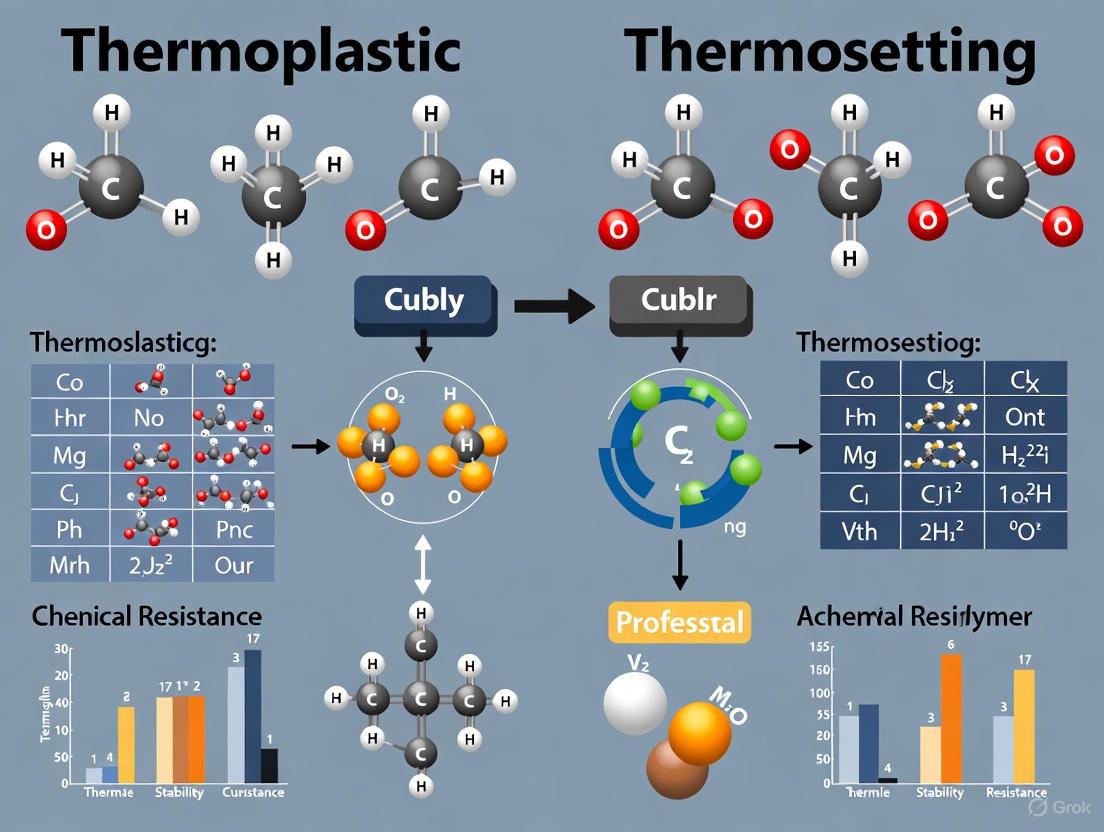
This article provides a definitive comparison of thermoplastic and thermosetting polymers, tailored for researchers and professionals in drug development and biomedical fields.
Thermoplastic vs Thermosetting Polymers: A Comprehensive Guide for Biomedical Researchers
Abstract
This article provides a definitive comparison of thermoplastic and thermosetting polymers, tailored for researchers and professionals in drug development and biomedical fields. It explores the fundamental chemical structures, processing methodologies, and material properties that dictate polymer performance. The content offers practical guidance for material selection, addresses common challenges in biomedical applications, and establishes a rigorous framework for validating polymer choices in clinical and laboratory settings, empowering scientists to make informed decisions for their specific research and development needs.
Molecular Blueprints: Understanding Polymer Structures and Core Properties
In polymer science, the distinction between thermoplastics and thermosets represents a fundamental classification with profound implications for material properties, processing methods, and application suitability. This division originates from fundamental differences in molecular architecture and bonding behavior when exposed to thermal energy. Thermoplastics maintain linear or branched polymer chains that facilitate reversible softening upon heating and solidification upon cooling, while thermosets form permanent, irreversible three-dimensional networks through covalent cross-linking during curing [1] [2]. This seemingly simple difference in molecular behavior creates a dramatic divergence in mechanical performance, thermal stability, chemical resistance, and recyclability that dictates material selection across industries from aerospace to biomedical devices.
The comparative analysis of these material families has gained renewed importance in recent years as sustainability concerns drive innovation in polymer science. Researchers and development professionals face increasingly complex decisions when selecting polymer systems that must balance performance requirements with environmental considerations [3] [4]. This guide provides a comprehensive, data-driven comparison of thermoplastics and thermosets, with particular emphasis on the experimental methodologies and quantitative performance metrics essential for informed material selection in research and development contexts.
Molecular Structures and Bonding Mechanisms
Thermoplastic Linear and Branched Architectures
Thermoplastics possess molecular structures characterized by linear or branched polymer chains that associate through weak secondary intermolecular forces, including van der Waals forces and hydrogen bonding [5]. These materials lack permanent covalent cross-links between polymer chains, allowing the chains to slide past one another when thermal energy exceeds the strength of these secondary interactions. The absence of permanent networking enables thermoplastics to undergo repeated phase transitions when subjected to thermal cycles [1] [2].
This molecular arrangement exists in either amorphous or semi-crystalline morphological states. Amorphous thermoplastics exhibit randomly oriented chains with no long-range order, resulting in materials with good impact strength and optical clarity. Semi-crystalline thermoplastics feature regions of ordered, aligned molecular chains within a disordered amorphous matrix, providing enhanced chemical resistance, mechanical strength, and dimensional stability [6]. The relative proportion of crystalline to amorphous regions significantly influences material properties and processing behavior.
Thermoset Cross-Linked Network Formation
Thermosetting polymers undergo an irreversible chemical transformation during curing wherein molecular chains form extensive three-dimensional networks connected by strong covalent bonds [1] [7]. This cross-linking process creates an interconnected molecular structure that restricts chain mobility and prevents viscous flow upon subsequent heating attempts. The curing reaction represents a permanent chemical change that cannot be reversed without breaking the primary covalent bonds that constitute the polymer backbone itself [5] [2].
The cross-link density—the number of cross-links per unit volume—profoundly influences the mechanical and thermal properties of the resulting thermoset. Low cross-link densities yield more flexible, tough materials, while high cross-link densities produce rigid, brittle networks with superior thermal stability and mechanical strength [8]. The curing process typically involves the application of heat, radiation, or chemical catalysts that initiate the cross-linking reaction, transforming the material from a workable liquid or soft solid into an infusible, insoluble network [7].
Figure 1: Molecular Architecture and Bonding Mechanisms. Thermoplastics feature linear chains with weak secondary bonds enabling reversible softening, while thermosets form permanent 3D networks through strong covalent cross-links during curing.
Quantitative Performance Comparison
The fundamental differences in molecular architecture between thermoplastics and thermosets manifest in distinctly different performance profiles across mechanical, thermal, and chemical domains. The following tables synthesize experimental data and characteristic properties to facilitate direct comparison for research and development purposes.
Table 1: Mechanical and Thermal Properties Comparison
| Property | Thermoplastics | Thermosets | Test Method |
|---|---|---|---|
| Tensile Strength | Moderate to High (20-100 MPa) [5] | High to Very High (30-200 MPa) [1] | ASTM D638 |
| Impact Resistance | Generally High [7] | Moderate to High (Varies with cross-link density) [1] | ASTM D256 (Izod) |
| Heat Resistance | Low to Moderate (Deforms at elevated temperatures) [7] [2] | High (No melting, chars instead) [1] [7] | ASTM D648 (HDT) |
| Continuous Service Temperature | 80°C - 150°C (Varies by polymer) [7] | 150°C - 300°C (Varies by formulation) [7] | UL 746B |
| Creep Resistance | Moderate (Good in some engineering grades) [6] | Excellent (High resistance to deformation under load) [6] | ASTM D2990 |
| Dimensional Stability | Moderate (Can be affected by temperature) [7] | Excellent (Low coefficient of thermal expansion) [7] | ASTM D696 |
Table 2: Chemical, Environmental, and Processing Characteristics
| Characteristic | Thermoplastics | Thermosets | Test Standard |
|---|---|---|---|
| Chemical Resistance | Variable (Good to excellent depending on polymer) [7] [5] | Generally Excellent [7] [5] | ASTM D543 |
| Solvent Response | Soluble in selected solvents [6] | Insoluble (May swell only) [6] | ASTM D543 |
| Recyclability | Highly recyclable [3] [7] | Limited recyclability (Non-remeltable) [3] [7] | N/A |
| Processing Shrinkage | Moderate to High (1-5%) | Low (0.1-1%) [1] | ASTM D955 |
| Storage Conditions | Stable (No special requirements) | Limited shelf life (Require cold storage) [3] | N/A |
| Electrical Insulation | Good to Excellent [7] | Excellent [7] | ASTM D257 |
Notably, thermoplastic composites demonstrate exceptional impact tolerance and strain-to-failure characteristics, with some advanced formulations achieving impact strengths 50-100% higher than comparable thermoset composites [3]. Conversely, thermosets typically exhibit 30-50% higher tensile strength and modulus values at elevated temperatures (above 150°C) compared to standard thermoplastics [1]. The exceptional thermal stability of thermosets enables their use in applications where thermoplastics would undergo catastrophic deformation, such as in electrical insulation components and under-the-hood automotive applications [7].
Experimental Protocols and Methodologies
Curing Behavior Analysis Protocol
Objective: To characterize and compare the curing behavior and thermal reversibility of thermoplastic and thermoset systems.
Materials and Equipment:
- Differential Scanning Calorimetry (DSC) instrument
- Thermogravimetric Analyzer (TGA)
- Parallel Plate Rheometer
- Standard polymer specimens (1-10mg for DSC, 10-50mg for TGA)
- Hermetic sample pans
- Nitrogen purge gas
Methodology:
- Sample Preparation: Precisely weigh and load specimens into appropriate sample pans. For thermosets, include uncured or partially cured samples to monitor exothermic curing reactions.
- DSC Analysis: Program temperature ramp from 25°C to 300°C at 10°C/min under nitrogen atmosphere. Monitor heat flow for endothermic (melting) and exothermic (curing) transitions.
- TGA Analysis: Heat specimens from 25°C to 800°C at 20°C/min under nitrogen. Record mass loss to determine thermal degradation profiles.
- Rheological Analysis: Perform temperature sweeps from 25°C to 300°C at constant strain. Monitor viscosity changes, gel point determination for thermosets, and melt flow behavior for thermoplastics.
- Data Analysis: Determine glass transition temperature (Tg), melting temperature (Tm), crystallization temperature (Tc), curing onset temperature, peak exotherm temperature, and degradation temperature (Td).
Expected Outcomes: Thermoplastics will exhibit distinct endothermic melting transitions upon heating and crystallization exotherms upon cooling, demonstrating reversible phase changes. Thermosets will display exothermic curing reactions during first heating (if uncured) with no melting endotherms, and will maintain structural integrity until decomposition temperatures [1] [2].
Mechanical Property Assessment Protocol
Objective: To quantitatively compare mechanical performance under various loading conditions and temperatures.
Materials and Equipment:
- Universal Testing Machine (UTM) with environmental chamber
- Standardized test specimens (ASTM D638 Type I for tensile, ASTM D256 for impact)
- Thermal chamber capable of -40°C to 200°C operation
- Extensometer or strain gauge
- Notched Izod impact tester
Methodology:
- Specimen Preparation: Injection mold or machine specimens to standardized dimensions. Condition at 23°C and 50% relative humidity for 48 hours minimum.
- Tensile Testing: Perform tests at crosshead speed of 5mm/min at multiple temperatures (-40°C, 23°C, 80°C, 150°C). Record stress-strain curves until failure.
- High-Temperature Testing: For thermosets, extend testing to 200°C to demonstrate retention of mechanical properties.
- Impact Testing: Test notched Izod specimens at 23°C according to ASTM D256. For temperature variants, condition specimens for 1 hour at test temperature.
- Creep Testing: Apply constant load (20-40% of yield stress) at elevated temperature (80°C for thermoplastics, 150°C for thermosets) for 1000 hours. Measure strain versus time.
Expected Outcomes: Thermosets will demonstrate minimal reduction in modulus and strength at elevated temperatures, while thermoplastics will show significant decreases as temperatures approach glass transition or melting points. Thermosets will exhibit superior creep resistance with minimal deformation under sustained loading at high temperatures [1] [8].
Table 3: Essential Research Reagents and Materials for Polymer Analysis
| Reagent/Material | Function/Application | Research Context |
|---|---|---|
| Dicumyl Peroxide | Free-radical initiator for cross-linking | Thermoset curing studies [5] |
| Epoxy Resin (DGEBA) | Model thermoset system | Fundamental cross-linking research [9] |
| Polycarbonate Pellet | Model amorphous thermoplastic | Reference material for comparative studies |
| Boron Nitride Fillers | Thermal conductivity enhancement | Composite performance studies [9] |
| Silane Coupling Agents | Surface modification of fillers | Interface optimization in composites [9] |
| Tetrahydrofuran (THF) | Solvent for solubility studies | Chemical resistance testing [6] |
| Methylene Diphenyl Diisocyanate (MDI) | Polyurethane formulation | Reactive processing studies [5] |
Advanced Material Systems and Recent Developments
High-Performance Thermoplastic Composites
Recent advances in high-performance thermoplastics have expanded their application into domains traditionally dominated by thermosets. Materials such as polyphenylene sulfide (PPS), polyetherimide (PEI), and polyaryletherketone (PAEK) offer exceptional mechanical properties, environmental resistance, and chemical resistance while maintaining recyclability [10]. These systems are particularly valuable in aerospace applications where their combination of rapid processibility and damage tolerance provides significant advantages.
The development of innovative impregnation methods has addressed historical challenges with high-viscosity thermoplastic matrices. Techniques such as film stacking, powder impregnation, and hybrid yarns have enabled better fiber wet-out and reduced void content in composite structures [3]. Additionally, in-situ polymerization methods for specific thermoplastics like PA6 circumvent viscosity issues by impregnating with low-viscosity monomers that subsequently polymerize [3].
Sustainable and Bio-Based Formulations
The sustainability paradigm has driven significant innovation in both material families. For thermoplastics, research has focused on bio-based alternatives such as furan-based polyesters derived from 2,5-furan dicarboxylic acid (FDCA) as replacements for petroleum-based aromatic polyesters [4]. These materials offer comparable performance with reduced environmental impact and enhanced recyclability.
Thermoset recycling technologies have also advanced, with mechanical, thermal, and chemical processing methods being developed to address end-of-life concerns. While thermal and mechanical recycling methods typically recover only the reinforcing fibers, emerging chemical recycling approaches show promise for recovering both fibers and resin components [3]. The development of vitrimers—thermoset-like materials with covalent adaptable networks—represents a promising approach to combining the performance of thermosets with the recyclability of thermoplastics [3].
Figure 2: Comparative Processing Workflows. Thermoplastics undergo reversible melting and shaping cycles, while thermosets experience irreversible chemical curing that prevents reprocessing.
Application-Specific Selection Guidelines
High-Temperature and Structural Applications
For applications requiring sustained performance at elevated temperatures (>150°C) or superior dimensional stability under load, thermosets typically offer significant advantages. Their cross-linked network structure maintains mechanical integrity at temperatures where thermoplastics would undergo viscous flow [1] [7]. Epoxy systems are particularly valuable in aerospace composite structures, while phenolic resins find application in electrical components and high-temperature appliances [7] [5].
When impact resistance, damage tolerance, or recyclability are prioritized, advanced thermoplastics may be preferable. Thermoplastic composites exhibit approximately 50-100% higher fracture toughness than thermoset composites, making them valuable in applications subject to impact events [3]. The aviation industry has increasingly adopted thermoplastic composites for interior components and secondary structures where their combination of damage tolerance and fire resistance provides significant advantages [10].
Sustainability-Driven Applications
The circular economy paradigm has intensified focus on material recyclability, making thermoplastics increasingly attractive despite potential performance compromises in some domains. Thermoplastic polyester elastomers (TPEEs) represent a particularly promising class of materials that combine mechanical performance with reprocessability [4]. Their segmented block structure enables tunable properties while maintaining recyclability through both mechanical and emerging chemical recycling pathways.
Thermosets remain essential in applications where extreme durability and long service life minimize the environmental impact of non-recyclability. Additionally, developing recycling technologies for thermoset composites, including fiber recovery through pyrolysis and solvolysis, is improving their sustainability profile [3]. Material selection should consider the entire lifecycle impact, including production energy, service life duration, and end-of-life options rather than focusing solely on recyclability.
The divide between thermoplastics and thermosets represents a fundamental dichotomy in polymer science with far-reaching implications for material performance, processing methodology, and sustainability. Thermoplastics offer reprocessability, recyclability, and often superior impact resistance, while thermosets provide exceptional thermal stability, mechanical strength at elevated temperatures, and dimensional stability. The selection between these material families requires careful consideration of application requirements, manufacturing constraints, and environmental impact throughout the product lifecycle.
Recent advancements in both material families have blurred traditional boundaries, with high-performance thermoplastics expanding into high-temperature applications and novel thermoset recycling technologies addressing end-of-life concerns. The continuing development of bio-based feedstocks, sustainable processing methods, and hybrid material systems promises to further enhance the performance and sustainability profiles of both thermoplastics and thermosets. Researchers and development professionals must consider the fundamental chemical differences outlined in this guide while remaining attentive to emerging materials and technologies that continue to redefine the possibilities of polymer science.
The fundamental division between thermoplastic and thermosetting polymers originates from their distinct molecular architectures: linear chains versus 3D cross-linked networks. These underlying structures dictate all subsequent material properties, including thermal behavior, mechanical performance, and processability. Thermoplastics, composed of linear or slightly branched polymer chains held together by weak intermolecular forces, soften when heated and harden when cooled in a reversible physical process [11] [12]. In contrast, thermosetting polymers form permanent, irreversible three-dimensional networks during curing, created by strong covalent bonds between polymer chains [11] [13]. This architectural difference is the cornerstone of their performance characteristics and application suitability, particularly in demanding fields like drug delivery systems, medical devices, and scientific equipment.
Architectural Fundamentals and Bonding
Thermoplastics: Linear and Branched Chains
The molecular structure of thermoplastics consists of long polymer chains without permanent chemical links between them. These chains can be simple and linear or possess various branches, but they remain as separate entities that can slide past one another.
- Intermolecular Forces: The chains are associated through weak secondary forces, including van der Waals forces and hydrogen bonding [11] [12].
- Thermal Response: Upon heating, these weak forces are overcome, allowing the chains to move and the polymer to become soft and pliable. Upon cooling, the forces re-establish, and the material solidifies. This cycle can be repeated multiple times without altering the chemical nature of the polymer, enabling recyclability and re-molding [11] [14].
Thermosets: Permanently Cross-Linked Networks
Thermosetting polymers undergo a fundamental chemical change during curing, forming a dense network of covalent bonds that lock the chains together into a single, giant molecule.
- Curing Process: The cross-linking process, also called curing, is triggered by heat, light, catalysts, or radiation. This process is irreversible [11] [15].
- Network Structure: The resulting three-dimensional network is characterized by a high degree of cross-link density, which severely restricts chain mobility. This structure does not soften upon reheating but will instead degrade or char at extremely high temperatures [11] [13].
Table 1: Fundamental Characteristics of Polymer Architectures
| Characteristic | Linear Chains (Thermoplastics) | 3D Cross-Linked Networks (Thermosets) |
|---|---|---|
| Primary Bonding | Weak intermolecular forces | Strong covalent cross-links |
| Chain Topology | Linear or branched, separable chains | Interconnected network, single molecule |
| Curing | Not required; physical solidification | Irreversible chemical reaction |
| Structural Model | A bundle of separate strings | A single, tangled fishing net |
Diagram 1: Molecular architecture of linear chains versus 3D cross-linked networks.
Comparative Material Properties and Performance Data
The architectural dichotomy directly translates to a clear divergence in macroscopic properties. The following experimental data and comparative tables quantify these performance differences.
Mechanical Properties
The cross-linked network of thermosets provides superior strength, rigidity, and dimensional stability, while the sliding chains of thermoplastics grant them higher impact resistance and toughness.
Table 2: Experimental Mechanical Property Comparison
| Property | Thermoplastics (e.g., Nylon, PP) | Thermosets (e.g., Epoxy, Polyester) | Experimental Protocol |
|---|---|---|---|
| Tensile Strength (MPa) | 30 - 85 [12] | 40 - 90 [12] | Tensile Testing (ASTM D638): Dog-bone specimens are stretched uniaxially at a constant crosshead speed until failure. Stress-strain curves are analyzed for ultimate tensile strength. |
| Tensile Modulus (MPa) | 1,000 - 3,100 [12] | 2,800 - 4,100 [12] | Tensile Testing (ASTM D638): The initial linear slope of the stress-strain curve is calculated to determine Young's Modulus, indicating material stiffness. |
| Impact Resistance | High [11] [14] | Low to Moderate (Brittle) [11] | Izod Impact Test (ASTM D256): A notched specimen is clamped vertically and struck by a pendulum. The energy absorbed in breaking the specimen is measured. |
| Creep Resistance | Low to Moderate [11] | High [13] | Creep Test (ASTM D2990): A constant load is applied to a specimen at a constant temperature. The gradual deformation (strain) over time is measured. |
A molecular dynamics (MD) simulation study on an epoxy thermoset (EPON-862/DETDA system) demonstrated the direct mechanical impact of cross-linking. The simulations, which virtually created cross-linked networks from different initial conformations and performed tensile experiments at an imposed stress rate, revealed that an 80% cross-linked system exhibited a Young's modulus more than a factor of two higher than an ideal linear system of the same chemistry [13].
Thermal and Chemical Properties
The permanent bonds in thermosets make them exceptionally stable under thermal and chemical stress, whereas thermoplastics are defined by their thermal reversibility.
Table 3: Thermal and Chemical Property Comparison
| Property | Thermoplastics | Thermosets | Experimental Protocol |
|---|---|---|---|
| Heat Response | Melt upon heating (Reversible) [11] | Degrade without melting (Irreversible) [11] | Thermogravimetric Analysis (TGA) & DMA: Samples are heated at a constant rate. TGA measures mass loss, while DMA tracks modulus changes to identify melting or decomposition temperatures. |
| Continuous Use Temp. | Lower (e.g., PP: ~100°C) [16] | Higher (e.g., Epoxy: >150°C) [16] | Long-Term Thermal Aging (UL 746B): Samples are exposed to elevated temperatures for extended periods, with periodic testing to assess property retention. |
| Chemical Resistance | Good, but soluble in strong solvents [14] | Excellent, high solvent resistance [11] [14] | Immersion Test (ASTM D543): Specimens are immersed in various chemicals (acids, bases, solvents) at specified temperatures. Changes in weight, dimensions, and properties are measured over time. |
Research into dynamic cross-linked polyurethanes (DAG-PU) shows how cross-link density can be manipulated to enhance properties. In a 2025 study, a higher cross-link density (DAG-PU-3) resulted in a Young’s modulus of 29.7 ± 0.9 MPa and a tensile strength of 45.0 ± 1.7 MPa, significantly outperforming the lower density variants. This was attributed to a higher density of dynamic bonds and hydrogen bonds that dissipate energy [15].
Experimental Protocols for Architectural Analysis
Protocol: Molecular Dynamics Simulation of Cross-Linking
This in-silico protocol is used to model the cross-linking process and predict its effect on mechanical properties [13].
- Model Construction: Build an initial simulation cell containing the epoxy resin (e.g., EPON-862) and curing agent (e.g., DETDA) molecules in a specific stoichiometric ratio (e.g., 1:2) using amorphous builder software.
- Cross-Linking Simulation: Perform a virtual cross-linking routine that forms covalent bonds between reactive sites on the resin and hardener molecules, starting from multiple different initial molecular conformations.
- Relaxation: Apply a multi-step relaxation protocol using molecular dynamics (MD) simulations to equilibrate the newly formed cross-linked network and release residual stresses.
- In-silico Tensile Testing: Perform simulated tensile experiments on the equilibrated model by applying a constant strain rate (e.g., 1 atm/ps). The resulting stress-strain curve is analyzed to extract properties like Young's modulus.
Diagram 2: Workflow for molecular dynamics simulation of cross-linking.
Protocol: Swelling Test for Cross-Link Density Assessment
This experimental method qualitatively assesses the presence and density of a cross-linked network [15].
- Sample Preparation: Prepare and fully cure a thermoset sample. Accurately measure and record its initial dry dimensions and/or weight.
- Solvent Immersion: Immerse the sample in a suitable solvent (e.g., tetrahydrofuran (THF)) for a predetermined time (e.g., 30 minutes) at room temperature.
- Measurement and Analysis: Remove the sample, gently blot off excess solvent, and immediately measure its dimensions and weight. The swelling ratio is calculated as the change in volume or weight relative to the initial state. A lower swelling ratio indicates a higher cross-link density, as the network is more restricted and cannot absorb as much solvent.
Protocol: Temperature-Dependent In Situ FTIR for Dynamic Bond Analysis
This technique probes the dynamic nature of bonds within a cross-linked network, such as in Covalent Adaptable Networks (CANs) [15].
- Baseline Characterization: Place the polymer sample in the FTIR spectrometer and collect a spectrum at room temperature to establish a baseline.
- Heating and Spectral Acquisition: Increase the temperature of the sample stage in controlled increments (e.g., 10°C steps). At each temperature plateau, collect a new FTIR spectrum.
- Spectral Analysis: Monitor the intensity of absorption peaks corresponding to specific dynamic bonds (e.g., oxime-carbamate at ~2275 cm⁻¹). A decrease in intensity or the appearance of free isocyanate peaks at elevated temperatures indicates bond dissociation, confirming the dynamic nature of the cross-links.
The Scientist's Toolkit: Key Research Reagents and Materials
Table 4: Essential Materials for Polymer Network Research
| Material/Reagent | Function in Research | Specific Example |
|---|---|---|
| Bisphenol A Epoxy Resins | A common thermoset model system for studying cure kinetics, network formation, and composite properties. | EPON 826/828, EPON 862 [13] |
| Aromatic Amines | Used as cross-linking agents (hardeners) for epoxy resins; influence cure temperature and final network properties. | Diethyltoluenediamine (DETDA) [13], 4,4'-Diaminodiphenyl methane [17] |
| Diaminoglyoxime (DAG) | A tetrafunctional cross-linker for creating dynamic covalent networks with oxime-carbamate and amidine-urea bonds [15]. | N/A |
| Polyol & Diisocyanate | Monomers for synthesizing polyurethane (PU) and polyurea networks, allowing study of structure-property relationships. | Polytetramethylene ether glycol (PTMEG), Isophorone diisocyanate (IPDI) [15] |
| Thermoplastic Pellets | Base polymers for studying crystallization, processing, and as a matrix for creating cross-linkable thermoplastic compounds. | Polyamide 6 (PA 6), Polyamide 66 (PA 66) [18] |
| Conductive Fillers | Added to polymers to create composites for specialized applications in flexible electronics or static dissipation. | Carbon nanotubes [17], Carbon fiber, Glass fiber [16] |
Advanced Concepts and Innovations
The classical divide between thermoplastics and thermosets is being bridged by innovative material designs.
Covalent Adaptable Networks (CANs): These are thermosets incorporating dynamic covalent bonds (e.g., oxime-carbamate, amidine-urea, disulfide) that can break and reform under specific stimuli like heat [15]. This allows for reprocessability and self-healing while maintaining the high performance of a cross-linked network. A groundbreaking 2025 study demonstrated a CAN where increasing the dynamic cross-linking density simultaneously enhanced both tensile properties and processability, a phenomenon that subverts traditional polymer physics [15].
Cross-Linkable Thermoplastics: Standard engineering thermoplastics (e.g., PA 6, PBT) can be formulated with cross-linkable sites. After being molded via conventional injection molding, the parts are exposed to E-beam radiation, which creates a 3D network within the amorphous regions. This process significantly improves high-temperature tolerance, creep, and chemical resistance without requiring specialized processing equipment, offering a cost-effective alternative to ultra-polymers like PEEK [18].
Multidimensional Cross-Linked Networks: Research into shape memory epoxy resins (SMEPs) explores networks with combined covalent and non-covalent bonds (e.g., multi-level hydrogen bonds, π-π interactions). This strategy can overcome the traditional strength-toughness trade-off, creating materials that are both strong and damage-tolerant [17]. One such SMEP demonstrated the ability to lift 10,000 times its own weight while achieving an ultimate bending curvature of 0.99 mm [17].
The choice between linear and cross-linked polymer architectures is a fundamental decision that dictates material performance. Thermoplastics offer process flexibility, toughness, and recyclability, while thermosets provide unmatched thermal stability, rigidity, and chemical resistance. The emerging field of dynamic and cross-linkable polymers is blurring these traditional boundaries, enabling the creation of intelligent, sustainable, and high-performance materials tailored for the next generation of scientific and medical applications.
The selection between thermoplastic and thermosetting polymers is a fundamental decision in materials science, influencing everything from part design and manufacturing process to end-of-life recyclability. These two classes of polymers exhibit profoundly different characteristics stemming from their distinct molecular architectures. Thermoplastics are composed of linear or branched polymer chains with linear molecular chain structures that are held together by weaker intermolecular forces such as van der Waals interactions and hydrogen bonds [19]. In contrast, thermosetting polymers form a crosslinked polymers with a dense three-dimensional network structure created by covalent bonds between polymer chains [20].
These structural differences dictate not only processing methods but also the ultimate performance characteristics of the final material. Thermosets undergo an irreversible curing process, typically initiated by heat or chemical catalysts, which forms permanent crosslinks that prevent the material from being remelted or reshaped [21]. Thermoplastics, however, can be repeatedly softened when heated and hardened when cooled due to the absence of permanent crosslinks [21]. This fundamental distinction creates a necessary trade-off in material selection, where thermosets generally offer superior thermal stability and mechanical strength at the expense of recyclability, while thermoplastics provide easier processing and recyclability with some potential limitations in high-temperature performance.
This guide provides a comprehensive, data-driven comparison of these material families, focusing on their thermal, mechanical, and chemical properties to inform researchers and development professionals in their material selection processes.
Comparative Analysis of Fundamental Properties
Table 1: Fundamental Characteristics of Thermoplastics vs. Thermosets
| Property | Thermoplastics | Thermosets |
|---|---|---|
| Molecular Structure | Linear or branched chains | Cross-linked, 3D network |
| Processing Behavior | Reversibly softens when heated, can be remolded | Irreversibly cures when heated, cannot be remolded |
| Recyclability | Fully recyclable via remelting [22] | Not recyclable due to permanent crosslinks [21] |
| Typical Processing Methods | Injection molding, extrusion, thermoforming [21] | Reaction injection molding, resin transfer molding [21] |
| General Cost Consideration | Often lower cost, though high-performance variants can be expensive [21] | Often more expensive due to fillers and additives [21] |
Table 2: Quantitative Mechanical and Thermal Property Comparison
| Property | Thermoplastic (Polypropylene Example) | Thermoset (Epoxy Example) |
|---|---|---|
| Heat Deflection Temperature (HDT) | Low HDT compared to thermosets [21] | Exceptionally high HDT compared to thermoplastics [21] |
| Elasticity/Toughness | More elastic, higher toughness [21] | Less elastic, more brittle due to cross-linked bonds [21] |
| Chemical Resistance | Generally lower chemical resistance [21] | High chemical resistance [21] |
| Tensile Strength (Neat/Unfilled) | Moderate (e.g., ~20-40 MPa for commodity types) | Moderate to High (e.g., ~20-90 MPa for epoxies) |
| Tensile Strength (Fiber-Reinforced) | Varies with fiber type and content | 71.3 MPa (polyester with 22.8 wt% short PGF) to 187.9 MPa (epoxy with continuous PGF) [23] |
| Storage Modulus | Varies with polymer type | Can reach 12.3 GPa in rigid, high-crosslink-density systems [20] |
The data in Table 2 highlights a general trend where thermosets excel in applications demanding high thermal stability and chemical resistance, while thermoplastics offer superior toughness and elasticity. For instance, epoxy thermosets can be formulated to achieve storage modulus values as high as 12.3 GPa and glass transition temperatures (Tg) reaching 167°C, as demonstrated in rigid, high-crosslink-density systems derived from lignin monomers [20]. The mechanical properties of both material classes can be significantly enhanced through fiber reinforcement. Phosphate glass fiber (PGF)-reinforced thermosets, for example, demonstrate tensile strength increasing from 20.8 MPa (unfilled polyester) to 71.3 MPa (with 22.8 wt% short PGFs), and further to 145.7 MPa when continuous PGFs are used [23].
Advanced Material Performance Analysis
Thermal and Mechanical Behavior Under Load
The thermal and mechanical performance of these materials becomes particularly important in demanding applications. Thermoplastics generally exhibit lower heat deflection temperatures compared to thermosets, which limits their use in high-temperature applications [21]. However, high-performance thermoplastics like Polyether Ether Ketone (PEEK) and Polyphenylene Sulfide (PPS) are exceptions, possessing excellent thermal stability exceeding 200°C [22].
The incorporation of fillers significantly alters these properties. In thermosets, hybrid filler systems comprising boron nitride (BN) and copper (Cu) have been shown to enhance thermal conductivity effectively, which is crucial for electronic encapsulation applications [9]. Similarly, the addition of kaolin clay to thermosets improves thermal resistance and enhances mechanical properties including tensile strength, flexural strength, and impact strength [20].
Long-term performance characteristics also differ substantially between these material classes. Thermoplastic composites reinforced with natural fibers can exhibit susceptibility to creep, particularly under varying relative humidity conditions and water immersion [24]. Thermoset composites, while generally more resistant to creep due to their crosslinked nature, still experience process-induced residual stresses that can lead to long-term deformations, a phenomenon that has been observed and modeled in carbon-fiber-reinforced epoxy (CF/epoxy) systems [25].
Chemical Resistance and Environmental Stability
The crosslinked structure of thermosetting polymers provides them with outstanding solvent resistance compared to thermoplastics [20]. This makes thermosets particularly valuable in applications involving exposure to harsh chemicals, such as chemical processing equipment, automotive components exposed to fuels and lubricants, and corrosive environments [20] [21].
Thermoplastics generally exhibit poorer resistance to certain chemicals, including organic solvents, highly polar solvents, and hydrocarbons [21]. However, their resistance varies significantly among different thermoplastic types, with high-performance thermoplastics like PPS offering better chemical resistance than commodity thermoplastics.
For both material classes, environmental factors like moisture absorption can significantly impact performance. Wood Plastic Composites (WPCs) based on thermoplastics like Polypropylene (PP), Polystyrene (PS), and Polylactic acid (PLA) demonstrate that the addition of natural fibers generally improves mechanical properties but increases water absorption, which must be considered in the design for specific applications [24].
Experimental Protocols for Property Characterization
Protocol 1: Composite Fabrication and Tensile Testing
Objective: To fabricate fiber-reinforced polymer composites and evaluate their tensile properties according to ASTM standards.
Materials Preparation:
- Matrix Materials: For thermosets: epoxy or unsaturated polyester resins. For thermoplastics: polypropylene (PP), polystyrene (PS), or polylactic acid (PLA) [24] [23].
- Reinforcement: Continuous or chopped fibers (e.g., phosphate glass fibers, carbon fibers, or natural fibers like wood fibers) [24] [23].
- Compatibilizers: Maleic anhydride grafted polymers (e.g., PP-g-MA, PLA-g-MA) for improved fiber-matrix adhesion in thermoplastic composites [24].
Composite Fabrication:
- Drying: Pre-dry thermoplastic pellets and natural fibers (if used) in a ventilation oven (e.g., 105°C for natural fibers, 80°C for PLA) to remove moisture [24].
- Compounding: For thermoplastics, use twin-screw extruder for melt compounding with fibers. Parameters: Temperature profile appropriate for polymer (e.g., <200°C for natural fibers to prevent degradation), screw speed 100-300 rpm [24].
- Molding: For thermosets, use contact molding or resin transfer molding. Impregnate fiber mats with catalyzed resin, cure at room temperature or elevated temperature [23]. For thermoplastics, use injection molding to form standard test specimens.
Tensile Testing:
- Specimen Preparation: Machine or mold specimens according to ASTM D638 or ISO 527 standards.
- Testing Conditions: Conduct test at room temperature using universal testing machine. Crosshead speed: 1-5 mm/min. Record stress-strain curve.
- Data Analysis: Calculate tensile strength, Young's modulus, and elongation at break from stress-strain data.
Protocol 2: Thermal Conductivity Measurement of Filled Thermosets
Objective: To measure thermal conductivity enhancement in thermoset composites with hybrid filler systems.
Materials Preparation:
- Matrix: Epoxy resin (e.g., EP 3162 E) [9].
- Fillers: Boron nitride (BN) combined with secondary fillers such as copper (Cu), aluminum oxide, or zinc oxide [9].
- Surface Treatment: Silane coupling agents for filler surface modification to reduce interfacial thermal resistance [9].
Composite Preparation:
- Filler Incorporation: Use high-shear mixing to disperse hybrid fillers in epoxy resin.
- Degassing: Vacuum degas mixture to remove entrapped air bubbles.
- Curing: Pour mixture into molds, cure according to manufacturer's specifications.
Thermal Conductivity Measurement:
- Sample Preparation: Prepare disk-shaped specimens with parallel, smooth surfaces.
- Testing Standard: Follow ASTM E1461 for laser flash method or ASTM D5470 for steady-state heat flow method.
- Measurement: For laser flash method, measure thermal diffusivity, then calculate thermal conductivity using formula: λ = α × ρ × Cp, where λ is thermal conductivity, α is thermal diffusivity, ρ is density, and Cp is specific heat capacity.
Research Reagent Solutions for Polymer Characterization
Table 3: Essential Research Reagents and Materials for Polymer Composite Studies
| Reagent/Material | Function/Application | Research Context |
|---|---|---|
| Kaolin (Kaolinite) | Filler in thermoset composites to improve mechanical properties, thermal resistance, and surface finish [20] | Used in thermosets including polyurethanes, epoxy, and phenolic resins for enhanced performance [20] |
| Phosphate Glass Fibers (PGFs) | Reinforcement for thermoset composites to improve mechanical properties [23] | Composition: 52P2O5-24CaO-13MgO-5Fe2O3-1TiO2-5Al2O3; used in polyester and epoxy composites [23] |
| Boron Nitride (BN) and Copper (Cu) Hybrid Fillers | Enhance thermal conductivity in epoxy resins for electronic encapsulation [9] | Hybrid filler systems in epoxy thermosets to achieve higher thermal conductivity with potential filler amount reduction [9] |
| Maleic Anhydride Grafted Polymers (MAPP, PLA-g-MA) | Compatibilizers to improve fiber-matrix adhesion in natural fiber composites [24] | Used in wood plastic composites (WPCs) to enhance interfacial bonding between natural fibers and thermoplastic matrices [24] |
| Polyether Ether Ketone (PEEK) and Polyphenylene Sulfide (PPS) | High-performance thermoplastics for demanding applications [22] | Used in aerospace, automotive; often blended (e.g., PPS/PEEK blends) to optimize properties and recyclability [22] |
| Bio-based Epoxy Monomers | Sustainable alternatives to petroleum-based thermosets [20] | Derived from lignin monomers; can achieve high storage modulus (12.3 GPa) and glass transition temperature (167°C) [20] |
Property Relationships and Material Selection Workflows
Diagram 1: Material Selection Workflow for Thermoplastics vs. Thermosets. This decision tree illustrates key considerations when selecting between thermoplastic and thermoset materials based on application requirements.
The property relationships between thermoplastics and thermosets present engineers with complementary options for different application scenarios. Thermosets generally provide superior thermal stability and higher strength/modulus, making them ideal for high-temperature applications and structural components where dimensional stability under load is critical [21]. Their crosslinked structure affords them outstanding chemical resistance, valuable in aggressive environments [20]. However, this comes at the cost of limited recyclability, as the permanent crosslinks prevent remelting or reshaping [21].
Thermoplastics offer better toughness and impact resistance due to their linear chain structure, which allows for plastic deformation rather than brittle fracture [21]. Their excellent recyclability supports circular economy principles, as they can be repeatedly remelted and reformed [22]. Recent advances have also yielded high-performance thermoplastics (e.g., PEEK, PPS) that bridge the property gap for demanding applications [22].
For both material families, composite approaches provide pathways to enhance properties. Fiber reinforcement significantly improves mechanical strength and stiffness [23], while strategic filler incorporation can tailor thermal, electrical, or tribological properties to meet specific application requirements [9].
The comparative analysis of thermoplastic and thermosetting polymers reveals a complex landscape of material properties governed by fundamental differences in molecular architecture. Thermosets generally provide superior thermal stability, chemical resistance, and mechanical strength—properties derived from their densely crosslinked networks. Thermoplastics offer advantages in toughness, processability, and recyclability—benefits flowing from their linear or branched chain structures.
The emerging research highlights several future directions for both material classes. For thermosets, developments focus on enhancing sustainability through bio-based epoxy monomers [20] and improving functional properties through advanced filler systems [9]. For thermoplastics, research advances include developing high-performance blends [22], sustainable composites with natural fibers [24], and smart materials with shape memory capabilities [19].
The selection between thermoplastic and thermoset materials ultimately depends on the specific requirements of the application, including thermal conditions, mechanical loads, chemical environment, and sustainability considerations. By understanding the fundamental property relationships and trade-offs outlined in this guide, researchers and development professionals can make informed decisions that optimize material performance while meeting economic and environmental objectives.
In the realm of materials science and engineering research, polymers are broadly classified into two distinct categories: thermoplastics and thermosetting polymers (commonly known as thermosets). These materials differ fundamentally in their molecular architecture and response to thermal stimuli, which directly dictates their processing methods, mechanical performance, and ultimate research applications [26] [21]. Thermoplastics are characterized by linear or slightly branched polymer chains that do not form permanent covalent bonds with adjacent molecules. This structure allows them to soften when heated and solidify upon cooling, a process that is fully reversible and repeatable without altering the material's chemical composition [26] [27]. In contrast, thermosetting polymers undergo an irreversible curing process where polymer chains form extensive three-dimensional cross-linked networks through covalent bonding [26]. Once cured, these materials cannot be re-melted or re-shaped, yielding permanent structures with exceptional thermal stability and mechanical integrity [21].
The selection between thermoplastic and thermosetting polymers represents a critical decision point in research design across fields ranging from biomedical device development to aerospace materials. A comprehensive understanding of their respective advantages and limitations enables researchers to make informed material selections aligned with their specific experimental requirements, environmental conditions, and performance expectations [26] [21]. This review provides a systematic comparison of these two polymer classes, highlighting their distinctive properties, processing techniques, and ideal research applications through experimental data and practical implementation guidance.
Fundamental Structural Differences and Resulting Material Behavior
The divergent properties of thermoplastics and thermosets originate from their fundamentally different molecular structures, which govern their thermal, mechanical, and chemical behavior [26] [27].
Diagram 1: Fundamental structural differences and behavioral characteristics of thermoplastic versus thermoset polymers.
Thermoplastics possess linear or slightly branched molecular structures without permanent cross-links between chains [26]. When heated, the weak intermolecular forces (van der Waals forces) are overcome, allowing chains to slide past one another, resulting in material softening and eventual melting. Upon cooling, these forces re-establish, causing the material to solidify. This physical transformation is reversible and can be repeated multiple times without causing significant chemical degradation, enabling recycling and reprocessing [26] [21]. Common thermoplastics include polypropylene (PP), polyethylene (PE), polycarbonate (PC), nylon, and advanced high-performance polymers like polyether ether ketone (PEEK) and polyimide (PI) [21] [6].
Thermosetting polymers form irreversible chemical bonds during the curing process, creating a densely cross-linked three-dimensional network throughout the material [26]. This cross-linking is typically initiated by heat, irradiation, or chemical catalysts and results in an infusible and insoluble solid structure [27]. Once this network is formed, it prevents polymer chains from moving independently, making the material dimensionally stable and resistant to heat even at elevated temperatures. However, this permanent structure also means thermosets cannot be melted or reshaped after curing, limiting their recyclability [26] [21]. Examples of thermosetting polymers include epoxy, phenolic resin, silicone, polyurethane, and vinyl ester [21] [27].
Comparative Analysis of Key Properties for Research Applications
Thermal and Mechanical Properties
The structural differences between thermoplastics and thermosets manifest in distinctly different thermal and mechanical behaviors, which are critical considerations for research applications.
Table 1: Comparison of key properties between thermoplastic and thermoset polymers
| Property | Thermoplastic Polymers | Thermoset Polymers |
|---|---|---|
| Heat Resistance | Low to moderate heat deflection temperature; may soften under elevated temperatures [21] | Exceptionally high heat deflection temperature; maintain structural integrity at elevated temperatures [21] |
| Mechanical Behavior | Flexible, elastic, and impact-resistant; strength derived from crystallinity [27] | Rigid, brittle, and inelastic; strength derived from cross-linking [26] [27] |
| Chemical Resistance | Highly resistant to chemicals but poor resistance to certain solvents and hydrocarbons [21] | Excellent chemical and corrosion resistance [21] [27] |
| Recyclability | Fully recyclable and reusable through remelting and remolding [26] [21] | Not recyclable; cannot be remelted or reformed after curing [26] [21] |
| Processing Methods | Injection molding, extrusion, thermoforming, fused filament fabrication [28] [21] | Reaction injection molding, resin transfer molding, compression molding [21] |
| Toughness | Higher toughness and ability to undergo plastic deformation when heated [21] [6] | Lower toughness; prone to cracking under stress due to cross-linked bonds [26] [21] |
| Solubility | Can dissolve in organic solvents [27] | Insoluble in organic solvents; rarely swell in presence of solvents [6] [27] |
Experimental Data on Mechanical Performance Under Controlled Conditions
Recent research has provided quantitative data on the performance of both polymer classes under various conditions. A 2025 study on stress-strain relationships of thermoplastic polymers revealed their complex mechanical behavior, which "may encompass linear viscoelastic deformation, nonlinear viscoelastic deformation, yield behavior, softening, and hardening" [29]. Furthermore, the study highlighted that "mechanical properties of thermoplastic polymers are highly sensitive to temperature and strain rate, leading to the phenomena of temperature softening and strain rate hardening" [29].
A comparative analysis of tensile properties on thermoplastic and thermosetting polymer composites demonstrated that fiber orientation significantly affects mechanical performance. The research found that "polyester fibre reinforced plastic material with a 45° orientation demonstrates extraordinarily high tensile strength in all combinations when compared to hybrid materials with a 0°/90° orientation" [30]. This has important implications for designing composite materials for specific research applications where directional mechanical properties are required.
Another 2025 study investigated the potential use of 3D printable thermoplastic polymers as structural adhesives, evaluating materials including ABS, PLA, PETG, and TPU. The research employed thick adherent shear tests (TAST) to evaluate shear load capacity and found that "PETG showed the best performance among the other adhesives for the shear and tensile loadings. The maximum shear load of PETG is about 102% higher than that of TPU" [31]. This experimental approach provides valuable data for researchers selecting polymer materials for joining applications.
Research Applications and Material Selection Guidelines
Domain-Specific Applications
The distinctive properties of thermoplastics and thermosets make them suitable for different research and application domains:
Table 2: Research and industrial applications of thermoplastic versus thermoset polymers
| Application Domain | Thermoplastic Polymers | Thermoset Polymers |
|---|---|---|
| Aerospace & Automotive | Lightweight substitutes for metals in components like fuel tanks and piping systems; helps enhance fuel efficiency [26] | Components requiring strength and stability at high temperatures: air intake manifolds, brake pistons, structural panels [26] |
| Electronics & Electrical | Used in telecommunications, computer, and medical industries; offers benefits like reworkability and simplified manufacturing [27] | Electrical housings, connectors, and insulators; excellent insulating and heat-resistant properties [26] [27] |
| Medical & Biomedical | Chemical resistance and ability to be sterilized make them appropriate for medical instruments and laboratory equipment [26] | -- |
| Chemical Processing | -- | Pipes, fittings, and cell covers due to strong resistance to corrosive chemicals and reliable performance under high-temperature conditions [26] |
| Additive Manufacturing | Widely used in fused filament fabrication; materials include ABS, PLA, PETG, nylon [28] [31] | Increasingly used in vat photopolymerization; structural applications requiring high temperature resistance [28] |
| Consumer Products | Toys, lighting fixtures, office supplies, containers; valued for ease of reshaping and clean surface appearance [26] | Cookware, kitchenware, adhesives, sealants, insulation products [26] [21] |
Advanced Research and Development Applications
In cutting-edge research applications, both polymer classes continue to evolve. Thermoplastic polymers are gaining attention in sustainable material research, with recent studies exploring "recycled thermoplastic blends" for use in unidirectional fiber-reinforced composites [22]. The drive for "fully recyclable composites has spurred extensive research on thermoplastics, valued for their recyclability and excellent mechanical properties" [22]. High-performance thermoplastics like PEEK and PPS are particularly valued in aerospace applications "due to their outstanding load-bearing capabilities" [22].
Simultaneously, thermosetting polymers are experiencing innovations in additive manufacturing. Research indicates that "thermosets have the largest market share and growth, amongst polymers for structural applications" [28]. Their adoption in vat photopolymerization processes and as matrix materials for fiber-reinforced composites in automotive and aerospace parts highlights their importance in advanced research applications [28].
Experimental Protocols and Research Methodologies
Standardized Testing Approaches for Polymer Characterization
Researchers employ several standardized experimental protocols to evaluate and compare the properties of thermoplastic and thermosetting polymers:
Tensile Testing for Mechanical Characterization: This fundamental test measures stress-strain relationships and is conducted according to ASTM D638 standards. Specimens are typically dog bone-shaped and loaded uniaxially until failure. The test reveals elastic modulus, yield strength, ultimate tensile strength, and elongation at break. For fiber-reinforced polymer composites, specimens are prepared with different fiber orientations (0°/90°, 45°) to evaluate anisotropic properties [30].
Thick Adherend Shear Test (TAST) for Adhesive Performance: This method evaluates the shear strength of adhesive materials, including thermoplastic polymers used as structural adhesives. The test involves bonding thick metal adherends to prevent deformation, then applying tensile load to measure shear strength. Recent research has used this protocol to compare the performance of 3D printable thermoplastics like ABS, PLA, PETG, and TPU as structural adhesives [31].
Heat Deflection Temperature (HDT) Testing: This test determines the temperature at which a polymer sample deforms under a specified load, providing crucial data on thermal stability. The test follows ASTM D648 standards, with a sample immersed in a heat transfer fluid while a fixed load is applied. The temperature is increased at a controlled rate until the specimen deflects by a specified amount [21].
Advanced Research Methodologies for Polymer Analysis
Multi-Fidelity Data-Driven Modeling (MFDM): Recent research has developed sophisticated modeling approaches to predict stress-strain relationships of thermoplastic polymers under different temperature and strain rate conditions. This hierarchical Kriging model uses both literature data and experimental data to construct accurate predictions while reducing the need for extensive physical testing [29].
Induction Heating for Adhesive Bonding and Debonding: This innovative approach uses electromagnetic induction to cure and debond thermoplastic adhesives in joined materials. The method allows for rapid heating and can be used for bonding metallic components with thermoplastic adhesives, as well as for disassembly and repair operations [31].
Micromechanical Representative Volume Element (RVE) Approach: This computational method models the mechanical performance of unidirectional fiber-reinforced composites at the microstructural level. The approach is particularly valuable for predicting the behavior of composites with recycled thermoplastic matrices and understanding failure mechanisms like matrix cracking, fiber breakage, and delamination [22].
The Researcher's Toolkit: Essential Materials and Methods
Table 3: Essential research reagents and materials for polymer research
| Material/Reagent | Function/Application | Polymer Type |
|---|---|---|
| Polyether Ether Ketone (PEEK) | High-performance thermoplastic for aerospace and biomedical applications; offers excellent mechanical properties, thermal stability, and chemical resistance [29] [22] | Thermoplastic |
| Epoxy Resins | Versatile thermosetting polymers for composites, adhesives, and coatings; provide high strength, chemical resistance, and excellent adhesion [21] [27] | Thermoset |
| Methyl Ethyl Ketone Peroxide (MEKP) | Catalyst for curing polyester resins in fiber-reinforced composites [30] | Thermoset |
| Cobalt Napthanate | Accelerator for polyester resin curing systems [30] | Thermoset |
| Iron Oxide Nanoparticles | Additive for induction heating applications; enables curing and debonding of thermoplastic adhesives through electromagnetic fields [31] | Additive for Both |
| Polyester Resin | Matrix material for glass fiber-reinforced composites; commonly used in hand wet layup processes [30] | Thermoset |
| Acrylonitrile Butadiene Styrene (ABS) | 3D printable thermoplastic for prototyping and functional parts; used in fused filament fabrication [28] [31] | Thermoplastic |
| Polylactic Acid (PLA) | Biodegradable thermoplastic for 3D printing and biomedical applications [31] | Thermoplastic |
| Polyethylene Terephthalate Glycol (PETG) | 3D printable thermoplastic with excellent layer adhesion and chemical resistance; shows strong performance as structural adhesive [31] | Thermoplastic |
| Thermoplastic Polyurethane (TPU) | Flexible, elastomeric thermoplastic for applications requiring impact absorption and flexibility [31] | Thermoplastic |
Diagram 2: Material selection decision tree for research applications based on key requirements and performance characteristics.
The choice between thermoplastic and thermosetting polymers represents a fundamental decision in research design that significantly impacts experimental outcomes, material performance, and sustainability considerations. Thermoplastics offer advantages in process flexibility, recyclability, and impact resistance, making them ideal for applications requiring complex geometries, recyclability, and modifications during development. Thermosets provide superior thermal stability, chemical resistance, and dimensional rigidity, making them indispensable for high-temperature applications and harsh chemical environments.
Informed material selection requires careful consideration of the specific research requirements, including thermal conditions, mechanical stresses, chemical exposure, and sustainability goals. Recent advances in both polymer families—including high-performance thermoplastics for extreme environments, sustainable thermoplastic composites, and advanced processing methods for thermosets—continue to expand their applications in research and development. By understanding the fundamental properties, advantages, and limitations of each polymer class, researchers can make strategic decisions that optimize experimental success and contribute to material innovation across scientific disciplines.
From Lab to Application: Processing Techniques and Biomedical Use Cases
The selection of an appropriate fabrication technique is a critical determinant in the performance and application of polymeric materials, particularly within the overarching research context comparing thermoplastic and thermosetting polymers. Injection molding, extrusion, and resin transfer molding (RTM) represent three principal processing methods employed in both industrial and research settings for transforming polymer resins into finished components [32] [33]. These techniques differ fundamentally in their operational principles, material compatibility, and resultant product characteristics, making their comparative understanding essential for researchers and product developers.
Injection molding is primarily characterized by its ability to produce complex, three-dimensional shapes with high precision and excellent surface finish through a cyclic process of injecting molten material into a closed mold [32] [34]. Extrusion, conversely, is a continuous process that generates products with uniform cross-sectional profiles—such as sheets, pipes, and films—by forcing material through a die [34] [35]. Resin transfer molding occupies a specialized niche, particularly for manufacturing fiber-reinforced thermoset composites, by injecting liquid resin into a closed mold containing dry fiber preforms [36] [33]. The fundamental distinction in material compatibility stems from the inherent properties of thermoplastics and thermosets: thermoplastics can be repeatedly melted and solidified through heating and cooling, whereas thermosets undergo an irreversible curing process to form a cross-linked network structure [37] [21] [38].
This guide provides a systematic comparison of these three fabrication techniques, with emphasis on their operational parameters, material considerations, and experimental protocols relevant to scientific research and development activities. The comparative analysis is structured to assist researchers in selecting the optimal processing method based on material class—thermoplastic or thermoset—and the performance requirements of the target application.
Technical Comparison of Fabrication Techniques
Process Characteristics and Material Compatibility
The three fabrication techniques exhibit distinct operational characteristics that determine their suitability for specific material classes and applications. Injection molding operates as a high-pressure cyclic process where material is heated to a molten state and injected into a mold cavity, with cooling and solidification (for thermoplastics) or thermal curing (for thermosets) occurring within the mold before part ejection [32] [39]. The process is renowned for its high production speed, with cycle times typically ranging from 30 seconds to several minutes, and its ability to manufacture complex, three-dimensional parts with intricate features and tight tolerances [32] [34]. Extrusion is a continuous process wherein material is melted and forced through a die to create products with constant cross-sectional profiles [34] [35]. This method excels in producing long, continuous shapes such as tubes, pipes, sheets, and profiles, but is limited to uniform cross-sections without three-dimensional complexity. Resin transfer molding involves placing dry fiber reinforcement into a mold cavity, closing the mold, and injecting liquid thermoset resin under pressure to impregnate the fibers [36] [33]. The process is characterized by its ability to manufacture high-performance composite parts with excellent fiber consolidation and dimensional stability, albeit with longer cycle times compared to injection molding.
Material compatibility varies significantly across these processes. Injection molding predominantly processes thermoplastics such as polypropylene (PP), polyethylene (PE), polyamide (PA), and acrylonitrile butadiene styrene (ABS), though it can also accommodate thermosets with appropriate equipment modifications [32] [37]. Extrusion is almost exclusively used for thermoplastics due to their remelting capability, with common materials including polyethylene, polypropylene, and polyvinyl chloride (PVC) [34] [35]. In contrast, resin transfer molding is specifically designed for thermosetting polymers such as epoxy, vinyl ester, polyester, and phenolic resins, which undergo irreversible curing within the mold to form dimensionally stable, cross-linked composite structures [36] [33].
Table 1: Fundamental Characteristics of Polymer Fabrication Techniques
| Characteristic | Injection Molding | Extrusion | Resin Transfer Molding |
|---|---|---|---|
| Process Type | Cyclic process | Continuous process | Cyclic process |
| Operating Pressure | High (varies with material) | Moderate | Low to moderate (0.4-1 MPa) [33] |
| Typical Cycle Time | 30 seconds to several minutes [32] | Continuous output | Several minutes to hours (depends on resin system) [36] |
| Primary Material Compatibility | Thermoplastics (PP, PE, PA, ABS) and some thermosets [32] [37] | Thermoplastics (PE, PP, PVC) [34] [35] | Thermosets (epoxy, polyester, vinyl ester) [36] [33] |
| Recyclability of Output | Thermoplastics: High; Thermosets: Not recyclable [21] [39] | High (thermoplastics only) | Not recyclable (thermosets) [21] |
| Key Limitations | High tooling costs, limited part size [32] [34] | Limited to uniform cross-sections [34] [35] | Long cycle times, limited to low-viscosity resins [33] |
Performance and Economic Considerations
The economic and performance characteristics of each fabrication technique significantly influence their application domains and suitability for research versus commercial production. Equipment and tooling costs present substantial variation, with injection molding representing the highest capital investment due to complex mold designs and high-pressure clamping requirements, with machine costs typically ranging from $50,000 to $100,000 [32]. Extrusion equipment is generally more affordable, while RTM offers intermediate tooling costs that are lower than compression molding but higher than simple open molding techniques [32] [33]. Production efficiency differs markedly, with injection molding providing rapid cycle times ideal for high-volume manufacturing, extrusion enabling continuous high-output production, and RTM typically requiring longer cycles due to resin impregnation and curing requirements [32] [36].
Part quality and performance attributes also vary considerably. Injection molding produces parts with high dimensional accuracy, excellent surface finish, and the capability for complex geometries with tight tolerances [32] [34]. Extrusion generates products with consistent cross-sectional profiles but generally with lower dimensional precision than injection molding [34]. RTM manufactures composite components with high fiber content, excellent mechanical properties, and good dimensional stability, though surface finish quality depends on mold surface characteristics [33]. Material utilization and waste generation present further differentiators; injection molding produces minimal flash but may generate sprue and runner waste, extrusion typically has high material efficiency with minimal waste, while RTM may experience resin loss in feed systems and requires careful control to minimize voids and dry spots [32] [33].
Table 2: Economic and Performance Comparison of Fabrication Techniques
| Parameter | Injection Molding | Extrusion | Resin Transfer Molding |
|---|---|---|---|
| Equipment Cost | $50,000-$100,000 [32] | Lower than injection molding | $10,000-$50,000 (transfer molding); RTM tooling lower than compression molding [32] [33] |
| Tooling Cost | High (complex molds) | Moderate (simpler dies) | Moderate to high |
| Production Volume Suitability | High volume [32] | High volume (continuous) | Low to medium volume [32] [33] |
| Dimensional Tolerance | 0.05-0.01 mm [32] | Lower than injection molding | Good, depends on mold precision |
| Surface Finish | Excellent | Good | Good to excellent (two-sided finish) [33] |
| Waste Generation | Moderate (sprues, runners) | Low | Moderate (resin in feed system) |
| Mechanical Properties | Good, depends on material | Anisotropic (direction-dependent) | Excellent (fiber reinforcement) [33] |
Experimental Protocols and Research Methodologies
Material Preparation and Process Optimization
The experimental implementation of these fabrication techniques requires meticulous attention to material preparation, process parameters, and optimization strategies to ensure reproducible results—a critical consideration for research validity. For injection molding experiments, the protocol typically involves: (1) material preconditioning through drying to eliminate moisture (particularly critical for hygroscopic polymers like polyamide); (2) systematic optimization of barrel temperature profiles, injection pressure, injection speed, and cooling time based on the specific polymer's thermal and rheological properties; and (3) mold temperature control to influence crystallization kinetics (for semi-crystalline thermoplastics) or cure kinetics (for thermosets) [32] [39]. Experimental documentation should precisely record these parameters alongside material lot numbers and environmental conditions to ensure reproducibility.
Extrusion experiments require different optimization approaches: (1) screw design selection based on material characteristics (compression ratio, flight geometry); (2) temperature profile establishment along the barrel to achieve uniform melting without degradation; (3) die design optimization to control swell effects and dimensional stability; and (4) haul-off speed calibration to manage orientation and final dimensions [34] [35]. For reactive extrusion systems, additional monitoring of reaction kinetics and byproduct removal becomes necessary. Process analytical technologies, including in-line rheometry and infrared spectroscopy, can be incorporated for real-time monitoring of material transformations.
Resin transfer molding research protocols typically emphasize: (1) careful preparation of fiber preforms with specific architecture, orientation, and volume fraction (typically 40-60%); (2) resin formulation optimization, including catalyst/initiator concentrations for appropriate gel times; (3) precise control of injection pressure and flow rates to ensure complete impregnation without fiber washing or void formation; and (4) temperature management during both injection and cure stages [36] [33]. Advanced research implementations often incorporate flow visualization techniques and in-situ sensors to monitor resin flow fronts and cure state, providing critical data for process modeling and validation.
Characterization and Analysis Methods
Comprehensive material characterization following fabrication is essential for establishing structure-property relationships and validating process efficacy. Standardized mechanical testing according to ASTM or ISO standards provides quantitative performance data, including tensile strength, flexural modulus, impact resistance, and hardness. These properties should be correlated with processing parameters to identify optimal processing windows. For fiber-reinforced composites manufactured via RTM, additional attention to fiber volume fraction, void content, and interfacial adhesion through microscopy is crucial [33].
Thermal analysis techniques, including differential scanning calorimetry (DSC) and thermogravimetric analysis (TGA), reveal vital information about polymer transitions, crystallization behavior, thermal stability, and cure extent. For thermosetting systems, DSC can monitor the exothermic cure reaction and determine the optimal processing temperature range, while for thermoplastics, it can quantify crystallinity development influenced by processing conditions [36] [21].
Morphological characterization through optical microscopy, scanning electron microscopy (SEM), and atomic force microscopy (AFM) elucidates microstructural features such as crystal structure, fiber orientation, void distribution, and fracture surfaces. These analyses are particularly valuable for troubleshooting process-induced defects and validating model predictions. For extrusion processes, additional orientation analysis through birefringence measurements or X-ray diffraction provides insight into molecular alignment effects on anisotropic properties [36] [34].
Figure 1: Experimental workflow for polymer processing research, illustrating the systematic approach from material selection through characterization, with process-specific parameters for injection molding, extrusion, and resin transfer molding.
Research Reagent Solutions and Materials
The selection of appropriate materials and reagents is fundamental to experimental success in polymer processing research. The following table details essential materials and their functions across the three fabrication techniques, with particular emphasis on the thermoplastic versus thermoset context that frames this research.
Table 3: Essential Research Materials for Polymer Fabrication Techniques
| Material Category | Specific Examples | Primary Function | Compatible Processes |
|---|---|---|---|
| Thermoplastic Polymers | Polypropylene (PP), Polyamide (PA, Nylon), Polycarbonate (PC), ABS [32] [37] | Base material that softens when heated and hardens when cooled, enabling reprocessing | Injection Molding, Extrusion |
| Thermoset Polymers | Epoxy resin, Polyester resin, Vinyl ester, Phenolic resin [32] [33] | Base material that cures irreversibly when heated or catalyzed, providing thermal and chemical resistance | Resin Transfer Molding, Injection Molding (modified) |
| Reinforcement Materials | Glass fibers, Carbon fibers, Natural fibers [36] [33] | Enhance mechanical properties (strength, stiffness) in composite structures | Resin Transfer Molding, Injection Molding (with fillers) |
| Catalysts/Initiators | Organic peroxides (e.g., MEK peroxide), Amines (e.g., dimethylaniline) [36] [33] | Initiate and accelerate cross-linking reactions in thermoset polymers | Resin Transfer Molding, Reaction Injection Molding |
| Fillers and Additives | Calcium carbonate, Talc, Carbon black [33] | Modify properties (stiffness, conductivity), reduce cost, or improve processability | Injection Molding, Extrusion, RTM |
| Release Agents | Silicone-based, Fluoropolymer-based | Facilitate demolding of finished parts from tool surfaces | All processes |
| Process Monitoring Aids | Thermocouples, Pressure sensors, Flow sensors | Monitor and control critical process parameters for reproducibility | All processes |
For research involving thermoplastic injection molding and extrusion, material selection should consider melt flow characteristics, thermal stability, and crystallization behavior. Semi-crystalline polymers like polypropylene and polyamide require precise temperature control to manage crystallization kinetics, while amorphous polymers like polycarbonate and ABS necessitate attention to molecular orientation and residual stresses [37] [34]. In resin transfer molding research, the resin system selection must account for viscosity profile, reactivity (gel and cure times), and compatibility with fiber reinforcement. Epoxy systems typically offer superior mechanical properties and adhesion to fibers, while polyester and vinyl ester resins provide more cost-effective alternatives with shorter cycle times [36] [33].
Advanced research in reactive systems, such as thermoplastic RTM (T-RTM), employs specialized monomeric or oligomeric precursors that polymerize in-situ during the molding process. For example, ε-caprolactam systems undergoing anionic ring-opening polymerization to form polyamide-6 represent a cutting-edge research area that bridges the gap between traditional thermoset processing and thermoplastic performance [36]. These systems require stringent control of moisture levels, precise stoichiometric ratios of initiators and activators, and specialized equipment capable of handling reactive precursors.
Injection molding, extrusion, and resin transfer molding each occupy distinct but complementary positions within the polymer processing landscape, with selective advantages based on material class, production volume, part complexity, and performance requirements. Injection molding excels in high-volume production of complex, precision components from both thermoplastic and thermoset materials. Extrusion provides unparalleled efficiency in manufacturing continuous profiles with uniform cross-sections, though exclusively with thermoplastic systems. Resin transfer molding offers specialized capabilities for producing high-performance thermoset composites with exceptional mechanical properties and dimensional stability.
The selection of an appropriate fabrication technique must be guided by the fundamental distinction between thermoplastic and thermosetting polymers—specifically, the reversible physical transformations of thermoplastics versus the irreversible chemical curing of thermosets [21] [38]. This dichotomy dictates not only process compatibility but also influences recyclability, thermal and chemical resistance, and mechanical performance characteristics. For researchers operating within the comparative framework of thermoplastic versus thermoset polymers, this guide provides the necessary technical foundation for informed process selection, experimental design, and interpretation of results across these three fundamental fabrication techniques.
Selecting the appropriate polymer is a critical step in the development of medical devices, directly influencing their performance, safety, and reliability. Within the broader research on thermoplastic vs thermosetting polymers, the choice between these two classes hinges on fundamental differences in molecular structure and material behavior. This guide provides an objective, data-driven comparison of thermoplastics and thermosets for three key application areas: implants, syringes, and surgical tools.
The core distinction between thermoplastics and thermosets lies in their response to heat, which stems from their molecular architecture.
- Thermoplastics consist of linear polymer chains that are held together by weak secondary bonds. When heated, these bonds weaken, allowing the material to soften and be reshaped. This process is reversible and allows for recycling [40].
- Thermosets undergo a curing process where polymer chains form a dense, three-dimensional network through covalent cross-links. This structure is irreversible; once set, the material cannot be re-melted and will degrade instead of softening under high heat [21] [40].
The following table summarizes the fundamental differences that guide material selection.
Table 1: Fundamental Characteristics of Thermoplastics and Thermosets
| Characteristic | Thermoplastics | Thermosets |
|---|---|---|
| Molecular Structure | Linear or branched chains [21] | Cross-linked, 3D network [21] |
| Response to Heat | Softens/melts reversibly [40] | Degrades irreversibly; does not melt [40] |
| Recyclability | Recyclable and reusable [21] [40] | Not recyclable; difficult to reuse [21] [40] |
| Typical Manufacturing Processes | Injection molding, extrusion, thermoforming [21] [41] | Reaction injection molding, resin transfer molding [21] |
| General Cost-Effectiveness | Often lower cost; suitable for high-volume production [21] [40] | Can be more expensive due to fillers and additives [21] |
Performance Comparison in Medical Applications
The properties of thermoplastics and thermosets make them uniquely suited for different medical device applications. Device manufacturers must balance requirements such as biocompatibility, sterility, mechanical strength, and environmental stability.
Material Selection by Medical Device Type
Table 2: Medical Device Applications and Material Choices
| Medical Device | Common Thermoplastics Used | Common Thermosets Used | Key Rationale for Selection |
|---|---|---|---|
| Implants | PEEK (Polyetheretherketone), UHMW-PE (Ultra-High Molecular Weight Polyethylene) [42] [43] | Epoxy, Silicone [44] [45] | Thermoplastics: Biocompatibility, high strength-to-weight ratio, and excellent wear resistance (e.g., for orthopedic implants) [42].Thermosets: Used in specific applications like cardiovascular devices or bone cement for their stability and biocompatibility [45]. |
| Syringes | Polypropylene (PP), Polyethylene (PE) [21] [42] | Not typically used | Thermoplastics: Heat resistance for sterilization (e.g., steam autoclaving), chemical stability, clarity, and suitability for high-volume, disposable manufacturing [42]. |
| Surgical Tools | Polycarbonate (PC), PEEK, Acetal Copolymer (POM) [41] [42] [43] | Epoxy [21] | Thermoplastics: High impact resistance, ability to withstand repeated sterilization, durability, and precision in molding complex parts [41] [42].Thermosets: Used for components requiring exceptional thermal and dimensional stability, such as in electronic housings [21]. |
Quantitative Property Comparison
Experimental data from material testing allows for direct comparison of key properties. The following table contrasts a typical engineering thermoplastic (Polypropylene) with a common thermoset (Epoxy) to illustrate performance differences.
Table 3: Experimental Property Data: Thermoplastic vs. Thermoset
| Property | Thermoplastic (Polypropylene) | Thermoset (Epoxy) | Experimental Protocol & Context |
|---|---|---|---|
| Heat Deflection Temperature (HDT) | Low HDT compared to thermosets [21] | Exceptionally high HDT [21] | ASTM D648; Measures temperature at which a polymer deforms under a specified load [21]. |
| Chemical Resistance | Poor resistance to certain solvents and hydrocarbons [21] | High chemical resistance [21] | Exposure to organic/inorganic chemicals with measurement of weight change, swelling, or loss of mechanical properties [21]. |
| Elasticity / Toughness | More elastic; higher toughness [21] | Less elastic; more brittle due to cross-linking [21] | Tensile testing (ASTM D638) to measure elongation at break and impact tests (e.g., Izod) for toughness [21]. |
| Longitudinal Modulus | N/A for specific value | Modifiable via curing parameters [46] | Ultrasonic Non-Destructive Evaluation (UNDE) or tensile testing; Epoxy's modulus can be tailored by varying stoichiometry and cure temperature [46]. |
| Strain Recovery (Shape Memory) | N/A for standard PP | High recoverable strain in specialized SMPs [44] | Cyclic thermo-mechanical testing; Thermoset Shape Memory Polymers (SMPs) can be programmed to recover >90% of strain upon stimulus [44]. |
Experimental Protocols for Material Characterization
Researchers rely on standardized and advanced experimental protocols to generate the comparative data required for material selection.
Thermoset Cure Kinetics and Elastic Property Tailoring
A novel, non-destructive method for characterizing and optimizing thermosets uses ultrasonics and machine learning.
Diagram 1: Thermoset Tailoring Experimental Workflow
Research Reagent Solutions for Thermoset Tailoring
| Item | Function in Experiment |
|---|---|
| EPON 828 Resin | A difunctional bisphenol A/epichlorohydrin liquid epoxy resin, serving as the base polymer [46]. |
| EPIKURE 3234 | An unmodified aliphatic amine curing agent that cross-links with the epoxy resin [46]. |
| Ultrasound Transducers (2.25 MHz) | Emit and receive acoustic bursts to measure sound speed changes in the curing polymer in real-time [46]. |
| Environmental Chamber | Maintains a precise and constant temperature during the curing process for different experimental conditions [46]. |
Detailed Protocol [46]:
- Sample Preparation: A thermoset epoxy (EPON 828) is mixed with an amine curing agent (EPIKURE 3234) at stoichiometric ratios (r) from 0.6 to 1.4 (±40% of the recommended amount). The mixture is degassed and poured into molds.
- Curing: Samples are cured in an environmental chamber at temperatures ranging from 15°C to 40°C.
- Ultrasonic Non-Destructive Evaluation (UNDE): Two piezoelectric ultrasound transducers are fixed on opposite sides of the curing sample. The transmitter emits an acoustic burst, and the receiver measures the time-of-flight. The progressive stiffening of the polymer during curing increases the speed of sound, which is monitored in real-time to capture cure kinetics.
- Post-cure Analysis: The longitudinal modulus of the fully cured samples is determined using UNDE.
- Machine Learning Modeling: A k-nearest neighbors (KNN) algorithm is trained on the dataset. The model can predict final material properties based on manufacturing parameters or inversely, determine the required parameters to achieve target properties.
Accelerated Aging and Shelf-Life Studies
For medical devices, especially those made from stimuli-responsive materials like thermoset Shape Memory Polymers (SMPs), determining shelf-life is crucial.
Diagram 2: Accelerated Aging Experimental Workflow
Detailed Protocol [44]:
- Real-Time Aging: Porous thermoset polyurethane SMP samples are stored at ambient conditions for extended periods (e.g., two years).
- Accelerated Thermal Aging: Parallel samples are subjected to elevated temperatures. The accelerated aging factor (AAF) is calculated using a modified Arrhenius equation, where
AAF = Q10^((T_AA - T_RT)/10). AQ10value of 2.0 is often used, assuming the aging rate doubles for every 10°C increase in temperature [44]. - Performance Testing: At regular intervals, samples from both groups are tested for shape memory performance. This includes:
- Strain Recovery: The ability of the material to return to its original shape.
- Strain Fixity: The ability to hold a temporary, deformed shape.
- Recovery Kinetics: The rate at which shape recovery occurs.
- Data Correlation: The properties from the accelerated aging tests are compared to the real-time aged samples. If a strong correlation is found, the accelerated protocol can be used to confidently predict a device's shelf-life.
The selection between thermoplastics and thermosets for medical devices is a deterministic process guided by application requirements and fundamental material science.
- Thermoplastics are predominantly selected for syringes and many surgical tools due to their excellent processability, suitability for high-volume production, recyclability, and resistance to repeated sterilization cycles. Their versatility and balance of properties make them the workhorse material for a wide range of medical devices.
- Thermosets are specified for applications where exceptional environmental stability, high heat resistance, and structural rigidity are paramount. They are found in specialized implants (e.g., bone cement, cardiovascular devices) and components requiring long-term dimensional stability under stress. Their irreversible cross-linked network makes them unsuitable for recycling but ideal for permanent applications.
Ongoing research, utilizing advanced experimental protocols like non-destructive evaluation and machine learning, continues to refine our understanding of these materials, enabling the development of next-generation medical devices with enhanced performance and reliability.
The drug development process is a complex, multi-stage endeavor that relies heavily on advanced laboratory equipment and specialized components. The performance of these tools is intrinsically linked to the materials from which they are constructed. Thermoplastic and thermosetting polymers represent two fundamental classes of materials with distinct properties that make them suitable for different applications within pharmaceutical research and diagnostics. Understanding their comparative performance is crucial for selecting the right material for specific laboratory applications, ultimately impacting the efficiency, accuracy, and cost-effectiveness of drug development workflows. This guide provides an objective comparison of these polymers in the context of key laboratory equipment and diagnostic components, supported by experimental data and detailed methodologies.
Fundamental Differences Between Thermoplastic and Thermosetting Polymers
To make informed decisions in a laboratory setting, one must first understand the core structural and behavioral differences between these two polymer classes.
Thermoplastics possess linear or slightly branched molecular chains that do not form permanent cross-links. When heated, these materials soften and eventually melt, allowing them to be molded and remolded multiple times without undergoing chemical change. This property, known as reversible processing, makes them readily recyclable and suitable for injection molding and extrusion. They generally offer greater flexibility and impact resistance [26].
Thermosetting plastics, or thermosets, form irreversible, three-dimensional cross-linked networks of covalently bonded polymer chains during a curing process. Once cured, they cannot be melted or reshaped, resulting in high thermal stability, dimensional rigidity, and strong resistance to heat and chemicals [26].
Table 1: Fundamental Comparison of Thermoplastic and Thermosetting Polymers
| Property | Thermoplastic Polymers | Thermosetting Polymers |
|---|---|---|
| Response to Heat | Soften and melt when heated; process is reversible [26] | Strengthen and solidify when heated; process is irreversible [26] |
| Chemical Structure | Linear or slightly branched chains without permanent cross-links [26] | 3D cross-linked network formed during curing [26] |
| Recyclability | Recyclable and remoldable [26] | Non-recyclable; cannot be remelted [26] |
| Key Advantages | Excellent impact resistance, good aesthetic finishing, recyclable [26] | High strength, toughness, rigidity, and heat resistance [26] |
| Key Disadvantages | May soften upon heat exposure; can degrade under UV light [26] | Brittle and prone to cracking; cannot be reshaped [26] |
Polymer Applications in Key Laboratory Equipment
The choice between thermoplastic and thermosetting polymers directly influences the design, functionality, and durability of essential laboratory equipment used in drug development.
Equipment Housings and Structural Components
The external and internal structures of lab equipment demand different material properties.
- Thermosetting Polymers (e.g., Epoxies, Phenolic): These are often selected for applications requiring exceptional dimensional stability under thermal and mechanical stress. For instance, components within analytical instruments like clinical chemistry analyzers or mass spectrometers may utilize epoxies for their rigidity and resistance to creep. Their high strength-to-weight ratio is also valuable in the aerospace industry, a performance benchmark for high-end laboratory apparatus [26] [47].
- Thermoplastic Polymers (e.g., ABS, Polycarbonate): Known for their excellent impact resistance, thermoplastics are the material of choice for the outer housings of devices such as centrifuges, PCR machines, and hematology analyzers [26] [48]. Polycarbonate, in particular, offers transparency and high impact strength, making it suitable for protective shields and viewing windows. ABS provides a good balance of strength, toughness, and surface finish for console panels and device exteriors [49].
Single-Use Labware and Diagnostic Components
The shift toward disposable, sterile labware to prevent cross-contamination is a major trend in biomedical research and diagnostics.
- Thermoplastic Polymers (e.g., Polypropylene (PP), Polyethylene (PE)): These materials dominate the market for single-use labware. Polypropylene is widely used for sterile petri dishes, pipette tips, and sample vials due to its excellent chemical resistance and ability to withstand autoclaving (sterilization by heat) [50]. Polyethylene is commonly used for specimen containers and wash bottles. Their ease of molding and lower material cost make them economically viable for disposable applications [26] [50].
- Thermosetting Polymers (e.g., Silicones): While less common for standard disposable labware, certain thermosetting silicones are used to manufacture gaskets, seals, and tubing for specialized fluidic paths in diagnostic equipment, leveraging their flexibility and high-temperature resistance [47].
Table 2: Polymer Selection in Common Laboratory Equipment
| Laboratory Equipment | Typical Polymer Types Used | Rationale for Selection |
|---|---|---|
| Centrifuge Rotor (High-Speed) | Thermoset Composites | High strength-to-weight ratio and dimensional stability under extreme centrifugal force [51] |
| PCR Machine Casing | Thermoplastic (e.g., Polycarbonate) | Good thermal insulation, impact resistance, and aesthetic finish [48] |
| Disposable Pipette Tips | Thermoplastic (Polypropylene) | Clarity (for some grades), chemical inertness, sterilizability, and low cost for single-use [50] [48] |
| Microplate Well Plates | Thermoplastic (Polystyrene) | Optical clarity for absorbance readings, ease of high-volume manufacturing, and biocompatibility [48] |
| Chemical Storage Bottles | Thermoplastic (HDPE, PP) | Excellent chemical resistance and impact strength, preventing cracking and leakage [50] |
Experimental Comparison: Performance in Diagnostic Components
Experimental Protocol: Testing Thermal Stability in Microfluidic Chips
Objective: To compare the dimensional stability and sealing integrity of thermoplastic (e.g., Polycarbonate) and thermosetting (e.g., Epoxy) polymers when used in microfluidic chips under thermal cycling.
Methodology:
- Fabrication: Microfluidic chips with identical channel designs (100 µm width) are fabricated via injection molding for Polycarbonate (PC) and via casting and curing for Epoxy.
- Thermal Cycling: The chips are subjected to 100 cycles between 4°C and 121°C (autoclave temperature) in an environmental chamber. Each cycle consists of a 30-minute dwell at each extreme temperature.
- Measurement: Pre- and post-cycling measurements are taken using a coordinate measuring machine (CMM) to assess channel width deformation. The sealing surface of the chips is also inspected for cracks or delamination under a microscope.
- Leak Test: A pressure decay leak test is performed post-cycling to check the integrity of the chip seals and bonding interfaces.
Hypothesized Data: Table 3: Hypothesized Results from Thermal Cycling Experiment
| Polymer Type | Avg. Channel Deformation (%) | Sealing Surface Integrity (Post-Cycle) | Leak Test Result |
|---|---|---|---|
| Thermoplastic (Polycarbonate) | +1.5% | Minor warping observed | Marginal pass (slight pressure drop) |
| Thermosetting (Epoxy) | +0.2% | No visible cracks or deformation | Pass (no pressure drop) |
Supporting Experimental Workflow: The following diagram illustrates the key steps in the experimental protocol for comparing polymer performance.
Material Selection Workflow for Diagnostic Components
Selecting the appropriate polymer for a diagnostic component requires a systematic approach based on the application's primary requirements. The following decision logic can guide researchers and engineers.
Essential Research Reagent Solutions and Materials
The following table details key materials and reagents, including polymeric components, essential for experiments in drug development, such as the thermal stability test described above.
Table 4: Essential Research Reagents and Materials for Polymer Performance Testing
| Item | Function/Description | Application Example |
|---|---|---|
| Polycarbonate (PC) Resin | A high-performance thermoplastic known for impact strength and transparency. | Raw material for fabricating test components like microfluidic chips or device housings. [49] |
| Epoxy Resin System | A two-part thermosetting polymer (resin + hardener) known for high adhesion and thermal/chemical resistance. | Raw material for casting high-stability microfluidic chips or embedding samples. [47] |
| Coordinate Measuring Machine (CMM) | A precision instrument for measuring the physical geometrical characteristics of an object. | Used to take accurate pre- and post-experiment dimensional measurements of test components. [48] |
| Environmental Test Chamber | A device that simulates environmental conditions such as temperature and humidity. | Used for subjecting polymer samples to controlled thermal cycling tests. |
| Surface Profilometer | An instrument to measure a surface's profile, used to determine roughness or step height. | Can be used to quantify nanoscale deformations on polymer surfaces after stress tests. [48] |
The choice between thermoplastic and thermosetting polymers in drug development is not a matter of superiority, but of appropriate application. Thermoplastics, with their recyclability, impact resistance, and suitability for high-volume disposable components like pipette tips and microplates, are indispensable for routine laboratory work and cost-effective diagnostics. In contrast, thermosetting polymers offer unmatched thermal stability, rigidity, and dimensional integrity, making them the material of choice for critical components in high-precision analytical instruments and applications demanding long-term performance under harsh conditions. A deep understanding of their distinct properties, as validated through systematic experimental protocols, enables researchers and engineers to optimize material selection, thereby enhancing the reliability and efficacy of the entire drug development pipeline.
The materials science landscape is undergoing a profound transformation driven by the urgent need for sustainable manufacturing practices. At the heart of this shift are bio-based polymers, materials derived from renewable biological resources, which offer a promising alternative to conventional petroleum-based plastics [52] [53]. Currently representing approximately 1% of global polymer production (4.2 million tonnes annually), the bio-based polymer market is projected to expand at a compound annual growth rate (CAGR) of 13-15% through 2035, substantially outpacing the conventional polymer market's modest 2-3% growth trajectory [52] [54]. This expansion positions bio-based polymers to capture 4-5% of global polymer production by 2035, potentially reaching 25-30 million tonnes annually [52] [54].
This article examines the evolving landscape of bio-based polymers within the fundamental context of thermoplastic and thermosetting polymer classifications. As industries from packaging to automotive strive to reduce carbon emissions and environmental impact, understanding the performance characteristics, applications, and sustainability profiles of these material categories becomes essential for researchers and development professionals navigating the transition toward a circular bioeconomy.
Fundamental Classifications: Thermoplastics vs. Thermosets
Before examining bio-based alternatives, understanding the fundamental distinction between thermoplastic and thermosetting polymers is essential. These material classes differ profoundly in their molecular structures, processing behaviors, and material properties, which dictates their appropriate applications and sustainability profiles.
Thermoplastics are polymers that become soft and malleable when heated and solidify upon cooling, a process that is reversible and repeatable without significant chemical change [21] [55]. This property stems from their linear or branched molecular chains that do not form permanent cross-links when heated. Their molecular structure consists of individual polymer chains held together by weak secondary forces (van der Waals forces) or hydrogen bonding, allowing them to be repeatedly reprocessed through heating and cooling cycles [21]. Common manufacturing processes for thermoplastics include injection molding, extrusion, and thermoforming [21].
In contrast, thermosetting polymers (thermosets) undergo an irreversible chemical change when heated or cured, forming a highly cross-linked three-dimensional network that permanently sets their shape [21] [55]. Once this cross-linking (curing) occurs, thermosets cannot be remelted or reprocessed—reapplying heat causes degradation rather than softening [55]. This cross-linked structure provides exceptional thermal stability, mechanical strength, and resistance to creep, but renders them unsuitable for mechanical recycling [21]. Thermosets are typically processed using reaction injection molding, resin transfer molding, or compression molding [21].
Table 1: Fundamental Properties of Thermoplastic vs. Thermosetting Polymers
| Property | Thermoplastics | Thermosets |
|---|---|---|
| Molecular Structure | Linear or branched chains | Cross-linked, 3D network |
| Response to Heat | Softens/melts | Chars/decomposes |
| Recyclability | Recyclable & reusable | Non-recyclable |
| Chemical Resistance | Generally high | Variable (often lower) |
| Mechanical Properties | Tough & impact-resistant | Rigid & brittle |
| Typical Manufacturing Processes | Injection molding, extrusion | Reaction injection molding, resin transfer molding |
| Durability | Good | Excellent |
| Cost | Generally lower | Generally higher |
Diagram 1: Polymer classification and key characteristics
Emerging Bio-based Polymer Innovations
Bio-based Thermoplastics
Bio-based thermoplastics represent the fastest-growing segment within sustainable polymers, driven by their compatibility with existing manufacturing infrastructure and recyclability potential. These materials are derived from renewable feedstocks including sugars, starch, cellulose, plant oils, and increasingly, waste biomass [52] [54].
Polylactic acid (PLA) currently dominates the bio-based thermoplastic market, holding approximately 35% market share [53]. Produced primarily from fermented plant starch (usually corn or sugarcane), PLA offers transparency, processability, and compostability, making it particularly suitable for packaging, textiles, and consumer goods [52]. Recent advancements have focused on improving PLA's thermal stability and mechanical properties through stereocomplex crystallization and nanocomposite approaches.
Polyhydroxyalkanoates (PHA), produced directly by microorganisms through fermentation of renewable feedstocks, represent another promising category of bio-based thermoplastics [56]. These polymers are inherently biodegradable in various environments including soil, marine water, and home composting systems [56]. The PHA segment accounted for approximately 30% of the bio-based polymer market share in 2021 and is estimated to grow at a significant CAGR [56]. Their production capacity is expanding rapidly, with North America expected to demonstrate 25% CAGR driven by PHA production capacity expansions [52].
Other significant bio-based thermoplastics include:
- Bio-Polyethylene (Bio-PE) and Bio-Polypropylene (Bio-PP): "Drop-in" replacements for their conventional counterparts with identical properties but derived from sugarcane or other biomass [52]
- Polyethylene Furanoate (PEF): An emerging polymer with superior barrier properties compared to PET, potentially reducing packaging weight while extending food shelf life [52] [54]
- Bio-polyamides (Bio-PA): Utilizing bio-based monomers like castor oil for applications requiring durability and thermal resistance [52]
Bio-based Thermosets
The development of bio-based thermosetting polymers presents unique technical challenges due to their more complex chemistry, but significant progress has been made in several resin systems. The global thermosetting plastics market, valued at approximately USD 145.86 billion in 2025, is increasingly incorporating bio-based alternatives [57].
Bio-based epoxy resins currently represent one of the most commercially significant bio-based thermoset categories, collectively accounting for over half of bio-based production volume alongside cellulose acetate [52] [54]. These resins utilize bio-derived precursors such as epoxidized vegetable oils, lignin, or plant-based phenols to partially or fully replace bisphenol-A (BPA), addressing both sustainability and toxicity concerns.
Bio-polyurethanes represent another major category, with bio-based polyols derived from soybean, castor, or other plant oils replacing petroleum-based polyols [52]. These materials maintain the versatile properties of conventional polyurethanes—including flexibility, durability, and insulation capabilities—while incorporating renewable carbon content. The unsaturated polyesters segment is projected to hold almost 43% share in the thermosetting plastics market, with ongoing development of bio-based alternatives to petroleum-derived unsaturated polyester resins [57].
Other emerging bio-based thermosets include:
- Phenolic resins derived from lignin or cardanol
- Furan-based resins utilizing furfural and hydroxymethylfurfural (HMF) from biomass
- Vinyl ester resins with bio-derived molecular backbones
Table 2: Commercial and Emerging Bio-based Polymers by Classification
| Polymer Type | Examples | Key Feedstocks | Current Market Status | Primary Applications |
|---|---|---|---|---|
| Bio-based Thermoplastics | Polylactic acid (PLA) | Corn starch, sugarcane | Established (35% market share) | Packaging, textiles, consumer goods |
| Polyhydroxyalkanoates (PHA) | Sugars, plant oils | Rapid growth (30% market share) | Packaging, agricultural films, medical | |
| Bio-Polyethylene (Bio-PE) | Sugarcane | Commercial scale | Packaging, bottles, toys | |
| Polyethylene Furanoate (PEF) | Plant-based sugars | Emerging | Beverage bottles, food packaging | |
| Bio-based Thermosets | Epoxy resins | Plant oils, lignin | Established (>50% bio-based volume) | Coatings, composites, adhesives |
| Polyurethanes | Soybean oil, castor oil | Growing | Foams, insulation, elastomers | |
| Unsaturated Polyesters | Plant oils, bio-glycols | Emerging | Construction, automotive parts |
Comparative Performance Analysis
Experimental Framework for Bio-based Polymer Evaluation
Standardized testing methodologies are essential for objectively comparing the performance of bio-based polymers against conventional alternatives and across different categories. The following experimental protocols represent industry-standard approaches for characterizing key material properties:
Thermal Analysis Protocol:
- Objective: Determine thermal stability, phase transitions, and processing windows
- Methodology:
- Thermogravimetric Analysis (TGA): Heat samples from 25°C to 600°C at 10°C/min under nitrogen atmosphere; measure weight loss percentage versus temperature
- Differential Scanning Calorimetry (DSC): Cycle samples between -50°C and 250°C at 10°C/min under nitrogen; measure glass transition (Tg), melting (Tm), and crystallization temperatures
- Heat Deflection Temperature (HDT): Apply constant flexural stress (typically 0.45 MPa or 1.82 MPa) while increasing temperature at 2°C/min; record temperature at which specimen deflects 0.25mm
Mechanical Testing Protocol:
- Objective: Quantify structural performance under various loading conditions
- Specimen Preparation: Injection mold or machine samples according to ASTM D638 (tensile), ASTM D790 (flexural), and ASTM D256 (impact) specifications
- Methodology:
- Tensile Testing: Test at 5mm/min crosshead speed until failure; record modulus, yield strength, ultimate tensile strength, and elongation at break
- Flexural Testing: Employ three-point bending setup at 2mm/min; calculate flexural modulus and strength
- Izod Impact Strength: Use notched specimens tested at 23°C; measure energy absorbed per unit cross-sectional area
Barrier Properties Protocol:
- Objective: Evaluate resistance to gas and vapor transmission for packaging applications
- Methodology:
- Water Vapor Transmission Rate (WVTR): Follow ASTM E96 using dessicant method at 38°C and 90% relative humidity
- Oxygen Transmission Rate (OTR): Follow ASTM D3985 using coulometric sensor at 23°C and 0% relative humidity
Performance Data Comparison
The experimental data generated through these standardized protocols reveals both the capabilities and limitations of current bio-based polymers relative to conventional alternatives and across the thermoplastic-thermoset classification.
Table 3: Comparative Performance Data of Bio-based vs Conventional Polymers
| Polymer Material | Tensile Strength (MPa) | Elongation at Break (%) | Heat Deflection Temperature (°C) | Oxygen Barrier (cm³·mm/m²·day·atm) | Biodegradation (180 days) |
|---|---|---|---|---|---|
| PLA (Bio-Thermoplastic) | 45-70 | 2-10 | 55-60 | 20-25 | 60-100% (industrial) |
| PHA (Bio-Thermoplastic) | 20-40 | 3-15 | 50-130 | 15-20 | 80-100% (soil/marine) |
| Bio-PE (Bio-Thermoplastic) | 25-40 | 200-800 | 50-60 | 400-600 | Non-biodegradable |
| PET (Conventional) | 55-80 | 30-300 | 65-80 | 8-12 | Non-biodegradable |
| Bio-Epoxy (Bio-Thermoset) | 60-120 | 2-8 | 80-150 | N/A | Non-biodegradable |
| Conventional Epoxy | 70-140 | 2-10 | 100-200 | N/A | Non-biodegradable |
The data reveals several key trends:
- Mechanical Performance: Bio-based thermoplastics like PLA achieve mechanical properties comparable to conventional polymers like PET, though often with reduced ductility [56]
- Thermal Properties: Bio-based thermosets generally maintain the superior thermal stability characteristic of cross-linked networks, with bio-epoxies approaching the performance of conventional epoxies [21]
- Barrier Properties: Certain bio-based polymers like PEF demonstrate superior barrier properties compared to conventional alternatives, a significant advantage for packaging applications [52]
- Biodegradation: The biodegradability of certain bio-based thermoplastics represents a distinct functional advantage, with PHAs showing particularly broad environmental biodegradation [56]
Diagram 2: Experimental evaluation framework for bio-based polymers
Sustainable Manufacturing and Environmental Impact
Life Cycle Assessment Considerations
Evaluating the environmental impact of bio-based polymers requires comprehensive life cycle assessment (LCA) that considers multiple sustainability metrics beyond simple biodegradability. The sustainability advantage of bio-based polymers manifests primarily in reduced fossil carbon consumption and potentially lower carbon footprints, though outcomes vary significantly based on feedstock selection, manufacturing processes, and end-of-life management [52].
Critical LCA considerations include:
- Carbon Footprint: Bio-based polymers typically show 25-80% reduction in greenhouse gas emissions compared to conventional counterparts, though some manufacturing routes show minimal improvement [52]
- Land Use Efficiency: Current feedstock utilization for bio-based polymers remains highly efficient, with only 0.023% of global biomass production directed toward bio-based polymer production, using just 0.013% of agricultural land indirectly [52]
- End-of-Life Management: Most bio-based polymers (approximately 60% of production capacity) are non-biodegradable, requiring similar recycling infrastructure as conventional polymers [52] [54]
Manufacturing Infrastructure and Scalability
The integration of bio-based polymers into existing manufacturing ecosystems presents both challenges and opportunities. Thermoplastic bio-polymers generally offer better compatibility with conventional processing equipment, while bio-thermosets often require modified formulations and curing cycles.
Key manufacturing trends include:
- Drop-in Bio-based Solutions: Polymers like bio-PE and bio-PET demonstrate identical processing characteristics to their conventional counterparts, enabling seamless integration [52]
- Hybrid Processing Approaches: Combining bio-based materials with conventional polymers in multilayer structures or alloy systems to optimize performance-cost balance
- Regional Production Hubs: Asia currently dominates production capacity (primarily for PLA and PA), with North America showing strongest growth (25% CAGR) driven by PHA and PP expansions [52]
The Researcher's Toolkit: Essential Reagents and Methodologies
Advancing bio-based polymer research requires specialized materials and analytical capabilities. The following toolkit outlines essential resources for experimental work in this field.
Table 4: Essential Research Reagents and Equipment for Bio-based Polymer Research
| Category | Specific Items | Research Application | Key Function |
|---|---|---|---|
| Bio-based Monomers | Lactide, Bio-based diols/diacids, Plant oil polyols | Polymer synthesis & modification | Building blocks for bio-based polymer chains |
| Catalyst Systems | Tin octoate, Zinc compounds, Enzyme catalysts | Controlled polymerization | Initiate and control polymerization reactions |
| Processing Aids | Chain extenders, Compatibilizers, Bio-based plasticizers | Material formulation | Modify processing behavior and final properties |
| Analytical Instruments | FTIR, NMR, GPC/SEC | Structural characterization | Determine chemical structure and molecular weight |
| Thermal Analyzers | TGA, DSC, DMA | Thermal property analysis | Measure thermal stability and transitions |
| Mechanical Testers | Universal testing machine, Impact tester | Performance evaluation | Quantify mechanical properties under stress |
| Biodegradation Setup | Soil columns, Aquatic mesocosms, Compositing units | Environmental fate studies | Assess biodegradation rates in various environments |
The landscape of bio-based polymers continues to evolve rapidly, with distinct innovation pathways for thermoplastic and thermosetting materials. Several emerging trends are particularly noteworthy for researchers and industry professionals:
Feedstock Innovation: The transition from first-generation (food crop) feedstocks to non-food biomass, agricultural residues, and waste streams is accelerating, potentially addressing the food-versus-fuel debate while improving sustainability metrics [52] [53]. Emerging feedstock platforms include lignocellulosic biomass, food waste, and atmospheric CO₂ via microbial conversion [52].
Performance Enhancement: While early bio-based polymers often required performance compromises, newer generations increasingly match or exceed conventional polymer performance. Particularly promising developments include:
- PEF's superior barrier properties compared to PET [52]
- High-temperature PLA variants approaching the thermal performance of polystyrene [53]
- Bio-based composites combining natural fibers with bio-resins for improved mechanical properties [58]
Circular Economy Integration: The evolving relationship between bio-based and recycling infrastructures presents both challenges and opportunities. While bio-based thermoplastics can typically integrate into existing mechanical recycling streams, their distinct chemical signatures may complicate sorting [52]. Emerging solutions include:
- Chemical recycling technologies capable of processing mixed plastic waste including bio-based materials [52]
- Advanced sorting technologies utilizing spectroscopic identification to separate polymer types regardless of bio-based or fossil origin [52]
- Biodegradable bio-based polymers for specific applications where recycling is impractical and controlled biodegradation represents a better environmental outcome [56]
The continued advancement of bio-based polymers within both thermoplastic and thermosetting categories will require ongoing research into synthetic biology, catalysis, polymer physics, and manufacturing engineering. As performance-to-cost ratios improve and regulatory frameworks increasingly favor sustainable materials, bio-based polymers are poised to transition from specialty alternatives to mainstream materials across packaging, textiles, automotive, electronics, and construction applications.
Solving Research Challenges: Material Failure and Performance Optimization
The long-term performance and failure mechanisms of polymers are fundamentally governed by their molecular architecture. The distinction between thermoplastics and thermosets at the molecular level creates dramatically different responses to environmental and mechanical stress. Thermoplastics consist of long, linear or branched polymer chains held together by weak secondary intermolecular forces (van der Waals bonds). These chains can slide past one another when heated, making them reprocessable but vulnerable to gradual deformation under sustained load (creep) and susceptible to solvent attack [59] [60].
In contrast, thermosets possess a permanent, three-dimensional network formed by strong covalent cross-links between polymer chains. This network is created during an irreversible curing process. While this structure provides exceptional dimensional stability and resistance to heat and chemicals, it also restricts molecular motion, which can lead to brittleness and a propensity for catastrophic fracture without significant deformation [59] [61].
This guide provides a systematic comparison of how these underlying structures influence three critical failure modes: degradation, creep, and brittle fracture. It is structured to assist researchers in selecting appropriate materials and experimental methods for applications demanding long-term reliability.
Degradation: Chemical and Environmental Attack
Polymer degradation involves the chemical alteration of the polymer structure by environmental factors, leading to a loss of physical and mechanical properties.
Comparative Degradation Mechanisms
The cross-linked network of thermosets provides a robust barrier against chemical ingress, making them highly resistant to solvents, acids, and alkalis [59] [61]. Their primary degradation pathways often involve surface oxidation or chain scission at the interface in composite materials. For instance, studies on basalt fiber reinforced polymer (BFRP) show that in coupled chloride and freeze-thaw environments, the most severe degradation occurs, leading to resin hydrolysis, fiber-matrix interface debonding, and the formation of corrosion pits and 'sponge-like' pores in the resin matrix [62]. Epoxy resins, a common thermoset, generally exhibit superior resistance to chemical degradation compared to vinyl ester and polyester resins [63].
Thermoplastics, with their non-cross-linked structure, are more vulnerable to swelling and dissolution by organic solvents [55]. Furthermore, they are highly susceptible to photo-degradation under UV radiation. UV exposure excites photo-initiators, generating free radicals that lead to chain scission and a reduction in molecular weight, causing embrittlement, surface cracking, and discoloration [63]. This process can be accelerated by thermal expansion induced by UV radiation, which creates residual stress fields that promote further damage propagation [63].
Table 1: Comparative Summary of Polymer Degradation Mechanisms
| Factor | Thermosets | Thermoplastics |
|---|---|---|
| Chemical Resistance | Outstanding; highly resistant to solvents, acids, and fuels [61]. | Variable; good in polyolefins (e.g., PE, PP), but poor in others (e.g., ABS, PC) [61]. |
| UV Degradation | Surface-level oxidation and chalking; damage can propagate at fibre-matrix interface [63]. | Significant chain scission, reduction in molecular weight, leading to embrittlement and surface cracking [63] [64]. |
| Hydrolytic Degradation | Resin hydrolysis occurs in epoxies in harsh conditions, leading to interface debonding in composites [62]. | Generally good resistance for commodity types; some engineering plastics (e.g., nylon) absorb moisture, affecting properties. |
| Primary Degradation Sites | Fibre-matrix interface; resin surface [62] [63]. | Amorphous regions of the polymer bulk; material surface [63]. |
Experimental Protocols for Degradation Studies
Accelerated UV Ageing Test: This protocol is used to simulate the long-term effects of solar radiation.
- Standards: ASTM D4329 or ISO 4892 for plastics [63].
- Methodology: Expose specimens to UV-A fluorescent lamps (peak emission at 340 nm) or filtered xenon light sources (290–400 nm range) in a controlled chamber. The temperature and humidity are often cycled to mimic diurnal rhythms.
- Damage Characterization: Periodically remove samples and evaluate:
- Mechanical Properties: Track residual tensile/flexural strength [63].
- Surface Morphology: Use Scanning Electron Microscopy (SEM) to observe cracking, pitting, and fibre-matrix debonding [62] [63].
- Chemical Changes: Use Fourier-Transform Infrared Spectroscopy (FTIR) to identify oxidation products (e.g., carbonyl groups) and monitor bond breakage [63].
Combined Environmental Coupling Test: This protocol assesses synergistic degradation effects.
- Methodology: Submerge specimens in a 5% NaCl solution and subject them to repeated freeze-thaw cycles (e.g., -17°C to +8°C) [62].
- Damage Characterization: Measure the degradation of tensile strength, elastic modulus, and elongation at break. Use SEM and Energy Dispersive X-Ray Spectroscopy (EDS) to reveal changes in surface element distribution, metal ion precipitation, and the formation of corrosion pits and interface cracks [62].
The following diagram illustrates the sequential workflow for a comprehensive degradation study, integrating the protocols above:
Creep: Time-Dependent Deformation
Creep is the gradual, time-dependent deformation of a material under a constant mechanical load. It is a critical consideration for polymers used in long-term load-bearing applications.
Comparative Creep Behavior
The covalent cross-links in thermosets act as a permanent molecular lock, granting them exceptional resistance to creep and the ability to maintain dimensional stability under sustained loads, even at elevated temperatures [59] [61]. This makes them the preferred choice for applications like structural composites and electrical insulators that require long-term stability.
Thermoplastics, however, are inherently susceptible to creep, especially at temperatures approaching their glass transition (Tg). Their linearly entangled chains can slowly slide past one another, untangle, and reorient under stress, leading to progressive deformation [60] [64]. This behavior is highly sensitive to temperature and applied stress; for example, polypropylene (PP) demonstrates significantly diminished creep resistance at elevated temperatures due to its thermal sensitivity [65]. The entire creep process in thermoplastics can be divided into three stages: primary (decelerating strain rate), secondary (steady-state), and tertiary (accelerating strain leading to rupture) [65].
Table 2: Comparative Summary of Polymer Creep Behavior
| Aspect | Thermosets | Thermoplastics |
|---|---|---|
| Inherent Resistance | Excellent; cross-links prevent chain slippage [59]. | Poor to moderate; susceptible to chain slippage and reorientation [60]. |
| Heat Deflection Temperature (HDT) | Very high; can maintain shape under load at 200-300°C or higher [59]. | Moderate to high for engineering grades; commodity grades soften at lower temperatures [61]. |
| Creep Stages | Largely confined to primary stage; rarely exhibits tertiary creep before other failure modes. | Exhibits all three stages: primary, secondary, and tertiary creep leading to rupture [65]. |
| Modeling Approach | Often modeled as linear viscoelastic solids. | Requires nonlinear, temperature/stress-dependent models (e.g., fractional calculus models) [65]. |
Experimental Protocols and Modeling for Creep
Fractional Creep Modeling for Thermoplastics: Advanced models are required to predict the nonlinear creep behavior of thermoplastics.
- Model Basis: Fractional derivative operators bridge the gap between linear elastic (Hookean) and viscous (Newtonian) behavior, providing a concise model with physically significant parameters [65].
- Temperature/Stress Dependence: The model parameters are correlated with temperature (T) and initial stress (σ₀) through relationships like:
ln(φᵢ) = -rᵢT + λᵢandln(φᵢ) = -uᵢσ₀ᵛⁱ + qᵢwhereφᵢ,rᵢ,λᵢ,uᵢ,vᵢ,qᵢare fitted constants [65].
- Creep-Rupture Prediction: The model can be combined with the Monkman-Grant law to predict the time to creep rupture, which is vital for lifetime prediction [65].
Accelerated Creep Damage Test: This protocol characterizes the full creep curve up to failure.
- Methodology: Apply a constant tensile or flexural load to a specimen placed in an environmental chamber where temperature can be controlled. Test multiple samples at different stress levels and temperatures.
- Data Collection: Continuously monitor strain over time until fracture. The resulting strain-time curves are used to fit fractional creep damage models and identify the onset of the accelerating tertiary stage [65].
Brittle Fracture: Catastrophic Failure
Brittle fracture occurs suddenly with little to no plastic deformation, often initiated by pre-existing flaws or cracks under stress.
Comparative Fracture Behavior
Thermosets are typically strong in compression but are inextensible and inelastic [61]. Their densely cross-linked network efficiently transmits stress but restricts the molecular mobility needed to absorb impact energy. This results in low fracture toughness, making them prone to cracking or shattering under sudden impact or sharp blows [59] [55]. According to the Lake-Thomas theory, as cross-link density increases, the length of polymer chains between cross-links decreases, further reducing fracture toughness [63].
Thermoplastics generally exhibit superior toughness and impact resistance [59] [61]. The ability of their polymer chains to stretch, slide, and orient under stress allows them to dissipate a significant amount of energy through plastic deformation before fracture. This makes them ideal for applications like automotive bumpers and sports equipment. However, they can still undergo brittle fracture under certain conditions, such as at high strain rates, low temperatures, or when a sharp notch is present that locally elevates stress and suppresses yielding [64].
Table 3: Comparative Summary of Polymer Fracture Behavior
| Aspect | Thermosets | Thermoplastics |
|---|---|---|
| Impact Resistance | Low to moderate; prone to cracking or fracturing under impact [61]. | High; absorbs energy well, ideal for shock loading [61]. |
| Failure Mode | Often brittle fracture without significant yielding [59]. | Ductile failure with necking and plastic deformation; can be brittle under specific conditions [64]. |
| Influence of Structure | High cross-link density increases strength and hardness but also brittleness [64]. | Crystallinity increases strength; amorphous regions and chain entanglement contribute to toughness. |
| Environmental Stress Cracking (ESC) | Not typically susceptible. | A major cause of brittle failure; initiated by stress and contact with specific chemicals [61]. |
The Scientist's Toolkit: Essential Research Reagents & Materials
This section details key materials and equipment used in the experimental studies cited for investigating polymer failure modes.
Table 4: Essential Research Reagents and Materials for Polymer Failure Analysis
| Item Name | Function/Description | Relevant Experimental Context |
|---|---|---|
| Basalt Fiber Reinforced Polymer (BFRP) | A composite material used to study degradation mechanisms in structural applications, especially under coupled environmental effects [62]. | Degradation studies under chloride, freeze-thaw, and their synergistic coupling [62]. |
| UV-A Fluorescent Lamps / Xenon Arc Lamps | Light sources in accelerated ageing chambers to simulate solar UV radiation (typically 340 nm peak or 290-400 nm range) [63]. | Accelerated UV ageing tests per ASTM D4329 / ISO 4892 [63]. |
| Fractional Derivative Model | A mathematical framework using fractional calculus operators to accurately describe the nonlinear, temperature/stress-dependent creep of thermoplastics [65]. | Modeling creep and creep-recovery behavior in thermoplastics like HDPE and PP [65]. |
| Scanning Electron Microscope (SEM) | Used for high-resolution imaging of fracture surfaces and degraded morphologies (e.g., cracks, pits, fibre-matrix debonding) [62] [63]. | Post-mortem analysis of failed creep specimens; surface analysis of degraded samples [62] [63]. |
| Fourier-Transform Infrared Spectrometer (FTIR) | Identifies chemical functional groups and detects oxidative products (e.g., carbonyl groups) on degraded polymer surfaces [63]. | Analyzing chemical changes after UV exposure or environmental ageing [63]. |
| Environmental Chamber | A test chamber that controls and cycles temperature, humidity, and/or corrosive media to simulate harsh service environments. | Combined environmental tests (e.g., chloride immersion with freeze-thaw cycles) [62]. |
The failure modes of thermoplastics and thermosets are a direct consequence of their molecular architecture. The choice between them is a trade-off driven by application requirements.
- Thermosets are the material of choice when the primary demands are exceptional thermal stability, rigidity, creep resistance, and dimensional integrity under load in harsh environments. Their primary weakness is brittle fracture under impact.
- Thermoplastics offer superior toughness, recyclability, and ease of processing. Their main limitations are a propensity for creep under sustained load and greater susceptibility to solvent attack and UV degradation.
For researchers, this comparison underscores that material selection must be based on a holistic view of the service environment. Accelerated testing protocols and advanced modeling, as outlined in this guide, are essential for predicting long-term performance and preventing in-service failures. Future work should continue to explore the synergistic effects of multiple environmental stressors acting concurrently with mechanical load to better mimic real-world conditions.
Within medical device and bioprocessing research, the selection of polymer materials is critically influenced by their ability to withstand repeated sterilization cycles while maintaining structural integrity and performance. This guide provides a systematic comparison between thermoplastic and thermosetting polymers, focusing on two paramount properties: autoclave (steam sterilization) compatibility and chemical resistance. For researchers and drug development professionals, optimizing these properties is essential for ensuring device longevity, patient safety, and process reliability in fermentation, filtration, and single-use or reusable medical device applications. The data and protocols herein provide a foundation for making evidence-based material selections for demanding laboratory and clinical environments.
Sterilization is a prerequisite for many biotechnological and medical processes. The chosen method must effectively eliminate all microorganisms without degrading the material properties of the polymer device or component.
Table 1: Common Sterilization Methods and Key Characteristics
| Sterilization Method | Mechanism of Action | Typical Cycle Parameters | Primary Advantages | Primary Limitations |
|---|---|---|---|---|
| Steam Autoclave | Denaturation of microbial proteins by saturated steam under pressure. [66] [67] | 121-134°C, 15-60 minutes, 15+ psi pressure. [67] [68] | Fast, reliable, inexpensive, and leaves no toxic residues. [68] | High temperatures and moisture can degrade heat-sensitive or hydrolytically unstable polymers. [67] |
| Ethylene Oxide (EtO) | Alkylation of microbial proteins and DNA. [68] | 25-55°C, 1-6 hours exposure, followed by aeration. [68] | Effective for heat- and moisture-sensitive materials; compatible with all polymers. [68] | Technically complex, requires long aeration to remove toxic gas, and poses environmental and safety concerns. [67] [68] |
| Gamma Irradiation | Ionizing radiation breaks microbial DNA. [67] [68] | 20-40 kGy (2-4 Mrad) dosage. [68] | Excellent penetration, room temperature process, and suitable for pre-packaged devices. | Can alter the physical and chemical properties of some polymers, causing embrittlement or discoloration. [67] [68] |
| Dry Heat | Oxidative destruction of microbes by hot air. [68] | 160-190°C for 1-2 hours. [67] | Non-corrosive, no moisture involved, and simple to control. | Requires significantly higher temperatures than steam, leading to potential thermal degradation of many plastics. [67] [68] |
Among these, steam autoclaving is one of the most widely used and recommended methods due to its speed, reliability, and low cost. [68] [69] However, it presents a significant challenge for polymers, as the combination of high heat and pressure can lead to deformation, hydrolysis, and a reduction in mechanical properties.
Autoclave Compatibility of Polymers
The suitability of a polymer for repeated autoclaving depends on its thermal stability and resistance to hydrolysis. Research indicates a clear distinction between polymers that can withstand these conditions and those that cannot.
Table 2: Autoclave Compatibility of Common Polymers
| Polymer | Autoclave Compatibility (Key Findings) | Experimental Context & Performance Data |
|---|---|---|
| Polyvinylidene Difluoride (PVDF) | Excellent | A commercial PVDF ultrafiltration membrane subjected to multiple autoclave cycles (121°C, 20 min) showed stable pure water permeance (830-990 L·m⁻²·h⁻¹·bar⁻¹) and consistent Molecular Weight Cut-Off (MWCO). [66] |
| Polysulfone (PSU) | Good | Used in membrane bioreactors and sterilized via autoclave (121°C, 40 min); however, specific performance data post-sterilization is often not reported in studies. [66] |
| Polyethersulfone (PES) | Good | Listed as compatible with steam autoclave sterilization. [68] |
| Polypropylene (PP) | Good | A low-cost polymer able to withstand autoclave temperatures. [69] |
| Polyetheretherketone (PEEK) | Excellent | A go-to material for the medical community; known for high-performance under autoclave conditions. [69] |
| Polytetrafluoroethylene (PTFE) | Excellent | Part of the fluoropolymer family, which boasts strength and extreme chemical resistance across a broad temperature range. [69] |
| Polyamide (Nylon) | Good | A common thermoplastic known for its strength and wear resistance; considered autoclavable. [69] |
| Polycarbonate (PC) | Good | An optically clear alternative to acrylic that is suitable for autoclaving. [69] |
| Silicone / LSR | Excellent | Offers flexibility, biocompatibility, and is quite autoclavable. [69] |
| Polyvinyl Chloride (PVC) | Not Compatible | Degrades with autoclaving and is not recommended. [69] |
| Polyethylene (LDPE, HDPE) | Not Compatible | Does not withstand autoclaving conditions. [69] |
| Polystyrene (PS) | Not Compatible | A definite no-no for autoclaving. [69] |
| Acrylic (PMMA) | Not Compatible | Not suitable for autoclaving. [69] |
The following workflow outlines a standard experimental protocol for evaluating polymer stability under autoclave sterilization, integrating key analyses from recent research.
Figure 1: Experimental Workflow for Evaluating Polymer Stability After Autoclaving. MWCO: Molecular Weight Cut-Off; FTIR: Fourier-Transform Infrared Spectroscopy; SEM: Scanning Electron Microscopy; DSC: Differential Scanning Calorimetry.
Chemical Resistance of Polymers
Chemical resistance is a critical property for polymers used in applications involving harsh cleaning agents (e.g., bleach, acids, alkalis) or exposure to complex chemical mixtures like fermentation broths. A polymer's chemical resistance is determined by its susceptibility to chemical attack, which can cause swelling, cracking, dissolution, or a reduction in mechanical strength. [70]
Table 3: Chemical Resistance Guide for Selected Polymers [70]
| Chemical | PVDF | PTFE | PEEK | Nylon 6/6 | Polypropylene | Polysulfone | PVC Type I | PVC Type II |
|---|---|---|---|---|---|---|---|---|
| Acetone | A | A | A | C | A | D | D | D |
| Ethanol (95%) | A | A | A | A | A | A | A | A |
| Hydrochloric Acid, 10% | A | A | A | D | A | A | A | B |
| Sodium Hydroxide, 10% | A | A | A | B | A | A | A | A |
| Sodium Hypochlorite, 10% | A | A | A | B | A | A | A | A |
| Hydrogen Peroxide, 10% | A | A | A | * | A | * | A | A |
| Ammonium Hydroxide, 10% | A | A | A | B | A | A | A | A |
| Sulfuric Acid, 10% | A | A | A | D | A | A | A | A |
| Acetic Acid, 10% | A | A | A | B | A | B | A | A |
Legend: A = No Attack. Negligible effect on mechanical properties. B = Slight attack. Some swelling and small reduction in mechanical properties. C = Moderate attack. Material will have limited life. D = Material will decompose or dissolve. * = No data available. [70]
Comparative Analysis: Thermoplastics in Focus
The data from Tables 2 and 3 allows for a direct comparison of the most relevant polymers for autoclave and chemically demanding environments. No single polymer is optimal for every application, and the choice often involves trade-offs between performance, processability, and cost.
Table 4: Comparative Performance of Key Autoclave-Compatible Thermoplastics
| Polymer | Max Continuous Use Temperature (°C) | Key Advantages | Key Limitations | Ideal Application Context |
|---|---|---|---|---|
| PVDF | ~150 | Excellent chemical resistance, good UV stability, and proven autoclave stability. [66] [70] | Can be more expensive than polyolefins. | Ultrafiltration membranes for bioprocessing, chemical waste tubing, and high-purity fluid handling. [66] |
| PEEK | ~250 | Exceptional mechanical strength, high thermal stability, and excellent chemical resistance. [69] | High cost and requires high processing temperatures. | Surgical instruments, implantable components, and high-performance fixtures. [69] |
| PTFE | ~260 | Ultimate chemical resistance and very high temperature capability. [69] | Poor creep resistance and difficult to process. | Seals, gaskets, and linings for extremely corrosive environments. |
| Polypropylene | ~100 | Low cost, good chemical resistance, and autoclavable. [69] | Lower strength and temperature resistance than engineering plastics. | Laboratory consumables, sample containers, and housings. |
| Polysulfone | ~150 | High clarity, good toughness, and steam sterilizable. [68] [69] | Can be susceptible to some solvents (e.g., acetone). [70] | Membrane substrates, filter housings, and visible-flow components. |
Experimental Data Spotlight: PVDF Membrane Performance
A 2022 study provides robust experimental data on the effect of repeated autoclaving on PVDF ultrafiltration membranes, which are critical in biotechnological processes like membrane bioreactors. [66]
- Experimental Protocol: Commercial PVDF hollow fiber ultrafiltration membrane modules were constructed and sterilized multiple times in an autoclave (typical conditions: 121°C, 20 minutes). [66]
- Performance Metrics:
- Pure Water Permeance: Measured in L·m⁻²·h⁻¹·bar⁻¹ before and after sterilization cycles.
- Molecular Weight Cut-Off (MWCO): Determined via dextran rejection tests to characterize changes in membrane pore size and distribution.
- Fouling Propensity: Assessed by monitoring trans-membrane pressure increase rate during filtration with real fermentation broth. [66]
- Key Findings: After repeated autoclave cycles, the PVDF membrane exhibited remarkable stability. Pure water permeance remained relatively constant (between approximately 830 and 990 L·m⁻²·h⁻¹·bar⁻¹), and the MWCO was maintained within a range of 31.5–98.0 kDa. The fouling rate was also stable and low. [66] This study demonstrates that PVDF is a viable and robust alternative to more expensive ceramic membranes for integrated fermentation processes requiring heat sterilization. [66]
The Scientist's Toolkit: Essential Research Reagents and Materials
Selecting the correct materials and reagents is fundamental to designing experiments involving sterilization and chemical exposure.
Table 5: Key Research Reagent Solutions for Sterilization Studies
| Item | Function/Application | Example in Context |
|---|---|---|
| Commercial PVDF UF Membranes | Serve as the test subject for evaluating sterilization-induced changes in filtration performance. [66] | Used in studies to assess pure water flux and MWCO stability after autoclaving. [66] |
| Dextran Standards | Polysaccharides of known molecular weights used to characterize the pore size and MWCO of ultrafiltration membranes. [66] | Critical for determining if autoclaving causes pore enlargement or degradation, impacting separation efficiency. |
| Cell Culture Media / Fermentation Broth | A complex, biologically active solution used for fouling propensity tests under realistic conditions. [66] | Provides a more accurate assessment of membrane performance post-sterilization compared to pure water tests alone. |
| Chemical Cleaners (e.g., NaOCl, NaOH) | Used for chemical sterilization and cleaning-in-place (CIP) protocols for membranes and bioreactors. [66] | Understanding a polymer's resistance to these harsh chemicals is vital for predicting its operational lifespan. |
| Mammalian Cell Lines | Used for cytotoxicity testing (e.g., ISO 10993-5) to ensure no leachables from the sterilized polymer cause adverse biological effects. [71] | A critical safety test for any polymer used in medical devices or biopharmaceutical processing. |
The optimization of polymer selection for sterilization and chemical resistance is a cornerstone of robust research and development in the medical and bioprocessing fields. Thermoplastics such as PVDF, PEEK, PTFE, and Polysulfone demonstrate superior performance in withstanding the rigorous conditions of repeated steam autoclaving while also maintaining integrity in the face of aggressive chemicals. Experimental data, particularly on PVDF membranes, confirms that these materials can sustain critical performance metrics like permeance and molecular selectivity over multiple sterilization cycles. By applying the comparative data, experimental protocols, and material guidelines presented in this review, researchers and developers can make informed, evidence-based decisions to enhance the safety, efficacy, and longevity of their products and processes.
The success of medical devices, from temporary implants to complex drug delivery systems, hinges on the biological performance of their constituent polymers. Biocompatibility—the ability of a material to perform with an appropriate host response in a specific application—is a non-negotiable requirement that ensures patient safety and device efficacy [72]. For researchers and drug development professionals, the journey to achieving optimal biocompatibility involves two primary, and often interconnected, strategies: the selection of appropriate base polymers and additives and the application of targeted surface modifications [73]. This guide objectively compares the performance of thermoplastic and thermosetting polymers within this context, providing a framework for selecting and enhancing materials for advanced biomedical applications.
The fundamental distinction between thermoplastics and thermosets lies in their molecular architecture and processing behavior. Thermoplastics, such as PEEK and PLA, are polymers with linear or branched chains that soften when heated and harden upon cooling, a process that is reversible and allows for recycling and re-molding [74] [75]. In contrast, thermosetting polymers are formed through an irreversible curing process that creates a densely cross-linked, three-dimensional network. This network does not melt upon reheating but will instead decompose, granting thermosets superior heat resistance and dimensional stability but making them non-recyclable [75]. This core difference dictates not only their manufacturing routes but also their strategies for biocompatibility enhancement.
Comparative Analysis: Thermoplastics vs. Thermosets for Biomedical Applications
The choice between a thermoplastic and a thermoset for a medical application involves a careful trade-off between mechanical properties, processability, and biological performance. The following table summarizes the key characteristics of the most prominent polymers in each category.
Table 1: Comparison of Key Biomedical Thermoplastic and Thermoset Polymers
| Polymer | Type | Key Properties | Common Medical Applications | Biocompatibility Notes |
|---|---|---|---|---|
| PEEK [76] [77] | Thermoplastic | High mechanical strength, radiolucency, elastic modulus similar to bone | Orthopedic & spinal implants, dental components | Bioinert; requires surface modification for osseointegration |
| PLA [76] [78] | Thermoplastic (Bioresorbable) | Biodegradable, good tensile strength | Resorbable sutures, temporary scaffolds, drug delivery | Can provoke inflammatory reactions; degradation rate can be tuned |
| PCL [76] | Thermoplastic (Bioresorbable) | Biodegradable, flexible, slow degradation | Long-term drug delivery systems, soft tissue scaffolds | Good biocompatibility; often blended to modify degradation |
| Silicone Rubber [79] [75] | Thermoset | Excellent flexibility, durability, high biocompatibility | Catheters, implants, tubing | Inherently biocompatible; widely used for devices in prolonged contact with body fluids |
| Polyester Resins [79] | Thermoset | Good chemical resistance, strong, durable | Drug delivery systems, tissue engineering scaffolds | Biocompatibility depends on specific formulation and curing agents |
| Epoxy Resins [75] | Thermoset | High strength, excellent adhesion, stability | Aerospace and potential composite medical devices | Requires rigorous leaching tests; not typically used for long-term implants |
Performance and Selection Criteria
When selecting a polymer for a specific application, researchers must weigh several performance criteria:
- Mechanical and Thermal Properties: Thermosets generally win in categories of heat resistance, fatigue strength, and dimensional stability once cured due to their cross-linked network [75]. This makes them suitable for applications requiring repeated sterilization or exposure to high stress. Thermoplastics like PEEK also offer excellent heat resistance, making them suitable for steam autoclaving, and possess an elastic modulus comparable to bone, which helps reduce stress shielding in orthopedic implants [76] [77].
- Processability and Sustainability: Thermoplastics offer significant advantages in ease of processing and recyclability. Their ability to be melted and re-formed is highly compatible with additive manufacturing techniques like Fused Deposition Modeling (FDM), enabling the production of patient-specific implants and complex scaffold geometries [76]. The linear structure of thermoplastics allows them to be reformed, whereas the cross-linked nature of thermosets makes them non-recyclable [75].
- Biocompatibility and Biodurability: Both classes can be biocompatible, but their pathways differ. Biocompatible thermoplastics are widely used in both permanent implants (e.g., PEEK) and temporary, resorbable devices (e.g., PLA, PCL) [76]. Thermosets like silicone rubber are valued for their long-term stability and flexibility in devices like catheters [79]. A key challenge with any polymer, especially for drug delivery, is the potential for leaching of unreacted monomers or additives, which necessitates rigorous biocompatibility testing [78] [80].
Enhancing Performance: Surface Modification Techniques
The bulk properties of a polymer may make it suitable for an application, but its surface properties ultimately dictate the biological response [73]. Surface modification techniques are therefore crucial to enhance bioactivity, control protein adsorption, and improve integration with surrounding tissues.
Physical and Mechanical Modifications
These techniques alter the topography or morphology of the implant surface to create a more favorable physical environment for cell attachment.
- Laser Surface Engineering (LSE): Uses a focused laser beam to texture or pattern the surface. Advantages: Improved corrosion resistance, mechanical properties, and increased surface roughness to promote osseointegration. Disadvantages: Can lead to surface microcracking and requires precise parameter optimization [81].
- Sandblasting: Involves propelling abrasive particles at the surface to increase roughness. Advantages: Improves surface hydrophilicity and roughness, which can enhance cell adhesion. Disadvantages: Can introduce surface impurities and potentially cause damage to the material surface [81].
Chemical Modifications
These methods alter the surface chemistry to impart specific bioactivity or to functionalize the surface for further modification.
- Acid Etching: Uses strong acids to dissolve parts of the surface, creating a micro-rough texture. Advantages: Increases surface roughness and activity, favoring osteoblast adhesion. It is often used as a pre-treatment for other coatings. Disadvantages: Requires strict control over time and conditions, as over-treatment can damage the surface [81].
- Anodization: An electrochemical process that creates a stable oxide layer on the surface. Advantages: This oxide layer can improve osteogenic properties and can be used as a reservoir for drug loading. Disadvantages: High preparation cost and may affect the mechanical properties of the underlying implant [81].
Bioconvergence and Composite Coatings
This approach involves incorporating biologically active molecules or composite materials to create a direct biochemical link with the body.
- Bioactive Ceramic Coatings: Coatings such as hydroxyapatite (HAp) are applied to bioinert polymers like PEEK to confer osteoconductivity. For example, a study showed that PEEK implants with an HAp coating demonstrated better osseointegration compared to uncoated PEEK, though initial fixation remained a challenge [76].
- Layer-by-Layer (LbL) Assembly: A technique that uses alternating dips in solutions of oppositely charged particles (e.g., polymers, proteins) to create nanoscale, multi-functional coatings. This method exploits natural electrostatic attraction and allows for facile, non-line-of-sight coatings [73].
The following diagram illustrates the logical decision-making process for selecting an appropriate surface modification technique based on the polymer type and the desired biological outcome.
Experimental Protocols and Additive Selection
Robust experimental validation is critical. The following provides a template for a key experiment assessing the biocompatibility of a polymer additive, based on a study comparing plasticizers.
Experimental Protocol: In Vivo Biocompatibility Assessment of an Additive
Objective: To evaluate the systemic toxicity and histocompatibility of a new bio-based plasticizer (e.g., Acetyl Tributyl Citrate - ATBC) compared to a standard phthalate plasticizer (e.g., Dioctyl Phthalate - DOP) [80].
Methodology:
- Animal Model: Use SPF clean-grade SD rats (e.g., 4-6 weeks old). The experiment must be approved by an institutional ethics committee.
- Grouping: Divide rats into groups (e.g., Control, Test Article 1 (ATBC), Test Article 2 (DOP)). The control group receives a vehicle (e.g., carboxymethyl cellulose sodium), while test groups receive the plasticizer suspended in the same vehicle.
- Dosing: Administer the solutions via oral gavage daily at a fixed time for 28 days. Monitor daily survival status and record body weight at predefined intervals (e.g., days 7, 14, 28).
- Terminal Analysis:
- Blood Collection: After the dosing period, fast animals overnight, anesthetize, and collect blood via the abdominal aorta. Perform blood routine and biochemical analysis.
- Histopathology: Euthanize animals and harvest key organs (e.g., heart, liver, spleen, lungs, kidneys). Fix tissues in formalin, process, embed in paraffin, section, and stain with Hematoxylin and Eosin (H&E). Examine under a microscope for signs of toxicity, inflammation, or tissue damage.
Expected Outcomes: In the cited study, the biocompatibility ranking based on blood indicators and liver histopathology was ESO > ATBC > TCP > DOP, demonstrating the superior safety profile of the bio-based alternatives [80].
The Scientist's Toolkit: Essential Research Reagents and Materials
Table 2: Key Research Reagents for Biocompatibility and Surface Modification Studies
| Item | Function/Application | Example Use Case |
|---|---|---|
| SD Rats | A standard in vivo model for preliminary biocompatibility and toxicology studies. | Assessing systemic toxicity and organ-specific responses to a new polymer or additive [80]. |
| Hydroxyapatite (HAp) | A bioactive ceramic used to coat implants to promote bone growth (osteoconduction). | Coating a PEEK spinal cage to improve its integration with the vertebral bone [76]. |
| Polyelectrolyte Solutions | Solutions of oppositely charged polymers or biomolecules used in Layer-by-Layer (LbL) assembly. | Creating thin, functional coatings on an implant surface to control the release of a growth factor [73]. |
| H&E Staining Kit | A standard histological stain to visualize tissue morphology and identify pathological changes. | Evaluating the inflammatory response in tissue surrounding an implanted polymer scaffold [80]. |
| Phosphate Buffered Saline (PBS) | An isotonic solution used as a wash buffer, diluent, and to simulate physiological conditions in vitro. | Rinsing samples during LbL assembly or as a medium for in vitro degradation studies [73]. |
The workflow for such a comprehensive biocompatibility assessment, integrating both material processing and biological evaluation, can be summarized as follows:
The quest for enhanced biocompatibility in medical polymers is not a one-size-fits-all endeavor but a multifaceted engineering challenge. Thermoplastics offer unparalleled versatility in processing, especially with the rise of 3D printing for personalized medicine, while thermosets provide robust mechanical and thermal stability for demanding applications [76] [75]. The decision between them must be rooted in the final application's requirements for strength, durability, and biodegradability.
Surface modification techniques, from laser engineering to bioactive coatings, are powerful tools to overcome the inherent limitations of a base polymer, transforming a bioinert material like PEEK into an osteoconductive scaffold [76] [81]. Furthermore, the selection of biocompatible additives, validated by rigorous in vivo protocols, is critical to ensuring the final product's safety [80]. The future of the field, as indicated by market and research trends, points toward smart, multifunctional materials that are not only biocompatible but also biodegradable and bioactive, capable of actively guiding tissue regeneration and adapting to the physiological environment [79]. For researchers, this underscores the need for an integrated approach that combines thoughtful material selection with advanced surface science to develop the next generation of safe and effective biomedical devices.
For researchers and scientists selecting polymeric materials, two of the most significant failure modes encountered in practical applications are dimensional instability under thermal loads and ultraviolet (UV) degradation from environmental exposure. These degradation pathways directly impact experimental reproducibility, product lifespan, and performance reliability in applications ranging from medical devices to outdoor structural components. The fundamental divergence in molecular architecture between thermoplastics and thermosetting polymers dictates profoundly different behaviors when confronted with these stresses [82] [83].
Thermoplastics consist of linear or branched polymer chains held together by weak intermolecular forces, allowing them to soften and be reshaped upon heating [82]. In contrast, thermosetting polymers form a permanent, three-dimensional cross-linked network during curing, creating an insoluble and infusible structure [82] [84]. This foundational difference in chemical structure translates to distinct performance profiles in the face of thermal and UV stressors. This guide provides a systematic, data-driven comparison of these material classes to inform selection criteria and troubleshooting approaches for research and development professionals.
Fundamental Material Differences and Degradation Mechanisms
Molecular Structures and Their Response to Stress
The behavioral differences between these polymer classes originate from their molecular organization. Thermoplastics possess linear or branched chains that can slide past one another when thermal energy overcomes the weak intermolecular forces (van der Waals forces) binding them [82] [85]. This molecular mobility enables recycling and reshaping but also creates inherent vulnerabilities to heat-induced deformation and creep under sustained mechanical loads [55].
Thermosets, once cured, form an extensively cross-linked covalent network that severely restricts chain mobility [85] [84]. This network structure provides exceptional dimensional stability up to the point of thermal decomposition but also creates brittleness and resistance to reprocessing [83]. When exposed to UV radiation, both polymer types undergo photooxidative degradation, but the specific mechanisms and consequences differ due to their structural variations.
Diagram 1: Molecular response of thermoplastics vs. thermosets to environmental stresses.
UV Degradation Pathways in Polymers
UV radiation (typically 295-400 nm) possesses sufficient energy to break chemical bonds in polymer backbones and side groups [86] [87]. The primary degradation mechanism involves photooxidation, where UV exposure generates free radicals that initiate autocatalytic oxidation chains, leading to:
- Chain scission: Reduction in molecular weight, causing embrittlement, surface cracking, and loss of mechanical properties [87]
- Cross-linking: Increased brittleness and density in surface layers [87]
- Chromophore formation: Development of discoloration (yellowing) and loss of optical clarity [86] [87]
- Hydrophobicity loss: Critical for electrical insulation applications [88]
The specific vulnerability to UV damage varies significantly between polymer types and formulations, with some materials incorporating advanced stabilization systems to mitigate these effects.
Quantitative Performance Comparison
Thermal and Dimensional Stability Data
Table 1: Comparative thermal and mechanical properties of thermoplastics vs. thermosets
| Property | Thermoplastics | Thermosets | Test Method |
|---|---|---|---|
| Heat Resistance | Low to moderate (softens at specific temperature) [82] [1] | High (does not melt, degrades at ~300°C+) [1] [83] | ASTM D648, ISO 75 |
| Dimensional Stability | Prone to creep and thermal expansion [85] | Excellent (high rigidity, low creep) [85] [83] | ASTM D696, D2990 |
| Tensile Strength | Moderate to high [82] | High [82] | ASTM D638 |
| Impact Resistance | Generally high [85] [84] | Generally low to moderate (brittle) [82] [84] | ASTM D256 |
| Recyclability | Excellent (re-meltable) [1] [55] | Not recyclable [1] [83] | - |
UV Resistance Performance Data
Table 2: UV resistance ratings of common polymers (based on accelerated weathering tests) [86]
| Polymer | Polymer Type | UV Resistance Rating | Key Degradation Signs |
|---|---|---|---|
| ABS | Thermoplastic | Poor | Yellowing, embrittlement [86] |
| Polycarbonate (PC) | Thermoplastic | Fair | Yellowing, loss of clarity [86] |
| Acrylic (PMMA) | Thermoplastic | Good | Minor yellowing [86] |
| HDPE | Thermoplastic | Poor | Chalking, embrittlement [86] |
| Epoxy | Thermoset | Varies (Fair to Good) | Chalking, surface deterioration |
| Silicone Rubber | Thermoset | Good | Minimal surface change [88] |
| ASA | Thermoplastic | Good | Minimal color change [86] |
| Polyimide | Thermoset | Excellent | Minimal degradation [86] |
Experimental Protocols for Performance Validation
Accelerated Aging Methodologies
UV Exposure Testing Protocol
Standardized accelerated weathering tests predict long-term polymer performance under UV exposure [86]:
- ASTM D2565: Xenon-arc exposure of plastics intended for outdoor applications
- ASTM G154: Fluorescent UV lamp exposure of non-metallic materials
- ISO 4892-2: Xenon-arc exposure with controlled irradiance, temperature, and humidity cycles
A typical experimental workflow involves exposing specimens to repeated cycles of UV radiation at controlled intensity (0.35-1.5 W/m² at 340 nm), temperature (50-70°C), and periodic water spray to simulate rain/condensation [86]. Samples are evaluated at regular intervals for:
- Color change (ΔE) using spectrophotometry
- Gloss retention (%) at 20°, 60°, and 85° geometries
- Mechanical property retention (tensile strength, elongation at break)
- Surface cracking assessment via optical or electron microscopy
- Chemical changes via FTIR spectroscopy [88]
Diagram 2: Experimental workflow for UV degradation testing of polymer samples.
Thermal Dimensional Stability Testing
Thermal performance evaluation involves several complementary methods:
- Heat Deflection Temperature (HDT): ASTM D648 measures temperature at which a sample deflects 0.25 mm under specified load (1.82 MPa or 0.45 MPa)
- Vicat Softening Temperature: ASTM D1525 determines temperature at which a flat-ended needle penetrates 1 mm into specimen
- Thermogravimetric Analysis (TGA): Measures weight loss versus temperature in controlled atmosphere to determine decomposition onset
- Thermal Mechanical Analysis (TMA): Precisely measures dimensional changes (expansion/contraction) versus temperature
- Long-term creep testing: ASTM D2990 applies sustained tensile or compressive loads at elevated temperatures
For thermosets, the crosslink density can be quantitatively determined via solvent swelling experiments (ASTM D3616) or dynamic mechanical analysis (DMA) to correlate structure with thermal performance.
Case Study: Long-Term Multi-Stress Aging of Insulators
A comprehensive 21,504-hour (approximately 2.5-year) accelerated aging study compared thermoset silicone rubber (SiR) and thermoplastic elastomer (TPE) insulators under multi-stress conditions simulating 32 years of service in Hattar, Pakistan—a polluted industrial environment [88]. The experimental design included:
- Cyclic stresses: UV radiation (UVA, 8-10 hours daily), temperature variations (35.3-47.2°C), salt fog (6000 μS/cm), and acid rain (pH 4.5)
- Orientation testing: Vertical and horizontal positioning to assess environmental accumulation effects
- Evaluation methods: Visual inspection, hydrophobicity classification (STRI guide), FTIR analysis, leakage current monitoring, and surface deposit measurements (ESDD/NSDD)
Key findings demonstrated that thermoset SiR maintained superior hydrophobicity and showed less degradation than TPE, particularly in vertical orientations where contaminant accumulation was more significant [88]. The study highlighted the importance of material selection for specific environmental conditions and installation configurations.
The Scientist's Toolkit: Research Reagents and Materials
Table 3: Essential materials and reagents for polymer stability research
| Item | Function/Application | Examples/Specifications |
|---|---|---|
| UV Stabilizers | Mitigate photodegradation [86] [87] | Hindered Amine Light Stabilizers (HALS), Benzotriazoles, Benzophenones |
| UV Absorbers | Convert UV to harmless heat [86] | Hydroxybenzophenones, Hydroxyphenyl-benzotriazoles, Oxanilides |
| Antioxidants | Prevent thermal oxidative degradation | Hindered phenols, Phosphites, Thioesters |
| Pigments/Screens | Physically block UV radiation [86] | Carbon black, Titanium dioxide, Zinc oxide |
| Accelerated Weathering Instruments | Simulate long-term outdoor exposure | Xenon-arc chambers, QUV testers with UVA-340/UVB-313 lamps |
| Characterization Equipment | Analyze degradation mechanisms | FTIR Spectrometer, SEM, TGA, DMA, Gloss/Color Meters |
| Reference Materials | Calibration and method validation | Polymer standards with known UV/thermal stability |
Troubleshooting Guide: Failure Analysis and Mitigation
Addressing Dimensional Instability
Problem: Component warping, distortion, or creep under load, particularly at elevated temperatures.
For Thermoplastics:
- Material Selection: Switch to higher-performance thermoplastics with higher heat deflection temperatures (e.g., PEEK, PPS, PEI) [86]
- Additive Modification: Incorporate reinforcing fillers (glass fiber, carbon fiber, minerals) to reduce coefficient of thermal expansion and improve creep resistance [85]
- Design Optimization: Redesign parts with uniform wall thickness, avoid sharp transitions, and account for anisotropic shrinkage in fiber-reinforced grades
- Process Optimization: Adjust molding parameters (packing pressure, cooling time, mold temperature) to minimize residual stresses
For Thermosets:
- Post-Curing: Implement complete curing cycles to ensure maximum crosslink density is achieved
- Formulation Adjustment: Optimize catalyst levels and resin/hardener ratios for improved thermal properties
- Reinforcement Utilization: Employ fiber reinforcements (glass, carbon, aramid) to enhance dimensional stability under thermal and mechanical loads [85]
Mitigating UV Degradation
Problem: Surface chalking, color change, cracking, or embrittlement during outdoor exposure.
Stabilization Strategies:
- Screening Pigments: Incorporate 2-3% carbon black (for black products) or titanium dioxide (2-5% rutile grade for white/colored products) to physically block UV penetration [86]
- UV Absorbers: Add 0.25-1.0% benzotriazole or benzophenone derivatives to absorb and dissipate UV energy as heat [86]
- Hindered Amine Light Stabilizers (HALS): Employ 0.5-1.5% HALS (e.g., Chimassorb 944, Tinuvin 770) to scavenge free radicals generated during photooxidation; particularly effective in polyolefins [86] [87]
- Surface Protection: Apply clear UV-resistant coatings (polyurethane, acrylic) or use in-mold coatings for additional protection
- Material Substitution: Replace UV-susceptible polymers (e.g., ABS, PC) with inherently more stable alternatives (e.g., ASA, PMMA, PVDF) for demanding applications [86]
Material Selection Decision Framework
The choice between thermoplastics and thermosets should be guided by application requirements:
- Select thermoplastics when: Recyclability, impact resistance, complex processing, or repair/weldability are priorities, and service temperatures remain below the material's HDT [55] [83]
- Select thermosets when: High temperature resistance, superior dimensional stability, maximum rigidity, or exceptional resistance to creep and chemical exposure are critical [85] [83]
For applications demanding a balance of properties, advanced solutions like thermoplastic composites or specially formulated thermosets with enhanced toughness may provide optimal performance.
Dimensional instability and UV degradation present significant challenges in polymer applications, but systematic material selection and stabilization strategies can effectively mitigate these failure modes. Thermoplastics offer process flexibility and recyclability but require careful consideration of thermal limits and UV stabilization. Thermosets provide superior thermal stability and rigidity but cannot be remolded or easily recycled. Research professionals should implement accelerated testing protocols specific to their application environments and consider the total lifecycle performance when selecting between these material classes. The experimental methodologies and troubleshooting approaches outlined in this guide provide a foundation for developing robust, reliable polymeric materials and components for research and commercial applications.
Data-Driven Selection: Validating Polymer Choices for Clinical Research
The selection of materials is a critical determinant of success in biomedical projects, influencing everything from device performance and patient safety to manufacturing feasibility. Within this context, thermoplastics and thermosetting polymers represent two fundamental classes of materials with distinct properties and applications. Thermoplastics are characterized by their linear or slightly branched molecular structures, which allow them to be repeatedly softened when heated and hardened when cooled without undergoing significant chemical change [26] [83]. In contrast, thermosetting polymers form irreversible, three-dimensional cross-linked networks of covalently bonded polymer chains during the curing process, which prevents them from being remelted or reshaped after their initial formation [26] [89]. This fundamental chemical difference dictates their processing behavior, mechanical performance, and ultimate suitability for specific biomedical applications, ranging from single-use disposable items to permanent implantable devices.
Understanding the key decision factors for selecting between these polymer classes requires a structured framework based on quantitative properties and experimental validation. This comparative analysis provides biomedical researchers, scientists, and drug development professionals with a systematic approach for evaluating these materials against the stringent requirements of biomedical applications, focusing on performance characteristics, experimental characterization methods, and material-specific considerations.
Comparative Analysis of Key Properties
The selection between thermoplastic and thermosetting polymers for biomedical projects requires careful consideration of their intrinsic properties. The table below provides a quantitative comparison of these characteristics, highlighting their performance differences.
Table 1: Key Property Comparison for Biomedical Applications
| Property | Thermoplastics | Thermosetting Polymers |
|---|---|---|
| Chemical Structure | Linear or slightly branched chains [26] | 3D cross-linked network [26] |
| Response to Heat | Soften and melt upon heating (reversible process) [26] [83] | Decompose without melting (irreversible process) [26] [83] |
| Recyclability/Re-shapability | Excellent; can be remelted and reshaped [26] [89] | Poor; permanent set after curing [26] [83] |
| General Impact Resistance | Typically High [26] [83] | Lower; can be brittle and prone to cracking [26] |
| Typical Tensile Strength | Variable (Good) [83] | High [26] [90] |
| Resistance to High Temperatures | Low; may soften [26] [83] | Excellent [26] [83] |
| Chemical Resistance | Good resistance to chemicals and detergents [83] | Excellent resistance to corrosive chemicals [26] [89] |
| Common Sterilization Suitability | Suitable for various methods (e.g., radiation, low-temperature gas) | Suitable for high-temperature methods (e.g., autoclave) [83] [89] |
| Primary Processing Methods | Injection Molding, Extrusion [26] [91] | Reaction Injection Molding (RIM), Resin Transfer Molding (RTM) [83] |
Experimental Characterization and Protocols
Characterizing the Curing Process of Thermosetting Polymers
The hardening, or curing, of thermosetting polymers is a critical process parameter that directly influences the final material's mechanical properties, dimensional stability, and performance in biomedical devices, such as encapsulants for integrated circuits or adhesive anchors [92].
Experimental Protocol:
- Objective: To model the mechanical response dependency on the degree of cure and determine material parameters during the curing process [92].
- Equipment: Oscillatory rheometer equipped with parallel plate geometry, disposable aluminum plates, thermocouple for direct sample temperature measurement, and a Differential Scanning Calorimetry (DSC) module [92] [93].
- Methodology:
- The rheometer is outfitted with disposable plates, and a sample of the uncured thermoset resin is loaded between them [93].
- Non-isothermal Curing: The sample is equilibrated at a starting temperature (e.g., 30°C) and then heated at a controlled rate to a final temperature (e.g., 175°C) [93].
- Data Collection: Oscillatory measurements are taken at regular intervals (e.g., every 30 seconds) with a specific strain amplitude and frequency (e.g., 2% strain at 1 Hz) to monitor the storage modulus (G') and loss modulus (G'') [93]. This allows for the calculation of complex viscosity as a function of time and temperature.
- Correlation with Cure Conversion: At specified time intervals, the experiment can be stopped, and the sample is rapidly quenched (e.g., in liquid nitrogen) to halt the chemical reaction. The quenched sample is then analyzed via DSC to determine the glass transition temperature (Tg) and the degree of conversion [93].
- Outcome: This protocol allows researchers to correlate the viscosity, Tg, and conversion during curing. The point where the storage modulus surpasses the loss modulus (G' > G'') indicates the gelation point, after which the material transitions from a viscous liquid to an elastic solid [92].
The following workflow diagrams the experimental process for characterizing thermoset curing, integrating rheometry and thermal analysis.
Analyzing Flow Progression and Hesitation in Thermoplastics
For thermoplastics, understanding flow behavior during injection molding is crucial for manufacturing complex, thin-walled biomedical components (e.g., microfluidic chips, housing for lab-on-a-chip devices) and avoiding defects like short shots or hesitation marks [91].
Experimental Protocol:
- Objective: To directly evaluate and simulate the flow progression and hesitation effect during the filling phase of the injection molding process in a thin-wall cavity [91].
- Equipment: Special mold with a glass window (e.g., borosilicate or sapphire), high-speed camera (HSC) capable of recording at least 500 frames per second, injection molding machine, pressure sensors, and thermocouples embedded in the cavity [91].
- Methodology:
- A mold with a "staircase geometry" cavity is used, featuring sections of varying thicknesses down to the sub-millimeter range [91].
- The mold is installed on an injection molding machine, and unfilled thermoplastic polymers (e.g., ABS, Polypropylene) are used for the trials [91].
- The high-speed camera, focused on the glass window, records the polymer flow during injection at different injection velocities (e.g., 6 mm/s, 10 mm/s, 40 mm/s) [91].
- Pressure sensors and thermocouples provide simultaneous in-cavity data to validate the simulation boundary conditions [91].
- Outcome: The analysis of video recordings quantifies how the melt flow hesitates in thinner sections compared to thicker ones. This data is used to validate and refine simulation software predictions, ensuring the manufacturability of complex part geometries [91].
The logical relationship between the experimental setup and the observed phenomenon is shown below.
The Scientist's Toolkit: Key Research Reagent Solutions
Selecting the appropriate materials and instruments is fundamental for the experimental characterization of polymers. The following table details essential items for a research laboratory focused on this field.
Table 2: Essential Research Reagents and Equipment for Polymer Characterization
| Item | Function/Description | Example Use-Case |
|---|---|---|
| Oscillatory Rheometer | Measures the viscoelastic properties (e.g., storage and loss modulus) of materials during curing or melting [93]. | Characterizing the curing kinetics and gel point of an epoxy resin for a medical adhesive [92] [93]. |
| Parallel Plate Geometry | Fixture for the rheometer, often used with disposable aluminum plates for easy cleanup after curing tests [93]. | Testing the viscosity build-up of a thermosetting polymer sample [93]. |
| Differential Scanning Calorimetry (DSC) | Measures thermal transitions, such as glass transition temperature (Tg), melting point, and cure enthalpy [93]. | Determining the degree of cure and Tg of a quenched thermoset sample [93]. |
| High-Speed Camera (HSC) | Captures high-frame-rate video to analyze fast processes like polymer flow during injection molding [91]. | Visualizing and quantifying the hesitation effect of a thermoplastic melt in a thin-wall cavity [91]. |
| Glass-Window Mold | A specialized mold with a transparent window (e.g., borosilicate glass) allowing direct observation of the filling process [91]. | Experimental flow visualization for validating injection molding simulations [91]. |
| Unfilled Thermoplastic Polymers | Pure polymers without reinforcing fillers, used to establish baseline material behavior [91]. | Acrylonitrile Butadiene Styrene (ABS) and Polypropylene (PP) for fundamental flow studies [91]. |
| Embedded Dielectric Sensor | Measures the dielectric loss factor of a material, which can be correlated with viscosity and cure state [93]. | Obtaining dielectric data simultaneously with rheological data during curing [93]. |
This framework establishes a systematic approach for selecting between thermoplastic and thermosetting polymers in biomedical projects. The decision is multi-faceted, hinging on the balance between required mechanical strength, thermal and chemical stability, manufacturability, and the necessity for reprocessing or recycling. Thermosetting polymers, with their high strength, rigidity, and thermal stability, are often suited for permanent applications demanding durability under harsh conditions, such as in chemically resistant equipment or components requiring repeated sterilization at high temperatures [26] [83]. Thermoplastics, offering versatility, impact resistance, and recyclability, are ideal for a wide array of applications from single-use medical devices and packaging to components requiring complex geometries achieved through efficient processing techniques like injection molding [26] [89].
The application of rigorous experimental protocols—such as rheometry for curing analysis and high-speed visualization for flow studies—provides the critical data needed to inform this material selection process. By leveraging this comparative analysis and the associated experimental toolkit, researchers and professionals can make evidence-based decisions, ultimately de-risking development and enhancing the performance and reliability of biomedical products.
In the fields of materials science and engineering, the selection between thermoplastic and thermosetting polymers is a fundamental decision that impacts the performance, durability, and sustainability of everything from consumer goods to aerospace components. The choice hinges on a precise understanding of their mechanical and thermal properties under various conditions. Thermoplastics, characterized by their ability to be melted and remolded, and thermosets, known for their irreversible, cross-linked structure after curing, exhibit profoundly different behaviors when subjected to stress and heat [21] [27]. This guide provides an objective, data-driven comparison of these two polymer classes, framing the analysis within the broader context of academic and industrial research. It details standardized and advanced testing protocols used to validate key performance metrics, presents synthesized experimental data, and outlines the essential toolkit for researchers, thereby offering a rigorous framework for material selection and product development.
Fundamental Distinctions: Thermoplastics vs. Thermosets
At the molecular level, the divergence between these polymers dictates their performance. Thermoplastics consist of linear or branched polymer chains with weak intermolecular forces, allowing them to soften upon heating and harden upon cooling in a fully reversible process [27] [94]. This structure grants them properties such as recyclability, impact resistance, and the ability to undergo plastic deformation when heated [6]. In contrast, thermosetting polymers undergo a curing process, often initiated by heat or chemical additives, which forms irreversible covalent bonds between polymer chains [21] [95]. This cross-linking creates a rigid, infusible, and insoluble network, making thermosets ideal for applications requiring exceptional thermal stability, structural integrity, and resistance to creep and chemicals [27] [6].
Table 1: Fundamental Characteristics of Thermoplastics and Thermosets
| Property | Thermoplastics | Thermosets |
|---|---|---|
| Molecular Structure | Linear or branched polymers with weak bonds [27] | Cross-linked, network polymers with strong covalent bonds [21] [27] |
| Response to Heat | Soften and melt upon heating; process is reversible [6] | Harden irreversibly upon curing; degrade rather than melt upon reheating [21] [94] |
| Recyclability | Highly recyclable via remelting and remolding [21] [95] | Difficult to recycle; cannot be remelted or reshaped [21] [94] |
| Typical Properties | Good toughness, flexibility, and impact resistance [21] [6] | High rigidity, strength, thermal stability, and chemical resistance [21] [27] |
| Example Materials | Polyethylene (PE), Polypropylene (PP), PVC, Nylon, PEEK [21] [6] | Epoxy, Polyurethane, Phenolic Resin, Vinyl Ester [21] [6] |
Testing Protocols for Mechanical Properties
Validating the mechanical performance of polymers requires standardized tests that simulate various loading conditions. The following protocols are central to characterizing and differentiating thermoplastics and thermosets.
Quasi-Static Compression Testing
Objective: To determine the material's behavior under a slow, compressive load, providing data on strength, stiffness, and energy absorption. Methodology: Specimens are placed between two plates of a universal testing machine (e.g., Zwick Roell). A uniaxial compressive force is applied at a constant crosshead speed until failure or a predetermined deformation is reached [96]. The force and displacement are recorded to generate a stress-strain curve. Key Metrics:
- Compressive Strength: The maximum stress a material can withstand before failure.
- Stiffness: The resistance to deformation, often derived from the slope of the initial linear portion of the stress-strain curve.
- Specific Energy Absorption (SEA): The energy absorbed per unit mass, calculated from the area under the stress-strain curve, crucial for applications like protective equipment [96]. Application Note: This test is vital for evaluating components like thin-walled cylinders in aerospace or automotive systems. Research on PEEK, CF/PEEK, and GF/PEEK thin-walled cylinders at different temperatures (e.g., 20°C vs. 170°C) exemplifies how temperature sensitivity is quantified [96].
Tensile Testing
Objective: To measure the material's response to tensile forces. Methodology: A standardized "dog-bone" shaped specimen is gripped at both ends and stretched at a constant rate until fracture. The test is performed on a universal testing machine [97]. Key Metrics:
- Tensile Strength: The maximum stress endured during the test.
- Elongation at Break: The strain at which the material fractures, indicating its ductility or brittleness.
- Elastic (Young's) Modulus: The stiffness of the material in the elastic deformation region. Application Note: This test effectively highlights the brittleness of many thermosets and the ductility of many thermoplastics. It is also used to assess the efficacy of fillers, such as carbon nanotubes or waste carbon, in reinforcing thermoset matrices like epoxy, polyester, and vinylester resins [97].
Impact Toughness Testing (Izod/Charpy)
Objective: To evaluate a material's resistance to a sudden, sharp impact, indicating its toughness. Methodology: A notched specimen is clamped in a pendulum impact tester (e.g., Izod GT-7045-HM). The pendulum is released, and it strikes and fractures the specimen. The energy absorbed by the specimen is calculated from the height the pendulum reaches after the break [97]. Key Metrics:
- Impact Energy: The energy (in Joules) absorbed during fracture. Application Note: This test is critical for applications subject to shock loading. Thermosets, while strong, can be brittle, but their impact toughness can be modified with reinforcements [97].
Testing Protocols for Thermal Properties
The thermal behavior of polymers is a key differentiator, especially for high-temperature applications.
Dynamic Mechanical Thermal Analysis (DMTA)
Objective: To characterize the viscoelastic properties of a material as a function of temperature, time, and frequency. Methodology: A specimen is subjected to a small, oscillating stress (or strain) while being heated in a controlled manner. DMTA can be run in different modes: temperature sweeps (at constant frequency), frequency sweeps (at constant temperature), and amplitude sweeps (at constant frequency and temperature) [98]. Key Metrics:
- Storage Modulus (E'): The elastic component, representing the stored energy and material stiffness.
- Loss Modulus (E''): The viscous component, representing the dissipated energy.
- Loss Tangent (tan δ): The ratio E''/E', indicating the material's damping ability. Application Note: DMTA is exceptionally powerful for mapping a material's performance across service conditions. It can mimic winter/summer conditions (temperature sweep), wearing vs. impact (frequency sweep), and deformation during impact (amplitude sweep) [98]. For instance, it can reveal how a polyolefin foam's storage modulus increases with frequency, making it soft during normal wear but rigid upon impact [98].
Heat Deflection Temperature (HDT) Test
Objective: To determine the temperature at which a polymer sample deforms under a specified load. Methodology: A rectangular bar is loaded in three-point bending with a defined stress (e.g., 0.45 MPa or 1.82 MPa). The temperature is increased at a constant rate, and the HDT is recorded as the temperature at which the bar deflects by 0.25 mm [21]. Key Metrics:
- Heat Deflection Temperature (°C): The temperature of failure under the given load. Application Note: This test provides a practical, comparative measure of short-term thermal performance. Thermosets like epoxy generally exhibit an "exceptionally high HDT compared to thermoplastics" [21].
Synthesis of Experimental Data
The following tables synthesize quantitative data from experimental studies to provide a direct, objective comparison of material performance.
Table 2: Comparative Mechanical Properties at Room Temperature
| Material | Tensile Strength (MPa) | Elongation at Break (%) | Impact Toughness (Izod, J/m) | Hardness (Shore D) | Compressive Strength (MPa) |
|---|---|---|---|---|---|
| Epoxy (Thermoset) | 40-80 (Base) [97] | 3-6 (Base) [97] | 15-25 (Base) [97] | 80-85 (Base) [97] | N/A |
| Epoxy + 1% CNTs | 25-35 [97] | 5-7 [97] | 30-40 [97] | 85-90 [97] | N/A |
| PEEK (Thermoplastic) | 90-100 [96] | 20-30 | N/A | N/A | ~120 [96] |
| CF/PEEK (Thermoplastic Composite) | N/A | N/A | N/A | N/A | ~150 [96] |
Table 3: Thermal and Thermo-Mechanical Property Comparison
| Material | Heat Deflection Temp. (HDT) | Specific Energy Absorption (SEA) @ 20°C | Specific Energy Absorption (SEA) @ 170°C | Key DMTA Finding |
|---|---|---|---|---|
| Polypropylene (Thermoplastic) | Low HDT [21] | N/A | N/A | N/A |
| Epoxy (Thermoset) | Exceptionally High HDT [21] | N/A | N/A | N/A |
| PEEK-TWCS | N/A | 22.3 J/g [96] | 8.1 J/g [96] | Most sensitive to temperature [96] |
| CF/PEEK-TWCS | N/A | 25.1 J/g [96] | 18.5 J/g [96] | Fiber reinforcement reduces thermal sensitivity [96] |
| Polyolefin Foam | N/A | N/A | N/A | tan δ = 0.15; Lower damping, higher compressive strength [98] |
| Rubber Foam | N/A | N/A | N/A | tan δ = 0.44; Higher damping, better energy dissipation [98] |
The Scientist's Toolkit: Essential Research Reagents and Materials
Table 4: Key Research Reagent Solutions for Polymer Testing
| Item | Function in Research & Testing |
|---|---|
| Universal Testing Machine | Used for quasi-static tensile, compression, and flexural tests to determine fundamental mechanical properties [96] [97]. |
| Dynamic Mechanical Analyzer | Characterizes the viscoelastic properties (E', E'', tan δ) of polymers over a range of temperatures and frequencies [98]. |
| Pendulum Impact Tester | Measures the impact toughness (Izod/Charpy) of notched polymer specimens to evaluate resistance to sudden fracture [97]. |
| Carbon Nanotubes | Used as a nano-reinforcement in polymer composites to enhance properties like stiffness, strength, and impact toughness [97]. |
| Carbon/Glass Fibers | Discontinuous or continuous fibers added to a polymer matrix to create high-strength, high-stiffness composites (e.g., CF/PEEK, GF/PEEK) [96]. |
| Shore Durometer | Measures the indentation hardness of polymers, typically on the Shore D scale for rigid materials [97]. |
Visualizing Testing Workflows
The following diagrams illustrate the logical workflow for core testing protocols, providing a clear roadmap for experimental validation.
Mechanical Testing Workflow
Thermal Analysis Workflow
The performance validation of thermoplastics and thermosets through standardized mechanical and thermal testing protocols reveals a clear trade-off: thermoplastics generally offer superior toughness, recyclability, and ease of processing, while thermosets provide unmatched thermal stability, rigidity, and chemical resistance. The experimental data shows that the properties of thermoplastics like PEEK can be significantly enhanced with fiber reinforcement, though they often remain more sensitive to temperature than cross-linked thermosets. Advanced techniques like DMTA provide deep mechanistic insights that complement conventional tests, enabling researchers to predict material behavior under real-world, dynamic conditions. This objective comparison underscores that material selection is not a search for a universal superior option, but a rigorous process of matching a polymer's validated characteristics to the specific demands of the application, a decision that is increasingly informed by sustainability considerations alongside performance metrics.
In the fields of materials science and engineering, the selection between thermosetting and thermoplastic polymers is a fundamental decision with significant implications for product performance, longevity, and total cost. These two polymer classes exhibit profoundly different behaviors stemming from their distinct molecular architectures [99]. A nuanced understanding of their properties is essential for researchers and development professionals to make informed choices that align with technical requirements and budgetary constraints.
Thermosetting polymers, or thermosets, undergo an irreversible chemical reaction during curing, forming a rigid, three-dimensional cross-linked network [100] [84]. This structure cannot be melted or reshaped after formation, yielding a material that is typically hard, strong, and exhibits excellent resistance to heat and chemicals. Common examples include epoxy resins, phenolic resins, and polyurethanes [100] [99].
In contrast, thermoplastic polymers possess linear or branched molecular chains without permanent cross-links, held together by weaker intermolecular forces [99]. This structure allows them to be repeatedly softened by heat and hardened upon cooling, making them recyclable and re-moldable [100] [101]. This category includes materials such as polyethylene (PE), polypropylene (PP), and polyvinyl chloride (PVC) [100].
Performance and Durability Comparison
The structural divergence between these polymers dictates their performance across key mechanical, thermal, and chemical properties. The table below provides a comparative summary of these critical attributes, which form the basis for material selection.
Table 1: Key Performance and Durability Properties of Thermosets and Thermoplastics
| Property | Thermosetting Polymers | Thermoplastic Polymers |
|---|---|---|
| Molecular Structure | Cross-linked, 3D network [101] [99] | Linear or branched chains [101] [99] |
| Heat Resistance | High; chars instead of melting [84] [99]. Examples: Silicone (up to 250°C), PEEK (melting point ~343°C) [102] [84] | Lower; softens upon heating [84]. Operational range often below glass transition temperature [101] |
| Mechanical Strength & Rigidity | High strength, toughness, and rigidity [101] [84] | Moderate strength and rigidity; good toughness and impact resistance [101] [84] |
| Chemical Resistance | Excellent resistance to chemicals, jet fuels, and hydraulic fluids [102] [84] | Good chemical resistance, though varies by type (e.g., PTFE is exceptional) [101] |
| Dimensional Stability | Excellent; maintains shape under heat and stress [101] [99] | Poorer; susceptible to creep and deformation under heat or constant stress [99] |
| Recyclability | Non-recyclable; irreversible cure makes remolding impossible [100] [84] | Highly recyclable; can be melted and reshaped multiple times [100] [84] |
Visualizing the Structural and Behavioral Divide
The core differences in behavior when heated originate from the polymer's fundamental structure, which dictates its processing and end-of-life options.
Experimental Data and Testing Protocols
Rigorous, standardized testing is required to quantify the performance differences summarized in Table 1. The data supporting material selection decisions are derived from specific experimental protocols.
Thermal Resistance and Stability Testing
The ability of a polymer to retain its properties at elevated temperatures is a critical performance differentiator.
Experimental Protocol 1: Continuous Service Temperature Assessment
- Objective: To determine the maximum temperature at which a material can operate continuously without significant degradation of its key properties.
- Methodology:
- Specimen Preparation: Prepare multiple standardized test bars of both the thermoset (e.g., epoxy) and thermoplastic (e.g., PEEK) materials.
- Thermal Exposure: Place specimens in controlled ovens at set temperatures (e.g., 100°C, 150°C, 200°C, 250°C).
- Duration: Expose specimens for a standardized period, typically 1000 hours or more.
- Post-Exposure Analysis: Remove specimens at intervals and test for mechanical properties (tensile strength, flexural modulus) and dimensional changes.
- Key Metrics: Percentage retention of original mechanical properties, heat deflection temperature (HDT), and glass transition temperature (Tg) [102] [101].
Experimental Protocol 2: Thermal Cycling for Avionics
- Objective: To simulate the rapid temperature transitions experienced by materials in applications like aerospace electronics.
- Methodology:
- Specimen Preparation: Prepare components or test coupons with integrated sensors.
- Cycling Profile: Subject specimens to repeated cycles between extreme temperatures (e.g., -55°C to +85°C or +95°C) with controlled transition rates (e.g., 10°C per minute) [102].
- Monitoring: Use in-situ monitoring to detect warpage, solder joint weakness, or cracking.
- Key Metrics: Number of cycles until failure, observation of delamination or cracking, changes in electrical insulation resistance [102].
Mechanical and Chemical Robustness Testing
Durability under mechanical stress and in harsh chemical environments is vital for long-term reliability.
Experimental Protocol 3: Chemical Resistance Immersion Test
- Objective: To evaluate the material's stability and property retention when exposed to aggressive chemicals.
- Methodology:
- Specimen Preparation: Prepare and weigh tensile test specimens.
- Immersion: Submerge specimens in specific chemicals (e.g., hydraulic fluid, jet fuel) at ambient and elevated temperatures (e.g., 200°F/93°C) for a set duration (e.g., 30 days) [102].
- Post-Immersion Analysis: Remove specimens, clean, and re-weigh. Conduct tensile testing and visual inspection for crazing or swelling.
- Key Metrics: Percentage change in weight (absorption), percentage retention of tensile strength, and change in dimensions [102].
Table 2: Experimental Data Summary from Performance Testing
| Test Category | Material | Key Experimental Findings | Source Context |
|---|---|---|---|
| Thermal Resistance | PEEK (Thermoplastic) | Continuous use temperature of 260°C; Melting point of ~343°C. | Avionics Materials [102] |
| Thermal Resistance | Silicone (Thermoset) | Remains stable up to 250°C. | Electrical Insulation [84] |
| Chemical Resistance | CELAZOLE (Thermoset) | Retained 100% tensile strength after 30 days submerged in hydraulic fluid at 200°F. | Avionics Materials [102] |
| Dimensional Stability | Thermosets | Excellent dimensional stability due to cross-linking; minimal expansion/contraction. | Electronic Applications [99] |
| Dimensional Stability | Thermoplastics | More significant dimensional changes with temperature shifts; prone to creep under constant stress. | Electronic Applications [99] |
The Researcher's Toolkit: Essential Materials and Reagents
Selecting and testing these polymers requires specific reagents and equipment. The following table outlines key items relevant to experimental work in this field.
Table 3: Essential Research Reagent Solutions for Polymer Testing
| Reagent / Material | Function in Research and Development |
|---|---|
| Epoxy Resin Systems | A common thermoset used for encapsulating electronic components, creating PCB substrates, and potting transformers due to its superior insulation and adhesion [99]. |
| Polyetheretherketone (PEEK) | A high-performance thermoplastic used in sensor housings and cable insulation where high thermal resistance and chemical stability are required [102]. |
| Hydraulic Fluid & Jet Fuel | Standardized chemical media used in immersion tests to assess the chemical resistance and long-term reliability of polymers for aerospace and automotive applications [102]. |
| Carbon Fiber Fillers | Reinforcement additives used to enhance the mechanical properties (e.g., strength, rigidity) and reduce the thermal expansion of both thermosets and thermoplastics [102] [101]. |
| Catalysts & Hardeners | Chemical additives used to initiate and control the cross-linking (curing) reaction in thermosetting polymers like epoxies and polyurethanes [99]. |
Cost-Benefit Analysis: Balancing Budget and Performance
The ultimate choice between a thermoset and a thermoplastic is rarely based on performance alone. It requires a holistic cost-benefit analysis that weighs upfront costs, processing expenses, and lifetime value.
Visualizing the Material Selection Decision Process
Navigating the trade-offs between performance needs and economic constraints is the core of material selection. The following diagram outlines a logical decision pathway.
Quantitative Cost and Market Considerations
Beyond the initial material cost per kilogram, the total project budget is heavily influenced by processing expenses, production volume, and lifecycle considerations. The global market data reflects the demand and application trends for both material types.
Table 4: Cost, Processing, and Economic Factor Analysis
| Factor | Thermosetting Polymers | Thermoplastic Polymers |
|---|---|---|
| Material Cost | Often higher-cost feedstocks; can be more expensive [100]. | Generally cost-effective; simpler production [100]. |
| Processing Cost | Complex curing (heat/pressure); lower production efficiency; limited recycling [100] [101]. | Efficient processing (e.g., injection molding); high production rates; recyclable scrap [100] [101]. |
| Lifecycle & Environmental Cost | Non-recyclable; end-of-life disposal costs; challenges with waste management [100] [103]. | Recyclable; supports circular economy; lower environmental impact potential [100] [103]. |
| Global Market Context | Market size of ~USD 145.86B in 2025 [57]. | Thermoplastics dominate packaging; key role in automotive lightweighting [104] [103]. |
| Best Budgetary Context | Justified for high-end applications requiring extreme durability, strength, or heat resistance [100]. | Ideal for cost-sensitive, high-volume production, and applications where recyclability is a priority [100]. |
The decision between thermosetting and thermoplastic polymers is a classic trade-off between ultimate performance and processability/cost. Thermosets offer superior heat resistance, mechanical strength, and dimensional stability, making them indispensable for demanding applications in aerospace, electronics, and automotive sectors where failure is not an option [100] [102] [99]. Conversely, thermoplastics provide unparalleled versatility, efficiency in high-volume manufacturing, and a crucial path toward sustainability through recycling, making them the dominant choice for consumer goods, packaging, and an increasing number of automotive components [100] [104].
Future innovations are likely to blur the lines between these two families. Research into bio-based thermosets and new chemical recycling methods aims to mitigate the environmental drawbacks of thermosets [57] [99]. Simultaneously, the development of ever-higher-performance thermoplastics continues to expand their reach into traditional thermoset domains [102]. For researchers and developers, the optimal choice will continue to hinge on a rigorous cost-benefit analysis that carefully weighs the imperatives of performance, durability, and project budget against the backdrop of an evolving technological and regulatory landscape.
The selection of materials for clinical applications is a critical decision that extends far beyond basic mechanical properties. For researchers, scientists, and drug development professionals, understanding the regulatory pathway for polymers is as crucial as understanding their performance characteristics. Thermoplastics and thermosetting polymers, the two fundamental classes of synthetic plastics, present vastly different profiles in terms of processability, performance, and most importantly, their route to regulatory compliance for use in medical devices, drug packaging, and food contact applications [21]. The U.S. Food and Drug Administration (FDA) does not directly "approve" materials but rather regulates the finished medical device or food contact product, establishing rules for the safe and appropriate use of materials based on their composition and intended application [105] [106]. Navigating this landscape requires a rigorous approach centered on chemical characterization, biological evaluation, and a deep understanding of the specific regulatory frameworks that govern these two material families. This guide provides a comparative analysis of the compliance considerations for thermoplastics and thermosets, equipping researchers with the knowledge to make informed decisions early in the product development lifecycle.
Fundamental Material Differences: Structure Dictates Pathway
The journey to FDA compliance begins with the fundamental molecular structure of the polymer, which dictates its processing, properties, and the nature of its regulatory evaluation.
- Thermoplastics: These polymers, such as Polypropylene (PP), Polyethylene (PE), and Polyether Ether Ketone (PEEK), consist of linear or branched molecular chains held together by weak intermolecular forces like van der Waals forces [107] [21]. This structure allows them to be softened by heat and hardened upon cooling, a process that is reversible and enables recycling and re-processing. Their application in clinical settings ranges from single-use syringes and IV bags to durable implantable components like spinal cages and joint replacements [108].
- Thermosetting Polymers: In contrast, thermosets like epoxy, polyurethane, and silicone undergo an irreversible curing process. Initially liquid or soft solid, the application of heat or chemical catalysts creates permanent, cross-linked, three-dimensional networks [107] [21]. This structure makes them infusible and insoluble, granting them high thermal stability, rigidity, and chemical resistance. These properties make them suitable for applications including permanent implant encapsulants, housings for surgical tools, and components in drug processing equipment [105] [21].
The following diagram illustrates the fundamental structural and behavioral differences between these two polymer classes.
Table 1: Core Structural and Behavioral Differences Between Thermoplastics and Thermosets
| Characteristic | Thermoplastics | Thermosetting Polymers |
|---|---|---|
| Molecular Structure | Linear or branched chains [19] [21] | Cross-linked, 3D network [107] [21] |
| Response to Heat | Softens/melts (reversible process) [21] | Chars/burns (irreversible cure) [107] |
| Recyclability | Recyclable and re-meltable [21] | Cannot be remelted or recycled [21] |
| Typical Mechanical Properties | More elastic, higher toughness [21] | Rigid, high strength, brittle [21] |
| Chemical Resistance | Generally lower, varies by polymer [21] | High chemical resistance [21] |
The FDA Regulatory Framework and Key Standards
The FDA's regulatory approach is based on risk management, with the level of scrutiny dependent on the device's intended use and the nature of patient contact. A pivotal standard for medical devices is ISO 10993, "Biological evaluation of medical devices," which is undergoing a significant update to its Part 1 in 2025 [109].
The Shift to a Risk-Based Approach
The forthcoming ISO 10993-1:2025 mandates a decisive move away from a prescriptive, "checklist" mentality (previously guided by Table A1) towards a fully integrated, risk-based approach aligned with ISO 14971 (Risk Management for Medical Devices) [109]. This means researchers must ask, "What biological safety risks does our device actually present?" rather than simply "Which tests must we perform?" [109]. Key changes include:
- Device Categorization by Contact Type: Simplification from device type (e.g., surface, implant) to four categories based solely on the nature of patient contact: intact skin, intact mucosal membranes, breached/internal tissues, and circulating blood [109].
- Exposure Duration Calculation: A more conservative method where each day of exposure is counted, regardless of contact time per day, directly impacting the categorization of contact as prolonged (<30 days) or long-term (>30 days) [109].
- Emphasis on Justification: The standard requires clear rationales in the Biological Evaluation Plan for when tests are or are not performed, including acceptance criteria [109].
Chemical Characterization as a Cornerstone
For both thermoplastics and thermosets, chemical characterization is the foundation of the biological safety assessment. The FDA's 2024 Draft Guidance on "Chemical Analysis for Biocompatibility Assessment of Medical Devices" reinforces its critical role [110]. This process involves identifying and quantifying extractables—chemical substances that can be released from the device under controlled, exaggerated conditions. The data is used for a toxicological risk assessment (TRA) to ensure patient safety, potentially reducing the need for extensive animal testing [110]. The recommended analytical techniques form the core of the experimental protocol for material evaluation, as shown in the workflow below.
Comparative Analysis: Thermoplastics vs. Thermosets for Clinical Use
The choice between a thermoplastic and a thermoset has profound implications for the regulatory strategy, testing focus, and ultimate application.
Table 2: Compliance and Certification Profile Comparison
| Aspect | Thermoplastics | Thermosetting Polymers |
|---|---|---|
| FDA Compliance Focus | Additives (plasticizers, stabilizers), monomers, processing aids [110] | Unreacted monomers, catalysts, hardeners, fillers [107] |
| Typical ISO 10993 Endpoints | Cytotoxicity, Sensitization, Irritation/Intracutaneous Reactivity, Systemic Toxicity, Genotoxicity (dependent on contact category) [109] | Cytotoxicity, Sensitization, Irritation, Systemic Toxicity, Implantation effects (dependent on contact category) [109] |
| Key Advantages | Wide range of medical grades (e.g., USP Class VI, FDA-compliant) [108] [107]; Ease of processing and sterilization [108] | Excellent stability and durability under harsh conditions (e.g., autoclaving, chemical exposure) [21] |
| Primary Clinical Applications | Single-use devices (syringes, tubing), implantables (PEEK spines, UHMWPE joints) [108], packaging | Permanent implants (encapsulants), housings for durable equipment, components for corrosive environments [111] [21] |
| Material Certification | Certificates of Compliance with FDA 21 CFR or USP Class VI are common for virgin resins. | Formulation-specific certification is critical due to multi-part chemistry; supplier support is essential. |
Experimental Data and Case Studies
- PEEK in Implantables: Since its FDA recognition in 1998, PEEK has become a cornerstone polymer for structural implants like spinal fusion cages. Its key to success lies in its bone-matching elastic modulus (~4-30 GPa), which prevents "stress shielding"—a phenomenon where stiffer metallic implants cause bone resorption [108]. Furthermore, its radiolucency allows for clear post-operative imaging, and its exceptional chemical resistance ensures longevity in the biological environment [108].
- Polyurethane in Flexible Components: Thermoset polyurethanes are widely used for their customizable properties. As noted by a specialty manufacturer, they offer "flexible formulation options that can be customized to meet FDA standards," making them excellent for components requiring a combination of flexibility, toughness, and compliance in medical devices or food contact scenarios [105].
- Conductive PFA in Pharmaceutical Equipment: A recent innovation involves the use of conductive Perfluoroalkoxy (PFA), a high-performance thermoplastic, in valves and pumps for the pharmaceutical industry. This material is noted for its FDA compliance, ensuring it does "not release harmful substances into the products," while its static-dissipative property enhances safety when processing flammable solvents [111].
Navigating material compliance requires specific tools and knowledge. The following table details key resources for researchers.
Table 3: Essential Research Reagent Solutions for Material Compliance Testing
| Item / Solution | Function in Compliance Testing | Key Consideration for Researchers |
|---|---|---|
| USP Class VI Plastics | A stringent plastics classification involving systemic injection, intracutaneous, and implantation tests. | Often used as a starting point for material selection, but ISO 10993 is considered more comprehensive for risk assessment [108]. |
| Polar & Non-Polar Solvents | Used in extraction studies to simulate the worst-case leaching of chemicals into bodily fluids or drugs [110]. | Selection (e.g., saline, ethanol, hexane) is based on the device's intended use and is critical for a valid chemical characterization [110]. |
| Reference Standards | Certified materials for calibrating analytical instruments like GC/MS and LC/MS to ensure accurate identification and quantification of extractables. | Essential for generating reliable and defensible data for regulatory submissions [110]. |
| Cell Cultures (e.g., L929 Mouse Fibroblasts) | Used for the mandatory initial cytotoxicity screening test described in ISO 10993-5 [108]. | A failed cytotoxicity test requires immediate investigation into the material's composition or processing [108]. |
| Specialized Analytical Services | Third-party labs provide expert execution of complex chemical characterization and toxicological risk assessment. | Crucial for sponsors lacking in-house expertise in techniques like LC/MS or ICP/MS, especially under new FDA draft guidance [110]. |
The selection between thermoplastic and thermosetting polymers for clinical applications is a multifaceted decision that balances material properties with regulatory strategy. Thermoplastics offer advantages in processability, recyclability, and a wide array of pre-certified grades, while thermosets provide unmatched environmental stability and durability for long-term, demanding applications. The regulatory landscape is dynamically shifting towards a more nuanced, risk-based framework, as exemplified by ISO 10993-1:2025 and the FDA's 2024 Draft Guidance on Chemical Analysis. For researchers, success hinges on integrating material selection with a robust biological evaluation plan early in the development process. This involves a thorough chemical characterization of any formulation, especially thermosets, and a close partnership with material suppliers and testing laboratories. By moving beyond a checkbox mentality and embracing a science-backed, risk-managed approach, innovators can effectively navigate the path to FDA compliance and bring safer, more effective clinical products to market.
Conclusion
The choice between thermoplastic and thermosetting polymers is a fundamental decision that directly impacts the success of biomedical research and drug development projects. Thermoplastics offer remoldability and recyclability, ideal for single-use devices and applications not requiring extreme heat resistance. In contrast, thermosets provide superior thermal stability and structural integrity, suited for permanent implants and components facing harsh chemical environments. Future directions point toward developing novel recyclable thermosets and advanced bio-compatible hybrids, promising a new generation of smart polymers that combine the best properties of both classes for advanced clinical applications, from targeted drug delivery systems to long-term implantable sensors.
References
- 1. Thermosets vs. Thermoplastics [https://romeorim.com/thermoset-vs-thermoplastics/]
- 2. Thermoplastics vs. Thermosets: What's the Difference? [https://sybridge.com/thermoplastics-thermosets/]
- 3. Different Production Processes for Thermoplastic ... [https://www.mdpi.com/2073-4360/15/1/242]
- 4. Recent advances in sustainable thermoplastic polyester ... [https://www.sciencedirect.com/science/article/abs/pii/S003238612500864X]
- 5. Thermoset vs Thermoplastic Materials: Key Differences [https://hmroyal.com/blog/thermoset-vs-thermoplastic-materials-key-differences/]
- 6. Thermosets vs. Thermoplastics: Key Differences and ... [https://aipprecision.com/thermoplastics-vs-thermosets/]
- 7. Thermoset vs Thermoplastics | Pros & Cons | Differences [https://vantageplastics.com/vantage-news-updates/thermoset-vs-thermoplastics-whats-the-difference]
- 8. Mechanical properties of thermosets [https://www.sciencedirect.com/science/article/abs/pii/B9780081010211000022]
- 9. Correlation of the Thermal Conductivity and Mechanical ... [https://pmc.ncbi.nlm.nih.gov/articles/PMC12300131/]
- 10. Development of high-performance thermoplastic resin- ... [https://www.sciopen.com/article/10.11868/j.issn.1005-5053.2025.000084]
- 11. Thermoset vs. Thermoplastic: What's the Difference? - Accu [https://accu-components.com/us/p/456-thermoset-vs-thermoplastic-whats-the-difference?srsltid=AfmBOorW_wbx5D1BZGZ8lQtXSkuy6E3m7NKA1budLJrth4sL6DeOcoQj]
- 12. Thermoplastics - an overview [https://www.sciencedirect.com/topics/agricultural-and-biological-sciences/thermoplastics]
- 13. Modeling properties of cross-linked polymers [https://www.scienomics.com/case-studies/modeling-properties-of-cross-linked-polymers/]
- 14. Thermoset vs. Thermoplastic: Your Comprehensive Guide [https://www.kemalmfg.com/materials/plastic/thermoset-vs-thermoplastic/]
- 15. Dynamic cross-linked topological network reconciles ... - PMC [https://pmc.ncbi.nlm.nih.gov/articles/PMC11922047/]
- 16. Understanding High-Performance Thermoplastics in Detail [https://www.polarismarketresearch.com/blog/exploring-high-performance-thermoplastics-and-their-various-types]
- 17. Multidimensional cross-linked network strategies for ... [https://www.sciencedirect.com/science/article/abs/pii/S1385894723061594]
- 18. How Cross-Linkable Thermoplastics Boost Performance [https://etp.teknorapex.com/blog/cross-linkable-thermoplastics-boost-performance]
- 19. Research Status and Potential Direction for Thermoplastic ... [https://pmc.ncbi.nlm.nih.gov/articles/PMC12114747/]
- 20. Thermoset Plastics - an overview [https://www.sciencedirect.com/topics/materials-science/thermoset-plastics]
- 21. Thermoplastics vs. Thermosets: Material Differences and ... [https://www.xometry.com/resources/materials/thermoplastic-vs-thermoset/]
- 22. Untapped Potential of Recycled Thermoplastic Blends in UD ... [https://pmc.ncbi.nlm.nih.gov/articles/PMC12074001/]
- 23. Exploring the Thermal and Mechanical Properties of ... [https://www.mdpi.com/2073-4360/17/12/1627]
- 24. Improving the Long-Term Mechanical Properties of ... [https://www.mdpi.com/2313-7673/10/1/46]
- 25. Mechanism investigation and comparison of long-term ... [https://www.sciencedirect.com/science/article/pii/S1359835X2500257X]
- 26. Thermosetting plastic vs Thermoplastic [https://tldvietnam.com/products/thermosetting-plastic-vs-thermoplastic/]
- 27. Thermoplastic vs Thermoset Plastics [https://resources.pcb.cadence.com/blog/2023-thermoplastic-vs-thermoset-plastics]
- 28. A review of additive manufacturing technologies and ... [https://www.sciencedirect.com/science/article/abs/pii/S2214860420311209]
- 29. A multi-fidelity data-driven model for predicting stress-strain ... [https://www.sciencedirect.com/science/article/abs/pii/S026382232500594X]
- 30. Comparative analysis of tensile properties on thermoplastic ... [https://www.sciencedirect.com/science/article/abs/pii/S2214785323038063]
- 31. A comprehensive experimental study of the potential use ... [https://link.springer.com/article/10.1007/s00170-025-15532-9]
- 32. Injection vs. Transfer Molding: A Quick Comparison [https://www.rapiddirect.com/blog/injection-molding-vs-transfer-molding/]
- 33. Resin Transfer Molding - an overview [https://www.sciencedirect.com/topics/materials-science/resin-transfer-molding]
- 34. Injection molding vs Extrusion: Differences and Comparison [https://www.3erp.com/blog/injection-molding-vs-extrusion-differences-and-comparison/]
- 35. The Difference Between Extrusion Molding vs Injection ... [https://www.fictiv.com/articles/extrusion-molding-vs-injection-molding]
- 36. A Review of Thermoplastic Resin Transfer Molding [https://pmc.ncbi.nlm.nih.gov/articles/PMC6835702/]
- 37. Thermoplastic vs. Thermoset Injection Molding [https://www.protolabs.com/resources/design-tips/thermoplastic-versus-thermoset-materials/]
- 38. Thermoplastics vs Thermosetting Plastics - UDTECH [https://ud-machine.com/blog/what-is-the-difference-between-thermoplastic-and-engineering-plastic/]
- 39. Thermoset Vs. Thermoplastic Injection Molding [https://www.micronsolutions.com/blog/thermoset-vs-thermoplastic]
- 40. Thermoset vs Thermoplastic - What is the Difference? [https://www.cdiproducts.com/blog/whats-the-difference-between-thermoplastics-and-thermosets]
- 41. Plastic Tooling for Medical Devices: A Comprehensive Guide [https://www.ace-mold.com/plastic-tooling-for-medical-devices-guide/]
- 42. The Top 6 Thermoplastics Trusted in the Healthcare Industry [https://www.cdiproducts.com/blog/the-top-6-thermoplastics-trusted-in-the-healthcare-industry]
- 43. Best Thermoplastics For the Medical Market [https://www.ensinger-pc.com/resources/blog/best-thermoplastics-for-the-medical-market/]
- 44. Two-year performance study of porous, thermoset, shape ... [https://pmc.ncbi.nlm.nih.gov/articles/PMC6022853/]
- 45. A comprehensive thermo-viscoelastic experimental ... [https://www.sciencedirect.com/science/article/abs/pii/S0142941820301185]
- 46. Data-Driven Tailoring Optimization of Thermoset Polymers ... [https://www.mdpi.com/2073-4360/17/7/895]
- 47. Thermosetting Polymer Market Report 2025 (Global Edition) [https://www.cognitivemarketresearch.com/thermosetting-polymer-market-report]
- 48. Medical Lab Equipment List: From Diagnostics to R&D Tools [https://www.excedr.com/blog/medical-lab-equipment-list]
- 49. Thermoplastic Polymers Market Report 2025 (Global Edition) [https://www.cognitivemarketresearch.com/thermoplastic-polymers-market-report]
- 50. The Role of Plastic Materials in the Pharmaceutical Industry [https://www.polypvc.com/news/The-Role-of-Plastic-Materials-in-the-Pharmaceutical-Industry.html]
- 51. 5 Important Diagnostic Testing Devices [https://cryostarindustries.com/lab-equipment-repair-blog/5-important-diagnostic-testing-devices/]
- 52. The Global Market for Bio-based Polymers 2025-2035 [https://www.futuremarketsinc.com/the-global-market-for-bio-based-polymers-2025-2035/]
- 53. Bio-Based Polymers Market Size to Worth USD 58.36 Billion [https://www.globenewswire.com/news-release/2025/09/05/3145308/0/en/Bio-Based-Polymers-Market-Size-to-Worth-USD-58-36-Billion-by-2034.html]
- 54. Global Bio-based Polymers Market Report 2025-2035 ... [https://www.businesswire.com/news/home/20250422585969/en/Global-Bio-based-Polymers-Market-Report-2025-2035-with-Profiles-of-620-Companies-across-the-Bio-based-Polymer-Value-Chain-from-Feedstock-Suppliers-to-Polymer-Producers-and-End-product-Manufacturers---ResearchAndMarkets.com]
- 55. : Definition and Their Differences Thermoset vs Thermoplastic [https://www.rapiddirect.com/blog/thermoset-vs-thermoplastic-differences/]
- 56. Bio-based Polymer Market - Forecast(2025 - 2031) [https://www.industryarc.com/Research/Bio-based-Polymer-Market-Research-509285]
- 57. Thermosetting Plastics Market size to reach $252.43 billion ... [https://www.researchnester.com/reports/thermosetting-plastics-market/5892]
- 58. Thermoplastic Composite Market 2025 - Demand & Forecast [https://www.thebusinessresearchcompany.com/report/thermoplastic-composite-global-market-report]
- 59. Thermoplastic vs. Thermoset: What's the Difference? - Chiggo [https://chiggofactory.com/thermoplastic-vs-thermoset/]
- 60. Next-Generation Aircraft Structures: Thermoplastic ... [https://www.addcomposites.com/post/next-generation-aircraft-structures-thermoplastic-composites-and-welding-technologies]
- 61. Thermoset vs Thermoplastic: Key Differences Explained [https://www.hlc-metalparts.com/news/thermoset-vs-thermoplastic-85142852.html]
- 62. Experimental Study on the Degradation Mechanism of ... [https://pmc.ncbi.nlm.nih.gov/articles/PMC12526973/]
- 63. Degradation mechanisms effect on the ... [https://link.springer.com/article/10.1007/s44347-025-00029-1]
- 64. Thermosets versus Thermoplastics [https://engineeringproductdesign.com/knowledge-base/thermosets-versus-thermoplastics/]
- 65. Temperature/Stress-Dependent Fractional Creep Models of ... [https://pmc.ncbi.nlm.nih.gov/articles/PMC12298901/]
- 66. The Effect of Heat Sterilization on Key Filtration ... [https://pmc.ncbi.nlm.nih.gov/articles/PMC9394269/]
- 67. Plastics Sterilization Compatibility | ISM [https://www.industrialspec.com/resources/plastics-sterilization-compatibility/?srsltid=AfmBOopdNjOq7pRCV-5j-Qz2C5cu9Vu6Y7Adq6sdSvKf21qfNstkkicR]
- 68. Sterilization Compatibility for Synthetic Polymers [https://boydbiomedical.com/articles/sterilization-compatibility-for-synthetic-polymers-1]
- 69. Common Autoclave Compatible Materials [https://www.protolabs.com/resources/blog/keep-it-clean-material-selection-for-autoclave-use-during-sterilization/]
- 70. Chemical Resistance Chart [https://www.plasticsintl.com/chemical-resistance-chart/]
- 71. A state-of-the-art guide to the sterilization of thermoplastic ... [https://www.sciencedirect.com/science/article/pii/S0264127522007419]
- 72. Comparing Biocompatible Polymers: Properties and ... [https://www.octexgroup.com/blog/comparing-biocompatible-polymers-properties-and-performance/]
- 73. Surface Modification of Biomaterials and Biomedical Devices ... [https://pmc.ncbi.nlm.nih.gov/articles/PMC5785782/]
- 74. Introduction in thermoplastic and thermosetting polymers [https://www.sciencedirect.com/science/article/abs/pii/B9780128168745000013?country-options=cn]
- 75. Thermoplastic vs Thermoset Resins – Ultimate Guide [https://www.aberdeentech.com/blog/thermoplastic-vs-thermoset-resins]
- 76. Biocompatible Thermoplastics in Additive Manufacturing of ... [https://pmc.ncbi.nlm.nih.gov/articles/PMC12387413/]
- 77. Using High Temperature Thermoplastics In Biomedical ... [https://boydbiomedical.com/articles/using-high-temperature-thermoplastics-in-biomedical-applications]
- 78. Advanced Biocompatible and Biodegradable Polymers [https://pmc.ncbi.nlm.nih.gov/articles/PMC12611034/]
- 79. Polymer Biocompatible Materials 2025-2033 Analysis [https://www.archivemarketresearch.com/reports/polymer-biocompatible-materials-394136]
- 80. Comparative analysis of bio-based plasticizers - RSC Publishing [https://pubs.rsc.org/en/content/articlehtml/2025/ra/d4ra07258h]
- 81. A Comprehensive Review of Surface Modification ... [https://www.mdpi.com/2079-6412/13/11/1917]
- 82. Thermoplastics vs Thermosetting Polymers? [https://www.azom.com/article.aspx?ArticleID=22736]
- 83. Thermoset vs Thermoplastic (What is the Difference?) - TWI [https://www.twi-global.com/technical-knowledge/faqs/thermoset-vs-thermoplastic]
- 84. : What’s the Difference? | Get It Made Thermoset vs Thermoplastic [https://get-it-made.co.uk/resources/thermoset-vs-thermoplastic-whats-the-difference]
- 85. Thermoplastics vs. Thermosets for Structural Applications [https://www.strongwell.com/news/thermoplastics-vs-thermosets-for-structural-applications-whats-the-difference/]
- 86. UV light Resistance & Properties: Polymer ... [https://www.specialchem.com/plastics/guide/uv-light-resistance]
- 87. Photodegradation and photostabilization of polymers ... [https://pmc.ncbi.nlm.nih.gov/articles/PMC4320144/]
- 88. Lifetime Estimation and Orientation Effect Based on Long-Term... [https://pmc.ncbi.nlm.nih.gov/articles/PMC9573371/]
- 89. Thermosets vs. Thermoplastics: Key Differences and ... [https://www.atlasfibre.com/thermosets-vs-thermoplastics-understanding-the-key-differences-and-their-industrial-applications/]
- 90. Thermosetting Plastic Best in-depth analysis - Kruger 2025 [https://kruger.industries/thermosetting-plastic/]
- 91. Experimental Characterization and Simulation of ... [https://pmc.ncbi.nlm.nih.gov/articles/PMC7231364/]
- 92. Experimental investigation for modeling the hardening of ... [https://www.sciencedirect.com/science/article/pii/S0142941821002579]
- 93. Characterization of Thermosetting Polymers; How to Get ... [https://polymerinnovationblog.com/characterization-of-thermosetting-polymers-how-to-get-more-out-of-your-rheometer-part-one/]
- 94. What is the Difference Between Thermoset vs Thermoplastic? [https://www.banyannation.com/blog/thermoset-vs-thermoplastic/]
- 95. Thermosetting vs. Thermoplastic Polymers [https://www.makerverse.com/resources/injection-molding/thermosetting-vs-thermoplastic-polymers/]
- 96. Experimental study on the mechanical and thermal ... [https://www.sciencedirect.com/science/article/abs/pii/S0263823125001260]
- 97. Investigation of the Mechanical Properties of Thermosetting ... [https://www.mdpi.com/2673-4591/100/1/21]
- 98. Preliminary study on the dynamic mechanical thermal ... [https://www.nature.com/articles/s41598-025-25803-w]
- 99. The use of Thermosetting and Thermoplastic Polymers in ... [https://efemag.co.uk/the-use-of-thermosetting-and-thermoplastic-polymers-in-electronic-applications/]
- 100. Thermosets vs. Thermoplastics: A Final Decision on ... [https://www.keyco-powdercoating.com/info/thermosets-vs-thermoplastics-a-final-decisio-103176684.html]
- 101. Thermoplastics vs Thermosets: Key Material Differences [https://www.moldall.com/thermoplastics-vs-thermosets/]
- 102. High-Performance Thermoplastics in Avionics Materials [https://aipprecision.com/how-high-performance-thermoplastics-are-redefining-avionics-materials-in-2025/]
- 103. Thermosetting and Thermoplastics Market Report [https://dataintelo.com/report/global-thermosetting-and-thermoplastics-market]
- 104. Thermoplastic Polymers Market Report | Global Forecast ... [https://dataintelo.com/report/global-thermoplastic-polymers-market]
- 105. How to Identify FDA-Compliant Plastics for Your Next ... [https://knowledgecenter.mearthane.com/polyurethanefda]
- 106. Food Contact Materials, Substances and Food Safety [https://www.industrialspec.com/resources/food-contact-material?srsltid=AfmBOopEaxG7pPlrG2T9c2qn9HTtX-DAgOKmn6vvj-kd_8FcKvGvqEXA]
- 107. What are thermoplastics and thermosetting plastics? 2025 [https://kruger.industries/what-are-thermoplastics-and-thermosetting-plastics/]
- 108. Biocompatible Plastics Guide for Implantable Medical ... [https://aipprecision.com/biocompatible-plastics-selection-guide-from-material-testing-to-fda-approval/]
- 109. ISO 10993-1:2025 Publication Is Imminent [https://veranex.com/blog/iso-10993-1-2025-implications-med-device-innovators-manufacturers]
- 110. Navigating the FDA's New Draft Guidance on Chemical ... [https://www.intertek.com/blog/2025/01-24-new-draft-guidance-on-chemical-analysis-for-medical-devices/]
- 111. FDA-Compliant, Conductive Products in PFA-L [https://www.richter-ct.com/en/news/richter-chemie-technik-sets-new-standards]