Understanding and Controlling the Glass Transition Temperature (Tg) in Pharmaceutical Excipients: A Comprehensive Guide for Formulation Scientists
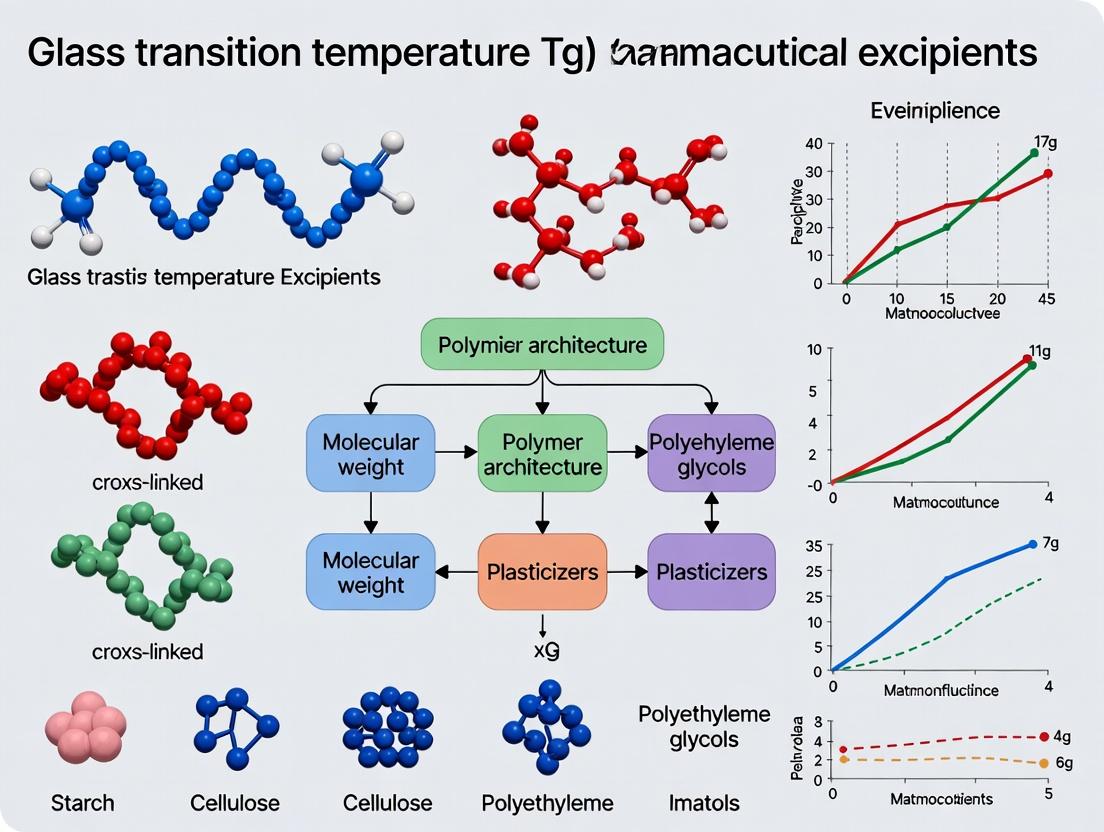
This article provides a detailed exploration of the key factors influencing the glass transition temperature (Tg) of pharmaceutical excipients, a critical parameter for amorphous solid dispersion stability, lyophilization, and controlled-release...
Understanding and Controlling the Glass Transition Temperature (Tg) in Pharmaceutical Excipients: A Comprehensive Guide for Formulation Scientists
Abstract
This article provides a detailed exploration of the key factors influencing the glass transition temperature (Tg) of pharmaceutical excipients, a critical parameter for amorphous solid dispersion stability, lyophilization, and controlled-release formulation. Targeting researchers and drug development professionals, the content covers foundational concepts, measurement methodologies, practical formulation troubleshooting, and advanced validation strategies. The scope spans from molecular-level interactions to real-world application, equipping scientists with the knowledge to predict, optimize, and validate Tg for enhanced product performance and stability.
The Science of Tg in Pharmaceuticals: From Molecular Fundamentals to Material Behavior
The glass transition temperature (Tg) is a fundamental material property that defines the temperature at which an amorphous solid transitions from a brittle, glassy state to a viscous, rubbery state. In pharmaceutical formulation, this transition governs critical performance attributes of solid dispersions, polymeric matrices, freeze-dried products, and other amorphous systems. A comprehensive thesis on factors influencing Tg in pharmaceutical excipients research must consider the intricate interplay between molecular structure, plasticization, processing conditions, and stability. This whitepaper provides a technical guide to defining, measuring, and applying Tg in drug development.
Fundamental Principles and Quantitative Data
Key Factors Influencing Tg in Pharmaceutical Systems
Tg is not an intrinsic constant for a material but is influenced by multiple formulation and processing variables.
Table 1: Primary Factors Influencing Tg of Pharmaceutical Amorphous Systems
| Factor Category | Specific Variable | General Effect on Tg | Typical Magnitude of Change |
|---|---|---|---|
| Molecular Weight | Increase in polymer Mw | Increases Tg | ~10-50°C per log unit increase until plateau |
| Plasticization | Addition of water | Decreases Tg dramatically | ~5-20°C per 1% moisture gain |
| Plasticization | Addition of API or low-Tg excipient | Decreases Tg | ΔTg ≈ (w1ΔTg1 + w2ΔTg2) / (w1 + w2) (Gordon-Taylor) |
| Molecular Structure | Increased chain flexibility | Decreases Tg | Varies widely by polymer backbone |
| Molecular Structure | Increased hydrogen bonding | Increases Tg | Can raise Tg by 20-100°C |
| Processing History | Annealing below Tg | Can increase Tg | ~1-10°C increase |
| Processing History | Quench cooling rate | Faster cooling can elevate measured Tg | ~1-5°C variation |
Table 2: Tg Values of Common Pharmaceutical Polymers (Dry State)
| Polymer/Excipient | Reported Tg (°C) | Key Application | Notable Sensitivity |
|---|---|---|---|
| Polyvinylpyrrolidone (PVP K30) | 150-180 | Solid dispersions | Highly hygroscopic, Tg drops sharply with moisture |
| Hydroxypropyl methylcellulose (HPMC) | 150-180 | Matrix tablets, coatings | Moderate moisture sensitivity |
| Polyvinyl alcohol (PVA) | 70-85 | Film coating | Very sensitive to residual moisture |
| Sucrose | 70-75 | Lyophilization stabilizer | Extremely sensitive to water |
| Trehalose | 115-120 | Lyophilization stabilizer | High Tg for a disaccharide |
| Polylactic acid (PLA) | 55-60 | Controlled release microparticles | Tg affected by crystallinity |
| Soluplus | ~70 | Solid solutions | Designed low Tg for melt extrusion |
The Gordon-Taylor Equation and Prediction
The Tg of a binary mixture, such as a polymer and a drug or a polymer and water, is often predicted using the Gordon-Taylor equation:
Tg(mix) = (w1Tg1 + Kw2Tg2) / (w1 + Kw2)
Where w1 and w2 are weight fractions, Tg1 and Tg2 are the glass transition temperatures of the components, and K is a fitting constant related to the difference in free volume between the components. For water-polymer systems, K is often approximated by the ratio of the polymer's Tg to that of water (~137 K).
Experimental Protocols for Tg Determination
Differential Scanning Calorimetry (DSC)
Principle: Measures the heat flow difference between a sample and reference as a function of temperature, detecting the change in heat capacity (Cp) at Tg.
Detailed Protocol:
- Sample Preparation: Place 3-10 mg of accurately weighed amorphous solid in a hermetically sealed aluminum pan. For hygroscopic samples, use a glove box (<5% RH) or seal rapidly.
- Instrument Calibration: Calibrate the DSC for temperature and enthalpy using indium (Tm = 156.6°C, ΔHfus = 28.45 J/g).
- Method Programming:
- Equilibration: Hold at 25°C for 2 min.
- Heating Scan: Heat from 25°C to a temperature 30°C above the expected Tg at a controlled rate (typically 10°C/min).
- Cooling Scan: Cool back to 25°C at 20-50°C/min.
- Re-Heating Scan: Repeat the heating scan identically to erase thermal history.
- Data Analysis: Analyze the re-heat scan. Tg is reported as the midpoint of the step change in heat capacity. Report onset and endpoint temperatures as well.
- Moisture Control: For precise work, perform measurements under a dry nitrogen purge (50 mL/min).
Dynamic Mechanical Analysis (DMA)
Principle: Applies a oscillatory stress to the sample and measures the resulting strain, determining the modulus and damping factor (tan δ), which peaks near Tg.
Detailed Protocol:
- Sample Geometry: Prepare films or compacts of uniform thickness (0.5-1 mm). Clamp in tension, compression, or three-point bending fixture.
- Frequency Sweep: Set a constant oscillation amplitude (within linear viscoelastic region) and a fixed temperature. Measure storage (E') and loss (E") moduli over a frequency range (e.g., 0.1-100 Hz).
- Temperature Ramp: At a fixed frequency (1 Hz), ramp temperature (e.g., 2°C/min) from below to above Tg.
- Data Analysis: Identify Tg from the peak of the tan δ (E"/E') curve or the onset of the drop in storage modulus (E').
Thermally Stimulated Depolarization Current (TSDC)
Principle: A highly sensitive technique that measures depolarization currents released as frozen molecular dipoles mobilize upon heating through Tg.
Visualization of Concepts and Workflows
Title: State Transition and Properties at Tg
Title: Key Factors Influencing Measured Tg
Title: Standard DSC Protocol for Tg Measurement
The Scientist's Toolkit: Key Research Reagent Solutions
Table 3: Essential Materials for Tg Research in Formulation
| Item/Category | Example Products/Details | Primary Function in Tg Research |
|---|---|---|
| Model Polymers | PVP (Kollidon), HPMC (Methocel), Soluplus, Eudragit grades | Standards for studying polymer-specific Tg behavior and API-polymer miscibility. |
| Plasticizers | Glycerin, Triethyl citrate, Polyethylene Glycol (PEG) 400, Water (D2O for some analyses) | Used to systematically study Tg depression and understand plasticization effects. |
| Calibration Standards | Indium, Zinc, Tin (for DSC temperature/enthalpy); Polystyrene reference materials (for DMA) | Critical for instrument calibration to ensure accurate and reproducible Tg measurement. |
| Hermetic Sealing Tools | TZero pans & lids (TA Instruments), High-pressure sealing dies | To prevent moisture loss/uptake during analysis, which drastically affects Tg. |
| Dynamic Vapor Sorption (DVS) Instrument | Surface Measurement Systems DVS, TA Instruments VTI | To precondition samples at specific %RH and quantify water sorption isotherms, directly linking water content to Tg depression. |
| Dielectric Spectroscopy Probes | Broadband Dielectric Spectrometers (e.g., Novocontrol) | To measure molecular mobility (α and β relaxations) around and below Tg, linking dynamics to stability. |
| Computational Software | Materials Studio (Blends module), Molecular Dynamics (MD) simulation packages | To predict miscibility, interaction parameters (χ), and theoretical Tg of blends using atomistic modeling. |
Within the broader thesis on factors influencing the glass transition temperature (Tg) in pharmaceutical excipients, understanding the practical implications of Tg is critical. Tg is a fundamental property of amorphous solids, defining the temperature at which a material transitions from a brittle, glassy state to a softer, rubbery state. For drug development professionals, the Tg of an amorphous active pharmaceutical ingredient (API) or solid dispersion formulation directly dictates physical stability, shelf-life predictions, and ultimate drug product performance. This technical guide delves into the mechanisms by which Tg influences these critical parameters.
Tg as a Predictor of Physical Stability
Below Tg, molecular mobility is severely restricted, freezing the system in a non-equilibrium state and kinetically stabilizing it against crystallization, chemical degradation, and phase separation. As storage temperature approaches or exceeds Tg, increased molecular mobility can lead to various physical instabilities.
Table 1: Correlation Between (T - Tg) and Physical Instability Rates
| T - Tg (°C) | Molecular Mobility | Expected Physical Instability | Typical Timeframe for De-vitrification |
|---|---|---|---|
| < -50 | Extremely Low | Negligible | Years to decades |
| -50 to -20 | Very Low | Very Slow | Months to years |
| -20 to 0 | Low | Slow, measurable | Weeks to months |
| 0 to +20 | Moderate | Significant | Days to weeks |
| > +20 | High | Rapid | Hours to days |
Experimental Protocol: Determining Tg and Onset of Mobility (Modulated DSC)
Objective: To accurately measure the Tg and characterize the associated change in heat capacity (ΔCp) using Modulated Differential Scanning Calorimetry (mDSC), which separates reversing (glass transition) from non-reversing (relaxation, crystallization) events.
Methodology:
- Sample Preparation: Precisely weigh 3-10 mg of the amorphous solid (e.g., spray-dried dispersion, melt-quenched API) into a standard Tzero aluminum pan. Hermetically seal the pan with a lid.
- Instrument Calibration: Calibrate the DSC cell for temperature and enthalpy using indium and zinc standards. Calibrate the cell constant using sapphire.
- Method Parameters:
- Purge Gas: Nitrogen at 50 mL/min.
- Temperature Range: Typically 25°C to 20°C above the estimated Tg or degradation temperature.
- Modulation Parameters: Use an amplitude of ±0.5°C and a period of 60 seconds.
- Underlying Heating Rate: 2°C/min.
- Data Analysis: Analyze the reversing heat flow signal. Tg is identified as the midpoint of the step-change in heat capacity. The non-reversing heat flow signal is examined for enthalpic relaxation peaks (below Tg) or crystallization exotherms (above Tg).
Title: mDSC Workflow for Tg Analysis
Implications for Shelf Life Prediction
The difference between storage temperature (T) and Tg is a key parameter in the Vogel-Tammann-Fulcher (VTF) and Williams-Landel-Ferry (WLF) equations, which model the temperature dependence of molecular relaxation times. A common rule of thumb is that for long-term stability, storage temperature should be at least 50°C below the Tg (i.e., T < Tg - 50°C).
Table 2: Estimated Shelf-Life at Different (T - Tg) Conditions
| Formulation Tg (°C) | Storage T (°C) | T - Tg (°C) | Predicted Dominant Instability | Accelerated Testing Protocol |
|---|---|---|---|---|
| 85 | 25 | -60 | Chemical degradation only | 40°C/75% RH for 6 months |
| 65 | 25 | -40 | Potential slow crystallization | 30°C/65% RH for 12 months |
| 45 | 25 | -20 | Probable crystallization | 25°C/60% RH for 3-6 months |
| 50 | 40 (Climatic Zone IV) | -10 | Rapid physical instability | Not stable for long-term storage |
Impact on Drug Performance: Dissolution and Bioavailability
Amorphous solid dispersions (ASDs) are engineered to enhance the dissolution rate and apparent solubility of poorly soluble APIs. The Tg of the polymer carrier and the ASD itself are crucial. A polymer with a high Tg (e.g., HPMCAS, Tg ~120°C) can provide better kinetic stabilization of the supersaturated state by inhibiting drug recrystallization from the dissolution medium, compared to a low-Tg polymer (e.g., PVP, Tg ~100-120°C but more hygroscopic, plasticizing).
Experimental Protocol: Microscale Parallel Dissolution with Concentration-Time Tracking
Objective: To evaluate the dissolution performance and supersaturation maintenance of ASDs with varying Tg.
Methodology:
- Apparatus: Use a µDISS Profiler or parallel small-volume dissolution apparatus.
- Media: 500 mL of biorelevant medium (e.g., FaSSIF, pH 6.5) in each vessel, maintained at 37°C.
- Sample Introduction: Add an equivalent of 5 mg API from each ASD formulation (and crystalline API control) to vessels simultaneously.
- Sampling/Monitoring: Use fiber-optic UV probes or automated micro-sampling to measure API concentration in situ at high frequency (e.g., every 10-30 seconds) for 2-4 hours.
- Analysis: Plot concentration vs. time (dissolution profile). Calculate Area Under the Curve (AUC) and determine the maximum achieved concentration (Cmax) and time to precipitation (if any).
Title: High Tg ASD Inhibits Precipitation Pathway
The Scientist's Toolkit: Key Research Reagent Solutions
Table 3: Essential Materials for Tg and Stability Research
| Reagent/Material | Function in Research | Key Consideration |
|---|---|---|
| Model Amorphous API (e.g., Felodipine, Indomethacin) | High glass-forming ability; used to study fundamental Tg-stability relationships without API-specific complications. | Well-characterized, readily forms stable glass. |
| Polymer Carriers with Varying Tg (HPMCAS, PVP/VA, PVP K30, Soluplus) | To formulate ASDs and study the effect of polymer Tg and functionality on the overall system Tg and stability. | Hygroscopicity can plasticize and lower measured Tg. |
| Standard DSC & mDSC Calibration Kits (Indium, Zinc, Sapphire) | Ensures accuracy and reproducibility of Tg measurements. Critical for comparing data across studies. | Must be of certified purity and weight. |
| Dynamic Vapor Sorption (DVS) Instrument | Measures moisture uptake as a function of RH. Data is used to predict plasticizing effect of water (Gordon-Taylor equation) on Tg. | Determines critical RH for Tg depression to storage T. |
| Microscale Parallel Dissolution Apparatus (e.g., µDISS) | Allows high-throughput, material-sparing assessment of dissolution performance linked to ASD Tg. | Enables real-time concentration monitoring without manual sampling. |
| Stability Chambers (ICH Conditions: 25°C/60%RH, 40°C/75%RH) | For long-term and accelerated stability studies to validate predictions based on Tg and (T-Tg). | Precise control and monitoring of temperature and humidity is essential. |
Within the broader thesis on factors influencing the glass transition temperature (Tg) in pharmaceutical excipients research, understanding the molecular-scale determinants is paramount. Tg is a critical physical property dictating the stability, processing, and performance of amorphous solid dispersions, polymeric excipients, and lyophilized products. This technical guide delineates the core principles through which chemical structure, molecular weight, and free volume govern Tg, providing a foundational framework for rational excipient design and selection in drug development.
Theoretical Foundations
The glass transition is a kinetic event where an amorphous material transitions from a brittle, glassy state to a viscous, rubbery state upon heating. At the molecular level, Tg marks the temperature at which segmental chain mobility commences. The three primary determinants are intrinsically linked:
- Chemical Structure: Governs intermolecular forces (cohesion energy) and chain stiffness.
- Molecular Weight: Influences the number of chain ends, which act as sites of increased free volume and mobility.
- Free Volume: The unoccupied space between molecules; segmental motion requires a critical amount of free volume.
The Fox-Flory equation provides a quantitative link between Tg and molecular weight (Mw) for linear polymers:
T_g = T_g(∞) - K / M_n
where T_g(∞) is the Tg at infinite molecular weight, K is a constant related to free volume per chain end, and M_n is the number-average molecular weight.
Molecular Determinants: Detailed Analysis
Chemical Structure
Chemical structure is the foremost determinant. Key structural factors include:
- Chain Rigidity: Bulky side groups (e.g., phenyl rings) and cyclic structures in the backbone restrict bond rotation, increasing Tg. Flexible linkages like ether bonds (-O-) lower Tg.
- Intermolecular Forces: Strong forces such as hydrogen bonding, dipole-dipole interactions, and ionic bonding increase cohesive energy density, requiring more thermal energy to initiate motion, thus elevating Tg.
- Symmetry & Regularity: High symmetry often allows for better packing, reducing free volume and sometimes increasing Tg, though it can also promote crystallization.
- Polarity: Polar groups enhance intermolecular attractions, typically raising Tg.
Table 1: Impact of Chemical Groups on Tg of Common Pharmaceutical Polymers
| Polymer/Excipient | Key Structural Feature | Approximate Tg (°C) | Effect on Tg |
|---|---|---|---|
| Polyvinylpyrrolidone (PVP) | Polar amide carbonyl, rigid pyrrolidone ring | ~175 | High Tg due to strong dipole-dipole interactions and ring rigidity. |
| Hydroxypropyl Methylcellulose (HPMC) | Flexible glucose backbone, ether & hydroxyl groups | ~170-180 | High Tg from extensive hydrogen bonding network. |
| Polyvinyl Alcohol (PVA) | High density of hydroxyl groups | ~85 | High Tg due to strong hydrogen bonding. Degree of hydrolysis is critical. |
| Poly(lactic-co-glycolic acid) (PLGA) | Ester linkages, methyl side groups (LA) | 40-55 | Moderate Tg. LA:GA ratio and end groups significantly affect value. |
| Polyethylene Glycol (PEG) | Flexible ether (-O-) backbone, low polarity | ~(-60)-(-10) | Very low Tg due to high chain flexibility and low cohesive energy. |
Molecular Weight
The effect of molecular weight follows the Fox-Flory relationship. As Mw increases, Tg increases asymptotically, plateauing at T_g(∞). This is because chain ends constitute regions of excess free volume and enhanced mobility. A higher concentration of chain ends (lower Mw) leads to a greater free volume fraction and a lower Tg.
Table 2: Effect of Molecular Weight on Tg for Representative Polymers
| Polymer | M_n (kDa) | Tg (°C) | T_g(∞) (Literature, °C) |
|---|---|---|---|
| PVP K12 | ~4-6 | ~100-110 | ~175 |
| PVP K30 | ~44-54 | ~160-165 | ~175 |
| PLGA (50:50) | ~10 | ~40 | ~48 |
| PLGA (50:50) | ~80 | ~47 | ~48 |
| Dextran | ~3-6 | ~100 | ~220 |
| Dextran | ~40 | ~200 | ~220 |
Free Volume
Free volume (Vf) is the conceptual space not occupied by molecules. The Williams-Landel-Ferry (WLF) equation describes the temperature dependence of polymer mobility above Tg in relation to free volume. Additives (e.g., water, plasticizers) increase free volume and reduce Tg. The Gordon-Taylor equation models this effect:
T_g(mix) = (w_1 T_g1 + K w_2 T_g2) / (w_1 + K w_2)
where w is weight fraction and K is a constant related to free volume expansion coefficients.
Table 3: Free Volume Impact: Plasticization of PVP by Water
| PVP K30 Moisture Content (% w/w) | Estimated Free Volume Increase | Resultant Tg (°C) |
|---|---|---|
| 0% | Baseline | 165 |
| 5% | Moderate | ~90 |
| 10% | High | ~20 |
| 15% | Very High | <0 |
Experimental Protocols for Determination
Differential Scanning Calorimetry (DSC) for Tg Measurement
Principle: Measures heat flow difference between sample and reference as a function of temperature. Protocol:
- Sample Preparation: Place 3-10 mg of accurately weighed sample in a hermetically sealed DSC pan. For hygroscopic excipients, seal pans in a dry environment.
- Method Development:
- Purge Gas: Nitrogen, 50 mL/min.
- Heating Rate: 10°C/min (standard). Slower rates (2-5°C/min) can resolve subtle transitions.
- Temperature Range: Typically -50°C to 250°C, depending on material.
- Calibration: Calibrate enthalpy and temperature using indium and zinc standards.
- Run Cycle: Equilibrate at start temperature. Heat (first heating) to erase thermal history, cool at 20°C/min, then reheat (second heating) for analysis.
- Data Analysis: Tg is identified as the midpoint of the step change in heat capacity (Cp) on the second heating scan.
Molecular Weight Determination via Gel Permeation Chromatography (GPC/SEC)
Principle: Separates polymer molecules by hydrodynamic volume in solution. Protocol:
- System: GPC/SEC with refractive index (RI) detector.
- Columns: Series of polystyrene-divinylbenzene columns with varying pore sizes.
- Mobile Phase: Suitable solvent (e.g., DMF with LiBr for polysaccharides, THF for many synthetics). Filter and degas.
- Standards: Narrow dispersity polystyrene or polymethylmethacrylate standards for calibration curve.
- Procedure: Dissolve sample at ~2-4 mg/mL. Filter (0.2 μm). Inject 100 μL. Run isocratically at 1 mL/min.
- Analysis: Use software to determine Mn, Mw, and dispersity (Ð) from the calibration curve.
The Scientist's Toolkit: Research Reagent Solutions
Table 4: Essential Materials for Tg-Related Research
| Item | Function in Research |
|---|---|
| Differential Scanning Calorimeter (DSC) | Primary instrument for direct measurement of Tg via heat capacity change. |
| Hermetic Sealing DSC Pans & Lids | Prevents sample loss/contamination and controls moisture for accurate Tg measurement. |
| Dynamic Mechanical Analyzer (DMA) | Measures viscoelastic properties (storage/loss modulus) providing Tg from peak in tan δ. |
| Gel Permeation Chromatography System | Determines molecular weight distributions (Mn, Mw, Ð) critical for Fox-Flory analysis. |
| Sorption Balance (DVS) | Quantifies moisture uptake under controlled RH, essential for plasticization (free volume) studies. |
| High-Purity, Anhydrous Organic Solvents | For sample preparation, GPC analysis, and synthesis without introducing plasticizers. |
| Polymer Standards (Narrow Ð) | For calibrating GPC systems to obtain accurate molecular weight data. |
| Model Plasticizers (e.g., Glycerol, Triacetin) | Used in controlled experiments to study free volume effects on Tg via Gordon-Taylor equation. |
Visualizations
Molecular Determinants of Tg Relationship Diagram
DSC Protocol for Tg Measurement Workflow
Within the broader thesis investigating factors influencing the glass transition temperature (Tg) in pharmaceutical excipients, this analysis provides a foundational examination of three critical excipient classes. The Tg is a fundamental property dictating the physical stability, mechanical behavior, and performance of solid dispersions, lyophilized products, and polymeric film coatings. Understanding how the chemical nature and concentration of polymers (like PVP and HPMC), sugars, and plasticizers modulate Tg is essential for rational formulation design to prevent crystallization, ensure adequate shelf-life, and control drug release kinetics.
Technical Analysis of Key Excipient Classes
Polymers: Polyvinylpyrrolidone (PVP) and Hypromellose (HPMC)
These amorphous polymers are widely used as matrix formers in solid dispersions and as coating agents. Their high inherent Tg provides rigidity but is susceptible to modulation by water and API.
PVP (e.g., PVP K30): A synthetic polymer with a Tg of ~160-180°C. Its polar amide group is highly hygroscopic, leading to significant Tg depression upon moisture absorption. It acts as an effective crystallization inhibitor for APIs. HPMC (e.g., HPMC E5): A semi-synthetic cellulose ether with a Tg typically between 150-180°C (depending on grade and moisture). Its less hygroscopic nature compared to PVP often results in a higher Tg under similar RH conditions.
Sugars (e.g., Sucrose, Trehalose, Mannitol)
Sugars serve as stabilizers, bulking agents, and cryoprotectants, particularly in lyophilized products. Their Tg behavior is highly type-dependent:
- Disaccharides (Sucrose, Trehalose): Form amorphous matrices with relatively high Tg (e.g., sucrose ~70°C) crucial for stabilizing biologics. They are prone to plasticization by residual water.
- Polyols (Mannitol): Often crystallizes during freeze-drying, providing structural elegance but negligible amorphous content. Its crystalline form does not exhibit a Tg relevant to stability concerns.
Plasticizers (e.g., Glycerol, Triacetin, PEG 400)
These low molecular weight, high-boiling point compounds are intentionally added to polymeric coatings to increase chain mobility, reduce brittleness, and lower the Tg. The extent of Tg depression follows the Gordon-Taylor equation and depends on plasticizer miscibility and free volume addition.
Table 1: Characteristic Glass Transition Temperatures (Tg) of Key Excipients
| Excipient Class | Specific Example | Approximate Dry Tg (°C) | Key Influencing Factor | Effect of 5% w/w Water (ΔTg) |
|---|---|---|---|---|
| Polymer | PVP K30 | 165-180 | Molecular weight, moisture | ↓ ~40-60°C |
| Polymer | HPMC E5 | 150-180 | Methoxy/hydroxypropyl substitution, moisture | ↓ ~20-40°C |
| Sugar | Amorphous Sucrose | 65-75 | Purity, moisture content | ↓ ~30-40°C |
| Sugar | Amorphous Trehalose | 100-120 | Isomer form, moisture | ↓ ~40-50°C |
| Plasticizer | Glycerol | (-)93* | -- | -- |
| Plasticizer | PEG 400 | (-)65 to (-)13* | -- | -- |
*Plasticizers themselves have low Tg; their primary function is to lower the Tg of polymer blends.
Table 2: Impact of 10% w/w Plasticizer on Polymer Tg (Modeled Data)
| Polymer | Plasticizer | Estimated Tg of Blend (°C) | % Reduction from Dry Polymer Tg |
|---|---|---|---|
| PVP K30 (Tg 170°C) | Triacetin | ~110 | ~35% |
| PVP K30 (Tg 170°C) | PEG 400 | ~90 | ~47% |
| HPMC E5 (Tg 165°C) | Triacetin | ~115 | ~30% |
| HPMC E5 (Tg 165°C) | Glycerol | ~70 | ~58% |
Experimental Protocols for Tg Determination
Protocol 1: Differential Scanning Calorimetry (DSC) for Tg Measurement
- Sample Preparation: Precisely weigh 3-10 mg of excipient (dry or conditioned at specific %RH) into a hermetically sealed aluminum DSC pan. An empty pan serves as reference.
- Method Development: Equilibrate at 0°C. Use a heat-only ramp, typically 10°C/min, from 0°C to 200°C (or above polymer decomposition temperature) under 40-50 mL/min N2 purge.
- Data Analysis: In the resulting thermogram, identify the glass transition as a step-change in heat flow. The Tg is conventionally reported as the midpoint of the step transition.
- Critical Note: For moisture-sensitive materials, use Tzero hermetic pans and consider fast scanning rates to minimize in-situ drying.
Protocol 2: Modulated DSC (mDSC) for Separating Reversing and Non-Reversing Events
- Sample Preparation: As per standard DSC.
- Method Development: Apply a sinusoidal temperature modulation (e.g., ±0.5°C every 60 seconds) superimposed on a linear underlying heating rate (e.g., 2°C/min).
- Data Analysis: Deconvolute the total heat flow into reversing (heat capacity-related, e.g., Tg) and non-reversing (kinetic, e.g., enthalpy relaxation, evaporation) signals. The Tg is taken from the midpoint of the step change in the reversing heat flow signal, providing clearer transitions overlapped by relaxation endotherms.
Protocol 3: Dynamic Mechanical Analysis (DMA) for Film Coatings
- Sample Preparation: Cast or spray-dry a free film of the polymer/excipient blend. Cut into a rectangular strip of precise dimensions (e.g., 20mm x 10mm).
- Method Development: Clamp the film in tension. Apply a oscillatory strain (frequency often 1 Hz) while ramping temperature (e.g., 3°C/min). Measure the storage modulus (E'), loss modulus (E''), and tan delta (E''/E').
- Data Analysis: Identify the Tg as the peak maximum of the tan delta curve or the onset of the steep drop in the storage modulus (E').
Visualizations: Relationships and Workflows
Tg Determination Pathway for Excipient Systems
Experimental Tg Measurement Workflow
The Scientist's Toolkit: Key Research Reagent Solutions
Table 3: Essential Materials for Tg Excipient Research
| Item/Category | Example(s) | Primary Function in Research |
|---|---|---|
| Model Polymers | PVP K30, HPMC (E5, E15), Soluplus | Serve as high-Tg amorphous matrix formers for studying blending, plasticization, and stabilization. |
| Model Plasticizers | Glycerol, Triacetin, Citrate esters (e.g., ATBC), PEG 400 | Used to systematically study Tg depression and film flexibility in polymer coatings. |
| Model Sugars/Stabilizers | Trehalose dihydrate, Sucrose, Mannitol | Representatives for studying cryoprotection, bulking, and Tg in lyophilized systems. |
| Thermal Analysis Consumables | Hermetic Tzero DSC pans/lids (aluminum), DMA film tension clamps | Ensure reliable, moisture-free measurements and proper mechanical analysis of films. |
| Standard Reference Materials | Indium, Zinc, Cyclohexane (for DSC calibration) | Critical for temperature and enthalpy calibration of thermal analyzers for accurate Tg. |
| Controlled Humidity Systems | Saturated salt solutions, dynamic vapor sorption (DVS) instruments | For preconditioning samples at precise %RH to study water's plasticizing effect on Tg. |
| Film Formation Aids | Methanol, Dichloromethane, Acetone, Deionized Water (as solvents) | Used for solvent casting of free films for DMA or texture analysis. |
This whitepaper, framed within the broader thesis on Factors influencing Tg in pharmaceutical excipients research, details the critical role of water as a plasticizer in amorphous pharmaceutical systems. The glass transition temperature (Tg) is a fundamental property dictating the physical stability, mechanical behavior, and performance of solid dispersions, lyophilized products, and polymeric excipients. Water, due to its small molecular size and polarity, acts as a nearly universal plasticizer, significantly depressing the Tg of hydrophilic amorphous matrices. Understanding this depression is paramount for predicting product shelf-life, preventing collapse during freeze-drying, and mitigating issues like crystallization and chemical degradation.
Core Principles of Tg Depression by Water
Water depresses the Tg by increasing the free volume and molecular mobility of the system. The extent of depression is governed by the strength of water-polymer/excipient interactions and the resultant change in system thermodynamics. The Gordon-Taylor equation (and its derivation, the Fox equation) is the primary model used to predict the Tg of a water-excipient mixture:
Gordon-Taylor Equation:
Tg,mix = (w1 * Tg1 + K * w2 * Tg2) / (w1 + K * w2)
Where:
- Tg,mix = Glass transition of the mixture
- w1, Tg1 = Weight fraction and Tg of component 1 (excipient)
- w2, Tg2 = Weight fraction and Tg of component 2 (water, Tg ≈ -135°C)
- K = Fitting parameter related to the strength of interaction and free volume additivity.
A lower K value indicates a stronger plasticizing effect and greater Tg depression per unit of water added.
Quantitative Data on Tg Depression
Table 1: Tg Depression of Common Pharmaceutical Excipients by Water
| Excipient (Amorphous Form) | Dry Tg (°C) | K (Gordon-Taylor) | Tg at 5% Moisture (°C) | Key Reference (Live Search 2024) |
|---|---|---|---|---|
| Polyvinylpyrrolidone (PVP K30) | ~175 | 0.45 - 0.55 | ~55 | Shamblin et al., Pharm. Res. 1999; Recent reviews confirm consistency. |
| Hydroxypropyl Methylcellulose (HPMC) | ~165 | 0.50 - 0.65 | ~60 | Yoshioka et al., J. Pharm. Sci. 2004; Cited in current ASD stability models. |
| Sucrose | ~70 | 0.7 - 1.0 | ~-10 to 5 | Slade & Levine, Crit. Rev. Food Sci. Nutr. 1991; Foundational data still applied. |
| Trehalose | ~120 | 0.5 - 0.6 | ~35 | Surana et al., Pharm. Res. 2004; Critical for modern lyo-formulation. |
| Copovidone (PVP-VA) | ~105 | 0.60 - 0.75 | ~40 | Konno & Taylor, Pharm. Res. 2006; Widely used in hot-melt extrusion. |
| Soluplus | ~70 | 0.8 - 1.2 | ~25 | Recent patent analyses and formulation guides (2023). |
Experimental Protocols for Measurement
Protocol A: Determination of Tg Depression via Dynamic Vapor Sorption (DVS) & DSC Objective: To measure the Tg of an excipient as a function of precise water content. Materials: Amorphous excipient powder, Dynamic Vapor Sorption analyzer, Differential Scanning Calorimeter (DSC), hermetic sample pans. Method:
- Conditioning: Place ~10-20 mg of sample in the DVS. Expose to a stepped humidity profile (e.g., 0%, 10%, 20%... 90% RH) at constant temperature (25°C). Hold at each step until equilibrium mass change (dm/dt < 0.002%/min).
- Water Content Determination: Record the exact mass of water sorbed at each RH. Calculate the equilibrium moisture content (%, w/w).
- Tg Measurement: Immediately after reaching equilibrium at a target RH, transfer a subsample (~5-10 mg) into a hermetically sealed DSC pan. Perform a DSC scan (e.g., -50°C to 150°C at 10°C/min) to determine the Tg of the equilibrated sample.
- Data Fitting: Plot Tg vs. water content (w/w). Fit data to the Gordon-Taylor equation using non-linear regression to obtain the
Kparameter.
Protocol B: Modeling Water Distribution using Inverse Gas Chromatography (IGC) Objective: To probe the surface energy and specific interaction sites for water on an excipient surface. Materials: Amorphous excipient powder, Inverse Gas Chromatography system, inert column packing material, molecular probes (alkanes, alcohols, water). Method:
- Column Preparation: Pack a chromatographic column with the excipient coated on an inert support.
- Probe Injection: Inject a series of non-polar (alkanes) and polar (e.g., ethanol, water) vapor probes at infinite dilution (zero surface coverage).
- Data Analysis: Calculate the net retention volume. From alkane data, determine the dispersive surface energy. From polar probes, calculate the specific free energy of adsorption (∆Gsp). The strength of water-excipient interaction (related to
Kin Gordon-Taylor) can be derived from the ∆Gsp for water.
Visualization: Pathways and Workflows
Title: Mechanism of Water-Induced Tg Depression
Title: Experimental Workflow for Tg-Moisture Profile
The Scientist's Toolkit: Key Research Reagent Solutions
Table 2: Essential Materials and Reagents for Tg Depression Studies
| Item | Function & Rationale |
|---|---|
| Hermetic DSC Pans & Lids | To prevent moisture loss or gain during Tg measurement, ensuring the sample's water content is identical to that conditioned in the DVS. |
| Standard Reference Materials (Indium, Zinc) | For calibration of DSC temperature and enthalpy scales, ensuring accuracy and inter-laboratory reproducibility of Tg measurements. |
| Desiccants (e.g., P₂O₅, Molecular Sieves) | For generating dry atmospheres (0% RH) in desiccators to prepare and store baseline "dry" amorphous samples. |
| Saturated Salt Solutions | For creating constant humidity environments (e.g., LiCl [11% RH], MgCl₂ [33% RH], NaCl [75% RH]) in static desiccators for sample conditioning. |
| High-Purity Analytical Grade Water | Essential for preparing standards and for use in DVS generators, avoiding impurities that could affect sorption kinetics or thermal properties. |
| Model Amorphous Excipients (e.g., PVP, Sucrose) | Well-characterized reference materials with published Tg depression data, used for method validation and instrument performance qualification. |
| Thermogravimetric Analyzer (TGA) | Used in conjunction with DSC to directly measure the exact water content of a sample pan immediately prior to or after a Tg scan. |
Measuring and Applying Tg Data: Best Practices in Characterization and Formulation Design
Within the critical research on factors influencing the glass transition temperature (Tg) of pharmaceutical excipients, accurate and insightful analytical techniques are paramount. Tg is a key determinant of an excipient’s physical stability, mechanical behavior, and performance in solid dosage forms, impacting dissolution, crystallization tendency, and shelf-life. This guide details the core techniques of Differential Scanning Calorimetry (DSC) and Dynamic Mechanical Analysis (DMA), and surveys emerging methods for robust Tg determination.
Differential Scanning Calorimetry (DSC): The Benchmark
Principle & Methodology
DSC measures the difference in heat flow between a sample and an inert reference as a function of temperature or time. As an amorphous excipient undergoes glass transition, a change in heat capacity is observed as an endothermic step-change in the baseline.
Detailed Experimental Protocol for Tg Determination
- Sample Preparation: Precisely weigh 3-10 mg of the powdered excipient into a standard aluminum DSC pan. For hygroscopic materials, perform weighing in a controlled humidity glove box. Hermetically seal the pan with a lid using a press.
- Instrument Calibration: Calibrate the DSC for temperature and enthalpy using high-purity indium and zinc standards.
- Experimental Parameters:
- Purge Gas: Nitrogen at 50 mL/min.
- Temperature Program: Equilibrate at 20°C below the expected Tg. Heat from this starting temperature to 30°C above the expected Tg at a controlled scanning rate (typical: 10°C/min). A modulated DSC (MDSC) protocol may involve a superimposed sinusoidal oscillation (e.g., ±0.5°C every 60 seconds) to separate reversing (heat capacity) and non-reversing events.
- Quench Cooling: Rapidly cool the sample back to the start temperature.
- Re-Run: Perform a second heating scan under identical conditions to erase thermal history and observe the annealed Tg.
- Data Analysis: Analyze the first and second heating scans. Tg is typically reported as the midpoint (inflection point) of the step change in heat capacity, determined using the instrument's software tangent method. The onset and endpoint temperatures should also be noted.
Data Presentation
Table 1: Typical Tg Values for Common Pharmaceutical Excipients via DSC (10°C/min)
| Excipient | Chemical Classification | Tg Range (°C) | Critical Factors Influencing Tg |
|---|---|---|---|
| Polyvinylpyrrolidone (PVP K30) | Polymer | ~160-175 | Molecular weight, residual moisture |
| Hydroxypropyl Methylcellulose (HPMC) | Polymer | ~155-180 | Degree of substitution, hydration state |
| Sucrose | Disaccharide | ~60-75 | Purity, crystallization history |
| Trehalose | Disaccharide | ~100-120 | Hydration state, preparation method |
| Sorbitol | Polyol | ~-5 to 10 | Polymorphic form, water content |
| Indomethacin (model drug) | Small Molecule | ~45-50 | Amorphous purity, aging |
Dynamic Mechanical Analysis (DMA): Probing Viscoelasticity
Principle & Methodology
DMA applies a oscillatory stress (or strain) to a sample and measures the resultant strain (or stress). It directly measures the viscoelastic moduli—storage modulus (E'), loss modulus (E''), and tan delta (E''/E')—as functions of temperature, frequency, or time. The Tg is identified by a dramatic drop in E' and a peak in E'' or tan delta, corresponding to the onset of large-scale molecular motion.
Detailed Experimental Protocol for Tg Determination
- Sample Preparation: Prepare a solid, coherent specimen (e.g., compacted powder, film, or free-standing solid dispersion) suitable for the clamping geometry. Common geometries include single cantilever, three-point bend, or compression. Sample dimensions must be precisely measured.
- Instrument Setup: Install the appropriate fixture and calibrate according to manufacturer specifications. Ensure good mechanical contact without over-tightening.
- Experimental Parameters:
- Deformation Mode: Single cantilever bending is common for solid excipient compacts.
- Oscillation Frequency: 1 Hz is standard for temperature ramps; multi-frequency sweeps provide activation energy data.
- Strain Amplitude: Set within the linear viscoelastic region (determined via prior strain sweep).
- Temperature Program: Equilibrate at start temperature (e.g., -50°C). Heat at 3°C/min to a suitable endpoint (e.g., 150°C) under a nitrogen purge.
- Data Analysis: Identify the Tg from: i) the onset of the steep decrease in the storage modulus (E'), ii) the peak maximum of the loss modulus (E''), and iii) the peak maximum of tan delta (δ). The tan delta peak typically occurs at a temperature 10-20°C higher than the E'' peak.
Emerging & Complementary Methods
Local Thermal Analysis (LTA)
Techniques like nano-TA or scanning thermal microscopy use a nanoscale thermal probe to measure local changes in thermal properties, mapping Tg heterogeneity in complex formulations (e.g., coated particles, bi-layer tablets).
Dielectric Spectroscopy (DES)
Measures the dielectric permittivity and loss of a material as a function of frequency and temperature. The α-relaxation, associated with large-scale segmental motion, correlates directly with Tg and provides rich information on molecular dynamics.
Solid-State Nuclear Magnetic Resonance (ssNMR)
Probes local molecular mobility. Changes in relaxation times (e.g., ¹³C CP/MAS line-shape, ¹H T₁ρ) can be used to identify Tg, particularly for complex or heterogeneous systems where bulk techniques are less sensitive.
The Scientist's Toolkit: Research Reagent Solutions
Table 2: Essential Materials for Tg Analysis of Excipients
| Item | Function & Rationale |
|---|---|
| Hermetic Aluminum DSC Pans/Lids | Standard sample encapsulation to prevent mass loss, control atmosphere, and ensure good thermal contact. |
| High-Purity Calibration Standards (Indium, Zinc) | Essential for accurate temperature and enthalpy calibration of DSC instruments. |
| Desiccant (e.g., P₂O₅) | For preparation and storage of hygroscopic excipients prior to analysis to control plasticization by moisture. |
| Hydraulic Pellet Press | To form cohesive compacts of powdered excipients for DMA analysis in bending or compression modes. |
| Standard Reference Material (e.g., Polystyrene) | Used for validation of DMA temperature and modulus calibration. |
| Inert Purge Gas (N₂ or He cylinder) | Provides an inert, moisture-free atmosphere during analysis to prevent oxidative degradation and moisture uptake. |
| Modulated DSC Kit/Software | Enables separation of complex thermal events (reversing/non-reversing heat flow) for more accurate Tg deconvolution. |
Decision Pathway for Tg Analysis Technique Selection
Standard DSC Protocol for Tg Workflow
This in-depth technical guide serves as a critical resource for interpreting differential scanning calorimetry (DSC) thermograms, with a specific focus on identifying the glass transition temperature (Tg), secondary relaxations, and common experimental artifacts. This analysis is framed within the essential context of pharmaceutical excipients research, where precise determination of Tg is a cornerstone for predicting the physical stability, dissolution behavior, and shelf-life of amorphous solid dispersions, lyophilized products, and polymeric drug delivery systems. Understanding the factors that influence Tg—such as molecular weight, plasticization by water or API, and processing history—is fundamental to rational formulation design.
Fundamentals of Thermogram Features
A DSC thermogram plots heat flow against temperature, revealing thermal events characteristic of a material's physical state.
Primary Thermal Events:
- Glass Transition (Tg): A second-order, step-change event reflecting the reversible transition from a glassy to a rubbery state. It is characterized by a change in heat capacity (ΔCp).
- Relaxation Endotherm: Often appears as a peak superimposed on the Tg step, indicative of enthalpy recovery from physical aging or stress relaxation in the glass.
- Crystallization Exotherm: A sharp exothermic peak occurring upon heating an amorphous material above its Tg, where molecules gain mobility to order into a crystalline lattice.
- Melting Endotherm: A sharp endothermic peak representing the first-order transition from a crystalline solid to a liquid.
Secondary Relaxations (β, γ): These are local-scale, sub-Tg motions often visible as subtle inflections or peaks in modulated DSC (MDSC) reversing heat flow signals or in dielectric analysis. They are crucial for understanding local mobility that may impact chemical stability.
Common Artifacts:
- Thermal Lag: Misalignment of temperatures between sample and sensor, causing shifts in event temperatures, especially at high heating rates.
- Baseline Drift: Non-flat baseline due to poor contact, sample pan issues, or instrument instability.
- Fictive Peaks: Apparent transitions caused by moisture loss or solvent evaporation during the run.
Detailed Experimental Protocols for Tg Determination
Standard DSC Protocol for Tg Assessment
This protocol is designed for the accurate determination of Tg in pharmaceutical excipients like polyvinylpyrrolidone (PVP), hydroxypropyl methylcellulose (HPMC), or sucrose.
Materials & Equipment:
- Differential Scanning Calorimeter (e.g., TA Instruments Q2000, Mettler Toledo DSC 3)
- Hermetically sealed Tzero aluminum pans and lids
- Analytical balance (µg precision)
- Desiccator with phosphorus pentoxide or similar desiccant
- Sample (5-10 mg of finely milled excipient or formulation)
Procedure:
- Sample Preparation: Dry the sample in a desiccator under vacuum for a minimum of 24 hours to remove residual moisture.
- Panning: Precisely weigh 5-10 mg of the sample into a Tzero aluminum pan. Crimp the pan hermetically using a seal press in a dry environment (e.g., glovebox) to prevent moisture uptake.
- Instrument Calibration: Calibrate the DSC for temperature and enthalpy using indium and zinc standards.
- Experimental Parameters:
- Temperature Range: -50°C to 250°C (or 30°C above expected melting/decomposition point).
- Heating Rate: 10°C/min (standard). For more resolved Tg, a slower rate (e.g., 5°C/min) may be used.
- Purge Gas: Dry nitrogen at 50 mL/min.
- Cooling: After first heat, cool rapidly (20-50°C/min) to the start temperature.
- Run: Perform a minimum of two heating-cooling cycles. The Tg is typically reported from the second heat to erase thermal history, unless the effect of processing history is under study.
- Analysis: Using the instrument software, identify the Tg as the midpoint of the step change in heat flow. The onset and endpoint temperatures should also be noted.
Modulated DSC (MDSC) Protocol for Separating Overlapping Events
MDSC separates total heat flow into reversing (heat capacity-related) and non-reversing (kinetic) components, crucial for deconvoluting Tg from relaxation or evaporation artifacts.
Procedure:
- Follow steps 1-3 from the Standard DSC Protocol.
- Experimental Parameters:
- Underlying Heating Rate: 2°C/min.
- Modulation Amplitude: ±0.5°C.
- Modulation Period: 60 seconds.
- Purge gas and temperature range as above.
- Analysis: The reversing heat flow signal provides a clear Tg step, often unobscured by the enthalpy relaxation endotherm, which appears in the non-reversing heat flow signal.
Quantitative Data on Tg of Common Pharmaceutical Excipients
The following table summarizes Tg values for key amorphous excipients, highlighting the profound plasticizing effect of water—a primary factor in pharmaceutical research.
Table 1: Glass Transition Temperatures (Tg) of Select Pharmaceutical Excipients
| Excipient | Chemical Class | Dry Tg (°C) | Tg at 3% RH (°C) | Critical Relative Humidity (RH) for Significant Plasticization | Key Application |
|---|---|---|---|---|---|
| Sucrose | Disaccharide | ~70 | ~30 | >10% RH | Lyoprotectant, Stabilizer |
| Trehalose | Disaccharide | ~120 | ~80 | >15% RH | Superior lyoprotectant |
| PVP K30 | Polymer (vinylpyrrolidone) | ~170 | ~100 | >20% RH | Amorphous solid dispersion matrix |
| HPMC | Cellulose ether (polymer) | ~170 | ~120 | >25% RH | Controlled release, film coating |
| Copovidone (VA64) | Polymer (vinyl acetate/ pyrrolidone) | ~105 | ~70 | >20% RH | Soluble solid dispersion matrix |
| Soluplus | Polymer (polyvinyl caprolactam-PVA-PEG graft copolymer) | ~70 | < Room Temp | >10% RH | Melt extrusion, solubility enhancement |
Data compiled from recent literature (2020-2024). Values are approximate and batch/polymer grade dependent.
Diagram: Workflow for Systematic Thermogram Interpretation
Thermogram Analysis Workflow
Diagram: Factors Influencing Tg in Pharmaceutical Systems
Factors Affecting Formulation Tg
The Scientist's Toolkit: Key Research Reagent Solutions & Materials
Table 2: Essential Materials for Reliable Thermogram Analysis
| Item | Function & Rationale |
|---|---|
| Hermetic Tzero Aluminum Pans & Lids | Provides a sealed environment crucial for preventing moisture loss/uptake during the run, which creates significant artifacts. Tzero technology improves baseline. |
| High-Purity Nitrogen Gas (≥99.999%) | Inert purge gas to prevent oxidative degradation of samples and ensure stable, clean baselines. |
| Calibration Standards (Indium, Zinc) | Certified standards for accurate temperature and enthalpy calibration of the DSC cell, mandatory for reproducible, quantitative data. |
| Desiccants (P2O5, Molecular Sieves) | For creating ultra-dry environments (<1% RH) in desiccators for sample drying and storage, critical for measuring intrinsic, dry Tg. |
| Refrigerated Cooling System (e.g., RCS) | For precise control of sub-ambient starting temperatures and rapid quenching after melting, essential for studying glass formation and annealing effects. |
| Modulated DSC (MDSC) Software License | Enables separation of complex thermal events, allowing clear identification of Tg in the reversing signal despite overlapping relaxations. |
| Microbalance (0.001 mg resolution) | Accurate sample weighing (5-10 mg typical) is critical for consistent heat flow results and quantitative ΔCp measurement. |
This technical guide addresses a critical subtopic within the broader thesis on Factors influencing Tg in pharmaceutical excipients research. The glass transition temperature (Tg) is a fundamental property dictating the physical stability and performance of amorphous solid dispersions (ASDs), a key strategy for enhancing the bioavailability of poorly soluble drugs. This paper details how the Tg of a polymer excipient and its blend with an API can be used to predict molecular miscibility and long-term physical stability, directly contributing to the understanding of excipient selection and design.
Theoretical Framework: Tg, Miscibility, and Stability
The Gordon-Taylor Equation and Miscibility Prediction
A primary indicator of API-polymer miscibility is the comparison between the experimentally measured Tg of the ASD and the predicted Tg of a fully miscible blend, most commonly using the Gordon-Taylor equation:
Equation: Tg(blend) = (w1 * Tg1 + K * w2 * Tg2) / (w1 + K * w2)
Where w1 and w2 are the weight fractions of components 1 and 2, Tg1 and Tg2 are their respective glass transition temperatures, and K is a fitting constant often approximated by K ≈ (ρ1 * Tg1) / (ρ2 * Tg2) (ρ = density).
- A single, composition-dependent Tg close to the Gordon-Taylor prediction suggests a miscible, homogeneous single-phase system.
- Multiple Tg values or significant deviation (typically > 20°C) suggests phase separation.
Tg as a Stability Proxy: The "∆T Rule"
The difference between the storage temperature (Ts) and the Tg of the formulation (Tg - Ts = ∆T) is a critical stability predictor.
- General Rule: For long-term stability,
Tg - Ts ≥ 50°C. At∆T < 20°C, molecular mobility increases significantly, risking crystallization, phase separation, and chemical degradation.
Table 1: Common Pharmaceutical Polymers and Their Tg Values
| Polymer Excipient | Chemical Class | Approx. Tg (°C) | Key Characteristics |
|---|---|---|---|
| Polyvinylpyrrolidone (PVP K30) | Vinyl polymer | ~170 | High Tg, hygroscopic, good for spray drying. |
| Copovidone (PVP-VA64) | Vinyl copolymer | ~105 | Lower Tg than PVP, good solubilizing capacity. |
| Hydroxypropyl Methylcellulose Acetate Succinate (HPMCAS) | Cellulose derivative | ~120 (grade dependent) | pH-dependent solubility, often used in hot-melt extrusion. |
| Soluplus | Polyvinyl caprolactam-PVA-PEG graft copolymer | ~70 | Low Tg, plasticizing effect, good for melt extrusion. |
| Methacrylic Acid Copolymers (Eudragit E PO) | Methacrylate | ~48 | Low Tg, requires plasticizer for processing. |
Table 2: Impact of Tg-Storage Temperature Delta (∆T) on ASD Stability
| ∆T (Tg - Ts) | Molecular Mobility | Risk of Crystallization | Expected Physical Stability |
|---|---|---|---|
| ≥ 50°C | Very Low | Very Low | High (Years) |
| 20 to 50°C | Low to Moderate | Low to Moderate | Moderate (Months to Years) |
| < 20°C | High | High | Low (Weeks to Months) |
Assumes dry storage conditions; humidity significantly reduces effective Tg.
Experimental Protocols for Tg Measurement and Miscibility Assessment
Protocol: Sample Preparation via Solvent Evaporation
Objective: To produce a homogeneous ASD film for initial miscibility screening.
- Solution Preparation: Co-dissolve the API and polymer at the desired ratio (e.g., 10:90 to 50:50 w/w) in a common volatile solvent (e.g., acetone, methanol, dichloromethane).
- Casting: Pour the clear solution onto a leveled, non-stick surface (e.g., Teflon sheet or Petri dish).
- Drying: Evaporate the solvent slowly under a fume hood at ambient temperature for 24 hours.
- Final Drying: Transfer the film to a vacuum desiccator over phosphorus pentoxide (P₂O₅) for at least 48 hours to remove residual solvent.
- Milling: Gently grind the dried film into a fine powder using a mortar and pestle.
Protocol: Modulated Differential Scanning Calorimetry (mDSC)
Objective: To measure the Tg of the pure components and the ASD accurately.
- Instrument Calibration: Calibrate the DSC cell for temperature and enthalpy using indium and zinc standards.
- Sample Preparation: Precisely weigh 3-10 mg of ASD powder into a Tzero hermetic aluminum pan. Crimp the lid tightly.
- Method Parameters:
- Modulated Mode: Use a modulation amplitude of ±0.5°C every 60 seconds.
- Temperature Ramp: Heat from 25°C to at least 50°C above the expected Tg at a linear underlying rate of 2°C/min.
- Purge Gas: Nitrogen at 50 ml/min.
- Data Analysis: Analyze the reversible heat flow signal. The Tg is identified as the midpoint of the step change in heat capacity. A single, sharp Tg transition indicates miscibility.
Protocol: Stability Study Design for ASD
Objective: To correlate predicted stability (via ∆T) with observed physical stability.
- Condition Selection: Store sealed vials of ASD powder at controlled conditions:
- Condition A:
Ts = Tg - 50°C(e.g., -20°C or 4°C for low-Tg ASDs). - Condition B:
Ts = Tg - 20°C(e.g., 25°C/60% RH for a Tg=75°C ASD). - Condition C:
Ts > Tg(e.g., 40°C/75% RH for accelerated testing).
- Condition A:
- Time Points: Withdraw samples at 0, 1, 3, 6, and 12 months.
- Analysis: Assess physical stability using Powder X-Ray Diffraction (PXRD) to detect crystallization and mDSC to monitor any changes in Tg or the appearance of multiple Tg events.
Visualization of Key Concepts and Workflows
Title: Tg-Based Miscibility and Stability Assessment Workflow
Title: Key Factors Influencing ASD Physical Stability
The Scientist's Toolkit: Essential Research Reagents & Materials
Table 3: Key Research Reagent Solutions for ASD Formulation & Characterization
| Item | Function in ASD Research | Example / Note |
|---|---|---|
| High Tg Polymer | Provides a high matrix Tg to increase kinetic stability of the supersaturated API. | HPMCAS, PVP K30. |
| Low Tg / Solubilizing Polymer | Enhances dissolution and maintains supersaturation; may require stabilization. | Soluplus, Eudragit E PO. |
| mDSC Instrument | Gold-standard for measuring Tg of pure components and ASDs. | TA Instruments Q2000, Mettler Toledo DSC 3. |
| Hermetic Tzero Pans | Prevents sample loss/decomposition and moisture uptake during Tg measurement. | Crucially ensures data accuracy. |
| Vacuum Desiccator | Removes residual processing solvent and moisture from ASD samples. | Use with P₂O₅ or molecular sieves. |
| Moisture Sorption Analyzer | Quantifies hygroscopicity, which plasticizes the ASD and lowers effective Tg. | DVS Intrinsic, SPSx-1μ. |
| Powder X-Ray Diffractometer | Detects the onset of API crystallization within the ASD matrix. | Bench-top systems (e.g., Malvern Panalytical Aeris). |
| Stability Chambers | Provide controlled temperature and humidity for long-term stability studies. | ICH-compliant conditions (e.g., 25°C/60% RH, 40°C/75% RH). |
This whitepaper, framed within a broader thesis on Factors influencing Tg in pharmaceutical excipients research, provides a technical guide for leveraging the critical temperature parameters, Tg' (glass transition of the maximally freeze-concentrated solute) and Tg (glass transition of the dry solid), in lyophilization cycle development. The physical state and stability of excipients and active pharmaceutical ingredients (APIs) are intrinsically governed by their glass transition behavior, making the understanding of Tg-modulating factors essential for rational process design.
Fundamental Concepts: Tg' and Tg
Tg' is the temperature below which the freeze-concentrated amorphous phase exists as a glassy state during freezing. It represents the practical lower limit for primary drying to avoid collapse. Tg is the glass transition temperature of the final, dried product, dictating storage stability and defining the maximum temperature for secondary drying.
Key factors from excipients research that influence these parameters include:
- Molecular weight and structure of polymers (e.g., dextran, PVP).
- Presence and concentration of plasticizers (e.g., water, glycerol).
- Specific interactions between API and excipient matrices (e.g., hydrogen bonding).
- Residual moisture content (primarily affects Tg).
Table 1: Representative Tg' and Tg Values for Common Pharmaceutical Excipients
| Excipient | Tg' (°C) | Tg (dry, °C) | Key Influencing Factor (from thesis context) |
|---|---|---|---|
| Sucrose | -32 to -34 | ~70 | High plasticizing effect of water; strong hydrogen bond capacity. |
| Trehalose | -29 to -31 | ~120 | Low hygroscopicity; forms stable dihydrate crystal. |
| Mannitol | -25 to -30 (for amorphous) | ~15 (crystalline) | Tends to crystallize; Tg' of amorphous fraction is relevant. |
| Polyvinylpyrrolidone (PVP K30) | -21 to -24 | ~160 | High molecular weight polymer, increases system viscosity. |
| Dextran 40 | -10 to -14 | ~220 | High molecular weight, provides rigid amorphous matrix. |
| Hydroxyethyl Starch (HES) | -8 to -12 | ~180 | Polymer structure and molecular weight impact. |
Table 2: Cycle Parameters Derived from Thermal Analysis
| Critical Temperature | Determination Method | Cycle Phase | Target Process Temperature |
|---|---|---|---|
| Tg' (Collapse Temp, Tc) | Freeze-Dry Microscopy (FDM), DSC | Primary Drying | Shelf Temp (T_shelf) < Tg' (typically -2°C to -5°C safety margin) |
| Eutectic Melt (Te) | DSC (for crystalline systems) | Primary Drying | T_shelf << Te (for crystalline solutes) |
| Tg (dry) | DSC, DMTA | Secondary Drying & Storage | Secondary Drying Temp < Tg; Storage Temp < Tg (with safety margin) |
Experimental Protocols for Determination
Protocol 4.1: Differential Scanning Calorimetry (DSC) for Tg' and Tg
Objective: To determine the glass transition temperatures of frozen (Tg') and dried (Tg) formulations. Materials: DSC instrument, sealed Tzero pans, lyophilized cake, liquid formulation. Method:
- Sample Preparation:
- For Tg': Load 10-20 µL of liquid formulation into a pan, seal, and quench-cool to -70°C.
- For Tg: Place 3-5 mg of finely powdered lyophilized cake into a pan.
- Thermal Program (Tg'):
- Heat from -70°C to 20°C at 5°C/min.
- The midpoint of the step change in heat flow during rewarming is recorded as Tg'.
- Thermal Program (Tg):
- Heat from ambient to 150°C (or above predicted Tg) at 10°C/min.
- The midpoint of the step change is recorded as Tg.
- Analysis: Use instrument software to analyze the inflection point. Run triplicates.
Protocol 4.2: Freeze-Dry Microscopy (FDM) for Collapse Temperature (Tc)
Objective: To visually observe the collapse or eutectic melt temperature. Materials: FDM stage, thin glass sample cell, digital camera, light source. Method:
- Place a small droplet (2-5 µL) of formulation between two cover slips on the stage.
- Cool rapidly to -50°C to freeze.
- Apply vacuum to the stage.
- Ramp temperature upward slowly (0.5-2°C/min) while monitoring via camera.
- Record the temperature at which the frozen structure begins to lose rigidity, visibly collapses, or melts (for crystalline systems). This temperature (Tc) is operationally equivalent to or slightly above Tg'.
- Report the average of three observations.
Process Optimization Workflow & Pathways
Diagram Title: Lyophilization Cycle Optimization Logic Flow
The Scientist's Toolkit: Research Reagent Solutions
Table 3: Essential Materials for Tg' and Tg Research in Lyophilization
| Item | Function & Rationale |
|---|---|
| Modulated DSC Instrument | Allows separation of reversible (glass transition) from non-reversible events (enthalpy relaxation, crystallization) for clearer Tg detection. |
| Freeze-Dry Microscope with Vacuum Stage | Provides direct visual confirmation of collapse behavior, complementing DSC data for Tc determination. |
| Hermetically Sealed DSC Crucibles | Prevents moisture loss during Tg' analysis and ensures sample integrity for dry Tg measurement. |
| Standard Reference Materials (Indium, Gallium) | For temperature and enthalpy calibration of DSC to ensure data accuracy. |
| Controlled Humidity Chambers | For conditioning lyophilized cakes to specific residual moisture levels to study plasticizing effect on Tg. |
| High-Purity, Characterized Excipients | Sucrose, trehalose, PVP of known molecular weight and grade. Variability in source can alter Tg. |
| Karl Fischer Titration Apparatus | To quantitatively correlate residual moisture content with measured Tg of the final product. |
| Dielectric Analysis (DEA) Probe | An alternative tool for monitoring molecular mobility and defining process endpoints during secondary drying. |
This whitepaper addresses a critical subtopic within the broader thesis on Factors influencing Tg in pharmaceutical excipients research. The glass transition temperature (Tg) is a fundamental property dictating the physical state and molecular mobility of polymeric excipients. In controlled-release drug delivery systems, correlating Tg with chain mobility and the resultant drug diffusion coefficient is paramount for rational design. This guide explores the quantitative relationships and experimental methodologies that bridge these key parameters.
Theoretical Framework: Relating Tg, Mobility, and Diffusion
The rate of drug release from a polymeric matrix is governed by Fickian diffusion, where the diffusion coefficient (D) is exponentially related to polymer free volume and segmental mobility. According to free volume theory and the Williams-Landel-Ferry (WLF) equation, mobility increases dramatically as the system temperature (T) approaches and exceeds the Tg.
Core Relationship:
The diffusion coefficient (D) for a drug in a polymer can be modeled as:
D = D0 * exp(-B / f)
where f is the fractional free volume. f is temperature-dependent and increases near Tg, as described by:
f = fg + αf (T - Tg) (for T > Tg)
where fg is the free volume at Tg and αf is the thermal expansion coefficient of the free volume. This establishes the direct link between measured Tg, operational temperature, and diffusivity.
Key Experimental Protocols
Protocol: Determination of Tg via Differential Scanning Calorimetry (DSC)
Objective: To measure the glass transition temperature of a polymer or polymer-drug dispersion. Methodology:
- Sample Preparation: Precisely weigh 5-10 mg of polymer or solid dispersion into a hermetic Tzero aluminum pan. Seal the pan.
- Temperature Program: Equilibrate at 20°C. Ramp temperature at a standard rate of 10°C/min from 20°C to a temperature 30°C above the anticipated Tg under a nitrogen purge (50 ml/min).
- Analysis: Cool the sample at 40°C/min and run a second heat cycle to remove thermal history. The Tg is taken as the midpoint of the heat capacity change in the second heating scan from the DSC thermogram.
- Critical Parameters: Heating rate, sample mass, encapsulation integrity, and removal of thermal history.
Protocol: Measuring Drug Diffusion Coefficient via Fluorescence Recovery After Photobleaching (FRAP)
Objective: To determine the translational diffusion coefficient (D) of a fluorescently tagged drug molecule within a hydrated polymer film. Methodology:
- Film Preparation: Cast a thin film (~100 µm) of the polymer containing a trace amount of fluorescent probe (e.g., fluorescein-labeled drug) onto a glass coverslip.
- Hydration: Condition the film in a controlled humidity chamber to achieve the desired hydration level.
- Photobleaching: Use a confocal laser scanning microscope with a high-intensity laser pulse to photobleach a defined circular spot (~2 µm diameter) within the film.
- Recovery Monitoring: Monitor the recovery of fluorescence in the bleached area over time using a low-intensity laser. Acquire images at regular intervals (e.g., 5-30 seconds).
- Data Analysis: Fit the fluorescence intensity recovery curve, I(t), to the appropriate diffusion model equation to calculate the diffusion coefficient, D.
Data Presentation: Quantitative Correlations
Table 1: Tg, WLF Parameters, and Calculated Diffusion Coefficients for Common Controlled-Release Polymers
| Polymer | Tg (Dry) (°C) | Tg at 50% RH (°C) | WLF C1 | WLF C2 | D (Propranolol HCl) at 37°C (cm²/s) *10^-10 |
|---|---|---|---|---|---|
| Poly(vinyl acetate) (PVAc) | 35 | ~20 | 17.4 | 51.6 | 4.2 |
| Ethylcellulose (EC) | 133 | ~110 | 16.5 | 65.0 | 0.003 |
| Hydroxypropyl methylcellulose (HPMC) | 170 | ~100 (rubbery gel) | - | - | 12.5 (hydrated) |
| Eudragit RL PO (MMA-TMAEMA) | ~65 | ~55 | 15.8 | 52.0 | 8.7 |
| Poly(lactic-co-glycolic acid) 50:50 | ~45 | ~40 | 14.5 | 48.0 | 1.8 |
Note: D values are model-dependent and approximate, intended for comparative illustration. RH = Relative Humidity.
Table 2: The Scientist's Toolkit: Essential Research Reagents & Materials
| Item | Function/Explanation |
|---|---|
| Hermetic DSC Pans & Lids (Tzero) | Ensure no mass loss or moisture exchange during thermal analysis, crucial for accurate Tg measurement. |
| Model API Fluorescent Probes (e.g., FITC-Dextran, Rhodamine B) | Serve as diffusants in FRAP experiments, allowing visualization and quantification of mobility. |
| Humidity-Controlled Environmental Chamber | Precisely conditions polymer films to specific %RH, controlling plasticization and thereby Tg. |
| Molecular Sieves (3Å or 4Å) | Used to dry solvents and store polymer samples, preventing moisture absorption that lowers Tg. |
| Model Hydrophobic/Hydrophilic Drugs (e.g., Theophylline, Propranolol HCl) | Standard compounds for in vitro drug release studies to correlate diffusion data with release kinetics. |
| Phosphate Buffered Saline (PBS) pH 7.4 | Standard dissolution medium for simulating physiological conditions during release testing. |
Visualizing Relationships and Workflows
Title: Factors Influencing Tg and Impact on Drug Release
Title: Experimental Workflow for Tg-Diffusion-Release Correlation
Solving Tg-Related Challenges: Stabilizing Amorphous Forms and Preventing Collapse
This whitepaper addresses three critical manifestations of physical instability in amorphous solid dispersions (ASDs) and related pharmaceutical systems: recrystallization, stickiness, and phase separation. These phenomena are directly governed by the glass transition temperature (Tg), a central parameter in the thesis on Factors Influencing Tg in Pharmaceutical Excipients Research. The Tg acts as a primary determinant of molecular mobility; storage or processing above this temperature dramatically increases the risk of all three instability pathways. Understanding the excipient and formulation factors that modulate Tg is therefore foundational to designing physically stable drug products.
Fundamentals of Instability Mechanisms
Recrystallization
Recrystallization is the nucleation and growth of crystalline domains from an amorphous matrix, leading to reduced solubility and bioavailability. The rate is governed by the difference between storage temperature (T) and Tg (i.e., T - Tg), as described by the Williams-Landel-Ferry (WLF) equation.
Stickiness (Adhesion and Cohesion)
Stickiness involves adhesive interactions with equipment surfaces or cohesive powder caking, primarily during manufacturing. It is exacerbated when the material's surface temperature exceeds its Tg, causing a rapid decrease in viscosity and increased molecular mobility at particle surfaces.
Phase Separation
Phase separation is the decomposition of a single amorphous phase into multiple amorphous phases, often drug-rich and polymer-rich domains. This is a precursor to recrystallization and occurs due to thermodynamic instability and sufficient molecular mobility (again, related to T > Tg).
Quantitative Data on Tg and Instability
The following tables summarize key data from recent research linking excipient properties to Tg and instability outcomes.
Table 1: Tg and Onset of Instability for Common Pharmaceutical Polymers
| Polymer | Average Tg (°C) | ΔCp at Tg (J/g°C) | Typical Plasticizer (Water) Uptake (% w/w) | Critical RH for Stickiness* (% RH) | Reference (Year) |
|---|---|---|---|---|---|
| Polyvinylpyrrolidone (PVP K30) | ~165 | 0.47 | 15-20 at 60% RH | ~55 | 2023 |
| Vinylpyrrolidone-vinyl acetate copolymer (PVP-VA64) | ~105 | 0.42 | 10-15 at 60% RH | ~65 | 2024 |
| Hydroxypropyl methylcellulose acetate succinate (HPMCAS-LF) | ~120 | 0.38 | 5-8 at 60% RH | >70 | 2023 |
| Methacrylic acid copolymer (Eudragit E PO) | ~50 | 0.51 | <2 at 60% RH | ~45 | 2022 |
| Soluplus (PVP-VA-PEG) | ~70 | 0.55 | 8-12 at 60% RH | ~60 | 2024 |
*Estimated for pure polymer at 25°C. Critical RH is where Tg is depressed to ambient temperature.
Table 2: Impact of Drug Loading and Storage Conditions on Instability Timeframe
| Formulation (Polymer:Drug) | Drug Tg Contribution | Tg of ASD (°C) | Instability Observed (Condition) | Time to Onset | Primary Mechanism |
|---|---|---|---|---|---|
| PVPVA64:Itraconazole (70:30) | Positive (↑ Tg) | 85 | 40°C/75% RH | >12 months | None (Stable) |
| PVPVA64:Itraconazole (50:50) | Positive (↑ Tg) | 78 | 40°C/75% RH | 6 months | Phase Separation |
| HPMCAS:Celecoxib (80:20) | Positive (↑ Tg) | 105 | 40°C/dry | >24 months | None (Stable) |
| HPMCAS:Celecoxib (50:50) | Neutral | 95 | 40°C/75% RH | 1 month | Recrystallization |
| PVP:KinetiCore (60:40) | Negative (↓ Tg) | 70 | 25°C/60% RH | 2 weeks | Stickiness & Caking |
Experimental Protocols for Key Analyses
Protocol: Measuring Tg and Predicting Stability (Modulated DSC)
Objective: Determine the Tg of an excipient or ASD and calculate the critical storage parameters.
- Sample Prep: Accurately weigh 3-5 mg of sample into a hermetic Tzero pan. Seal pan to prevent moisture loss.
- Instrument Calibration: Calibrate DSC for temperature and heat capacity using indium and sapphire standards.
- Method Parameters:
- Temperature Range: -20°C to 200°C (or 30°C above expected Tg).
- Heating Rate: 2°C/min.
- Modulation: ±0.5°C every 60 seconds.
- Purge Gas: Dry N₂ at 50 ml/min.
- Data Analysis: Analyze the reversible heat flow signal. Tg is taken as the midpoint of the step change in heat capacity. Calculate T - Tg for intended storage conditions.
- Interpretation: A formulation with (Storage T) > (Tg - 20°C) is considered high risk for instability.
Protocol: Accelerated Stability Study for Recrystallization & Phase Separation
Objective: Monitor physical instability under stress conditions.
- Sample Preparation: Prepare ASDs via hot-melt extrusion or spray drying. Sieve to obtain uniform particle size (e.g., 90-150 µm).
- Storage Conditions: Place samples in open vials or controlled humidity chambers. Standard conditions: 25°C/60% RH, 40°C/75% RH. Include dry storage as control.
- Sampling Intervals: 0, 1, 2, 4, 8, 12, 16, 24 weeks.
- Analysis Suite at Each Interval: a. X-ray Powder Diffraction (XRPD): To detect crystallinity. Use a scan range of 5° to 40° 2θ. b. Modulated DSC (as above): To monitor any Tg shifts or splitting, indicating phase separation. c. Microscopy (Hot-Stage or PLM): Visual observation of morphological changes.
- Kinetic Modeling: Fit crystallization data to Avrami or Johnson-Mehl-Avrami-Kolmogorov models to estimate rate constants.
Protocol: Powder Stickiness and Caking Evaluation
Objective: Quantify the tendency of amorphous powders to agglomerate.
- Conditioning: Condition powder samples at target RH (e.g., 30-80%) for 48 hrs in a climate chamber.
- Tensile Strength Test (Caking Rig): a. Place powder in a consolidated cell under a controlled normal load (e.g., 5 kPa) for 24 hrs. b. Apply increasing vertical force to break the formed cake. c. Record the tensile strength (break force/area).
- Dynamic Method (Fluidized Bed Rheology): a. Use a powder rheometer with a conditioned sample. b. Perform a stability and caking test, measuring the flow energy after consolidation and aeration. c. The "caking index" is calculated from the ratio of flow energies post- and pre-consolidation.
- Correlation: Plot tensile strength or caking index vs. (Tg - Conditioning T). A sharp increase is observed when conditioning T approaches Tg.
Visualizations
Title: Tg Dictates Physical Stability Pathways
Title: Instability Cascade from Storage Above Tg
The Scientist's Toolkit: Research Reagent Solutions
Table 3: Essential Materials for Tg and Instability Research
| Item | Function / Relevance | Key Consideration |
|---|---|---|
| Hermetic DSC Pans & Lids | For accurate Tg measurement, prevents moisture loss during heating, critical for hygroscopic excipients. | Use Tzero pans for modulated DSC. Ensure proper sealing. |
| Controlled Humidity Chambers | For equilibrating samples at precise %RH for stability or stickiness testing. | Use saturated salt solutions or commercial dynamic vapor sorption systems. |
| Model APIs (High & Low Tg) | Tool compounds for formulation studies. High Tg (e.g., Itraconazole, ~60°C) and low Tg (e.g., Ibuprofen, ~-45°C) demonstrate plasticization effects. | Useful for probing polymer's anti-plasticization ability. |
| Polymer Library (Varied Tg & Chemistry) | Core excipients for ASD formation. Include PVP, PVPVA, HPMCAS, Eudragits, Soluplus to study structure-Tg-property relationships. | Characterize lot-to-lot variability in Tg and molecular weight. |
| Atomic Force Microscopy (AFM) with Thermal Stage | To map phase separation and nanoscale stickiness (adhesion force measurements) as a function of temperature. | Requires specialized thermal tips and environmental control. |
| Powder Rheometer | Quantifies bulk powder properties like cohesion, caking strength, and flow energy under varied humidity/temperature. | Essential for predicting manufacturing handling issues. |
| Fluorescence Probes (e.g., Pyrene) | Monitors microenvironmental changes during phase separation via fluorescence emission spectrum shifts. | More sensitive than DSC for early phase separation detection. |
| HyperDSC Capabilities | Ultra-fast scanning DSC to separate overlapping thermal events (e.g., relaxation, crystallization) near Tg. | Requires high cooling/heating rates (>100°C/min). |
Within pharmaceutical excipients research, the glass transition temperature (Tg) is a critical parameter influencing material stability, processability, and drug release kinetics. A higher Tg generally correlates with improved physical stability by reducing molecular mobility, thereby inhibiting crystallization and chemical degradation in amorphous solid dispersions. This technical guide details three core strategies—Polymer Blending, Antiplasticization, and Crosslinking—employed to elevate Tg, providing a framework for rational excipient design.
Polymer Blending
Polymer blending involves combining two or more polymers to create a miscible system with a single, composition-dependent Tg, typically described by the Gordon-Taylor or Fox equations. A miscible blend with strong intermolecular interactions (e.g., hydrogen bonding) will exhibit a positive deviation from these equations, yielding a Tg higher than the weighted average.
Key Quantitative Data:
| Polymer Blend System (Miscible) | Tg of Polymer A (°C) | Tg of Polymer B (°C) | Blend Tg at 50:50 wt% (Observed, °C) | Deviation from Gordon-Taylor Prediction |
|---|---|---|---|---|
| PVPVA64 / HPMCAS | 107 | 120 | 118 | Slight Positive |
| PVP / PAA | 175 | ~105 | ~160 | Strong Positive |
| Soluplus / Eudragit L100 | 70 | 150 | 95 | Negative (immiscible at some ratios) |
Experimental Protocol: Fabrication and Characterization of Polymer Blends
- Solution Casting: Dissolve precise weight ratios of two polymers (e.g., 75:25, 50:50, 25:75) in a common volatile solvent (e.g., acetone, methanol). Stir until complete dissolution.
- Film Formation: Cast the solution onto a leveled PTFE plate. Allow solvent to evaporate slowly at room temperature for 24h, followed by vacuum drying at 40°C for 48h to remove residual solvent.
- Thermal Analysis (DSC): Cut 3-5 mg samples from the dried film. Analyze using Differential Scanning Calorimetry (DSC) with a heat-cool-heat cycle (e.g., -20°C to 200°C at 10°C/min under N₂). The Tg is taken as the midpoint of the transition in the second heating scan to erase thermal history.
- Miscibility Validation: Use Modulated DSC (mDSC) to separate reversing and non-reversing heat flow, confirming a single, composition-dependent Tg. Complement with FTIR to identify shifts in carbonyl or hydroxyl stretches indicative of intermolecular interactions.
Diagram 1: Workflow for developing a high-Tg polymer blend.
Antiplasticizers
Antiplasticizers are low molecular weight additives that, unlike plasticizers, increase the Tg and stiffness of a polymer by reducing free volume while simultaneously restricting chain segment mobility through specific, strong interactions.
Key Quantitative Data:
| Polymer System | Additive | Additive Conc. (wt%) | Tg of Neat Polymer (°C) | Tg with Additive (°C) | % Change in Tg |
|---|---|---|---|---|---|
| PVP | Sorbitol | 10 | 175 | 185 | +5.7% |
| HPMC | Citric Acid | 15 | 170 | 190 | +11.8% |
| Soluplus | Trisodium Citrate | 5 | 70 | 85 | +21.4% |
Experimental Protocol: Evaluating Antiplasticizer Efficacy
- Preparation: Prepare co-ground mixtures or spray-dried dispersions of the polymer (e.g., PVP K30) with the antiplasticizer candidate (e.g., citric acid) at 5, 10, and 15% w/w drug load.
- DSC Analysis: Characterize Tg as described in Section 1. Plot Tg versus antiplasticizer concentration.
- Mechanical Property Testing: Using a powder compaction simulator or texture analyzer, measure the tensile strength and elastic modulus of compacted discs of the mixture. Antiplasticizers typically increase both properties.
- Stability Study: Place samples under accelerated conditions (40°C/75% RH) for 4 weeks. Monitor for crystallization (via XRD) and chemical degradation (via HPLC). A successful antiplasticizer will maintain the amorphous state.
Chemical and Physical Crosslinking
Crosslinking creates covalent or strong physical bonds between polymer chains, dramatically reducing chain mobility and increasing Tg. Chemical crosslinkers (e.g., glutaraldehyde) form irreversible bonds, while physical crosslinks (e.g., ionic, crystallites) may be reversible.
Key Quantitative Data:
| Polymer | Crosslinking Method | Crosslinker/Agent | Degree of Crosslinking | Tg of Native Polymer (°C) | Tg after Crosslinking (°C) |
|---|---|---|---|---|---|
| Gelatin | Chemical (Schiff base) | Glutaraldehyde | 5 mol% | ~95 | >150 (decomposition) |
| PAA | Physical (Ionic) | Zinc ions (Zn²⁺) | 10 mol% | ~105 | ~140 |
| Chitosan | Physical (H-Bond Network) | Genipin | 2 wt% | ~155 | ~180 |
Experimental Protocol: Inducing and Characterizing Crosslinking
- Chemical Crosslinking (e.g., Gelatin-Glutaraldehyde):
- Dissolve gelatin in warm water (60°C). Adjust pH to ~9.
- Add a calculated molar equivalent of glutaraldehyde solution (e.g., 1-10 mol% relative to lysine residues) with stirring.
- React for 1h at 60°C. Pour the solution into a mold and allow to gel and dry.
- Extract unreacted crosslinker by soaking in ethanol/water.
- Physical Crosslinking (e.g., PAA-Zn²⁺):
- Dissolve poly(acrylic acid) in a water/ethanol mix.
- Slowly add a methanolic solution of zinc acetate dihydrate (stoichiometric to COOH groups) under vigorous stirring.
- Collect the resulting gel, wash, and dry.
- Characterization:
- Sol-Gel Fraction: Weigh the dry crosslinked network (W₀), soak in a good solvent for 24h, dry, and re-weigh the insoluble gel fraction (Wꜰ). Gel % = (Wꜰ/W₀)*100.
- Thermal Analysis (DMA preferred): Use Dynamic Mechanical Analysis to measure the storage modulus (E') and tan δ peak (as Tg). The rubbery plateau above Tg confirms network formation.
- Spectroscopy: Use FTIR or solid-state NMR to confirm bond formation (e.g., C=N for Schiff base).
Diagram 2: Crosslinking reduces mobility to elevate Tg.
The Scientist's Toolkit: Research Reagent Solutions
| Material / Reagent | Function in Tg Elevation Research |
|---|---|
| Polyvinylpyrrolidone (PVP K90) | High Tg (∼175°C) model polymer for blending and antiplasticization studies. |
| Hydroxypropyl Methylcellulose Acetate Succinate (HPMCAS) | pH-responsive polymer used in blends to modulate Tg and release. |
| Citric Acid (Anhydrous) | Model antiplasticizer; forms hydrogen bonds with polymers, reducing free volume. |
| Genipin | Natural, biocompatible crosslinker for polymers with amine groups (e.g., chitosan, gelatin). |
| Glutaraldehyde (25% Solution) | Efficient chemical crosslinker for amine-containing polymers; forms Schiff base linkages. |
| Zinc Acetate Dihydrate | Source of Zn²⁺ ions for ionic crosslinking of polymers with carboxylate groups (e.g., PAA, alginate). |
| Modulated DSC (mDSC) Pan | Hermetic pans required for precise Tg measurement, separating reversing and non-reversing events. |
| FTIR with ATR Accessory | For characterizing intermolecular interactions (H-bonding) and crosslink bond formation. |
Within the broader research on factors influencing the glass transition temperature (Tg) of pharmaceutical excipients, humidity-induced plasticization stands as a critical challenge. Water, acting as a potent low-molecular-weight plasticizer, depresses the Tg of amorphous solids and semi-crystalline polymers, jeopardizing product stability, dissolution profiles, and shelf-life. This technical guide focuses on the practical strategies of packaging and moisture barriers to mitigate this phenomenon, thereby preserving the critical material attributes dictated by Tg.
Mechanisms of Humidity-Induced Tg Depression
The absorption of water molecules into an excipient matrix increases free volume and molecular mobility, effectively lowering the energy required for the glass-to-rubber transition. The relationship is often described by the Gordon-Taylor equation, which quantifies the plasticizing effect of water.
Key Equation: Gordon-Taylor
Tg,mix = (w1Tg1 + Kw2Tg2) / (w1 + Kw2)
Where:
- Tg,mix = Glass transition of the mixture
- w1, Tg1 = Weight fraction and Tg of component 1 (excipient/drug)
- w2, Tg2 = Weight fraction and Tg of component 2 (water, ~138K)
- K = Fitting parameter related to the strength of interaction
Quantitative Data: Moisture Uptake and Tg Depression
The following table summarizes empirical data from recent studies on common pharmaceutical excipients, illustrating the correlation between moisture content and Tg depression.
Table 1: Tg Depression for Selected Excipients at Various Equilibrium Moisture Contents
| Excipient (Amorphous Form) | Initial Tg (Dry, °C) | Moisture Content (% w/w) | Resultant Tg (°C) | % Reduction in Tg | Reference Model |
|---|---|---|---|---|---|
| Polyvinylpyrrolidone (PVP K30) | 167 | 5% | 75 | 55% | Gordon-Taylor (K=0.3) |
| Hydroxypropyl Methylcellulose (HPMC AS) | 125 | 3% | 90 | 28% | Gordon-Taylor (K=0.5) |
| Sucrose | 70 | 2% | 35 | 50% | Gordon-Taylor (K=0.7) |
| Copovidone (VA64) | 106 | 4% | 55 | 48% | Gordon-Taylor (K=0.4) |
| Maltodextrin DE10 | 160 | 6% | 85 | 47% | Gordon-Taylor (K=0.35) |
Data compiled from recent sorption isotherm and DSC studies.
Primary Packaging and Barrier Strategies
Material Selection and Properties
The primary packaging is the first line of defense. The water vapor transmission rate (WVTR) is the critical metric.
Table 2: Water Vapor Transmission Rates (WVTR) of Common Packaging Materials at 40°C/75%RH
| Packaging Material | Thickness | WVTR (g/m²/day) | Typical Pharmaceutical Use |
|---|---|---|---|
| Blisters: | |||
| PVC (Polyvinyl Chloride) | 250 µm | 1.5 - 3.0 | Conventional solid dosages (moisture-sensitive) |
| PVC/PVDC (Aclar) | 250 µm / 25 µm | 0.01 - 0.05 | Highly moisture-sensitive products |
| Cold-Form Foil (Aluminum) | 250 µm | <0.001 | Critical moisture/oxygen protection (e.g., biologics) |
| Bottles: | |||
| HDPE (High-Density Polyethylene) | 1 mm | 0.3 - 0.6 | Common for tablets/capsules |
| Glass (Amber) | N/A | 0 | Gold standard for moisture barrier |
Experimental Protocol: Determining Critical Moisture Content
Objective: To determine the moisture content at which a given formulation's Tg falls below the intended storage temperature (T - Tg > 0), risking instability. Methodology:
- Conditioning: Place identical samples of the amorphous solid dispersion (ASD) or excipient in controlled humidity chambers (e.g., 20% RH, 40% RH, 60% RH, 75% RH) at 25°C until equilibrium (monitored by weight).
- Moisture Analysis: Precisely measure the equilibrium moisture content of a sample subset using Karl Fischer titration.
- Tg Measurement: Analyze the Tg of the conditioned samples using Modulated Differential Scanning Calorimetry (MDSC).
- Protocol: Hermetically sealed pans. Heat from -20°C to 200°C at 2°C/min with a modulation amplitude of ±0.5°C every 60 seconds. Tg is taken as the midpoint of the transition in the reversible heat flow signal.
- Data Modeling: Plot Tg vs. moisture content. Fit data to the Gordon-Taylor equation. Extrapolate/interpolate to find the moisture content where Tg =
Tstorage + (safety margin, e.g., 20°C).
Diagram Title: Workflow for Determining Critical Moisture Content
Secondary Packaging and Desiccants
For bottle packaging, secondary barriers and desiccants are essential.
- Induction Sealing: Aluminum/polymer laminate seals applied via electromagnetic induction to bottle mouths provide a primary barrier.
- Desiccant Selection: Based on the calculated moisture ingress rate and desired shelf-life.
- Silica Gel: Standard, non-reactive.
- Molecular Sieves: Superior capacity at low RH.
- Clay (Montmorillonite): Cost-effective for moderate protection.
Advanced Barrier Strategies: Coating and Encapsulation
A formulation-centric approach involves applying protective coatings to individual particles or granules.
Experimental Protocol: Fluidized Bed Wurster Coating for Moisture Barrier Objective: Apply a thin, continuous polymer film to moisture-sensitive granules. Materials: Moisture-sensitive core particles, coating polymer (e.g., Ethylcellulose, HPMC), plasticizer, anti-tacking agent. Methodology:
- Solution Preparation: Dissolve ethylcellulose (e.g., 10% w/w) and plasticizer (e.g., triethyl citrate, 20% of polymer weight) in a hydro-alcoholic solvent.
- Equipment Setup: Configure a bottom-spray Wurster fluidized bed coater. Set partition height, nozzle diameter, and air distribution plate.
- Process Parameters:
- Inlet Temperature: 40-45°C (below Tg of core).
- Atomization Air Pressure: 1.5 - 2.0 bar.
- Spray Rate: 5-10 g/min, optimized to avoid overwetting.
- Fluidization Air Volume: Sufficient for vigorous, even particle movement.
- Coating: Spray the coating solution until a target weight gain (e.g., 3-5%) is achieved.
- Curing: Post-coating, anneal the batch at 50°C for 2 hours to ensure film coalescence and continuity.
- Validation: Test coated particles using Dynamic Vapor Sorption (DVS) to measure the reduction in moisture uptake rate and extent compared to uncoated cores.
The Scientist's Toolkit: Research Reagent Solutions
Table 3: Essential Materials for Tg and Moisture Barrier Research
| Item | Function & Relevance |
|---|---|
| Modulated DSC (MDSC) | Separates reversible (Tg) and non-reversible thermal events, crucial for accurate Tg measurement in complex formulations. |
| Dynamic Vapor Sorption (DVS) | Precisely measures moisture uptake/loss as a function of RH at controlled temperature, defining sorption isotherms. |
| Karl Fischer Titrator (Coulometric) | Provides exact moisture content determination for small samples, essential for correlating Tg with % water. |
| Ethylcellulose (EC) | A water-insoluble, flexible film-forming polymer widely used in moisture-protective coatings (e.g., Surelease). |
| Polyvinyl Alcohol-Polyethylene Glycol Graft Copolymer (e.g., Kollicoat IR) | A readily water-soluble polymer that can form barriers against water vapor transmission in certain film configurations. |
| Triethyl Citrate (TEC) | A common plasticizer added to film-coating polymers to lower their Tg, improve elasticity, and prevent cracking. |
| Molecular Sieves (3Å or 4Å) | Desiccant with precise pore size for selectively adsorbing water molecules in packaging headspace. |
| High-Barrier Polymer Laminate (e.g., ACLAR / PVDC) | Critical component for constructing blister cavities with extremely low WVTR for sensitive products. |
This technical guide operates within the broader research thesis investigating Factors Influencing the Glass Transition Temperature (Tg) in Pharmaceutical Excipients. The Tg is a critical material property dictating the physical state and stability of amorphous solid dispersions (ASDs), which are central to enhancing the bioavailability of poorly soluble drugs. Both Spray Drying (SD) and Hot-Melt Extrusion (HME) are pivotal manufacturing techniques for ASDs, where processing parameters must be meticulously optimized relative to the Tg of the drug-polymer system. The core thesis posits that excipient molecular structure, plasticization (by moisture, API, or other components), and processing-induced molecular mobility are dominant factors affecting Tg. Consequently, defining the operational processing window for SD and HME in direct relation to the measured and predicted Tg is fundamental to achieving a stable, homogeneous amorphous product.
Fundamentals: Tg as the Central Design Parameter
The glass transition temperature (Tg) is the temperature at which an amorphous material transitions from a brittle glassy state to a rubbery, viscous state. For pharmaceutical processing:
- Spray Drying: The outlet temperature (Tout) relative to the Tg of the feed solution (often lowered by solvents) and the resulting dry powder is crucial for particle formation, drying kinetics, and preventing stickiness.
- Hot-Melt Extrusion: The processing temperature (Tproc) must be sufficiently above the Tg of the blend to enable adequate mixing and extrusion, but controlled to prevent thermal degradation. The
Tproc - Tgdifferential is a key design space variable.
Defining the Processing Windows
Quantitative Processing Parameters Relative to Tg
The following table summarizes critical process parameters and their recommended ranges relative to the system's Tg, as established by current literature and experimental data.
Table 1: Processing Windows for SD and HME Relative to Tg
| Process Parameter | Spray Drying (SD) | Hot-Melt Extrusion (HME) | Rationale & Tg-Relationship |
|---|---|---|---|
| Core Temperature | Outlet Temp (Tout): Typically set at Tg (dry) + 10°C to 50°C. |
Barrel Temp (Tproc): Typically set at Tg (blend) + 50°C to 100°C. |
SD: Tout > Tg(dry) ensures complete solvent evaporation and free-flowing powder, but excess can cause thermoplasticity. HME: Sufficient ΔT (Tproc-Tg) reduces melt viscosity for effective mixing. |
| Critical Limit | Tout must remain below the sticky point temperature (Tg - 20°C to Tg for many polymers). |
Tproc must remain below the thermal decomposition temperature (Tdec) of any component. | Prevents agglomeration in cyclone (SD) and chemical degradation (HME). |
| Key Tg Influencer | Solvent choice and residual solvent. Solvents act as plasticizers, drastically lowering effective Tg during drying. | Drug Loading & Polymer Type. API can increase or decrease blend Tg based on miscibility and its own Tg. | SD: Residual solvent post-drying will lower final product Tg, risking instability. HME: Gordon-Taylor equation predicts blend Tg. |
| Typical Range | Inlet: 80-200°C; Outlet: 40-120°C. ΔT (In-Out) often > 50°C. | Barrel Zones: Often ramped from ~Tg to Tproc. Melt Temp: 100-200°C. | Driven by solvent evaporation enthalpy (SD) and required melt viscosity (HME). |
| Optimal Target State | Amorphous, spherical particles with Tg > Storage T by at least 50°C. | Homogeneous single-phase amorphous melt, quenched to glassy solid with high Tg. | Provides kinetic stability against crystallization during shelf life. |
Experimental Protocols for Determining Tg-Dependent Parameters
Protocol 1: Determination of Blend Tg and Processing Temperature for HME
- Sample Preparation: Physically mix the API and polymer (e.g., PVP-VA, HPMCAS) at target weight ratios (e.g., 10:90 to 40:60).
- Tg Measurement (DSC): Use a Differential Scanning Calorimeter. Seal samples in Tzero pans. Run a heat-cool-heat cycle from 25°C to ~200°C (above expected Tg) at 10°C/min under N2 purge. Analyze the second heating scan. The midpoint of the transition step is reported as Tg.
- Gordon-Taylor Calculation: Predict the Tg of miscible blends using the equation:
Tg(blend) = (w1*Tg1 + K*w2*Tg2) / (w1 + K*w2), where w is weight fraction and K is a fitting constant (often estimated as ρ1Tg1/ρ2Tg2). Compare with experimental DSC data. - Set HME Parameters: Initial barrel zone is set near the predicted Tg. Subsequent zones increase, with the melting zone set at
Tg(blend) + ΔT(where ΔT is determined empirically, starting at +70°C). Screw speed is set (e.g., 100-200 rpm), and torque is monitored.
Protocol 2: Spray Drying Outlet Temperature Optimization Relative to Tg
- Feed Solution Preparation: Dissolve drug and polymer in a volatile solvent (e.g., acetone, methanol, or dichloromethane/ethanol mixtures).
- Determination of Tg (Dry): Prepare a bulk sample of the solid dispersion via rotary evaporation or small-scale SD. Measure its dry Tg via DSC as in Protocol 1.
- Preliminary Drying Run: Using a lab-scale spray dryer, set the inlet temperature and feed pump rate to achieve an initial target outlet temperature (e.g.,
Tg(dry) + 20°C). - Process Adjustment Matrix: Systematically vary inlet temperature (± 20°C) and feed rate (± 20%) to produce a matrix of outlet temperatures (e.g., from
Tg(dry) - 10°CtoTg(dry) + 40°C). - Evaluation: Collect product at each condition. Analyze for yield, residual solvent (TGA), morphology (SEM), and crystallinity (PXRD). The optimal Tout is the highest value that maximizes yield and maintains amorphous content without inducing stickiness/agglomeration.
Visualizing the Decision and Experimental Workflows
Diagram Title: Processing Pathway Decision Flow: Tg-Driven Method Selection
Diagram Title: HME Experimental Workflow from Blend to ASD
The Scientist's Toolkit: Key Research Reagent Solutions
Table 2: Essential Materials for Tg-Optimized Process Development
| Item / Reagent | Function & Relevance to Tg/Processing | Example(s) |
|---|---|---|
| Polymer Carriers | Provide amorphous matrix. Their Tg is the baseline for processing. Critical for solubility enhancement and stabilization. | PVP-VA (Kollidon VA64): Tg ~106°C. HPMCAS: Tg ~120°C. Soluplus (PVA-PEG graft copolymer): Tg ~70°C. |
| Plasticizing Solvents (for SD) | Dissolve API/polymer. Volatility dictates drying kinetics. Significantly depress effective Tg during evaporation. | Acetone: Fast drying, high volatility. Dichloromethane (DCM): Good solubilizer, very volatile. Ethanol/Water Mixtures: Modulate drying rate & Tg. |
| Thermal Analysis Kits | For precise Tg measurement. Hermetic seals prevent moisture loss/gain during DSC runs. | Hermetic Tzero DSC pans & lids (aluminum). High-pressure capsules for volatile samples. |
| Process Analytical Technology (PAT) | In-line monitoring of critical quality attributes linked to Tg and phase. | Rheometer (for melt viscosity, linked to T-Tg). NIR Spectroscopy (for real-time API/polymer conc. & moisture). Dielectric Analysis (for molecular mobility near Tg). |
| Anti-Plasticizing Excipients | Added to increase blend Tg, improving physical stability. Must be miscible. | Citric acid derivatives (e.g., acetyl tributyl citrate) in specific systems. Certain inorganic fillers (non-miscible, but restrict mobility). |
| Model Poorly Soluble APIs | Standard compounds for method development and comparing excipient performance. | Itraconazole (Tg ~59°C), Fenofibrate (Tg ~-20°C), Griseofulvin (Tg ~89°C). |
Thesis Context: This case study is presented within a broader investigation into the Factors Influencing Tg in Pharmaceutical Excipients Research, specifically examining the strategic application of high-Tg polymers to kinetically stabilize amorphous low-Tg active pharmaceutical ingredients (APIs) and prevent physical instability.
Amorphous solid dispersions (ASDs) are a cornerstone strategy for enhancing the bioavailability of poorly soluble APIs. A critical stability challenge arises when the API possesses a low glass transition temperature (Tg, API), rendering it prone to molecular mobility, crystallization, and phase separation at storage conditions. The core principle explored here is the use of high-Tg polymer excipients to elevate the overall Tg of the ASD, thereby reducing molecular mobility and stabilizing the amorphous system within the framework of the Gordon-Taylor equation and the concept of a single, composition-dependent "system Tg."
Core Principles and Quantitative Data
The stabilization mechanism is governed by thermodynamics and kinetics. A polymer with a Tg significantly higher than that of the API increases the blended system's Tg. This is often predicted by the Gordon-Taylor equation:
[ T{g, mix} = \frac{w1 T{g1} + K w2 T{g2}}{w1 + K w2} ] where (K) ≈ (ρ1 Δα2 / ρ2 Δα_1), and (w) is the weight fraction.
The following table summarizes representative Tg values for common low-Tg APIs and high-Tg polymer stabilizers, based on recent literature and manufacturer data.
Table 1: Representative Tg Values of Low-Tg APIs and High-Tg Polymer Excipients
| Material | Category | Glass Transition Temp (Tg, °C) | Key Functional Attributes |
|---|---|---|---|
| Itraconazole | API (Model Low-Tg) | 59 | Broad-spectrum antifungal, BCS Class II |
| Celecoxib | API (Model Low-Tg) | 52 - 57 | NSAID, BCS Class II |
| Polyvinylpyrrolidone-vinyl acetate (PVP-VA) | Polymer | 101 - 107 | Excellent hydrotropic properties, moderate hygroscopicity |
| Hypromellose Acetate Succinate (HPMCAS) | Polymer | 120 - 135 (grade-dependent) | pH-dependent solubility, often used for enteric protection |
| Methacrylic Acid Copolymer (Eudragit L100) | Polymer | ~150 | Anionic, pH-dependent dissolution |
| Poly(acrylic acid) (Carbopol) | Polymer | > 100 (highly crosslinked) | Bioadhesive, gel-forming polymer |
Table 2: Stabilization Outcomes for Model Low-Tg API (Tg ~55°C) Formulations
| Formulation (API:Polymer) | Polymer Tg (°C) | Predicted System Tg (°C)* | Observed Crystallization Onset (40°C/75% RH) | Key Finding |
|---|---|---|---|---|
| 50:50 Itraconazole: PVP-VA | 105 | ~78 | > 6 months | Stabilized; system Tg > storage T. |
| 50:50 Itraconazole: HPMCAS-M | 125 | ~85 | > 12 months | Excellent stabilization; higher polymer Tg provides greater kinetic barrier. |
| 70:30 Itraconazole: PVP-VA | 105 | ~65 | 3 months | Marginal stability; system Tg close to storage T. |
| Pure Amorphous Itraconazole | 59 | 59 | < 1 week | Rapid crystallization. |
*Predicted using Gordon-Taylor equation with an estimated K value of ~0.8 for these systems.
Experimental Protocols for Key Analyses
Protocol 1: Preparation of Amorphous Solid Dispersions via Hot-Melt Extrusion (HME)
- Objective: To manufacture a homogeneous, single-phase ASD of a low-Tg API and a high-Tg polymer.
- Materials: API, polymer excipient, co-rotating twin-screw extruder.
- Methodology:
- Pre-blend the API and polymer at the desired weight ratio (e.g., 50:50) using a tumble blender for 15 minutes.
- Feed the pre-blend into the extruder hopper at a controlled rate (e.g., 0.5 kg/hr).
- Set extruder barrel temperature profile to exceed the system Tg but remain below the degradation temperature of either component (e.g., 130-150°C for a PVP-VA based system).
- Set screw speed to 100-200 rpm to ensure adequate mixing and residence time.
- Collect the extruded strand, cool on a conveyor belt, and mill into a fine powder using a comminuting mill.
- Store powder in a desiccator until analysis.
Protocol 2: Determination of Glass Transition Temperature (Tg) by Modulated DSC
- Objective: To measure the single, composition-dependent Tg of the ASD as direct evidence of miscibility and stabilization.
- Materials: Differential Scanning Calorimeter (DSC) with modulation capability, hermetic Tzero pans.
- Methodology:
- Accurately weigh 5-10 mg of ASD powder into a hermetic Tzero pan and seal.
- Equilibrate at 20°C. Use a modulated temperature program: underlying heating rate of 2°C/min, modulation amplitude ±0.5°C every 60 seconds.
- Heat from 20°C to 180°C or a temperature above the polymer's Tg.
- Analyze the reversing heat flow signal. The midpoint of the step change in heat capacity is reported as the Tg.
- Compare the measured Tg of the ASD to the predicted value from the Gordon-Taylor equation and the pure component Tgs.
Protocol 3: Accelerated Stability Study for Physical Form Assessment
- Objective: To evaluate the physical stability (resistance to crystallization) of the ASD under stressful conditions.
- Materials: Stability chambers, controlled humidity desiccators, X-ray Powder Diffractometer (XRPD).
- Methodology:
- Place ~500 mg of ASD powder in an open glass vial or on a petri dish to maximize surface exposure.
- Store samples in stability chambers at accelerated conditions (e.g., 40°C/75% RH). Include controls (pure amorphous API, physical mixture).
- Withdraw samples at predefined intervals (e.g., 0, 1, 2, 4, 8, 12 weeks).
- Analyze withdrawn samples by XRPD to detect crystalline Bragg peaks. A flat, halo pattern indicates an amorphous state; sharp peaks indicate crystallization.
- Correlate the time to observable crystallization with the measured system Tg of the ASD.
Visualizations
Diagram 1: Logic of Stabilizing a Low-Tg API
Diagram 2: Experimental Workflow for ASD Study
The Scientist's Toolkit: Essential Research Reagents & Materials
Table 3: Key Research Reagent Solutions for ASD Development
| Item / Solution | Function / Purpose in Research |
|---|---|
| Polyvinylpyrrolidone-vinyl acetate (PVP-VA, e.g., Kollidon VA 64) | A widely used, versatile polymer with moderate Tg, good solubilizing capacity, and broad compatibility for HME and spray drying. |
| Hypromellose Acetate Succinate (HPMCAS, e.g., AquaSolve) | A high-Tg polymer offering pH-dependent release, often providing superior physical stability and mitigating moisture-induced crystallization. |
| Methacrylic Acid Copolymers (Eudragit series) | A family of polymers (ionic/non-ionic) with high Tg, used for targeted release profiles (enteric, sustained) in solid dispersions. |
| Hermetic Tzero DSC Pans & Lids | Essential for accurate Tg measurement by mDSC, as they prevent solvent/water loss during heating, which can distort the thermal signal. |
| Organic Solvent Blends (e.g., Dichloromethane/Methanol) | Used for solution-based preparation methods (e.g., spray drying, film casting) or for cleaning extrusion equipment. |
| Molecular Sieves (3Å or 4Å) | Used to dry polymers and APIs pre-processing, as residual moisture can plasticize the system and lower the observed Tg during HME. |
| Silica Gel Desiccant | For dry storage of ASD powders post-manufacturing to prevent moisture absorption during initial characterization. |
Benchmarking and Predictive Modeling: Validating Tg for Robust Formulations
1. Introduction within the Thesis Context
This guide provides a critical data resource within the broader research thesis on Factors influencing Tg in pharmaceutical excipients. The glass transition temperature (Tg) is a fundamental property dictating the mechanical behavior, stability, and performance of amorphous solid dispersions, film coatings, and polymeric drug delivery systems. Understanding the Tg of individual components and their mixtures is essential for predicting product shelf-life, preventing stickiness or cracking, and ensuring controlled drug release. This document compiles comparative Tg data for prevalent excipients and details standardized experimental protocols for its determination.
2. Reference Table: Tg of Common Pharmaceutical Polymers
Table 1: Glass Transition Temperatures (Tg) of Selected Pharmaceutical Polymers.
| Polymer | Chemical Family | Tg (°C) | Key Application | Molecular Weight (Mw) Note |
|---|---|---|---|---|
| PVP K30 | Polyvinylpyrrolidone | ~165-175 | Solid dispersions, binder | Varies with manufacturer |
| PVP VA64 | Vinylpyrrolidone-vinyl acetate copolymer | ~101-108 | Solid dispersions | ~45-70 kDa |
| HPMCAS | Cellulose acetate succinate | ~120-135 (grade-dependent) | Enteric solid dispersions | Varies with acetyl/succinoyl content |
| Eudragit L100 | Methacrylic acid-ethyl acrylate copolymer (1:1) | ~150-160 | Enteric coating | ~125,000 Da |
| Eudragit E PO | Dimethylaminoethyl methacrylate copolymers | ~48-55 | Immediate release, taste masking | ~47,000 Da |
| Soluplus | Polyvinyl caprolactam-polyvinyl acetate-polyethylene glycol graft copolymer | ~70-75 | Solid solutions, solubilizer | ~90,000-140,000 Da |
| PEG 6000 | Polyethylene Glycol | ~(-60) to (-67) | Plasticizer, binder | ~6,000 Da |
| HPMC (2910) | Hydroxypropyl methylcellulose | ~155-180 | Film coating, matrix former | Varies with substitution & Mw |
3. Reference Table: Tg of Common Plasticizers and the Plasticization Effect
Table 2: Glass Transition Temperatures (Tg) of Common Plasticizers and Their Effect on Polymer Tg.
| Plasticizer | Tg (°C) | Typical Use Level (% w/w) | Example: Effect on PVP VA64 Tg (ΔTg approx.) |
|---|---|---|---|
| Triethyl Citrate (TEC) | ~-55 | 10-30% | -15 to -40°C |
| Dibutyl Sebate (DBS) | ~100 | 10-25% | -20 to -50°C |
| Polyethylene Glycol 400 (PEG 400) | ~(-65) | 5-20% | -10 to -30°C |
| Glycerol | ~(-93) | 5-15% | -5 to -25°C |
| Propylene Glycol | ~(-59) | 5-15% | -10 to -28°C |
| Tributyl Citrate (TBC) | ~(-80) | 10-30% | -20 to -45°C |
The extent of Tg reduction follows the Gordon-Taylor equation and is non-linear.
4. Experimental Protocols for Tg Determination
4.1. Differential Scanning Calorimetry (DSC) – Standard Protocol
- Instrument: Calibrated DSC (e.g., TA Instruments, Mettler Toledo).
- Sample Preparation: Weigh 5-10 mg of accurately dried polymer/plasticizer blend into a hermetic Tzero pan. Ensure good contact.
- Method:
- Equilibrate at 25°C.
- Purge with dry N2 at 50 mL/min.
- Heat from 25°C to at least 30°C above the expected Tg at a rate of 10°C/min.
- Cool rapidly back to 25°C.
- Re-heat under identical conditions (this 2nd heat eliminates thermal history).
- Data Analysis: Tg is taken as the midpoint of the inflection in the heat flow curve on the second heating scan.
4.2. Dynamic Mechanical Analysis (DMA) – Film Characterization Protocol
- Instrument: DMA in tension or film clamp mode.
- Sample Preparation: Cast a uniform, bubble-free film of the polymer/plasticizer blend. Cut into strips of precise dimensions (e.g., 10mm x 5mm).
- Method:
- Clamp sample, ensuring uniform tension.
- Apply a sinusoidal strain (e.g., 0.1% amplitude, 1 Hz frequency).
- Heat at 3°C/min over a suitable temperature range (e.g., -50°C to 200°C).
- Data Analysis: Tg is identified as the peak in the tan δ (loss modulus/storage modulus) curve or the onset of the steep drop in storage modulus (E').
5. Visualization: Key Relationships and Workflow
5.1. Diagram: Factors Influencing Polymer Tg
5.2. Diagram: DSC Tg Determination Workflow
6. The Scientist's Toolkit: Research Reagent Solutions & Essential Materials
Table 3: Key Materials for Tg Research in Pharmaceutical Polymers
| Item | Function/Brief Explanation |
|---|---|
| Hermetic DSC Pans & Lids (Tzero) | Prevents sample vaporization, essential for volatile plasticizers or wet samples. |
| DSC Calibration Standards (Indium, Zinc) | Ensures temperature and enthalpy accuracy of the calorimeter. |
| Film Casting Knife (e.g., Bird Applicator) | Produces uniform film thickness for DMA or dissolution testing. |
| Vacuum Oven / Desiccator | For controlled drying of polymers to remove confounding residual moisture. |
| Controlled Humidity Chambers | For studying the critical impact of water as a plasticizer under specific RH conditions. |
| Analytical Balance (µg sensitivity) | Accurate weighing of small sample masses for DSC and formulation. |
| Molecular Weight Standards (for GPC/SEC) | To characterize the molecular weight distribution of polymer batches, a key Tg factor. |
| Dielectric Analyzer (DEA) | Alternative technique to measure molecular mobility and Tg, especially for thin films. |
Within the critical research on factors influencing the glass transition temperature (Tg) in pharmaceutical excipients, predictive models are indispensable for rational formulation design. The Gordon-Taylor and Fox equations provide classical, composition-based predictions for binary and multi-component amorphous solid dispersions. Meanwhile, the rise of computational (in silico) models offers a pathway to de-risk formulation development by simulating molecular interactions and predicting Tg from first principles. This guide details the validation of these predictive approaches against experimental data, a cornerstone of modern pharmaceutical materials science.
Theoretical Foundations & Model Equations
The Gordon-Taylor Equation
The Gordon-Taylor equation is the industry standard for predicting the Tg of a plasticized system or a binary mixture, relating it to the composition and the Tg of individual components.
Equation: ( T{g,mix} = \frac{w1 T{g1} + K w2 T{g2}}{w1 + K w_2} )
Where:
- ( T_{g,mix} ) = predicted glass transition of the mixture.
- ( w1, w2 ) = weight fractions of components 1 and 2.
- ( T{g1}, T{g2} ) = glass transition temperatures of pure components 1 and 2.
- ( K ) = a fitting constant, often approximated by ( K \approx \frac{\rho1 T{g1}}{\rho2 T{g2}} ) (where ( \rho ) is density).
The Fox Equation
The Fox equation is a simplified, specific case of the Gordon-Taylor equation (assuming K=1), often used for polymer blends where volume additivity is assumed.
Equation: ( \frac{1}{T{g,mix}} = \frac{w1}{T{g1}} + \frac{w2}{T_{g2}} )
Computational (In Silico) Models
These models use molecular dynamics (MD) simulations or quantitative structure-property relationship (QSPR) models to predict Tg. Cohesive energy density, free volume, and molecular interaction energies are typical computational descriptors used to simulate the glass transition.
Experimental Validation Protocols
Validation requires precise measurement of experimental Tg values for comparison with model predictions.
Protocol: Sample Preparation for Tg Validation
Objective: Prepare homogeneous amorphous binary mixtures of an API (e.g., Itraconazole) and a polymer (e.g., PVP-VA).
- Weighing: Precisely weigh the API and polymer to achieve desired weight fractions (e.g., 10:90, 30:70, 50:50).
- Co-dissolution: Dissolve both components in a common volatile solvent (e.g., dichloromethane).
- Solvent Evaporation: Remove solvent rapidly using a rotary evaporator under controlled temperature and vacuum to form a solid film.
- Drying: Further dry the solid in a vacuum oven (e.g., 40°C, <5% RH, 24-48 hours) to remove residual solvent, confirmed by Karl Fischer titration.
- Milling & Sieving: Gently mill the film and sieve to obtain a uniform particle size (<250 µm).
- Storage: Store in a desiccator until analysis.
Protocol: Tg Measurement via Differential Scanning Calorimetry (DSC)
Objective: Accurately determine the experimental Tg of pure components and their mixtures.
- Instrument Calibration: Calibrate the DSC (e.g., TA Instruments Q2000) for temperature and enthalpy using indium and zinc standards.
- Sample Loading: Precisely weigh 3-5 mg of sample into a T-zero aluminum hermetic pan. Seal the pan.
- Method Programming:
- Equilibration: 20°C.
- Modulated Cycle (optional): Modulate ±0.5°C every 60 seconds.
- Ramp: Heat from 20°C to 200°C at a linear rate of 10°C/min under a 50 mL/min N₂ purge.
- Cooling: Cool rapidly to 20°C.
- Second Ramp: Re-heat under identical conditions to erase thermal history.
- Data Analysis: Analyze the second heating curve. Tg is identified as the midpoint of the step change in heat capacity. Perform triplicate runs.
Data Presentation: Model Predictions vs. Experimental Results
Table 1: Tg Prediction Validation for Itraconazole:PVP-VA Formulations
| Weight Fraction (Polymer:API) | Experimental Tg (°C) ± SD (n=3) | Gordon-Taylor Predicted Tg (°C) (K=0.78) | Fox Equation Predicted Tg (°C) | In Silico MD Predicted Tg (°C) |
|---|---|---|---|---|
| Pure PVP-VA (100:0) | 106.5 ± 0.8 | 106.5 (input) | 106.5 (input) | 108 ± 5 |
| 90:10 | 97.2 ± 0.6 | 97.8 | 96.5 | 98 ± 4 |
| 70:30 | 80.1 ± 1.1 | 81.3 | 78.9 | 83 ± 4 |
| 50:50 | 65.4 ± 0.9 | 66.7 | 63.1 | 69 ± 5 |
| Pure API (0:100) | 59.8 ± 0.5 (amorphous) | 59.8 (input) | 59.8 (input) | 61 ± 5 |
SD: Standard Deviation; K value fitted from experimental 50:50 data.
Table 2: Summary of Model Validation Metrics (RMSE, AIC)
| Predictive Model | Root Mean Square Error (RMSE) | Akaike Information Criterion (AIC) | Key Assumption/Limitation |
|---|---|---|---|
| Gordon-Taylor Equation | 0.92 °C | -12.4 | Requires experimentally fitted K; assumes ideal mixing. |
| Fox Equation | 1.87 °C | -5.2 | Assumes volume additivity (K=1); less accurate. |
| In Silico MD Simulation | 2.45 °C | N/A | Computationally intensive; accuracy depends on force field. |
Workflow for Predictive Tg Model Validation
Title: Tg Prediction Validation Workflow
The Scientist's Toolkit: Key Research Reagent Solutions
Table 3: Essential Materials for Tg Prediction & Validation Experiments
| Item/Reagent | Function & Rationale |
|---|---|
| Model API (e.g., Itraconazole) | A poorly soluble, glass-forming drug substance used as the core active in amorphous dispersion studies. |
| Polymer Excipients (e.g., PVP-VA) | Carriers that inhibit crystallization and modulate Tg. Critical for testing Gordon-Taylor predictions in blends. |
| Volatile Organic Solvent (DCM) | Common solvent for spray drying or film casting to create homogeneous amorphous solid dispersions. |
| Differential Scanning Calorimeter | Primary instrument for experimental Tg measurement via heat capacity change. |
| Hermetic DSC Pans & Lids | Prevent sample dehydration or sublimation during heating, ensuring accurate Tg measurement. |
| Molecular Dynamics Software (GROMACS, Desmond) | Platform for running in silico simulations to compute glass transition behavior from molecular interactions. |
| High-Performance Computing Cluster | Provides the computational power required for nanoseconds-scale MD simulations of amorphous systems. |
| Karl Fischer Titrator | Quantifies residual solvent in prepared samples, as solvent acts as a plasticizer and artificially lowers Tg. |
This whitepaper addresses a critical subtopic within the broader research thesis on Factors influencing Tg in pharmaceutical excipients research. The glass transition temperature (Tg) of amorphous solid dispersions, polymeric excipients, and other disordered systems is a fundamental physical property with profound implications for product stability. Within the drug development pipeline, establishing a predictive correlation between a material's Tg and its long-term chemical and physical stability is paramount. It enables accelerated formulation design, rational excipient selection, and reduced reliance on protracted real-time stability studies. This guide details the scientific principles, experimental methodologies, and data analysis techniques required to build and validate such predictive relationships.
Theoretical Foundation: Tg as a Predictor of Stability
The Tg signifies the transition from a brittle, glassy state to a rubbery, viscous state. Molecular mobility, a key driver of degradation pathways (e.g., chemical reactivity, crystallization, phase separation), is drastically reduced below Tg. Therefore, the difference between the storage temperature (T) and the material's Tg (i.e., T - Tg, or ΔT) is a critical metric. A larger negative ΔT (storage far below Tg) correlates with higher kinetic stability.
Key Degradation Pathways Linked to Molecular Mobility:
- Chemical Degradation: Diffusion-limited reactions (e.g., hydrolysis, oxidation) slow significantly in the glassy state.
- Physical Instability: Crystallization of the API or phase separation within a solid dispersion requires molecular rearrangement, which is suppressed below Tg.
- Water Sorption: Hydrophilic excipients plasticized by water experience a depression in Tg, which can bring the system closer to or above the storage temperature, triggering instability.
Experimental Protocols for Key Measurements
Protocol for Determining Tg (Differential Scanning Calorimetry - DSC)
Objective: To accurately measure the glass transition temperature of a pharmaceutical solid (e.g., API, excipient, or formulation).
Methodology:
- Sample Preparation: Precisely weigh 3-10 mg of sample into a hermetic Tzero pan. Crimp the lid to ensure an airtight seal. An empty, sealed pan serves as the reference.
- Instrument Calibration: Calibrate the DSC for temperature and enthalpy using indium and zinc standards.
- Thermal Program:
- Equilibrate at 20°C below the expected Tg.
- Heat at a controlled rate (typically 10°C/min) to a temperature 30°C above the expected Tg.
- Cool rapidly at 50°C/min back to the starting temperature.
- Repeat the heating scan (this second scan often provides a clearer Tg, erasing thermal history).
- Data Analysis: Analyze the second heating curve. The Tg is identified as the midpoint of the step change in heat capacity.
Protocol for Accelerated Stability Studies
Objective: To generate stability data under controlled stress conditions for correlation with Tg.
Methodology:
- Sample Fabrication: Prepare representative batches of the formulation (e.g., spray-dried dispersion, hot-melt extrudate) and seal in vials or appropriate packaging.
- Stress Conditions: Place samples in stability chambers under varied conditions:
- Temperature: e.g., 25°C, 40°C, 50°C, 60°C.
- Relative Humidity (RH): e.g., 0% RH (desiccator), 40% RH, 75% RH.
- Time Points: e.g., 0, 1, 2, 3, 6 months.
- Stability-Indicating Assays: At each time point, analyze samples for:
- Chemical Purity: HPLC for assay and degradation products.
- Physical State: XRPD for crystallinity, microscopy for morphology.
- Tg Re-measurement: DSC to monitor any Tg shift due to relaxation or phase separation.
Data Presentation & Correlation Modeling
Table 1: Exemplar Dataset for a Model Solid Dispersion (API: Polymer)
| Formulation (API:Polymer) | Tg (Dry) (°C) | Tg at 40% RH (°C) * | ΔT at 40°C/40% RH (°C) | % Crystallinity (6 Months) | % Degradation (6 Months) |
|---|---|---|---|---|---|
| 20:80 (PVP-VA) | 105.2 | 62.1 | 22.1 | 0.5 | 0.8 |
| 30:70 (PVP-VA) | 98.5 | 54.3 | 14.3 | 2.1 | 1.5 |
| 50:50 (PVP-VA) | 85.7 | 40.8 | 0.8 | 15.7 | 3.2 |
| 30:70 (HPMCAS) | 120.3 | 115.4 | 75.4 | 0.0 | 0.3 |
| 50:50 (HPMCAS) | 110.5 | 102.1 | 62.1 | 1.2 | 0.9 |
Estimated using the Gordon-Taylor equation with measured moisture uptake. *ΔT = Tg (at condition) - Storage Temperature (40°C). A negative ΔT indicates storage above Tg.
Table 2: Correlation Metrics for Instability vs. ΔT
| Stability Endpoint | Correlation Model (Exemplar) | R² (from exemplar data) | Predictive Utility |
|---|---|---|---|
| Crystallinity Growth Rate | Rate = A * exp(-B / |ΔT|) | 0.94 | High: Predicts physical stability threshold (ΔT > ~20°C). |
| Degradation Rate Constant | k_deg = C * exp(D * ΔT) for ΔT<0 | 0.89 | Moderate-High: Predicts chemical stability shelf-life. |
| Tg Depression Rate (aging) | ΔTg/day = E * (RH)^F | 0.97 | High: Predicts long-term Tg shift due to moisture. |
Mandatory Visualizations
Diagram 1: Tg-Stability Correlation Logic Flow (78 chars)
Diagram 2: Predictive Stability Study Workflow (52 chars)
The Scientist's Toolkit: Research Reagent Solutions
| Item / Reagent | Function in Tg-Stability Correlation Studies |
|---|---|
| Hermetic DSC Pans & Lids | Ensures an airtight seal during Tg measurement to prevent moisture loss/uptake and sample degradation. |
| Dynamic Vapor Sorption (DVS) Instrument | Precisely measures moisture uptake as a function of RH at a constant T, critical for predicting Tg depression. |
| Stability Chambers | Provide controlled temperature and humidity environments for generating accelerated stability data. |
| Polymer Excipients (e.g., PVP-VA, HPMCAS) | Model polymers for solid dispersions; their varying hygroscopicity and Tg allow relationship exploration. |
| Model Amorphous API | A chemically stable but physically unstable compound is ideal for studying crystallization kinetics. |
| Standard Reference Materials (Indium, Zinc) | For precise temperature calibration of the DSC, ensuring accurate and reproducible Tg values. |
| HPLC with Stability-Indicating Method | Quantifies chemical degradation (assay, impurities) over time under stress conditions. |
| XRPD with Amorphous Capability | Detects and quantifies low levels of crystallinity that may develop during stability studies. |
Within the broader thesis on factors influencing the glass transition temperature (Tg) in pharmaceutical excipients, documenting Tg is critical for ensuring product stability, performance, and manufacturability. In a QbD framework, Tg is not merely a measured parameter but a Critical Material Attribute (CMA) or Critical Quality Attribute (CQA) that must be understood, controlled, and documented throughout development to ensure regulatory compliance and product robustness.
Tg as a Critical Attribute in QbD
In QbD, the goal is to design quality into the product from the outset. For solid dosage forms, particularly amorphous solid dispersions or lyophilized products, Tg directly impacts:
- Chemical Stability: Molecular mobility above Tg accelerates degradation.
- Physical Stability: Prevents crystallization, phase separation, and changes in dissolution.
- Processability: Dictates processing conditions (e.g., drying, milling, compaction). Documenting Tg involves establishing its link to the Target Product Profile (TPP), defining a design space, and implementing control strategies.
Key Regulatory Documentation Elements
A comprehensive regulatory submission must clearly document the role of Tg.
Table 1: Essential Tg Documentation in Common Technical Document (CTD) Sections
| CTD Section | Documentation Requirement | QbD Context & Rationale |
|---|---|---|
| 3.2.P.2 (Pharm. Development) | - Justification of excipient selection based on Tg. - Demonstration of Tg's impact on formulation stability & process. - Link between Tg, process parameters, and CQAs. | Establishes Tg as a CMA/CQA. Shows scientific understanding and forms basis for design space. |
| 3.2.P.3 (Manufacturing Process) | - Description of how process controls maintain product below Tg (e.g., drying temp, RH). - Data showing operational limits within design space. | Demonstrates process robustness. Tg is a key parameter for defining proven acceptable ranges. |
| 3.2.P.5 (Control of Excipients) | - Specifications for excipient properties (e.g., molecular weight, moisture) that influence Tg. - Certificate of Analysis with relevant data. | Ensures consistent excipient quality, which is critical for maintaining consistent Tg of the final product. |
| 3.2.P.8 (Stability) | - Stability data at storage conditions relative to Tg. - Prediction of shelf-life based on Tg-modulated molecular mobility. | Provides direct evidence that controlling Tg ensures long-term product quality. Supports storage condition justification. |
Experimental Protocols for Tg Determination
Accurate and standardized measurement is foundational for documentation.
Differential Scanning Calorimetry (DSC) Protocol
Objective: To determine the Tg of an excipient or formulation via measurement of heat capacity change. Materials: See The Scientist's Toolkit below. Method:
- Sample Preparation: Precisely weigh 3-10 mg of sample into a hermetic Tzero pan. Seal the pan to prevent moisture loss. For hygroscopic materials, prepare in a dry box.
- Instrument Calibration: Calibrate the DSC for temperature and enthalpy using indium and zinc standards.
- Method Parameters:
- Purge Gas: Dry nitrogen at 50 mL/min.
- Temperature Range: Typically 25°C to 150°C, or at least 50°C above expected Tg.
- Scanning Rate: 10°C/min (consistent with many pharmacopeial methods). A second scan is recommended to erase thermal history.
- Data Analysis: Use the instrument software to analyze the thermogram. The Tg is identified as the midpoint of the step transition in the heat flow curve. Report the onset, midpoint, and endpoint temperatures.
Dynamic Mechanical Analysis (DMA) Protocol
Objective: To measure Tg via changes in viscoelastic properties, particularly useful for films or compacts. Method:
- Sample Preparation: Prepare a film or compact of defined geometry (e.g., rectangular bar, tension film).
- Mounting: Clamp the sample securely in the DMA fixture (tension, 3-point bend, or shear).
- Method Parameters:
- Frequency: 1 Hz.
- Strain Amplitude: Within the linear viscoelastic region (determined by strain sweep).
- Temperature Ramp: 2°C/min from below to above Tg.
- Data Analysis: Identify Tg as the peak maximum in the tan δ curve or the onset of the drop in storage modulus (E').
QbD Workflow for Tg Integration
The following diagram illustrates the logical flow of integrating Tg into a QbD framework.
Diagram Title: QbD Workflow for Tg Integration and Control
The Scientist's Toolkit
Table 2: Essential Research Reagents & Materials for Tg Studies
| Item | Function & Relevance to Tg Documentation |
|---|---|
| Differential Scanning Calorimeter (DSC) | Primary tool for measuring Tg via heat flow. Essential for generating data for regulatory filings. |
| Hermetic Tzero Pans & Lids | Encapsulates sample to prevent mass loss and control atmosphere during DSC runs, ensuring data integrity. |
| Standard Reference Materials (Indium, Zinc) | For temperature and enthalpy calibration of DSC. Critical for method validation and ensuring data accuracy. |
| Dynamic Mechanical Analyzer (DMA) | Provides Tg data based on mechanical properties, valuable for films, compacts, and polymeric excipients. |
| Modulated Temperature DSC (MTDSC) | Separates reversible (heat capacity) and non-reversible thermal events, improving Tg detection in complex systems. |
| Thermogravimetric Analyzer (TGA) | Often used in tandem with DSC to rule out mass loss (e.g., dehydration) that can interfere with Tg interpretation. |
| Controlled Humidity Generator/Desiccator | For preconditioning samples at specific %RH. Moisture is a critical factor influencing Tg (plasticizer). |
| High-Purity, Well-Characterized Excipients | Essential for DoE studies to understand the impact of excipient properties (MW, functionality) on formulation Tg. |
Risk Assessment and Control Strategies
Documentation must include a formal risk assessment linking Tg to process and product risks.
Diagram Title: Risk Assessment and Control for Tg-Related Failures
Documenting Tg within a QbD framework transforms it from a simple characterization data point into a scientifically understood and controlled element of product quality. Regulatory submissions that clearly articulate this understanding—through risk assessments, design spaces, and control strategies rooted in robust experimental data—facilitate smoother reviews and support the development of more robust, patient-centric pharmaceutical products.
Within the broader thesis on Factors influencing Tg in pharmaceutical excipients research, the glass transition temperature (Tg) emerges as a critical parameter for understanding the solid-state dynamics of amorphous solid dispersions (ASDs). Tg is not merely an intrinsic property of a polymer but a sensitive probe of polymer-drug miscibility and interaction strength. Predicting and characterizing these interactions is paramount for ensuring the physical stability and dissolution performance of modern amorphous drug formulations. This whitepaper provides an in-depth technical guide on leveraging Tg measurements for this purpose.
Theoretical Framework: Tg and Miscibility
The underlying principle is rooted in polymer physics, primarily the Gordon-Taylor equation, which models the Tg of a binary mixture:
1/Tg,mix = (w1/Tg1 + K * w2/Tg2) / (w1 + K * w2)
where w is weight fraction and K is a fitting constant often approximated by K ≈ (ρ1 * Tg1) / (ρ2 * Tg2). Significant deviations from this predicted ideal mixing behavior indicate specific intermolecular interactions (e.g., hydrogen bonding, ionic interactions) that enhance miscibility. The Flory-Fox equation and the Couchman-Karasz equation offer more advanced thermodynamic treatments.
Core Experimental Methodologies
Differential Scanning Calorimetry (DSC) Protocol
Objective: Determine the Tg of pure components and their mixtures. Procedure:
- Sample Preparation: Precisely weigh polymer and drug to desired weight ratios (e.g., 10:90 to 90:10). Dissolve in a common volatile solvent (e.g., acetone, methanol) and mix thoroughly.
- Film Casting: Cast the solution onto a petri dish and allow solvent to evaporate slowly at room temperature. Further dry under vacuum (e.g., 40°C, 24-48 hours) to remove residual solvent, which can plasticize and lower Tg.
- DSC Analysis:
- Hermetically seal 5-10 mg of sample in an aluminum pan.
- Run a heat-cool-heat cycle under nitrogen purge (50 mL/min).
- First heat: 0°C to 20°C above estimated Tg at 10°C/min.
- Cool: Quench at 50°C/min to at least 50°C below Tg.
- Second heat: Same range as first heat at 10°C/min. Analyze the second heating curve.
- Data Analysis: Tg is reported as the midpoint of the heat capacity transition step.
Calculation of Interaction Parameters
Objective: Quantify the strength of polymer-drug interactions. Procedure:
- Measure experimental Tg values for at least 5 different blend compositions.
- Fit the data to the Gordon-Taylor equation. A good fit suggests ideal mixing.
- For deeper analysis, use the Kwei equation, which adds a quadratic term (q) to account for strong specific interactions:
Tg,mix = (w1Tg1 + K w2Tg2) / (w1 + K w2) + q w1 w2A positiveqvalue signifies strong intermolecular interactions enhancing miscibility.
Quantitative Data & Analysis
Table 1: Tg Values and Interaction Parameters for Model Systems (2023-2024 Data)
| Polymer (Tg, °C) | Drug (Tg, °C) | Blend Ratio (Polymer:Drug) | Experimental Tg (°C) | Gordon-Taylor K | Kwei q (kJ/mol) | Interpretation |
|---|---|---|---|---|---|---|
| PVP-VA64 (106) | Itraconazole (60) | 70:30 | 82.5 | 0.78 | 45.2 | Strong H-bonding, positive deviation |
| HPMCAS (120) | Ritonavir (50) | 50:50 | 95.1 | 0.65 | 38.7 | Strong interaction, stable ASD |
| Soluplus (70) | Felodipine (45) | 80:20 | 65.2 | 1.02 | -5.1 | Near-ideal mixing, weak interactions |
| Eudragit E PO (48) | Ibuprofen (-45)* | 60:40 | 15.3 | 2.15 | 22.4 | Significant plasticization, ion-dipole |
Note: Ibuprofen is a low-Tg crystalline drug; value represents its theoretical Tg. Data synthesized from recent literature.
The Scientist's Toolkit: Essential Research Reagents & Materials
Table 2: Key Materials for Tg-Miscibility Studies
| Item | Function & Rationale |
|---|---|
| Model Polymers: PVP-VA64 (Kollidon VA64), HPMCAS (AQOAT), Soluplus, Eudragit series | Versatile, commonly used carriers with well-characterized Tg. Provide a range of functionalities (H-bonding, pH-dependent solubility). |
| Model Drugs: Itraconazole, Ritonavir, Felodipine, Ibuprofen | High, moderate, and low Tg BCS Class II drugs. Enable study of different interaction strengths. |
| Differential Scanning Calorimeter (DSC) e.g., TA Instruments DSC 250, Mettler Toledo DSC 3 | Gold-standard for direct, sensitive measurement of Tg via heat capacity change. |
| Dynamic Mechanical Analyzer (DMA) | Provides Tg via mechanical loss modulus (tan δ), sensitive to molecular mobility. |
| Thermogravimetric Analyzer (TGA) | Critical companion. Ensures samples are solvent-free before DSC, as residual solvent drastically depresses Tg. |
| High-Vacuum Oven | For controlled, thorough drying of cast films to equilibrium moisture content. |
| Hermetic DSC Pan Crimper | Prevents sample dehydration or moisture uptake during analysis, which affects Tg. |
| Molecular Modeling Software (e.g., Gaussian, Materials Studio) | To calculate Hansen Solubility Parameters (δD, δP, δH) and predict miscibility computationally. |
Visualization of Workflows & Relationships
Diagram 1: Tg Analysis Workflow for Miscibility
Diagram 2: Relationship Between Tg Deviation & Interaction Strength
Advanced Applications & Future Outlook
Current research extends beyond binary systems to ternary dispersions (polymer-polymer-drug). Advanced techniques like nanocalorimetry allow for ultra-fast scanning to study phase separation kinetics, while Dielectric Spectroscopy (DES) probes molecular mobility over a wide frequency range, providing a more detailed map of relaxation processes around Tg. Integrating Tg analysis with Atomic Force Microscopy (AFM) and molecular dynamics simulations is pushing the field toward predictive design of stable ASDs, directly addressing core questions within pharmaceutical excipient research about the factors governing Tg and, ultimately, product performance.
Conclusion
Mastering the factors influencing Tg in excipients is paramount for modern pharmaceutical development, particularly for advanced dosage forms like amorphous solid dispersions. By understanding the foundational science, applying rigorous measurement methodologies, proactively troubleshooting stability issues, and validating predictions with comparative data, scientists can strategically design more robust and effective drug products. Future directions point toward increased use of predictive computational models, the design of novel excipients with tailored Tg profiles, and the integration of real-time Tg monitoring into continuous manufacturing processes. Ultimately, a deep comprehension of Tg empowers researchers to transcend empirical formulation, enabling the rational design of stable, bioavailable medicines that meet critical clinical needs.